(57) In a quadrature amplitude modulator, two binary, synchronous data signals representing
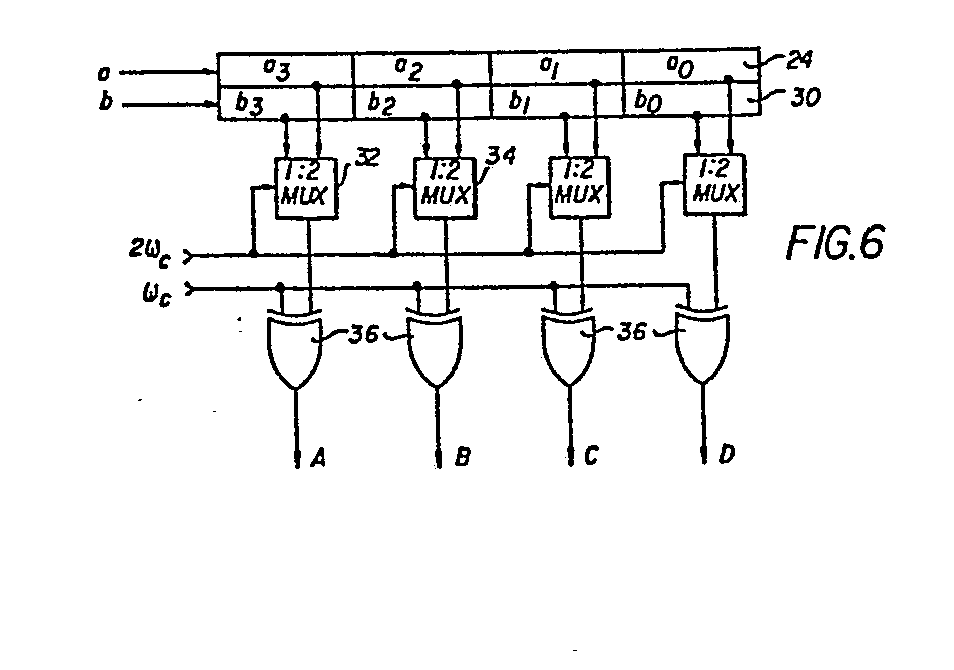
four possible phase states of a carrier signal are sampled and respectively fed into
two shift registers comprising part of a finite impulse response lowpass filter. The
samples in each corresponding pair of stages in the shift registers are multiplexed
at twice the carrier frequency. Each multiplexer output is then added modulo-two to
a binary signal at the carrier frequency using exclusive-OR gates. The gate outputs
are weighted in a desired fashion and summed and converted to an analog signal which
exhibits a preferred spectral shape. This approach enables the quadrature amplitude
modulation function to be included within the structure of the finite impulse response
lowpass filter. The binary synchronous nature of the input data enables the structure
of the filter to be simplified and the number of multiplexers and modulo-two adders
to be reduced to a number equal to the number of bits stored from the input sequences.
An extension of this basic concept includes higher levels of encoding, specifically
the case of sixteen or more possible phase and amplitude states of a carrier signal.
The particular method for weighting and summing the multiplexed and modulated signals
may utilize digital logic combined with resistors, switched capacitors, or a stored
program combined with a digital-to-analog converter, and is suitable for integrated
circuit fabrication.
|
|
