|
(11) | EP 0 197 237 B1 |

| (12) | EUROPEAN PATENT SPECIFICATION |
|
|
| (54) |
Process for preparing aromatic polycarboxylic acids and their anhydrides from polycarboximides Verfahren zur Herstellung aromatischer Polycarbonsäuren und ihrer Anhydride aus Polycarboximiden Procédé pour la préparation d'acides polycarboxyliques aromatiques et de leurs anhydrides à partir de polycarboximides |
|
|
|||||||||||||||||||||||||||||||
| Note: Within nine months from the publication of the mention of the grant of the European patent, any person may give notice to the European Patent Office of opposition to the European patent granted. Notice of opposition shall be filed in a written reasoned statement. It shall not be deemed to have been filed until the opposition fee has been paid. (Art. 99(1) European Patent Convention). |
[0001] This invention relates to the preparation of aromatic polycarboxylic acids and their anhydrides from the corresponding polycarboximides. More particularly, it relates to the preparation of such anhydrides by an exchange reaction in the presence of an exchange catalyst, and reactive compositions used in such preparation.
[0002] Aromatic polycarboxylic acids and their anhydrides may be prepared by an exchange reaction between a corresponding aromatic N-substituted polycarboximide, wherein the N-substituent may be an alkyl or aryl radical, a mixture of phthalic acid or phthalic anhydride and water. This reaction is particularly useful for the preparation of aromatic ether bis(phthalic acids) or (phthalic anhydrides), especially 2,2-bis[4-(3,4-dicarboxyphenoxy)phenyl]propane dianhydride (hereinafter "bisphenol A dianhydride"), as disclosed in the following U.S. patents,
[0003] According to several of these patents, the reaction is conveniently conducted in the presence of an exchange catalyst, particularly a trialkylamine such as trimethylamine, triethylamine, tripropylamine or tributylamine. Aromatic dianhydrides produced by this method are useful in the preparation of polyimides by reaction with diamines. In particular, bisphenol A dianhydride is used in the preparation of valuable polyetherimides.
[0004] It is well known that polymers such as polyetherimides are most desirably colorless or very light- colored. Thus, a disadvantage in the use of such tertiary amines as triethylamine in the exchange reaction is the formation of highly colored by-products which remain in the dianhydride during polyetherimide formation, thus discoloring the polymeric product. It has been found that many of these colored by-products are formed by degradation of triethylamine.
[0005] A principal object of the present invention, therefore, is to provide an improved method for the preparation of aromatic polycarboxylic acids and anhydrides.
[0006] A further method is to provide a method for the preparation of such compounds by a tertiary amine catalyzed exchange reaction between a corresponding polycarboximide and phthalic acid or phthalic anhydride, and reactive compositions suitable for use in said method.
[0007] A still further object is to prepare such compounds by a catalytic method in which the catalyst does not contribute materially to discoloration of polymeric products prepared from the anhydrides.
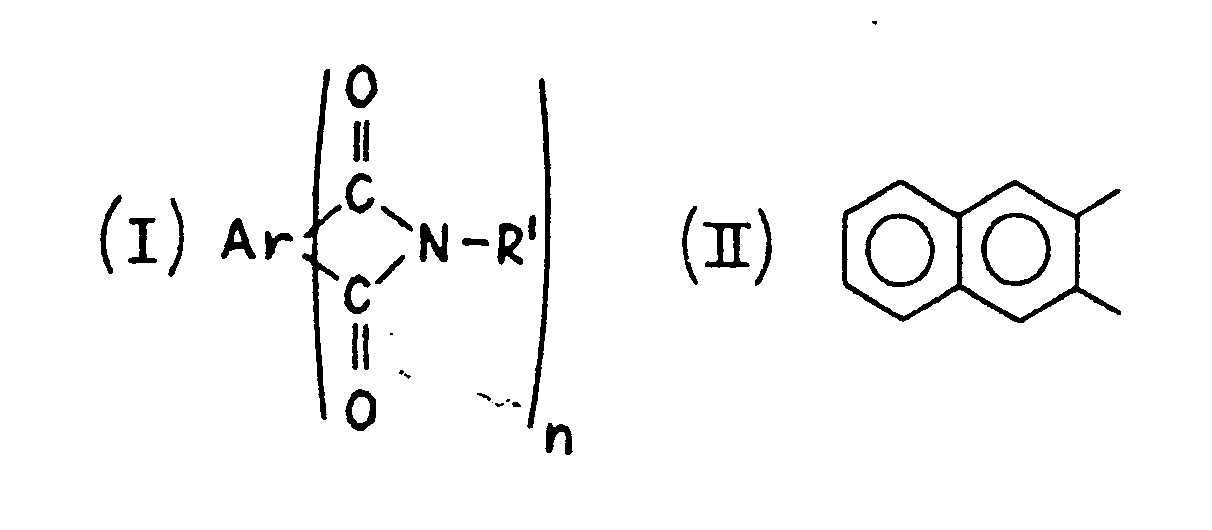
[0008] In its broadest sense, the present invention is an improvement in a method for preparing an aromatic polycarboxylic acid or anhydride thereof by an exchange reaction, in the presence of an exchange catalyst, between phthalic acid or phthalic anhydride, water and least one aromatic polycarboxyimide having formula I in the drawings, wherein Ar is an aromatic radical, R' is a Cl-S alkyl radical or a C6-20 aromatic hydrocarbon or halogenated aromatic hydrocarbon radical, n is 1 or 2 and the carbonyl groups in a single imide radical are attached to Ar at ortho positions. Said improvement comprises using dimethyl-n-butylamine as the exchange catalyst.
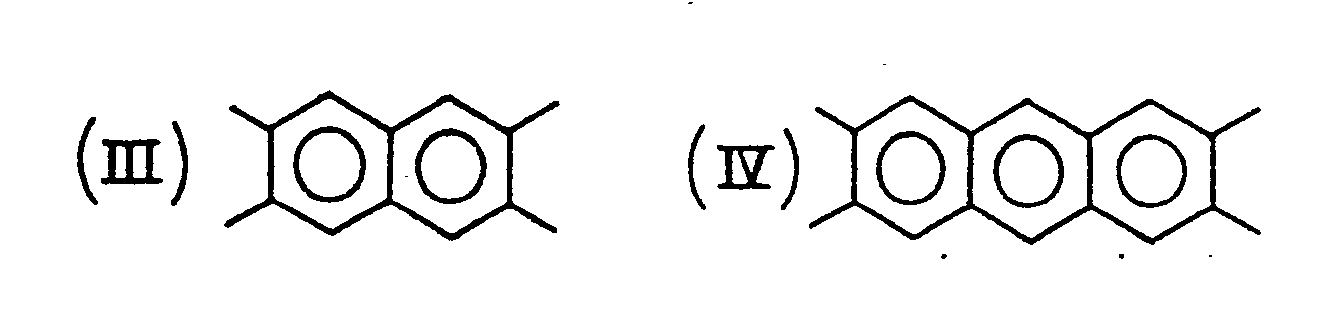
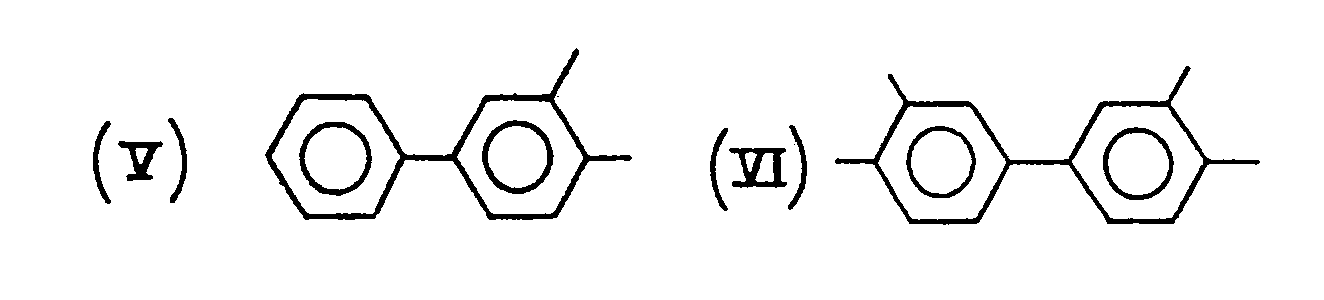
[0009] The method of this invention is applicable to the preparation of various aromatic polycarboxylic acids and their anhydrides, especially dicarboxylic acid monoanhydrides and tetracarboxylic acid dianhydrides, from the corresponding polycarboximides. (As used herein, the term "polycarboximide" designates an imide of a polycarboxylic acid; it may contain one or more than one imide group). In general, the Ar value may be any aromatic radical containing one or two sets of free ortho-positions to accommodate one or two imide groups, with the sole exception of phthalimides (since phthalic acid or phthalic anhydride is another of the reactants). Figures II-VI are examples of suitable Ar radicals.
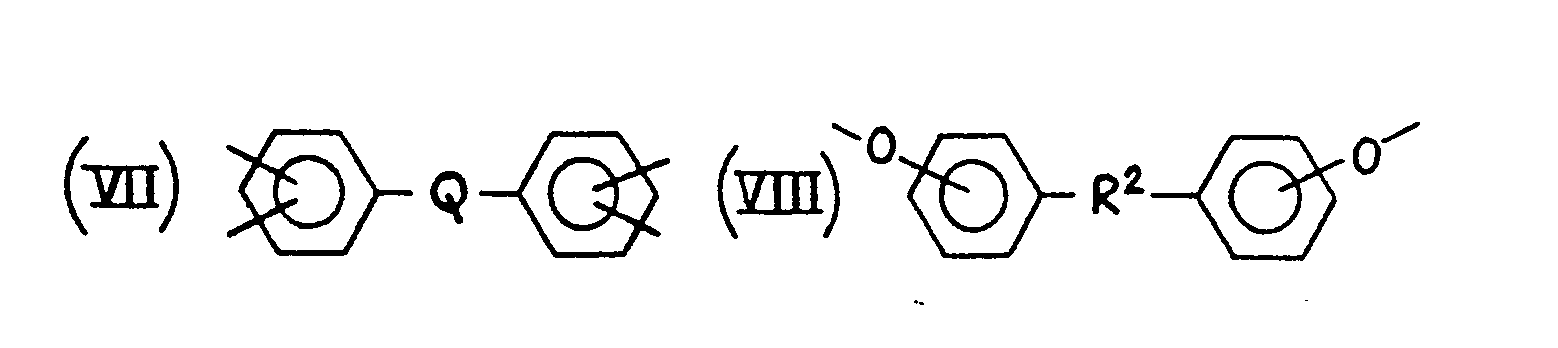
[0010] The preferred Ar radicals are represented by formula VII, wherein Q is a bridging radical and the free valence bonds in each aromatic ring are in the 2,3- or 3,4-positions or both with respect to Q. (They are usually both in the 3,4-positions). The Q value therein may be selected from a wide variety of bridging radicals including oxygen atoms, sulfur atoms and divalent groups such as methylene, ethylene, propylidene, carbonyl, sulfone and the like. More preferably, Q has formula VIII, wherein R2 is a C'-4 alkylene radical and especially the isopropylidene radical. The oxygen atoms are most often both in the 4- positions (i.e., the para-positions) with respect to R2.
[0011] The R' value may be, for example, methyl, ethyl, n-hexyl, phenyl, 1-naphthyl, 2-naphthyl, p-chlorophenyl or m-tolyl. It is usually methyl or phenyl and preferably methyl.
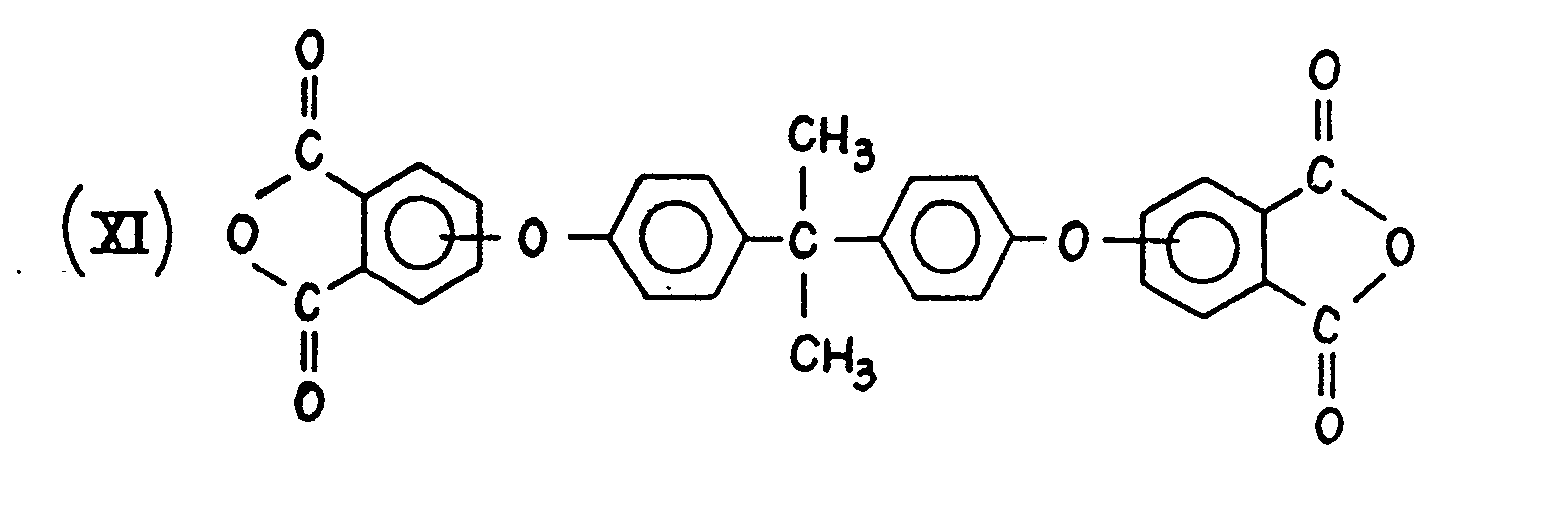
[0012] As will be apparent from the above-expressed preferences, the present invention is particularly useful for the preparation of the aromatic ether dianhydrides represented by formula IX. These include especially the aforementioned bisphenol A dianhydride and its symmetrical position isomer, 2,2-dimethyl-[4-(2,3-di- carboxyphenoxy)phenyl]propane dianhydride.
[0013] The details of the exchange reaction, other than the identity of the catalyst, are adequately disclosed in the aforementioned U.S. patents and need not be repeated in detail here. They generally involve the reaction of a bisimide containing an alkyl or aryl N-substituent, preferably a C'-4 alkyl substituent and most preferably methyl, with an aqueous solution of phthalic and or phthalic anhydride. The bisimide is most often 2,2-bis[4-(3,4-dicarboxyphenoxy)phenyl]propane bis-N-methylimide (hereinafter "bisphenol A bisimide") and the resulting product bisphenol A dianhyride. Therefore, frequent reference will be made to these compounds hereinafter. It should be understood, howwever, that other imides may be substituted for bisphenol A bisimide when appropriate.
[0014] The bisimide may be dissolved in a substantially inert organic solvent, although solvent-free methods are also within the scope of the invention. Suitable solvents are water-immiscible liquids which are good solvents for the imides, whether reactants or products. Illustrative solvents are aromatic liquids such as benzene, toluene, xylene, chlorobenzene and o-dichlorobenzene, with toluene being preferred. The reaction is frequently conducted under pressure, typically about 1.379―4.826 HPa (200-700 psi), and at a temperature within the range of about 150-300°C.
[0015] The equilibrium may be shifted to the right by removal of the N-methylphthalimide by-product. This may be accompanied by such means as solvent extraction or venting the pressurized reaction vessel several times to the atmosphere, whereupon an aqueous phase rich in N-methylphthalimide and containing relatively insignificant amounts of phthalic acid is removed.
[0016] The ratio of equivalents of phthalic acid or anhydride to bisphenol is generally within the range of about 0.5―40:1 and preferably about 1-10:1, and the corresponding ratio of water to bisphenol A bisimide is usualy about 0.1-1500:1 and preferably about 50-200:1. For the purposes of this invention, the equivalent weight of water is equal to its molecular weight and the equivalent weight of an anhydride or bisimide is its molecular weight divided by the number of intramolecular anhydride or bisimide groups therein.
[0017] The present invention is based on the discovery that the use of dimethyl-n-butylamine as the exchange catalyst results in the formation of a product which has a much lighter color than those obtained by the use of other amines such as triethylamine. This lighter color carries over into polyimide prepared from the dianhydride. The substitution of dimethyl-n-butylamine for triethylamine, a commonly used exchange catalyst, requires substantially no design changes in the equipment or process, since the two have the same molecular weight and differ in boiling point by only 2°C. The invention also includes reactive compositions comprising phthalic acid or phthalic anhydride, water, at least one aromatic polycarboximide as described hereinabove, and dimethyl-n-butylamine.
[0018] According to the invention, dimethyl-n-butylamine is incorporated in the reaction mixture in an amount to provide about 1-15 and preferably about 3-8 equivalents per equivalent of bisphenol A bisimide. (The equivalent weight of dimethyl-n-butylamine is equal to its molecular weight).
[0019] The method of this invention is illustrated by an example in which 59.3 parts by weight (0.216 equivalent) of bisphenol A bisimide, 107.17 parts (0.645 equivalent) of phthalic acid, 246.18 parts (13.49 equivalents) of water and 85.76 parts (0.85 equivalent) of dimethyl-n-butylamine were combined in an autoclave, which is purged with nitrogen by three successive instances of sealing, pressurizing to 2.068 MPa (300 psi) and venting. The sealed autoclave was then heated at 170°C for 3 hours, cooled and opened. Toluene, 433 parts, was added and the mixture was stirred for hour to extract the imide constituents. One hundred parts of the aqueous phase was stripped at 100-250°C (25 torr) 3325 Pa.
[0020] Color values for the samples were determined by dissolving 500 mg of the product in 10 ml of methylene chloride and obtaining the ultraviolet-visible spectrum of the resulting solution. The sum of the absorbance values at 420, 460 and 500 nm was multiplied by 100 to give a color number which was comparable for various samples.
[0021] When this procedure was used to prepare bisphenol A dianhydride from a bisphenol A bisimide sample having a color number of 6.3, duplicate reaction runs yielded samples of bisphenol A dianhydride having color numbers of 28.3 and 27.7. Two control runs, using triethylamine in the same amount as the exchange catalyst, yielded bisphenol A dianhydride products having color numbers of 40.0 and 39.9.
1. A method for preparing an aromatic polycarboxylic acid or anhydride thereof by
an exchange reaction, in the presence of an exchange catalyst, between phthalic aid
or phthalic anhydride, water and at least one aromatic polycarboximide having the
formula
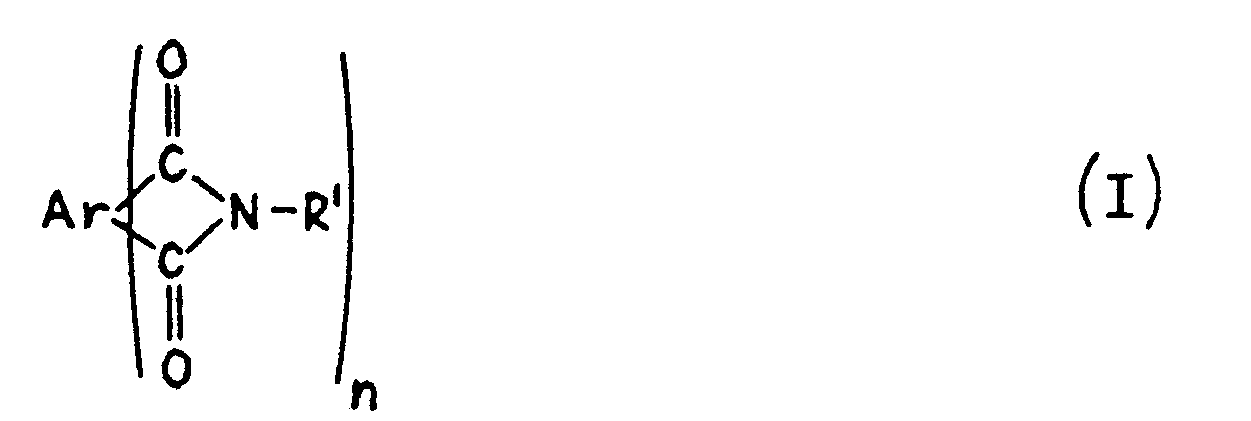
wherein Ar is an aromatic radical, R' is a Cl-, alkyl radical or a C6-20 aromatic hydrocarbon or halogenated aromatic hydrocarbon radical, n is 1 or 2 and the carbonyl groups in a single imide radical are attached to Ar at ortho positions, characterized in that it comprises using dimethyl-n-butylamine as the exchange catalyst.
wherein Ar is an aromatic radical, R' is a Cl-, alkyl radical or a C6-20 aromatic hydrocarbon or halogenated aromatic hydrocarbon radical, n is 1 or 2 and the carbonyl groups in a single imide radical are attached to Ar at ortho positions, characterized in that it comprises using dimethyl-n-butylamine as the exchange catalyst.
2. A method according to claim 1 wherein the polycarboximide is a bisimide in which
n is 2.
3. A method according to claim 2 wherein Ar has formula VII,

wherein Q is a bridging radical.
wherein Q is a bridging radical.
4. A method according to claim 3 wherein Q has formula VIII,

wherein R2 is a C1_4 alkylene radical.
wherein R2 is a C1_4 alkylene radical.
5. A method according to claim 4 wherein R' is methyl or phenyl.
6. A method according to claim 5 wherein about 1-15 equivalents of dimethyl-n-butylamine
are used per equivalent of bisimide.
7. A method according to claim 6 wherein R2 is isopropylidene.
8. A method according to claim 7 wherein the ratio of equivalents of phthalic acid
or anhydride and water to bisimide are within the range of about 0.5―40:1 and about
0.1-1500:1, respectively.
9. A method for preparing bisphenol A dianhydride by an exchange reaction, in the
presence of an exchange catalyst, between phthalic anhydride, water and bisphenol
A bisimide, the ratio of equivalents of phthalic anhydride and water to bisphenol
A bisimide being within the range of about 1-10:1 and about 50-200:1, respectively,
and said reaction being conducted at a temperature within the range of about 150-300°C
and at a pressure of about 1.379―4.826 MPa (200-700 psi), characterized in that it
comprises using dimethyl-n-butylamine as the exchange catalyst, said dimethyl-n-butylamine
being present in the amount of about 3-8 equivalents per equivalent of bisimide.
1. Verfahren zur Herstellung einer aromatischen Polycarbonsäure oder eines Anhyrids
derselben durch Austauschreaktion in Anwesenheit eines Austauschkatalysators zwischen
Phthalsäure oder Phthalsäureanhydrid, Wasser und wenigstens einem aromatischen Polycarbonsäureimid
mit der Formel
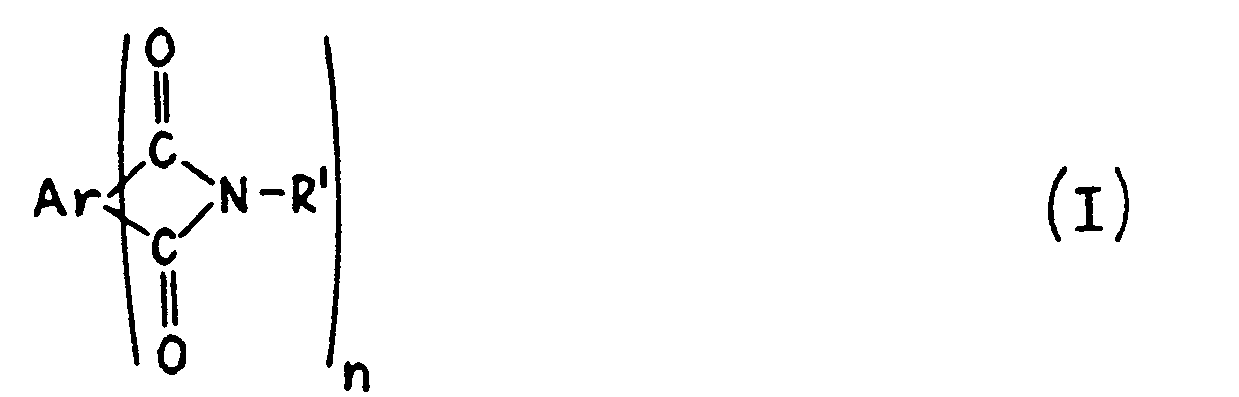
worin Ar ein aromatischer Rest, R' ein C1_8 Alkylrest oder ein C6-20 aromatischer Kohlenwasserstoff oder halogenierter aromatischer Kohlenwasserstoffrest ist, n gleich 1 oder 2 ist und die Carbonylgruppen in einem einzigen Imidrest in Orthostellung am Arylrest gebunden sind, dadurch gekennzeichnet, daß es die Verwendung von Dimethyl-n-butylamin als Austauschkatalysator umfaßt. 2. Verfahren nach Anspruch 1, worin das Polycarboximid ein Bisimid ist, in welchem n gleich 2 ist.
worin Ar ein aromatischer Rest, R' ein C1_8 Alkylrest oder ein C6-20 aromatischer Kohlenwasserstoff oder halogenierter aromatischer Kohlenwasserstoffrest ist, n gleich 1 oder 2 ist und die Carbonylgruppen in einem einzigen Imidrest in Orthostellung am Arylrest gebunden sind, dadurch gekennzeichnet, daß es die Verwendung von Dimethyl-n-butylamin als Austauschkatalysator umfaßt. 2. Verfahren nach Anspruch 1, worin das Polycarboximid ein Bisimid ist, in welchem n gleich 2 ist.
3. Verfahren nach Anspruch 2, worin Ar die Formel VII aufweist

worin Q ein Brückenrest ist.
worin Q ein Brückenrest ist.
4. Verfahren nach Anspruch 3, worin Q die Formel VIII aufweist,

worin R2 ein Cl-4-Alkylenrest ist.
worin R2 ein Cl-4-Alkylenrest ist.
5. Verfahren nach Anspruch 4, worin R' Methyl oder Phenyl ist.
6. Verfahren nach Anspruch 5, worin etwa 1 bis 15 Äquivalente des Dimethyl-n-butylamins
pro Äquivalent des Bisimids verwendet werden.
7. Verfahren nach Anspruch 6, worin R2 Isopropyliden ist.
8. Verfahren nach Anspruch 7, worin das Verhältnis der Äquivalente der Phthalsäure
oder des Anhydrids und des Wassers zum Bisimid im Bereich von jeweils etwa 0,5 bis
40:1 bzw. etwa 0,1, bis 1500:1 liegen.
9. Verfahren zur Herstellung von Bisphenol-A-Dianhydrid durch eine Austauschreaktion
in Anwesenheit eines Austauschkatalysators zwischen Phthalsäureanhydrid, Wasser und
Bisphenol-A-Bisimid, wobei das Verhältnis der Äquivalente von Phtahlsäureanhydrid
und Wasser zum Bisphenol-A-Bisimid im Bereich von jeweils etwa 1 bis 10:1 bzw. etwa
50 bis 200:1 liegt und die Reaktion bei einer Temperatur im Bereich von etwa 150 bis
300°C und bei einem Druck von etwa 1.378-4.826 MPa (200 bis 700 psi) durchgeführt
wird, dadurch gekennzeichnet, daß es die Verwendung von Dimethyl-n-Butylamin als Austauschkatalysator
umfaßt, wobei das Dimethyl-n-Butylamin in einer Menge von etwa 3 bis 8 Äquivalente
pro Äquivalent des Bisimids vorhanden ist.
1. Procédé de préparation d'un acide polycarboxylique aromatique ou de son anhydride
par une réaction d'échange, en présence d'un catalyseur d'échange, entre de l'acide
phtalique ou de l'anhydride phtalique, de l'eau et au moins un polycarboximide aromatique
ayant pour formule
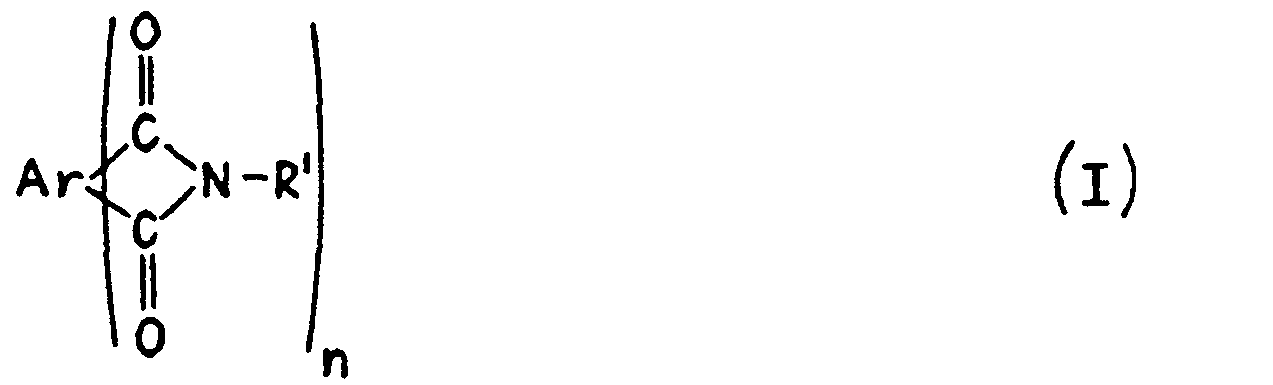
dans laquelle Ar représente un radical aromatique, R' représente un radical alkyle en C1_8 ou un radical hydrocarboné aromatique halogéné ou un radical hydrocarboné aromatique en C6_20, n est égal à 1 ou à 2 et les groupes carbonyles à l'intérieur d'un même radical imide sont attachés à Ar en postion ortho, caractérisé en ce qu'il comprend l'utilisation de diméthyl-n-butylamine comme catalyseur d'échange.
dans laquelle Ar représente un radical aromatique, R' représente un radical alkyle en C1_8 ou un radical hydrocarboné aromatique halogéné ou un radical hydrocarboné aromatique en C6_20, n est égal à 1 ou à 2 et les groupes carbonyles à l'intérieur d'un même radical imide sont attachés à Ar en postion ortho, caractérisé en ce qu'il comprend l'utilisation de diméthyl-n-butylamine comme catalyseur d'échange.
2. Procédé selon la revendication 1, dans, lequel le polycarboximide est un bisimide
dans lequel n est égal à 2.
3. Procédé selon la revendication 2 dans lequel Ar répond à la formule VII,

dans laquelle Q représente un radical formant un pont.
dans laquelle Q représente un radical formant un pont.
4. Procédé selon la revendication 3, dans lequel Q répond à la formule VIII,

dans laquelle R2 représente un radical alkylène en Cl-4.
dans laquelle R2 représente un radical alkylène en Cl-4.
5. Procédé selon la revendication 4, dans lequel R' représente un groupe méthyle ou
phényle.
6. Procédé selon la revendication 5, dans lequel on utilise d'environ 1 à 15 équivalents
de diméthyl-n-butylamine par équivalent de bisimide.
7. Procédé selon la revendication 6, dans lequel R2 représente un groupe isopropylidéne.
8. Procédé selon la revendication 7, dans lequel les rapports d'équivalents d'acide
ou d'anhydride phtalique et d'eau aux équivalents de bisimide sont, respectivement,
d'environ 0,5-40:1 et d'environ 0,1-1500:1.
9. Procédé de préparation de dianhydride de bisphénol A par une réaction d'échange,
en présence d'un catalyseur d'échange, entre de l'anhydride phtalique, de l'eau et
du bisimide de bisphénol A, les rapports d'équivalents d'anhydride phtalique et d'eau
aux équivalents de bisimide de bisphénol A étant, respectivement, d'environ 1-10:1
et d'environ 50-200:1, en mettant en oeuvre la réaction à une température comprise
entre environ 150 et 300°C et sous une pression comprise entre environ 1,379 et 4,826
MPa (200 et 700 psi), caractérisé en ce qu'il comprend l'utilisation de diméthyl-n-butylamine
comme catalyseur d'échange, la diméthyl-n-butylamine étant présente en une quantité
d'environ 3 à 8 éaquivalents par équivalent de bisimide.