|
(11) | EP 0 197 484 B1 |

| (12) | EUROPEAN PATENT SPECIFICATION |
|
|
| (54) |
Method for producing optically active glycol derivatives Verfahren zur Herstellung von optisch aktiven Glykolderivaten Procédé de préparation de dérivés de glycol optiquement actifs |
|
|
|||||||||||||||||||||||||||||||
| Note: Within nine months from the publication of the mention of the grant of the European patent, any person may give notice to the European Patent Office of opposition to the European patent granted. Notice of opposition shall be filed in a written reasoned statement. It shall not be deemed to have been filed until the opposition fee has been paid. (Art. 99(1) European Patent Convention). |
BACKGROUND OF THE INVENTION
Field of the Invention
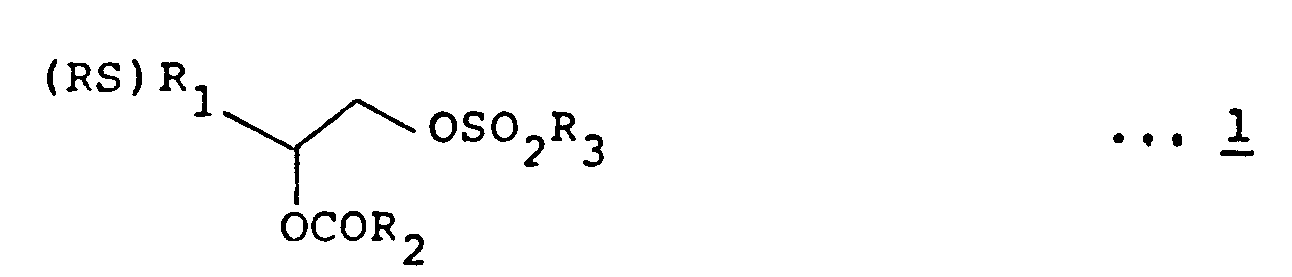
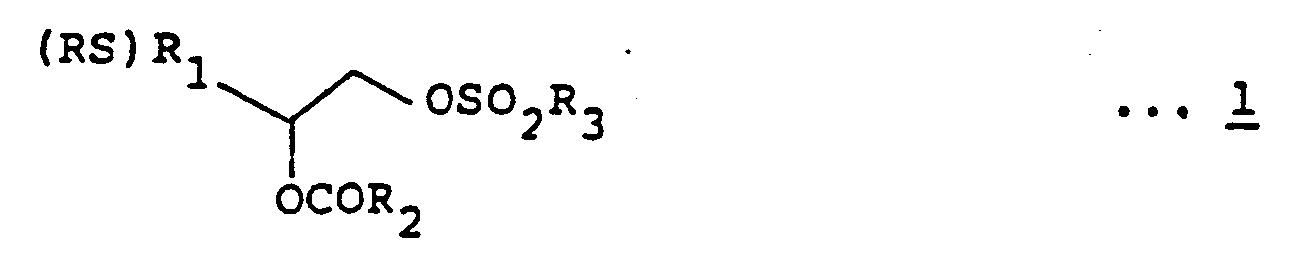
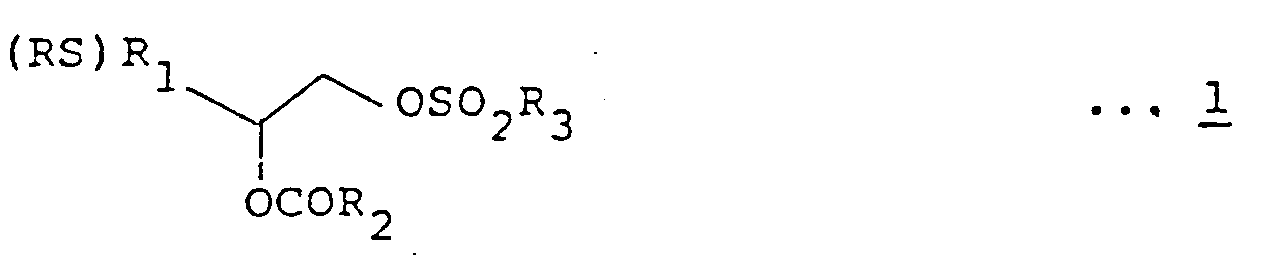
[0001] The present invention relates to a method for producing optically active glycol derivatives by biochemical resolution which comprises contacting a racemic ester of the general formula 1
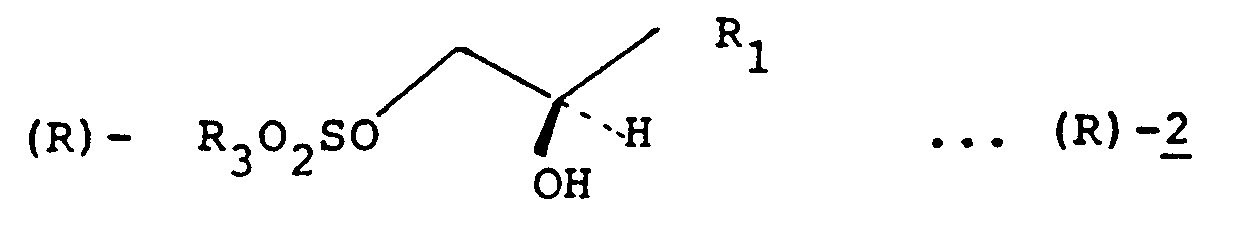
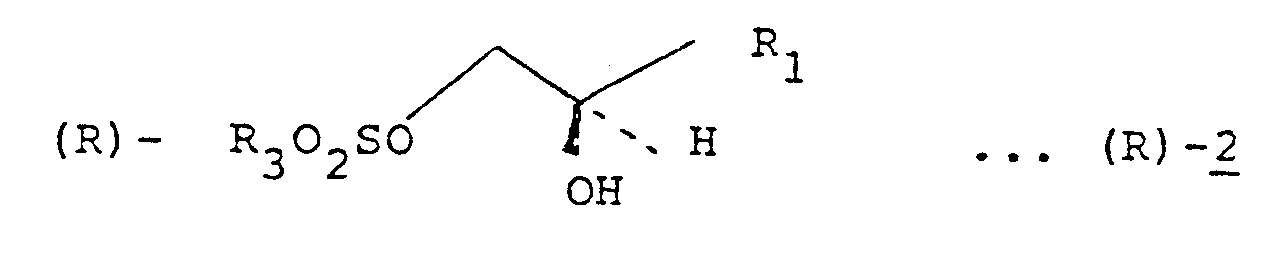
(wherein R₁ is an aliphatic hydrocarbon group of 1 to 16 carbon atoms, R₂ is an aliphatic hydrocarbon group of 1 to 8 carbon atoms, and R₃ is an aromatic hydrocarbon group) with a microorganism- or animal organ-derived enzyme having stereoselective esterase activity to asymmetrically hydrolyze said racemic ester of general formula 1 to produce an optically active alcohol of general formula 2*
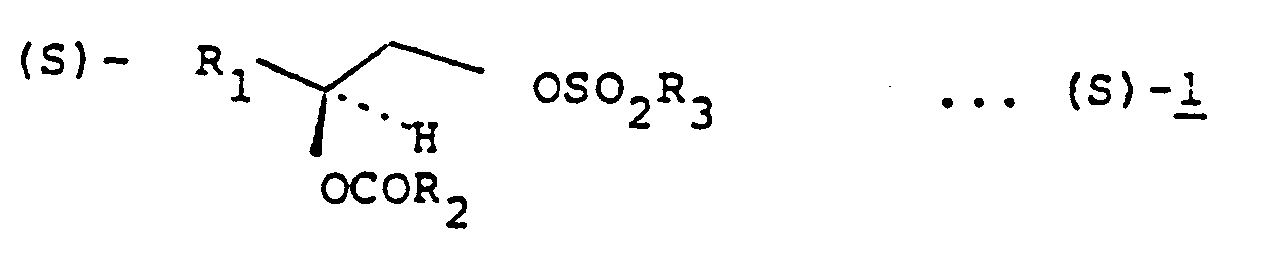
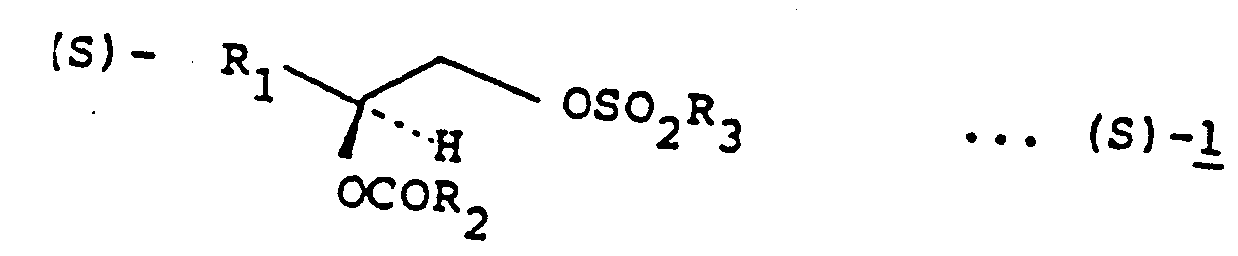
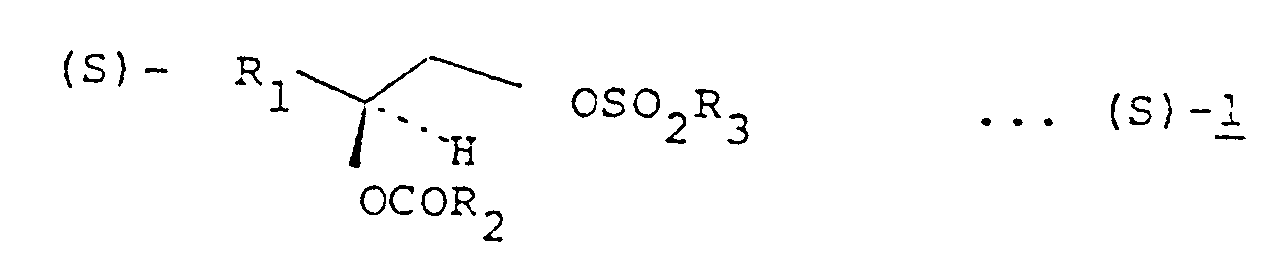
(wherein R₁ and R₃ have the same meanings as defined above) and an unreacted ester of the general formula 1*
(wherein R₁, R₂ and R₃ have the same meanings as defined hereinbefore) and, then, isolating the respective optically active compounds.
[0002] In another aspect, the present invention further comprises a method for producing an optically active glycol derivative which comprises hydrolyzing said ester of general formula 1* to give an optically active glycol derivative which is antipodal to the alcohol of general formula 2* and, then, isolating the same optically active glycol derivative.
Description of the Prior Art
[0003] The optically active glycol derivatives mentioned above are versatile starting materials for the production of various optically active pharmaceutical products, agricultural chemicals and so on.
[0004] Taking 1-p-tosyloxy-2-propanol
which corresponds to R₁ = methyl and R₃ = tolyl, as an example, it can be easily converted to propylene oxide
and this optically active propylene oxide can be further converted to various physiologically active substances [Uchimoto et al: Tetrahedron Letters, 3641 (1977), synthesis of (R)-recifeiolide from (R)-propylene oxide; and W. Seidel & D. Seebach: Tetrahedron Letters 23, 159 (1982), synthesis of grahamimycin A₁ from (R)-propylene oxide]
[0005] Further, in the case of 1-p-tosyloxy-2-tridecanol
which corresponds to R₁ = undecyl (C₁₁H₂₃) and R₃ = tolyl, it can be easily converted to 1,2-epoxytridecane
which, in turn, can be converted to δ-n-hexadecalactone
an insect pheromone [J. L. Coke & A. B. Richon: Journal of Organic Chemistry 22, 3516 (1976); and Fujisawa et al: Tetrahedron Letters 26, 771 (1985)].
[0006] These optically active glycol derivatives can be respectively synthesized, for example, by means of an optically active acid after conversion to an amine or by esterifying lactic acid or 3-hydroxybutyric acid from a fermentation process, reducing the ester with a reducing agent such as lithium aluminum hydride to give 1,2-propanediol or 1,2-butanediol and introducing a sulfonic acid group into the 1-position [B. Seuring: Helvetica Chimica Acta 60, 1175 (1977)].
[0007] However, these methods are disadvantageous in that complicated procedures are involved or costly reagents must be employed, and are not suitable for commercial scale production. Therefore, the establishment of an expedient method for production of such optically active compounds has been earnestly awaited.
SUMMARY OF THE INVENTION
[0008] It is an object of the present invention to provide a commercially advantageous method for producing optically active glycol derivatives which is expedient and does not require costly reagents.
[0009] Other objects and advantages of the present invention will become apparent as the following detailed description of the invention proceeds.
DETAILED DESCRIPTION OF THE INVENTION
[0010] The present invention in one aspect thereof relates to a method for producing an optically active glycol derivative by biochemical resolution which comprises contacting a racemic ester of the general formula 1
(wherein R₁ is an aliphatic hydrocarbon group of 1 to 16 carbon atoms, R₂ is an aliphatic hydrocarbon group of 1 to 8 carbon atoms, and R₃ is an aromatic hydrocarbon group) with a microorganism- or animal organ-derived enzyme having stereoselective esterase activity to asymmetrically hydrolyze said racemic ester of general formula 1 to produce an optically active alcohol of general formula 2*
(wherein R₁ and R₃ have the same meanings as defined above) and an unreacted ester of the general formula 1*
(wherein R₁, R₂ and R₃ have the same meanings as defined hereinbefore) and, then, isolating the respective optically active compounds.
[0011] In another aspect, the present invention is directed to a method for producing an optically active glycol derivative which comprises hydrolyzing the ester of general formula 1* obtained in the first-mentioned process to give an optically active glycol derivative which is antipodal to the compound of general formula 2* and, then, isolating the same compound.
[0012] The present inventors conducted an intensive research to obtain an optically active compound by esterifying the hydroxyl group in the 2-position of an alcohol of the general formula 2
and permitting an enzyme having stereoselective esterase activity to act on the resulting ester of general formula 1 for asymmetric hydrolysis of the ester bond. As a result, the inventors have found that certain enzymes derived from microorganisms belonging to the genera Pseudomonas, Chromobacterium, Aspergillus, Mucor, Rhizopus and so on and certain enzymes derived from animal organs such as the livers and pancreas of bovine, equine, swine, and other species of animals are respectively able to asymmetrically hydrolyze the above-mentioned ester 1 to give an unreacted ester (S)-1 having the general formula:
and an alcohol (R)-2 having the general formula:
[0013] Further, the optically active ester 1* can be easily hydrolyzed, if necessary, into the alcohol 2* by refluxing 1* in methanol.
[0014] The products 1* and 2* can be easily separated from each other by silica gel column chromatography, for instance, so that the respective optically active compounds can be independently recovered.
[0016] In the ester of the general formula 1:
which is used as the substrate in the present invention, the substituent groups R₁, R₂ and R₃ may for example be as follows. R₁ is an aliphatic hydrocarbon group containing 1 to 16 carbon atoms, such as methyl, ethyl, propyl, butyl, isopropyl, undecyl, etc., preferably, being an aliphatic hydrocarbon containing 1 to 4 carbon atoms and R₂ may for example an aliphatic hydrocarbon group, an unsubstitued or substituted alicyclic hydrocarbon group, or an unsubstituted or substituted phenyl or benzyl group, although an aliphatic hydrocarbon group of 1 to 8 carbon atoms is preferred from the standpoint of the enzymatically hydrolytic activity. Further, the aliphatic hydrocarbon group may be substituted by halogen and/or hydroxy groups. R₃ is an aromatic hydrocarbon group such as tolyl, phenyl, naphthyl and so on. These aromatic hydrocarbon groups may have halogen and/or hydroxy groups as substituents.
[0017] The starting material 1 can be synthesized, for example, by the following two routes of synthesis.
[0018] The enzyme may be any enzyme having stereoselective esterase activity to asymmetrically hydrolyze the racemic ester 1 to give (S)-1 and (R)-2. Thus, for example, there may be mentioned the enzymes derived from Pseudomonas aeruginosa, Chromobacterium viscosum, Aspergillus niger, Rhizopus delemar, Rhizopus japonicus and so on. The enzymes derived from animal organs can also be used and the organs may be the pancreas, liver, etc. of bovine, equine, swine and other species of animals. Examples of commercial preparations of such enzymes that can be utilized include Lipoprotein Lipase Amano 3, Lipase AP-6, Lipase M-AP-10, Lipase D, Lipase F-AP15 and pancreatic digesting enzyme TA (all available from Amano Pharmaceutical Co., Ltd.), Saiken 100 (manufactured by Nagase Sangyo Co., Ltd.), Lipase (Carbiochem Co.), Steapsin (Wako Pure Chemical Industries, Ltd.) and so on.
[0019] The asymmetric hydrolysis reaction is conducted in the following manner. The substrate racemic ester 1 is suspended in the reaction medium at a concentration of 2 to 80 w/v percent and, then, the enzyme is added in a suitable proportion, for example in an enzyme-to-substrate weight ratio of 1:1 through 1:1000. The reaction is carried out at a temperature of 10 to 40°C, preferably in the range of 25 to 35°C and its progress is monitored by high performance liquid chromatography (HPLC) to determine the residual amount of the substrate and the amount of product alcohol 2. The reaction is terminated when the molar ratio of 1* to 2* in the reaction system is 50:50. The pH range for this hydrolysis reaction is pH 4 to 8.5, preferably pH 6 to 7.5, but as the pH of the reaction system leans to the acidic side with the progress of reaction, this reaction is preferably carried out in a buffer solution or while the pH of the system is controlled at pH 6 to 7.5 by the addition of a neutralizing agent such as an aqueous solution of sodium hydroxide.
[0020] Depending on the types of substituents on the substrate ester, the reaction may not proceed smoothly. In such instances, the substrate may be dissolved in a suitable solvent such as dioxane, acetone, tetrahydrofuran or the like and, then, suspended in the reaction medium or if the melting point of the substrate is not so high, an elevated reaction temperature may be used for the enzymatic conversion.
[0021] Furthermore, by immobilizing the enzyme, the above asymmetric hydrolysis reaction may be conducted in repeated runs.
[0022] Following the hydrolysis reaction, the compound 1* and 2* in the reaction mixture can be separated from each other in the following manner. For example, both compounds 1* and 2* are extracted with a solvent such as methylene chloride, ethyl acetate, or the like and the extract is concentrated and subjected to silica gel chromatography. In this manner, 1* and 2* are easily separated from each other. The optically active ester 1* thus fractionated can be directly concentrated to give the ester with high optical purity. Hydrolysis of this ester in dilute hydrochloric acid at room temperature or refluxing thereof in methanol converts 1* into the alcohol 2* having the corresponding optical activity.
Examples
[0023] The following examples are intended to illustrate the present invention in further detail and should by no means be construed as limiting the scope of the invention.
Example 1 of Production of the Substrate
[0025] In 200 ml of methylene chloride were dissolved 38 g of 1,2-propanediol and 44 g of pyridine and, then, 95 g of p-toluenesulfonyl chloride was added gradually over a period of 15 minutes. The reaction was further conducted at room temperature for 72 hours. The reaction mixture was washed twice with one volume of water each, dehydrated over anhydrous sodium sulfate, and concentrated under reduced pressure. The concentrate was crystallized from toluene-hexane (100 ml-100 ml), filtered, and dried in vacuo to give colorless crystals of (RS)-1-p-toluenesulfonyloxy-2-propanol 2a
(54 g). Melting point: 49.5-50°C
[0026] The ¹H NMR (90 MHz) spectrum and elemental analysis of the above product were as follows.
¹H NMR (90 MHz, CDCl₃), δ (ppm): 1.16 (3H,d,CH₃(OH)-), 2.33 (1H, broad, OH), 2.35 (3H,s,CH₃-Ar), 3.70-4.18 (3H,m,-CH(OH)CH₂O-), 7.34, 7.80 (4H,2d,Ar-H)
| Elemental analysis: | ||
| Calcd. for C₁₀H₁₄O₄S: | C,52.16; | H,6.13 |
| Found: | C, 52.41; | H, 6.21 |
[0027] In 200 ml of methylene chloride were dissolved 11.5 g of compound 2a and 6 g of triethylamine. Under ice-cooling, 6 g of butyryl chloride was added dropwise to the above solution over a period of 15 minutes and the reaction was further conducted at room temperature for 3 hours.
[0028] After butanoylation was confirmed by HPLC, the reaction mixture war washed twice with one volume of a saturated aqueous solution of sodium carbonate and concentrated under reduced pressure. The above procedure gave a syrup of (RS)-2-butanoyloxy-1-p-toluenesulfonyloxypropane (1a₁) in a yield of 13 g.
[0029] The ¹H NMR (90 MHz) spectrum and elemental analysis of the above product were as follows.
¹H NMR (90 MHz, CDCl₃) δ (ppm):
0.82-1.08 (3H,t,CH₃-CH₂-), 1.16-1.83 (5H,m,CH₃CH(O-)-, CH₃CH₂CH₂-), 2.10-2.33 (2H,t,CH₃CH₂CH₂-), 2.45 (3H,s,CH₃-Ar), 4.05 (2H,d,-CH(O-)CH₂O-), 4.86-5.22 (1H,m,-CH(O-)-), 7.35, 7.77 (4H,2d,Ar-H).
| Elemental analysis: | ||
| Calcd. for C₁₄H₂₀O₅S: | C, 55.98; | H, 6.71 |
| Found: | C, 55.73; | H, 6.77 |
Example 2 of Production of the Substrate
[0031] Using 2a, triethylamine and acetyl chloride, the substrate compound 1a₂ was produced in accordance with Example 1 of Production.
[0032] Description: Colorless crystals
Melting point: 39.5-40.0°C
¹H NMR (90 MHz, CDCl₃) δ (ppm):
1.23 (3H,d,CH₃CH(O-)-), 1.95 (3H,s,CH₃CO-), 2.45 (3H,s,CH₃-Ar-), 4.03 (2H,d,-CH₂-), 4.82-5.17 (1H,m,-CH-), 7.33, 7.77 (4H,2d,Ar-H)
| Elemental analysis: | ||
| Calcd. for C₁₂H₁₆O₅S: | C, 52.93; | H, 5.92 |
| Found: | C, 53.08; | H, 5.99 |
Example 3 of Production of the Substrate
[0034] Using 1,2-butanediol, pyridine and p-toluenesulfonyl chloride, (RS)-1-p-toluenensulfonyloxy-2-butanol 2b
was prepared in the same manner as Example 1 of Production.
[0035] Description: Colorless crystals
Melting point: 59-60°C
¹H NMR (90 MHz, CDCl₃) δ (ppm):
0.79-1.05 (3H,t,CH₃CH₂-), 1.30-2.10 (2H,m,CH₃CH₂-), 2.15 (1H,d,OH), 2.45 (3H,s,CH₃-Ar), 3.60-4.12 (3H,m, -CH(OH)CH₂O-), 7.30, 7.76 (4H,2d,Ar-H)
| Elemental analysis: | ||
| Calcd. for C₁₁H₁₆O₄S: | C, 54.08; | H, 6.60 |
| Found: | C, 54.29; | H, 6.75 |
[0036] Using 2b, triethylamine and butyryl chloride, the substrate compound 1b was produced in accordance with Example 1 of Production.
[0037] Description: a syrup
¹H NMR (90 MHz, CDCl₃) δ (ppm):
0.73-1.07 (6H,m,CH₃CH₂CH(O-)-, CH₃CH₂CH₂CO-), 1.35-1.80 (4H,m,CH₃CH₂CH(O-)-, CH₃CH₂CH₂CO-), 2.08-2.33 (2H,m,CH₃CH₂CH₂CO-), 2.45 (3H,s,CH₃-Ar), 4.04 (2H,d,-CH(O-)CH₂O-), 4.76-5.03 (1H,m,-CH(O-)-), 7.30, 7.75 (4H,2d,Ar-H)
| Elemental analysis: | ||
| Calcd. for C₁₅H₂₂O₅S: | C, 57.30; | H, 7.05 |
| Found: | C, 56.95; | H, 6.89 |
Example 4 of Production of the Substrate
[0039] Using 1,2-heptanediol, pyridine and p-toluenesulfonyl chloride, (RS)-1-p-toluenensulfonyloxy-2-heptanol 2c
was prepared in the same manner as Example 1 of Production.
[0040] Description: a syrup
¹H NMR (90 MHz, CDCl₃) δ (ppm):
0.70-1.75(11H, m, C₅H₁₁-), 2.45(3H, s, CH₃-Ar-), 2.90(1H, s, OH), 3.67(2H, d, -CH₂O-), 4.30-4.70 (1H, m, -CH-), 7.30, 7.77(4H, d-d, Ar-H)
| Elemental analysis: | ||
| Calcd. for C₁₄H₂₂O₄S: | C, 58.72, | H, 7.74 |
| Found: | C, 58.70, | H, 7.71 |
[0041] Using 2c, triethylamine and butyryl chloride, the substrate compound 1c was produced in accordance with Example 1 of Production.
[0042] Description: a syrup
¹H NMR (90 MHz, CDCl₃) δ (ppm):
0.70-2.33(18H, m, C₅H₁₁, C₃H₇-), 2.42(3H, s, CH₃-Ar), 3.85(2H, m, -CH₂O-), 4.52-4.80(1H, m, -CH-), 7.26, 7.76(4H, d-d, Ar-H)
| Elemental analysis: | ||
| Calcd. for C₁₈H₂₈O₅S: | C, 60.65, | H, 7.92 |
| Found: | C, 60.71, | H, 7.94 |
Example 5 of Production of the Substrate
[0043] Production of (RS)-2-butanoyloxy-1-p-toluenesulfonyloxyhexadecane 1d
Using 1,2-hexadecanediol, pyridine and p-toluenesulfonyl chloride, (RS)-1-p-toluenensulfonyloxy-2-hexadecanol 2d
was prepared in the same manner as Example 1 of Production.
[0044] Description: a syrup
¹H NMR (90 MHz, CDCl₃) δ (ppm):
0.75-1.73(29H, m, C₁₄H₂₉-), 2.00(1H, s, OH), 2.45 (3H, s, CH₃-Ar), 3.67(2H, d, -CH₂O-), 4.40-4.70 (1H, m, -CH-), 7.26, 7.76(4H, d-d, Ar-H)
| Elemental analysis: | ||
| Calcd. for C₂₃H₄₀O₄S: | C, 66.95, | H, 9.77 |
| Found: | C, 66.99, | H, 9.82 |
[0045] Using 2d, triethylamine and butyryl chloride, the substrate compound 1d was prepared in accordance with Example 1 of Production.
[0046] Descriprion: a syrup
¹H NMR (90 MHz, CDCl₃) δ (ppm):
0.80-2.27(36H, m, C₁₄H₂₉-, C₃H₇-), 2.44(3H, s, CH₃-Ar), 3.90-4.27(1H, m, -CH₂O-), 4.56-4.79(2H, m, -CH-), 7.27, 7.73(4H, d-d, Ar-H)
| Elemental analysis: | ||
| Calcd. for C₂₇H₄₆O₅S; | C, 67.18, | H, 9.60 |
| Found: | C, 67.25, | H, 9.67 |
Examples 1 to 16
[0047] A 20 ml test tube equipped with a cap was charged with 100 mg of the substrate compound 1a₁ or 1b, 10 mg of the enzyme and 5 ml of 0.1 M phosphate buffer (pH 7.25) and shaken at 33°C for 48 hours. To the reaction mixture was then added 10 ml of ethyl acetate to extract the unreacted ester (1a₁ or 1b) and the hydrolysate (2a or 2b). The ethyl acetate layer was dehydrated, filtered, and subjected to high performance liquid chromatography using a chiral column to determine the yield and optical purity of the alcohol. The results are shown in Table 1.
Liquid chromatography
[0049]
- Column:
- Chiral CEL OC (Nippon Bunko)
- Developer solvent system:
- hexane-isopropyl alcohol = 95:5
- Flow rate:
- 2.5 ml/min
- Detection:
- UV, 235 nm
- Retention times:
- (RS) - 1a₁:
- 10.7 minutes
- (S) - 2a :
- 32.1 minutes
- (R) - 2a
- : 27.4 minutes
- (RS) - 1b :
- 8.4 minutes
- (S) - 2b :
- 19.8 minutes,
- (R) - 2b :
- 17.6 minutes
[0050] Incidentally, as to compounds 1a₁ and 1b, the R-form and the S-form have the same retention time and are, therefore, not separated from each other.
Example 17
[0051] The reaction was conducted using Lipoprotein lipase Amano 3 which possessed the highest hydrolytic activity among the lipases in Examples 1 to 16.
[0052] To 30 ml of 0.1 M phosphate buffer (pH 7.25) were added 3.0 g of the substrate 1a₁ and 0.03 g of Lipoprotein lipase Amano 3 and the asymmetric hydrolysis reaction was conducted at 33°C with stirring for 4 hours, while the reaction system was controlled at pH 7.25 using an 1 N aqueous solution of NaOH. The reaction mixture (30 ml) was extracted twice with 60 ml portions of methylene chloride and the methylene chloride layers were combined, dehydrated over anhydrous sodium sulfate and concentrated under reduced pressure. The concentrate was subjected to silica gel column chromatography (Wakogel C-200, L/D=40/1.5 cm, developer solvent: hexane-acetone = 12-6:1, v/v) and the fractions corresponding to the ester (S)-1a₁ and the alcohol (R)-2a were recovered and concentrated under reduced pressure. The above procedure gave 1.15 g of (S)-1a₁ (yield 77%) and 0.91 g of (R)-2a (yield 79%).
[0053] The above (R)-2a was further recrystallized from ether-hexane to obtain 0.70 g (theoretical yield based on (RS)-1a₁:61%)
[0054] The optical rotation values of the two compounds were as follows.
(S)-1a₁: [α]
-10.0° (c= 2.0, chloroform)
(R)-2a : [α]
-12.6° (c= 2.0, chloroform)
[0055] The literature value: B. Seuring et al (Helvetica Chimica Acta 60, 1175 (1977): (S)-2a: [α]D=+11.3° (c=1.1, chloroform).
[0056] Then, the ester (S)-1a₁ was refluxed in methanol for 3 hours, whereby it was converted into the alcohol (S)-2a. The reaction mixture was concentrated under reduced pressure to remove the methanol and the concentration residue was washed with a saturated aqueous solution of sodium hydrogen carbonate, extracted with methylene chloride, dehydrated and concentrated to give (S)-2a in a yield of about 75%. The optical rotation value of this product was as follows.
(S)-2a : [α]
+12.6° (c=2.0, chloroform)
Examples 18 and 19
[0057] Using 1a₂ or 1b, the asymmetric hydrolysis reaction was conducted and (S)-1a₂ and (R)-2a or (S)-1b and (R)-2b were respectively separated and isolated as in Example 17. The results are shown in Table 2.
Examples 20 and 21
1. A method for producing optically active glycol derivatives by biochemical resolution
which comprises contacting a racemic ester of the general formula 1
(wherein R₁ is an aliphatic hydrocarbon group of 1 to 16 carbon atoms, R₂ is an aliphatic hydrocarbon group of 1 to 8 carbon atoms, and R₃ is an aromatic hydrocarbon group) with a microorganism- or animal organ-derived enzyme having stereoselective esterase activity to asymmetrically hydrolyze said racemic ester of general formula 1 to produce an optically active alcohol of general formula 2*

(wherein R₁ and R₃ have the same meanings as defined above) and an unreacted ester of the general formula 1*

(wherein R₁, R₂ and R₃ have the same meanings as defined hereinbefore) and, then, isolating the respective optically active compounds.
(wherein R₁ is an aliphatic hydrocarbon group of 1 to 16 carbon atoms, R₂ is an aliphatic hydrocarbon group of 1 to 8 carbon atoms, and R₃ is an aromatic hydrocarbon group) with a microorganism- or animal organ-derived enzyme having stereoselective esterase activity to asymmetrically hydrolyze said racemic ester of general formula 1 to produce an optically active alcohol of general formula 2*
(wherein R₁ and R₃ have the same meanings as defined above) and an unreacted ester of the general formula 1*
(wherein R₁, R₂ and R₃ have the same meanings as defined hereinbefore) and, then, isolating the respective optically active compounds.
2. A method according to Claim 1, wherein the substituent group R₁ is an aliphatic hydrocarbon
group containing 1 to 4 carbon atoms.
3. A method according to Claim 1 or 2 wherein the hydrolysate alcohol 2* is represented by the general formula

(wherein R₁ and R₃ have the same meanings as defined) and the unreacted ester 1* is represented by the general formula

(wherein R₁, R₂ and R₃ have the same meanings as defined).
(wherein R₁ and R₃ have the same meanings as defined) and the unreacted ester 1* is represented by the general formula
(wherein R₁, R₂ and R₃ have the same meanings as defined).
4. A method according to Claim 1, 2 or 3, wherein the microorganism-derived enzyme is
an enzyme derived from a microorganism belonging to any of the genera Pseudomonas, Chromobacterium, Aspergillus, Mucor and Rhizopus.
5. A method according to Claim 1, 2 or 3, wherein the animal organ-derived enzyme is
an enzyme derived from bovine or swine liver or pancreas.
6. A method according to Claim 1, which further comprises hydrolyzing said ester of general
formula 1* to give an optically active glycol derivative which is antipodal to the alcohol
of general formula 2* and, then, isolating the same optically active glycol derivative.
7. A method according to Claim 6, wherein the substituent group R₁ is an aliphatic hydrocarbon
containing 1 to 4 carbon atoms.
8. A method according to Claim 6 or 7, wherein the hydrolysate alcohol 2* is represented by the general formula
(wherein R₁ and R₃ have the same meanings as defined) and the unreacted ester 1* is represented by the general formula

(wherein R₁, R₂ and R₃ have the same meanings as defined).
(wherein R₁ and R₃ have the same meanings as defined) and the unreacted ester 1* is represented by the general formula
(wherein R₁, R₂ and R₃ have the same meanings as defined).
9. A method according to Claim 6, 7 or 8,wherein the microorganism-derived enzyme is
an enzyme derived from a microorganism belonging to any of the genera Pseudomonas, Chromobacterium, Aspergillus, Mucor and Rhizopus.
10. A method according to Claim 6, 7 or 8,wherein the animal organ-derived enzyme is an
enzyme derived from bovine or swine liver or pancreas.
1. Procédé de préparation de dérivés de glycol optiquement actifs par résolution biochimique,
qui comprend la mise en contact d'un ester racémique de formule générale 1
(dans laquelle R₁ est un groupe hydrocarboné aliphatique avec 1 à 16 atomes de carbone, R₂ est un groupe hydrocarboné aliphatique avec 1 à 8 atomes de carbone et R₃ est un groupe hydrocarboné aromatique) avec une enzyme provenant d'un micro-organisme ou d'un organe d'animal ayant une activité d'estérase stéréosélective pour hydrolyser asymétriquement ledit ester racémique de formule générale 1 pour produire un alcool optiquement actif de formule générale 2*

(dans laquelle R₁ et R₃ ont les mêmes significations que données ci-dessus) et un ester n'ayant pas réagi de formule générale 1*

(dans laquelle R₁, R₂ et R₃ ont les mêmes significations que données précédemment),et ensuite l'isolement des composés optiquement actifs respectifs.
(dans laquelle R₁ est un groupe hydrocarboné aliphatique avec 1 à 16 atomes de carbone, R₂ est un groupe hydrocarboné aliphatique avec 1 à 8 atomes de carbone et R₃ est un groupe hydrocarboné aromatique) avec une enzyme provenant d'un micro-organisme ou d'un organe d'animal ayant une activité d'estérase stéréosélective pour hydrolyser asymétriquement ledit ester racémique de formule générale 1 pour produire un alcool optiquement actif de formule générale 2*
(dans laquelle R₁ et R₃ ont les mêmes significations que données ci-dessus) et un ester n'ayant pas réagi de formule générale 1*
(dans laquelle R₁, R₂ et R₃ ont les mêmes significations que données précédemment),et ensuite l'isolement des composés optiquement actifs respectifs.
2. Procédé selon la revendication 1, dans lequel le groupe substituant R₁ est un groupe
hydrocarboné aliphatique contenant 1 à 4 atomes de carbone.
3. Procédé selon la revendication 1 ou 2, dans lequel l'alcool 2*, produit de l'hydrolyse, est représenté par la formule générale

(dans laquelle R₁ et R₃ ont les mêmes significations que définies) et l'ester n'ayant pas réagi 1* est représenté par la formule générale
(dans laquelle R₁, R₂ et R₃ ont les mêmes significations que définies).
(dans laquelle R₁ et R₃ ont les mêmes significations que définies) et l'ester n'ayant pas réagi 1* est représenté par la formule générale
(dans laquelle R₁, R₂ et R₃ ont les mêmes significations que définies).
4. Procédé selon l'une quelconque des revendications 1, 2 ou 3, dans lequel l'enzyme
provenant d'un micro-organisme est une enzyme provenant d'un micro-organisme appartenant
à l'un quelconque des genres Pseudomonas, Chromobacterium, Aspergillus, Mucor et Rhizopus.
5. Procédé selon l'une quelconque des revendications 1, 2, ou 3, dans lequel l'enzyme
provenant d'un organe d'animal est une enzyme provenant du foie ou du pancréas de
bovin ou de porc.
6. Procédé selon la revendication 1, qui comprend en outre l'hydrolyse dudit ester de
formule générale 1* pour donner un dérivé de glycol optiquement actif qui est énantiomorphe à l'alcool
de formule générale 2* et ensuite l'isolement du même dérivé de glycol optiquement actif.
7. Procédé selon la revendication 6, dans lequel le groupe substituant R₁ est un groupe
hydrocarboné aliphatique contenant 1 à 4 atomes de carbone.
8. Procédé selon la revendication 6 ou 7, dans lequel l'alcool 2*, produit de l'hydrolyse, est représenté par la formule générale

(dans laquelle R₁ et R₃ ont les mêmes significations que définies) et l'ester n'ayant pas réagi 1* est représenté par la formule générale
(dans laquelle R₁, R₂ et R₃ ont les mêmes significations que définies).
(dans laquelle R₁ et R₃ ont les mêmes significations que définies) et l'ester n'ayant pas réagi 1* est représenté par la formule générale
(dans laquelle R₁, R₂ et R₃ ont les mêmes significations que définies).
9. Procédé selon l'une quelconque des revendications 6, 7 ou 8, dans lequel l'enzyme
provenant d'un micro-organisme est une enzyme provenant d'un micro-organisme appartenant
à l'un quelconque des genres Pseudomonas, Chromobacterium, Aspergillus, Micor et Rhizopus.
10. Procédé selon l'une quelconque des revendications 6, 7 ou 8, dans lequel l'enzyme
provenant d'un organe d'animal est une enzyme provenant du foie ou du pancréas de
bovin ou de porc.
1. Verfahren zur Herstellung optisch aktiver Glykol-Derivate durch biochemische Auflösung,
welches das Inkontaktbringen eines racemischen Esters der allgemeinen Formel 1
(worin R₁ eine aliphatische Kohlenwasserstoffgruppe mit 1 bis 16 Kohlenstoffatomen ist, R₂ eine aliphatische Kohlenwasserstoffgruppe mit 1 bis 8 Kohlenstoffatomen ist und R₃ eine aromatische Kohlenwasserstoffgruppe ist) mit von einem Mikroorganismus oder tierischem Organ erhaltenen Enzym umfaßt, welches stereoselektive Esteraseaktivität besitzt den racemischen Ester der allgemeinen Formel 1 asymmetrisch zu hydrolysieren, und einen optisch aktiven Alkohol der allgemeinen Formel 2*

(worin R₁ und R₃ die gleiche Bedeutung wie oben haben) und einen nicht abreagierten Ester der allgemeinen Formel 1*

zu bilden (worin R₁, R₂ und R₃ dieselbe Bedeutung haben, wie vorher definiert wurde) und dann das Isolieren der jeweiligen optisch aktiven Verbindungen.
(worin R₁ eine aliphatische Kohlenwasserstoffgruppe mit 1 bis 16 Kohlenstoffatomen ist, R₂ eine aliphatische Kohlenwasserstoffgruppe mit 1 bis 8 Kohlenstoffatomen ist und R₃ eine aromatische Kohlenwasserstoffgruppe ist) mit von einem Mikroorganismus oder tierischem Organ erhaltenen Enzym umfaßt, welches stereoselektive Esteraseaktivität besitzt den racemischen Ester der allgemeinen Formel 1 asymmetrisch zu hydrolysieren, und einen optisch aktiven Alkohol der allgemeinen Formel 2*
(worin R₁ und R₃ die gleiche Bedeutung wie oben haben) und einen nicht abreagierten Ester der allgemeinen Formel 1*
zu bilden (worin R₁, R₂ und R₃ dieselbe Bedeutung haben, wie vorher definiert wurde) und dann das Isolieren der jeweiligen optisch aktiven Verbindungen.
2. Verfahren nach Anspruch 1, worin die Substituentengruppe R₁ eine aliphatische Kohlenwasserstoffgruppe
ist, die 1 bis 4 Kohlenstoffatome enthält.
3. Verfahren nach Anspruch 1 oder 2, worin der Hydrolysat-Alkohol 2* durch die allgemeine Formel:
dargestellt wird
(worin R₁ und R₃ die gleiche Bedeutung haben wie definiert wurde) und der nicht abreagierte Ester 1* durch die allgemeine Formel:
dargestellt wird
(worin R₁, R₂ und R₃ die gleiche Bedeutung haben wie definiert wurde).
dargestellt wird
(worin R₁ und R₃ die gleiche Bedeutung haben wie definiert wurde) und der nicht abreagierte Ester 1* durch die allgemeine Formel:
dargestellt wird
(worin R₁, R₂ und R₃ die gleiche Bedeutung haben wie definiert wurde).
4. Verfahren nach Anspruch 1, 2 oder 3, worin das von einem Mikroorganismus erhaltene
Enzym ein Enzym ist, das von einem Mikroorganismus erhalten wird, welcher zu einem
der Genera Pseudomonas, Chromobacterium, Aspergillus, Mucor und Rhizopus gehört.
5. Verfahren nach Anspruch 1, 2 oder 3, worin das von einem Tierorgan erhaltene Enzym
ein Enzym ist, das erhalten wurde von Leber oder Bauchspeicheldrüse von Rind oder
Schwein.
6. Verfahren nach Anspruch 1, welches weiterhin das Hydrolysieren des genannten Esters
der allgemeinen Formel 1* umfaßt, um ein optisch aktives Glykol-Derivat zu erhalten, welches antipodal zum
Alkohol der allgemeinen Formel 2* ist, und dann Isolieren desselben optisch aktiven Glykol-Derivates.
7. Verfahren nach Anspruch 6, worin die Substituentengruppe R₁ eine aliphatische Kohlenwasserstoffgruppe
ist, die 1 bis 4 Kohlenstoffatome enthält.
8. Verfahren nach Anspruch 6 oder 7, worin der Hydrolysat-Alkohol 2* durch die allgemeine Formel:

dargestellt wird
(worin R₁ und R₃ die gleiche Bedeutung haben, wie definiert wurde) und der nicht abreagierte Ester 1* durch die allgemeine Formel:

dargestellt wird
(worin R₁, R₂ und R₃ die gleiche Bedeutung haben, wie definiert wurde).
dargestellt wird
(worin R₁ und R₃ die gleiche Bedeutung haben, wie definiert wurde) und der nicht abreagierte Ester 1* durch die allgemeine Formel:
dargestellt wird
(worin R₁, R₂ und R₃ die gleiche Bedeutung haben, wie definiert wurde).
9. Verfahren nach Anspruch 6, 7 oder 8, worin das von Mikroorganismen erhaltene Enzym
ein Enzym ist, das von einem Mikroorganismus erhalten wird, welcher zu einem der Genera
Pseudomonas, Chromobacterium, Aspergillus, Mucor und Rhizopus gehört.
10. Verfahren nach Anspruch 6, 7 oder 8, worin das von einem Tierorgan erhaltene Enzym
das Enzym ist, das von Leber oder Bauchspeicheldrüse von Rind oder Schwein erhalten
wurde.