|
(11) | EP 0 201 260 B1 |

| (12) | EUROPEAN PATENT SPECIFICATION |
|
|
| (54) |
GnRH antagonists GnRH-Antagonisten Antagonistes du GnRH |
|
|
|||||||||||||||||||||||||||||||
| Note: Within nine months from the publication of the mention of the grant of the European patent, any person may give notice to the European Patent Office of opposition to the European patent granted. Notice of opposition shall be filed in a written reasoned statement. It shall not be deemed to have been filed until the opposition fee has been paid. (Art. 99(1) European Patent Convention). |
[0001] The present invention relates to peptides which inhibit the release of gonadotropins by the pituitary gland in mammalians, including humans, and to methods of preventing ovulation and/or inhibiting the release of steroids. More particularly, the present invention is directed to peptides which inhibit gonadal function and the release of the steroidal hormones, progesterone and testosterone.
[0002] The pituitary gland is attached by a stalk to the region in the base of the brain known as the hypothalamus. In particular, follicle stimulating hormone (FSH) and luteinizing hormone (LH), sometimes referred to as gonadotropins or gonadotropic hormones, are released by the pituitary gland. These hormones, in combination, regulate the functioning of the gonads to produce testosterone in the testes and progesterone and estrogen in the ovaries, and they also regulate the production and maturation of gametes.
[0003] The release of a hormone by the anterior lobe of the pituitary gland usually requires a prior release of another class of hormones produced by the hypothalamus. One of the hypothalamic hormones acts as a factor that triggers the release of the gonadotropic hormones, particularly LH, and this hormone is referred to herein as GnRH although it has also been referred to as LH-RH and as LRF. GnRH has been isolated and characterized as a decapeptide having the following structure:
p-Glu-His-Trp-Ser-Tyr-Gly-Leu-Arg-Pro-Gly-NH₂
Peptides are compounds which contain two or more amino acids in which the carboxyl group of one acid is linked to the amino group of the other acid. The formula for GnRH, as represented above, is in accordance with conventional representation of peptides where the amino terminus appears to the left and the carboxyl terminus to the right. The position of the amino acid residue is identified by numbering the amino acid residues from left to right. In the case of GnRH, the hydroxyl portion of the carboxyl group of glycine has been replaced with an amino group(NH₂). The abbreviations for the individual amino acid residues above are conventional and are based on the trivial name of the amino acid, e.g. pGlu is pyroglutamic acid, Glu is glutamic acid, His is histidine, Trp is tryptophan, Ser is serine, Tyr is tyrosine, Gly is glycine, Leu is leucine, Nle is norleucine, Orn is ornithine, Arg is arginine, Pro is proline, Sar is sarcosine, Phe is phenylalanine, Ala is alanine, Val is valine, Nva is norvaline, Ile is isoleucine, Thr is threonine, Lys is lysine, Asp is aspartic acid, Asn is asparagine, Gln is glutamine, Cys is cysteine, and Met is methionine. Except for glycine, amino acids of the peptides of the invention are of the L-configuration unless noted otherwise; however, the lower case abbreviation, i.e. asp, is used to designate either the L-or D-isomer, i.e. either Asp or D-Asp.
[0004] There are reasons for desiring to prevent ovulation in female mammalians, and the administration of GnRH analogs that are antagonistic to the normal function of GnRH have been used to suppress or delay ovulation. For this reason, analogs of GnRH which are antagonistic to GnRH are being investigated for their potential use as a contraceptive or for regulating conception periods. GnRH antagonists may also be used for the treatment of precocious puberty and endometriosis. Such antagonists have also been found useful to regulate the secretion of gonadotropins in male mammals and can be employed to arrest spermatogenesis, e.g. as male contraceptives, and for treatment of prostatic hypertrophy. More specifically, GnRH antagonists can be used to treat steroid-dependent tumors, such as prostatic and mammary tumors.
[0005] It is desired to provide improved peptides which are strongly antagonistic to endogenous GnRH and which prevent secretion of LH and the release of steroids by the gonads of mammals, and to provide compounds which are more effective in vivo when administered orally.
[0006] EP-A-0 100 218 discloses GnRH antagonists of the formula [beta-D-2NAL¹, R₂², D-Trp³, R₅⁵, R₆⁶, R₇⁷, R₁₀¹⁰] - GnRH. As in the GnRH decapeptide itself, R₅ may be Tyr, but it may also be Cl-Phe, R₇ may be Leu, but it may also be Nalpha Me-Leu and R₁₀ may be Gly-NH₂, but it may alternatively be NHCH₂CH₃ or D-Ala-NH₂. R₂ is Cl-D-Phe, F-D-Phe, NO₂-D-Phe, Cl₂-D-Phe or Br-D-Phe. R₆ may be 4-NH₂-D-Phe or D-Arg. The peptides disclosed show contraceptive activity by preventing ovulation in female rats on proestrous intravenous injection of the antagonist. The disclosed peptides are linear and oral administration is not disclosed.
[0007] US-A-4 504 414 discloses pyridylalanyl-decapeptides active to prevent mammalian ovulation in conception control. The decapeptides disclosed are linear and typified as [N-Ac-D-2-Nal¹, pCl-D-Phe², D-3-Pal³, D-Arg⁶, D-Ala¹⁰]-LHRH. However, the decapeptide may have 1-position N-Ac-3, 4-diCl-D-Phe or N-Ac-pCl-D-Phe, 3-position D-2-Pal, D-4-Pal or D-Trp, 6-position D-2-Pal, D-3-Pal or D-4-Pal and 10-position Gly. However, one of the specified D-Pal residues must be present.
LHRH Peptides as Female and Male Contraceptives
[0009] G.I. Zatuchni, J.D. Shelton, J.J. Sciarra (eds) Harper and Row Publishers pp. 13-23, 1981
cysteine-bridged cyclic GnRH antagonists. However they have shown very low levels of in vivo antagonistic activity even at dosages as high as 500 micrograms in rat ovulation inhibition tests.
[0010] The present invention provides peptides which inhibit the release of gonadotropins in mammalians, including humans, and it also provides methods for inhibiting the release of steroids by the gonads of male and female mammalians. The improved GnRH analogs are strongly antagonistic to GnRH and have an inhibitory effect on the reproduction processes of mammalians; thus, they are referred to as GnRH antagonists. These analogs may be used to inhibit the production of gonadotropins and sex hormones under various circumstances, including precocious puberty, hormone dependent meoplasia, dysmenorrhea, endometriosis and steroid-dependent tumors.
[0011] Generally, in accordance with the present invention, peptides have been synthesized which strongly inhibit the secretion of gonadotropins by the pituitary gland of mammalians, including humans, and/or inhibit the release of steroids by the gonads. These peptides are cyclic analogs or GnRH wherein there is a covalent bond between the 4-position residue and the 10-position residue. Preferably, the 4-position residue has a carboxyl side chain, most preferably is Asp, and preferably the 10-position residue has an amino side chain, most preferably is daP. These peptides should have a 1-position substitution, preferably dehydro-Pro or beta-(1-or 2-naphthyl)-D-alanine(hereinafter beta-D-1NAL or beta-D-2NAL), a 2-position substitution in the form of a modified D-Phe and a 3-position substitution, preferably in the form of substituted D-Trp, D-3PAL or beta-D-NAL. The 4-position substitution may be Cys, a diamino acid having not more than 5 carbon atoms, a decarboxyl amino acid, such as Asp or Glu, or aBu. The 5-position may be occupied by (a) Tyr, (b) a halogenated or methylated Phe or Tyr, (c) His or preferably (d) Arg. The peptide has a 6-position substitution, an optional substitution in the 7-position, such as Nle, NML, Phe, Nva, Met, Tyr, Trp or PAL, optional substitutions in the 8- and 9-positions and a substitution in the 10-position that is complementary to the 4-position residue and that may be either the L- or D-isomer.
[0012] Modified D-Phe in the 2-position provides increased antagonistic activity as a result of the specific modifications present in the benzene ring. Single substitutions for hydrogen in the ring are preferably made in the para- or 4-position, but might be in either the 2- or 3-position also; the substitutions are selected from chloro, fluoro, bromo, methyl, methoxy and nitro, with chloro, fluoro and nitro being preferred. Dichloro substitutions are in the 2,4 or 3,4 positions in the ring. The alpha-carbon atom may also be methylated, eg (CaMe/4Cl)Phe. The 1-position substituent is preferably modified so that its alpha amino group contains an acyl group, such as formyl (For), acetyl (Ac), acrylyl (Acr), vinylacetyl (Vac) or benzoyl (Bz), with acetyl and acrylyl being preferred. PAL and D-PAL represent the L- and D-isomers of pyridyl-alanine where the B-carbon of Ala is linked to the 2-, 3- or 4-position, preferably to the 3-position, on the pyridine ring. When B-D-NAL is present in the 1-position and R₅ is not Arg, a hydrophillic D-amino acid residue, such as 4-NH₂ -D-Phe, 4-guanido-D-Phe, D-His, D-Lys, D-Orn, D-Arg, D-Har (Homoarginine) or D-PAL is preferably present in the 6-position. Particularly when dehydro-Pro is present in the 1-position, a D-isomer of a lipophilic amino acid, such as D-Trp, D-Phe, For-D-Trp, NO₂-D-Trp, D-Leu, D-Ile, D-Nle, D-Tyr, D-Val, D-Ala, D-Ser (OtBu), B-D-NAL or (imBzl)D-His is preferably in the 6-position, but D-PAL may be used. Thus, for example, peptides in which R₆ is D-Val, D-Leu, D-Nle, D-Ile, D-Ser (OtBu) or D-Ala are considered within the scope of the invention, such as peptides with Pro, D-Phe or D-pGlu in the 1-position and R₆ equal to D-Val, D-Ile or D-Ser (OtBu), examples of the latter peptides being D-pGlu¹, D-Ile⁶; D-Phe¹, D-Val⁶; Pro¹, D-Ser (OtBu)⁶ and D-Phe¹, D-Ile⁶ peptides.
[0013] These GnRH antagonists are very potent when administered orally. The peptides inhibit ovulation of female mammals when administered at low levels at proestrous and are also effective to cause resorption of fertilized eggs if administered shortly after conception. These peptides are also effective for the contraceptive treatment of male mammals and the treatment of steroid-dependent tumors.
[0014] The cyclic decapeptides according to the invention are defined by the formula I below in which the amino acid sequence is cyclized by a covalent R₄-R₁₀ bond represented in said formula and in the form of a disulfide linkage, an amide bond, a dicarba linkage or a carba-S linkage:-
Formula 1
[0015]
wherein X is hydrogen or an acyl group having 7 or less carbon atoms; R₁ is dehydro-Pro, D-pGlu,, (A)D-Phe, (B)D-Trp, pro, or beta-D-NAL; A is H, Cl, F, NO₂, CH₃ OCH₃, CaMe/4Cl, Cl₂ or Br; B is H, NO₂, NH₂, OCH₃, F, Cl, Br, CH₃, NinFor or NinAc; R₃ is D-PAL, beta-D-NAL or (B)D-Trp; R₄ is Cys, Asp, Glu, Orn, daB, daP or aBu; R₅ is Tyr, (C)Arg, (A)Phe, (3I)Tyr or His; R₆ is beta-D-NAL, (B)D-Trp, (A')D-Phe, (D)D-Lys, (D)D-Orn, D-Har, D-Tyr, (E)D-His, D-PAL or (C)D-Arg; A' is A, NH₂, NHCH₃ or gua; C is (lower alkyl)n where n is 0,1 or 2; D is X or an aryl group; E is H, imBzl or dinitrophenyl; R₇ is Nle, Leu, NML, Phe, Met, Nva, F-Phe, Tyr, Trp or PAL; R₈ is Arg, Ser, Tyr, Thr or PAL; G is H, OH or dehydro and R₁₀ is cys, asp, glu, orn, dab, dap or abu. When R₁ is beta-D-NAL and R₅ is not Arg, then R₆ is preferably 4-NH₂-D-Phe, D-Lys, D-Orn, D-Har, D-His, 4-gua-D-Phe, D-PAL or D-Arg. Formula I is subject to the proviso that R₄ and R₁₀ are so selected as to be complementary whereby the aforesaid covalent bond is provided on cyclization.
[0016] By dehydroPro is meant 3,4 dehydroproline, C₅H₇O₂N. By beta-D-NAL is meant the D-isomer of alanine which is substituted by naphthyl on the beta-carbon atom, ie also 3-D-NAL. Preferably beta-D-2NAL is employed, the attachment to naphthalene is at the 2-position on the ring structure; however, beta-D-1NAL may also be used. PAL represents alanine which is substituted by pyridyl on the beta-carbon atom; preferably the linkage is to the 3-position on the pyridine ring. When substituted D-Trp is employed, single substitutions for hydrogen may be made in either the 5- or 6-position, which are selected from chloro, fluoro, bromo, methyl, amino, methoxy and nitro, with chloro, fluoro and nitro being preferred. Alternatively, the indole nitrogen may be acylated, e.g. with formyl (NinFor- or 1For-) or with acetyl. NinFor-D-Trp and 6NO₂-D-Trp are the preferred substituted residues. By NML is meant NaCH₃-L-Leu. By aBu is meant a-amino butyric acid and by daB is meant a, diamino butyric acid. By daP is meant a,β diamino proprionic acid. When dehydro Pro is present in the 1-position, Tyr is preferably present in the 5-position and a lipophilic residue is in the 6-position. By 4-gua-D-Phe is meant a residue of D-Phe having guanidine substituted in the para-position. The guanido group of an Arg residue in the 5- or 6-position may be substituted once or twice by lower alkyl, i.e. 1 to 4 carbon atoms, e.g. propyl(Pr). When D-Lys or D-Orn is present in the 6-position, its side-chain-amino group may be substituted by acyl (1 to 7 carbon atoms) or by an aryl group having not more than 1 phenyl ring.
[0017] The peptides of the present invention can be synthesized by classical solution synthesis or by a solid phase technique using a chloromethylated resin, a hydroxymethylated resin, a methylbenzhydrylamine resin (MBHA), a benzhydrylamine (BHA) resin or any other suitable resin known in the art. Solid phase synthesis is preferably conducted in a manner to stepwise add the amino acids in the chain in a manner known in the art. Side-chain protecting groups, as are well known in the art, are preferably added to the residues to be employed in the synthesis having particularly labile side chains and may optionally be added to others, such as Trp, before these amino acids are coupled to the chain being built upon the resin. Such synthesis provides the fully protected intermediate peptidoresin.
[0018] Chemical intermediates made generally in accordance with the invention may be represented by Formula II: X¹-R₁-(A)D-Phe-R₃(X²)-R₄(X³)-R₅(X⁴ or X⁵)-R₆(X⁴ or X⁵ or X⁶)-R₇(X² or X⁷)-R₈(X⁴ or X⁵ or X⁸)-(G)Pro-R₁₀(X³)-X⁹ wherein: X¹ is an a-amino protecting group of the type known to be useful in the art in the stepwise synthesis of polypeptides and when X in the desired peptide composition is a particular acyl group, that group may be used as the protecting group. Among the classes of a-amino protecting groups covered by X¹ are (1) acyl-type protecting groups, such as formyl(For), trifluoroacetyl, phthalyl, p-toluenesulfonyl(Tos), benzoyl(Bz), benzenesulfonyl, o-nitrophenylsulfenyl(Nps), tritylsulfenyl, o-nitrophenoxyacetyl, acrylyl(Acr), chloroacetyl, acetyl(Ac) and γ-chlorobutyryl; (2) aromatic urethan-type protecting groups, e.g., benzyloxycarbonyl(Z), fluorenylmethyloxycarbonyl(Fmoc) and substituted benzyloxycarbonyl, such as p-chlorobenzyloxycarbonyl(ClZ), p-nitrobenzyloxycarbonyl, p-bromobenzyloxycarbonyl and p-methoxybenzyloxycarbonyl; (3) aliphatic urethan protecting groups, such as tertbutyloxycarbonyl(Boc), diisopropylmethoxycarbonyl, isopropyloxycarbonyl, ethoxycarbonyl and allyloxycarbonyl; (4) cycloalkyl urethan-type protecting groups, such as cyclopentyloxycarbonyl, adamantyloxycarbonyl and cyclohexyloxycarbonyl; (5) thiourethan-type protecting groups, such as phenylthiocarbonyl; (6) alkyl-type protecting groups, such as allyl(Aly), triphenylmethyl(trityl) and benzyl(Bzl); (7) trialkylsilane groups, such as trimethylsilane. The preferred a-amino protecting group is Boc when X is hydrogen.
[0019] X² is hydrogen or a protecting group for the indole nitrogen of Trp, such as Bz, Ac or For. In many syntheses there is no need to protect Trp, and such protection is not used if acylated D-Trp is present elsewhere in the peptide.
[0020] X³ is a protecting group for the sulfhydryl group of Cys, preferably p-methoxybenzyl(MeOBzl), p-methylbenzyl, acetamidomethyl, trityl or Bzl; or a suitable protecting group for an amino side chain, e.g. Z Cl-Z or t-amyloxycarbonyl; or a suitable, preferably hydrazine-labile, protecting group for a carboxyl side chain, such as OBzl(benzyl ester); or is a direct bond where the cyclic form results from a carba or dicarba bond.
[0021] X⁴ is hydrogen or a protecting group for the phenolic hydroxyl group of Tyr selected from the group consisting of tetrahydropyranyl, tert-butyl, trityl, benzyl, Z, 4-bromobenzyloxycarbonyl and 2,6-dichlorobenzyl. 2,6-dichlorobenzyl(DCB) is preferred.
[0022] X⁵ is a protecting group for a side chain guanido group, such as that in Arg, or for the imidazole group of His, such as nitro, Tos, trityl, adamantyloxycarbonyl, Z and 2,4-dinitrophenyl(DNP), or X⁵ may be hydrogen, which means there is no protection on the side chain group atoms. Tos is generally preferred.
[0023] X⁶ is a protecting group for an amino side chain group which is not removed when X³ is removed from an amino side chain group in the 4- or 10-position which will thereafter take part in the cyclization, and is preferably Fmoc.
[0025] X⁸ is a protecting group for a hydroxyl side chain of Ser or Thr, e.g. Ac, Bz, trityl, Bzl or DCB.
[0027] The criterion for selecting side chain protecting groups for X²-X⁸ is that the protecting group should be stable to the reagent under the reaction conditions selected for removing the a-amino protecting group (preferably Boc) at each step of the synthesis. The protecting group should not be split off under coupling conditions but should be removable upon completion of the synthesis of the desired amino acid sequence under reaction conditions that will not alter the peptide chain. The protecting groups X³ in some syntheses should be removable prior to the removal of the protecting group X⁶.
[0028] When the X⁹ group is -O-CH₂-[resin support], the ester moiety of one of the many functional groups of a polystyrene resin support is being represented. When the X⁹ group is -NH-[resin support], an amide bond connects R₁₀ to a BHA resin or to a MBHA resin.
[0029] When X is acetyl, for example, in the final formula, it may be possible to employ it as the X¹ protecting group for the a-amino group of D-NAL or whatever amino acid is used in the 1-position by adding it before the coupling of this last amino acid to the peptide chain. However, a reaction is preferably carried out with the peptide on the resin (after deblocking the a-amino group while the side-chain groups remain protected), e.g. by reacting with acetic acid in the presence of dicyclohexyl carbodiimide (DCC) or preferably with acetic anhydride or by another suitable reaction as known in the art.
[0030] Cyclization is preferably effected of the linear peptide, as opposed to cyclizing the peptide while a part of the peptidoresin. When cyclization is effected via a disulfide linkage, the fully protected peptide can be cleaved from a hydroxymethylated resin or a chloromethylated resin support by ammonolysis, as is well known in the art, to yield the fully protected amide intermediate, which is thereafter suitably cyclized and deprotected; alternatively, deprotection as well as cleavage of the peptide from a benzhydrylamine resin, can take place at 0°C with hydrofluoric acid (HF). Using some protocols, cyclization may be carried out while the partially protected peptide remains attached to the resin; however, it may not result in as good yields.
[0031] The cyclizing step for the GnRH peptide analog depends, of course, upon the type of linkage which is desired between the residues in the 4- and 10-positions. When residues of D- or L-Cys are included in both the 4- and 10-positions, it is convenient to carry out the cyclizing step following the cleavage from the resin and the removal of all of the protecting groups from the peptide. The cyclic form of the peptide is obtained by oxidizing using a ferricyanide solution, by air oxidation, or in accordance with some other known procedure.
[0032] When the cyclization is via an amide bond between a side-chain amino group of the 4-position residue and a side-chain carboxyl group of the 10-position residue (which may be preferred), or vice-versa, it is preferable to synthesize the protected peptide on an MBHA or BHA resin and to derivatize the benzyl ester of the carboxyl acid side chain to the hydrazide while the peptide is still attached to the resin. This can be accomplished by using OBzl as a protecting group for the carboxyl side-chain of the residue to be involved in the amide-bond bridge and using Fmoc as a protecting group for any amino side chain on the 6-position residue. Following this selective hydrazide activation, deprotection of the remainder of the side-chain protecting groups except for any Fmoc protecting group upon a residue in the 6-position and cleavage from the resin are effected. Then reaction to accomplish cyclization is carried out by treating with isoamylnitrite and a strong acid, such as HCl, to generate the azide which in turn reacts with the free amino group, after a neutralization step, to generate the amide bond. Following cyclization, the peptide is completely deprotected by removal of any Fmoc group using a basic reagent, such as piperidine. In general, cyclizations of peptides in this overall fashion are exemplified by the teachings of the following U.S. Patents 4,115,554, (September 19, 1978); 4,133,805 (January 9, 1979); 4,140,767 (February 20, 1979); 4,161,521 (July 17, 1979); 4,191,754 (March 4, 1980); 4,238,481 (December 9, 1980); 4,244,947 (January 13, 1981); and 4,261,885 (April 14, 1981).
[0033] Analogs of GnRH including the equivalent of modified cysteine residues in the 4- and 10-positions wherein the disulfide linkage has been replaced by CH₂-CH₂- linkage are referred to as dicarba. If only one of the sulfhydryl group is replaced by a CH₂-group, it is referred to as carba or carba-S, e.g., [carba⁴,Cys¹⁰]-GnRH. Viewed from the aspect of the ultimate peptide, the location which would otherwise have been occupied by a Cys residue instead contains a residue of alpha-amino butyric acid(aBu). When preparing peptides having such a dicarba or carba-S linkage, the procedure set forth in U.S. Patent No. 4,161,521 is preferably employed so that, in the intermediate of Formula II, X³ is a direct bond to the other residue.
[0034] Thus, the invention also provides a method for making a peptide or a nontoxic salt thereof, said peptide having the formula:
wherein X is hydrogen or an acyl group having 7 or less carbon atoms; R₁ is dehydro-Pro, D-pGlu, (A)D-Phe, (B)D-Trp, Pro, or β-D-NAL; A is H, Cl, F, NO₂, CaMe/4Cl, Cl₂ or Br; B is H, NO₂, NH₂, OCH₃, F, Cl, Br, CH₃, NinFor or NinAc; R₃ is D-PAL, β-D-NAL or (B)D-Trp; R₄ is Cys, Asp, Glu, Orn, daB, daP or aBu; R₅ is Tyr, (C)Arg, (A)Phe, (3I)Tyr or His; R₆ is β-D-NAL, (B)D-Trp, (A')D-Phe, (D)D-Lys, (D)D-Orn, D-Har, D-Tyr, (E)D-His, D-PAL or (C)D-Arg; A' is A, NH₂, NHCH₃ or gua; C is (lower alkyl)n where n is O, 1 or 2; D is X or an aryl group; E is H, imBzl or dinitrophenyl; R₇ is Nle, Leu, NML, Phe, Met, Nva, Tyr, Trp or PAL; R₈ is Arg, Ser, Tyr, Thr or PAL; G is H, OH or dehydro and R₁₀ is cys, asp, glu, orn, dab, dap or abu; which method comprises (a) forming an intermediate compound having the formula:
X¹-R₁-(A)D-Phe-R₃(X²)-R₄(X³)-R₅(X⁴ or X⁵)-R₆(X⁴ or X⁵ or X⁶)-R₇(X² or X⁷)-R₈(X⁴ or X⁵ or X⁸)-(G)Pro-R₁₀(X³)-X⁹ wherein X¹ is hydrogen or an a-amino protecting group; X² is hydrogen or a protecting group for an indole nitrogen; X³ is a direct bond, hydrogen or a protecting group for Cys or for a side-chain amino or carboxyl group; X⁴ is hydrogen or a protecting group for a phenolic hydroxyl group of Tyr; X⁵ is either hydrogen or a protecting group for a guanido or imidazole side chain; X⁶ is a protecting group for an amino side chain; X⁷ is a protecting group for Met; X⁸ is a protecting group for an alcoholic hydroxyl group of Ser or Tyr; and X⁹ is selected from the group consisting of O-CH₂-(resin support), -NH-(resin support), esters, and amides; (b) splitting off one or more of the groups X¹ to X⁸ and/or cleaving from any resin support included in X⁹; (c) optionally creating a cyclizing bond between R₄ and R₁₀ if not already present and, if desired, (d) converting a resulting peptide into a nontoxic salt thereof.
[0035] Purification of the peptide is effected by ion exchange chromotography on a CMC column, followed by partition chromotography using the elution system: n-butanol;0.1N acetic acid (1:1 volume ratio) on a column packed with Sephadex G-25, or by using HPLC, as known in the art.
[0036] The peptides of the invention are effective at levels of less than 100 micrograms per kilogram of body weight, when administered at about noon on the day of proestrous, to prevent ovulation in female rats. For prolonged suppression of ovulation, it may be necessary to use dosage levels in the range of from about 0.1 to about 2.5 milligrams per kilogram of body weight. These antagonists are also effective to arrest spermatogenesis when administered to male mammals on a regular basis and can thus be used as contraceptives. Since these compounds will reduce testosterone levels (an undesired consequence in the normal, sexually active male), it may be reasonable to administer replacement dosages of testosterone along with the GnRH antagonist. These antagonists can also be used to regulate the production of gonadotropins and sex steroids for other purposes as indicated hereinbefore.
EXAMPLE I
[0037] Peptides as indicated in TABLE I having the formula:
are prepared by the solid-phase procedure referred to above.
[0038] For purposes of an example, a representative solid phase synthesis of Peptide No. 1 above, which is referred to as [Ac-β-D-2NAL¹, (4Cl)D-Phe², D-3PAL3,6, Cys4,10,Arg⁵]-GnRH is set forth hereinafter. This peptide has the following formula: Ac-β-D-2NAL-(4Cl)D-Phe-D-3PAL-Cys-Arg-D-3PAL-Leu-Arg-Pro-Cys-NH₂. The other peptides are similarly synthesized and purified.
[0039] A BHA resin is used, and Boc- and MeOB₂l-protected Cys is coupled to the resin over a 2-hour period in CH₂Cl₂ using a 3-fold excess of Boc derivative and DCC as an activating reagent. The cysteine residue attaches to the BHA residue by an amide bond.
[0040] Following the coupling of each amino acid residue, washing, deblocking and coupling of the next amino acid residue is carried out in accordance with the following schedule using an automated machine and beginning with about 5 grams of resin:
| STEP | REAGENTS AND OPERATIONS | MIX TIMES MIN. |
| 1 | CH₂Cl₂ wash-80 ml. (2 times) | 3 |
| 2 | Methanol(MeOH) wash-30 ml. (2 times) | 3 |
| 3 | CH₂Cl₂ wash-80 ml. (3 times) | 3 |
| 4 | 50 percent TFA plus 5 percent 1,2-ethanedithiol in CH₂Cl₂-70 ml. (2 times) | 10 |
| 5 | Isopropyl alcohol + 1% ethanedithiol wash-80 ml. (2 times) | 3 |
| 6 | TEA 12.5 percent in CH₂Cl₂-70 ml. (2 times) | 5 |
| 7 | MeOH wash-40 ml. (2 times) | 2 |
| 8 | CH₂Cl₂ wash-80 ml. (3 times) | 3 |
| 9 | Boc-amino acid (10 mmoles) in 30 ml. of either DMF or CH₂Cl₂, depending upon the solubility of the particular protected amino acid, (1 time) plus DCC (10 mmoles) in CH₂Cl₂ | 30-300 |
| 10 | MeOH wash-40 ml. (2 times) | 3 |
| 11 | TEA 12.5 percent in CH₂Cl₂-70 ml. (1 time) | 3 |
| 12 | MeOH wash-30 ml. (2 times) | 3 |
| 13 | CH₂Cl₂ wash-80 ml. (2 times) | 3 |
[0041] After step 13, an aliquot may be taken for a ninhydrin test: if the test is negative, go back to step 1 for coupling of the next amino acid; if the test is positive or slightly positive, go back and repeat steps 9 through 13.
[0042] The above schedule is used for coupling of each of the amino acids of the peptide of the invention after the first amino acid has been attached. NaBoc protection is used for each of the remaining amino acids throughout the synthesis. NaBoc-β-D-2NAL is prepared by a method known in the art or purchased from a U.S. supply house. The side chain of Arg is protected with Tos. MeOBzl is used as a side chain protecting group for the sulfhydryl group of Cys. NaBoc-β-D-2NAL is introduced as the final amino acid. Boc-Arg(Tos), which has low solubility in CH₂Cl₂, is coupled using a DMF:CH₂Cl₂ mixture.
[0043] After deblocking the a-amino group at the N-terminal using trifluoroacetic acid(TFA), acetylation is achieved using a large excess of acetic anhydride in dichloromethane. The cleavage of the peptide from the resin and complete deprotection of the side chains takes place very readily at 0°C. with HF. Anisole is added as a scavenger prior to HF treatment. After the removal of HF under vacuum, the resin is extracted with 50% acetic acid, and the washings are lyophilized to provide a crude peptide powder.
[0044] The peptide is then air-oxidized for about 24 hours at about 22°C. to create a disulfide linkage between the Cys residues in each molecules.
[0045] Purification of the peptide is then effected by ion exchange chromatography on CMC (Whatman CM 32, using a gradient of 0.05 to 0.3M NH₄OAc in 50/50 methanol/water) followed by partition chromatography in a gel filtration column using the elution system: n-Butanol; 0.1N Acetic acid (1:1 - volume ratio).
[0046] The peptide is judged to be homogeneous using thin layer chromatography and several different solvent systems, as well as by using reversed-phase high pressure liquid chromatography and an aqueous triethylammonium phosphate solution plus acetonitrile. Amino acid analysis of the resultant, purified peptide is consistent with the formula for the prepared structure, showing substantially integer-values for each amino acid in the chain. The optical rotation is measured on a photoelectric polarimeter as [a]
=-37.8°±1(c=1, 50% acetic acid).
[0047] A peptide, such as No. 2 which is cyclized via an amide bond between the side chains of the residues in the 4- and 10-positions, may be made following the general teachings of U.S. Patent No. 4,133,805 or No. 4,161,521. As an example of a suitable procedure, the following intermediate is assembled on a MBHA resin: Ac-β-D-2NAL-(4Cl)D-Phe-D-3PAL-daP(Z)-Arg(Tos)-D-3PAL-Leu-Arg(Tos)-Pro-Asp(OBzl)-MBHA resin support. The deprotection and cyclicization are carried out as follows.
[0048] 4 g. of protected-peptidyl resin is suspended at room temperature in 40 ml of DMF, and 1 ml. of anhydrous hydrazine (30-40x excess) is added to it under continuous stirring. Nitrogen is bubbled through the reactive mixture, and continuous stirring is effected in a closed vial for 48 hours. The resin is filtered, washed with DMF, MeOH, CH₂Cl₂ and MeOH, and finally dried.
[0049] 4 g. of the protected peptide-hydrazide-resin is treated with 10-15 ml of distilled HF, in the presence of 1.5 ml of anisole as a scavenger, at 0°C for 60 minutes to remove the remaining protecting groups and cleave the peptide from the resin. HF is removed under high vacuum, and the peptide is precipitated with anhydrous ethyl ether. The solid is collected, dissolved in 50 ml CH₃CN:H₂O (1:1) and lyophilized. It is then purified using RP-HPLC, as described with respect to Peptide No. 1, prior to cyclizing.
[0050] 1000 mg of the peptide-hydrazide is dissolved in 15 ml of DMF, cooled to -25°C, and bubbled through with N₂ gas. 0.56 ml (about 2.25 mmol) of 4N HCl in dioxane is added, and finally 105 ul (about 0.78 mmol) of isoamylnitrite is added over ten minutes. Stirring at -25°C is continued for 3 hours. The aside-solution is diluted with 1000 ml of precooled DMF (-25°C); N,N diisopropylethylamine is added in suitable portions to give a final pH of 7.8. The pH is checked and readjusted several times.
[0051] The solution is stored at 4°C for 3 days, then evaporated to dryness in high vacuum. The residue is triturated in the presence of ethyl ether. The solid is collected and dried in vacuum.
[0052] The peptides are assayed in vivo and may also be tested in vitro. If performed, in vitro testing is carried out using dissociated rat pituitary cells maintained in culture for 4 days prior to the assay. The levels of LH mediated in response to the application of peptides is assayed by specific radioimmunoassay for rat LH. Control dishes of cells only receive a measure which is 3 nanomolar in GnRH; experimental dishes receive a measure 3 nanomolar in GnRH plus a measure having either the present standard antagonist for comparison purposes i.e. [Ac-dehydro Pro¹, (4F)D-Phe², D-Trp3,6]-GnRH or the test peptide, in concentrations ranging from 0.01 to 10 nanomolar. The amount of LH secreted in the samples treated only with GnRH is compared with that secreted by the samples treated with the peptide plus GnRH. The ability of the test peptide to reduce the amount of LH released by 3 nanomolar GnRH is compared to that of the present standard peptide.
[0053] The in vivo testing determines effectiveness to prevent ovulation in female rats. In this test, a specified number of mature female Sprague-Dawley rats, e.g. five to ten, each having a body weight from 225 to 250 grams, is injected with a specified microgram dosage of peptide in either saline or bacteriostatic water at about noon on the day of proestrous. Proestrous is the afternoon of ovulation. A separate female rat group is used as a control to which the peptide is not administered. Each of the control female rats ovulates on the evening of proestrous; of the rats treated, the number of them which ovulate is recorded. Each of the peptides is considered to be significantly effective to prevent ovulation of female rats at a very low dosage, and each peptide is considered to be totally effective at a dose of about 500 micrograms.
[0054] All peptides listed in Table I are considered effective to block GnRH-induced LH secretion in vitro at some reasonable concentration. Many of these peptides are more potent in vivo than the present standard. All of the peptides are considered to be effective to prevent ovulation of female mammals at low dosages. For example, in vivo testing of peptide No. 1 at a dosage of 10 micrograms shows that only 7 rats out of 10 ovulate. Similar testing of No. 2 shows that, at a dosage of 10 µg, 9 out of 10 rats ovulate and at 50 µg, 0 out of 10 rats ovulate, while testing of No. 5 shows that at 50 µg only 2 out of 9 rats ovulate.
EXAMPLE II
[0055] Peptides as indicated in TABLE II having the formula:
are prepared by the solid-phase procedure referred to above.
[0056] In vitro and/or in vivo testing of the peptides specified in Table II shows that the peptides listed in Table II are considered effective to block GnRH-induced LH secretion in vitro at a reasonable concentration. Many of these peptides are more potent in vivo than the present standard. All of the peptides are considered to be effective to prevent ovulation of female mammals at low dosages.
EXAMPLE III
[0057] Peptides as indicated in TABLE III having the formula:
are prepared by the solid-phase procedure referred to above.
[0058] Peptides such as Nos. 32 and 33 are synthesized by employing the general teaching of U.S. Patent No. 4,161,521.
[0059] In vitro and/or in vivo testing of the peptides specified in Table III shows that the peptides listed in Table III are considered effective to block GnRH-induced LH secretion in vitro at a reasonable concentration. Many of these peptides are more potent in vivo than the present standard. All of the peptides are considered to be effective to prevent ovulation of female mammals at low dosages.
EXAMPLE IV
[0060] Peptides as indicated in TABLE IV having the formula:
are prepared by the solid-phase procedure referred to above.
[0061] All peptides listed in Table IV are considered effective to block GnRH-induced LH secretion in vitro at some reasonable concentration. Many of these peptides are more potent in vivo than the present standard.
[0062] All of the peptides are considered to be effective to prevent ovulation of female mammals at low dosages.
EXAMPLE V
[0063] Peptides as indicated in TABLE V having the formula:
are prepared by the solid-phase procedure referred to above.
[0064] In vitro and/or in vivo testing of the peptides specified in Table V shows that the peptides listed in Table V are considered effective to block GnRH-induced LH secretion in vitro at a reasonable concentration. Many of these peptides are more potent in vivo than the present standard. All of the peptides are considered to be effective to prevent ovulation of female mammals at low dosages.
EXAMPLE VI
[0065] Peptides as indicated in TABLE VI having the formula:
are prepared by the solid-phase procedure referred to above.
[0066] In vitro and/or in vivo testing of the peptides specified in Table VI shows that the peptides listed in Table VI are considered effective to block GnRH-induced LH secretion in vitro at a reasonable concentration. Many of these peptides are more potent in vivo than the present standard. All of the peptides are considered to be effective to prevent ovulation of female mammals at low dosages.
EXAMPLE VII
[0067] Peptides as indicated in TABLE VII having the formula:
are prepared by the solid-phase procedure referred to above.
[0068] In vitro and/or in vivo testing of the peptides specified in Table V shows that the peptides listed in Table V are considered effective to block GnRH-induced LH secretion in vitro at a reasonable concentration. Many of these peptides are more potent in vivo than the present standard. All of the peptides are considered to be effective to prevent ovulation of female mammals at low dosages.
EXAMPLE VIII
[0069] Peptides as indicated in TABLE VIII having the formula:
are prepared by the solid phase procedure referred to above.
[0070] The peptides described in TABLE VIII are tested in vivo to determine their effectiveness to prevent ovulation in female rats. All of them are considered to prevent ovulation of female rats at a low dosage, and to be totally effective at a dose of about 500 micrograms.
[0071] The peptides of the invention are often administered in the form of pharmaceutically acceptable, nontoxic salts, such as acid addition salts, or of metal complexes, e.g., with zinc, barium, calcium, magnesium, aluminum or the like (which are considered as addition salts for purposes of this application), or of combinations of the two. Illustrative of such acid addition salts are hydrochloride, hydrobromide, sulphate, phosphate, nitrate, oxalate, fumarate, gluconate, tannate, maleate, acetate, citrate, benzoate, succinate, alginate, malate, ascorbate, tartrate and the like. For example, an aqueous solution of the peptide can be repeatedly treated with 1N acetic acid and then lyophilized to yield the acetic acid salt thereof. If the active ingredient is to be administered in tablet form, the tablet may contain a pharmaceutically-acceptable diluent which includes a binder, such as tragacanth, corn starch or gelatin; a disintegrating agent, such as alginic acid; and a lubricant, such as magnesium stearate. If administration in liquid form is desired, sweetening and/or flavoring may be used as part of the pharmaceutically-acceptable diluent, and intravenous administration in isotonic saline, phosphate buffer solutions or the like may be effected.
[0072] The pharmaceutical compositions will usually contain the peptide in conjunction with a conventional, pharmaceutically-acceptable carrier. Usually, the dosage will be from about 10 micrograms to about 2.5 milligrams of the peptide per kilogram of the body weight of the host when given intravenously; although oral dosages will be higher, it is anticipated that the cyclic nature of these compounds will permit more effective oral administration. Overall, treatment of subjects with these peptides is generally carried out in the same manner as the clinical treatment using other antagonists of GnRH using a suitable carrier in which the peptide is soluble.
[0073] These peptides can be administered to mammals intravenously, subcutaneously, intramuscularly, orally, percutaneously e.g. intranasally or intravaginally to achieve fertility inhibition and/or control and also in applications calling for reversible suppression of gonadal activity, such as for the management of precocious puberty or during radiation-or chemo-therapy. They are also useful for treatment of steroid-dependent tumors. Effective dosages will vary with the form of administration and the particular species of mammal being treated. An example of one typical dosage form is a bacteriostatic water solution containing the peptide which solution is administered to provide a dose in the range of about 0.1 to 2.5 mg/kg of body weight. Oral administration of the peptide may be given in either solid form or liquid form.
[0074] Although the invention has been described with regard to its preferred embodiments, it should be understood that changes and modifications as would be obvious to one having the ordinary skill in this art may be made without departing from the scope of the invention which is set forth in the claims which are appended hereto. For example, other substitutions known in the art which do not significantly detract from the effectiveness of the peptides may be employed in the peptides of the invention. D-2PAL and D-4PAL are considered to be equivalents of D-3PAL. Substituted Phe, such as (4F)Phe, can be used instead of Phe in the 7-position. Other hydrophobic amino acid residues can also be employed in the 1-position, preferably in D-isomer form, and are considered equivalents of those specified. Moreover, the amino side chain of D-Lys or D-Orn in the 6-position instead of being substituted with a acyl group may be substituted with a dipeptide or a tripeptide which are considered equivalents.
Claims for the following Contracting State(s): BE, FR, DE, IT, LU, NL, SE, CH, GB
1. A cyclic peptide having the formula I below in which the amino acid sequence is cyclized
by a covalent R₄-R₁₀ bond represented in said formula and in the form of a disulfide
linkage, an amino bond, a dicarba linkage or a carba-S linkage:-
Formula I
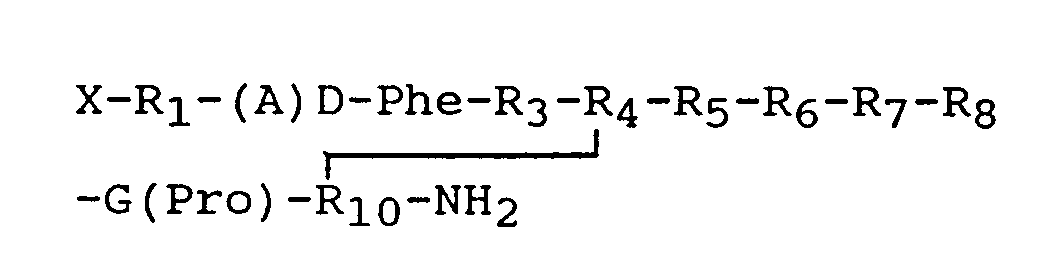
wherein X is hydrogen or an acyl group having 7 or less carbon atoms; R₁ is dehydro-Pro, D-pGlu, (A)D-Phe, (B)D-Trp, Pro, or beta-D-NAL; A is H,Cl, F, NO₂, CH₃, OCH₃, CaMe/4Cl, Cl₂ or Br; B is H, NO₂, NH₂, OCH₃, F, Cl, Br, CH₃, NinFor or NinAc; R₃ is D-PAL, beta-D-NAL or (B)D-Trp; R₄ is Cys, Asp, Glu, Orn, daB, daP or aBu; R₅ is Tyr, (C)Arg, (A)Phe, (3I)Tyr or His; R₆ is beta-D-NAL, (B)D-Trp, (A')D-Phe, (D)D-Lys, (D)D-Orn, D-Har, D-Tyr, (E)D-His, D-PAL or (C)D-Arg; A' is A, NH₂, NHCH₃ or gua; C is (lower alkyl)n where n is O, 1 or 2; D is X or an aryl group; E is H, imBzl or dinitrophenyl; R₇ is Nle, Leu, NML, Phe, Met, Nva, F-Phe, Tyr, Trp or PAL; R₈ is Arg, Ser, Tyr, Thr or PAL; G is H, OH or dehydro and R₁₀ is cys, asp, glu, orn, dab, dap or abu; provided that R₄ and R₁₀ are so selected as to be complementary whereby the aforesaid covalent bond is provided on cyclization.
Formula I
wherein X is hydrogen or an acyl group having 7 or less carbon atoms; R₁ is dehydro-Pro, D-pGlu, (A)D-Phe, (B)D-Trp, Pro, or beta-D-NAL; A is H,Cl, F, NO₂, CH₃, OCH₃, CaMe/4Cl, Cl₂ or Br; B is H, NO₂, NH₂, OCH₃, F, Cl, Br, CH₃, NinFor or NinAc; R₃ is D-PAL, beta-D-NAL or (B)D-Trp; R₄ is Cys, Asp, Glu, Orn, daB, daP or aBu; R₅ is Tyr, (C)Arg, (A)Phe, (3I)Tyr or His; R₆ is beta-D-NAL, (B)D-Trp, (A')D-Phe, (D)D-Lys, (D)D-Orn, D-Har, D-Tyr, (E)D-His, D-PAL or (C)D-Arg; A' is A, NH₂, NHCH₃ or gua; C is (lower alkyl)n where n is O, 1 or 2; D is X or an aryl group; E is H, imBzl or dinitrophenyl; R₇ is Nle, Leu, NML, Phe, Met, Nva, F-Phe, Tyr, Trp or PAL; R₈ is Arg, Ser, Tyr, Thr or PAL; G is H, OH or dehydro and R₁₀ is cys, asp, glu, orn, dab, dap or abu; provided that R₄ and R₁₀ are so selected as to be complementary whereby the aforesaid covalent bond is provided on cyclization.
2. A peptide in accordance with Claim 1 wherein A is 4Cl or 4F.
3. A peptide in accordance with either Claim 1 or 2 wherein R₄ is daP,daB or Orn and
R₁₀ is Asp or Glu.
4. A peptide in accordance with either Claim 1 or 2 wherein R₄ is Asp or Glu and R₁₀
is daP,daB or Orn.
5. A peptide in accordance with either Claim 1 or 2 wherein R₄ and R₁₀ are selected from
Cys, D-Cys, aBu and D-aBu.
6. A peptide in accordance with Claim 1 or 2 wherein R₄ is Asp and R₁₀ is daP.
7. A peptide in accordance with Claim 6 wherein R₁ is beta-D-2NAL or dehydroPro and R₆
is D-3PAL or beta-D-2NAL.
8. A peptide in accordance with any one of Claims 1-7 wherein R₃ is D-Trp, R₅ is Tyr,
R₇ is Leu, R₈ is Arg and G(Pro) is Pro.
9. A peptide in accordance with Claim 1 and having the formula:

10. A peptide in accordance with Claim 1 and having the formula:

11. A non-toxic salt of a peptide as claimed in any preceeding claim.
Claims for the following Contracting State(s): AT
1. A method for making a cyclic peptide having the formula I below in which the amino
acid sequence is cyclized by a covalent R₄-R₁₀ bond represented in said formula and
in the form of a disulfide linkage, an amide bond, a dicarba linkage or a carba-S
linkage:-
Formula I
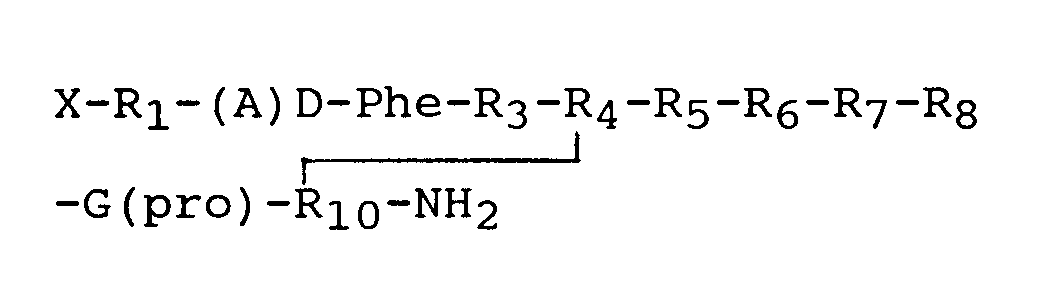
wherein X is hydrogen or an acyl group having 7 or less carbon atoms; R₁ is dehydro-Pro, D-pGlu, (A)D-Phe, (B)D-Trp, Pro, or beta-D-NAL; A is H, Cl, F, NO₂, CH₃, OCH₃, CaMe/4Cl, Cl₂ or Br; B is H, NO₂, NH₂, OCH₃, F, Cl, Br, CH₃, NinFor or NinAc; R₃ is D-PAL, beta-D-NAL or (B)D-Trp; R₄ is Cys, Asp, Glu, Orn, daB, daP or aBu; R₅ is Tyr, (C)Arg, (A)Phe, (3I)Tyr or His; R₆ is beta-D-NAL, (B)D-Trp, (A')D-Phe, (D)D-Lys, (D)D-Orn, D-Har, D-Tyr, (E)D-His, D-PAL or (C)D-Arg; A' is A, NH₂, NHCH₃ or gua; C is (lower alkyl)n where n is 0, 1 or 2; D is X or an aryl group; E is H, inBzl or dinitrophenyl; R₇ is Nle, Leu, NML, Phe, Met, Nva, F-Phe, Tyr, Trp or PAL; R₈ is Arg, Ser, Tyr, Thr or PAL; G is H, OH or dehydro and R₁₀ is cys, asp, glu, orn, dab, dap or abu; provided that R₄ and R₁₀ are so selected as to be complementary whereby the aforesaid covalent bond is provided on cyclization which method comprises (a) forming an intermediate compound having the formula: X¹-R₁-(A)D-Phe-R₃(X²)-R₄(X³)-R₅(X⁴ or X⁵)-R₆(X⁴ or X⁵ or X⁶)-R₇(X² or X⁷)-R₈(X⁴ or X⁵ or X⁸)- (G)Pro-R₁₀(X³)-X⁹ wherein X¹ s hydrogen or an a-amino protecting group; X² is hydrogen or a protecting group for an indole nitrogen; X³ is a direct bond, hydrogen or a protecting group for Cys or for a side-chain amino or carboxyl group; X⁴ is hydrogen or a protecting group for a phenolic hydroxyl group of Tyr; X⁵ is either hydrogen or a protecting group for a guanido or imidazole side chain X⁶ is a protecting group for an amino side chain; X⁷ is a protecting group for Met; X⁸ is a protecting group for an alcoholic hydroxyl group of Ser or Tyr; and X⁹ is selected from the group consisting of O-CH₂-(resin support), -NH-(resin support), esters, and amides; (b) splitting off one or more of the groups X¹ to X⁸ and/or cleaving form any resin support included in X⁹; and (c) creating a cyclizing bond between R₄ and R₁₀ if not already present.
Formula I
wherein X is hydrogen or an acyl group having 7 or less carbon atoms; R₁ is dehydro-Pro, D-pGlu, (A)D-Phe, (B)D-Trp, Pro, or beta-D-NAL; A is H, Cl, F, NO₂, CH₃, OCH₃, CaMe/4Cl, Cl₂ or Br; B is H, NO₂, NH₂, OCH₃, F, Cl, Br, CH₃, NinFor or NinAc; R₃ is D-PAL, beta-D-NAL or (B)D-Trp; R₄ is Cys, Asp, Glu, Orn, daB, daP or aBu; R₅ is Tyr, (C)Arg, (A)Phe, (3I)Tyr or His; R₆ is beta-D-NAL, (B)D-Trp, (A')D-Phe, (D)D-Lys, (D)D-Orn, D-Har, D-Tyr, (E)D-His, D-PAL or (C)D-Arg; A' is A, NH₂, NHCH₃ or gua; C is (lower alkyl)n where n is 0, 1 or 2; D is X or an aryl group; E is H, inBzl or dinitrophenyl; R₇ is Nle, Leu, NML, Phe, Met, Nva, F-Phe, Tyr, Trp or PAL; R₈ is Arg, Ser, Tyr, Thr or PAL; G is H, OH or dehydro and R₁₀ is cys, asp, glu, orn, dab, dap or abu; provided that R₄ and R₁₀ are so selected as to be complementary whereby the aforesaid covalent bond is provided on cyclization which method comprises (a) forming an intermediate compound having the formula: X¹-R₁-(A)D-Phe-R₃(X²)-R₄(X³)-R₅(X⁴ or X⁵)-R₆(X⁴ or X⁵ or X⁶)-R₇(X² or X⁷)-R₈(X⁴ or X⁵ or X⁸)- (G)Pro-R₁₀(X³)-X⁹ wherein X¹ s hydrogen or an a-amino protecting group; X² is hydrogen or a protecting group for an indole nitrogen; X³ is a direct bond, hydrogen or a protecting group for Cys or for a side-chain amino or carboxyl group; X⁴ is hydrogen or a protecting group for a phenolic hydroxyl group of Tyr; X⁵ is either hydrogen or a protecting group for a guanido or imidazole side chain X⁶ is a protecting group for an amino side chain; X⁷ is a protecting group for Met; X⁸ is a protecting group for an alcoholic hydroxyl group of Ser or Tyr; and X⁹ is selected from the group consisting of O-CH₂-(resin support), -NH-(resin support), esters, and amides; (b) splitting off one or more of the groups X¹ to X⁸ and/or cleaving form any resin support included in X⁹; and (c) creating a cyclizing bond between R₄ and R₁₀ if not already present.
2. A method in accordance with Claim 1 wherein A is 4Cl or 4F.
3. A method in accordance with either Claim 1 or 2 wherein R₄ is daP,daB or Orn and R₁₀
is Asp or Glu.
4. A method in accordance with either Claim 1 or 2 wherein R₄ is Asp or Glu and R₁₀ is
daP,daB or Orn.
5. A method in accordance with either Clain 1 or 2 wherein R₄ and R₁₀ are selected from
Cys, D-Cys, aBu and D-aBu.
6. A method in accordance with Claim 1 or 2 wherein R₄ is Asp and R₁₀ is daP.
7. A method in accordance with Claim 6 wherein R₁ is beta-D-2NAL or dehydroPro and R₆
is D-3PAL or beta-D-2NAL.
8. A method in accordance with any one of Claims 1-7 wherein R₃ is D-Trp, R₅ is Tyr,
R₇ is Leu, R₈ is Arg and R₉ is Pro.
9. A method in accordance with Claim 1 wherein said peptide has the formula: Ac-dehydroPro-4F-D-Phe-D-Trp-Asp-Tyr-beta-D-2NAL-Leu-Arg-Pro-daP-NH₂.
10. A method in accordance with Claim 1 wherein said peptide has the formula: Ac-beta-D-2NAL-4F-D-Phe-D-Trp-Asp-Tyr-D-Arg-Leu-Arg-Pro-daP-NH₂.
11. A method as claimed in my preceeding claim wherein the peptide obtained is converted
to non-toxic salt form.
12. A method of contraceptive treatment of female mammalians which method comprises administering
to a female mammalian an amount of a GnRH antagonist effective to suppress or delay
ovulation, characterized in the said GnRH antagonist is a peptide as defined in Claim
1 or a non-toxic salt thereof.
13. A method of contraceptive treatment of male mammalians which method comprises administering
to a male mammalian an amount of a GnRH antagonist effective to suppress spermatogenesis,
characterized in that said GnRH antagonist is a peptide as defined in Claim 1 or a
non-toxic salt thereof.
Revendications pour l'(les) Etat(s) contractant(s) suivant(s): BE, FR, DE, IT, LU,
NL, SE, CH, GB
1. Peptide cyclique répondant à la formule I ci-dessous, dans laquelle la séquence d'acides
aminés est cyclisée par une liaison covalente R₄-R₁₀ représentée dans ladite formule
et se présentant sous la forme d'une liaison disulfure, d'une liaison amino, d'une
liaison dicarba ou d'une liaison carba-S :
Formule I :
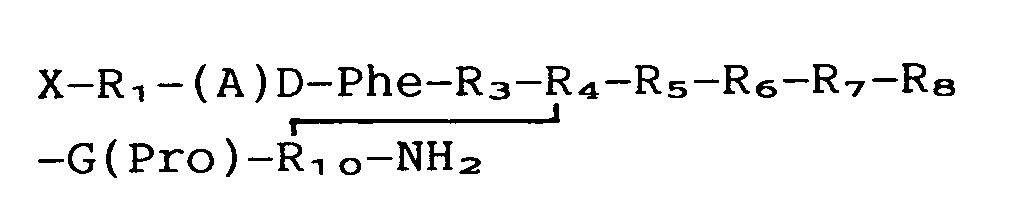
dans laquelle X représente un atome d'hydrogène ou un groupe acyle comportant 7 atomes de carbone ou moins ; R₁ représente déhydro-Pro, D-pGlu, (A)D-Phe, (B)D-Trp, Pro ou β-D-NAL ; A représente H, Cl, F, NO₂, CH₃, OCH₃, CaMe/4Cl, Cl₂ ou Br ; B représente H, NO₂, NH₂, OCH₃, F, Cl, Br, CH₃, NinFor ou NinAc ; R₃ représente D-PAL, β-D-NAL ou (B)D-Trp; R₄ représente Cys, Asp, Glu, Orn, daB, daP ou aBu ; R₅ représente Tyr, (C)Arg, (A)Phe, (3I)Tyr ou His ; R₆ représente β-D-NAL, (B)D-Trp, (A')D-Phe, (D)D-Lys, (D)D-Orn, D-Har, D-Tyr, (E)D-His, D-PAL ou (C)D-Arg ; A' représente A, NH₂, NHCH₃ ou Gua ; C représente un groupe (alcoyle inférieur)n dans lequel n vaut 0, 1 ou 2 ; D représente X un groupe aryle ; E représente H, imBzl ou un groupe dinitrophényle ; R₇ représente Nle, Leu, NML, Phe, Met, Nva, F-Phe, Tyr, Trp ou PAL ; R₈ représente Arg, Ser, Tyr, Thr ou PAL ; G représente H, OH ou déhydro ; et R₁₀ représente Cys, Asp, Glu, Orn, daB, daP ou aBu ; à condition que R₄ et R₁₀ soient choisis de façon à être complémentaires, ce qui permet d'obtenir la liaison covalente susmentionnée pendant la cyclisation.
Formule I :
dans laquelle X représente un atome d'hydrogène ou un groupe acyle comportant 7 atomes de carbone ou moins ; R₁ représente déhydro-Pro, D-pGlu, (A)D-Phe, (B)D-Trp, Pro ou β-D-NAL ; A représente H, Cl, F, NO₂, CH₃, OCH₃, CaMe/4Cl, Cl₂ ou Br ; B représente H, NO₂, NH₂, OCH₃, F, Cl, Br, CH₃, NinFor ou NinAc ; R₃ représente D-PAL, β-D-NAL ou (B)D-Trp; R₄ représente Cys, Asp, Glu, Orn, daB, daP ou aBu ; R₅ représente Tyr, (C)Arg, (A)Phe, (3I)Tyr ou His ; R₆ représente β-D-NAL, (B)D-Trp, (A')D-Phe, (D)D-Lys, (D)D-Orn, D-Har, D-Tyr, (E)D-His, D-PAL ou (C)D-Arg ; A' représente A, NH₂, NHCH₃ ou Gua ; C représente un groupe (alcoyle inférieur)n dans lequel n vaut 0, 1 ou 2 ; D représente X un groupe aryle ; E représente H, imBzl ou un groupe dinitrophényle ; R₇ représente Nle, Leu, NML, Phe, Met, Nva, F-Phe, Tyr, Trp ou PAL ; R₈ représente Arg, Ser, Tyr, Thr ou PAL ; G représente H, OH ou déhydro ; et R₁₀ représente Cys, Asp, Glu, Orn, daB, daP ou aBu ; à condition que R₄ et R₁₀ soient choisis de façon à être complémentaires, ce qui permet d'obtenir la liaison covalente susmentionnée pendant la cyclisation.
2. Peptide selon la revendication 1, dans lequel A représente 4Cl ou 4F.
3. Peptide selon la revendication 1 ou 2, dans lequel R₄ représente daP, daB ou Orn,
et R₁₀ représente Asp ou Glu.
4. Peptide selon la revendication 1 ou 2, dans lequel R₄ représente Asp ou Glu, et R₁₀
représente daP, daB ou Orn.
5. Peptide selon la revendication 1 ou 2, dans lequel R₄ et R₁₀ sont choisis dans le
groupe formé de Cys, D-Cys, aBu et D-aBu.
6. Peptide selon la revendication 1 ou 2, dans lequel R₄ représente Asp et R₁₀ représente
daP.
7. Peptide selon la revendication 6, dans lequel R₁ représente β-D-2NAL ou déhydroPro,
et R₆ représente D-3PAL ou β-D-2NAL.
8. Peptide selon l'une quelconque des revendications 1 à 7, dans lequel R₃ représente
D-Trp, R₅ représente Tyr, R₇ représente Leu, R₈ représente Arg, et G(Pro) représente
Pro.
9. Peptide selon la revendication 1, répondant à la formule :

10. Peptide selon la revendication 1, répondant à la formule :

11. Sel non-toxique d'un peptide selon l'une quelconque des revendications précédentes.
Revendications pour l'(les) Etat(s) contractant(s) suivant(s): AT
1. Procédé de préparation d'un peptide cyclique répondant à la formule I ci-dessous,
dans laquelle la séquence d'acides aminés est cyclisée par une liaison covalente R₄-R₁₀
représentée dans ladite formule et se présentant sous la forme d'une liaison disulfure,
d'une liaison amide, d'une liaison dicarba ou d'une liaison carba-S :
Formule I :
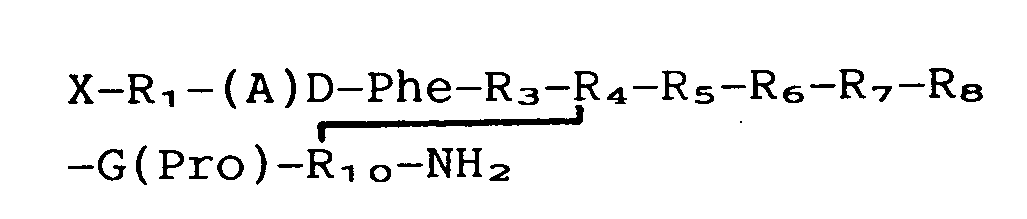
dans laquelle X représente un atome d'hydrogène ou un groupe acyle comportant 7 atomes de carbone ou moins ; R₁ représente déhydro-Pro, D-pGlu, (A)D-Phe, (B)D-Trp, Pro ou β-D-NAL ; A représente H, Cl, F, NO₂, CH₃, OCH₃, CaMe/4Cl, Cl₂ ou Br ; B représente H, NO₂, NH₂, OCH₃, F, Cl, Br, CH₃, NinFor ou NinAc ; R₃ représente D-PAL, β-D-NAL ou (B)D-Trp; R₄ représente Cys, Asp, Glu, Orn, daB, daP ou aBu ; R₅ représente Tyr, (C)Arg, (A)Phe, (3I)Tyr ou His ; R₆ représente β-D-NAL, (B)D-Trp, (A')D-Phe, (D)D-Lys, (D)D-Orn, D-Har, D-Tyr, (E)D-His, D-PAL ou (C)D-Arg ; A' représente A, NH₂, NHCH₃ ou Gua ; C représente un groupe (alcoyle inférieur)n dans lequel n vaut 0, 1 ou 2 ; D représente X un groupe aryle ; E représente H, imBzl ou un groupe dinitrophényle ; R₇ représente Nle, Leu, NML, Phe, Met, Nva, F-Phe, Tyr, Trp ou PAL ; R₈ représente Arg, Ser, Tyr, Thr ou PAL ; G représente H, OH ou déhydro ; et R₁₀ représente Cys, Asp, Glu, Orn, daB, daP ou aBu ; à condition que R₄ et R₁₀ soient choisis de façon à être complémentaires, ce qui permet d'obtenir la liaison covalente susmentionnée pendant la cyclisation, lequel procédé comprend les étapes consistant à (a) former un composé intermédiaire répondant à la formule: X¹-R₁-(A)D-Phe-R₃(X²)-R₄(X³)-R₅(X⁴ ou x⁵)-R₆(X⁴ ou X⁵ ou X⁶)-R₇(X² ou X⁷)-R₈(X⁴ ou X⁵ ou X⁸)-(G)Pro-R₁₀(X³)-X⁹, dans laquelle X¹ représente un atome d'hydrogène ou un groupe protecteur a-amino ; X² représente un atome d'hydrogène ou un groupe protecteur pour l'atome d'azote du groupe indole; X³ représente une liaison directe, un atome d'hydrogène ou un groupe protecteur pour Cys ou pour un groupe amino ou carboxyle de la chaine latérale ; X⁴ représente un atome d'hydrogène ou un groupe protecteur pour un groupe hydroxyle phénolique de Tyr ; X⁵ représente un atome d'hydrogène ou un groupe protecteur pour une chaîne latérale guanido ou imidazole ; X⁶ représente un groupe protecteur pour une chaîne latérale amino ; X⁷ représente un groupe protecteur pour Met ; X⁸ représente un groupe protecteur pour un groupe hydroxyle alcoolique de Ser ou Tyr ; et X⁹ est choisi dans le groupe formé de O-CH₂-(support de résine), -NH-(support de résine), d'esters et d'amides ; (b) séparer par clivage un ou plusieurs des groupes X¹ à X⁸ et/ou le/les séparer par clivage de n'importe quel support de résine représenté par X⁹ ; et (c) créer une liaison de cyclisation entre R₄ et R₁₀ si elle n'est pas déjà présente.
Formule I :
dans laquelle X représente un atome d'hydrogène ou un groupe acyle comportant 7 atomes de carbone ou moins ; R₁ représente déhydro-Pro, D-pGlu, (A)D-Phe, (B)D-Trp, Pro ou β-D-NAL ; A représente H, Cl, F, NO₂, CH₃, OCH₃, CaMe/4Cl, Cl₂ ou Br ; B représente H, NO₂, NH₂, OCH₃, F, Cl, Br, CH₃, NinFor ou NinAc ; R₃ représente D-PAL, β-D-NAL ou (B)D-Trp; R₄ représente Cys, Asp, Glu, Orn, daB, daP ou aBu ; R₅ représente Tyr, (C)Arg, (A)Phe, (3I)Tyr ou His ; R₆ représente β-D-NAL, (B)D-Trp, (A')D-Phe, (D)D-Lys, (D)D-Orn, D-Har, D-Tyr, (E)D-His, D-PAL ou (C)D-Arg ; A' représente A, NH₂, NHCH₃ ou Gua ; C représente un groupe (alcoyle inférieur)n dans lequel n vaut 0, 1 ou 2 ; D représente X un groupe aryle ; E représente H, imBzl ou un groupe dinitrophényle ; R₇ représente Nle, Leu, NML, Phe, Met, Nva, F-Phe, Tyr, Trp ou PAL ; R₈ représente Arg, Ser, Tyr, Thr ou PAL ; G représente H, OH ou déhydro ; et R₁₀ représente Cys, Asp, Glu, Orn, daB, daP ou aBu ; à condition que R₄ et R₁₀ soient choisis de façon à être complémentaires, ce qui permet d'obtenir la liaison covalente susmentionnée pendant la cyclisation, lequel procédé comprend les étapes consistant à (a) former un composé intermédiaire répondant à la formule: X¹-R₁-(A)D-Phe-R₃(X²)-R₄(X³)-R₅(X⁴ ou x⁵)-R₆(X⁴ ou X⁵ ou X⁶)-R₇(X² ou X⁷)-R₈(X⁴ ou X⁵ ou X⁸)-(G)Pro-R₁₀(X³)-X⁹, dans laquelle X¹ représente un atome d'hydrogène ou un groupe protecteur a-amino ; X² représente un atome d'hydrogène ou un groupe protecteur pour l'atome d'azote du groupe indole; X³ représente une liaison directe, un atome d'hydrogène ou un groupe protecteur pour Cys ou pour un groupe amino ou carboxyle de la chaine latérale ; X⁴ représente un atome d'hydrogène ou un groupe protecteur pour un groupe hydroxyle phénolique de Tyr ; X⁵ représente un atome d'hydrogène ou un groupe protecteur pour une chaîne latérale guanido ou imidazole ; X⁶ représente un groupe protecteur pour une chaîne latérale amino ; X⁷ représente un groupe protecteur pour Met ; X⁸ représente un groupe protecteur pour un groupe hydroxyle alcoolique de Ser ou Tyr ; et X⁹ est choisi dans le groupe formé de O-CH₂-(support de résine), -NH-(support de résine), d'esters et d'amides ; (b) séparer par clivage un ou plusieurs des groupes X¹ à X⁸ et/ou le/les séparer par clivage de n'importe quel support de résine représenté par X⁹ ; et (c) créer une liaison de cyclisation entre R₄ et R₁₀ si elle n'est pas déjà présente.
2. Procédé selon la revendication 1, dans lequel A représente 4Cl ou 4F.
3. Procédé selon la revendication 1 ou 2, dans lequel R₄ représente daP, daB ou Orn,
et R₁₀ représente Asp ou Glu.
4. Procédé selon la revendication 1 ou 2, dans lequel R₄ représente Asp ou Glu, et R₁₀
représente daP, daB ou Orn.
5. Procédé selon la revendication 1 ou 2, dans lequel R₄ et R₁₀ sont choisis dans le
groupe formé de Cys, D-Cys, aBu et D-aBu.
6. Procédé selon la revendication 1 ou 2, dans lequel R₄ représente Asp et R₁₀ représente
daP.
7. Procédé selon la revendication 6, dans lequel R₁ représente β-D-2NAL ou déhydroPro
et R₆ représente D-3PAL ou β-D-2NAL.
8. Procédé selon l'une quelconque des revendications 1 à 7, dans lequel R₃ représente
D-Trp, R₅ représente Tyr, R₇ représente Leu, R₈ représente Arg et R₉ représente Pro.
9. Procédé selon la revendication 1, dans lequel ledit peptide répond à la formule :
Ac-déhydroPro-4F-D-Phe-D-Trp-Asp-Tyr-β-D-2NAL-Leu-Arg-Pro-daP-NH₂.
10. Procédé selon la revendication 1, dans lequel ledit peptide répond à la formule :
Ac-β-D-2NAL-4F-D-Phe-D-Trp-Asp-Tyr-D-Arg-Leu-Arg-Pro-daP-NH₂.
11. Procédé tel que revendiqué dans les revendications précédentes, dans lequel le peptide
obtenu est mis sous forme d'un sel non-toxique.
12. Procédé de traitement contraceptif de mammifères femelles, qui consiste à administrer
à un mammifère femelle une quantité d'antagoniste de GnRH efficace pour supprimer
ou retarder l'ovulation, caractérisé en ce que ledit antagoniste de GnRH est un peptide
selon la revendication 1 ou un sel non-toxique de celui-ci.
13. Procédé de traitement contraceptif de mammifères mâles, qui consiste à administrer
à un mammifère mâle une quantité d'antagoniste de GnRH efficace pour supprimer la
spermatogénèse, caractérisé en ce que ledit antagoniste de GnRH est un peptide selon
la revendication 1 ou un sel non-toxique de celui-ci.
Patentansprüche für folgende(n) Vertragsstaat(en): BE, FR, DE, IT, LU, NL, CH, SE,
GB
1. Cyclisches Peptid der unten gezeigten Formel I, in welcher die Aminosäuresequenz durch
eine kovalente R₄-R₁₀-Bindung, welche in der Formel I dargestellt ist, cyclisiert
ist und welche in Form einer Disulfidbindung, einer Aminobindung, einer C-C-Bindung
oder einer C-S-Bindung ausgebildet ist:
Formel I
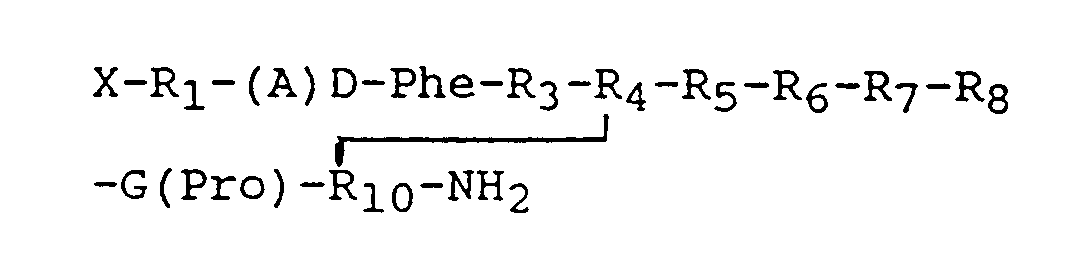
worin X Wasserstoff oder eine Acylgruppe mit 7 oder weniger Kohlenstoffatomen bedeutet; R₁ Dehydro-Pro, D-pGlu, (A)D-Phe, (B)D-Trp, Pro, oder β-D-NAL ist; A H, Cl, F, NO₂, CH₃, OCH₃, CaMe/4Cl, Cl₂ oder Br ist; B H, NO₂, NH₂, OCH₃, F, Cl, Br, CH₃, NinFor oder NinAc ist; R₃ D-PAL, β-D-NAL oder (B)D-Trp ist; R₄ Cys, Asp, Glu, Orn, daB, daP oder aBu ist; R₅ Tyr, (C)Arg, (A)Phe, (3I)Tyr oder His ist; R₆ β-D-NAL, (B)D-Trp, (A')D-Phe, (D)D-Lys, (D)D-Orn, D-Har, D-Tyr, (E)D-His, D-PAL oder (C)D-Arg ist; A' A, NH₂, NHCH₃ oder gua ist; C (niedrig Alkyl)n bedeutet, worin n 0, 1 oder 2 ist; D X oder eine Arylgruppe ist; E H, imBzl oder Dinitrophenyl ist; R₇ Nle, Leu, NML, Phe, Met, Nva, F-Phe, Tyr, Trp oder PAL ist; R₈ Arg, Ser, Tyr, Thr oder PAL ist; G H, OH oder Dehydro ist und R₁₀ cys, asp, glu, orn, dab, dap oder abu bedeutet, mit dem Proviso, daß R₄ und R₁₀ so gewählt sind, daß sie komplementär sind, wobei die zuvor genannte kovalente Bindung für die Cyclisierung vorgesehen ist.
Formel I
worin X Wasserstoff oder eine Acylgruppe mit 7 oder weniger Kohlenstoffatomen bedeutet; R₁ Dehydro-Pro, D-pGlu, (A)D-Phe, (B)D-Trp, Pro, oder β-D-NAL ist; A H, Cl, F, NO₂, CH₃, OCH₃, CaMe/4Cl, Cl₂ oder Br ist; B H, NO₂, NH₂, OCH₃, F, Cl, Br, CH₃, NinFor oder NinAc ist; R₃ D-PAL, β-D-NAL oder (B)D-Trp ist; R₄ Cys, Asp, Glu, Orn, daB, daP oder aBu ist; R₅ Tyr, (C)Arg, (A)Phe, (3I)Tyr oder His ist; R₆ β-D-NAL, (B)D-Trp, (A')D-Phe, (D)D-Lys, (D)D-Orn, D-Har, D-Tyr, (E)D-His, D-PAL oder (C)D-Arg ist; A' A, NH₂, NHCH₃ oder gua ist; C (niedrig Alkyl)n bedeutet, worin n 0, 1 oder 2 ist; D X oder eine Arylgruppe ist; E H, imBzl oder Dinitrophenyl ist; R₇ Nle, Leu, NML, Phe, Met, Nva, F-Phe, Tyr, Trp oder PAL ist; R₈ Arg, Ser, Tyr, Thr oder PAL ist; G H, OH oder Dehydro ist und R₁₀ cys, asp, glu, orn, dab, dap oder abu bedeutet, mit dem Proviso, daß R₄ und R₁₀ so gewählt sind, daß sie komplementär sind, wobei die zuvor genannte kovalente Bindung für die Cyclisierung vorgesehen ist.
2. Peptid nach Anspruch 1, worin A 4Cl oder 4F ist.
3. Peptid nach einem der Ansprüche 1 oder 2, worin R₄ daP, daB oder Orn bedeutet und
R₁₀ Asp oder Glu ist.
4. Peptid nach einem der Ansprüche 1 oder 2, worin R₄ Asp oder Glu ist und R₁₀ daP, daB
oder Orn ist.
5. Peptid nach einem der Ansprüche 1 oder 2, worin R₄ und R₁₀ aus Cys, D-Cys, aBu und
D-aBu gewählt sind.
6. Peptid nach einem der Ansprüche 1 oder 2, worin R₄ Asp ist und R₁₀ daP ist.
7. Peptid nach Anspruch 6, worin R₁ β-D-NAL oder DehydroPro ist und R₆ D-3PAL oder β-D-2NAL
ist.
8. Peptid nach einem der Ansprüche 1 bis 7, worin R₃ D-Trp ist, R₅ Tyr ist, R₇ Leu ist,
R₈ Arg ist und G(Pro) Pro ist.
9. Peptid nach Anspruch 1 der Formel

10. Peptid nach Anspruch 1 der Formel

11. Ein nicht-toxisches Salz eines Peptids nach einem der vorhergehenden Ansprüche.
Patentansprüche für folgende(n) Vertragsstaat(en): AT
1. Verfahren zur Herstellung eines cyclischen Peptids der unten gezeigten Formel I, in
welcher die Aminosäuresequenz durch eine kovalente R₄-R₁₀-Bindung, welche in der Formel
I dargestellt ist, cyclisiert ist und welche in Form einer Disulfidbindung, einer
Aminobindung, einer C-C-bindung oder einer C-S-Bindung ausgebildet ist:
Formel I
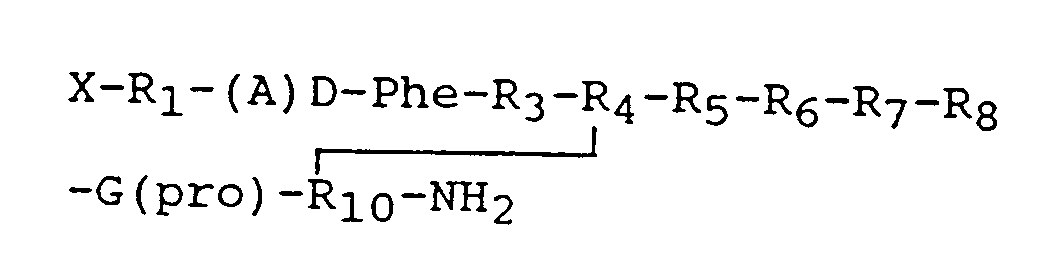
worin X Wasserstoff oder eine Acylgruppe mit 7 oder weniger Kohlenstoffatomen bedeutet; R₁ Dehydro-Pro, D-pGlu, (A)D-Phe, (B)D-Trp, Pro, oder β-D-NAL ist; A H, Cl, F, NO₂, CH₃, OCH₃, CaMe/4Cl, Cl₂ oder Br ist; B H, NO₂, NH₂, OCH₃, F, Cl, Br, CH₃, NinFor oder NinAc ist; R₃ D-PAL, β-D-NAL oder (B)D-Trp ist; R₄ Cys, Asp, Glu, Orn, daB, daP oder aBu ist; R₅ Tyr, (C)Arg, (A)Phe, (3I)Tyr oder His ist; R₆ β-D-NAL, (B)D-Trp, (A')D-Phe, (D)D-Lys, (D)D-Orn, D-Har, D-Tyr, (E)D-His, D-PAL oder (C)D-Arg ist; A' A, NH₂, NHCH₃ oder gua ist; C (niedrig Alkyl)n bedeutet, worin n 0, 1 oder 2 ist; D X oder eine Arylgruppe ist; E H, imBzl oder Dinitrophenyl ist; R₇ Nle, Leu, NML, Phe, Met, Nva, F-Phe, Tyr, Trp oder PAL ist; R₈ Arg, Ser, Tyr, Thr oder PAL ist; G H, OH oder Dehydro ist und R₁₀ cys, asp, glu, orn, dab, dap oder abu bedeutet, mit dem Proviso, daß R₄ und R₁₀ so gewählt sind, daß sie komplementär sind, wobei die zuvor genannte kovalente Bindung für die Cyclisierung vorgesehen ist, welches (a) die Bildung eines Zwischenproduktes der Formel X¹-R₁-(A)D-Phe-R₃(X²)-R₄(X³)-R₅(X⁴ oder X⁵)-R₆(X⁴ oder X⁵ oder X⁶)-R₇(X² oder X⁷)-R₈(X⁴ oder X⁵ oder X⁸)- (G)Pro-R₁₀(X³)-X⁹, worin X¹ Wasserstoff oder eine Amino-Schutzgruppe ist, X² Wasserstoff oder eine Schutzgruppe für einen Indolstickstoff ist, X³ eine Bindung, Wasserstoff oder eine Schutzgruppe für Cys oder eine Seitenkettenamino- oder -carbonylgruppe ist, X⁴ Wasserstoff oder eine Schutzgruppe für eine phenolische Hydroxylgruppe von Tyr, X⁵ entweder Wasserstoff oder eine Schutzgruppe für eine Guanido- oder Imidazol-Seitenkette bedeutet, X⁶ eine Schutzgruppe für eine Amino-Seitenkette bedeutet, X⁷ eine Schutzgruppe für Met bedeutet, X⁸ eine Schutzgruppe für eine alkoholische Hydroxylgruppe von Ser oder Tyr bedeutet und X⁹ aus der Gruppe bestehend aus O-CH₂-(Harzträger), -NH-(Harzträger), Estern und Amiden gewählt ist; (b) das Abspalten Von einer oder mehreren der Gruppen X¹ bis X⁸ und/oder Abspalten jedes in X⁹ enthaltenen Harzträgers; und (c) die Ausbildung einer cyclisierenden Bindung zwischen R₄ und R₁₀, falls diese nicht bereits vorhanden ist, umfaßt.
Formel I
worin X Wasserstoff oder eine Acylgruppe mit 7 oder weniger Kohlenstoffatomen bedeutet; R₁ Dehydro-Pro, D-pGlu, (A)D-Phe, (B)D-Trp, Pro, oder β-D-NAL ist; A H, Cl, F, NO₂, CH₃, OCH₃, CaMe/4Cl, Cl₂ oder Br ist; B H, NO₂, NH₂, OCH₃, F, Cl, Br, CH₃, NinFor oder NinAc ist; R₃ D-PAL, β-D-NAL oder (B)D-Trp ist; R₄ Cys, Asp, Glu, Orn, daB, daP oder aBu ist; R₅ Tyr, (C)Arg, (A)Phe, (3I)Tyr oder His ist; R₆ β-D-NAL, (B)D-Trp, (A')D-Phe, (D)D-Lys, (D)D-Orn, D-Har, D-Tyr, (E)D-His, D-PAL oder (C)D-Arg ist; A' A, NH₂, NHCH₃ oder gua ist; C (niedrig Alkyl)n bedeutet, worin n 0, 1 oder 2 ist; D X oder eine Arylgruppe ist; E H, imBzl oder Dinitrophenyl ist; R₇ Nle, Leu, NML, Phe, Met, Nva, F-Phe, Tyr, Trp oder PAL ist; R₈ Arg, Ser, Tyr, Thr oder PAL ist; G H, OH oder Dehydro ist und R₁₀ cys, asp, glu, orn, dab, dap oder abu bedeutet, mit dem Proviso, daß R₄ und R₁₀ so gewählt sind, daß sie komplementär sind, wobei die zuvor genannte kovalente Bindung für die Cyclisierung vorgesehen ist, welches (a) die Bildung eines Zwischenproduktes der Formel X¹-R₁-(A)D-Phe-R₃(X²)-R₄(X³)-R₅(X⁴ oder X⁵)-R₆(X⁴ oder X⁵ oder X⁶)-R₇(X² oder X⁷)-R₈(X⁴ oder X⁵ oder X⁸)- (G)Pro-R₁₀(X³)-X⁹, worin X¹ Wasserstoff oder eine Amino-Schutzgruppe ist, X² Wasserstoff oder eine Schutzgruppe für einen Indolstickstoff ist, X³ eine Bindung, Wasserstoff oder eine Schutzgruppe für Cys oder eine Seitenkettenamino- oder -carbonylgruppe ist, X⁴ Wasserstoff oder eine Schutzgruppe für eine phenolische Hydroxylgruppe von Tyr, X⁵ entweder Wasserstoff oder eine Schutzgruppe für eine Guanido- oder Imidazol-Seitenkette bedeutet, X⁶ eine Schutzgruppe für eine Amino-Seitenkette bedeutet, X⁷ eine Schutzgruppe für Met bedeutet, X⁸ eine Schutzgruppe für eine alkoholische Hydroxylgruppe von Ser oder Tyr bedeutet und X⁹ aus der Gruppe bestehend aus O-CH₂-(Harzträger), -NH-(Harzträger), Estern und Amiden gewählt ist; (b) das Abspalten Von einer oder mehreren der Gruppen X¹ bis X⁸ und/oder Abspalten jedes in X⁹ enthaltenen Harzträgers; und (c) die Ausbildung einer cyclisierenden Bindung zwischen R₄ und R₁₀, falls diese nicht bereits vorhanden ist, umfaßt.
2. Verfahren nach Anspruch 1, worin A 4Cl oder 4F ist.
3. Verfahren nach einem der Ansprüche 1 oder 2, worin R₄ daP, daB oder Orn bedeutet und
R₁₀ Asp oder Glu ist.
4. Verfahren nach einem der Ansprüche 1 oder 2, worin R₄ Asp oder Glu ist und R₁₀ daP,
daB oder Orn ist.
5. Verfahren nach einem der Ansprüche 1 oder 2, worin R₄ und R₁₀ aus Cys, D-Cys, aBu
und D-aBu gewählt sind.
6. Verfahren nach einem der Ansprüche 1 oder 2, worin R₄ Asp ist und R₁₀ daP ist.
7. Verfahren nach Anspruch 6, worin R₁ β-D-2NAL oder DehydroPro ist und R₆ D-3PAL oder
β-D-2NAL ist`
8. Verfahren nach einem der Ansprüche 1 bis 6, worin R₃ D-Trp ist, R₅ Tyr ist, R₇ Leu
ist, R₈ Arg ist und R₉ Pro ist.
9. Verfahren nach Anspruch 1, worin das Peptid folgende Formel aufweist:
Ac-dehydroPro-4F-D-Phe-D-Trp-Asp-Tyr-β-D-2NAL-Leu-Arg-Pro-daP NH₂.
Ac-dehydroPro-4F-D-Phe-D-Trp-Asp-Tyr-β-D-2NAL-Leu-Arg-Pro-daP NH₂.
10. Verfahren nach Anspruch 1, worin das Peptid folgende Formel aufweist:
Ac-β-D-2NAL-4F-D-Phe-D-Trp-Asp-Tyr-D-Arg-Leu-Arg-Pro-daP-NH₂.
Ac-β-D-2NAL-4F-D-Phe-D-Trp-Asp-Tyr-D-Arg-Leu-Arg-Pro-daP-NH₂.
11. Verfahren nach einem der vorhergehenden Ansprüche, worin das Peptid in eine nicht-toxische
Salzform überführt wird.
12. Verfahren zur empfängnisverhütenden Behandlung von weiblichen Säugern, welches Verfahren
die Verabreichung einer zur Unterdrückung oder Verzögerung der Ovulation wirksamen
Menge eines GnRH Antagonisten umfaßt, dadurch gekennzeichnet, daß der GnRH Antagonist
ein Peptid nach Anspruch 1 oder ein nicht-toxisches Salz davon ist.
13. Verfahren zur empfängnisverhütenden Behandlung von männlichen Säugern, welches Verfahren
die Verabreichung einer zur Unterdrückung der Spermatogenese wirksamen Menge eines
GnRH Antagonisten umfaßt, dadurch gekennzeichnet, daß der GnRH Antagonist ein Peptid
nach Anspruch 1 oder ein nicht-toxisches Salz davon ist.