|
(11) | EP 0 201 808 B1 |

| (12) | EUROPEAN PATENT SPECIFICATION |
|
|
| (54) |
Soluble fluorinated cycloalkane sulfonate surfactant additives for NH4F/HF oxide etchant solutions Lösliche Zusätze für Oxid-Ätzlösungen aus NH4F/HF mit oberflächenaktivem fluoriertem Cykloalkansulfonat Additifs solubles pour solutions d'attaque d'oxyde à base de NH4F/HF comportant des produits tensioactifs à base de sulfonates de cyclo-alcane fluorés |
|
|
|||||||||||||||||||||||||||||||
| Note: Within nine months from the publication of the mention of the grant of the European patent, any person may give notice to the European Patent Office of opposition to the European patent granted. Notice of opposition shall be filed in a written reasoned statement. It shall not be deemed to have been filed until the opposition fee has been paid. (Art. 99(1) European Patent Convention). |
FIELD OF THE INVENTION
[0001] This invention relates to improved compositions of etching solutions containing soluble surfactant additives. These additives are capable of maintaining reduced surface tensions for improved substrate wetting and are useful in integrated circuit manufacture. Specifically, this invention relates to the utilization of fluorinated cycloalkane sulfonates and/or fluorinated cycloalkene sulfonates as additives for suppression of surface tension.
BACKGROUND OF THE INVENTION
[0002] As integrated circuit component dimensions become smaller, physical wetting by etchant solution on substrate surfaces becomes more difficult. This is especially important for buffered oxide ammonium fluoride/hydrofluoric acid etchant solutions used in silicon dioxide etching, since these solutions exhibit extremely high surface tension values of 85 to 90 x 10⁻³ N/m (85 to 90 dyne/cm) at typical etching temperatures. Because the relatively low surface energies of the masking materials used, the photoresist topography, the type of impurities present, and the residual contaminants from other processing steps, it is difficult to properly wet the substrate, which results in non-uniform etching and poor line reproduction.
[0003] To overcome these problems, much of the integrated circuit industry has used one of at least two known techniques. The first involves a predip in an aqueous surfactant solution before placing the substrates in the etchant while the second utilizes direct addition of the surfactant to the etchant solution. However, as the industry progresses towards the use of more particulate free systems in which refiltration tanks are employed, and at the same time requires more precisely etched lines with less variation, existing methods have several shortcomings. With the use of predipping, two tanks are required instead of one, which adds an additional processing step. In addition, since wafers are being presoaked, there is a tendency to carry material over from the predip tank to the etchant tank, thus changing the etchant performance and shortening its useful life. More importantly, a major disadvantage associated with both of those methods is that, as experience has indicated, most surfactants commonly used by the industry are insoluble in ammonium fluoride/hydrofluoric acid oxide etchant solutions, which causes plating out of the surfactant onto substrate surfaces and plugs the filters (which are of the order of 0.2 »m (micron)) commonly used in recirculating etch baths and thus yields etchant solutions with little or no surfactant present. Also, the surfactants used may contain metal ion impurities which can be detrimental to integrated circuit performance or lose activity due to surfactant degradation caused by the presence of hydrofluoric acid in the etchants. Several etchant manufacturers have attempted to incorporate a surfactant in their oxide etchant solutions. However, analysis of these materials shows little, if any, surfactant is present as indicated by surface tension measurements. It is thus apparent that a need exists for an improved, effective silicon dioxide etchant solution with lower surface tension wherein the surfactant maintains surface activity in ammonium fluoride/hydrofluoric acid solutions after filtrations through 0.2 »m (micron) absolute filters and is essentially free of metal ion.
SUMMARY OF THE INVENTION
[0004] Since our prior application, United States Serial No. 604,112, filed on April 26, 1984, now US Patent 4,517,106, which described the use of linear and highly branched fluorinated alkylsulfonates as soluble additives in buffered oxide ammonium fluoride/hydrofluoric acid etchant solutions, it has since been learned that certain fluorinated cyclic materials can provide superior wetting. Furthermore, these additives remain in solution after 0.2 micrometer filtration and are low in metallic ion contamination. Surface tension values of less than 30 x 10⁻³ N/m (30 dynes per centimeter) are common for etchants with these additives compared to values of 85 x 10⁻³ to 90 x 10⁻³ N/m (85 to 90 dynes per centimeter) for etchants without the surfactant additives.
[0005] The surfactants found effective in accordance with the invention are the fluorinated cycloalkane sulfonates and fluorinated cycloalkene sulfonates that have the general formula:
Where X may be F, H, C1, OH, SO₃A or R with the proviso that at least one of the X groups is SO₃A and Y may be F C1 , H, OH , R or be omitted and thereby impart a double bond; wherein R is a 1 to 4 carbon atom alkyl and/or fluoroalkyl group; and wherein n has a value of up to 6. These materials have improved solubility and are not removed by 0.2 »m (micron) filtration. A as the cation group may be NH₄⁺, H⁺, Na⁺, K⁺, Li⁺, R⁺ or organic amine cations, i.e. NR₄⁺ wherein R is as defined above. Where metal ions, e.g. Na, K, and Li salts may adversely affect the electrical properties of the circuit e.g., primarily, Li, Na, K, Ca and Mg ions would be omitted. Significantly, these materials do not appear to be removed in continuous filtration baths and thus do not plug filters or plate out onto surface.
[0006] It is accordingly, an object of the present invention to provide a series of silicon dioxide etching solutions having the desirable etching rates and improved wetting over the prior art etching solutions. These improved etchants retain their surface active properties after filtration.
[0007] It is a further object of our invention to provide a series of such etching solutions which after 0.2 »m (micron) filtration are essentially free of metal ions, having the same rate of etching at the same etching temperatures as prior art solutions, and which have better wetting characteristics for improved etch uniformity, and do not leave residues or adversely affect photoresist adhesion.
[0008] These and other objects are accomplished according to our invention as described in claim 1 wherein etching solutions are provided comprising an aqueous solution of hydrogen fluoride and ammonium fluoride comprising between 1% and 11% by weight hydrogen fluoride (HF), between 13.5% and 40.5% by weight of ammonium fluoride (NH₄F) and 25 to 20,000 ppm of a specified surface active agent.
DESCRIPTION OF THE PREFERRED EMBODIMENT
[0009] The surfactants found effective in accordance with the invention are referred to as fluorinated cycloalkane sulfonates and fluorinated cycloalkene sulfonates and have the general formula:
Where X may be F, H, Cl, OH, SO₃A or R with the proviso that at least one of the X groups is SO₃A and Y may be F, Cl, H, OH, R or be omitted and thereby impart a double bond; wherein R is a 1 to 4 carbon atom alkyl and/or fluoroalkyl group; and wherein n has a value of up to 6. The preferred compounds contain 4 to 9 carbons. These materials have improved solubility and are not removed by 0.2 »m (micron) filtration. A represents the cation group and may be NH₄⁺, H⁺, Na⁺, K⁺, Li⁺, R⁺, or NR₄⁺, wherein R is as defined above. However, where salts of relatively high ion content, such as Na, K, and Li salts may adversely affect the electrical properties of the circuit compound containing such ions should be omitted. The term "low metal ion content" refers to the omission of any substantial amount of metal ions of groups I and II of the Periodic Table, primarily, Li, Na, K, Ca and Mg ions.
[0010] The new etching solutions of our invention all retain their surface active properties after 0.2 »m (micron) filtration, even under continuous filtration conditions. Moreover, the new solutions of the invention, despite being filtered, have the property of wetting substrates more effectively and yield more uniform results by etching small geometries (1 to 5 »m (micron) and large geometries (>5 »m (micron)) of oxide in patterned resist at the same rate without adding any deleterious effects to prior art solutions.
[0011] The HF/NH₄F solutions of our invention can be prepared by any method of dissolving the indicated proportions of the components in water. We prefer, however, to blend aqueous solutions of the individual components HF and HN₄F, respectively. We find that the standard HF solution containing about 49% hydrogen fluoride by weight is well adapted for this purpose. It will be understood that solutions of either HF concentration may be used. Using this 49% HF solution, it is necessary to employ an ammonium fluoride solution of concentration between 15 % and 48% NH₄F by weight, by blending, solutions containing the desired relative proportions of the two components. Blends of 1 part by weight of a 49% by weight aqueous hydrogen fluoride solution and between 4 and 100 parts by volume of 15% to 48% by weight aqueous ammonium fluoride can be used. Such blends produce mixtures containing from 1% to 11% HF and from 13.5% to 40.5% NH₄F by weight, the remainder being water. To this is added a low metal ion version of the dissolved fluorinated cycloalkane sulfonate and/or fluorinated cycloalkane sulfonate and the solution filtered through an 0.2 »m (micron) filter. Other concentrations of HF and NH₄F may, of course, also be prepared.
[0012] The determined effective concentration range is 25 to 20,000 ppm added as active surfactant. It may be added as a solid or as a solution in an aqueous polar solvent mixture. The desired concentration range is from 200 to 5000 ppm active surfactant.
[0013] In some applications, a suitable diluent to lower, i.e., depress, the corrosive effect may be added. Suitable diluents include, for example, acetic acid, ethylene glycol, and lower alkyl alcohols, e.g., of 1 to 3 carbon atoms.
[0014] The following specific examples further illustrate the invention. It will be understood, however, that although these examples may describe in detail certain preferred operating conditions of the invention, they are given primarily for purposes of illustration and the invention in its broader aspects is not limited thereto.
EXAMPLES 1-6
[0015] To a solution 27 percent by weight of ammonium fluoride, 6 percent by weight of hydrofluoric acid and the remainder being water, was added 250 ppm surfactant. An analysis of the surfactant was preformed using F¹⁹-NMR and mass spectrometry. Surface tensions were measured using a Du Nouy Ring tensiometer at 25°C. The solutions (as identified in Table I) were filtered through an 0. 2 »m TEFLON® fluorocarbon polymer filter and were remeasured for surface tension using the same method.
[0016] The results in Table I show that the potassium salts of perfluorocyclohexyl sulfonic acid and its perfluoroethyl derivative, and of the branched perfluorooctyl sulfonic acid were not significantly removed by 0.2 »m filtration as indicated by surface tension measurements. However, the surface tension results show that the potassium salts of linear perfluorooctyl sulfonic acid was essentially removed from solution upon filtration.
1. An aqueous hydrogen fluoride/ammonium fluoride etching solution for etching SiO₂ characterized
in that the solution comprises between 13.5 and 40.5 weight percent ammonium fluoride
(NH₄F), between 1 and 11 weight percent hydrogen fluoride and between 25 and 20,000
ppm of a fluorinated cyloalkane sulfonate surfactant and/or fluorinated cycloalkene
sulfonate surfactant of the formula:
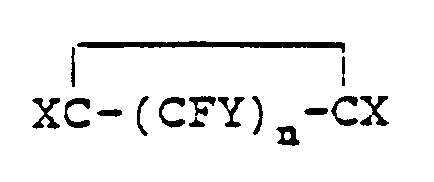
wherein n has a value of up to 6, X may be F, C1, H, OH, SO₃A or R, Y may be F, C1, H, OH, R or may be omitted so that a double bond is formed and A may be NH₄⁺, H⁺, Na⁺, K⁺, Li⁺, R⁺ or NR₄⁺ and wherein R is a 1 to 4 carbon atom alkyl and/or fluoroalkyl group with the proviso that at least one of the X groups is SO₃A.
wherein n has a value of up to 6, X may be F, C1, H, OH, SO₃A or R, Y may be F, C1, H, OH, R or may be omitted so that a double bond is formed and A may be NH₄⁺, H⁺, Na⁺, K⁺, Li⁺, R⁺ or NR₄⁺ and wherein R is a 1 to 4 carbon atom alkyl and/or fluoroalkyl group with the proviso that at least one of the X groups is SO₃A.
2. The etching solution of claim 1 wherein "n" has a value of 2 to 4.
3. The etching solution of any preceding claim wherein the fluorinated cyclic surfactant
is the ammonium salt having no substantial amount of metal ions of groups I and II
of the Periodic Table.
4. The etching solution of any preceding claim wherein the fluorinated cycloalkane or
cycloalkene sulfonate is fluorinated cycloalkane or cycloalkene sulfonic acid.
5. The etching solution of any preceding claim wherein the fluorinated cyclic surfactant
is present in amounts of 200 to 5000 ppms.
6. The etching solution according to any preceding claim containing between 200 and 5000
ppm of the fluorinated cyclic surfactant and further containing a diluent selected
from the group consisting of acetic acid, ethylene glycol and a C₁ to C₃ alkyl alcohol.
7. The etching solution of claim 6 containing up to 50 weight percent of said diluent.
8. A process for producing the etching solution of claim 1 which comprises blending 49%
by weight aqueous hydrogen fluoride and a 15% to 48% by weight aqueous solution or
ammonium fluoride, in the ratio of 1 part by weight of said aqueous hydrogen fluoride
solution to from 4 to 100 parts by volume of said aqueous ammonium fluoride solution
wherein the fluorinated cyclic sulfonate surfactant described in claim 1 is added
to the etching solution as a dry solid or as a solution in an aqueous polar solvent
mixture to form a solution wherein said fluorinated cyclic surfactant is present in
amounts of 200 to 5000 ppm.
1. Wäßrige Ätzlösung auf der Basis von Fluorwasserstoff und Ammoniumfluorid zum Ätzen
von SiO₂, dadurch gekennzeichnet, daß die Lösung zwischen 13,5 und 40,5 Gew.-% Ammoniumfluorid
(NH₄F), zwischen 1 und 11 Gew.-% Fluorwasserstoff und zwischen 25 und 20 000 ppm eines
Tensids aus einem fluorierten Cycloalkansulfonat und/oder eines Tensids aus einem
fluorierten Cycloalkensulfonat der Formel
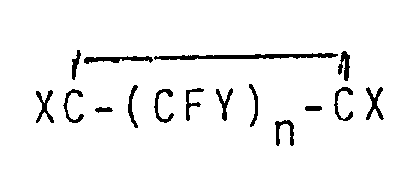
enthält, in der n einen Wert von bis zu 6 hat, X die Bedeutung F, Cl, H, OH, SO₃A oder R haben kann, Y die Bedeutung F, Cl, H, OH, R haben oder entfallen kann, so daß eine Doppelbindung vorhanden ist, A die Bedeutung NH₄⁺, H⁺, Na⁺, K⁺, Li⁺, R⁺ oder NR₄⁺ haben kann und R eine Alkyl- und/oder Fluoralkylgruppe mit 1 bis 4 Kohlenstoffatomen ist, wobei mindestens eine der Gruppen X SO₃A ist.
enthält, in der n einen Wert von bis zu 6 hat, X die Bedeutung F, Cl, H, OH, SO₃A oder R haben kann, Y die Bedeutung F, Cl, H, OH, R haben oder entfallen kann, so daß eine Doppelbindung vorhanden ist, A die Bedeutung NH₄⁺, H⁺, Na⁺, K⁺, Li⁺, R⁺ oder NR₄⁺ haben kann und R eine Alkyl- und/oder Fluoralkylgruppe mit 1 bis 4 Kohlenstoffatomen ist, wobei mindestens eine der Gruppen X SO₃A ist.
2. Ätzlösung nach Anspruch 1, in der "n" einen Wert von 2 bis 4 hat.
3. Ätzlösung nach einem der vorhergehenden Ansprüche, in der das fluorierte zyklische
Tensid das Ammoniumsalz ist, das Metallionen der Gruppen I und II des Periodensystems
nicht in beträchtlicher Menge enthält.
4. Ätzlösung nach einem der vorhergehenden Ansprüche, in der das fluorierte Cycloalkan-
oder Cycloalkensulfonat fluorierte Cycloalkan- oder Cycloalkensulfonsäure ist.
5. Ätzlösung nach einem der vorhergehenden Ansprüche, in der das fluorierte zyklische
Tensid in Mengen von 200 bis 5000 ppm vorhanden ist.
6. Ätzlösung nach einem der vorhergehenden Ansprüche mit zwischen 200 und 5000 ppm des
fluorierten zyklischen Tensids und mit einem Verdünnungsmittel, das aus der Gruppe
ausgewählt ist, die aus Essigsäure, Ethylenglykol und C₁- bis C₃-Alkylalkohol besteht.
7. Ätzlösung nach Anspruch 6, die bis zu 50 Gew.-% des Verdünnungsmittels enthält.
8. Verfahren zum Herstellen der Ätzlösung nach Anspruch 1, in dem 49 Gew.-% wäßriger
Fluorwasserstoff und eine wäßrige Lösung von 15 bis 48 Gew.-% Ammoniumfluorid im Verhältnis
von 1 Gewichtsteil der wäßrigen Fluorwasserstofflösung zu 4 bis 100 Volumenteilen
der wäßrigen Ammoniumfluoridlösung gemischt werden und das im Anspruch 1 beschriebene,
aus einem fluorierten zyklischen Sulfonat bestehende Tensid der Ätzlösung in Form
eines trockenen Feststoffes oder einer Lösung in einem wäßrigen polaren Lösungsmittel
zugesetzt und dadurch eine Lösung erhalten wird, in der das fluorierte zyklische Tensid
in Mengen von 200 bis 5000 ppm vorhanden ist.
1. Solution aqueuse d'attaque contenant du fluorure d'hydrogène/fluorure d'ammonium destinée
à l'attaque de SiO₂, caractérisée en ce que la solution comprend de 13,5 à 40,5 %
en masse de fluorure d'ammonium (NH₄F), de 1 à 11% en masse de fluorure d'hydrogène
et de 25 à 20 000 ppm d'un tensioactif qui est un cycloalcanesulfonate fluoré et/ou
d'un tensioactif qui est un cycloalcène-sulfonate fluoré de formule :
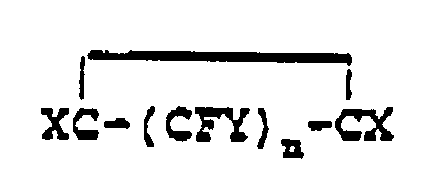
dans laquelle n vaut jusqu'à 6, X peut représenter F, Cl, H, OH, SO₃A ou R, Y peut représenter F, Cl, H, OH, R ou peut être omis, donnant ainsi lieu à la formation d'une double liaison et A peut réprésenter NH₄⁺, H⁺, Na⁺, K⁺, Li⁺, R⁺ ou NR₄⁺ et où R représente un groupement alkyle et/ou fluoroalkyle en C₁-C₄, à condition qu'au moins l'un des groupements X représente SO₃A.
dans laquelle n vaut jusqu'à 6, X peut représenter F, Cl, H, OH, SO₃A ou R, Y peut représenter F, Cl, H, OH, R ou peut être omis, donnant ainsi lieu à la formation d'une double liaison et A peut réprésenter NH₄⁺, H⁺, Na⁺, K⁺, Li⁺, R⁺ ou NR₄⁺ et où R représente un groupement alkyle et/ou fluoroalkyle en C₁-C₄, à condition qu'au moins l'un des groupements X représente SO₃A.
2. Solution d'attaque selon la revendication 1, dans laquelle "n" a une valeur comprise
entre 2 et 4.
3. Solution d'attaque selon l'une quelconque des revendications précédentes, dans laquelle
le tensioactif cyclique fluoré est le sel d'ammonium ne comportant pas de quantité
sensible d'ions métalliques des groupes I et II de la classification périodique.
4. Solution d'attaque selon l'une quelconque des revendications précédentes, dans laquelle
le cycloalcanesulfonate ou le cycloalcènesulfonate fluoré est un acide cycloalcanesulfonique
ou cycloalcènesulfonique fluoré.
5. Solution d'attaque selon l'une quelconque des revendications précédentes, dans laquelle
le tensioactif cyclique fluoré est présent à raison de 200 à 5 000 ppm.
6. Solution d'attaque selon l'une quelconque des revendications précédentes, contenant
entre 200 et 5 000 ppm du tensioactif cyclique fluoré et contenant de plus un diluant
choisi parmi les suivants : acide acétique, éthylèneglycol et alcool alkylique en
C₁-C₃.
7. Solution d'attaque selon la revendication 6, contenant jusqu'à 50 % en masse dudit
diluant.
8. Procédé de production de la solution d'attaque selon la revendication 1, qui comprend
le mélange d'une solution aqueuse de fluorure d'hydrogène à 49 % en masse et d'une
solution aqueuse de fluorure d'ammonium à 15 à 48 % en masse, dans la proportion de
1 partie en masse de ladite solution aqueuse de fluorure d'hydrogène pour 4 à 100
parties en volume de ladite solution aqueuse de fluorure d'ammonium, dans lequel le
tensioactif qui est un sulfonate cyclique fluoré décrit dans la revendication 1 est
ajouté à la solution d'attaque sous forme d'un solide sec ou sous forme d'une solution
dans un mélange solvant polaire aqueux de façon à former une solution dans laquelle
ledit tensioactif cyclique fluoré est présent à raison de 200 à 5 000 ppm.