|
(11) | EP 0 202 027 A1 |

| (12) | EUROPEAN PATENT APPLICATION |
|
|
|
|
|||||||||||||||||||||||||||
| (54) | A herbicidal composition |
| (57) @ A herbicidal composition contains a compound of the formula:
wherein X is a hydroxyl group or a hydroxylamino group, R is a hydrogen atom, an inorganic counter cation, an organic counter cation or an ester residue and n is an integer of 1 to 3, and an inert carrier or diluent. The composition can be applied by foliar or soil treatment and is effective against, for example, broad-leafed weeds, gramineous weeds and Cyperaceous weeds. |
[0001] This invention relates to a herbicide comprising a-substituted ethyl phosphinic acid or derivatives thereof having the formula [I]
wherein X is a hydroxyl group or a hydroxylamino group; R is a hydrogen atom, an inorganic or organic counter cation or an ester residue; and n is an integer of 1 to 3.
[0002] The compound [I], wherein X=OH, R=H and n=1. is disclosed in Annales de Chimie et de Physique, 23, 289-362, 1891, J. Ville and is prepared by known processes, U. S. Patent 4473561 discloses that a-hydroxyethyl phosphinic acid and a-(hydroxylamino)ethyl phosphinic acid are useful for a bactericide in the agricultural field. However, these references do not refer to herbicidal activity of the present compound [I]. The present inventors have first found herbicidal activity of the compound [I].
[0003] The inorganic counter cations are, for example, alkaline earth metal cations such as calcium (II), magnesium (II), and barium (II); alkali metal cations such as sodium (I) and potassium (1), and heavy metal cations such as iron (III), copper (II), zinc (II) and manganese (II). The organic counter cations are, for example, alkoxy(lower)alkylammonium, aralkylammonium and alkylammonium. The ester residues are, for example, alkyl groups, halo(lower)alkyl groups, alkoxy(lower)alkyl groups, alkylthio(lower) alkyl groups and substituted or unsubstituted aralkyl group.
[0004] The terms "alkyl" and "alkoxy" mean those having not more than 13 carbon atoms. The term "lower" means not more than 8, preferably not more than 4. The term "halo" means chlorine, bromine and fluorine.
[0005] The "aralkyl" includes, for example, benzyl, phenethyl, naphthyl(C1-C2)alkyl and anthranylmethyl, and the terms "substituted aralkyl" is halobenzyl, C1-C4 alkylbenzyl, C1-C4 alkoxybenzyl, phenoxybenzyl, phenylbenzyl, halophenethyl, C1-C4 alkylphenethyl, C1-C4 alkoxyphenethyl, haloaphthyl(C1-C2)alkyl, C1-C4 alkylnaphthyl(C1-C2)alkyl, C1-C4-alkaxynaphthyl (C1-C2)alkyl.
[0006] Preferences are those where X is a hydroxyl group, preferably X = OH and R is a hydrogen atom, calcium (II), magnesium (II), barium (II), iron (III), copper (II), zinc (II), manganese (II), C1-C10 alkoxy (C1-C3)alkylammonium, naphthyl(C1-C2)alkylamonium, C1-C6 alkyl group, chloro(C1-C2)alkyl group, C1-C2 alkylthiomethyl group or dichlorobenzyl group. More preferable compounds are 2-hydroxyethylphosphinic acid, calcium bis(2-hydroxyethylphosphinate), (+)-2-hydroxyethylphosphinic acid, (-)-2-hydroxyethylphosphinic acid, calcium bis[(+)-2-hydroxyethylphosphinate] and calcium bis[(-)-2-hydroxyethylphosphinate].
[0007] -The present invention includes all optical isomers and geometerical isomers of the compound [I].
[0008] Embodiments of the compound [I] are illustratively shown below, however, they do not intend to limit the present invention.
[0009] The herbicidal composition of the present invention shows a high herbicidal activity against a wide variety of weeds including broad-leaved weeds, Graminaceous weeds and Cyperaceous weeds in agricultural plowed field by foliar or soil treatment, especially by foliar treatment, without producing any material phytotoxicity on various agricultural crops as mentioned below.
[0010] Listed below are examples of weeds to which the herbicidal compositions of the present invention exert herbicidal activity.
Gramineous weeds
Cyperaceous Weeds
[0012]
The herbicidal composition of the present invention may be formulated in any composition form of emulsifiable concentrate, wettable powder, suspension, granule, water soluble composition, liquid composition, etc. by mixing with solid carrier, liquid carrier, surface active agent and other formulation adjuvants.
[0013] In the composition, the compound (I) is contained as active ingredient therein in the range of 1-95 % by weight, preferably 2-80 % by weight.
[0014] Examples of the solid carrier are kaolin clay, attapulgite clay, bentonite, terra alba, pyrophyllite, talc, diatomaceous silica, calcite, walnut powder, urea, ammonium sulfate, synthetic hydrated silicon dioxide and like fine powders or particles. As the liquid carrier or diluent, there may be exemplified aromatic hydrocarbons, e.g. xylene, methylnaphthalene, alcohols, e.g. isopropanol, ethylene glycol, cellosolve, ketones, e.g. acetone, cyclohexanone, isophorone, vegetable oils, e.g. soybean oil, cptton seed oil, dimethylsulfoxide, acetonitrile and water.
[0015] The surface active agent used for emulsification, dispersion or spreading may be any of the anionic and nonionic type of agents. Examples thereof include; the anionic type agent such as alkylsulfates, alkylsulfonates, alkylarylsulfonates, dialkylsulfosuccinates, phosphates of polyoxyethylenealkylaryl ethers, and the nonionic type agent such as polyoxyethylene alkyl ethers, polyoxyethylene alkylaryl ethers, polyoxyethylene polyoxypropylene block copolymer, sorbitan fatty acid esters, polyoxyethylene sorbitan fatty acid esters, etc.
[0016] Examples of formulation adjuvants include; ligninsulfonates, alginate, polyvinyl alcohol, gum arabic, CMC (carboxymethyl cellulose) or PAP (isopropyl acid phosphate), etc.
[0017] Practical embodiments of the herbicidal composition according to the invention are illustratively shown in the following examples wherein parts are by weight. The compound number of the active ingredient corresponds to the one in Table 1.
Formulation Example 1
[0018] 50 parts of the compound No. 22 as active ingredient, 3 parts of calcium ligninsulfonate, 2 parts of sodium laurylsulfate and 45 parts of synthetic hydrated silicon dioxide are well mixed while being powdered to obtain a wettable powder.
Formulation Example 2
[0019] 10 parts of the compound No. 18, 14 parts of polyoxyethylenestyryl phenyl ether, 6 parts of calcium dodecylbenzenesulfonate and 70 parts of cyclohexanone are well mixed to obtain an emulsifiable concentrate.
Formulation Example 3
[0020] 2 parts of the compound No. 10, 1 part of synthetic hydrated silicon dioxide, 2 parts of calcium ligninsulfonate, 30 parts of bentonite and 65 parts of kaolin clay are well mixed while being powdered. The mixture is then kneaded with water, granulated and dried to obtain granules.
Formulation Example 4
[0021] 25 parts of the compound No. 22, 3 parts of polyoxyethylene sorbitan molooleate, 3 parts of CMC and 69 parts of water are well mixed and pulverized until the particle size of powders becomes less than 5 microns to obtain a suspension.
Formulation Example 5
[0022] 10 parts of the compound No. 21, 1 part of polyoxyethylenestyryl phenyl ether and 89 parts of water are well mixed to obtain a liquid composition.
[0023] The herbicidal composition of the present invention thus formulated in any suitable composition form is useful for the pre- or post-germination control of undesired weeds by means of soil or foliar treatment. These treatments include the application to the soil surface prior or subsequent to planting, and the incorporation into the soil. The foliar treatment may be effected by spraying the herbicidal composition over the top of plants. Otherwise it may be applied directly to weeds if good care is taken to keep the chemical off the crop foliage.
[0024] The herbicidal composition may be used in mixture or blend of some other herbicide to improve their activity, and in some cases, a synergistic effect can be expected. Further, they may be applied in combination with insecticides, acaricides, nematocides, fungicides, plant growth regulators, fertilizers, soil improvers, etc.
[0025] Furthermore, the herbicidal composition of the present invention can be used to agricultural plowed field, orchard, pasture land, lawn, forest, non-agricultural field, etc.
Use as Herbicides
[0026] The dosage rate of the compound (I) which is an active ingredient of the herbicidal composition in the present invention may vary depending on prevailing weather conditions, site condition, formulation used, prevailing season, mode of application, soil involved, crop and weed species, etc. Generally, however, the dosage rate is from 1 to 500 g, preferably from 5 to 500 g of the active ingredient per are. The herbicidal composition formulated in the form of an emulsifiable concentrate, liquid composition, a wettable powder or a suspension may ordinarily be employed by diluting it with water at a volume of 1 to 10 liters per are, if necessary, with addition of an adjuvant such as a spreading agent. The herbicidal composition formulated in the form of granule may be normally applied as such without dilution. Examples of the spreading agent include, in addition to the surface active agents as noted above; polyoxyethylene resin acid (ester), ligninsulfonate, abiethylenic acid salt, dinaphthyl- methane disulfonate, paraffin, etc.
[0027] In the following, the biological data of the herbicidal composition of the present invention are illustratively shown in test examples, wherein an active compound [I] noted by the compound number listed in Table 1. The compounds shown in Table 2 below were used for comparison.
[0028] The phytotoxicity to crop plants and the herbicidal activity on weeds were observed visually in terms of the degree of germination as well as the growth inhibition and rated with a ranking index in any of 0, 1, 2, 3, 4 or 5, in which the numeral "0" indicates that no material difference is observed in comparison with the untreated plant and the numeral "5" indicates the complete inhibition or death of the test plants.
Test Example 1
[0030] Soil of plowed field was filled in cylindrical plastic pots wherein diameter-10 cm, height-10 cm and thereon seeds of Tall morningglory (Marubaasagao), Velvetleaf (Ichibi), were sowed and covered with soil. Then a designed amount of the test compound, which had been formulated into an emulsifiable concentrate according to Formulation Example 2 and diluted with water comparable to a volume of 10 liters per are, was sprayed by a small sprayer over the surface of the soil in pots. Thereafter the surface soil for 4 cm in depth was well blended. And furthermore, a tuber of Purple nutsedge (Hamasuge) was buried in 2 cm depth. After treatment, test plants were cultivated in a greenhouse for 20 days subsequent to the soil treatment above while the herbicidal activity was examined. Results are shown in Table 3.
Test Example 2
[0032] Cylindrical plastic pots wherein diameter-10 cm, height-10 cm were filled with soil of plowed field and seeds of Japanese millet (Hie), Oats (Enbaku), Radish (Daikon), and Velvetleaf (Ichibi) were sowed and cultivated for 10 days in a greenhouse. Thereafter a designed amount of the test compound, which had been formulated into an emulsifiable concentrate according to Formulation Example 2 and diluted with water containing a spreading agent comparable to 10 liters per are, was sprayed by a small sprayer over the top of weeds to effect the foliar treatment. Treated weeds were cultivated in a greenhouse for further 20 days subsequent to the treatment while the herbicidal activity was examined. Results are shown in Table 4.
Test Example 3
[0034] Vats measuring the area 33 x 23 cm2 and the depth 11 cm were filled with soil of plowed field, where Corn (Toomorokoshi), Cotton (Wata), Sugar beet (Tensai), Oats (Embaku), Johnsongrass (Seibanmorokoshi), Japanese millet (Hie), Large crabgrass (Mehishiba), Green foxtail (Enokorogusa), Common cocklebur (Onamomi), Velvetleaf (Ichibi), and Tall morningglory (Marubaasagao) were sowed and cultivated for 18 days. Thereafter a designed amount of the test compound, which had been formulated into an emulsifiable concentrate according to Formulation Example 2 and diluted with water containing a spreading agent comparable to 5 liters per are, was sprayed by a small sprayer over the top of weeds to effect the foliar treatment equally on the whole surface. At this time, growth conditions of weeds and crops depend on kinds of grass and the height of grass is 4 to 20 cm at 1 to 5 leaf stages. The herbicidal activity was examined after 20 days of treatment. Results are shown in Table 5. This test was carried out in a greenhouse through all period.
Test Example 4
[0037] Soil of plowed field was filled in cylindrical plastic pots. wherein diameter-10 cm, height-10 cm and thereon a tuber of Purple nutsedge (Hamasuge) was transplanted and cultivated for 28 days in a greenhouse. Thereafter a designed amount of the test compound, which had been formulated into an emulsifiable concentrate according to Formulation Example 2 and diluted with water containing a spreading agent comparable to 10 liters per are, was sprayed by a small sprayer over the top of weed to effect the foliar treatment equally on the whole surface. At this time, growth condition of weed was that the height of grass was 20 to 30 cm at 6 to 8 leaf stages. After treatment, the weed was cultivated for 28 days in a greenhouse, and the herbicidal activity on terrestrial part and subterranean tuber of Purple nutsedge (Hamasuge) was examined. Results are shown in Table 6.
Test Example 5
[0039] Cylindrical plastic pots wherein diameter-10 cm, height-10 cm were filled with soil of plowed field and tubers of Purple nutsedge (Hamasuge) and Yellow nutsedge were transplanted and Common ragweed (Butakusa) was sowed. The weeds were cultivated for 35 days in a greenhouse. Thereafter a designed amount of the test compound, which had been formulated into a liquid composition according to Formulation Example 5 and diluted with water containing a spread agent comparable to 5 liters per are, was sprayed by a small sprayer over the top of weeds to effect the foliar treatment equally on the whole surface. At this time, growth conditions of weeds were that the height of grass was 25 to 35 cm at 6 to 9 leaf stages. After treatment, the weeds were cultivated for 28 days in a greenhouse, and herbicidal activity on terrestrial part of weeds and subterranean tuber of Purple nutsedge was examined. Results are shown in Table 7.
1. A herbicidal composition which comprises as an active ingredient a herbicidally
effective amount of a compound of the formula:
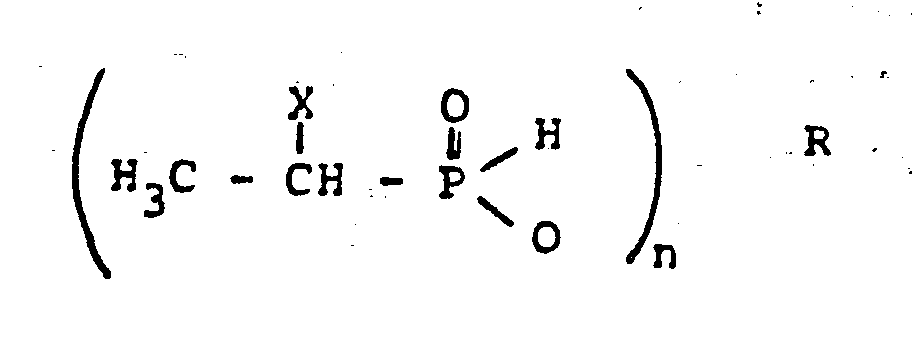
wherein X is hydroxyl or hydroxylamino, R is hydrogen, an inorganic counter cation, an organic counter cation or an ester residue and n is an integer of 1 to 3, and an inert carrier or diluent.
wherein X is hydroxyl or hydroxylamino, R is hydrogen, an inorganic counter cation, an organic counter cation or an ester residue and n is an integer of 1 to 3, and an inert carrier or diluent.
2. A composition according to claim 1, wherein X is hydroxyl and R is hydrogen, calcium
(II), magnesium (II), barium (II), iron (III), copper (II), zinc (II), manganese (II), C1-C10 alkoxy(Cl-C3)alkylammonium, naphthyl(C1-C2)alkylammonium, Cl-C6 alkyl, chloro(C1-C2)alkyl, Cl-C2 alkylthiomethyl or dichlorobenzyl.
3. A composition according to claim 1, wherein the active ingredient is 2-hydroxyethylphosphinic
acid.
4. A composition according to claim 1, wherein the active ingredient is calcium bis(2-hydroxyethylphosphinate).
5. A composition according to claim 1, wherein the active ingredient is (+)-2-hydroxyethylphosphinic
acid or (-)-2-hydroxyethylphosphinic acid.
6. A composition according to claim 1, wherein the active ingredient is calcium bis[(+)-2-hydroxyethyl-
phosphinate] or calcium bis[(-)-2-hydroxyethylphosphinate].
7. A herbicidal composition according to any one of the preceding claims wherein the
amount of said compound is 1-95% by weight, based on the weight of the composition.
8. A herbicidal composition according to claim 7 wherein the amount of said compound
is 2-80% by weight.
9. A method for controlling weeds which comprises applying a herbicidally effective
amount of a composition as claimed in any one of claims 1 to 8 to the area where the
weeds grow or will grow.
10. A method according to claim 9, wherein the herbicide is applied by foliar or soil
treatment.