|
(11) | EP 0 202 290 B1 |

| (12) | EUROPEAN PATENT SPECIFICATION |
|
|
| (54) |
DISPERSANTS DISPERGIERMITTEL DISPERSANTS |
|
|
|||||||||||||||||||||||||||||||
| Note: Within nine months from the publication of the mention of the grant of the European patent, any person may give notice to the European Patent Office of opposition to the European patent granted. Notice of opposition shall be filed in a written reasoned statement. It shall not be deemed to have been filed until the opposition fee has been paid. (Art. 99(1) European Patent Convention). |
Technical Field
[0001] This invention relates to dispersants, particularly pigment dispersants used in the preparation of paints and inks.
[0002] Dispersants aid in the dispersion of a pigment in a paint vehicle, that is, the film-forming resin and solvent of the paint. The pigment and vehicle are generally ground or milled together and the dispersant reduces the time needed to disperse the pigment in the vehicle and increases the degree of dispersion leading to higher opacity and colour value and improved gloss.
Background Art
[0003] Examples of pigment dispersants are described in British Patents Nos. 1108261, 1339930, 1346298, 1373660 and 1393401 and in U.S. Patent No. 3940353. such pigment dispersants are generally compounds containing a solvent-compatible organic radical of molecular weight at least 500 and a polar pigment-compatible radical.
[0004] Pigments dispersants can also be used to preparate dispersions of pigments in a solvent which can be mixed into different types of paints without requiring subsequent grinding or milling of the paint. Such pre- dispersions can be used to supply paint quickly without needing to keep stocks of many types of paint each in many colours. There is a need for a pigment dispersant which can be used in this way with a wide variety of film-forming resins and solvents.
Disclosure of Invention
[0005] A pigment dispersant according to the invention containing in its molecule a solvent-compatible organic radical R having a molecular weight of at least 500 and a pigment-compatible radical Z containing a polar group, is characterised in that the dispersant comprises a core radical D linked to a pigment-compatible radical Z containing a polar group and linked to more than one solvent-compatible organic radical R, the core radical D is the radical of an at least trifunctional compound Y having a molecular weight of less than 600 and is linked to the radicals R and Z by linkages derived from the functional groups of Y, at least one of which functional groups is epoxy group, and each solvent-compatible organic radical R has a molecular weight of 200 to 6000, provided that the average molecular weight of the radicals R is 500 to 6000.
[0006] A process for the preparation of a pigment dispersant according to the invention is characterised in that a compound Y having a molecular weight of less than 600 and containing at least three functional groups at least one of which is an epoxy group, is reacted simultaneously or successively with at least one compound of the formula R-X and with a compound of the formula Z-Xl, where R and Z have the meanings given in claim 1, X is a group capable with reacting with a functional group of the compound Y to link R to the radical D of compound Y, and X is a group capable of reacting with a functional group of the compound Y to link Z to the radical D of compound Y, the relative proportions of R-X and Y and, where appropriate, Z-X' being such that more than one radical R is linked to D.
[0007] Preferably Y is a trifunctional compound and reacts with the compound(s) R-X in a molar ratio of about 1:2 and with the compound Z-X' in a molar ratio of about 1:1. The trifunctional compound is preferably reacted first with the compound(s) R-X and subsequently with the compound Z-X'. For example it can be reacted with R-X in a molar ratio 1:1.5 to 1:2.5, and the proportion of the compound Z-X' used can be adjusted accordingly.
[0008] The product of the reaction is an any case generally a mixture; if the trifunctional compound is reacted with the compound(s) R-X at molar ratio 2:1 the major reaction product will contain two groups R bonded to the core radical but minor amounts of compounds containing one and three groups R bonded to the core radical will usually also be formed. The dispersant will accordingly contain minor amounts of compounds containing one solvent-compatible radical with two pigment compatible radicals and three solvent-compatible radicals with no pigment compatible radicals. Such reaction product mixtures can be used as dispersants according to the invention and may give as good or better dispersion than the pure compound.
[0009] The compound Y giving rise to the core radical D preferably contains at least three epoxy groups, for example three glycidyl groups. A particularly preferred trifunctional compound Y is triglycidyl isocyanurate. It can for example be bonded to the solvent-compatible radicals R and the pigment-compatible radical Z by reaction with carboxyl, amine or hydroxyl groups in the compounds R-X and Z-X'.
[0010] The linkages formed by the reaction of epoxy groups with carboxyl, amine or hydroxyl groups have the advantage that a secondary hydroxyl group is generated. Where a curing agent is used in the paint, for example in stoved paints or two-pack ambient temperature curing paints, such a secondary hydroxyl may react with the curing agent, ensuring that the dispersant is bound into the cured paint film. The hydroxyl group can for example react with melamine derivatives, isocyanates or anhydrides. The hydroxyl group may also improve the ability of the dispersant to disperse organic pigments. The dispersants according to the invention formed from compounds containing epoxy groups may also improve the adhesion of paints containing them to substrates such as metal and previously applied coats of paints.
[0011] The core radical D preferably contains an aromatic ring or a heterocyclic ring having some aromatic character, for example a pyridine, pyrimidine or pyrazine ring or a triazine ring, which can be in the form of melamine or isocyanuric acid or a derivative thereof.
[0012] The three functional groups in the compound Y forming the core radical D need not all be the same, for example the compound may contain two epoxy groups with a carboxyl group. If the functional groups are reactive with different functional groups in the compounds R-X an Z-X', compounds having two solvent-compatible organic radicals and one anchor group radical can readily be prepared in a relatively pure state. If the compound Y contains other functional groups than epoxy it can be bonded to the solvent-compatible radical or to the pigment-compatible radical by ester, ether, amide, amine or urethane linkages, which can for example be formed by the reaction of anhydride groups with hydroxyl or amine groups or by the reaction of hydroxyl groups with isocyanate groups, or by quaternary salt formation, for example by reacting a benzyl chloride group with a tertiary amine group.
[0013] The solvent-compatible organic radicals R can be the same or different. The radicals R generally improve the compatibility of the dispersant with film-forming resins as well as with organic solvents, particularly hydrocarbon solvents, used in paints. At least one of the radicals R preferably contains at least one hydrocarbon chain of at least ten carbon atoms. One example of a preferred radical R is a polyester of molecular weight 1000-3000. Such a polyester can for example be carboxy-functional for reaction with a trivalent epoxy functional compound such as triglycidyl isocyanurate. The carboxy-functional polyester may be formed from a dicarboxylic acid or anhydride having at least 10 carbon atoms with a diol, or from a diol having at least 10 carbon atoms with a dicarboxylic acid or an anhydride, but is preferably formed by polymerisation of a hydroxy-substituted carboxylic acid having at least 10 carbon atoms. The polyester-forming reagents preferably include a minor proportion of a monofunctional material.
[0014] Where the polyester is formed from a hydroxy-substituted carboxylic acid, a monofunctional acid is preferably used to produce a polyester containing a carboxyl end group or a monofunctional hydroxyl compound to produce a polyester containing a hydroxyl end group. The hydroxyl group in the carboxylic acid is preferably not in the omega position, so that the polyester has hydrocarbon side chains which aid the compatibility of the dispersant with hydrocarbon solvents. One preferred long-chain hydroxy-substituted carboxylic acid is 12-hydroxystearic acid, which is commercially available containing a minor proportion of stearic acid. An alternative long chain hydroxy-substituted carboxylic acid is ricinoleic acid. Dispersants containing poly(12-hydroxystearic acid) radicals, particularly those with a core radical derived from triglycidyl isocyaurate, are very effective in forming dispersions containing a high proportion of pigment with a low proportion of dispersant.
[0015] Alternative solvent-compatible polyester radicals can be prepared by the reaction of a diol, for example neopentyl, glycol, propylene glycol or ethylene glycol, with a dicarboxylic acid containing a long hydrocarbon chain, for example a fatty acid dimer. Carboxyl-terminated polyesters can be produced by the inclusion of a small proportion of monofunctional alcohol and hydroxy-terminated polyesters by the inclusion of a small proportion of monocarboxylic acid.
[0016] An alternative solvent-compatible polyester is polycaprolactone, which is commercially available as a hydroxy-tipped polymer. It can be used as such or can be reacted with an equimolar amount of an anhydride, for example phthalic anhydride, to provide a carboxyl-tipped polyester for reaction with a core radical having epoxy groups.
[0017] Alternative radicals R are derived from polyethers of molecular weight 600 to 2500, preferably about 1000, particularly tetrahydrofuran polymers (polytetramethylene glycol) which are commercially available having hydroxyl end groups. The polyether can be reacted with an appropriate difunctional reagent to introduce carboxyl or amine end groups for reaction with the trifunctional compound forming the core radical. Such polyether radicals R may be particularly valuable in forming a dispersant having good compatibility with epoxy and polyurethane film-forming resins.
[0018] Acrylic polymers of similar molecular weight can alternatively be used. These can contain a functional group such as carboxyl, hydroxy, epoxide, anhydride, isocyanate or amine in pendent groups or may be tipped by such a group, for example they may be carboxyl-tipped. Carboxyl-tipped acrylic polymers can be made by free radical polymerisation using an acid-functional initiator, for example azobis(cyanovaleric acid) and an acid-functional chain transfer agent, for example mercaptoacetic acid. The molecular weight of the acrylic polymer radical is preferably 800-6000, particularly 1000-4000. The acrylic polymer radical may include one or more pendent long-chain hydrocarbon groups having 8 or more carbon atoms, for example a stearyl, oleyl, lauryl, n-octyl or 2-ethylhexyl group introduced by polymerisation of stearyl, oleyl, lauryl, n-octyl 2-ethylhexyl methacrylate or acrylate, or it may include one or more pendent alicyclic groups, for example a bicyclic group such as an isobornyl group introduced by polymerisation of isobornyl acrylate or methacrylate. Acrylic polymer radicals R containing such alicyclic groups are particularly valuable in forming dispersants compatible with a wide range of film-forming resins. The polymer radical can for example be derived from a copolymer of 25-75 weight per cent isobornyl acrylate or methacrylate with 25-75 per cent of a lower alkyl acrylate or methacrylate such as methyl methacrylate or isobutyl methacrylate.
[0019] One of the radicals R can be a simple long-chain aliphatic radical derived from a fatty acid or alcohol; for example a stearoyl or oleoyl group can be introduced by reaction of stearic or oleic acid with an epoxide group in the trivalent compound. One or both of the radicals R can alternatively be derived from a dimer acid derived from an unsaturated fatty acid or a reactive polyamide produced therefrom. The use of an unsaturated fatty acid, such as a drying oil fatty acid derived from soya, tall oil or linseed oil, or ricinoleic acid, or a dimerised unsaturated fatty acid, either as one of the radicals R or as part of a polymer forming one or both radicals R, may give paints of improved properties. The adhesion of paints, particularly heat-cured paints, containing such an unsaturated dispersant to substrates, particularly metal, may be improved and the paints may have increased hardness.
[0020] Examples of dispersants containing different radicals R are the reaction products of a trifunctional core radical such as triglycidyl isocyanurate with poly(12-hydroxystearic acid) and with a carboxy-functional polyether formed by the reaction of equimolar amounts of polytetramethylene glycol and phthalic anhydride, or with one of the above solvent-compatible radicals, particularly poly(12-hydroxystearic acid) and a carboxy-functional isobornyl methacrylate or acrylate copolymer.
[0021] Examples of polar groups which can be included in the pigment-compatible radical include nitrogen- containing groups such as amino, nitro, amide, urea, nitrile or amine oxide groups and acid groups such as carboxylic or sulphonic acid groups which may be in acid or salt form. Preferred polar groups include amino groups, carboxylic acid groups in free acid form or as a salt with an alkali metal or amine, and nitro groups. The polar groups are preferably attached to an aromatic ring or to a heterocyclic ring having aromatic character. Amino groups have the advantages that they can react with many curing agents used in paints so that the dispersant is bound into the cured paint film.
[0022] The pigment-compatible radical Z can for example be derived from a primary or secondary amine containing a carboxylic acid group in its molecule, for example p-aminobenzoic acid. Such an amine-substituted acid can react with the trivalent compound forming the core radical either through its amine group, for example by reaction with an epoxide group, or through its carboxylic acid group to form an ester linkage. An amine-substituted sulphonic acid, e.g. taurine, can be reacted through its amine group. Alternatively a dicarboxylic acid can be reacted in proportions such that one acid group forms an ester linkage with the core radical and the other remains as a free carboxylic acid, which can be converted if desired into a salt, for example an ammonium, amine or quaternary ammonium salt, or an amide. A nitro-substituted aromatic carboxylic acid, for example p-nitrobenzoic acid or 3,5-dinitrobenzoic acid, is an alternative reagent for forming the anchor group radical by reaction of the acid to form an ester linkage. A diamine can be used to form the pigment-compatible radical for example by reaction with an epoxide group of the core radical. For example a primary diamine such as ethylene diamine can be reacted to form an anchor group having one secondary amine and one primary amine group.
[0023] Examples of preferred dispersants are those derived from triglycidyl isocyanurate and having the formula:
where R1 and R2 are solvent-compatible radicals, which may be the same or different, as defined above, Q is a divalent organic group which preferably comprises an aromatic ring and Q' is hydrogen or a monovalent organic group; or the formula:
where R1 and R have the above meanings and Z' is an aryl or aralkyl group ring-substituted by at least one nitro group.
[0024] The average molecular weight of the dispersant is preferably 1200-20000, most preferably 2000-10000.
[0025] The dispersant of the invention can be used with a wide range of pigments, solvents and film-forming resins. It can be used to disperse inorganic pigments and fillers such as titanium dioxide, zinc phosphate, barytes, red and yellow iron oxides, scarlet chrome and chrome yellow in solvents such as aliphatic hydrocarbons, for example white spirit, aromatic hydrocarbons, for example xylene, trimethylbenzene or toluene, ketones such as methyl isobutyl ketone, esters such as butyl acetate, alcohols such as butanol and ether alcohols such as 1-methoxy-2-propanol. The dispersant can also be used to disperse organic pigments such as phthalocyanine, azo, anthraquinone, thioindigo, isodibenzanthrone, triphendioxane or quinacridone pigments, vat dye pigments or lakes of acid, basic or mordant dyestuffs in the above solvents. When dispersing organic pigments, dispersants according to the invention are preferably used in conjuction with auxiliary dispersants of the type in which a radical of an organic pigment such as a phthalocyanine or azo pigment is bonded to a solvent-compatible radical. Examples of such auxiliary dispersants are sold under the Trade Marks Solsperse 5000 and Solsperse 22000.
[0026] The amount of dispersant used to prepare a pigment dispersion varies with the pigment to be dispersed but is preferably in the range 3-12 per cent by weight of the dispersion. For example a dispersion comprising 6 per cent by weight of a dispersant according to the invention, 70-75 per cent by weight of an inorganic pigment such as titanium dioxide or yellow iron oxide and 19-24 per cent by weight of an aromatic solvent such as trimethylbenzene is a stable dispersion which flows easily, as is a dispersion comprising 9 per cent by weight of a dispersant according to the invention, 3 per cent of an auxiliary dispersant as described above, 40 per cent of an organic pigment such as phthalocyanine blue and 48 per cent of an aromatic solvent.
[0027] Dispersants according to British Patent 1373660 and 1342746 such as the dispersant sold commercially under the Trade Mark 'Solsperse 17000' have similar dispersing power to the dispersants of the invention but have the disvantage that they reduce the adhesion to substrates of paints containing them. Paints containing the dispersants of the invention have improved adhesion compared to paints containing such prior art dispersants, both to substrates such as metals and primer paints and to subsequently applied coats of paint.
[0028] By comparison a commercially available dispersant based on an isobornyl methacrylate polymer according to US Patent 3940353, such as that sold under the Trade Mark 'DM 55', in many cases cannot achieve such a high pigment concentration in the dispersion and in any case needs to be used in substantially greater amounts to produce a stable fluid pigment dispersion containing the same pigment concentration. This leads to a relatively high concentration of dispersant in the paint film, which can reduce the properties of the paint film, particularly for high performance paints such as corrosion-resistant, weathering-resistant and chemically resistant paints. Pigment dispersants according to the invention in which at least one of the solvent-compatible radicals R comprises an acrylic polymer containing alicyclic groups, for example an isobornyl acrylate or methacrylate polymer, are compatible with as wide a range of film-forming resins and solvents as such prior art dispersants and are effective at much lower concentrations.
[0029] Pigment dispersions using the dispersant of the invention can be mixed with a wide range of film-forming resins, for example alkyd resins, oleoresins, chlorinated rubbers, acrylic polymers, polyesters, polyamides, vinyl resins, urethane resins including urethane alkyds, epoxy resins, styrenated alkyds or nitrocellulose in solution in an organic solvent to form a stable paint. The dispersant gives good resistance to flocculation upon mixing of the pigment dispersion with a film-forming resin solution. Paints containing pigment dispersions according to the invention can be mixed with curing agents such as melamine resins, polyisocyanates, and epoxy resins for use in stoving paints or two-pack paints without deleterious effect.
[0030] The dispersant can alternatively be mixed with the resin solution and pigment to produce a paint with a greatly reduced grinding time, for example 2 to 8 hours compared to more than a day. In either case the paint has improved tinctorial strength.
[0031] The dispersants of the invention can also be used to disperse pigments in printing inks or to disperse dyestuffs for use in disperse dyeing. The dispersants of the invention can also be used in the colouring of plastics materials, for example by forming a pigment dispersion in an organic liquid such as a plasticiser which is subsequently compounded with the plastics material. Examples of plastics materials which can be so coloured include polyvinyl chloride, polypropylene and polyesters. Examples of liquid plasticisers which can be used in the dispersion medium are ester plasticisers such as phthalate diesters, e.g. dioctyl phthalate, and liquid hydrocarbon polymers such as low molecular weight polybutene.
Modes for carrying out the Invention
[0032] The invention is illustrated by the following examples in which parts and percentages are by weight:
Example 1
Reaction A
[0033] A mixture of 22.5 parts of trimethyl benzene («Solvesso 100») and 50 parts of a commercial grade of 12-hydroxystearic acid having minimum acid and hydroxyl values of 175 and 150 respectively was heated to 100°C under nitrogen and 0.1 part of methane sulphonic acid added. The temperature was then held at between 130 and 140°C for 8 hours with sufficient vacuum applied to enable collection of the water formed during the reaction in a Dean and Stark separator. The resulting polyester had an acid value of 36.2 mg/KOH/g non-volatiles and was pale brown in colour.
Reaction B
[0034] 0.23 parts dimethyl lauryl amine and 4.62 parts of tri-glycidyl isocyanurate were added to the polyester solution of reaction A and heated for 8 hours under nitrogen at 140°C. The resulting solution had an acid value of 0.46.
Reaction C
[0035] 2.1 parts of 4-aminobenzonic acid were added to the solution produced in reaction B and heated for 8 hours at 140°C under nitrogen. The resulting solution was then diluted to 60 per cent solids with trimethyl benzene and filtered through Celite filter aid. The final product had an acid value of 9.4.
Pigment Dispersion A
[0036] 10 parts of the dispersing agent solution produced in Reaction C was diluted with 1 parts of trimethyl benzene and 75 parts of titanium dioxide was added under high speed stirring. The resulting dispersion was of low viscosity and well deflocculated.
Pigment Dispersion B
[0037] 15 parts of the dispersing agent solution produced in Reaction C was diluted with 42 parts trimethyl benzene. 3 parts of Solsperse 5000 (an auxiliary dispersant based on a modified pigment) and 40 parts phthalocyanine blue were then added and the mixture was passed through a bead mill to reduce the particle size of the pigment. The resulting dispersion was of low viscosity and well deflocculated.
Paint preparation
[0038] 30 parts of pigment dispersion A and 10 parts of pigment dispersion B were briefly stirred with 60 parts of a 60 per cent solution of an air-drying alkyd resin in white spirit giving a paint without flocculation.
[0039] Paints could similarly be prepared without flocculation using a short oil alkyd or a long oil alkyd as the film-forming resin.
Comparative experiment
[0040] Two pigment dispersions A' and B' and a paint based on an air-drying alkyd resin were prepared as described above, but using the commercial dispersant «Solsperse 17000» in place of the dispersant of the invention. The dispersions prepared had the same low viscosity and there was little flocculation on mixing with the resin solution.
[0041] Both paints were applied to steel panels and were allowed to dry. When the paints were dry a crosshatch adhesion test was carried out. The paint films were scored through to metal in a pattern of 10 x 10 scribes 3 mm apart and «Scotchtape 610» adhesive tape was applied. The paint containing the dispersant of the invention rated 100 (that is, none of the squares of the paint were removed by the adhesive tape). The paint containing «Solsperse 17000» rated 0 (that is, all the squares of paint were removed by the adhesive tape.
Example 2
[0042] 3.2 parts of 3,5-dinitrobenzonic acid were added to the solution produced in Reaction B of Example 1 and heated for 8 hours at 140°C under nitrogen. The resulting solution was diluted to 60 per cent solids with trimethyl benzene and filtered through Celite filter aid. The final product had a acid value of 0.9.
[0043] The dispersing agent solution produced could be used to produce pigment dispersion and paints in the same way as the product of Example 1.
Example 3
[0044] Poly(12-hydroxystearic acid) was reacted with triglycidyl isocyanurate as described in Reactions A and B of Example 1 to produce a product having an acid value of 0.5 and an average of 2 polyhydrox- ystearic acid chains attached to each triglycidyl isocyanurate molecule by ester linkages. This was obtained as a 70 per cent solution in trimethylbenzene (intermediate 1).
[0045] Intermediate 1 was reacted with ethylene diamine at a molar ratio of 1:1 for 30 minutes at a 120°C to produce a dispersant having the anchor group:-
attached to the remaining nitrogen atom of the isocyanurate ring.
[0046] 15 parts of the dispersing agent solution produced above was diluted with 42 parts trimethylbenzene. 3 parts of Solsperse 22000 (an auxiliary dispersant based on a modified pigment) and 40 parts «Pigment Yellow G», an organic yellow pigment, were then added and the mixture was bead milled. The resulting dispersion was of low viscosity and well deflocculated. 40 parts of the pigment dispersion was briefly stirred with 60 parts of a 60 per cent solution of a short oil alkyd resin in white spirit giving a paint without flocculation.
Example 4
[0047] Intermediate 1 of Example 3 was reacted with adipic acid at a 1:1 1 molar ratio for 2 hours at 140 ° C to produce a dispersant solution having an acid value of 20. The dispersant had the anchor group:-
attached to the remaining nitrogen atom of the isocyanurate ring. This dispersant containing a free carboxylic acid group could be used as such or could be converted into an alkali metal, ammonium or amine salt.
Example 5
[0048] Part of the dispersant solution produced in Example 4 was reacted with an equimolar amount of n-butylamine at 140°C for 30 minutes with removal of water formed during the reaction to produce the N-n-butylamide of the dispersant of Example 4.
Example 6
[0049] Intermediate 1 from Example 3 was reacted with taurine at a molar ratio of 1:1 for two hours at 140 ° C to produce a solution of a dispersant having anchor groups of the formula:-
[0050] Pigment dispersions and paints were produced using the dispersants of Example 4 (both in free acid and in ammonium salt form), 5 and 6 in place of the dispersant of Example 3 in the formulation of Example 3. Low viscosity pigment dispersions were produced from each dispersant and none of them gave any flocculation on mixing with the alkyd resin solution.
Example 7
[0051] 100 g Terathane 1000 (Trade Mark) polytetramethylene glycol of molecular weight about 1000 was melted at 100°C. 15 g phthalic anhydride and 0.75 g N,N-dimethyl lauryl amine catalyst were dissolved in the melt and heated to 150°C for 30 minutes to produce a carboxyl tipped polyether of the formula:-
where n has an average value of about 13.
[0052] Methoxypropanol was added to the product at 150°C to give a 60 per cent solution. 14.5 g triglycidyl isocyanurate was added to the solution and reacted at 150°C until the acid value dropped to 0.5. 6.5 g p-aminobenzonic acid was added and reacted at 150°C for 30 minutes. The solvent was removed by vaccum distillation and the product was redissolved in Solvesso 100 to give a 60 per cent solution.
[0053] Pigment dispersions of 4 different pigments were prepared from this dispersant solution. The composition of the pigment dispersions and their method of preparation is shown in Table 1. In all cases a well dispersed fluid dispersion was achieved. The pigment dispersions were stirred into 3 different paint bases, namely an alkyd resin base, an epoxy resin base and a polyurethane base. All the paint bases comprised a 60 per cent solution of the paint resin pigmented with 22.5 per cent white titanium dioxide pigment. The ratio of the mixing of the paint base and pigment dispersion was 9:1 by volume for the inorganic yellow, inorganic white and organic blue pigments and 8:2 by volume for the organic yellow pigment. The presence or absence of flocculation during mixing was noted in each case. The paint produced was painted on a metal coupon to observe its gloss. The results are quoted in Table 1.
[0055] The degree of gloss achieved in the alkyd resin paints, although satisfactory, was not as good as that achieved in alkyd resin paints using the dispersant of Example 1 or using the commercial dispersant «Solsperse 17000». The gloss and freedom from flocculation in epoxy resin paints, however, were at least as good as that achieved using the dispersants or Example 1 or Solsperse 17000, and the gloss and absence of flocculation in the polyuretane paint were considerably better.
Example 8
[0056] A dispersant was prepared using the process of Example 7 from a polytetramethylene glycol polyether of molecular weight 650 sold commercially under the Trade Mark «Teracol 650». The amounts of reagents used in preparing the dispersant were as follows:-
[0057]
Pigment dispersions having the formulations shown in Table 1 were prepared but using the dispersants of Example 8 in place of that of Example 7. Fluid dispersions were achieved in all cases. The pigment dispersions were let down into alkyd, epoxy and polyurethane paints as described in Example 7. No flocculation was observed in any preparation. The alkyd paints had a good gloss similar to that obtained using the dispersant of Example 1. The epoxy paints also had a good gloss although they were slightly less glossy than paints using the dispersants of Examples 1 and 7. The polyurethane paints, although they could be prepared without flocculation, did not have a good gloss.
Example 9
[0058] 57.4 g of the carboxyl tipped polyether produced from «Terathane 1000» and phthalic anhydride in Example 7 and 85.5 g poly(12-hydroxy stearic acid) as used in Example 1 were dissolved together at 60 per cent in methoxy propanol at 150°C. 14.85 g triglycidyl isocyanurate was added and reacted at 150°C until the acid value dropped to 0. 5. 6.85 g p-amino benzoic acid was then added and reacted at 150°C for 30 minutes. The dispersant produced was redissolved in Solvesso 100 as described in Example 7 to give a 60 per cent solution.
[0059] Pigment dispersion were prepared as described in Table 1 but using the dispersants of Example 9 in place of that of Example 7. Fluid dispersions were obtained in each case. The pigment dispersions were let down into alkyd, epoxy and polyurethane paints as described in Example 7. No flocculation was observed in any preparation. The alkyd and epoxy paints had a good gloss, substantially equal to paints prepared using the dispersants of Example 1 and of Example 8. The polyurethane paints also had a fairly good gloss; they were not as glossy as the polyurethane paints prepared in Example 7 but were much better than the polyurethane paints prepared using the dispersant of Example 1 or «Solsperse 17000».
Example 10
[0060] Ricinoleic acid (300 g), trimethyl benzene (75 g) and Fascat 4101 (3 g) (butyl chloro tin dihydroxide catalyst) were charged to a reaction vessel, set up for reflux, fitted with a Dean-Stark trap. The mixture was heated under reflux for 10.5 hours. The final acid value of the polyricinoleic acid solution produced was 33.9.
[0061] 250 g of the above solution was heated to 130°C under reflux then dimethyl lauryl amine (1.1 g) and triglycidyl isocyanurate (22.4 g) were added. When the acid value of the solution had fallen to 0.3, p-aminobenzoic acid (10.35 g) was added and thetem- perature maintained at 110-115°C for 30 minutes.
[0063] The mixture was milled for 5 minutes at 5,000 r.p.m on a bead mill and the resulting dispersions let down into white alkyd paint (20 parts dispersion: 80 white alkyd). There was no flocculation. The colour strength and gloss of the paint produced was equal to that produced using the dispersant of Example 1 or «Solsperse 17000».
[0064] The effect of Solsperse 17000 and the dispersant of Example 10 on the adhesion of air drying alkyds was tested. 4% dispersant (based on resin) was added to each resin solution (60% resin in white spirit), then the solutions were cast onto steel panels and stoved for 30 minutes at 120°C. A crosshatch adhesion test was carried out as described in Example 1; the results were as follows:-
Example 11
[0066] Pripol 1010 (Trade Mark) dimer acid (a fatty acid dimer) (300 g), neopentyl glycol (54.9 g), octanoic acid (25.8 g), toluene (60 cm3) and methane sulphonic acid (0.38 g) were heated under reflux in a reaction vessel fitted with a Dean-Stark trap. After 3.5 hours the acid value had fallen to 26.1, and the toluene was removed by vacuum distillation.
[0067] The polyester produced was dissolved in 200 cm3 of 4:1 vol/vol methoxypropanol:trimethylbenzene and the solution heated to 90°C. 2 g dimethyl lauryl amine was added followed by 24.9 g triglycidyl isocyanurate and the temperature raised to 120°C. This temperature was maintained until the acid value of the solution had fallen to 0.43. p-Aminobenzoic acid (11.5 g) was then added. The reaction was allowed to continue at 120°C for a further 45 minutes prior to removing the solvent by vacuum distillation.
Example 12
[0069] Butyl acetate (200 g) was heated to 90°C in a 1 litre flanged reaction vessel. The manomer solution comprising butyl acetate (100 g), ethanol (2.6 g), mercaptoacetic acid (14 g), 4,4' azobis(4-cyanovaleric acid) (3 g), and isobornyl methacrylate (318.2 g). This solution was added to the reaction vessel over a period of 8 minutes, then the temperature maintained at 90°C for 4 hours. The solvent was then removed by vacuum distillation. GPC indicated a peak m.wt. of 2000 relative to polystyrene calibration standards.
[0070] 250 g of the product was dissolved in methoxypropanol (167 g) and heatedto 90°C priorto adding dimethyl lauryl amine (0.92 g) followed by triglycidyl isocyanurate (18.5 g). The temperature was then increased to 120°C, and this temperature maintained until the acid value of the solution had fallen to 0.4. p-Aminobenzoic acid was then added. After 30 minutes at 120°C the solvent was removed by vacuum distillation.
[0071] The dispersing agent was evaluated by preparing a dispersion of Pigment Yellow'G', using the dispersing agent in conjunction with Solsperse 22000. The dispersion was then added to white alkyd, polyurethane and epoxy paints; films were cast and showed no significant flocculation.
Example 13
[0073] A monomer solution comprising isobornyl acrylate (594 g), ethyl acetate (150 g), butyl acetate (150 g), ethanol (10 g), mercaptoacetic acid (28 g) and 4 4' azobis (4-cyanovaleric acid) (6 g) was added over a period of one hour to ethyl acetate (150 g) and butyl acetate (150 g) in a flanged reaction vessel. The temperature was kept between 85-93°C during the addition. The polymerisation was allowed to continue for a further 4 hours prior to removing the solvent by vacuum distillation. GPC of the polymer gave a peak M,wt. of 2,000 relative to polystyrene calibration standard.
[0074] Methoxypropanol (400 g) was added to the polymer and the mixture warmed to dissolvethe polymer, then heated to 90°C. Dimethyl lauryl amine (2.6 g), then triglycidyl isocyanurate (51.7 g), were added, and the temperature increased to 120°C. This temperature was maintained until the acid value of the solution had fallen to 0.5. p-Aminobenzoic acid (23.8 g) was added. After 30 minutes the solution was allowed to cool and filtered and the solvent was removed by vacuum distillation. GPC of the product gave peak m.wt. of 4,000 relative to a polystyrene standard.
[0075] The dispersant was evaluated as described in Example 12 and produced a pigment dispersion having the same good compatibility with alkyd, polyurethane and epoxy paints.
Example 14 to 76
[0076] 3 further dispersants containing acrylic polymer chains were prepared using the process of Example 13. The formulations used in the first stage to prepare the carboxy functional acrylic polymer were as follows:-
[0077] The acrylic polymers were then each reacted with triglycidyl isocyanurate, followed by reaction of the product with p-aminobenzoic acid in the proportions set out below:-
[0078] The dispersants were each used to prepare a fluid dispersion of pigment yellow G as described in Example 12. The pigment dispersions were let down in alkyd, polyurethane and epoxy paints. The dispersions of Examples 14 and 15 showed good compatibility with all 3 types of paint and formed glossy paint films in each case. The dispersion of Example 16 showed good compatibility with alkyd and epoxy paints but there were some flocculation when it was added to the polyurethane paint base and films formed from the resulting paint were not as glossy as those produced in Examples 12 to 15.
1. A pigment dispersant containing in its molecule a solvent-compatible organic radical
R having a molecular weight of at least 500 and a pigment-compatible radical Z containing
a polar group, characterised in that the dispersant comprises a core radical D linked
to a pigment-compatible radical Z containing a polar group and linked to more than
one solvent-compatible organic radical R, the core radical D is the radical of an
at least trifunctional compound Y having a molecular weight of less than 600 and is
linked to the radicals R and Z by linkages derived from the functional groups of Y,
at least one of which functional groups is an epoxy group, and each solvent-compatible
organic radical R has a molecular weight of 200 to 6000, provided that the average
molecular weight of the radicals R is 500 to 6000.
2. A pigment dispersant according to claim 1, characterised in that the core radical
D is the radical of a compound Y containing at least three epoxy functional groups.
3. A pigment dispersant according to claim 2, characterised in that the core radical
D is the radical of triglycidyl isocyanurate.
4. A pigment dispersant according to any of claims 1 to 3, characterised in that the
solvent-compatible radicals R comprise polyester radicals of molecular weight 1000
to 3000.
5. A pigment dispersant according to claim 4, characterised in that the polyester
radicals are poly (12-hydroxystearic acid) radicals.
6. A pigment dispersant according to any of claims 1 to 3, characterised in that the
solvent-compatible radicals R comprise polyether radicals of molecular weight 600
to 2500.
7. A pigment dispersant according to claim 6, characterised in that the polyether
radical is a tetrahydrofuran polymer radical.
8. A pigment dispersant according to any of claims 1 to 3, characterised in that the
solvent-compatible radicals R comprise acrylic polymer radicals of molecular weight
800 to 6000.
9. A pigment dispersant according to claim 8, characterised in that the acrylic polymer
radicals have pendent alicyclic groups.
10. A pigment dispersant according to claim 9, characterised in that the acrylic polymer
radical is a radical of a polymer or copolymer of isobornyl acrylate or isobornyl
methacrylate.
11. A pigment dispersant according to any of claims 1 to 3, characterised in that
the solvent-compatible radicals R comprise radicals of at least two chemically different
types.
12. A pigment dispersant according to claim 11, characterised in that the solvent-compatible
radicals R comprise a poly(12-hydroxystearic acid) radical and a polyether radical
of molecular weight 600 to 2500.
13. A pigment dispersant according to claim 11, characterised in that the solvent-compatible
radicals R comprise a poly(12-hydroxystearic acid) radical and a radical of a polymer
or copolymer of isobornyl acrylate or isobornyl methacrylate.
14. A pigment dispersant according to any of claims 1 to13, characterised in that
the pigment-compatible radical Z comprises a polar group selected from amino, nitro,
amide, urea, nitrile and amine oxide groups and carboxylic or sulphonic acid groups
and salts of such acid groups.
15. A pigment dispersant according to claim 14, characterised in that the polar group
in the pigment-compatible radical Z is attached to an aromatic ring or to a heterocyclic
ring having aromatic character.
16. A pigment dispersant according to claim 14, characterised in that the pigment-compatible
radical Z is derived from a primary or secondary amine containing a carboxylic or
sulphonic acid group in its molecule.
17. A pigment dispersant according to claim 16, characterised in that the pigment-compatible
radical Z is the amino radical of p-aminobenzoic acid.
18. A pigment dispersant having the formula:-
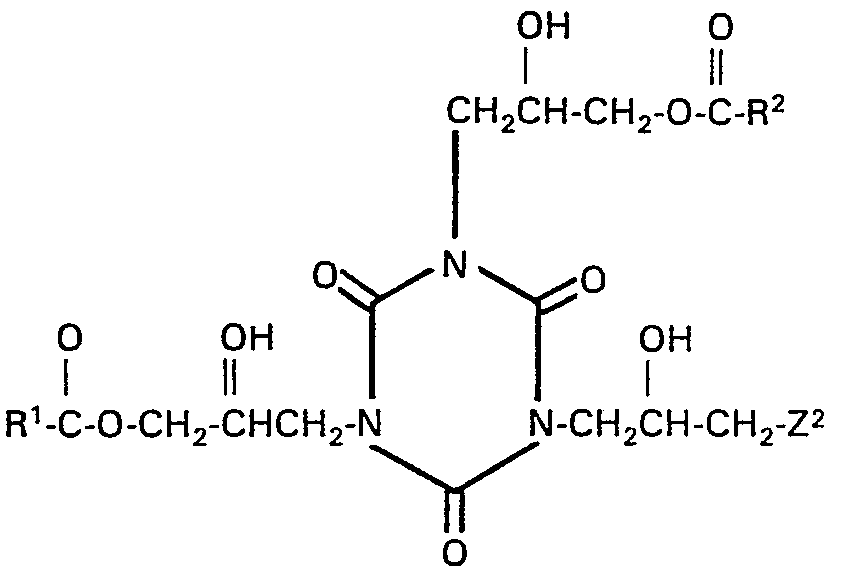
where R'and R2 are solvent-compatible organic radicals having a molecular weight of 200 to 6000 which are the same or different, the average molecular weight of the solvent-compatible radicals R1 and R2 being 500 to 6000, and Z2 is a pigment-compatible radical containing a polar group and linked to the remainder of the dispersant via an amine group.
where R'and R2 are solvent-compatible organic radicals having a molecular weight of 200 to 6000 which are the same or different, the average molecular weight of the solvent-compatible radicals R1 and R2 being 500 to 6000, and Z2 is a pigment-compatible radical containing a polar group and linked to the remainder of the dispersant via an amine group.
19. A pigment dispersant according to claim 18, characterised in that Z2 is a radical of the formula
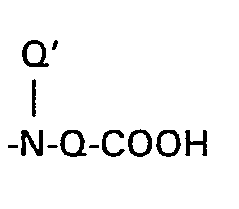
where Q is a divalent organic group and Q' is hydrogen or a monovalent organic group.
where Q is a divalent organic group and Q' is hydrogen or a monovalent organic group.
20. A pigment dispersant having the formula:-
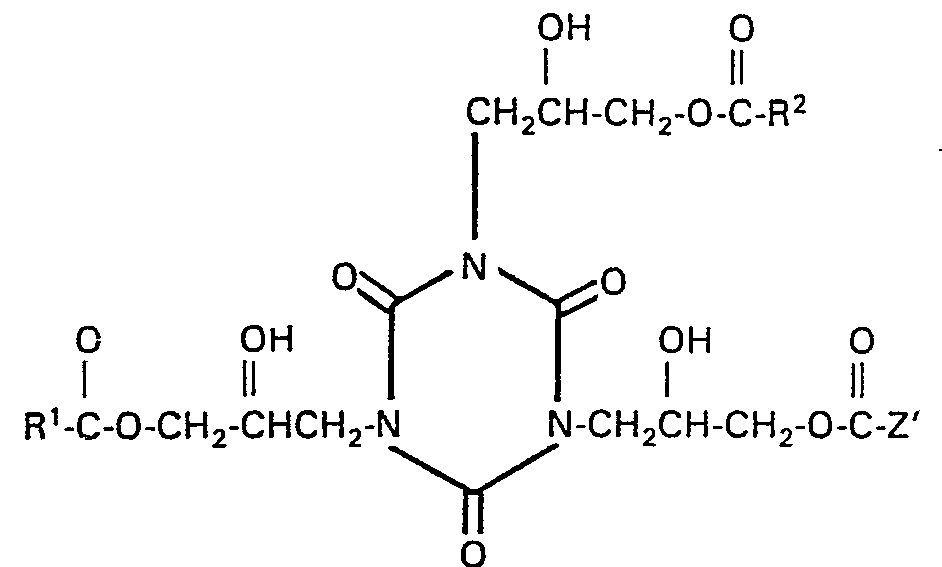
where R1 and R2 are solvent-compatible organic radicals having a molecular weight of 200 to 6000 which are the same or different, the average molecular weight of the solvent-compatible radical R1 and R2 being 500 to 6000, and Z is a pigment-compatible radical containing a polar group.
where R1 and R2 are solvent-compatible organic radicals having a molecular weight of 200 to 6000 which are the same or different, the average molecular weight of the solvent-compatible radical R1 and R2 being 500 to 6000, and Z is a pigment-compatible radical containing a polar group.
21. A pigment dispersant according to claim 20, characterised in that Z1 is an aryl or aralkyl group ring-substituted by at least one nitro group.
22. A pigment dispersant according to any of claims 1 to 21, characterised in that
it has an average nolecular weight of 1200 to 20000.
23. A pigment dispersant according to any of ;laims 1 to 21, characterised in that
it has an average molecular weight of 2000 to 10000.
24. A process for the preparation of a pigment dispersant as defined in claim 1, characterised
in that a compound Y having a molecular weight of less than 600 and containing at
least three functional groups, at least one of which is an epoxy group, is reacted
simultaneously or successively with at least one compound of the formula R-X and with
a compound of the formula Z-XI, where R and Z have the meanings given in claim 1, X is a group capable of reacting
with a functional group of the compound Y to link R to the radical D of compound Y,
and X1 is a group capable of reacting with a functional group of the compound Y to link
Z to the radical D of compound Y, the relative proportions of R-X and Y and, where
appropriate, Z-Xl being such that more than one radical R is linked to D.
25. A process according to claim 24, characterised in that the compound Y is a trifunctional
compound and is reacted first with the compound or compounds of the form R-X in a
molar ratio of 1:1.5 to 1 :2.5 and then with the compound Z-X' in a molar ratio of
1:1.5 to 1:0.5.
26. A pigment dispersant when prepared by a process according to claim 24 or claim
25.
27. A fluid dispersion of a pigment in an organic fluid characterised in that the
dispersion contains a pigment dispersant according to any of claims 1 to 23 or 26.
28. A dispersion according to claim 27, characterised in thatthe dispersion contains
3 to 12 percent by weight of the pigment dispersant.
29. A process for the preparation of paint or ink by grinding together a pigment,
a film-forming resin and a solvent, characterised in that a pigment dispersant according
to any of claims 1 to 23 or 26 is present during grinding.
30. A process for the colouration of plastics material, characterised in that a pigment
is dispersed in an organic liquid in the presence of a pigment dispersant according
to any of claims 1 to 23 or 26 and the dispersion so formed is mixed with the plastics
material.
1. Farbdispergiermittel, in dessen Molekül ein lö- . sungsmittelverträglicher organischer
Rest R mit einem Molekulargewicht von mindestens 500 und ein pigmentvertäglicher Rest
Z mit einer polaren Gruppe enthalten ist, dadurch gekennzeichnet, dass das Dispergiermittel
aus einem mit einem pigmentverträglichen, eine polare Gruppe enthaltenden Rest Z und
mit mehr als einem lösungsmittelverträglichen organischen Rest R verknüpften Kernrest
D besteht, der Kernrest D der Rest einer mindestens trifunktionellen Verbindung Y
mit einem Molekulargewicht von weniger als 600 ist und mit den Resten R und Z durch
von den funktionellen Gruppen von Y abgeleiteten Verknüpfungen verbunden ist, wobei
mindestens eine dieser funktionellen Gruppen eine Epoxygruppe ist, und jeder lösungsmittelverträgliche
organische Rest R ein Molekulargewicht von 200 bis 6000 aufweist, vorausgesetzt, dass
das mittlere Molekulargewicht der Reste R 500 bis 6000 beträgt.
2. Farbdispergiermittel gemäss Anspruch 1, dadurch gekennzeichnet, dass der Kernrest
D der Rest einer Verbindung Y mit mindestens drei epoxyfunktionellen Gruppen ist.
3. Farbdispergiermittel gemäss Anspruch 2, dadurch gekennzeichnet, dass der Kernrest
D der Rest eines Triglycidylisocyanurats ist.
4. Farbdispergiermittel gemäss einem der Ansprüche 1 bis 3, dadurch gekennzeichnet,
dass die lösungsmittelverträglichen Reste R aus Polyesterresten mit einem Molekulargewicht
von 1000 bis 3000 bestehen.
5. Farbdispergiermittel gemäss Anspruch 4, dadurch gekennzeichnet, dass die Polyesterreste
Poly-(12-hydroxystearinsäure)-reste sind.
6. Farbdispergiermittel gemäss einem der Ansprüche 1 bis 3, dadurch gekennzeichnet,
dass die lösungsmittelverträglichen Reste R aus Polyätherresten mit einem Molekulargewicht
von 600 bis 2500 bestehen.
7. Farbdispergiermittel gemäss Anspruch 6, dadurch gekennzeichnet, dass der Polyätherrest
ein Tetrahydrofuranpolymerrest ist.
8. Farbdispergiermittel gemäss einem der Ansprüche 1 bis 3, dadurch gekennzeichnet,
dass die lösungsmittelverträglichen Reste R aus Acrylpolymerresten mit einem Molekulargewicht
von 800 bis 6000 bestehen.
9. Farbdispergiermittel gemäss Anspruch 8, dadurch gekennzeichnet, dass die Acrylpolymerreste
seitenständige alicyclische Gruppen aufweisen.
10. Farbdispergiermittel gemäss Anspruch 9, dadurch gekennzeichnet, dass der Acrylpolymerrest
ein Rest eines Polymers oder Copolymers von Isobornylacrylat oder Isobornylmethacrylat
ist.
11. Farbdispergiermittel gemäss einem der Ansprüche 1 bis 3, dadurch gekennzeichnet,
dass die lösungsmittelverträglichen Reste R aus Resten mindestens zweier chemisch
verschiedener Arten bestehen.
12. Farbdispergiermittel gemäss Anspruch 11, dadurch gekennzeichnet, dass die lösungsmittelverträglichen
Reste R aus einem Poly-(12-hydroxystearinsäure)-rest und einem Polyätherrest mit einem
Molekulargewicht von 600 bis 2500 bestehen.
13. Farbdispergiermittel gemäss Anspruch 11, dadurch gekennzeichnet, dass die lösungsmittelverträglichen
Reste R aus einem Poly-( 12-hydroxystearinsäure)-rest und einem Rest eines Polymers
oder Copolymers von Isobornylacrylat oder Isobornylmethacrylat bestehen.
14. Farbdispergiermittel gemäss einem der Ansprüche 1 bis 13, dadurch gekennzeichnet,
dass der pigmentverträgliche Rest Z eine unter den Gruppen Amino, Nitro, Amid, Harnstoff,
Nitril und Aminoxid sowie Carbon- oder Sulfonsäuren und Salzen jener Säuren ausgewählte
polare Gruppe enthält.
15. Farbdispergiermittel gemäss Anspruch 14, dadurch gekennzeichnet, dass die polare
Gruppe im pigmentvertäglichen Rest Z an einen aromatischen oder heterocyclischen Ring
mit aromatischem Charakter gebunden ist.
16. Farbdispergiermittel gemäss Anspruch 14, dadurch gekennzeichnet, dass der pigmentverträgliche
Rest Z von einem primären oder sekundären Amin abgeleitet ist, in dessen Molekül sich
eine Carbon-oder Sulfonsäure Gruppe befindet.
17. Farbdispergiermittel gemäss Anspruch 16, dadurch gekennzeichnet, dass der pigmentverträgliche
Rest Z der Aminorest von p-Aminobenzoesäure ist.
18. Farbdispergiermittel mit der Formel:
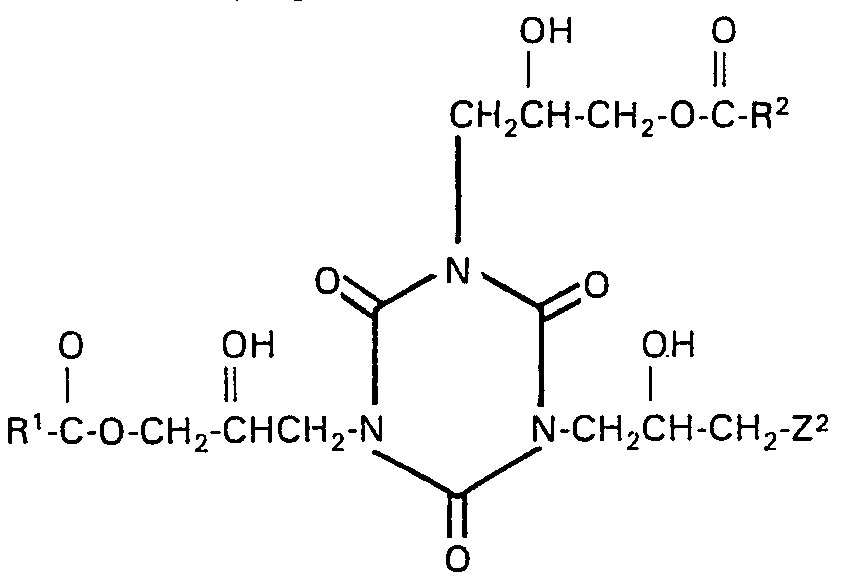
worin RI und R2 gleiche oder verschiedene lösungsmittelverträgliche organische Reste mit einem Molekulargewicht von 200 bis 6000 sind, wobei das mittlere Molekulargewicht der lösungsmittelabhängigen Radikale RI und R2 500 bis 6000 beträgt, und Z2 ein pigmentverträglicher, eine polare Gruppe enthaltender und mit dem Rest des Dispergiermittels über eine Amingruppe verknüpfter Rest ist.
worin RI und R2 gleiche oder verschiedene lösungsmittelverträgliche organische Reste mit einem Molekulargewicht von 200 bis 6000 sind, wobei das mittlere Molekulargewicht der lösungsmittelabhängigen Radikale RI und R2 500 bis 6000 beträgt, und Z2 ein pigmentverträglicher, eine polare Gruppe enthaltender und mit dem Rest des Dispergiermittels über eine Amingruppe verknüpfter Rest ist.
19. Farbdispergiermittel gemäss Anspruch 18, dadurch gekennzeichnet, dass Z2 ein Rest der Formel
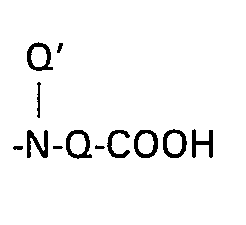
ist, worin Q eine zweiwertige organische Gruppe und Q' Wasserstoff oder eine einwertige organische Gruppe ist.
ist, worin Q eine zweiwertige organische Gruppe und Q' Wasserstoff oder eine einwertige organische Gruppe ist.
20. Farbdispergiermittel der Formel:
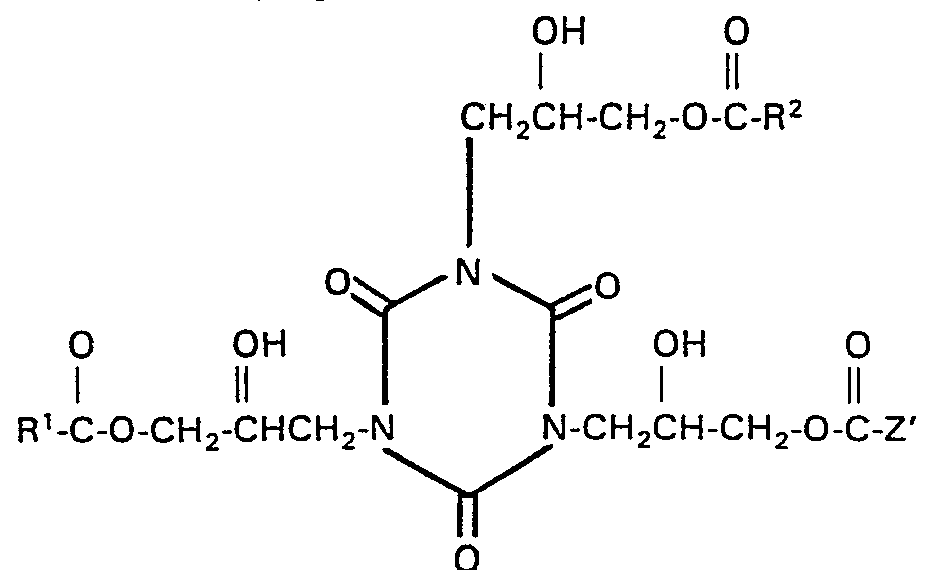
worin R1 und R2 gleiche oder verschiedene lösungsmittelverträgliche organische Reste mit einem Molekulargewicht von 200 bis 6000 sind, wobei das mittlere Molekulargewicht der lösungsmittelverträglichen Reste R1 und R2 500 bis 6000 beträgt, und Z ein pigmentverträglicher Rest mit einer polaren Gruppe ist.
worin R1 und R2 gleiche oder verschiedene lösungsmittelverträgliche organische Reste mit einem Molekulargewicht von 200 bis 6000 sind, wobei das mittlere Molekulargewicht der lösungsmittelverträglichen Reste R1 und R2 500 bis 6000 beträgt, und Z ein pigmentverträglicher Rest mit einer polaren Gruppe ist.
21. Farbdispergiermittel gemäss Anspruch 20, dadurch gekennzeichnet, dass Z1 eine mit mindestens einer Nitrogruppe ringsubstituierte Aryl- oder Aralkylgruppe
ist.
22. Farbdispergiermittel gemäss einem der Ansprüche 1 bis 21, dadurch gekennzeichnet,
dass es ein mittleres Molekulargewicht von 1200 bis 20000 hat.
23. Farbdispergiermittel gemäss einem der Ansprüche 1 bis 21, dadurch gekennzeichnet,
dass es ein mittleres Molekulargewicht von 2000 bis 10000 hat.
24. Verfahren zur Herstellung eines Farbdispergiermittels mit der in Anspruch 1 genannten
Bedeutung, dadurch gekennzeichnet, dass man eine mindestens dreifunktionelle Gruppen,
von denen zumindest eine eine Epoxygruppe ist, enthaltende Verbindung Y mit einem
Molekulargewicht von weniger als 600 gleichzeitig oder nacheinander mit mindestens
einer Verbindung der Formel R-X und mit einer Verbindung der Formel Z-X' reagieren
lässt, wobei R und Z die in Anspruch 1 gegebene Bedeutung haben, X eine mit einer
funktionellen Gruppe der Verbindung Y reaktionsfähige Gruppe ist, wodurch R mit dem
Rest D der Verbindung Y verknüpft wird, und X1 eine mit einer funktionellen Gruppe der Verbindung Y reaktionsfähige Gruppe ist,
wodurch Z mit dem Rest D der Verbindung Y verknüpft wird, wobei die Mengenverhältnisse
von R-X und Y und gegebenenfalls Z-X' derart sind, dass mehr als ein Rest R mit D
verknüpft wird.
25. Verfahren gemäss Anspruch 24, dadurch gekennzeichnet, dass die Verbindung Y eine
trifunktionelle Verbindung ist und zuerst mit der Verbindung oder den Verbindungen
vom Typ R-X in einem Molverhältnis von 1:1,5 bis 1:2,5 und dann mit der Verbindung
Z-X' in einem Molverhältnis von 1:1,5 bis 1:0,5 umgesetzt wird.
26. Farbdispergiermittel, das nach einem Verfahren gemäss Anspruch 24 oder Anspruch
25 hergestellt wird.
27. Flüssige Dispersion eines Pigments in einer organischen Flüssigkeit, dadurch gekennzeichnet,
dass die Dispersion ein Farbdispergiermittel gemäss einem der Ansprüche 1 bis 23 oder
26 enthält.
28. Dispersion gemäss Anspruch 27, dadurch gekennzeichnet, dass die Dispersion 3 bis
12 Gewichtsprozent des Farbdispergiermittels enthält.
29. Verfahren zur Herstellung von Lacken oder Farben durch gemeinsames Vermahlen eines
Pigments, eines filmbildenden Harzes und eines Lösungsmittels, dadurch gekennzeichnet,
dass ein Pigmentdispergiermittel gemäss einem der Ansprüche 1 bis 23 oder 26 beim
Vermahlen vorliegt.
30. Verfahren zur Einfärbung von Kunststoffmaterial, dadurch gekennzeichnet, dass
ein Pigment in einer organischen Flüssigkeit in Gegenwart eines Farbdispergiermittels
gemäss einem der Ansprüche 1 bis 23 oder 26 dispergiert wird und die so entstandene
Dispersion mit dem Kunststoffmaterial vermischt wird.
1. Un dispersant pour pigment contenant, dans sa molécule, un radical organique R
compatible avec les solvants ayant une masse moléculaire d'au moins 500 et un radical
Z compatible avec les pigments contenant un groupe polaire, caractérisé en ce que
le dispersant comprend un radical central D lié à un radical Z compatible avec les
pigments contenant un groupe polaire et lié à plus d'un radical organique R compatible
avec les solvants, le radical central D est le radical d'un composé Y au moins trifonctionnel
ayant une masse moléculaire inférieure à 600 et est lié aux radicaux R et Z par des
liaisons dérivées des groupes fonctionnels de Y, au moins un desdits groupes fonctionnels
étant un groupe époxy, et chaque radical organique R compatible avec les solvants
a une masse moléculaire de 200 à 6000, à condition que la masse moléculaire moyenne
des radicaus R soit de 500 à 6000.
2. Dispersant pour pigments selon la revendication 1, caractérisé en ce que le radical
central D est le radical d'un composé Y contenant au moins trois groupes fonctionnels
époxy.
3. Dispersant pour pigments selon la revendication 2, caractérisé en ce que le radical
central D est un radical isocyanurate de triglycidyle.
4. Dispersant pour pigments selon l'une quelconque des revendications 1 à 3, caractérisé
en ce que les radicaux R compatibles avec les solvants comprennent des radicaux polyesters
de masse moléculaire 1000 à 3000.
5. Dispersant pour pigments selon la revendication 4, caractérisé en ce que les radicaux
polyesters sont des radicaux poly(acide 12-hydroxystéarique).
6. Dispersant pour pigments selon l'une quelconque des revendications 1 à 3, caractérisé
en ce que les radicaux R compatibles avec les solvants comprennent des radicaux polyéthers
de masse moléculaire 600 à 2500.
7. Dispersant pour pigments selon la revendications 6, caractérisé en ce que le radical
polyéther est un radical polymère de tétrahydrofuranne.
8. Dispersant pour pigments selon l'une quelconque des revendications 1 à 3, caractérisé
en ce que les radicaux R compatibles avec les solvants comprennent des radicaux polymères
acryliques de masse moléculaire 800 à 6000.
9. Dispersant pour pigments selon la revendication 8, caractérisé en ce que les radicaux
polymères acryliques possèdent des groupes alicycliques pendants.
10. Dispersant pour pigments selon la revendi- ction 9, caractérisé en ce que le radical
polymère acrylique est un radical d'un polymère ou d'un copolymère d'acrylate d'isobornyle
ou de méthacrylate d'isobornyle.
11. Dispersant pour pigments selon l'une quelconque des revendications 1 à 3, caractérisé
en ce que les radicaux R compatibles avec les solvants comprennent des radicaux d'au
moins deux types chimiquement différents.
12. Dispersant pour pigments selon la revendication 11, caractérisé en ce que les
radicaux R compatibles avec les solvants comprennent un radical poly(acide 12-hydroxystéarique)
et un radical polyéther de masse moléculaire 600 à 2500.
13. Dispersant pour pigments selon la revendication 11, carctérisé en ce que les radicaux
R compatibles avec les solvants comprennent un radical poly(acide 12-hydroxystéarique)
et un radical d'un polymère ou d'un copolymère d'acrylate d'iso- bornyle ou de méthacrylate
d'isobornyle.
14. Dispersant pour pigments selon l'une quelconque des revendications 1 à 13, caractérisé
en ce que le radical Z compatible avec les pigments comprend un groupe polaire choisi
parmi les groupes amino, nitro, amide, urée, nitrile et oxyde d'amine et les groupes
acides carboxyliques ou sulfoniques, et les sels de ces groupes acides.
15. Dispersant pour pigments selon la revendication 14, caractérisé en ce que le groupe
polaire dans le radical Z compatible avec les pigments est fixé à un noyau aromatique
ou à un noyau hétérocyclique ayant un caractère aromatique.
16. Dispersant pour pigments selon la revendication 14, caractérisé en ce que le radical
Z compatible avec les pigments est dérivé d'une amine primaire ou secondaire contenant,
dans sa molécule, un groupe acide carboxylique ou sulfonique.
17. Dispersant pour pigments selon la revendication 16, caractérisé en ce que le radical
Z compatible avec les pigments est le radical amino de l'acide p-aminobenzoïque.
18. Dispersant pour pigments de formule:
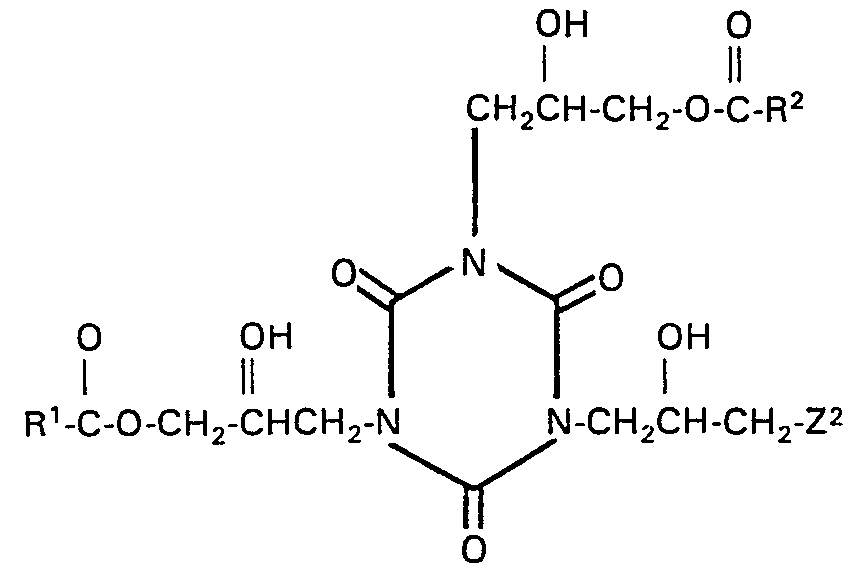
dans laquelle R' et R2 sont des radicaux organiques compatibles avec les solvants ayant une masse moléculaire de 200 à 6000, qui sont identiques ou différents, la masse moléculaire moyenne des radicaux R' et R2 compatibles avec les solvants étant de 500 à 6000, et Z2 est un radical compatible avec les pigments contenant un groupe polaire et lié au reste du dispersant par l'intermédiaire d'un groupe amine.
dans laquelle R' et R2 sont des radicaux organiques compatibles avec les solvants ayant une masse moléculaire de 200 à 6000, qui sont identiques ou différents, la masse moléculaire moyenne des radicaux R' et R2 compatibles avec les solvants étant de 500 à 6000, et Z2 est un radical compatible avec les pigments contenant un groupe polaire et lié au reste du dispersant par l'intermédiaire d'un groupe amine.
19. Dispersant pour pigments selon la revendication 18, caractérisé en ce que Z2 est un radical de formule
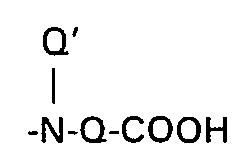
dans laquelle Q est un groupe organique divalent et Q' est un hydrogène ou un groupe organique monovalent.
dans laquelle Q est un groupe organique divalent et Q' est un hydrogène ou un groupe organique monovalent.
20. Dispersant pour pigments de formule:
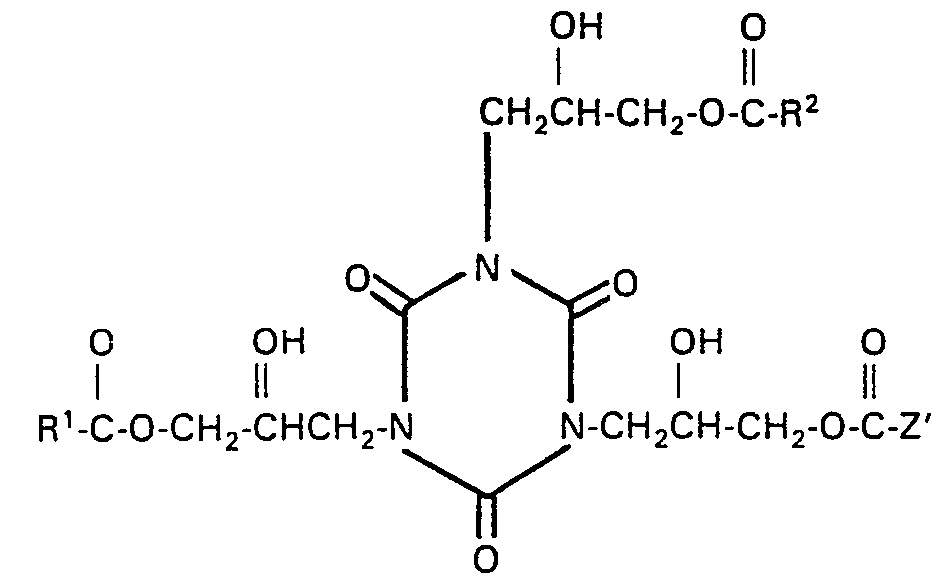
dans laquelle R1 et R2 sont des radicaux organiques compatibles avec les solvants ayant une masse moléculaire de 200 à 6000, qui sont identiques ou différents, la masse moléculaire moyenne des radicaux R1 et R2 compatibles avec les solvants étant de 500 à 6000, et Z est un radical compatible avec les pigments contenant un groupe polaire.
dans laquelle R1 et R2 sont des radicaux organiques compatibles avec les solvants ayant une masse moléculaire de 200 à 6000, qui sont identiques ou différents, la masse moléculaire moyenne des radicaux R1 et R2 compatibles avec les solvants étant de 500 à 6000, et Z est un radical compatible avec les pigments contenant un groupe polaire.
21. Dispersant pour pigments selon la revendication 20, caractérisé en ce que Z1 est un groupe aryle ou arylalkyle substitué sur le noyau par au moins un groupe nitro.
22. Dispersant pour pigments selon l'une quelconque des revendications 1 à 21, caractérisé
en ce qu'il a une masse moléculaire moyenne de 1200 à 20000.
23. Dispersant pour pigments selon l'une quelconque des revendications 1 à 21, caractérisé
en ce qu'il a une masse moléculaire moyenne de 2000 à 10000.
24. Procédé de préparation d'un dispersant pour pigments tel que défini dans la revendication
1, caractérisé en ce que l'on fait réagir un composé Y ayant une masse moléculaire
d'au moins 600 et contenant au moins trois groupes fonctionnels dont l'un au moins
est un groupe époxy, simultanément ou successivement, avec au moins un composé de
formule R-X et avec un composé de formule Z-Xl, où R et Z ont les significations indiquées dans la revendication 1, X est un groupe
capable de réagir avec un groupe fonctionnel du composé Y pour lier R au radical D
du composé Y, et X1 est un groupe capable de réagir avec un groupe fonctionnel du composé Y pour lier
Z au radical D du composé Y, les proportions relatives de R-X et de Y et, le cas échéant,
de Z-Xl étant telles que plus d'un radical R est lié à D.
25. Procédé selon la revendication 24, caractérisé en ce que le composé Y est un composé
trifonctionnel et est d'abord mis à réagir avec le ou les composés de forme R-X, dans
un rapport molaire de 1:1,5 à 1:2, 5, puis avec le composé Z-X', dans un rapport molaire
de 1:1,5 à 1:0,5.
26. Dispersant pour pigment, tel que préparé par un procédé selon la revendication
24 ou la revendication 25.
27. Dispersion fluide d'un pigment dans un fluide organique, caractérisé en ce que
la dispersion contient un dispersant pour pigments selon l'une quelconque des revendications
1 à 23, ou 26.
28. Dispersion selon la revendication 27, caractérisé en ce que la dispersion contient
3 à 12% en poids du dispersant pour pigments.
29. Procédé de préparation d'une peinture ou d'une encre, qui consiste à broyer ensemble
un pigment, une résine filmogène et un solvant, caractérisé en ce qu'un dispersant
pour pigments selon l'une quelconque des revendications 1 à 23, ou 26, est présent
au cours du broyage.
30. Procédé de coloration d'une matière plastique, caractérisé en ce qu'un pigment
est dispersé dans un liquide organique en présence d'un dispersant pour pigments selon
l'une quelconque des revendications 1 à 23, ou 26, et la dispersion ainsi formée est
mélangée avec la matière plastique.