|
(11) | EP 0 202 381 A1 |

| (12) | EUROPEAN PATENT APPLICATION |
|
|
|
|
|||||||||||||||||||||||||||
| (54) | Ultrasonic vibration method and apparatus for atomizing liquid material |
| (57) @ An ultrasonic fuel injection nozzle (1) for e.g. an internal combustion engine
comprises an ultrasonic vibration generating means (100) and a vibrating element (14)
connected to said vibration generating means (100) so as to be vibrated thereby, said
vibrating element being formed at its forward end with a concentrically stepped portion
(32) to which liquid fuel is delivered to be atomized at the edges of the steps. Liquid
material atomized in similar fashion is used for spray drying, humidifying and so
on. |
Technical Field
[0001] This invention relates generally to the art of atomizing liquid material by ultrasonic vibration, and particularly to an ultrasonic injecting method and injection nozzle suitable for use on a fuel injecting valve for internal combustion engines such as diesel engines, gasoline engines and gas turbine engines, and external combustion engines such as burners for boilers, heating furnaces, heating apparatus and the like, and also for a spray head for drying and producing powdered medicines. While this invention is useful as an injection nozzle or as an apparatus for atomizing liquid material in various applications such as described above the invention will be more particularly described hereinafter with respect to a fuel injecting nozzle particularly for use with internal combustion engines such as diesel and gasoline engines. This invention is not, however, to be regarded as so limited. It is also to be noted that the term "liquid material" is intended to mean not only a liquid such as liquid fuel but also various solutions or suspensions such as liquid for producing medicines as well as water or other liquid for use with a humidifying or spraying apparatus.
Background Art
[0002] Various attempts have heretofore been made to supply liauid fuel in atomized form into a combustion or precombustion chamber of an internal combustion engine such as diesel or gasoline engine in order to reduce soot and enhance fuel economy. One of the most common methods is to inject liquid fuel under pressure through the outlet port of an injection nozzle. In such injection it is known that atomization of liquid fuel is promoted by imparting ultrasonic vibrations to the liquid fuel.
[0003] There have heretofore been developed two mechanisms for atomizing liquid by ultrasonic waves - (1) the cavitation mechanism and (2) the wave mechanism. The cavitation mechanism is unsuitable for application to an injection valve because of difficulty in controlling the deqree of atomizing. The wave mechanism includes the capillary system and the liquid film system. In the capillary system an ultrasonic vibrating element has a capillary aperture formed therethrough. Liquid fuel is introduced through the inlet port of the capillary aperture while the ultrasonic vibrating element is subjected to vibration, whereby the liquid fuel is spread through the outlet of the capillary aperture in a film form over the bottom surface of the vibrating element and then injected in an atomized state. In the liquid film system, an ultrasonic vibrating element is formed on its forward end with a portion flared as in the form of a poppet valve. Liquid fuel is delivered to and spread over the face portion in a film form and then injected in an atomized state
[0004] As is understood from the foregoing, it has been heretofore considered that the mechanism by which liquid is atomized by means of an ultrasonic vibrating element is based on either cavitation or wave motions caused after the liquid is transformed into a film, and particularly that wave motions in film are indispensably required to effect atomization of liquid in a large quantity. Accordingly, the arrangements as described above have been hitherto proposed.
[0005] However, in actuality the injection nozzles hitherto proposed have so small capacity for spraying that they are unsuitable for use as an injection nozzle for internal combustion engines such as diesel or gasoline engines which require a larqe amount of atomized fuel.
Summary of the Invention
[0006] According to this invention, an ultrasonic vibration method of atomizing a liquid material by vibrating a vibrating element by means of ultrasonic vibration generating means is characterized by forming an edged portion at the forward end of said vibrating element and delivering a liquid material to and along said edged portion to atomize the liquid material.
[0007] Using the method of this invention, liquid fuel may be atomized in a large quantity for injection into an internal combustion enaine.
[0008] The vibrating element may be continuously vibrated and the delivery of the liquid material to the edged portion of the vibrating element may be either intermittently or continuously effected, thereby eliminatinq the time lag involved in initiating vibration of the vibrating element which is a defect of conventional ultrasonic injection nozzles for internal combustion engines where the vibrating element is vibrated only when it is required to inject liquid fuel.
[0009] The present invention is applicable to the continuous burning of fuel in a fuel burner and also to spraying for spray drying to produce powdered medicines for example, and for humidifying.
[0010] Thus the present invention is useful not only in relation to internal combustion engines such as a diesel engine, qasoline engine, gas turbine engine and the like, but also in relation to external combustion engines such as burners for boilers, heating furnaces, heating apparatus and the like for atomizinq liquid fuel in a uniform manner and in a large quantity to thereby provide for attaining complete combustion in a short time, resulting in preventing or reducing emission of soot as well as improving fuel economy.
[0011] The method of the present invention is capable of not only atomizing liquid in a large amount but also atomizing liquid even at a low flow rate at which the prior art is unable to effect atomizing, to thereby enhance fuel efficiency.
[0012] Specific embodiments of the present invention will now be described by way of example and not by way of limitation with reference to the accompanying drawings.
Brief Description of the Drawinqs
[0013]
Fig. 1 is an elevation in part in cross-section of an ultrasonic injection nozzle according to the present invention;
Fiqs. 2 and 3 are front views of alternative forms of the edged portion at the forward end of the vibrating element;
Fig. 4 is an enlarged view illustrating the operation of the edged portion; and
Fig. 5 is a front view of a hollow needle valve of the nozzle shown in Fig. 1.
[0014] Referring to the accompanying drawings and first to Fig. 1, the ultrasonic injection nozzle 1 according to this invention includes a generally cylindrical elongated housing 4 havinq a central bore 2 extending centrally therethrough. Threaded to an external thread 6 on the upper portion of the housing 4 is the lower mounting portion of a vibrator holder 8 which has a through bore 12 extending centrally therethrough coaxially with and in longitudinal alignment with the central bore of the housing 4.
[0015] A vibrating element or vibrator 14 is mounted in the through bore 12 of the vibrator holder 8 and the central bore 2 of the housing 4. The vibrating element 14 comprises an upper body portion 16, an elongated cylindrical vibrator shank 18 having a diameter smaller than that of the body portion 16, and a transition portion 20 connecting the body portion 16 and shank 18. The body portion 16 has an enlarged diameter collar 22 therearound which is clamped to the vibrator holder 8 by a shoulder 24 formed on the inner periphery of the vibrator 8 adjacent its upper end and an annular vibrator retainer 30 fastened to the upper end face of the vibrator holder 8.
[0016] The shank 18 of the vibrating element 14 extends downwardly or outwardly beyond the housing 4. The forward end of the vibrating element 14, that is, the forward end of the shank portion 18 is formed with an edged portion 32 as will be described in more details hereinafter. A sleeve-like needle valve 34 is slidably mounted on that portion of the vibrating element 14 extending beyond the housing 4.
[0017] The needle valve 34 is generally of hollow cylindrical shape, and comprises an upper reduced-diameter portion 36 adjacent its upper end, a central large-diameter portion 38, a tapered portion 40 sloping from the large-diameter portion 38, a small-diameter portion 42 connected to the tapered portion 40, and a tapered forward end portion 44 sloping from the small-diameter portion 42. The extreme end of the tapered forward end portion 44 is disposed adjacent the edged portion 32 of the vibrating element 14. On the other hand, the upper reduced-diameter portion 36 of the hollow needle valve 34 extends upwardly beyond an annular shoulder 46 extending radially inwardly from the lower end portion of the housing 4.
[0018] The hollow needle valve 34 is housed in a needle valve holder 50 which is detachably secured to the housing 4 by means of a holder sheath 52 which is affixed to the outer periphery of the holder 50. The inner configuration of the needle valve holder 50 comprises a large-diameter bore portion 54 in which the central large-diameter portion 38 of the hollow needle valve 34 is adapted to slidably move, a sloped portion 56 complementary to the tapered portion 40 of the needle valve 34, a small-diameter bore portion 58, and a sloped forward end portion. The small-diameter bore portion 58 and sloped forward end portion 60 cooperate with the small-diameter portion 42 and sloped forward end portion 44 of the hollow needle valve 34 to define a liquid fuel supply passage 62.
[0019] The needle valve holder 50 is formed around its sloped portion 56 with an annular fuel reservoir 64 opening radially inwardly which is in communication with a fuel supply passage 66 extending through the wall of the needle valve holder 50. Said fuel supply passage 66 is in communication with a fuel inlet passage 68 extending through the wall of the housing 4, which inlet passage 68 is in turn connected with a fuel inlet port 70 of the housing 4.
[0020] The needle valve holder 50 is formed around the upper part of the large-diameter bore portion 54 of the needle valve holder 50 with an annular radially inwardly opening return fuel sump 72 which is connected with a fuel outlet port 78 via a fuel return passage 74 and a fuel outlet passage 76 formed through the walls of the needle valve holder 50 and the housing 4, respectively.
[0021] A compression spring 80 is disposed in an annular space defined between the peripheral wall of the central bore 2 in the housing 4 and the outer periphery of the vibrator shank 18. The lower end of the compression sprina 80 acts against the top end face of the upper reduced-diameter portion 36 of the hollow needle valve 34 via an annular spring retainer 82 while the upper end of the spring abuts against the bottom surface of an injection pressure regulating member 84 which is a cylindrical member disposed in the space between the peripheral wall of the central bore 2 in the housing 4 and the outer periphery of the vibrator shank 18 and screw threadedly connected to the inner periphery of the housing 4. Thus, the spring pressure on the needle valve 34 may be adjusted by rotatinq the injection pressure regulating member 84 relative to the housing 4.
[0023] In operation, liquid fuel is introduced through the fuel inlet port 70 and supplied through the fuel inlet passage 68 and the fuel supply passage 66 into the fuel reservoir 64 which is closed by the tapered portion of the hollow needle valve 34 urged downwardly by the spring 80. Consequently, the pressure in the reservoir 64 is built up as it is continuously supplied with liquid fuel. When the pressure in the fuel reservoir 64 reaches a certain level, the hollow needle valve 34 is caused to move upward against the biasing force of the spring 80.
[0024] The upward movement of the hollow needle valve 34 causes the fuel reservoir 64 to be opened to the fuel supply passaqe 62, which is thus supplied with the liquid fuel. From the fuel supply passage 62, the fuel is delivered to the edged portion 32 formed on the forward end of the vibrating element 14.
[0025] The edged portion 32 of the vibrating element 14 may be in the form of a staircase including three concentric steps having progressively reduced diameters as shown in Fig. 1, or it may comprise two or five steps as shown in Figs. 2 and 3. Thus the edged portion 32 is formed around or along its outer periphery with an edge or edges. While the edged portion 32 as shown in Figs. 1 to 3 is of a stepped configuration having progressively reduced diameters, the steps of the edged portion 32 may have progressively increased diameters or steps of progressively reduced and then progressively increased diameters. Further, as shown in Fig. 4, the geometry such as the width (W) and height (h) of each step is such that the edge of the step may act to render the liquid fuel filmy and to dam the liquid flow.
[0026] According to the researches and experiments of the inventors, in the case of atomizing liquid in a large quantity it has been found that the height (h) and width (W) of each step of the edged portion must be kept at a specific range, that is, under the condition as follows:
Wherein λ is the length of the ultrasonic waves.
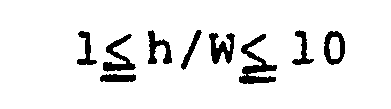
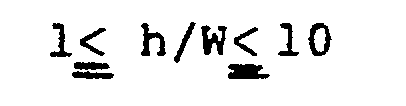
[0027] In a preferred embodiment of this invention the height (h) and width (W) of each step are 1< h/W<10. Particularly in the vibrating element having the configuration as shown in Fig. 3 the height (h) is preferably less than 4mm. The wave length (λ) of the ultrasonic waves varies with the materials used for the vibrating element such as Inconel, titanium, etc. and is usually in the range of 5 to 50 cm.
[0028] Further, the output of the ultrasonic oscillator for vibrating the vibrating element is substantially 10 W and the amplitude and frequency of the vibrating element are 30 to 70mm and 20 to 50kHz, respectively. In addition the diameter (D) of the vibrating element is preferably in the range of λ/10 to λ/4. The flow rate of the liquid to be processed increases as the amplitude and diameter (D) are larger.
[0029] The vibrating element 14 is continuously vibrated by ultrasonic vibration generating means 100 operatively connected to the body portion 16, so that the liquid fuel is atomized and injected outwardly as it is delivered to the edged portion 32. To ensure uniform injection around the injection nozzle, the small-diameter portion 42 of the hollow needle valve 34 is formed with a plurality of, say, two diametrically opposed angularly extending grooves 43 (see Fig. 5). It has been found that such arrangement causes turbulence to be produced in the fuel supply passage as well as imparting a swirl to the fuel being injected to thereby eliminate uneven injection. In addition, such an arrangement may also serve to promote separation of the spray of fuel off the edges of the edged portion 32 as well as to enhance the atomization.
[0030] An example of various parameters and dimensions applicable to the ultrasonic injection nozzle as described hereinabove with reference to the accompanying drawings is as follows:
[0031] A portion (surplus) of the fuel supplied to the fuel reservoir 64 flows through a narrow clearance space measured in microns (µm) between the hollow needle valve 34 and the needle valve holder 50 to be collected into the return fuel sump 72, and is then returned to the fuel outlet 78 through the fuel return passages 74 and 76.
[0032] The fuel outlet 78 is connected via a suitable conduit (not shown) with the fuel tank so that the excess fuel is recirculated to the tank.
[0033] As the pressure in the fuel reservoir 64 drops, the hollow needle valve 34 is moved downward under the action of the spring 80 to close the fuel reservoir 64, so that the delivery of fuel to the edged portion 32 of the vibrating element 14 is interrupted, and the fuel injection from the nozzle 1 is discontinued.
[0034] Mistiming in fuel injection due to a time lag in initiation of vibration is avoided since the vibrating element 14 may be kept in operation irrespective of the fuel supply.
[0035] As indicated above, the injection nozzle being described with reference to the accompanying drawings is capable of providing a large amount of injection at 0.06 cm3 per injection which makes it possible to put the nozzle to practical use as an injection nozzle for an internal combustion engine. This is 500 to 1,000 times as high as the flow rate as was reported to be possible with the prior art ultrasonic injection nozzle. The vibration element 14 having the edged portion 32 is so arranged adjacent the outlet port of the injection nozzle whereby a very compact ultrasonic injection nozzle is provided.
[0036] The present invention is also applicable to a burner for continuous combustion in which the flow rate may be in the order of 100 f/hr.
[0037] This invention may also be used as a spray drying apparatus for producing powdered medicines.
[0038] In addition to the provision for atomization of liquid in a large quantity as described above, this invention is also characterized in that it is capable of providing generally uniform distribution in atomized particles with an average particle radius in the order of 10 to 30µm.
Industrial Applications
[0039] As is understood from the foregoing, the present invention provides an ultrasonic injecting method and injecting nozzle capable of not only atomizing a liquid material in a uniform manner and in a large quantity but also atomizing a liquid material even at a low flow rate, on either an intermittent or a continuous basis.
[0040] Accordingly the ultrasonic injecting method and injection nozzle according to this invention is suitable for use on internal combustion engines such as a diesel engine, gasoline engine, gas turbine engine and the like, for use on external combustion engines such as burners for boilers, heating furnaces, heating apparatus and the like, or for use on a spraying or humidifying apparatus.
1. Ultrasonic vibration method of atomizing a liquid material by vibrating a vibrating
element (14) by means of ultrasonic vibration generating means (100), characterized
by forming an edged portion (32) at the forward end of said vibrating element, and
delivering a liquid material to and along said edged portion to atomize the liquid
material.
2. A method according to claim 1, wherein said vibrating element is continuously vibrated,
and the delivery of the liquid material to the edged portion of the vibrating element
is either intermittently or continuously effected.
3. A method according to claim 1 or 2, wherein said liquid material is liquid fuel
for use in an internal combustion engine such as a diesel engine, gasoline engine
or the like, or an external combustion engine such as a burner or the like.
4. A method according to claim 1 or 2, wherein said liquid material is a suspension
from which powdered medicine is to be produced.
5. A method according to any preceding claim, wherein said edged portion (32) is of
a stepped configuration.
6. A method according to claim 5, wherein the height (h) and width (W) of each step
are as follows:


where tN is the wave length of the ultrasonic waves.
where tN is the wave length of the ultrasonic waves.
7. A method according to claim 6, wherein the relation between the height (h) and
the width (W) is as follows:
8. An ultrasonic injection nozzle comprising an ultrasonic vibration generating means
(100), an elongated vibrating element (14) connected at one end to said ultrasonic
vibration generating means and having an edged portion (32) at the other end, a needle
valve (34) slidably mounted on said vibrating element adjacent said other end having
said edged portion (32), a needle valve holder (50) adapted to hold said needle valve
for slidable movement and co-operating with the needle valve to define a supply passage
(62) for liquid material at the edged portion (32) of the vibrating element (14),
and spring means (80) normally urging said needle valve toward said holder (50) to
close said liquid material supply passage (62).
9. An injection nozzle according to claim 8, wherein said edged portion (32) is of
a stepped configuration.
10. An injection nozzle according to claim 9, wherein the height (h) and width (W)
of each step are as follows:


where λ is the wave length of the ultrasonic waves.
where λ is the wave length of the ultrasonic waves.
11. An injection nozzle according to claim 10, wherein the relation between the height
(h) and the width (W) is as follows:
12. A vibrating element for use in an ultrasonic injection nozzle as claimed in claim
6, 7, 8 or 9, said element being formed around its outer periphery with a multi-stepped
edged portion (32) having at least two steps, said edged portion being adapted to
be supplied with a liquid.
13. A vibrating element according to claim 12, wherein said multi-stepped, edged portion
(32) has a progressively decreasing diameter.
14. A vibrating element according to claim 12 or 13 wherein the height (h) and width
(W) of each step are as follows:


where λ is the wave length of the ultrasonic waves.
where λ is the wave length of the ultrasonic waves.
15. A vibrating element according to claim 14, wherein the relation between the height
(h) and the width (W) is as follows: