| (19) |
 |
|
(11) |
EP 0 207 136 B1 |
| (12) |
EUROPEAN PATENT SPECIFICATION |
| (45) |
Mention of the grant of the patent: |
|
31.01.1990 Bulletin 1990/05 |
| (22) |
Date of filing: 20.12.1985 |
|
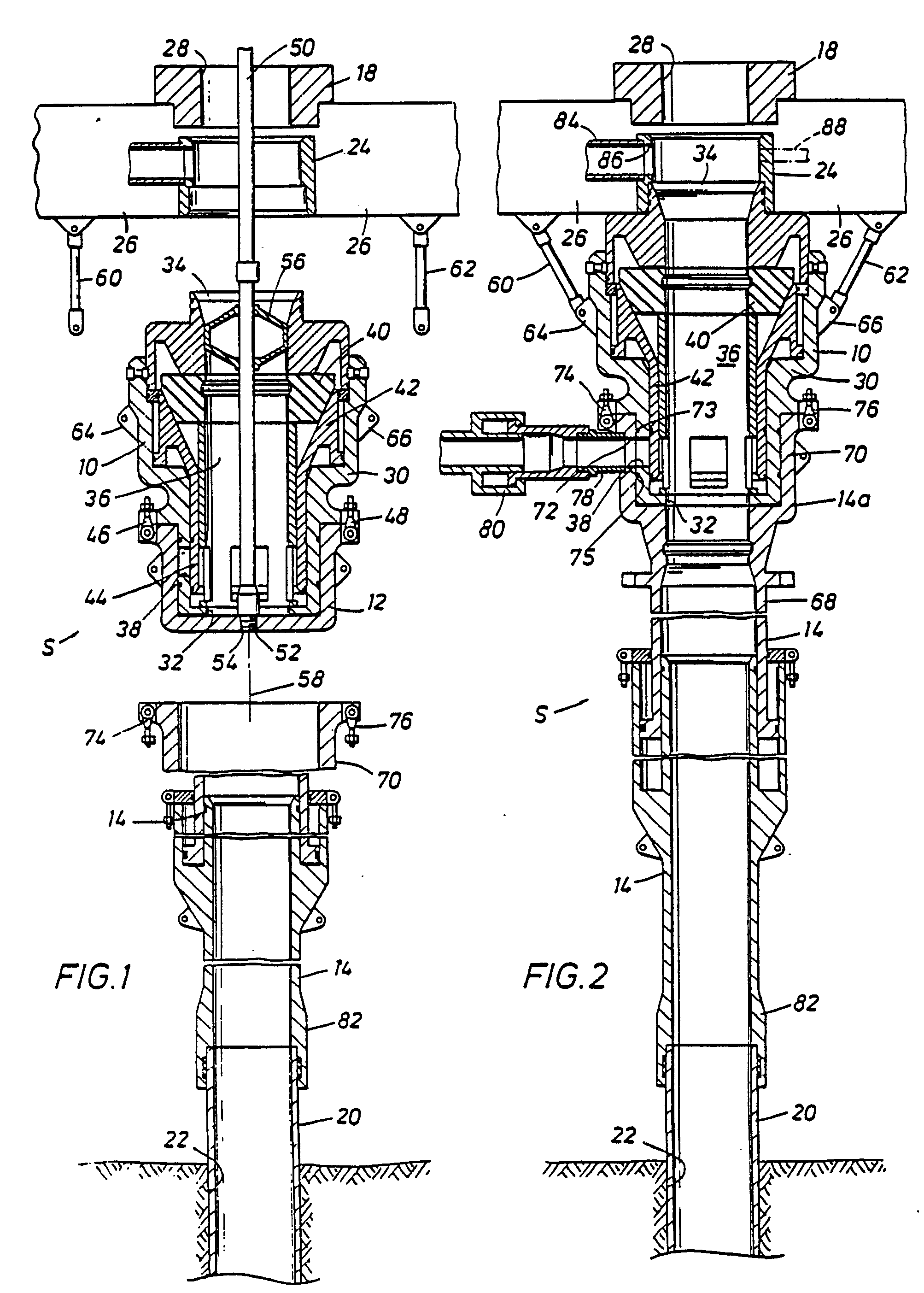
| (86) |
International application number: |
|
PCT/US8502/507 |
| (87) |
International publication number: |
|
WO 8603/798 (03.07.1986 Gazette 1986/14) |
|
| (54) |
DIVERTER/BOP SYSTEM AND METHOD FOR A BOTTOM SUPPORTED OFFSHORE DRILLING RIG
ABLEITUNGS-/ABSCHLUSSSYSTEM UND VERFAHREN AN BOHRLÖCHERN FÜR AUF DEM MEERESGRUND STEHENDE
BOHRTÜRME
SYSTEME DE DERIVATION ET D'OBTURATION POUR INSTALLATION DE FORAGE EN MER MONTEE SUR
LE FOND
|
| (84) |
Designated Contracting States: |
|
AT BE CH DE FR GB IT LI LU NL SE |
| (30) |
Priority: |
24.12.1984 US 686036
|
| (43) |
Date of publication of application: |
|
07.01.1987 Bulletin 1987/02 |
| (73) |
Proprietor: HYDRIL COMPANY |
|
Los Angeles
California 90015 (US) |
|
| (72) |
Inventors: |
|
- ROCHE, Joseph, R.
Humble, TX 77338 (US)
- ALEXANDER, Gabriel, G.
Houston, TX 77060 (US)
|
| (74) |
Representative: Baillie, Iain Cameron et al |
|
Ladas & Parry,
Altheimer Eck 2
80331 München
80331 München (DE) |
| (56) |
References cited: :
WO-A-84/02949
|
US-A- 3 461 958
|
|
| |
|
|
- G. Soulié, Technologie des têtes de puits sous-marines de forages. Ed. Technip, 1978,
Paris
|
|
| |
|
| Note: Within nine months from the publication of the mention of the grant of the European
patent, any person may give notice to the European Patent Office of opposition to
the European patent
granted. Notice of opposition shall be filed in a written reasoned statement. It shall
not be deemed to
have been filed until the opposition fee has been paid. (Art. 99(1) European Patent
Convention).
|
Field of the Invention
[0001] This invention relates generally to diverter and blowout control systems for drilling
rigs. In particular, the invention relates to diverter and blowout preventer systems
and methods for use with bottom supported offshore drilling rigs.
Description of the Prior Art
[0002] When drilling a well from a bottom supported offshore rig, it is desirable that a
diverter be provided during shallow hole drilling through the drive pipe. Such a diverter
is typically provided below a rig floor between the casing and the rotary table of
the drilling rig for safely venting or controlling unbalanced well bore pressure which
may produce an upward flow of drilling fluid in a conduit. Such an occurrence, called
a «kick», typically a pressurized gas accumulation in the fluid of the conduit, is
often encountered in top hole drilling making a fluid flow controller essential before
high pressure blowout preventers are connected to the drilling system.
[0003] U.S. patents 4 456 062, 4 456 063 and 4 444 401 and Application No. 449 376 assigned
to the same assignee as the assignee of the present application, disclose a «failsafe»
diverting system for a floating drilling rig. The disclosed system is «failsafe» in
that when a «kick» occurs during shallow hole drilling of a top hole well before a
blowout preventer stack has been provided, the «kick» cannot be accidentally confined
by the flow diverter apparatus to build pressure and explode, even if controls are
misconnected or malfunctioning. The above mentioned patents disclose a diverter or
«fluid flow controller» adapted for positioning within a housing permanently secured
to the floating drilling rig floor below the rotary table.
[0004] Diverters may also be provided for bottom supported offshore drilling rigs. Such
diverters, because of their capability of sealing the annular space between the drilling
conduit or riser and the drill pipe, may also be used as a low pressure blowout preventer.
Such a diverter/BOP system is disclosed in U.S. patent 4 524 832 to Roche et al. and
is assigned to the same assignee as that of this application. Such application is
incorporated herein for all purposes.
[0005] Another such blowout preventer is represented by G. Soule, technologies des tetes
de puits sous-marines de forage, 1978, editions technip, Paris, pages 203 - 206, disclosing
a system adapted for alternative use as a diverter or a blowout preventer for a bottom
supported drilling rig and adapted for positioning beneath a rotary table of the rig,
the system comprising: a fluid flow controller housing with a lower opening and an
upper opening and a vertical flow path therebetween and an outlet passage provided
in its housing wall.
[0006] When a drilling rig operator uses such a diverter/BOP system, he must be assured
of the mode that the system is in. If the operator believes the system to be in a
diverter mode, but yet the system is in a BOP mode, a kick of pressure greater than
the pressure rating of the system could result in catastrophic damage to the drilling
rig and its personnel. If the operator believes the system to be in the BOP mode because
sufficient casing has been set, but yet the system is actually in the diverter mode,
the well cannot be «controlled» in the sense of killing the kick with drilling mud
with the blowout preventer closed and circulating it out via a choke line to a choke
manifold. Rather, the kick is diverted via the vent line system and may flow until
the shallow gas is dissipated. It is necessary therefore to provide systems which
can assure the drilling crew and the drilling superintendent that the diverter/BOP
system described above is in a «for sure» mode, either as a diverter or as a BOP.
[0007] It is an object of this invention to provide a system adapted for alternative use
as a diverter or a blowout preventer where the system can be made up in only a preplanned,
safe, functional mode in either the diverter mode or the BOP mode.
[0008] It is another object of the invention to provide a system comprising a fluid flow
controller and two bases alternatively removably secured to the controller which facilitate
nippling up as a diverter in one mode and as a blowout preventer in an alternative
mode.
[0009] It is still another object of the invention to provide two telescoping spools having
bases at their upper ends and connection means their lower ends which are configured
so that it is impossible to inadvertently install the wrong spool for either a diverter
mode or a subsequent blowout preventer mode as dictated by the smallest diameter casing
string which has been set while drilling a well.
[0010] The present invention provides a system adapted for alternative use as a diverter
or a blowout preventer for a bottom supported drilling rig and adapted for positioning
beneath a rotary table of the drilling rig, and housing with a lower opening and an
upper opening and a vertical flow path therebetween and an outlet passage provided
in its housing wall characterized by comprising at least two bases adapted for being
alternatively removably secured to said controller about said lower opening of said
controller housing, said first base having an upwardly facing the cylindrical receptable
adapted for sealing engagement about the lower opening of said fluid flow controller
and the outlet passage provided in the controller housing wall, said first base having
a port adapted for communication with the outlet passage in said fluid flow controller,
and said second base having an upwardly facing cylindrical receptacle adapted for
sealing engagement about the lower opening of said fluid flow controller and the outlet
passage provided in the controller housing wall while closing the outlet passage in
said fluid flow controller housing wall, whereby, when said first base is connected
to said controller housing and said port of said first base is in communication with
the outlet passage of the fluid flow controller, the combination of said first base
and the fluid flow controller may be used to respond to a kick only as a diverter,
and when said second base is connected to said controller housing and said outlet
passage of said fluid flow controller is closed by said second base., the controller
may be used to control a kick only as a blowout preventer.
[0011] The present invention also provides a method for installing a system adapted for
alternative connection as a diverter or a blowout preventer for a bottom supported
drilling rig positioned beneath a rotary table of the drilling rig after a structural
casing has been set in borehole, the method comprising the steps of positioning a
first telescoping spool having a lower end and an upper end below the rotary table,
said first spool having a first base disposed at its upper end, said first base having
a port disposed in its wall and characterized by the further steps of aligning a fluid
flow controller having a controller housing wall outlet passage and adapted for alternative
use as a diverter or a blowout preventer so that the controller is substantially vertically
aligned between a bore of the rotary table above and the structural casing below;
securing the fluid flow controller beneath the drilling rig rotary table; stroking
said first telescoping spool out until the first base disposed at the upper end of
the spool connects with the lower end of the controller and said port disposed in
the first base communicates with the controller housing wall outlet passage.
Brief Description of the Drawings
[0012] The objects, advantages and features of the invention will become more apparent by
reference to the drawings which are appended hereto and wherein like numerals indicate
like parts and wherein an illustrative embodiment of the invention is shown, of which:
Fig. 1 is a vertical sectional illustration of the installation of a fluid flow controller
beneath a drilling rig rotary table and shows an installation base used for installing
the controller;
Fig. 2 is a vertical sectional view of the system in the diverting mode according
to the invention in which a first telescoping spool having a first base at its upper
end is connected to the fluid flow controller;
Fig. 3 is a vertical sectional view of the invention in a blowout preventer mode after
a conductor casing has been installed and a second telescoping spool has been connected
to the conductor casing and further illustrating the connection of a choke/kill line
to an aperture of the second base of the second telescoping spool; and
Fig. 4 is a vertical sectional view illustrating the invention in a second blowout
preventer mode after a high pressure blowout preventer stack is connected below the
second telescoping spool.
Description of the invention
[0013] The system S embodying the present invention is shown in detail in Figures 1-4. The
system S, adapted for alternative use as a diverter or a blowout preventer for a bottom
supported drilling rig, includes a fluid flow controller 10, an installation base
12, a first telescoping spool 14 integral with a first or diverter base 14a and a
second telescoping spool 16 integral with a second or blowout preventer base 16a.
[0014] Fig. 1 illustrates the apparatus and method for installing a system adapted for alternative
connection as a diverter or blowout preventer for a bottom supported drilling rig
positioned beneath a rotary table 18 of the drilling rig after structural casing 20
has been set in a borehole 22.
[0015] The fluid flow controller 10 is raised for connection to the permanent fixture 24
attached to the support beams 26 beneath a drilling rig floor. The rotary table 18
has a bore 28 therein which may be positioned to coincide with that of the permanent
fixture 24 thereby allowing tubular members to be inserted via the bore 28 of the
rotary table 18 and the permanent fixture 24 to position below.
[0016] The fluid flow controller 10, according to the invention, is similar to that described
in detail in U.S. Patent 4 456 063 assigned to the same assignee as the assignee of
the present application. Such application is incorporated herewith for all purposes.
[0017] The fluid flow controller 10, as illustrated in Figures 1 - 4, includes a controller
housing having a lower cylindrical opening 32 and an upper cylindrical opening 34
and a vertical flow path 36 therebetween. An outlet passage 38 is provided in a housing
wall of the controller 10. An annular packing element 40 is provided within the controller
housing 30 and an annular piston means 42 is adapted for moving from the first or
lower position, as shown in Figures 1-4, to a second or upper position. In the first
position, the piston wall 44 allows fluid communication of the interior fluid with
the outlet passage 38 and urges the annular packing element 40 to close about about
an object extending through the flow path 36 of the housing 30 such as a drill pipe
or to close the vertical flow path 36 through the housing 30 in the absence of any
object in the vertical flow path 36.
[0018] As shown in Fig. 1, after the initial bore in the sea floor is formed, as illustrated
by the borehole 22 a structural casing 20 is provided therein. The structural casing
20 typically has a 76.2 cm (thirty inch) outside diameter. The fluid flow controller
10 and an installation base 12 stored in the drilling rig at a sub- level below the
drilling rig floor is positioned for connection with a drill pipe extending through
the rotary table 18. The base 12 is connected to the controller 10 by fasteners 46
and 48. In the preferred embodiment a 12.7 cm (five inch) drill pipe 50 having an
externally threaded end 52 is threadedly received into an axially located internally
threaded bore 54 of the aligned above the structural casing 20 and below the bore
28 of the rotary table 18.
[0019] The installation base 12 is constructed so as to cover the outlet passage 38 of the
controller 10 in order to prevent entry of foregoing matter or debris into the outlet
passage 38. A centralizer 56 aids in the positioning of the drill pipe 50 along the
axis 58 of the controller 10.
[0020] The flow controller 10 is then raised into position as seen in Fig. 2 whereupon structural
support links 60 and 62 secured to support beams 26 are connected to flanges 64 and
66, respectively, of the controller 10 to provide a means for securing the fluid flow
controller 10 to the permanent fixture 24 beneath the rotary table 18.
[0021] A first telescoping spool 14, collapsed and pinned, is positioned between the structural
casing 20 and the fluid flow controller 10. The diverter or first base 14a integral
with spool 12 has an upwardly facing annulus 70 adapted for sealing engagement about
the lower opening 32 of the fluid flow controller 10 and the outlet passage 38 provided
in the housing wall of the controller 10. A circumferential seal 73 about outlet passage
38 in the outside surface of controller housing 30 provides sealing with the inner
surface of annulus 70. The diverter base 14a has a port 72 in the upwardly facing
annulus 70 adapted for communication with the outlet passage 38 in the fluid flow
controller by fasteners 74 and 76. The fasteners 74 and 76 are threaded studs rotatable
fastened to the first base 14a and having a nut threadedly received on each stud for
securing the controller 10 to the base 14a.
[0022] The fluid flow controller 10 and the diverter base 14a are provided with means for
aligning the controller 10 both axially and angularly with the base 14a as is known
in the prior art. Aligning means are disclosed in U.S. Patent No. 4 456 063to Roche
and may be advantageously provided for alignment in this invention. The Roche '063
patent is assigned to the same assignee as the assignee of the present application
and is incorporated herewith for all purposes.
[0023] The vent line comprising a 30.48 cm (twelve inch) spool 78 removably connected to
the port 72 of the diverter base 14a may be clamped to a pipe vent line or to a flexible
vent line 80 in the diverting mode.
[0024] Additionally, a blast deflector (not shown) as described in U.S. Patent application
Serial No. 456 206 may advantageously be provided to deflect diverted fluids away
from the drilling rig in a downwind direction. The above U.S. Patent application Serial
No. 456 206 is assigned to the same assignee as the assignee of the present application
and is incorporated herewith for all purposes.
[0025] The first telescoping spool 14 includes an overshot connection 82 intergrally disposed
on its lower end. The overshot connection 82 slides over the outer diameter of the
structural casing 20 to connect the firsttelescoping spool and integral diverter base
14a. The overshot connection 82 of the first telescoping spool 14 is sized so that
it may be made up only with the structural casing 20 which conventionally has a 76.2
cm (thirty inch) outside diameter. In other words the overshot connection 82 is sized
so it can only be made up with the exact diameter casing string which has been set,
i.e. 76.2 cm (thirty inch) structural casing. The overshot connection and therefore
the first telescoping spool connected to casing 20 can only be used in a preplanned,
safe and functional diverter mode. The drilling crew would find it impossibleto connect
the overshot connection 82 to a 50.8 cm (twenty inch) conductor casing, for example.
[0026] In normal operation, as illustrated in Fig. 2, the fluid returning from the drilling
operation returns via the first telescoping spool 14 to the fluid flow controller
10 and back to the drilling rig fluid system via fluid system flow line 84 connected
to opening 86 in the permanent fixture 24. A fill up line 88 may be connected to permanent
fixture 24 and is illustrated by dashed lines.
[0027] The system illustrated in Fig. 2 is to be used as a diverter. During drilling through
the structural casing 20 for purposes of providing a borehole for placement of the
conductor casing 90, a kick is diverted via outlet 38 as the vertical flow path is
closed by packing element 40.
[0028] Turning next to Fig. 3, an illustration of the system is presented after the conductor
casing 90 has been run and cement 92 pumped between the 76.2 cm (thirty inch) O.D.
structural casing 20 and 50.8 cm (twenty inch) O.D. conductor casing 90. The conductor
casing 90, provides a smaller outside diameter than the conventional 76.2 cm (thirty
inch) outside diameter of the structural casing 20. After the first telescoping spool
14 has been collapsed, pinned and removed, a collapsed and pinned second telescoping
spool 16 and a spacer spool 96 and mandrel 94 previously secured to spool 16 are positioned
between the previously installed controller 10 and conductor casing 90.
[0029] After the conductor casing 90 has been installed, the top of it is cut off and a
mandrel 94 and spacer spool 96 are connected to the top of the conductor casing 90.
Preferably the mandrel 94 and spacer spool have the same diameter as the conductor
casing, 50.8 cm (twenty inch) nominal diameter identical to the spacer spool 96 attached
via mandrel 94 to conductor casing 90 thereby preventing an inadvertent installation
of the first telescoping spool which is designed to be used only in the diverter mode.
[0030] The second or blowout preventer base 16a secured to the top of telescoping spool
16 preferably has an aperture 100 for connection with a choke/kill line 102 or, alternatively,
the second base 16a allows the controller to be used as a low pressure blowout preventer
useful in the event of a kick or a dangerous pressure condition in the well. The blowout
preventer allows the operator to bring the well blowout preventer mode of controller
10 may be designed to withstand relatively low well pressures, e.g. 70.3 or 140.6
Kg/cm
2 (1000 or 2000 psi). The choke/kill line 102 may be used as with any closed blowout
preventer to pump down kill mud via the drill pipe to bring the kick under control
by circulating the kick out via a choke manifold.
[0031] Fig. 4 illustrates the use of the second telescoping spool 16 where the well has
further been drilled so that a casing string (not shown) typically of 34.61 cm (13
- 5/8 inch) diameter may be landed and cemented within the conductor casing 90. According
to the invention the lower connection means 98 of the second telescoping spool 16
illustrated in Fig. 3 may be lifted to allow removal of the spacer spool 96 and mandrel
94.
[0032] A high pressure blowout preventer stack 104 may then be connected between the lower
connection means 98 of the second spool 16 and the 34.61 cm (13 - 5/8 inch) casing
string. The high pressure blowout preventer stack 104 in the preferred embodiment
comprises a 34.61 cm (13 - 5/8 inch) annular blowout preventer 106 and one or more
34.61 cm (13 - 5/8 inch) ram blowout preventer 108. A diameter reducing mandrel spool
150 is connected between the 50.8 cm (20 inch) lower end 98 of spool 16 and the 34.61
cm (13 - 5/8 inch) annular blowout preventer.
[0033] As shown in the figures and discussion above, the flow controller is in place for
substantially all the drilling phases of the offshore rig after the structural casing
has been placed in the initial hole in the seal floor.
1. A system adapted for alternative use as a diverter or a blowout preventer for a
bottom supported drilling rig and adapted for positioning beneath a rotary table (18)
of the drilling rig, and a fluid flow controller (10) having a controller housing
(30) with a lower opening (32) and an upper opening (34) and a vertical flow path
(36) therebetween and an outlet passage (38) provided in its housing wall, characterized
in that it comprises at least two bases (14a, 16a) adapted for being alternatively
removably secured to said controller (10) about said lower opening (32) of said controller
housing (30), said first base (14a) having an upwardly facing cylindrical receptacle
(70) adapted for sealing engagement about the lower opening (32) of said fluid flow
controller (10) and the outlet passage (38) provided in the controller housing wall,
said first base (14a) having a port (72) adapted for communication with the outlet
passage (38) in said fluid flow controller (10), and said second base (16a) having
an upwardly facing cylindrical receptacle adapted for sealing engagement about the
lower opening (32) of said fluid flow controller (10) and the outlet passage (38)
provided in the controller housing wall while closing the outlet passage (38) in said
fluid flow controller housing wall, whereby, when first base (14a) is connected to
said controller housing (30) and said port (72) of said first base (14a) is in communication
with the outlet passage (38) of the fluid flow controller (10), the combination of
said first base (14a) and the fluid flow controller (10) may be used to respond to
a kick only as a diverter, and when said second base (16a) is connected to said controller
housing (30) and said outlet passage (38) of said fluid flow controller (10) is closed
by said second base (16a), the combination of said second base (16a) and the fluid
flow controller (10) may be used to control a kick only as a blowout preventer.
2. The system of claim 1 wherein said fluid flow controller (10) further characterized
by a packing element (40) disposed within the controller housing, an annular piston
(42) from a first position to a second position, whereby in the first position the
piston wall (44) prevents interior fluid from communication with the outlet passage
(38) in the controller housing wall and in the second position the piston wall (44)
allows fluid communication of interior fluid with the outlet passage (38) and urges
said packing element (40) to close about an object extending through said controller
housing (30) or to close the extending through said controller housing (30) or to
close the vertical flow path (36) through said controller housing (30) in the absence
of any object in the vertical flow path (36).
3. The system of claim 1 further characterized by a firsttelescoping spool (14) having
an upper end and a lower end, said first base (14a) being secured to the upper end
of said first telescoping spool (14) and a first connection means (82) disposed on
the lower end of said first telescoping spool (14), for connecting said first telescoping
spool (14) only with a structural casing (20).
4. The system of claim 1 further characterized by a second telescoping (16) having
an upper end and a lower end (98), said second base (16a) being secured to the upper
end of said second telescoping spool (16) and a second connection means disposed on
the lower end (98) of said second telescoping spool (16) for connecting said second
telescoping spool (16) only with a tubular member (96) of 50 cm (20 inch) nominal
diameter.
5. The system of claim 3 characterized by when said first connection means (82) is
an overshot connection (82), said overshot connection (82) being slidable over the
structural casing (20) set in a borehole, said system may be used to respond to a
kick only as a diverter.
6. The system of claim 1 further characterized by means (74, 76) for removably securing
said first or second base (14a, 16a) about said fluid flow controller (10).
7. The system of claim 4 wherein when the second connection means of said second telescoping
spool (16a) is in communication with the conductor casing (90) the system may be used
to control a kick only as a blowout preventer.
8. The system of claim 1 further characterized by means (60, 62) for removably connecting
the fluid flow controller (10) beneath the rotary table (18).
9. The system of claim 1 further characterized by a vent line (80) connected to said
port of said first base (14a) when said port (72) is in communication with the outlet
passage (38), said vent line including a spool (78) extending from said port (72)
of said first base (14a) when said system is used as a diverter.
10. The system of claim 1 further characterized by an aperture (100) disposed in said
second base (16a) adapted for communication with the interior of the telescoping spool,
and a choke/kill line (102) connected to said line connected to said aperture (100)
of said second base (16a) when said system is used as a blowout preventer.
11. The system of claim 1 further characterized by means (156) for aligning said first
base (14a) or said second base (16a) with said fluid flow controller (10).
12. A method for installing a system adapted for alternative connection as a diverter
or blowout preventer for a bottom supported drilling rig positioned beneath a rotary
table (18) of the drilling rig after structural casing (20) has been set in a borehole,
the method comprising the step of, positioning a first telescoping spool (14) having
a lower end and an upper end below the rotary table (18), said first spool (14) having
first base (14a) disposed at its upper end, said first base (14a) having a port (72)
disposed in its wall and characterized by the further steps of aligning a fluid flow
controller (10) having a controller housing wall outlet passage (38) and adapted for
alternative use as a diverter or a blowout preventer so that the controller (10) is
substantially vertically aligned between a bore of the rotary table (18) above and
the structural casing (20) below; securing the fluid flow controller (10) beneath
the drilling rig rotary table (18); stroking said first telescoping spool (14) out
until the first base (14a) disposed at the upper end of the spool (14) connects with
the lower end of the controller (10) and said port (72) disposed in the first base
(14a) communicates with the controller housing wall outlet passage (38).
13. the method of claims 12 characterized by an overshot connection (82) is disposed
at the lower end of the first telescoping spool (14) and the method further comprises
the step of sliding the overshot connection (82) over the upper end of the structural
casing (20).
14. The method of claim 13 further comprising the step connecting a vent line (80)
to the port (72) of the first base (14a) whereby the system which results may be used
as a diverter system.
15. The method of claim 14 and after the well has been drilled for the conductor casing
and after the conductor casing (90) has been cemented in the well, further comprising
the steps of removing the vent line (80) from the port of the first base (14a), removing
the first telescoping spool (14) and the first base (14a), connecting a second base
(16a) secured to the upper end of a second telescoping spool (16) to the lower end
of the fluid flow controller (10), said second base (16a) having an aperture (100)
in communication with the interior of the second spool (16a) and said second base
(16a) closing the outlet passage (38) of the fluid flow controller (10), installing
a choke/kill line (102) to the aperture (102) of the second spool (16), and lowering
and securing the lower end of the second telescoping spool (16) when the second spool
(16) is in pressure sealing communication with the conductor casing (190), whereby
the system which results may be used as a blowout preventer during drilling through
the conductor casing.
16. The method of claim 15 further comprising the steps, raising the lower end of
the second telescoping spool (16), installing a high pressure blowout preventer spool
to the conductor casing, installing a high pressure blowout preventer stack (104)
into position above the higher pressure spool, and lowering the lower end of the second
telescoping spool (16) for pressure sealing communication between the high pressure
blowout preventer stack and the fluid flow controller.
1. System, das wahlweise für die Verwendung als Umlenker oder als Preventer für eine
unten abgestützte Bohranlage geeignet ist und das zur Anordnung zwischen einem Drehtisch
(18) der Bohranlage und einem Fluidströmungs-Steuergerät (10) geeignet ist, das ein
Steuergerätgehäuse (30) mit einer unteren Öffnung (34) und einer oberen Öffnung (34)
und einen dazwischen angeordneten, vertikalen Strömungsweg (36) und in der Gehäusewand
einen Austrittskanal (38) besitzt, dadurch gekennzeichnet, daß das System mindestens
zwei Basiskörper (14a, 16a) besitzt, von denen wahlweise der eine oder der andere
an dem Steuergerät (10) die untere Öffnung (32) des Steuergerätgehäuses (30) umgebend
abnehmbar befestigbar ist, wobei der erste Basiskörper (14a) eine aufwärtsgekehrte
zylindrische Aufnahme (70) besitzt, die zur dichten Anlage um den Umfang der unteren
Öffnung (32) des Fluidströmungs-Steuergeräts (10) und des in der Wand des Steuergerätgehäuses
vorgesehenen Austrittskanals (38) geeignet ist und einen Anschluß (72) besitzt, der
mit dem Austrittskanal (38) des Fluidströmungs-Steuergeräts (10) verbindbar ist, der
zweite Basiskörper (16a) eine aufwärtsgekehrte, zylindrische Aufnahme besitzt, die
zur dichten Anlage am Umfang der unteren Öffnung (32) des Fluidströmungs-Steuergeräts
(10) und des Austrittskanals (38) in der Gehäusewand des Steuergeräts unter Verschluß
des Austrittskanals (38) in der Gehäusewand des Steuergeräts geeignet ist, so daß
bei mit dem Steuergerätgehäuse (30) verbundenem ersten Basiskörper (14a) und mit dem
Austrittskanal (38) des Fluidströmungs-Steuergeräts (10) in Verbindung stehendem Anschluß
(72) des ersten Basiskörpers die Kombination des ersten Basiskörpers (14a) und des
Fluidströmungs-Steuergeräts (10) dazu verwendbar ist, auf einen Druckstoß nur als
Umlenker anzusprechen, und bei mit dem Steuergerätgehäuse (30) verbundenem, zweiten
Basiskörper (16a) durch den zweiten Basiskörper (16a) geschlossenem Austrittskanal
(38) des Fluidströmungs-Steuergeräts (10) die Kombination des zweiten Basiskörpers
(16a) und des Fluidströmungs-Steuergeräts (10) dazu verwendet werden kann, einen Druckstoß
nur als Preventer zu steuern.
2. System nach Anspruch 1, in dem das Fluidströmungs-Steuergerät (10) ferner gekennzeichnet
ist durch ein in dem Steuergerätgehäuse angeordnetes Dichtelement (40), einen aus
einer ersten in eine zweite Stellung bewegbaren Ringkolben (42), dessen Wand (44)
in der ersten Stellung eine Verbindung für innen angeordnetes Fluid zum Austrittskanal
(38) in der Gehäusewand des Steuergeräts verhindert und in der zweiten Stellung eine
Verbindung für innen angeordnetes Fluid zum Austrittskanal (38) aufsteuert und das
Dichtelement (40) veranlaßt, sich um einen das Steuergerätgehäuse durchsetzenden Gegenstand
herum zu schließen oder den das Steuergerätgehäuse (30) durchsetzenden Gegenstand
zu schließen oder den das Steuergerätgehäuse (30) durchsetzenden, vertikalen Strömungsweg
zu schließen, wenn sich kein Gegenstand in dem vertikalen Strömungsweg (36) befindet..
3. System nach Anspruch 1, gekennzeichnet durch ein erstes ausziehbares Verbindungsrohr
(14), das ein oberes und ein unteres Ende besitzt, wobei der erste Basiskörper (14a)
an dem oberen Ende des ersten ausfahrbaren Verbindungsrohrs (14) befestigt ist und
an dem unteren Ende des ersten Ausfahrbaren Verbindungsrohrs (14) eine erste Verbindungseinrichtung
(82) angeordnet ist, die dazu dient, das erste ausfahrbare Verbindungsrohr (14) nur
mit einem tragenden Gehäuse (20) zu verbinden.
4. System nach Anspruch 1, gekennzeichnet durch ein zweites ausfahrbares Verbindungsrohr
(16), das ein oberes Ende und ein unteres Ende (98) besitzt, wobei der zweite Basiskörper
(16a) am oberen Ende des zweiten ausfahrbaren Verbindungsrohrs (16) befestigt ist
und an dem unteren Ende (98) des zweiten ausfahrbaren Verbindungsrohrs (161 eine zweite
Verbindungseinrichtung vorgesehen ist, die dazu dient, das zweite ausfahrbare Verbindungsrohr
(16) nur mit einem Rohrstück (96) zu verbinden, das einen Nenndurchmesser von 50 cm
hat.
5. System nach Anspruch 3, dadurch gekennzeichnet, daß, wenn die erste Verbindungseinrichtung
(82) eine Fangglockenverbindung (82) ist, die über die in ein Bohrloch eingesetzte,
tragende Verrohrung (20) einsetzbar ist, das System dazu verwendet werden kann, auf
einen Druckstoß nur als Umlenker anzusprechen.
6. System nach Anspruch 1, ferner gekennzeichnet durch eine Einrichtung (74, 76) zum
lösbaren Befestigen des ersten oder zweiten Basiskörpers (14a, 16a) um das Fluidstömungs-Steuergerät
(10) herum.
7. System nach Anspruch 4, dadurch gekennzeichnet, daß, wenn die zweite Verbindungseinrichtung
des zweiten ausfahrbaren Verbindungsrohrs (16a) mit einer Leitverrohrung (90) in Verbindung
steht, das System dazu verwendet werden kann, auf einen Druckstoß nur als Preventer
anzusprechen.
8. System nach Anspruch 1, gekennzeichnet durch eine Einrichtung (60, 62) zum lösbaren
Verbinden des Fluidströmungs-Steuergeräts (10) unterhalb des Drehtisches (18).
9. System nach Anspruch 1, gekennzeichnet durch eine Druckentlastungsleitung (80),
die mit dem genannten Anschluß des ersten Basiskörpers (14a) verbunden ist, wenn dieser
Anschluß (72) mit dem Austrittskanal (38) verbunden ist, wobei die Druckentlastungsleitung
ein Verbindungsrohr (78) enthält, das sich von dem genannten Anschluß (72) des ersten
Basiskörpers (14a) weg erstreckt, wenn das System als Umlenker verwendet wird.
10. System nach Anspruch 1, dadurch gekennzeichnet, daß in dem zweiten Basiskörper
(16a) eine Ausnehmung (100) angeordnet ist, die mit dem Innern des ausfahrbaren Verbindungsrohrs
verbindbar ist, und eine Drossel- und Totdrückleitung (102) vorgesehen ist, die mit
der mit der Ausnehmung (100) des zweiten Basiskörpers (16a) verbundenen Leitung verbunden
ist, wenn das System als Preventer verwendet wird.
11. System nach Anspruch 1, gekennzeichnet durch eine Einrichtung (156) zum Fluchten
des ersten Basiskörpers (14a) oder des zweiten ausfahrbaren Verbindungsrohrs (16a)
mit dem Fluidströmungs-Steuergerät (10).
12. Verfahren zum Einbau eines Systems, das wahlweise als Umlenker oder als Preventer
für eine unten abgestützte Bohranlage verwendbar ist, unter einem Drehtisch (18) der
Bohranlage, nachdem eine tragende Verrohrung (20) in ein Bohrloch eingesetzt worden
ist, wobei in einem Schritt des Verfahrens unterhalb des Drehtisches (18) ein erstes
ausfahrbares Verbindungsrohr (14) angeordnet wird, das ein unteres und ein oberes
Ende und an seinem oberen Ende einen ersten Basiskörper (14a) besitzt, der in seiner
Wand einen Anschluß (72) besitzt, dadurch gekennzeichnet, daß in weiteren Schritten
ein Fluidströmungs-Steuergerät (10), das in einer Wand des Steuergerätgehäuses einen
Austrittskanal (38) hat und das wahlweise als Umlenker oder als Preventer verwendbar
ist, so gefluchtet wird, daß das Steuergerät (10) mit einer Bohrung des darüber angeordneten
Drehtisches (18) und der darunter angeordneten, tragenden Verrohrung (20) im wesentlichen
vertikal fluchtet, daß das Fluidströmungs-Steuergerät (10) unter dem Drehtisch (18)
der Bohranlage festgelegt wird, daß das erste ausfahrbare Verbindungsrohr (14) ausgefahren
wird, bis der am oberen Ende des Verbindungsrohrs (10) angeordnete, erste Basiskörper
(14a) mit dem unteren Ende des Steuergeräts (10) verbunden ist und der Anschluß (72)
des ersten Basiskörpers (14a) mit dem Austrittskanal (38) in der Gehäusewand des Steuergeräts
verbunden ist.
13. Verfahren nach Anspruch 12, dadurch gekennzeichnet, daß am unteren Ende des ersten
ausfahrbaren Verbindungsrohrs (14) eine Fangglockenverbindung (82) vorgesehen wird
und daß in einem weiteren Schritt des Verfahrens die Fangglockenverbindung (82) auf
das obere Ende der tragenden Verrohrung (20) aufgeschoben wird.
14. Verfahren nach Anspruch 13, in dem in einem weiteren Schritt an den Anschluß (72)
des ersten Basiskörpers (14a) eine Druckentlastungsleitung (80) angeschlossen wird,
so daß das so erhaltene System als Umlenksystem verwendet werden kann.
15. Verfahren nach Anspruch 14, in dem nach dem Bohren des Bohrloches für die Leitverrohrung
und dem Einzementieren der Leitverrohrung (90) in dem Bohrloch in weiteren Schritten
die Druckentlastungsleitung (80) von dem Anschluß des ersten Basiskörpers (14a) abgenommen
wird, das erste ausfahrbare Verbindungsrohr (14) und der erste Basiskörper (14a) abgenommen
werden, ein am oberen Ende eines zweiten ausfahrbaren Verbindungsrohrs (16) befestigter,
zweiter Basiskörper (16a) mit dem unteren Ende des Fluidströmungs-Steuergeräts (10)
verbunden wird, wobei der zweite Basiskörper (16a) eine Ausnehmung (100) besitzt,
die mit dem Innern des zweiten Verbindungsrohrs (16a) in Verbindung steht, und der
zweite Basiskörper (16a) den Austrittskanal (38) des Fluidströmungs-Steuergeräts (10)
schließt, an der Ausnehmung (100) des zweiten Verbindungsrohrs (16) eine Drossel-
und Totdrückleitung (102) eingebaut wird, und das untere Ende des zweiten ausfahrbaren
Verbindungsrohrs (16) abwärtsbewegt und festgelegt wird, wenn das zweite Verbindungsrohr
(16) mit der Leitverrohrung (190) druckdicht verbunden ist, so daß das so erhaltene
System beim durch die Leitverrohrung hindurch vorgenommenen Bohren als Preventer verwendet
werden kann.
16. Verfahren nach Anspruch 15, in dem in weiteren Schritten das untere Ende des zweiten
ausfahrbaren Verbindungsrohrs (16) aufwärtsbewegt wird, an der Leitverrohrung ein
Verbindungsrohr für einen Hochdruckpreventer eingebaut wird, oberhalb des Hochdruck-Verbindungsrohrs
eine Reihe (104) von Hochdruckpreventern eingebaut, wird, und das untere Ende des
zweiten ausfahrbaren Verbindungsrohrs (16) abwärtsbewegt und dadurch eine druckdichte
Verbindung zwischen der Reihe der Hochdruckpreventer und dem Fluidströmungs-Steuergerät
hergestellt wird.
1. Un système adapté pour être utilisé alternativement comme dérivateur ou obturateur
anti-éruption pour une tour de forage supportée à sa base, et adapté pour un positionnement
en dessous d'une table tournante (18) de la tour de forage, ainsi qu'un régulateur
d'écoulement de fluide (10) pourvu d'un carter (30) comportant une ouverture inférieure
(32), une ouverture supérieure (34), une voie d'écoulement vertical (36) entre elles
et un passage de sortie (38) ménagé dans la paroi du carter, caractérisé en ce qu'il
comprend au moins deux bases (14a, 16a) adaptées pour être fixées alternativement
de façon amovible sur ledit régulateur (10) autour de ladite ouverture inférieure
(32) dudit carter de régulateur (30), ladite première base (14a) comportant un réceptacle
cylindrique (70), dirigé vers le haut et adapté pour s'appliquer de façon étanche
autour de l'ouverture inférieure (32) dudit régulateur d'écoulement de fluide (10)
et du passage de sortie (38) ménagé dans la paroi du carter de régulateur, ladite
première base (14a) comportant un orifice (72) adapté pour communiquer avec le passage
de sortie (38) prévu dans ledit régulateur d'écoulement de fluide (10), et ladite
seconde base (16a) comportant un réceptacle cylindrique, dirigé vers le haut et adapté
pour s'appliquer de façon étanche autour de l'ouverture inférieure (32) dudit régulateur
d'écoulement de fluide (10) et du passage de sortie (38) prévu dans la paroi du carter
de régulateur tout en fermant le passage de sortie (38) prévu dans ladite paroi du
carter de régulateur d'écoulement de fluide, de telle sorte que, quand ladite première
base ( 14a) est reliée audit carter de régulateur (30) et quand ledit orifice (72)
de la première base (14a) est en communication avec le passage de sortie (38) du régulateur
d'écoulement de fluide (10), l'ensemble formé par ladite première base (14a) et ledit
régulateur d'écoulement de fluide (10) puisse être utilisé pour répondre à un à-coup
seulement comme dérivateur alors que, quand ladite second base (16a) est reliée audit
carter de régulateur (30) et quand ledit passage de sortie (38) dudit régulateur d'écoulement
de fluide (10) est fermé par ladite seconde base (16a), l'ensemble formé par ladite
seconde base (16a) et le régulateur d'écoulement de fluide (10) peut être utilisé
pour contrôler un à-coup seulement comme obturateur anti-éruption.
2. Le système selon la revendication 1, dans lequel ledit régulateur d'écoulement
de fluide (10) est en outre caractérisé par un élément d'étanchéité (40) disposé à
l'intérieur du carter de régulateur, un piston annulaire (42) déplaçable d'une première
position dans une seconde position de telle sorte que, dans la première position,
la paroi de piston (44) empêche du fluide intérieur de communiquer avec le passage
de sortie (38) prévu dans la paroi du carter de régulateur et que, dans la second
position, la paroi de piston (44) permette une communication du fluide intérieur avec
le passage de sortie (38) et sollicite ledit élément d'étanchéité (40) pour la fermeture
de celui-ci autour d'un objet s'étendant au travers du carter de régulateur (30) ou
pour fermer la partie s'étendant au travers dudit carter de régulateur (30), ou pour
fermer la voie d'écoulement vertical (36) au travers dudit carter de régulateur (30),
en l'absence d'un objet quelconque dans la voie d'écoulement vertical (36).
3. Le système selon la revendication 1, caractérisé en outre par un premier raccord
télescopique (14) comportant une extrémité supérieure et une extrémité inférieure,
ladite première base (14a) étant fixée à l'extrémité supérieure dudit premier raccord
télescopique (14), et un premier moyen de liaison (82) étant disposé à l'extrémité
inférieure dudit premier raccord télescopique (14) de façon à relier ledit premier
raccord télescopique (14) seulement avec un tubage structural (20).
4. Le système selon la revendication 1, caractérisé en outre par un second raccord
télescopique (16) comportant une extrémité supérieure et une extrémité inférieure
(98), ladite seconde base (16a) étant fixée à l'extrémité supérieure dudit second
raccord télescopique (16), et un second moyen de liaison étant disposé à l'extrémité
inférieure (98) dudit second raccord télescopique (16) pour relier ledit second raccord
télescopique (16) seulement avec un élément tubulaire (96) d'un diamètre nominal de
50 cm (20 pouces).
5. Le système selon la revendication 3, caractérisé en ce que, lorsque ledit premier
moyen de liaison (82) est une liaison en cloche (82), ladite liaison en cloche (82)
pouvant coulisser sur le tubage structural (20) placé dans un forage, ledit système
peut être utilisé pour répondre à un à-coup seulement comme dérivateur.
6. Le système selon la revendication 1, caractérisé en outre par des moyens (74, 76)
pour fixer de façon amovible ladite première ou ladite seconde base (14a, 16a) autour
dudit régulateur d'écoulement de fluide (10).
7. Le système selon la revendication 4, dans lequel, quand ledit second moyen de liaison
dudit second raccord télescopique (16a) est en communication avec le tubage conducteur
(90), le système peut être utilisé pour contrôler un à-coup seulement comme un obturateur
anti-éruption.
8. Le système selon la revendication 1, caractérisé en outre par des moyens (60, 62)
pour relier de façon amovible le régulateur d'écoulement de fluide (10) en dessous
de la table tournante (18).
9. Le système selon la revendication 1, caractérisé en outre par un conduit de décharge
(80) relié audit orifice de ladite première base (14a) quand ledit orifice (72) est
en communication avec le passage de sortie (38), ledit conduit de décharge comportant
un raccord (78) partant dudit orifice (72) de ladite première base (14a) quand ledit
système est utilisé comme dérivateur.
10. Le système selon la revendication 1, caractérisé en outre par une ouverture (100)
disposée dans ladite seconde base (16a) et adaptée pour communiquer avec l'intérieur
du raccord télescopique, et un conduit d'étranglement/arrêt (102) relié audit conduit
relié à ladite ouverture (100) de ladite seconde base (16a) lorsque ledit système
est utilisé comme obturateur anti-éruption.
11. Le système selon la revendication 1, caractérisé en outre par un moyen (156) pour
l'alignement de ladite première base (14a) ou de ladite seconde base (16a) avec ledit
régulateur d'écoulement de fluide (10).
12. Un procédé d'installation d'un système adapté pour être relié alternativement
comme un dérivateur ou bien un obturateur anti-éruption pour une tour de forage supportée
à sa base, en étant positionné en dessous d'une table tournante (18) de la tour de
forage après qu'un tubage structural (20) a été placé dans un forage, le procédé comprenant
l'étape consistant à positionner un premier raccord télescopique (14), pourvu d'une
extrémité inférieure et d'une extrémité supérieure, en dessous de la table tournante
(18), ledit premier raccord (14) comprenant une première base (14a) disposée à son
extrémité supérieure, ladite première base (14a) comportant un orifice (72) disposée
dans sa paroi, et le procédé étant caractérisé par les autres étapes consistant à
aligner un régulateur d'écoulement de fluide (10), pourvu d'un passage de sortie (38)
dans la paroi de son carter et adapté pour être utilisé alternativement comme un dérivateur
ou un obturateur anti-éruption, de telle sorte que le régulateur (10) soit aligné
sensiblement verticalement entre un trou de la table tournante (18) au-dessus et le
tubage structural (20) en dessous; à fixer le régulateur d'écoulement de fluide (10)
en dessous de la table tournante (18) de la tour de forage ; à déplacer ledit premier
raccord télescopique (14) vers l'extérieur jusqu'à ce que la première base (14a),
disposée à l'extrémité supérieure du raccord (14), soit reliée avec l'extrémité inférieure
du régulateur (10) et que ledit orifice (72) disposé dans ladite première base (14a)
communique avec le passage de sortie (38) prévu dans la paroi du carter de régulateur.
13. Le procédé selon la revendication 12, caractérisé par une liaison en cloche (82)
qui est disposée à l'extrémité inférieure dudit premier raccord télescopique (14),
et le procédé comprenant en outre l'étape consistant à faire glisser la liaison en
cloche (82) sur l'extrémité supérieure du tubage structural (20).
14. Le procédé selon la revendication 13, comprenant en outre l'étape consistant à
relier un conduit de décharge (80) avec l'orifice (72) de la première base (14a) de
manière que le système en résultant puisse être utilisé comme système dérivateur.
15. Le procédé selon la revendication 14 qui, après que le puits a été foré pour le
tubage conducteur et après que le tubage conducteur (90) a été scellé dans le puits,
comprend en outre les étapes consistant à enlever le conduit de décharge (80) de l'orifice
de la première base (14a), enlever le premier raccord télescopique (14) et la première
base (14a), relier une seconde base (16a) fixée à l'extrémité supérieure d'un second
raccord télescopique (16) avec l'extrémité inférieure du régulateur d'écoulement de
fluide (10), ladite seconde base (16a) comportant une ouverture (100) en communication
avec l'intérieur du second raccord (16a) et la seconde base (16a) fermant le passage
de sortie (38) du régulateur d'écoulement de fluide (10), à installer un conduit d'étranglement/arrêt
(102) dans l'ouverture (102) du second raccord (16), et à descendre et fixer l'extrémité
inférieure du second raccord télescopique (16) quand le second raccord (16) est en
communication étanche sous pression avec le tubage conducteur (190), de façon que
le système en résultant puisse être utilisé comme obturateur anti-éruption au cours
d'un forage au travers du tubage conducteur.
16. Le procédé selon la revendication 15, comprenant en outre les étapes consistant
à relever l'extrémité inférieure du second raccord télescopique (16), installer un
raccord haute-pression d'obturateur anti-éruption sur le tubage conducteur, mettre
en place une cheminée haute-pression (104) d'obturateur anti-éruption en position
sur le raccord haute-pression et descendre l'extrémité inférieure du second raccord
télescopique (16) en vue d'une communication étanche sous pression entre la cheminée
haute-pression de l'obturateur anti-éruption et le régulateur d'écoulement de fluide.