|
(11) | EP 0 207 498 B1 |

| (12) | EUROPEAN PATENT SPECIFICATION |
|
|
| (54) |
Spectrophotometer Spektrophotometer Spectrophotomètre |
|
|
|||||||||||||||||||||||||||||||
| Note: Within nine months from the publication of the mention of the grant of the European patent, any person may give notice to the European Patent Office of opposition to the European patent granted. Notice of opposition shall be filed in a written reasoned statement. It shall not be deemed to have been filed until the opposition fee has been paid. (Art. 99(1) European Patent Convention). |
[0001] This invention relates to a spectrophotometer of the type that the diffraction grating is driven directly by a motor.
[0002] A sine bar mechanism is known as a device to drive a diffraction grating used as dispersing means in a monochromator. This mechanism has the advantage that the amount of rotation of the screw rod for driving the sine bar, that is, the amount of rotation of the motor for driving the screw rod is in a linear relation to the wavelength of the light emerging from the monochromator. The mechanism, however, has the disadvantage that the structure is complicated.
[0003] In recent years electronic computers have come to be widely used to control spectrophotometers. In this case the amount of rotation of the motor for driving the diffraction grating is not in a linear relation to the wavelength. However, since the wavelength can be calculated from the amount of rotation of the driving motor, a system for driving the diffraction grating directly by a motor has come to be in increasing use, with the advantage that the mechanical structure is much simplified.
[0004] Generally, the grating pitch, that is, the spacing between ruled lines or grooves on the diffraction grating differs more or less from one diffraction grating to another. In those spectrophotometers which employ a sine bar mechanism for driving the diffraction grating, the above-mentioned difference is corrected by adjusting the length of the sine bar so that there is an exact correspondence between the amount of rotation of the motor and the wavelength obtained.
[0005] The system for driving the diffraction grating directly by a motor has no such means for mechanically correcting the above-mentioned difference in the grating pitch, so that if the grating pitch of a diffraction grating differs from the design or nominal value, the indication of wavelength contains an error. Thus the spectrophotometers of that type have been evaluated as having a low degree of accuracy in wavelength selection.
[0006] A spectrophotometer according to the preamble of claim 1 is known from the printed publication "PATENT ABSTRACTS OF JAPAN, vol. 9, no, 33 (P-334)[1756], February 13, 1985" which refers to the patent application document JP-A-59-176633. From this publication a direct shaft driving type spectrophotometer is known which comprises a light source, a monochromator including a diffraction grating and a motor for driving said diffraction grating, a sample cell, a photodetector, a data processor and a display unit. Every time a power source is turned on, one of the grating constants stored in a memory is selected in accordance with the difference in the angular position of the grating at two emission lines, so that any deviation from the desired grating constant is corrected automatically.
[0007] As the real grating constant is established by measurement after each switching-on of the spectrophotometer, it always takes a long time until the apparatus is ready for work.
[0008] In the printed publication "PATENT ABSTRACTS OF JAPAN, vol. 8, no. 97 (P-272)[1534], May 8, 1984" which refers to the patent application document JP-A-59-9523, a wavelength correcting system for spectrophotometers is diclosed. Said wavelength correction is performed by adding or subtracting to/from a set reference wavelength a value stored in a digital switch which is, however, not described in detail.
[0009] Therefore, it is the object of the present invention to develop a spectrophotometer by which the grating constant of the diffraction grating can be adjusted in such a way that after each switching-on the spectrophotometer reaches the condition ready for work in a very quick and simple manner.
[0010] According to the present invention this object could be achieved by providing the features indicated in the characterizing portion of claim 1.
[0011] Accordingly, an input unit for setting a parameter corresponding to a difference between the nominal and actual grating constant of the diffraction grating is provided, wherein said input unit comprises a plurality of mechanic switches, the on and off conditions of which are combined to express a plurality of data for modifying said nominal grating constant. The data processor for determining the wavelength of the presently emitted light is so arranged as to obtain the wavelength in accordance with the nominal grating constant having been modified with the parrameter set in the input unit.
[0012] As the diffraction grating constant correction has only to be performed once after each replacement of the diffraction grating, the spectrophotometer can very quickly reach the condition ready to work after each switching-on.
[0013] The spectrophotometer of the invention is provided with means for calculating the wavelength of the light beam emitted by the monochromator from the amount of rotation of the motor for driving the diffraction grating. Said calculation will now be described in more detail.
[0014] Referring to Fig. 3, suppose that a diffraction grating G is rotatable about an axis perpendicular to the plane of the sheet of paper of the drawing at the origin O of the coordinate system. A light beam L₁ incident on the diffraction grating makes an angle α with the Y axis, and the diffracted light LD from the diffraction grating makes the same angle α with the Y axis on the side opposite to the incident light. When the surface of the diffraction grating coincides with the X axis, the diffracted light that emerges from the monochromator is of the zeroth order, and the position of the diffraction grating corresponds to zero wavelength. When the diffraction grating is rotated for an angle ϑ from the zero wavelength position, the wavelength λ of the diffracted light (of the first order only) that emerges out of the monochromator is given as:
where d is a grating constant.
[0015] In the above expression the angle ϑ is proportional to the amount of rotation of the motor, and the grating constant is the inverse of the number N per millimeter of the grooves or lines ruled on the diffraction grating. Let the reduction ratio of the motor be A, and the amount of rotation of the motor be φ. The wavelength of the diffracted light that comes out of the exit slit of the monochromator can be calculated from the amount of rotation of the motor by the following expression:
The instrument of the invention is provided with a circuit for conducting the above calculation, and for the grating pitch N to be set as a parameter in the circuit there are provided 2n + 1 different kinds of grating pitches N±n (where n = 0, 1, 2 ···), so that by selecting one of the pitches for calibration it is possible to calculate the correct wavelength from the amount of rotation of the motor.
[0016] The invention will now be described in more detail.
Fig. 1 is a diagram of one embodiment of the invention;
Fig. 2a is a somewhat schematic top plan view of the wavelength driving mechanism in the system of Fig. 1;
Fig. 2b is an elevational view of the mechanism shown in Fig. 2a; and
Fig. 3 is a drawing for explaining the calculation of the wavelength of the diffracted light from the diffraction grating in Fig. 1.
[0017] Referring to Fig. 1, there is schematically shown a spectrophotometer comprising a light source 10, a monochromator 11, a sample cell 12 and a photodetector 13. The monochromator 11 includes a diffraction grating 14 which disperses the light from the source 10 into a series of wavelengths. A pulse motor M drives the diffraction grating 14 so that a selected one of the wavelengths is taken out of the monochromator.
[0018] Referring to Figs. 2a and 2b there is shown a sector gear 15 rotatable about an axis 16, and the diffraction grating 14 is mounted on the sector gear 15 with its axis coinciding with the axis 16 of the sector gear 15 for simultaneous rotation therewith. A pinion gear 17 meshes with the sector gear 15 and is driven directly by the pulse motor M. A photodetector 18 for detecting the wavelength origin is provided adjacent one side edge of the sector gear 15 so that when the diffraction grating 14 takes a position coinciding with the X axis of the coordinate system in Fig. 3, the photodetector 18 detects the side edge of the sector gear 15.
[0019] Referring to Fig. 1, the sample cell 12 contains a sample to be analyzed. The monochromatic light of a selected wavelength passes through the sample so as to be detected by the photodetector 13, which produces an output electrical signal in accordance with the intensity of the detected light.
[0020] The output from the photodetector 13 is amplified by a preamplifier 19 and applied through an A/D converter 20 to a computer 21, which processes the data obtained by the measurement and at the same time controls the operation of the instrument. A display unit 22 indicates the result of the measurement.
[0021] The computer 21 applies a signal in the form of pulses to a pulse motor driving circuit 23 to drive the pulse motor M for wavelength scanning of the monochromator. At the same time the pulses, which correspond to the amount φ of rotation of the motor in the previously given expression (1), are counted, so that the computer 21 calculates from the counted number of the pulses the wavelength λ of the monochromatic light emerging from the monochromator in accordance with the expression (1).
[0022] For the calculation the grating pitch N is required as a parameter as shown in the expression. This parameter is input as three-bit data into the computer 21 through an input unit 24. In the illustrated embodiment, the input unit 24 includes three switches S1, S2 and S3 the stationary contacts of which are connected through pull-up resistors r1, r2 and r3, respectively, to a voltage source +V on the one hand and to the computer 21 on the other hand, with the movable contacts of the switches being grounded as at E, so that the high or low level of the voltage at each of the stationary contacts of the switches is read into the computer 21. The switch S1 is provided for designation of addition (a positive sign) or subtraction (a negative sign), and the switches S1 and S3 correspond to numerical values 1 and 2, respectively, so that by combining the on or off condition of the three switches it is possible to set in the input unit seven (7) different values, that is, 0, +1, -1, +2, -2, +3 and -3 to be added to or subtracted from the nominal value N of the grating pitch.
[0023] The computer 21 is so designed that when the data set in the input unit 24 is zero (0), the computer calculates the wavelength with the nominal grating pitch as the parameter N in the previously mentioned expression (1) and that when the data set in the input unit is ± n, the computer calculates the wavelength with N±n as the parameter N in the expression (1). Diffraction gratings manufactured with a nominal grating pitch of N grooves or lines per millimeter may actually have a different pitch ranging. say, from N-3 to N+3. Therefore, when a spectrophotometer has been assembled or the diffraction grating has been exchanged for a new one, wavelength calibration is conducted by measuring a known sample for an emission line of a known wavelength on the assumption that the diffraction grating now in use has the nominal pitch, and calculating the actual grating pitch from the differrence between the known wavelength of the emission line and the measured wavelength thereof as indicated on the display unit, thereby to determine the parameter to be set in the input unit.
[0024] For wavelength calibration the computer 21 operates in the following manner. There are two ways of calibration. In one of them the position of the diffraction grating for the zeroth-order light is first determined and the position thereof corresponding to the 656.1 nm emission line of the light from a deuterium lamp is measured for calibration. In the other method, the positions of the diffraction grating corresponding to the two emission lines of 656.1 nm and 486.0 nm of the light from a deuterium lamp are obtained for calibration.
[0025] In the former method, first the position of the diffraction grating is roughly detected by the photodetector 18. Then a range adjacent the zeroth-order light is searched for a peak to determine the exact position of the diffraction grating for the zeroth-order light, and then a range adjacent the wavelength of 656.1 nm is searched for a peak to determine the position of the diffraction grating for the wavelength of 656.1 nm.
[0026] From the angle Aφ of rotation of the diffraction grating between the position for the zeroth-order light and that for the 656.1 nm emission line, the actual number N' of the grooves of the diffraction grating is calculated by using the following expression
[0027] The result of the calculation is indicated on the display unit 22, and in accordance with the indication, the switches S1 - S3 are operated to set in the input unit 24 the necessary data for calibration. After that, each time the apparatus is switched on, it is only necessary to determine the position of the diffraction grating for the zeroth-order light by peak searching. The computer will then read the on or off conditions of the switches to calculate the wavelength of the monochromatic light now provided by the monochromator.
[0028] In the latter method in which the two emission lines of the light from the deuterium lamp are used, after the position of the diffraction grating is roughly detected by the photodetector 18, both the positions of the emission lines of the wavelengths of 656.1 nm and 486.0 nm are determined. In this case, the angles of rotation of the diffraction grating from the position thereof for the zeroth-order light to the positions thereof for the two emission lines can not be obtained, but only the difference angle ΔAφ of rotation of the diffraction grating between the positions thereof for the two emission lines can be obtained, so that it is impossible to obtain the actual number N' of the grooves of the diffraction grating from the difference angle ΔAφ. However, it is possible to calculate beforehand the difference angle ΔAφ between the angles of rotation of the diffraction grating for the two emission lines in each of the seven cases of N'= N±1, N'±2, N'= N±3 and N'= N. Therefore, if the difference ΔAφ is indicated, it is possible to know the actual number N' and consequently which of the switches are to be on or off, and the switches are operated accordingly. After that, each time the instrument is switched on, it is only necessary to determine the position of the diffraction grating for 656.1 nm emission line. Then the computer reads the conditions of the switches and calculates the wavelength of the light now provided by the monochromator.
[0029] In the above embodiment, the wavelength is calculated from the counted number of the pulses applied to the pulse motor. In another embodiment of the invention, there may be provided a read only memory (ROM) which stores a table containing the counted numbers of the pulses applied to the motor and the corresponding wavelengths obtained in each of the cases of N±n (where n = 0, 1, 2, 3), so that any one of the wavelength may be selected in accordance with the counted number of the pulses applied to the motor.
1. A spectrophotometer comprising
a light source (10),
a monochromator (11) including a diffraction grating (14) and a motor (M) for driving said diffraction grating to provide a beam of monochromatic light at the exit slit of said monochromator,
a sample cell (12) containing a sample to be analyzed and so disposed that said monochromatic light beam impinges on said sample cell,
a photodetector (13) for detecting the light from said sample (12) to produce a corresponding electrical signal,
a data processor (20, 21) for obtaining the wavelength of said monochromatic light from the amount of rotation of said motor (M) in accordance with a predetermined functional relation, and
a display unit (22) for displaying said wavelength,
characterized in that
an input unit (24) is provided for setting a parameter corresponding to the difference between the nominal and actual grating constants of said diffraction grating (14),
said input unit comprises a plurality of mechanic switches (S1, S2, S3), the on and off conditions of which are combined to express a plurality of data to change said parameter, and
said data processor (20, 21) is so arranged as to obtain said wavelength in accordance with said nominal grating constant having been modified with said parameter set in said input unit.
a light source (10),
a monochromator (11) including a diffraction grating (14) and a motor (M) for driving said diffraction grating to provide a beam of monochromatic light at the exit slit of said monochromator,
a sample cell (12) containing a sample to be analyzed and so disposed that said monochromatic light beam impinges on said sample cell,
a photodetector (13) for detecting the light from said sample (12) to produce a corresponding electrical signal,
a data processor (20, 21) for obtaining the wavelength of said monochromatic light from the amount of rotation of said motor (M) in accordance with a predetermined functional relation, and
a display unit (22) for displaying said wavelength,
characterized in that
an input unit (24) is provided for setting a parameter corresponding to the difference between the nominal and actual grating constants of said diffraction grating (14),
said input unit comprises a plurality of mechanic switches (S1, S2, S3), the on and off conditions of which are combined to express a plurality of data to change said parameter, and
said data processor (20, 21) is so arranged as to obtain said wavelength in accordance with said nominal grating constant having been modified with said parameter set in said input unit.
2. The spectrophotometer according to claim 1, characterized in that said motor (M) is a pulse motor.
3. The spectrophotometer according to any one of the preceding claims, characterized in that said data processor (20, 21) calculates said wavelength in accordance with
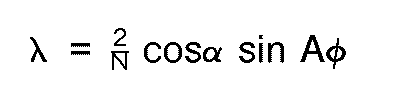
where λ is said wavelength, N is the nominal number per mm of the grooves ruled on said diffraction grating (14), α is the angle the light incident on said diffraction grating (14) makes with the normal to said diffraction grating, A is the reduction ratio of said motor (M), and φ is the amount of rotation of said motor (M).
where λ is said wavelength, N is the nominal number per mm of the grooves ruled on said diffraction grating (14), α is the angle the light incident on said diffraction grating (14) makes with the normal to said diffraction grating, A is the reduction ratio of said motor (M), and φ is the amount of rotation of said motor (M).
4. The spectrophotometer according to any one of the preceding claims, characterized in that said data processor (20, 21) includes a ROM which stores a table containing a group
of counted numbers of the pulses applied to said motor (M) and the corresponding wavelengths
of said monochromatic light for each of a group of different grating constants about
the nominal grating constant of said diffraction grating (14), and said data processor
(20, 21) selects one of said wavelengths in accordance with the counted number of
the pulses applied to said motor (M).
1. Spektrophotometer mit
einer Lichtquelle (10),
einem Monochromator (11), der ein Beugungsgitter (14) und einen Motor (M) zum Verstellen des Beugungsgitters enthält, um einen Strahl monochromatischen Lichts am Austrittsspalt des Monochromators zu erzeugen,
einer Probenküvette (12), die eine zu analysierende Probe enthält und so angeordnet ist, daß der monochromatische Lichtstrahl auf die Probenküvette auftrifft,
einem Photodetektor (13), der das von der Probe (12) kommende Licht erfasst und ein entsprechendes elektrisches Signal erzeugt,
einem Datenprozessor (20, 21), der die Wellenlänge des monochromatischen Lichts aus dem Betrag, um den sich der Motor (M) dreht, entsprechend einer vorbestimmten funktionalen Beziehung ermittelt, und
einer Sichtanzeige-Einheit (22) zum Anzeigen der Wellenlänge
dadurch gekennzeichnet, daß
eine Eingabe-Einheit (24) zum Einstellen eines der Differenz zwischen der nominellen und der tatsächlichen Gitterkonstante des Beugungsgitters (14) entsprechenden Parameters vorhanden ist,
die Eingabe-Einheit eine Vielzahl mechanischer Schalter (S1, S2, S3) enthält, deren Ein- und Aus-Zustände kombiniert werden, um eine Vielzahl von Daten zum Verändern des Parameters auszudrücken, und
der Datenprozessor (20, 21) so beschaffen ist, daß er die Wellenlänge entsprechend der nominellen Gitterkonstante ermittelt, die mittels des in der Eingabe-Einheit eingestellten Parameters modifiziert worden ist.
einer Lichtquelle (10),
einem Monochromator (11), der ein Beugungsgitter (14) und einen Motor (M) zum Verstellen des Beugungsgitters enthält, um einen Strahl monochromatischen Lichts am Austrittsspalt des Monochromators zu erzeugen,
einer Probenküvette (12), die eine zu analysierende Probe enthält und so angeordnet ist, daß der monochromatische Lichtstrahl auf die Probenküvette auftrifft,
einem Photodetektor (13), der das von der Probe (12) kommende Licht erfasst und ein entsprechendes elektrisches Signal erzeugt,
einem Datenprozessor (20, 21), der die Wellenlänge des monochromatischen Lichts aus dem Betrag, um den sich der Motor (M) dreht, entsprechend einer vorbestimmten funktionalen Beziehung ermittelt, und
einer Sichtanzeige-Einheit (22) zum Anzeigen der Wellenlänge
dadurch gekennzeichnet, daß
eine Eingabe-Einheit (24) zum Einstellen eines der Differenz zwischen der nominellen und der tatsächlichen Gitterkonstante des Beugungsgitters (14) entsprechenden Parameters vorhanden ist,
die Eingabe-Einheit eine Vielzahl mechanischer Schalter (S1, S2, S3) enthält, deren Ein- und Aus-Zustände kombiniert werden, um eine Vielzahl von Daten zum Verändern des Parameters auszudrücken, und
der Datenprozessor (20, 21) so beschaffen ist, daß er die Wellenlänge entsprechend der nominellen Gitterkonstante ermittelt, die mittels des in der Eingabe-Einheit eingestellten Parameters modifiziert worden ist.
2. Spektrophotometer nach Anspruch 1 dadurch gekennzeichnet, daß der Motor (M) ein Schrittmotor ist.
3. Spektrophotometer nach einem der vorangehenden Ansprüche dadurch gekennzeichnet, daß der Datenprozessor (20, 21) die Wellenlänge entsprechend
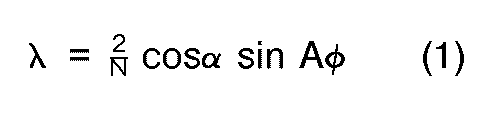
berechnet, wobei λ die Wellenlänge, N die nominelle Anzahl je mm der Rillen, mit denen das Beugungsgitter (14) versehen ist, α der Winkel, den das auf das Beugungsgitter (14) treffende Licht mit der Normalen des Beugungsgitters einschließt, A das Untersetzungsverhältnis des Motors (M) und φ der Betrag der Drehung des Motors (M) sind.
berechnet, wobei λ die Wellenlänge, N die nominelle Anzahl je mm der Rillen, mit denen das Beugungsgitter (14) versehen ist, α der Winkel, den das auf das Beugungsgitter (14) treffende Licht mit der Normalen des Beugungsgitters einschließt, A das Untersetzungsverhältnis des Motors (M) und φ der Betrag der Drehung des Motors (M) sind.
4. Spektrophotometer nach einem der vorangehenden Ansprüche dadurch gekennzeichnet, daß der Datenprozessor (20, 21) einen Festspeicher enthält, der eine Tabelle speichert,
die für jede aus einer Gruppe von verschiedenen, sich im Bereich der nominellen Gitterkonstante
des Beugungsgitters (14) bewegenden Gitterkonstanten eine Gruppe von gezählten Zahlen
der dem Motor (M) zugeführten Impulse und den entsprechenden Wellenlängen des monochromatischen
Lichts enthält, und daß der Datenprozessor (20, 21) eine der Wellenlängen entsprechend
der gezählten Zahl der dem Motor (M) zugeführten Impulse wählt.
1. Un spectrophotomètre comprenant:
une source lumineuse (10),
un monochromateur (11) comprenant un réseau de diffraction (14) et un moteur (M) pour commander ledit réseau de diffraction pour qu'il fournisse un faisceau de lumière monochromatique, au niveau de la fente de sortie dudit spectroprotomètre,
une cellule d'échantillon (12) contenant un échantillon destiné à être analysé et disposée de manière que ledit faisceau de lumière monochromatique se heurte sur ladite cellule d'échantillon,
un photodétecteur (13) pour détecter la lumière provenant dudit échantillon (12), afin de produire un signal électrique correspondant,
un processeur de traitement de données (20, 21) pour obtenir la longueur d'onde de ladite lumière monochromatique à partir de la valeur de rotation dudit moteur (M), selon une relation fonctionnelle prédéterminée et
une unité d'affichage (22) pour afficher ladite longueur d'onde,
caractérisé en ce que :
une unité d'entrée (24) est prévue pour déterminer un paramètre correspondant à la différence entre les constantes nominales et réelles de réseau, dudit réseau de diffraction (14),
ladite unité d'entrée comprend une pluralité de commutateurs mécaniques (S1, S2, S3), dont les états de marche et d'arrêt sont combinés pour exprimer une pluralité de données, en vue de modifier ledit paramètre et
ledit processeur de traitement de données (20, 21) est agencé de manière à obtenir ladite longueur d'onde en fonction de ladite constante de réseau nominale, modifiée avec ledit paramètre détecté dans ladite unité d'entrée.
une source lumineuse (10),
un monochromateur (11) comprenant un réseau de diffraction (14) et un moteur (M) pour commander ledit réseau de diffraction pour qu'il fournisse un faisceau de lumière monochromatique, au niveau de la fente de sortie dudit spectroprotomètre,
une cellule d'échantillon (12) contenant un échantillon destiné à être analysé et disposée de manière que ledit faisceau de lumière monochromatique se heurte sur ladite cellule d'échantillon,
un photodétecteur (13) pour détecter la lumière provenant dudit échantillon (12), afin de produire un signal électrique correspondant,
un processeur de traitement de données (20, 21) pour obtenir la longueur d'onde de ladite lumière monochromatique à partir de la valeur de rotation dudit moteur (M), selon une relation fonctionnelle prédéterminée et
une unité d'affichage (22) pour afficher ladite longueur d'onde,
caractérisé en ce que :
une unité d'entrée (24) est prévue pour déterminer un paramètre correspondant à la différence entre les constantes nominales et réelles de réseau, dudit réseau de diffraction (14),
ladite unité d'entrée comprend une pluralité de commutateurs mécaniques (S1, S2, S3), dont les états de marche et d'arrêt sont combinés pour exprimer une pluralité de données, en vue de modifier ledit paramètre et
ledit processeur de traitement de données (20, 21) est agencé de manière à obtenir ladite longueur d'onde en fonction de ladite constante de réseau nominale, modifiée avec ledit paramètre détecté dans ladite unité d'entrée.
2. Le spectrophotomètre selon la revendication 1, caractérisé en ce que ledit moteur
(M) est un moteur à impulsions.
3. Le spectrophotomètre selon l'une quelconque des revendications précédentes, caractérisé
en ce que ledit processeur de traitement de données (20, 21) calcule ladite longueur
d'onde en fonction de la relation qui suit:
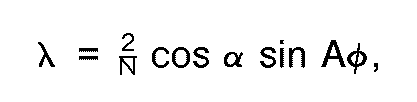
dans laquelle λ est ladite longueur d'onde, N est le nombre nominal par mm des rainures tracées sur ledit réseau de diffraction (14), α est l'angle de la lumière arrivant sur ledit réseau de diffraction (14) avec la perpendiculaire audit réseau de diffraction, A est le rapport de réduction dudit moteur (M) et (φ) est la vitesse de rotation dudit moteur (M).
dans laquelle λ est ladite longueur d'onde, N est le nombre nominal par mm des rainures tracées sur ledit réseau de diffraction (14), α est l'angle de la lumière arrivant sur ledit réseau de diffraction (14) avec la perpendiculaire audit réseau de diffraction, A est le rapport de réduction dudit moteur (M) et (φ) est la vitesse de rotation dudit moteur (M).
4. Le spectrophotomètre selon l'une quelconque des revendications précédentes, caractérisé
en ce que ledit processeur de traitement de données (20, 21) comprend une mémoire
morte qui stocke une table contenant un groupe de nombres comptés des impulsions appliquées
audit moteur (M) et les longueurs d'onde correspondantes de ladite lumière monochromatique,
pour chaque groupe de constantes de réseau différentes par rapport à la constante
de réseau nominale dudit réseau de diffraction (14) et ledit processeur de traitement
de données (20, 21) sélectionne l'une desdites longueurs d'onde en fonction du nombre
compté des impulsions appliquées audit moteur (M).