|
(11) | EP 0 209 899 B1 |

| (12) | EUROPEAN PATENT SPECIFICATION |
|
|
| (54) |
Water impervious rubber or plastic insulated power cable Mit wasserfestem Gummi oder Kunststoff isoliertes Kraftstromkabel Câble électrique de puissance isolé par du caoutchouc ou du plastique étanche |
|
|
|||||||||||||||||||||||||||||||
| Note: Within nine months from the publication of the mention of the grant of the European patent, any person may give notice to the European Patent Office of opposition to the European patent granted. Notice of opposition shall be filed in a written reasoned statement. It shall not be deemed to have been filed until the opposition fee has been paid. (Art. 99(1) European Patent Convention). |
[0001] The present invention relates to an improved water impervious rubber or plastic insulated power cable.
[0002] A water impervious rubber or plastic insulated power cable is known from Wire Journal International, Vol. 16, No. 9, September 1983, "Development of a Waterproof Crosslinked Polyethylene Cable", Uchiyama et alia, p.p. 178 - 189, having a water impervious layer of a laminated tape comprising a metal foil and an electrically conductive film formed directly around a cable core or through another coating layer as well as a hold tape layer and a metal shield layer formed sequentially on the cable core. The cable core has a conductor shield, a rubber or plastic insulation layer and an insulation shield which are formed on a conductor. Crosslinked polyethylene, an ethylene-propylene rubber and the like are mainly used as insulation layer in water impervious rubber or plastic insulated power cables having such a structure. Laminated tapes comprising lead or a lead alloy and polyolefin are mainly used as plastic laminated tapes constituting water impervious layers since they have excellent flexibility and chemical resistance. In addition, semiconductive cloth tapes are generally used as hold tapes applied on water impervious layers. A semiconductive cloth tape is obtained by friction-treating a woven fabric with electrically conductive rubber. The warps and wefts of the woven fabric are, in general, cotton yarn, viscose rayon yarn, acetate yarn, vinylon yarn, nylon yarn, or polyester yarn.
[0003] In the manufacture of water impervious rubber or plastic insulated power cables having the above conventional structure, a laminated tape comprising a metal foil and a plastic film is longitudinally applied on the cable core. After a hold tape is wound on the laminated tape, heating is performed to bond the laminated tape to the cable core, thereby forming a water impervious layer. In this case, the adhesive strength between the laminated tape and the cable core is largely influenced by the temperature and time during heating. That is, the higher the heating temperature and heating time, the higher the adhesive strength obtained.
[0004] A water impervious rubber or plastic insulated power cable manufactured in the manner described above, however, has the following problems.
[0005] A semiconductive cloth tape normally used as a hold tape on a conventional water impervious layer has a memory rate of expansion and contraction of 0 to 15%. Therefore, when a water impervious rubber or plastic insulated power cable having a hold tape constituted by such a tape is subjected to repeated bending, the water impervious tape cracks along the edge of the hold tape layer.
[0006] When the cable is subjected to a heat cycle of 130°C ⇄ R.T. (Room Temperature) with power applied to the conductor, as the cable core expands or contracts, the water impervious layer comprising a metal-plastic laminated tape bonded on the core also expands or contracts. However, the hold tape on the water impervious layer, once expanded, cannot contract. Therefore, when other layers expand and then contract, the hold tape layer forms wrinkles. Such wrinkles in the hold tape layer cause damage to the water impervious layer formed within the hold tape layer and/or the metal shield layer formed around the hold tape layer, thereby significantly degrading the characteristics of the cable.
[0008] The memory rate of expansion and contraction, which represents the degree of contraction of a yarn is an index for stretchability of a fabric of the yarn and is calculated in accordance with JIS (Japanese Industrial Standard) L 1090 by the following equation:
where,
a = hank (mm) in the case of applying a load of 2/1000 gf x 20 per 1d (denier) of the number of the indicated denier and another load of 1/10 gf (gramms force) x 20 per 1d of the number of the indicated denier; and
b = hank (mm) in the case of applying a load of 2/1000 gf x 20 per 1d of the number of the indicated denier.
[0009] In view of the fact as described above for a water impervious rubber or plastic insulated power cable, extensive studies have been made and it has been found that the above problems can be effectively solved for a water impervious rubber or plastic insulated power cable by the holding tape comprising a tape comprising a synthetic resin fiber cloth and an electrically conductive rubber, the synthetic resin fiber cloth having a memory rate of expansion and contraction, of at least 30% in the transverse or longitudinal or both directions of the tape the memory rate of expansion and contraction (A) being given by:
where,
a = hank (mm) in the case of applying a load of 2/1000 gf x 20 per 1d of the number of the indicated denier and another load of 1/10 gf x 20 per 1d of the number of the indicated denier; and
b = hank (mm) in the case of applying a load of 2/1000 gf x 20 per 1d of the number of the indicated denier.
[0010] This invention can be more fully understood from the following detailed description when taken in conjunction with the accompanying drawings, in which:
Fig. 1 is a sectional view showing an example of a cable construction according to the present invention; and
Fig. 2 is a sectional view showing another example of a cable construction according to the present invention.
[0011] According to the present invention, an electrically conductive tape using as a base cloth a woven fabric obtained by weaving a yarn having a memory rate of expansion and contraction of 30% or more is used as a hold tape formed on a water impervious layer. Therefore, the hold tape can follow the movement of the cable core, and therefore does not cause twisting or shifting or form wrinkles.
[0012] The effect of this hold tape layer is further enhanced when a lubricant such as silicone resin, graphite powder, talc, paraffin, hydrocarbon resin, fatty amide, fatty ester, carbon powder, or a stearate is applied on the surface of this electrically conductive tape.
[0013] In order to impart good characteristics to a cable, a yarn having a memory rate of expansion and contraction of 40% or more is used for the woven fabric, and wefts have a larger elongation than warps. The weaving method can be plain weaving, diagonal weaving, or twill weaving.
[0014] As the material for the yarn, a synthetic resin material having a low hygroscopicity is preferable. Preferred examples of such resin materials may include nylon, polyester, polybutylene terephthalate, polyurethane, and polypropylene.
[0015] As a yarn having a memory rate of expansion and contraction of 30% or more by crimping, wooly tetron, wooly nylon, and P.B.T. fiber ("Samora" available from Toray Industries, Inc.) are commercially available. As an electrically conductive rubber to be formed on at least one side of a woven fabric as a base material for a hold tape, an electrically conductive compound obtained by drying a solvent solution of a mixture of butyl rubber as a base and an electrically conductive carbon black such as "Ketjenblack EC" (trade name of AKZO Co.) or acetylene black and by vulcanizing the mixture by heating is used. The electrically conductive tape forming the hold tape has a volume resistivity of 5 x 10⁶ Ω·cm or less.
[0016] When at least one side of the electrically conductive rubber layer formed on the semiconductive woven fabric is subjected to a smoothening treatment by topping or the like, better results are obtained in respect to stress relaxation in and prevention of external damage to the water impervious layer.
[0017] In the water impervious rubber or plastic insulated power cable according to the present invention, the water impervious layer formed under the hold tape layer comprises a laminated tape comprising a metal foil of lead, copper, aluminum or the like, 20 to 200 µm in thick, and an electrically conductive plastic film having a thickness of 20 to 200 µm and a volume resistivity of 10⁶ Ω·cm or less. A copper wire or copper tape is used for a metal shield layer to be formed around the hold tape layer. A laminated tape using a lead or lead alloy foil is most preferred since it is flexible to provide excellent formability and can impart excellent chemical resistance to the cable.
[0018] Crosslinked polyethylene, polyethylene, ethylene-propylene rubber or the like is used for the insulation layer. Although a stranded conductor is normally used as a conductor, in applications where water infiltration from the conductor side is feared and must be prevented, a watertight conductor obtained by filling the gaps between the strands with an electrically conductive watertight compound is used. Although the electrically conductive watertight compound is not limited to a particular type, a mixture (developed by the present inventors) comprising 100 parts of butyl rubber (trade name: polysar-butyl), 10 to 30 parts of conductive carbon black (trade name: Ketjenblack EC), and 100 to 200 parts of calcium carbonate, and having a volume resistivity of 10⁶ Ω·cm or less is preferable due to its excellent filling and other properties.
[0019] In a water impervious rubber or plastic insulated power cable according to the present invention, since no wrinkles are formed in the hold tape layer, the inner water impervious layer and the outer metal shield layer are not adversely affected and the cable can exhibit excellent characteristics over a long period of time, thereby providing excellent industrial effects. Examples 1 - 4/Comparative Examples 1 - 4
[0020] In each of Examples 1 to 4 and Comparative Examples 1 to 4, as shown in Fig. 1, each watertight conductor had stranded conductors 1 of 500 mm² area which were filled with an electrically conductive watertight compound (volume resistivity: 5 x 10² Ω·cm) consisting of 100 parts of butyl rubber (polysar-butyl), 25 parts of conductive carbon black (Ketjenblack EC), and 100 parts of calcium carbonate. Conductor shield 2 consisting of ethylene-ethyl acrylate copolymer (EEA) and electrically conductive carbon, insulation layer 3 of crosslinked polyethylene, and insulation shield 4 consisting of EEA and electrically conductive carbon were formed around the watertight conductor to provide a cable core. After the cable core was dried at 60°C to make the amount of methane gas 0.2 cc or less per cc of the crosslinked polyethylene, a water impervious tape was longitudinally applied around the cable core to form water impervious layer 5. The water impervious tape was a 50 µm-thick lead foil laminated on both sides with a 100 µm-thick adhesive EEA films. Hold tape 6 of each material shown in Table 1 below was wound around the resultant structure with a 1/2 lap. Metal shield layer 7 comprising a copper wire having a diameter of 1.2 mm were formed. Jacket 9 of polyvinyl chloride was formed as an outermost layer to provide 66 kV water impervious crosslinked polyethylene insulated power cable.
Examples 5 - 7
[0021] In each of Examples 5 to 7, a watertight stranded conductor, 500 mm² in cross-sectional area, filled with an electrically conductive watertight compound (volume resistivity: 1 x 10⁴ Ω·cm) consisting of 100 parts of butyl rubber (polysar-butyl), 15 parts of conductive carbon black (Ketjenblack EC), and 250 parts of calcium carbonate was covered with a conductor shield consisting of ethylene-propylene rubber (EPR) and electrically conductive carbon, an insulation layer consisting of EPR, and an insulation shield consisting of EPR and electrically conductive carbon to form a cable core. After the cable core was dried, a water impervious tape was longitudinally applied to it to form a water impervious layer. The water impervious tape consisted of a 50 µm-thick lead foil laminated on both sides with a 100 µm-thick adhesive EEA film. A hold tape of each material as shown in Table 2 below was wound around the structure with a 1/2 lap. A metal shield layer consisting of a copper wire having a diameter of 1.2 mm was formed around the hold tape layer. A jacket of polyethylene was formed as an outermost layer to provide a 66 kV water impervious ethylene-propylene rubber insulated power cable.
Examples 8 - 10
[0022] In each of Examples 8 to 10, a watertight stranded conductor, 500 mm² in cross-sectional area, filled with an electrically conductive watertight compound (volume resistivity: 5 x 10³ Ω·cm) consisting of 100 parts of butyl rubber (polysar-butyl), 20 parts of conductive carbon black (Ketjenblack EC), and 150 parts of calcium carbonate was covered with a conductor shield consisting of an ethylene-vinyl acetate copolymer (EVA) and electrically conductive carbon, an insulation layer of polyethylene, and an insulation shield consisting of EVA and electrically conductive carbon to form a cable core. After the cable core was dried, a water impervious tape was longitudinally applied around the cable core to form a water impervious layer. The water impervious tape consisted of a 50 µm-thick lead foil laminated on both sides with a 100 µm-thick adhesive EEA film. Each hold tape of a material as shown in Table 3 below was wound around the structure with a 1/2 lap. After a metal shield layer comprising a copper wire of 1.2 mm was formed around the hold tape layer, a jacket of polyvinyl chloride was formed as an outermost layer to provide a 66 kV water impervious polyethylene insulated power cable.
Example 11
[0023] As shown in Fig. 2, a watertight conductor had stranded conductors 1 of 500 mm² area which were filled with an electrically, conductive watertight compound (volume resistivity: 1 x 10³ Ω·cm) consisting of 100 parts of butyl rubber (polysar-butyl), 20 parts of conductive carbon black (Ketjenblack EC), and 100 parts of calcium carbonate. Conductor shield 2 consisting of ethylene-ethyl acrylate copolymer (EEA) and electrically conductive carbon, insulation layer 3 of crosslinked polyethylene, and insulation shield 4 consisting of EEA and electrically conductive carbon were formed around the watertight conductor to provide a cable core. After the cable core was dried at 60°C to make the amount of methane gas 0.2 cc or less per cc of the crosslinked polyethylene, a water impervious tape was longitudinally applied around the cable core to form water impervious layer 5. The water impervious tape was a 50 µm-thick lead foil laminated on both sides with a 100 µm-thick adhesive EEA films. Hold tape 6 equal to that of Example 3 shown in Table 1 was wound around the resultant structure with a 1/2 lap. Metal shield layer 7 comprising a copper tape having a thickness of 0.1 mm and then hold tape layer 8 equal to that of Example 1 shown in Table 1 were formed. Jacket 9 of polyvinyl chloride was formed as an outermost layer to provide 66 kV water impervious crosslinked polyethylene insulated power cable.
[0024] The water impervious rubber or plastic insulated power cables in the above Examples and Comparative Examples were subjected to the following test.
[0025] The conductor of each power cable was powered and subjected to a heat cycle of a conductor temperature 130°C ⇄ R.T. ten times. Thereafter, the cables of each Example and Comparative Example were bent around a test cylinder at room temperature, unwound and repeated the process but this time they were bent in reverse direction. This cycle of operations was performed a total of five, ten and twenty times. Each cable was then disassembled, and the metal shield layer, the hold tape layer, and the water impervious layer of each cable were evaluated in accordance with the evaluation standards shown in the Table 4:
[0026] The results of evaluation are shown in Table 5 below. In practice, if no abnormality is found in the water impervious layer, the hold tape layer, and the metal shield layer after bending 5 cycles along an arc of a diameter 10 times greater than the outer diameter of the cable, the cable is evaluated as being usable for practical applications.
1. A water impervious rubber or plastic insulated power cable having a water impervious
layer (5) of a laminated tape comprising a metal foil and an electrically conductive
plastic film formed directly around a cable core or through another coating layer,
and a hold tape layer (6) formed on the water impervious layer, characterized in that
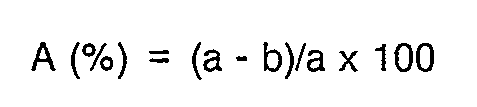
the hold tape layer (6) comprises a tape comprising a synthetic resin fiber cloth and an electrically conductive rubber, the synthetic resin fiber cloth having a memory rate of expansion and contraction of at least 30% in the transverse or longitudinal or both directions of the tape, the memory rate of expansion and contraction (A) being given by:
where,
a = hank (mm) in the case of applying a load of 2/1000 gf x 20 per 1d of the number of the indicated denier and another load of 1/10 gf x 20 per 1d of the number of the indicated denier; and
b = hank (mm) in the case of applying a load of 2/1000 gf x 20 per 1d of the number of the indicated denier.
the hold tape layer (6) comprises a tape comprising a synthetic resin fiber cloth and an electrically conductive rubber, the synthetic resin fiber cloth having a memory rate of expansion and contraction of at least 30% in the transverse or longitudinal or both directions of the tape, the memory rate of expansion and contraction (A) being given by:
where,
a = hank (mm) in the case of applying a load of 2/1000 gf x 20 per 1d of the number of the indicated denier and another load of 1/10 gf x 20 per 1d of the number of the indicated denier; and
b = hank (mm) in the case of applying a load of 2/1000 gf x 20 per 1d of the number of the indicated denier.
2. A cable according to claim 1, characterized in that the hold tape layer (6) is formed
in direct contact with the laminated tape forming the water impervious layer (5).
3. A cable according to claim 1, characterized in that the synthetic resin fiber cloth,
as a base cloth of the electrically conductive tape forming the hold tape layer (6),
is a woven fabric obtained by weaving a filament yarn, at least part of which is given
a memory rate of expansion and contraction of not less than 30% by applying small
crimps.
4. A cable according to claim 1, characterized in that the electrically conductive tape
forming the hold tape layer (6) is a tape in which an electrically conductive rubber
layer is formed on at least one side of a synthetic resin fiber cloth.
5. A cable according to claim 1, characterized in that a filament yarn of the synthetic
resin fiber cloth, as a base cloth of the electrically conductive tape forming the
hold tape layer (6) is a synthetic resin fiber selected from the group consisting
of fiber of nylon, polyester, polybutylene-terephthalate, polyurethane and polypropylene.
6. A cable according to claim 1, characterized in that a filament yarn of the synthetic
resin fiber cloth, as a base cloth of the electrically conductive tape forming the
hold tape layer (6) is a yarn selected from the group consisting of polyester and
polybutylene-terephthalate.
7. A cable according to claim 1, characterized in that the water impervious layer (5)
formed around the cable core comprises a laminated tape comprising an electrically
conductive polyolefin film and a foil of a metal selected from the group consisting
of lead, copper and aluminum.
8. A cable according to claim 1, characterized in that the water impervious layer (5)
comprises a laminated tape obtained by bonding an electrically conductive polyolefin
film on at least one side of a lead or lead alloy foil having a thickness of 20 to
200 µm.
9. A cable according to claim 1, characterized in that the electrically conductive tape
forming the hold tape layer (6) has a volume resistivity of not more than 5 x 10⁶
Ω· cm.
10. A cable according to claim 1, characterized in that the insulation layer (3) of the
cable core comprises a material selected from the group consisting of crosslinked
polyethylene, polyethylene and ethylene-propylene rubber.
11. A cable according to claim 1, characterized in that the insulation layer (3) of the
cable core comprises a polyethylene-type resin selected from the group consisting
of crosslinked polyethylene and polyethylene.
12. A cable according to claim 1, characterized in that the cable core comprises a conductor
shield (2), a rubber or plastic insulation layer (3) and an insulation shield (4)
which are sequentially formed around a conductor (1).
13. A cable according to claim 1, characterized in that the cable core comprises a conductor
shield (2), and a rubber or plastic insulation layer (3) which are sequentially formed
around a conductor (1).
14. A cable according to claim 1, characterized in that a water impervious layer (5) of
a laminated tape comprising a metal foil and an electrically conductive plastic film,
a hold tape layer (6), a metal shield layer (7) and, if required, a jacket (9), are
sequentially formed around a cable core.
15. A cable according to claim 1, characterized in that the cable conductor (1) is a watertight
conductor in which gaps between stranded conductors are filled with an electrically
conductive watertight compound.
1. Câble électrique de puissance isolé par du caoutchouc ou du plastique étanche à l'eau
comportant une couche (5), étanche à l'eau, d'un ruban stratifié comprenant une mince
feuille de métal et un film en plastique conducteur de l'électricité formé directement
autour d'une âme de câble ou par l'intermédiaire d'une autre couche de revêtement,
et une couche (6) de ruban de maintien formée sur la couche imperméable à l'eau, caractérisé en ce que :
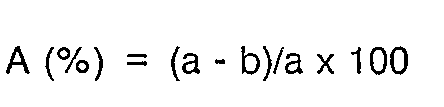
la couche (6) de ruban de maintien comprend un tissu en fibre de résine synthétique et un caoutchouc conducteur de l'électricité, le tissu en fibres de résine synthétique présentant un taux de mémoire de dilatation et de contraction d'au moins 30% dans la direction transversale et/ou dans la direction longitudinale du ruban, le taux de mémoire de dilatation et de contraction (A) étant donné par :
où,
a = échevette (mm) dans le cas de l'application d'une charge de 2/1000 gf x 20 par 1d (denier) du nombre de deniers indiqués et une autre charge de 1/10 gf x 20 par 1d du nombre de deniers indiqués et
b = échevette (mm) dans le cas de l'application d'une charge de 2/1000 gf x 20 par 1d du nombre de deniers indiqués.
la couche (6) de ruban de maintien comprend un tissu en fibre de résine synthétique et un caoutchouc conducteur de l'électricité, le tissu en fibres de résine synthétique présentant un taux de mémoire de dilatation et de contraction d'au moins 30% dans la direction transversale et/ou dans la direction longitudinale du ruban, le taux de mémoire de dilatation et de contraction (A) étant donné par :
où,
a = échevette (mm) dans le cas de l'application d'une charge de 2/1000 gf x 20 par 1d (denier) du nombre de deniers indiqués et une autre charge de 1/10 gf x 20 par 1d du nombre de deniers indiqués et
b = échevette (mm) dans le cas de l'application d'une charge de 2/1000 gf x 20 par 1d du nombre de deniers indiqués.
2. Câble selon la revendication 1, caractérisé en ce que la couche (6) de ruban de support est formée en contact direct avec le
ruban stratifié formant la couche (5) imperméable à l'eau.
3. Câble selon la revendication 1, caractérisé en ce que le tissu en fibres de résine synthétique, en tant que tissu de base du
ruban conducteur de l'électricité formant la couche (6) de ruban de maintien, est
un tissu tissé obtenu par tissage d'un filé en filament, dont on a donné à au moins
une partie un taux de mémoire de dilatation et de contraction qui n'est pas inférieur
à 30% par application de petites frisures.
4. Câble selon la revendication 1, caractérisé en ce que le ruban conducteur de l'électricité formant la couche (6) de ruban de
maintien est un ruban dans lequel une couche de caoutchouc conducteur de l'électricité
est formée sur au moins un des côtés d'un tissu en fibres de résine synthétique.
5. Câble selon la revendication 1, caractérisé en ce que le filé de filament du tissu en fibres de résine synthétique, en tant que
tissu de base du ruban conducteur de l'électricité formant la couche (6) de ruban
de maintien, est une fibre de résine synthétique choisie parmi le groupe comprenant
la fibre de nylon, la fibre de polyester, la libre de poly(téréphtalate de butylène),
la fibre de polyuréthane et la fibre de polypropylène.
6. Câble selon la revendication 1, caractérisé en ce que le filé de filament du tissu en fibres de résine synthétique, en tant que
tissu de base du ruban conducteur de l'électricité formant la couche (6) de ruban
de maintien, est un filé choisi parmi le groupe comprenant le polyester et le poly(téréphtalate
de butylène).
7. Câble selon la revendication 1, caractérisé en ce que la couche (5) imperméable à l'eau, formée autour de l'âme du câble comprend
un ruban stratifié comportant un film de polyoléfine conducteur de l'électricité et
une mince feuille d'un métal choisi parmi le groupe comprenant le plomb, le cuivre
et l'aluminium.
8. Câble selon la revendication 1, caractérisé en ce que la couche (5) imperméable à l'eau comprend un ruban stratifié obtenu par
adhérence d'un film de polyoléfine conducteur de l'électricité sur au moins une des
faces d'une mince feuille de plomb ou d'un alliage de plomb ayant une épaisseur de
20 à 200 µm.
9. Câble selon la revendication 1, caractérisé en ce que le ruban conducteur de l'électricité formant la couche (6) de ruban de
maintien a une résistivité volumique qui n'est pas supérieure à 5 x 10⁶ Ω. cm.
10. Câble selon la revendication 1, caractérisé en ce que la couche isolante (3) de l'âme du câble comprend une matière choisie parmi
le groupe comprenant le polyéthylène réticulé, le polyéthylène et le caoutchouc d'éthylène-propylène.
11. Câble selon la revendication 1, caractérisé en ce que la couche isolante (3) de l'âme du câble comprend une résine du type polyéthylène
choisie parmi le groupe comprenant le polyéthylène réticulé et le polyéthylène.
12. Câble selon la revendication 1, caractérisé en ce que l'âme du câble comprend un écran conducteur (2), une couche isolante (3)
en caoutchouc ou en plastique et un écran isolant (4) qui sont formés successivement
autour d'un conducteur (1).
13. Câble selon la revendication 1, caractérisé en ce que l'âme du câble comprend un écran conducteur (2) et une couche isolante
(3) en caoutchouc ou en plastique qui sont formés successivement autour d'un conducteur
(1).
14. Câble selon la revendication 1, caractérisé en ce que la couche (5) imperméable à l'eau d'un ruban stratifié comprend une mince
feuille métallique et un film en plastique conducteur de l'électricité, une couche
(6) de ruban de maintien, une couche (7) d'écran métallique et, si besoin est, une
gaine (9), formés successivement autour de l'âme du câble.
15. Câble selon la revendication 1, caractérisé en ce que le conducteur (1) du câble est un conducteur étanche à l'eau dans lequel
les interstices entre les conducteurs toronnés sont remplis d'un composé étanche à
l'eau et conducteur de l'électricité.
1. Mit wasserundurchlässigem Gummi oder Plastik isoliertes Stromkabel welches eine wasserundurchlässige
Schicht (5) aus einem laminierten Band aufweist, welches eine Metallfolie und einen
elektrisch leitenden Kunststoffilm umfaßt, der direkt oder durch eine andere Abdeckschicht
um einen Kabelkern herum gebildet ist, sowie eine Bandhalteschicht (6), welche auf
der wasserundurchlässigen Schicht gebildet ist, dadurch gekennzeichnet, daß die Bandhalteschicht (6) ein Band umfaßt, welches einen Kunstharz-Faserstoff
und ein elektrisch leitfähiges Gummi umfaßt, wobei der Kunstharz-Faserstoff eine Dehnungs-
und Zusammenziehungs-Speicherrate von wenigstens 30% in der transversalen oder longitudinalen
Richtung oder in beiden Richtungen des Bandes aufweist, und die Ausdehnungs- und Zusammenziehungs-Speicherrate
(A) durch
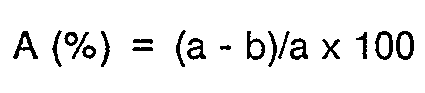
gegeben ist, worin a gleich hank (mm) im Falle des Aufbringens einer Last von 2/1000 gf x 20 pro 1d der Zahl der zu efassenden Deniers und einer anderen Last von 1/10 gf x 20 pro 1d der Zahl der zu efassenden Deniers und b gleich hank (mm) im Falle des Aufbringens einer Last von 2/1000 gf x 20 pro 1d der Zahl der zu efassenden Deniers ist.
gegeben ist, worin a gleich hank (mm) im Falle des Aufbringens einer Last von 2/1000 gf x 20 pro 1d der Zahl der zu efassenden Deniers und einer anderen Last von 1/10 gf x 20 pro 1d der Zahl der zu efassenden Deniers und b gleich hank (mm) im Falle des Aufbringens einer Last von 2/1000 gf x 20 pro 1d der Zahl der zu efassenden Deniers ist.
2. Kabel nach Anspruch 1,
dadurch gekennzeichnet, daß die Bandhalteschicht (6) in direktem Kontakt mit dem laminierten Band, welches die wasserundurchlässige Schicht (5) bildet, gebildet ist.
dadurch gekennzeichnet, daß die Bandhalteschicht (6) in direktem Kontakt mit dem laminierten Band, welches die wasserundurchlässige Schicht (5) bildet, gebildet ist.
3. Kabel nach Anspruch 1,
dadurch gekennzeichnet, daß der Kunstharz-Faserstoff als Grundstoff des elektrisch leitfähigen Bandes, welches die Bandhalteschicht (6) bildet, eine Gewebestruktur ist, welche durch Weben eines Fasergarns erhalten wird, und wenigstens einem Teil davon eine Dehnungs- und Kontraktions-Speicherrate von nicht weniger als 30% durch Verwendung von kleinen Crimps gegeben ist.
dadurch gekennzeichnet, daß der Kunstharz-Faserstoff als Grundstoff des elektrisch leitfähigen Bandes, welches die Bandhalteschicht (6) bildet, eine Gewebestruktur ist, welche durch Weben eines Fasergarns erhalten wird, und wenigstens einem Teil davon eine Dehnungs- und Kontraktions-Speicherrate von nicht weniger als 30% durch Verwendung von kleinen Crimps gegeben ist.
4. Kabel nach Anspruch 1,
dadurch gekennzeichnet, daß das elektrisch leitfähige Band, welches die Bandhalteschicht (6) bildet, ein Band ist, in welchem eine elektrisch leitfähige Gummischicht auf wenigstens einer Seite eines Kunstharz-Faserstoffes gebildet ist.
dadurch gekennzeichnet, daß das elektrisch leitfähige Band, welches die Bandhalteschicht (6) bildet, ein Band ist, in welchem eine elektrisch leitfähige Gummischicht auf wenigstens einer Seite eines Kunstharz-Faserstoffes gebildet ist.
5. Kabel nach Anspruch 1,
dadurch gekennzeichnet, daß ein Fasergarn des Kunstharz-Faserstoffes als Grundstoff des elektrisch leitfähigen Bandes, welches die Bandhalteschicht (6) bildet, eine Kunstharzfaser ist, welche aus der Gruppe bestehend aus Fasern aus Nylon, Polyester, Polybutylen-Terephthalat, Polyurethan und Polypropylen gewählt ist.
dadurch gekennzeichnet, daß ein Fasergarn des Kunstharz-Faserstoffes als Grundstoff des elektrisch leitfähigen Bandes, welches die Bandhalteschicht (6) bildet, eine Kunstharzfaser ist, welche aus der Gruppe bestehend aus Fasern aus Nylon, Polyester, Polybutylen-Terephthalat, Polyurethan und Polypropylen gewählt ist.
6. Kabel nach Anspruch 1,
dadurch gekennzeichnet, daß ein Fasergarn des Kunstharz-Faserstoffes als Grundlage des elektrisch leitfähigen Bandes, welches die Bandhalteschicht (6) bildet, ein Garn ist, welches aus der Gruppe bestehend aus Polyester und Polybutylen-Therephthalat gewählt ist.
dadurch gekennzeichnet, daß ein Fasergarn des Kunstharz-Faserstoffes als Grundlage des elektrisch leitfähigen Bandes, welches die Bandhalteschicht (6) bildet, ein Garn ist, welches aus der Gruppe bestehend aus Polyester und Polybutylen-Therephthalat gewählt ist.
7. Kabel nach Anspruch 1,
dadurch gekennzeichnet, daß die wasserundurchlässige Schicht (5), welche um den Kabelkern herum gebildet ist, ein laminiertes Band umfaßt, welches einen elektrisch leitfähigen Polyolefin-Film und eine Folie aus Metall umfaßt, welches aus der Gruppe umfassend Blei, Kupfer und Aluminium gewählt ist.
dadurch gekennzeichnet, daß die wasserundurchlässige Schicht (5), welche um den Kabelkern herum gebildet ist, ein laminiertes Band umfaßt, welches einen elektrisch leitfähigen Polyolefin-Film und eine Folie aus Metall umfaßt, welches aus der Gruppe umfassend Blei, Kupfer und Aluminium gewählt ist.
8. Kabel nach Anspruch 1,
dadurch gekennzeichnet, daß die wasserundurchlässige Schicht (5) ein laminiertes Band umfaßt, welches durch Bonden eines elektrisch leitfähigen Polyolefin-Films auf wenigstens eine Seite einer Folie aus Blei oder einer Bleilegierung erhalten wurde, welche eine Dicke von 20 bis 200 µm hat.
dadurch gekennzeichnet, daß die wasserundurchlässige Schicht (5) ein laminiertes Band umfaßt, welches durch Bonden eines elektrisch leitfähigen Polyolefin-Films auf wenigstens eine Seite einer Folie aus Blei oder einer Bleilegierung erhalten wurde, welche eine Dicke von 20 bis 200 µm hat.
9. Kabel nach Anspruch 1,
dadurch gekennzeichnet, daß das elektrisch leitfähige Band, welches die Bandhalteschicht (6) bildet, einen spezifischen Widerstand von nicht mehr als 5 x 10⁶ Ohm . cm hat.
dadurch gekennzeichnet, daß das elektrisch leitfähige Band, welches die Bandhalteschicht (6) bildet, einen spezifischen Widerstand von nicht mehr als 5 x 10⁶ Ohm . cm hat.
10. Kabel nach Anspruch 1,
dadurch gekennzeichnet, daß die Isolierschicht (3) des Kabelkernes ein Material umfaßt, welches aus der Gruppe umfassend vernetztes Polyethylen, Polyethylen und Ethylen-Propylengummi, gewählt ist.
dadurch gekennzeichnet, daß die Isolierschicht (3) des Kabelkernes ein Material umfaßt, welches aus der Gruppe umfassend vernetztes Polyethylen, Polyethylen und Ethylen-Propylengummi, gewählt ist.
11. Kabel nach Anspruch 1,
dadurch gekennzeichnet, daß die Isolierschicht (3) des Kabelkernes ein Kunstharz vom Polyethylen-Typ umfaßt, welches aus der Gruppe bestehend aus vernetztem Polyethylen und Polyethylen, gewählt ist.
dadurch gekennzeichnet, daß die Isolierschicht (3) des Kabelkernes ein Kunstharz vom Polyethylen-Typ umfaßt, welches aus der Gruppe bestehend aus vernetztem Polyethylen und Polyethylen, gewählt ist.
12. Kabel nach Anspruch 1,
dadurch gekennzeichnet, daß der Kabelkern eine Leiterabschirmung (2), eine Gummi- oder Kunststoffisolierschicht (3) und eine Isolationsabschirmung (4) umfaßt, welche aufeinanderfolgend um einen Leiter (1) herum gebildet sind.
dadurch gekennzeichnet, daß der Kabelkern eine Leiterabschirmung (2), eine Gummi- oder Kunststoffisolierschicht (3) und eine Isolationsabschirmung (4) umfaßt, welche aufeinanderfolgend um einen Leiter (1) herum gebildet sind.
13. Kabel nach Anspruch 1,
dadurch gekennzeichnet, daß der Kabelkern eine Leiterabschirmung (2) und eine Gummi- oder Kunststoffisolationsschicht (3) umfaßt, welche aufeinanderfolgend um einen Leiter (1) gebildet sind.
dadurch gekennzeichnet, daß der Kabelkern eine Leiterabschirmung (2) und eine Gummi- oder Kunststoffisolationsschicht (3) umfaßt, welche aufeinanderfolgend um einen Leiter (1) gebildet sind.
14. Kabel nach Anspruch 1,
dadurch gekennzeichnet, daß eine wasserundurchlässige Schicht (5) eines laminierten Bandes, welches eine Metallfolie und einen elektrisch leitfähigen Kunststoffilm umfaßt, eine Bandhalteschicht (6), eine Metallabschirmungsschicht (7), und falls benötigt, eine Umhüllung (9), aufeinanderfolgend um einen Kabelkern herum gebildet sind.
dadurch gekennzeichnet, daß eine wasserundurchlässige Schicht (5) eines laminierten Bandes, welches eine Metallfolie und einen elektrisch leitfähigen Kunststoffilm umfaßt, eine Bandhalteschicht (6), eine Metallabschirmungsschicht (7), und falls benötigt, eine Umhüllung (9), aufeinanderfolgend um einen Kabelkern herum gebildet sind.
15. Kabel nach Anspruch 1,
dadurch gekennzeichnet, daß der Kabelleiter (1) ein wasserdichter Leiter ist, in welchem Spalte zwischen verseilten Leitern mit einer elektrisch leitfähigen, wasserdichten Verbindung gefüllt sind.
dadurch gekennzeichnet, daß der Kabelleiter (1) ein wasserdichter Leiter ist, in welchem Spalte zwischen verseilten Leitern mit einer elektrisch leitfähigen, wasserdichten Verbindung gefüllt sind.