|
(11) | EP 0 212 820 B1 |

| (12) | EUROPEAN PATENT SPECIFICATION |
|
|
| (54) |
Metal perfluorosulphonic acid polymer catalyst Katalysator aus Metall enthaltendem Perfluorsulfonsäurepolymer Catalyseur constitué par un polymère d'acide perfluorosulfonique sous forme métal |
|
|
|||||||||||||||||||||||||||||||
| Note: Within nine months from the publication of the mention of the grant of the European patent, any person may give notice to the European Patent Office of opposition to the European patent granted. Notice of opposition shall be filed in a written reasoned statement. It shall not be deemed to have been filed until the opposition fee has been paid. (Art. 99(1) European Patent Convention). |
[0001] The present invention relates to metal perfluorosulphonic acid polymer catalysts and the preparation and use thereof. More specifically, this invention relates to a catalyst comprising a perfluorosulphonic acid polymer containing units derived from a metal perfluorosulphonic acid salt and the use of this catalyst in a process for preparing glycol ethers.
[0002] Polymers containing perfluorosulphonic acid groups have long been known to have catalytic properties. Examples of such properties include the alkylation of aromatic hydrocarbons, the nitration of aromatics with nitric acid, and the oxidative carbonylation of aromatics.
[0003] US patent 4,356,318 discloses the use of Group VIII metal cations of perfluorosulphonic acid polymers as catalysts for the oxidative carbonylation of toluene to toluic acid. US patent 4,446,329 discloses a process for the alkylation of aromatic substrates employing as a catalyst a metal cation salt of a perfluorosulphonic acid polymer. However, neither of these patents disclose perfluorosulphonic acid polymers containing metal cations which are surrounded by fluorosulphonic acid groups.
[0004] The present invention provides a metal perfluorosulphonic acid polymer catalyst having an increased number of fluorosulphonic acid groups surrounding the metal cation, thereby maximising the catalytic effect of the acid catalyst.
[0005] Accordingly, the present invention provides a perfluorosulphonic acid polymer suitable for use as a catalyst containing units of the formula:
wherein M is a multivalent metal cation,
R is a C1 to C8 fluorinated alkyl group,
z is the valency of M, and
w is an integer having a value between 1 and z-1.
[0006] The polymer may be represented by the general formula:
wherein X is a perfluorosulphonic acid polymer backbone comprising fluorinated carbon atoms,
M R, z and w are the same as in formula (I), and y is an integer.
[0007] According to another embodiment of the present invention, a process is provided for the preparation of glycol ethers comprising reacting an alkylene oxide and an alcohol in the presence of a catalyst, characterised in that the catalyst is a perfluorosulphonic acid polymer containing units of the formula (1) as hereinbefore described.
[0008] The catalyst of the present invention is a perfluorosulphonic acid polymer containing units of the formula (I). Metals having such multiple valencies and useful herein include but are not limited to Al, Zn, Se, Cu, Sn, Cr, Co, Hg, Mg, Mn, Ni and B. Preferred metal cations include A13+ and Zn2+.
[0009] The metal or metal cation is selected for the particular reaction in which the inventive catalyst will be employed. For example, A13+, Fe3+, and Cr3+ are generally preferred for use in alkylation reactions. Moreover, A13+ is also preferred as the catalyst used in preparing glycol ethers from the reaction of alkylene oxides and alcohols.
[0010] The group, designated as R in formula (I), is a C1 to Ce fluorinated alkyl group. Preferably, the fluorinated alkyl group will have from one to four carbon atoms with CF3 being most preferred.
[0011] Generally, the perfluorosulphonic acid polymers which are used as the backbone and as one of the anion components of the metal perfluorosulphonic acid catalyst will have a number average molecular weight of at least 2,000. The polymer should contain a sufficient number of sulphonic acid groups to give an equivalent weight of between 500 to 20,000 and preferably from 900 to about 2,000. Although the polymer backbone comprises, for the most part, bonded fluorinated carbon atoms, it is not necessary that all other atoms be excluded. For example, oxygen atoms may be present either in the backbone or in the side chains of the polymer. Other atoms and/or groups such as hydrogen, chlorine, and carboxyl may be present in limited amounts without significantly reducing the effectiveness, the stability or the operability of the polymer. Perfluorosulphonic acid polymers may be employed in either powder or film form, preferably powder form.
[0012] The perfluorosulphonic acid polymer of the present invention may be prepared by known ion-exchange techniques. For example, a metal fluorosulphonic acid salt may be physically contacted with the fluorosulphonic acid polymer. Typically, the polymer will be physically mixed with an aqueous or alcoholic solution of the metal fluorosulphonic acid salt. The ion-exchange reaction typically occurs at room temperature and atmospheric pressure although the ion-exchange conditions may vary.
[0013] When preparing the metal perfluorosulphonic acid polymer of the present invention, it is desirable to allow sufficient time for the ion-exchange to occur such that at least 10% of the available sulphonic acid groups on the polymer will be substituted with the metal fluorosulphonic acid salt. The necessary time will depend on the process conditions employed and the particular metal fluorosulphonic acid salt employed and can be easily determined by one skilled in the art.
[0014] The ion-exchanged polymer may be separated from the ion-exchange medium by means known in the art, for example by filtration or centrifugation. Following separation, it is preferred to wash the ion-exchanged polymer, suitably with water or a lower alkanol, for example methanol, and thereafter dry the polymer.
[0015] The perfluorosulphonic acid polymer of this invention can be used as catalyst in a wide variety of reactions. Typically, these catalysts can be employed in Friedel-Crafts and related reactions. More particularly, these catalysts can be employed in the production of glycol ethers from alkylene oxides and alcohols.
[0016] Whereas the majority of the units contained in the perfluorosulphonic acid polymer will have the formula 6 (SO3)M(SO3R)z-1, it is possible that there may be units present of the formula (S03)2M(S03R)z-2 formed by exchange of two sulphonic acid groups on the perfluorosulphonic acid polymer backbone with a single molecule of the metal fluorosulphonic acid salt. Whilst it is not intended to be bound in any way be theory, it is believed that an exchange of the following type occurs in the case of M = AI for example:-
[0017] According to a separate embodiment of the present invention, glycol ethers are prepared by reacting an alkylene oxide and an alcohol in the presence as catalyst of the perfluorosulphonic acid polymer containing units of formula (I). It is preferred that the catalyst be an aluminium fluorosulphonic acid salt of the perfluorosulphonic acid polymer.
[0018] The alkylene oxide used as a reactant can be any alkylene oxide but is conveniently a lower alkylene oxide having less than 20 carbon atoms.Both unsubstituted alkylene oxides, for example ethylene oxide, and substituted alkylene oxides, for example epichlorohydrin may be used. Preferred alkylene oxides are ethylene oxide, propylene oxide, butylene oxide, cyclohexane oxide and epichlorohydrin.
[0019] In addition to an alkylene oxide, an alcohol is used as a coreactant. The alcohol reactant can be monohydric containing one hydroxyl group or can be polyhydric containing two or more hydroxyl groups. The alcohol reactant is typically a substituted or unsubstituted C1 to C10 monohydric or polyhydric alcohol. Examples of suitable alcohols include but are not limited to methanol, butanol, cyclopentanol, ethylene glycol, propylene glycol and glycerol. Preferred are C1 to C6 monohydric alcohols and dihydric alcohols (containing two hydroxyl groups). Combinations of these alcohols can also be employed.
[0020] The molar ratio of reactants can vary. In general, the molar ratio of alcohol to alkylene oxide should be in the range from 10:1 to 1:10, preferably 10:1 to 1:3. The catalyst is conveniently added in amount such that it constitutes between 1 and 10,000 ppm by weight of the reactants.
[0021] It is possible to carry out the above process at room temperature although higher temperatures can be used to accelerate the rate of reaction. The reaction is preferably carried out at a temperature in the range from 20°C to 140°C.
[0022] The reaction can be carried out at atmospheric pressure or at a superatmospheric pressure in the range 1 to 20 bar. Preferably the reaction is carried out under the autogenous pressure generated by the reaction mixture in a closed vessel at the temperature of reaction.
[0024] In another embodiment of the aforesaid process instead of an alcohol there may be used an aromatic hydroxy-containing compound, for example phenol.
[0025] The present invention is further illustrated by the following Examples. However, these Examples should not be construed as limiting the scope of this invention which includes equivalent variations, modifications and embodiments.
Example 1
[0026] 1g of a perfluorosulphonic acid polymer commercially obtained from E.I. DuPont de Nemours and Company from Wilmington, Delaware, USA and known as Nafion (TM) 117 powder (35-60 mesh = 0.42-0.25 mm) was added to a solution of 0.5g of aluminium triflate (trifluoromethanesulphonic acid) in 10g of methanol and the resulting mixture stirred for 7 hours. The solid was filtered, washed with 100 ml of methanol and air dried. The resulting resin had an aluminium content of 0.53% by weight.
Example 2
[0027] Example 1 was repeated except that the mixture was stirred for 24 hours. Analysis of the resulting resin showed an aluminium content of 0.73% by weight.
Example 3
[0028] A Fischer-Porter tube was charged with 10.5g of methanol, 3g of propylene oxide and 0.2g of the aluminium salt of the Nafion (TM) resin prepared in Example 2. The tube was purged with nitrogen to remove air, pressurised to 80 psi (0.552 MPa) with nitrogen, sealed and finally heated to 80°C with stirring. After one hour, the tube was cooled and depressurised. Analysis of the liquid product by gas chromatography showed a quantitative conversion of propylene oxide with a greater than 95% selectivity to the two isomers of methoxypropanol.
1. A perfluorosulphonic acid polymer suitable for use as a catalyst containing units
of the formula:
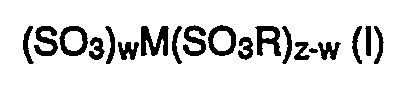
wherein M is a multivalent metal cation,
wherein M is a multivalent metal cation,
R is a C1 to Ca fluorinated alkyl group,
z is the valency of M, and
w is an integer having a value between 1 and z-1.
2. A perfluorosulphonic acid polymer according to claim 1 having the general formula:

wherein X is a perfluorosulphonic acid polymer backbone comprising fluorinated carbon atoms,
wherein X is a perfluorosulphonic acid polymer backbone comprising fluorinated carbon atoms,
M, R, z and w are the same as in formula (I), and y is an integer.
3. A perfluorosulphonic acid polymer according to either claim 1 or claim 2 wherein
the metal M is either aluminium, iron or chromium.
4. A perfluorosulphonic acid polymer according to any one of the preceding claims
wherein the group R is a fluorinated alkyl group having from 1 to 4 carbon atoms.
5. A perfluorosulphonic acid polymer according to claim 4 wherein the group R is a
CF3 group.
6. A process for producing the perfluorosulphonic acid polymer of claim 1 which process
comprises ion-exchanging a perfluorosulphonic acid polymer with a solution of a metal
fluorosulphonic acid salt.
7. A process according to claim 6 wherein the solution is an aqueous or alcoholic
solution.
8. A process according to either claim 6 or claim 7 wherein the ion-exchange is conducted
for a time such that at least 10% of the available sulphonic acid groups on the polymer
are exchanged.
9. A process according to any one of claims 6 to 8 wherein the perfluorosulphonic
acid polymer to be ion-exchanged has a number average molecular weight of at least
2,000.
10. A process according to any one of claims 6 to 9 wherein the metal fluorosulphonic
acid salt is the trifluoromethanesulphonic acid salt of aluminium.
11. A process for the production of a glycol ether which process comprises reacting
an alkylene oxide with an alcohol in the presence as catalyst of the perfluorosulphonic
acid polymer of claim 1.
12. A process according to claim 11 wherein the perfluorosulphonic acid polymer is
of formula (I) wherein M is aluminium.
1. Ein zur Verwendung als Katalysator geeignetes Perfluorsulphonsäurepolymer enthaltend
Einheiten der Formel:

worin M ein mehrwertiges Metallkation, R eine C1 bis C8 fluorierte Alkylgruppe, z die Valenz von M, und w eine ganze Zahl mit einem Wert zwischen 1 und z-1 bedeutet.
worin M ein mehrwertiges Metallkation, R eine C1 bis C8 fluorierte Alkylgruppe, z die Valenz von M, und w eine ganze Zahl mit einem Wert zwischen 1 und z-1 bedeutet.
2. Perfluorsulphonsäurepolymer gemäß Anspruch 1 mit der allgemeinen Formel:

worin X eine Perfluorsulphonsäurepolymerkette umfassend fluorierte Kohlenstoffatome bedeutet, M, R, z und w die gleiche Bedeutung wie in Formel (I) besitzen, und y eine ganze Zahl darstellt.
worin X eine Perfluorsulphonsäurepolymerkette umfassend fluorierte Kohlenstoffatome bedeutet, M, R, z und w die gleiche Bedeutung wie in Formel (I) besitzen, und y eine ganze Zahl darstellt.
3. Perfluorsulphonsäurepolymer gemäß Anspruch 1 oder 2, worin das Metall M Aluminium,
Eisen oder Chrom ist.
4. Perfluorsulphonsäurepolymer gemäß einem der vorgehenden Ansprüche, worin die Gruppe
R eine fluorierte Alkylgruppe mit 1 bis 4 Kohlenstoffatomen darstellt.
5. Perfluorsulphonsäurepolymer gemäß Anspruch 4, worin die Gruppe R eine CF3 Gruppe ist.
6. Verfahren zur Herstellung des Perfluorsulphonsäurepolymers gemäß Anspruch 1, wobei
ein Perfluorsulphonsäurepolymer mit einer Lösung eines Fluorsulphonsäuremetallsalzes
einer lonenaustauschreaktion unterworfen wird.
7. Verfahren gemäß Anspruch 6, worin die Lösung eine wäßrige oder alkoholische Lösung
ist.
8. Verfahren gemäß Anspruch 6 oder 7, worin der Ionenaustausch während einer solchen
Zeit durchgeführt wird, daß zumindest 10% der verfügbaren Sulphonsäuregruppen an dem
Polymer ausgetauscht werden .
9. Verfahren gemäß einem der Ansprüche 6 bis 8, worin das Perfluorsulphonsäurepolymer,
welches der lonenaustauschreaktion unterworfen wird, ein Zahlendurchschnittsmolekulargewicht
von mindestens 2000 besitzt.
10. Verfahren gemäß einem der Ansprüche 6 bis 9, worin das Fluorsulphonsäuremetallsalz
das Trifluormethansulphonsäuresalz von Aluminium ist.
11. Verfahren zur Herstellung eines Glykolethers durch Umsetzung eines Alkylenoxids
mit einem Alkohol in Anwesenheit des Perfluorsulphonsäurepolymers gemäß Anspruch 1
als Katalysator.
12. Verfahren gemäß Anspruch 11, worin das Perfluorsulphonsäurepolymer ein solches
der Formel I ist, worin M Aluminium bedeutet.
1. Polymère d'acide perfluorosulfonique convenant pour servir de catalyseur, et contenant
des motifs de formule
dans laquelle M représente un cation de métal multivalent, R représente un groupe alkyle en Ci à Ca, fluoré, z est la valence de M, et w est un nombre entier valant entre 1 et z-1.
(S03)wM(S03R)z-w (I)
dans laquelle M représente un cation de métal multivalent, R représente un groupe alkyle en Ci à Ca, fluoré, z est la valence de M, et w est un nombre entier valant entre 1 et z-1.
2. Polymère d'acide perfluorosulfonique selon la revendication 1, répondant à la formule
générale
dans laquelle X représente une charpente polymère d'acide perfluorosulfonique comprenant des atomes de carbone fluoré, M, R, z et w sont les mêmes que pour la formule (I), et y est un nombre entier.
X [(SO3)wM(SO3R)z-w] y (II)
dans laquelle X représente une charpente polymère d'acide perfluorosulfonique comprenant des atomes de carbone fluoré, M, R, z et w sont les mêmes que pour la formule (I), et y est un nombre entier.
3. Polymère d'acide perfluorosulfonique selon l'une des revendications 1 et 2, dans
lequel le métal M est l'aluminium, le fer ou le chrome.
4. Polymère d'acide perfluorosulfonique selon l'une quelconque des revendications
précédentes dans lequel le groupe R est un groupe alkyle fluoré ayant 1 à 4 atomes
de carbone.
5. Polymère d'acide perfluorosulfonique selon la revendication 4, dans lequel le groupe
R est un groupe CF3.
6. Procédé pour produire le polymère d'acide perfluorosulfonique selon la revendication
1, ce procédé comprenant la soumission d'un polymère d'acide perfluorosulfonique à
échange d'ions avec une solution d'un sel métallique d'acide fluorosulfonique.
7. Procédé selon la revendication 6, dans lequel la solution est une solution aqueuse
ou alcoolique.
8. Procédé selon la revendication 6 ou la revendication 7, dans lequel on conduit
l'échange d'ions pendant un temps tel qu'au moins 10% des groupes acides sulfoniques
disponibles du polymère aient subi un échange d'ions.
9. Procédé selon l'une quelconque des revendications 6 à 8, dans lequel le polymère
d'acide perfluorosulfonique, à soumettre à échange d'ions, possède un poids moléculaire
moyen en nombre au moins égal à 2000.
10. Procédé selon l'une quelconque des revendications 6 à 9, dans lequel le sel de
métal d'acide fluorosulfonique est le sel d'aluminium de l'acide trifluorométhanesulfonique.
11. Procédé pour la production d'un éther de glycol, ce procédé comprenant la réaction
d'un oxyde d'alkylène avec un alcool en présence, comme catalyseur, des polymères
d'acide perfluorosulfonique selon la revendication 1.
12. Procédé selon la revendication 11, dans lequel le polymère d'acide perfluorosulfonique
répond à la formule (I), dans laquelle M représente l'aluminium.