|
(11) | EP 0 212 944 B1 |

| (12) | EUROPEAN PATENT SPECIFICATION |
|
|
| (54) |
Melt-processable aromatic copolyester In der Schmelze verarbeitbarer aromatischer Copolyester Copolyester aromatique transformable à l'état fondu |
|
|
|||||||||||||||||||||||||||||||
|
||||||||||||||||||||||||||||||||
| Note: Within nine months from the publication of the mention of the grant of the European patent, any person may give notice to the European Patent Office of opposition to the European patent granted. Notice of opposition shall be filed in a written reasoned statement. It shall not be deemed to have been filed until the opposition fee has been paid. (Art. 99(1) European Patent Convention). |
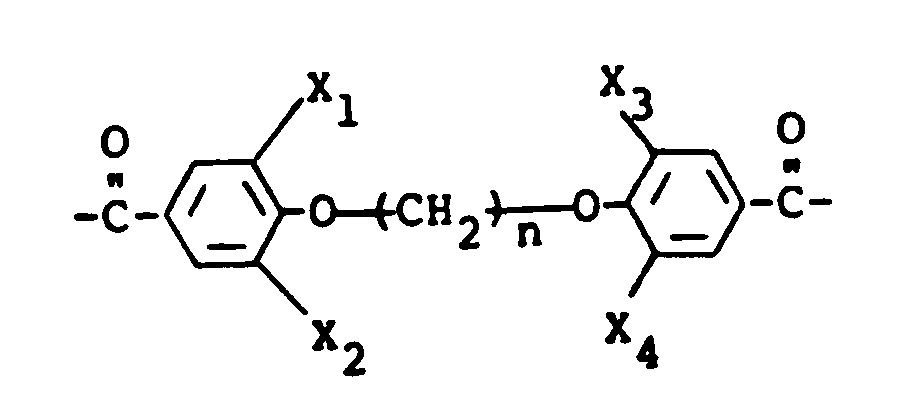
[0001] This invention relates to a melt-processable copolyester having improved mechanical properties, especially flexural properties.
[0002] It is known that a group of aromatic polyesters which show liquid crystallinity when melted have a high degree of orientation and accordingly show excellent mechanical properties, particularly high tensile strength. On the other hand, since there is a very large difference between their mechanical properties in the direction of the axis of orientation and those in a direction perpendicular to it, their properties depend greatly upon their flowing state during melt processing. Hence, their industrial application encounters difficulties.
[0003] Those which have been put to industrial application contain fillers in order to decrease high orientation, and do not prove to be satisfactory because the light weight of the resin material is greatly sacrificed and their specific strength decreases.
[0004] For example, as shown in U. S. Patent 4,473,682, a resin formed from 5 mole% of 6-acetoxy-2-naphthoic acid, 60 mole% of p-hydroxybenzoic acid, 17.5 mole% of 4,4'-biphenol diacetate and 17.5 mole% of terephthalic acid has a tensile strength of 1900 kg/cm² but a flexural strength of 1230 kg/cm² and a flexural modulus of 8.4 x 10⁴ kg/cm².
[0005] Starting monomers for aromatic polyesters are frequently crystalline, and the melt-polymerization conditions are naturally restricted by the melting points of the monomers and the resulting polymer. Furthermore, the restriction of the melting point of the polymer in turn imposes restrictions on the monomer composition which can be melt-polymerized.
[0006] Polymers containing component (I) in this invention are described, for example, in Japanese Laid-Open Patent Publications Nos. 41331/1984 and 4529/1985. Polymers containing components (III) and (IV) in this invention are described, for example, in U. S. Patent 4,161 470, EP-A-117086, U. S. Patent 4,219,461, EP-A-102160, and U. S. Patent 4,473,682.
[0007] A homopolymer of p-hydroxybenzoic acid, known as "EKONOL E101", has a very high melting point and cannot be melt-polymerized. Its processability can be increased by using 6-acetoxy-2-naphthoic acid as a copolymer component (U. S. Patent 4,161,470). Further work on its improvement has been done, but no significant improvement in mechanical strength, particularly flexural strength has been achieved (U. S. Patent 4,161,470 and EP-A-117086).
[0008] It was recently reported that polymers containing 1,2-bis(2-chlorophenoxy)ethane-4,4'-dicarboxylic acid as a copolymer component are tough (Japanese Laid-Open Patent Publication No. 4529/1985). Since, however, these polymers generally have a fairly low melting point because they contain an aliphatic component in the main chain, they have only limited uses in practical application.
[0009] The resins shown in Japanese Laid-Open Patent Publication No. 41331/1984 are wholly aromatic polyesters. A polymer derived from 1,2-bis(2-chlorophenoxy)ethane-4,4'-dicarboxylic acid and 4,4'-diacetoxybiphenol, which is stated to be most preferred, has a high melting point, and is very difficult to prepare by melt-polymerization.
[0010] An aromatic polyester having melt moldability and an excellent balance between optical anisotropy and mechanical properties, containing 2,7-dihydroxynapthalene is disclosed in JP-A-60188423.
[0011] It is an object of this invention therefore to remedy the aforesaid defects of the conventional polyesters, and to provide copolyesters which can be prepared by melt polymerization and can be melt-processed, have moderately high heat distortion temperatures and melting points and which give shaped articles having high strengths and high moduli.
[0012] According to this invention, this object is achieved by a copolyester composed of the following structural units (I), (II) and (III) and/or (IV).
Structural unit (I)
[0014] In the formula, X₁, X₂, X₃ and X₄, independently from each other, represent H, F, Cl, Br, CH₃ or C(CH₃)₃, provided that X₁ to X₄ do not simultaneously represent H, and n is 2 or 4.
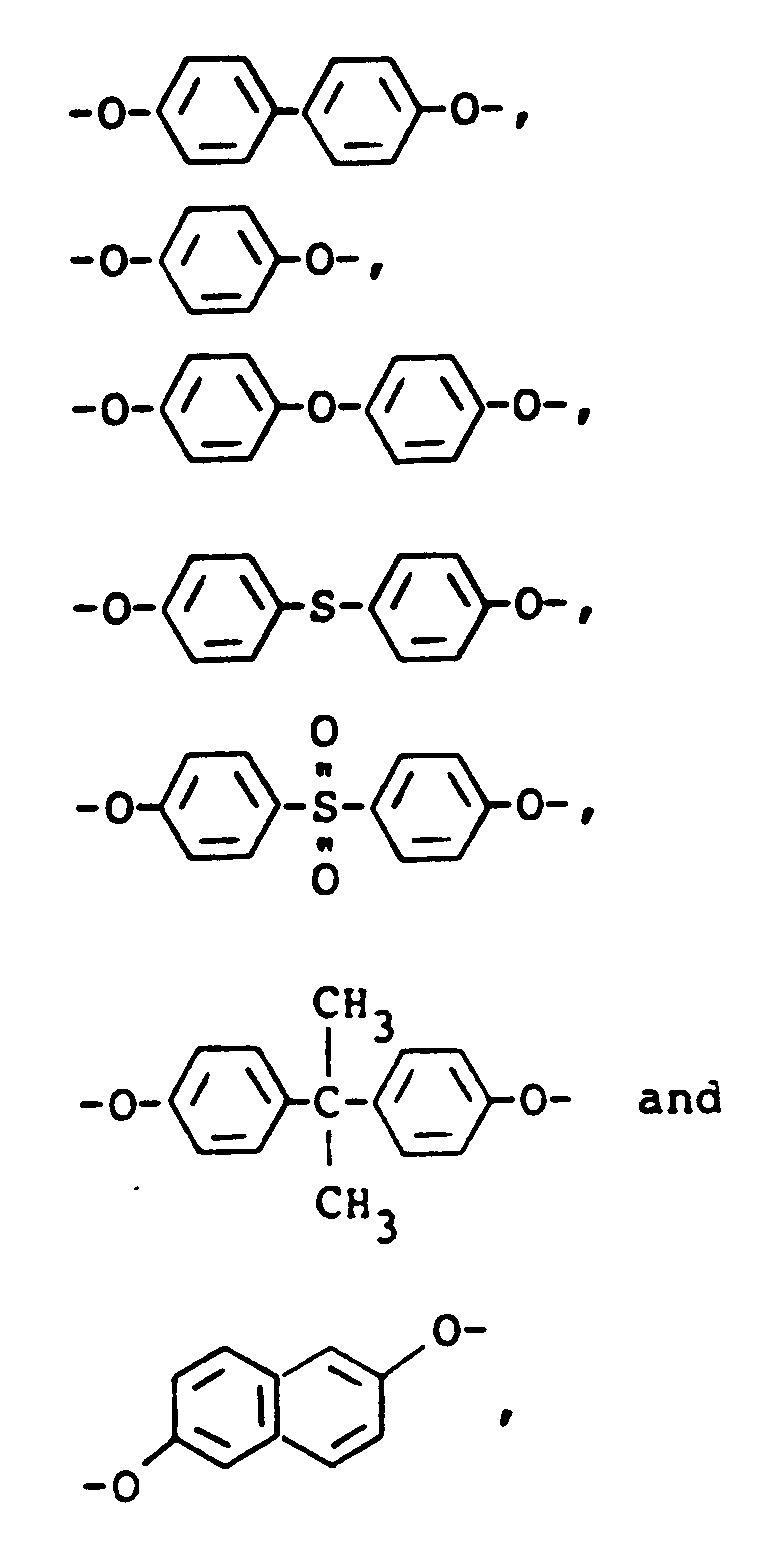
Structural unit (II)
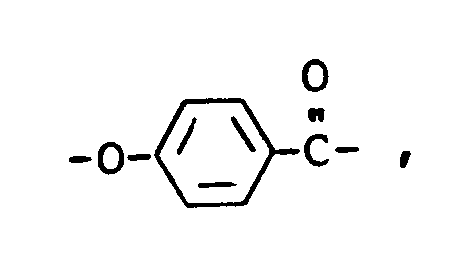
Structural unit (III)
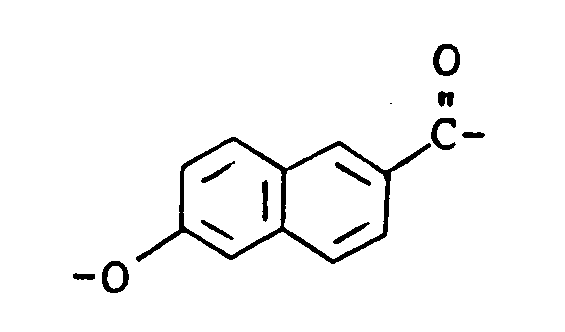
Structural unit (IV)
[0018] In the structural units (II), (III) and (Iv), at least one of the hydrogen atoms on each aromatic ring may be substituted by an alkyl or alkoxy group having 1 to 4 carbon atoms or a halogen atom.
[0019] The copolyester of this invention should contain 2.5 to 35 mole%, preferably 5 to 30 mole%, more preferably 10 to 25 mole%, of unit (I), 2.5 to 35 mole%, preferably 5 to 30 mole%, more preferably 10 to 25 mole%, of unit (II), and 30 to 95 mole%, preferably 40 to 90 mole%, more preferably 50 to 80 mole%, of unit (III), or unit (IV) or a combination of units (III) and (IV). If the total proportion of the units (I) and (II) exceeds 70 mole % based on the copolyester, the copolyesters have a high melting point and is extremely difficult to prepare by melt-polymerization. At least one of the units (III) and (IV) should be present, but preferably both units are present.
[0020] The ease of shaping a resin does not necessarily depends upon the melting point of the resin. The copolyester of this invention can be melt-shaped. It attains a melt viscosity of 10⁴ to 10² poises (10³ to 10 Pa·s) temperatures of not more than 400oC, preferably not more than 360oC, more preferably not more than 320oC, but cannot attain this melt viscosity range at temperatures of not more than 180oC. The polymerization temperature for the preparation of the copolyester of this invention is not more than 360oC, preferably not more than 340oC, and more preferably not more than 320oC.
[0021] When the copolyester of this invention is prepared at a polymerization temperature exceeding 360oC, it is undesirably colored and undergoes decomposition resulting in the liberation of the halogen atoms in unit (I).
[0022] When substituents exist on the structural units of the copolyester of this invention, its melting point generally becomes broad and vague. But its glass transition temperature, as a measure of heat resistance is equivalent to that of the non-substituted copolyester, and the copolyester shows high mechanical properties.
[0023] Preferred starting compounds which provide the unit (I) of the copolyester of the invention include, for example,
1,2-bis(2-chlorophenoxy)ethane-4,4'-dicarboxylic acid,
1,2-bis(2-bromophenoxy)ethane-4,4'-dicarboxylic acid,
1,2-bis(2-fluorophenoxy)ethane-4,4'-dicarboxylic acid,
1,2-bis(2-methylphenoxy)ethane-4,4'-dicarboxylic acid,
1,2-biS(2,6-dimethylphenoxy)ethane-4,4'-dicarboxylic acid,
1,2-bis(2-tert-butylphenoxy)ethane-4,4'-dicarboxylic acid,
1,2-bis(2,6-di-tert-butylphenoxy)ethane-4,4'-dicarboxylic acid,
1,4-bis(2-chlorophenoxy)butane-4,4'-dicarboxylic acid,
1,4-bis(2-bromophenoxy)butane-4,4'-dicarboxylic acid,
1,4-bis(2-fluorophenoxy)butane-4,4'-dicarboxylic acid,
1,4-bis(2-methylphenoxy)butane-4,4'-dicarboxylic acid,
1,4-bis(2,6-dimethylphenoxy)butane-4,4'-dicarboxylic acid,
1,4-bis(2-tert-butylphenoxy)butane-4,4'-dicarboxylic acid,
1,4-bis(2,6-di-tert.-butylphenoxy)butane-4,4'-dicarboxylic acid, and
these esters (e.g., methyl or phenyl) and chlorides.
[0024] The following compounds may also be used in small amounts which do not impair the properties of the resulting copolyester of this invention.
[0025] 1(2-Chlorophenoxy)-2(2',6'-dichlorophenoxy)ethane-4,4'-dicarboxylic acid,
1(2-chlorophenoxy)-2(2',3',6'-trichlorophenoxy)ethane-4,4'-dicarboxylic acid,
1,2-bis(2,6-dichlorophenoxy)ethane-4,4'-dicarboxylic acid,
1(2,6-dichlorophenoxy)-2(2',3',6'-trichlorophenoxy)ethane-4,4'-dicarboxylic acid,
1(phenoxy)-2(2'-chlorophenoxy)ethane-4,4'-dicarboxylic acid,
1(2-bromophenoxy)-2(2',5'-dibromophenoxy)ethane-4,4'-dicarboxylic acid,
1(2-bromophenoxy)-2(2',3,,6'-tribromophenoxy)ethane-4,4'-dicarboxylic acid,
1,2-bis(2,6-dibromophenoxy)ethane-4,4'-dicarboxylic acid,
1(2,6-dibromophenoxy)-2(2',3',6'-tribromophenoxy)ethane-4,4'-dicarboxylic acid,
1(phenoxy)-2(2'-bromophenoxy)ethane-4,4'-dicarboxylic acid,
1(2-fluorophenoxy)-2(2',6'-difluorophenoxy)ethane-4,4'-dicarboxylic acid,
1(2-fluorophenoxy)-2(2',3',6'-trifluorophenoxy)ethane-4,4'-dicarboxylic acid,
1,2-bis(2,6-difluorophenoxy)ethane-4,4'-dicarboxylic acid,
1(2,6-difluorophenoxy)-2(2',3',6'-trifluorophenoxy)ethane-4,4'-dicarboxylic acid,
1(phenoxy)-2(2'-fluorophenoxy)ethane-4,4'-dicarboxylic acid,
1(2-chlorophenoxy)-4(2',6'-dichlorophenoxy)butane-4,4'-dicarboxylic acid,
1(2-chlorophenoxy)-4(2',3',6'-trichlorophenoxy)butane-4,4'-dicarboxylic acid,
1,4-bis(2,6-dichlorophenoxy)butane-4,4'-dicarboxylic acid,
1(2,6-dichlorophenoxy)-4(2',3',6'-trichlorophenoxy)butane-4,4'-dicarboxylic acid,
1(phenoxy-4(2'-chlorophenoxy)butane-4,4'-dicarboxylic acid,
1(2-bromophenoxy)-4(2',6'-dibromophenoxy)butane-4,4'-dicarboxylic acid,
1(2-bromophenoxy)-4(2',3',6'-tribromophenoxy)butane-4,4'-dicarboxylic acid,
1,4-bis(2,6-dibromophenoxy)butane-4,4'-dicarboxylic acid,
1(2,6-dibromophenoxy)-4(2',3',6'-tribromophenoxy)butane-4,4'-dicarboxylic acid,
1(phenoxy)-4(2'-bromophenoxy)butane-4,4'-dicarboxylic acid,
1(2-fluorophenoxy)-4(2',6'-difluorophenoxy)butane-4,4'-dicarboxylic acid,
1(2-fluorophenoxy)-4(2',3',6'-trifluorophenoxy)butane-4,4'-dicarboxylic acid,
1,4-bis(2,6-difluorophenoxy)butane-4,4'-dicarboxylic acid,
1(2,6-difluorophenoxy)-4(2',3',6'-trifluorophenoxy)butane-4,4'-dicarboxylic acid,
1(phenoxy)-4(2'-fluorophenoxy)butane-4,4'-dicarboxylic acid, and
their esters (e.g., methyl or phenyl) and chlorides.
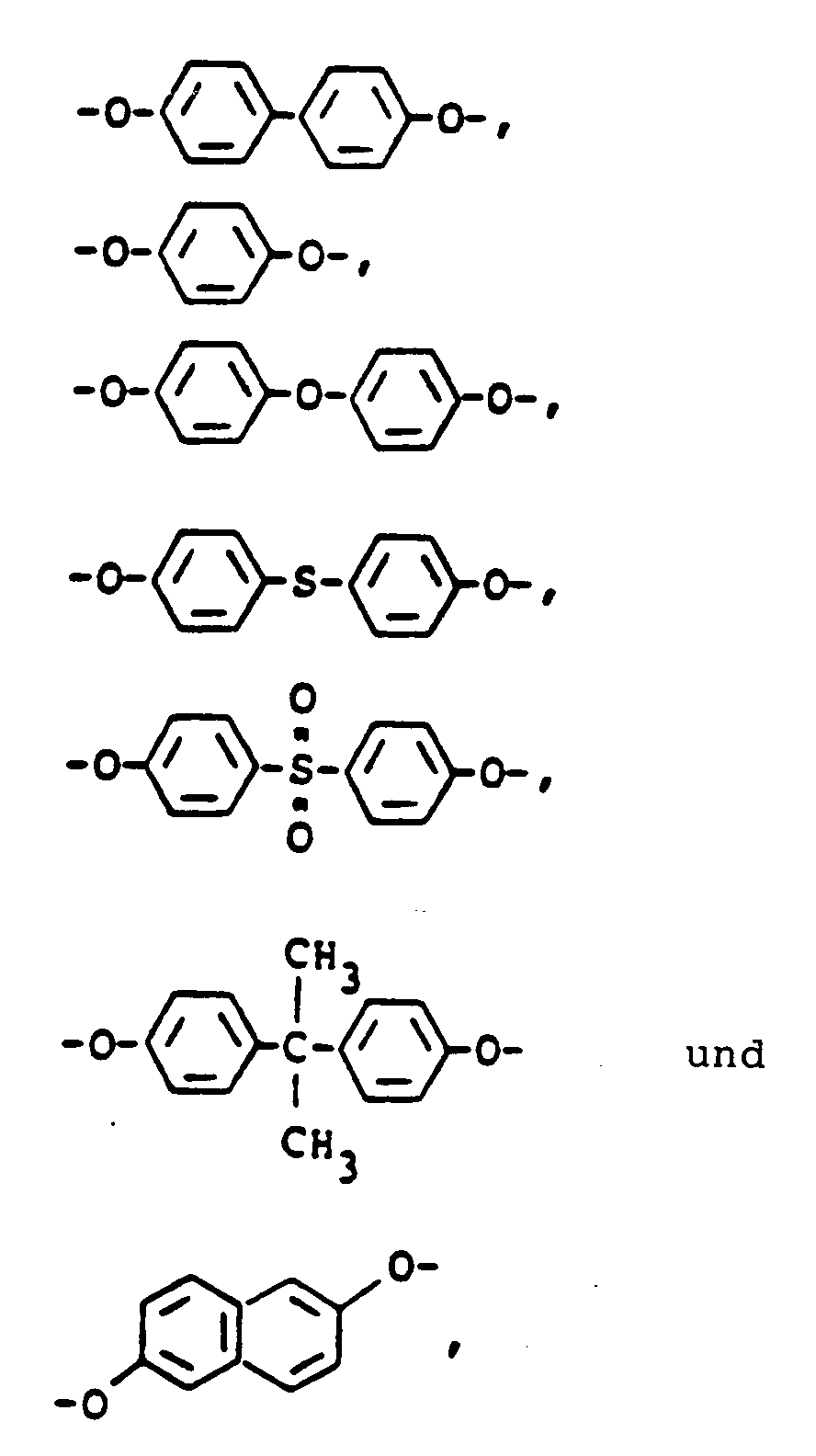
[0026] Starting compounds which provide the unit (II) are, for example, selected from biphenol, hydroquinone, 4,4'-hydroxydiphenol, 4,4'-thiodiphenol, 4,4'-sulfonyldiphenol, bisphenol A and 2,6-dihydroxynaphthalene. At least one of the hydrogen atoms on the aromatic rings of the diols may be substituted by an alkyl or alkoxy group having 1 to 4 carbon atoms or a halogen atoms (F, Cl, Br or I).
[0027] Examples of substitution products of biphenol include
3-chloro-4,4'-biphenol,
2-chloro-4,4'-biphenol,
3,3'-dichloro-4,4'-biphenol,
2,2'-dichloro-4,4'-biphenol,
3,5-dichloro-4,4'-biphenol,
3,3',5-trichloro-4,4'-biphenol,
3,3',5,5'-tetrachloro-4,4'-biphenol,
2,3'-dichloro-4,4'-biphenol,
2,2',6,6'-tetrachloro-4,4'-biphenol,
3-bromo-4,4'-biphenol,
2-bromo-4,4'-biphenol,
3,3'-dibromo-4,4'-biphenol,
2,2'-dibromo-4,4'-biphenol,
3-methyl-4,4'-biphenol,
2-methyl-4,4'-biphenol,
3,3'-dimethyl-4,4'-biphenol,
2,2'-dimethyl-4,4'-biphenol,
3,3',5,5'-tetrabutyl-4,4'-biphenol,
3-methoxy-4,4'-biphenol,
2-methoxy-4,4'-biphenol, and
3,3'-dimethoxy-4,4'-biphenol.
[0028] Examples of substitution products of hydroquinone include
methylhydroquinone,
2,5-dimethylhydroquinone,
2,6-dimethylhydroquinone,
ethylhydroquinone,
methoxyhydroquinone,
2,5-dimethoxyhydroquinone,
chlorohydroquinone,
2,5-dichlorohydroquinone,
2,6-dichlorohydroquinone,
bromohydroquinone,
2,5-dibromohydroquinone,
2,6-dibromohydroquinone,
fluorohydroquinone, and
iodohydroquinone.
[0029] Examples of substitution products of 4,4'-oxydiphenol include
3-chloro-4,4'-oxydiphenol,
2-chloro-4,4'-oxydiphenol,
3,3'-dichloro-4,4'-oxydiphenol,
2,2'-dichloro-4,4'-oxydiphenol,
3,5-dichloro-4,4'-oxydiphenol,
2,3-dichloro-4,4'-oxydiphenol,
3,3',5-trichloro-4,4'-oxydiphenol,
3,3',5,5'-tetrachloro-4,4'-oxydiphenol,
2,2',6,6'-tetrachloro-4,4'-oxydiphenol,
3-bromo-4,4'-oxydiphenol,
2-bromo-4,4'-oxydiphenel
3,3'-dibromo-4,4-oxydiphenol,
2,2'-dibromo-4,4'-oxydiphenol,
3,5-dibromo-4,4'-oxydiphenol,
3,3',5,5'-tetrabromo-4,4'-oxydiphenol,
3-methyl-4,4'-oxydiphenol,
2-methyl-4,4'-oxydiphenol,
3,3'-dimethyl-4,4'-oxydiphenol,
2,2'-dimethyl-4,4'-oxydiphenol,
3-methoxy-4,4'-oxydiphenol,
2-methoxy-4,4'-oxydiphenol, and
3,3-dimethoxy-4,4'-oxydiphenol.
[0030] Similar examples of substitution products to 4,4'-oxydiphenol may be cited for substitution products of 4,4'-thiodiphenol, 4,4'-sulfonyldiphenol and bisphenol A.
[0031] Examples of substitution products of 2,6-dihydroxynaphthalene include
1-chloro-2,6-dihydroxynaphthalene,
3-chloro-2,6-dihydroxynaphthalene,
4-chloro-2,6-dihydroxynaphthalene,
1,3-dichloro-2,6-dihydroxynaphthalene,
1,5-dichloro-2,6-dihydroxynaphthalene,
1,3,5,7-tetrachloro-2,6-dihydroxynaphthalene,
1-bromo-2,6-dihydroxynaphthalene,
3-bromo-2,5-dihydroxynaphthalene,
4-bromo-2,6-dihydroxynaphthalene,
1,5-dibromo-2,6-dihydroxynaphthalene,
1-methyl-2,6-dihydroxynaphthalene,
3-methyl-2,6-dihydroxynaphthalene,
4-methyl-2,6-dihydroxynaphthalene,
1,5-dimethyl-2,6-dihydroxynaphthalene,
1-methoxy-2,6-dihydroxynaphthalene,
3-methoxy-2,6-dihydroxynaphthalene,
4-methoxy-2,6-dihydroxynaphthalene, and
1,5-dimethoxy-2,6-dihydroxynaphthalene.
[0032] In addition, lower acyl esters, preferably acetates, of these exemplified compounds may be cited as compounds which provides the unit (II).
[0033] Examples of starting compounds which provide the unit (III) include
4-hydroxybenzoic acid,
3-chloro-4-hydroxybenzoic acid,
2-chloro-4-hydroxybenzoic acid,
3,5-dichloro-4-hydroxybenzoic acid,
3-bromo-4-hydroxybenzoic acid,
2-bromo-4-hydroxybenzoic acid,
3,5-dibromo-4-hydroxybenzoic acid,
3-methyl-4-hydroxybenzoic acid,
2-methyl-4-hydroxybenzoic acid,
3,5-dimethyl-4-hydroxybenzoic acid,
3-methoxy-4-hydroxybenzoic acid,
2-methoxy-4-hydroxybenzoic acid,
3,5-dimethoxy-4-hydroxybenzoic acid,
3-phenyl-4-hydroxybenzoic acid,
2-phenyl-4-hydroxybenzoic acid, and
lower acyl esters, preferably acetates, or lower alkyl esters, preferably methyl esters, of these acids.
[0034] Examples of starting compounds which provide the unit (IV) include
6-hydroxy-2-naphthoic acid,
5-chloro-6-hydroxy-2-naphthoic acid,
7-chloro-6-hydroxy-2-naphthoic acid,
1-chloro-6-hydroxy-2-naphthoic acid,
3-chloro-6-hydroxy-2-naphthoic acid,
5,7-dichloro-6-hydroxy-2-naphthoic acid,
1,5-dichloro-6-hydroxy-2-naphthoic acid,
1,5,7-trichloro-6-hydroxy-2-naphthoic acid,
5-bromo-6-hydroxy-2-naphthoic acid,
7-bromo-6-hydroxy-2-naphthoic acid,
1-bromo-6-hydroxy-2-naphthoic acid,
3-bromo-6-hydroxy-2-naphthoic acid,
5,7-dibromo-6-hydroxy-2-naphthoic acid,
1,5-dibromo-6-hydroxy-2-naphthoic acid,
1,5,7-tribromo-6-hydroxy-2-naphthoic acid,
5-methyl-6-hydroxy-2-naphthoic acid,
7-methyl-6-hydroxy-2-naphthoic acid,
5-methoxy-6-hydroxy-2-naphthoic acid,
7-methoxy-6-hydroxy-2-naphthoic acid, and
lower acyl esters, preferably acetates, or lower alkyl esters, preferably methyl esters, of these acids.
[0035] The copolyester of this invention can be obtained by any desired method using the aforesaid starting compounds, namely compounds having the structural unit (I), compounds having the structural unit (II), and compounds having the structural unit (III) and/or compounds having the structural unit (IV), for example by polycondensation of an aromatic diol, a phenyl ester of an aromatic hydroxycarboxylic acid, and a diphenyl ester of an aromatic dicarboxylic acid with elimination of phenol, or by first reacting a required amount of diphenyl carbonate with a mixture of an aromatic hydroxycarboxylic acid and an aromatic dicarboxylic acid to convert the carboxylic acids to their phenyl esters, then adding an aromatic diol, and subjecting ther mixture to polycondensation with elimination of phenol. Preferably, it is obtained by polycondensation with elimination of monocarboxylic acid which comprises reacting an aromatic dicarboxylic acid with an acyloxy aromatic carboxylic acid and a diacyl aromatic diol. In this method, the polymerization may be carried out subsequent to acylation of the hydroxyl group with acetic anhydride, or the polymerization may be carried out by using an acylated monomer. Acetylated compound is the most preferred acylated monomer.
[0036] Preferably, the copolyester of this invention is obtained by the following two-step reaction. In a first stage reaction, de-acylation reaction is carried out in an atmosphere of an inert gas at a temperature of 140 to 320oC, especially 250 to 320oC. In a second-stage reaction, the polymer obtained by the first-stage reaction is heated at 290 to 320oC under a vacuum of about 0.13 KPa (1 torr) to otain a polymer having a higher degree of polymerization.
[0037] A catalyst may be used to obtain the desired inherent viscosity within a short period of time. Typical examples of the catalyst are dialkyltin oxides such as dibutyltin oxide, diaryltin oxides, titanium dioxide, titanium alkoxysilicates, titanium alkoxides, alkali or alkaline earth metal salts of carboxylic acids such as potassium acetate, sodium acetate and calcium acetate, and antimony trioxide. Sodium acetate and potassium acetate are most preferred. The amount of the catalyst added is 0.0001 to 1% by weight, preferably 0.01 to 0.2% by weight, based on the total weight of the monomers.
[0038] The inherent viscosity (IV) of the copolyester of the invention is defined by
where c is the concentration (0.1% by weight) of a solution of the polymer, and ηrel is the relative viscosity of the polymer.
The copolyester of this invention has an inherent viscosity, determined for a 0.1% by weight pentadifluorophenol solution of the polymer at 60oC by a capillary viscometer, of 1.0 to 15, preferably 3.0 to 6.0. When the contents of the units (I) and (II) increase, the inherent viscosity of the copolyester decreases. If the inherent viscosity is less than 1.0, the copolyester does not show sufficient properties. As the contents of the units (III) and (IV) increase, the inherent viscosity increases, but when it exceeds 15, melt polymerization becomes very difficult.
[0039] The copolyester of this invention is very tough and shows a flexural modulus of at least 1 x 10⁵ kg/cm² or values close to it and a heat distortion temperature of at least 120oC or values close to it under a load of 18.6 kg/cm².
[0040] Generally, improving flexural properties requires a larger amount of reinforcing agents than improving tensile properties, and consequently, the resulting shaped articles increase in weight and decrease in specific strength. The copolyesters of this invention have high flexural strength and an excellent modulus equivalent to conventional composites of engineering plastics, e.g. polycarbonates, polyamides or polyphenylene sulfide, in which about 40% of glass fibers are incorporated, or a higher modulus. Generally, the heat resistance of a resin can be improved by adding a filler. The heat resistance of the resin over a long period of time is mostly dominated by the glass transition temperature of the resin itself. The copolyester of this invention has a glass transition temperature of about 120oC or values close to it, which is very high among existing resins having improved flexural properties.
[0041] The copolyester of the invention has good melt processability because it has a melt viscosity of 10⁴ to 10² poises (10³ to 10 Pa·s) at a temperature in the range of 180 to 400oC. It can be processed by usual melt shaping techniques such as extrusion, injection molding, compression molding and blow molding, and shaped articles composed of the resin alone which are comparable to conventional glass fiber-filled articles can be obtained.
[0042] The copolyester of the invention can also be shaped into fibers, films, three-dimensional articles, containers, hoses and pipes and structures produced by using these shaped articles.
[0043] Various desired properties may be imparted to shaped articles by adding various additives, for example reinforcing materials such as glass fibers, carbon fibers, asbestos fibers, organic fibers, ceramic fibers and short metallic fibers, fillers such as calcium carbonate and mica, nucleating agents, pigments, dyes, antioxidants, stabilizers, plasticizers, lubricants, mold releasing agents and fire retardants, and other thermoplastic resins to the aromatic copolyester of the invention at the time of shaping.
Melting point and glass transition point
[0046] Measured at a temperature elevating rate of 20oC/min. using a differential scanning calorimeter (DSC) (SSC/560, SSC/560S, made by Seiko Electronics Industry, Co., Ltd.).
Inherent viscosity
Tensile strength of a shaped article
Flexural strength of a shaped article
Flexural modulus of a shaped article
Heat distortion temperature of a shaped article
Impact strength (notched) of a shaped article
[0053] The accompanying Figure 1 is a graph showing the relation between the measured temperatures and the measured melt viscosities (poises) of the copolyesters obtained in Examples 1, 5 and 6. The numeral 1, 5 and 6 in the drawing represent the example numbers.
EXAMPLE 1
[0054] A 5-liter three-necked separable flask equipped with a stirrer, a distillate condensing device and a nitrogen gas introducing opening was charged with 667.8 g (1.8 moles) of 1,2-bis(2-chlorophenoxy)ethane-4,4'-dicarboxylic acid, 486.5 g (1.8 moles) of 4,4'-biphenol diacetate, 1025.5 g (4.455 moles) of 6-acetoxy-2-naphthoic acid and 170.3 g (0.945 mole) of p-acetoxybenzoic acid, and the inside of the flask was purged three times with nitrogen. In a stream of nitrogen, the mixture was polymerized at 250oC for 3 hours. Then, the temperature was raised, and the mixture was further polymerized at 280oC for 1.5 hours, at 300oC for 1.5 hours, at 310oC for 1 hour and at 320oC for 1 hour.
[0055] The distillate obtained up to this time was analyzed by high-performance liquid chromatography. It was found that acetic acid distilled in an amount corresponding to 96.2% of theory.
[0056] Then, the pressure was gradually reduced by using a water flow pump and in about 1 hour, decreased to about 4.0 kPa (30 torr). The pump was switched over to a vacuum pump, and the polymerization was carried out under about 0.13 kPa (1 torr) for 2 hours. The resulting polymer had an inherent viscosity of 3.2, and a melting point, measured by DSC, was 287oC.
[0057] The polymer showed optional anisotropy when obsrved under a polarizing microscope (Nikon PFX).
[0058] The resulting sample was molded into Dumbell test specimens, flexural test specimens, etc. by an injecting molding machine (PROMAT 165/75 made by Sumitomo Heavy Machinery Industry, Co., Ltd.) under the conditions shown in Table I, and the mechanical properties of the specimens were measured. As shown in Table I, the polymer showed high trength and high modulus.
[0059] The resulting polymer was subjected to a Capillograph PMD-C (made by Toyo Seiki Seisakusho), and spun at 300oC using a spinneret with an orifice diameter of 0.5 mm and a length of 5 mm to form an undrawn yarn having a diameter of 0.25 mm. The dynamic modulus of this yarn, measured by a Dynamic Modulus Tester made by Toyo Seiki Seisakusho, was as high as 151 GPa.
[0060] The relation between the temperature and the melt viscosity of this polymer was determined by using a flow tester (CFT-500, a product of Shimazu Seisakusho) under the following measuring conditions.
- Die diameter:
- 0.5 mm
- Die length:
- 1.0 mm
- Pre-heating time:
- 300 seconds
- Load: 10 kg/cm²
EXAMPLE 2
[0061] A 5-liter three-necked flask equipped with a stirrer, a distillate condensing device and a nitrogen gas introducing opening was charged with 668.2 g (1.8 moles) of 1,2-bis(2-chlorophenoxy)ethane-4,4'-dicarboxylic acid, 374.8 g (1.8 moles) of methylhydroquinone diacetate, 932.3 g (4.05 moles) of 6-acetoxy-2-naphthoic acid, and 243.3 g (1.35 moles) of p-acetoxybenzoic acid, and the inside of the flask was purged three times with nitrogen. In an stream of nitrogen, the mixture was polymerized at 250oC for 2 hours, and thereafter stepwise at 280, 290, 300, and 310oC for 1 hour at each of the temperatures.
[0062] The pressure was then gradually reduced by means of a water flow pump, and the polymerization was performed under 80 kPa (600 torr), 27 kPa (200 torr), 13 kPa (100 torr) and 5.3 kPa (40 torr) for 20 minutes under each of the pressures. Thereafter, the pump was switched over to a vacuum pump, and the polymerization was carried out at 320oC under less than 0.13 kPa (1 torr) for about 1 hour to give a pale brown lustrous polymer having an inherent viscosity of 3.0, a glass transition temperature of 126oC, and a melting point of 266oC.
[0063] The polymer was molded by an injection molding machine (PROMAT 165/75 made by Sumitomo Heavy Machinery Industry Co., Ltd.) into Dumbell specimens, flexural test specimens, etc., and their mechanical and thermal properties were measured. As shown below, it showed relatively high heat resistance, and high strength and modulus.
- Tensile strength:
- 1,990 kg/cm³
- Flexural strength:
- 2,590 kg/cm²
- Flexural modulus:
- 1.5 x 10⁵ kg/cm²
- Izod impact strength:
- 44.8 kg-cm/cm
- Heat distortion temperature:
- 127.4oC
EXAMPLES 3-6
[0064] The same reactor as in Example 1 was charged with 1,2-bis(2-chlorophenoxy)ethane-4,4'-dicarboxylic acid, 4,4'-biphenol diacetate, 6-acetoxy-2-naphthoic acid and p-acetoxybenzoic acid in the proportions indicated in Table II, and the mixture was subjected to polycondensation reaction under the same conditions as in Example 1.
Table II
| Example | 1,2-bis(2-chlorophenoxyethane-4,4'-dicarboxylic acid (moles) | 4,4'-biphenol diacetate (moles) | 6-acetoxy-2-naphthoic acid (moles) | p-acetoxybenzoic acid (moles) |
| 3 | 1.8 | 1.8 | 3.456 | 1.944 |
| 4 | 1.8 | 1.8 | 1.458 | 3.942 |
| 5 | 1.8 | 1.8 | 0.81 | 4.59 |
| 6 | 0.45 | 0.45 | 5.184 | 2.916 |
[0065] The properties of these polymers were measured in the same way as in Example 1. They showed high strength and high modulus. The results are shown in Table III together with those obtained in Example 1.
[0066] The polymers obtained in Examples 3 to 6, when observed under a polarizing microscope (Nikon PFX), showed optical anisotropy as did the polymer obtained in Example 1.
[0067] The polymer obtained in Example 6 was subjected to a Capillograph PMD-C (made by Toyo Seiki Seisakusho), and spun at 270oC using a spinneret with an orifice diameter of 0.5 mm and a length of 5 mm to form an undrawn yarn having a diameter of 0.25 mm. The dynamic modulus of this yarn, measured by a Dynamic Modulus Tester made by Toyo Seiki Seisakusho, was as high as 168 GPa.
[0068] The relation between the temperatures and melt viscosities of the polymers obtained in Examples 5 and 6 were measured as in Example 1. The results are shown in Figure 1.
EXAMPLE 7
[0069] A 5-liter three-necked separable flask equipped with a stirrer, a distillate condensing device and a nitrogen gas introducing opening was charged with 668.2 g (1.8 moles) of 1,2-bis(2-chlorophenoxy)ethane-4,4'-dicarboxylic acid, 486.5 g (1.8 moles) of 4,4'-biphenol diacetate, 1025.5 g (4.455 moles) of 6-acetoxy-2-naphtroic acid, 85.1 g (0.4725 mole) of 4-acetoxybenzoic acid, and 101.4 g (0.4725 mole) of 3-chloro-4-acetoxybenzoic acid, and the inside of the flask was purged three times with nitrogen. In a stream of nitrogen, the mixture was polymerized at 250oC for 3 hours. Then, the temperature was raised, and the mixture was further polymerized at 280oC for 1.5 hours, at 300oC for 1.5 hours, at 310oC for 1 hour and at 320oC for 1 hour.
[0070] Then, the pressure was gradually reduced by using a water flow pump and in about 1 hour, decreased to about 4.0 kPa (30 torr). The pump was switched over to a vacuum pump, and the polymerization was carried out under about 0.13 kPa (1 torr) for 2 hours.
[0071] The resulting polymer was lustrous and beige in color, and had an inherent viscosity of 3.5, a glass transition temperature of 132oC and a melting point of 283oC.
[0072] The polymer was molded by an injection molding machine (PROMAT 165/75 made by Sumitomo Heavy Machinery Industry Co., Ltd.) into Dumbell specimens, flexural test specimens, etc., and their mechanical and thermal properties were measured. As shown below, it showed relatively high heat resistance, and high strength and modulus, especially excellent flexural properties.
- Tensile strength:
- 1,940 kg/cm²
- Flexural strength:
- 3,140 kg/cm²
- Flexural modulus:
- 2.0 x 10⁵ kg/cm²
- Izod impact strength:
- 37 kg-cm/cm
EXAMPLE 8
[0073] Example 2 was repeated except that 1.8 moles of 1,2-bis(2-chlorophenoxy)ethane-4,4'-dicarboxylic acid for unit (I), 1.8 moles of methylhydroquinone diacetate for unit (II), 4.59 moles of p-hydroxybenzoic acid for unit (III) and 0.81 mole of 6-acetoxy-2-naphthoic acid for unit (IV) were used as starting compounds. The inherent viscosity, glass transition temperature, melting point and mechanical properties of the resulting copolyester were measured, and the results are shown below.
- Tensile strength:
- 2,490 kg/cm²
- Flexural strength:
- 2,470 kg/cm²
- Flexural modulus:
- 1.7 x 10⁵ kg/cm²
- Izod impact strength:
- 45.0 kg-cm/cm
- Heat distortion temperature:
- 120.9oC
- Glass transition temperature:
- 118oC
- Melting point:
- 182oC
- Inherent viscosity:
- 2.8
EXAMPLE 9
[0074] A 300 ml three-necked flask equipped with a stirrer, a distillate condensing device and a nitrogen gas introducing opening was charged with 37.1 g (0.1 mole) of 1,2-bis(2-chlorophenoxy)ethane-4,4'-dicarboxylic acid, 27.0 g (0.1 mole) of 4,4'-biphenol diacetate, 57.0 g (0.2475 mole) of 6-acetoxy-2-naphthoic acid and 11.0 g (0.0525 mole) of 2-methoxy-4-acetoxybenzoic acid (acetylvanillic acid). The mixture was polymerized by the same method as in Example 7.
[0075] The resulting polymer had an inherent viscosity of 4.0, a glass transition temperature of 133oC, and a melting point of 273oC.
EXAMPLE 10
[0076] A 300 ml three-necked flask equipped with a stirrer, a distillate condensing device and a nitrogen gas introducing opening was charged with 17.9 g (0.05 mole) of 1,2-bis(2,6-dimethylphenoxy)ethane-4,4'-dicarboxylic acid, 13.5 g (0.05 mole) of biphenol diacetate, 38.7 g (0.168 mole) of 6-acetoxy-2-naphthoic acid and 41.8 g (0.232 mole) of p-acetoxybenzoic acid. The mixture was polymerized at 250, 280 and 300oC for 1 hour at each of the temperatures. Then, the temperature was gradually raised and in 30 minutes, brought to 320oC. Then, over the course of about 20 minutes, the inside pressure of the flask was reduced, and after the pressure fell below 0.13 kPa (1 torr), the polymerization was further conducted for 20 minutes to give a lustrous pale brown polymer.
[0077] The polymer had an inherent viscosity of 5.8, and a glass transition temperature of 99.5oC. Its melting point was broad and vague.
EXAMPLE 11
[0078] A 300 ml three-necked flask equipped with a stirrer, a distillate condensing device and a nitrogen gas introducing opening was charged with 37.1 g (0.1 mole) of 1,2-bis(2-chlorophenoxy)ethane-4,4'-dicarboxylic acid, 22.4 g (0.1 mole) of methoxyhydroquinone diacetate, 57.0 g (0.2475 mole) of 6-acetoxy-2-naphthoic acid and 9.5 g (0.0525 moles) of p-acetoxybenzoic acid, and the mixture was polymerized in the same way as in Example 1. There was obtained a lustrous brown polymer having an inherent viscosity of 3.0 and a glass transition temperature of 128oC. Its melting point was vague.
[0079] The polymer was extruded under a load of 10 kg/cm² at a temperature elevating rate of 3oC/min. from a narrow opening (diameter 0.5 mm; length 1 mm) using a flow tester (CFT-500 made by Shimazu Seizakusho). It began to flow at 255oC.
EXAMPLES 12-16
[0080] Example 11 was repeated except that each of the aromatic diols shown in Table IV was used in the same molar proportion. The inherent viscosities, glass transition temperatures and melting points of the resulting copolyesters are shown in Table IV. They showed sufficiently high glass transition temperatures, and those obtained in Examples 12 and 13 show especially high glass transition temperatures.
EXAMPLE 17
[0081] A 300 ml three-necked flask equipped with a stirrer, a distillate condensing device and a nitrogen introducing opening was charged with 50.1 g (0.135 mole) of 1,2-bis(2-chlorophenoxy)ethane-4,4'-dicarboxylic acid, 36.5 g (0.135 mole) of 4,4'-biphenol diacetate, 17.4 g (0.0756 mole) of 6-acetoxy-2-naphthoic acid, and 18.8 g (0.104 mole) of p-acetoxybenzoic acid, and the inside of the flask was purged with nitrogen three times. The mixture was first polymerized at 280oC for 30 minutes, and then at 290oC for 10 minutes and at 300oC for 10 minutes. Then, the temperature was elevated to 335oC over 10 minutes, and the polymerization was carried out at this temperature for 10 minutes. The reaction system was then maintained under reduced pressure, and the polymerization was carried out under about 4.0 kPa (30 torr) for 15 minutes and then under less than 0.13 kPa (1 torr) for 10 minutes to give a lustrous beige polymer.
EXAMPLE 18
[0083] A 300 ml three-necked flask equipped with a stirrer, a distillate condensing device and a nitrogen gas introducing opening was charged with 4.2 g (0.0113 mole) of 1,2-bis(2-chlorophenoxy)ethane-4,4'-dicarboxylic acid, 3.19 g (0.0115 mole) of 4,4'-biphenol diacetate, 63.0 g (0.274 mole) of 6-acetoxy-2-naphthoic acid and 27.7 g (0.154 mole) of p-acetoxybenzoic acid, and the mixture was subjected to polycondensation under the same conditions as in Example 1 except that in the second-stage polymerization under reduced pressure, the pressure was reduced to about 13 kPa (100 torr) at 320oC over the course of 30 minutes, and thereafter, the polymerization was carried out under 0.07 kPa (0.5 torr) for 30 minutes. A lustrous beige non-transparent polymer was obtained.
EXAMPLE 19
[0085] A 300 ml three-necked flask equipped with a stirrer, a distillate condensing device and a nitrogen gas introducing opening was charged with 33.4 g (0.09 mole) of 1,2-bis(2-chlorophenoxy)ethane-4,4'-dicarboxylic acid, 24.3 g (0.09 mole) of 4,4'-biphenol diacetate and 48.7 g (0.27 mole) of p-acetoxybenzoic acid, and the inside of the flask was purged with nitrogen three times. At 260oC, the monomers were dissolved for 10 minutes, and then reacted at 250oC for 2.5 hours. The temperature was then elevated, and the mixture was reacted further at 280oC for 1.5 hours, at 290oC for 1 hour, at 300oC for 1 hour, and at 310oC for 1 hour. Thereafter, at 310oC, the pressure was gradually reduced by a water flow pump, and finally to 13 kPa (100 torr) in 30 minutes. The pressure was then reduced to 0.13 kPa (1 torr) by a vacuum pump, and the reaction mixture was polymerized under this pressure for 1 hour to give a lustrous beige non-transparent polymer.
EXAMPLE 20
[0087] A 300 ml three-necked flask equipped with a stirrer, a distillate condensing device and a nitrogen gas introducing opening was charged with 33.4 g (0.09 mole) of 1,2-bis(2-chlorophenoxy)ethane-4,4'-dicarboxylic acid, 24.3 g (0.09 mole) of 4,4'-biphenol diacetate and 62.2 g (0.27 mole) of 6-acetoxy-2-naphthoic acid, and the inside of the flask was purged with nitrogen three times. At 280oC, the monomers were heated for 5 minutes to dissolve them, and then reacted at 265oC for 55 minutes, and then at 280oC for 30 minutes and at 300oc for 5 minutes. The temperature was then elevated to 345oC from 300oC, and the mixture was reacted further at 345oC for 10 minutes. Thereafter, the pressure was gradually reduced by a vacuum pump, and the reaction mixture was polymerized under 0.07 kPa (0.5 torr) for 10 minutes to give a lustrous beige non-transparent polymer.
1. A melt-processable copolyester composed of the following structural units (I), (II)
and (III) and/or (IV) wherein
unit (I) is represented by the formula
wherein X₁, X₂, X₃ and X₄, independently from each other, represent H, F, Cl, Br, CH₃ or C(CH₃)₃, provided that X₁ to X₄ do not simultaneously represent H, and n is 2 or 4,
unit (II) is at least one unit selected from
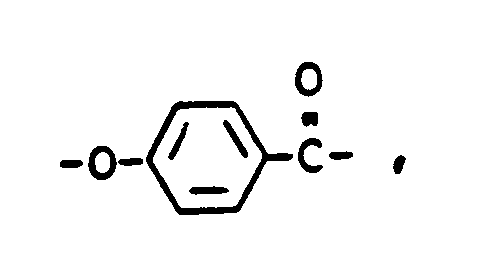
unit (III) is
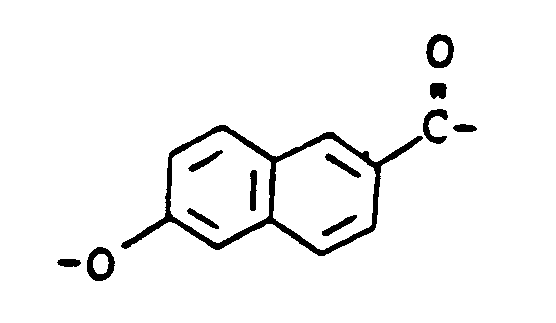
and unit (IV) is
wherein at least one of the hydrogen atoms in each aromatic ring in units (II), (III) and (IV) may be substituted by an alkyl or alkoxy group having 1 to 4 carbon atoms or a halogen atom;
and
the proportion of unit (I) is 2.5 to 35 mole%, the proportion of unit (II) is 2.5 to 35 mole%, and the proportion of unit (III) and/or (IV) is 30 to 95 mole%.
unit (I) is represented by the formula
wherein X₁, X₂, X₃ and X₄, independently from each other, represent H, F, Cl, Br, CH₃ or C(CH₃)₃, provided that X₁ to X₄ do not simultaneously represent H, and n is 2 or 4,
unit (II) is at least one unit selected from
unit (III) is
and unit (IV) is
wherein at least one of the hydrogen atoms in each aromatic ring in units (II), (III) and (IV) may be substituted by an alkyl or alkoxy group having 1 to 4 carbon atoms or a halogen atom;
and
the proportion of unit (I) is 2.5 to 35 mole%, the proportion of unit (II) is 2.5 to 35 mole%, and the proportion of unit (III) and/or (IV) is 30 to 95 mole%.
2. A copolyester according to claim 1 which has an inherent viscosity, measured in pentafluorophenol
at 60oC in a polymer concentration of 0.1% by weight, of 1 to 15.
3. A process for producing a melt-processable copolyester as claimed in claim 1 which
comprises copolymerizing a compound containing the structural unit (I), a compound
containing the structural unit (II) and a compound containing the structural unit
(III) and/or a compound containing the structural unit (IV) .
4. A process according to claim 3 wherein said compounds are melt copolymerised at a
temperature of 140o to 320oC.
5. A process according to claim 3 wherein said compounds are copolymerised at a temperature
of 140oC to 320oC using an acylated monomer, or by acylation of an aromatic hydroxyl group followed
by polycondensation.
6. A process according to claim 5 wherein the acylated monomer is an acetylated monomer.
7. Shaped articles of a melt-processable copolyester as claimed in claim 1 or 2.
1. Copolyester transformable à l'état fondu, constitué des motifs structuraux (I), (II)
et (III) et /ou (IV), dans lesquels
le motif (I) est représenté par la formule
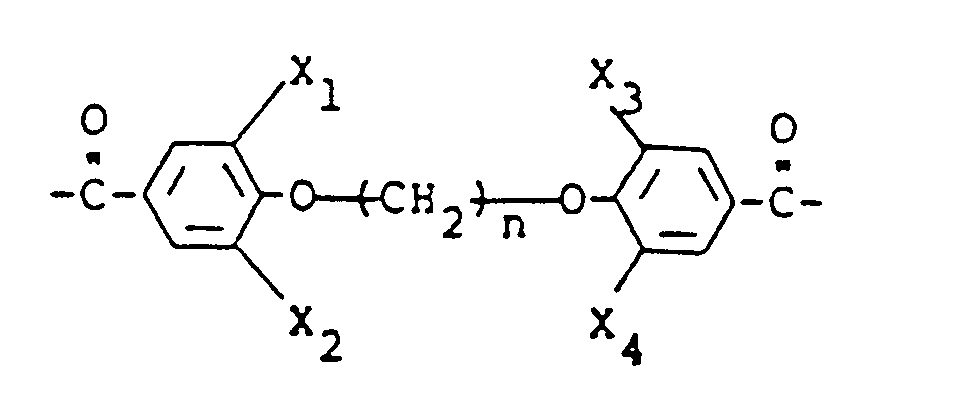
dans laquelle X₁, X₂, X₃ et X₄, indépendamment l'un de l'autre, représentent H, F, Cl, Br, CH₃ ou C(CH₃)₃, avec la condition que X₁ à X₄ ne représentent pas simultanément H, et n vaut 2 ou 4,
le motif (II) est au moins un motif choisi parmi
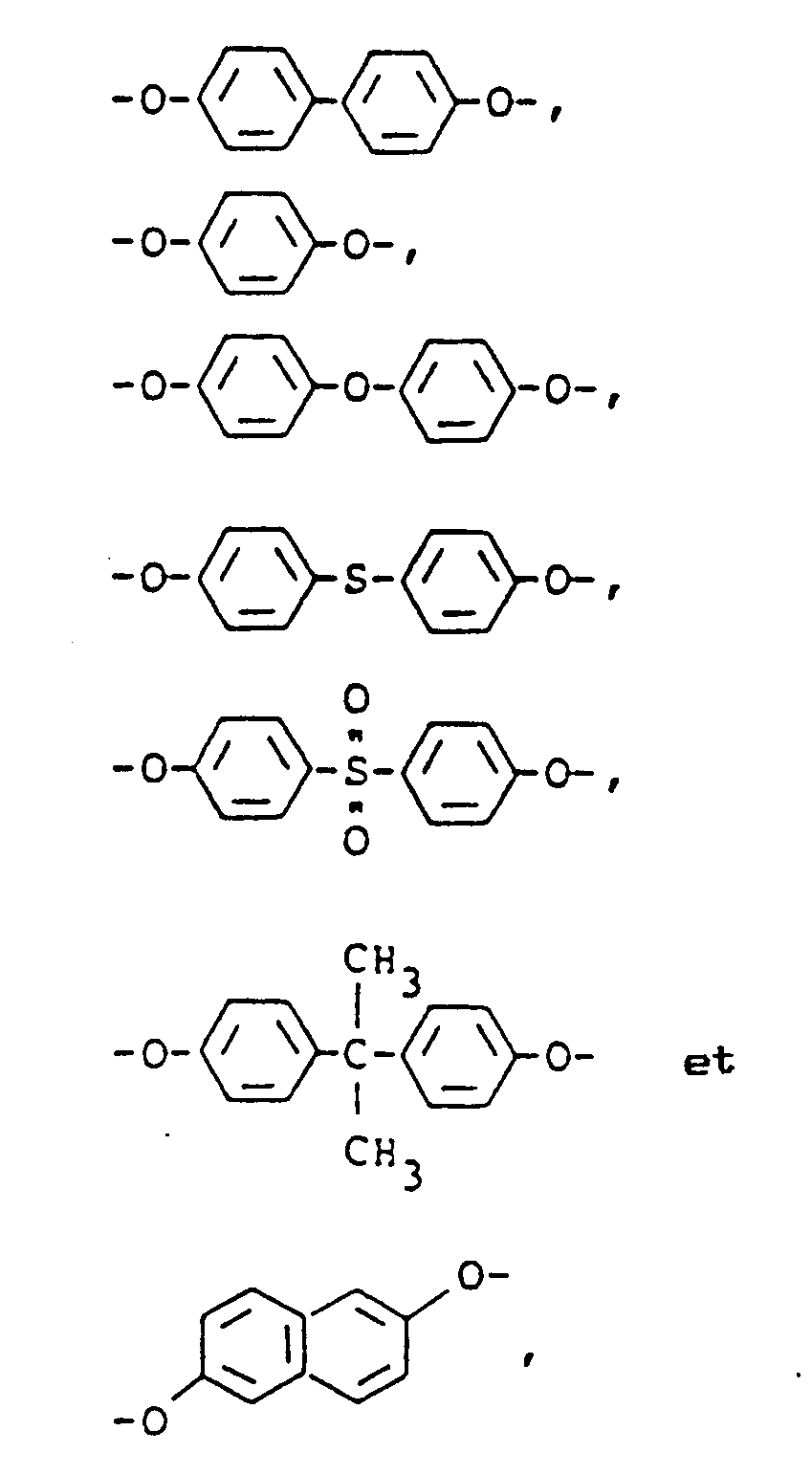
le motif (III) est
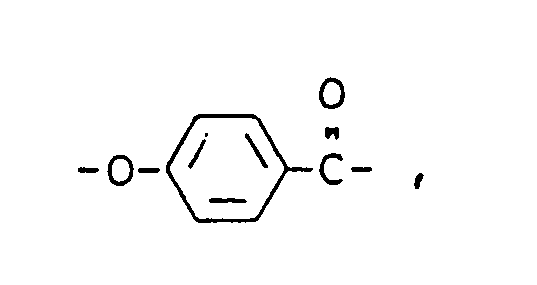
et le motif (IV) est
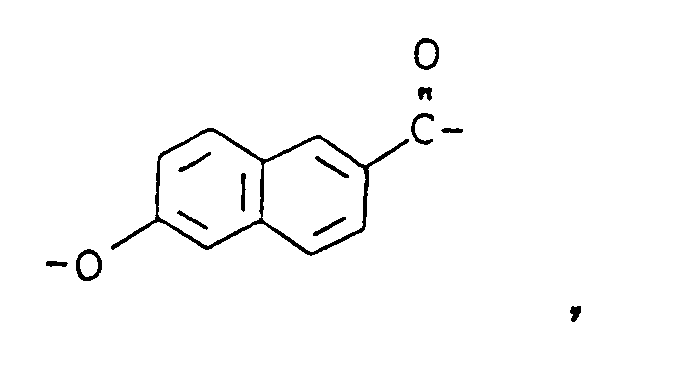
au moins un des atomes d'hydrogène de chaque cycle aromatique, dans les motifs (II), (III) et (IV), pouvant être substitué par un groupe alkyle ou alcoxy en C₁₋₄ ou par un atome d'halogène, et
la proportion de motifs (I) est de 2,5 à 35 % en moles, la proportion de motifs (II) est de 2,5 à 35 % en moles et la proportion de motifs (III) et/ou (IV) est de 30 à 95 % en moles.
le motif (I) est représenté par la formule
dans laquelle X₁, X₂, X₃ et X₄, indépendamment l'un de l'autre, représentent H, F, Cl, Br, CH₃ ou C(CH₃)₃, avec la condition que X₁ à X₄ ne représentent pas simultanément H, et n vaut 2 ou 4,
le motif (II) est au moins un motif choisi parmi
le motif (III) est
et le motif (IV) est
au moins un des atomes d'hydrogène de chaque cycle aromatique, dans les motifs (II), (III) et (IV), pouvant être substitué par un groupe alkyle ou alcoxy en C₁₋₄ ou par un atome d'halogène, et
la proportion de motifs (I) est de 2,5 à 35 % en moles, la proportion de motifs (II) est de 2,5 à 35 % en moles et la proportion de motifs (III) et/ou (IV) est de 30 à 95 % en moles.
2. Copolyester selon la revendication 1, qui présente une viscosité inhérente, mesurée
dans le pentafluorophénol à 60°C et pour une concentration du polymère de 0,1 % en
poids, de 1 à 15.
3. Procédé de production d'un copolyester transformable à l'état fondu, tel que revendiqué
dans la revendication 1, qui comprend la copolymérisation d'un composé comportant
le motif structural (I), d'un composé comportant le motif structural (II), d'un composé
comportant le motif structural (III) et/ou d'un composé comportant le motif structural
(IV).
4. Procédé selon la revendication 3, dans lequel on copolymérise lesdits composés à l'état
fondu, à une température allant de 140°C à 320°C.
5. Procédé selon la revendication 3, dans lequel on copolymérise lesdits composés à une
température allant de 140°C à 320°C, en utilisant un monomère acylé, ou bien on acyle
un groupe hydroxyle aromatique puis on effectue une polycondensation.
6. Procédé selon la revendication 5, dans lequel le monomère acylé est un monomère acétylé.
7. Articles façonnés, à base d'un copolyester transformable à l'état fondu tel que revendiqué
dans la revendication 1 ou 2.
1. In der Schmelze verarbeitbarer Copolyester, bestehend aus den folgenden Struktureinheiten
(I), (II) und (III) und/oder (IV), wobei die Einheit (I) angegeben ist durch die Formel
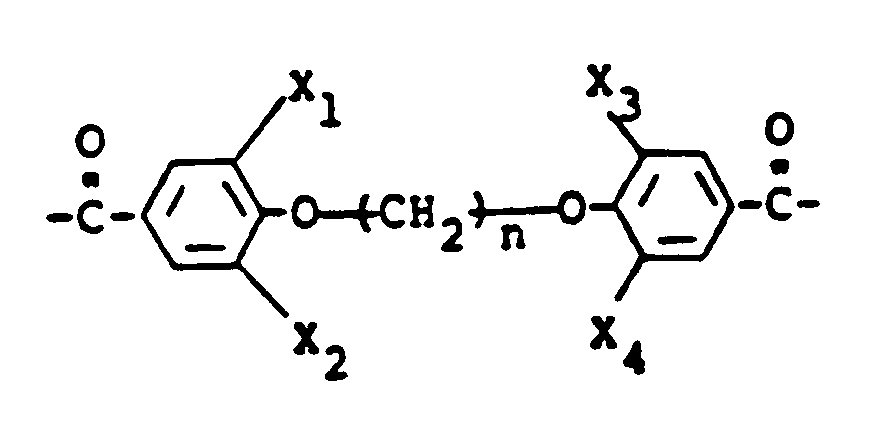
in der X₁, X₂, X₃ und X₄ unabhängig voneinander H, F, Cl, Br, CH₃ oder C(CH₃)₃ bedeuten, mit der Maßgabe, daß X₁ bis X₄ nicht gleichzeitig H bedeuten und n 2 oder 4 ist,
die Einheit (II) zumindest eine Einheit ist, ausgewählt aus
die Einheit (III)
ist und die Einheit (IV)
ist, wobei mindestens eines der Wasserstoffatome in jedem aromatischen Ring bei den Einheiten (II), (III) und (IV) substituiert sein kann durch eine Alkyl- oder Alkoxygruppe mit 1 bis 4 Kohlenstoffatomen oder ein Halogenatom,
und der Anteil an Einheit (I) 2,5 bis 35 mol-%, der Anteil der Einheit (II) 2,5 bis 35 mol-% und der Anteil der Einheit (III) und/oder (IV) 30 bis 95 mol-% beträgt.
in der X₁, X₂, X₃ und X₄ unabhängig voneinander H, F, Cl, Br, CH₃ oder C(CH₃)₃ bedeuten, mit der Maßgabe, daß X₁ bis X₄ nicht gleichzeitig H bedeuten und n 2 oder 4 ist,
die Einheit (II) zumindest eine Einheit ist, ausgewählt aus
die Einheit (III)
ist und die Einheit (IV)
ist, wobei mindestens eines der Wasserstoffatome in jedem aromatischen Ring bei den Einheiten (II), (III) und (IV) substituiert sein kann durch eine Alkyl- oder Alkoxygruppe mit 1 bis 4 Kohlenstoffatomen oder ein Halogenatom,
und der Anteil an Einheit (I) 2,5 bis 35 mol-%, der Anteil der Einheit (II) 2,5 bis 35 mol-% und der Anteil der Einheit (III) und/oder (IV) 30 bis 95 mol-% beträgt.
2. Copolyester nach Anspruch 1 mit einer inhärenten Viskosität, gemessen in Pentafluorphenol
bei 60oC und einer Polymerkonzentration von 0,1 Gew.-%,von 1 bis 15.
3. Verfahren zur Herstellung eines in der Schmelze verarbeitbaren Copolyesters nach Anspruch
1, umfassend das Copolymerisieren einer Verbindung, enthaltend die Struktureinheit
(I), einer Verbindung, enthaltend die Struktureinheit (II) und einer Verbindung, enthaltend
die Struktureinheit (III) und/oder einer Verbindung, enthaltend die Struktureinheit
(IV).
4. Verfahren nach Anspruch 3, wobei die Verbindungen in der Schmelze bei einer Temperatur
von 140 bis 320oC copolymerisiert werden.
5. Verfahren nach Anspruch 3, wobei die Verbindungen bei einer Temperatur von 140 bis
320oC unter Verwendung eines acylierten Monomers oder durch Acylieren einer aromatischen
Hydroxylgruppe und anschließende Polykondensation copolymerisiert werden.
6. Verfahren nach Anspruch 5, wobei das acylierte Monomer ein acetyliertes Monomer ist.
7. Formkörper aus einem in der Schmelze verarbeitbaren Copolyester nach Anspruch 1 oder
2.