|
(11) | EP 0 213 337 B1 |

| (12) | EUROPEAN PATENT SPECIFICATION |
|
|
| (54) |
4-cyanopiperidine derivatives, preparation and use thereof 4-Cyanopiperidine-Derivate, Herstellung und Anwendung Dérivés de 4-cyanopipéridines, préparation et utilisation |
|
|
|||||||||||||||||||||||||||||||
|
||||||||||||||||||||||||||||||||
| Note: Within nine months from the publication of the mention of the grant of the European patent, any person may give notice to the European Patent Office of opposition to the European patent granted. Notice of opposition shall be filed in a written reasoned statement. It shall not be deemed to have been filed until the opposition fee has been paid. (Art. 99(1) European Patent Convention). |
BACKGROUND OF THE INVENTION
1) Field of the Invention:
[0001] This invention relates to novel 4-cyanopiperidine derivatives and a process for the preparation of same.
2) Description of the Prior Art:
[0002] The compounds of this invention are useful as intermediates for the syntheses of quinuclidine derivatives. Quinuclidine derivatives are in turn useful as synthesis intermediates for medicines, chemical reagents, etc. Their syntheses are however not easy due to their unique structures. Synthetic processes of quinuclidine derivatives have been reported, for example, in Helvetica Chimica Acta, 194, 1672-1679 (1954) and ibid, 195, 1680 - 1688 (1954). In these literatures,4-cyanoquinuclidine was synthesized by way of N-methyl-4-carbamoylpiperidine, N-methyl-4-cyanopiperidine and N-methyl-4-cyanoquinuclidine when 4-carbamoylpiperidine was employed as a starting material. This synthesis route however involved such problems that many process steps were required because N-methylation was effected at the beginning and demethylation was conducted at the end and the yield of the conversion step of from piperidine to quinuclidine was as low as 17%.
SUMMARY OF THE INVENTION
[0003] The present inventors have found that the use of compounds of this invention allows to obtain quinuclidine derivatives with ease, resulting in completion of the present invention.
[0004] An object of this invention is therefore to provide novel 4-cyanopiperidine derivatives useful as synthesis intermediates for quinuclidine derivatives and a multi-step process for their preparation.
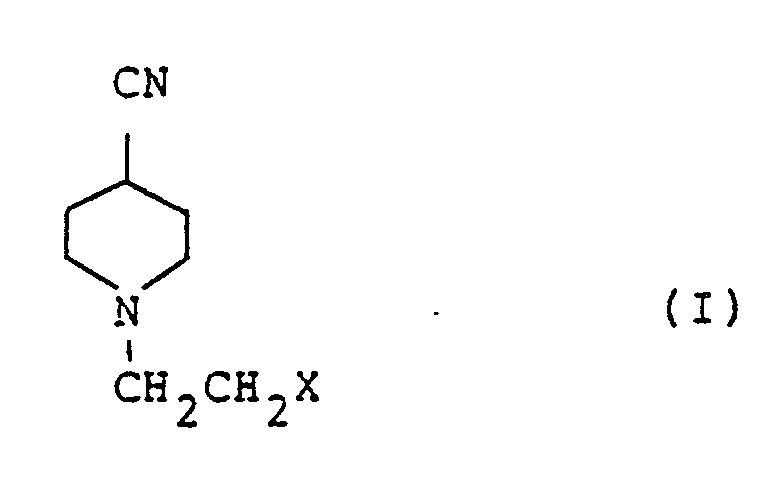
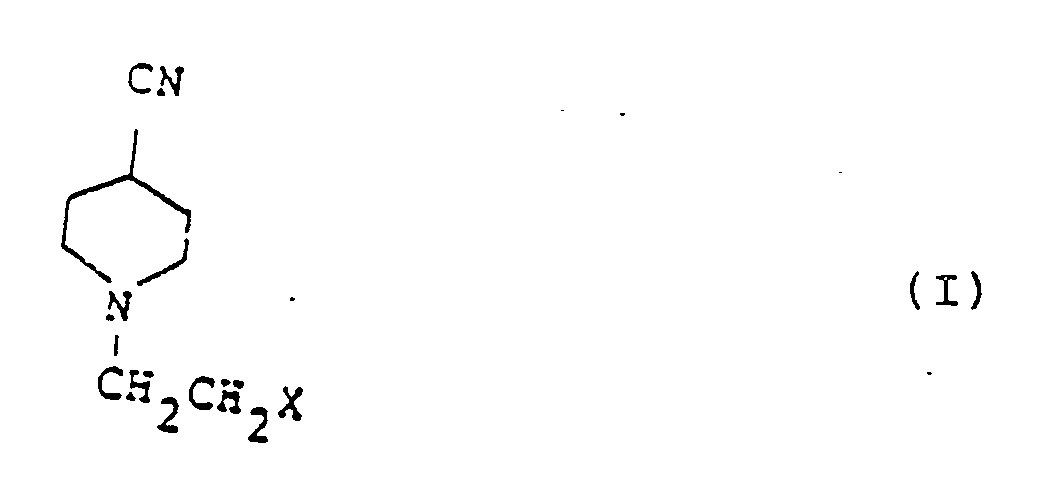
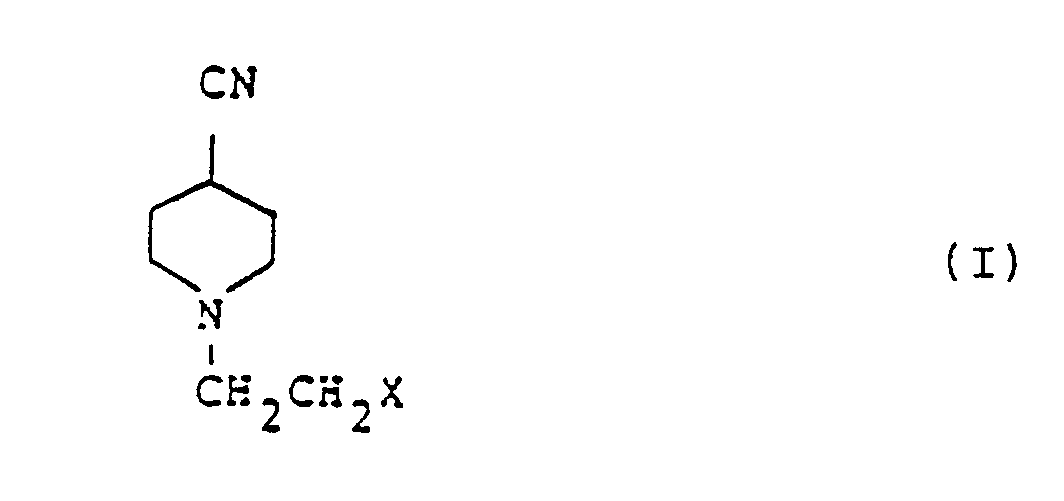
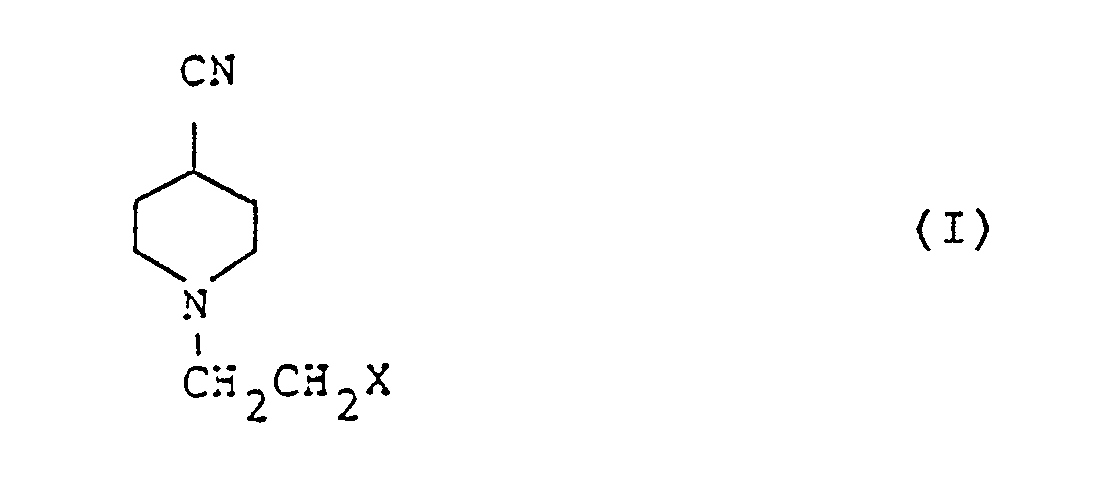
[0005] In one aspect of this invention, there is thus provided a 4-cyanopiperidine derivative represented by the following general formula (I):
wherein X means a halogen atom, or an acid addition salt thereof.
[0006] In this multi-step process, there is also provided a process for the preparation of a 4-cyanopiperidine derivative represented by the following general formula (I):
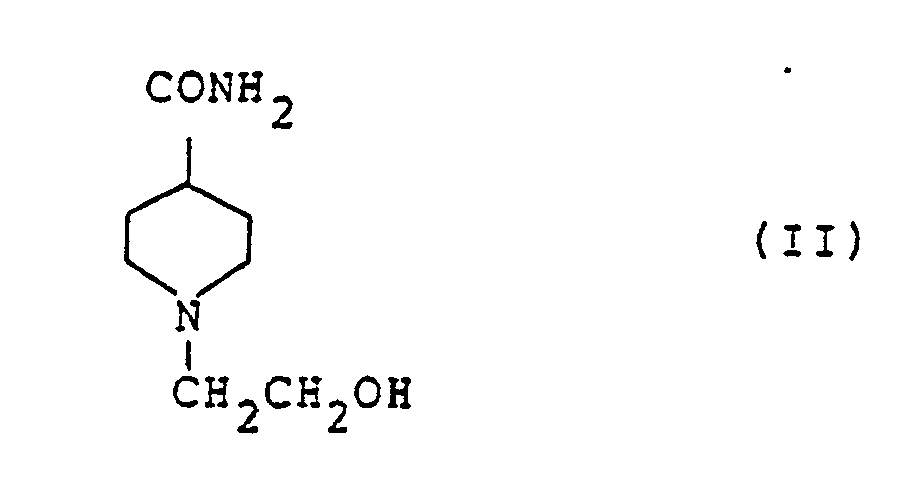
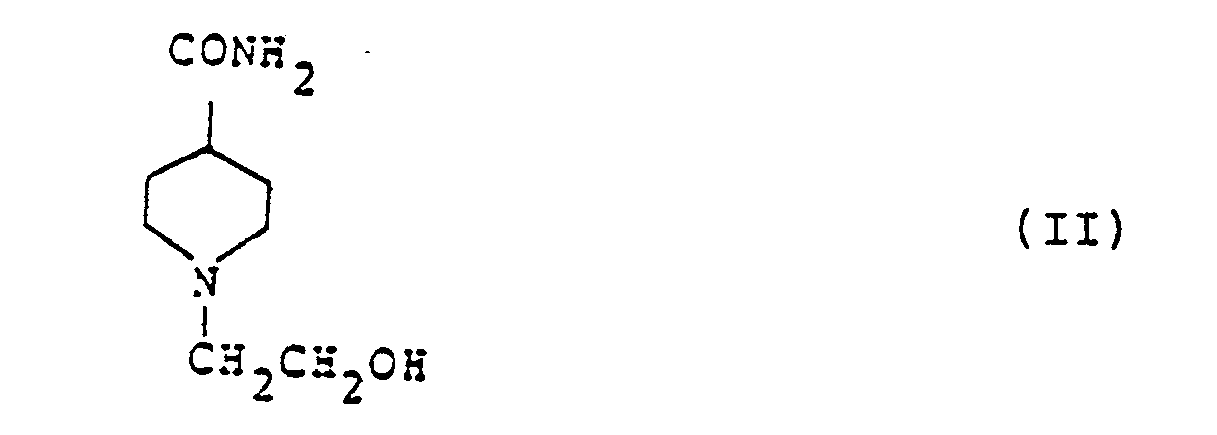
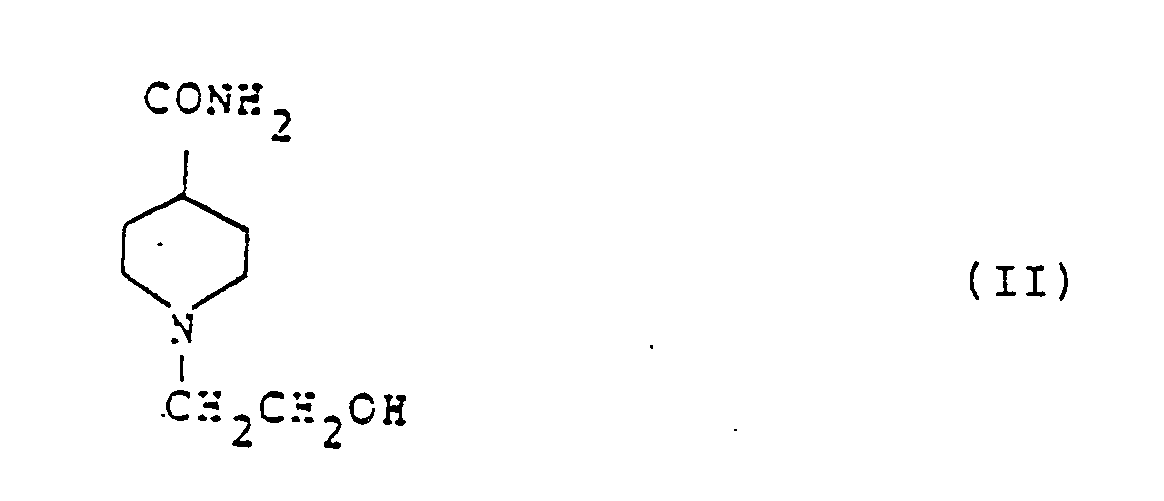
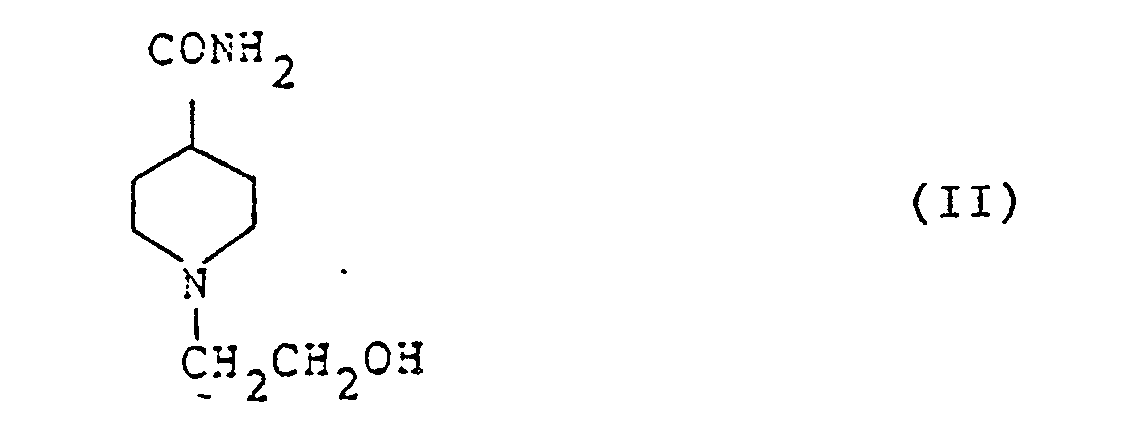
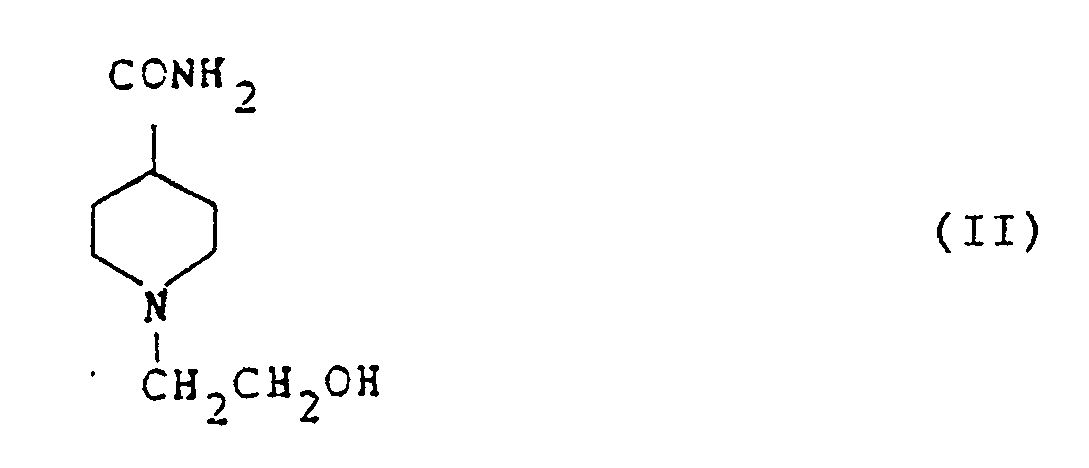
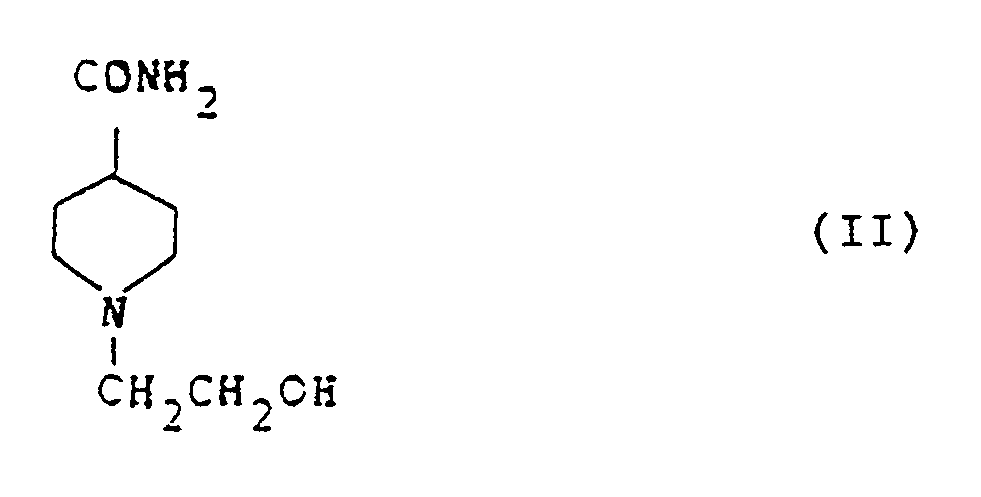
wherein X means a halogen atom, or an acid addition salt thereof, which comprises reacting a compound represented by the following formula (II):
or an acid addition salt thereof with a dehydrating and halogenating agent.
[0007] In a further step thereof, there is also provided a process for the preparation of a 4-cyanopiperidine derivative represented by the following general formula (I):
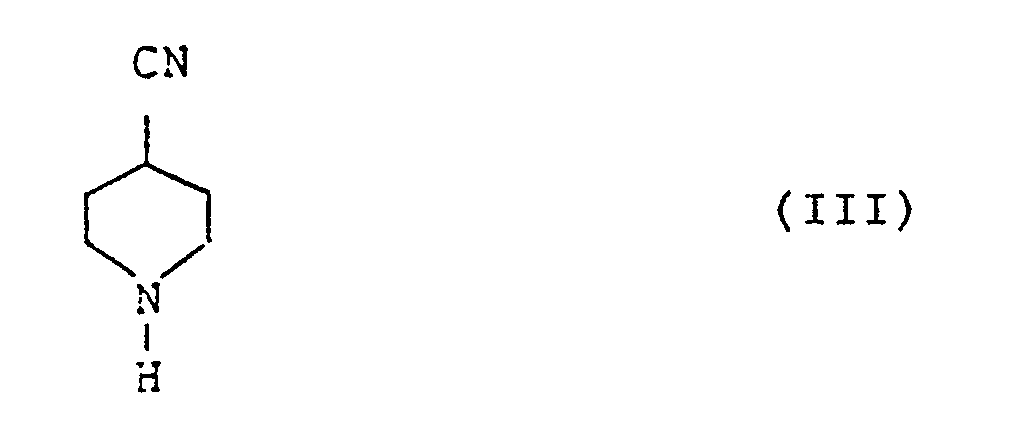
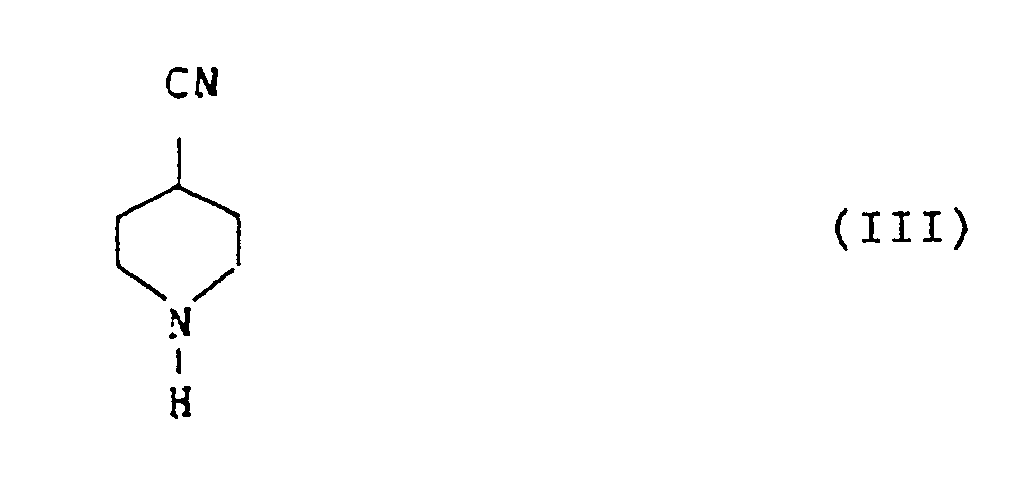
wherein X means a halogen atom, or an acid addition salt thereof, which comprises reacting a compound represented by the following formula (III):
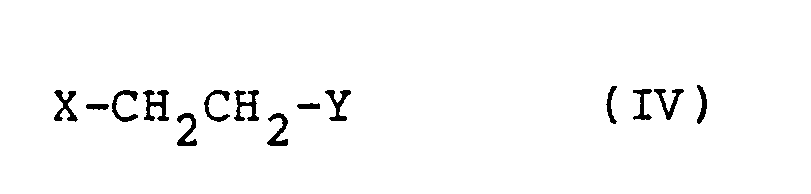
or an acid addition salt thereof with a compound represented by the following general formula (IV):
wherein X has the same meaning as defined above and Y denotes the same halogen atom as X or another halogen atom.
[0008] The novel 4-cyanopiperidine derivatives of this invention are useful for the easy syntheses of quinuclidine derivatives.
[0009] The above and other objects, features and advantages of the present invention will become apparent from the following description and the appended claims.
DETAILED DESCRIPTION OF THE INVENTION AND PREFERRED EMBODIMENTS
[0010] As the halogen atom represented by X in the general formula (I), a chlorine atom, bromine atom, iodine atom may be mentioned. Illustrative of the acid addition salt of the compound represented by the general formula (I) may include inorganic acid addition salts such as hydrochloride, hydrobromide, hydroiodide, sulfate, carbonate and bicarbonate; organic carboxylates such as acetate, maleate, lactate, tartrate and trifluoroacetate; organic sulfonates such as methanesulfonate, benzenesulfonate and toluenesulphonate; amino acid salts such as aspartate and glutamate; etc.
Preparation Process A:
[0012] The compound represented by the formula (II) or its acid addition salt is reacted with a dehydrating and halogenating agent to obtain the compound of the general formula (I) or its acid addition salt.
[0013] The term "dehydrating and halogenating agent" as used herein means a reagent which has both dehydrating function and halogenating function. As exemplary dehydrating and halogenating agents, may be mentioned thionyl chloride, thionyl bromide, thionyl iodide, phosphorus oxychloride, phosphorus oxybromide.
[0014] The above reaction can be carried out in a solvent such as benzene, toluene, xylene, acetonitrile, dioxane or tetrahydrofuran or a mixed solvent of two or more of such solvents at a temperature ranging from 10°C to the refluxing temperature of the solvent.
[0015] Examples of the acid addition salt of the compound of the formula (II), which acid addition salt salt is also useful in the above reaction, may include those similar to the above-described acid addition salts of the compound of the general formula (I).
Preparation Process B:
[0016] The compound represented by the formula (III) or its acid addition salt is reacted with the compound represented by the general formula (IV) to obtain the compound of the general formula (I) or its acid addition salt.
[0017] As exemplary halogen atoms represented by X and Y in the general formula (IV), may be mentioned chlorine atom, bromine atom and iodine atom. As specific compounds of the general formula (IV), there are 1-bromo-2-chloroethane, 1,2-dichloroethane, 1,2-dibromoethane, 1-iodo-2-chloroethane, 1-iodo-2-bromoethane, 1,2-diiodoethane.
[0018] The above reaction can be conducted in a solvent such as methanol, ethanol, isopropanol, n-propanol, n-butanol or dimethylformamide or a mixed solvent of two or more of such solvents at a temperature ranging from room temperature to the refluxing temperature of the solvent.
[0019] Examples of the acid addition salt of the compound of the formula (III), which acid addition salt is also useful in the above reaction, may include those similar to the above-described acid addition salts of the compound of the general formula (I).
[0020] The present invention will hereinafter be described in further detail by the following Experiments and examples.
Experiment 1:
[0022] 2-Chloroethanol (23.9 mℓ), potassium carbonate (82.0 g) and sodium iodide (4.5 g) were added to an ethanol solution (500 mℓ) of 4-carbamoylpiperidine (35 g), followed by refluxing for 20 hours. After allowing the reaction mixture to cool down to room temperature, it was filtered through Celite (trade mark). The filtrate was concentrated under reduced pressure. After washing the residue, it was dried to obtain 46.6 g of the desired product.
Melting point: 141 - 142°C.
IR absorption spectrum (cm⁻¹, Nujol®):
3360, 3160, 1650, 1610.
NMR spectrum (δ, DMSO-d₆):
1.2-2.1 (7H, m), 2.26 (2H, t, J=8Hz),
2.6-2.9 (2H, m), 4.39 (2H, t, J=8Hz),
4.32 (1H, br.s), 6.59 (1H, br.s),
7.11 (1H, br.s),
Example 1:
[0024] To a suspension of the compound (38.7 g) of Experiment 1 in acetonitrile (390 mℓ), thionyl chloride (82 mℓ) was added dropwise over 1 hour with ice-cooling and stirring. After refluxing the resulting solution for 4 hours, it was concentrated. Isopropanol (100 mℓ) was added to the residue, followed by refluxing for 10 minutes. The solution was allowed to cool down to room temperature and the resulting crystals were collected by filtration. Besides, isopropyl ether was added to the filtrate and the resulting crystals were also collected by filtration. As colorless crystals, the desired product was obtained in a total amount of 43.1 g.
Melting point: 176 - 178°C.
IR absorption spectrum (cm⁻¹, Nujol®):
2220
NMR spectrum (δ, DMSO-d₆):
1.7-2.3 (4H, m), 2.6-3.8 (7H, m),
3.98 (2H, t, J=8Hz).
Example 2:
[0026] 1-Bromo-2-chloroethane (2.6 mℓ) and potassium carbonate (6.6 g) were added to a solution of 4-cyanopiperidine (2.63 g) in isopropanol (50 mℓ), followed by refluxing for 10 hours. The reaction mixture was concentrated under reduced pressure. After adding a 50% aqueous solution of potassium carbonate to the residue, the resulting mixture was extracted with diethyl ether. The extract was washed with saturated saline, followed by an addition of anhydrous potassium carbonate to dry the diethyl ether solution. The thus-dried diethyl ether solution was concentrated under reduced pressure. The residue was purified by silica gel chromatography (developer: methanol-chloroform) to obtain 0.31 g of the desired product in an oily form.
IR absorption spectrum (cm⁻¹, neat):
2220
NMR spectrum (δ, CDCl₃):
1.7-2.1 (4H, m), 2.3-2.9 (7H, m),
3.56 (2H, t, J=8Hz)
[0027] Illustrative syntheses of 4-cyanoquinuclidine from the above-obtained compounds of this invention will next be described.
Experiment 2:
[0029] Sodium amide (150 g) and sodium iodide (7.2 g) were suspended in 1,2-dimethoxyethane (1.5 ℓ), and the resulting suspension was stirred at room temperature for 1 hour. The compound (100 g) of Example 1 was then added to the suspension and the resulting mixture was stirred for 24 hours. The reaction mixture was poured in ice water (2 ℓ), followed by filtration through Celite (trade mark). The residue was washed with diethyl ether (300 mℓ). The organic layer of the filtrate was combined with the washing, followed by an addition of anhydrous potassium carbonate to dry same. The thus-dried solution was then concentrated to obtain 4-cyanoquinuclidine. In addition, after adding anhydrous potassium carbonate (1 kg) to the water layer of the filtrate, the resulting mixture was extracted with chloroform. After adding anhydrous potassium carbonate to the extract to dry same, the thus-dried chloroform solution was concentrated to obtain 4-cyanoquinuclidine (8.4 g). In total, the 4-cyanoquinuclidine was obtained with a 66.3% yield.
[0030] 4-Cyanoquinuclidine (85.0 g) was suspended in ethanol (200 mℓ), followed by an addition of a solution of p-toluenesulfonic acid monohydrate (119 g) in ethanol (350 mℓ). The resulting mixture was then stirred at 40°C for 1 hour. The reaction mixture was cooled with ice and the precipitated crystals were collected by filtration. They were then washed with ethanol and diethylether to obtain 182.9 g of 4-cyanoquinuclidine p-toluenesulfonate as colorless crystals (yield: 95%).
4-Cyanoquinuclidine:
[0031] Melting point: 133°C.
IR absorption spectrum (cm⁻¹, Nujol®):
2225
NMR spectrum (δ, CDCl₃):
1.6-2.0 (6H, m), 2.7-3.0 (6H, m).
4-Cyanoquinuclidine p-toluenesulfonate:
[0032] Melting point: 220°C.
IR absorption spectrum (cm⁻¹, Nujol®):
2220
NMR spectrum (δ, DMSO-d₆):
2.0-2.3 (6H, m), 2.27 (3H, s),
3.1-3.5 (6H, m) 7.08 (2H, d, j=10Hz),
7.45 (2H, d, J=10Hz).
Experiment 3:
[0034] n-Butyl lithium (19.9 mℓ) was added at -78°C to a solution of diisopropylamine (4.7 mℓ) in tetrahydrofuran (70 mℓ), followed by stirring for 10 minutes. To the resulting lithium diisopropylamide solution, a solution of the compound (5.0 g) of Example 2 in tetrahydrofuran (30 mℓ) was added dropwise at the same temperature over 10 minutes. After stirring the resulting mixture at the same temperature for 20 minutes, it was stirred at 0°C for further 30 minutes. The reaction solution was washed with saturated saline, followed by extraction with chloroform. The extract was concentrated and the residue was then sublimated to obtain 2.6 g of the desired product (yield: 65.3%).
Melting point: 133°C.
IR absorption spectrum (cm⁻¹, Nujol®):
2225
NMR spectrum (δ, CDCl₃):
1.6-2.0 (6H, m), 2.7-3.0 (6H, m).
1. A process for the preparation of 4-cyanoquinuclidine and acid addition salts thereof
characterized in that N-(2-halogenoethyl)-4-cyanopiperidine of the following general
formula (I):

(wherein X means a halogen atom), obtained by reacting N-(2-hydroxyethyl)-4-carbamoylpiperidine of the general formula (II):

or an acid addition salt thereof with a dehydrating and halogenating agent, or an acid addition salt thereof is reacted with a base.
(wherein X means a halogen atom), obtained by reacting N-(2-hydroxyethyl)-4-carbamoylpiperidine of the general formula (II):
or an acid addition salt thereof with a dehydrating and halogenating agent, or an acid addition salt thereof is reacted with a base.
2. A process according to claim 1 characterized in that x means a chlorine, bromine or
iodine atom.
3. A process according to claim 1 characterized in that the acid addition salt is selected
from the group consisting of inorganic acid addition salts, organic carboxylates,
organic sulfonates and amino acid salts.
4. A process according to claim 3 characterized in that the inorganic acid addition salts
are hydrochloride, hydrobromide, hydroiodide, sulfate, carbonate and bicarbonate;
the organic carboxylates are acetate, maleate, lactate, tartrate and trifluoroacetate;
the organic sulfonates are methanesulfonate, benzenesulfonate and toluenesulfonate;
and the amino acid salts are aspartate and glutamate.
5. A process according to claim 1, characterized in that x means a chlorine atom.
6. A process according to claim 1, characterized in that the dehydrating and halogenating
agent is thionyl chloride, thionyl bromide, thionyl iodide, phosphorus oxychloride
or phosphorus oxybromide.
7. A process according to claim 1, characterized in that the reaction of the compound
of the general formula (II) is carried out in benzene, toluene, xylene, acetonitrile,
dioxane or tetrahydrofuran or a mixed solvent of two or more of the solvents at a
temperature ranging from 10°C to the refluxing temperature of the solvent.
8. A process according to claim 1, characterized in that the dehydrating and halogenating
agent is thionyl chloride and N-(2-chloroethyl)-4-cyanopiperidine hydrochloride is
obtained.
9. A process according to claim 1 characterized in that the N-(2-halogenoethyl)-4-cyanopiperidine
of the general formula (I) is produced by reacting 4-cyanopiperidene of the general
formula (III):

or an acid addition salt thereof with a compound represented by the following general formula (IV):
wherein X has the same meaning as defined above and Y denotes the same halogen atom as X or another halogen atom instead of the reaction of the compound with the formula (II) with a dehydrating and halogenating agent.
or an acid addition salt thereof with a compound represented by the following general formula (IV):
wherein X has the same meaning as defined above and Y denotes the same halogen atom as X or another halogen atom instead of the reaction of the compound with the formula (II) with a dehydrating and halogenating agent.
10. A process according to claim 9, characterized in that the compound of the general
formula (IV) is 1-bromo-2-chloroethane, 1,2-dichloroethane, 1,2-dibromoethane, 1-iodo-2-chloroethane,
1-iodo-2-bromoethane, or 1,2-diiodoethane.
11. A process according to claim 9, wherein the reaction of 4-cyanopiperidine of the general
formula (III) is carried out in methanol, ethanol, isopropanol, n-propanol, n-butanol
or dimethylformamide or a mixed solvent of two or more of such solvents at a temperature
ranging from room temperature to the refluxing temperature of the solvent.
12. A process according to claim 9, characterized in that compound of the general formula
(IV) is 1-bromo-2-chloroethane and the 4-cyanopiperidine derivative is N-(2-chloroethyl)-4-cyanopiperidine.
13. A 4-cyanopiperidine derivative represented by the following general formula (I):

wherein X means a halogen atom, or an acid addition salt thereof.
wherein X means a halogen atom, or an acid addition salt thereof.
14. The compound as claimed in Claim 13, wherein X means a chlorine, bromine or iodine
atom.
15. The compound as claimed in Claim 13, wherein the acid addition salt is selected from
the group consisting of inorganic acid addition salts, organic carboxylates, organic
sulfonates, and amino acid salts.
16. The compound as claimed in Claim 15, wherein the inorganic acid addition salts are
hydrochloride, hydrobromide, hydroiodide, sulfate, carbonate and bicarbonate; the
organic carboxylates are acetate, maleate, lactate, tartrate and trifluoroacetate;
the organic sulfonates are methanesulfonate, benzenesulfonate and toluenesulfonate;
and the amino acid salts are aspartate and glutamate.
17. The compound as claimed in Claim 13, which is N-(2-chloroethyl)-4-cyanopiperidine
or an acid addition salt thereof.
Claims for the following Contracting State(s): AT
1. A process for the preparation of 4-cyanoquinuclidine and acid addition salts thereof
characterized in that N-(2-halogenoethyl)-4-cyanopiperidine of the following general
formula (I):
(wherein X means a halogen atom), obtained by reacting N-(2-hydroxyethyl)-4-carbamoylpiperidine of the general formula (II):

or an acid addition salt thereof with a dehydrating and halogenating agent, or an acid addition salt thereof is reacted with a base.
(wherein X means a halogen atom), obtained by reacting N-(2-hydroxyethyl)-4-carbamoylpiperidine of the general formula (II):
or an acid addition salt thereof with a dehydrating and halogenating agent, or an acid addition salt thereof is reacted with a base.
2. A process according to claim 1 characterized in that x means a chlorine, bromine or
iodine atom.
3. A process according to claim 1 characterized in that the acid addition salt is selected
from the group consisting of inorganic acid addition salts, organic carboxylates,
organic sulfonates and amino acid salts.
4. A process according to claim 3 characterized in that the inorganic acid addition salts
are hydrochloride, hydrobromide, hydroiodide, sulfate, carbonate and bicarbonate;
the organic carboxylates are acetate, maleate, lactate, tartrate and trifluoroacetate;
the organic sulfonates are methanesulfonate, benzenesulfonate and toluenesulfonate;
and the amino acid salts are aspartate and glutamate.
5. A process according to claim 1, characterized in that X means a chlorine atom.
6. A process according to claim 1, characterized in that the dehydrating and halogenating
agent is thionyl chloride, thionyl bromide, thionyl iodide, phosphorus oxychloride
or phosphorus oxybromide.
7. A process according to claim 1, characterized in that the reaction of the compound
of the general formula (II) is carried out in benzene, toluene, xylene, acetonitrile,
dioxane or tetrahydrofuran or a mixed solvent of two or more of the solvents at a
temperature ranging from 10°C to the refluxing temperature of the solvent.
8. A process according to claim 1, characterized in that the dehydrating and halogenating
agent is thionyl chloride and N-(2-chloroethyl)-4-cyanopiperidine hydrochloride is
obtained.
9. A process according to claim 1 characterized in that the N-(2-halogenoethyl)-4-cyanopiperidine
of the general formula (I) is produced by reacting 4-cyanopiperidene of the general
formula (III):

or an acid addition salt thereof with a compound represented by the following general formula (IV):

wherein X has the same meaning as defined above and Y denotes the same halogen atom as x or another halogen atom instead of the reaction of the compound with the formula (II) with a dehydrating and halogenating agent.
or an acid addition salt thereof with a compound represented by the following general formula (IV):
wherein X has the same meaning as defined above and Y denotes the same halogen atom as x or another halogen atom instead of the reaction of the compound with the formula (II) with a dehydrating and halogenating agent.
10. A process according to claim 9, characterized in that the compound of the general
formula (IV) is 1-bromo-2-chloroethane, 1,2-dichloroethane, 1,2-dibromoethane, 1-iodo-2-chloroethane,
1-iodo-2-bromoethane, or 1,2-diiodoethane.
11. A process according to claim 9, wherein the reaction of 4-cyanopiperidine of the general
formula (III) is carried out in methanol, ethanol, isopropanol, n-propanol, n-butanol
or dimethylformamide or a mixed solvent of two or more of such solvents at a temperature
ranging from room temperature to the refluxing temperature of the solvent.
12. A process according to claim 9, characterized in that compound of the general formula
(IV) is 1-bromo-2-chloroethane and the 4-cyanopiperidine derivative is N-(2-chloroethyl)-4-cyanopiperidine.
13. A process for the preparation of a 4-cyanopiperidine derivative represented by the
following general formula (I):

wherein X means a halogen atom, or an acid addition salt thereof, characterized in that N-(2-hydroxyethyl)-4-carbamoylpiperidine of the general formula (II):
or an acid addition salt thereof is reacted with a dehydrating and halogenating agent.
wherein X means a halogen atom, or an acid addition salt thereof, characterized in that N-(2-hydroxyethyl)-4-carbamoylpiperidine of the general formula (II):
or an acid addition salt thereof is reacted with a dehydrating and halogenating agent.
14. A process as claimed in Claim 13, wherein X means a chlorine, bromine or iodine atom.
15. A process as claimed in Claim 13, wherein the acid addition salt is selected from
the group consisting of inorganic acid addition salts, organic carboxylates, organic
sulfonates, and amino acid salts.
16. A process as claimed in Claim 15, wherein the inorganic acid addition salts are hydrochloride,
hydrobromide, hydroiodide, sulfate, carbonate and bicarbonate; the organic carboxylates
are acetate, maleate, lactate, tartrate and trifluoroacetate; the organic sulfonates
are methanesulfonate, benzenesulfonate and toluenesulfonate; and the amino acid salts
are aspartate and glutamate.
17. A process as claimed in Claim 13, wherein the compound with the formula (I) is N-(2-chloroethyl)-4-cyanopiperidine
or an acid addition salt thereof.
1. Procédé pour la préparation de la 4-cyanoquinuclidine et de sels d'addition avec des
acides de celle-ci, caractérisé en ce que l'on fait réagir avec une base une N-(2-halogénoéthyl)-4-cyanopipéridine
de formule générale (I) suivante:

(dans laquelle X représente un atome d'halogène), obtenue par mise en réaction de la N-(2-hydroxyéthyl)-4-carbamoylpipéridine de formule générale (II):

ou d'un sel d'addition avec un acide de celle-ci, avec un agent de déshydratation et d'halogénation ou un sel d'addition avec un acide de celui-ci.
(dans laquelle X représente un atome d'halogène), obtenue par mise en réaction de la N-(2-hydroxyéthyl)-4-carbamoylpipéridine de formule générale (II):
ou d'un sel d'addition avec un acide de celle-ci, avec un agent de déshydratation et d'halogénation ou un sel d'addition avec un acide de celui-ci.
2. Procédé selon la revendication 1, caractérisé en ce que X représente un atome de chlore,
brome ou iode.
3. Procédé selon la revendication 1, caractérisé en ce que le sel d'addition avec un
acide est choisi parmi des sels d'addition avec des acides minéraux, des carboxylates
organiques, des sulfonates organiques et des sels d'aminoacides.
4. Procédé selon la revendication 3, caractérisé en ce que les sels d'addition avec des
acides minéraux sont le chlorhydrate, le bromhydrate, l'iodhydrate, le sulfate, le
carbonate et le bicarbonate; les carboxylates organiques sont l'acétate, le maléate,
le lactate, le tartrate et le trifluoroacétate; les sulfonates organiques sont le
méthanesulfonate, le benzènesulfonate, et le toluènesulfonate; et les sels d'aminoacides
sont l'aspartate et le glutamate.
5. Procédé selon la revendication 1, caractérisé en ce que X représente un atome de chlore.
6. Procédé selon la revendication 1, caractérisé en ce que l'agent de déshydratation
et d'halogénation est le chlorure de thionyle, le bromure de thionyle, l'iodure de
thionyle, l'oxychlorure de phosphore ou l'oxybromure de phosphore.
7. Procédé selon la revendication 1, caractérisé en ce que la réaction du compose de
formule générale (I) est effectuée dans du benzène, du toluène, du xylène, de l'acétonitrile,
du dioxanne ou du tétrahydrofuranne, ou dans un solvant composé de deux des solvants
ou plus, à une température dans la plage allant de 10°C à la température de reflux
du solvant.
8. Procédé selon la revendication 1, caractérisé en ce que l'agent de déshydratation
et d'halogénation est le chlorure de thionyle et on obtient le chlorhydrate de N-(2-chloréthyl)-4-cyanopipéridine.
9. Procédé selon la revendication 1, caractérisé en ce que l'on obtient une N-(2-halogénoéthyl)-4-cyanopipéridine
de formule générale (I) en faisant réagir la 4-cyanopipéridine de formule générale
(III):

ou un sel d'addition avec un acide de celle-ci, avec un composé représenté par la formule générale (IV) suivante:

dans laquelle X est tel que défini plus haut, et Y représente le même atome d'halogène que X ou un autre atome d'halogène, au lieu de la réaction du composé de formule (II) avec un agent de déshydratation et d'halogénation.
ou un sel d'addition avec un acide de celle-ci, avec un composé représenté par la formule générale (IV) suivante:
dans laquelle X est tel que défini plus haut, et Y représente le même atome d'halogène que X ou un autre atome d'halogène, au lieu de la réaction du composé de formule (II) avec un agent de déshydratation et d'halogénation.
10. Procédé selon la revendication 9, caractérisé en ce que le composé de formule générale
(IV) est le 1-bromo-2-chloréthane, le 1,2-dichloréthane, le 1,2-dibromoéthane, le
1-iodo-2-chloréthane, le 1-iodo-2-bromoéthane ou le 1,2-diiodoéthane.
11. Procédé selon la revendication 9, dans lequel la réaction de la 4-cyanopipéride de
formule générale (III) est effectuée dans du méthanol, de l'éthanol, de l'isopropanol,
du n-propanol, du n-butanol ou du diméthylformamide, ou dans un solvant composé de
deux de ces solvants ou plus, à une température dans la plage allant de la température
ambiante à la température de reflux du solvant.
12. Procédé selon la revendication 9, caractérisé en ce que le composé de formule générale
(IV) est le 1-bromo-2-chloréthane, et le dérivé de 4-cyanopipéridine est la N-(2-chloréthyl)-4-cyanopipéridine.
13. Dérivé de 4-cyanopipéridine représenté par la formule générale (I) suivante:

dans laquelle X représente un atome d'halogène,ou sel d'addition avec un acide de celui-ci.
dans laquelle X représente un atome d'halogène,ou sel d'addition avec un acide de celui-ci.
14. Composé selon la revendication 13, dans lequel x représente un atome de chlore, brome
ou iode.
15. Composé selon la revendication 13, dans lequel le sel d'addition avec un acide est
choisi parmi des sels d'addition avec des acides minéraux, des carboxylates organiques,
des sulfonates organiques et des sels d'aminoacides.
16. Composé selon la revendication 15, dans lequel les sels d'addition avec des acides
minéraux sont le chlorhydrate, le bromhydrate, l'iodhydrate, le sulfate, le carbonate
et le bicarbonate; les carboxylates organiques sont l'acétate, le maléate, le lactate,
le tartrate et le trifluoroacétate; les sulfonates organiques sont le méthanesulfonate,
le benzènesulfonate et le toluènesulfonate; et les sels d'aminoacides sont l'aspartate
et le glutamate.
17. Composé selon la revendication 13, lequel est la N-(2-chloréthyl)-4-cyanopipéridine
ou un sel d'addition avec un acide de celle-ci.
Revendications pour l'(les) Etat(s) contractant(s) suivant(s): AT
1. Procédé pour la préparation de la 4-cyanoquinuclidine et de sels d'addition avec des
acides de celle-ci, caractérisé en ce que l'on fait réagir avec une base une N-(2-halogénoéthyl)-4-cyanopipéridine
de formule générale (I) suivante:
(dans laquelle x représente un atome d'halogène), obtenue par mise en réaction de la N-(2-hydroxyéthyl)-4-carbamoylpipéridine de formule générale (II):
ou d'un sel d'addition avec un acide de celle-ci, avec un agent de déshydratation et d'halogénation ou un sel d'addition avec un acide de celui-ci.
(dans laquelle x représente un atome d'halogène), obtenue par mise en réaction de la N-(2-hydroxyéthyl)-4-carbamoylpipéridine de formule générale (II):
ou d'un sel d'addition avec un acide de celle-ci, avec un agent de déshydratation et d'halogénation ou un sel d'addition avec un acide de celui-ci.
2. Procédé selon la revendication 1, caractérisé en ce que X représente un atome de chlore,
brome ou iode.
3. Procédé selon la revendication 1, caractérisé en ce que le sel d'addition avec un
acide est choisi parmi des sels d'addition avec des acides minéraux, des carboxylates
organiques, des sulfonates organiques et des sels d'aminoacides.
4. Procédé selon la revendication 3, caractérisé en ce que les sels d'addition avec des
acides minéraux sont le chlorhydrate, le bromhydrate, l'iodhydrate, le sulfate, le
carbonate et le bicarbonate; les carboxylates organiques sont l'acétate, le maléate,
le lactate, le tartrate et le trifluoroacétate; les sulfonates organiques sont le
méthanesulfonate, le benzènesulfonate, et le toluènesulfonate; et les sels d'aminoacides
sont l'aspartate et le glutamate.
5. Procédé selon la revendication 1, caractérisé en ce que X représente un atome de chlore.
6. Procédé selon la revendication 1, caractérisé en ce que l'agent de déshydratation
et d'halogénation est le chlorure de thionyle, le bromure de thionyle, l'iodure de
thionyle, l'oxychlorure de phosphore ou l'oxybromure de phosphore.
7. Procédé selon la revendication 1, caractérisé en ce que la réaction du composé de
formule générale (I) est effectuée dans du benzène, du toluène, du xylène, de l'acétonitrile,
du dioxanne ou du tétrahydrofuranne, ou dans un solvant composé de deux des solvants
ou plus, à une température dans la plage allant de 10°C à la température de reflux
du solvant.
8. Procédé selon la revendication 1, caractérisé en ce que l'agent de déshydratation
et d'halogénation est le chlorure de thionyle et on obtient le chlorhydrate de N-(2-chloréthyl)-4-cyanopipéridine.
9. Procédé selon la revendication 1, caractérisé en ce que l'on obtient une N-(2-halogénoéthyl)-4-cyanopipéridine
de formule générale (I) en faisant réagir la 4-cyanopipéridine de formule générale
(III):

ou un sel d'addition avec un acide de celle-ci, avec un composé représenté par la formule générale (IV) suivante:

dans laquelle X est tel que défini plus haut, et Y représente le même atome d'halogène que X ou un autre atome d'halogène, au lieu de la réaction du composé de formule (II) avec un agent de déshydratation et d'halogénation.
ou un sel d'addition avec un acide de celle-ci, avec un composé représenté par la formule générale (IV) suivante:
dans laquelle X est tel que défini plus haut, et Y représente le même atome d'halogène que X ou un autre atome d'halogène, au lieu de la réaction du composé de formule (II) avec un agent de déshydratation et d'halogénation.
10. Procédé selon la revendication 9, caractérisé en ce que le composé de formule générale
(IV) est le 1-bromo-2-chloréthane, le 1,2-dichloréthane, le 1,2-dibromoéthane, le
1-iodo-2-chloréthane, le 1-iodo-2-bromoéthane ou le 1,2-diiodoéthane.
11. Procédé selon la revendication 9, dans lequel la réaction de la 4-cyanopipéride de
formule générale (III) est effectuée dans du méthanol, de l'éthanol, de l'isopropanol,
du n-propanol, du n-butanol ou du diméthylformamide, ou dans un solvant composé de
deux de ces solvants ou plus, à une température dans la plage allant de la température
ambiante à la température de reflux du solvant.
12. Procédé selon la revendication 9, caractérisé en ce que le composé de formule générale
(iV) est le 1-bromo-2-chloréthane, et le dérivé de 4-cyanopipéridine est la N-(2-chloréthyl)-4-cyanopipéridine.
13. Procédé pour la préparation d'un dérivé de 4-cyano pipéridine représenté par la formule
générale (I) suivante:
dans laquelle X représente un atome d'halogène, ou d'un sel d'addition avec un acide de celui-ci, caractérisé en ce que l'on fait réagir la N-(2-hydroxyéthyl)-4-carbamoylpipéridine de formule générale (II):
ou un sel d'addition avec un acide de celle-ci, avec un agent de déshydratation et d'halogénation.
dans laquelle X représente un atome d'halogène, ou d'un sel d'addition avec un acide de celui-ci, caractérisé en ce que l'on fait réagir la N-(2-hydroxyéthyl)-4-carbamoylpipéridine de formule générale (II):
ou un sel d'addition avec un acide de celle-ci, avec un agent de déshydratation et d'halogénation.
14. Procédé selon la revendication 13, dans lequel X représente un atome de chlore, brome
ou iode.
15. Procédé selon la revendication 13, dans lequel le sel d'addition avec un acide est
choisi parmi des sels d'addition avec des acides minéraux, des carboxylates organiques,
des sulfonates organiques et des sels d'aminoacides.
16. Procédé selon la revendication 15, dans lequel les sels d'addition avec des acides
minéraux sont le chlorhydrate, le bromhydrate, l'iodhydrate, le sulfate, le carbonate
et le bicarbonate; les carboxylates Organiques sont l'acétate, le maléate, le lactate,
le tartrate et le trifluoroacétate; les sulfonates organiques sont le méthanesulfonate,
le benzènesulfonate et le toluènesulfonate; et les sels d'aminoacides sont l'aspartate
et le glutamate.
17. Procédé selon la revendication 13, dans lequel le composé de formule (I) est la N-(2-chloréthyl)-4-cyanopipéridine
ou un sel d'addition avec un acide de celle-ci.
1. Verfahren zur Herstellung von 4-Cyanochinolidin und Säureadditionssalzen davon, dadurch
gekennzeichnet, dass N-(2-Halogenoethyl)-4-cyanopiperidin der folgenden allgemeinen Formel (I)
(worin X ein Halogenatom ist) oder ein Säureadditionssalz davon, erhalten durch Umsetzen von N-(2-Hydroxyethyl)-4-carbamoylpiperidin der allgemeinen Formel (II)
oder eines Säureadditionssalzes davon mit einem dehydrierenden und halogenierenden Mittel, mit einer Base umgesetzt wird.
gekennzeichnet, dass N-(2-Halogenoethyl)-4-cyanopiperidin der folgenden allgemeinen Formel (I)
(worin X ein Halogenatom ist) oder ein Säureadditionssalz davon, erhalten durch Umsetzen von N-(2-Hydroxyethyl)-4-carbamoylpiperidin der allgemeinen Formel (II)
oder eines Säureadditionssalzes davon mit einem dehydrierenden und halogenierenden Mittel, mit einer Base umgesetzt wird.
2. Verfahren nach Anspruch 1, dadurch
gekennzeichnet, dass X Chlor, Brom oder Jod ist.
gekennzeichnet, dass X Chlor, Brom oder Jod ist.
3. Verfahren nach Anspruch 1, dadurch
gekennzeichnet, dass das Säureadditionssalz ausgewählt ist aus der Gruppe von anorganischen Säureadditionssalzen, organischen Carboxylaten, organischen Sulfonaten und Aminosäuresalzen.
gekennzeichnet, dass das Säureadditionssalz ausgewählt ist aus der Gruppe von anorganischen Säureadditionssalzen, organischen Carboxylaten, organischen Sulfonaten und Aminosäuresalzen.
4. Verfahren nach Anspruch 3, dadurch
gekennzeichnet, dass die anorganischen Säureadditionssalze Hydrochloride, Hydrobromide, Hydrojodide, Sulfate, Karbonate und Bikarbonate sind; die organischen Carboxylate sind Acetate, Maleate, Lactate, Tartrate und Trifluoroacetate; die organischen Sulfonate sind Methansulfonat, Benzolsulfonat und Toluolsulfonat; die Aminosäuresalze sind Aspartat und Glutamat.
gekennzeichnet, dass die anorganischen Säureadditionssalze Hydrochloride, Hydrobromide, Hydrojodide, Sulfate, Karbonate und Bikarbonate sind; die organischen Carboxylate sind Acetate, Maleate, Lactate, Tartrate und Trifluoroacetate; die organischen Sulfonate sind Methansulfonat, Benzolsulfonat und Toluolsulfonat; die Aminosäuresalze sind Aspartat und Glutamat.
5. Verfahren nach Anspruch 1, dadurch
gekennzeichnet, dass X ein Chloratom ist.
gekennzeichnet, dass X ein Chloratom ist.
6. Verfahren nach Anspruch 1, dadurch
gekennzeichnet, dass das dehydrierende und halogenierende Mittel für das vorherige Agens Thionylchlorid, Thionylbromid, Thionyljodid, Phosphoroxychlorid oder Phosphoroxybromid ist.
gekennzeichnet, dass das dehydrierende und halogenierende Mittel für das vorherige Agens Thionylchlorid, Thionylbromid, Thionyljodid, Phosphoroxychlorid oder Phosphoroxybromid ist.
7. Verfahren nach Anspruch 1, dadurch
gekennzeichnet, das die Reaktion der Verbindungen der allgemeinen Formel (II) in Benzol, Toluol, Xylol, Acetonitril, Dioxan oder Tetrahydrofuran oder einem Lösungsmittelgemisch von zwei oder mehreren der Lösungsmittel in einem Temperaturbereich von 10°C bis zur Rückflusstemperatur des Lösungsmittels durchgeführt wird.
gekennzeichnet, das die Reaktion der Verbindungen der allgemeinen Formel (II) in Benzol, Toluol, Xylol, Acetonitril, Dioxan oder Tetrahydrofuran oder einem Lösungsmittelgemisch von zwei oder mehreren der Lösungsmittel in einem Temperaturbereich von 10°C bis zur Rückflusstemperatur des Lösungsmittels durchgeführt wird.
8. Verfahren nach Anspruch 1, dadurch
gekennzeichnet, dass das dehydrierende und halogenierende Mittel Thionylchlorid ist und N-(2-Chloroethyl)-4-cyanopiperidin-hydrochlorid erhalten wird.
gekennzeichnet, dass das dehydrierende und halogenierende Mittel Thionylchlorid ist und N-(2-Chloroethyl)-4-cyanopiperidin-hydrochlorid erhalten wird.
9. Verfahren nach Anspruch 1, dadurch
gekennzeichnet, dass N-(2-Halogenoethyl)-4-cyanopiperidin der allgemeinen Formel (I) erhalten wird durch Umsetzen von 4-Cyanopiperidin der allgemeinen Formel (III)
oder eines Säureadditionssalzes davon, mit einer Verbindung, dargestellt durch die folgende allgemeine Formel (IV)

worin X dieselbe Bedeutung wie oben hat und Y das gleiche Halogenatom wie X oder ein anderes Halogenatom bedeutet, anstelle der Umsetzung der Verbindung der Formel (II) mit einem dehydrierenden und halogenierenden Mittel.
gekennzeichnet, dass N-(2-Halogenoethyl)-4-cyanopiperidin der allgemeinen Formel (I) erhalten wird durch Umsetzen von 4-Cyanopiperidin der allgemeinen Formel (III)
oder eines Säureadditionssalzes davon, mit einer Verbindung, dargestellt durch die folgende allgemeine Formel (IV)
worin X dieselbe Bedeutung wie oben hat und Y das gleiche Halogenatom wie X oder ein anderes Halogenatom bedeutet, anstelle der Umsetzung der Verbindung der Formel (II) mit einem dehydrierenden und halogenierenden Mittel.
10. Verfahren nach Anspruch 9, dadurch
gekennzeichnet, dass die Verbindung der allgemeinen Formel (IV) 1-Brom-2-chlorethan, 1,2-Dichlorethan, 1,2-Dibromethan, 1-Jod-2-chlorethan, 1-Jod-2-bromethan oder 1,2-Dijodethan ist.
gekennzeichnet, dass die Verbindung der allgemeinen Formel (IV) 1-Brom-2-chlorethan, 1,2-Dichlorethan, 1,2-Dibromethan, 1-Jod-2-chlorethan, 1-Jod-2-bromethan oder 1,2-Dijodethan ist.
11. Verfahren nach Anspruch 9, worin die Umsetzung von 4-Cyanopiperidin der allgemeinen
Formel (III) in Methanol, Ethanol, Isopropanol, n-Propanol, n-Butanol oder Dimethylformamid
oder einer Lösungsmittelmischung von zwei oder mehreren dieser Lösungsmittel in einem
Temperaturbereich von Raumtemperatur bis zur Rückflusstemperatur des Lösungsmittels
durchgeführt wird.
12. Verfahren nach Anspruch 9, dadurch
gekennzeichnet, dass die Verbindung der allgemeinen Formel (IV) 1-Brom-2-chlorethan und das 4-Cyanopiperidinderivat N-(2-Chloroethyl)-4-cyanopiperidin ist.
gekennzeichnet, dass die Verbindung der allgemeinen Formel (IV) 1-Brom-2-chlorethan und das 4-Cyanopiperidinderivat N-(2-Chloroethyl)-4-cyanopiperidin ist.
13. 4-Cyanopiperidinderivat, dargestellt durch die folgende allgemeine Formel (I)

worin X ein Halogenatom ist, oder ein Säureadditionssalz davon.
worin X ein Halogenatom ist, oder ein Säureadditionssalz davon.
14. Verbindung nach Anspruch 13, worin X ein Chlor-, Brom- oder Jodatom ist.
15. Verbindung nach Anspruch 13, worin das Säureadditionssalz ausgewählt ist aus der Grppe,
bestehend aus anorganischen Säureadditionssalzen, organischen Carboxylaten, organischen
Sulfonaten und Aminosäuresalzen.
16. Verbindung nach Anspruch 15, worin die anorganischen Säureadditionssalze Hydrochlorid,
Hydrobromid, Hydrojodid, Sulfat, Karbonat und Bikarbonat sind; die organischen Carboxylate
sind Acetat, Maleat, Lactat, Tartrat und Trifluoroacetat; die organischen Sulfonate
sind Methansulfonat, Benzolsulfonat und Toluolsulfonat; und die Aminosäuresalze sind
Aspartat und Glutamat.
17. Verbindung nach Anspruch 13, die N-(2-Chloroethyl)-4-cyanopiperidin oder ein Säureadditionssalz
davon ist.
Patentansprüche für folgende(n) Vertragsstaat(en): AT
1. Verfahren zur Herstellung von 4-Cyanochinolidin und Säureadditionssalzen davon, dadurch
gekennzeichnet, dass N-(2-Halogenoethyl)-4-cyanopiperidin der folgenden allgemeinen Formel (I)

(worin X ein Halogenatom ist) oder ein Säureadditionssalz davon, erhalten durch Umsetzen von N-(2-Hydroxyethyl)-4-carbamoylpiperidin der allgemeinen Formel (II)
oder eines Säureadditionssalzes davon mit einem dehydrierenden und halogenierenden Mittel mit einer Base umgesetzt wird.
gekennzeichnet, dass N-(2-Halogenoethyl)-4-cyanopiperidin der folgenden allgemeinen Formel (I)
(worin X ein Halogenatom ist) oder ein Säureadditionssalz davon, erhalten durch Umsetzen von N-(2-Hydroxyethyl)-4-carbamoylpiperidin der allgemeinen Formel (II)
oder eines Säureadditionssalzes davon mit einem dehydrierenden und halogenierenden Mittel mit einer Base umgesetzt wird.
2. Verfahren nach Anspruch 1, dadurch
gekennzeichnet, dass X Chlor, Brom oder Jod ist.
gekennzeichnet, dass X Chlor, Brom oder Jod ist.
3. Verfahren nach Anspruch 1, dadurch
gekennzeichnet, dass das Säureadditionssalz ausgewählt ist aus der Gruppe von anorganischen Säureadditionssalzen, organischen Carboxylaten, organischen Sulfonaten und Aminosäuresalzen.
gekennzeichnet, dass das Säureadditionssalz ausgewählt ist aus der Gruppe von anorganischen Säureadditionssalzen, organischen Carboxylaten, organischen Sulfonaten und Aminosäuresalzen.
4. Verfahren nach Anspruch 3, dadurch
gekennzeichnet, dass die anorganischen Säureadditionssalze Hydrochloride, Hydrobromide, Hydrojodide, Sulfate, Karbonate und Bikarbonate sind; die organischen Carboxylate sind Acetate, Maleate, Lactate, Tartrate und Trifluoroacetate; die organischen Sulfonate sind Methansulfonat, Benzolsulfonat und Toluolsulfonat; die Aminosäuresalze sind Aspartat und Glutamat.
gekennzeichnet, dass die anorganischen Säureadditionssalze Hydrochloride, Hydrobromide, Hydrojodide, Sulfate, Karbonate und Bikarbonate sind; die organischen Carboxylate sind Acetate, Maleate, Lactate, Tartrate und Trifluoroacetate; die organischen Sulfonate sind Methansulfonat, Benzolsulfonat und Toluolsulfonat; die Aminosäuresalze sind Aspartat und Glutamat.
5. Verfahren nach Anspruch 1, dadurch
gekennzeichnet, dass X ein Chloratom ist.
gekennzeichnet, dass X ein Chloratom ist.
6. Verfahren nach Anspruch 1, dadurch
gekennzeichnet, dass das dehydrierende und halogenierende Mittel Thionylchlorid, Thionylbromid, Thionyljodid, Phosphoroxychlorid oder Phosphoroxybromid ist.
gekennzeichnet, dass das dehydrierende und halogenierende Mittel Thionylchlorid, Thionylbromid, Thionyljodid, Phosphoroxychlorid oder Phosphoroxybromid ist.
7. Verfahren nach Anspruch 1, dadurch
gekennzeichnet, das die Reaktion der Verbindungen der allgemeinen Formel (II) in Benzol, Toluol, Xylol, Acetonitril, Dioxan oder Tetrahydrofuran oder einem Lösungsmittelgemisch von zwei oder mehreren der Lösungsmittel in einem Temperaturbereich von 10°C bis zur Rückflusstemperatur des Lösungsmittels durchgeführt wird.
gekennzeichnet, das die Reaktion der Verbindungen der allgemeinen Formel (II) in Benzol, Toluol, Xylol, Acetonitril, Dioxan oder Tetrahydrofuran oder einem Lösungsmittelgemisch von zwei oder mehreren der Lösungsmittel in einem Temperaturbereich von 10°C bis zur Rückflusstemperatur des Lösungsmittels durchgeführt wird.
8. Verfahren nach Anspruch 1, dadurch
gekennzeichnet, dass das dehydrierende und halogenierende Mittel Thionylchlorid ist und N-(2-Chloroethyl)-4-cyanopiperidin-hydrochlorid erhalten wird.
gekennzeichnet, dass das dehydrierende und halogenierende Mittel Thionylchlorid ist und N-(2-Chloroethyl)-4-cyanopiperidin-hydrochlorid erhalten wird.
9. Verfahren nach Anspruch 1, dadurch
gekennzeichnet, dass N-(2-Halogenoethyl)-4-cyanopiperidin der allgemeinen Formel (I) erhalten wird durch Umsetzen von 4-Cyanopiperidin der allgemeinen Formel (III)
oder eines Säureadditionssalzes davon, mit einer Verbindung, dargestellt durch die folgende allgemeine Formel (IV)

worin X dieselbe Bedeutung wie oben hat und Y das gleiche Halogenatom wie X oder ein anderes Halogenatom bedeutet, anstelle der Umsetzung der Verbindung der Formel (II) mit einem dehydrierenden und halogenierenden Mittel.
gekennzeichnet, dass N-(2-Halogenoethyl)-4-cyanopiperidin der allgemeinen Formel (I) erhalten wird durch Umsetzen von 4-Cyanopiperidin der allgemeinen Formel (III)
oder eines Säureadditionssalzes davon, mit einer Verbindung, dargestellt durch die folgende allgemeine Formel (IV)
worin X dieselbe Bedeutung wie oben hat und Y das gleiche Halogenatom wie X oder ein anderes Halogenatom bedeutet, anstelle der Umsetzung der Verbindung der Formel (II) mit einem dehydrierenden und halogenierenden Mittel.
10. Verfahren nach Anspruch 9, dadurch
gekennzeichnet, dass die Verbindung der allgemeinen Formel (IV) 1-Brom-2-chlorethan, 1,2-Dichlorethan, 1,2-Dibromethan, 1-Jod-2-chlorethan, 1-Jod-2-bromethan oder 1,2-Dijodethan ist.
gekennzeichnet, dass die Verbindung der allgemeinen Formel (IV) 1-Brom-2-chlorethan, 1,2-Dichlorethan, 1,2-Dibromethan, 1-Jod-2-chlorethan, 1-Jod-2-bromethan oder 1,2-Dijodethan ist.
11. Verfahren nach Anspruch 9, worin die Umsetzung von 4-Cyanopiperidin der allgemeinen
Formel (III) in Methanol, Ethanol, Isopropanol, n-Propanol, n-Butanol oder Dimethylformamid
oder einer Lösungsmittelmischung von zwei oder mehreren dieser Lösungsmittel in einem
Temperaturbereich von Raumtemperatur bis zur Rückflusstemperatur des Lösungsmittels
durchgeführt wird.
12. Verfahren nach Anspruch 9, dadurch
gekennzeichnet, dass die Verbindung der allgemeinen Formel (IV) 1-Brom-2-chlorethan und das 4-Cyanopiperidinderivat N-(2-Chloroethyl)-4-cyanopiperidin ist.
gekennzeichnet, dass die Verbindung der allgemeinen Formel (IV) 1-Brom-2-chlorethan und das 4-Cyanopiperidinderivat N-(2-Chloroethyl)-4-cyanopiperidin ist.
13. Verfahren zur Herstellung eines 4-Cyanopiperidinderivates, dargestellt durch die folgende
allgemeine Formel (I)

worin X ein Halogenatom ist, oder eines Säureadditionssalzes davon, dadurch
gekennzeichnet, dass N-(2-Hydroxyethyl)-4-carbamoylpiperidin der allgemeinen Formel (II)
oder ein Säureadditionssalz davon mit einem dehydrierenden und halogenierenden Mittel umgesetzt wird.
worin X ein Halogenatom ist, oder eines Säureadditionssalzes davon, dadurch
gekennzeichnet, dass N-(2-Hydroxyethyl)-4-carbamoylpiperidin der allgemeinen Formel (II)
oder ein Säureadditionssalz davon mit einem dehydrierenden und halogenierenden Mittel umgesetzt wird.
14. Verfahren nach Anspruch 13, worin X ein Chlor-, Brom- oder Jodatom ist.
15. Verfahren nach Anspruch 13, worin das Säureadditionssalz ausgewählt ist aus der Gruppe,
bestehend aus anorganischen Säureadditionssalzen, organischen Carboxylaten, organischen
Sulfonaten und Aminosäuresalzen.
16. Verfahren nach Anspruch 15, worin die anorganischen Säureadditionssalze Hydrochlorid,
Hydrobromid, Hydrojodid, Sulfat, Karbonat und Bikarbonat sind; die organischen Carboxylate
sind Acetat, Maleat, Lactat, Tartrat und Trifluoracetat; die organischen Sulfonate
sind Methansulfonat, Benzolsulfonat und Toluolsulfonat; und die Aminosäuresalze sind
Aspartat und Glutamat.
17. Verfahren nach Anspruch 13, worin die Verbindung der Formel (I) N-(2-Chloroethyl)-4-cyanopiperidin
oder ein Säureadditionssalz davon ist.