|
(11) | EP 0 213 609 B1 |

| (12) | EUROPEAN PATENT SPECIFICATION |
|
|
| (54) |
Polyester carbonate containing imido groups and method of preparing the same Polyesterkarbonat des Imidgruppierungen enthält, und Verfahren für dessen Herstellung Polyester carbonate contenant des groupes imides et méthode pour le préparer |
|
|
|||||||||||||||||||||||||||||||
|
||||||||||||||||||||||||||||||||
| Note: Within nine months from the publication of the mention of the grant of the European patent, any person may give notice to the European Patent Office of opposition to the European patent granted. Notice of opposition shall be filed in a written reasoned statement. It shall not be deemed to have been filed until the opposition fee has been paid. (Art. 99(1) European Patent Convention). |
[0001] This invention relates to a polyester carbonate containing imido groups which is excellent in mechanical strength and molding processability and also has liquid crystal characteristic and to a process for producing the same.
[0002] Polyester carbonates are generally excellent in physical properties such as mechanical properties, heat resistance, chemical resistance, etc., and are useful as the materials for molded product in general for which high strength is not required.
[0003] However, a polyester carbonate having a structure known in the art, for example, one having the repeating units of
cannot be said to have satisfactory strength as the material for molded products in the field for which high strength is demanded. US-A-3 567 685 describes polyester carbonates consisting of the reaction product of a dihydric phenol, 4-carboxy-N-(4-hydroxyphenyl)phthalimide and phosgene. These polymers show a poor moldability.
[0004] An object of the present invention is to cancel the problem as mentioned above and to provide a polyester carbonate which is useful also as the material for molded products in the field for which high strength is demanded.
[0005] The present inventors have studied intensively in order to accomplish the above object and consequently found the fact that the mechanical strength of polyester carbonate can be improved by introducing imido bonding into the molecular chain of the polyester carbonate and further the fact that such a polyester carbonate is excellent in melting moldability since it exhibits liquid crystal characteristic, to accomplish the present invention.
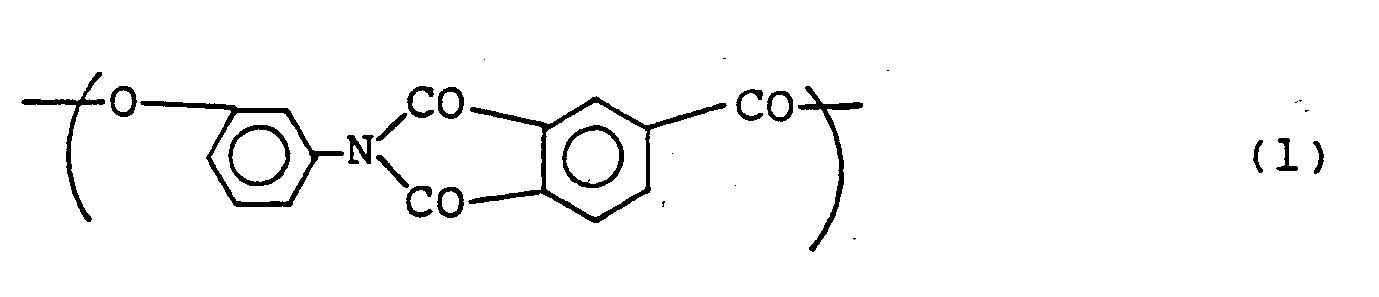
[0006] More specifically, the polyester carbonate of the present invention is a polyester carbonate containing imido groups, comprising recurring units represented by the following formula:
and recurring units represented by the following formula:
(̵O-Ar-O-CO)̵ (2)
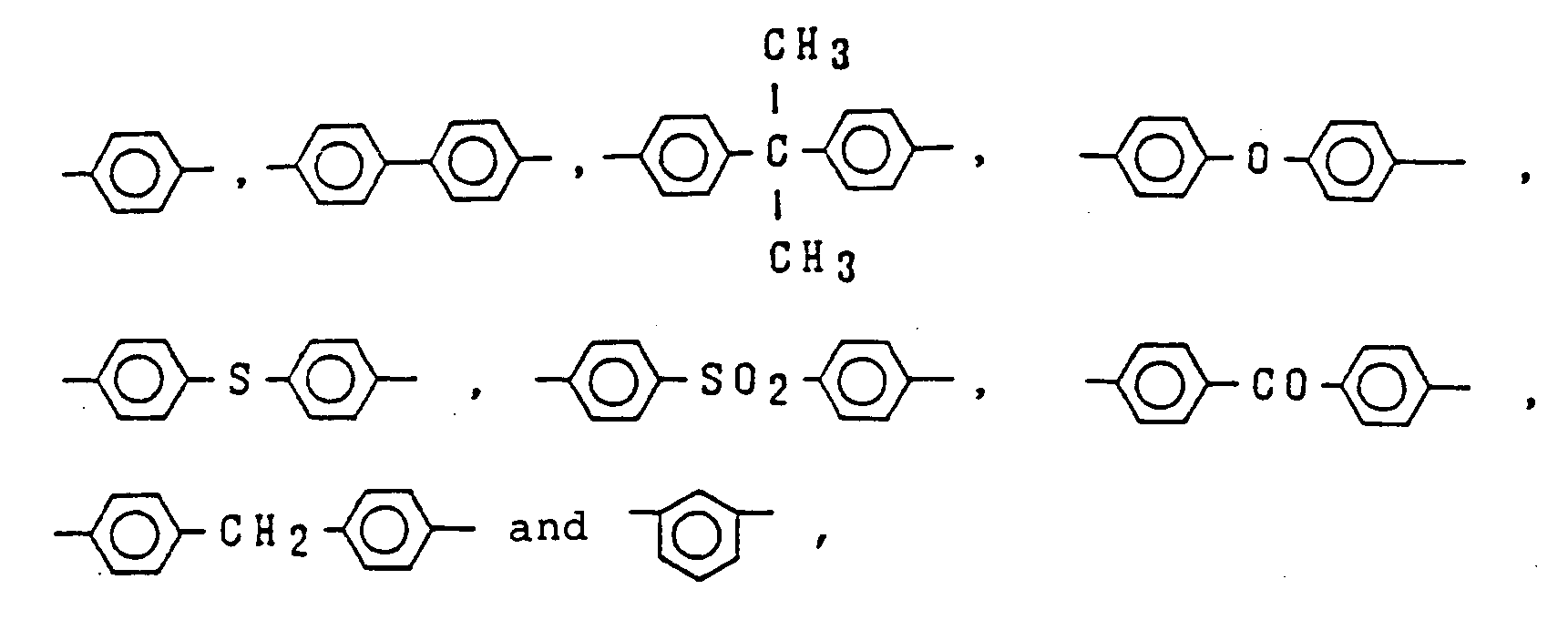
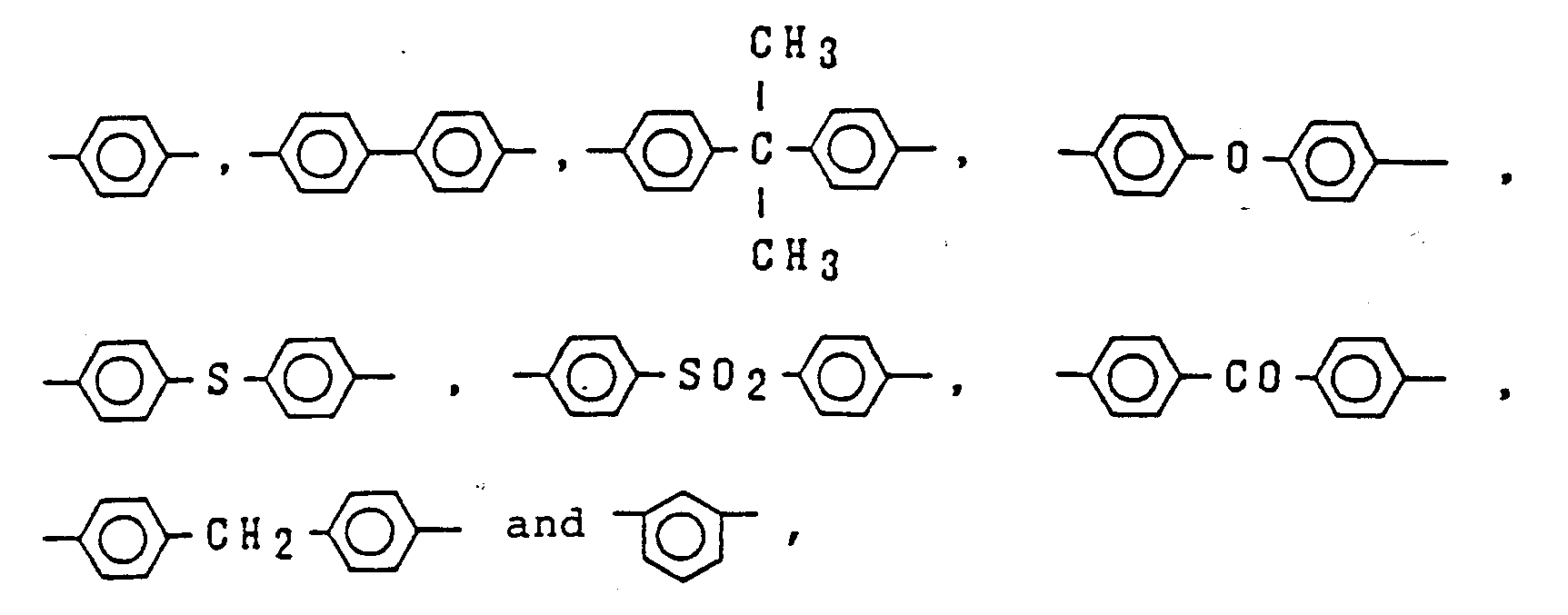
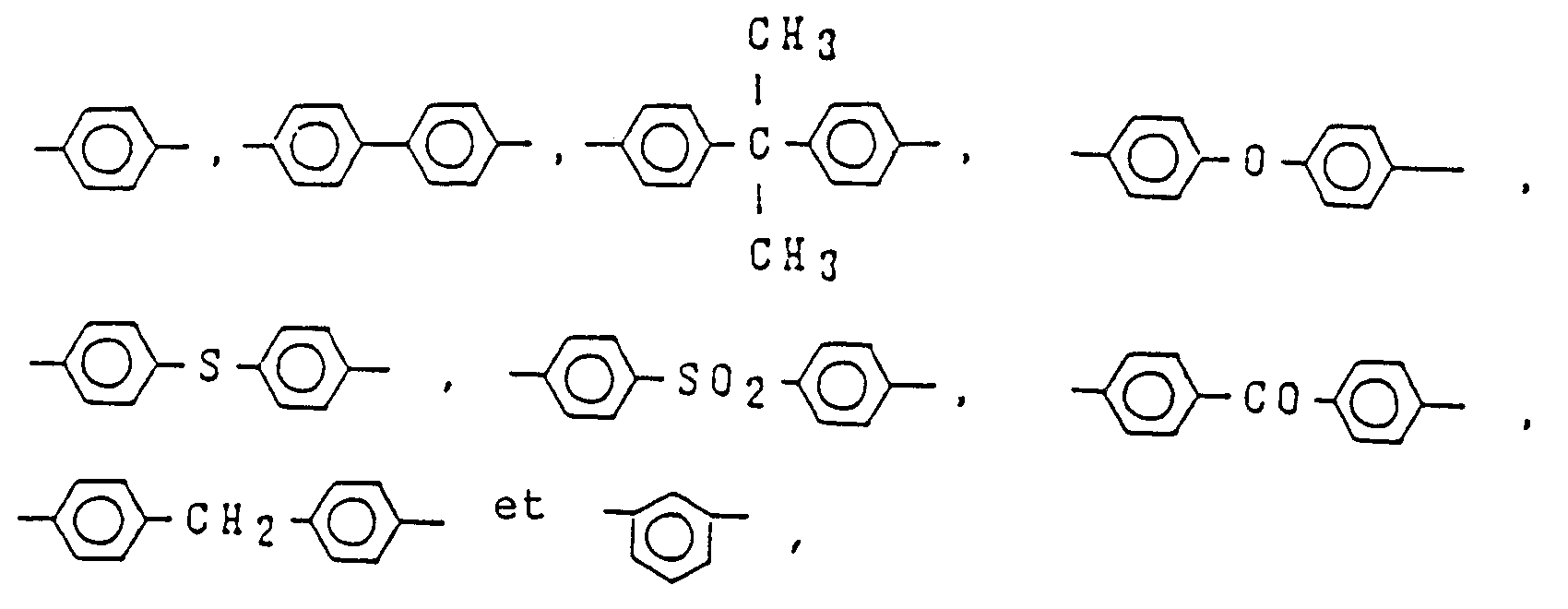
wherein Ar represents a divalent aromatic hydrocarbon group, selected from the group consisting of
with the mole fraction of the recurring units shown by the formula (l) being 0.2 to 0.8, and having a reduced specific viscosity [η sp/C] of 0.3 dl/g or more at 60 °C in a solution in which the polyester carbonate is dissolved in p-chlorophenol as a solvent at a concentration of 0.2 g/dl, and its preparation method comprises allowing 4-carboxy-N-(3-hydroxyphenyl)-phthalimide to react with a divalent phenol represented by the following formula:
HO-Ar-OH (3)
wherein Ar has the same meaning as mentioned above,
and diphenyl carbonate.
[0007] The polyester carbonate of the present invention is constituted of one unit represented by the formula (l) or a linked member consisting of a plurality of this unit and one unit represented by the formula (2) or a linked member consisting of a plurality of this unit linked in a straight chain to each other disorderly or orderly.
[0008] The ratio of the number of unit of the formula (l) to the number of unit of the formula (2) in the polyester carbonate of the present invention is required to be set as follows. That is, the mole fraction of the unit of the formula (l) (the mole fraction as herein mentioned is represented by
when the moles of the unit of the formula (l) are defined as a₁ and the moles of the unit of the formula (2) as a₂) should be set at 0.2 to 0.8. When the mole fraction of the unit of the formula (l) is less than 0.2, the temperature region exhibiting liquid crystal characteristic is so high that the molding temperature becomes undesirably higher. On the other hand, when the mole fraction exceeds 0.8, no liquid crystal characteristic is exhibited to lower remarkably moldability.
[0010] And, the terminal ends of the polyester carbonate of the present invention are blocked with hydrogen atom, carboxyl group,
etc.
[0011] The polyester carbonate of the present invention has a molecular weight such that, when the imido containing polyester carbonate is dissolved in p-chlorophenol at a concentration of 0.2 g/dl, the reduced viscosity of this solution [η sp/C] at 60 °C is 0.3 dl/g or more. If the reduced viscosity is less than 0.3 dl/g, the copolymer obtained has no sufficient mechanical strength.
[0012] The polyester carbonate of the present invention is prepared as follows. That is, 4-carboxy-N-(3-hydroxyphenyl)-phthalimide represented by the following formula:
is allowed to react with a divalent phenol represented by the above formula (3) and diphenyl carbonate represented by the following formula:
[0013] The compound of the formula (4) can be synthesized from, for example, trimellitic anhydride and m-aminophenol.
[0014] In the divalent phenol represented by the formula (2) and (3), Ar represents a divalent aromatic hydrocarbon group which is at least one selected from the group consisting of
Among them,
are preferred.
[0015] As to the amounts of the respective compounds to be used, the amounts of the compound of the formula (4) and the compound of the formula (3) are required to be set so as to satisfy the mole fraction as specified above. That is, when the amount of the compound of the formula (4) used is defined as b₁ mole and that of the compound of the formula (3) as b₂ mole, the relationship of
may be satisfied. On the other hand, the amount of the compound of the formula (5) used may be equimolar amount to two-fold molar amount to (b₁ + b₂) in terms of molar ratio.
[0016] The reaction should preferably be carried out in the presence of a catalyst. Such catalysts may include single metal such as sodium, potassium, calcium, magnesium, zinc, manganese, cobalt, titanium, tin and antimony, and oxides, hydroxides, hydrides, halides, alcoholates and phenolates of these.
[0017] In the present invention, the reaction should preferably be conducted at a temperature of 200 to 400 °C, more preferably 250 to 350 °C. The reaction time may be 0.1 to 5 hours, preferably l to 2 hours. Concerning the reaction method, there may be employed the method in which melt polymerization is performed under normal pressure and then continued under reduced pressure or the method in which solution polymerization is carried out in a hot medium oil under normal pressure.
Example l
[0018] Into a flask equipped with a stirring means and a pipe for introducing argon gas, 11.3 g (0.04 mole) of 4-carboxy-N-(3-hydroxyphenyl)-phthalimide, 11.2 g (0.06 mole) of 4,4'-dihydroxy diphenyl and 25.7 g (0.12 mole) of diphenyl carbonate were charged. Subsequently, 0.01 ml (0.03 m mole) of tetra-n-butoxytitanium was added to these, and the reaction was carried out at an elevated temperature of 250 °C under argon gas stream for l hour. Next, after the temperature was raised to 280 °C, the flask was brought to a reduced pressure of 1 mmHg and the reaction was carried out for l hour. Further, at a temperature elevated up to 300 °C, the reaction was carried out for l hour.
[0019] The polymer thus obtained was found to have a reduced viscosity [ηsp/C] of 0.63 dl/g in a solution of 0.2 g/dl concentration in a solvent of p-chlorophenol at 60 °C.
[0020] A film was prepared by press molding by use of this polymer, and IR-ray absorption spectral (IR) analysis was conducted by use of this film. As the result, absorptions based on benzene ring at the positions of 1580 cm⁻¹ and 1490 cm⁻¹, absorption based on carbonyl group at the position of 1650 cm⁻¹, absorptions based on imido bonding at the positions of 1780 to 1680 cm⁻¹, absorption based on the ether bonding at the position of 1240 cm⁻¹ and the imido characteristic absorption at the position of 720 cm⁻¹ were recognized, respectively.
[0021] Next, solvent resistance of this polymer was examined and it was found that the polymer was insoluble in solvents such as ethyl alcohol, diethyl ether, acetone, chloroform, methylene chloride, xylene and toluene.
[0022] For examination of the melting moldability of this polymer, the melt index under a load of 2.16 kg at 250 °C was measured to obtain the result as shown in the Table. Further, this polymer was confirmed to exhibit liquid crystal characteristic at a temperature of 250 °C or higher.
[0023] Also, for examination of the thermal properties of this polymer, the glass transition temperature and the thermal decomposition initiating temperature were measured to obtain the results as shown in the Table.
[0024] Next, for examination of the mechanical properties of this polymer, a fiber was prepared. That is, by use of the polymer obtained, a fiber was spun through a spinning nozzle with a diameter of l mm at 350 °C. The fiber with a diameter of 40 µm obtained was examined for its mechanical properties to obtain the results as shown in the Table.
Example 2
[0025] A polymer was prepared in the same manner as in Example 1 except for changing the amount of 4-carboxy-N-(3-hydroxyphenyl)-phthalimide used to 17.0 g (0.06 mole) and the amount of 4,4'-dihydroxy diphenyl used to 7.4 g (0.04 mole).
[0026] The polymer obtained was found to have a reduced viscosity [η sp/C] of 0.36 dl/g, and the results of IR-ray absorption spectral analysis, solvent resistance, liquid crystal characteristic were the same as Example l. Other measurement results are listed in the Table.
Example 3
[0027] A polymer was prepared in the same manner as in Example l except for using 6.67 g (0.06 mole) of hydroquinone in place of 11.2 g (0.06 mole) of 4,4'-dihydroxy diphenyl used in Example 1. The polymer obtained was found to have a reduced viscosity [η sp/C] of 0.31 dl/g, and the results of IR-ray absorption spectral analysis, solvent resistance, liquid crystal characteristic were the same as Example l. Other measurement results are listed in the Table.
Example 4
[0028] A polymer was prepared in the same manner as Example l except for using 9.3 g (0.05 mole) of 4,4'-dihydroxy diphenyl and 2.0 g (0.01 mole) of 4,4'-dihydroxy diphenyl ether in place of 4,4'-dihydroxy diphenyl used in Example l. The polymer obtained was found to have a reduced viscosity [η sp/C] of 0.45 dl/g, and the results of IR-ray absorption spectral analysis, solvent resistance, liquid crystal characteristic were the same as in Example l. Other measurement results are listed in the Table.
Comparative example l
[0029] A polyester carbonate having a structure known in the art was prepared in the same manner as in Example l except for using 11.2 g (0.06 mole) of 4,4'-dihydroxy diphenyl, 5.52 g (0.04 mole) of p-hydroxybenzoic acid and 25.7 g (0.12 mole) of diphenyl carbonate. The polymer obtained was found to have a reduced viscosity [η sp/C] of 0.52 dl/g.
[0030] For the polymer obtained, thermal properties and melt index were measured and also a fiber was spun similarly as in Example l and its mechanical properties were measured to obtain the results as shown in the Table.
[0031] As can be clearly seen from the above Examples of the present invention, the polyester carbonate containing imido groups of the present invention has higher mechanical strength than the polyester carbonate with a structure of the prior art, yet having good moldability as well as solvent resistance, and also exhibits liquid crystal characteristic. Accordingly, its industrial value is great when applied for materials such as various fibers, films, etc., in the field where high strength is required.
1. A polyester carbonate containing imido groups which comprises recurring units represented
by the following formula:
and recurring units represented by the following formula:
(̵O-Ar-O-CO)̵ (2)
wherein Ar represents a divalent aromatic hydrocarbon group selected from the group consisting of
with a mole fraction of the recurring units shown by the formula (1) being 0.2 to 0.8, and has a reduced viscosity [n sp/C] of 0.3 dl/g or more at 60 °C in a solution in which the polyester carbonate is dissolved in p-chlorophenol as a solvent at a concentration of 0.2 g/dl.
and recurring units represented by the following formula:
(̵O-Ar-O-CO)̵ (2)
wherein Ar represents a divalent aromatic hydrocarbon group selected from the group consisting of
with a mole fraction of the recurring units shown by the formula (1) being 0.2 to 0.8, and has a reduced viscosity [n sp/C] of 0.3 dl/g or more at 60 °C in a solution in which the polyester carbonate is dissolved in p-chlorophenol as a solvent at a concentration of 0.2 g/dl.
2. A process for producing a polyester carbonate containing imido groups, comprising
recurring units represented by the following formula:

and recurring units represented by the following formula:
(̵O-Ar-O-CO)̵ (2)
wherein Ar represents a divalent aromatic hydrocarbon group selected from the group consisting of
with a mole fraction of the recurring units shown by the formula (1) being 0.2 to 0.8, and having a reduced viscosity [n sp/C] of 0.3 dl/g or more at 60 °C in a solution in which the polyester carbonate is dissolved in p-chlorophenol as a solvent at a concentration of 0.2 g/dl, which comprises allowing 4-carboxy-N-(3-hydroxyphenyl)-phthalimide to react with a divalent phenol represented by the following formula:
HO-Ar-OH (3)
wherein Ar has the same meaning as above,
and diphenyl carbonate.
and recurring units represented by the following formula:
(̵O-Ar-O-CO)̵ (2)
wherein Ar represents a divalent aromatic hydrocarbon group selected from the group consisting of
with a mole fraction of the recurring units shown by the formula (1) being 0.2 to 0.8, and having a reduced viscosity [n sp/C] of 0.3 dl/g or more at 60 °C in a solution in which the polyester carbonate is dissolved in p-chlorophenol as a solvent at a concentration of 0.2 g/dl, which comprises allowing 4-carboxy-N-(3-hydroxyphenyl)-phthalimide to react with a divalent phenol represented by the following formula:
HO-Ar-OH (3)
wherein Ar has the same meaning as above,
and diphenyl carbonate.
3. The process for producing a polyester carbonate containing imido groups according
to Claim 2, wherein the mole fraction of 4-carboxy-N-(3-hydroxyphenyl)-phthalimide
is from 0.2 to 0.8 to the total amount of 4-carboxy-N-(3-hydroxyphenyl) -phthalimide
and divalent phenol.
4. The process for producing a polyester carbonate containing imido groups according
to Claim 2, wherein diphenyl carbonate is used in an amount between equimolar amount
and two-fold molar amount to 4-carboxy-N-(3-hydroxyphenyl)-phthalimide and divalent
phenol.
5. The process for producing a polyester carbonate containing imido groups according
to Claim 2, wherein said reaction is carried out in the presence of a catalyst selected
from the group consisting of sodium, potassium, calcium, magnesium, zinc, manganese,
cobalt, titanium, tin and antimony, and oxides, hydroxides, hydrides, halides, alcoholates
and phenolates thereof.
6. The process for producing a polyester carbonate containing imido groups according
to Claim 2, wherein said reaction is carried out at a temperature of the range of
from 200 °C to 400°C.
1. Polyester carbonate contenant des groupes imides, qui comporte des motifs périodiques
réprésentés par la formule suivante :

et des motifs périodiques représentés par la formule suivante :
(̵O-Ar-O-CO)̵ (2)
dans laquelle Ar représente un groupe hydrocarbure aromatique bifonctionnel, choisi dans le groupe comprenant:
avec une fraction molaire des motifs
périodiques de formule (1) qui est comprise entre 0,2 et 0,8, et présente une viscosité réduite [η sp/C] de 0,3 dl/g ou plus, à 60°C dans une solution dans laquelle le polyester carbonate est dissous dans du p-chlorophénol comme solvant, à une concentration de 0,2 g/dl.
et des motifs périodiques représentés par la formule suivante :
(̵O-Ar-O-CO)̵ (2)
dans laquelle Ar représente un groupe hydrocarbure aromatique bifonctionnel, choisi dans le groupe comprenant:
avec une fraction molaire des motifs
périodiques de formule (1) qui est comprise entre 0,2 et 0,8, et présente une viscosité réduite [η sp/C] de 0,3 dl/g ou plus, à 60°C dans une solution dans laquelle le polyester carbonate est dissous dans du p-chlorophénol comme solvant, à une concentration de 0,2 g/dl.
2. Procédé de préparation d'un polyester carbonate contenant des groupes imides, comportant
des motifs périodiques représentés par la formule suivante :

et des motifs périodiques représentés par la formule suivante :
(̵O-Ar-O-CO)̵ (2)
dans laquelle Ar représente un groupe hydrocarbure aromatique bifonctionnel, choisi dans le groupe comprenant:
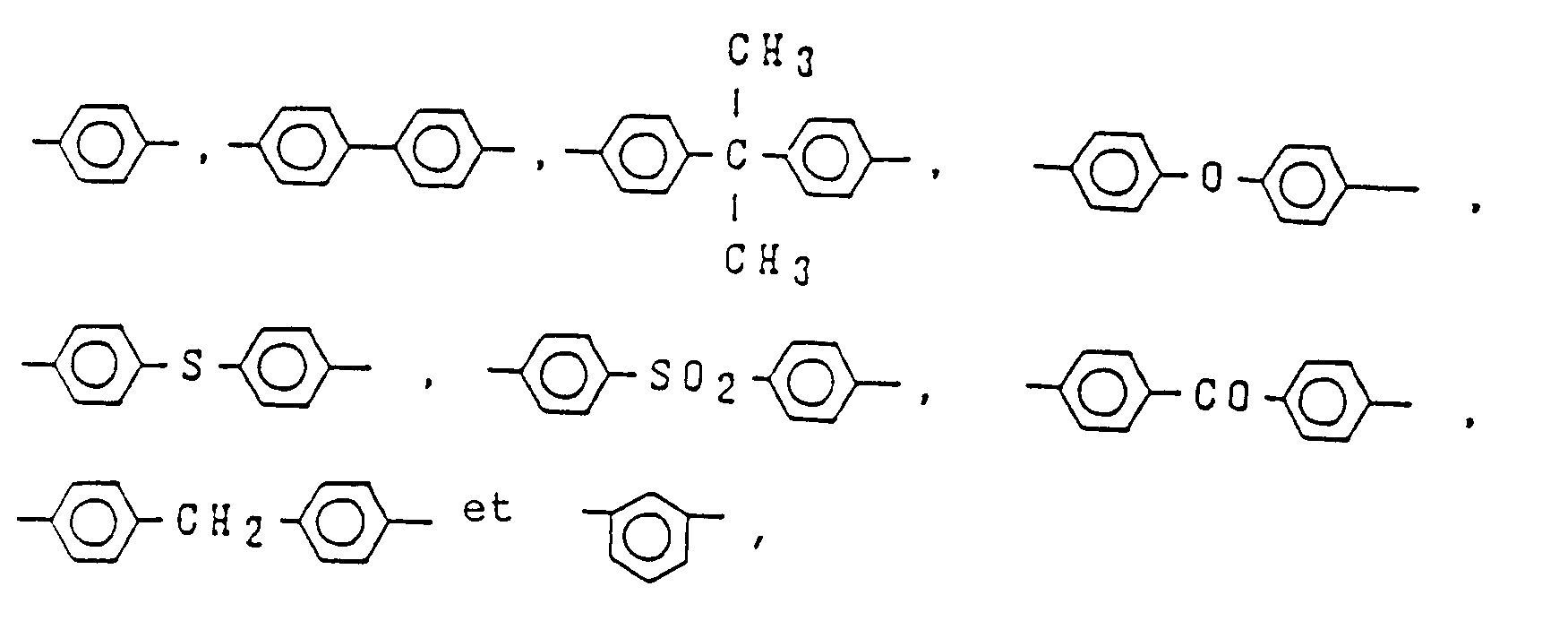
avec une fraction molaire des motifs périodiques de formule (1) qui est comprise entre 0,2 et 0,8, et ayant une viscosité réduite [η sp/C] de 0,3 dl/g ou plus, à 60°C dans une solution dans laquelle le polyester carbonate est dissous dans du p-chlorophénol comme solvant, à une concentration de 0,2 g/dl,
qui consiste à faire réagir du 4-carboxy-N-(3-hydroxyphényl)-phtalimide avec un phénol bifonctionnel représenté par la formule :
HO-Ar-OH (3)
dans laquelle Ar a la même signification que ci-dessus,
et du carbonate de diphényle.
et des motifs périodiques représentés par la formule suivante :
(̵O-Ar-O-CO)̵ (2)
dans laquelle Ar représente un groupe hydrocarbure aromatique bifonctionnel, choisi dans le groupe comprenant:
avec une fraction molaire des motifs périodiques de formule (1) qui est comprise entre 0,2 et 0,8, et ayant une viscosité réduite [η sp/C] de 0,3 dl/g ou plus, à 60°C dans une solution dans laquelle le polyester carbonate est dissous dans du p-chlorophénol comme solvant, à une concentration de 0,2 g/dl,
qui consiste à faire réagir du 4-carboxy-N-(3-hydroxyphényl)-phtalimide avec un phénol bifonctionnel représenté par la formule :
HO-Ar-OH (3)
dans laquelle Ar a la même signification que ci-dessus,
et du carbonate de diphényle.
3. Procédé de préparation d'un polyester carbonate contenant des groupes imides selon
la revendication 2, dans lequel la fraction molaire de 4-carboxy-N-(3-hydroxyphényl)-phtalimide
est de 0,2 à 0,8, par rapport à la quantité totale du 4-carboxy-N-(3-hydroxypnényl)-phtalimide
et du phénol bifonctionnel.
4. Procédé de préparation d'un polyester carbonate contenant des groupes imides selon
la revendication 2, dans lequel on utilise une quantité de carbonate de diphényle
comprise entre une quantité molaire et une quantité bimolaire de 4-carboxy-N-(3-hydroxyphényl)-phtalimide
et de phénol bifonctionnel.
5. Procédé de préparation d'un polyester carbonate contenant des groupes imides selon
la revendication 2, dans lequel ladite réaction est réalisée en présence d'un catalyseur
qu'on choisit dans le groupe comprenant le sodium, le potassium, le calcium, le magnésium,
le zinc, le manganèse, le cobalt, le titane, l'étain et l'antimoine, et des oxydes,
hydroxydes, hydrides, halogénures, alcoolates et phénolates de ceux-ci.
6. Procédé de préparation d'un polyester carbonate contenant des groupes imides selon
la revendication 2, dans lequel ladite réaction est réalisée à une température comprise
dans la plage de 200°C à 400°C.
1. Polyestercarbonat, das Imidogruppen enthält, dadurch gekennzeichnet, daß es sich wiederholende Einheiten, die durch die folgende Formel:

dargestellt werden, und sich wiederholende Einheiten, die durch die folgende Formel:
(̵O-Ar-O-CO)̵ (2)
dargestellt werden,
worin Ar eine zweiwertige aromatische Kohlenwasserstoffgruppe bedeutet, ausgewählt aus der Gruppe, die besteht aus:
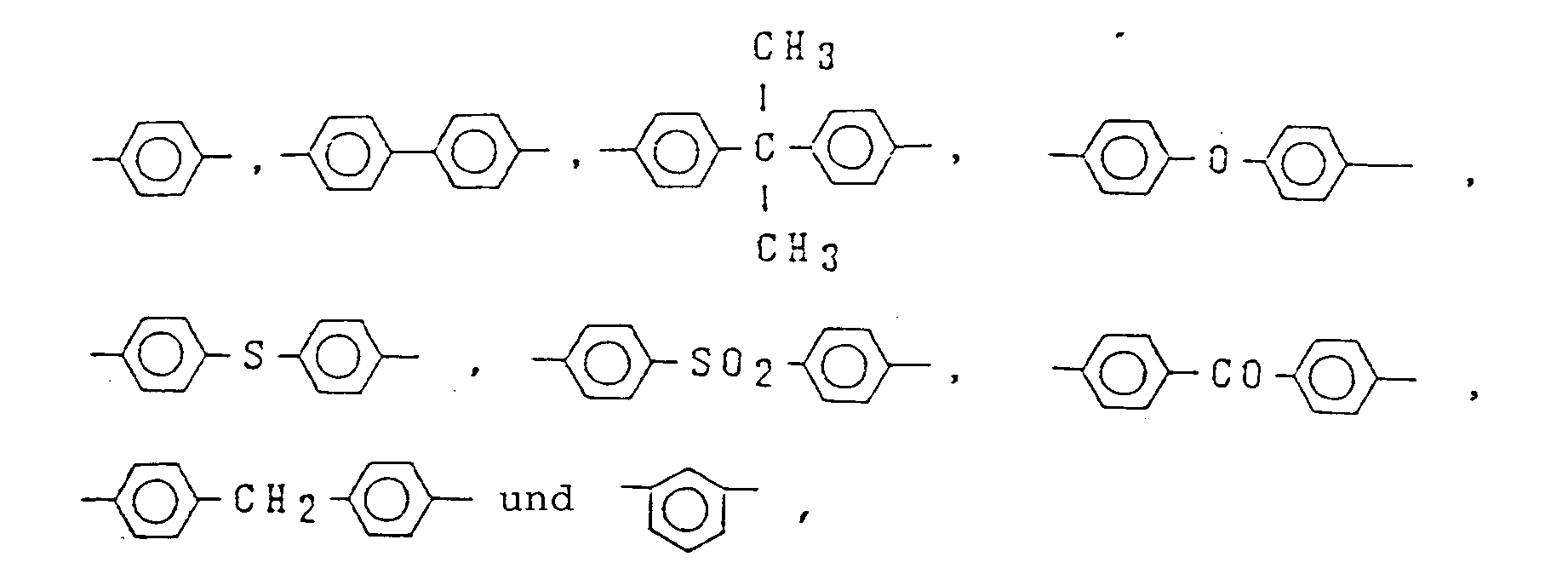
enthält, wobei die Molfraktion der sich wiederholenden Einheiten, die durch die Formel (1) dargestellt wird, 0,2 bis 0,8 beträgt, und es eine reduzierte bzw. verringerte Viskosität [ηsp/C] von 0,3 dl/g oder mehr bei 60°C in einer Lösung besitzt, in der das Polyestercarbonat in p-Chlorphenol als Lösungsmittel in einer Konzentration von 0,2 g/dl gelöst ist.
dargestellt werden, und sich wiederholende Einheiten, die durch die folgende Formel:
(̵O-Ar-O-CO)̵ (2)
dargestellt werden,
worin Ar eine zweiwertige aromatische Kohlenwasserstoffgruppe bedeutet, ausgewählt aus der Gruppe, die besteht aus:
enthält, wobei die Molfraktion der sich wiederholenden Einheiten, die durch die Formel (1) dargestellt wird, 0,2 bis 0,8 beträgt, und es eine reduzierte bzw. verringerte Viskosität [ηsp/C] von 0,3 dl/g oder mehr bei 60°C in einer Lösung besitzt, in der das Polyestercarbonat in p-Chlorphenol als Lösungsmittel in einer Konzentration von 0,2 g/dl gelöst ist.
2. Verfahren zur Herstellung eines Polyestercarbonats, das Imidogruppen enthält und das
sich wiederholende Einheiten, die durch die folgende Formel:

dargestellt werden, und sich wiederholende Einheiten, die durch die folgende Formel:
(̵O-Ar-O-CO)̵ (2)
dargestellt werden, enthält,
worin Ar eine zweiwertige aromatische Kohlenwasserstoffgruppe bedeutet, die aus der Gruppe ausgewählt wird, die besteht aus:
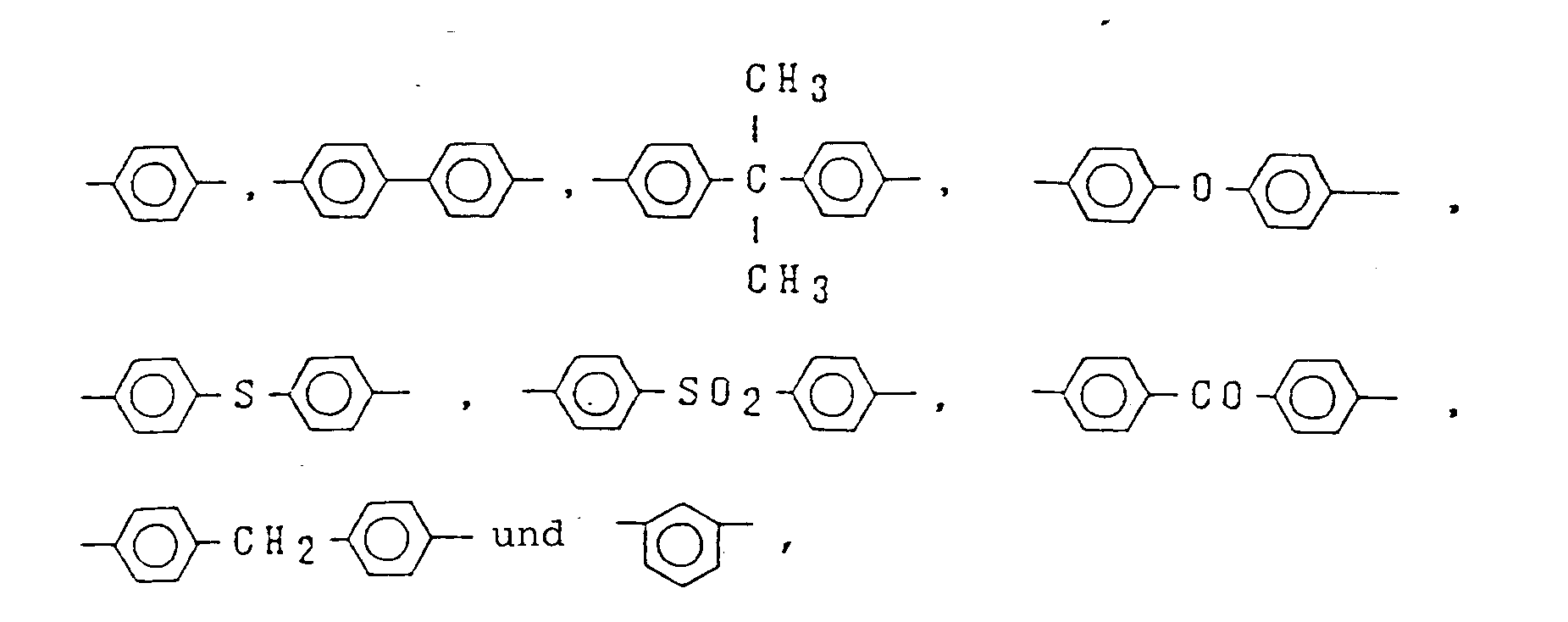
wobei die Molfraktion der sich wiederholenden Einheiten, die durch die Formel (1) dargestellt wird, 0,2 bis 0,8 beträgt, und es eine reduzierte bzw. verringerte Viskosität [ηsp/C] von 0,3 dl/g oder mehr bei 60°C in einer Lösung besitzt, in der das Polyestercarbonat in p-Chlorphenol als Lösungsmittel in einer Konzentration von 0,2 g/dl gelöst ist, dadurch gekennzeichnet, daß 4-Carboxy-N-(3-hydroxyphenyl)-phthalimid mit einem zweiwertigen Phenol, das durch die folgende Formel:
HO-Ar-OH (3)
dargestellt wird, worin Ar die gleiche Bedeutung wie oben besitzt, und Diphenylcarbonat umgesetzt wird.
dargestellt werden, und sich wiederholende Einheiten, die durch die folgende Formel:
(̵O-Ar-O-CO)̵ (2)
dargestellt werden, enthält,
worin Ar eine zweiwertige aromatische Kohlenwasserstoffgruppe bedeutet, die aus der Gruppe ausgewählt wird, die besteht aus:
wobei die Molfraktion der sich wiederholenden Einheiten, die durch die Formel (1) dargestellt wird, 0,2 bis 0,8 beträgt, und es eine reduzierte bzw. verringerte Viskosität [ηsp/C] von 0,3 dl/g oder mehr bei 60°C in einer Lösung besitzt, in der das Polyestercarbonat in p-Chlorphenol als Lösungsmittel in einer Konzentration von 0,2 g/dl gelöst ist, dadurch gekennzeichnet, daß 4-Carboxy-N-(3-hydroxyphenyl)-phthalimid mit einem zweiwertigen Phenol, das durch die folgende Formel:
HO-Ar-OH (3)
dargestellt wird, worin Ar die gleiche Bedeutung wie oben besitzt, und Diphenylcarbonat umgesetzt wird.
3. Verfahren zur Herstellung eines Polyestercarbonats, das Imidogruppen enthält, nach
Anspruch 2, dadurch gekennzeichnet, daß die Molfraktion aus 4-Carboxy-N-(3-hydroxyphenyl)-phthalimid 0,2 bis 0,8, bezogen
auf die Gesamtmenge an 4-Carboxy-N-(3-hydroxyphenyl)-phthalimid und zweiwertigem Phenol,
beträgt.
4. Verfahren zur Herstellung eines Polyestercarbonats, das Imidogruppen enthält, nach
Anspruch 2, dadurch gekennzeichnet, daß das Diphenylcarbonat in einer Menge zwischen äquimolarer Menge und zweifacher
molarer Menge, bezogen auf das 4-Carboxy-N-(3-hydroxyphenyl)-phthalimid und das divalente
Phenol, verwendet wird.
5. Verfahren zur Herstellung eines Polyestercarbonats, das Imidogruppen enthält, nach
Anspruch 2, dadurch gekennzeichnet, daß die Reaktion in Anwesenheit eines Katalysators durchgeführt wird, der aus der
Gruppe ausgewählt wird, die aus Natrium, Kalium, Calcium, Magnesium, Zink, Mangan,
Kobalt, Titan, Zinn und Antimon und Oxiden, Hydroxiden, Hydriden, Halogeniden, Alkoholaten
und Phenolaten davon besteht.
6. Verfahren zur Herstellung eines Polyestercarbonats, das Imidogruppen enthält, nach
Anspruch 2, dadurch gekennzeichnet, daß die Reaktion bei einer Temperatur im Bereich von 200 bis 400°C durchgeführt wird.