|
(11) | EP 0 213 883 B1 |

| (12) | EUROPEAN PATENT SPECIFICATION |
|
|
| (54) |
Novel radioactive and non-radioactive iodobutyrophenone derivative and processes for the preparation thereof Radioaktive oder nichtradioaktive Jodobutyrophenonderivate und Verfahren zur Herstellung Dérivés radioactifs ou non-radioactifs de l'iodobutyrophénone et procédés de préparation |
|
|
|||||||||||||||||||||||||||||||
| Note: Within nine months from the publication of the mention of the grant of the European patent, any person may give notice to the European Patent Office of opposition to the European patent granted. Notice of opposition shall be filed in a written reasoned statement. It shall not be deemed to have been filed until the opposition fee has been paid. (Art. 99(1) European Patent Convention). |
[0001] This invention relates to a novel radioactive or non-radioactive 2-iodobutyrophenone derivative of the formula :
wherein X is a radioactive or non-radioactive iodine atom, and processes for producing the same.
[0002] The compound of this invention is a novel compound not disclosed in any literature. The radioactive compound of this invention has a high affinity for dopamine receptors as well as iodospiroperidol, which has been disclosed in Japanese Pat Appln. Kokai (Laid-Open) No. 59-95288. However, in the biodistribution studies, the radioactive compound of this invention showed higher brain uptake (Factor: approximately 2.0) than that of radioactive iodospiroperidol. Therefore, the radioactive compound of this invention is very useful as a radioactive diagnostic agent and as a radiopharmaceutical.
[0003] The radioactive 2-iodobutyrophenone derivative (I) produced by this invention permits quantitative measurement of dopamine receptors in the living human brain by applying a suitable method such as a probe method, a single photon emission computed tomography (SPECT) method, and the like. Therefore, a certain neuropsychiatic disorder caused by abnormality of dopamine receptor concentration can be diagnosed by using above system. The radioactive compound of this invention can also be used as a standard material for evaluation in vivo of dopamine receptor specific drugs, and it is useful for the diagnosis and treatment of other diseases, such as breast cancer, resulting from a change of dopamine receptors. Furthermore, the radioactive compound of this invention can be used as a radioactive ligand in the various kinds of in vitro radioassays such as RIA, RRA and the like. On the other hand, since the nonradioactive 2-iodobutyrophenone derivative of this invention also has a high affinity for dopamine receptors and has a central nervous system depressing action, antiadrenaline action and the like, it is useful as a neuroleptic, a sedative, an anodyne, a tranquillizer, and the like.
[0005] The compound of this invention of the above-mentioned formula (I) can be produced by a conventional method for the synthesis of radioactive or non-radioactive iodine compounds. For instance, it can be produced according to either Process A or Process B shown below.
[Process A]
[0006] A 2-iodospiroperidol compound of the formula (II) :
wherein X is the same as described above, which is disclosed in Japanese Pat. Appln. Kokai (Laid-Open) No. 59-95288 and corresponding EP-A-0 187 162 (which falls under Art 54(3) EPC), is reacted with methyl bromide or methyl iodide, preferably in a solvent, in the presence of a base, if necessary, in the presence of a crown-ether or a phase transfer catalyst, at a temperature in a range of 30° to 100 °C. As the solvent described above, for example, acetone, methyl ethyl ketone, methylene chloride, dichloroethane, ether, isopropyl ether, tetrahydrofuran, dioxane, benzene, acetonitrile, water and a mixture of these solvents are exemplified. And as the base, for example, a caustic alkali, an alkali metal, an alkali metal hydride and a quaternary amine compound are exemplified.
[Process B]
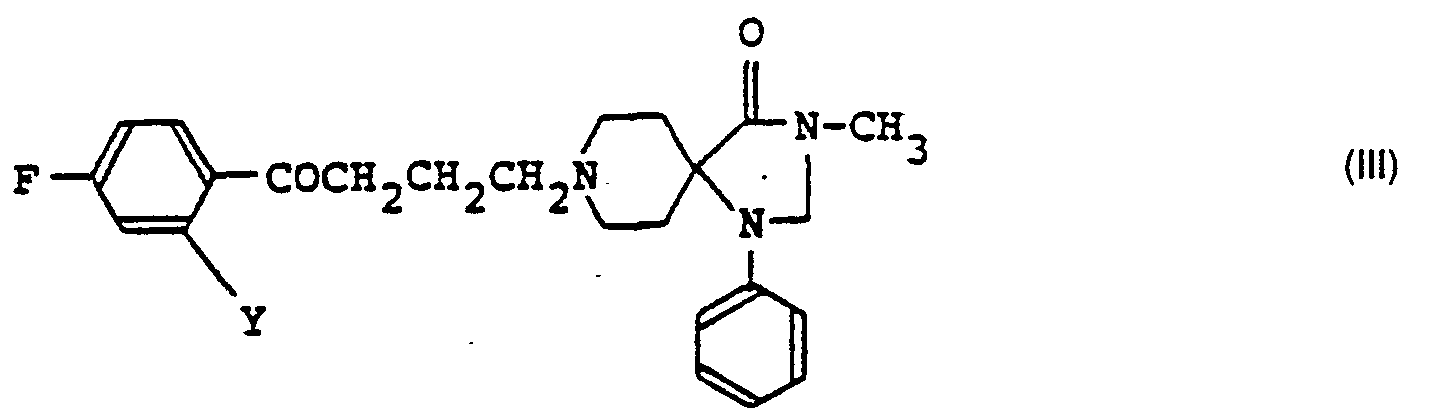
[0007] A halogeno compound of the formula :
wherein Y is a halogen atom is subjected to an exchange reaction with a radioactive or non-radioactive iodine metal salt, preferably in a solvent at a temperature of 50° to 180 °C. As the solvent described above, for example, acetonitrile, dimethylformamide, ethylene glycol, an ether derivative of ethylene glycol, an ether derivative of diethylene glycol, water and the like are exemplified.
[0008] The compound (I) obtained can be purified by a conventional method such as thin layer chromatography (TLC) or high-performance liquid chromatography (HPLC).
[0009] In the process of this invention, for example, I-123, 1-125, I-131, 1-132, etc. are exemplified as the radioactive iodine atom, and 1-123 is preferred. The radioactive iodine metal salt means a metal salt of the above radioactive iodine, and may be any of those capable of providing a radioactive I- ion, though alkali metal salts such as, for example, sodium iodide, potassium iodide and lithium iodide are preferred. As the halogen ion in the formula (III), anions of chlorine, bromine, iodine and the like are exemplified.
Example 1
[0011] Preparation of 8-[4-(4-fluoro-2-iodophenyl)-4.-oxobutyl]-3-methyl-1-phenyl-1,3,8-triazaspiro[4.5] de- can-4-one (2-iodomethylspiroperidol).
[0012] Methylene chloride (10 mi), methyl iodide (62 µl) and tetra-n-butylammonium hydroxide (5 ml) were added to 2-iodospiroperidol (260 mg), and the mixture was stirred at a temperature of 40° to 50 °C for thirty minutes. After cooling, water is added to the reaction mixture and the mixture was subjected to an extraction by methylene chloride. Then the solvent was removed by distillation to obtain a crude product This was purified by silica gel column chromatography to obtain 2-iodomethylspiroperidol (107 mg).
Melting point: 115-118°C
IR(CHCl3) cm-1 : 1 705 (C=O)
1H-NMR(CDCl3) 8 (ppm) : 1.60-3.10
(14 H, m, -CHz-), 3.00(3 H, s, CH3),
4.70(2 H, s, ―N―CH2―N―), 6.80-8.00
(8 H, m, benzene ring H).
Mass spectrum (70 eV) m/e : 535 [M+]
Example 2
[0013] Preparation of [125|]-8-[4-(4-fluoro-2-iodophenyl)-4-oxobutyl]-3-methyl-1-phenyl-1,3,8-triazas- piro[4.5]-decan-4-one ([1251]-2-iodomethylspiroperidol).
[0014] Methylene chloride (500 µl), methyl iodide (10 µl) and tetra-n-butylammonium hydroxide (60 µl) were added to an aqueous solution of [125I]-2-iodospiroperidol (300 µl, 500 µCi). The mixture was stirred at room temperature for thirty minutes. A methylene chloride layer was separated, dried and condensed under reduced pressure. The resulting crude product was purified by HPLC (column ; Licrosorb® RP-18, solvent : waterlmethanol/acetonitrile/triethylamine = 164/336/68/0.2 to obtain [1251]-2-iodomethylspiroperidol 400 µCi). This product was identical with the specimen obtained in the Example 1 in Rf values of TLC and HPLC.
Example 3
[0016] Dimethylformamide (10 µl) and Na125| (2 mCi) were added to 2-iodomethylspiroperidol (5 µg) synthesized in the Example 1, and a slight amount of 0.1 N sulfuric acid was further added thereto, and the resulting mixture was heated at 100 °C for 3 hours. After cooling, the resulting crude product was purified by HPLC to obtain [125|]-2-iodomethylspiroperidol (0.75 mCi). This product was identical with the specimen obtained in Example 1 in Rf values of TLC and HPLC.
1. A radioactive or non-radioactive 2-iodobutyrophenone derivative of the formula:
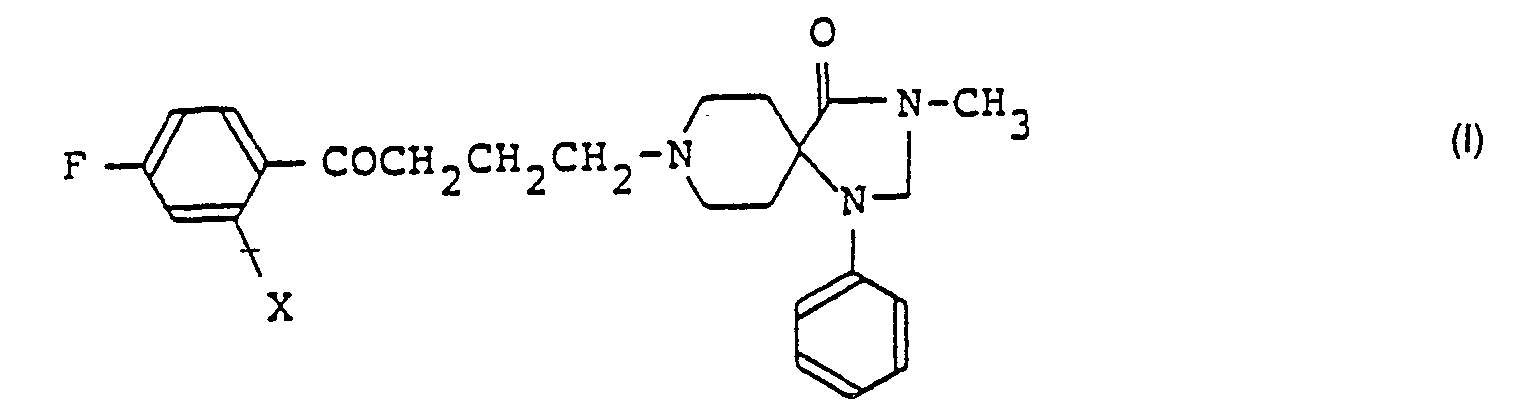
wherein X is a radioactive or non-radioactive iodine atom.
wherein X is a radioactive or non-radioactive iodine atom.
2. The 2-iodobutyrophenone derivative according to Claim 1, wherein X is an atom selected
from the group of iodine isomers consisting of I-127, 1-123, I-125, I-131 and 1-132.
3. A process for producing the radioactive or non-radioactive 2-iodobutyrophenone
derivative claimed in Claim 1, which comprises reacting a 2-iodospiroperidol of the
formula:
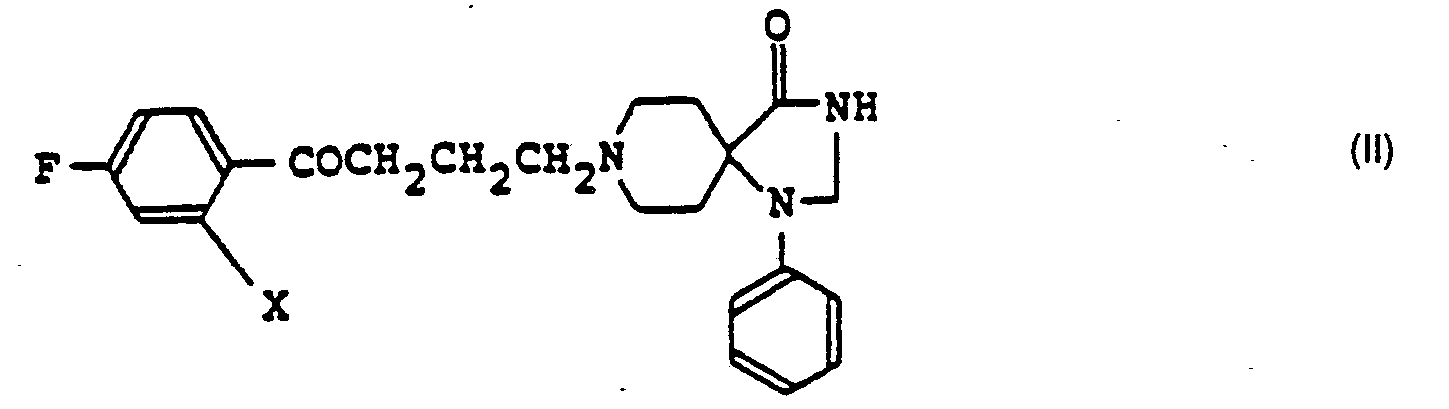
wherein X is as defined above, with methyl bromide or iodide in the presence of a base.
wherein X is as defined above, with methyl bromide or iodide in the presence of a base.
4. The process according to Claim 3, wherein the radioactive or non-radioactive iodine
is I-127, I-123, 1-125, I-131 or 1-132.
5. A process for producing the radioactive or non-radioactive 2-iodo-butyrophenone
derivative claimed in Claim 1, which comprises subjecting a 2-halogenobutyrophenone
derivative of the formula :
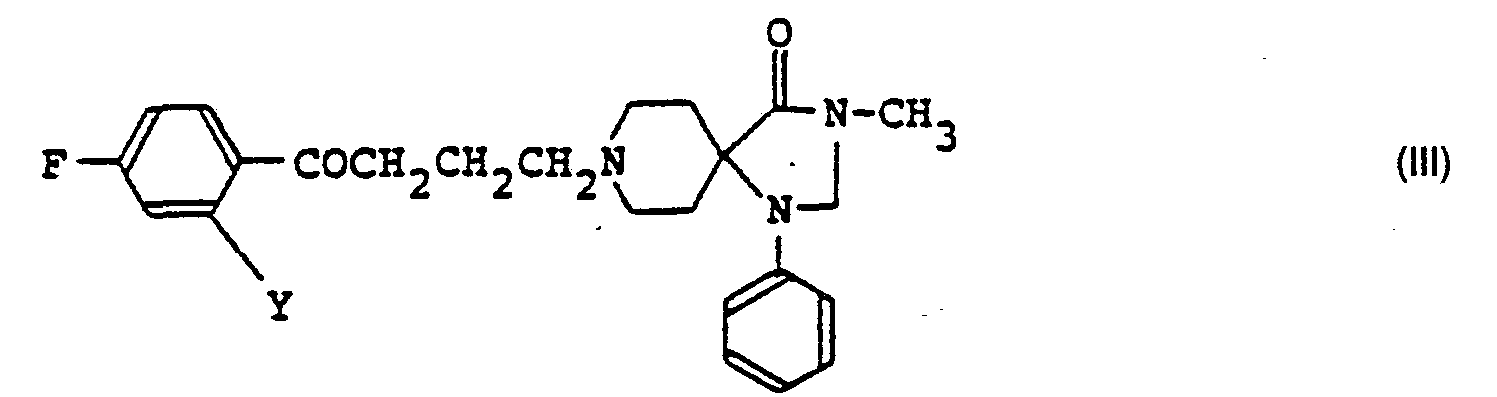
wherein Y is a halogen atom to an exchange reaction with a radioactive or non-radioactive iodine metal salt.
wherein Y is a halogen atom to an exchange reaction with a radioactive or non-radioactive iodine metal salt.
6. The process according to Claim 5, wherein the radioactive or non-radioactive iodine
is 1-127, 1-123, I-125, 1-131 or I-132.
7. The process according to claim 5 or claim 6, wherein Y is a bromine atom.
8. A 2-halogenobutyrophenone derivative of the formula (III) as defined in Claim 5,
wherein Y is a chlorine or bromine atom.
9. A 2-halogenobutyrophenone derivative according to claim 8, wherein Y is a bromine
atom.
1. Radioaktives oder nicht-radioaktives 2-Jodbutyrophenon-Derivat der Formel
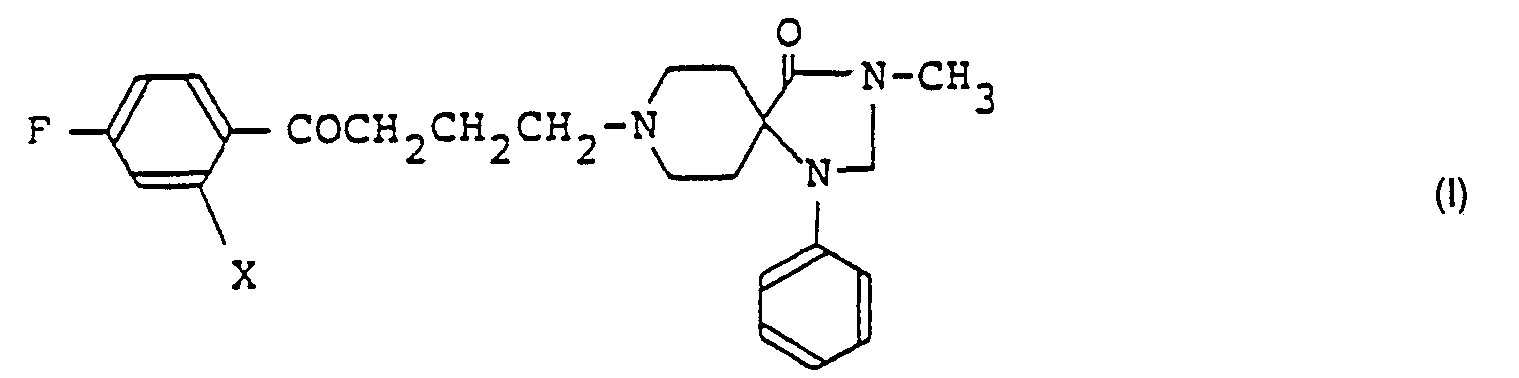
in der X ein radioaktives oder nicht-radioaktives Jodatom ist.
in der X ein radioaktives oder nicht-radioaktives Jodatom ist.
2. Jodbutyrophenon-Derivat nach Anspruch 1, in dem X ein Atom ist, das aus der Gruppe
der Jodisomeren ausgewählt ist, die aus I-127, I-123, I-125, I-131 und I-132 besteht.
3. Verfahren zur Herstellung des radioaktiven oder nicht-radioaktiven 2-Jodbutyrophenon-Derivates
nach Anspruch 1, das Umsetzung eines 2-Jodspiroperidols der Formel
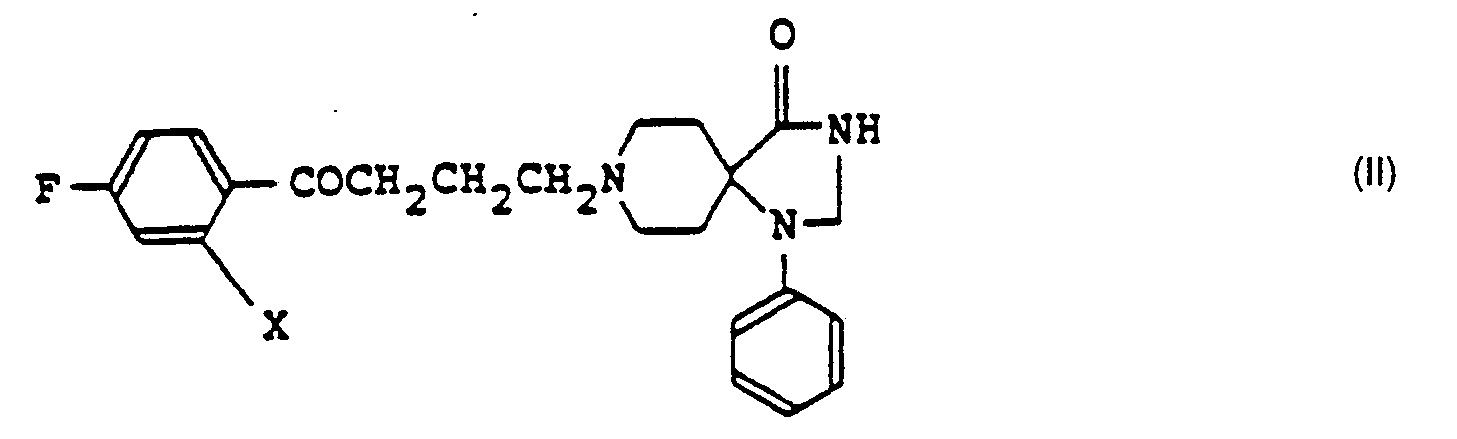
in der X wie vorstehend definiert ist, mit Methylbromid oder -jodid in Gegenwart einer Base umfaßt.
in der X wie vorstehend definiert ist, mit Methylbromid oder -jodid in Gegenwart einer Base umfaßt.
4. Verfahren nach Anspruch 3, wobei das radioaktive oder nicht-radioaktive Jod I-127,
I-123, I-125, I-131 oder I-132 ist.
5. Verfahren zur Herstellung des radioaktiven oder nicht-radioaktiven 2-Jodbutyrophenon-Derivates
nach Anspruch 1, welches Unterziehen eines 2-Halogenbutyrophenon-Derivates der Formel
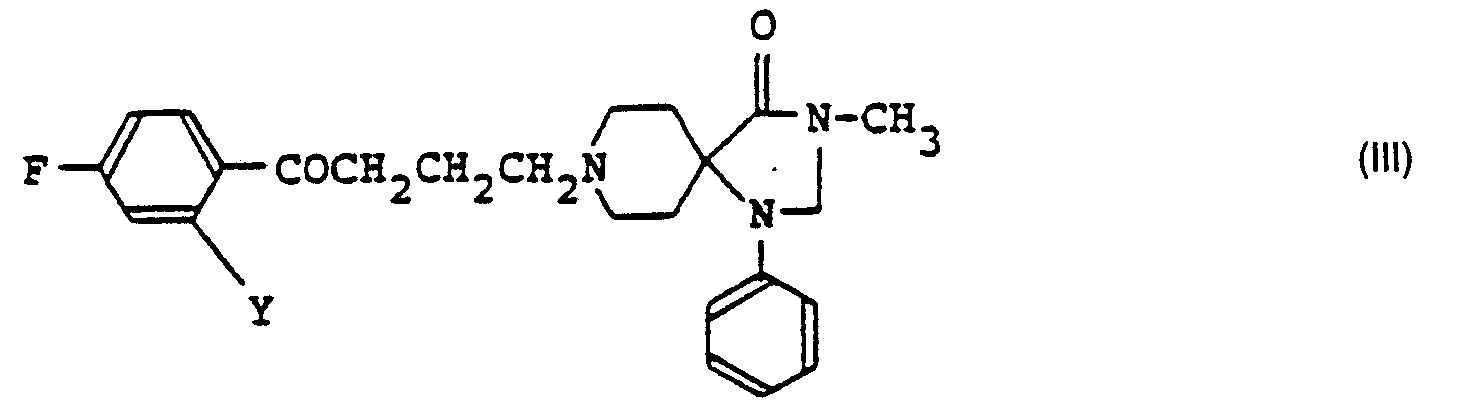
in der Y ein Halogenatom ist, einer Austauschreaktion mit einem radioaktiven oder nicht-radioaktiven Jod-Metallsalz umfaßt.
in der Y ein Halogenatom ist, einer Austauschreaktion mit einem radioaktiven oder nicht-radioaktiven Jod-Metallsalz umfaßt.
6. Verfahren nach Anspruch 5, wobei das radioaktive oder nicht-radioaktive Jod 1-127,
1-123, 1-125, I-131 oder I-132 ist.
7. Verfahren nach Anspruch 5 oder nach Anspruch 6, wobei Y ein Bromatom ist.
8. Halogenbutyrophenon-Derivat der Formel (III) gemäß Anspruch 5, in der Y ein Chlor-
oder Bromatom ist.
9. 2-Halogenbutyrophenon-Derivat nach Anspruch 8, in dem Y ein Bromatom ist.
1. Dérivé radioactif ou non radioactif de la 2=iodobutyrophénone de formule
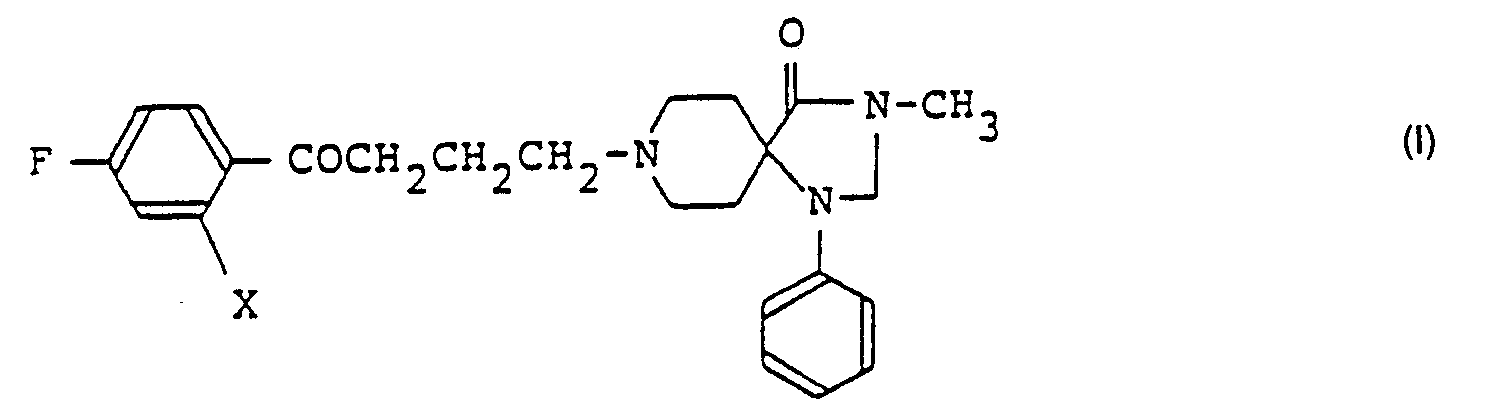
dans laquelle X est un atome d'iode radioactif ou non radioactif.
dans laquelle X est un atome d'iode radioactif ou non radioactif.
2. Dérivé de la 2-iodobutyrophénone selon la revendication 1, dans lequel X est un
atome choisi dans le groupe d'isomères de l'iode constitué par 1-127, 1-123, 1-125,
I-131 et 1-132.
3. Procédé de préparation du dérivé radioactif ou non radioactif de la 2-iodobutyrophénone
selon la revendication 1, consistant à faire réagir un 2-iodospiropéridol de formule
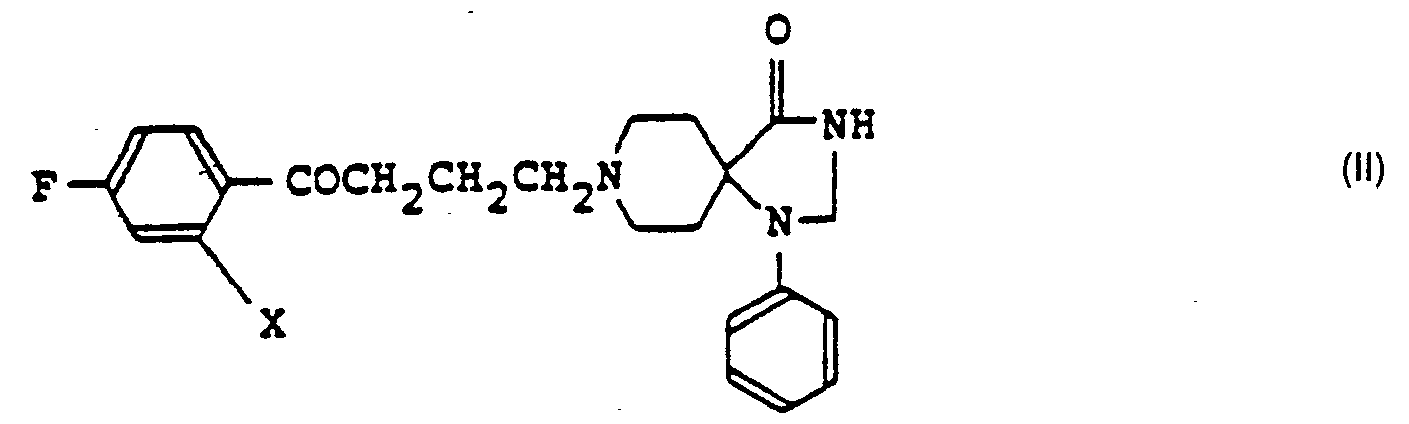
dans laquelle X est tel que défini précédemment, avec du bromure ou de l'iodure de méthyle en présence d'une base.
dans laquelle X est tel que défini précédemment, avec du bromure ou de l'iodure de méthyle en présence d'une base.
4. Procédé selon la revendication 3, dans lequel l'iode radioactif ou non radioactif
est I-127, I-123, 1-125, 1-131 ou I-132.
5. Procédé de préparation du dérivé radioactif ou non radioactif de la 2-iodobutyrophénone
selon la revendication 1, consistant à soumettre un dérivé de 2-halogénobutyrophénone
de formule
dans laquelle Y est un atome d'halogène, à une réaction d'échange avec un sel métallique d'iode radioactif ou non radioactif.
dans laquelle Y est un atome d'halogène, à une réaction d'échange avec un sel métallique d'iode radioactif ou non radioactif.
6. Procédé selon la revendication 5, dans lequel l'iode radioactif ou non radioactif
est I-127, 1-123, I-125, 1-131 ou I-132.
7. Procédé selon la revendication 5 ou 6, dans lequel Y est un atome de brome.
8. Dérivé de 2-halogénobutyrophénone de la formule (III) indiquée et définie dans
la revendication 5, dans lequel Y est un atome de chlore ou de brome.
9. Dérivé de 2-halogénobutyrophénone selon la revendication 8, dans lequel Y est un
atome de brome.