| (19) |
 |
|
(11) |
EP 0 214 238 B1 |
| (12) |
EUROPEAN PATENT SPECIFICATION |
| (45) |
Mention of the grant of the patent: |
|
04.08.1993 Bulletin 1993/31 |
| (22) |
Date of filing: 24.02.1986 |
|
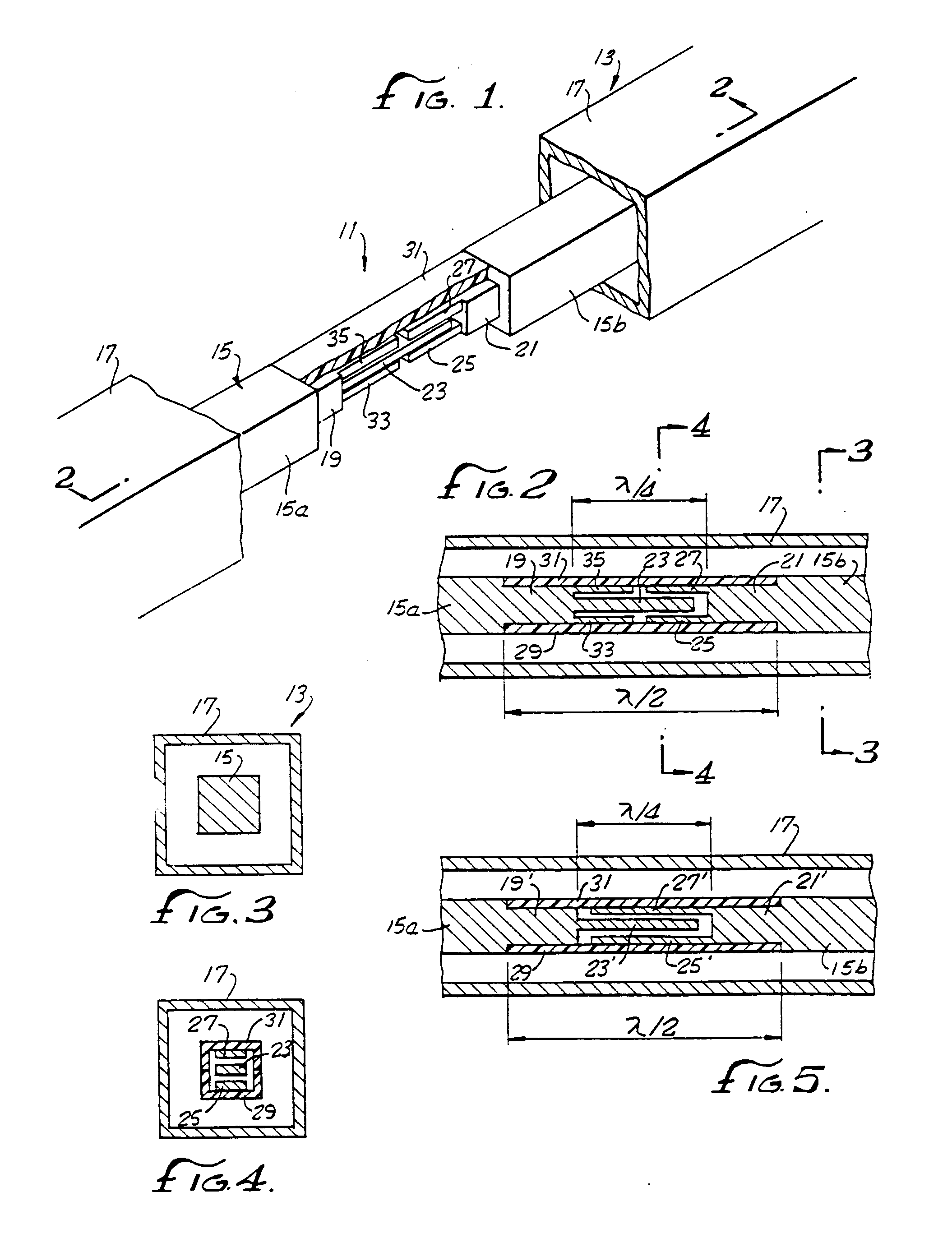
| (86) |
International application number: |
|
PCT/US8600/378 |
| (87) |
International publication number: |
|
WO 8605/325 (12.09.1986 Gazette 1986/20) |
|
| (54) |
COAXIAL PHASE SHIFTER FOR TRANSVERSE ELECTROMAGNETIC TRANSMISSION LINE
KOAXIAL-PHASENSCHIEBER FÜR TEM-LEITUNGEN
DEPHASEUR COAXIAL POUR LIGNE ELECTROMAGNETIQUE TRANSVERSALE DE TRANSMISSION
|
| (84) |
Designated Contracting States: |
|
DE FR GB IT |
| (30) |
Priority: |
08.03.1985 US 709878
|
| (43) |
Date of publication of application: |
|
18.03.1987 Bulletin 1987/12 |
| (73) |
Proprietor: Hughes Aircraft Company |
|
Los Angeles, California 90045-0066 (US) |
|
| (72) |
Inventors: |
|
- WARD, Robert, D.
Manhattan Beach, CA 90266 (US)
- TAORMINA, Frank, A.
Glendale, CA 91208 (US)
- WONG, Mon, N.
Torrance, CA 90503 (US)
|
| (74) |
Representative: Colgan, Stephen James et al |
|
CARPMAELS & RANSFORD
43 Bloomsbury Square
London WC1A 2RA
London WC1A 2RA (GB) |
| (56) |
References cited: :
DE-B- 1 052 485
US-A- 2 426 226
US-A- 2 677 809
US-A- 3 197 720
US-A- 3 605 045
|
DE-C- 0 901 808
US-A- 2 541 836
US-A- 3 089 105
US-A- 3 444 485
US-A- 3 872 412
|
|
| |
|
|
- IRE Convention Record, vol. 3,part 8, 21-24 March 1955 (New York, US) H.J. Carlin:"A
UHF multiplexing system using frequency selective coaxial directional couplers", pages
135-140, see figures 3 and 5.
- The Microwave Journal, vol.5, no. 12, December 1962 , Horizon House (Dedham, US) L.
Young: "The practical realization of series-capacitive couplings for microwave filters",
pages 79-81, see the figures.
|
|
| |
|
| Note: Within nine months from the publication of the mention of the grant of the European
patent, any person may give notice to the European Patent Office of opposition to
the European patent
granted. Notice of opposition shall be filed in a written reasoned statement. It shall
not be deemed to
have been filed until the opposition fee has been paid. (Art. 99(1) European Patent
Convention).
|
BACKGROUND OF THE INVENTION
[0001] This invention relates generally to phase shifters, and, more particularly, to phase
shifters of the kind that are aligned with the inner conductor of a transverse electromagnetic
(TEM) transmission line.
[0002] It is frequently necessary to shift the phase of signals being transmitted along
a TEM transmission line. Equalizing the signals output by a hybrid coupler, for example,
usually requires a differential phase shifting of one output branch. In the past,
phase shifting of this kind has sometimes been provided by incorporating an excess
line length in a particular one of the output branches. This is not an entirely satisfactory
technique, however, because an excess line length is dispersive, i.e., it provides
a phase shift that is directly proportional to frequency.
[0003] Other phase shifters of this kind used in the past have included elements that are
not aligned with the transmission line. Although generally effective at shifting the
phase of the transmitted signal, without introducing excessive dispersion, such phase
shifters are believed to be excessively bulky. In addition, these phase shifters require
modification of both the inner and outer conductors of the transmission line.
[0004] It should be appreciated that there is a need for a phase shifter for use in a TEM
transmission line, which is aligned with the line's inner conductor, such that the
outer conductor can remain unmodified, and which provides convenient selection of
the amount of phase shifting, while providing low dispersion. The present invention
fulfills this need.
SUMMARY OF THE INVENTION
[0005] The present invention is defined in the appended claims.
[0006] The present invention is embodied in a compact, coaxial phase shifter for use in
shifting the phase of a signal being transmitted along a transverse electromagnetic
(TEM) transmission line. The transmission line includes coaxial inner and outer conductors,
and a dielectric, preferably air or a vacuum, located between the two conductors.
The phase shifter of the invention interconnects and capacitively couples together
first and second segments of the inner conductor and it is in line with the inner
conductor, to provide a very compact structure. In addition, the phase shifter provides
a selected phase shift of the transmitted signal, with very low dispersion.
[0007] More particularly, the phase shifter of the invention includes first means electrically
connected to the first inner conductor segment and second means electrically connected
to the second inner conductor segment. The first and second means both include finger
means that are positioned in spaced, confronting relationship with each other, so
as to form a capacitive coupling between the two means. An insulating sheath encircles
and secures together the first and second means in their predetermined aligned relationship.
[0008] The first and second means both have cross sections that are smaller in size than
that of the adjacent TEM line's inner conductor. The sheath, which encircles the first
and second means, compensates for their reduced cross section and has an outside dimension
preferably substantially equal to that of the inner conductor. The overall length
of the first and second means, and of the encircling sheath, is substantially equal
to one-half the signal wavelength, and the distance from the base of the first finger
means to the base of the second finger means is substantially equal to one-fourth
the signal wavelength. This configuration provides impedance matching, such that the
phase shifter has an input impedance at both ends that is substantially the same as
the transmission line's characteristic impedance.
[0009] A known arrangement of reactively coupled elements is described in DE-B-1052485.
This document describes a rotational coaxial joint. The two sections of the inner
conductor on either side of the joint are formed with reduced diameter portions which
are spaced apart in axial confronting relationship. An insulating sleeve bearing made
of polytetrafluoroethylene fits over the reduced diameter portions, and is itself
surrounded over a portion of its length by a metal sleeve coupled to one of the sections
of the inner conductor. The insulating sleeve acts as a rotational bearing to maintain
the physical arrangement of the joint, and as a dielectric for a capacitive coupling
between the two sections of the inner conductor. The length of the sleeve equals the
distance from the farthest end of one of the reduced diameter portions, to the farthest
end of the other of the reduced diameter portions. This distance is illustrated to
be somewhat over a half-wavelength of the signal at the working frequency. The joint
is said to have low-loss characteristics at high frequency, and capable of signal
conduction when the joint is revolving.
[0010] In one form of the present invention, the center and outer conductors of the transmission
line both have square cross sections. The first finger means includes a single finger
aligned with the centerline of the inner conductor, and the second finger means includes
two fingers, located on opposite sides of, and equally spaced from, the single finger
of the first finger means. The capacitive coupling is, of course, provided by the
confronting surfaces of the respective fingers. The fingers preferably have rectangular
cross sections that are substantially uniform along their entire lengths. The degree
of capacitive coupling between the respective fingers is selected by modifying the
widths of the fingers' confronting surfaces. The maximum width corresponds to the
width of the remaining portions of the first and second means.
[0011] In an alternative form of the invention, the first finger means can further include
two additional fingers sized the same as, and axially aligned with, the two fingers
of the second finger means. These additional fingers are substantially shorter than
the first finger and function to be engaged by the insulating sheath and thereby assist
the securing together of the first and second means in their aligned positions.
[0012] The insulating sheath can conveniently include two U-shaped channel sections extending
the entire length of, and located on opposite sides of, the first and second means.
When in place, these two channel sections secure the first and second means in alignment
with each other, thus ensuring a uniform capacitive coupling and phase shifting.
[0013] Other aspects and advantages of the present invention will become apparent from the
following description of the preferred embodiments, taken in conjunction with the
accompanying drawings, which illustrate, by way of example, the principles of the
invention.
BRIEF DESCRIPTION OF THE DRAWINGS
[0014]
FIG. 1 is a perspective view of one embodiment of the coaxial phase shifter of the
invention, shown with the squarax transmission line's outer conductor and the insulating
sheath being broken away to reveal the phase shifter's inner structure;
FIG. 2 is a side sectional view of the coaxial phase shifter, taken in the direction
of the arrows 2-2 in FIG. 1;
FIG. 3 is a sectional view of the squarax transmission line used with the coaxial
phase shifter of the invention, the view being taken in the direction of the arrows
3-3 in FIG. 2;
FIG. 4 is a sectional view of the coaxial phase shifter, taken in the direction of
the arrows 4-4 in FIG. 2; and
FIG. 5 is a sectional view similar to that of FIG. 2, but of an alternative embodiment
of the coaxial phase shifter of the invention.
DESCRIPTION OF THE PREFERRED EMBODIMENT
[0015] As shown in the illustrative drawings, the present invention is embodied in a compact,
coaxial phase shifter 11 for use in shifting the phase of a signal being transmitted
along a transverse electromagnetic (TEM) transmission line 13. The TEM line has a
square cross section and includes an inner conductor 15, a coaxial outer conductor
17, and an air or vacuum dielectric located between the two conductors. The phase
shifter is in line with the inner conductor, and the outer conductor need not be modified,
whereby the phase shifter has a very compact and non-complex structure. The phase
shifter capacitively couples a first or left section 15a with a second or right section
15b of the inner conductor, so as to shift the phase of the transmitted signal by
a selected amount. In addition, the phase shifter provides a dispersion, i.e., change
in phase shift with frequency, that is significantly less than that of a phase shifter
in the form of a transmission line of excess length.
[0016] With particular reference to FIGS. 1 and 2, the phase shifter 11 includes first means
in the form of a left segment 19 electrically connected to the left section 15a of
the inner conductor, and second means in the form of a right segment 21 electrically
connected to the right section 15b of the inner conductor. The left segment includes
a single finger 23 projecting to the right and aligned with the centerline of the
inner conductor. The right segment 21, on the other hand, includes two fingers 25
and 27 projecting to the left and located on opposite, confronting sides of the first
finger 23. All of the fingers have uniform rectangular cross sections and the space
between their confronting surfaces is uniform and filled with an air or vacuum dielectric.
[0017] The cross sections of the phase shifter's left and right segments 19 and 21, respectively,
are square, but smaller in size than the respective left and right inner conductor
sections 15a and 15b. The overall length of the phase shifter is substantially equal
to one half the wavelength of the transmitted signal in the transmission line. This
is substantially the same as one half of the signal's free space wavelength, since
the transmission line's dielectric is either air or a vacuum. In addition, the overall
length of the confronting fingers 23, 25 and 27, i.e., from the base of the first
finger 23 to the adjacent bases of the two fingers 25 and 27, is substantially equal
to one quarter the wavelength of the transmitted signal.
[0018] This configuration provides an impedance match with the transmission line, with a
low voltage standing wave ratio. In particular, the phase shifter's input impedance
at both of its ends is substantially the same as the line's characteristic impedance,
e.g., 50 ohms. The mismatching created by the capacitive interface and the stepped
cross sections is substantially eliminated by tuning the lengths of the various elements,
as described above. The capacitively-coupled fingers 23, 25 and 27 are believed to
be generally equivalent to a single discontinuity located approximately at the phase
shifter's midpoint, one-quarter wavelength from the two ends.
[0019] The respective left and right segments 19 and 21 of the phase shifter 11 are rigidly
held in their predetermined aligned positions by an insulating sheath that includes
two U-shaped channels 29 and 31. These channels fit snugly around the left and right
segments 19 and 21, including their respective fingers 23, 25 and 27. The inside dimensions
of the two channels correspond with the outside dimensions of the left and right segments,
and the outside dimensions of the two channels correspond with the dimensions of the
transmission line's inner conductor sections 15a and 15b. Thus, when the phase shifter
is assembled, it is sized just like a segment of the inner conductor. The phase shifting
therefore can occur without the need for any modification to the transmission line's
outer conductor 17.
[0020] By securing the two segments 19 and 21 of the phase shifter 11 in their prescribed
aligned locations using a sheath 29 and 31 that encircles the segments, the gaps beween
the confronting fingers 23, 25 and 27 can have an air or vacuum dielectric. This is
advantageous because the space between the fingers is where the strongest electromagnetic
field is present. The two channnels of the sheath are preferably formed of a suitable
insulating material such as Rexolite.
[0021] To assist the firm gripping of the respective left and right segments 19 and 21 of
the phase shifter 11 by the sheath's two U-shaped channels 29 and 31, the left segment
further includes two additional fingers 33 and 35 projecting to the right, in alignment
with the two fingers 25 and 27, respectively, of the right segment. These two additional
fingers 33 and 35 have substantially the same cross sectional size and shape of the
other two fingers 25 and 27, and are of approximately the same length. A small gap
between the remote ends of these corresponding fingers is thus located at the approximate
midpoint of the phase shifter. The two U-shaped channels therefore have a substantially
equal grip on the two segments 19 and 21.
[0022] With particular reference to FIGS. 1 and 4, it will be observed that the finger 23
of the left segment 19 and the fingers 25 and 27 of the right segment 21 are somewhat
narrower in width than the base portions of the corresponding segments. This dimension
can be selectively varied to provide a desired amount of capacitive coupling between
the respective fingers, and thereby provide a desired amount of phase shifting of
the signal being transmitted. Maximum coupling, of course, occurs when the fingers
occupy the full width available. The capacitive coupling also can be selected by varying
the size of the gaps between the confronting surfaces of the fingers.
[0023] In an alternative embodiment, depicted in FIG. 5, the left segment 19' of the phase
shifter 11 does not include any additional fingers. In this embodiment, the two fingers
25' and 27' projecting to the left from the right segment 21' extend well beyond the
approximate midpoint of the phase shifter and terminate just short of the base of
the finger 23' for the left segment. This embodiment provides additional capacitive
coupling between the two segments, and is suitable in situations where additional
phase shifting is desired.
[0024] Phase shifts on the order of 60 to 90 degrees are readily provided by just a single
phase shifter 11 of the kind described above. If a greater phase shift is desired,
two or more separate phase shifters may be cascaded with each other.
[0025] It should be appreciated from the foregoing description that the present invention
provides an improved phase shifter for use with a TEM transmission line. The phase
shifter is in line with the transmission line's inner conductor, such that it is very
compact and such that the transmission line's outer conductor need not be modified.
The phase shifter is configured to provide an impedance match with the transmission
line, with both of its ends having substantially the same input impedance as the line's
characteristic impedance.
1. A transverse electromagnetic transmission line (13) comprising a square inner conductor
(15), a coaxial outer conductor (17), a dielectric located between the conductors,
and a coaxial phase shifter (11) for shifting the phase of a signal being transmitted
along the transmission line (13) by a predetermined amount, the phase shifter being
in line with the inner conductor and comprising first means (19) electrically connected
to a first section (15a) of the inner conductor (15), the first means having a first
base portion of cross section less than that of the inner conductor (15) and first
finger means (23) projecting coaxially from the first base portion, the first finger
means being of rectangular section and being thinner than the first base portion in
a first of two orthogonal directions, the orthogonal directions being parallel with
the sides of the square shape of the inner conductor, and having a width equal to
or less than the first base portion in a second of the two orthogonal directions,
the phase shifter (11) further comprising second means (21) electrically connected
to a second section (15b) of the inner conductor (15), the second means (21) having
a second base portion of cross section less than that of the inner conductor (15)
and second finger means (25, 27) of rectangular section and projecting from the second
base portion in an off axis position in a spaced overlapping relationship with the
first finger means (23) in said first orthogonal direction, so that the first and
second finger means (23, 25, 27) provide capacitive coupling between the first and
second sections (15a, 15b) of the inner conductor (15), the second finger means (25,
27) being thinner than the second base portion in said first orthogonal direction,
and having a width equal to or less than the second base portion in said second orthogonal
direction, and the phase shifter (11) further comprising an insulating sheath (29,
31) encircling and securing together the first and second means (19, 21) in their
predetermined relationship, the insulating sheath (29, 31) being located outside the
first and second means (19, 21) and outside the first and second finger means (23,
24, 27), the overall length of the first and second means (19, 21) and of the encircling
sheath (29, 31) being substantially equal to one-half the signal's nominal wavelength,
and the distance from the base of the first finger means (23) to the base of the second
finger means (25, 27) being substantially equal to one-fourth the signal's nominal
wavelength.
2. A transmission line according to claim 1, wherein said second finger means comprises
a pair of second fingers (125, 27) located on opposite sides of, and equally spaced
from, the first finger means (19).
3. A transmission line according to claim 1 or 2, wherein the first and second finger
means have cross sections that are substantially uniform along their entire lengths.
4. A transmission line according to claim 1, 2 or 3, wherein the confronting surfaces
of the finger means (23, 25, 27) have uniform widths that are smaller in size than
the widths of the respective base portions of the first and second means.
5. A transmission line according to claim 2, wherein the first finger means comprises
a single first finger (23) aligned with the center line of the inner conductor (15),
and further comprises two additional fingers (33, 35) sized the same as, and axially
aligned with, the two fingers (25, 27) of the second finger means, the two additional
fingers (33, 35) being substantially shorter than the single first finger (23) and
functioning to be engaged by the insulating sheath (29, 31) and thereby assist the
securing together of the first and second means (19, 21).
6. A transmission line according to any preceding claim, wherein the insulating sheath
includes two U-shaped channels (29, 31) extending the entire length of, and located
on opposite sides of, the first and second means (19, 21), and wherein the outside
dimensions of the insulating sheath (29, 31) are substantially the same as the outside
dimensions of the inner conductor (15) of the transmission line (30).
7. A transmission line according to any preceding claim, wherein the first and second
finger means (23, 25, 27) are spaced a uniform distance apart from each other, and
an air or vacuum dielectric is provided therebetween.
1. Eine TEM-Leitung (13) mit einem quadratischen inneren Leiter (15), einem koaxialen
äußeren Leiter (17), einem zwischen den Leitern angeordneten Dielektrikum und einem
Koaxial-Phasenschieber (11) zum Schieben der Phase eines Signals, welches entlang
der Übertragungsleitung (13) übertragen wird, um einen vorherbestimmten Betrag, wobei
der Phasenschieber mit dem inneren Leiter in einer Leitung liegt und eine erste Einrichtung
(19) aufweist, welche elektrisch an einen ersten Abschnitt (15a) des inneren Leiters
(15) angeschlossen ist, wobei die erste Einrichtung ein erstes Basisteil eines Querschnitts
aufweist, welcher kleiner als der des inneren Leiters (15) ist, und eine erste Fingereinrichtung
(23), welche koaxial von dem ersten Basisteil vorspringt, wobei die erste Fingereinrichtung
einen rechteckigen Abschnitt aufweist und dünner ist als das erste Basisteil in einer
ersten von zwei orthogonalen Richtungen, wobei sich die orthogonalen Richtungen parallel
zu den Seiten der quadratischen Form des inneren Leiters erstrecken, und eine Breite
gleich oder kleiner der des ersten Basisteils in einer zweiten der zwei orthogonalen
Richtungen aufweist, wobei der Phasenschieber (11) des weiteren eine zweite Einrichtung
(21) aufweist, welche elektrisch an einen zweiten Abschnitt (15b) des inneren Leiters
(15) angeschlossen ist, wobei die zweite Einrichtung (21) ein zweites Basisteils eines
Querschnittes aufweist, welcher kleiner als der des inneren Leiters (15) ist, und
eine zweite Fingereinrichtung (25, 27) von rechteckigem Querschnitt, und welche von
dem zweiten Basisteil vorspringt in einer von der Achse entfernten Position in einer
getrennten überlappenden Beziehung mit der ersten Fingereinrichtung (23) in der ersten
orthogonalen Richtung, so daß die erste und zweite Fingereinrichtung (23, 25, 27)
eine kapazitive Kopplung zwischen den ersten und zweiten Abschnitten (15a, 15b) des
inneren Leiters (15) bereitstellen, wobei die zweite Fingereinrichtung (25, 27) dünner
ist als das zweite Basisteil in der ersten orthogonalen Richtung und eine Breite aufweist,
welche gleich oder kleiner als das zweite Basisteil in der zweiten orthogonalen Richtung
ist, und wobei der Phasenschieber (11) des weiteren einen isolierenden Mantel (29,
31) aufweist, welcher die erste und zweite Einrichtung (19, 21) gemeinsam umgibt und
in ihrer vorherbestimmten Beziehung sichert, wobei der isolierende Mantel (29, 31)
außerhalb der ersten und zweiten Einrichtung (19, 21) angeordnet ist und außerhalb
der ersten und zweiten Fingereinrichtung (23, 24, 27), wobei die Gesamtlänge der ersten
und zweiten Einrichtung (19, 21) und des umgebenden Mantels (29, 31) im wesentlichen
gleich der Hälfte der nominellen Wellenlänge des Signals ist, und die Entfernung von
der Basis der ersten Fingereinrichtung (23) zu der Basis der zweiten Fingereinrichtung
(25, 27) im wesentlichen gleich einem Viertel der nominellen Wellenlänge des Signals
ist.
2. Eine Übertragungsleitung nach Anspruch 1, worin die zweite Fingereinrichtung ein Paar
zweiter Finger (125, 27) aufweist, welche auf den entgegengesetzten Seiten der ersten
Fingereinrichtung (19) und gleich beabstandet davon angeordnet sind.
3. Eine Übertragungsleitung nach Anspruch 1 oder 2, worin die erste und zweite Fingereinrichtung
Querschnitte aufweisen, welche im wesentlichen gleich entlang ihrer vollständigen
Längen sind.
4. Eine Übertragungsleitung nach Anspruch 1, 2 oder 3, worin die sich gegenüberstehenden
Oberflächen der Fingereinrichtung (23, 25, 27) gleichförmige Breiten aufweisen, die
in ihrer Größe kleiner als die Breiten der jeweiligen Basisteile der ersten und zweiten
Einrichtung sind.
5. Eine Übertragungsleitung nach Anspruch 2, worin die erste Fingereinrichtung einen
einzigen ersten Finger (23) aufweist, welcher nach der Mittellinie des inneren Leiters
(15) ausgerichtet ist, und des weiteren zwei zusätzliche Finger (33, 35) aufweist,
welche dieselbe Größe wie die zwei Finger (25, 27) der zweiten Fingereinrichtung aufweisen
und axial danach ausgerichtet sind, wobei die zusätzlichen Finger (33, 35) im wesentlichen
kürzer als der einzige erste Finger (23) sind und in Eingriff mit dem isolierenden
Mantel (29, 31) wirken, wodurch das gemeinsame Sichern der ersten und zweiten Einrichtung
(19, 21) unterstützt wird.
6. Eine Übertragungsleitung nach einem der vorhergehenden Ansprüche, worin der isolierende
Mantel zwei U-förmige Kanäle (29, 31) aufweist, welche sich über die vollständige
Länge der ersten und zweiten Einrichtung (19, 21) erstrecken und an den entgegengesetzten
Seiten davon angeordnet sind, und worin die äußeren Dimensionen des isolierenden Mantels
(29, 31) im wesentlichen dieselben sind wie die äußeren Dimensionen des inneren Leiters
(15) der Übertragungsleitung (30).
7. Eine Übertragungsleitung nach einem der vorhergehenden Ansprüche, worin die erste
und zweite Fingereinrichtung (23, 25, 27) in einer gleichförmigen Entfernung voneinander
beabstandet sind, und ein Luft- oder Vakuum-Dielektrikum dazwischen vorgesehen ist.
1. Une ligne de transmission à mode transverse électromagnétique (13) comprenant un conducteur
intérieur carré (15), un conducteur extérieur coaxial (17), un diélectrique placé
entre les conducteurs, et un déphaseur coaxial (11) pour déphaser d'une quantité prédéterminée
un signal qui est transmis le long de la ligne de transmission (13), le déphaseur
étant aligné avec le conducteur intérieur et comprenant des premiers moyens (19) connectés
électriquement à une première section (15a) du conducteur intérieur (15), les premiers
moyens ayant une première partie de base de section transversale inférieure à celle
du conducteur intérieur (15) et une première structure de doigts (23) faisant saillie
en position coaxiale à partir de la première partie de base, la première structure
de doigts ayant une section rectangulaire et étant plus mince que la première partie
de base dans une première de deux directions orthogonales, les directions orthogonales
étant parallèles aux côtés de la forme carrée du conducteur intérieur, et ayant une
largeur inférieure ou égale à celle de la première partie de base dans une seconde
des deux directions orthogonales, le déphaseur (11) comprenant en outre des seconds
moyens (21) connectés électriquement à une seconde section (15b) du conducteur intérieur
(15), les seconds moyens (21) ayant une seconde partie de base de section transversale
inférieure à celle du conducteur intérieur (15) et une seconde structure de doigts
(25, 27) de section rectangulaire et faisant saillie à partir de la seconde partie
de base dans une position décalée par rapport à l'axe et dans une condition espacée
et en chevauchement par rapport à la première structure de doigts (23) dans la première
direction orthogonale, de façon que les première et seconde structures de doigts (23,
25, 27) établissent un couplage capacitif entre les première et seconde sections (15a,
15b) du conducteur intérieur (15), la seconde structure de doigts (25, 27) étant plus
mince que la seconde partie de base dans la première direction orthogonale, et ayant
une largeur inférieure ou égale à celle de la seconde partie de base dans la seconde
direction orthogonale, et le déphaseur (11) comprenant en outre une gaine isolante
(29, 31) qui encercle et fixe ensemble les premiers et seconds moyens (19, 21) dans
leur relation prédéterminée, la gaine isolante (29, 31) étant disposée à l'extérieur
des premiers et seconds moyens (19, 21) et à l'extérieur des première et seconde structures
de doigts (23, 24, 27), la longueur totale des premiers et seconds moyens (19, 21)
et de la gaine (29, 31) qui les encercle étant pratiquement égale à la moitié de la
longueur d'onde nominale du signal, et la distance de la base de la première structure
de doigts (23) jusqu'à la base de la seconde structure de doigts (25, 27) étant pratiquement
égale au quart de la longueur d'onde nominale du signal.
2. Une ligne de transmission selon la revendication 1, dans laquelle la seconde structure
de doigts comprend une paire de seconds doigts (25, 27) disposés sur des côtés opposés
de la première structure de doigts (19), et équidistants de cette dernière.
3. Une ligne de transmission selon la revendication 1 ou 2, dans laquelle les première
et seconde structures de doigts ont des sections transversales qui sont pratiquement
uniformes sur toute leur longueur.
4. Une ligne de transmission selon la revendication 1, 2 ou 3, dans laquelle les surfaces
en regard des structures de doigts (23, 25, 27) ont des largeurs uniformes qui sont
inférieures aux largeurs des parties de base respectives des premiers et seconds moyens.
5. Une ligne de transmission selon la revendication 2, dans laquelle la première structure
de doigts comprend un premier doigt unique (23) aligné avec l'axe du conducteur intérieur
(15), et comprend en outre deux doigts supplémentaires (33, 35) qui ont les mêmes
dimensions que les deux doigts (25, 27) de la seconde structure de doigts, et qui
sont alignés axialement avec eux, les deux doigts supplémentaires (33, 35) étant notablement
plus courts que le premier doigt unique (23) et ayant pour fonction de venir en contact
avec la gaine isolante (29, 31) et de contribuer ainsi à fixer ensemble les premiers
et seconds moyens (19, 21).
6. Une ligne de transmission selon l'une quelconque des revendications précédentes, dans
laquelle la gaine isolante comprend deux profilés à section en U (29, 31) s'étendant
sur la totalité de la longueur des premiers et seconds moyens (19, 21), et disposés
de part et d'autre de ceux-ci, et dans laquelle les dimensions extérieures de la gaine
isolante (29, 31) sont pratiquement identiques aux dimensions extérieures du conducteur
intérieur (15) de la ligne de transmission (30).
7. Une ligne de transmission selon l'une quelconque des revendications précédentes, dans
laquelle les première et seconde structures de doigts (23, 25, 27) sont mutuellement
espacées d'une distance uniforme, et un diélectrique consistant en air ou en vide
est intercalé entre elles.