| (19) |
 |
|
(11) |
EP 0 214 239 B1 |
| (12) |
EUROPEAN PATENT SPECIFICATION |
| (45) |
Mention of the grant of the patent: |
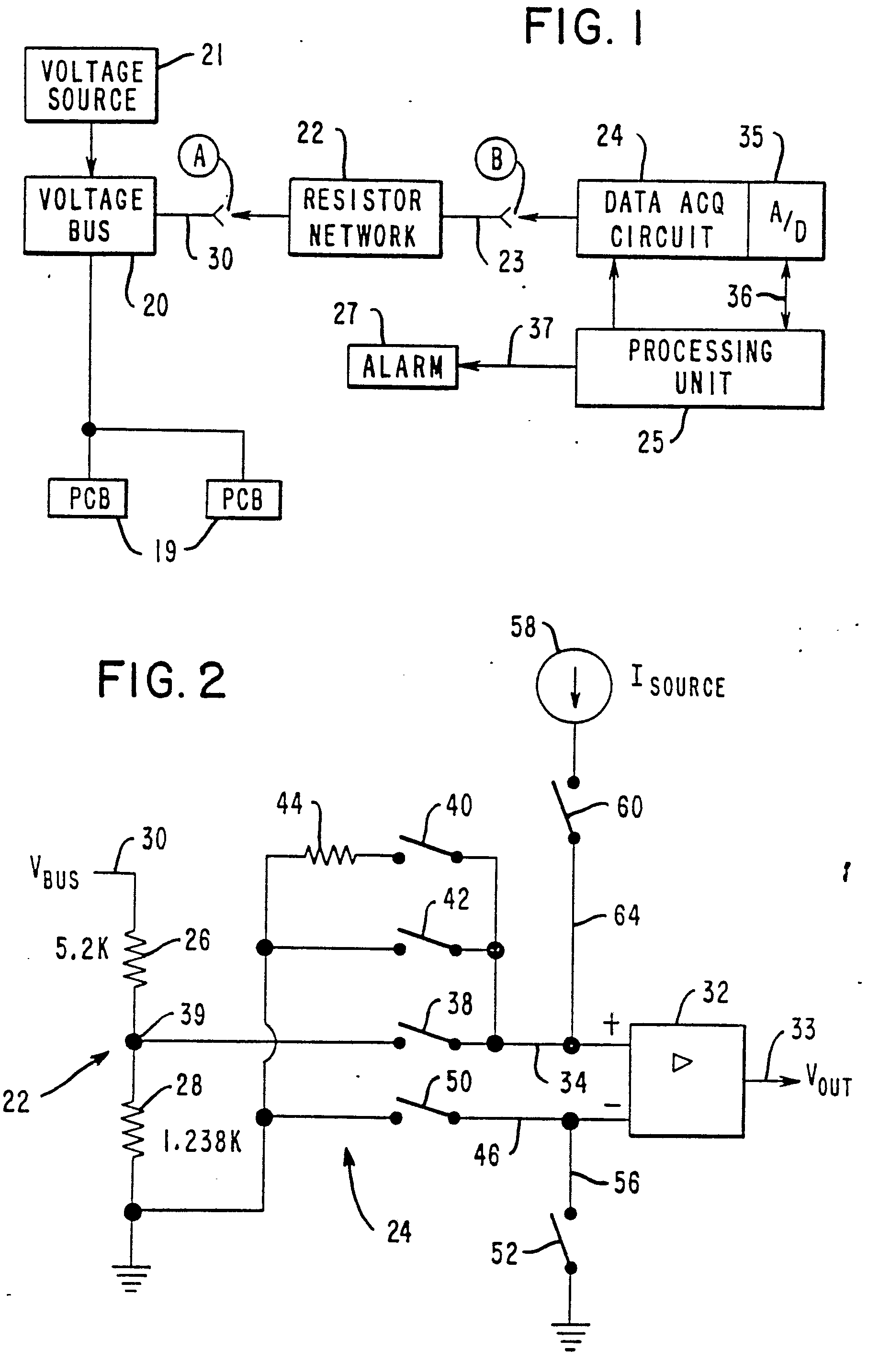
|
30.05.1990 Bulletin 1990/22 |
| (22) |
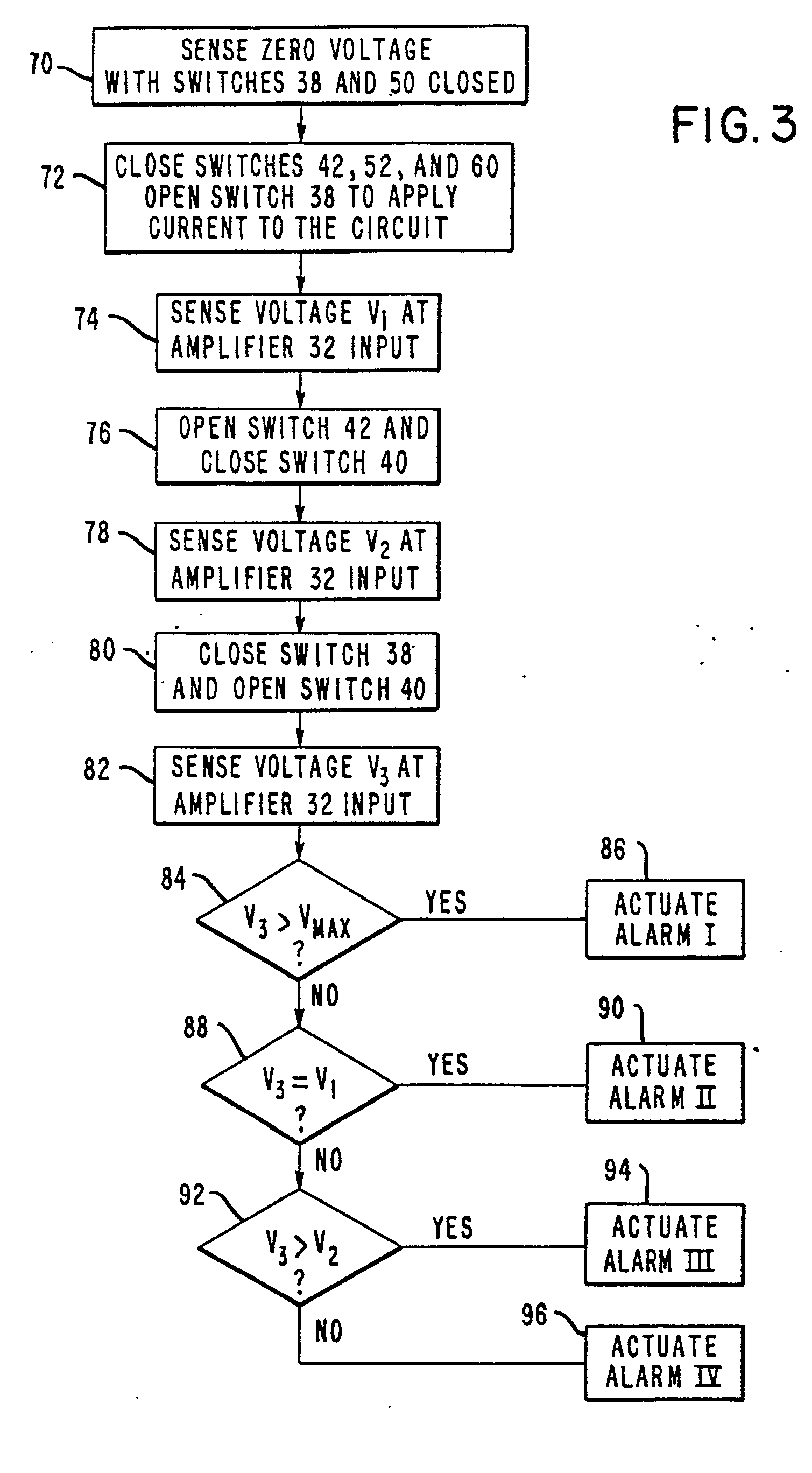
Date of filing: 24.02.1986 |
|
| (86) |
International application number: |
|
PCT/US8600/380 |
| (87) |
International publication number: |
|
WO 8605/277 (12.09.1986 Gazette 1986/20) |
|
| (54) |
METHOD AND CIRCUIT FOR DETECTING A FAULT CONDITION
VERFAHREN UND SCHALTUNG ZUR FESTSTELLUNG EINES FEHLERZUSTANDES
PROCEDE ET CIRCUIT DE DETECTION DE PANNES
|
| (84) |
Designated Contracting States: |
|
DE FR GB |
| (30) |
Priority: |
28.02.1985 US 706696
|
| (43) |
Date of publication of application: |
|
18.03.1987 Bulletin 1987/12 |
| (73) |
Proprietor: NCR CORPORATION |
|
Dayton, Ohio 45479 (US) |
|
| (72) |
Inventor: |
|
- PIPKORN, Mark, George
Minneapolis, MN 55406 (US)
|
| (74) |
Representative: Robinson, Robert George |
|
International Intellectual Property Department,
NCR Limited,
206 Marylebone Road
London NW1 6LY
London NW1 6LY (GB) |
| (56) |
References cited: :
|
| |
|
|
- Machine Design, volume 50, no. 4, February 1978: "Capacitor cancels current-monitor
errors", page 46
- New Electronics, volume 15, no. 24, December 1982, Harpenden, Herts., (GB); J.M.Button:
"Signal line voltage monitor", page 18
|
|
| |
|
| Note: Within nine months from the publication of the mention of the grant of the European
patent, any person may give notice to the European Patent Office of opposition to
the European patent
granted. Notice of opposition shall be filed in a written reasoned statement. It shall
not be deemed to
have been filed until the opposition fee has been paid. (Art. 99(1) European Patent
Convention).
|
Technical Field
[0001] This invention relates to a method for detecting a fault in a voltage distribution
bus adapted to be supplied with a line voltage level by a voltage supply and which
is connected to utilization means utilizing the line voltage.
[0002] The invention also relates to a test circuit for detecting a fault condition in a
voltage distribution bus adapted to be supplied with a line voltage by a voltage supply
and which is connected to utilization means utilizing the line voltage.
Background Art
[0003] In a data processing system, one type of parameter which is especially important
to the operation of the system is the bus voltage appearing on the input connection
to various printed circuit boards on which are located the processing elements that
form the data processing system. In monitoring such bus voltages, a zero voltage reading
may indicate an actual zero bus voltage or may be due to various other causes such
as open or short circuits in the monitoring device or its connections.
Disclosure of the Invention
[0004] It is an object of the present invention to provide a method and a test circuit of
the kind specified having the capability of automatically determining the status of
a fault indication.
[0005] Therefore, according to one aspect of the present invention, there is provided a
method of the kind specified, characterized by the steps of: connecting a test circuit
including a resistor network and a data acquisition circuit to said voltage distribution
bus such that said resistor network is connected between said voltage distribution
bus and ground, supplying a current through a first circuit path in said data acquisition
circuit and sensing a first voltage drop in said first circuit path, forming a second
circuit path including a first resistor in said test circuit, passing said current
through said second circuit path, and sensing a second voltage drop in said second
circuit path, forming a third circuit path including a second resistor having a greater
resistance than the first resistor and included in said resistor network, passing
said current through said third circuit path and sensing a third voltage drop in said
third circuit path, comparing the third voltage drop with either the second voltage
drop and/or the first voltage drop and/or the maximum detectable voltage drop, and
generating a respective one out of a number of alarm actuating signals when a) the
second voltage drop is greater than the third voltage drop, b) the third voltage drop
is greater than the second voltage drop, c) the first voltage drop is equal to the
third voltage drop, d) the third voltage drop is greater than the maximum detectable
voltage drop.
[0006] According to another aspect of the invention, there is provided a test circuit of
the kind specified, characterized in that said test circuit includes a resistor network
adapted for connection between said voltage distribution bus and ground and a data
acquisition circuit adapted for connection to said resistor network and including
voltage sensing means connected to an output of said data acquisition circuit, and
in that there are provided first switching means adapted to connect a first circuit
path in said data acquisition circuit to said voltage sensing means, second switching
means adapted to connect a second circuit path including a first resistor to said
voltage sensing means, third switching means adapted to connect a second resistor
having a value greater than said first resistor and included in said resistor network
to said voltage sensing means, and fourth switching means adapted to connect a current
source to said data acquisition circuit, and processor means responsive to the output
of said voltage sensing means and adapted to operate said fourth switching means and
to successively operate said first, second and third switching means thereby providing
respective first, second and third voltage drops, whereby said processor means is
adapted to generate a respective one of a number of alarm actuating signals when a)
the second voltage drop is greater than the third voltage drop, b) the third voltage
drop is greater than the second voltage drop, c) the first voltage drop is equal to
the third voltage drop, d) the third voltage drop is greater than the maximum detectable
voltage drop.
[0007] It will be appreciated that a method and test circuit according to the invention
have the advantage that the status of a fault condition can be determined without
requiring the utilization of a plurality of additional sensing lines and associated
measuring devices.
Brief Description of the Drawings
[0008] One embodiment of the invention will now be described by way of example with reference
to the accompanying drawings, in which:
Fig. 1 is a block diagram of the sensing system which includes the circuit of the
present invention;
Fig. 2 is a circuit diagram of the present invention; and
Fig. 3 is a flow chart of the method for determining the status of various detected
fault conditions.
Best Mode or Carrying Out the Invention
[0009] Referring now to Fig. 1, there is shown a block diagram of a portion of a data processing
system which includes the circuit of the present invention. A voltage distribution
bus 20 is connected to a voltage source 21 which supplies voltage to the bus 20 for
operating elements in the data processing system such as printed circuit boards 19
connected to the bus 20. Also connected to the bus 20 over line 30 is a resistor network
22 which is connected over bus 23 to a data acquisition circuit 24. The circuit 24
will monitor the voltage level appearing on the bus 20 and when such level falls to
zero, a processing unit 25 of the data processing system will determine the nature
of the cause for such voltage reading. The cause of such reading may include a failure
of, the voltage source 21, the distribution bus 20 or the presence of an open or short
circuit at point A or point B in the circuit. The resistor network 22 is designed
to prescale the reading of the voltages appearing on the bus 20 to a range of plus
or minus one volt when the bus voltages appearing on the bus 20 are at the required
bus voltage level, e.g. plus twelve volts etc.
[0010] Referring now to Fig. 2, there is shown a schematic diagram of the resistor network
22 and the data acquisition circuit 24 of the present invention. The resistor network
22 includes the resistors 26 and 28 which are wired in series over line 30 with the
voltage bus 20. The resistor 28 is connected to a remote ground or ground bus. The
acquisition circuit 24 includes a differential amplifier 32 whose positive or non-inverting
input is connected over line 34 and through switch 38 to a node 39 which is located
intermediate the resistors 26 and 28. The negative or inverting input of the amplifier
32 is connected over line 46 and through the switch 50 to the other side of the resistor
28.
[0011] The acquisition circuit 24 further includes a parallel network including switches
40 and 42 and a IK test resistor 44 which are wired across the input lines 34 and
46 of the amplifier 32. The value of the resistor 44 must equal the total resistance
of the parallel combination of the resistors 26 and 28. The amplifier 32 will normally
measure the voltage drop across the resistor 28 when switches 38 and 50 are closed.
The output line 33 of the amplifier 32 is connected to a A/D converter 35 whose output
signal is connected over line 36 (Fig. 1) to the processing unit 25 which in turn
is connected over line 37 to any type of alarm device 27 which may take the form of
generating a flag or the display of an alarm condition on a CRT screen. The switch
50 is normally closed during the operation of the data acquisition circuit 24. The
circuit 24 further includes a constant current source 58, and switches 52 and 60 for
controlling the operation of the acquisition circuit in a manner to be described more
fully hereafter. As previously described, if the output voltage signal Vout of the
amplifier 32 indicates the voltage on the bus 20 is zero, it is not known whether
the reading is a result of a failure in the voltage source 21 or the presence of an
open or short circuit. The present invention provides a method for detecting the cause
of such a voltage reading and the setting of an alarm upon the detection of such a
condition if the condition is required to be reported. The switches in the circuit
of Fig. 2 may comprise transistors or other type of mechanical and electronic switches
which can be electrically operated.
[0012] Referring now to Fig. 3, there is shown a flow chart of the operation of the data
acquisition circuit 24 which may, in the present embodiment, comprise a routine performed
by the processing unit 25. In monitoring the voltage drop across the resistor 28 with
switches 38 and 50 closed, the processing unit will, upon detecting (block 70) a zero
voltage level, close (block 72) switches 60, 42, and 52 and open switch 38 allowing
one milliamp of current to flow from a constant current source 58 (Fig. 2) through
the closed switches to ground enabling the amplifier 32 to sense (block 74) a voltage
drop V
1 across the circuit which includes the inherent resistance of the circuit due to the
length of lines 34 and 46 together with the resistance of the switches in the circuit.
The processing unit 25 will then open switch 42 and close switch 40 (block 76) allowing
the amplifier 32 to sense (block 78) a voltage drop V
2 across the circuit which includes the resistor 44. The processing unit will then
open switch 40 and close switch 38 (bloc 80) allowing the amplifier 32 to sense (block
82) a voltage drop V
3 across the circuit which includes the resistor 28. The voltage drop V
3 is then compared with a voltage drop V
max (block 84) where Vmax is the maximum voltage that can be sensed by the amplifier
32. If the voltage drop V
3 is greater than V
max, then there is a break at point B (Fig. 1) which may be the result of an open circuit
in one of the lines in bus 23. This condition results in the generation of a signal
which activates a first alarm condition (block 86) notifying the operator of the existence
of such a fault condition. If V
3 is less than V
max, the voltage drops V, and V
3 are compared by the processing unit 25. If the voltage drop V
1 is equal to V
3 (block 88) indicating a short circuit in the bus 23, a signal is generated to activate
a second alarm (block 90). If the voltage drop V
3 is not equal to V
1, the processing unit 25 will then compare (block 92) the voltage drop V
3 with V
2. If V
3 is greater than V
2 indicating an open circuit at point A (Fig. 1) in the circuit, a third alarm is activated
(block 94). If V
2 is greater than V
3 indicating the bus voltage level supplied by the voltage source 21 (Fig. 1) is zero,
a fourth alarm 96 is activated.
[0013] It will thus be seen that with this method and apparatus for detecting a fault in
a voltage bus, various fault conditions can be automatically determined and an alarm
activated which notifies the operator of the nature of the fault.
1. A method for detecting a fault in a voltage distribution bus (20) adapted to be
supplied with a line voltage level by a voltage supply (21) and which is connected
to utilization means (19) utilizing the line voltage, characterized by the steps of:
connecting a test circuit including a resistor network (22) and a data acquisition
circuit (24) to said voltage distribution bus (20) such that said resistor network
(22) is connected between said voltage distribution bus (20) and ground, supplying
a current through a first circuit path in said data acquisition circuit (24) and sensing
a first voltage drop (Vi) in said first circuit path, forming a second circuit path including a first resistor
(44) in said test circuit, passing said current through said second circuit path,
and sensing a second voltage drop (VZ) in said second circuit path, forming a third circuit path including a second resistor
(28) having a greater resistance than the first resistor and included in said resistor
network (22), passing said current through said third circuit path and sensing a third
voltage drop (V3) in said third circuit path, comparing the third voltage drop (V3) with either the
second voltage drop (V2) and/or the first voltage drop and/or the maximum detectable voltage drop (Vmax), and generating a respective one out of a number of alarm actuating signals when
(a) the second voltage drop (V2) is greater than the third voltage drop (V3), (b) the third voltage drop (V3) is greater than the second voltage drop (V2), (c) the first voltage drop (Vi) is equal to the third voltage drop (V3), (d) the third voltage drop (V3) is greater than the maximum detectable voltage drop (Vmax).
2. A method according to claim 1, characterized by the step of generating a first
alarm actuating signal (96) representing a failure of said volt- agesupply (21) when
the second voltage drop (V2) is greater than the third voltage drop (V3).
3. A method according to claim 1, characterized by the step of generating a second
alarm actuating signal (94) representing an open circuit in the connection of said
resistor network (22) to said voltage bus (20) when the third voltage drop (V3) is greater than the second voltage drop (V2).
4. A method according to claim 1, characterized by the steps of: comparing the first
and third voltage drops (Vi, V3) and generating a third alarm actuating signal (90) indicating a short circuit in
said data acquisition circuit (24) when the first voltage drop (Vi) is equal to the third voltage drop (V3).
5. A method according to claim 1, characterized by the step of generating a fourth
alarm actuating signal (86), representing an open circuit between said resistor network
(22) and said data acquisition circuit (24) when said third voltage drop (V4) is greater than a predetermined value (Vmax)-
6. A test circuit for detecting a fault condition in a voltage distribution bus (20)
adapted to be supplied with a line voltage by a voltage supply (21) and which is connected
to utilization means (19) utilizing the line voltage, characterized in that said test
circuit includes a resistor network (22) adapted for connection between said voltage
distribution bus (20) and ground, and a data acquisition circuit (24) adapted for
connection to said resistor network (22) and including voltage sensing means (32)
connected to an output of said data acquisition circuit (24), and in that there are
provided first switching means (42) adapted to connect a first circuit path in said
data acquisition circuit (24) to said voltage sensing means (32), second switching
means (40) adapted to connect a second circuit path including a first resistor (44)
to said voltage sensing means (32), third switching means (38) adapted to connect
a second resistor (28) having a value greater than said first resistor (44) and included
in said resistor network (22) to said voltage sensing means (32), and fourth switching
means (52, 60) adapted to connect a current source (58) to said data acquisition circuit
(24), and processor means (25) responsive to the output of said voltage sensing means
(32) and adapted to operate said fourth switching means (52,60) and to successively
operate said first, second and third switching means (42, 40, 38) thereby providing
respective first, second and third voltage drops (V1, V2, V3), whereby said processor means (25) is adapted to generate a respective one of a
number of alarm actuating signals when (a) the second voltage drop (V2) is greater than the third voltage drop (V3), (b) the third voltage drop (V3) is greater than the second voltage drop (V2), (c) the first voltage drop (V1) is equal to the third voltage drop (V3), (d) the third voltage drop (V3) is greater than the maximum detectable voltage drop (Vmax).
7. A test circuit according to claim 6, characterized in that said processor means
(25) is adapted to generate a first alarm actuating signal (96) to indicate a first
fault condition when said second voltage drop (V2) is greater than said third voltage drop (V2).
8. A test circuit according to claim 6, characterized in that said processor means
(25) is adapted to generate a second alarm actuating signal (94) to indicate a second
fault condition when said third voltage drop (V3) is greater than said second voltage drop (V2).
9. A test circuit according to claim 6 characterized in that said processor means
(25) is adapted to generate a third alarm actuating signal (90) to indicate a third
fault condition when said first voltage drop (V2) is equal to said third voltage drop (V3).
10. A test circuit according to claim 6, characterized in that said processor means
(25) is adapted to generate a fourth alarm actuating signal (86) to indicate a fourth
fault condition when said third voltage drop (V2) is greater than a predetermined value (Vmax).
1. Verfahren zum Feststellen eines Fehlers in einer Spannungsverteilungssammelschaltung
(20), die geeignet ist, von einer Spannungsquelle (21) mit einem Leitungsspannungspegel
versorgt zu werden, und die mit einer Verwendungsvorrichtung (19) verbunden ist, und
die diese Leitungsspannung verwendet, gekennzeichnet durch die Schritte:
Verbinden einer ein Widerstandsnetzwerk (22) und eine Datenerfassungsschaltung (24)
aufweisenden Testschaltung mit der Spannungsverteilungssammelleitung derart, daß das
Widerstandsnetzwerk (22) zwischen der Spannungsverteilungsleitung (20) und Erde geschaltet
ist, Zuführen eines Stromes zu der Datenerfassungsschaltung (24) durch einen ersten
Schaltungsweg und Abfühlen eines ersten Spannungsabfalls (V1) in dem ersten Schaltungsweg, Bilden eines zweiten Schaltungsweges, der einen ersten
Widerstand (44) in der Testschaltung einschließt, Durchleiten des Stromes durch den
zweiten Spannungsweg und Abfühlen eines zweiten Spannungsabfalls (V2) in dem zweiten Schaltungsweg, Bilden eines dritten Schaltungsweges mit einem zweiten
Widerstand (28), der einen größeren Widerstandswert als der erste Widerstand hat und
in dem Widerstandsnetzwerk (22) enthalten ist, Durchleiten des Stromes durch den dritten
Schaltungsweg und Abfühlen eines dritten Spannungsabfalls (V3) in dem dritten Schaltungsweg, Vergleichen des dritten Spannungsbfalls (V3) entweder mit dem zweiten Spannungsabfall (V2) und/oder dem ersten Spannungsabfall und/oder dem maximal feststellbaren Spannungsabfall
(Vmax) und Erzeugen eines entsprechenden von einer Anzahl von Alarmbetätigungssignalen,
wenn
(a) der zweite Spannungsabfall (V2) größer als der dritte Spannungsabfall (V3) ist,
(b) der dritte Spannungsabfall (V3) größer als der zweite Spannungsabfall (V2) ist,
(c) der erste Spannungsabfall (V1) gleich dem dritten Spannungsabfall (V3) ist,
(d) der dritte Spannungsabfall (V3) größer als der maximal feststellbare Spannungsabfall (Vmax) ist.
2. Verfahren nach Anspruch 1, gekennzeichnet durch den Schritt Erzeugen eines ersten
Alarmbetätigungssignals (96), das eine Fehlfunktion der Spannungsquelle (21) darstellt,
wenn der zweite Spannungsabfall (V2) größer als der dritte Spannungsabfall (V3) ist.
3. Verfahren nach Anspruch 1, gekennzeichnet durch den Schritt Erzeugen eines zweiten
Alarmbetätigungssignals (94), das eine offene Schaltung in der Verbindung des Widerstandsnetzwerks
(22) mit der Spannungssammelleitung (20) darstellt, wenn der dritte Spannungsabfall
(V3) größer als der zweite Spannungsabfall (V2) ist.
4. Verfahren nach Anspruch 1, gekennzeichnet durch die Schritte: Vergleichen des ersten
und dritten Spannungsabfalls (V1,v3) und Erzeugen eines dritten Alarmbetätigungssignals (90), das einen Kurzschluß in
der Datenerfassungsschaltung (24) anzeigt, wenn der erste Spannungsabfall (V1) gleich dem dritten Spannungsabfall (V3) ist.
5. Verfahren nach Anspruch 1, gekennzeichnet durch den Schritt Erzeugen eines vierten
Alarmbetätigungssignals (86), das eine offene Schaltung zwischen dem Widerstandsnetzwerk
(22) und der Datenerfassungsschaltung (24) darstellt, wenn der dritte Spannungsabfall
(V3) größer als ein vorbestimmter Wert (Vmax) ist.
6. Testschaltung zum Feststellen eines Fehlerzustandes in einer Spannungsverteilungssammelleitung
(20), die geeignet ist, von einer Spannungsquelle (21) mit einer Leitungsspannung
versorgt zu werden, und die mit einer Verwendungsvorrichtung (19) verbunden ist, die
diese Leitungsspannung verwendet, dadurch gekennzeichnet, daß die Testschaltung ein
Widerstandsnetzwerk (22) aufweist, das zur Verbindung zwischen der Spannungssammelleitung
(20) und Erde geeignet ist, und eine Datenerfassungsschaltung (24) aufweist, die zur
Verbindung mit dem Widerstandsnetzwerk (22) geeignet ist und eine Spannungsabfühlvorrichtung
(32) aufweist, die an einen Ausgang der Datenerfassungsschaltung (24) angeschlossen
ist, und daß vorgesehen sind: eine erste Schaltvorrichtung (42), die geeignet ist,
einen ersten Schaltungsweg in der Datenerfassungsschaltung (24) zu der Spannungsabfühlvorrichtung
(32) herzustellen, eine zweite Schaltvorrichtung (40), die geeignet ist, einen zweiten
Schaltungsweg einschließlich eines ersten Widerstandes (44) zu der Spannungsabfühlvorrichtung
(32) herzustellen, eine dritte Schaltvorrichtung (38), die geeignet ist, einen zweiten
Widerstand (28) mit größerem als derjenige des ersten Widerstands (44) im Widerstandsnetzwerk
(22) mit der Spannungsabfühlvorrichtung (32) zu verbinden, und vierte Schaltvorrichtungen
(52, 60), die geeignet sind, eine Stromquelle (58) mit dem Datenerfassungsnetzwerk
(24) zu verbinden, und eine Verarbeitungsvorrichtung (25), die auf das Ausgangssignal
der Spannungsabfühlvorrichtung (32) anspricht und geeignet ist, die vierten Schaltvorrichtungen
(52, 60) zu betätigen und aufeinanderfolgend die erste, zweite und dritte Schaltvorrichtung
(42, 40, 38) zu betätigen, wodurch sich erste, zweite und dritte Spannungsabfälle
(V
l,V
2,V
3) ergeben, wobei die Verarbeitungsvorrichtung (25) geeignet ist, ein entsprechendes
einer Anzahl von Alarmbetätigungssignalen zu erzeugen, wenn
(a) der zweite Spannungsabfall (V2) größer als der dritte Spannungsabfall (V3) ist,
(b) der dritte Spannungsabfall (V3) größer als der zweite Spannungsabfall (V2) ist,
(c) der erste Spannungsabfall (V1) gleich dem dritten Spannungsabfall (V3) ist,
(d) der dritte Spannungsabfall (V3) größer als der maximal feststellbare Spannungsabfall (Vmax) ist.
7. Testschaltung nach Ansprüche, dadurch gekennzeichnet daß, die Verarbeitungsvorrichtung
(25) geeignet ist, ein erstes Alarmbetätigungssignal (96) zu erzeugen, das einen ersten
Fehlerzustand anzeigt, wenn der zweite Spannungsabfall (V2) größer als der dritte Spannungsabfall (V3) ist.
8. Testschaltung nach Anspruch 6, dadurch gekennzeichnet, daß die Verarbeitungsvorrichtung
(25) geeignet ist, ein zweites Alarmbetätigungssignal (94) zu erzeugen, um einen zweiten
Fehlerzustand anzuzeigen, wenn der dritte Spannungsabfall (V3) größer als der zweite Spannungsabfall (V2) ist.
9. Testschaltung nach Anspruch 6, dadurch gekennzeichnet, daß die Verarbeitungsvorrichtung
(25) geeignet ist, ein drittes Alarmbetätigungssignal (90) zu erzeugen, um einen dritten
Fehlerzustand anzuzeigen, wenn der erste Spannungsabfall (V1) gleich dem dritten Spannungsabfall (V3) ist.
10. Testschaltung nach Anspruch 6, dadurch gekennzeichnet, daß die Verarbeitungsvorrichtung
(25) geeignet ist, ein viertes Alarmbetätigungssignal (86) zu erzeugen, um einen vierten
Fehlerzustand anzuzeigen, wenn der dritte Spannungsabfall (V3) größer als ein vorbestimmter Wert (Vmax) ist.
1. Procédé pour détecter un défaut dans un bus (20) de distribution de tension conçu
pour être alimenté à un niveau de tension de ligne à partir d'une alimentation (21)
en tension et qui est connecté à des moyens d'utilisation (19) utilisant la tension
de ligne, caractérisé par les étapes qui consistent: à connecter un circuit d'essai
comprenant un réseau de résistances (22) et un circuit (24) d'acquisition de données
audit bus (20) de distribution de tension afin que ledit réseau (22) de résistances
soit connecté entre ledit bus (20) de distribution de tension et la masse, à fournir
un courant par un premier trajet de circuit audit circuit (24) d'acquisition de données
et à détecter une première chute de tension (V,) dans ledit premier trajet de circuit,
à former un deuxième trajet de circuit comprenant une première résistance (44) dans
ledit circuit d'essai, à faire passer ledit courant dans ledit deuxième trajet de
circuit et à détecter une deuxième chute de tension (V2) dans ledit deuxième trajet de circuit, à former un troisième trajet de circuit comprenant
une seconde résistance (28) ayant une valeur plus grande que celle de la première
résistance et incorporée dans ledit réseau (22) de résistances, à faire passer ledit
courant dans ledit troisième trajet de circuit et détecter une troisième chute de
tension (V3) dans ledit troisième trajet de circuit, à comparer la troisième chute de tension
(V3) à la deuxième chute de tension (V2) et/ou à la première chute de tension et/ou à la chute de tension maximale décelable
(Vmax), et à générer l'un, respectif, d'un certain nombre de signaux de déclenchement d'alarme
lorsque (a) la deuxième chute de tension (V2) est supérieure à la troisième chute de tension (V3), (b) la troisième chute de tension (V3) est supérieure à la deuxième chute de tension (V2), (c) la première chute de tension (V1) est égale à la troisième chute de tension (V3), (d) la troisième chute de tension (V3) est supérieure à la chute de tension maximale décelable (Vmax).
2. Procédé selon la revendication 1, caractérisé par l'étape qui consiste à générer
un premier signal (96) de déclenchement d'alarme représentant une défaillance de ladite
alimentation (21) en tension lorsque la deuxième chute de tension (V2) est supérieure à la troisième chute de tension (V3).
3. Procédé selon la revendication 1, caractérisé par l'étape qui consiste à générer
un second signal (94) de déclenchement d'alarme représentant un circuit ouvert dans
la connexion dudit réseau (22) de résistances sur ledit bus (20) de tension lorsque
la troisième chute de tension (V3) est supérieure à la deuxième chute de tension (V3).
4. Procédé selon la revendication 1, caractérisé par les étapes qui consistent: à
comparer les première et troisième chutes de tension (V1, V3) et à générer un troisième signal (90) de déclenchement d'alarme indiquant un court-circuit
dans ledit circuit (24) d'acquisition de données lorsque la première chute de tension
(V1) est égale à la troisième chute de tension (V3).
5. Procédé selon la revendication 1, caractérisé par les étapes qui consistent à générer
un quatrième signal (86) de déclenchement d'alarme, représentant un circuit ouvert
entre ledit réseau (22) de résistances et ledit circuit (24) d'acquisition de données
lorsque ladite troisième chute de tension (V4) est supérieure à une valeur prédéterminée (Vmax).
6. Circuit d'essai pour détecter une condition de défaut dans un bus (20) de distribution
de tension conçu pour être alimenté par une tension de ligne par une alimentation
en tension (21) et qui est connecté à des moyens d'utilisation (19) utilisant la tension
de ligne, caractérisé en ce que ledit circuit d'essai comprend un réseau (22) de résistances
conçu pour une connexion entre ledit bus (20) de distribution de tension et la masse,
et un circuit (24) d'acquisition de données conçu pour une connexion sur ledit réseau
(22) de résistances et comprenant des moyens (32) de détection de tension connectés
à une sortie dudit circuit (24) d'acquisition de données, et en ce qu'il est prévu
un premier moyen (42) de commutation conçu pour connecter un premier trajet de circuit,
situé dans ledit circuit (24) d'acquisition de données, auxdits moyens (32) de détection
de tension, un deuxième moyen (40) de commutation conçu pour connecter un deuxième
trajet de circuit, comprenant une première résistance (44), auxdits moyens (32) de
détection de tension, un troisième moyen (38) de commutation conçu pour connecter
une seconde résistance (28), d'une valeur supérieure à celle de ladite première résistance
(44) et montée dans ledit réseau (22) de résistances, auxdits moyens (32) de détection
de tension, et un quatrième moyen de commutation (52, 60) conçu pour connecter une
source de courant (58) audit circuit (24) d'acquisition de données, et des moyens
processeurs (25) sensibles au signal de sortie desdits moyens (32) de détection de
tension et conçus pour actionner ledit quatrième moyen (52, 60) de commutation et
pour actionner successivement lesdits premier, deuxième et troisième moyens (42, 40,
38) de commutation afin de produire des première, deuxième et troisième chutes respectives
de tension (V1, V2, V3), lesdits moyens processeurs (25) étant conçus pour générer l'un, respectif, d'un
certain nombre de signaux de déclenchement d'alarme lorsque (a) la deuxième chute
de tension (V2) est supérieure à la troisième chute de tension (V3), (b) la troisième chute de tension (V3) est supérieure à la deuxième chute de tension (V2), (c) la première chute de tension (V1) est égale à la troisième chute de tension (V3), (d) la troisième chute de tension (V3) est supérieure à la chute de tension maximale décelable (Vmax).
7. Circuit d'essai selon la revendication 6, caractérisé en ce que lesdits moyens
processeurs (25) sont conçus pour générer un premier signal (96) de déclenchement
d'alarme afin d'indiquer une première condition de défaut lorsque ladite deuxième
chute de tension (V2) est supérieure à ladite troisième chute de tension (V3).
8. Circuit d'essai selon la revendication 6, caractérisé en ce que lesdits moyens
processeurs (25) sont conçus pour générer un deuxième signal (94) de déclenchement
d'alarme pour indiquer une deuxième condition de défaut lorsque ladite troisième chute
de tension (V3) est supérieure à ladite deuxième chute de tension (V2).
9. Circuit d'essai selon la revendication 6, caractérisé en ce que lesdits moyens
processeurs (25) sont conçus pour générer un troisième signal (90) de déclenchement
d'alarme afin d'indiquer une troisième condition de défaut lorsque ladite première
chute de tension (V2) est égale à ladite troisième chute de tension (V3).
10. Circuit d'essai selon la revendication 6, caractérisé en ce que lesdits moyens
processeurs (25) sont conçus pour générer un quatrième signal (86) de déclenchement
d'alarme pour indiquer une quatrième condition de défaut lorsque ladite troisième
chute de tension (V3) est supérieure à une valeur prédéterminée (Vmax).