|
(11) | EP 0 214 294 B1 |

| (12) | EUROPEAN PATENT SPECIFICATION |
|
|
| (54) |
HEAT DETECTING ELEMENT WÄRMENACHWEISELEMENT ELEMENT THERMODETECTEUR |
|
|
|||||||||||||||||||||||||||||||
|
||||||||||||||||||||||||||||||||
| Note: Within nine months from the publication of the mention of the grant of the European patent, any person may give notice to the European Patent Office of opposition to the European patent granted. Notice of opposition shall be filed in a written reasoned statement. It shall not be deemed to have been filed until the opposition fee has been paid. (Art. 99(1) European Patent Convention). |
(Field of the Art)
[0001] The present invention relates to a thermal-environment ensor to detect thermal conditions in an indoor environment which provide the data for the control of an air-conditioning system, for example, when it supplies the human body in a room with a comfortable thermal environment; in particular, it relates to a thermal-environment sensor, the emissivity of which corresponds to that of the human body.
(Background of the Art)
[0002] Generally there is a limit to keeping a room in comfortable thermal conditions for a human body by an air-conditioning system which controls only room-temperature, therefore it is necessary to estimate the actual residential thermal environment by other factors of the thermal environment, that is, the total physical quantities of the speed of the air flow, the humidity, and the radiation. And to detect said thermal conditions, it is required that a thermal-environment sensor should be composed so as to have a mutual thermal relationship between said sensor and the human body based on the thermal equilibrium of the human body.
[0003] It should be noted, as disclosed in the official gazette, TOKKAISHO No.58-218624 in Japan, that a similar kind of sensor exists, which comprises an electric heating element having an electric heater in an empty shell and a thermometer for measuring the surface temperature of said heating element, and which detects thermal conditions in an indoor environment considering the radiation by measuring the surface temperature of said heating element after supplying it with the predetermined thermal quantity by feeding an electric flow to said electric heater.
[0005] Though in the above conventional type sensor, the emissivity of the outside surface of the heating element closely conforms to the emissivity of the surface of the human skin or clothes thereon so as to establish a correlation regarding the thermal equilibrium between the sensor and the human body, considering radiation. But this sensor can detect only the rate of radiation and emission of a heat radiator(the heating element and the human body) with emissivity, whereas the rate of absorption of incident radiation from the outside(radiation from the wall and solar radiation) cannot be detected precisely. That is, regarding radiation from an object which has a similar temperature to the heat radiator(the heating element and the human body) such as radiation from the wall, emissivity is closely equal to absorptivity because the spectral distribution of the radiation is similar to that of the incidence, but regarding extraneous incident radiation in which there is a difference between the spectral distribution of radiation and that of the incidence, such as solar radiation or radiation from a heating apparatus, emissivity and absorptivity in said radiator(the heating element and the human body) do not always conform to each other. Therefore, if the spectral emissivity(equal to the spectral absorptivity) of said heating element does not conform to the spectral emissivity(equal to the spectral absorptivity) of the human body, in the case that there is a difference between the spectral distribution of radiation and that of the incidence, it is difficult to accurately detect the thermal environment due to the low accuracy of substantial conformity in the correlation regarding heat between the surface of the sensor and that of the human body.
[0006] In regard to this point, the correlation regarding heat between the above-composed thermal-environment sensor and the human body is described in detail as follows:
that is, the thermal equilibrium expression of said thermal-environment sensor is given by:
(where, M is the supplied thermal quantity; Tg: the surface temperature of the heating element; Tr: the mean radiation temperature in a room environment; Ta: the temperature of the air; hgr: the radiant heat transfer coefficient of the heating element; hgc: the convective heat transfer coefficient of the heating element).
[0007] Meanwhile, the expression which calculates heat, Hsk released from the human skin under the optional various temperature environments is:
in this case, R, C, and E express respectively thermal loss by radiation, convection, and evaporation from the human body, and the expression of each thermal loss of the above-mentioned R, C, and E is as follows:
(where, hr is the radiant heat transfer coefficient of the human body; hc: the convective heat transfer coefficient of the human body; øa: the relative humidity; Psk: the saturation vapour pressure under the mean temperature of the human skin, Tsk; Pa: the saturation vapour pressure under the temperature of the air, Ta; w: the proportion of the wet area of the skin; Fcl: a coefficient of the heat resistance of clothes; Fpcl: the transmission coefficient of the clothes against vapour evaporated from the surface of the human skin to the surroundings thereof; k: 2.2 at sea level, the Lewis relationship).
[0008] In the case of estimating thermal comfortableness in a room by adopting the new standard effective temperature, SET* -which has a close relationship to the sense of coldness or warmth and the comfortableness of the human body, and which was settled by ASHRAE, the American Society of Heating-Refrigerating and Air-conditioning Engineers in the U.S.A.-, the release of thermal quantity calculated based on that theory is determined as follows so as to be equal to Hsk in the above expression [2]:
(where, hcs is the convective heat transfer coefficient of the human body in the standard air flow; hs: the heat transfer coefficient, the sum of the radiant heat transfer coefficient, hr and the convective heat transfer coefficient, hcs of the human body in a normal state; Pset*: the saturation vapour pressure under SET*, Fcls: the coefficient of heat resistance in the case of the quantity of clothes being equal to 0.6; Fpcls: the transmission coefficient of the clothes against evaporated water vapour in the case.
In other words, SET* is the temperature defined as the equal temperature environment under which the heat value equal to Hsk given by the expression [2] can be released in a normal state (the thermal resistance coefficient (Clo) corresponding to the quantity of clothes worn equal to 0.6; the speed of the air flow equal to 0.1m/s to 0.15m/s; the humidity equal to 50%, Tr=Ta) and in the equal physiology state (equal conditions regarding Tsk, w), and moreover, SET* depends on the temperature of the air, Ta; the mean radiation temperature, Tr; the speed of the air flow: for example, when the speed of the air flow is 0.1m/s to 0.15m/s in a normal state where the coefficient Clo is 0.6; the humidity is 50%; generated heat quantity is 1Met(=58.2W/m²), if SET* is 22.2o C to 25.6o C, ASHRAE agreed that more than 80% of people feel comfortable in the thermal environment.
[0009] In the above thermal equilibrium expression [2] for the human body, by establishing the situation without an action for perspiration of the human body(w=0.06) to consider wet heat release and a range of comfortable temperatures(the temperature of the air is 22°C to 26°C) and also by establishing the condition that the relative humidity øa is set at 0.5, the right side, C+E is approximately concluded as follows:
(whereas, hc': the convective heat transfer coefficient of the human body considering evaporation),
then, said expression [2] is replaced by:
And comparing said expression [1] with said expression [8] establishes the following relationships:
then, the surface temperature of said heating element, Tg is equal to the mean temperature of the human skin, Tsk, which results in:
(hereinafter, the surface temperature of said heating element with characteristics meeting said expressions [9] to [11] is expressed as KET*).
[0010] Furthermore, regading said SET*, wet heat release is included in heat loss by convection, and then said expression [6] results in:
(whereas, hs': the total heat transfer coefficient of the human body by convection, evaporation, and radiation in a standard air flow).
And said expressions [12] and [13] results in:
and by calculating the range of comfortable temperatures, the 2nd term of the right side in said expression [14] approximates to a constant.
[0011] Accordingly, by measuring the surface temperature, KET* of said heating element with the characteristics of heat transfer which meet the conditions of the expressions [9] to [11], SET* can be calculated approximately and the thermal estimation can be executed strictly under the actual residential environment by said thermal-environment sensor.
[0012] Therefore, it is firstly important to detect the actual thermal environment in a room with high accuracy, closely approximating the detecting characteristics of a thermal-environment sensor to actual bodily sensations by specifying the characteristics of radiation and absorption of the surface of a heating element with spectral emissivity-which is the function of wave length-so as to correspond to the extraneous incidence spectrum, so that said expression [9] can be satisfied. In other words, so the radiant heat transfer coefficient of the surface of said thermal-environment sensor, hgr can conform to that of the human body, hr.
[0013] And in said conventional sensor equipped with a heating element having an electric heater in an empty shell, decreasing the supplied electric quantity by shortening the diameter of the shell(the heating element) increases the error between the actual effective temperature and the output value of said thermal-environment sensor, which defeats the essential function of the thermal-environment sensor to establish a thermal correlation with the human body. The concrete explanation of this is as follows:
the error between SET*(the index adopted by the American Society of Heating-Refrigerating and Air-conditioning Engineers, ASHRAE in the U.S.A.; the new standard effective temperature which has a close relationship with the sense of warmth or coldness, and comfortableness of the human body) and KET*(the output temperature of said thermal-environment sensor) is increased by shortening the diameter of said heating element as illustrated in Figs.2 and 3. That is, Fig.2 illustrates the mean square value of the difference between SET* and KET* as S regarding the diameter of the spherical shell, D in the case that the speed of the air flow varies between 0.1 m/s and 1.0m/s. Fig.3 illustrates the mean square value of the difference between SET* and KET* as S regarding the diameter of spherical shell, D in the case that the difference between the mean radiation temperature and the temperature of the air varies between 0°C and 10°C. Therefore, by Figs.2 and 3, it becomes clear that the error, S increases as the diameter, D becomes smaller than 100mm, and that the lowest limit is about 60mm as the range of the allowable error.
[0014] From this view of point, it is desirable to detect the thermal conditions at the place where the person is, by putting said thermal-environment sensor near the human body in order to keep a room in a comfortable thermal condition for the human body. But nevertheless, in the above-mentioned case, this requirement cannot be satisfied, because the diameter of the shell cannot be shortened under the predetermined value, and moreover, the large quantity of the supplied electric power requires a supplied electric cord from a commercial electric source, which cannot allow said thermal-environment sensor to be carried freely, so the field of movement is limited. In addition, there exists the practical inconvenience of tripping over said supplied electric cord.
[0015] For this reason, we propose to detect the thermal environment near the human body precisely by the following method:
the composition of said thermal-environment sensor is reformed as follows: that is, the electric heater is installed in part of the heat insulator; and in this way, the newly devised sensor becomes a partial heating sensor, while the conventional one is a whole heating one; by means of this partial heating sensor, the effective temperature considering the temperature of the air, the speed of the air flow, and the radiation can be detected: therefore, this makes it possible to decrease the quantity of electricity and to supply said heater with electric power from an electric battery without an electric cord from a commercial electric source.
[0016] In addition, the conventional type considers only the dry heat release from the human body by radiation and convection, and does not include wet heat release which is caused by perspiration, etc. Therefore, it is difficult to detect thermal conditions in an actual residential environment as precisely as bodily sensations.
[0017] For this reason, preferred embodiments of this invention detect more precisely actual thermal conditions in a room by considering heat release due to perspiration of the human body and by keeping the size of said heating element and the supplied thermal quantity within the most reasonable range to satisfy the condition of wet heat release so as to approximate said thermal-environment sensor to the actual sensations of the human body more precisely.
[0018] And the expression of thermal equilibrium regarding said thermal-environment sensor is said expression [1] as above-mentioned, and by this expression, thermal conditions in an indoor environment are determined; in this theory, the condition of equability of the heat flux becomes the premise thereof. While, in the case of said conventional type, there is a problem that the precision thereof is low because the condition of equability of the heat flux is not sufficiently satisfied, since the electric heater is simply settled near the center of the inside of the empty shell and only the upper part of the shell is heated mainly by convective heat transfer as above-mentioned.
[0019] Preferred embodiments of this invention seek improvement in the precision of thermal detecting by meeting the conditions of the uniformity of heat flux that is the premise of the theory of said thermal-environment sensor as much as possible by heating the whole shell equally during the heat transfer from said electric heater to said shell.
[0020] Further preferred embodiments of this invention quantify the thermal environment precisely by reckoning with all the factors of the thermal environment by detecting the effective temperature considering the humidity as well as the temperature of the air, the speed of the air flow, and the radiation, since the actual thermal environment cannot be otherwise grasped precisely, and the effective temperature depends on the variation of the humidity, even though the temperature, the speed of the air flow and the radiation in a room are under the same conditions.
[0021] Moreover, the effective temperature depends on the variation of the quantity of clothes of the users, such as the variation of clothes due to the seasons (for example, summer clothes and winter clothes) and due to whether or not bedclothes are used on the bed, even though the thermal environment is the same in terms of the temperature of the air, the speed of the air flow, and the radiation, etc.
[0022] Preferred embodiments of this invention denote precisely the actual effective temperature adjusted to the quantity of clothes of the users by detecting the effective temperature reckoning with the quantity of the clothes of the users in addition to the temperature of the air, the speed of the air flow, and the radiation including the humidity in the environment of a room.
[0023] In addition, it is known that a sense of draft is caused in heating a room when the speed of the air flow in the room is in excess of a certain value; therefore, it is necessary that the properties of the air flow blowing from the air-conditioning system are grasped. It should be noted that the conventional type has not the capacity to detect each physical quantity individually, such as the speed of the air flow and the mean radiation temperature, etc., because said conventional type detects the effective temperature simply reckoning with heat loss by radiation, convection, and evaporation of water from the human body: therefore, it is difficult to control the air-conditioning system in the optimum way by detecting directly the speed of the air flow and a sense of draft near the human body.
[0024] For this reason,preferred embodiments of this invention detect the speed of the air flow and the mean radiation temperature which are important to grasp the thermal environment in a room, while detecting the effective temperature reckoning with heat loss by radiation, convection, and wet heat release from the human body.
[0025] For the purpose of accurate detection of the actual thermal environment as explained above, a thermal-environment sensor is equipped with a heating element heated by a supply of a quantity of heat which is positioned in a room; and with a temperature detector which detects the surface temperature of said heating element, Tg. Then, on the basis of the surface temperature of said heating element, Tg detected by said temperature detector, the thermal conditions in an indoor environment are detected. In addition, the outer surface of said heating element is covered by a layer of radiant materials with such spectral emissivity as closely conforms to that of the human skin or clothes thereon. In this way, in the case of solar radiation, the heat characteristics of said sensor correspond to those of the human body and both their radiant heat transfer coefficients have a close correlation in which they are approximated to each other, because of the correspondence between the spectral emissivity of the outer surface of said heating element and that of the human body: so, thermal conditions where the human body feels comfortable can be detected with high accuracy by said sensor.
[0026] For detection of the thermal environment near the human body as above-mentioned, said heating element of said thermal-environment sensor is equipped with said electric heater in part of an insulator, and the surface temperature of said electric heater, Tg is detected by the temperature detector. Accordingly, said heating element has a similar heating organization to that of the human body; the heat value of said heating element per a unit surface area is equal to that of the human body. For this, in comparison with the conventional type sensor which heats the whole shell, the expression is as follows, whereas, the heat value per a unit surface area is expressed as M:
(where, M is the generated heat value per a unit surface area of the human body; H₁: the heat value of an electric heater of the conventional type of the thermal-environment sensor in which the whole shell is heated; A₁: the effective surface area of the conventional type of thermal-environment sensor in which the whole shell is heated; H₂: the heat value of the electric heater of the thermal-environment sensor in this invention; A₂: the effective surface area of the thermal-environment sensor of this invention, that is, the surface area of the electric heater).
And by this expression [15], the expression [16] is derived as follows:
As confirmed in the expression [16], in said thermal-envrionment sensor of this invention, the heat value of the electric heater, H₂ decreases in proportion to A₂/A₁ that is the rate of the effective surface area; and the input electric power can also be decreased. Furthermore, by the adiabatic action of the heat insulator, the lost thermal quantity during thermal transfer to the heat insulator of the electric heater can be decreased more sharply: so it is possible to decrease the quantity of input electric power more. In result, by this decrease of the input electric power, an electric cell such as a dry cell can be used as a source of electricity, which makes said thermal-environment sensor handy to carry easily and freely, so that the thermal environment surrounding the human body can be always detected precisely.
[0027] And, for the purpose of detection of heat-release due to perspiration as above-mentioned, and for the purpose of meeting the conditions of said expressions [10], [11], in this invention, the supplied thermal quantity, M to the heating element and the size thereof are determined to conform to the characteristics regarding the speed of the air flow and the mean radiation temperature of SET* reckoning with the wet heat release under normal conditions and within a range of comfortableness; and to the characteristics of KET*, the surface temperature of said heating element; that is , to the characteristics of thermal equilibrium of the human body reckoning with wet heat release.
[0028] In other words, provided that the state of the speed of the air flow equal to 0.1m/s is defined as a standard state and the speed of the air flow varies from said standard state to 1.0m/s, the mean square value, S of the difference between ²SET* and ²KET*, which is the value of each variation of SET* and KET* in accordance with the variation ot the speed of the air flow is given by:
And then, the size of the shell of the heating element is set at the variable value, and the supplied thermal quantity, M, by which said mean square value, S becomes minimum regarding each size, is given and this minimum of the mean square value, S is plotted according to each size; then, for example, in the case of a spherical shell, by putting the diameter, D on a horizontal axis, characteristics as illustrated in Fig.4 are found. In this connection, the surface temperature of the heating element, Tg is calculated based on the expression [1]; the convective heat transfer coefficient of the heating element, hgc is calculated by such an empirical formula regarding the forced convective heat transfer coefficient as the expression [18] below-mentioned.
(whereas, Nu: Nusselt's number, Re: Reynold's number)
Fig.5 illustrates the variation of the mean square value, S in the case that the supplied thermal quantity, M(Met=58.2W/m²) varies and the diameter, D of the spherical shell is 100mm; if the diameter, D is determined, the optimum supplied thermal quantity, M which is the minimum of the mean square value, S is determined. And Fig.6 illustrates the variation of the optimum supplied thermal quantity, M, in the case that the diameter of the spherical shell varies. Therefore, by these Figs. From Fig.4 to Fig.6, it is known that it is necessary to determine the supplied thermal quantity, M and the diameter of the spherical shell, D specially in order to make the thermal-environment sensor more precise by lessening the mean square value.
[0029] The above-mentioned is the case of determining the supplied thermal quantity, M in order to minimize the mean square value, S within the range of the speed of the air flow from 0.1m/s to 1.0m/s; when the diameter of the spherical shell is 60mm, the supplied thermal quantity, M is 101W/m². Meanwhile, on condition that in the case of the speed of the air flow equal to 0.1m/s, KET* is equal to SET*, so if the supplied thermal quantity, M is determined to minimize S and the diameter of the spherical shell, D is 60mm, the supplied thermal quantity is 86W/m². The former way is to optimize by estimating equably the whole range of the speed of the air flow of 0.1m/s to 1.0m/s; but the latter way is to optimize so as to make KET* equal to SET* preferentially when the speed of the air flow is 0.1m/s. It is appropriate to take the latter supplied thermal quantity value when the thermal-environment sensor is used in an environment where the speed of the air flow is around 0.1m/s; it is also appropriate to take the former supplied thermal quantity value when the speed of the air flow varies within the wide range of 0.1m/s to 1.0m/s. This specification is described based on the former way.
[0030] In the same way as the above-mentioned, on condition that the state that the mean radiation temperature, Tr is equal to the temperature of the air, Ta(Tr=Ta) is defined as a standard state and when the value of the difference between Tr and Ta varies between -5°C and +5°C, said mean square value, S which relates to ΔSET* and ΔKET*, each varied value of SET* and KET* varied by the increased and decreased value of subtracting Ta from Tr, (Tr-Ta) is plotted regarding each diameter of the shell, D, then the characteristic as shown in Fig.7 is found. In this connection, for the supplied thermal quantity to the heating element, M, the value that is determined in seeking the characteristics about said variation of the speed of the air flow is used(the optimum supplied thermal quantity, M regarding each diameter of the shell, D is shown in Fig.6).
[0031] Therefore, in this invention, in the case of a spherical shell, based on the characteristics as shown in Figs.4 and 7, the diameter of the heating element, D is restricted, for example, to within a range of between 60mm and 150mm; regarding this range of the diameter of the shell, D, the supplied thermal quantity, M to the heating element is restricted within a range of between 76W/m² and 150W/m² so as to establish a very close correlation between ΔSET* and ΔKET* regarding each variation of the speed of the air flow and of the difference between the mean radiation temperature, Tr and the temperature of the air, Ta.
[0032] To explain the reason for this restriction, from Fig.7, it is known that the mean square value, S increases remarkably as the diameter of the spherical shell decreases, so its efficiency as a thermal sensor decreases. Hence, when the mean radiation temperature, Tr varies, ΔKET* is in direct proportion to Tr and also ΔSET* is almost nearly in direct proportion to Tr: so according to the increase of Tr, (ΔSET*-ΔKET*) increases. Then, regarding a variation of 1°C in said mean radiation temperature, Tr, (ΔSET*-ΔKET*) is allowed to be 0.1°C, and also, in Fig.7, Tr varies from -5°C to +5°C, therefore, the mean square value, S is S=0.1 from said expression [17]. And from Fig.7, when S is within the range of S≦0.1, the diameter of the spherical shell is D≧60mm. On the other hand, the minimum upper boundary of the diameter, D is 150mm because it is easy to use and allows the thermal sensor to be small in size and volume. Hence, from Fig.6, the optimum supplied thermal quantity, M corresponding to the diameter, D within the raqnge of D=60mm to 150mm is within the range of M=76 to 150(W/m²)=1.3 to 1.8(Met).
[0033] In addition, for the shape of the shell, not only a sphere but a column, an ellipsoid of revolution, etc. and other various shapes are available. And also, in the case of these other shapes, in the same way as above mentioned, the size of the heating element and the supplied thermal quantity, M can be specially restricted so as to conform to the characteristics in thermal equilibrium of the human body considering even wet heat release: for example, in the case of a column-shaped shell, adopting the expression of Messrs. Igarashi and Hirata's as below-defined, which is concerned with the forced convection heat transfer of the column-shaped shell, the expression is:
in the same way as said spherical shell, regarding the diameter of said column, D, the mean square value, S which is calculated by said expression [17], is plotted: so, the variation and the characteristics concerning each speed of the air flow and each mean radiation temperature are expressed in Figs.8 and 9; and in this case, it is known that it is preferable that the diameter, D is greater than 80mm. In addition, it is also known that the optimum supplied thermal quantity, M in this case is greater than 76W/m².
[0034] Hence, the thermal equilibrium of the thermal sensor can establish a closely approximate correlation with that of the human body so that the thermal condition in which the human body feels comfortable can be detected with high precision by only one sensor. Moreover, it is possible to shorten the size of said heating element because even wet heat release is considered in setting the size of the heating element and the supplied thermal quantity, M so as to correspond to the characteristics of thermal equilibrium of the human body. Fig.10 illustrates the convective heat transfer coefficient, hgc regarding the diameter, D of said shell in the thermal-environment sensor having a spherical heating element or a column-shaped heating element, etc., and also illustrates the level of the convective heat transfer coefficient in the human body, hc and of the convective heat transfer coefficient, hc' considering even wet heat release defined in said expression [7]. As illustrated in said Fig., due to the characteristics that the convective heat transfer coefficient, hgc decreases as the diameter, D increases, the diameter, DB which is determined to conform hc' to hgc is shorter than the diameter, DA which is determined to conform hc to hgc; so that shortening the size is possible.
[0035] Moreover, for the purpose of obtaining greater precision in the uniformity of the heat flux as aforesaid, said heating element in said thermal-environment sensor may be provided with a panel-shaped electric heater on the surface of the shell in the pattern where said shell is in the state of uniformity of the heat flux; or is provided with the means for heat transfer by which heat from the electric heater is transferred to said shell equally so that the heat flux of said shell is uniform. Hence, the condition of uniformity of the heat flux is met, which is the premise of the theory of said thermal-environment sensor.
[0036] In addition, for the purpose of quantifying the thermal-environment as aforesaid, this invention comprises said heating element put in a room; also, a temperature detector which detects the surface temperature, Tg of said heating element; a humidity detector which detects the humidity in the room, RH; a means for operating which, inputting the output of both of the above detectors, calculates the effective temperature, y in an indoor environment corresponding to the temperature of the air, the speed of the air flow, the radiation, and the humidity based on the surface temperature of said heating element, Tg and the humidity in the room, RH. Hence, the effective temperature corresponding to the temperature of the air, the speed of the air flow, the radiation, and the humidity in an indoor environment is detected based on the surface temperature of said heating element, Tg and the humidity, RH. Moreover, in the case that the quantity of heat supplied to the heating element is M, the expression of thermal equilibrium is said expression [1]; hence, the surface temperature of the heating element, Tg is a function of the temperature of the air, the speed of the air flow, and the radiation; because hgc in said expression [1] is a function of the speed of the air flow. And considering the humidity, RH as well as the surface temperature of said heating element, Tg, the effective temperature, y is calculated by the expression of y=f(Tg, RH): so this is the effective temperature considering the temperature of the air, the speed of the air flow, the radiation, and also the humidity. Hence, even in a residential environment where the temperature of the air, the speed of the air flow, the radiation, and the humidity vary, the variation of the effective temperature due to the above variations thereof can be detected precisely.
[0037] And for the purpose of denoting the effective temperature allowing for the clothing worn, there may be provided a temperature detector which detects the surface temperature of said heating element, Tg; a setting device for the quantity of clothes which sets thermal resistance, Clo corresponding to the quantity of clothes on the human body; a means for operating which calculates the effective temperature, y in an indoor environment corresponding to the temperature of the air, the speed of the air flow, the radiation, and the quantity of clothes on the human body, based on the surface temperature of the heating element, Tg and the thermal resistance of the quantity of clothes, Clo given by inputting the output of said temperature detector and said setting device for the quantity of clothes.
Hence, the effective temperature corresponding to the temperature of the air, the speed of the air flow, the radiation, and the quantity of clothes on human body in an indoor environment can be detected based on the surface temperature, Tg and the thermal resistance, Clo which is set so as to correspond to the quantity of clothes on the human body. That is , the effective temperature considering the temperature of the air, the speed of the air flow, the radiation, and the quantity of clothes can be detected; because as mentioned above, the surface temperature of the heating element, Tg is a function of the temperature of the air, the speed of the air flow, and the radiation; also, because the effective temperature, y is calculated by the expression of y=f(Tg, Clo), considering the thermal resistance of the quantity of clothes, Clo, as well as the surface temperature of the heating element. Hence, in the case that an air-conditioning system is controlled by using said effective temperature, a comfortable thermal environment can be maintained without need to vary the set comfortable temperature only by setting the thermal resistance, Clo corresponding to the quantity of clothes with the setting device.
[0038] For the purpose of taking into account the air flow speed and mean radiation temperature, the thermal-environment sensor may be provided with the means for a variable electric source to vary the supplied thermal quantity, M to the heating element (or the electric heater therein). And the speed of the air flow is calculated based on the difference between the surface temperature of said heating element, ΔTg before and after the variation of the supplied thermal quantity, M by the means for the variable electric source. In addition, the speed of the air flow and the mean radiation temperature are calculated based on the difference between the surface temperatures of said heating element, ΔTg and the temperature in the room, Ta.
[0039] Here, the way to measure the speed of the air flow and the mean radiation temperature by varying the supplied thermal quantity to said heating element, M and detecting the difference, ΔTg of the surface temperature of said heating element, Tg is described in detail.
[0040] That is, in the case of the supplied thermal quantity, M₁ in the thermal-environment sensor, the expression of thermal equilibrium is defined from said expression [1] as follows:
(whereas, Tr: the mean radiation temperature in an indoor environment; Ta: the temperature of the air; hgr: the radiant heat transfer coefficient of the heating element; hgc: convective heat transfer coefficient of the heating element).
[0041] In the same way, in the case of the supplied thermal quantity, M₂, if the thermal environment is the same as in the case of said supplied thermal quantity, M₁, the expression regarding thermal equilibrium is defined as follows:
And by subtracting expression [21] from expression [20], the convective heat transfer coefficient, hgc of the heating element is calculated from the following expression of:
[0042] In expression [22], since it is considered that M₁-M₂ is the supplied thermal quantity set in advance and that hgr is the constant of 5.0[kcal/m2hr°C] in an ordinary indoor environment, hgc can be calculated only by measuring
. On the other hand, the expression regarding the transfer coefficient of the forced convection heat of the thermal-environment sensor is given by said expression [18], whereas, here Nu and Re are defined as follows:
(whereas, D: the diameter of a spherical shell; λ: the thermal conductivity of the air; U: the speed of the air flow; ν: the dynamic coefficient of the viscosity of the air),
and the speed of the air flow, U is given by:
In said expression [23], D is already known and also ν, λ are already known as the values of the physical properties of air. Therefore, the speed of the air flow, U can be given by expressions [22], and [23] from measuring
. Moreover, by detecting the temperature in a room, Ta, the mean radiation temperature, Tr can be given by:
Hence, the speed of the air flow, U and the mean radiation temperature, Tr can be detected by varying the supplied thermal quantity to the heating element, M by the means for a variable electric source.
(Brief Description of Drawings)
[0043] Fig.1 shows the cross section of a thermal-environment sensor, the 1st embodiment of this invention. Fig.2 shows the characteristics to restrict specially the optimum range of the diameter of a heating element of a sphere-shaped shell type concerning the speed of the air flow. Fig.3 shows the characteristics to restrict specially the optimum range of the diameter of a heating element of a sphere-shaped shell type concerning the difference between the mean radiation temperature and the temperature of the air. Fig.4 shows the characteristics of the mean minimum value for the diameter in the case of the heating element of a sphere-shaped shell type. Also, Fig.5 shows the characteristics of the variation of the mean square value regarding the supplied thermal quantity, in the case that the diameter of the heating element is 100mm. Fig.6 shows the characteristics of the variation of the optimum supplied thermal quantity regarding the diameter of the heating element. Fig.7 shows the characteristics of the mean square value regarding the increase and decrease of the difference between the mean radiation temperature and the temperature of the air. Fig.8 and 9 show the characteristics of the variation of the mean square value concerning the speed of the air flow and the mean radiation temperature regarding the diameter, in the case of a column-shaped shell. Fig.10 shows the characteristics of the convective heat transfer coefficient regarding the diameter of the shell. Fig.11 shows the characteristics which illustrate the relationship with reflexibility regarding wave length in the layer of radiant materials. Fig.12 shows the characteristics which illustrate the relationship with emissivity regarding wave length in the case of varying the rate of the composition of titanous oxide included in the layer of radiant materials. Figs.13 and 14 each show the characteristics which, compared with ΔSET*, illustrate ΔKET* regarding the speed of the air flow and the difference between the mean radiation temperature and the temperature of the air, in the case of restricting specially each diameter of the heating element and each supplied thermal quantity, to the predetermined value. Figs.15 and 16 each show the characteristics which, compared with ΔSET*, illustrate ΔKET* regarding the speed of the air flow and the difference between the mean radiation temperature and the temperature of the air, in the case of restricting specially each diameter of the heating elements and each supplied thermal quantity to the other predetermined values within the range of this invention. Figs.17 and 18 each show the cross section of the thermal-environment sensor in the 2nd and the 3rd embodiment of this invention. Fig.19 shows a disassembled perspective view illustrating the process of making an empty spherical shell. Fig.20 shows the perspective view of the essential part illustrating the method of fixing a thermocouple. Fig.21 shows the cross section of the thermal-environment sensor, the 4th embodiment of this invention. Fig.22 shows the perspective view illustrating the method of making a panel-shaped electric heater. Fig.23 shows the cross section of the thermal-environment sensor, the 5th embodiment of this invention. Fig.24 shows an enlarged view of the essential part. Fig.25 shows the cross section of the thermal-environment sensor, the 6th embodiment of this invention. Fig.26 shows the front view of the surface of the 6th embodiment in a state without the layer of radiant materials. Fig.27 shows the enlarged view of the essential parts of Fig.25. Fig.28 shows the illustration of the result of measuring, illustrating the distribution of the temperature of the electric heater and the fringe thereof in this embodiment compared with certain examples. Fig.29 is an outline, in the state of heat balance of the electric heater. Figs.30 and 31 each show an outline of the perspective view of the spherical shell and the column-shaped shell, in the case of being provided with 2 electric heaters. Fig.32 shows a characteristic illustrating the relationship with the variation range of the surface temperature of the shell regarding a phase angle between 2 electric heaters. Fig.33 shows the cross section of the thermal-environment sensor, the 7th embodiment of this invention. Fig.34 shows the front view of the surface in a state without the layer of radiant materials thereon. Fig.35 shows the outline of the thermal-environment sensor, the 8th embodiment of this invention. Fig.36 illustrates the comparison between the value of the effective temperature in said embodiment and the value of SET*. Fig.37 shows the outline of the thermal-environment sensor, the 9th embodiment of this invention. Fig.38 shows the front view illustrating a concrete composition of an operation panel of the setting device for the quantity of clothes. Fig.39 illustrates the comparison between the value of the effective temperature in said embodiment and the value of SET*. Fig.40 shows the outline of the thermal-environment sensor, the 10th embodiment of this invention. Figs.41 and 42 each illustrates the comparison between the value of the effective temperature of each embodiment and the value of SET*. Fig.43 shows the outline of the thermal-environment sensor, the 11th embodiment of this invention. Fig.44 illustrates the variation of the surface temperature of the heating element, in the case of varying the supplied thermal quantity. Fig.45 illustrates the relationship between the difference of the surface temperature of the heating element of the speed of the air flow.
(Detailed Description of Preferred Embodiment)
[0044] To explain this invention in detail, this is described according to the attached drawings as below.
[0045] Fig.1 shows a thermal-environment sensor (A₁) for the use of controlling an air-conditioning system concerning the 1st embodiment to be the base of this invention; (1) is a heating element of a spherical shell, wherein an electric heater (4) is enclosed in the center of an empty spherical shell (3) made of a metal with high heat conductivity such as copper, aluminium, etc. in which a supporting pipe-pole (2) is pierced and fixed. Said electric heater is connected with a supply electric power cord (6), (6) supplying said electric heater with supply electric power, and piercing an electric insulator (5) packed into said supporting pipe-pole (2), and by said supply electric power cord (6), (6), the electric heater (4) is fixed and supported in the shell (3).
[0046] In addition, to the inside surface of the shell of said heating element, a thermocouple (7) is adhered as a temperature detector which detects the temperature, Tg of the surface of the heating element (1) (the shell (3)); the output cord (8) of said thermocouple (7) is guided to the outside of the shell (3) through said insulator (5) and said supporting pole (2), which supplies said heating element (1) with a thermal quantity heating the electric heater (4) by passing an electric current; in that state, the surface temperature, Tg of the heating element (1) is detected by the output voltage of the thermocouple (7), and based on this, Tg, the thermal conditions in an indoor environment can be detected as the effective temperature considering heat loss by radiation, convection, and wet heat release from the human body.
[0047] Moreover, the outside surface of the shell (3) of said heating element (1) is covered by a filmy layer of radiant materials (9) with spectral emissivity closely conforming to the spectral emissivity of the surface of the human skin or the clothes thereon.
[0048] Said layer of radiant materials (9) is made of burned materials of a mixture of a metallic oxide as a pigment and a binder of synthetic resins, etc., wherein the thickness of the film is 20µ to 40µ. Titanous oxide(TiO₂), manganese dioxide(MnO₂), aluminum oxide(Al₂O₃), nickel oxide(NiO), cobalt oxide(CoO), chrome oxide(Cr₂O₃), etc. are available for said metallic oxide. And acrylic resin, melamine resin, polyester resin, epoxy resin, fluoric resin, and silicone resin are available for a binder; regarding the the heat resisting property, fluoric resin such as tetrafluoroethylene resin(PTFE), etc., and silicone resin are preferable. Especially, radiant materials made of titanous oxide and tetrafluoroethylene resin are suitable due to their charateristics of spectral emission which conforms favorably to the characteristics of spectral absorption of the human body; in this case, a rate of combination of titanous oxide equal to from 20% by weight to 50% by weight is preferable from the point of radiant capacity within the range of far-infrared radiation, the intensity of the film, and the mean dispersion of the grains of titanous oxide. Therefore, the rate of combination of titanous oxide is set at within a range between 20% by weight and 50% by weight, because in the case of more than 60% by weight, the emissivity of the range of far-infrared radiation is low; and in the case of less than 20% by weight, the capacity of dispersion of titanous oxide is low.
[0049] In addition, to meet the conditions of the expressions, [10], [11] described in the background of the art as above-mentioned, the supplied thermal quantity, M to the heating element (1) and the diameter, D thereof are set so as to conform the characteristic regarding the speed of the air flow and the mean radiation temperature of SET* considering wet heat release in a normal state, within the range of comfortableness, to the characteristics of KET*, the surface temperature of said heating element; in other words, so as to equal the characteristics of thermal equilibrium of the human body considering even wet thermal release.
[0050] That is, the state of the speed of the air flow equal to 0.1m/s is prescribed as the standard state; then, in varying the speed of the air flow to 1.0m/s from the standard state, the mean square value, S of the difference between ΔSET* and ΔKET*-which are the varied values of SET* and KET* accompanied with the variation of the speed of the air flow-is given by said expression [17]; then, after setting the diameter, D of the shell (3) of the heating element (1) at each value, the supplied thermal quantity, M -which minimizes said mean square value, S regarding each diameter, D- is given; then, that mean square value, S is plotted regarding each diameter, D: so, the characteristic illustrated in Fig.2 is given. In that time, the surface temperature, Tg of the heating element (1) is given based on the expression [1]; and the convective heat transfer coefficient, hgc of the heating element (1) is given by using the following expression [25] of Yumikezuri's regarding the forced convective heat transfer coefficient of the sphere:
(whereas, Nu: Nusselt's number, Re: Reynold's number).
[0051] Furthermore, in the same way as the above, the state where the mean radiation temperature, Tr equals the temperature of the air, Ta(Tr=Ta) is prescribed as the standard state; and in varying Tr-Ta from the standard state to 10°C, the mean value, S concerning each varied value of SET* and KET*, that is, ΔSET* and ΔKET* accompanied with the increasing variation of(Tr-Ta) is plotted regarding each diameter, D: and then, the characteristic as illustrated in Fig.3 is given.
For the supplied thermal quantity, M to the heating element (1), the value determined in getting the characteristics concerning said variation of the speed of the air flow is used. And the diameter, D of the shell (3) of the heating element (1) is set at a range of D=60mm to 150mm, or better at a range of D=100mm to 140mm; also, regarding the range of the diameter, D, the supplied thermal quantity, M(electric input to the heater (4)) to the heating element (1) is set at a range of M=76W/m² to 105W/m², or better at a range of M=76W/m² to 93W/m² so as to establish a very close correlation between ΔSET* and ΔKET* concerning each variation of the speed of the air flow and of the difference between the mean radiation temperature, Tr and the temperature of the air, Ta, based on the characteristics as illustrated in Figs.2 and 3.
[0052] Therefore, in said 1st embodiment, since the spectral emissivity of the outside surface of the shell (3) closely conforms to the spectral emissivity of the human skin or clothes thereon due to the layer of radiant materials (8) formed over the outside surface of the shell (3) of the heating element (1), the radiant heat transfer coefficient, hgr of the surface of the heating element (1) can conform to the radiant heat transfer coefficient of the human body, hr precisely; and by said thermal-environment sensor (A₁), thermal conditions in an actual residential environment can be detected precisely.
[0053] Furthermore, the diameter, D of the shell (3) of the heating element (1) and the supplied thermal quantity, M to the heating element (1) is set so as to equal the characteristics of thermal equilibrium of the human body considering even wet heat release; and the convective heat transfer coefficient, hgc of the heating element (1) conforms to the convective heat transfer coefficient, hc' considering evaporation from the human body; furthermore, the supplied thermal quantity, M to the heating element (1) conforms to the value in which thermal release, Hsk from the surface of the human skin divided by the thermal resistance coefficient, Fcl results: so, the thermal equilibrium of the thermal-environment sensor (A₁) can approximate very remarkably that of the human body; and SET* which is the actual thermal environment can be detected more precisely by detecting KET* with the thermal-environment sensor (A₁) based on the above reason.
[0054] Furthermore, regarding the thermal equilibrium of the human body, the convective heat transfer coefficient, hc' considering evaporation is set and said convective heat transfer coefficient, hc' conforms to the convective heat transfer coefficient, hgc of the heating element (1): so, the diameter, D of the heating element (1) can be reduced without using a cover for the heating element which covers the surface of the heating element (1) and transfers radiation heat to the heating element (1) and also restrains convection.
[0055] In this connection, in said embodiment, the shell (3) composing the heating element (1) is a hollow spherical Shell, but other hollow shell shapes such as a column-shaped and ellipsoid-of-revolution-shaped, etc. are available.
[0056] Next, the concrete examples thereof will be described. In the thermal-environment sensor with the composition of said embodiment, in the case of using the mixture of 70% by weight of tetrafluoroethylene(PTFE) and 30% by weight of titanous oxide(TiO₂) for the layer of radiant materials formed over the surface of the heating element, the characteristic of reflectivity(in the case of not transmitting, emissivity is given by (1-reflectivity)) for each wave-length to the layer of materials is illustrated by a full line in Fig.11. On the other hand, a broken line and a chain line in Fig.11, respectively illustrate the characteristic of relectivity of the surface of the arm skin of the human body and that of a white undershirt. From Fig.11, it is known that if the layer of radiant materials which has the composition as illustrated above is used, the charateristics of spectral radiation of the surface of the heating element of the thermal-environment sensor in this invention can closely conform to those of the surface of the human skin or the shirt quantitatively and qualitatively: so, the thermal-environment sensor in this invention can be embodied substantially.
[0057] In addition, in the case of varying said rate of mixture of titanous oxide to 30% by weight, 40% by weight, and 50% by weight and determining the thickness of the film as 30 , the result of measuring the characteristics of spectral radiation of each layer of radiant materials is illustrated in Fig.12. In Fig.12, a full line shows the case of 30% by weight, a broken line shows the case of 40% by weight, a chain line shows the case of 50% by weight. And from Fig.12, it is known that when each wave length is 2.5 m, there exists a cut-off value; and when each wave length is below 2.5 m, emissivity is low between 0.3 and 0.6; and when each wave length is above 2.5 m and within the range of high wave length of far-infrared rays, emissivity is high between 0.8 and 0.9. On the other hand, when the wave length is above 1.4 m, the characteristics of spectral absorption of the human body have a high spectral absorptivity above 0.9. Hence, it is known that said layer of radiant materials has characteristics of spectral radiation which closely conform to the characteristics of spectral absorption of the human body.
[0058] Furthermore,provided that the diameter, D of said heat ing element is set at 120mm and the supplied thermal quantity, M at 83.2W/m²(1.43Met); and provided that in said thermal-environment sensor, in the case that the speed of the air flow is varied within a range of between 0.1m/s and 1.0m/s, the varied value of KET*, ΔKET* from the standard state(when the speed of the air flow is 0.1m/s) is calcurated; then, the characteristics as illustrated by a full line in Fig.13 are given. The broken line in this Fig. illustrates the characteristics of the varied value of SET*, ΔSET* under the same conditions as the above. And, provided that in the same thermal-environment sensor as the above, the difference, (Tr-Ta) between the mean radiation temperature, Tr and the temperature of the air, Ta in an indoor environment is varied within a range between 0°C and 10°C; the characteristic of said ΔKET* which varies from the standard state(when Tr equals Ta) is illustrated by a full line in Fig.14. In this Fig., a broken line illustrates the characteristics of ΔSET*. So, it is known from Figs.13 and 14 that in the thermal-environment sensor of said embodiment, regarding each variation of the speed of the air flow and the difference, ( Tr-Ta) between the mean radiation temperature, Tr and the temperature of the air, Ta, ΔKET* has a very close correlation with ΔSET* and the detecting efficiency of the actual thermal environment is high.
[0059] Furthermore, provided that the diameter, D of said heating element is set at D=100mm and the supplied thermal quantity, M at M=92.2W/m²(1.585 Met) and when regarding the thermal-environment sensor, the speed of the air flow is varied within a range of between 0.1m/s and 1.0m/s, the varied value, ΔKET* of KET* which varies from the standard state(when the speed of the air flow is 0.1m/s) is given the characteristics illustrated by a full line in Fig.15. A broken line in said Fig. illustrates the characteristic of the varied value, ΔSET* of SET* under the same condition. In addition, provided that in the same thermal-environment sensor as the above, the difference, (Tr-Ta) between the mean radiation Temperature, Tr and the temperature of the air, Ta in an indoor environment is varied within a range of between -5°C and +5°C, the characteristic of said ΔKET* which varies from the standard state(when Tr equals Ta) is illustrated by a full line in Fig.16. In said Fig., a broken line illustratesthe characteristics of ΔSET*. From Figs.15 and 16, it is known that in the same way as the above, regarding each of the speed of the air flow and the difference, (Tr-Ta) between the mean radiation temperature, Tr and the temperature of the air, Ta, ΔKET* has a very close correlation with ΔSET* and the detecting efficiency of the actual thermal environment is high.
[0060] Figs.17 and 18 show each of the thermal-environment sensors (A₂), (A₃) concerning each of the 2nd and the 3rd embodiments of this invention, which are so composed as to transfer heat from the electric heater (4) in said 1st embodiment to the shell (3) so as to keep the heat flux of the shell (3) invaried. That is, in the thermal-environment sensor (A₂) of the 2nd embodiment shown in Fig.17, in comparison with the thermal-environment sensor (A₁) having the composition of said 1st embodiment, the whole inside surface of the shell (3) of the heating element (1) is painted by paints with high emissivity as a means for heat transfer: for example, a layer of paints (10) such as mat black(emissivity is about 0.95) is covered thereon.
[0061] Therefore, regarding said thermal-environment sensor (A₂), inside the shell (3) of the heating element (1) enclosing the electric heater (4), the heat value by said electric heater (4) does not only heat the upper part of the shell (3) by convection heat transfer, but radiates equally all over the shell (3) due to the layer of paints (10) with high emission that covers the inside of the shell (3); and by this heat transfer by radiation, the whole shell (3) can be heated almost uniformly. Furthermore, as the shell (3) is made of a metal with high heat conductivity, the shell (3) can be heated more uniformly by this heat conduction. Hence, since the condition of the uniformity of the heat flux as the premise of the thermal equilibrium expression of the thermal-environment sensor (A₂) is closely met, the thermal condition can be detected precisely, and by the control of the air-conditioning system based on this, comfortableness of the indoor environment can be improved.
[0062] Furthermore, in the thermal-environment sensor (A₃), the 3rd embodiment of this invention illustrated in Fig.18, in comparison with said thermal-environment sensor (A₁), said 1st embodiment, the lower part of the shell (3) is connected with the electric heater (4) by materials with heat conduction made of a metalic plate as a means for heat transfer which has a section of a capital letter L-shape; and the heat value of the electric heater (4) is conducted mainly to the lower part of the shell (3). Therefore, in this thermal-environment sensor (A₃), inside the shell (3) of the heating element (1) enclosing the electric heater (4), the heat value by said electric heater (4) is transferred to the upperside of the shell (3) by its convection; and heats the upper part of the shell (3); and also is transferred to the lower part of the shell (3) by its conduction through the materials with heat conduction connecting the lower part of the shell (3) with the electric heater (4); and heats the lower part of the shell (3): therefore, from both of the two parts, the whole of the shell (3) can be heated almost equally. Hence, in the same way as the above, the condition of the uniformity of the heat flux which is the premise of the thermal equilibrium expression is closely met. In addition, the materials with heat conduction (12) connecting the electric heater (4) with the shell (3) do not only contact and transfer heat mainly to the lower part of the shell (3), but contact and transfer heat more strongly to the lower part of the shell (3) and more weakly to the upper part, as illustrated in Fig. It is important to increase heat conduction from the electric heater (4), which then increases the heat in the lower part of the shell (3) so as to compensate for convection heat transfer.
[0063] In this connection,one of the production processes of said empty shell (3) is described from Fig.19:
said shell (3) is composed of a couple of hemisphere shaped shells (13), (13), a half of an empty shell; and inside the junction of the one hemisphere (13), plural metallic guide-plates (14)... of ribbon-shape(in this case, 3 pieces) are fixed by spot welding or soldering, etc. from the inside thereof; by said guide-plates (14)... both hemisphere shells, (13), (13) are connected; the guide-plates (14)... are fixed on the inside of the other hemisphere (13) by soldering, etc.
The shell (3) made in this way has high sphericity without a prominence and a difference in level on the surface thereof and has low heat resistance by contact in the junction and can be produced solidly at low cost.
[0064] Furthermore, by using said guide-plates, a thermocouple (7) can be fixed without a problem of heat resistance due to adhesives. That is, as illustrated in Fig.20, a part of the guide-plate (14) is bent inside so as to form a pressing part (15); and in fixing the guide-plate (14) on the hemisphere (13), the thermocouple (7) is fixed by pressing and attaching said pressing part (15). In fixing this, adhesives can be used jointly. Hence, since the thermocouple (7) is fixed by pressing the pressing part (15), adhesives are not necessary; and if used, very little in quantity; so, the increase of heat resistance due to adhesives can be restrained and also the temperature at output doesn't vary so widely: therefore, the thermocouple (7) can be fixed with a simple composition solidly at low cost.
[0065] Furthermore, Fig.21 shows the thermal-environment sensor (A₄), the 4th embodiment of this invention illustrating that the change of the composition of the heating element (1) itself makes the shell (3) have the equability of the heat flux:
i.e. the heating element (1) is composed and disposed so as to have the equability of the heat flux in the shell (3) having a panel-shaped electric heater (4) of a ribbon style coiled around the outside surface of the shell (3). In connection, said electric heater (4) is covered over the surface thereof by a layer of radiant materials (9) made of fluoric resins such as tetrafluoroethylene(PTEF) and a pigment such as titanous oxide(TiO₂), etc. which have electric insulation, and also a spectral emissivity that closely conforms to that of the human skin or clothes thereon; on the inside surface of said shell (3), the thermocouple (7) measuring the temperature of the shell (3)(the surface temperature of the heating element (1)), Tg is fixed; and in the empty part of said shell (3), a heat insulator (16) made of foam materials such as polyurethane foam, etc. is packed.
[0066] Here, an example of the production process of said panel-shaped electric heater (4) will be illustrated from Fig.22:
a layer of paint with electrical insulation (17) is formed over the whole outside surface of the shell (3) by coating the paint with electrical insulation; then, in the state of being masked by masking material having a whirlpool pattern thereon, a layer of paint with electrical conduction (18) is formed by coating the paint with an electrical conduction such as fluoric resin, etc. containing carbon. During that process, said layer of paint with electrical conduction (18) is insulated by a layer of paint with electrical insulation (17) of whirlpool style, and so, it is formed in a whirlpool style. After that, the masking material is removed; then a layer of radiant materials (9) with electrical insulation is painted thereon.
[0067] Therefore, in the thermal-environment sensor (A₄), the 4th embodiment of this invention, as the shell (3) in the heating element (1) is heated by direct heat conduction so that the shell (3) has the equability of the heat flux due to the panel-shaped electric heater formed on the outside surface thereof; also, since the shell (3) is composed of a metal with high heat conductivity, the whole of the shell (3) can be heated equally. Hence, since the condition of the equability of heat flux which is the premise of the expression of the thermal equilibrium of the thermal sensor (A₄) is met, the thermal condition can be detected precisely, and furthermore, comfortableness in an indoor environment can be greatly improved by control of the air-conditioning system based on this sensor. In addition, since said shell (3) is heated by direct heat conduction from the panel-shaped electric heater (4), the temperature, Tg of the shell (3) and the output of the thermocouple (7) measuring said temperature, Tg can make a good rise and response promptly: therefore, the rising performance and the responsing performance can be improved, and also, the precision of the thermal detecting can be increased.
[0068] Fig.23 shows the thermal-environment sensor (A₅) concerning the 5th embodiment of this invention and in this embodiment, only one part of the shell (3) with heat conduction is heated, in comparison with the above-mentioned sensors in which the whole of the shell (3) is heated. That is, the heating element (1) is provided with an empty spherical shell (20) composed of resins such as polystylene, etc. and other heat insulators; a part of said shell (20) is cut off, and in said part cut off (20a), a heat conductor (21) made of metal such as copper, etc. and an electric heater (4) are arranged and fixed by adhesives, etc. with said heat conductor (21) outside. Fig.24 shows the enlargement of this to illustrate it in detail. Furthermore, between said heat conductor (21) and the electric heater (4), the thermocouple (7) which functions as the thermal detector to detect the surface temperature, Tg of the heat conductor (21), is fixed. In addition, in the empty part of said shell (20), a heat insulator (16) made of foam materials such as polyurethane foam, etc. are packed.
[0069] And, a supply electric power cord (6) supplying said electric heater (4) with electric power and an output line (8) of the thermocouple (7) are led outside through the inside of the shell (20) made of the heat insulator and the heat insulator (16) and further through a supporting pole (2). Then, said electric heater (4) is heated by an electric current; in the state that said electric heater (4) is supplied with the predetermined thermal quantity so that the heat value equals the product of the generated heat value, M per a unit surface area of the human body and the outside surface area, A₂ of the heat conductor (21), the surface temperature, Tg of the heat conductor (21) is detected by the output voltage of the thermocouple (7); then, based on this surface temperature, Tg, the thermal conditon in an indoor environment is detected in the same way as the effective temperature condidering heat loss due to radiation, convection, and wet heat release from the human body.
[0070] Furthermore, the outside surface of said heat conductor (21) is provided with a layer of radiant materials (9) made of a fluoric resin such as tetrafluoroethylene(PTFE), etc. and a pigment such as titanous oxide(TiO₂), etc. whose emissivity closely conforms to the spectral emissivity of the human skin or clothes thereon; so said effective temperature can be detected precisely, conforming the radiant heat transfer coefficient of the human body, etc. to that of the heat conductor (21).
[0071] Accordingly, in said thermal-environment sensor (A₅) with said composition, the supplied thermal quantity to the electric heater (4) installed in the part of the shell (20) made of the heat insulator which functions as the heating element (1) can be the product of the generated heat value, M per a unit surface area of the human body and the surface area, A₂ of the heat conductor (21) and can be decreased in proportion to the rate of the effective surface area, A₂/A₁, as compared with a conventional heating element in which the whole of the shell is heated(this effective surface area is A₁), so that the input electric power to the electric heater (4) can be decreased: it is possible to use an electric cell such as a dry cell and a solar cell as the source of electric power, so that the thermal-environment sensor can be wireless. Hence, it is possible for the thermal-environment sensor (A₅) to be carried easily and freely and also possible to detect the thermal environment around the human body always precisely by placing it near the human body: therefore, it is also possible to improve the comfortableness of the environment surrounding the human body by controlling the air-conditioning system based on the thermal environment surrounding the human body.
In this connection, though in this embodiment, the shell (20) is spherical, column and ellipsoid-of-revolution shapes are available.
[0072] And Figs.25 and 26 show the thermal-environment sensor (A₆) concerning the 6th embodiment of this invention, and different from said 5th embodiment, this heating element (1) is composed as follows:
that is, as illustrated in Fig.27 by enlargement, the section (20a) of the empty spherical shell made of materials with hardness and heat insulation such as polystylene resin, etc. is provided with an electric heater of disk-shape (4) which is surrounded by a heat insulator of ring-shape (22) made of foam materials with high heat insulation such as polyurethanefoam.
Furthermore, on the central part of the surface of said electric heater (4), the thermocouple (7) functions as a temperature detector detecting the surface temperature, Tg thereof. In addition, the outside surface of said shell (20) and said electric heater (4) is provided with a layer of radiant materials (9) with spectral emissivity closely conforming to tha t of the human skin or clothes thereon.
[0073] Therefore, also in this thermal-environment sensor (A₆), the input electric power to the electric heater (4) can be decreased, because the supplied thermal quantity to the electric heater (4) is only the product of the generated heat value, M per a unit surface area of the human body and the outside surface area, A₂ of the electric heater (4).
[0074] And in this case, if said electric heater (4) is installed directly on the section (20a) of the shell (20) and the surface temperature of said electric heater (4) is measured, there exist the following problems:
that is, though it is necessary that the thermal-environment sensor has a composition with the characteristics of heat transfer equal to the human body, in said composition, heat from the electric heater is transferred to the surroundings of the electric shell, so, there exists heat loss by transfer: therefore, as illustrated in Fig.29, the expression of heat balance of said electric heater (4) is given by:
(whereas, M: the heat value of the electric heater; Qc: the heat release by convection; Qr: the heat release by radiation; Qloss: the heat loss by transfer to the shell).
Said Qc is a function of the speed of the air flow; Qr is a function of the radiant thermal quantity: they are equal to the human body in heat transfer(in this case, the heat loss by transfer from the back of the electric heater (4) need not be considered, since the heat capacity of the back of the shell is minimum). And on condition that the heat value of the electric heater, M is invariable and said Qloss is large, (Qc+Qr) decreases relatively and differs from the characteristics of the speed of the air flow and the radiation of the human body.
For this reason, it is necessary that the input quantity to the elecric heater is greatly increased in order to disregard heat loss by transfer, Qloss, in comparison with said (Qc+Qr), and also the efficiency decreses, in comparison with the case of a little heat loss by transfer. And also, in order to measure the surface temperature of said heating element (1) precisely, it is considered that the heating element (4) is to be provided with a heat conductor on the surface of said electric heater (4), and by this heat conductor, the surface temperature of the heating element can remain unvaried and mean in the whole of the heating element: so, this surface temperature can be detected by the temperature detector. But, though in this case, heat loss by transfer occurres from the surroundings of the electric heater to the shell, the difference in temperature between the surroundings of said electric heater and the shell increases; on the contrary, said heat loss by transfer increases, because the surface temperature of the surroundings of said electric heater is closely equal to that of the center of the electric heater. Compared with this, in this embodiment, the electric heater (4) is installed on the section (20a) of the shell (20), without a heat conductor installed on the surface thereof but with a heat insulator (22) interposed around said electric heater: therefore, the surface temperature of the surroundings of said electric heater (4) can be kept low; also, the heat conduction from the surroundigs of the electric heater (4) to the shell (20) is almost entirely intercepted; so, the quantity of the heat loss by transfer can be greatly decreased, and by decreasing this heat loss by transfer, the input electric power to said electric heater (4) can be decreased still further and also the detecting precision can be improved. As a result, wire-less capability is possible by using an electric cell as a power supply, and thus it is possible to detect the thermal environment around the human body always precisely with the sensor near the human body.
[0075] Now, regarding the thermal-environment sensor (A₆) with the composition of said 6th embodiment, the surface temperature distribution of the electric heater (4) and of the surroundings thereof is concretely measured in the windless state. Fig.28 illustrates the result of measuring by a full line. And also, Fig.28 illustrates the compared examples; each surface temperature distribution of the one without a heat insulator around the electric heater (4), (the 1st compared example) and of the one with a heat conductor on the surface of the electric heater (4), (the 2nd compared example) is illustrated each by a broken line and a chain line. From this Fig., in both of the 1st and the 2nd compared examples, as each shell is contacted directly to the surroundings of the electric heater, the surface temperature of that junction is high, especially in the 2nd compared example, a rise in the surface temperature of the junction is remarkable, because the surface temperature of the heating element is made to be mean by the heat conductor. As compared with these examples, the embodiment of this invention is different from said two compared examples in the following points:
[1]. the surface of the electric heater (4) is not provided with a heat conductor; and [2]. the heat insulator (22) with a high adiabatic is interposed between the surroundings of the electric heater (4) and the section (20a) of the shell (20);
so, it is known that the surface temperature of the junction of the electric heater (4) and the shell (20) is low, and that the quantity of heat loss by transfer from the electric heater (4) to the shell (20) is decreased. As a result, wireless capability is possible by using an electric cell of low capacity, and it is possible to improve the detecting efficiency due to the decrease of input electric power to the electric heater (4).
[0076] In this connection, though in said 5th and 6th embodiments, one set of an electric heater (4) and a thermocouple (7) is installed on one point in one part of the shell (20), sets of them can be installed on some other points thereof. In this case, the mean value of the output of each set of the thermocouple(the temperature detector) is the output temperature. In other words, on condition that one part of the shell (20) is heated, the heat transfer coefficient is varied partially depending on the angle of the direction of a wind (the main flow direction); and also, accompanied with said varied heat transfer coefficient, said surface temperature of the shell (20) is varied dependingly on the direction of a wind. As illustrated in Figs.30 and 31, in the case that in order to get rid of the influence of the direction of a wind, 2 pieces of the electric heaters (4) are installed on the shell (20) of sphere-shape or column-shape, as a result, it is preferable to install them at a phase angle of 180 degrees with the central axis of the shell (20) of sphere-shape or column-shape in order to decrease the influence depending on the direction of a wind to the minimum. This is clear from Fig.32 that illustrates the relation of the variation range of the surface temperature of the shell in varying the direction of a wind from an angle of 0 degrees to an angle of 360 degrees with a phase angle between said 2 electric heaters, in the case of the state of a speed of air flow equal to between 0.29m/s and 0.8m/s.
[0077] And Figs.33 and 34 show the thermal-environment sensor (A₇) concerning the 7th embodiment of this invention, which is embodied by simplifying the composition of the one part heating type. In said Fig., the center of the heat insulator (20) of disk-shape is provided with a receiving part (20b) which penetrates inside and outside thereof along the central axis; an electric heater (4) of panel-shape is installed in said receiving part (20b); also on the inside and the outside of said electric heater (4), each thermocouple (7), (7) detecting the surface temperature, Tg of the electric heater (4) is installed: in the above way, the heating element (1) is composed. Furthermore, layers of radiant materials (9), (9) are installed on the inside and outside of said heat insulator (20).
[0078] In the case of this embodiment, because in the case of the heating element (1) provided with only a small panel-shaped electric heater (4), the convective heat transfer coefficient is so large that the thermal-environment sensor (A₇)is composed so as to have characteristics of heat transfer equal to those of the human body by decreasing said convective heat transfer coefficient by installing the heat insulator (20) which is the non-heat-transfer part, around the electric heater (4), and by developing the boundary layer of speed; but the convective heat transfer coefficient varies depending on the length of the non-heat-transfer part, so said heat insulator (20) is shaped into a disk so as to get rid of the characteristic of the direction. Accordingly, in comparison with a sphere or column-shaped heat insulator, the insulator (20) can have a low capacity; it is possible to reduce the material cost and to simplify the composition thereof and also, to save electric power due to detecting both the inside and the outside thereof with one electric heater (4).
[0079] Fig.35 shows a thermal-environment sensor (A₈), the 8th embodiment of this invention, which detects thermal conditions in an indoor environment considering the temperature of the air, the speed of the air flow, the radiation, and the humidity, that is, in the same way as the human body. The electric heater (4) of the heating element (1) is heated by passing an electric current from a power source circuit (23); the heating element is supplied with the thermal quantity, M; in that state, the surface temperature, Tg of the heating element (1) is detected by the output voltage; then, based on this surface temperature, Tg of the heating element (1), thermal conditions in an indoor environment can be detected considering the temperature of the air, the speed of the air flow, and the radiation, that is, in the same way as the human body: the above-mentioned is the composition of this thermal-environment sensor (A₈). On the other hand, a humidity detector (30) put in a room as a humidity detector which detects the humidity, RH in the room is installed; the output of said humidity detector (30) isinput with the output of said thermocouple (7) to an operation circuit (40) as an operation means. Said operation circuit (40) is composed so as to operate the effective temperature, y in an indoor environment corresponding to the temperature of the air, the speed of the air flow, the radiation, and the humidity by the expression of y=f(Tg, RH), based on the surface temperature, Tg of the heating element (1) given by the thermocouple (7) and the humidity, RH in the room given by the humidity detector (30). As the operation expression in the operation circuit (40), the following empirical formulas are used: for example, in the case of the supplied thermal quantity equal to 86W/m², the empirical formula of
is used; also, in the case of the supplied thermal quantity equal to 101W/m², the empirical formula of
is used. In addition, the outside surface of the shell (3) in said heating element (1) is provided with a filmy layer of radiant materials (9) with spectral emissivity closely confoming to the spectral emissivity of the human skin or clothes thereon: so said effective temperature can be detected more precisely by conforming the radiant heat transfer coefficient of the human body, etc. to that of the heating element (1).
[0080] Accordingly, in the thermal-environment sensor (A₈) composed as the above-mentioned, the thermocouple (7) detects the surface temperature, Tg of the heating element (1) supplied with a predetermined thermal quantity; this surfcae temperature, Tg is a function of the temperature of the air, the speed of the air flow, and the radiation as explained before in said expression of thermal equilibrium. Furthermore, the humidity, RH in the room is detected by the humidity sensor (30). And then, by the operation circuit (40), the effective temperature, y is operated from the expression of y=f(Tg, RH) based on the surface temperature, Tgof these heating elements (1) and the humidity, RH in the room: so, this effective temperature, y can correspond to the temperature of the air, the speed of the air flow, the radiation, and the humidity. Hence, since this effective temperature, y considers all of the thermal environment factors such as the temperature of the air, the speed of the air flow, the radiation, and the humidity, thermal conditions can be detected precisely in any indoor environment as any of these thermal environment factors vary. As a result, in the case that the air-conditioning system is controlled based on the detection of this effective temperature, y, once a user sets the predetermined effective temperature which he feels comfortable, thermal conditions in an indoor environment can always be kept in a comfortable condition without need to vary said temperature during the season by the automatic detection of the variation of the effective temperature, y depending on the variation of the temperature of the air, the speed of the air flow, the radiation, and the humidity: accordingly, it is possible to realize fully automatic operation.
[0081] Now, Fig.36 illustrates concretely the results of the comparison of the value of the effective temperature and the value of SET* which is an index of logarithm adopted by the American Society of Heating-Refrigerating and Air-conditioning Engineers, ASHRAE in the U.S.A.; the former is given by the expression of
as the operation expression of said operation circuit (40), and the latter is the value of the new standard effective temperature which has a close relationship with the sense of coolness or warmth, and comfortableness of the human body. In said Fig., a broken line illustrates the value operated by said operation circuit; and a full line illustrates the value of SET*. And from said Fig., it is known that both of them are closely equal in value within the range of comfortableness where the air-conditioning system is used(SET* is within a rage of between 23°C and 25°C; relative humidity, RH is between 30% and 70%); and that the value of the effective temperature in this invention comforms to the actual bodily sensations of the human body quite precisely.
[0082] Fig.37 shows a thermal-environment sensor (A₉) concerning the 9th embodiment of this invention, which detects thermal conditions in an indoor environment in the same way as the effective temperature considering the temperature of the air, the speed of the air flow, the radiation, and the quantity of clothes on the human body. To detail this, it is composed as follows:
wherein, the electric heater (4) of the heating element (1) is heated by passing an electrical current from the power source circuit (23); and this heating element (1) is supplied with the thermal quantity, M; in that state, the surface temperature, Tg of the heating element (1) is detected by the output voltage from the thermocouple (7); based on this surface temperature, Tg of the heating element (1), the thermal conditions in an indoor environment can be detected in the same way as the effective temperature, considering the temperature of the air, the speed of the air flow, and the radiation.
On the other hand, this thermal-environment sensor is equipped with a setting device for the quantity of clothes (31) which is put in the room, setting thermal resistance, Clo corresponding to the quantity of clothes on the human body: this setting device for the quantity of clothes (31) is composed of a setting device for clothes (31a) which sets thermal resistance, Clo corresponding to the type of clothes; and a setting device for bedclothes (31b) which sets thermal resistance, Clo corresponding to the type of bedclothes: the output of said setting device for clothes (31a) and said setting device for bedclothes (31b) are input in the operation circuit (41) as a means for operation through a change-over switch (31c) with the output of said thermocouple (7). This operation circuit (41) is composed so as to operate the effective temperature, y in an indoor environment which corresponds to the temperature of the air, the speed of the air flow, the radiation, and the quantity of clothes, by using the expression of y=f(Tg, Clo); based on the surface temperature, Tg of the heating element (1) given by the thermocouple (7) and the thermal resistance, Clo which corresponds to the quantity of clothes given by the setting device for the quantity of clothes (31)( the setting device for clothes (31a) or the setting device for bedclothes (31b)). In this connection, as the operation expression in this operation circuit (41), the following empirical formulas are used: that is, for example, in the case of the supplied thermal quantity equal to 86W/m², the formula of
is used; in the case of the supplied thermal quantity equal to 101W/m², the formula of
is used. Furthermore, the outside surface of the shell (3) of said heating element (1) is provided with a filmy layer of radiant materials (9) with a spectral emissivity closely conforming to that of the human skin or clothes thereon.
[0083] Next, Fig.38 illustrates one example of the composition of an operation panel on said setting device for the quantity of clothes (31). On said operation panel (32) as illustrated in Fig.38, the following instractions are put in order from the upper side to the lower side:
that is, on the side for the setting for clothes, a man and a woman in winter wear(for example, in this case, the thermal resistance, Clo shows Clo=1.0); a man in between-season wear(in this case, Clo=0.8); a woman in between-season wear(in this case, Clo=0.7); a man in a summer suit(in this case, Clo=0.5); a woman in full summer dress(in this case, Clo=0.4); a man in summer wear(in this case, Clo=0.3); a woman in a light summer dress(in this case, Clo=0.2), etc. are arranged: and a 1st slide grip (33) which slides up and down between each instruction is provided.
Furthermore, also in the side for the setting for bedclothes, the following instructions are arranged in order of value of thermal resistance, Clo from the upper side to the lower side:
that is, a quilt for winter and a blanket; a quilt for winter; a guilt for summer and a blanket; a quilt for summer; a blanket; a blanket made of towelling; and night clothes only, etc.: and a 2nd slide grip (34) which slides up and down between each instruction is provided.
In addition, for the use of the change-over between the setting for clothes and the setting for bedclothes, the instructions for clothes and bedclothes are provided on the right and the left, and a 3rd slide grip (35) which slides between them is provided. As above-mentioned, a user can set the value of the thermal resistance corresponding to the quantity of clothes on the human body as follows:
that is, in the daytime, the 3rd slide grip (35) is placed on the clothes instruction; the 1st slide grip (33) is placed on the instruction corresponding to the kind of clothes for that time: on the other hand, at bedtime, the 3rd slide grip (35) is placed on the bedclothes instruction and the 2nd slide grip (34) is placed on the instruction corresponding to the kind of bedclothes for that time.
Accordingly, in the thermal-environment sensor (A₉) composed as the above-mentioned, the surface temperature, Tg of the heating element (1) supplied with the predetermined thermal quantity is detected by the thermocouple (7); this surface temperature, Tg is the function of the temperature of the air, the speed of the air flow, and the radiation as mentioned in said expression of thermal equilibrium. Furthermore, the thermal resistance, Clo corresponding to the quantity of clothes on the human body is set by operating the setting device for the quantity of clothes (31). And then, in the operation circuit (41), the effective temperature, y is operated by the expression of y=f(Tg, Clo) based on the surface temperature, Tg of the heating element (1) and the thermal resistance, Clo of the quantity of clothes: for this reason, this effective temperature, y corresponds to the temperature of the air, the speed of the air flow, the radiation, and the quantity of clothes. Hence, in the case of controlling the air-conditioning system based on the effective temperature, y, once a comfortable temperature is set, even if the quantity of clothes varied, said comfortable temperature need not to be varied, and only the setting device for the quantity of clothes (31) is operated and set at the thermal resistance which corresponds to the quantity of clothes for that time: so, an equally comfortale thermal environment can be maintained always.
[0084] Now, Fig.39 illustrates concretely the result of the comparison of the value of the effective temperature and the value of SET* which is an index of logarithm adopted by the American Society of Heating-Refrigerating and Air-conditioning Engineers, ASHRAE in the U.S.A.: the former is given by the expression of
used as the operation expression of said operation circuit (41), and the latter is the value of the new standard effective temperature which has a close relationship with the human bodily sensations of warmth or coolness and comfortableness. In said Fig., a broken line illustrates the value operated by said operation circuit (10), and a full line illustrates the value of SET*. And from said Fig., it is known that both of them are closely equal in their values within the range of comfortableness(SET* 23°C to 25°C), where the air-conditioning system is used; and that the value of the effective temperature given by this invention conforms almost precisely to actual human bodily sensations.
[0085] Fig.40 shows a thermal-environment sensor (A₁₀), the 10th embodiment of this invention, which detects the effective temperature considering also the quantity of the user's clothes as mentioned in said 9th embodiment, in addition to the temperature of the air, the speed of the air flow, the radiation, and the humidity as mentioned in said 8th embodiment. In Fig.40, accompanied with the output of the thermocouple (7), the output of the humidity detector (30) and the setting device for the quantity of clothes (31) are input as the means for operation into the operation circuit (42). This operation circuit (42) is composed so as to operate the effective temperature, y in an indoor environment corresponding to the temperature of the air, the speed of the air flow, the radiation, the humidity, and the quantity of clothes by the expression of y=f(Tg, RH, Clo), based on the surface temperature, Tg of the heating element (1) given by the thermocouple (7); the humidity, RH in a room given by the humidity detector (30); and the thermal resistance, Clo corresponding to the quantity of clothes given by the setting device for the quantity of clothes (31)(the setting device for clothes (31a) or the setting device for bedclothes (31b)).
In this operation circuit (42), the following empirical formulas are used as the operation expressions:
that is, for example, in the case of the supplied thermal quantity equal to 86W/m², the expression of
is used; and in the case of the supplied thermal quantity equal to 101W/m², the expression of
is used.
[0086] In this embodiment, the effective temperature, y corresponds to the temperature of the air, the speed of the air flow, the radiation, the humidity and the quantity of clothes: therefore, in the case of controlling the air-conditioning system based on this effective temperature, once a comfortable temperature is set, even if the quantity of clothes varied, said comfortable temperature need not be varied; but only the setting device for the quantity of clothes (31) is operated and set at the thermal resistance, Clo corresponding to the quantity of clothes for that time: so, it is possible to maintain a constantly comfortable thermal environment.
[0087] Now, Figs.41 and 42 illustrate concretely the result of comparison between the value of the effective temperature and the value of SET*: the former is given by the expression of
used as the operation expression of said operation circuit (42). Fig.41 illustrates the case of the quantity of men's summer wear (Clo=0.3). Fig.42 illustrates the case of the quantity of winter wear (Clo=1.0). In said Figs., a broken line illustrates the value operated in said operation circuit (42); and a full line illustrates the value of SET*. And from these Figs., it is known that both of them are closely equal in their value within the range of comfortableness (SET*=23°C to 25°C, relative humidity, RH=30% to 70%), where the air-conditioning system is used, and that the vlaue of the effective temperature given by this invention conforms near exactly to the actual bodily sensations of the human body.
[0088] Fig.43 shows a thermal-environment sensor (A₁₁), the 11th embodiment of this invention, which computes the speed of the air flow by using detected signals of the thermal conditions in an indoor environment. To detail this, the electric heater (4) of the heating element (1) is heated by an electrical currenct; the heating element (1) is supplied with the thermal quantity, M; in that state, the surface temperature, Tg of the heating element (1) is detected by the output voltage of the thermocouple (7); based on this surface temperature, Tg, thermal conditions in an indoor environment can be detected in the same way as the effective temperature considering heat loss by radiation, convection, and wet heat release from the human body. And said electric heater (4) is connected with a variable power supply circuit (36) as a means of variable power supply which supplies said electric heater (4) with electric power through an electric power supply cord (6), which supplies said electric heater (4) with electric power and varies the supplied thermal quantity, M to the electric heater (1). On the other hand, said thermocouple (7) is connected with a thermo circuit (37) which converts the electromotive force of said thermocouple (7) into temperature. Said variable power supply circuit (36) is connected with the operation circuit (43) with the capability of input/output; also, said operation circuit (43) is connected with said thermo circuit (37) with the capability of input/output. Furthermore, said operation circuit (43) is connected with a timer circuit, (44) with input capability which sets the time during which the surface temperature, Tg of the heating element (1) varies due to the variation of the supplied thermal quantity, M by said variable power supply circuit (36) and then, remains steady. In addition, said operation circuit (43) is also connected with a memory device (45) with input capability, which memorizes the surface temperature, Tg₁, etc. of the heating element (1), in the case of the supplied thermal quantity, M₁, which is the value before the supplied thermal quantity, M is varied by said variable power supply circuit (36). In this way, said operation circuit (43) is so composed as to operate the effective temperature, y based on the surface temperature, Tg of the heating element (1) by the supplied thermal quantity, M from the variable power supply circuit, (36); it also operates the speed of the air flow, U based on the difference of temperatures, ΔTg between the surface temperatures, Tg of the heating element (1) before and after the variation of the supplied thermal quantity, M. In this connection, (38) is an exterior power supply which supplies the variable power supply circuit (36) with electric power.
[0089] Fig.44 illustrates this functioning. Said Fig. illustrates the variation of the surface temperature, Tg of the heating element (1), in the case that the supplied thermal quantity, M to the heating element (1) is varied to an optional supplied thermal quantity, M₂ from the optimum supplied thermal quantity, M₁ for the use of detecting the effective temperature. The first, the effective temperature, y is detected by the surface temperature, Tg₁ of the heating element (1) given by the optimum supplied thermal quantity, M₁ from the variable power supply circuit, (36). And the surface temperature, Tg₁ at that time is memorized by the memory device (45). Next, the optimum supplied thermal quantity, M₁ is varied to an optional supplied thermal quantity, M₂, by the variable power supply circuit (36); the surface temperature, Tg₂ of the heating element (1) is measured after the surface temperature, Tg becomes steady; the timer circuit (44) sets the time which it takes for said surface temperature, Tg to become steady. And then, based on both of these surface temperatures, Tg₁ and Tg₂, in the operation circuit (43), the speed of the air flow, U is given by said expressions (22) and (23). Last, the supplied thermal quantity, M of the variable power supply circuit (36) is restored to the original supplied thermal quantity, M₁.
[0090] Next, the concrete examples will be explained.
Regarding the thermal-environment sensor with the composition of said embodiment, Fig.45 illustrates the relationship between the speed of the air flow, U and the difference, ΔTg of the surface temperature, Tg of the heating element (1), in the case that the diameter, D of the heating element equals 60mm; the optimum supplied thermal quantity, M₁ for the purpose of detecting the effective temperature equals 0.973W; and the supplied thermal quantity, M₂ for the purpose of measuring the speed of the air flow equal 0.0W. And then, it is known that U corresponds to ΔTg to be one to one, and by detecting ΔTg, the speed of the air flow, U can be measured. In this connection, though said Fig. illustrates one example, but it is possible that based on the setting conditions of said M₁ and M₂, the speed of the air flow can be measured within the range of 0.1m/s to 1.0m/s which can be detected in an indoor environment.
[0091] In this connection, in addition to the composition of said 11th embodiment, by installing an indoor temperature detector which detects the temperature of the air in a room, Ta, the mean radiation temperature, Tr can be given by said expression [24], accompanied with the operation of said speed of the air flow, U. In this case, the merit is that it is easy to adjust either the speed of the air flow, U or the mean radiation temperature, Tr which are factors to cause the surface temperature, Tg of the heating element (1) to miss KET*. For example, in the case of the speed of the air flow, U, the direction of the wind can be varied, and also, in the case of the mean radiation temperature, Tr, it is possible to adjust the wall temperaure, etc., whether to increase it or not, which varies depending on the direction of the wind.
(Possible Industrial Utilization)
[0092] As is described in the above, the thermal-environment sensor in this invention can detect the thermal conditions of an actual resident room in the same way as the effective temperature, so it is preferable for the thermal-environment sensor to be the means for controlling the operation of an air-conditioning system which is suitable for the human body.
1. A thermal-environment sensor comprising a heating element (1) including a hollow shell
(3) and a heater (4) for supplying a quantity of heat to the shell, a temperature
detector (7) for detecting the surface temperature of the heating element, the outer
surface of the shell having an emissivity conforming to that of the surface of the
human skin, characterized in that a layer of radiant material (9) covers the outer
surface of the shell and has a spectral emissivity closely conforming to that of the
surface of the human skin or clothes thereon, said layer of radiant materials including
a metallic oxide pigment.
2. A thermal-environment sensor as claimed in Claim 1, wherein said layer of radiant
material (9) is made of a metallic oxide pigment and a resin binder.
3. A thermal-environment sensor as claimed in Claim 2, wherein said binder is made of
synthetic resins.
4. A thermal-environment sensor as claimed in Claim 3, wherein said binder is made of
fluoric resins (e.g. tetrafluoroethylene).
5. A thermal-environment sensor as claimed in Claim 2, wherein said metallic oxide is
titanous oxide.
6. A thermal-environment sensor as claimed in Claim 2, wherein said layer of radiant
materials (9) is made of titanous oxide and tetrafluoroethylene.
7. A thermal-environment sensor as claimed in Claim 6, wherein the proportion of the
composition of titanous oxide is 20% to 50% by weight.
8. A thermal-environment sensor as claimed in Claim 1, wherein said heater (4) is an
electric heater, the temperature (Tg) of said heater (4) being detected by the temperature
detector (7).
9. A thermal-environment sensor as claimed in Claim 8, wherein the size of the shell
(3) of the heating element (1) and the supplied quantity of heat (M) are set so as
to be equal to the characteristics of thermal equilibrium of the human body including
wet heat release.
10. A thermal-environment sensor as claimed in Claim 9, based on the following conditions:
wherein, in the case that for setting the size of the shell (3) of the heating element (1) and the supplied quantity of heat (M), the new standard effective temperature, SET* is used, and also, in the case where the radiant heat transfer coefficient of the heating element (1) is expressed as (hgr); the convective heat transfer coefficient of the heating element (1) as (hgc); the thermal release from the surface of the human skin under the optional variable temperature environment as (Hsk); the radiant heat transfer coefficient of the human body as (hr); the convective heat transfer coefficient of the human body considering evaporation as (hc'); the total heat transfer coefficient of the human body depending on convection, evaporation, and radiation under the standard air flow as (hs'); the coefficient of the heat resistance of clothes as (Fcl); the coefficient of the heat resistance of clothes equal to 0.6 as (Fcls); and the surface temperature of said thermal-environment sensor as (Tg), said size of the shell (3) and said supplied quantity of heat (M) to the heating element (1) are set based on the following expressions:




.
wherein, in the case that for setting the size of the shell (3) of the heating element (1) and the supplied quantity of heat (M), the new standard effective temperature, SET* is used, and also, in the case where the radiant heat transfer coefficient of the heating element (1) is expressed as (hgr); the convective heat transfer coefficient of the heating element (1) as (hgc); the thermal release from the surface of the human skin under the optional variable temperature environment as (Hsk); the radiant heat transfer coefficient of the human body as (hr); the convective heat transfer coefficient of the human body considering evaporation as (hc'); the total heat transfer coefficient of the human body depending on convection, evaporation, and radiation under the standard air flow as (hs'); the coefficient of the heat resistance of clothes as (Fcl); the coefficient of the heat resistance of clothes equal to 0.6 as (Fcls); and the surface temperature of said thermal-environment sensor as (Tg), said size of the shell (3) and said supplied quantity of heat (M) to the heating element (1) are set based on the following expressions:
.
11. A thermal-environment sensor as claimed in Claim 10, wherein the shell (3) of the
heating element (1) is spherical, and the diameter (D) of said shell (3) is set at
D=100mm to 140mm; the quantity of heat (M) supplied to the heating element (1) at
M=76W/m² to 93W/m².
12. A thermal-environment sensor as claimed in Claim 10, wherein the shell (3) is spherical,
and the diameter (D) of said shell (3) is set at D=60mm and the supplied quantity
of heat (M) to the heating element at M=86W/m² or 101W/m².
13. A thermal-environment sensor as claimed in Claim 10, wherein the shell (3) is column-shaped,
and the diameter (D) of said shell (3) is 80mm and the supplied quantity of heat (M)
to the heating element (1) is set at 80W/m².
14. A thermal-environment sensor as claimed in Claim 8, wherein the shell (3) is shaped
as an ellipsoid of revolution.
15. A thermal-environment sensor as claimed in Claim 1, wherein the shell (3) is composed
of heat insulating material and is filled with a heat insulator (16), said electric
heater (4) being incorporated in the shell and having the surface temperature (Tg)
thereof detected by the temperature detector (7).
16. A thermal-environment sensor as claimed in Claim 15, wherein a part of the shell (3)
is cut away to form an aperture (20a) in which the electric heater (4) is positioned.
17. A thermal-environment sensor as claimed in Claim 15, wherein the heating element (1)
incorporates a disk-shaped heat insulator (20) in the center of which the electric
heater is disposed.
18. A thermal-environment sensor as claimed in Claim 15, wherein in the case that in order
to be equal to the characteristics of thermal equilibrium of the human body considering
the wet heat release, the size of the heating element(1) and the supplied quantity
of heat (M) to said heating element (1) is set based on the conditions set out in
claim 10.
19. A thermal-environment sensor as claimed in Claim 16, wherein the shell (3) is shaped
as a surface of revolution, and on each portion thereof 180 degrees apart about the
central axis of said shell, electric heaters (4) are installed.
20. A thermal-environment sensor as claimed in Claim 16, wherein the outside surface of
the electric heater (4) is provided with a heat conductor (21).
21. A thermal-environment sensor as claimed in Claim 16, wherein the aperture (20a) of
the shell (3) has mounted therein an electric heater (4) which is surrounded by a
heat insulator (22).
22. A thermal-environment sensor as claimed in Claim 1, wherein the heating element (1)
is so composed that the surface of the shell (3) is provided with a panel-shaped electric
heater (4) in a pattern to provide uniform heat flux.
23. A thermal-environment sensor as claimed in Claim 1, comprising a humidity detector
(30) which detects the humidity (RH) in the room; means for the calculation (40) which,
by receiving the output of both detectors (7, 30), calculates the effective temperature
(y) in a room which corresponds to the temperature of the air, the speed of the air
flow, the radiation, and the humidity, based on the surface temperature (Tg) of the
heating element (1) and the humidity (RH) in the room.
24. A thermal-environment sensor as claimed in Claim 23, wherein the calculation means
(40) calculates the effective temperature (y) by the following empirical formula:

(in the case where supplied quantity of heat is 86W/m²) or
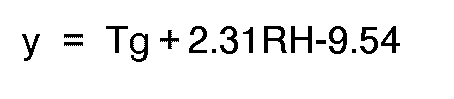
(in the case where supplied quantity of heat is 101W/m²).
(in the case where supplied quantity of heat is 86W/m²) or
(in the case where supplied quantity of heat is 101W/m²).
25. A thermal-environment sensor as claimed in Claim 1, comprising a setting device for
the quantity of clothes (31) which sets the thermal resistance (Clo) corresponding
to the quantity of clothes on the human body; and calculation means (41) which calculates
the effective temperature, (y) in the room corresponding to the temperature of the
air, the speed of the air flow, the radiation, and the quantity of clothes, based
on the surface temperature (Tg) of the heating element (1) and the thermal resistance
(Clo) of the quantity of clothes by receiving the output of said temperature detector
(7) and said setting device for the quantity of clothes (31).
26. A thermal-environment sensor as claimed in Claim 25, wherein the calculation means
(41) calculates the effective temperature (y) by the following empirical formula:

(in the case where the supplied quantity of heat is 86W/m²)
or

(in the case where the supplied quantity of heat is 101W/m²).
(in the case where the supplied quantity of heat is 86W/m²)
or
(in the case where the supplied quantity of heat is 101W/m²).
27. A thermal-environment sensor as claimed in Claim 23, comprising a setting device for
setting the thermal resistance (Clo) corresponding to the quantity of clothes on the
human body, and calculation means (42) which calculates the effective temperature
(y) in a room corresponding to the temperature of the air, the speed of the air flow,
the radiation, the humidity, and the quantity of clothes, based on the surface temperature
(Tg) of the heating element (1), the humidity (RH) in the room, and the thermal resistance
(Clo) set on the setting device.
28. A thermal-environment sensor as claimed in Claim 27, wherein the calculation means
(42) calculates the effective temperature (y) by means of the following empirical
formula:

(in the case where the supplied quantity of heat is 86W/m²)
or

(in the case where the supplied quantity of heat is 101W/m²).
(in the case where the supplied quantity of heat is 86W/m²)
or
(in the case where the supplied quantity of heat is 101W/m²).
29. A thermal-environment sensor as claimed in Claim 1, comprising heat transfer means
for transferring the heat from said heater (4) to the shell (3) so that heat flux
of said shell (3) is uniform.
30. A thermal-environment sensor as claimed in Claim 29, wherein the heat transfer means
is composed of a layer of paint (10) with high emissivity which covers the inside
of the shell (3).
31. A thermal-environment sensor as claimed in Claim 29, wherein the heat transfer means
is composed of materials with heat conduction (12) which connects the electric heater
(4) with the shell (3).
32. A thermal-environment sensor as claimed in Claim 31, wherein the materials with heat
conduction (12) are so composed that heat conduction from the electric heater (4)
increases in the lower part of the shell (3).
33. A thermal-environment sensor as claimed in Claim 29, wherein the shell (3) is formed
in two halves (13), (13) which are made by cutting a spherical or ellipsoid of revolution
shaped hollow shell in half, and the inside of the joint of one half shell (13) is
provided with ribbon-shaped metallic guide plates (14) so as to compose the means
for heat transfer.
34. A thermal-environment sensor as claimed in Claim 33, wherein the guide plates (14)
have pressing parts (15) to keep the temperature detector (7) fixed.
35. A thermal-environment sensor as claimed in Claim 1, comprising a variable power supply
source (36) for varying the supplied quantity of heat (M) to said heating element
(1).
36. A thermal-environment sensor as claimed in Claim 35, comprising calculation means
(43) for calculating the speed of the air flow based on the difference (ΔTg) of the
surface temperature of the heating element (1) before and after said variable power
supply source (36) varies the supplied quantity of heat.
37. A thermal-environment sensor as claimed in Claim 36, wherein the calculation means
(43) comprises memory means (45) which memorizes the surface temperature (Tg₁) of
the heating element (1) before the variable power supply source (36) varies the supplied
quantity of heat (M), and a timer (44) which sets the time which it takes for the
surface temperature of the heating element (1) to become uniform after said variable
power supply source (36) varies the supplied quantity of heat (M).
38. A thermal-environment sensor as claimed in Claim 36, wherein the calculation means
(43), which calculates the speed of the air flow, further calculates the mean radiation
temperature based on the difference (ΔTg) between the surface temperatures of the
heating element (1) before and after said variable power supply source (36) varies
the supplied quantity of heat (M), and also based on the room temperature (Ta) detected
by said room temperature detector.
1. Wärmeumgebungssensor mit einem Heizelement (1), das eine hohle Ummantelung (3) und
eine Heizeinrichtung (4) zur Lieferung einer Wärmemenge an die Ummantelung aufweist,
und einem Temperaturfühler (7) zur Erfassung der Oberflächentemperatur des Heizelements,
wobei die Außenfläche der Ummantelung ein Emissionsvermögen hat, welches mit demjenigen
der Oberfläche der menschlichen Haut übereinstimmt, dadurch gekennzeichnet, daß eine
Schicht von Strahlungsmaterialien (9) die Außenfläche der Ummantelung bedeckt und
ein Spektral-Emissionsvermögen hat, welches eng mit demjenigen der Oberfläche der
menschlichen Haut oder von Kleidern darauf übereinstimmt, wobei die Schicht der Strahlungsmaterialien
ein Metalloxydpigment einschließt.
2. Wärmeumgebungssensor nach Anspruch 1, bei welchem die Schicht der Strahlungsmaterialien
(9) aus einem Metalloxydpigment und einem Harzbindemittel besteht.
3. Wärmeumgebungssensor nach Anspruch 2, bei welchem das Bindemittel aus Kunstharzen
besteht.
4. Wärmeumgebungssensor nach Anspruch 3, bei welchem das Bindemittel aus Fluorharzen
(wie bspw. Tetrafluoräthylen) besteht.
5. Wärmeumgebungssensor nach Anspruch 2, bei welchem das Metalloxyd Titanoxyd ist.
6. Wärmeumgebungssensor nach Anspruch 2, bei welchem die Schicht der Strahlungsmaterialien
(9) aus Titanoxyd und Tetrafluoräthylen besteht.
7. Wärmeumgebungssensor nach Anspruch 6, bei welchem Titanoxyd im Verhältnis der Zusammensetzung
zu 20 bis 50 Gew.-% vorhanden ist.
8. Wärmeumgebungssensor nach Anspruch 1, bei welchem die Heizeinrichtung (4) ein elektrisches
Heizgerät ist, wobei die Temperatur (Tg) der Heizeinrichtung (4) durch den Temperaturfühler
(7) erfaßt wird.
9. Wärmeumgebungssensor nach Anspruch 8, bei welchem die Größe der Ummantelung (3) des
Heizelements (1) und die gelieferte Wärmemenge (M) derart eingestellt sind, daß sie
gleich den Eigenschaften des Wärmegleichgewichts des menschlichen Körpers unter Einschluß
der nassen Wärmefreisetzung sind.
10. Wärmeumgebungssensor nach Anspruch 9, ausgelegt unter den folgenden Bedingungen:
für den Fall, daß für die Bemessung der Größe der Ummantelung (3) des Heizelements (1) und die gelieferte Wärmemenge (M) die neue Standard-Effektivtemperatur SET* zugrunde gelegt wird und auch für den Fall, daß der Strahlungswärme-Übertragungskoeffizient des Heizelements (1) mit (hgr) ausgedrückt wird; der konvektive Wärmeübertragungskoeffizient des Heizelements (1) mit (hgc); die Wäremefreisetzung von der Oberfläche der menschlichen Haut unter der wahlweise veränderlichen Temperaturumgebung mit (Hsk); der Strahlungswärme-Übertragungskoeffizient des menschlichen Körpers mit (hr); der konvektive Wärmeübertragungskoeffizient des menschlichen Körpers unter Berücksichtigung der Verdampfung mit (hc'); der gesamte Wäremeübertragungskoeffizient des menschlichen Körpers in Abhängigkeit von der Konvektion, Verdampfung und Strahlung unter der Standardluftströmung mit (hs'); der Koeffizient des Wärmewiderstands der Bekleidung mit (Fcl); der Koeffizient des Wärmewiderstands der Bekleidung gleich dem Wert 0.6 mit (Fcls); und die Oberflächentemperatur des Wärmeumgebungssensors mit (Tg); die Größe der Ummantelung (3) und die an das Heizelement (1) gelieferte Wärmemenge (M) auf der Grundlage der folgenden Gleichungen eingestellt werden:




.
für den Fall, daß für die Bemessung der Größe der Ummantelung (3) des Heizelements (1) und die gelieferte Wärmemenge (M) die neue Standard-Effektivtemperatur SET* zugrunde gelegt wird und auch für den Fall, daß der Strahlungswärme-Übertragungskoeffizient des Heizelements (1) mit (hgr) ausgedrückt wird; der konvektive Wärmeübertragungskoeffizient des Heizelements (1) mit (hgc); die Wäremefreisetzung von der Oberfläche der menschlichen Haut unter der wahlweise veränderlichen Temperaturumgebung mit (Hsk); der Strahlungswärme-Übertragungskoeffizient des menschlichen Körpers mit (hr); der konvektive Wärmeübertragungskoeffizient des menschlichen Körpers unter Berücksichtigung der Verdampfung mit (hc'); der gesamte Wäremeübertragungskoeffizient des menschlichen Körpers in Abhängigkeit von der Konvektion, Verdampfung und Strahlung unter der Standardluftströmung mit (hs'); der Koeffizient des Wärmewiderstands der Bekleidung mit (Fcl); der Koeffizient des Wärmewiderstands der Bekleidung gleich dem Wert 0.6 mit (Fcls); und die Oberflächentemperatur des Wärmeumgebungssensors mit (Tg); die Größe der Ummantelung (3) und die an das Heizelement (1) gelieferte Wärmemenge (M) auf der Grundlage der folgenden Gleichungen eingestellt werden:
.
11. Wärmeumgebungssensor nach Anspruch 10, bei welcher die Ummantelung (3) des Heizelements
(1) kugelförmig ist und der Durchmesser (D) der Ummantelung (3) mit D=100mm bis 140mm
eingestellt wird sowie die an das Heizelement (1) gelieferte Wärmemenge (M) mit M=76W/m²
bis 93W/m².
12. Wärmeumgebungssensor nach Anspruch 10, bei welchem die Ummantelung (3) kugelförmig
ist und der Durchmesser (D) der Ummantelung (3) mit D=60mm eingestellt wird sowie
die an das Heizelement gelieferte Wärmemenge (M) mit M=86W/m² oder 101W/m².
13. Wärmeumgebungssensor nach Anspruch 10, bei welchem die Ummantelung (3) säulenförmig
ist und der Durchmesser (D) der Ummantelung (3) 80mm beträgt sowie die an das Heizelement
(1) gelieferte Wärmemenge (M) auf 80W/m² eingestellt wird.
14. Wärmeumgebungssensor nach Anspruch 8, bei welchem die Ummantelung (3) als ein Rotationsellipsoid
ausgebildet ist.
15. Wärmeumgebungssensor nach Anspruch 1, bei welchem die Ummantelung (3) aus einem Wärmeisoliermaterial
besteht und mit einem Wärmeisolator (16) gefüllt ist, wobei das elektrische Heizgerät
(4) in die Ummantelung eingefügt ist und deren Oberflächentemperatur (Tg) durch den
Temperaturfühler (7) erfaßt wird.
16. Wärmeumgebungstemperatur nach Anspruch 15, bei welcher ein Teil der Ummantelung (3)
entfernt ist, um eine Öffnung (20a) auszubilden, in welcher das elektrische Heizgerät
(4) angeordnet ist.
17. Wärmeumgebungssensor nach Anspruch 15, bei welchem das Heizelement (1) einen scheibenförmigen
Wärmeisolator (20) einschließt, in dessen Mitte das elektrische Heizgerät angeordnet
ist.
18. Wärmeumgebungssensor nach Anspruch 15, bei welchem für den Fall einer Gleichheit mit
den Eigenschaften des Wärmegleichgewichts des menschlichen Körpers unter Berücksichtigung
der nassen Wärmefreisetzung die Größe des Heizelements (1) und die an das Heizelement
gelieferte Wärmemenge (M) nach den Bedingungen des Anspruchs 10 eingestellt wird.
19. Wärmeumgebungssensor nach Anspruch 16, bei welchem die Ummantelung (3) als eine Rotationsoberfläche
ausgebildet ist und an jedem Bereich davon, der 180 Grad beabstandet ist zu der Mittelachse
dieser Ummantelung, elektrische Heizgeräte (4) angeordnet sind.
20. Wärmeumgebungssensor nach Anspruch 16, bei welchem die Außenfläche des elektrischen
Heizgerätes (4) mit einem Heizleiter (21) versehen ist.
21. Wärmeumgebungssensor nach Anspruch 16, bei welchem in der Öffnung (20a) der Ummantelung
(3) ein elektrisches Heizgerät (4) angeordnet ist, das von einem Wärmeisolator (22)
umgeben ist.
22. Wärmeumgebungssensor nach Anspruch 1, bei welchem das Heizelement (1) derart ausgeführt
ist, daß die Oberfläche der Ummantelung (3) mit einem plattenförmigen elektrischen
Heizgerät (4) einer Ausgestaltung versehen ist, die eine gleichmäßige Wärmestromdichte
liefert.
23. Wärmeumgebungssensor nach Anspruch 1, mit einem Feuchtigkeitsfühler (30), der die
Raumfeuchtigkeit (RH) erfaßt; einer Rechnereinrichtung (40), die durch Empfang des
Ausgangs der beiden Fühler (7, 30) die effektive Temperatur (y) in einem Raum berechnet,
welche der Lufttemperatur, der Geschwindigkeit der Luftströmung, der Strahlung und
der Feuchtigkeit entspricht, auf der Grundlage der Oberflächentemperatur (Tg) des
Heizelements (1) und der Feuchtigkeit (RH) in dem Raum.
24. Wärmeumgebungssensor nach Anspruch 23, bei welchem die Rechnereinrichtung (40) die
effektive Temperatur (y) nach der folgenden empirischen Formel berechnet:
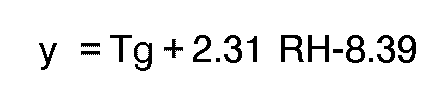
(für den Fall, daß die gelieferte Wärmemenge 86W/m² beträgt)
oder
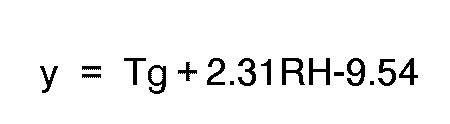
(für den Fall, daß die gelieferte Wärmemenge 101W/m² beträgt).
(für den Fall, daß die gelieferte Wärmemenge 86W/m² beträgt)
oder
(für den Fall, daß die gelieferte Wärmemenge 101W/m² beträgt).
25. Wärmeumgebungssensor nach Anspruch 1, mit einer Einstellvorrichtung für die Bekleidungsmenge
(31), welche den Wärmewiderstand (Clo) entsprechend der Bekleidungsmenge an dem menschlichen
Körper einstellt; und einer Rechnereinrichtung (41), welche die effektive Temperatur
(y) in dem Raum berechnet, entsprechend der Lufttemperatur, der Geschwindigkeit der
Luftströmung, der Strahlung und der Bekleidungsmenge, auf der Grundlage der Oberflächentemperatur
(Tg) des Heizelements (1) und der Wärmewiderstands (Clo) der Bekleidungsmenge durch
einen Empfang des Ausgangs des Temperaturfühlers (7) und der Stelleinrichtung für
die Bekleidungsmenge (31).
26. Wärmeumgebungssensor nach Anspruch 25, bei welcher die Rechnereinrichtung (41) die
effektive Temperatur (y) nach der folgenden empirischen Formel berechnet:

(für den Fall, daß die gelieferte Wärmemenge 86W/m² beträgt)
oder

(für den Fall, daß die gelieferte Wärmemenge 101W/m² beträgt).
(für den Fall, daß die gelieferte Wärmemenge 86W/m² beträgt)
oder
(für den Fall, daß die gelieferte Wärmemenge 101W/m² beträgt).
27. Wärmeumgebungssensor nach Anspruch 23, mit einer Stelleinrichtung für ein Einstellen
des Wärmewiderstands (Clo) entsprechend der Bekleidungsmenge an dem menschlichen Körper
und einer Rechnereinrichtung (42), welche die effektive Temperatur (y) in einem Raum
berechnet, welche der Lufttemperatur, der Geschwindigkeit der Luftströmung, der Strahlung,
der Feuchtigkeit und der Bekleidungsmenge entspricht, auf der Grundlage der Oberflächentemperatur
(Tg) des Heizelements (1), der Feuchtigkeit (RH) in dem Raum und dem Wärmewiderstand
(Clo), der an der Stelleinrichtung eingestellt ist.
28. Wärmeumgebungssensor nach Anspruch 27, bei welchem die Rechnereinrichtung (42) die
effektive Temperatur (y) nach der folgenden empirischen Formel berechnet:

(für den Fall, daß die gelieferte Wärmemenge 86W/m² beträgt)
oder

(für den Fall, daß die gelieferte Wärmemenge 101W/m² beträgt).
(für den Fall, daß die gelieferte Wärmemenge 86W/m² beträgt)
oder
(für den Fall, daß die gelieferte Wärmemenge 101W/m² beträgt).
29. Wärmeumgebungssensor nach Anspruch 1, mit einer Wärmeübertragungseinrichtung für die
Übertragung der Wärme von der Heizeinrichtung (4) an die Ummantelung (3), sodaß die
Wärmestromdichte der Ummantelung (3) gleichförmig ist.
30. Wärmeumgebungssensor nach Anspruch 29, bei welchem die Wärmeübertragungseinrichtung
aus einer Farbschicht (10) mit hohem Emissionsvermögen besteht, welche die Innenseite
der Ummantelung bedeckt.
31. Wärmeumgebungssensor nach Anspruch 29, bei welchem die Wärmeübertragungseinrichtung
aus Materialien mit einer Wärmeleitung (12) besteht, welche das elektrische Heizgerät
(4) mit der Ummantelung (3) verbinden.
32. Wärmeumgebungssensor nach Anspruch 31, bei welchem die Materialien mit Wärmeleitung
(12) derart zusammengesetzt sind, daß die Wärmeleitung von dem elektrischen Heizgerät
(4) in dem unteren Teil der Ummantelung (3) ansteigt.
33. Wärmeumgebungssensor nach Anspruch 29, bei welchem die Ummantelung (3) in zwei Hälften
(13, 13) ausgebildet ist, die durch einen hälftigen Schnitt einer kugelförmigen oder
als Rotationsellipsoid ausgebildeten hohlen Ummantelung erhalten sind, und die Innenseite
der Fuge der einen Ummantelungshälfte (13) mit bandförmigen Metallführungsplatten
(14) versehen ist, um die Einrichtung für die Wärmeübertragung zu erhalten.
34. Wärmeumgebungssensor nach Anspruch 33, bei welchem die Führungsplatten (14) Preßteile
(15) haben, um dem Temperaturfühler (7) festzuhalten.
35. Wärmeumgebungssensor nach Anspruch 1, mit einer veränderlichen Energieversorgungsquelle
(36), um die an das Heizelement (1) gelieferte Wärmemenge (M) zu verändern.
36. Wärmeumgebungssensor nach Anspruch 35, mit einer Rechnereinrichtung (43) für eine
Berechnung der Geschwindigkeit der Luftströmung auf der Grundlage der Differenz (ΔTg)
der Oberflächentemperatur des Heizelements (1) vor und nach der mit der veränderlichen
Energieversorgungsquelle (36) bewirkten Veränderung der gelieferten Wärmemenge.
37. Wärmeumgebungssensor nach Anspruch 36, bei welcher die Rechnereinrichtung (43) eine
Speichereinrichtung (45) umfaßt, welche die Oberflächentemperatur (Tg₁) des Heizelements
(1) vor der Veränderung der gelieferten Wärmemenge (M) durch die veränderliche Energieversorgungsquelle
(36) speichert, und einen Zeitgeber (44), welcher die Zeit einstellt, die benötigt
wird, um die Oberflächentemperatur des Heizelements (1) gleichmäßig zu erhalten, nachdem
die veränderliche Energieversorgungsquelle (36) die gelieferte Wärmemenge (M) verändert
hat.
38. Wärmeumgebungssensor nach Anspruch 36, bei welchem die Rechnereinrichtung (43), welche
die Geschwindigkeit der Luftströmung berechnet, weiterhin die mittlere Strahlungstemperatur
berechnet, auf der Grundlage der Differenz (ΔTg) zwischen den Oberflächentemperaturen
des Heizelements (1) vor und nach der Änderung der gelieferten Wärmemenge (M) durch
die veränderliche Energieversorgungsquelle (36), und auch auf der Grundlage der Raumtemperatur
(Ta), die durch den Raumtemperaturfühler erfaßt wird.
1. Capteur thermique d'ambiance comportant un élément chauffant (1) comprenant une coque
creuse (3) et un organe chauffant (4) destiné à fournir une quantité de chaleur à
la coque, un détecteur (7) de température destiné à détecter la température de surface
de l'élément chauffant, la surface extérieure de la coque ayant une émissivité adaptée
à celle de la surface de la peau humaine, caractérisé en ce qu'une couche de matière
rayonnante (9) recouvre la surface extérieure de la coque et possède une émissivité
spectrale adaptée étroitement à celle de la surface de la peau humaine ou des vêtements
la recouvrant, ladite couche de matière rayonnante comprenant un pigment à oxyde métallique.
2. Capteur thermique d'ambiance selon la revendication 1, dans lequel ladite couche de
matière rayonnante (9) est formée d'un pigment à oxyde métallique et d'un liant du
type résine.
3. Capteur thermique d'ambiance selon la revendication 2, dans lequel ledit liant est
formé de résines synthétiques.
4. Capteur thermique d'ambiance selon la revendication 3, dans lequel ledit liant est
formé de résines fluorées (par exemple du tétrafluoréthylène).
5. Capteur thermique d'ambiance selon la revendication 2, dans lequel ledit oxyde métallique
est l'oxyde titaneux.
6. Capteur thermique d'ambiance selon la revendication 2, dans lequel ladite couche de
matière rayonnante (9) est formée d'oxyde titaneux et de tétrafluoréthylène.
7. Capteur thermique d'ambiance selon la revendication 6, dans lequel la proportion de
la composition d'oxyde titaneux est de 20 % à 50 % en poids.
8. Capteur thermique d'ambiance selon la revendication 1, dans lequel ledit organe chauffant
(4) est un organe chauffant électrique, la température (Tg) dudit organe chauffant
(4) étant détectée par le détecteur (7) de température.
9. Capteur thermique d'ambiance selon la revendication 8, dans lequel la dimension de
la coque (3) de l'élément chauffant (1) et la quantité fournie de chaleur (M) sont
établies de façon à être égales aux caractéristiques d'équilibre thermique du corps
humain incluant le dégagement de chaleur humide.
10. Capteur thermique d'ambiance selon la revendication 9, basé sur les conditions suivantes
:
dans le cas où, pour établir la dimension de la coque (3) de l'élément chauffant (1) et la quantité fournie de chaleur (M), la nouvelle température effective normalisée SET* est utilisée, et également dans le cas où le coefficient de transmission de chaleur rayonnante de l'élément chauffant (1) est exprimé par (hgr) ; le coefficient de transmission de chaleur par convection de l'élément chauffant (1) est exprimé par (hgc) : le dégagement de chaleur depuis la surface de la peau humaine dans l'ambiance à température variable optionnelle est exprimée par (Hsk) ; le coefficient de transmission de chaleur par rayonnement du corps est exprimé par (hr) ; le coefficient de transmission de chaleur par convection du corps humain en considérant l'évaporation est exprimé par (hc') ; le coefficient total de transmission de chaleur du corps humain dépendant de la convection, de l'évaporation et du rayonnement dans l'écoulement d'air normalisé est exprimé par (hs') ; le coefficient de la résistance thermique des vêtements est exprimé par (Fcl) ; le coefficient de résistance thermique des vêtements égal à 0,6 est exprimé par (Fcls) ; et la température de surface dudit capteur thermique d'ambiance est exprimée par (Tg), ladite dimension de la coque (3) et ladite quantité de chaleur (M) fournie à l'élément chauffant (1) sont établies sur la base des expressions suivantes :




.
dans le cas où, pour établir la dimension de la coque (3) de l'élément chauffant (1) et la quantité fournie de chaleur (M), la nouvelle température effective normalisée SET* est utilisée, et également dans le cas où le coefficient de transmission de chaleur rayonnante de l'élément chauffant (1) est exprimé par (hgr) ; le coefficient de transmission de chaleur par convection de l'élément chauffant (1) est exprimé par (hgc) : le dégagement de chaleur depuis la surface de la peau humaine dans l'ambiance à température variable optionnelle est exprimée par (Hsk) ; le coefficient de transmission de chaleur par rayonnement du corps est exprimé par (hr) ; le coefficient de transmission de chaleur par convection du corps humain en considérant l'évaporation est exprimé par (hc') ; le coefficient total de transmission de chaleur du corps humain dépendant de la convection, de l'évaporation et du rayonnement dans l'écoulement d'air normalisé est exprimé par (hs') ; le coefficient de la résistance thermique des vêtements est exprimé par (Fcl) ; le coefficient de résistance thermique des vêtements égal à 0,6 est exprimé par (Fcls) ; et la température de surface dudit capteur thermique d'ambiance est exprimée par (Tg), ladite dimension de la coque (3) et ladite quantité de chaleur (M) fournie à l'élément chauffant (1) sont établies sur la base des expressions suivantes :
.
11. Capteur thermique d'ambiance selon la revendication 10, dans lequel la coque (3) de
l'élément chauffant (1) est sphérique, et le diamètre (D) de ladite coque (3) est
établi à D=100 mm à 140 mm ; la quantité de chaleur (M) fournie à l'élément chauffant
(1) est M=76W/m² à 93W/m².
12. Capteur thermique d'ambiance selon la revendication 10, dans lequel la coque (3) est
sphérique, et le diamètre (D) de ladite coque (3) est établi à D=60 mm et la quantité
de chaleur (M) fournie à l'élément chauffant (1) est M=86W/m² ou 101W/m².
13. Capteur thermique d'ambiance selon la revendication 10, dans lequel la coque (3) est
en forme de colonne et le diamètre (D) de ladite coque (3) est de 80 mm et la quantité
de chaleur (M) fournie à l'élément chauffant (1) est établie à 80W/m².
14. Capteur thermique d'ambiance selon la revendication 8, dans lequel la coque (3) est
réalisée sous la forme d'une ellipsoïde de révolution.
15. Capteur thermique d'ambiance selon la revendication 1, dans lequel la coque (3) est
composée d'un matériau d'isolation thermique et est remplie d'un isolant thermique
(16), ledit organe chauffant électrique (4) étant incorporé dans la coque et sa température
de surface (Tg) étant détectée par le détecteur (7) de température.
16. Capteur thermique d'ambiance selon la revendication 15, dans lequel une partie de
la coque (3) est découpée pour former une ouverture (20a) dans laquelle l'organe chauffant
électrique (4) est placé.
17. Capteur thermique d'ambiance selon la revendication 15, dans lequel l'élément chauffant
(1) comprend un isolant thermique (20) en forme de disque dans le centre duquel l'organe
chauffant électrique est disposé.
18. Capteur thermique d'ambiance selon la revendication 15, dans lequel, dans le cas où,
pour être appropriées aux caractéristiques d'équilibre thermique du corps humain en
considérant le dégagement de chaleur humide, la dimension de l'élément chauffant (1)
et la quantité de chaleur (M) fournie audit élément chauffant (1) sont établies sur
la base de conditions indiquées dans la revendication 1.
19. Capteur thermique d'ambiance selon la revendication 16, dans lequel la coque (3) est
réalisée sous la forme d'une surface de révolution et, sur chaque partie de celle-ci
espacée de 180° autour de l'axe central de ladite coque, des organes chauffants électriques
(4) sont installés.
20. Capteur thermique d'ambiance selon la revendication 16, dans lequel la surface extérieure
de l'organe chauffant électrique (4) est pourvue d'un conducteur (21) de la chaleur.
21. Capteur thermique d'ambiance selon la revendication 16, dans lequel un organe chauffant
électrique (4), qui est entouré d'un isolant thermique (22), est monté dans l'ouverture
(20a) de la coque (3).
22. Capteur thermique d'ambiance selon la revendication 1, dans lequel l'élément chauffant
(1) est composé de manière que la surface de la coque (3) soit pourvue d'un organe
chauffant électrique (4) en forme de panneau dans une configuration pour produire
un flux thermique uniforme.
23. Capteur thermique d'ambiance selon la revendication 1, comportant un détecteur (30)
d'humidité qui détecte l'humidité (RH) de la pièce ; des moyens de calcul (40) qui,
en recevant les signaux de sortie des deux détecteurs (7, 30), calculent la température
effective (y) dans une pièce qui correspond à la température de l'air, à la vitesse
de l'écoulement d'air, au rayonnement et à l'humidité, sur la base de la température
de surface (Tg) de l'élément chauffant (1) et de l'humidité (RH) dans la pièce.
24. Capteur thermique d'ambiance selon la revendication 23, dans lequel les moyens de
calcul (40) calculent la température effective (y) par la formule empirique suivante
:
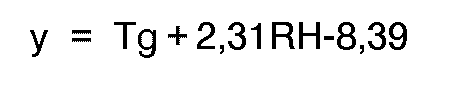
(dans le cas où la quantité de chaleur fournie est de 86W/m²) ou

(dans le cas où la quantité de chaleur fournie est de 101W/m²).
(dans le cas où la quantité de chaleur fournie est de 86W/m²) ou
(dans le cas où la quantité de chaleur fournie est de 101W/m²).
25. Capteur thermique d'ambiance selon la revendication 1, comportant un dispositif de
réglage pour la quantité de vêtements (31) qui règle la résistance thermique (Clo)
correspondant à la quantité de vêtements sur le corps humain ; et un moyen de calcul
(41) qui calcule la température effective (y) dans la pièce correspondant à la température
de l'air, à la vitesse de l'écoulement d'air, au rayonnement et à la quantité de vêtements,
sur la base de la température de surface (Tg) de l'élément chauffant (1) et de la
résistance thermique (Clo) de la quantité de vêtements en recevant les signaux de
sortie dudit détecteur (7) de température et dudit dispositif de réglage pour la quantité
de vêtements (31).
26. Capteur thermique d'ambiance selon la revendication 25, dans lequel le moyen de calcul
(41) calcule la température effective (y) par la formule empirique suivante :

(dans le cas où la quantité de chaleur fournie est de 86W/m²) ou
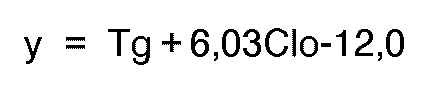
(dans le cas où la quantité de chaleur fournie est de 101W/m²).
(dans le cas où la quantité de chaleur fournie est de 86W/m²) ou
(dans le cas où la quantité de chaleur fournie est de 101W/m²).
27. Capteur thermique d'ambiance selon la revendication 23, comportant un dispositif de
réglage destiné à régler la résistance thermique (Clo) correspondant à la quantité
de vêtements sur le corps humain, et un moyen de calcul (42) qui calcule la température
effective (y) dans une pièce correspondant à la température de l'air, à la vitesse
de l'écoulement d'air, au rayonnement, à l'humidité et à la quantité de vêtements,
sur la base de la température de surface (Tg) de l'élément chauffant (1), de l'humidité
(RH) dans la pièce et de la résistance thermique (Clo) réglée sur le dispositif de
réglage.
28. Capteur thermique d'ambiance selon la revendication 27, dans lequel le moyen de calcul
(42) calcule la température effective (y) au moyen de la formule empirique suivante
:

(dans le cas où la quantité de chaleur fournie est de 86W/m²) ou

(dans le cas où la quantité de chaleur fournie est de 101W/m²).
(dans le cas où la quantité de chaleur fournie est de 86W/m²) ou
(dans le cas où la quantité de chaleur fournie est de 101W/m²).
29. Capteur thermique d'ambiance selon la revendication 1, comportant un moyen de transmission
de chaleur destiné à transmettre la chaleur dudit organe chauffant (4) à la coque
(3) afin que le flux de chaleur de ladite coque (3) soit uniforme.
30. Capteur thermique d'ambiance selon la revendication 29, dans lequel le moyen de transmission
de chaleur est composé d'une couche de peinture (10) à haute émissivité qui recouvre
l'intérieur de la coque (3).
31. Capteur thermique d'ambiance selon la revendication 29, dans lequel le moyen de transmission
de chaleur est composé de matières à conduction thermique (12) qui relient l'organe
chauffant électrique (4) à la coque (3).
32. Capteur thermique d'ambiance selon la revendication 31, dans lequel les matières à
conduction thermique (12) sont composées de façon que la conduction de la chaleur
à partir de l'organe chauffant électrique (4) augmente dans la partie inférieure de
la coque (3).
33. Capteur thermique d'ambiance selon la revendication 29, dans lequel la coque (3) est
formée en deux moitiés (13), (13) qui sont réalisées par coupe en deux moitiés d'une
coque creuse en forme de sphère ou d'ellipsoïde de révolution, et l'intérieur du joint
d'une demi-coque (13) est pourvu de plaques métalliques de guidage (14) en forme de
ruban afin de composer le moyen de transmission de chaleur.
34. Capteur thermique d'ambiance selon la revendication 33, dans lequel les plaques de
guidage (14) comportent des parties (15) de pression destinées à maintenir fixement
le détecteur (7) de température.
35. Capteur thermique d'ambiance selon la revendication 1, comportant une source d'alimentation
en énergie variable (36) destinée à faire varier la quantité de chaleur (M) fournie
audit élément chauffant (1).
36. Capteur thermique d'ambiance selon la revendication 35, comportant un moyen de calcul
(43) destiné à calculer la vitesse d'écoulement d'air sur la base de la différence
(Δ Tg) de température de surface de l'élément chauffant (1) avant et après que ladite
source d'alimentation en énergie variable (36) a fait varier la quantité fournie de
chaleur.
37. Capteur thermique d'ambiance selon la revendication 36, dans lequel le moyen de calcul
(43) comporte un moyen à mémoire (45) qui mémorise la température de surface (Tg₁)
de l'élément chauffant (1) avant que la source d'alimentation en énergie variable
(36) ait fait varier la quantité fournie de chaleur (M), et une horloge (44) qui établit
le temps qu'il faut pour que la température de surface de l'élément chauffant (1)
devienne uniforme après que ladite source d'alimentation en énergie variable (36)
a fait varier la quantité fournie de chaleur (M).
38. Capteur thermique d'ambiance selon la revendication 36, dans lequel le moyen de calcul
(43), qui calcule la vitesse de l'écoulement d'air, calcule en outre la température
moyenne de rayonnement sur la base de la différence (Δ Tg) entre les températures
de surface de l'élément chauffant (1) avant et après que ladite source d'alimentation
en énergie variable (36) a fait varier la quantité de chaleur fournie (M), et aussi
sur la base de la température (Ta) de la pièce détectée par ledit détecteur de température
de la pièce.