| (19) |
 |
|
(11) |
EP 0 214 558 B1 |
| (12) |
EUROPEAN PATENT SPECIFICATION |
| (45) |
Mention of the grant of the patent: |
|
02.05.1990 Bulletin 1990/18 |
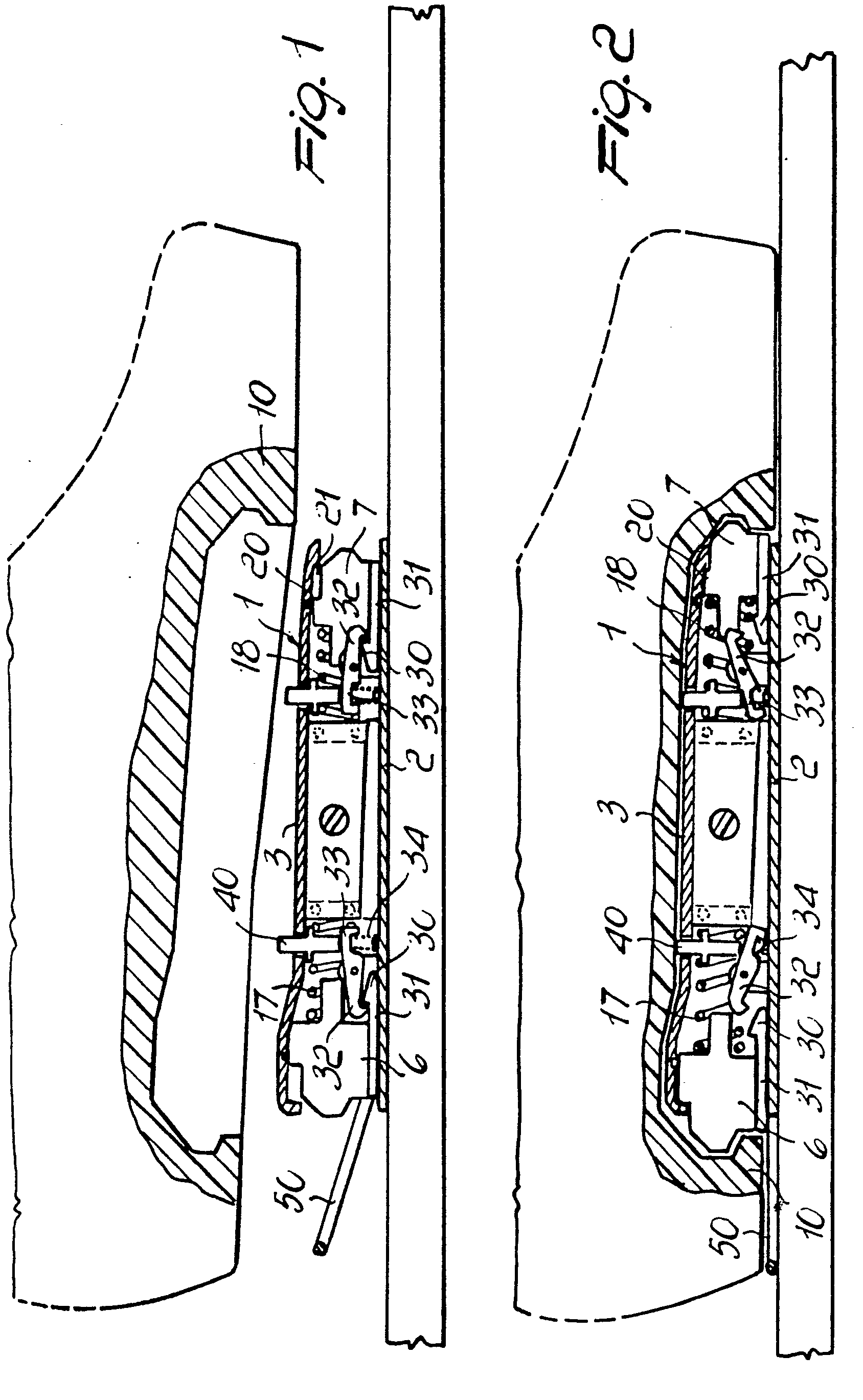
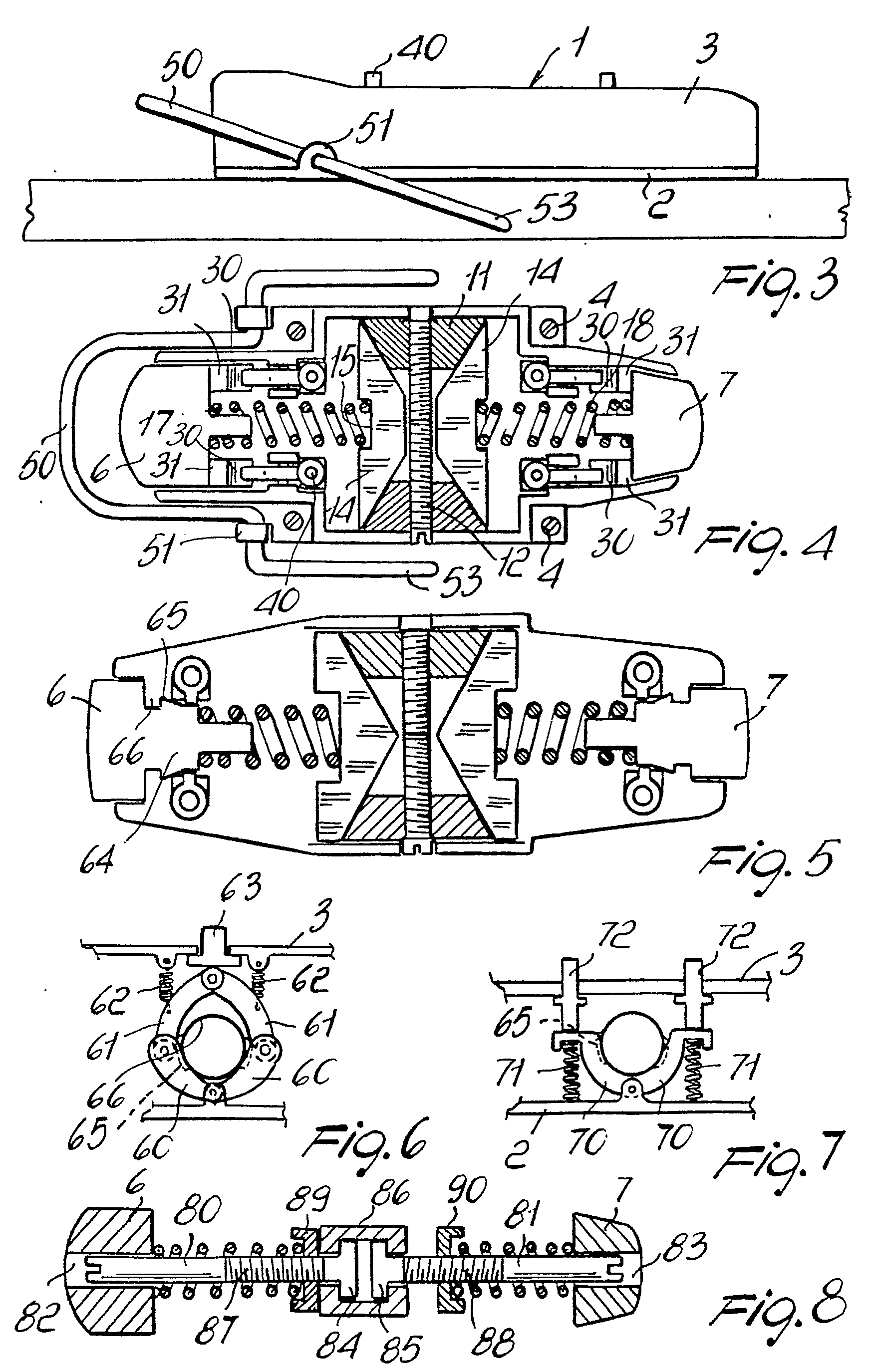
| (22) |
Date of filing: 28.08.1986 |
|
| (51) |
International Patent Classification (IPC)5: A63C 9/086 |
|
| (54) |
Middle binding particularly for ski shoes
Mittlere Bindung, insbesondere für Skistiefel
Fixation centrale, en particulier pour chaussures de ski
|
| (84) |
Designated Contracting States: |
|
AT CH DE FR LI |
| (30) |
Priority: |
04.09.1985 IT 2206585
|
| (43) |
Date of publication of application: |
|
18.03.1987 Bulletin 1987/12 |
| (73) |
Proprietor: NORDICA S.p.A |
|
31040 Trevignano (Treviso) (IT) |
|
| (72) |
Inventor: |
|
- Pozzobon, Alessandro
I-31050 Paderno di Ponzano Veneto (IT)
|
| (74) |
Representative: Modiano, Guido, Dr.-Ing. et al |
|
Modiano & Associati S.r.l.
Via Meravigli, 16
20123 Milano
20123 Milano (IT) |
| (56) |
References cited: :
EP-A- 0 105 011
US-A- 3 695 623
US-A- 4 063 752
|
DE-A- 2 115 199
US-A- 3 869 136
|
|
| |
|
|
|
|
| |
|
| Note: Within nine months from the publication of the mention of the grant of the European
patent, any person may give notice to the European Patent Office of opposition to
the European patent
granted. Notice of opposition shall be filed in a written reasoned statement. It shall
not be deemed to
have been filed until the opposition fee has been paid. (Art. 99(1) European Patent
Convention).
|
[0001] This invention relates to a ski binding and ski shoe combination, with ski binding,
specifically of the hidden type, located in the middle portion of the ski shoe sole.
[0002] As is known currently available on the market are hidden bindings in combination
with ski shoes or boots which are set up to effect hooking of the ski shoe on the
ski by engagement in a recess defined in the sole of the ski shoe. Example of such
combinations are described in US-A-3 869 136 and EP-A-105 011.
[0003] With conventional bindings of this type it occurs that, to carry out the coupling
between the shoe and ski, it is necessary to exert a pressure action such as to overcome
the elastic bias of the forward and rear ferrules provided in the binding, to bring
them to snap into the seats specially prearranged in the recess.
[0004] This procedure creates, in many cases, considerable coupling difficulty, and it is
not infrequent to fail to obtain accurate positioning between the binding and the
shoe.
[0005] Another drawback affecting known solutions is that considerable difficulty and structural
complications are encountered in carrying out adjustment of the binding release tension
and, moreover, known solutions afford no adjustment of the rear ferrule and forward
ferrule adjustments independently of each other.
[0006] Therefore it is the aim of this invention to remove the prior drawbacks by providing
a novel combination of a ski binding of the hidden type and of a ski shoe which enables
effectuation of the coupling between the shoe and ski without the necessity to exert
efforts, but by merely inserting the binding into the seat, and only after the binding
is positioned in the seat provided in the footwear sole, to obtain the desired coupling.
[0007] It is a particular object of the invention to provide a ski binding and ski shoe
combination which affords mutually independent adjustment of the forward ferrule and
rear ferrule, thus favouring a more effective adjustment of the binding.
[0008] Also an object of this invention is to provide a ski binding and ski shoe combination
which has a highly compact conformation so as to affect a limited region of the ski,
thereby it does not reduce or anyhow change the elastic characteristics of the ski.
[0009] Another object of this invention is to provide a ski binding and ski shoe combination
which is structurally simple and fully reliable and safe in use.
[0010] The above outlined aim, and these and other objects to become apparent hereinafter,
are achieved by a ski binding and ski shoe combination, according to the invention,
comprising a box-type case attachable to a ski in the middle portion of the ski shoe
sole and supporting a forward hook-on ferrule and a rear hook-on ferrule removably
engageable with hook-on seats correspondingly defined in a sole of a ski shoe, there
being also provided means of adjusting the release tension of the ski binding, characterized
in that said ski binding comprises means for removably locking said ferrules at a
retracted position driven by actuators actuatable by said sole.
[0011] Further features and advantages will be apparent from the description of some preferred,
but not exclusive, embodiments of a middle binding particularly for ski shoes, as
shown by way of illustration and not of limitation in the accompanying drawings, where:
Figure 1 shows diagrammatically and in longitudinal section the binding as set up
for coupling to the shoe with the ferrules in their re-entered position;
Figure 2 shows diagrammatically in longitudinal section the binding according to this
invention;
Figure 3 shows the binding in side elevation with ski stop;
Figure 4 shows diagrammatically in plan and partially cut-away view the binding according
to this invention;
Figure 5 shows in plan view the binding with a different embodiment of the means for
locking the ferrules in a re-entered position;
Figures 6 and 7 show diagrammatically and in front elevation two different embodiments
of the means for locking the ferrules in the oriented position; and
Figure 8 shows diagrammatically a different embodiment of the means of adjusting the
release tension.
[0012] With reference to the cited drawing Figures and in particular to Figures 1 to 4,
there is shown a hidden type middle binding which comprises a box-type case, designated
generally with the reference numeral 1, comprising a support plate 2 and a cover element
3 coupled thereto, defining the accommodation for the elements making up the binding.
[0013] The plate 2 is provided, at its corners, with through-holes for accommodating screws
4 for fastening to the ski.
[0014] As may be readily appreciated, the length dimension of the binding is extremely reduced
thereby the binding itself does not affect the elastic and flexible characteristics
of the ski.
[0015] Supported inside the box-type case 1 for sliding movement are a forward ferrule 7
and a rear ferrule 6 which may engage in corresponding hook-on seats defined in a
recess provided in the sole of the ski boot, generally designated with the reference
numeral 10.
[0016] The binding further comprises means for adjusting the release tension which, in the
embodiment described in Figures 1 to 4, includes substantially a pair of juxtaposed
double wedges 11 engaging with a double-threaded bar 12 arranged crosswise to the
longitudinal extent of the binding so as to create symmetrical translation of the
double wedges 11 on rotating the threaded crossbar 12.
[0017] The double wedges 11 act on actuating wedges 14 defining each a seat 15 for abutment
respectively of a rear bias spring 17 and a forward bias spring 18 which act with
an elastic thrust action against the ferrules 6 and 7 to hold them elastically in
the extraction position.
[0018] The ferrules 6 and 7 have a ledge element 20 which engages with a corresponding stop
21 defined by the cover element so as to prevent their slipping off the box-type case.
[0019] Adjustment of the double wedges 11 causes translation in the longitudinal direction
of the actuating wedges 14 with consequent different compressive action exerted on
the springs 17 and 18 and thus change in the action of elastic bias exerted on the
ferrules, which elastic bias action corresponds in practice to the release tension.
[0020] An important feature of the invention is the provision of means for removably locking
the ferrules 6 and 7 in a retracted position, thereby it is extremely easy to insert
them into the recess defined in the sole 10, having then a successive automatic withdrawal
of the ferrules to move into the locked position.
[0021] Said removably locking means comprises in this specific case a pair of hooks 30 provided
on lugs 31 extending from the ferrules 6 and 7 inwardly and engaging with the hook-on
section of a pawl element 32 swingable mounted on the plate 2 and having the end 33
remote from the hook-on section acting against a thrust spring 34.
[0022] The removably locking means further comprises actuators consisting of stems 40 acting
on the end 33 and emerging upwardly from the box-type case 1. The stems 40 may be
depressed by the sole to obtain release of the hook 30 from the pawl element 32 with
consequent elastic exiting of the ferrules 6 and 7 and their engagement in the seats
defined in the recess provided in the sole 10.
[0023] In actual use, the skier, when he wants to hook on the boot or shoe, having previously
positioned the ferrules 6 and 7 in the retracted position, is simply to bring the
sole over the binding introducing the box-type case 1 into the recess provided in
the sole itself and then by exerting a pressure action he pushes the actuators 40
which carry out automatic locking of the binding to the sole as a consequence of the
disengagement of the removable locking means.
[0024] Furthermore the binding is provided with a ski stop, which comprises an oscillating
lever 50 journalled in small ears 51 defined by the box-type case 1 and having a rear
portion pressable from the sole to bring the lever 50 in a horizontal position and
a forward introduction portion 53 which tends to penetrate the snow, when the rear
portion is not depressed.
[0025] Two different embodiments of the means for removable locking the ferrules, again
indicated at 6 and 7, in the retracted position are shown in Figures 5 to 7.
[0026] The embodiment shown in Figure 6 has a pair of small lower connecting rods 60 journalled
together and connected to the lower portion of the box-type case 1 at one end thereof
and articulated, at the other end thereof, to a pair of small upper connecting rods
61. According to Fig. 6, tension springs 62 are connected to the inner upper portion
of the cover element 3 of the box-type case 1 and act on the upper connecting rods
61, whereas an actuator consisting of a pushbutton 63 acts at the mutual hinge connection
between the small connecting rods 61.
[0027] The connecting rods 60 and 61 practically encircle a tang portion 64 extending inwardly
from the ferrules and defining teeth 65 which delimit a locking groove 66.
[0028] In the retracted position of the ferrules the small connecting rods, pulled by the
action of the tension springs 62, are housed in the groove 66.
[0029] On exerting a pressure action on the pushbutton 63 the small connecting rods 60 and
61 tend to spread apart and come out of the groove, allowing outwardly movement of
the ferrules.
[0030] Similar in conception is the embodiment shown in Fig. 7 where there are provided
lower jaw elements 70, journalled together and connected at the mutual pivot point
to the plate 2 of the box-type case 1; thrust springs 71 provided between the upper
free ends of the jaws 70 and the plate 2 act on the lower faces of these ends whilst
actuators comprising small pegs 72 protruding from the cover portion of the case act
on the upper face thereof.
[0031] Also with this embodiment it occurs that, with the small pegs 72 in the extracted
position, the thrust springs 71 can keep the jaw elements 70 within the groove 66
thus effecting locking by engagement with the teeth 65.
[0032] A pressure action exerted on the small pegs 72 causes spreading of the jaws 70 with
consequent disengagement thereof from the groove 66 and outward movement of the ferrules
as urged by their thrust springs 17 and 18.
[0033] With reference to Figure 8, an embodiment is diagrammatically shown wherein it is
possible to effect adjustment of the forward ferrule, again indicated at 7, and the
rear ferrule, again indicated at 6, independently. As in the embodiments according
to Figures 1-7, the ferrules are provided with a removable locking means of the type
previously described and not shown in Fig. 8.
[0034] The means of adjusting the release tension comprises a forward stem 81 and a rear
stem 80 which are accessible from central channels 82 and 83 respectively defined
by the ferrules 6 and 7.
[0035] At their inner end the stems 80 and 81 have a widened portion 84 and 85, respectively,
which is rotatably accommodated in a middle block 86.
[0036] The middle stems have each threaded portion 87 and 88, respectively, engaging washers
89 and 90 which are prevented from turning through a guide, for example, defined by
the box-type case 1.
[0037] Thus on rotating the stems 80 or 81 the washer 89 or the washer 90 are caused to
translate independently to each other with consequent change in the adjustment of
the forward spring 17 or of the rear spring 18, and possibility of independently effecting
adjustment of the release tension of the forward and rear ferrules.
[0038] This embodiment, in addition to affording an adjustment system for the hook-up or
release tension obtained independently for the forward and rear ferrules, also affords
containment of the binding transverse dimensions.
[0039] Thus, the binding housing seat to be made in the sole of the boot affords improved
continuity of the sole structure, ensuring the required rigidity for obtaining a good
binding.
[0040] In actual use, to effect hooking of the binding on the boot, it will be sufficient,
with the forward and rear ferrules in the retracted position, to arrange the shoe
sole over the binding and exert a slight downward pressure which allows depression
of the actuators, which automatically cause the outward movement of the ferrules with
their engagement in the related hook-up seats.
[0041] To effect release, conventional lever means are utilised which are not described
herein in detail.
[0042] It may be seen from the foregoing description that the binding according to the invention
achieves the objects set forth and in particularthat it has an extremely compact conformation
with considerable advantages both constructional and practical in nature, because
it requires no particular actions or efforts to carry out the coupling between the
binding and the sole.
[0043] Another important aspect is then represented by the possibility of independently
adjusting the release tension for the forward and the rear ferrules.
1. Ski binding and ski shoe combination, comprising a box-type case (1) for attachment
to a ski in the middle portion of the ski shoe sole, said box-type case accommodating
a forward hook-on ferrule (7) and a rear hook-on ferrule (6) removably engageable
with hook-on seats correspondingly defined in the sole of the ski shoe (10), and means
(11,12,14, 87, 90) for adjusting the release tension of the ski binding, characterized
in that said ski binding comprises removably locking means (30-34; 60-62, 64-66; 70,
71) for removably locking said ferrules (6, 7) at a retracted position, said removably
locking means being driven by actuators (40, 63, 72) actuatable by the ski shoe sole.
2. Ski binding and ski shoe combination, according to claim 1, characterized in that
said removable locking means comprises hook elements (30) extending from said ferrules
(6, 7) toward the interior of said box-type case (1), said hook elements (30) removably
engaging a hooked portion of a pawl (32) journalled on said box-type case (1) and
having an end thereof elastically urged for engagement with said hook elements (30)
by a spring (34) and engaged by said actuators (40).
3. Ski binding and ski shoe combination, according to one or more of the preceding
claims, characterized in that said actuators comprise at least one stem (40) protruding
from said box-type case (1) and being engageable for its translation by the sole of
the ski shoe.
4. Ski binding and ski shoe combination, according to one or more of the preceding
claims, characterized in that said removable locking means comprises a pair of small
lower connecting rods (60) having a first end journalled together and to a lower inner
portion (2) of said box-type case (1), and a second end articulated to a pair of small
upper connecting rods (61) articulated together at a hinge region thereof, said upper
connecting rods (61) being engaged by tension springs (62) extending between said
upper connecting rods (61) and an upper portion (3) of said box-type case (1), said
connecting rods, in a locked position of said removable locking means, being removably
accommodated in a groove (66) defined on a tang (64) extending from said ferrules
(6, 7) and delimited by tooth elements (65), said actuators comprising pushbutton
elements (63) supported on said upper connecting rods (61) at said hinge region thereof.
5. Ski binding and ski shoe combination, according to one or more of the preceding
claims, characterized in that said removable locking means comprises a pair of jaw
elements (70) having first ends journalled to each other and to a lower inner portion
(2) of said box-type case (1), and second free ends engaged at a first face thereof
by thrust springs (71) extending between said second free ends and said lower inner
portion (2), said actuators comprising small pegs (72) protruding from said box-type
case (1) and acting on a second face of said free ends of said jaw elements (70).
6. Ski binding and ski shoe combination, according to one or more of the preceding
claims, characterized in that said means for adjusting the release tension comprises
a pair of double wedges (11) juxtaposed to each other in a transverse direction of
said box-type case, said wedges engaging with a double threaded cross-bar (12) on
a respective threaded portion, thereby the rotation of said cross-ba causes symmetrical
translation of said double wedges (11) with respect to said cross- bar (12), said
double wedges acting on actuating wedges (14) translatable transversally with respect
to said transverse direction and defining abutment seats (15) respectively for forward
rear springs (18, 17) acting on said forward and rear ferrules (7, 6).
7. Ski binding and ski shoe combination, according to one or more of the preceding
claims, characterized in that said means for adjusting the release tension (80-90)
acts independently on said forward ferrule (7) and said rear ferrule (6).
8. Ski binding and ski shoe combination, according to one or more of the preceding
claims, characterized in that said means for adjusting the release tension acting
independently on said forward ferrule and said rear ferrule comprises a forward stem
(81) and a rear stem (80) slidably engaging in said forward ferrule (7) and said rear
ferrule (6), respectively, said forward and rear stems (80, 81) pivotally engaging
at first ends thereof with a middle block (86) and having each a threaded portion
(88, 87) respectively engaging a forward washer (90) and a rear washer (89) slidably
moving along a respective stem on rotation of said stem, a forward spring and a rear
spring extending around a respective stem between said washers (89, 90) and said ferrules
(6,7).
1. Kombination von Skibindung und Skischuh, bestehend aus einem boxartigen Gehäuse
(1) zur Befestigung an einem Ski im Mittelbereich der Skisohle, welches boxartige
Gehäuse einen vorderen Anharkriegel (7) und einen hinteren Anhakriegel (6) aufnimmt,
die lösbar in entsprechend in der Sohle des Skischuhes (10) definierte Anhaksitze
eingreifen, wobei weiters eine Einrichtung (11, 12, 14, 87, 90) für die Einstellung
der Freigabespannung der Skibindung vorgesehen ist, dadurch gekennzeichnet, daß die
Skibindung eine lösbare Arretiereinrichtung (30-34; 60-62; 64-66; 70, 71) zur lösbaren
Arretierung der Riegel in einer zurückgezogenen Stellung aufweist, welche lösbare
Arretiereinrichtung durch von der Sohle betätigbare Betätigungsorgane (40, 63, 72)
angetrieben wird.
2. Kombination von Skibindung und Skischuh nach Anspruch 1, dadurch gekennzeichnet,
daß die lösbare Arretiereinrichtung aus Hakenelementen (30), die sich von den Riegeln
(6,7) weg gegen das Innere des boxartigen Gehäuses (1) erstekken, besteht, welche
Hakenelemente (30) lösbar an einen Hakenteil einer Klaue (32) angreifen, die am boxartigen
Gehäuse (1) angelenkt ist und von der ein Ende elastisch in Eingriff mit den Hakenelementen
(30) durch eine Feder (34) gedrückt wird und am Betätigungsorgan (40) angreift.
3. Kombination von Skibindung und Skischuh nach einem oder mehreren der vorhergehenden
Ansprüche, dadurch gekennzeichnet, daß das Betätigungsorgan aus wenigstens einem Zapfen
(40) besteht, der vom boxartigen Gehäuse (1) wegsteht und an den zu seiner Verschiebung
die Sohle des Skischuhes angreifen kann.
4. Kombination von Skibindung und Skischuh nach einem oder mehreren der vorhergehenden
Ansprüche, dadurch gekennzeichnet, daß die lösbare Arretiereinrichtung aus einem Paar
von kleinen unteren Verbindungsstäben (60) besteht, von denen ein erstes Ende gemeinsam
und am unteren inneren Teil (2) des boxartigen Gehäuses (1) gelagert und ein zweites
Ende an ein Paar von kleinen oberen Verbindungsstäben (61) angelenkt ist, die gemeinsam
in Gelenkbereich derselben angelenkt und durch Zugfedern (62) beaufschlagt sind, welche
sich zwischen den oberen Verbindungsstäben (61) und einem oberen Teil (3) des boxartigen
Gehäuses (1) erstrecken, wobei die genannten Verbindungsstäbe in der Arretierstellung
der lösbaren Arretiereinrichtung ausnehmbar in einer Rille (66) liegen, die auf einem
Schaffteil (64) ausgebildet ist, welcher sich von den Riegeln (6, 7) weg erstreckt
und von Zahnelementen (65) begrenzt ist, wobei die Betätigungseinrichtung aus Druckknopfelementen
(63), die auf den oberen Verbindungsstäben (61) im Gelenkbereich derselben gelagert
sind, besteht.
5. Kombination von Skibindung und Skischuh nach einem oder mehreren der vorhergehenden
Ansprüche, dadurch gekennzeichnet, daß die lösbare Arretiereinrichtung aus einem Paar
von Klauenelementen (70) besteht, die erste Enden, die aneinander und an einem unteren
inneren Teil (2) des boxartigen Gehäuses (1) angelenkt sind, und zweite freie Enden
aufweisen, die an einer ersten Seite durch Druckfedern (71), die sich zwischen den
genannten freien Enden und dem genannten inneren Teil (2) erstrecken, beaufschlagt
sind, wobei die Betätigungsorgane aus kleinen Stiften (72) bestehen, die sich vom
boxartigen Gehäuse (1) weg erstrecken und auf eine zweite Seite der freien Enden der
Klauenelemente (70) wirken.
6. Kombination von Skibindung und Skischuh nach einem oder mehreren der vorhergehenden
Ansprüche, dadurch gekennzeichnet, daß die Einrichtung für die Einstellung der Freigabespannung
aus einem Paar von doppelten, einander in einer Querrichtung des boxartigen Gehäuses
gegenüberliegenden Backen (11) besteht, welche Backen mit einer Querstange (12) mit
Doppelgewinde auf einem entsprechenden Gewindeabschnitt im Eingriff stehen, wobei
die Drehung der Querstange eine symmetrische Translation der Doppelbacken (11) in
bezug auf die Querstange (12) verursacht und die Doppelbacken auf Backen (14) wirken,
die quer in bezug auf die genannte Querrichtung verschiebbar sind und Auflagesitze
(15) für vordere bzw. hintere Federn (18, 17), die auf den vorderen bzw. hinteren
Riegel (7, 6) wirken, bilden.
7. Kombination von Skibindung und Skischuh nach einem oder mehereren der vorhergehenden
Ansprüche, dadurch gekennzeichnet, daß die Einrichtung zur Einstellung der Freigabespannung
(80-90) unabhängig auf den vorderen Riegel (7) und den hinteren Riegel (6) wirkt.
8. Kombination von Skibindung und Skischuh nach einem oder mehereren der vorhergehenden
Ansprüche, dadurch gekennzeichnet, daß die Einrichtung zur Einstellung der Freigabespannung,
die unabhängig auf den vorderen und auf den hinteren Riegel wirkt, aus einem vorderen
Schaft (81) und einem hinteren Schaft (80) besteht, die verschiebbar in den vorderen
Riegel (7) bzw. den hinteren Riegel (6) eingreifen, wobei der vordere und der hintere
Schaft (80, 81) schwenkbar an ersten Enden hiervon mit einem Mittelblock (86) im Eingriff
stehen und jeder einen Gewindeabschnitt (88, 87) besitzt, die mit einer vorderen Scheibe
(90) und einer hinteren Scheibe (89) im Eingriff stehen, welche bei Drehung des Schaftes
verschiebbar entlang des betreffenden Schaftes bewegbar sind, wobei sich eine vordere
und eine hintere Feder um den betreffenden Schaft zwischen den Scheiben (89, 90) und
den Riegeln (6, 7) erstrecken.
1. Combinaison d'une fixation de ski et d'une chaussure de ski, comprenant un logement
(1) du type boîtier dans la portion centrale de la semelle de la chaussure de ski
en vue de sa fixation à un ski, ledit logement du type boîtier recevant un embout
d'accrochage avant (7) et un embout d'accrochage arrière (6) pouvant coopérer de façon
libérable avec des sièges d'accrochage correspondants définis dans la semelle de la
chaussure de ski (10), et des moyens (11, 12, 14, 87, 90) pour ajuster la tension
de dégagement de la fixation de ski, caractérisée en ce que ladite fixation de ski
comprend des moyens de blocage libérables (30-34; 60-62; 64-66; 70, 71) pour bloquer
de façon libérable lesdits embouts (6, 7) dans une position rétractée, lesdits moyens
de blocage libérables étant entraînés par des actionneurs (40, 63, 72) pouvant être
commandés par la semelle de la chaussure de ski.
2. Combinaison d'une fixation de ski et d'une chaussure de ski selon la revendication
1, caractérisée en ce que lesdits moyens de blocage libérables comprennent des éléments
de crochet (30) s'étendant depuis lesdits embouts (6, 7) en direction de l'intérieur
dudit logement du type boîtier, lesdits éléments de crochet (30) venant coopérer de
façon libérable avec une portion en crochet d'un cliquet (32) monté à rotation sur
ledit logement du type boîtier (1) et dont une extrémité est sollicitée élastiquement
en vue de sa coopération avec lesdits éléments de crochet (30) par un ressort (34)
et est amenée en engagement avec lesdits actionneurs (40).
3. Combinaison d'une fixation de ski et d'une chaussure de ski selon une ou plusieurs
des revendications précédentes, caractérisée en ce que lesdits actionneurs comprennent
au moins une tige (40) faisant saillie dudit logement du type boîtier, avec laquelle
la semelle de la chaussure de ski peut venir en contact en vue de sa translation.
4. Combinaison d'une fixation de ski et d'une chaussure de ski selon une ou plusieurs
des revendications précédentes, caractérisée en ce que lesdits moyens de blocage libérables
comprennent une paire de petites bielles de liaison (60) dont une première extrémité
est montée à rotation dans une portion interne inférieure (2) dudit logement du type
boîtier (1), et une seconde extrémité articulée à une paire de petites bielles de
liaison supérieures (61) articulées ensemble par une région formant charnière, lesdites
bielles de liaison supérieures (61) coopérant avec des ressorts de tension (62) s'étendant
entre lesdites bielles de liaison supérieures (61) et une portion supérieure (3) dudit
logement du type boîtier (1), lesdites bielles de liaison, dans la position bloquée
desdits moyens de blocage libérables, étant logées de façon libérable dans une gorge
(66) définie sur une patte (64) s'étendant à partir desdits embouts (6, 7) et limitée
par des éléments de dent (65), lesdits actionneurs comprenant des éléments à bouton-poussoir
(63) supportés sur lesdites bielles de liaison supérieures (61) dans leur dite région
formant charnière.
5. Combinaison d'une fixation de ski et d'une chaussure de ski selon une ou plusieurs
des revendications précédentes, caractérisée en ce que lesdits moyens de blocage libérables
comprennent deux éléments de mâchoire (70) dont les premières extrémités sont montées
à rotation l'une par rapport à l'autre et dans une portion interne inférieure (2)
dudit logement du type boîtier (1), et dont les secondes extrémités libres coopérent
par une première face avec des ressorts de poussée (71) s'étendant entre lesdites
secondes extrémités libres et ladite portion inférieure interne (2), lesdits actionneurs
comprennent de petites saillies (72) faisant saillie dudit logement du type boîtier
et agissant sur une seconde face desdites extrémités libres desdits éléments de mâchoire
(70).
6. Combinaison d'une fixation de ski et d'une chaussure de ski selon une ou plusieurs
des revendications précédentes, caractérisée en ce que lesdits moyens pour ajuster
la tension de dégagement comprennent une paire de doubles coins (11) juxtaposés l'un
à l'autre en direction transversale dudit logement du type boîtier, lesdits coins
venant coopérer avec une barre transversale à double filetage (12) sur une portion
filetée respective, la rotation de ladite barre transversale provoquant un mouvement
de translation symétrique desdits doubles coins (11) par rapport à ladite barre transversale
(12), lesdits doubles coins agissant sur des coins d'actionnement (14) pouvant être
déplacés transversalement en translation par rapport à ladite direction transversale
et définissant des sièges de butée (15) respectivement pour les ressorts arrière et
avant (18, 17) agissant sur lesdits embouts avant et arrière (7, 6).
7. Combinaison d'une fixation de ski et d'une chaussure de ski selon une ou plusieurs
des revendications précédentes, caractérisée en ce que lesdits moyens d'ajustement
de la tension de dégagement (80-90) agissent indépendamment sur ledit embout avant
(7) et sur ledit embout arrière (6).
8. Combinaison d'une fixation de ski et d'une chaussure de ski selon une ou plusieurs
des revendications précédentes, caractérisée en ce que lesdits moyens d'ajustement
de la tension de dégagement agissant indépendamment sur ledit embout avant et ledit
embout arrière comprennent une tige avant (81) et une tige arrière (80) s'engageant
de façon coulissante dans ledit embout avant (7) et ledit embout arrière (6), respectivement,
lesdites tiges avant et arrière (80 et 81) venant coopérer par pivotement par l'une
de leurs premières extrémités avec un bloc central (86) et comportant chacune une
portion filetée (88, 87) coopérant respectivement avec une rondelle-écrou avant (90)
et une rondelle-écrou arrière (89) se déplaçant par coulissement le long d'une tige
respective lors de la rotation de ladite tige, un ressort avant et un ressort arrière
s'étendant autour de chaque tige respective entre lesdites rondelles-écrous (89, 90)
et lesdites embouts (6, 7).