|
(11) | EP 0 214 622 B1 |

| (12) | EUROPEAN PATENT SPECIFICATION |
|
|
| (54) |
Transition metal complex catalyzed processes Durch Übergangsmetallkomplexe katalysierte Herstellungsverfahren Procédés catalysés par des complexes de métaux de transition |
|
|
|||||||||||||||||||||||||||||||
| Note: Within nine months from the publication of the mention of the grant of the European patent, any person may give notice to the European Patent Office of opposition to the European patent granted. Notice of opposition shall be filed in a written reasoned statement. It shall not be deemed to have been filed until the opposition fee has been paid. (Art. 99(1) European Patent Convention). |
[0001] This invention relates to the use of poly-phosphite ligands in transition metal complex catalyzed carbonylation processes, especially hydroformylation, as well as to transition metal-poly-phosphite ligand complex compositions.
[0002] It is well known in the art that carbonylation reactions are enhanced by the use of a modified Group VIII metal catalysts e.g., catalysts comprising a Group VIII transition metal-phosphorus ligand complex.
[0003] Carbonylation processes directed to production of oxygenated products in the presence of a catalyst in general involve the reaction of an organic compound with carbon monoxide and preferably another reactant, especially hydrogen, and are well known in the art, e.g., see J. Falbe, "New Synthesis With Carbon Monoxide" Springer Verlag, New York 1980. Such processes may include the carbonylation of organic compounds such as olefins, acetylenes, alcohols and activated chlorides with carbon monoxide along or with carbon monoxide and either hydrogen, alcohol, amine or water, as well as ring closure reactions of functionally unsaturated compounds e.g. unsaturated amides with CO. One of the major types of known carbonylation reactions is the hydroformylation of an olefinic compound with carbon monoxide and hydrogen to produce oxygenated products such as aldehydes using a Group VIII transition metal-phosphorus ligand complex, followed by a subsequent aldolization reaction if desired.
[0004] However, the search for a more effective phosphorus ligand or all purpose type metal-phosphorus ligand complex catalyst is a constant one in the art and heretofore, unlike the present invention, has been centered for the most part on the use of triorganophosphine, triorganophosphite and diorganophosphite ligands, such as disclosed e.g. in US-A-3 527 809 and WO 85/03702.
[0005] It has now been discovered that poly-phosphite ligands of this invention may be employed as the phosphorus ligand in Group VIII transition metal complex catalyzed carbonylation processes to provide good active and stable Group VIII transition metal-phosphorus ligand complex catalysts.
[0006] For instance, the poly-phosphite ligands employable herein may be useful in providing unique chelated metal complexes having good catalytic activity and stability in carbonylation processes and particularly hydroformylation. Further, the use of the poly-phosphite ligands employable herein may provide an excellent means for controlling product selectivity in hydroformylation reactions to achieve oxygenated products, e.g. aldehydes, having a wide range of low to high normal to iso (branched) product ratios as desired. Indeed, the poly-phosphite ligands employable herein are especially useful in the hydroformylation of all types of olefinic unsaturated compounds, including both alpha and internal olefins.
[0007] Thus it is an object of this invention to provide a carbonylation process and especially a hydroformylation process, wherein said process is carried out in the presence of a Group VIII transition metal-poly-phosphite ligand complex catalyst. It is also an object of this invention to provide a novel class of Group VIII transition metal-poly-phosphite ligand complex precursor solutions suitable for use in such carbonylation and hydroformylation processes. Other objects and advantages of this invention will become readily apparent from the following written description and appended claims.
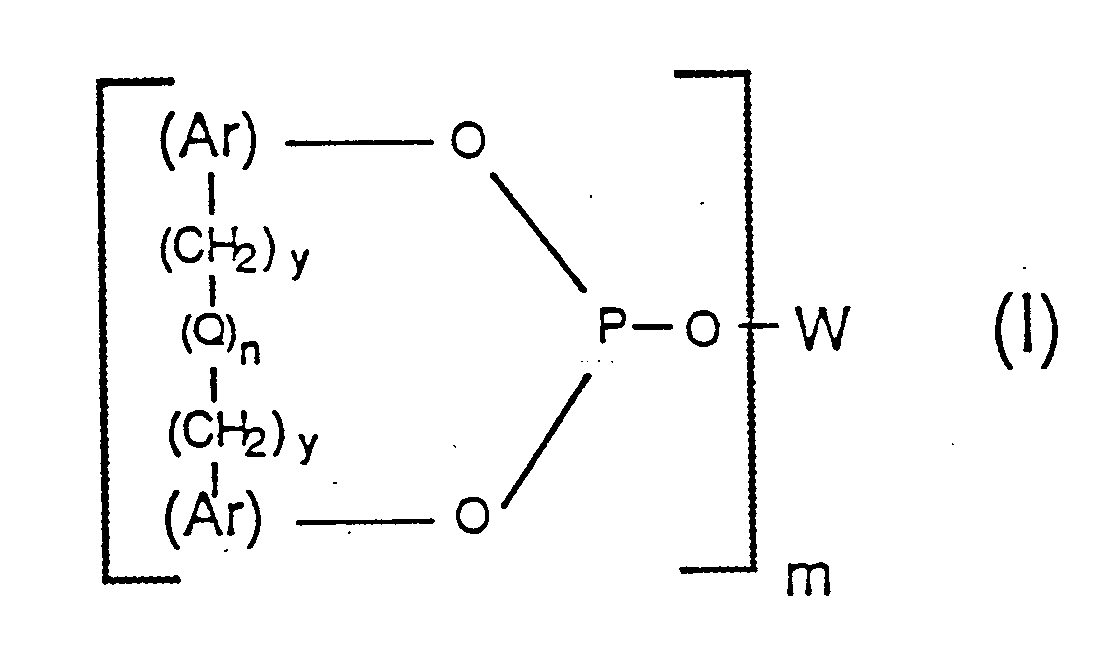
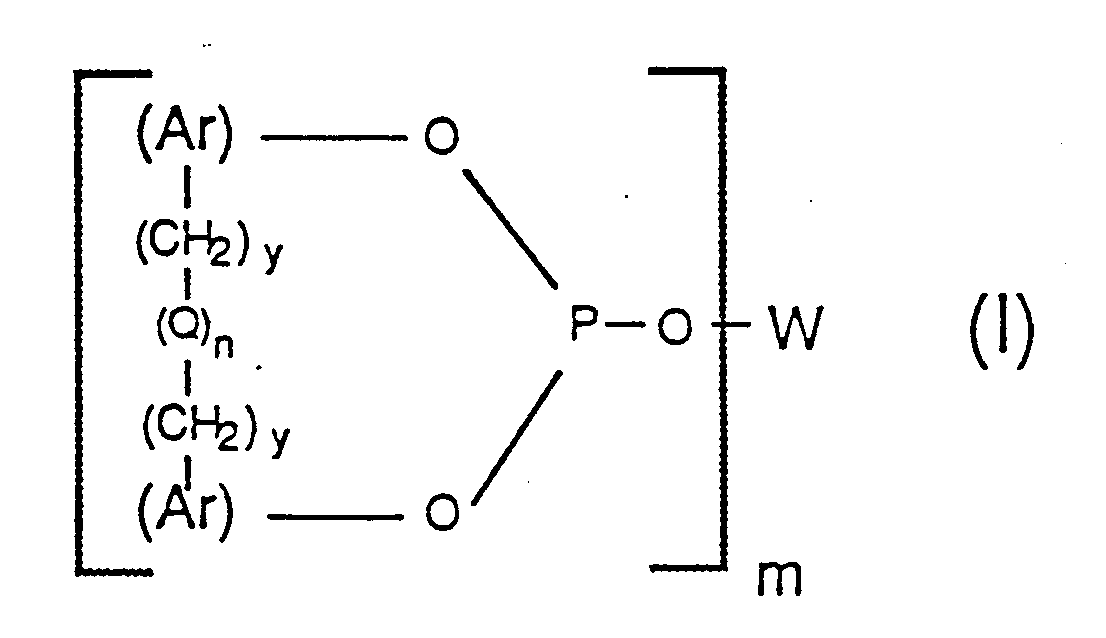
[0008] Accordingly, a generic aspect of this invention can be described as a process for carbonylation comprising reacting an organic compound capable of being carbonylated with carbon monoxide in the presence of a Group VIII transition metal-phosphorus ligand complex catalyst wherein the phosphorus ligand of said complex catalyst is a poly-phosphite ligand having the general formula:
wherein each Ar group represents an identical or different, substituted or unsubstituted aryl radical; wherein W represents a m-valent radical selected from the group consisting of alkylene, alkylene-oxy-alkylene, arylene and arylene--(CH₂)y-(Q)n-(CH₂)y-arylene, wherein each arylene radical is the same as Ar defined above; wherein each y individually has a value of 0 or 1; wherein each Q individually represents a divalent bridging group selected from the class consisting of -CR¹R²-, -O-, -S-, -NR³-, -SiR⁴R⁵- and -CO-, wherein each R¹ and R² radical individually represents a radical selected from the group consisting of hydrogen, alkyl of 1 to 12 carbon atoms, phenyl, tolyl and anisyl, wherein each R³, R⁴, and R⁵ radical individually represents -H or -CH₃; wherein each n individually has a value of 0 or 1; and wherein m has a value of 2 to 6. Preferably each R¹ and R² individually represents -H or CH₃.
[0009] Another generic aspect of this invention comprises novel Group VIII transition metal-poly-phosphite ligand complex catalyst precursor solutions as described more fully herein below.
[0010] As seen by the above formula the poly-phosphite ligands employable herein represent a different class of compounds than triorganophosphite ligands and diorganophosphite ligands of the type in said WO 85/03702. For example, if hydrolyzed the poly-phosphite ligands employable herein would yield the equivalent of three diol compounds as compared to the equivalent of three mono-ol compounds for triorganophosphite or the equivalent of two diol compounds and one mono-ol compound for the diorganophosphites of said WO 85/03702.
[0011] The subject invention encompasses the carrying out of any known carbonylation process in which the catalyst thereof is replaced by a Group VIII transition metal-poly-phosphite complex catalyst as disclosed herein. As noted above such carbonylation reactions may involve the reaction of organic compounds with carbon monoxide, or carbon monoxide and a third reactant e.g. hydrogen in the presence of a catalytic amount of a Group VIII transition metal-poly-phosphite ligand complex catalyst, said ligand being of the general Formula (I) above.
[0012] More preferably the subject invention involves the use of such a Group VIII transition metal-poly-phosphite ligand complex catalyst and free poly-phosphite ligand in the production of aldehydes wherein an olefinic compound is reacted with carbon monoxide and hydrogen. The aldehydes produced correspond to the compounds obtained by the addition of a carbonyl group to an olefinically unsaturated carbon atom in the starting material with simultaneous saturation of the olefinic bond. Such preferred processes are known in industry under varying names such as the oxo process or reaction, oxonation, the Roelen reaction and more commonly hydroformylation. Accordingly, the processing techniques of this invention may correspond to any of the known processing techniques heretofore employed in conventional carbonylation and especially hydroformylation reactions.
[0013] For instance, the preferred hydroformylation process can be conducted in continuous, semi-continuous, or batch fashion and involve a liquid recycle and/or gas recycle operation as desired. Likewise, the manner or order of addition of the reaction ingredients, catalyst and solvent are also not critical and may be accomplished in any conventional fashion.
[0014] In general, the preferred hydroformylation reaction is preferably carried out in a liquid reaction medium that contains a solvent for the catalyst, preferably one in which both the olefinically unsaturated compound and catalyst are substantially soluble. In addition, as is the case with prior art hydroformylation processes that employ a rhodium-phosphorus complex catalyst and free phosphorus ligand, it is highly preferred that the hydroformylation process of this invention be effected in the presence of free poly-phosphite ligand as well as in the presence of the complex catalyst. By "free ligand" is meant poly-phosphite ligand that is not complexed with the Group VIII transition metal atom in the active complex catalyst.
[0015] The Group VIII transition metals which make up the metal-poly-phosphite complexes of this invention include those selected from the group consisting of rhodium (Rh), cobalt (Co), iridium (Ir), ruthenium (Ru), iron (Fe), nickel (Ni), palladium (Pd), platinum (Pt), and osmium (Os), and mixtures thereof, with the preferred metals being Rh, Co, Ir and Ru, more preferably Rh and Co, especially Rh. It is to be noted that the successful practice of this invention does not depend and is not predicated on the exact structure of the catalytically active metal complex species, which may be present in their mononuclear, dinuclear and or higher nuclearity forms. Indeed the exact active structure is not known. Although it is not intended herein to be bound to any theory or mechanistic discourse, it appears that the active catalytic species may in its simplest form consist essentially of the Group VIII transition metal in complex combination with the carbon monoxide and a poly-phosphite ligand.
[0016] The term "complex" as used herein and in the claims means a coordination compound formed by the union of one or more electronically rich molecules or atoms capable of independent existence with one or more electronically poor molecules or atoms, each of which is also capable of independent existence. The poly-phosphite ligands employable herein which possess at least two phosphorus donor atoms, each having one available or unshared pair of electrons which are each capable of forming a coordinate covalent bond independently or possibly in concert (e.g. via chelation) with the Group VIII transition metal. As can be surmised from the above discussion, carbon monoxide (which is also properly classified as a ligand) is also present and complexed with the Group VIII transition metal. The ultimate composition of the active complex catalyst may also contain an additional ligand e.g. hydrogen or an anion satisfying the coordination sites or nuclear charge of the Group VIII transition metal as in the case of heretofore conventional Group VIII transition metal-triorganophosphine or phosphite catalysts. Illustrative additional ligands include e.g., halogen (Cl, Br, I), alkyl, aryl, substituted aryl, CF₃, C₂F₅, CN, R₂PO and RP(0)(OH) 0 (wherein each R is alkyl or aryl), acetate, acetylacetonate, S0₄, PF₄, PF₆, NO₂, NO₃, CH₃O, CH₂=CHCH₂, C₆H₅CN, CH₃CH, NO, NH₃, pyridine, (C₂H₅)₃N, mono-olefins, diolefins and triolefins, tetrahydrofuran, and the like. It is of course to be understood that the active complex species is preferably free of any additional organic ligand or anion that might poison the catalyst and have an undue adverse effect on catalyst performance. For instance it is known that in conventional rhodium catalyzed hydroformylation reactions that halogen anions and sulfur compounds can poison the catalyst. Accordingly it is preferred that in the rhodium catalyzed hydroformylation reactions of this invention that the active catalysts also be free of halogen and sulfur directly bonded to the rhodium, although such may not be absolutely necessary.
[0017] The number of available coordination sites on such Group VIII transition metals is well known in the art and may range in number from 4 to 6. Thus the active species may comprise a complex catalyst mixture, in their monomeric, dimeric or higher nuclearity forms, which are characterized by at least one poly-phosphite molecule complexed per one molecule of rhodium. As noted above carbon monoxide is also considered to be present and complexed with the rhodium in the active species. Moreover, as in the case of conventional rhodium-triorganophosphine or phosphite ligand complexed catalyzed hydroformylation reactions, the active catalyst species of which is generally considered to also contain hydrogen directly bonded to the rhodium, it is likewise considered that the active species of the preferred rhodium catalyst employed in this invention during hydroformylation may also be complexed with hydrogen in addition to the poly-phosphite and carbon monoxide ligands in view of the hydrogen gas employed by the process.
[0018] Moreover, regardless of whether one preforms the active complex catalyst prior to introduction into the carbonylation reaction zone or whether the active species is prepared in situ during the carbonylation reaction, it is preferred that the carbonylation, and especially the hydroformylation reaction be effected in the presence of free poly-phosphite ligand, although such may not be absolutely necessary.
[0019] The poly-phosphite ligands employable in this invention as noted above are those having the general formula
wherein each Ar group represents an identical or different substituted or unsubstituted aryl radical; wherein W represents a m-valent radical selected from the group consisting of alkylene, alkylene-oxy-alkylene, arylene and arylene-(CH₂)y-(Q-)n-(CH₂)y-arylene-, wherein each arylene radical is the same as Ar defined above; wherein each y individually has a value of 0 or 1; wherein each Q individually represents a divalent bridging group selected from the class consisting of -CR¹R²-, -0-, -S-, -NR³-, and -CO-, wherein each R¹ and R² radical individually represents a radical selected from the group consisting of hydrogen, alkyl of 1 to 12 carbon atoms, phenyl, tolyl and anisyl, wherein each R³, R⁴, and R⁵ radical individually represents -H or -CH₃; wherein each n individually has a value of 0 or 1; and wherein m has a value of 2 to 6, preferably 2 to 4. Preferably each y and each n has a value of 0. Moreover, when either n is 1, its corresponding Q is preferably a -CR¹R2 bridging group as defined above and more preferably methylene (-CH₂-) or alkylidene (-CHR²-), wherein R² is an alkyl radical of 1 to 12 carbon atoms, (e.g. methyl, ethyl, propyl, isopropyl, butyl, isodecyl, dodecyl, etc., especially methyl).
[0020] Illustrative m-valent radicals represented by W in the above poly-phosphite formula include substituted and unsubstituted radicals selected from the group consisting of alkylene, alkylene-oxy-alkylene, phenylene, naphthylene, phenylene -(CH₂)y (Q)n-(CH₂)y-phenylene and naphthylene- (CH₂)y(Q)m(CH₂)y- naphthylene-radicals, Q, n and y are the same as defined above. More specific illustrative m-valent radicals represented by W include e.g. straight or branched chain alkylene radicals such as -(CH₂)x wherein x has a value of 2 to 18 (preferably 2 to 12), pentaerythritol,1,2,6-hexylene, and the like; -CH₂CH₂OCH₂CH₂-, 1,4-phenylene, 2,3-phenylene, 1,3,5-phenylene, 1,3-phenylene, 1,4-naphthylene, 1,5-naphthylene, 1,8-naphthylene, 2,3-naphthylene, 1,1'biphenyl-2,2'-diyl, 2,2'biphenyl-1,1'-diyl, 1,1'-biphenyl-4,4'-diyl, 1,1'binaphthyl-2,2'-diyl, 2,2'-binaphthyl-1,1'-diyl, phenylene-CH₂-phenylene, phenylene-S-phenylene, CH₂-phenylene-CH₂, phenylene -CH(CH₃)-phenylene radicals and the like.
[0021] Thus w is a m-valent radical which may contain from 2 to 30 carbon atoms, wherein the alkylene and alkylene-oxy-alkylene radicals preferably contain from 2 to 18 and more preferably from 2 to 12 carbon atoms, while the arylene type radicals may contain from 6 to 18 carbon atoms. Preferably W is ethylene or an arylene type radical and more preferably a naphthylene or phenylene-(Q)n-phenylene radical.
[0022] Illustrative aryl radicals represented by the Ar groups and the arylene radicals of W in the above poly-phosphite formula include both substituted and unsubstituted aryl radicals. Such aryl radicals may contain from 6 to 18 carbon atoms such as phenylene (C₆H₄), naphthylene (C₁₀H₆), anthracylene (C₁₄H₈), and the like.
[0023] Illustrative substituent groups that may be present on the alkylene or arylene radicals of W and the aryl groups represented by Ar in the above poly-phosphite formula include monovalent hydrocarbon radicals such as substituted or unsubstituted alkyl, aryl, alkaryl, aralkyl and alicyclic radicals as well as silyl radicals such as -Si(R⁶)₃ and -Si(OR⁶)₃, amino radicals such as -N(R⁶)₂, acyl radicals such as -C(O)R⁶, carbonyloxy radicals such as -C(O)OR⁶, oxycarbonyl radicals such as -OC(O)R⁶, amido radicals such as -C(O)N(R⁶)₂ and -N(R⁶)C(O)R⁶, sulfonyl radicals such as -S(O)₂R⁶, sulfinyl radicals such as -S(O)R⁶, ether (e.g. alkoxy) radicals such as -OR⁶, thionyl ether radicals such as -SR⁶, phosphonyl radicals such as -P(O)(R⁶)₂, and halogen, nitro, cyano, trifluoromethyl and hydroxy radicals, and the like, wherein each R⁶ individually represents the same or different, substituted or unsubstituted monovalent hydrocarbon radical having the same meaning as defined herein with the proviso that in amino substituents such as -N(R⁶)₂, each R⁶ taken together can also represent a divalent bridging group that forms a heterocyclic radical with the nitrogen atom and in amino and amido substituents such as -N(R⁶)₂, -C(O)N(R⁶)₂ and -N(R⁶)C(O)R⁶ each -R⁶ bonded to N can also be hydrogen, while in phosphonyl substituents such as -P(O)(R⁶)₂, one R⁶ radical can also be hydrogen. Preferably the monovalent hydrocarbon substituent radicals, including those represented by R⁶, are unsubstituted alkyl or aryl radicals, although if desired they in turn may be substituted with any substituent which does not unduly adversely effect the process of this invention, such as e.g. those hydrocarbon and non-hydrocarbon substituent radicals already herein outlined above.
[0024] Among the more specific unsubstituted monovalent hydrocarbon substitute radicals, including those represented by R⁶, that may be bonded to the alkylene and/or the arylene radicals of W and/or the Ar groups of the above diorganophosphite formulae that may be mentioned are alkyl radicals including primary, secondary and tertiary alkyl radicals such as methyl, ethyl, n-propyl, isopropyl, butyl, sec-butyl, t-butyl, neo-pentyl, n-hexyl, amyl, sec-amyl, t-amyl, iso-octyl, decyl, and the like; aryl radicals such as phenyl, naphthyl and the like; aralkyl radicals such as benzyl, phenylethyl, triphenylmethyl, and the like; alkaryl radicals such as tolyl, xylyl, and the like; and alicyclic radicals such as cyclopentyl, cyclohexyl, 1-methylcyclohexyl, cyclooctyl, cyclohexylethyl, and the like. More specific illustrative non-hydrocarbon substituents that may be present on the alkylene and/or the arylene radicals of W and/or the Ar groups of the above diorganophosphite formula include e.g. halogen, preferably chlorine or fluorine, -NO₂, -CN, -CF₃, -OH, -Si(CH₃)₃, -Si(OCH₃)₃, -Si(C₃H₇)₃, -C(O)CH₃, -C(O)C₂H₅, -OC(O)C₆H₅, -C(O)OCH₃, -N(CH₃)₂, -NH₂, -NHCH₃, -NH(C₂H₅), -CONH₂, -CON(CH₃)₂, -S(O)₂C₂H₅, -OCH₃, -OC₂H₅, -OC₆H₅, -C(O)C₆H₅, -O(t-C₄H₉), -SC₂H₅, -OCH₂CH₂OCH₃, -(OCH₂CH₂)₂OCH₃, -(OCH₂CH₂)₃OCH₃, -SCH₃, -S(O)CH₃, -SC₆H₅, -P(O)(C₆H₅)₂, -P(O)(CH₃)₂, -P(O)(C₂H₅)₂, -P(O)(C₃H₇)₂, -P(O)(C₄H₉)₂, -P(O)(C₆H₁₃)₂, -P(O)CH₃(C₆H₅), -P(O)(H)(C₆H₅), -NHC(O)CH₃,
and the like. In general, the substituent radicals present on the alkylene and/or arylene radicals of W and/or the Ar groups of the above diorganophosphite formula may also contain from 1 to 18 carbon atoms and may be bonded to the alkylene and/or arylene radicals of W and/or Ar groups in any suitable position as may be the bridging group -(CH₂)y-(Q)n-(CH₂)y- connecting the two Ar groups or the two arylene groups of W in the above formula. Moreover, each Ar radical and/or alkylene and/or arylene radical of W may contain one or more such substituent groups which substituent groups may also be the same or different in any given diorganophosphite. Preferred substituent radicals include alkyl and alkoxy radicals containing from 1 to 18 carbon atoms and more preferably from 1 to 10 carbon atoms, especially t-butyl and methoxy.
[0025] Among the more preferred poly-phosphite ligands are those wherein the two Ar groups linked by the bridging group represented by -(CH₂)y-(Q)n -(CH₂)y- in the above poly-phosphite formula are bonded through their ortho positions in relation to the oxygen atoms that connect the Ar groups to the phosphorus atom. It is also preferred that any substituent radical, when present on such Ar groups be bonded in the para and/or ortho position of the aryl in relation to the oxygen atom that bonds the given substituted Ar group to its phosphorus atom.
[0026] Accordingly, a preferred class of poly-phosphite ligands employable in this invention are those of the formulas
wherein in said Formulas (II) and (III), Q is -CR¹R² wherein each R¹ and R² radical individually represents a radical selected from the group consisting of hydrogen, alkyl of 1 to 12 carbon atoms (e.g. methyl, propyl, isopropyl, butyl, isodecyl, dodecyl, etc.) phenyl, tolyl and anisyl, and n has a value of 0 to 1; wherein each Y¹, Y², Z², and Z³ group individually represents a radical selected from the group consisting of hydrogen, an alkyl radical having from 1 to 18 carbon atoms, substituted or unsubstituted aryl, alkaryl, aralkyl and alicyclic radicals as defined and exemplified herein above (e.g. phenyl, benzyl, cyclohexyl, 1-methylcyclohexyl, and the like), cyano, halogen, nitro, trifluoromethyl, hydroxy, as well as the carbonyloxy, amino, acyl, phosphonyl, oxycarbonyl, amido, sulfinyl, sulfonyl, silyl, alkoxy, and thionyl as defined and exemplified herein above, and wherein m has a value of 2 to 6, more preferably 2 to 4 and most preferably 2, and wherein W is a m-valent radical as generically and preferably herein defined above. Preferably both Y¹ and Y² are radicals having a steric hindrance of isopropyl, or more preferably t-butyl, or greater. Preferably Q represents a methylene (-CH₂-) bridging group or an alkylidene (-CHR²-) bridging group wherein R² is an alkyl radical of 1 to 12 carbon atoms as defined above, especially methyl (e.g. -CHCH₃ -). The more preferred ligands are those of Formula (II) above, wherein, both Y¹ and Y² are branched chain alkyl radicals having three to five carbon atoms, especially t-butyl, and Z² and Z³ are hydrogen, an alkyl radical, especially t-butyl, a hydroxy radical or an alkoxy radical, especially methoxy.
[0027] Further more preferred poly-phosphite ligands include those wherein W in the above poly-phosphite formulas is a divalent radical selected from the group consisting of alkylene, especially ethylene, alkylene-oxy-alkylene, especially CH₂CH₂OCH₂CH₂, and substituted or unsubstituted phenylene, naphthylene, naphthylene-(Q)n- naphthylene and phenylene -(Q)n-phenylene radicals wherein Q and n are the same as both generically and preferably defined above. Among the more preferred bis-phosphite type ligands when m is 2 are those wherein W is a divalent radical selected from the group consisting of 1,2-ethylene, naphthylene, substituted phenylene and substituted phenylene-(Q)n-phenylene radicals, especially 1,4-naphthylene and 1,5-naphthylene. Moreover the preferred substituents on such phenylene and/or phenylene-(Q)n-phenylene radicals are preferably radicals selected from the group consisting of alkyl and alkoxy radicals, which most preferably correspond to the substituent radicals of Y¹, Y², Z² and Z³ defined herein.
[0028] Accordingly, another preferred class of bis-phosphite ligands employable herein are those of the formulas
and
wherein in said Formulas (IV) and (V), each Y¹, Y², Q, W, Z², Z³, and n are the same as generically and preferably defined in Formulas (II) and (III) above and most preferably n is zero. Of course it is to be understood that each Y¹, Y², Q, Z², Z³ and n can be the same or different in any given phosphite. More preferably each Y¹, Y², Z² and Z³ group individually represents a radical selected from the group consisting of hydrogen, an alkyl radical having from 1 to 8 carbon atoms, substituted or unsubstituted aryl, alkaryl, aralkyl and alicyclic radicals as defined and exemplified herein above (e.g. phenyl, benzyl, cyclohexyl, 1-methylcyclohexyl, and the like), cyano, halogen, nitro, trifluoromethyl, hydroxy, as well as the carbonyloxy, amino, acyl, phosphonyl, oxycarbonyl, amido, sulfinyl, sulfonyl, silyl, alkoxy, and thionyl radicals as defined and exemplified herein above.
[0029] Preferably both Y¹ and Y² are radicals having a steric hindrance of isopropyl, or more preferably t-butyl, or greater. The more preferred ligands are those of above, wherein both Y¹ and Y² are branched chain alkyl radicals having three to five carbon atoms, especially t-butyl, and Z² and Z³ are hydrogen, an alkyl radical especially t-butyl, a hydroxy radical or an alkoxy radical, especially methoxy.
[0030] Additional illustrative examples of the poly-phosphite ligands of this invention include e.g.
and the like.
[0031] Such types of poly-phosphite ligands of the generic class employable in this invention and/or methods for their preparation are known. For instance, the poly-phosphite ligands employable in this invention can be readily and easily prepared via a series of conventional phosphorus halide-alcohol condensation reactions. Such types of condensation reactions and the manner in which they may be conducted are well known in the art. For instance a simple method for preparing such ligands may comprise (a) reacting a corresponding organic diphenolic compound with phosphorus trichloride to form the corresponding organic phosphorochloridite intermediate, (b) reacting said intermediate with a diol (corresponding to W in the above formulas) to form the corresponding hydroxy substituted diorganophosphite intermediate, (c) reacting said diorganophosphite intermediate with phosphorus trichloride to form the corresponding phosphorodichloridite intermediate and (d) reacting said dichloridite with a corresponding diol to arrive at the corresponding desired poly-phosphite ligand. Said condensation reactions are preferably carried out in the presence of a solvent, e.g. toluene, and an HCl acceptor, e.g. an amine, and may be carried out in a single-pot synthesis, if desired. For instance, desired symmetrical phosphite type ligands, such as encompassed e.g. by Formula IV above, can be directly produced by reacting two mole equivalents of the phosphorochloridite intermediate of Step (a) above with one mole equivalent of the diol corresponding to W. Moreover, the poly-phosphite ligands employable herein can be readily identified and characterized by conventional analytical techniques, such as e.g. Phosphorus-31 nuclear magnetic resonance spectroscopy and Fast Atom Bombardment Mass Spectroscopy if desired.
[0032] The poly-phosphite ligands of this invention are uniquely adaptable and suitable for processes that promote hydroformylation, especially rhodium catalyzed hydroformylation. For instance, the poly-phosphite ligands have been found to provide very good rhodium complex stability in addition to providing good catalytic activity for the hydroformylation of all types of olefins. Further their unique chemical structure should provide the ligand with very good stability against side reactions such as being hydrolyzed during hydroformylation, as well as upon storage.
[0033] Further, the poly-phosphite ligands of this invention possess high molecular weight and low volatility properties and have been found to be especially useful ligands in the homogeneous catalyzed hydroformylation of olefinically unsaturated compounds. Such is indeed surprising since due to their high molecular weight one might expect such ligands to have low solubility in the reaction media of such hydroformylation processes. Further, the use of the poly-phosphite ligands can provide an excellent means for controlling product selectivity in hydroformylation reactions. For instance, the poly-phosphites have been found to be very effective ligands for controlling aldehyde product selectivity over a wide range of low to high normal to iso (branched) product ratios and are especial useful in hydroformylating alpha and internal olefins, including isobutylene.
[0034] Without wishing to be bound to any exact theory or mechanistic discourse, it appears that it is the structural features of the poly-phosphite ligands which make them unique hydroformylation catalysts promoters capable of providing either low or high normal to iso (branched) aldehyde product ratios. These features appear to include the steric size of the phosphorus groups of the poly-phosphite as well as the steric size of the bridging group W and the relationship of the phosphorus groups to each other. It is believed that certain of such poly-phosphites may have the ability of forming chelate complexes with transition metals e.g. rhodium. Such a unique phenomenon is believed to be the primary reason responsible for the very high normal:iso aldehyde product selectivities obtainable with the use of some of the poly-phosphites in hydroformylation process of this invention.
[0035] It is believed that the high normal to iso product selectives obtained with such chelateable type ligands is a reflection of the cis chelation ability of the ligand which appears to create a steric environment around the rhodium favoring the formation of linear hydroformylation products. Moreover, the overall size of the ligand itself as well as the size of the other substituent groups in the poly-phosphite molecule are considered important factors with regard to the chelateability of the poly-phosphite ligands. Too much steric hindrance may affect the ability of the poly-phosphite to chelate while not enough steric hindrance may cause the poly-phosphite to chelate too strongly.
[0036] It is, of course, to be understood that the possible inability of other poly-phosphites to form chelate metal complexes in no way should be considered to detract from the usefulness of such poly-phosphites as ligand promoters in e.g. hydroformylation, but only that they are not on a par with regard to achieving the very high normal to iso aldehyde product ratios that may be possible with the poly-phosphites which do have such chelateability properties.
[0037] As noted above the poly-phosphite ligands defined above are employed in this invention as both the phosphorus ligand of the Group VIII transition metal complex catalyst, as well as, the free phosphorus ligand that is preferably present in the reaction medium of the process of this invention. In addition, it is to be understood that while the phosphorus ligand of the Group VIII transition metal-poly-phosphite complex catalyst and excess free phosphorus ligand preferably present in a given process of this invention are normally the same type of poly-phosphite ligand, different types of poly-phosphite ligands, as well as, mixtures of two or more different poly-phosphite ligands may be employed for each purpose in any given process, if desired.
[0038] As in the case of prior art Group VIII transition metal-phosphorus complex catalysts, the Group VIII transition metal-poly-phosphite complex catalysts of this invention may be formed by methods known in the art. For instance, preformed Group VIII transition metal hydrido-carbonyl (poly-phosphite) catalysts may possibly be prepared and introduced into the reaction medium of a hydroformylation process. More preferably, the Group VIII transition metal-poly-phosphite complex catalysts of this invention can be derived from a metal catalyst precursor which may be introduced into the reaction medium for in situ formation of the active catalyst. For example, rhodium catalyst precursors such as rhodium dicarbonyl acetylacetonate, Rh₂O₃,Rh₄(CO)₁₂, Rh₆(CO)₁₆, Rh(NO₃)₃ and the like may be introduced into the reaction medium along with the poly-phosphite ligand for the in situ formation of the active catalyst. In a preferred embodiment rhodium dicarbonyl acetylacetonate is employed as a rhodium precursor and reacted in the presence of a solvent with the poly-phosphite to form a catalytic rhodium -poly-phosphite complex precursor which is introduced into the reactor along with excess free poly-phosphite ligand for the in situ formation of the active catalyst. In any event, it is sufficient for the purpose of this invention to understand that carbon monoxide, hydrogen and poly-phosphite are all ligands that are capable of being complexed with the Group VIII transition metal, e.g. rhodium and that an active Group VIII transition metal-poly-phosphite catalyst is present in the reaction medium under the conditions of the carbonylation and more preferably hydroformylation process.
[0039] Accordingly, the Group VIII transition metal-poly-phosphite complex catalysts of this invention may be defined as consisting essentially of a Group VIII transition metal complexed with carbon monoxide and a poly-phosphite ligand, said ligand being bonded (complexed) to the metal, e.g. rhodium in a chelated and/or non-chelated fashion. Moreover, it is to be understood that the catalyst terminology "consisting essentially of" is not meant to exclude, but rather can include hydrogen complexed with the metal particularly in the case of rhodium catalyzed hydroformylation, in addition to carbon monoxide and the poly-phosphite ligand. Further, as noted above such terminology is also not meant to exclude the possibility of other organic ligands and/or anions that might also be complexed with the metal. However, such catalyst terminology preferably is meant to exclude other materials in amounts which unduly adversely poison or unduly deactivate the catalyst and thus rhodium most desirably is free of contaminants such as rhodium bound halogen e.g. chlorine, and the like, although such may not be absolutely necessary. As noted, the hydrogen and/or carbonyl ligands of an active rhodium-poly-phosphite complex catalyst may be present as a result of being ligands bound to a precursor catalyst and/or as a result of in situ formation e.g. due to the hydrogen and carbon monoxide gases employed in a hydroformylation process.
[0040] Moreover, like prior art Group VIII transition metal phosphorus ligand complex catalysts it is clear that the amount of complex catalyst present in the reaction medium of a given process of this invention need only be that minimum amount necessary to provide the given Group VIII transition metal concentration desired to be employed and which will furnish the basis for at least that catalytic amount of Group VIII transition metal necessary to catalyze the particular carbonylation process desired. In general, Group VIII transition metal concentrations in the range of from about 10 ppm to about 1000 ppm, calculated as free metal, should be sufficient for most carbonylation processes. Moreover, in the rhodium catalyzed hydroformylation processes of this invention, it is generally preferred to employ from about 10 to 500 ppm of rhodium and more preferably from 25 to 350 ppm of rhodium, calculated as free metal.
[0041] The olefinic starting material reactants encompassed by the processes of this invention can be terminally or internally unsaturated and be of straight chain, branched-chain or cyclic structure. Such olefins can contain from 2 to 20 carbon atoms and may contain one or more ethylenic unsaturated groups. Moreover, such olefins may contain groups or substituents which do not essentially adversely interfere with the hydroformylation process such as carbonyl, carbonyloxy, oxy, hydroxy, oxycarbonyl, halogen, alkoxy, aryl, haloalkyl, and the like. Illustrative olefinic unsaturated compounds include alpha olefins, internal olefins, alkyl alkenoates, alkenyl alkanoates, alkenyl alkyl ethers, alkenols, and the like, e.g. ethylene, propylene, 1-butene, 1-pentene, 1-hexene, 1-octene, 1-decene, 1-dodecene, 1-octadecene, 2-butene, 2-methyl propene (isobutylene), isoamylene, 2-pentene, 2-hexene, 3-hexene, 2-heptene, cyclohexene, propylene dimers, propylene trimers, propylene tetramers, 2-ethyl-hexene, styrene, 3-phenyl-1-propene, 1,4-hexadiene, 1,7 octadiene, 3-cyclohexyl-1-butene, allyl alcohol, hex- 1-en-4-ol, oct-1-en-4-ol, vinyl acetate, allyl acetate, 3-butenyl acetate, vinyl propionate, allyl propionate, allyl butyrate, methyl methacrylate, 3-butenyl acetate, vinyl ethyl ether, vinyl methyl ether, allyl ethyl ether, n-propyl-7-octenoate, 3-butenenitrile, 5-hexenamide, and the like. Of course, it is understood that mixtures of different olefinic starting materials can be employed, if desired, by the hydroformylation process of the subject invention. More preferably the subject invention is especially useful for the production of aldehydes, by hydroformylating alpha olefins containing from 2 to 20 carbon atoms, including isobutylene, and internal olefins containing from 4 to 20 carbon atoms as well as starting material mixtures of such alpha olefins and internal olefins.
[0042] The carbonylation and preferably hydroformylation process of this invention is also preferably conducted in the presence of an organic solvent for the Group VIII transition metal-poly-phosphite complex catalyst. Any suitable solvent which does not unduly adversely interfere with the intended carbonylation process can be employed and such solvents may include those heretofore commonly employed in known Group VIII transition metal catalyzed processes. By way of illustration suitable solvents for rhodium catalyzed hydroformylation processes include those disclosed e.g. in U.S. Pat. Nos. 3,527,809 and 4,148,830. Of course, mixtures of one more different solvents may be employed if desired. In general, in rhodium catalyzed hydroformylation it is preferred to employ aldehyde compounds corresponding to the aldehyde products desired to be produced and/or higher boiling aldehyde liquid condensation by-products as the primary solvent, such as the higher boiling aldehyde liquid condensation by-products that are produced in situ during the hydroformylation process. Indeed, while one may employ, if desired, any suitable solvent at the start up of a continuous process (aldehyde compounds corresponding to the desired aldehyde products being preferred), the primary solvent will normally eventually comprise both aldehyde products and higher boiling aldehyde liquid condensation by-products due to the nature of such continuous processes. Such aldehyde condensation by-products can also be preformed if desired and used accordingly. Moreover, such higher boiling aldehyde condensation by-products and methods for their preparation are more fully described in U.S. Pat. Nos. 4,148,830 and 4,247,486. Of course, it is obvious that the amount of solvent employed is not critical to the subject invention and need only be that amount sufficient to provide the reaction medium with the particular Group VIII transition metal concentration desired for a given process. In general, the amount of solvent when employed may range from about 5 percent by weight up to about 95 percent by weight or more based on the total weight of the reaction medium.
[0043] It is further generally preferred to carry out the carbonylation and especially the hydroformylation process of this invention in a continuous manner. Such types of continuous processes are well known in the art and may involve e.g. hydroformylating the olefinic starting material with carbon monoxide and hydrogen in a liquid homogeneous reaction medium comprising a solvent, the Group VIII transition metal-poly-phosphite catalyst, and free poly-phosphite ligand; supplying make-up quantities of the olefinic starting material, carbon monoxide and hydrogen to the reaction medium; maintaining reaction temperature and pressure conditions favorable to the hydroformylation of the olefinic starting material; and recovering the desired aldehyde hydroformylation product in any conventional manner desired. While the continuous process can be carried out in a single pass mode, i.e. wherein a vaporous mixture comprising unreacted olefinic starting material and vaporized aldehyde product is removed from the liquid reaction medium from whence the aldehyde product is recovered and make-up olefinic starting material, carbon monoxide and hydrogen are supplied to the liquid reaction medium for the next single pass through without recycling the unreacted olefinic starting material, it is generally desirable to employ a continuous process that involves either a liquid and/or gas recycle procedure. Such types of recycle procedures are well known in the art and may involve the liquid recycling of the Group VIII transition metal-poly-phosphite complex catalyst solution separated from the desired aldehyde reaction product, such as disclosed e.g. in U.S.P. 4,148,830 or a gas recycle procedure such as disclosed e.g. in U.S.P. 4,247,486, as well as a combination of both a liquid and gas recycle procedure if desired. The disclosures of said U. S. Patents 4,148,830 and 4,247,486 are incorporated herein by reference thereto. The most preferred hydroformylation process of this invention comprises a continuous liquid catalyst recycle process.
[0044] The desired aldehyde product may be recovered in any conventional manner such as described, e.g. in U.S. Patents 4,148,830 and 4,247,486. For instance, in a continuous liquid catalyst recycle process the portion of the liquid reaction solution (containing aldehyde product, catalyst, etc.) removed from the reactor can be passed to a vaporizer/separator wherein the desired aldehyde product can be separated via distillation, in one or more stages, under normal, reduced or elevated pressure, from the liquid reaction solution, condensed and collected in a product receiver, and further purified if desired. The remaining non-volatilized catalyst containing liquid reaction solution may then be recycled back to the reactor as may if desired any other volatile materials, e.g. unreacted olefin, together with any hydrogen and carbon monoxide dissolved in the liquid reaction solution after separation thereof from the condensed aldehyde product, e.g. by distillation in any conventional manner. In general, it is preferred to separate the desired aldehyde product from the rhodium catalyst containing product solution under reduced pressure and at low temperatures such as below 150°C and more preferably below 130°C.
[0045] As noted above, the carbonylation process and especially the hydroformylation process of this invention is preferably carried out in the presence of free poly-phosphite ligand, i.e. ligand that is not complexed with the Group VIII transition metal of the metal complex catalyst employed. Thus the free poly-phosphite ligand may correspond to any of the above defined poly-phosphite ligands discussed above. However, while it is preferred to employ a free poly-phosphite ligand that is the same as the poly-phosphite ligand of the Group VIII transition metal-poly-phosphite complex catalyst such ligands need not be the same in a given process, but can be different if desired. While the carbonylation and preferably hydroformylation process of this invention may be carried out in any excess amount of free poly-phosphite ligand desired, e.g. at least one mole of free poly-phosphite ligand per mole of Group VIII transition metal present in the reaction medium, the employment of free poly-phosphite ligand may not be absolutely necessary. Accordingly, in general amounts of poly-phosphite ligand of from about 2 to about 100, or higher if desired, and preferably from about 4 to about 50, moles per mole of Group VIII transition metal (e.g. rhodium) present in the reaction medium should be suitable for most purposes, particularly with regard to rhodium catalyzed hydroformylation; said amounts of poly-phosphite ligand employed being the sum of both the amount of poly-phosphite that is bound (complexed) to the Group VIII transition metal present and the amount of free (non-complexed) poly-phosphite ligand present. Of course, if desired, make-up poly-phosphite ligand can be supplied to the reaction medium of the hydroformylation process, at any time and in any suitable manner, to maintain a predetermined level of free ligand in the reaction medium.
[0046] The ability to carry out the process of this invention in the presence of free poly-phosphite ligand is an important beneficial aspect of this invention in that it removes the criticality of employing very low precise concentrations of ligand that may be required of certain complex catalysts whose activity may be retarded when even any amount of free ligand is also present during the process, particularly when large scale commercial operations are involved, thus helping to provide the operator with greater processing latitude.
[0047] The reaction conditions for effecting a carbonylation and more preferably a hydroformylation process of this invention may be those heretofore conventionally used and may comprise a reaction temperature of from about 45°C to about 200°C and pressures ranging from about 6.9 kPa to 68.95 MPa (1 to 10,000 psia), While the preferred carbonylation process is the hydroformylation of olefinically unsaturated compounds and more preferably olefinic hydrocarbons, with carbon monoxide and hydrogen to produce aldehydes, it is to be understood that the Group VIII transition metal-poly-phosphite complexes of this invention may be employed as catalysts in any other type of prior art carbonylation process to obtain good results. Moreover, while such other prior carbonylation art processes may be performed under their usual conditions, in general it is believed that they may be performed at lower temperatures than normally preferred due to the Group VIII transition metal-poly-phosphite complex catalysts of this invention.
[0048] As noted the more preferred process of this invention involves the production of aldehydes via hydroformylation of an olefinic unsaturated compound with carbon monoxide and hydrogen in the presence of a Group VIII transition metal-poly-phosphite complex catalyst and free poly-phosphite ligand, especially a rhodium-poly-phosphite complex catalyst.
[0049] The poly-phosphite ligands employable herein provide an excellent means for controlling product selectivity and obtaining a wide range of low to high linear (normal) to branched (isomer) aldehyde product ratios in hydroformylation reactions. Moreover the ability to hydroformylate both alpha and internal olefins with ease allows one to hydroformylate both types of olefins (e.g. mixtures of butene-1 and butene-2) concurrently with comparable facility from the same starting material mixture. Such is highly beneficial to the art since such mixed alpha olefin and internal olefin starting materials are readily available and are the most economical olefin feedstocks. Moreover, the versatility of the poly-phosphite ligands employable herein lend themselves readily to the continuous hydroformylation of both alpha-olefins and internal olefins wherein different reactors in series may be employed. Such ability not only provides one with the processing latitude of further hydroformylating in the second reactor any unreacted olefin passed to it from the first reactor but also allows one, if desired, to optimize the reaction conditions for hydroformylation of e.g. the alpha-olefin in the first reactor, while also optimizing the reaction conditions for the hydroformylation of e.g. the internal olefin in the second reactor.
[0050] Of course, it is to be understood that while the optimization of the reaction conditions necessary to achieve the best results and efficiency desired are dependent upon one's experience in the utilization of the subject hydroformylation invention, only a certain measure of experimentation should be necessary to ascertain those conditions which are optimum for a given situation and such should be well within the knowledge of one skilled in the art and easily obtainable by following the more preferred aspects of this invention as explained herein and/or by simple routine experimentation.
[0051] For instance, the total gas pressure of hydrogen, carbon monoxide and olefinic unsaturated starting compound of the hydroformylation process of this invention may range from about 6.9 kPa to 68.95 MPa (1 to 10,000 psia), More preferably, however, in the hydroformylation of olefins to produce aldehydes it is preferred that the process be operated at a total gas pressure of hydrogen, carbon monoxide and olefinic unsaturated starting compound of less than about 10.34 MPa (1500 psia) and more preferably less than about 3.45 MPa (500 psia). The minimum total pressure of the reactants is not particularly critical and is limited predominately only by the amount of reactants necessary to obtain a desired rate of reaction. More specifically the carbon monoxide partial pressure of the hydroformylation process of this invention is preferably from about 6.9 to 827.4 kPa (1 to 120 psia) and more preferably from about 20.7 to 620.6 kPa (3 to 90 psia), while the hydrogen partial pressure is preferably about 103.4 to 1103.2 kPa (15 to 160 psia) and more preferably from about 206.8 to 689.5 kPa (30 to 100 psia). In general the H₂:CO molar ratio of gaseous hydrogen to carbon monoxide may range from about 1:10 to 100:1 or higher, the more preferred hydrogen to carbon monoxide molar ratio being from about 1:1 to about 10:1.
[0052] Further as noted above the hydroformylation process of this invention may be conducted at a reaction temperature from about 45°C to about 200°C. The preferred reaction temperature employed in a given process will of course be dependent upon the particular olefinic starting material and metal catalyst employed as well as the efficiency desired. In general, hydroformylations at reaction temperatures of about 50°C to about 120°C are preferred for all types of olefinic starting materials. More preferably, alpha-olefins can be effectively hydroformylated at a temperature of from about 60°C to about 110°C while even less reactive olefins than conventional linear alpha-olefins such as isobutylene and internal olefins as well as mixtures of alpha-olefins and internal olefins are effectively and preferably hydroformylated at a temperature of from about 70°C to about 120°C. Indeed in the rhodium-catalyzed hydroformylation process of this invention no substantial benefit is seen in operating at reaction temperatures much above 120°C. and such is considered to be less desirable.
[0053] As outlined herein the carbonylation and more preferably hydroformylation process of this invention can be carried out in either the liquid or gaseous state and involve a continuous liquid or gas recycle system or combination of such systems. Preferably the rhodium catalyzed hydroformylation of this invention involves a continuous homogeneous catalysis process wherein the hydroformylation is carried out in the presence of both free poly-phosphite ligand and any suitable conventional solvent as further outlined herein.
[0054] Thus in general the use of the poly-phosphite ligands of this invention are unique in that they provide very good catalytically active and stable rhodium catalysts. Moreover the low volatility possessed by such high molecular weight poly-phosphite ligands renders them especially suitable for use in hydroformylating higher olefins, e.g. olefins of four or more carbon atoms. For example volatility is related to molecular weight and is inversely proportional to molecular weight within a homologus series. Accordingly it is generally desirable to employ a phosphorus ligand whose molecular weight exceeds that of the higher boiling aldehyde by-product trimer corresponding to the aldehyde being produced in the hydroformylation process in order to avoid or at least minimize possible ligand loss during removal via distillation of the aldehyde product and/or higher boiling aldehyde condensation by products, when desired, from the reaction system. Thus for instance, since the molecular weight of valeraldehyde trimer is about 250 (C₁₅H₃₀O₃) and all the poly-phosphites of this invention well exceed 250 in molecular weight, there should not be any unduly detrimental loss of the poly-phosphite ligand during such higher product aldehyde and/or such higher boiling aldehyde by-product removal from the reaction system.
[0055] Moreover, in a continuous liquid rhodium-triorganophosphite catalyzed recycle process an undesirable hydroxy alkyl phosphine acid by-product may result due to reaction of the triorganophosphite ligand and aldehyde product over the course of such a continuous process causing a loss of ligand concentration. Such an acid is often insoluble in the general liquid hydroformylation reaction medium and can lead to precipitation of an undesirable gellatinous by-product and may also promote the autocatalytic formation of itself. The poly-phosphite ligands of this invention should have very good stability against the formation of such acid. However if such a problem does occur with the use of the poly-phosphite ligands of this invention it is considered that it may be effectively and preferably controlled by passing the liquid reaction effluent stream of a continuous liquid recycle process either prior to or more preferably after separation of the aldehyde product therefrom through any suitable weakly basic anion exchange resin, such as a bed of amine-Amberlyst® resin, e.g. Amberlyst® A-21, and the like, to remove some or all of the undesirable hydroxy alkyl phosphonic acid by-product that might be present in the liquid catalyst containing stream prior to its reincorporation into the hydroformylation reactor. Of course if desired, more than one such basic anion exchange resin bed, e.g. a series of such beds, may be employed and any such bed may be easily removed and/ or replaced as required or desired. Alternatively if desired, any part or all of the hydroxy alkyl phosphonic acid contaminated catalyst recycle stream may be periodically removed from the continuous recycle operation and the contaminated liquid so removed treated in the same fashion as outlined above, to eliminate or reduce the amount of hydroxy alkyl phosphonic acid contained therein prior to reusing the catalyst containing liquid in the hydroformylation process. Likewise, any other suitable method for removing such hydroxy alkyl phosphonic acid by-product from the hydroformylation process of this invention may be employed herein if desired such as by extraction of the acid with a weak base, e.g. sodium bicarbonate.
[0056] A further aspect of this invention can be described as a catalyst precursor composition consisting essentially of a solubilized Group VIII transition metal-poly-phosphite complex precursor catalyst, an organic solvent and free poly-phosphite ligand. Such precursor compositions may be prepared by forming a solution of a Group VIII transition metal starting material, such as a metal oxide, hydride, carbonyl or salt e.g. a nitrate, which may or may not be in complex combination with a poly-phosphite ligand, an organic solvent and a free poly-phosphite ligand as defined herein. Any suitable Group VIII transition metal starting material may be employed e.g. rhodium dicarbonyl acetylacetonate, Rh₂O₃, Rh₄ (CO)₁₂, Rh₆(CO)₁₆, Rh(NO₃)₃, poly-phosphite rhodium carbonyl hydrides, iridium carbonyl, poly-phosphite iridium carbonyl hydrides, osmium halide, chlorosmic acid, osmium carbonyls, palladium hydride, palladous halides, platinic acid, platinous halides, ruthenium carbonyls, as well as other salts of other Group VIII transition metals and carboxylates of C₂-C₁₆ acids such as cobalt chloride, cobalt nitrate, cobalt acetate, cobalt octoate, ferric acetate, ferric nitrate, nickel fluoride, nickel sulfate, palladium acetate, osmium octoate, iridium sulfate, ruthenium nitrate, and the like. Of course any suitable solvent may be employed such as e.g. those employable in the carbonylation process desired to be carried out. The desired carbonylation process may of course also dictate the various amounts of metal, solvent and ligand present in the precursor solution. Carbonyl and poly-phosphite ligands if not already complexed with the initial Group VIII transition metal may be complexed to the metal either prior to or in situ during the carbonylation process. By way of illustration, since the preferred Group VIII transition metal is rhodium and since the preferred carbonylation process is hydroformylation, the preferred catalyst precursor composition of this invention consists essentially of a solubilized rhodium carbonyl poly-phosphite complex precursor catalyst, an organic solvent and free poly-phosphite ligand prepared by forming a solution of rhodium dicarbonyl acetylacetonate, an organic solvent and a poly-phosphite ligand as defined herein. The poly-phosphite readily replaces one of the dicarbonyl ligands of the rhodium-acetylacetonate complex precursor at room temperature as witnessed by the evolution of carbon monoxide gas. This substitution reaction may be facilitated by heating the solution if desired. Any suitable organic solvent in which both the rhodium dicarbonyl acetylacetonate complex precursor and rhodium poly-phosphite complex precursor are soluble can be employed. Accordingly, the amounts of rhodium complex catalyst precursor, organic solvent and poly-phosphite, as well as their preferred embodiments present in such catalyst precursor compositions may obviously correspond to those amounts employable in the hydroformylation process of this invention and which have already been discussed herein. Experience has shown that the acetylacetonate ligand of the precursor catalyst is replaced after the hydroformylation process has begun with a different ligand, e.g. hydrogen, carbon monoxide or poly-phosphite ligand, to form the active rhodium complex catalyst as explained above. The acetylacetone which is freed from the precursor catalyst under hydroformylation conditions is removed from the reaction medium with the product aldehyde and thus is in no way detrimental to the hydroformylation process. The use of such preferred rhodium complex catalytic precursor compositions thus provides a simple economical and efficient method for handling the rhodium precursor metal and hydroformylation start-up.
[0057] Finally, the aldehyde products of the hydroformylation process of this invention have a wide range of utility that is well known and documented in the prior art e.g. they are especially useful as starting materials for the production of alcohols and acids.
[0058] The following examples are illustrative of the present invention and are not to be regarded as limitative. It is to be understood that all of the parts, percentages and proportions referred to herein and in the appended claims are by weight unless otherwise indicated. In the formulas of this specification a tertiary butyl radical is represented by -C[CH₃]₃, or t-Bu, while a nonyl or [-C₉H₁₉] radical represents branched mixed nonyl radicals. Likewise -OMe represents a methoxy radical; -C₆H₅ represents a phenyl radical and sometimes -H is used to indicate the absence of any substituent other than hydrogen in that particular position of the formula.
EXAMPLE 1
[0059] A rhodium complex catalyst precursor solution consisting essentially of the solubilized reaction product of rhodium dicarbonyl acetylacetonate and a poly-phosphite ligand was prepared and employed to hydroformylate butene-1 into C₅ aldehydes in the following manner.
[0060] Rhodium dicarbonyl acetylacetonate was mixed at ambient temperature with a poly-phosphite ligand having the formula:
and valeraldehyde trimer as solvent to produce a rhodium catalytic precursor solution containing the amounts of rhodium and ligand shown in Table 1 below.
[0061] The rhodium catalytic precursor solution so prepared was then employed to hydroformylate butene-1 in a magnetically stirred, 100 mℓ capacity, stainless steel autoclave which was attached to a gas manifold for introducing gases to the desired partial pressures. The autoclave was also equipped with a pressure calibrator for determining reaction pressure to ± 6.9 Pa (0.01 psia) and a platinum resistance thermometer for determining reactor solution temperature to ± 0.1°C. The reactor was heated externally by two 300 watt heating bands. The reactor solution temperature was controlled by a platinum resistance sensor connected to an external proportional temperature controller for controlling the temperature of the external band heaters.
[0062] About 15 milliliters (about 14 grams) of the rhodium catalytic precursor solution so prepared was charged to the autoclave reactor under nitrogen and heated to the reaction temperature employed (as given in Table 1 below). The reactor was then vented down to 135.8 kPa (5 psig) and 2.5 mℓ (about 1.5 grams) of butene-1 introduced into the reactor. Then carbon monoxide and hydrogen (partial pressures given in Table 1) were introduced into the reactor via the gas manifold and the butene-1 so hydroformylated.
[0063] The hydroformylation reaction rate in gram moles per liter per hour of C₅ aldehydes produced was determined from sequential 34.5 kPa (5 psia) pressure drops in the reactor spanning the nominal operating pressure in the reactor, while the mole ratio of linear (n-valeraldehyde) to branched (2-methylbutyraldehyde) product was measured by gas chromatography and the results are given in Table 1 below, said results being determined after about a 5 to 20 percent conversion of the butene-1 starting material.
Table 1
| Ligand/Rhodium Mole Ratio | Reaction Rate Gram Moles/Liter/Hour | Linear/Branched C₅ Aldehyde Mole Ratio |
| 4.1 | 6.0 | 50.5 |
| Precursor Solution and Reaction Conditions: 250 ppm rhodium; 2 weight percent bis-phosphite ligand; 70°C.; 689.5 kPa (100 psia) CO:H2 (1:2 mole ratio); 35 psia butene-1 (2.5 mℓ butene-1) (Ligand/Rhodium mole ratio of about 8.6). |
||
EXAMPLE 2
[0064] The same procedure and conditions employed in Example 1 of preparing a rhodium catalytic precursor solution using rhodium dicarbonyl acetylacetonate, valeraldehyde trimer as solvent and the same poly-phosphite ligand used in Example 1 and hydroformylating butene-1 were repeated, save for hydroformylating propylene instead of butene-1 and using a premixed gas composition of carbon monoxide, hydrogen and propylene after having adjusted the reaction pressure to 137.9 kPa (20 psia) with nitrogen and varying the rhodium complex catalyst precursor solution and hydroformylation reaction conditions as shown in Table 2 below. The hydroformylation reaction rate in terms of gram moles per liter per hour of butyraldehyde produced as well as the mole ratio of linear (n-butyraldehyde) to branched (isobutyraldehyde) product were determined and the results are given in Table 2 below.
Table 2
| Reaction Rate Gram Moles/Liter/Hour | Linear/Branched Butyraldehyde Mole Ratio |
| 1.31 | 11.0 |
| Precursor Solution and Reaction Conditions: 250 ppm rhodium; 4 moles equivalents of bis-phosphite ligand per mole equivalent of rhodium; 70°C; 620.5 kPa (90 psia) CO:H₂ Propylene (1:1:1 mole ratio) |
|
EXAMPLE 3
[0065] The same procedure and conditions employed in Example 1 of preparing a rhodium catalytic precursor solution using rhodium dicarbonyl acetylacetonate, valeraldehyde trimer as solvent and a poly-phosphite ligand and hydroformylating butene-1 were repeated using the various poly-phosphite ligands having the formula:
wherein W is a divalent bridging group as shown in Table 3 below, rhodium complex catalyst precursor solutions and hydroformylation reaction conditions as shown in said Table 3. The hydroformylation reaction rate in terms of gram moles per liter per hour of C₅ aldehydes (pentenals) produced as well as the mole ratio of linear (n-valeraldehyde) to branched (2-methylbutyraldehyde) product were determined in the same manner as in Example 1 and the results are given in Table 3 below.
EXAMPLE 4
[0066] The same procedure and conditions employed in Example 2 of preparing a rhodium catalytic precursor solution using rhodium dicarbonyl acetylacetonate, valeraldehyde trimer as solvent and a phosphite ligand and hydroformylating propylene were repeated using the various bis-phosphite ligands having the formula:
wherein W is a divalent bridging group as shown in Table 4 below, rhodium complex catalyst precursor solutions and hydroformylation reaction conditions as shown in Table 4 below. The hydroformylation reaction rate in terms of gram moles per liter per hour of butyraldehyde produced as well as the mole ratio of linear (n-butyraldehyde) to branched (isobutyraldehyde) product were determined and the results are given in Table 4 below.
EXAMPLE 5
[0067] Continuous hydroformylation of butene-1 using a poly-phosphite ligand was conducted in the following manner.
[0068] The hydroformylation was conducted in a glass reactor operating in a continuous single pass butene-1 hydroformylation mode. The reactor consisted of a three-ounce pressure bottle submersed in an oil bath with a glass front for viewing. About 20-mℓ of a freshly prepared rhodium catalytic precursor solution was charged to the reactor with a syringe, after purging the system with nitrogen. The precursor solution contained about 250 ppm rhodium introduced as rhodium dicarbonyl acetylacetonate, about 2 weight percent of a bis-phosphite ligand of the formula
(about 8.5 mole equivalents per mole equivalent of rhodium) and Texanol® (2,2,4-trimethyl-1,3-pentanediol monoisobutyrate) as the solvent. After closing the reactor, the system was again purged with nitrogen and the oil bath was heated to furnish the desired hydroformylation reaction temperature. The hydroformylation reaction was conducted at a total gas pressure of about 1204.5 kPa (160 psig), the partial pressures of hydrogen, carbon monoxide, and butene-1 being given in Table 5 below, the remainder being nitrogen and aldehyde product. The flows of the feed gases (carbon monoxide, hydrogen, butene-1 and nitrogen) were controlled individually with mass flow meters and the feed gases dispersed into the precursor solution via fritted spargers. The reaction temperatures are given in Table 5 below. The unreacted portion of the feed gases was stripped out the product C₅ aldehydes and the outlet gas analyzed over about 5 days of continuous operation. The approximate daily average reaction rate in terms of gram moles per liter per hour of product C₅ aldehydes, as well as the linear (n-valeraldehyde) to branched (2-methylbutyraldehyde) product ratio are given in Table 5 below.
POLY-PHOSPHITE LIGANDS
[0069] The following poly-phosphite ligands were prepared and employed in the following Examples 6 to 9, 11 and 12 as described below.
EXAMPLE 6
[0070] A series of various rhodium complex catalyst precursor compositions consisting essentially of solubilized reaction product of rhodium dicarbonyl acetylacetonate and a poly-phosphite ligand were prepared and employed to hydroformylate butene-1 into C₅ aldehydes in the following manner.
[0071] Rhodium dicarbonyl acetylacetonate was mixed with a sufficient amount of poly-phosphite ligand and diluted with sufficient solvent, Texanol®, to produce a rhodium catalytic precursor solution containing about 350 ppm of rhodium calculated as free metal and about 1 wt. % of ligand, the ligand being varied as given Table 6 below. About 5 wt. % toluene was included in catalyst precursor as a gas chromatographic internal standard.
[0072] In each hydroformylation reaction, about 15 milliliters of the rhodium catalytic precursor solution so prepared was charged to the autoclave reactor under nitrogen, evacuated to about 4 psia under house vacuum, then heated to the hydroformylation reaction temperature of 90°C. Thereupon 2 ml (about 1.2 g.) of butene-1 was introduced into the reactor followed by 689.5 kPa (100 psia) CO:H₂ (1:1 mole ratio) and the butene-1 so hydroformylated. After each 34.5 kPa (5 psia) drop in reactor pressure, makeup CO:H₂ was supplied to the reactor to adjust the reactor back to its initial pressure. After 10 consecutive 5 psia pressure drops 344.8 kPa (50 psia total) corresponding to an approximately 30% conversion of the butene-1, the reaction was terminated and the total reaction time noted (i.e. the period spanning the time from when the initial 689.5 kPa (100 psia) of CO:H₂ was introduced to when the reaction was terminated). After discharging from the reactor, the reaction mixture was analyzed for total C₅ aldehyde produced by gas chromatography employing the toluene internal standard.
[0073] The hydroformylation reaction rate in gram moles per liter per hour of C₅ aldehydes was determined from the measured total amount of C₅ aldehyde produced over the total reaction time per volume of catalyst solution employed. The mole ratio of linear (n-valeraldehyde) to branched (2-methylbutyraldehyde) was also measured by gas chromatography. The results are given in Table 6 below.
Table 6
| Ligand | Reaction Rate g-mol/L/Hr | Linear/Branched Aldehyde Mole Ratio |
| A | 3.27 | 2.54 |
| B | 12.80 | 1.97 |
| C | 2.67 | 2.06 |
| D | 1.55 | 2.16 |
| E | 8.29 | 1.87 |
| F | 6.50 | 1.85 |
| G | 7.82 | 2.13 |
| H | 6.77 | 2.32 |
| I | 14.03 | 1.63 |
| J | 6.39 | 1.87 |
| K | 8.00 | 1.61 |
| L² | 5.67 | 2.27 |
| L³ | 4.63 | 3.76 |
| L⁴ | 3.76 | 2.24 |
| L⁵ | 5.54 | 2.20 |
| L⁶ | 4.64 | 2.20 |
| L⁷ | 5.51 | 2.42 |
| L⁸ | 6.48 | 2.41 |
| M | 5.77 | 9.94 |
| N | 3.51 | 1.94 |
EXAMPLE 7
[0074] Butene-2 (about 50:50 mole mixture of cis and transbutene-2) was hydroformylated in the same manner described in Example 6 employing the same series of rhodium complex catalyst precursor solutions. The hydroformylation reaction rates in gram moles per liter per hour of C₅ aldehyde and mole ratios of linear (n-valeraldehyde) to branched (2-methylbutyraldehyde) are given in Table 7.
Table 7
| Ligand | Reaction Rate g-mol/L/Hr | Linear/Branched Aldehyde Mole Ratio |
| A | 0.10 | 0.53 |
| B | 3.98 | 0.51 |
| C | 0.18 | 0.44 |
| D | 0.12 | 0.41 |
| E | 3.76 | 0.56 |
| F | 3.39 | 0.53 |
| G | 3.34 | 0.54 |
| H | 1.74 | 0.31 |
| I | 7.08 | 0.56 |
| J | 1.10 | 0.45 |
| K | 5.63 | 0.57 |
| L² | 1.52 | 0.33 |
| L³ | 0.32 | 0.64 |
| L⁴ | 1.63 | 0.27 |
| L⁵ | 1.32 | 0.25 |
| L⁶ | 1.04 | 0.22 |
| L⁷ | 1.29 | 0.25 |
| L⁸ | 1.79 | 0.25 |
| M | 0.23 | 2.83 |
| N | 0.98 | 0.19 |
| O | 1.22 | 0.27 |
| P | 0.96 | 0.29 |
EXAMPLE 8
[0075] Iso-Butylene was hydroformylated in the same manner described in Example 6 employing the same series of rhodium complex catalyst precursor solutions. The hydroformylation reaction rates in gram moles per liter per hour of C₅ aldehyde are given in Table 8. One product 3-methyl-butyraldehyde is formed.
Table 8
| Ligand | Reaction Rate g-mol/L/Hr |
| B | 2.20 |
| E | 2.87 |
| F | 1.84 |
| G | 1.51 |
| H | 1.30 |
| I | 3.04 |
| J | 0.41 |
| K | 2.11 |
| L² | 1.00 |
| L³ | 0.51 |
| L⁴ | 1.08 |
| L⁵ | 0.94 |
| L⁶ | 0.69 |
| L⁷ | 0.95 |
| L⁸ | 1.16 |
| N | 0.55 |
| O | 0.85 |
| P | 0.58 |
EXAMPLE 9
[0076] The same series of rhodium complex catalyst precursor solutions of Example 6 were employed to hydroformylate propylene. The same procedure in Example 6 was employed with the exception that in place of butene-1, about 262 kPa (38 psia) propylene was added to the reactor at 90°C followed by 689.5 kPa (100 psi) CO:H₂ (1:1 mole ratio).
[0077] The hydroformylation reaction rates of C₄ aldehydes in gram moles per liter per hour and mole ratio of straight chain (n-butyraldehyde) to branched (iso-butyraldehyde) product are given in Table 9.
Table 9
| Ligand | Reaction Rate g-mol/L/Hr | Linear/Branched Aldehyde Mole Ratio |
| A | 1.84 | 1.32 |
| B | 9.05 | 1.05 |
| C | 1.35 | 1.12 |
| D | 1.00 | 1.59 |
| E | 6.93 | 0.98 |
| F | 6.31 | 0.97 |
| G | 6.96 | 1.11 |
| J | 3.90 | 1.04 |
| L² | 4.54 | 1.32 |
| L³ | 2.92 | 2.39 |
| L⁴ | 2.83 | 1.29 |
| L⁵ | 3.60 | 1.30 |
| L⁶ | 3.37 | 1.30 |
| L⁷ | 4.22 | 1.37 |
| L⁸ | 6.74 | 1.38 |
| M | 2.71 | 4.78 |
| N | 2.33 | 1.18 |
| O | 2.49 | 1.31 |
| P | 2.97 | 1.35 |
EXAMPLE 10
[0078] A symmetrical unsubstituted poly-phosphite ligand of the formula
did not promote propylene or butene-1 hydroformylation when used in excess relative to the rhodium. This ligand, however, promoted the hydroformylation of propylene when it was used in a 2:1 ligand to rhodium stoichiometry. For instance, a linear butyraldehyde to branched isomer ratio of 2.0 to 1 and a reaction rate of 1.16 gram-mole per liter per hour of aldehyde product was obtained using 500 ppm rhodium, 0.3 weight percent bis-phosphite ligand and 620.6 kPa (90 psia) CO:H₂:Propylene (1:1:1 mole ratio) at 70°C.
EXAMPLE 11
[0079] Continuous hydroformylation of butene-2 (about a 1:1 mole mixture of cis and trans butene-2) was conducted in the same manner as described in Example 5, using as the poly-phosphite ligand, Ligand E depicted above, and the rhodium precursor complex solution (about 3.2 mole equivalents of ligand per mole equivalent of rhodium) and the reaction conditions given in Table 11 below. The average reaction rates in terms of gram moles per liter per hour of product C₅ aldehydes as well as the linear n-valeraldehyde to branched 2-methylbutyraldehyde product ratio are also given in Table 11.
EXAMPLE 12
[0080] The rhodium complex stability of various rhodium-poly-phosphite complexes using the poly-phosphite ligands J, L², L⁴, L⁸ and Q formulas shown above, was determined according to the following test procedure.
[0081] 10 ml of Texanol* was degassed in a small septum-stoppered glass bottle by evacuation and refilling with nitrogen. Ten mole equivalents of the appropriate ligand (per mole equivalent of rhodium) were added under nitrogen and the mixture stirred until homogeneous. Tetrarhodium dodecacarbonyl (0.018 grams) was added to give a complex solution containing 1000 ppm rhodium. This solution was charged to a nitrogen-flushed 100 ml pressure bottle equipped with a magnetic stirrer, which was then attached to a nitrogen flushed gas manifold. The bottle was flushed three times with 60 psia CO:H₂ (1:1 mole ratio) and placed under 414 kPa (60 psia) CO:H₂ (1:1 mole ratio) and stirred for one hour at 120°C. The pressure was then vented and the bottle flushed three times with hydrogen. The solution was then placed under 69 kPa (10 psia) H₂ and stirred for 20 hours at 120°C. The solution was cooled and a 2 to 3 ml aliquot was filtered through a 5 micron Millipore® filter and the rhodium concentration of the filtrate determined by flame atomic absorption spectroscopy. The percent of the rhodium retained in solution was determined by dividing the found rhodium concentration value by the initial rhodium concentration employed The results are given in Table 12.
TABLE 12
| Ligand | Rhodium Retention (%) |
| L⁴ | 59 |
| L⁸ | 64 |
| Q | 88 |
| J | 94 |
| L² | 100 |
1. A process for carbonylation comprising reacting an organic compound capable of being
carbonylated with carbon monoxide in the presence of a Group VIII transition metal-poly-phosphite
complex catalyst consisting essentially of a Group VIII transition metal complexed
with carbon monoxide and a poly-phosphite ligand having the formula:
wherein each Ar group represents an identical or different, substituted or unsubstituted aryl radical; wherein W represents a m-valent radical selected from alkylene, alkylene-oxy-alkylene, arylene and arylene-(CH₂)y-(Q)n-(CH₂)y-arylene, wherein each arylene radical is the same as Ar defined above; wherein each y individually has a value of 0 or 1; wherein each Q individually represents a divalent bridging group selected from -CR¹R²-, -O-, -S-, -NR³-, -SiR⁴R⁵- and -CO-, wherein each R¹ and R² radical individually represents a radical selected from hydrogen, alkyl of 1 to 12 carbon atoms, phenyl, tolyl and anisyl, wherein each R³, R⁴, and R⁵ radical individually represents -H or -CH₃; wherein each n has a value of 0 or 1; and wherein m has a value of 2 to 6.
wherein each Ar group represents an identical or different, substituted or unsubstituted aryl radical; wherein W represents a m-valent radical selected from alkylene, alkylene-oxy-alkylene, arylene and arylene-(CH₂)y-(Q)n-(CH₂)y-arylene, wherein each arylene radical is the same as Ar defined above; wherein each y individually has a value of 0 or 1; wherein each Q individually represents a divalent bridging group selected from -CR¹R²-, -O-, -S-, -NR³-, -SiR⁴R⁵- and -CO-, wherein each R¹ and R² radical individually represents a radical selected from hydrogen, alkyl of 1 to 12 carbon atoms, phenyl, tolyl and anisyl, wherein each R³, R⁴, and R⁵ radical individually represents -H or -CH₃; wherein each n has a value of 0 or 1; and wherein m has a value of 2 to 6.
2. A hydroformylation process for producing aldehydes as defined in claim 1, which comprises
reacting an olefinically unsaturated organic compound with carbon monoxide and hydrogen
in the presence of a complex catalyst as defined in claim 1.
3. A hydroformylation process for producing aldehydes as defined in claim 1 or 2, wherein
the process is carried out in the presence of a free poly-phosphite ligand having
the formula:
wherein each Ar group represents an identical or different, substituted or unsubstituted aryl radical; wherein W represents a m-valent radical selected from alkylene, alkylene-oxy-alkylene, arylene and arylene--(CH₂)y-(Q)n(CH₂)y-arylene, wherein each arylene radical is the same as Ar defined above; wherein each y individually has a value of 0 or 1; wherein each Q individually represents a divalent bridging group selected from -CR¹R²-, -O-, -S-, -NR³-, -SiR⁴R⁵- and -CO-, wherein each R¹ and R² radical individually represents a radical selected from hydrogen, alkyl of 1 to 12 carbon atoms, phenyl, tolyl and anisyl, wherein each R³, R⁴, and R⁵ radical individually represents -H or -CH₃; wherein each n individually has a value of 0 or 1; and wherein m has a value of 2 to 6 and wherein the Group VIII transition metal is rhodium.
wherein each Ar group represents an identical or different, substituted or unsubstituted aryl radical; wherein W represents a m-valent radical selected from alkylene, alkylene-oxy-alkylene, arylene and arylene--(CH₂)y-(Q)n(CH₂)y-arylene, wherein each arylene radical is the same as Ar defined above; wherein each y individually has a value of 0 or 1; wherein each Q individually represents a divalent bridging group selected from -CR¹R²-, -O-, -S-, -NR³-, -SiR⁴R⁵- and -CO-, wherein each R¹ and R² radical individually represents a radical selected from hydrogen, alkyl of 1 to 12 carbon atoms, phenyl, tolyl and anisyl, wherein each R³, R⁴, and R⁵ radical individually represents -H or -CH₃; wherein each n individually has a value of 0 or 1; and wherein m has a value of 2 to 6 and wherein the Group VIII transition metal is rhodium.
4. A hydroformylation process as defined in any one of claims 1-3, wherein the olefinically
unsaturated compound is selected from alpha-olefins containing from 2 to 20 carbon
atoms, internal olefins containing from 4 to 20 carbon atoms, and mixtures of such
alpha and internal olefins.
5. A process as defined in any one of claims 1-4, wherein the hydroformylation reaction
conditions comprise, a reaction temperature in the range of from about 50°C to 120°C,
a total gas pressure of hydrogen, carbon monoxide and olefinically unsaturated organic
compound of from about 6.9 kPa to 10.34 MPa (1 to 1500 psia), a hydrogen partial pressure
of from about 103.4 to 1103.2 kPa (15 to 160 psia), a carbon monoxide partial pressure
of from about 6.9 to 827.4 kPa (1 to 120 psia), and wherein the reaction medium contains
from about 4 to about 100 moles of said poly-phosphite ligand per mole of rhodium
in said medium.
6. A process as defined in any one of claims 3-5, wherein the poly-phosphite ligand complexed
with the rhodium and the free poly-phosphite ligand also present are each individually
identical or different ligands selected from the formulas
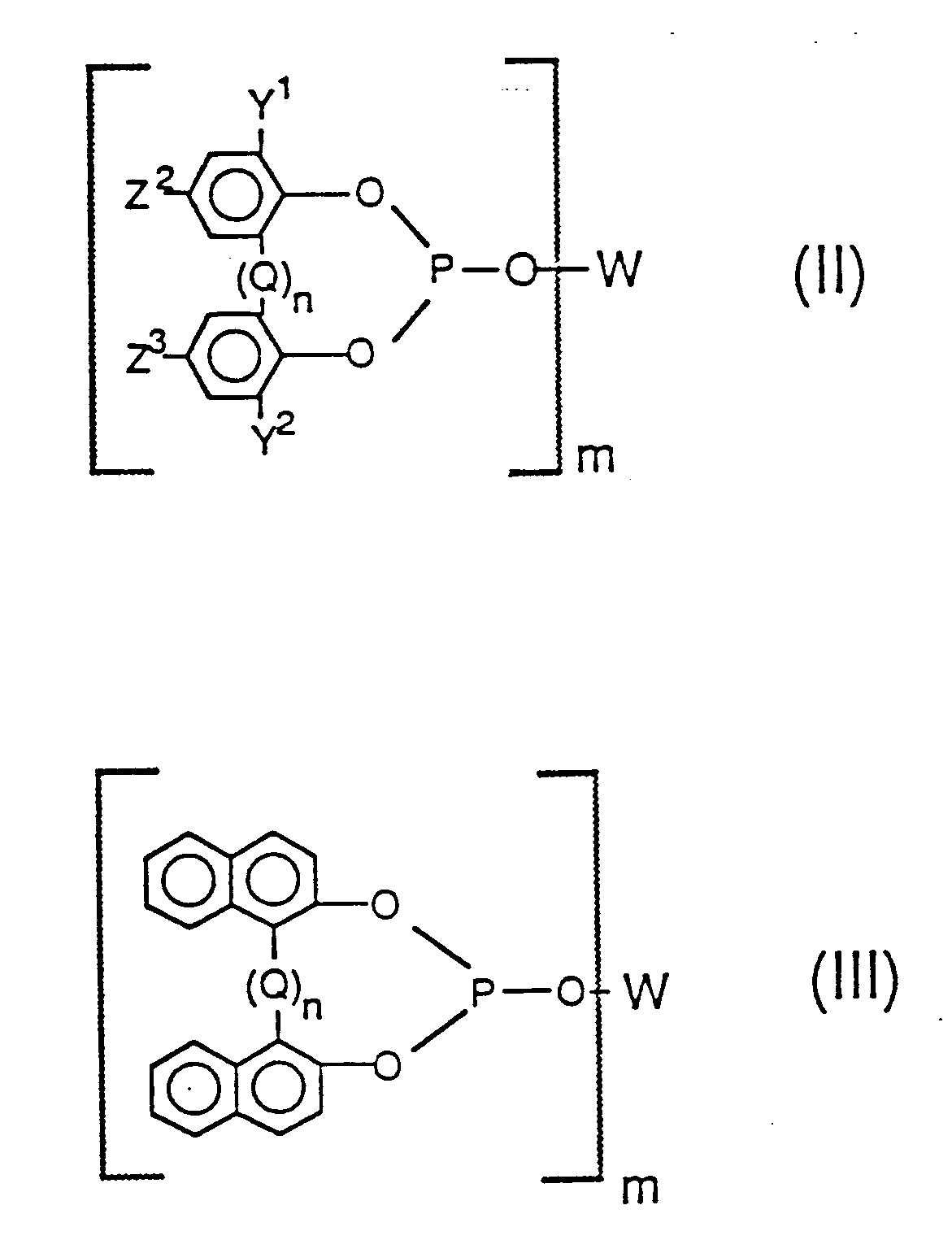
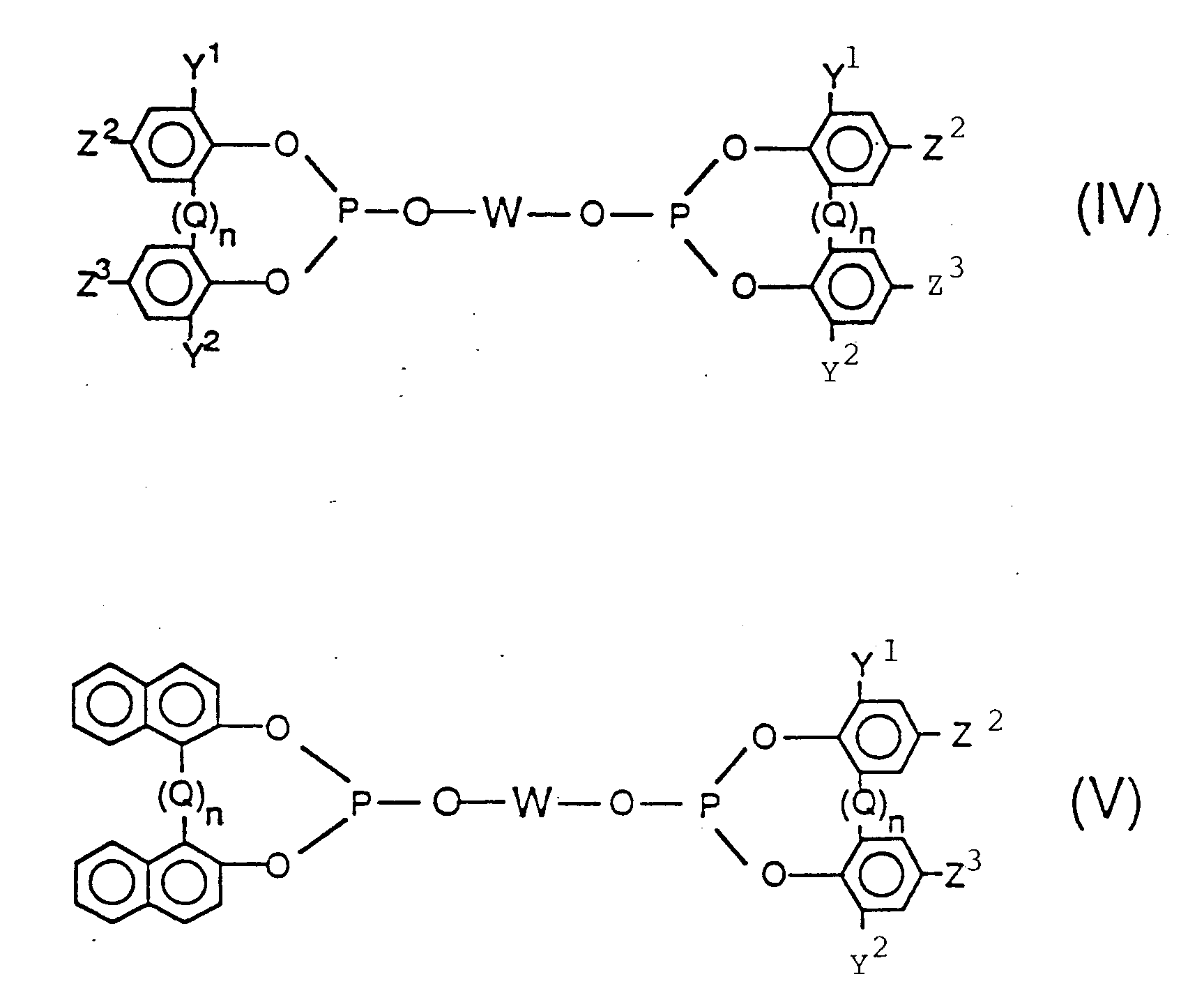
wherein Q is -CR¹R² wherein each R¹ and R² radical individually represents a radical selected from hydrogen, alkyl of 1 to 12 carbon atoms, phenyl, tolyl and anisyl; wherein each Y¹, Y², Z², and Z³ group individually represents an identical or different radical selected from hydrogen, an alkyl radical having from 1 to 18 carbon atoms, substituted or unsubstituted aryl, alkaryl, aralkyl and alicyclic radicals, as well as cyano, halogen, nitro, trifluoromethyl, hydroxy, carbonyloxy, amino, acyl, phosphonyl, oxycarbonyl, amido, sulfinyl, sulfonyl, silyl, alkoxy, and thionyl radicals, wherein m has a value of 2 to 4 and wherein W and n are the same as defined above.
wherein Q is -CR¹R² wherein each R¹ and R² radical individually represents a radical selected from hydrogen, alkyl of 1 to 12 carbon atoms, phenyl, tolyl and anisyl; wherein each Y¹, Y², Z², and Z³ group individually represents an identical or different radical selected from hydrogen, an alkyl radical having from 1 to 18 carbon atoms, substituted or unsubstituted aryl, alkaryl, aralkyl and alicyclic radicals, as well as cyano, halogen, nitro, trifluoromethyl, hydroxy, carbonyloxy, amino, acyl, phosphonyl, oxycarbonyl, amido, sulfinyl, sulfonyl, silyl, alkoxy, and thionyl radicals, wherein m has a value of 2 to 4 and wherein W and n are the same as defined above.
7. A process as defined in claim 6, wherein Y¹ and Y² are branched alkyl radicals having from 3 to 5 carbon atoms, preferably t-butyl
radicals, wherein Z² and Z³ are methoxy radicals, wherein W is 1,4-naphthylene, 1,5-naphthylene, ethylene, or a substituted phenylene-(Q)n-phenylene radical containing substituents selected from alkyl and alkoxy radicals
and wherein Q is -CH₂- or -CHCH₃-; wherein m is 2 and n is the same as defined above.
8. A process as defined in claim 6 or 7, wherein the ligand is a ligand of Formula IV
and W is 1,4-naphthylene or 1,5-naphthylene.
9. A process as defined in any one of claims 2-8, wherein the olefin starting material
is selected from butene-1, butene-2, isobutylene, and an olefin mixture consisting
essentially of butene-1 and butene-2.
10. A Group VIII transition metal complex hydroformylation catalytic precursor composition
consisting essentially of a solubilized group VIII transition metal-poly-phosphite
complex, an organic solvent, and free poly-phosphite ligand, wherein the poly-phosphite
ligand of said complex and free poly-phosphite ligand are each individually and identical
or different ligand having the general formula
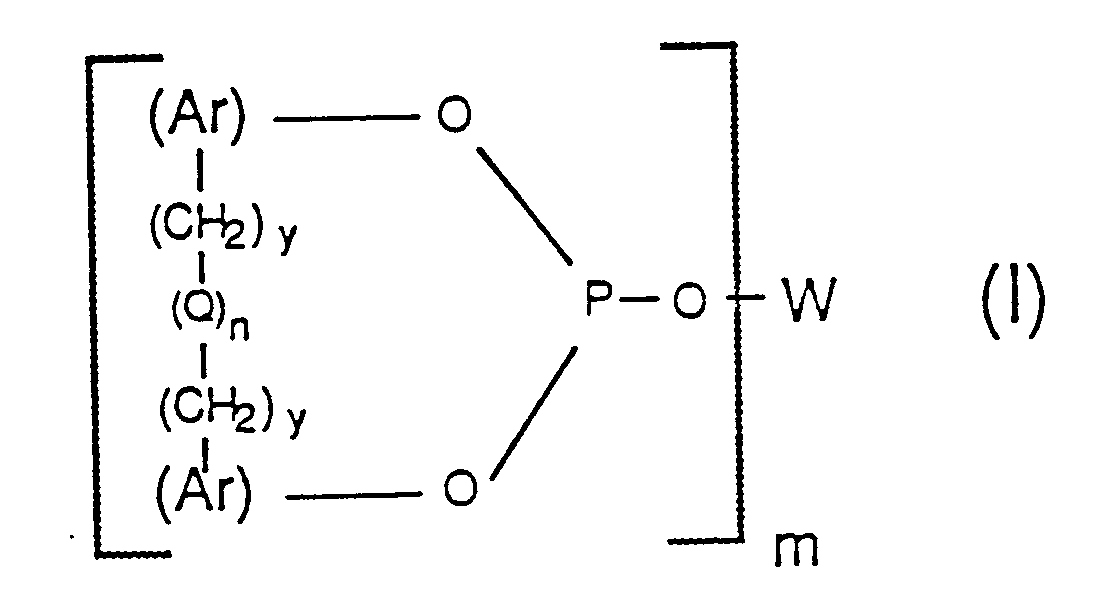
wherein each Ar group represents an identical or different, substituted or unsubstituted aryl radical; wherein W represents a m-valent radical selected from alkylene, alkylene-oxy-alkylene, arylene and arylene-(CH₂)y-(Q)n-(CH₂)y-arylene, wherein each arylene radical is the same as Ar defined above; wherein each y individually has a value of 0 or 1; wherein each Q individually represents a divalent bridging group selected from -CR¹R²-, -O-, -S-, -NR³-, -SiR⁴R⁵- and -CO-, wherein each R¹ and R² radical individually represents a radical selected from hydrogen, alkyl 1 to 12 carbon atoms, phenyl, tolyl and anisyl, wherein each R³, R⁴, and R⁵ radical individually represents -H or -CH₃; wherein each n individually has a value of 0 or 1; and wherein m has a value of 2 to 6.
wherein each Ar group represents an identical or different, substituted or unsubstituted aryl radical; wherein W represents a m-valent radical selected from alkylene, alkylene-oxy-alkylene, arylene and arylene-(CH₂)y-(Q)n-(CH₂)y-arylene, wherein each arylene radical is the same as Ar defined above; wherein each y individually has a value of 0 or 1; wherein each Q individually represents a divalent bridging group selected from -CR¹R²-, -O-, -S-, -NR³-, -SiR⁴R⁵- and -CO-, wherein each R¹ and R² radical individually represents a radical selected from hydrogen, alkyl 1 to 12 carbon atoms, phenyl, tolyl and anisyl, wherein each R³, R⁴, and R⁵ radical individually represents -H or -CH₃; wherein each n individually has a value of 0 or 1; and wherein m has a value of 2 to 6.
11. A composition as defined in claim 10, wherein the Group VIII transition metal is rhodium.
12. A composition as defined in claim 11, wherein the rhodium-poly-phosphite complex is
the reaction product complex of a poly-phosphite ligand and rhodium dicarbonyl acetylacetonate.
1. Procédé de carbonylation, consistant à faire réagir un composé organique capable d'être
carbonylé avec de l'oxyde de carbone en présence d'un catalyseur du type complexe
métal de transition du Groupe VIII-polyphosphite, consistant essentiellement en un
métal de transition du Groupe VIII complexé avec de l'oxyde de carbone et un ligand
polyphosphite de formule :
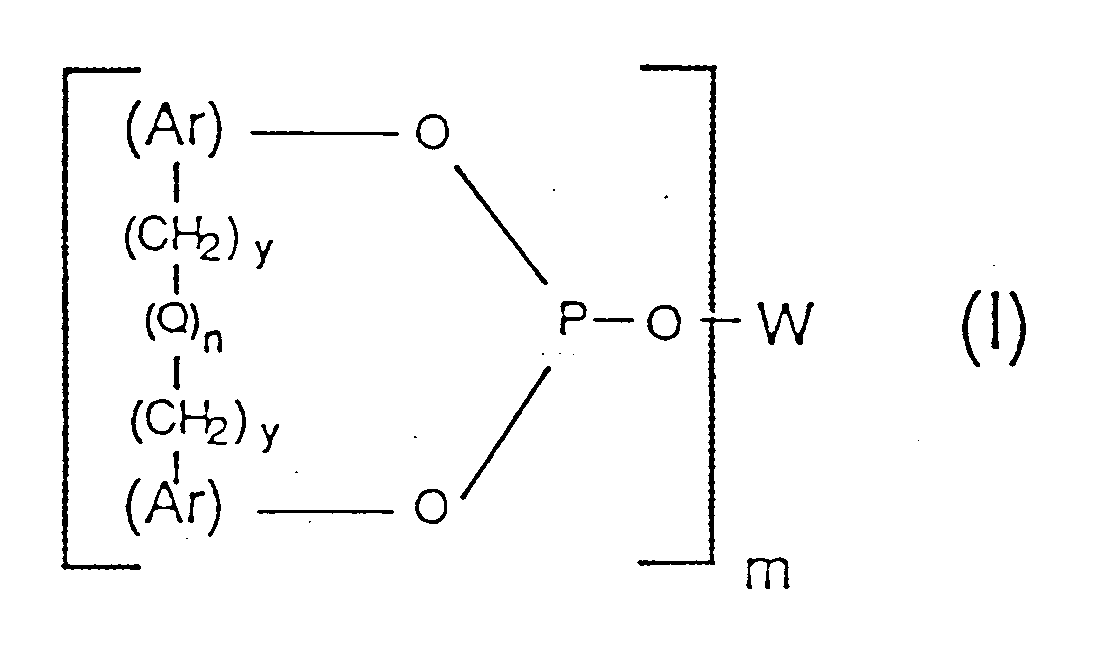
dans laquelle les groupes Ar représentent des radicaux aryle identiques ou différents, substitués ou non substitués ; W représente un radical de valence m, choisi entre des radicaux alkylène, alkylène-oxy-alkylène, arylène et arylène-(CH₂)y-(Q)n-(CH₂)y-arylène, chaque radical arylène étant identique au radical Ar défini ci-dessus ; chaque indice y possède individuellement la valeur 0 ou 1 ; chaque radical Q représente individuellement un groupe divalent de pontage choisi entre -CR¹R²-, -O-, -S-, -NR³-, -SiR⁴R⁵- et -CO-, chacun des radicaux R¹ et R² représentant individuellement un radical choisi entre l'hydrogène, des radicaux alkyle ayant 1 à 12 atomes de carbone, phényle, tolyle et anisyle, chacun des radicaux R³, R⁴ et R⁵ représentant individuellement un radical -H ou -CH₃ ; chaque indice n a la valeur 0 ou 1 ; et m a une valeur de 2 à 6.
dans laquelle les groupes Ar représentent des radicaux aryle identiques ou différents, substitués ou non substitués ; W représente un radical de valence m, choisi entre des radicaux alkylène, alkylène-oxy-alkylène, arylène et arylène-(CH₂)y-(Q)n-(CH₂)y-arylène, chaque radical arylène étant identique au radical Ar défini ci-dessus ; chaque indice y possède individuellement la valeur 0 ou 1 ; chaque radical Q représente individuellement un groupe divalent de pontage choisi entre -CR¹R²-, -O-, -S-, -NR³-, -SiR⁴R⁵- et -CO-, chacun des radicaux R¹ et R² représentant individuellement un radical choisi entre l'hydrogène, des radicaux alkyle ayant 1 à 12 atomes de carbone, phényle, tolyle et anisyle, chacun des radicaux R³, R⁴ et R⁵ représentant individuellement un radical -H ou -CH₃ ; chaque indice n a la valeur 0 ou 1 ; et m a une valeur de 2 à 6.
2. Procédé d'hydroformylation pour la production d'aldéhydes suivant la revendication
1, qui consiste à faire réagir un composé organique à insaturation oléfinique avec
de l'oxyde de carbone et de l'hydrogène en présence d'un catalyseur complexe suivant
la revendication 1.
3. Procédé d'hydroformylation pour la production d'aldéhydes suivant la revendication
1 ou 2, qui est mis en oeuvre en présence d'un ligand polyphosphite libre de formule
:
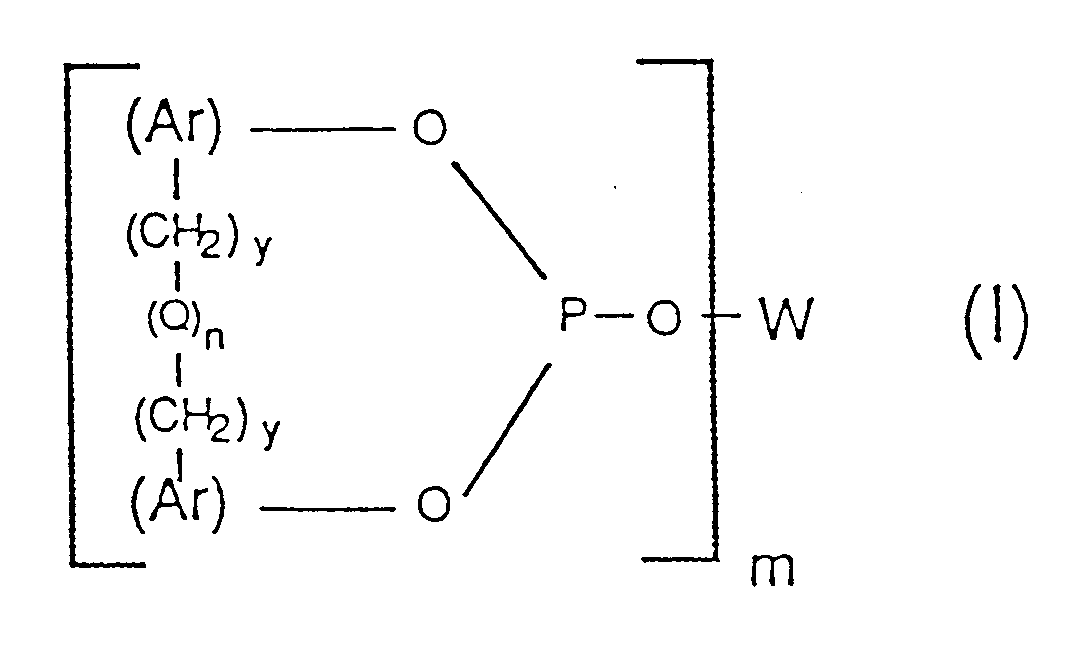
dans laquelle les groupes Ar représentent des radicaux aryle identiques ou différents, substitués ou non substitués ; W représente un radical de valence m choisi entre des radicaux alkylène, alkylène-oxy-alkylène, arylène et arylène-(CH₂)y-(Q)n-(CH₂)y-arylène, chaque radical arylène étant identique au radical Ar défini ci-dessus ; chaque indice y possède individuellement la valeur 0 ou 1 ; chaque radical Q représente individuellement un groupe divalent de pontage choisi entre -CR¹R²-, -O-, -S-, -NR³-, -SiR⁴R⁵- et -CO-, chacun des radicaux R¹ et R² représentant individuellement un radical choisi entre l'hydrogène, des radicaux alkyle ayant 1 à 12 atomes de carbone, phényle, tolyle et anisyle, chacun des radicaux R³, R⁴ et R⁵ représentant individuellement un groupe -H ou -CH₃ ; chaque indice n possède individuellement la valeur 0 ou 1 ; et m a une valeur de 2 à 6 ; le métal de transition du Groupe VIII étant le rhodium.
dans laquelle les groupes Ar représentent des radicaux aryle identiques ou différents, substitués ou non substitués ; W représente un radical de valence m choisi entre des radicaux alkylène, alkylène-oxy-alkylène, arylène et arylène-(CH₂)y-(Q)n-(CH₂)y-arylène, chaque radical arylène étant identique au radical Ar défini ci-dessus ; chaque indice y possède individuellement la valeur 0 ou 1 ; chaque radical Q représente individuellement un groupe divalent de pontage choisi entre -CR¹R²-, -O-, -S-, -NR³-, -SiR⁴R⁵- et -CO-, chacun des radicaux R¹ et R² représentant individuellement un radical choisi entre l'hydrogène, des radicaux alkyle ayant 1 à 12 atomes de carbone, phényle, tolyle et anisyle, chacun des radicaux R³, R⁴ et R⁵ représentant individuellement un groupe -H ou -CH₃ ; chaque indice n possède individuellement la valeur 0 ou 1 ; et m a une valeur de 2 à 6 ; le métal de transition du Groupe VIII étant le rhodium.
4. Procédé d'hydroformylation suivant l'une quelconque des revendications 1 à 3, dans
lequel le composé à insaturation oléfinique est choisi entre des alpha-oléfines contenant
2 à 20 atomes de carbone, des oléfines internes contenant 4 à 20 atomes de carbone,
et des mélanges de ces alpha-oléfines et oléfines internes.
5. Procédé suivant l'une quelconque des revendications 1 à 4, dans lequel les conditions
de la réaction d'hydroformylation comprennent une température réactionnelle d'environ
50°C à 120°C, une pression totale du gaz constitué d'hydrogène, d'oxyde de carbone
et du composé organique à insaturation oléfinique d'environ 6,9 kPa à 10,34 MPa (1
à 1500 lb/in² en valeur absolue), une pression partielle d'hydrogène de 103,4 à 1103,2
kPa (15 à 160 lb/in² en valeur absolue), une pression partielle d'oxyde de carbone
d'environ 6,9 à 827,4 kPa (1 à 120 lb/in² en valeur absolue), et dans lequel le milieu
réactionnel contient environ 4 à environ 100 moles du ligand polyphosphite par mole
de rhodium dans ledit milieu.
6. Procédé suivant l'une quelconque des revendications 3 à 5, dans lequel le ligand polyphosphite
complexé au rhodium et le ligand polyphosphite libre également présent sont des ligands
identiques ou différents choisis entre des ligands de formules
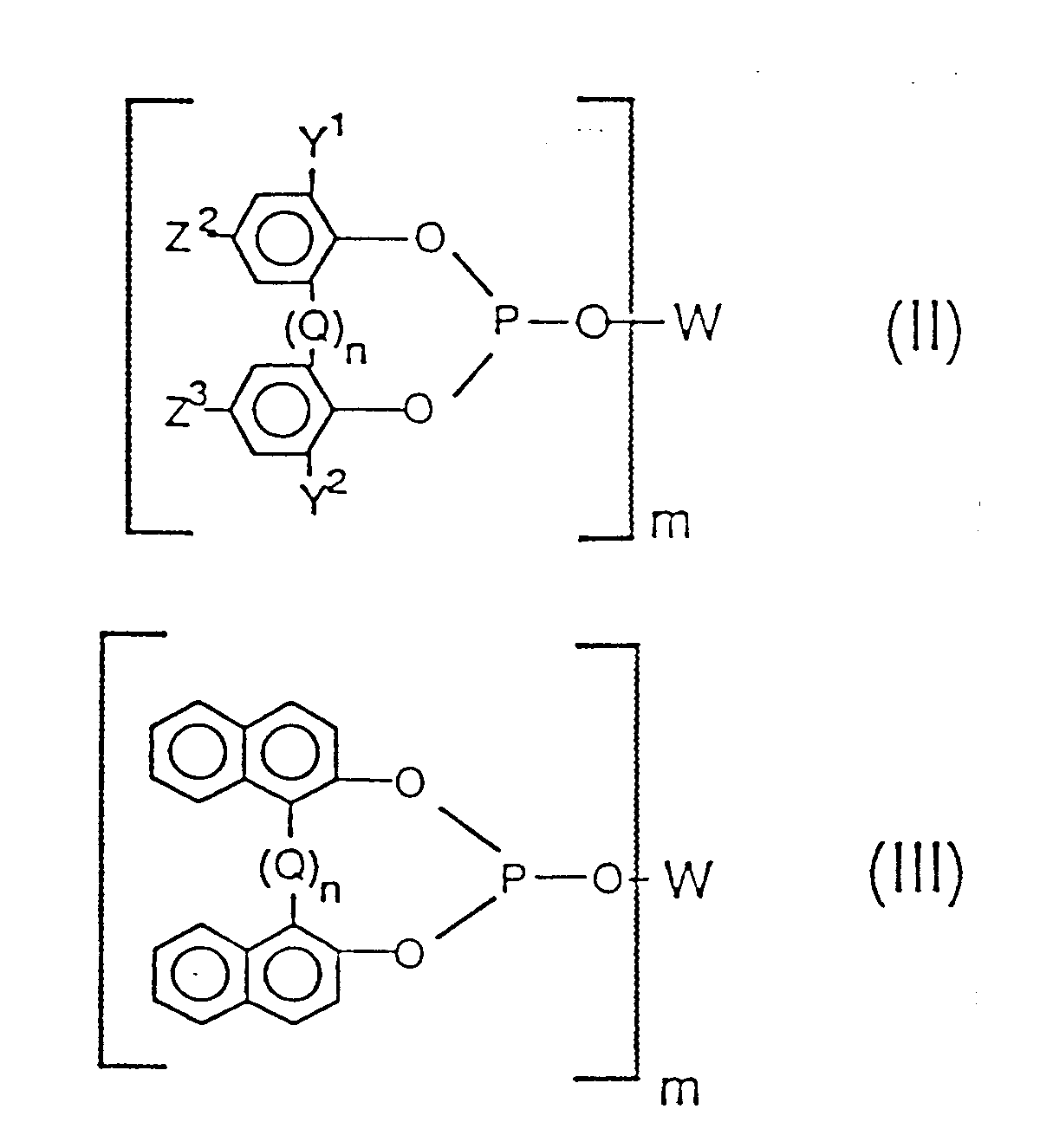
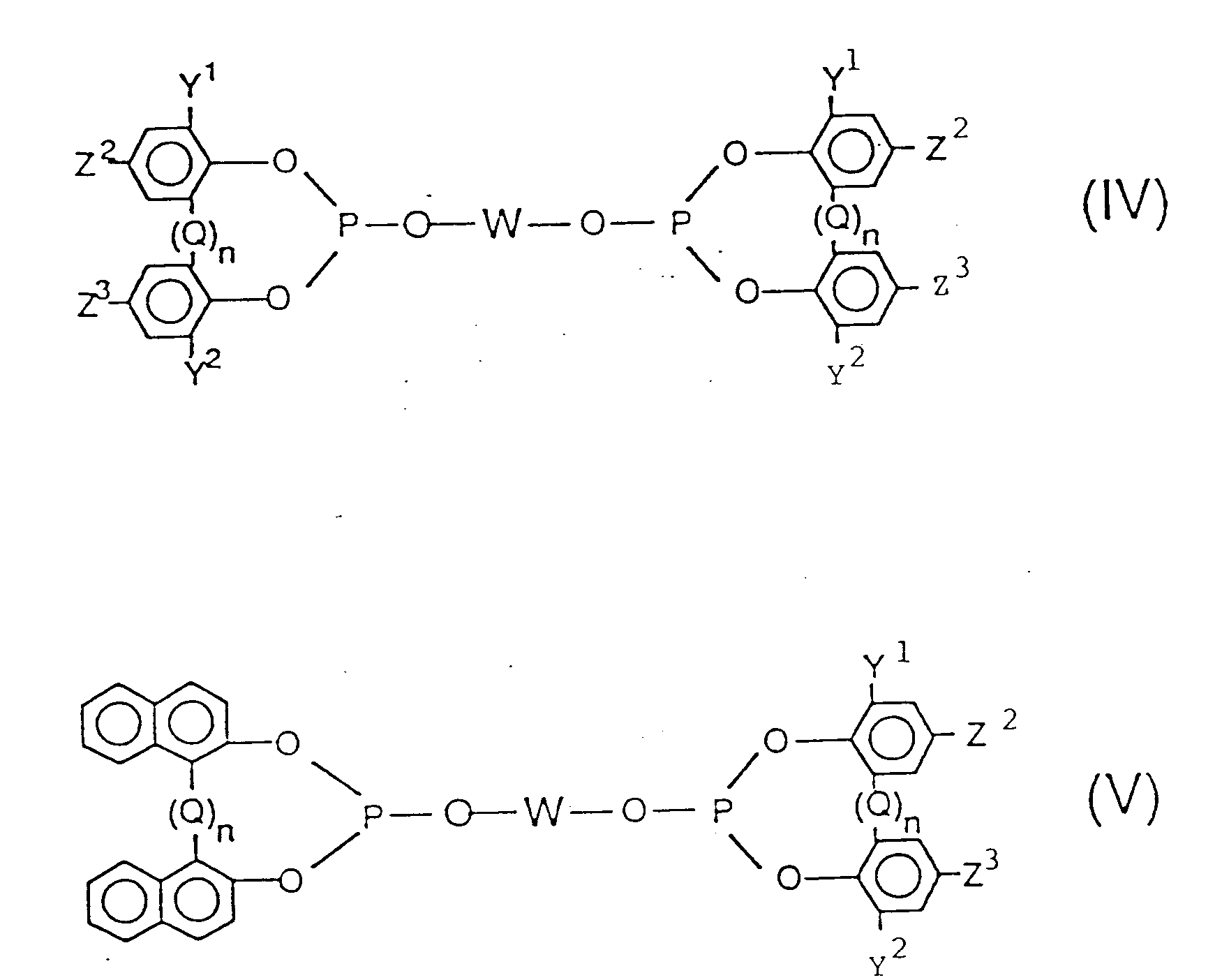
dans lesquelles Q représente un groupe -CR¹R² dans lequel chacun des radicaux R¹ et R² représente individuellement un radical choisi entre l'hydrogène, des radicaux alkyle ayant 1 à 12 atomes de carbone, phényle, tolyle et anisyle ; chacun des groupes Y¹, Y², Z² et Z³ représente individuellement un radical identique ou différent choisi entre l'hydrogène, un radical alkyle ayant 1 à 18 atomes de carbone, des radicaux aryle, alkaryle, aralkyle et alicyclique substitués ou non substitués, ainsi que des radicaux cyano, halogéno, nitro, trifluorométhyle, hydroxy, carbonyloxy, amino, acyle, phosphonyle, oxycarbonyle, amido, sulfinyle, sulfonyle, silyle, alkoxy et thionyle, m a une valeur de 2 à 4 et W et n répondent aux définitions mentionnées précédemment.
dans lesquelles Q représente un groupe -CR¹R² dans lequel chacun des radicaux R¹ et R² représente individuellement un radical choisi entre l'hydrogène, des radicaux alkyle ayant 1 à 12 atomes de carbone, phényle, tolyle et anisyle ; chacun des groupes Y¹, Y², Z² et Z³ représente individuellement un radical identique ou différent choisi entre l'hydrogène, un radical alkyle ayant 1 à 18 atomes de carbone, des radicaux aryle, alkaryle, aralkyle et alicyclique substitués ou non substitués, ainsi que des radicaux cyano, halogéno, nitro, trifluorométhyle, hydroxy, carbonyloxy, amino, acyle, phosphonyle, oxycarbonyle, amido, sulfinyle, sulfonyle, silyle, alkoxy et thionyle, m a une valeur de 2 à 4 et W et n répondent aux définitions mentionnées précédemment.
7. Procédé suivant la revendication 6, dans lequel Y¹ et Y² sont des radicaux alkyle ramifiés ayant 3 à 5 atomes de carbone, de préférence des
radicaux tertiobutyle, Z² et Z³ sont des radicaux méthoxy, W représente un radical 1,4-naphtylène, 1,5-naphtylène, éthylène ou un radical phénylène-(Q)n-phénylène substitué contenant des substituants choisis entre des radicaux alkyle
et alkoxy, et Q représente un radical -CH₂- ou -CHCH₃- ; m est égal à 2 et n répond à la définition mentionnée précédemment.
8. Procédé suivant la revendication 6 ou 7, dans lequel le ligand est un ligand de formule
IV et W représente un radical 1,4-naphtylène ou 1,5-naphtylène.
9. Procédé suivant l'une quelconque des revendications 2 à 8, dans lequel la matière
oléfinique de départ est choisie entre le butène-1, le butène-2, l'isobutylène et
un mélange d'oléfines consistant essentiellement en butène-1 et butène-2.
10. Composition de précurseur de catalyseur d'hydroformylation formé d'un complexe de
métal de transition du Groupe VIII, consistant essentiellement en un complexe solubilisé
métal de transition du Groupe VIII-polyphosphite, un solvant organique et un ligand
polyphosphite libre, dans lequel le ligand polyphosphite dudit complexe et le ligand
polyphosphite libre sont des ligands identiques ou différents répondant à la formule
générale
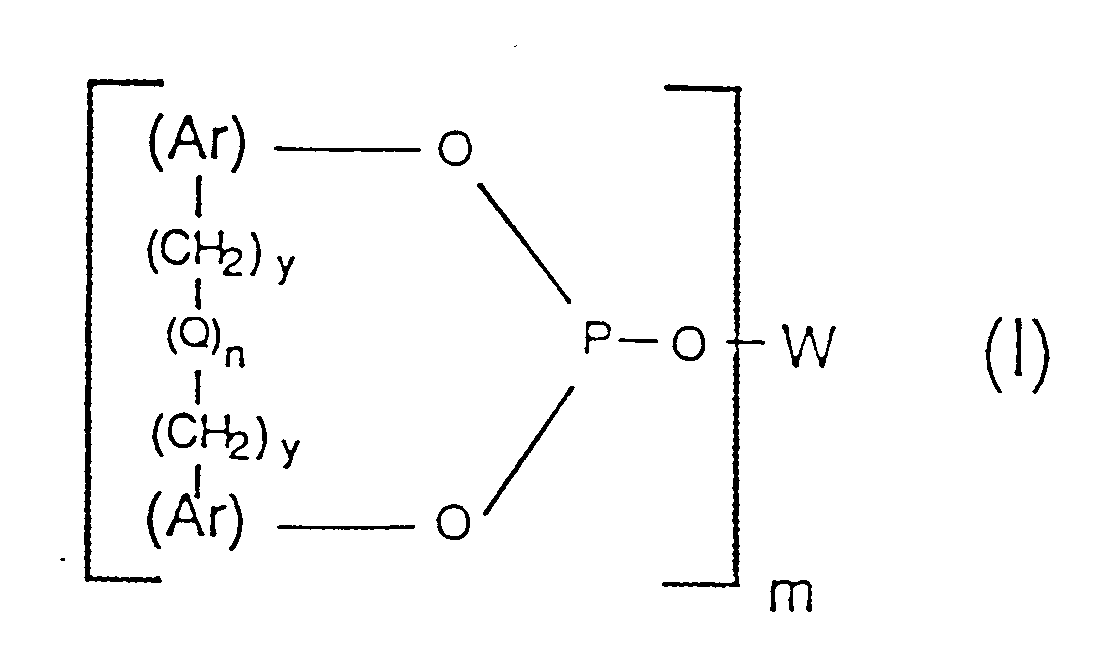
dans laquelle les groupes Ar représentent des radicaux aryle identiques ou différents, substitués ou non substitués ; W représente un radical de valence m choisi entre des radicaux alkylène, alkylène-oxy-alkylène, arylène et arylène-(CH₂)y-(Q)n-(CH₂)y-arylène, chaque radical arylène étant identique au radical Ar défini précédemment ; chaque indice y possède individuellement la valeur 0 ou 1 ; chaque radical Q représente individuellement un groupe divalent de pontage choisi entre -CR¹R²-, -O-, -S-, -NR³-, -SiR⁴R⁵-et -CO-, chacun des radicaux R₁ et R² représentant individuellement un radical choisi entre l'hydrogène, des radicaux alkyle ayant 1 à 12 atomes de carbone, phényle, tolyle et anisyle, chacun des radicaux R³, R⁴ et R⁵ représentant individuellement un radical -H ou -CH₃ ; chaque indice n possède individuellement la valeur 0 ou 1 ; et m a une valeur de 2 à 6.
dans laquelle les groupes Ar représentent des radicaux aryle identiques ou différents, substitués ou non substitués ; W représente un radical de valence m choisi entre des radicaux alkylène, alkylène-oxy-alkylène, arylène et arylène-(CH₂)y-(Q)n-(CH₂)y-arylène, chaque radical arylène étant identique au radical Ar défini précédemment ; chaque indice y possède individuellement la valeur 0 ou 1 ; chaque radical Q représente individuellement un groupe divalent de pontage choisi entre -CR¹R²-, -O-, -S-, -NR³-, -SiR⁴R⁵-et -CO-, chacun des radicaux R₁ et R² représentant individuellement un radical choisi entre l'hydrogène, des radicaux alkyle ayant 1 à 12 atomes de carbone, phényle, tolyle et anisyle, chacun des radicaux R³, R⁴ et R⁵ représentant individuellement un radical -H ou -CH₃ ; chaque indice n possède individuellement la valeur 0 ou 1 ; et m a une valeur de 2 à 6.
11. Composition suivant la revendication 10, dans laquelle le métal de transition du Groupe
VIII est le rhodium.
12. Composition suivant la revendication 11, dans laquelle le complexe rhodium-polyphosphite
est le complexe consistant en le produit de réaction d'un ligand polyphosphite et
de rhodium-dicarbonyl-acétylacétonate.
1. Verfahren zur Carbonylierung, umfassend die Umsetzung einer organischen Verbindung,
die imstande ist carbonyliert zu werden, mit Kohlenmonoxid in Gegenwart eines Gruppe
VIII-Übergangsmetall-Polyphosphit-Komplexkatalysators, der im wesentlichen besteht
aus einem Gruppe VIII-Übergangsmetall, das mit Kohlenmonoxid und einem Polyphosphit-Liganden
der folgenden Formel komplexiert ist:
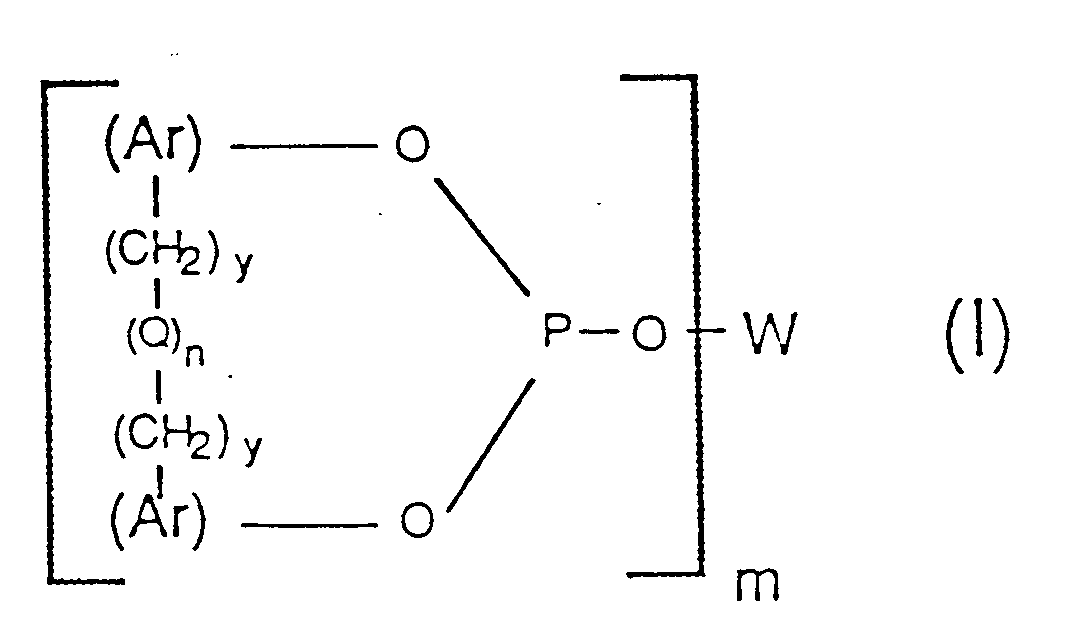
worin jede Ar-Gruppe einen identischen oder verschiedenen, substituierten oder unsubstituierten Arylrest darstellt; worin W einen m-wertigen Rest repräsentiert, der aus Alkylen, Alkylenoxyalkylen, Arylen und Arylen-(CH₂)y-(Q)n-(CH₂)y-arylen ausgewählt ist, worin jeder Arylenrest so wie Ar oben definiert ist; worin jedes y für sich einen Wert von 0 oder 1 aufweist; worin jedes Q für sich eine zweiwertige Brückengruppe repräsentiert, die aus -CR¹R²-, -O-, -S-, -NR³-, -SiR⁴R⁵- und -CO- ausgewählt ist, worin jeder R¹- und R²-Rest für sich einen Rest darstellt, der aus Wasserstoff, Alkyl mit 1 bis 12 Kohlenstoffatomen, Phenyl, Tolyl und Anisyl ausgewählt ist, worin jeder R³-, R⁴- und R⁵-Rest für sich -H oder -CH₃ darstellt; worin jedes n einen Wert von 0 oder 1 aufweist; und worin m einen Wert von 2 bis 6 besitzt.
worin jede Ar-Gruppe einen identischen oder verschiedenen, substituierten oder unsubstituierten Arylrest darstellt; worin W einen m-wertigen Rest repräsentiert, der aus Alkylen, Alkylenoxyalkylen, Arylen und Arylen-(CH₂)y-(Q)n-(CH₂)y-arylen ausgewählt ist, worin jeder Arylenrest so wie Ar oben definiert ist; worin jedes y für sich einen Wert von 0 oder 1 aufweist; worin jedes Q für sich eine zweiwertige Brückengruppe repräsentiert, die aus -CR¹R²-, -O-, -S-, -NR³-, -SiR⁴R⁵- und -CO- ausgewählt ist, worin jeder R¹- und R²-Rest für sich einen Rest darstellt, der aus Wasserstoff, Alkyl mit 1 bis 12 Kohlenstoffatomen, Phenyl, Tolyl und Anisyl ausgewählt ist, worin jeder R³-, R⁴- und R⁵-Rest für sich -H oder -CH₃ darstellt; worin jedes n einen Wert von 0 oder 1 aufweist; und worin m einen Wert von 2 bis 6 besitzt.
2. Hydroformylierungsverfahren zur Herstellung von Aldehyden nach Anspruch 1, welches
umfaßt, daß eine olefinisch ungesättigte organische Verbindung mit Kohlenmonoxid und
Wasserstoff in Gegenwart eines nach Anspruch 1 definierten Komplexkatalysators umgesetzt
wird.
3. Hydroformylierungsverfahren zur Herstellung von Aldehyden nach Anspruch 1 oder 2,
worin das Verfahren in Gegenwart eines freien Polyphosphit-Liganden der folgenden
Formel ausgeführt wird:
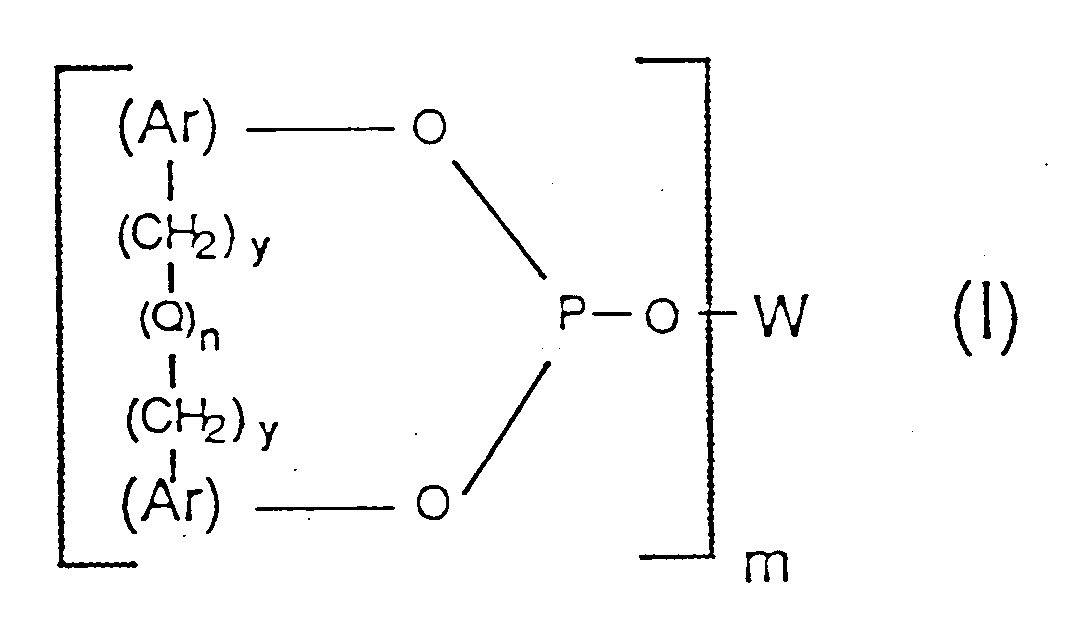
worin jede Ar-Gruppe einen identischen oder verschiedenen, substituierten oder unsubstituierten Arylrest darstellt; worin W einen m-wertigen Rest repräsentiert, der aus Alkylen, Alkylenoxyalkylen, Arylen und Arylen-(CH₂)y-(Q)n-(CH₂)y-arylen ausgewählt ist, worin jeder Arylenrest so wie Ar oben definiert ist; worin jedes y für sich einen Wert von 0 oder 1 aufweist; worin jedes Q für sich eine zweiwertige Brückengruppe repräsentiert, die aus -CR¹R²-, -O-, -S-, -NR³-, -SiR⁴R⁵- und -CO- ausgewählt ist, worin jeder R¹- und R²-Rest für sich einen Rest darstellt, der aus Wasserstoff, Alkyl mit 1 bis 12 Kohlenstoffatomen, Phenyl, Tolyl und Anisyl ausgewählt ist, worin jeder R³-, R⁴- und R⁵-Rest für sich -H oder -CH₃ darstellt; worin jedes n für sich einen Wert von 0 oder 1 aufweist; und worin m einen Wert von 2 bis 6 besitzt, und worin das Gruppe VIII-Übergangsmetall Rhodium ist.
worin jede Ar-Gruppe einen identischen oder verschiedenen, substituierten oder unsubstituierten Arylrest darstellt; worin W einen m-wertigen Rest repräsentiert, der aus Alkylen, Alkylenoxyalkylen, Arylen und Arylen-(CH₂)y-(Q)n-(CH₂)y-arylen ausgewählt ist, worin jeder Arylenrest so wie Ar oben definiert ist; worin jedes y für sich einen Wert von 0 oder 1 aufweist; worin jedes Q für sich eine zweiwertige Brückengruppe repräsentiert, die aus -CR¹R²-, -O-, -S-, -NR³-, -SiR⁴R⁵- und -CO- ausgewählt ist, worin jeder R¹- und R²-Rest für sich einen Rest darstellt, der aus Wasserstoff, Alkyl mit 1 bis 12 Kohlenstoffatomen, Phenyl, Tolyl und Anisyl ausgewählt ist, worin jeder R³-, R⁴- und R⁵-Rest für sich -H oder -CH₃ darstellt; worin jedes n für sich einen Wert von 0 oder 1 aufweist; und worin m einen Wert von 2 bis 6 besitzt, und worin das Gruppe VIII-Übergangsmetall Rhodium ist.
4. Hydroformylierungsverfahren nach irgendeinem der Ansprüche 1 bis 3, worin die olefinisch
ungesättigte Verbindung aus α-Olefinen mit 2 bis 20 Kohlenstoffatomen, inneren Olefinen
mit 4 bis 20 Kohlenstoffatomen und Mischungen solcher α- und innerer Olefine ausgewählt
ist.
5. Verfahren nach irgendeinem der Ansprüche 1 bis 4, worin die Bedingungen für die Hydroformylierungsreaktion
eine Reaktionstemperatur im Bereich von etwa 50°C bis 120°C, einen Gesamtgasdruck
von Wasserstoff, Kohlenmonoxid und olefinisch ungesättigter organischer Verbindung
von etwa 6,9 kPa bis 10,34 MPa (1 bis 1500 psia), einen Wasserstoff-Partialdruck von
etwa 103,4 bis 1103,2 kPa (15 bis 160 psia) und einen Kohlenmonoxid-Partialdruck von
etwa 6,9 bis 827,4 kPa (1 bis 120 psia) umfassen, und worin das Reaktionsmedium etwa
4 bis etwa 100 Mol des Polyphosphit-Liganden pro Mol Rhodium im Medium enthält.
6. Verfahren nach irgendeinem der Ansprüche 3 bis 5, worin der mit dem Rhodium komplexierte
Polyphosphit-Ligand und der ebenfalls anwesende freie Polyphosphit-Ligand jeweils
für sich identische oder verschiedene Liganden sind, die aus den folgenden Formeln
ausgewählt sind
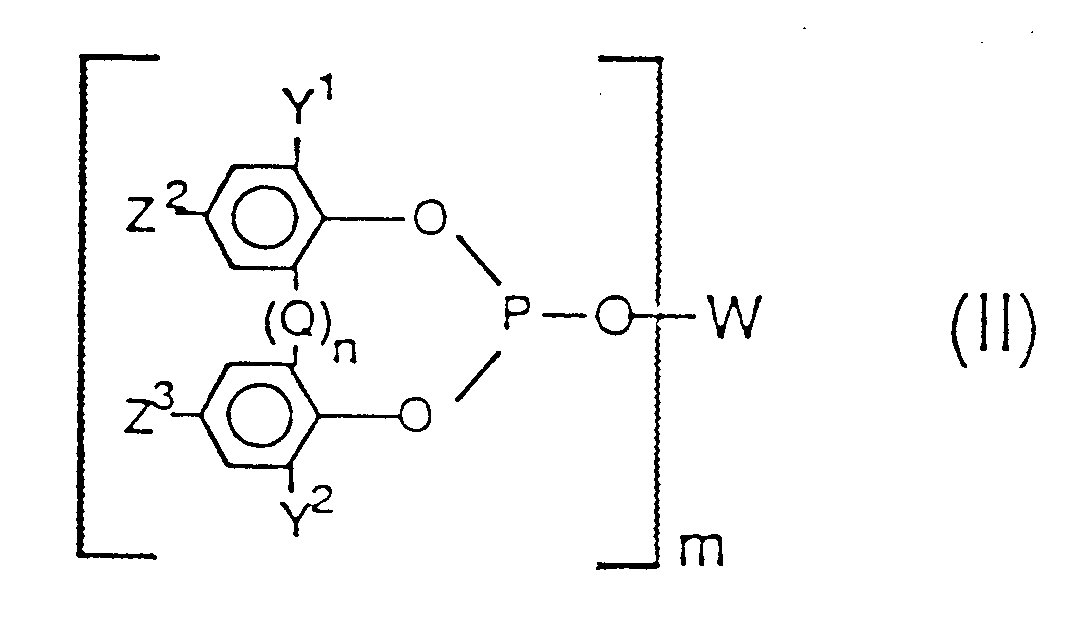
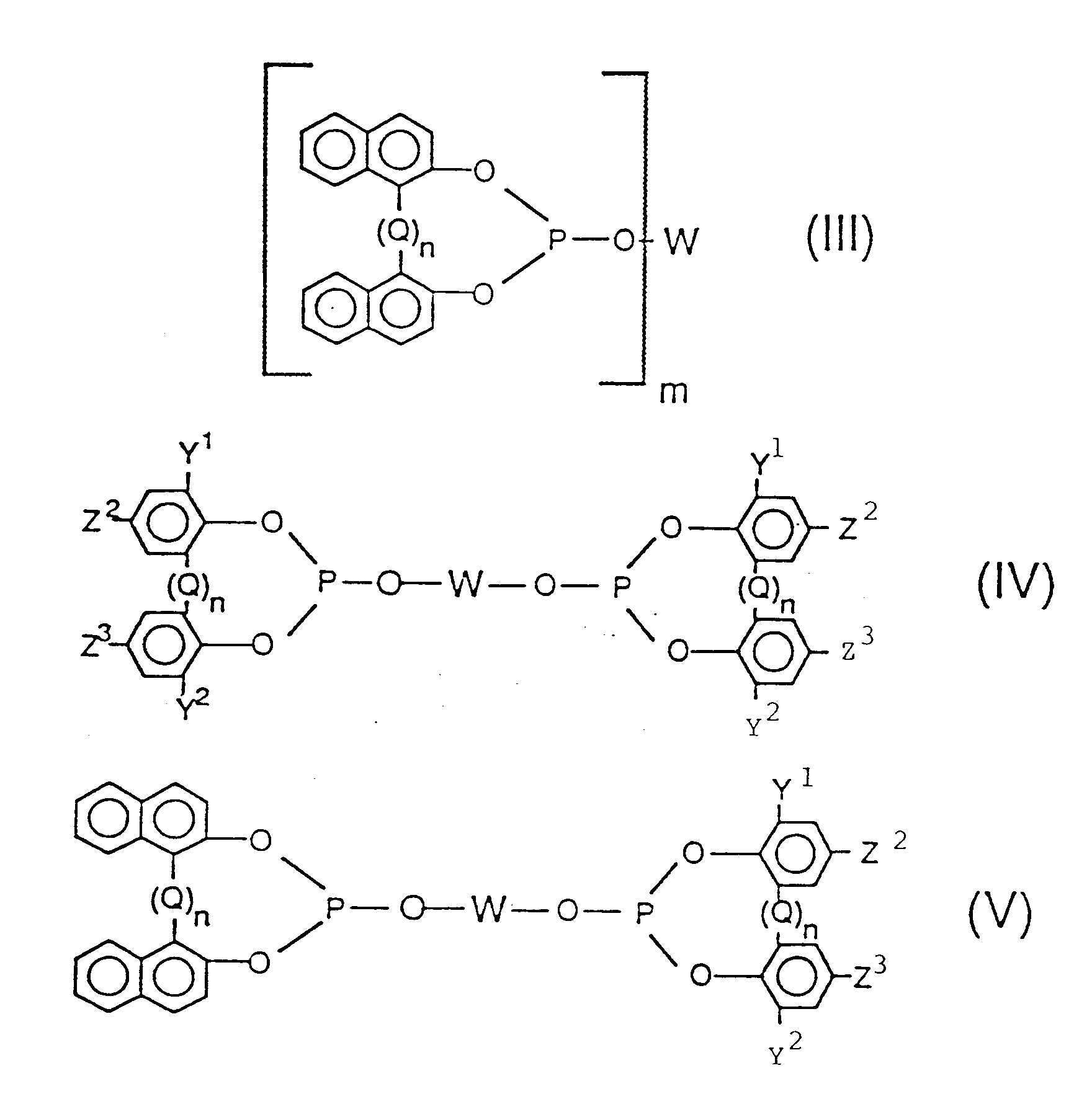
worin Q -CR¹R² ist, worin jeder R¹- und R²-Rest für sich einen Rest darstellt, der aus Wasserstoff, Alkyl mit 1 bis 12 Kohlenstoffatomen, Phenyl, Tolyl und Anisyl ausgewählt ist; worin jede Y¹-, Y²- Z²- und Z³-Gruppe für sich einen identischen oder verschiedenen Rest repräsentiert, der aus Wasserstoff, einem Alkylrest mit 1 bis 18 Kohlenstoffatomen, substituierten oder unsubstituierten Aryl-, Alkaryl-, Aralkyl- und alicyclischen Resten sowie aus Cyano, Halogen, Nitro, Trifluormethyl, Hydroxy, Carbonyloxy, Amino, Acyl, Phosphonyl, Oxycarbonyl, Amido, Sulfinyl, Sulfonyl, Silyl, Alkoxy und Thionylresten ausgewählt ist, worin m einen Wert von 2 bis 4 besitzt und worin W und n wie oben definiert sind.
worin Q -CR¹R² ist, worin jeder R¹- und R²-Rest für sich einen Rest darstellt, der aus Wasserstoff, Alkyl mit 1 bis 12 Kohlenstoffatomen, Phenyl, Tolyl und Anisyl ausgewählt ist; worin jede Y¹-, Y²- Z²- und Z³-Gruppe für sich einen identischen oder verschiedenen Rest repräsentiert, der aus Wasserstoff, einem Alkylrest mit 1 bis 18 Kohlenstoffatomen, substituierten oder unsubstituierten Aryl-, Alkaryl-, Aralkyl- und alicyclischen Resten sowie aus Cyano, Halogen, Nitro, Trifluormethyl, Hydroxy, Carbonyloxy, Amino, Acyl, Phosphonyl, Oxycarbonyl, Amido, Sulfinyl, Sulfonyl, Silyl, Alkoxy und Thionylresten ausgewählt ist, worin m einen Wert von 2 bis 4 besitzt und worin W und n wie oben definiert sind.
7. Verfahren nach Anspruch 6, worin Y¹ und Y² verzweigte Alkylreste mit 3 bis 5 Kohlenstoffatomen, vorzugsweise t-Butylreste,
sind, worin Z² und Z³ Methoxyreste sind, worin W 1,4-Naphthylen, 1,5-Naphthylen, Ethylen oder ein substituierter Phenylen-(Q)n-Phenylenrest ist, der aus Alkyl und Alkoxyresten ausgewählte Substituenten enthält,
und worin Q -CH₂- oder -CHCH₃- ist; worin m 2 ist und n wie oben definiert ist.
8. Verfahren nach Anspruch 6 oder 7, worin der Ligand ein Ligand der Formel IV ist und
W 1,4-Naphthylen oder 1,5-Naphthylen ist.
9. Verfahren nach irgendeinem der Ansprüche 2 bis 8, worin das olefinische Ausgangsmaterial
aus Buten-1, Buten-2, Isobutylen und einer Olefinmischung, die im wesentlichen aus
Buten-1 und Buten-2 besteht, ausgewählt ist.
10. Gruppe VIII-Übergangsmetallkomplex-Zusammensetzung eines katalytischen Vorläufers
für die Hydroformylierung, welche im wesentlichen aus einem solubilisierten Gruppe
VIII Übergangsmetall-Polyphosphit-Komplex, einem organischen Lösungsmittel und freiem
Polyphosphit-Liganden besteht, worin der Polyphosphit-Ligand des Komplexes und der
freie Polyphosphit-Ligand jeweils für sich identische oder verschiedene Liganden der
allgemeinen Formel
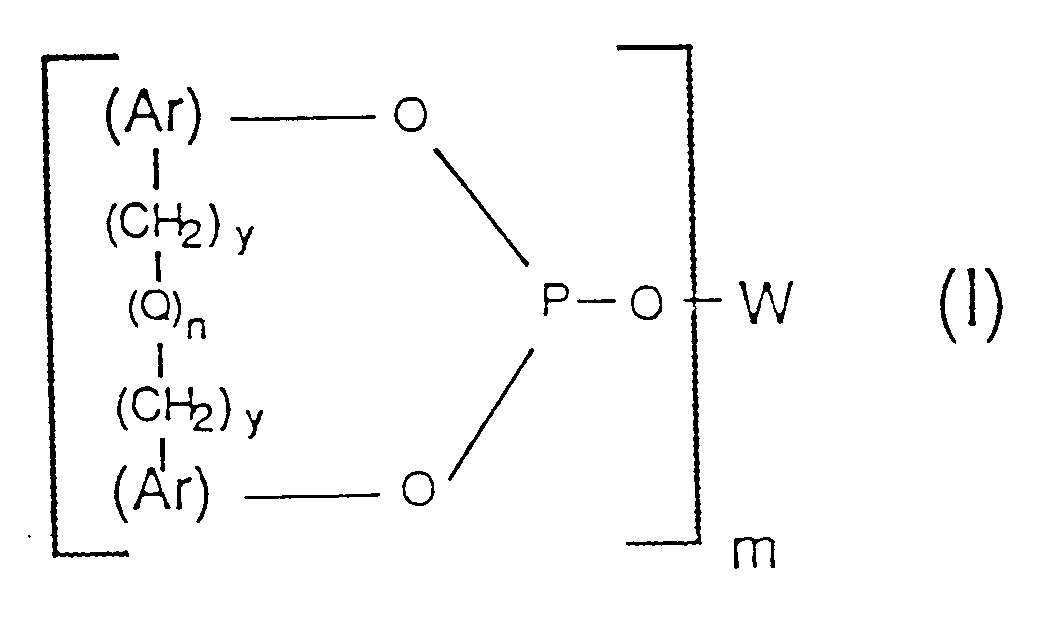
sind, worin jede Ar-Gruppe einen identischen oder verschiedenen, substituierten oder unsubstituierten Arylrest repräsentiert; worin W einen m-wertigen Rest darstellt, der aus Alkylen, Alkylenoxyalkylen, Arylen und Arylen-(CH₂)y-(Q)n-(CH₂)y-arylen ausgewählt ist, worin jeder Arylenrest so wie Ar oben definiert ist; worin jedes y für sich einen Wert von 0 oder 1 hat; worin jedes Q für sich eine zweiwertige Brückengruppe repräsentiert, die aus -CR¹R²-, -O-, -S-, -NR³-, -SiR⁴R⁵- und -CO- ausgewählt ist, worin jeder R¹- und R²-Rest für sich einen Rest darstellt, der aus Wasserstoff, Alkyl mit 1 bis 12 Kohlenstoffatomen, Phenyl, Tolyl und Anisyl ausgewählt ist, worin jeder R³-, R⁴- und R⁵-Rest für sich -H oder -CH₃ darstellt; worin jedes n für sich einen Wert von 0 oder 1 hat; und worin m einen Wert von 2 bis 6 besitzt.
sind, worin jede Ar-Gruppe einen identischen oder verschiedenen, substituierten oder unsubstituierten Arylrest repräsentiert; worin W einen m-wertigen Rest darstellt, der aus Alkylen, Alkylenoxyalkylen, Arylen und Arylen-(CH₂)y-(Q)n-(CH₂)y-arylen ausgewählt ist, worin jeder Arylenrest so wie Ar oben definiert ist; worin jedes y für sich einen Wert von 0 oder 1 hat; worin jedes Q für sich eine zweiwertige Brückengruppe repräsentiert, die aus -CR¹R²-, -O-, -S-, -NR³-, -SiR⁴R⁵- und -CO- ausgewählt ist, worin jeder R¹- und R²-Rest für sich einen Rest darstellt, der aus Wasserstoff, Alkyl mit 1 bis 12 Kohlenstoffatomen, Phenyl, Tolyl und Anisyl ausgewählt ist, worin jeder R³-, R⁴- und R⁵-Rest für sich -H oder -CH₃ darstellt; worin jedes n für sich einen Wert von 0 oder 1 hat; und worin m einen Wert von 2 bis 6 besitzt.
11. Zusammensetzung nach Anspruch 10, worin das Gruppe VIII-Übergangsmetall Rhodium ist.
12. Zusammensetzung nach Anspruch 11, worin der Rhodium-Polyphosphit-Komplex der Reaktionsprodukt-Komplex
eines Polyphosphit-Liganden und Rhodiumdicarbonylacetylacetonat ist.