|
(11) | EP 0 216 459 B1 |

| (12) | EUROPEAN PATENT SPECIFICATION |
|
|
| (54) |
9-Substituted guanine monohydrates 9-Substituierte Guaninmonohydrate Monohydrates de guanine substitués en position 9 |
|
|
|||||||||||||||||||||||||||||||
|
||||||||||||||||||||||||||||||||
| Note: Within nine months from the publication of the mention of the grant of the European patent, any person may give notice to the European Patent Office of opposition to the European patent granted. Notice of opposition shall be filed in a written reasoned statement. It shall not be deemed to have been filed until the opposition fee has been paid. (Art. 99(1) European Patent Convention). |
[0001] The present invention relates to a novel form of the sodium salt of a guanine derivative, both having antiviral activity, to a process for their preparation and their use in therapy.
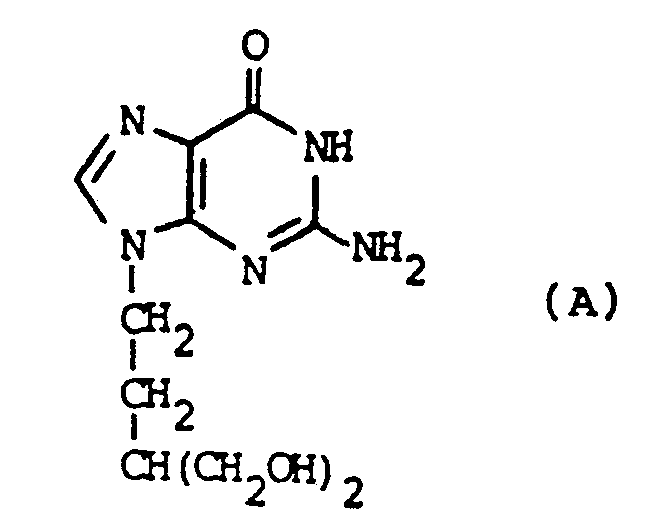
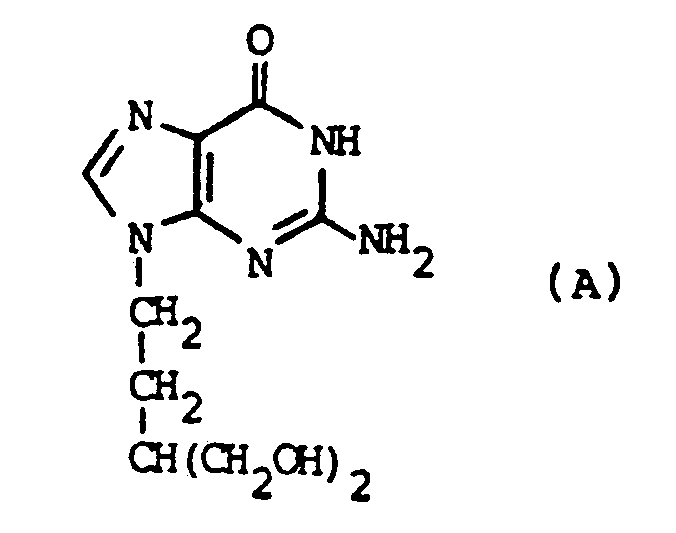
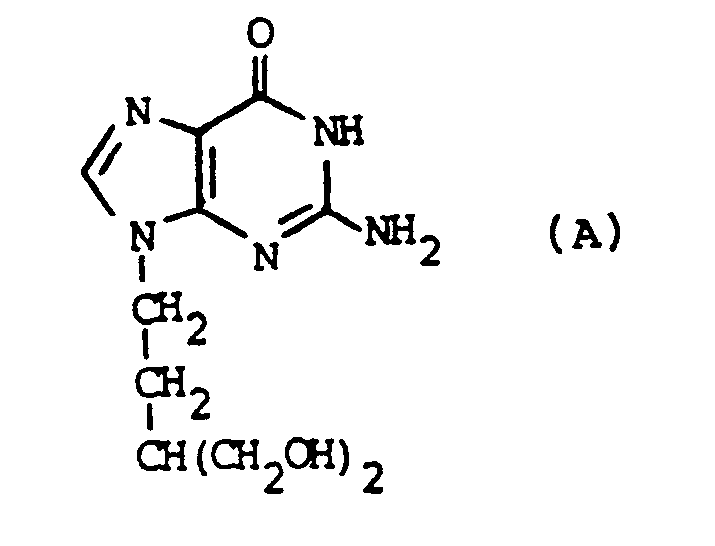
[0002] EP-A-141927 (Beecham Group p.l.c.) discloses the compound of formula (A), 9-(4-hydroxy-3-hydroxymethylbut-1-yl)guanine:
and its sodium salt (in Example 12) and their pharmaceutical use in the treatment of viral infections.
[0003] EP-A-146516 (Astra Läkemedel Antiebolag) and EP-A-152316 (Merck and Co. Inc) also disclose the compound of formula IA).
[0004] The sodium salt of the compound of the formula (A) is preferred for therapeutic use when parenteral administration is desirable, because of its improved solubility over the free base.
[0005] It is important, however, that a solid product comprising the compound of formula (A) or its sodium salts should be stable and have good handling qualities for commercial production.
[0006] A pure crystalline monohydrate of the sodium salt of the compound of formula (A) has now been discovered, this hydrate possessing antiviral activity.
[0007] This hydrate exists in crystalline form, and has improved stability and handling qualities over the anhydrous form disclosed in EP-A-141927.
[0008] Accordingly the present invention provides a crystalline sodium salt monohydrate of the compound of formula (A).
[0009] The present invention further provides a process for the preparation of the crystalline monohydrate of the sodium salt of the compound of formula (A) which process comprises crystallising the sodium salt of the compound of formula (A) from an aqueous medium.
[0010] The invention also provides, in a particular aspect, a process for the preparation of the sodium salt monohydrate of the compound of formula (A), which process comprises dissolving the compound of formula (A) in aqueous sodium hydroxide solution at a non-extreme temperature, removing water by evaporation and recovering the crystals so formed.
[0011] The sodium hydroxide is usually in a solution of concentration 0.1 to 5 molar, preferably 0.5 to 0.6 molar.
[0012] The solution is allowed to remain at a temperature of 0 to 30°C, normally at ambient temperature 20-250C, preferably allowing to stand for about an hour.
[0013] Preferably the solution is then filtered and the water evaporated under reduced pressure. The crystals may be dried by grinding to a fine powder and drying under reduced pressure over a drying agent such as calcium chloride.
[0014] Elemental analysis and other data, such as nmr and IR spectra, shown in Figures 1, 2 and 3 confirm that the isolated compound is a monohydrate of the sodium salt of the compound of formula (A).
[0015] The sodium salt of the compound of formula (A) may be prepared as described in EP-A-141927, preferably in substantially pure anhydrous form.
[0016] The monohydrate may be formulated for use in a pharmaceutical composition for treating viral infections.
[0017] The invention further provides a pharmaceutical composition which comprises the sodium salt monohydrate of the compound of formula (A) together with a pharmaceutically acceptable carrier or excipient.
[0018] The compositions may be adapted for administration via the parenteral route. The compositions of this invention may contain diluents, binder, fillers, disintegrants, lubricants, preservatives in conventional manner.
[0019] Compositions suitable for parenteral administration may be in the form of solutions, suspensions or emulsions, or dry powders which are dissolved or suspended in a suitable vehicle prior to use.
[0020] Fluid unit dosage forms are prepared utilising the compound and a pyrogen-free sterile vehicle. The compound, depending on the vehicle and concentration used, can be either dissolved or suspended in the vehicle. Solutions may be used for all forms of parenteral administration, and are particularly used for intravenous infection. In preparing solutions the compound can be dissolved in the vehicle, the solution being made isotonic if necessary by addition of sodium chloride and sterilised by filtration through a sterile filter using aseptic techniques before filling into suitable sterile vials or ampoules and sealing. Alternatively, if solution stability is adequate, the solution in its sealed containers may be sterilised by autoclaving. Advantageously additives such as buffering, solubilising, stabilising, preservative or bactericidal, suspending or emulsifying agents and/or local anaesthetic agents may be dissolved in the vehicle.
[0021] Dry powders which are dissolved or suspended in a suitable vehicle prior to use may be prepared by filling pre-sterilised drug substance and other ingredients into a sterile container using aseptic technique in a sterile area. Alternatively the drug and other ingredients may be dissolved in an aqueous vehicle, the solution is sterilised by filtration and distributed into suitable containers using aseptic technique in a sterile area. The product is then freeze dried and the containers are sealed aseptically.
[0022] Parenteral suspensions, suitable for intramuscular, subcutaneous or intradermal injections, are prepared in substantially the same manner, except that the sterile compound is suspended in the sterile vehicle, instead of being dissolved and sterilisation cannot be accomplished by filtration. The compound may be isolated in a sterile state or alternatively it may be sterilised after isolation, e.g. by gamma irradiation. Advantageously, a suspending agent for example polyvinylpyrrolidone is included in the composition to facilitate uniform distribution of the compound.
[0023] Preferably, the composition of this invention is in unit dosage form or in some other suitable form for parenteral administration. A suitable dosage unit might contain from 50 mg to 1 g of active ingredient, for example 100 to 500 mg. Such doses may be administered 1 to 4 times a day or more usually 2 or 3 times a day. The effective dose of compound will in general be in the range of from 1.0 to 20 mg/kg of body weight per day or more usually 2.0 to 10 mg/kg per day. No toxicological effects are indicated at the aforementioned dosage range.
[0024] In a further aspect of the invention there is provided the sodium salt monohydrate of the compound of formula (A) for use as a pharmaceutical, in particular, for use in the treatment of viral infections.
Example 1
[0027] 9-(4-Hydroxy-3-hydroxymethylbut-1-yl)guanine (113.8 g) was added to a solution of sodium hydroxide (18.0 g) in water (750 ml) and the solution allowed to remain at 20°C for 1 hour. The solution was then filtered and the water evaporated under reduced pressure (ca 15mm Hg). The solid residue was ground to a fine powder and dried under reduced pressure (ca 15mm Hg or 2 kPa) over anhydrous calcium chloride for 3 days, affording the sodium salt monohydrate (130.0 g).
Elemental analysis
Found:C, 40.93; H, 5.27; N, 23.57; Na, 7.54%.
Calculated for CoH4N503Na.HzO: C, 40.95; H, 5.50; N 23.89; Na, 7.84%.
Water Content (KF-CA02)
Found: 5.97%
Calculated for C,oH,4N503Na.H20: 6.14%
Thermal Analysis Broad endotherm, Tp = 160°C Melting endotherm, Te = 266°C
Spectroscopic Data
IR Spectrum - see Figure 3. (KBr disc)
'H nmr Spectrum - see Figures 4 and 5. (Solvent - DMSO, 270 MHz). Figure 5 shows the 'H nmr spectrum with D20 exchange.
1. A crystalline sodium salt monohydrate of the comound of formula (A):
2. A process for the preparation of the crystalline sodium salt monohydrate of the
compound of formula (A) as defined in claim 1, which process comprises crystallising
the sodium salt of the compound of formula (A) from an aqueous medium.
3. A process according to claim 2 for the preparation of the sodium salt monohydrate
of the compound of formula (A), as defined in claim 1, which process comprises dissolving
the compound of formula (A) in aqueous sodium hydroxide solution at G-30°C, removing
water by evaporation and recovering the crystals so formed.
4. A pharmaceutical composition which comprises the sodium salt monohydrate of the
compound of formula (A), as defined in claim 1, together with a pharmaceutically acceptable
carrier or excipient.
5. The monohydrate according to claim 1 for use as an active therapeutic substance.
6. The monohydrate according to claim 1 for use in the treatment of viral infections.
7. Use of a monohydrate according to claim 1 in the preparation of a medicament for
use in the treatment of viral infections.
1. Ein kristallines Natriumsalzmonohydrat der Verbindung der Formel (A):
2. Ein Verfahren zur Herstellung des kristallinen Natriumsalzmonohydrats der Verbindung
der Formel (A), wie in Anspruch 1 definiert, welches Verfahren des Kristallisieren
des Natriumsalzes der Verbindung der Formel (A) aus einem wäßrigen Medium umfaßt.
3. Ein Verfahren nach Anspruch 2 zur Herstellung des Natriumsalzmonohydrats der Verbindung
der Formel (A), wie in Anspruch 1 definiert, welches Verfahren das Auflösen der Verbindung
der Formel (A) in wäßriger Natriumhydroxidlösung bei 0 bis 30°C, das Entfernen von
Wasser durch Verdampfen und das Gewinnen der so gebildeten Kristalle umfaßt.
4. Eine pharmazeutische Zusammensetzung, welche das Natriumsalzmonohydrat der Verbindung
der Formel (A), wie in Anspruch 1 definiert, zusammen mit einem pharmazeutisch verträglichen
Träger oder Exzipienten umfaßt.
5. Das Monohydrat nach Anspruch 1 zur Verwendung als aktive therapeutische Substanz.
6. Das Monohydrat nach Anspruch 1 zur Verwendung bei der Behandlung von Virusinfektionen.
7. Verwendung eines Monohydrats nach Anspruch 1 bei der Herstellung eines Medikaments
zur Verwendung bei der Behandlung von Virusinfektionen.
1. Sel sodique cristallin monohydraté du composé caractérisé par la formule (A):
2. Procédé pour la préparation du sel sodique cristallin monohydraté du composé de
formule (A) suivant la revendication 1, caractérisé en ce qu'il comprend la cristillisation
du sel sodique du composé de formule (A) à partir d'un milieu acqueux.
3. Procédé suivant la revendication 2, pour la préparation d'un sel sodique monohydraté
du composé de formule (A) suivant la revendication 1, caractérisé en ce qu'il comprend
la dissolution du composé de formule (A) dans une solution acqueuse d'hydroxyde de
sodium à 0―30°C, l'élimination de l'eau par évaporation et la récupération des cristaux
ainsi fournis.
4. Composition pharmaceutique, caractérisée en ce qu'elle comprend le sel sodique
monohydraté du composé de formule (A) suivant la revendication 1, avec un support
ou un excipient acceptable du point de vue pharmaceutique.
5. Monohydrate suivant la revendication 1, caractérisé en ce qu'il est utile comme
substance thérapeutique active.
6. Monohydrate suivant la revendication 1, caractérisé en ce qu'il est utile dans
le traitement d'infections virales.
7. Utilisation d'un monohydrate suivant la revendication 1, dans la préparation d'un
médicament utile dans le traitement des infections virales.