|
(11) | EP 0 221 613 A1 |

| (12) | EUROPEAN PATENT APPLICATION |
|
|
|
|
|||||||||||||||||||||||||||
| (54) | Low drive voltage display device |
| (57) In a display device having a matrix structure the number of rows to be addressed
is selected to be smaller than is possible on the ground of threshold steepness. The
required selection voltages can then be selected to be considerably lower than the
voltages in accordance with the Alt & Pleshko addressing scheme. |
[0001] The invention relates to a display device comprising two support plates spaced at a defined distance from each other and having surfaces facing each other between which a layer of liquid crystal material is provided, a pattern of N row electrodes being provided on one surface and a pattern if column electrodes being provided on the other surface, said row electrodes crossing the column electrodes and the crossover regions constituting a matrix of display cells which can be switched from a first condition to a second condition optically different therefrom by means of a row-scanning circuit periodically scanning the row electrodes with a row selection pulse of the magnitude Vs and a column selection circuit applying data voltages of the magnitude + Vd to the column electrodes during a period when a row electrode is scanned such that the optical condition realized in a display cell is determined by the RMS-voltage value across the relevant cell, said RMS voltage value for the selected display cells, i.e. the display cells in the on-condition being given by:
and for the non-selected display cells, i.e. the display cells in the off-condition being given by:
wherein the ratio
in the transmission voltage characteristic curve of the optical effect associated with the liquid crystal material is of such a nature that not more than N row electrodes can be used for a selected max contrast ratio between selected and non-selected display cells in accordance with the Alt & Pleshko-RMS multiplex drive mode.
[0002] The RMS multiplex drive mode as described by Alt & Pleshko in IEEE Trans. El. Dev., Vol., ED 21, 1974, pages 146-153 is applied as the most commonly used mode for liquid crystal display devices. Alt & Pleshko have derived relations which for a given value of the ratio S = V1/V2 (also referred to as threshold slope in the transmission voltage characteristic curve) indicate the maximum number of rows Nmax that can be driven by using this mode while maintaining a predetermined contrast and in which way the voltage V of the row-selection pulse and the data voltages of the magnitude + Vd must be chosen to realize this. These relations are as follows:
[0003] If the row-selection voltage Ys and the data voltage Vd are selected in accordance with the equations (2) and (3), the resultant RMS voltage across a selected picture element will be equal to V1 when using Nmax rows and the voltage across a non-selected element will be equal to V2. A higher multiplex ratio, in other words a higher value for Nmax requires a steeper slope in the transmission voltage characteristic curve, i.e. a value of the magnitude
closer to 1.
[0004] When the multiplex ratio increases, ever higher voltages are required when the drive according to Alt & Pleshko is used. For a multiplex ratio of approximately 1:100 and more and a value of V2 of (typically) 2 Volts this leads to, for example, row selection voltage V s of the order of 16 Volts or more which is undesirable inter alia in connection with the availability of integrated drive circuits.
[0005] It is an object of the invention to provide a display device in which for a given high multiplex ratio (for example, higher than 100:1) the drive of a liquid crystal display is effected in accordance with the RMS multiplex drives with row selection voltages which are lower than those prescribed by the Alt & Pleshko-relations, without detracting from contrast.
[0006] To this end a display device of the type described in the opening paragraph according to the invention is characterized in that for
the voltage ratio Vs/Vd is defined by the relation:
in which for V2 the RMS-voltage value is selected which corresponds to the off-condition of the display cell.
[0007] The invention is based on the recognition that for a selected V2 at a number of N rows with N N max multiplex drive can be used with a certain range of V5 and Vd values while maintaining the desired contrast. From this range of values row selection voltages can be chosen which are considerably lower than those in accordance with the Alt & Pleshko-relations.
[0008] The invention will now be further described with reference to an embodiment and the drawing in which
Figure 1 diagrammatically shows a liquid crystal display device,
Figure 2 diagrammatically shows part of a matrix- oriented display device,
Figure 3 shows the transmission voltage characteristic curve of a picture cell associated with this device,
Figure 4 shows the relation between selection and data voltages for such a display device driven with N selection rows, where N is less than the maximum N associated with the picture element,
Figure 5 shows the effective voltages across a picture element emanating therefrom, and
Figure 6 shows the minimum Vs/Vd value as a function of
[0009] The liquid crystal display device shown in Fig. 1 has two glass supporting plates 1 and 2 which are provided with electrodes 3 and 4 consisting of indium-tin oxide. A silicon oxide layer is vapour-deposited on the surfaces of the supporting plates 1 and 2 provided with electrodes at an angle of 80°-86° to the normal on the surface. The layers constitute the orientation layers 6 and 7. A liquid crystal material 8 is present between the supporting plates. The distance d between the plates is maintained by spacers not shown in the drawing, which are regularly distributed over the plate surfaces. A sealing rim 9 connects the supporting plates at their circumference. The supporting plates are each provided with a linear polariser, more specifically a polariser 10 and an analyser 11.
[0010] Figure 2 diagrammatically shows part of a matrix- oriented display device 1 which is driven by a number of N selection rows (row electrodes) 2, while the information to be displayed is presented on the data rows (column elecrrodes) 3. Display elements 4 are provided at the crossover regions of the selection rows 2 and the data rows 3. The voltage transmission characteristic curve of these display elements is diagrammatically shown in Figure 3. Dependent on the information presented on the data rows 3 the display elements 4 are either in an on or in an off-condition. The device includes a line scanning circuit 12 and a column selection circuit 13 for presenting selection and data voltages.
[0011] The information is presented, for example by way of pulses. Synchronously with the selection of the lines or row electrodes with the aid of a row selection voltage Vs the picture information (data voltage ± Vd) is applied via the column electrodes. From the instant t the row 2a is selected during a period TL (line period), which together with the information (± Vd) which is then present on the data rows 3 , 3b, 3c determines the condition of the picture elements 4aa, 4ab, 4ac. From instant t2 the row 2b is selected during a period TL. The information (± vd) then present on the data rows 3 determines the condition of the picture elements 4ba, 4bb, 4bc etc. During the remaining part of a frame time Tf = N.TL a voltage + Vd is present across the display cells 4 which voltage must be lower than the threshold voltage of the optical effect.
[0012] In practice both the rise time and the decay time of the optical effect is often much longer than the frame time. This means that the display element reacts to the cumulative effect of a number of drive pulses. Notably an LCD-display element reacts in the same manner as when it was driven with a sine or square-wave signal having the same RMS-value as that of the on and off-voltages V1 and V2 given by:
[0013] As described in the preamble, the maximum number of selection rows Nmax is related to the value of V1/V2 also referred to as the threshold slope of the optical effect.
[0014] According to the invention, if N Nmax, the selection voltage Vs to be used may be considerably lower than that which has been derived by means of the Alt & Pleshko-relations, provided that the following relations are satisfied:
With x2 =(
)2 and y2 =(
)2 (4) and (5) may be rewritten as: y2 (x + 1)2+ (N-1) y2≥ N(1 +
(6) y2 (x - 1)2 + (N - 1) y2 = N (7)
[0015] Elimination of y2 from (6) and (7) results in:
which with δ = 1 +
results in
with the sub-requirement:
or
(
) according to the Alt & Pleshko relations is equal
can be rewritten as
[0017] The actual Vs and Vd values satisfying this can be found by combination of the equations (10) and (5). This is illustrated in Figure 4 in which N max is assumed to be 256, N = 128 and V2 = 1.8 Volts. This Figure also shows which Vs and Vd values would be found for multiplexing 128 rows in accordance with the Alt & Pleshko multiplex drive mode.
[0018] It is clearly evident from the Figure that dependent on the selected Vd values, selection voltages which are lower then those determined by the Alt & Pleshko relations for N max = 128 (vs = 15, 1 Volts) are possible. Figure 5 diagrammatically shows how the effective RMS-voltage V1 across a picture display element varies as a function of the selection voltage Vs within the limits as defined in Figure 3. The Vs values selected in this Figure and the associated Vd values give rise to the RMS voltage across the picture element, as is found with the left-hand member of the equation (4). The Figure shows that V1 is of course at a maximum for Vs = 15.1 Volts, in other words the selection voltage in accordance with Alt & Pleshko for N max = 128, but the device can also be operated without loss of contrast and at much lower voltages because V1 in the example shown only needs to be higher than 1.91 Volts.
[0019] Equation (10) also shows the minimum Vs/Vd ratio with which N rows can be multiplexed for an optical medium at such a threshold slope S = V1/V2 that in accordance with the Alt & Pleshko mode a maximum of N rows can be max multiplexed, namely
[0020] In the Table below Vs/Vd and Vs/V2 values are given which are calculated in accordance with equation (12) for a number of electro-optical media having a different value for S = V1/V2 and hence a different Nmax value
[0021] It is evident from this Table and Figure 4 that in practice where a low
ratio is desired the relevant range is determined by
[0022] The term
in equation (12) corresponds to
according to Alt & Pleshko (equation (2). Equation (12) can then be rewritten as:
[0023] This function is shown in Figure 6. It is apparent from this Figure that for a given electro-optical effect in which with multiplex drive Nmax rows can be used when using approximately 75% of this number of rows the required Vs/Vd ratio is halved relative to that required for multiplexing Nmax rows according to Alt & Pleshko. In practice a Vs/Vd ratio will preferably be selected which satisfies this ratio, in other words for which it holds that
1. A display device comprising two support plates spaced at a defined distance from
each other and having surfaces facing each other between which a layer of liquid crystal
material is provided, a pattern of N row electrodes being provided on one surface
and a pattern of column electrodes being provided on the other surface, said row electrodes
crossing the column electrodes and the crossover regions constituting a matrix of
display cells which can be switched from a first condition to a second condition optically
different therefrom by means of a row-scanning circuit periodically scanning the row
electrodes with a row selection pulse of the magnitude V and a column-selection circuit
applying data voltages of the magnitude + Vd to the column electrodes during a period when a row electrode is scanned such that
the optical condition realized in a display cell is determined by the RMS-voltage
value across the relevant cell, said RMS-voltage value for the selected display cells,
i.e. the display cells in the on-condition being given by

and for the non-selected display cells, i.e. the display cells in the off-condition being given by

wherein the ratio
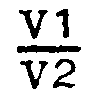
in the transmission voltage characteristic curve of the optical effect associated with the liquid crystal material is of such a nature that not more than N row electrodes can be used for a selected contrast max ratio between selected and non-selected display cells in accordance with the Alt & Pleshko RMS multiplex drive mode, characterized in that for N < Nmax the voltage ratio Vs/Vd is defined by the relation:

in which for V2 the RMS-voltage value is selected which corresponds to the off-condition of the display cell.
and for the non-selected display cells, i.e. the display cells in the off-condition being given by
wherein the ratio
in the transmission voltage characteristic curve of the optical effect associated with the liquid crystal material is of such a nature that not more than N row electrodes can be used for a selected contrast max ratio between selected and non-selected display cells in accordance with the Alt & Pleshko RMS multiplex drive mode, characterized in that for N < Nmax the voltage ratio Vs/Vd is defined by the relation:
in which for V2 the RMS-voltage value is selected which corresponds to the off-condition of the display cell.
2. A display device as claimed in Claim 1, characterized in that the ratio Vs/Vd is
less than approximately 0.9 N.
3. A display device as claimed in Claim 1, characterized in that the ratio Vs/Vd is
substantially equal to
