|
(11) | EP 0 221 651 A1 |

| (12) | EUROPEAN PATENT APPLICATION |
|
|
|
|
|||||||||||||||||||||||||||
| (54) | Water soluble polyvinyl alcohol derivative |
| (57) A cold water-soluble polyvinyl alcohol derivative comprises 70 to 90 mol% of the
vinyl alcohol units, 0 to 2 mol% of the vinyl acetate units and 10 to 30 mol% of the
acetalized vinyl alcohol units having an alkyl group having 0.34 to 1.70 carbon atoms
on the average, having a viscosity-average polymerization degree of 200 to 500 in
respect to the vinyl monomer units. |
[0001] The present invention relates to a cold water-soluble polyvinyl alcohol derivative. More particularly, the present invention relates to a cold water-soluble polyvinyl alcohol derivative which has acid resistance and alkali resistance and can retain its solubility over a long period of time.
Statement of Prior Arts
[0002] Since polyvinyl alcohol (hereinafter referred to as "PVA") is a water-soluble polymer, the polymer is widely used for water-soluble films and in other fields. PVA having a degree of saponification of 80 to 95 mol.% shows a rapid water solubility. PVA having a degree of saponification of at least 98 mol.% is called "completely saponified PVA" and this PVA is dissolved in water when it is allowed to stand still in water for a long time or it is thrown into hot water, but it is not promptly dissolved in cold water.
[0003] PVA having a degree of saponification of 80 to 95 mol.% is stable in the neutral region, but when it falls in contact with an alkaline substance, saponification of the remaining ester groups in advanced and the degree of saponification is deviated from the above-mentioned range and exceeds this range. Accordingly, the prompt solubility in cold water is lost.
[0004] The reason why completely saponified PVA has no prompt solubility in water is that the polymer is crystalline. More specifically, it is believed that since hydroxyl groups of PVA form very strong hydrogen bonds intermolecularly, crystallization is caused and intrusion of water molecules is inhibited. This is reported by Sakurada et al. in Kobunshi Kagaku, Vol. l2, No. l28, pages 5l0-5l3 (l955).
[0005] Furthermore, in the report of Sakurada et al. in Kobunshi Kagaku, Vol. l2, No. l28, pages 5l7-52l (l955), it is taught that the degree of crystallization of completely saponified PVA is increased by heating, and it is stated that the increase in the degree of crystallization participates greatly in reduction in the solubility.
[0006] Moreover, in the report of Sakurada et al., Kobunshi Kagaku, Vol. l2, No. l28, pages 5l0-5l3 (l955), it is shown that the crystal region does not participate in swelling of PVA.
[0007] Accordingly, if it is supposed that "dissolution" corresponds to infinite swelling in which molecules of PVA are disjointed, it is necessary to prepare substantially completely amorphous PVA in order to obtain cold water-soluble, completely saponified PVA. In other words, it is necessary that crystallization should be prevented by putting the regularity into disorder.
[0008] Under this background, a process for synthesizing atactic PVA while reducing the crystallinity is proposed in Kobunshi Ronbunshu by Imai et al., Vol. 35, No. l2, pages 8ll-8l3 (l978) and Japanese Patent Publication No. 36-3999. However, since preparation is possible only under strictly limited conditions in this process, industrial production is considerably difficult.
[0009] To obtain a PVA having improved properties, an alkoxybutyralization product of PVA is proposed in Japanese Patent Publication No. 38-20720. According to this technique, however, since the chain of the aldehyde used for acetalization is long, if the degree of acetalization is controlled within a range capable of imparting water solubility, the acetalization has to be maintained at a low level, and therefore, the disorder of the structural regularity cannot be maintained for a long time, resulting in rise of the degree of crystallization and loss of the water solubility.
[0010] A technique using acetalized PVA as the water-soluble PVA derivative is disclosed in an example of Japanese Patent Publication No. 39-l69l0. According to this technique, a non-ionic surface active agent is added to acetoacetalized PVA. Since the average degree of polymerization of acetoacetalized PVA is 550, if commercially available PVA (composed mainly of a syndiotactic polymer) is used, rise of the degree of crystallization with the lapse of time cannot be avoided, as in the above-mentioned conventional technique, and therefore, the water solubility is lost. According to the report of Sakurada et al., Kobunshi Kagaku, Vol. l2, No. l28, pages 506-5l0 (l955) concerning the relation between the degree of crystallization and average degree of polymerization of PVA, it is taught that rise of the average degree of polymerization results in rise of the degree of crystallization. This means that rise of the average degree of polymerization results in reduction in the water solubility.
[0011] Furthermore, a technique using partially aldolacetalized PVA is disclosed in Japanese Patent Publication No. 42-2-845. This partially aldolacetalized PVA is prepared by acetalization reaction between aldol and PVA. Since both hydroxyl and aldehyde groups are present in a molecule of aldol, a reaction of molecules of aldol with each other takes place and control of the reaction is difficult. This means that it is very difficult to prepare an acetalization product having a degree of acetalization assuring maintenance of good water solubility for a long time industrially stably.
[0012] As is apparent from the foregoing description, a cold water-soluble PVA derivative which is rapidly soluble in cold water, is excellent in the long-period stability, does not undergo any change in the crystallinity and has excellent acid resistance and alkali resistance has not been present.
Summary of the Invention
[0013] Under this background, we made various investigations and succeeded in providing a cold water-soluble PVA derivative which is promptly soluble in cold water and is excellent in the long-period stability because of a stable amorphousness and which is excellent in acid resistance and alkali resistance, though development of such a PVA derivative is impossible according to the conventional techniques.
[0014] More specifically, it was found that a PVA derivative having a basic structure comprising vinyl alcohol units, vinyl acetate units and acetalized vinyl alcohol units, wherein the viscosity average degree of polymerization based on the vinyl monomer units is 200 to 500, the content of the vinyl alcohol units is 70 to 90 mol.%, the content of the vinyl acetate units is 0 to 2 mol.%, the degree of acetalization is l0 to 30 mol.%, and in the acetalized vinyl alcohol units represented by the following formula:
wherein R stands for an alkyl group, the average alkyl chain length of R corresponds to a carbon number of 0.34 to l.70, is soluble in cold water, does not show rise of the degree of crystallization because it has a stable amorphousness, and is excellent in stability for long time and resistance to an acid and an alkali. We have now completed the present invention based on this finding.
[0015] A cold water-soluble compound of a polyvinyl alcohol derivative according to the invention comprises 70 to 90 mol% of the vinyl alcohol units, 0 to 2 mol% of the vinyl acetate units and l0 to 30 mol% of the acetalized vinyl alcohol units having the formula:
in which R is an alkyl group having 0.34 to l.70 carbon atoms on the average, having a viscosity-average polymerization degree of 200 to 500 in respect to the vinyl monomer units.
[0016] It is preferable that the compound has methyl for R. It is possible that the acetalized vinyl alcohol units of the compound have two or more alkyl groups in R.
[0017] The mechanism of imparting the water solubility to the cold water-soluble. PVA derivative and the reason why this PVA has a stable amorphousness will now be described.
[0018] The reason why completely saponified PVA has no prompt solubility in cold water has been described hereinbefore. In contrast, partially saponified PVA having a degree of saponification of 80 to 95 mol.% has a water solubility. The reason is that acetate groups are present in the molecule. The acetate group per se is a hydrophobic group, but if they are present in an amount of 5 to 20 mol.% in the molecule, they exert a steric hindrance disturbing the intermolecular arrangement of chains, and crystallization among molecules of PVA is prevented. Accordingly, a water solubility can be given to the above-mentioned, partially saponified PVA. However, since partially saponified PVA has ester linkages, as pointed out hereinbefore, saponification is advanced on contact with an alkali to let PVA get out of the water-soluble region and attainment of an alkali resistance cannot be expected.
[0019] In the present invention, a mixture of aldehydes (R'-CHO) is added by acetalization to completely saponified PVA having a viscosity average degree of polymerization based on the vinyl monomer units (hereinafter referred to merely as "viscosity-average degree of polymerization") of 200 to 500 so that the average alkyl chain length of R corresponds to a carbon number of 0.34 to l.70, and in this PVA derivative, the degree of acetalization is l0 to 30 mol.%. This acetalized portion exerts a steric hindrance disturbing the intramolecular regularity of PVA and inhibits the crystallization. Accordingly, the cold water-soluble PVA derivative of the present invention is amorphous and is weak in the intramolecular bonding force. Accordingly, it is considered that when this PVA derivative is thrown into water, water easily intrudes in the texture and the derivative shows a water solubility.
[0020] The basic structure of the cold water-soluble PVA derivative of the present invention is represented by the following formula:
and the derivative has ether linkages in the molecule.
[0021] This bonding state is stable against an alkali, and the water solubility is not lost even in the presence of an alkali.
[0022] The reason why the average degree of polymerization of PVA used in the present invention, the alkyl chain length of the aldehyde used and the degree of acetalization are limited as described above in the present invention will now be described.
[0023] The partially acetalized PVA used in the present invention is prepared from commercially available PVA, which is composed mainly of a syndiotactic polymer and has a high crystallinity.
[0024] The reason why the viscosity-average degree of polymerization is limited to 200 to 500 in the present invention is due to the relation between the degree of polymerization and the degree of crystallization. This relation is reported by Sakurada et al. in Kobunshi Kogaku, Vol. l2, No. l28, pages 506-5l0 (l955), and it is taught that an increase in the degree of polymerization has great influences on the degree of crystallization.
[0025] As the result of various experiments made by us, it was found that it is necessary that PVA having a viscosity-average degree of polymerization of 200 to 500 should be used. In case of PVA having an average degree of polymerization higher than 500, the cold water solubility is degraded with the lapse of time, and no good results can be obtained.
[0026] The reason of the limitation of the alkyl chain length of the aldehyde to be added is due to the effect of steric hindrance. If the alkyl chain length R corresponds to a carbon number smaller than 0.32, the alkyl chain length is too short and no effect of steric hindrance can be attained. If the alkyl chain length R corresponds to a carbon number larger than l.72, the alkyl chain length is larger than that of the aldehyde used in the present invention, and PVA becomes more oleophilic. If acetalization is effected to a degree of acetalization of l0 to 30 mol.% as specified in the present invention, PVA becomes water-insoluble. Accordingly, in order to maintain PVA in the water-soluble region, the number of moles of the added aldehyde should be reduced, resulting in reduction of the effect of steric hindrance. Therefore, as-prepared PVA is water-soluble, but if PVA is allowed to stand still for a long time, the degree of crystallization is increased and the solubility in cold water is reduced.
[0027] The reason of the limitation of the degree of acetalization in the present invention is that in order to maintain the cold water solubility for a long time, it is necessary that the degree of crystallization should not be changed after the preparation. More specifically, if the degree of acetalization exceeds 30 mol.%, PVA becomes insoluble in water, while if the degree of acetalization is lower than l0 mol.%, PVA has temporarily a cold water solubility, but the degree of crystallization is changed with the lapse of time and the cold water solubility is reduced.
[0028] As is apparent from the foregoing description, according to the present invention, by limiting the average degree of polymerization of starting PVA, the alkyl chain length of the aldehyde to be added and the degree of acetalization within specific ranges, an intended cold water-soluble PVA derivative having an excellent stability can be obtained for the first time. Incidentally, a single aldehyde or a mixture of two or more of aldehydes may be used for the production of the cold water-soluble PVA derivative of the present invention.
[0029] The cold water-soluble PVA derivative of the present invention can be easily prepared from commercially available PVA by a known acetalization process, and since any special means need not be adopted for the synthesis of PVA, the present invention is industrially excellent. For molding, for example, for formation of a film, there may be adopted a melt extrusion process and a casting process. Furthermore, known plasticizers and other additives for PVA may be incorporated. Moreover, known secondary processing may be adopted.
[0030] The invention compound is obtained by a conventional method for acetalyzation. A polyvinyl alcohol is reacted with an aldehyde having the formula R-CHO in which R is an alkyl having 0.34 to l.70 on the average.
[0031] The process to conduct practically comprises the steps of adding to water a polyvinyl alcohol having a viscosity-average polymerization degree of 200 to 500, heating the mixture to form an aqueous solution, adding to the solution an acid, reacting an aldehyde having the formula: R-CHO in which R is an alkyl having 0.34 to l.70 on the average with the solution to conduct acetalization, then neutralizing the product mixture and separating the compound by drying and removal of water or use of an organic solvent. The aqueous solution of said polyvinyl alcohol may be alternatively formed by adding first an acid and then the polyvinyl alcohol to water.
[0032] As is apparent from the foregoing description, the cold water-soluble PVA derivative of the present invention can be promptly dissolved in cold water and has a stable amorphousness, and therefore, the PVA derivative is excellent in the long-period stability and has a good resistance to an acid and an alkali. Moreover, since the melting point is low, the PVA derivative may be molded by melt extrusion and injection molding or molded into fibers, and the PVA derivative is widely used in various fields.
[0033] The compound of the invention can be applied to an absorbent article such as a sanitary article together with a superabsorptive polymer. It is used in the form of film.
[0034] It is useful as a hotmelt adhesive. It may be used in combination of up to 60 percent by weight of a polyhydric alcohol compound having a melting point of 70°c or lower.
[0037] It may contain up to 90 percent by weight of water-insoluble fibers and be used in the form of sheet.
[0039] The film of the compound may be used together with an oily substance and/or a nonionic surfactant as a releasing agent. Coating or blend may be conducted for the purpose.
[0040] This way the compound of the invention is useful in various fields by utilizing the above shown physical properties.
(Examples)
[0041] The present invention will now be described in detail with reference to the following examples that by no means limit the scope of the invention.
Example l
[0042] Twenty grams of a polyvinyl alcohol having a saponification degree of 98.6 mol% and a viscosity-average polymerization degree of 200 was added to 980 g of water and the mixture was stirred with heat to form an aqueous solution. To one kg of the solution having a solid concentration of 2% by weight was added 0.7 g of concentrated hydrochloric acid, and 3 g of acetaldehyde, was added to the solution. The mixture was reacted at 60°C for 5 hours with stirring. Then, neutralization was effected with NaOH, and the reaction product was precipitated by addition of acetone. The precipitate was separated, washed with acetone and dried to obtain partially acetoacetalized PVA. The degree of acetoacetalization of the reaction product was measured by an acetoacetalization degree determining method contrived by modifying the formalization degree determining method disclosed in Kobunshi Bunseki Handbook (published by Asakura Shoten, page 770) based on the difference in the molecular weight between formaldehyde and acetaldehyde. It was found that the degree of acetoacetalization was 22.2 mol.%. An aqueous solution of the obtained product was prepared, cast on a glass sheet, dried and heated at 95°C to obtain a film having a thickness of 20 microns.
Example 2
[0043] 20 g of a polyvinyl alcohol having a saponification degree of 98.4 mol% and a viscosity-average polymerization degree of 400 was added to 980 g of water and the mixture was stirred with heat to form an aqueous solution of the polyvinyl alcohol. To l kg of the solution having a solid concentration of 2% by weight was added 0.7 g of concentrated hydrochloric acid, and 2.5 g of acetaldehyde was added to the solution. Partially acetoacetalized PVA was obtained in the same manner as described in Example l. The degree of acetoacetalization of the reaction product was l7.0 mol.% (as determined according to the method described in Example l). A film having a thickness of 20 microns was obtained according to the same procedures as described in Example l.
Example 3
[0044] 20 g of a polyvinyl alcohol having a saponification degree of 98.6 mol% and a viscosity-average polymerization degree of 500 was added to 980 g of water and the mixture was stirred with heat to form an aqueous solution of the polyvinyl alcohol. To l kg of the solution having a solid concentration of 2% by weight was added 0.7 g of concentrated hydrochloric acid, and 3.6 g of acetaldehyde was added to the solution. Partially acetoacetalized PVA was obtained according to the same procedures as described in Example l. The degree of acetoacetalization of the obtained reaction product was 30.0 mol.% (as determined according to the same method as described in Example l). A film having a thickness of 20 microns was obtained according to the same procedures as described in Example l.
Example 4
[0045] To l kg of the same aqueous solution of PVA as used in Example 3 was added 0.7 g of concentrated hydrochloric acid, and 2.4 g of paraldehyde was added to the aqueous solution. Partially acetoacetalized PVA was obtained according to the same procedures as described in Example l. The degree of acetoacetalization of the reaction product was 22.2 mol.% (as determined according to the same method as described in Example l). A film having a thickness of 20 microns was obtained according to the same procedures as described in Example l.
Example 5
[0046] To l kg of the same aqueous solution of PVA as used in Example 3 was added 0.7 g of hydrochloric acid, and l.4 g of acetaldehyde was added to the solution. Partially acetoacetalized PVA was obtained according to the same procedures as described in Example l. The degree of acetoacetalization of the reaction product was l0.3 mol.% (as determined according to the same method as described in Example l). A film having a thickness of 20 microns was obtained according to the same procedures as described in Example l.
Example 6
[0047] To l kg of the same aqueous solution of PVA as used in Example 3 was added 0.7 g of concentrated hydrochloric acid, and 3.0 g of an aldehyde mixture (formaldehyde/acetaldehyde, molar ratio of 65/35) was added to the solution. Mixed acetalized PVA was obtained according to the same procedures as described in Example l. From the result of gas chromatography, it was found that the average alkyl chain length of the acetalized portion of the reaction product was 0.34, and when the degree of acetalization was determined from the average alkyl chain length while making correction based on the molecular weight, it was found that the degree of acetalization was l7 mol.%. A film having a thickness of 20 microns was obtained according to the same procedures as described in Example l.
Example 7
[0048] To l kg of the same aqueous solution of PVA as used in Example 3 was added 0.7 g of concentrated hydrochloric acid, and 2.5 g of an aldehyde mixture (acetaldehyde/n-butylaldehyde, molar ration of 65/35) was added to the solution. Mixed acetalized PVA was obtained according to the same procedures as described in Example l. The average alkyl chain length of the acetalized portion of the reaction product was l.70 as determined by the gas-chromatographic analysis, and the degree of acetalization was l3.6 mol.% as determined in the same manner as described in Example l after making correction based on the molecular weight from the average alkyl chain length. A film having a thickness of 20 microns was obtained according to the same procedures as described in Example l.
Example 8
[0049] To l kg of the same aqueous solution of PVA as used in Example 3 was added 0.7 g of concentrated hydrochloric acid, and l.2 g of paraformaldehyde was added to the squeous solution. The mixture was reacted for l hour. Then, l.8 g of paraldehyde was added and mixed acetalized PVA was obtained according to the same procedures as described in Example l. The average alkyl chain length of the acetalized portion of the reaction product was 0.53 as determined by the gas-chromatographic analysis, and the degree of acetalization was l5.3 mol.% as determined according to the same method as described in Example l after making correction based on the molecular weight from the average alkyl chain length. A film having a thickness of 20 microns was prepared according to the same procedures as described in Example l.
Example 9
[0050] To l kg of the same aqueous solution of PVA as used in Example 3 was added 0.7 g of concentrated hydrochloric acid, and 2.5 g of an aldehyde mixture (acetaldehyde/n-butylaldehyde, molar ratio of 90/l0) was added to the solution. Mixed acetalized PVA was obtained according to the same procedures as described in Example l. The average alkyl chain length of the acetalized portion of the reaction product was l.27 as determined by the gas-chromatographic analysis, and the degree of acetalization was l6.8 mol.% as determined according to the same method as described in Example l after making correction based on the molecular weight from the average alkyl chain length. A film having a thickness of 20 microns was obtained according to the same procedures as described in Example l.
Comparative Example l
[0051] An aqueous solution of PVA (having a degree of saponification of 98.4 mol.% and a viscosity-average degree of polymerization of 500) was prepared and glycerol was added to the aqueous solution in an amount of l0% by weight based on PVA. A film having a thickness of 20 microns was obtained according to the same procedures as described in Example l.
Comparative Example 2
[0052] To l kg of the same aqueous solution of PVA as used in Example 3 was added 0.7 g of concentrated hydrochloric acid, and 5.0 g of formaldehyde (37% aqueous solution) was added to the aqueous solution. Partially formalized PVA was obtained according to the same procedures as described in Example l. The degree of formalization of the reaction product was l4.l mol.% (according to the formalization degree measuring method described in page 770 of Kobunshi Bunseki Handbook). A film having a thickness of 20 microns was obtained according to the same procedures as described in Example l.
Comparative Example 3
[0053] To l kg of the same aqueous solution of PVA as described in Example 3 was added 0.7 g of concentrated hydrochloric acid, and l.3 g of n-butylaldehyde was added to the aqueous solution. Partially butyralized PVA was obtained according to the same procedures as described in Example l. The degree of butyralization of the reaction product was 8.4 mol.% (as determined by the measuring method contrived by modifying the above-mentioned method for determination of the degree of butyralization based on the molecular weight). A film having a thickness of 20 microns was obtained according to the same procedures as described in Example l.
Comparative Example 4
[0054] To l kg of the same aqueous solution of PVA as used in Example 3 was added 0.7 g of concentrated hydrochloric acid, and l.0 g of acetaldehyde was added to the aqueous solution. Partially acetoacetalized PVA was obtained according to the same procedures as described in Example l. The degree of acetalization of the reaction product was 8.7 mol.% (as determined by the same method as described in Example l). A film having a thickness of 20 microns was obtained according to the same procedures as described in Example l.
Comparative Example 5
[0055] To l kg of the same aqueous solution of PVA as described in Example 3 was added 0.7 g of concentrated hydrochloric acid, and 4.0 g of acetaldehyde was added to the aqueous solution. Partially acetoacetalized PVA was obtained according to the same procedures as described in Example l. The degree of acetalization was 34.0 mol.% (as determined according to the same method as described in Example l). Considerable quantities of insoluble substances were formed in the reaction product on completion of the reaction. A film having a thickness of 20 microns was obtained according to the same procedures as described in Example l.
Comparative Example 6
[0056] To l kg of an aqueous solution of PVA (having a degree of saponification of 98.0 mol.% and a viscosity-average degree of polymerization of 550) having a solid concentration of 2% by weight was added 0.7 g of concentrated hydrochloric acid, and 2.0 g of acetaldehyde was added to the aqueous solution. Partially acetoacetalized PVA was obtained according to the same procedures as described in Example l. The degree of acetalization of the reaction product was l4.6 mol.% (as determined according to the same method as described in Example l). A film having a thickness of 20 microns was obtained according to the same procedures as described in Example l.
Comparative Example 7
[0057] To l kg of an aqueous solution of PVA (having a degree of saponification of 98.3 mol.% and a viscosity-average degree of polymerization of 970) having a solid concentration of 2% by weight was added 0.7 g of concentrated hydrochloric acid, and 2.6 g of acetaldehyde was added to the aqueous solution. Partially acetoacetalized PVA was obtained according to the same procedures as described in Example l. The degree of acetalization of the reaction product was l7.6 mol.% (as determined according to the same method as described in Example l). A film having a thickness of 20 microns was obtained according to the same procedures as described in Example l.
Comparative Example 8
[0058] To l kg of an aqueous solution of PVA (having a degree of saponification of 98.7 mol.% and a viscosity-average degree of polymerization of l760) having a solid concentration of 2% by weight was added 0.7 g of concentrated hydrochloric acid, and 2.6 g of acetaldehyde was added to the aqueous solution. Partially acetoacetalized PVA was obtained according to the same procedures as described in Example l. The degree of acetalization of the reaction product was l8.0 mol.% (as determined according to the same method as described in Example l). A film having a thickness of 20 microns was obtained according to the same procedures as described in Example l.
Comparative Example 9
[0059] To l kg of the same aqueous solution of PVA as described in Example l was added 0.7 g of concentrated hydrochloric acid, and 3.0 g of an aldehyde mixture (formaldehyde/acetaldehyde, molar ratio of 70/30) was added. Mixed acetalized PVA was obtained according to the same procedures as described in Example l. The average alkyl chain length of the acetalized portion of the obtained reaction product was 0.32 as determined by the gas-chromatographic analysis, and the degree of acetalization was l6.2 mol.% as determined by the measuring method described in Example l after making correction based on themolecular weight from the average alkyl chain length. A film having a thickness of 20 microns was obtained according to the same procedures as described in Example l.
Comparative Example l0
[0060] To l kg of the same aqueous solution of PVA as described in Example 3 was added 0.7 g of concentrated hydrochloric acid, and l.5 g of an aldehyde mixture (acetaldehyde/n-butyraldehyde, molar ratio of 64/36) was added to the aqueous solution. Mixed acetalized PVA was obtained according to the same procedures as described in Example l. Considerable quantities of insoluble substances were observed in the reaction product on completion of the reaction. The average alkyl chain length of the acetalized portion of the reaction product was l.72 as determined by the gas-chromatographic analysis, and the degree of acetalization was l0.2 mol.% as determined according to the same method as described in Example l after making correction based on the molecular weight from the average alkyl chain length. A film having a thickness of 20 microns was obtained according to the same procedures as described in Example l.
[0061] Results of the analysis of samples prepared in Examples l through 9 and Comparative Examples l through l0 are shown in Table l. Incidentally, the average degree of polymerization of starting PVA is a viscosity-average degree of polymerization determined according to the measuring method of JIS K-6726-l977.
[0062] With respect to each sample, the water solubility, the long-period stability, the heat resistance, the acid resistance, the alkali resistance, the heat sealing property, the specific gravity, the thermal properties and the turbidity time of a dimethylsulfoxide solution containing 40% of water were determined and evaluated.
[0063] The test methods are described below, and the evaluation results are shown in Tables 2 through 5.
Test Methods
l. Water Solubility
[0064] A film was cut into a size of 2 cm × 2 cm and dropped in water maintained at l0°C, and the dissolution time in the standing state was measured.
2. Long-Period Stability
[0065] A film was cut into a size of 2 cm × 2 cm and allowed to stand still at a temperature of 50 or 40°C and a relative humidity of 80% for 30 days. The dissolution time was measured according to the above-mentioned method.
3. Heat Resistance
[0066] A film was cut into a size of 2 cm × 2 cm and heated in an air oven at l40°C for l hour, and the film was cooled and the dissolution time was measured according to the above-mentioned method.
4. Acid Resistance
[0067] To 30 g of a powdery pulp was added 70 g of a dilute hydrochloric acid solution having a pH value of 2, and a uniform flaky product was prepared. A film cut into a size of 2 cm × 2 cm was thrown into the flaky product so that both the surfaces of the film were completely brought into contact with the flaky product, and in this state, the film was allowed to stand still at a temperature of 40°C and a relative hymidity of 80% for 20 days. The film was recovered and the dissolution time was measured according to the above-mentioned method.
[0068] Separately, a sample was dissolved in the above-mentioned dilute hydrochloric acid solution at a concentration of 5% and the sample was allowed to stand still in this state at 40°c for 20 days. Then, neutralization was effected with an aqueous solution of sodium hydroxide, and the precipitate was separated by acetone, washed and dried. The degree of acetalization was measured according to the above-mentioned method.
5. Alkali Resistance
[0069] To 80 g of anhydrous sodium carbonate was added 20 g of water and a homogeneous powder was prepared. A film cut into a size of 2 cm × 2 cm was thrown into the powder so that both the surfaces of the film were completely brought into contact with the powder and in this state, the film was allowed to stand still at a temperature of 40°C and a relative humidity of 80% for 20 days. The film was recovered and the dissolution time was measured according to the above-mentioned method.
[0070] Separately, 3 g of a sample was thrown and dissolved in 300 mℓ of a N/l0 aqueous solution of sodium hydroxide and allowed to stand still at 40°C for l0 days. The acetalized product was separated by acetone, washed with acetone and dried. The degree of acetalization was measured according to the above-mentioned method.
6. Change of Specific Gravity
[0071] A sample was placed under the same standing conditions as adopted in the methods for testing the long-period stability and heat resistance, and changes in the specific gravity were traced. This test was conducted based on the report of Sakurada et al. [Kobunshi Kagaku, Vol. l2, No. l28, pages 506-5l0 (l955)] indicating that there is an interrelation between an increase in the crystallinity and rise of the specific gravity. A sample which showed the rise of the specific gravity under the above standing conditions had a tendency of reduction in the water solubility.
[0072] In the experiment, the size of the film was adjusted to l cm × l cm and the film was allowed to stand still at a temperature of 25°C and a relative humidity of 40% for 24 hours, before the measurement was conducted. A carbon tetrachloride/benzene mixed solvent was used as the solvent, and the film was allowed to stand still in the solvent for l0 minutes after standing. The specific gravity of the solvent where no migration of the film occurred was designated as the specific gravity of the film.
7. Thermal Properties
[0073] The melting point and decomposition-initiating temperature were measured by using test devices described below.
(l) Melting Point
[0074] The melting point was measured by using a melting point measuring device, Model MP-S3 supplied by Yanagimoto Seisakusho.
(2) Decomposition-Initiating Temperature
[0075] The decomposition-initiating temperature was measured by using a thermobalance, Model DT-30 supplied by Shimadzu Seisakusho.
8. Heat Sealing Property
[0076] A sample was bonded at l40°C for l second by a heat sealer, and the bonded state was checked.
9. Stability of Dimethyl Sulfoxide Solution Containing 40% of Water
[0077] In 40 g of deionized water was dissolved 3 g of a sample and the solution was cooled. 60 g of dimethyl sulfoxide was added to the solution. After it was confirmed that the solution was transparent, the solution was filtered through filter paper No. l and allowed to stand still at 30°C. The transmittance was periodically measured with a spectrophotometer (Model l00-40 supplied by Hitachi) by using rays having a wavelength of 430 mµ. Then, the absorbance, D = log (l/T), was determined and plotted against the standing time, and the time tl/2 required for D to reach l/2 of the equilibrium value De was determined. This time was designated as the turbidity time.
[0078] This experiment was carried out for confirming the regularity of PVA. Occurrence of turbidity or gelation is a criterion indicating disorder of the steric regularity.
[0079] This experiment was conducted in the light of the report of Imai et al., Kobunshi Kagaku, Vol. l2, No. l72, pages 499 through 504.
Example 10
[0080] A uniform mixture of 420 g of water and 420 g of a polyvinyl alcohol having a saponification degree of 98.6 mol% and a viscosity-average polymerization degree of 200 was prepared and stirred at 98°c to form an aqueous solution of the polyvinyl alcohol. The solution was cooled to 85°c and mixted with 12 g of a concentrated hydrochloric acid. Then 43 g of paraaldehyde was added to the solution and the reaction was effected with agitation 80°c for 6 hours. Neutralization with NaOH was carried out. Film having a thickness of 20 microns was formed from the product mixture with a table coater. The product was found to have an acetoacetalization degree of 19.9 mol%, according to the method as shown in Example 1.
Example 11
[0081] A uniform mixture was prepared from 220 g of water and 94 g of the polyvinyl alcohol used in Example 3 and stirred at 85°c to form an aqeous solution. The solution was cooled to 80°c and mixed with 2.7 g of a concentrated hydrochloric acid. Then 9.7 g of paraaldehyde was added thereto and the reaction was effected at 80°c for 6 hours, while stirred. Neutralization with NaOH was carried out. Film being 20 microns thick was obtained from the product mixture with a table coater. The product had an acetoacetalyzation degree of 23.0 mol%, according to the method as shown in Example 1.
Example 12
[0082] 94 g of the polyvinyl alcohol used in Example 3 was added to 220 g of water in which 2.0 g of a concentrated hydrochloric acid had been contained. The obtained uniform mixture was stirred at 85°c to form an aqueous solution of the polyvinyl alcohol. The solution was cooled to 80°c and then mixted with 9.7 g of para-aldehyde. The reaction was effected at 80°c for 6 hours whil the mixture was stirred. Neutralization was effected with NaOH. Film was obtained from the product mixture with a table coater to have a thickness of 20 microns. The product was found to have an acetoacetalyzation degree of 22.4 mol%, according to the method as shown in Example 1.
-1- A cold water-soluble compound of a polyvinyl alcohol derivative which comprises
70 to 90 mol% of the vinyl alcohol units, 0 to 2 mol% of the vinyl acetate units and
10 to 30 mol% of the acetalized vinyl alcohol units having the formula:
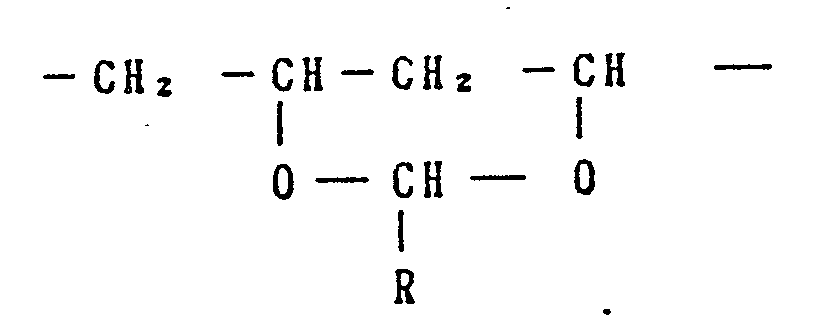
in which R is an alkyl group having 0.34 to 1.70 carbon atoms on the average, having a viscosity-average polymerization degree of 200 to 500 in respect to the vinyl monomer units.
in which R is an alkyl group having 0.34 to 1.70 carbon atoms on the average, having a viscosity-average polymerization degree of 200 to 500 in respect to the vinyl monomer units.
-2- A compound as claimed in Claim 1, in which R is CH3.
-3- A compound as claimed in Claim l, in which said acetalized vinyl alcohol units
have two or more alkyl groups in R.