|
(11) | EP 0 222 522 B1 |

| (12) | EUROPEAN PATENT SPECIFICATION |
|
|
| (54) |
Platinum coordination compounds Koordinationsverbindungen von Platin Composés de coordination du platine |
|
|
|||||||||||||||||||||||||||||||
| Note: Within nine months from the publication of the mention of the grant of the European patent, any person may give notice to the European Patent Office of opposition to the European patent granted. Notice of opposition shall be filed in a written reasoned statement. It shall not be deemed to have been filed until the opposition fee has been paid. (Art. 99(1) European Patent Convention). |
[0002] Since the initial discovery by Rosenburg that the compound known generally as "cisplatin" (cis- dichlorodiammineplatinum(li)) is an active drug against certain types of cancer, there have been many attempts to provide analogous compounds which are either more active, less toxic and/or have a broader spectrum of activity. Various promising compounds have emerged as a result, although it has remained impossible from studies of structure/activity relationships to predict with any confidence the extent to which a proposed new compounds will show anti-tumour activity.
[0003] EP-A 0098135 discloses solubilized platinum (II) complexes which include polyhydroxylated amine ligands.
[0004] We have now found that compounds of platinum(II) with certain bis(aminomethyl)-dioxolanes show promise as potential anti-cancer agents.
[0005] Accordingly, the present invention provides coordination compounds, of platinum(II) with a 4,5- bis(aminomethyl)-1,3-dioxolane ligand.
[0006] Compounds according to the invention comprise the general formula
in which the X groups are the same or different and are selected from mono-valent and di-valent anionic moieties and neutral moieties such that the total charge thereof is -2, or together represent a divalent bidentate moiety, the R groups are the same or different and are selected from H, alkyl and aryl, and n is 1 or an integer greater than 1.
[0007] When n is 1, compounds according to the invention have the general formula
and when n is greater than 1, compounds according to the invention may be cyclic polymers or linear polymers having the general formula
in which m is zero or an integer up to and including (n-1).
[0008] Preferably the X groups in general formula (I), (II) or (III) are both halide, for example chloride. When X is chloride and R is methyl, the monomer compound (II) may be named cis-dichloro[4.5-bis(aminomethyl-2,2-dimethyl-1,3-dioxolane] platinum (I).
[0009] The bis(aminomethyl)-dioxolane moiety of compounds according to the invention can exist in enantiomeric forms (threo stereochemistry) or as a meso-form (erythro stereochemistry) and the invention includes compounds incorporating the individual stereoisomers as well as mixtures thereof.
[0010] The enantiomer moieties where the R groups are methyl are as follows, in which the absolute configuration at each chiral centre is designated using the Cahn-Ingold-Prelog nomenclature:-
[0011] The invention also includes a pharmaceutical composition comprising a compound of general formula (1) in association with a pharmaceutically-acceptable carrier, diluent or excipient, preferably in unit dosage form.
[0013] Compounds according to the invention may be prepared by double nucleophilic displacement on a di-sulphonate ester of 2,3-o-isopropylidene-threitol (for example the di-methanesulphonate or the di-p-toluenesulphonate) with azide ion to form the diazide, reduction in the corresponding diamine and reaction of the latter with platinum(II).
[0014] Such a reaction is illustrated for R=methyl by way of example in Scheme 1, for the preparation of the (4R,5R)-compound. The starting material, the known 3,4-0-isopropylidene-D-mannitol (1), is reacted with periodate ion, and the product of glycol cleavage is reduced with sodium borohydride to afford 2,3-O-isopropylidene-D-threitol (2). Sulphonylation of (2) with methanesulphonyl chloride affords the di-methanesulphonate (3), which undergoes displacement with azide ion to yield the diazide (4). Catalytic reduction of (4) gives the (4R,5R)-diamine (5), which is reacted, generally without isolation, with potassium tetrachloroplatinate, to afford (4R,5R)-(I).
[0016] In Scheme 1, the intermediate compound (4), 1,3-diazido-1,4-dideoxy-2,3-o-isopropylidenethreitol (as the D-enantiomer, although the L-enantiomer may be prepared in the same reaction sequence starting from the corresponding L-mannitol), is a novel compound.
[0017] Compounds according to the invention where R=methyl may also be prepared by reduction of 2,2-dimethyl-1,3-dioxolane-4,5-dicarbonitrile to the bis(aminomethyl)-dioxolane and reaction of the latter with platinum(II). Such a reaction sequence is illustrated by way of example in Scheme 2 for the preparation of the 4R,5S compound. The reaction scheme starts with (2R,3R)-dimethyl, 2,3-0-isopropylidenetartrate [(4R,5R)-dimethyl-2,2-dimethyl-1,3-dioxolane-4,5-dicarboxylate] (6) which is converted, by reaction with ammonia, to the dicarboxamide (7), which is dehydrated to give the dicarbonitrile (8). The latter compound is reduced to the (4S,5S)-bis(aminomethyl) compound (9), which is reacted with potassium tetrachloroplatinate to give (4S,5S)-(I). The same reaction sequence, starting with the enantiomer of (6), that is, (2S,3S)-dimethyl-2,2-0-isopropylidenetartrate, could equally be used for the preparation of (4R,5R)-(I).
[0018] One way of determining whether the compounds as prepared exist according to general formula (I), (II) or (III) may be measurement of the molecular weight.
Example 1
Preparation of the (4R,5R)-(I):-
[0020] The starting material (1) (3,4-O-isopropylidene-D-mannitol) was reacted with sodium periodate and potassium borohydride as described in J. Chem. Soc., Perkin Trans. /., 1972, 275 (the contents of which are herein incorporated by reference) to yield compound (2) in 92% yield. Compound (2) (5.1g) was dissolved in pyridine (40ml) and cooled in ice. To this solution was added methanesulphonyl chloride (18ml). dropwise with stirring. The mixture was allowed to stand at room temperature for 3 hours, after which time it was added to a solution of sodium bicarbonate. This solution was then extracted with dichloromethane (5x50 ml) and the combined extracts were dried (MgS04) and concentrated in vacuo. The residue obtained was recrystallized from ethanol to give 2,3-O-isopropylidene-1, 4-di-O-methanesulphonyl-D-threitol (3), (6.6g, 66%), m.p. 83-85°C.
[0021] Compound (3) (3g) was dissolved in N,N-dimethylformamide (100ml) and sodium azide (4.9g) was added. The mixture was heated under reflux for 3 hours. The cooled solution was diluted with dichloromethane (150ml) and filtered. The solution was then washed with water (2x50ml), treated with charcoal, dried (MgS04) and concentrated in vacuo to give 1,4-diazido-1,4-dideoxy-2,3-O-isopropylidene-D-threitol (4), (1.3g, 65%).
[0022] Compound (4) (1.13g) was dissolved in "Analar" methanol (50ml) and hydrogenated over 6% palladium on charcoal (0.2g) until thin layer chromatography showed that all starting material had been consumed. The suspension was filtered and the filtrate was concentrated in vacuo to give a syrup (0.613g) whose I.R. spectrum showed no absorption at 2110cm-1 (-N3) and which was assumed to be (4R,5R)-4,5- bis(aminomethyl)-2,2-dimethyl-1 ,3-dioxolane (5). This material was dissolved in water (5ml) and a solution of potassium tetrachloroplatinate (1.58g) in water (10ml) was added. The mixture was chilled overnight whereupon a pale orange precipitate appeared. After centrifuging, the supernatant liquid was removed and the precipitate was washed successively with water, ethanol, and diethyl ether. The residue was dried over phosphorus pentoxide to give the product.
[0023] The intermediate and final products were characterized by elemental analysis and infra-red spectroscopy.
Example 2
Preparation of (4S,5S)-(I):-
[0025] The starting material (6) [(4R,5R-)-dimethyl-2,2-dimethyl-1,3-dioxalane-4,5-dicarboxylate] was reacted in methanol with concentrated aqueous ammonia to give the diamine (7), which was reacted with benzenesulphonyl chloride in dry pyridine to give the dicarbonitrile (8), according to the method disclosed in J. Chem. Soc., Perkin Trans. l., 1985, 795 the contents of which are herein incorporated by reference. The dicarbonitrile (1g) was dissolved in dry diethyl ether (100ml) and added to a suspension of lithium aluminium hydride (1.3g) in dry diethyl ether (40ml). The suspension was then stirred for 4 hours at room temperature. Water (0.5ml) was then added to the reaction mixture followed at 5 minute intervals by a 15% sodium hydroxide solution (0.6ml) and water (1.9ml). The solution was then filtered and the filtrate was dried (MgS04) and concentrated in vacuo to give a syrup which was assumed to be (4S,5S)-4,5- bis(aminomethyl)-2,2-dimethyl-1,3-dioxolane (0.27g) (9). This syrup was dissolved in water and a solution of potassium tetrachloroplatinate (0.7g) in water (10ml) was added with stirring. After 15 minutes, at room temperature a pale orange precipitate began to form. The suspension was stored overnight at 0°C and, after centrifuging, the supernatant liquor was removed and the precipitate was washed successively with water, ethanol, and diethyl ether. The pale orange powder was then dried over phosphorus pentoxide to give the product.
[0026] The intermediate and final products were characterized by elemental analysis and infrared spectroscopy.
[0028] Compounds according to the invention were screened for anti-tumour activity against ADJ/PC6 tumour implemented into female Balb C- mice, compared with a chemically similar compound not according to the invention. Compounds were administered both parenterally (IP) and orally (PO). Results were as follows:-
1. A coordination compound of platinum(II) with a 4,5-bis(aminomethyl)-1,3-dioxolane
ligand.
2. A compound according to claim 1 having the formula
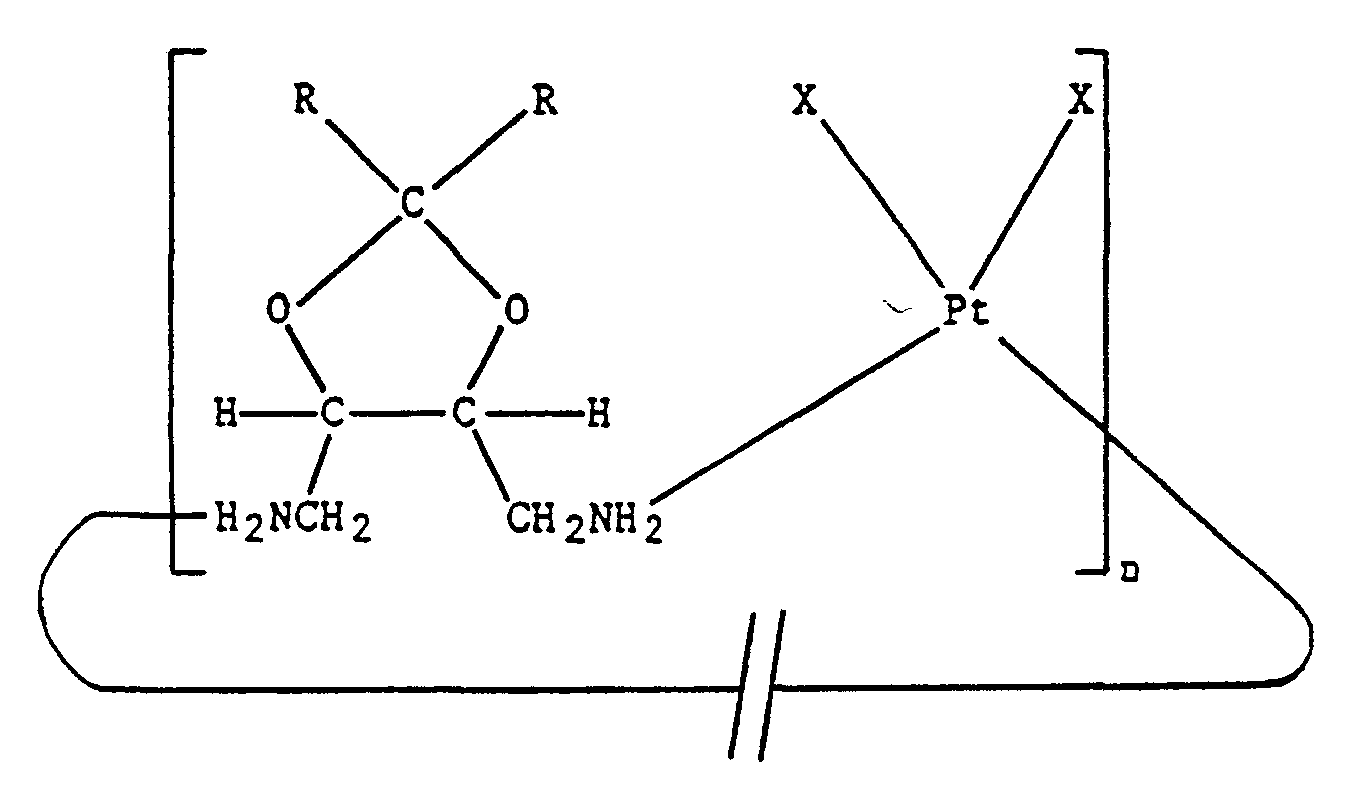
in which the X groups are the same or different and are selected from mono-valent and di-valent anionic moieties and neutral moieties such that the total charge thereof is -2, or together represent a divalent bidentate moiety, the R groups are the same or different and are selected from H, alkyl and aryl, and n is 1 or an integer greater than 1.
in which the X groups are the same or different and are selected from mono-valent and di-valent anionic moieties and neutral moieties such that the total charge thereof is -2, or together represent a divalent bidentate moiety, the R groups are the same or different and are selected from H, alkyl and aryl, and n is 1 or an integer greater than 1.
3. A compound according to claim 2 in which the X groups are both halide.
4. The compound cis-dichloro[(4R,5R)-4,5-bis-(aminomethyl)-2,2-dimethyl-1 ,3-dioxolane]
platinum(II), existing per se or as a polymer thereof.
5. The compound cis-dichloro[(4S,5S)-4,5-bis-(aminomethyl)-2,2-dimethyl-1,3-dioxolane)
platinum(II), existing per se or as a polymer thereof.
6. A pharmaceutical composition comprising a compound according to any preceding claim
in association with a pharmaceutically acceptable carrier, diluent or excipient.
7. A composition according to claim 6 in unit dosage form.
8. A method for the preparation of a compound according to claim 2, the method comprising
the steps of double nucleophilic displacement on a di-sulphonate ester of 2,3-O-isopropylidenethreitol
by azide ion to form the diazide, reduction in the corresponding diamine and reaction
with platinum(II).
9. A method for the preparation of a compound according to claim 2, the method comprising
the steps of reduction of 2,2-dimethyl-1,3-dioxolane-4,5-dicarbonitrile to the bis(aminomethyl)dioxolane
and reaction with platinum(II).
1. Eine Koordinationsverbindung von Platin(11) mit einem 4,5-Bis(aminomethyl)-1,3-dioxolanliganden.
2. Verbindung nach Anspruch 1 mit der Formel
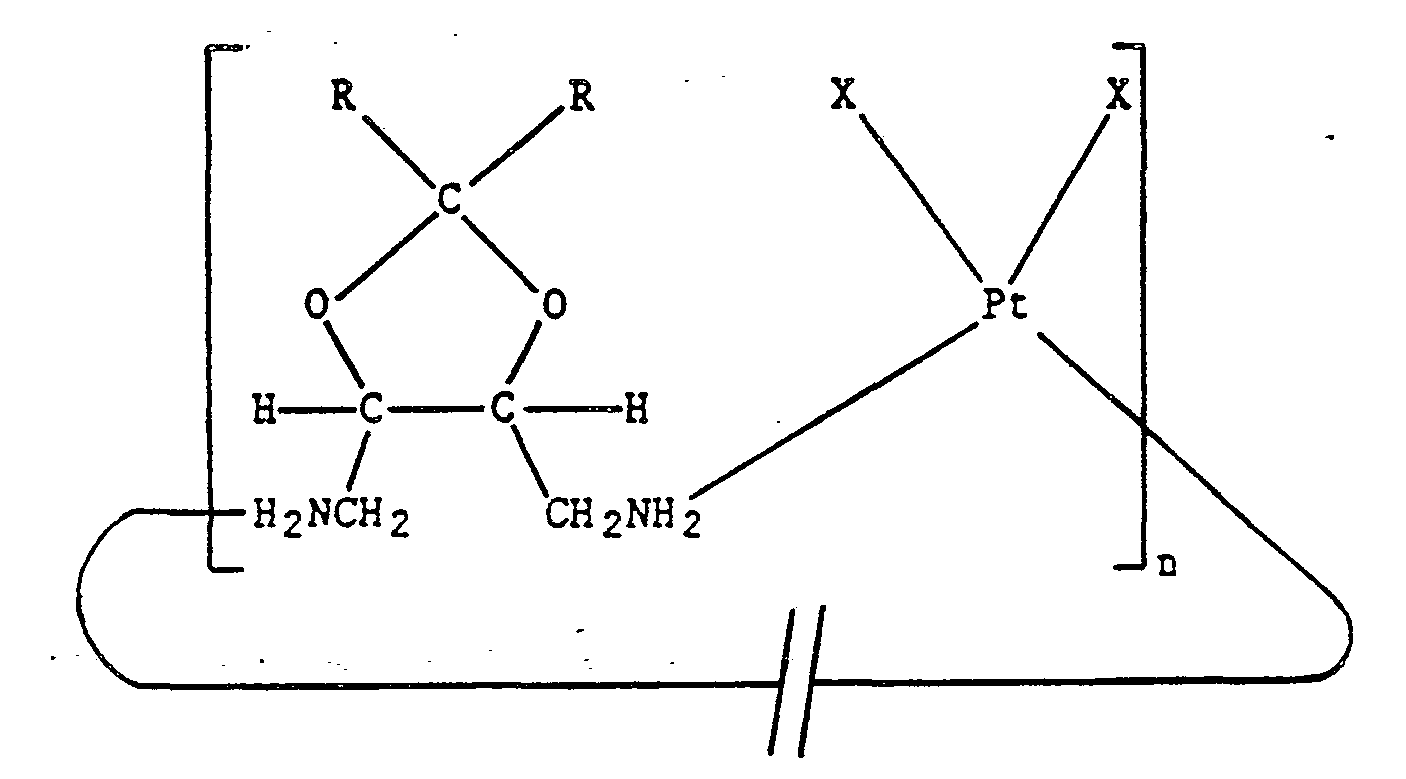
worin die Gruppen X gleich oder verschieden sind und von einwertigen und zweiwertigen anionischen Liganden und neutralen Liganden so ausgewählt sind, daß die Gesamtladung davon -2, ist oder die Gruppen X zusammen einem zweiwertigen, bidentalen Liganden darstellen, die Gruppen R gleich oder verschieden sind und von H, Alkyl und Aryl ausgewählt sind und n 1 oder eine ganze Zahl größer als 1 ist.
worin die Gruppen X gleich oder verschieden sind und von einwertigen und zweiwertigen anionischen Liganden und neutralen Liganden so ausgewählt sind, daß die Gesamtladung davon -2, ist oder die Gruppen X zusammen einem zweiwertigen, bidentalen Liganden darstellen, die Gruppen R gleich oder verschieden sind und von H, Alkyl und Aryl ausgewählt sind und n 1 oder eine ganze Zahl größer als 1 ist.
3. Verbindung nach Anspruch 2, worin beide Gruppen X Halogenidgruppen sind.
4. Die Verbindung cis-Dichlor((4R,5R)-4,5-bis(aminomethyl)-2,2-dimethyl-1,3-dioxolan]platin(II),
die als solche oder als ein Polymer davon vorliegt.
5. Die Verbindung cis-Dichlor[(4S,5S)-4,5-bis(aminomethyl)-2,2-dimethyl-1,3-dioxolan]platin(II),
die als solche oder als ein Polymer davon vorliegt.
6. Pharmazeutische Zusammensetzung, die eine Verbindung gemäß einem der vorhergehenden
Ansprüche in Verbindung mit einem pharmazeutisch verträglichen Träger, Verdünnungsmittel
oder Hilfsstoff enthält.
7. Zusammensetzung nach Anspruch 6 in Form einer Dosierungseinheit.
8. Verfahren zur Herstellung einer Verbindung nach Anspruch 2 mit den Stufen der doppelten
nukleophilen Substitution an einem Disulfonatester von 2,3-O-lsopropylidenthreit mit
Azidionen unter Bildung das Diazids, Reduktion zu dem entsprechenden Diamin und Umsetzung
mit Platin(11).
9. Verfahren zur Herstellung einer Verbindung nach Amspruch 2 mit den Stufen der Reduktion
von 2,2-Dimethyl-1,3-dioxolan-4,5-dicarbonitril zum Bis(aminomethyl)dioxolan und Umsetzung
mit Platin(II).
1. Composé de coordination du platine(II) avec un coordinat 4,5-bis(aminométhyl)-1,3-dioxolanne.
2. Composé selon la revendication 1, répondant à la formule
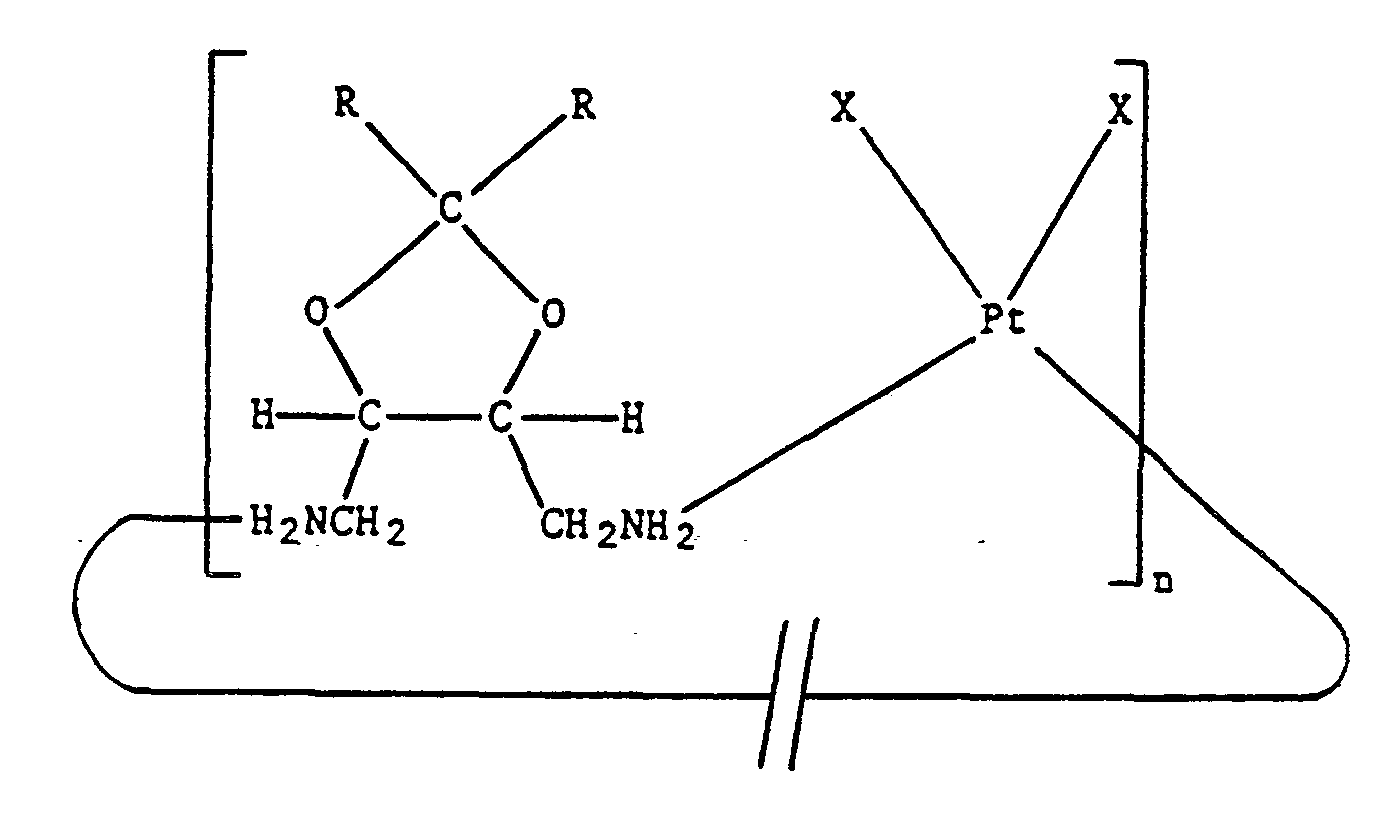
dans laquelle les groupes X sont identiques ou différents et sont choisis parmi des fractions anioniques monovalentes et divalents et des fractions neutres, de telle sorte que leur charge totale soit égale à -2, ou représentent ensemble une fraction divalente bidentée, les groupes R étant identiques ou différents et étant choisis parmi un atome d'hydrogène, un groupe alkyle et un groupe aryle, tandis que n représente 1 ou un entier supérieur à 1.
dans laquelle les groupes X sont identiques ou différents et sont choisis parmi des fractions anioniques monovalentes et divalents et des fractions neutres, de telle sorte que leur charge totale soit égale à -2, ou représentent ensemble une fraction divalente bidentée, les groupes R étant identiques ou différents et étant choisis parmi un atome d'hydrogène, un groupe alkyle et un groupe aryle, tandis que n représente 1 ou un entier supérieur à 1.
3. Composé selon la revendication 2, dans lequel les groupes X représentent tous deux
des halogénures.
4. La composé platine(II) cis-dichloro[(4R,5R)-4,5-bis-(aminométhyl)-2,2-diméthyl-1,3-dioxolanne)
existant en soi ou sous forme d'un de ses polymères.
5. La composé platine(ll) cis-dichloro[(4S,5S)-4,5-bis-(aminométhyl)-2,2-diméthyl-1,3-dioxolanne)
existant en soi ou sous forme d'un de ses polymères.
6. Composition pharmaceutique comprenant un composé selon l'une quelconque des revendications
précédentes, en association avec un excipient, un diluant ou un support pharmaceutiquement
acceptable.
7. Composition selon la revendication 6 sous forme posologique unitaire.
8. Procédé de préparation d'un composé selon la revendication 2, ce procédé comprenant
les étapes consistant à effecteur un double déplacement nucleophile sur un ester disulfonate
de 2,3-O-isopropylidène-thréitol par un ion azide pour obtenir le diazide, à réduire
la diamine correspondante et à la faire réagir avec du platine(II).
9. Procédé de préparation d'un composé selon la revendication 1, ce procédé, comprenant
les étapes consistant à réduire le 2,2-diméthyl-1,3-dioxolanne-4,5-dicarbonitrile
en bis(aminométhyl)-dioxolanne et à le faire réagir avec du platine(II).