|
(11) | EP 0 225 853 B1 |

| (12) | EUROPEAN PATENT SPECIFICATION |
|
|
| (54) |
Holograms Hologramme Hologrammes |
|
|
|||||||||||||||||||||||||||||||
| Note: Within nine months from the publication of the mention of the grant of the European patent, any person may give notice to the European Patent Office of opposition to the European patent granted. Notice of opposition shall be filed in a written reasoned statement. It shall not be deemed to have been filed until the opposition fee has been paid. (Art. 99(1) European Patent Convention). |
[0001] This invention relates to multicolour holograms in which a unique feature has been incorporated in the hologram and which is reconstructed as a different colour to the remainder of the hologram.
[0002] The holograms of the present invention are of particular use in identification and security cards.
[0003] Identification cards are well known, both for visual and machine inspection. In the latter case, it is relatively easy to build codes into the card, which codes may not be visually apparent, to enable the machine to verify only an authentic card, and it can readily be made extremely difficult to forge a card which will deceive the machine.
[0004] However, identification cards for visual inspection by the human eye to verify the holder can more readily be forged, because it is difficult to incorporate into the card a unique feature which, although readily apparent to the eye, is not readily reproducible.
[0005] In British patent no. 2116908 there is described an identification and/or security device which incorporates a multi-colour hologram having interference fringes lying in layers parallel to the substrate, the colours of which are visible by reflection in incident natural light, wherein the film emulsion has been selectively deformed differently in different areas of the hologram in order to produce the multiple colours.
[0006] The term "reflection", as used above and hereinafter, is employed in the conventional context applicable to holography, wherein images are seen by light returned from the hologram to the same side thereof from which the light is incident, although it will be understood that the "reflected" imaged are in fact produced by a special case of diffraction.
[0007] The images and colours of the hologram will readily be apparent in any artificial or other "white" or non-monochromatic light such as daylight, generally referred to herein as natural light.
[0008] Thus, in order to provide the hologram with colours which are visible in reflected light, the film emulsion is permanently deformed, selectively in different regions of the area of the hologram. The interference fringes generated with a hologram viewed by reflected light normally lie in layers parallel to the substrate, and the spacing between these layers of fringes, in the direction of normal to the substrate, are altered at the regions of deformation. The effect of this is to change the wavelength of the reflected light emanating from these regions of the hologram.
[0009] Selective deformation produces a multi-colour hologram. This results in a hologram which is virtually non-reproducible, even by the most practical method, which is the Denisyuk single beam system using a tunable dye laser, because if the laser is initially tuned to one colour, other regions of the hologram of different colour will become "fogged" and reproduction at these latter regions then produces a very unsatisfactory result to the would-be forger, even if the laser is subsequently retuned to the different colour.
[0010] In said British patent No. 2116908 the method of deforming the film emulsion selectively is to cause the film emulsion to shrink in selected areas. This produces a hypsochromic shift in the replay wavelength of those areas of the hologram where the emulsion has been shrunk. This shrinking is carried out during the processing of the hologram. It is particularly directed to producing holograms wherein the colour of the hologram is gradually shaded from one end of the hologram to the other end or to the production of a hologram which has a striped coloured pattern.
[0011] There is described in US patent 4656106 a method of deforming the film emulsion selectively to cause the film emulsion to shrink in selected areas. This produces a hypsochromic shift in the replay wavelength of those areas of the hologram where the emulsion has been shrunk. This however is a complicated process which involves an imagewise photographic exposure using actinic light and a holographic exposure using laser light.
[0012] We have found a method of producing a multi-coloured hologram wherein the emulsion can be deformed in a more readily controllable manner.
[0013] According to the present invention there is provided a method of preparing a multicolour hologram which uses gelatin as the binder which hologram has interference fringes lying in layers parallel to the substrate, the colours of which are visible by reflection in incident natural light, which comprises holographically exposing the material and then processing it to produce a hologram therein, which method is characterised in that there is applied to selected areas of the gelatin which contain the interference fringes a solution of a compound which causes the interference fringes to separate permanently and produce a bathochromic shift in the replay wavelength.
[0014] Thus in the areas of the holographic material to which the solution has been applied the interference fringes separate and a bathochromic shift in the replay wavelength is exhibited when the hologram is reconstructed.
[0015] Preferably the hologram is dried after processing before the solutions of the compound which causes the interference fringes to separate is applied. This solution can be applied by means of a paint brush, a pen, a rubber stamp, a finger or by any other means by means of which the solution can be supplied to a selected area of the hologram.
[0016] Three main classes of compounds have been identified which can cause the interference fringes in a gelatine silver halide hologram to separate permanently. These are:
a) onium compounds which comprise at lease one alkyl group having 10 to 18 carbon atoms or which has at least a total of 15 carbon atoms in its substituent groups or which is a polymer and comprises at least one onium group in its repeating unit.
b) a compound which has an molecular weight over 200 and which reacts with the gelatin to form covalent bonds therewith to increase the molecular weight of the gelatin.
c) a water-soluble polymer which comprises a tertiary amino group either in the repeating unit or in a side chain.
[0017] Most preferably the compound which causes the interference fringes to separate permanently is applied to the hologram as an aqueous solution but it can be applied in a solvent which does not affect the gelatin.
Examples of onium compounds a).
[0019] One class of useful quaternary ammonium compounds have the general formula I:
wherein R is a straight chain alkyl group having 10 to 18 carbon atoms, R₁ and R₂ are each alkyl groups having 1 or 2 carbon atoms and R₃ is either an alkyl group having 1 to 2 carbon atoms, or an aralkyl group or a cycloalkyl group or a group of formula II
wherein R₄ and R₅ an each alkyl groups having 1 or 2 carbon atoms, or R₁, R₂ and R₃ represent the atoms necessary to complete a hetrocyclic aromatic ring group and x is an anion.
[0022] Examples of particularly useful compounds of formula I are:
Cetyl pyridinium bromide
N-dodecyldimethylbenzyl ammonium chloride
N-myristyltrimethyl ammonium chloride
[0024] Other useful compounds have the general formula IV:
wherein R₇ and R₈ are each alkyl groups having 1 and 2 carbon atoms, R₉ is an optionally substituted alkyl group, (alkylene) is an alkylene radical which may be substituted or interrupted by heteroatoms, R₁₀ is a group which comprises an alkyl group having 10 to 18 carbon atoms and X is an anion.
[0026] Another class of useful quaternary ammonium compounds have the general formula V:
wherein R₁₇ and R₁₁ are each aliphatic hydrocarbon radicals containing 12 to 18 carbon atoms, R₁₂, R₁₃, R₁₅ and R₁₆ are optionally substituted alkyl, cycloalkyl or aralkyl radicals, Z is an optionally substituted alkylene linking group which may comprise hetro atoms, Z₁ and Z₂ are alkylene radicals containing 2 or 3 carbon atoms, n is an integer of at most 2 and X is an anion.
[0028] Particularly useful compounds are those wherein R₁₇ and R₁₁ are each straight chain alkyl radical having 12 to 18 carbon atoms, Z is alkylene radical containing 2-4 carbon atoms optionally substituted by hydroxyl groups, R₁₂, R₁₅ and R₁₆ are each alkyl groups comprising one or two carbon atoms and X is a halogen atom.
[0031] Polymeric compounds which are related to the bis-quaternary compound of formula VI are high molecular weight condensation products formed from a compound of the general formula VII:
by heating this compound to form a high molecular weight condensation compound.
[0032] A useful compound of formula VII which may be condensed to form high molecular weight compounds has the formula:
[0033] Another useful class of polymeric compounds are prepared by quaternising a diamine of the formula IX:
where R₂₂, R₂₃, R₂₄ and R₂₅ are each alkyl groups having 1 or 2 carbon atoms and R₂₆ is an alkylene group which may be substituted or interrupted with hereto atoms or with bischloromethyldiphenyl to yield a polymer having the repeating unit of formula X:
wherein R₂₂, R₂₃, R₂₄, R₂₅ and R₂₆ have the meanings just assigned to them and n is 10 - 15.
[0035] Most of the quaternary ammonium compounds as just described have found use as so called 'retarding agents' in the dyeing of textile materials.
[0036] Another useful polymeric compound having quaternary ammonium groups in the repeating unit is polydimethyldiallylammonium chloride.
[0038] A useful concentration of the solution of onium compounds to use is from 1 to 20g per 100ml of water.
[0039] A particularly useful class of gelatin reactive compounds B) are the aldehyde condensation compounds described in British patent specification No. 814288.
[0040] These compounds have a very complex structure and can be best defined by their process of manufacture as set forth in No. 814288 wherein it states that there is provided a process for the manufacture of condensation products, wherein a non-cyclic compound containing at least once the atomic grouping
is condensed in a first stage with an aldehyde and a salt of an aliphatic amine containing at least two primary or secondary amino groups at a temperature above 100°C, and the product so obtained is further condensed in a second stage with an aldehyde and a water-soluble ammonium salt or amine salt in the presence of a solvent.
[0041] A particularly useful range of condensation compounds are obtained when the aldehyde used in the first stage condensation and in the second stage is in each case formaldehyde.
[0042] Preferably the salt of an alphatic amine used is a salt of ethylene diamine. Also preferably the water-soluble ammonium salt used in the second stage condensation is ammonium chloride.
[0043] As non-cyclic compounds which contain at least once the grouping
there may be used, guanidine, acetoguanidine, biguanide or substitution products of those compounds such as alkyl-biguanides or aryl-biguanides. Most preferably, however, the non-cyclic compound used is dicyandiamide.
[0044] An especially useful compound is obtained which is the reaction product of formaldehyde, ammonium chloride, dicyandiamide and ethylene diamine in a molar ration of 2:1:1:0:1. This compound is hereinafter referred to as Condensate 1.
[0045] When a condensate of the type described in B.P. 814288 is used to treat the holographic material a greater effect is observed the higher the pH used. Also a greater effect is observed using an elevated temperature.
[0046] Another useful group of compounds of this class are the commercially available compounds made by Degussa under the trade name of QUAB which have a molecular weight of over 200.
[0047] Another useful class of compounds are the so-called reactive dyestuffs which comprise at least one hydrophilic group and at least one group and at least one group which can react with a textile such as wool, cotton or silk.
[0048] Reactive dyestuffs were developed to dye cottons and rayons; others have been developed to dye wool and silk. It would be thought that as gelatin has a greater similarity with wool or silk than cellulose the reactive dyestuffs which can be used primarily for wool or silk only could be used in the method of the present invention. However, it has been found that a number of reactive dyestuffs which are used for cellulose can also be used in the method of the present invention.
[0050] Examples of reactive groups are substituted monoazine, diazine-, triazine-, oxaxine-, pyridine-, pyrimidine, pyridazine-, pyrazine- and thiazine-rings and rings of this type which are annelated for example, phthalazine, quinoline, quinazoline, quinoxaline and acridine rings.
[0051] Other examples of reactive groups are acryloyl and mono-, di-, or trichloroacryloyl for example-CO CH-CH Cl and other substituted acryloyl groups such as -methylsulphonylacryloyl and protected acryloyl groups. Also vinyl sulphone groups and protected vinyl sulphone groups.
[0056] The nature of the dye chromophore is not important in the method of the present invention, but chromophores present include azo, anthroquinone and phthalocyanine groups.
[0057] An example of class c) polymers are polymers formed by reacting methylene bisacrylamide or substituted derivatives thereof with a compound which comprise two secondary amino groups.
[0058] Examples of useful compounds which comprise two secondary amino groups are:
piperazine, 4,4'bipiperidine, 4,4'-ethylene dipiperidine, 2,-dimethyl-piperazine and N,N'-dimethylethylene diamine.
[0059] Examples of polymers which comprise a tertiary amino group in a side claim are polymers which have a repeating unit of the general formula XI:
wherein R₂₇ is hydrogen or a methyl group R₂₈ and R₂₉ are each selected from optionally substituted alkyl, aralkyl or aryl groups and n is 2 - 4, or R₂₈ and R₂₉ represent the atoms necessary to complete a saturated hetrocylic ring.
[0060] Preferably R₂₈ and R₂₉ are each methyl or ethyl. Polymers which comprise the repeating unit of formula XI may be homopolymers or copolymers.
[0061] Examples of polymers which comprise a repeating unit of formula XI are polydimethylaminoethylmethacrylate and polymorpholinoethyl methacrylate.
[0062] In the process of the present invention preferably a hologram is prepared from silver halide sensitised holographic material wherein the binder for the silver halide is gelatin. After the holographic exposure to produce the parallel fringes the usual processing sequence is silver halide development using a silver halide developing agent for example hydroquinone, followed by a silver bleaching process.
[0063] The silver bleaching step may be any process for removing the developed silver, but which leaves the unexposed silver halide in situ. It is to be understood that the developed silver may be converted to silver halide some of which may remain in the holographic material.
[0064] Examples of bleaching techniques are solvent bleaching methods in which the developed silver is removed from the material and rehalogenating bleaching methods, in which the developed silver is converted to silver halide.
[0065] After the hologram has been prepared it is treated in selected areas with a solution of a compound which causes the interference fringes of the hologram to separate permanently.
[0066] Alternatively the hologram may be a dichromated gelatin type wherein a wet process to remove the unhardened gelatin followed by a dehydrating process to form the interference fringes is employed.
[0067] Preferably an aqueous solution of one of the classes of compound a), b) or c) as hereinbefore set forth is used.
Example
[0069] Samples of holographic material were prepared by coating onto a transparent photographic film base a gelatino silver halide emulsion which was substantially pure silver bromide having a mean crystal size of 0.03 µm at a silver coating weight of 30mg/dm². The emulsion was optically sensitised with a red sensitising dye so that it was optimally sensitive to 633 nm the colour of a He:Ne laser.
[0070] The material was holographically exposed by a Denisyuk exposure method using a brushed aluminium plate as an object to yield (after processing) a reflective hologram.
[0072] The samples were then transferred to rehalogenating bleach bath of the following composition:
until all silver metal had been bleached out which was about 2 minutes.
[0074] An absorbent material attached to a handle and fabricated to form the letter 'D' was then placed in the Solution A as set forth below and then was pressed on to the gelatin layer of the hologram as just prepared and left there for 2 minutes. The holographic material was then water washed for 1 minute in running water, dried and then replayed to exhibit a reflection hologram. In three similar tests the absorbent material in the shape of a letter 'D' was placed in solution B, C and D as set forth below.
[0075] There was visible in the holographic material a greenish hologram of the brushed aluminium plate. Superimposed on the image was the red letter 'D'. Because of the way the fringes of the hologram had been separated in the area which had been in contact with the absorbent material the letter 'D' was not in the same place as the hologram of the brushed aluminium plate but appeared as water-mark in front of the hologram.
[0076] Solution A was a 10% aqueous solution of compound A which is a quaternary ammonium compound class a).
[0078] Solution C was a 5% aqueous solution of an orange dyestuff of the formula:
which is also a compound of class b).
[0079] Solution D was 1% aqueous solution of polydimethylaminoethylmethacrylate which is a class c) compound.
[0080] As the period of contact of the solution was only 2 minutes the bathochromic shift in every case appeared to be about the same. However in the case of solution C the letter 'D' was visible in ordinary ambient light as an orange colour 'D' which is the colour of the reactive dye used.
[0081] In order to show the versatility of the method of the present invention in security applications a hologram of an eagle was prepared on similar material as just prepared.
[0082] After the hologram had been dried an absorbent writing instrument was placed in solution B and a signature was written on to the hologram in one corner therof. A finger of the person who wrote the signature was then dipped in solution B and then this finger was pressed on the hologram at another corner. After the hologram had been washed and re-dried it was replayed to exhibit a greenish hologram of an eagle with two reddish water-marks one of the signature and the other of the finger print.
1. A method of preparing a multicolour hologram which uses gelatin as the binder which
hologram has interference fringes lying in layers parallel to the substrate, the colours
of which are visible by reflection in incident natural light, which comprises holographically
exposing the material and then processing it to produce a hologram therein, which
method is characterised in that there is applied to selected areas of the gelatin
which contains the interference fringes a solution of a compound which causes the
interference fringes to separate permanently and produce a bathochromic shift in the
replay wavelength.
2. A method according to claim 1 wherein the compound which causes the interference fringes
to separate permanently is an onium compound which comprises at least one alkyl group
having 10 to 18 carbon atoms or which has at least a total of 15 carbon atoms in its
substituent groups or which is a polymer and comprises at least one onium group in
its repeating unit.
3. A method according to claim 1 wherein the onium compound is a quaternary ammonium
compound.
4. A method according to claim 3 wherein the quaternary ammonium compound has the general
formula:
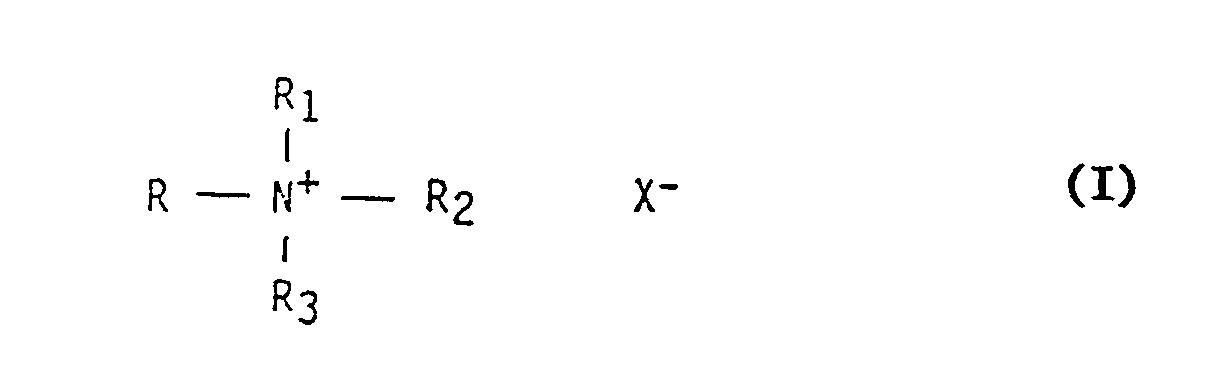
wherein R is a straight chain alkyl group having 10 to 18 carbon atoms, R₁ and R₂ are each alkyl groups having 1 or 2 carbon atoms and R₃ is either an all group having 1 to 2 carbon atoms, or an aralykl group or a cycloalkl group or a group of formula
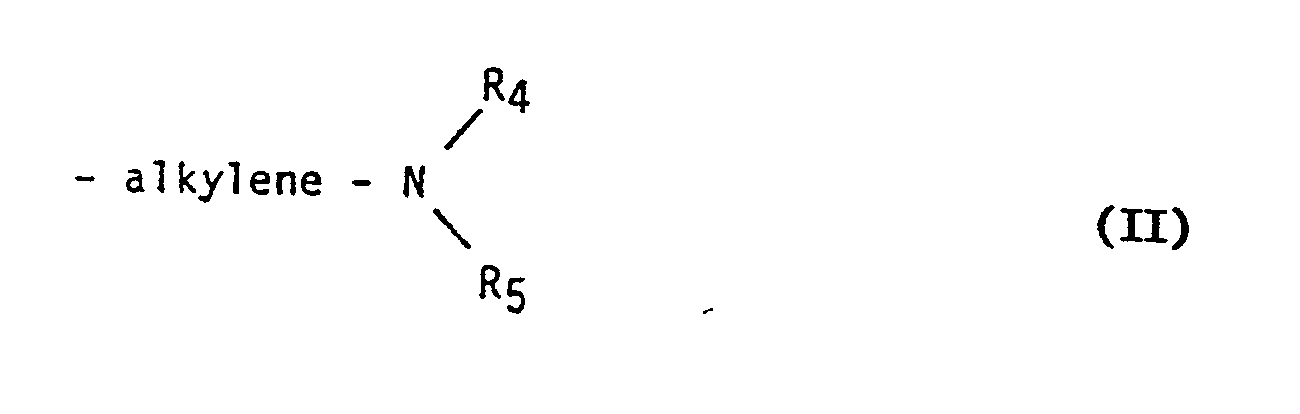
wherein R₄ and R₅ are each all groups having 1 or 2 carbon atoms, or R₁, R₂ and R₃ represent the atoms necessary to complete a heterocyclic aromatic ring group and X is an anion.
wherein R is a straight chain alkyl group having 10 to 18 carbon atoms, R₁ and R₂ are each alkyl groups having 1 or 2 carbon atoms and R₃ is either an all group having 1 to 2 carbon atoms, or an aralykl group or a cycloalkl group or a group of formula
wherein R₄ and R₅ are each all groups having 1 or 2 carbon atoms, or R₁, R₂ and R₃ represent the atoms necessary to complete a heterocyclic aromatic ring group and X is an anion.
5. A method according to claim 3 wherein the quaternary ammonium compound has the general
formula:
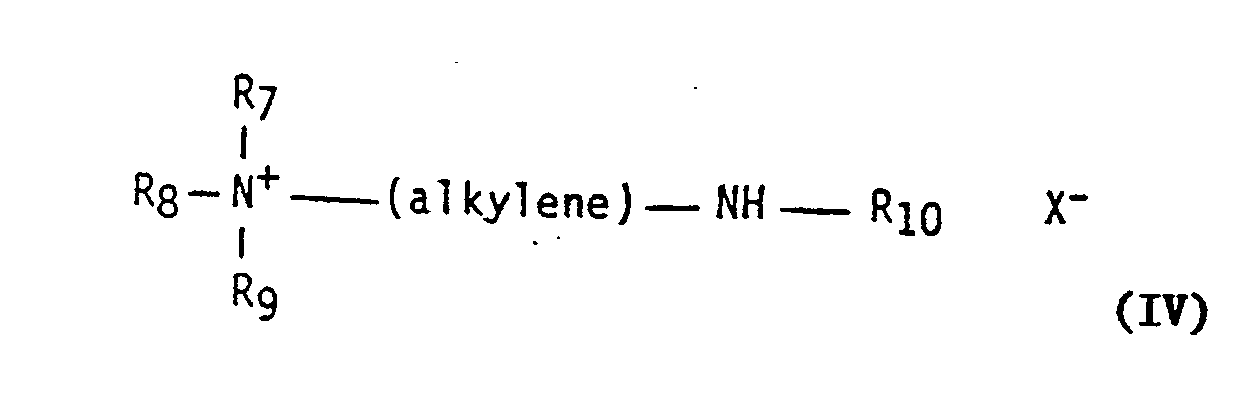
wherein R₇ and R₈ are each alkyl groups having 1 or 2 carbon atoms, Rg is an optionally substituted alkyl group, (alkylene) is an alkylene radical which may be substituted or interrupted by heteroatoms, R₁₀ is a group which comprises an alkyl group having 10 to 18 carbon atoms and X is an anion.
wherein R₇ and R₈ are each alkyl groups having 1 or 2 carbon atoms, Rg is an optionally substituted alkyl group, (alkylene) is an alkylene radical which may be substituted or interrupted by heteroatoms, R₁₀ is a group which comprises an alkyl group having 10 to 18 carbon atoms and X is an anion.
6. A method according to claim 3 wherein the quaternary ammonium compound has the general
formula
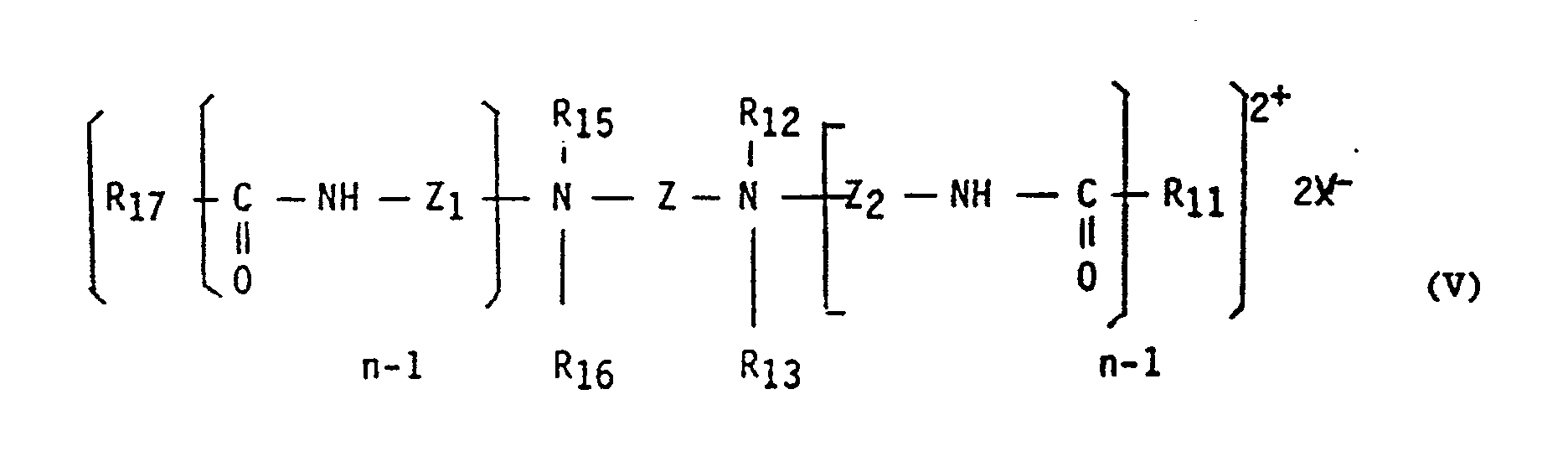
wherein R₁₇ and R₁₁ are each aliphatic hydrocarbon radicals containing 12 to 18 carbon atoms, R₁₂, R₁₃, R₁₅ and R₁₆ are optionally substituted alkyl, cycloalkyl or aralkyl radicals, Z is an optionally substituted alkylene linking group which may comprise hetero atoms, Z₁ and Z₂ are alkylene radicals containing 2 or 3 carbon atoms, n is an integer of at most 2 and X is an anion.
wherein R₁₇ and R₁₁ are each aliphatic hydrocarbon radicals containing 12 to 18 carbon atoms, R₁₂, R₁₃, R₁₅ and R₁₆ are optionally substituted alkyl, cycloalkyl or aralkyl radicals, Z is an optionally substituted alkylene linking group which may comprise hetero atoms, Z₁ and Z₂ are alkylene radicals containing 2 or 3 carbon atoms, n is an integer of at most 2 and X is an anion.
7. A method according to claim 6 wherein in the formula of the quaternary ammonium compound
set forth therein R₁₇ and R₁₁ are each straight chain alkyl radical having 12 to 18
carbon atoms, Z is an alkylene radical containing 2-4 carbon atoms optionally substituted
by hydroxyl groups, R₁₂, R₁₃, R₁₅ and R₁₆ are each alkyl groups comprising one or
two carbon atoms and X is a halogen atom.
8. A method according to claim 3 wherein the quaternary ammonium compound is a polymer
which has been prepared by quaternising a diamine of the formula IX:
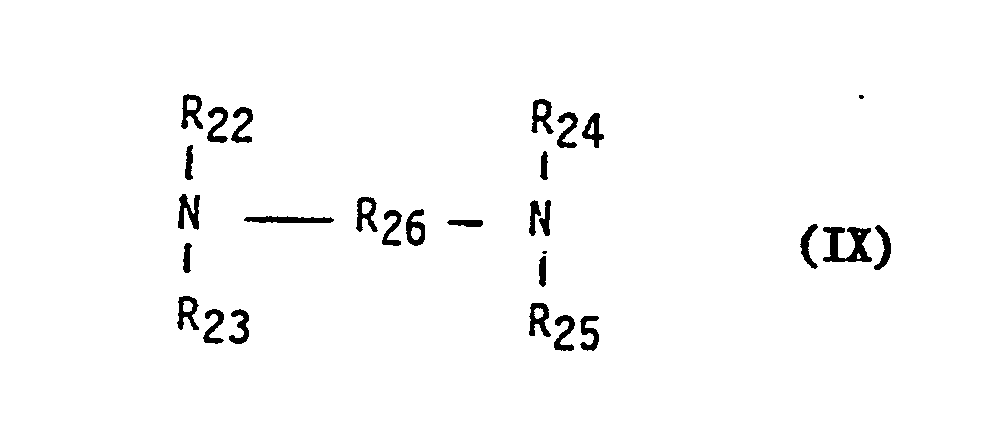
wherein R₂₂, R₂₃ and R₂₅ are each alkyl groups having 1 or 2 carbon atoms and R₂₆ is an alkylene group which may be substituted or interrupted with hetero atoms or with bischloromethyldiphenyl.
wherein R₂₂, R₂₃ and R₂₅ are each alkyl groups having 1 or 2 carbon atoms and R₂₆ is an alkylene group which may be substituted or interrupted with hetero atoms or with bischloromethyldiphenyl.
9. A method according to claim 1 wherein the compound which causes the interference fringes
to separate permanently is a compound which has an molecular weight over 200 and which
reacts with the gelatin to form covalent bonds therewith to increase the molecular
weight of the gelatin.
10. A method according to claim 9 wherein the compound which reacts with gelatin is a
reactive dyestuff.
11. A method according to claim 10 wherein the reactive dyestuff comprises a chromophore
group and a reactive group derived from a substituted monoazine, diazine-, triazine-,
oxazine-, pyridine-, pyrimidine-, pyridazine-, pyrazine- or thiazine-ring or a ring
of this type which is annelated, or selected from an acryloyl, mono-, di- or trichloroacryloyl,
protected acryloyl, vinyl sulphone and protected vinyl sulphone group.
12. A method according to claim 1 wherein the compound which causes the interference to
separate permanently is a water-soluble polymer which comprises a tertiary amino group
either in the repeating unit or in a side chain.
13. A method according to claim 12 wherein the water-soluble polymer is a polymer formed
by reacting methylene bisacrylamide or a substituted derivative thereof with a compound
which comprises two secondary amino groups.
14. A method according to claim 12 wherein the polymer which comprises a tertiary amino
group in a side chain is a polymer which has a repeating unit of the general formula:
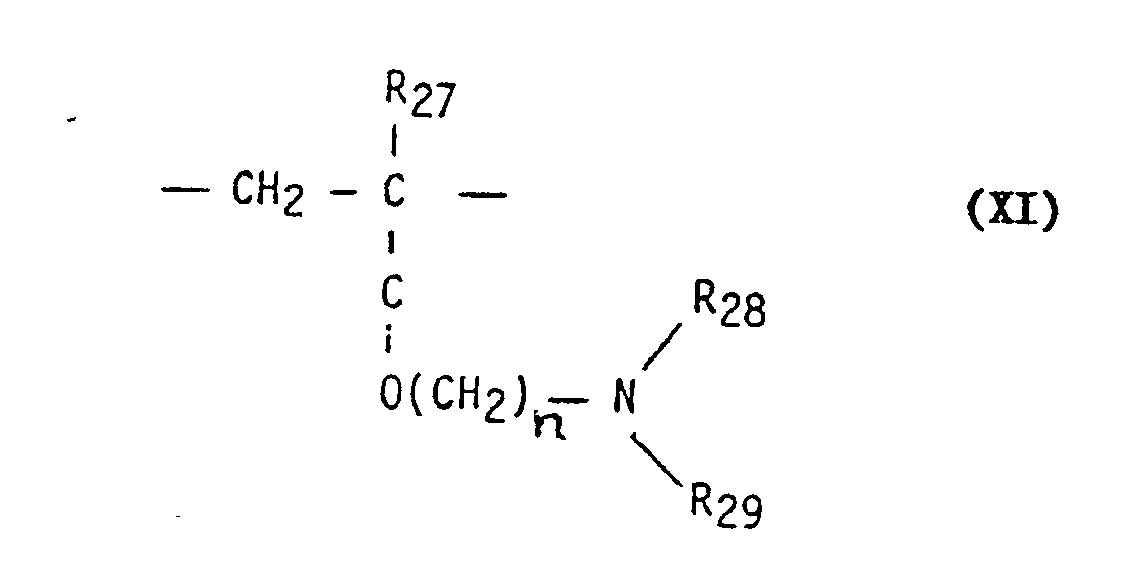
wherein R₂₇ is hydrogen or a methyl group R₂₈ and R₂₉ are each selected from optionally substituted alkyl, aralkyl or aryl groups and n is 2 - 4, or R₂₈ and R₂₉ represent the atoms necessary to complete a saturated heterocyclic ring.
wherein R₂₇ is hydrogen or a methyl group R₂₈ and R₂₉ are each selected from optionally substituted alkyl, aralkyl or aryl groups and n is 2 - 4, or R₂₈ and R₂₉ represent the atoms necessary to complete a saturated heterocyclic ring.
15. A method to claim 14 wherein the polymer is poly (dimethylaminoethylmethacrylate)
or poly (morpholinoethylmethacrylate).
16. A hologram prepared by the method according to claim 1.
1. Procédé de préparation d'un hologramme multicolore qui emploie de la gélatine comme
liant, hologramme comportant des franges d'interférence situées en couches parallèles
au substrat, dont les couleurs sont visibles par réflexion dans une lumière incidente
naturelle, qui comprend l'exposition holographique de la matière, puis son traitement,
pour y produire un hologramme, ce procédé étant caractérisé en ce que l'on applique
sur des zones sélectionnées de la gélatine qui contiennent les franges d'interférence
une solution d'un composé qui provoque la séparation permanente des franges d'interférence
et la production d'un déplacement bathochrome dans la longueur d'onde de restitution.
2. Procédé selon la revendication 1, dans lequel le composé qui provoque la séparation
permanente des franges d'interférence est un composé onium qui comprend au moins un
groupe alkyle comportant 10 à 18 atomes de carbone ou qui comporte au moins un total
de 15 atomes de carbone dans ses groupes substituants, ou qui est un polymère et qui
comprend au moins un groupe onium dans son motif récurrent.
3. Procédé selon la revendication 1, dans lequel le composé onium est un composé d'ammonium
quaternaire.
4. Procédé selon la revendication 3, dans lequel le composé d'ammonium quaternaire a
pour formule générale :
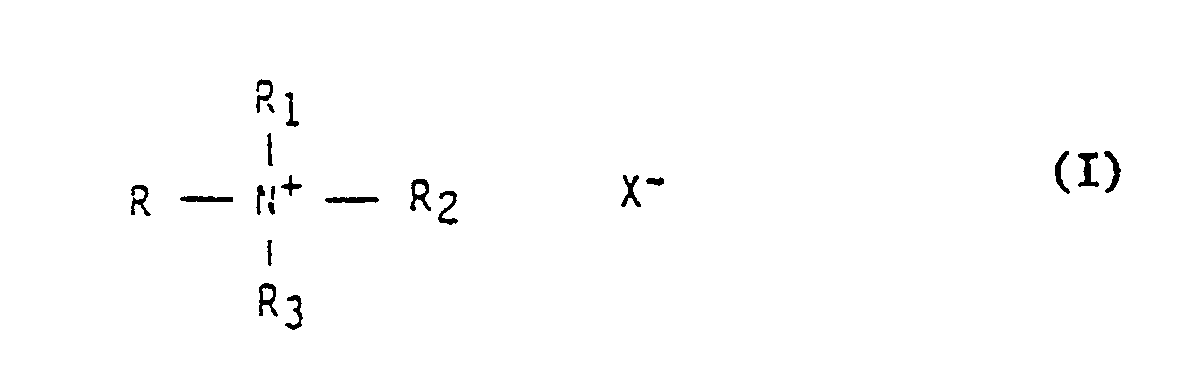
dans laquelle R est un groupe alkyle à chaîne droite comportant 10 à 18 atomes de carbone, R₁ et R₂ sont chacun des groupes alkyle comportant 1 ou 2 atomes de carbone et R₃ est ou bien un groupe alkyle comportant 1 à 2 atomes de carbone, ou bien un groupe arylalkyle ou un groupe cycloalkyle, ou bien un groupe de formule
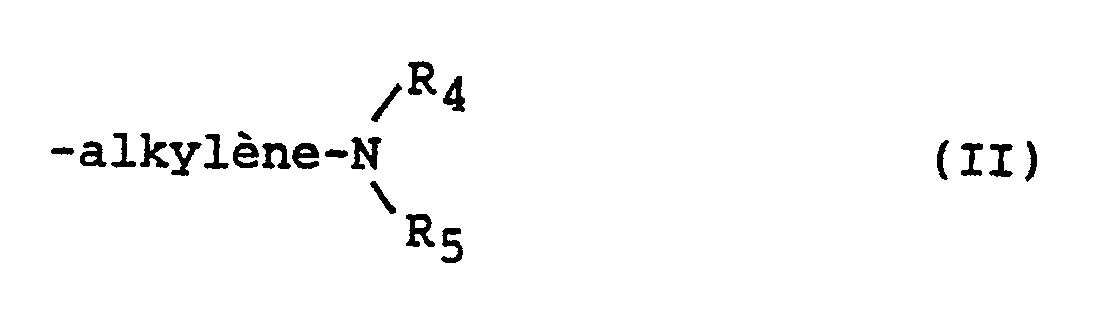
dans laquelle R₄ et R₅ sont chacun des groupes alkyle comportant 1 ou 2 atomes de carbone, ou R₁, R₂ et R₃ représentent les atomes nécessaires pour compléter un groupe à noyau aromatique hétérocyclique et X-est un anion.
dans laquelle R est un groupe alkyle à chaîne droite comportant 10 à 18 atomes de carbone, R₁ et R₂ sont chacun des groupes alkyle comportant 1 ou 2 atomes de carbone et R₃ est ou bien un groupe alkyle comportant 1 à 2 atomes de carbone, ou bien un groupe arylalkyle ou un groupe cycloalkyle, ou bien un groupe de formule
dans laquelle R₄ et R₅ sont chacun des groupes alkyle comportant 1 ou 2 atomes de carbone, ou R₁, R₂ et R₃ représentent les atomes nécessaires pour compléter un groupe à noyau aromatique hétérocyclique et X-est un anion.
5. Procédé selon la revendication 3, dans lequel le composé d'ammonium quaternaire répond
à la formule générale :
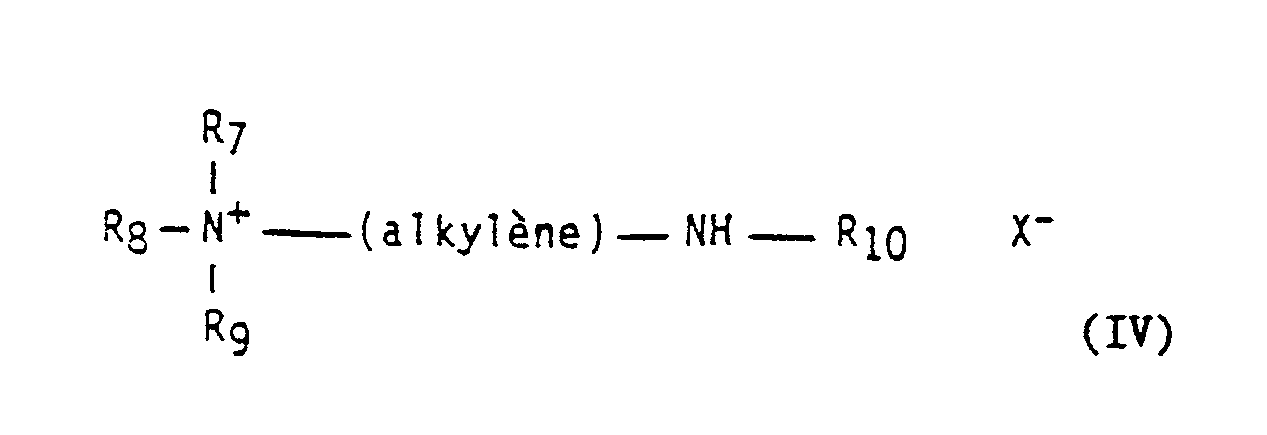
dans laquelle R₇ et R₈ sont chacun des groupes alkyle comportant 1 et 2 atomes de carbone, R₉ est un groupe alkyle éventuellement substitué, (alkylène) est un radical alkylène qui peut être substitué ou interrompu par des hétéroatomes, R₁₀ est un groupe qui comprend un groupe alkyle comportant 10 à 18 atomes de carbone et X est un anion.
dans laquelle R₇ et R₈ sont chacun des groupes alkyle comportant 1 et 2 atomes de carbone, R₉ est un groupe alkyle éventuellement substitué, (alkylène) est un radical alkylène qui peut être substitué ou interrompu par des hétéroatomes, R₁₀ est un groupe qui comprend un groupe alkyle comportant 10 à 18 atomes de carbone et X est un anion.
6. Procédé selon la revendication 3, dans lequel le composé d'ammonium quaternaire répond
à la formule générale
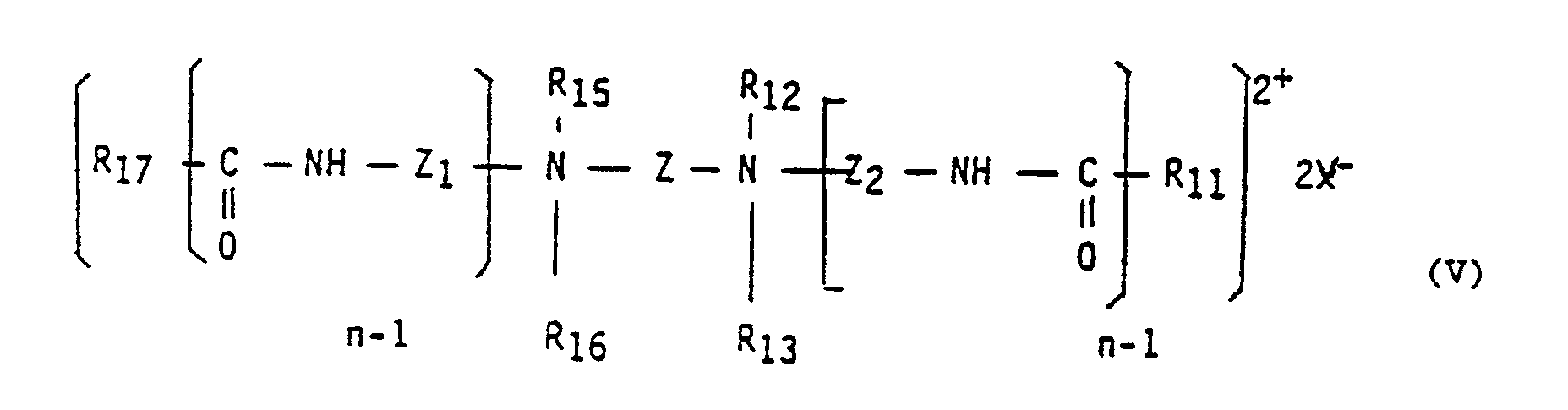
dans laquelle R₁₇ et R₁₁ sont chacun des radicaux hydrocarbonés aliphatiques contenant 12 à 18 atomes de carbone, R₁₂, R₁₃, R₁₅ et R₁₆ sont des radicaux alkyle, cycloalkyle ou arylalkyle éventuellement substitués, Z est un groupe de liaison alkylène éventuellement substitué qui peut comporter des hétéroatomes, Z₁ et Z₂ sont des radicaux alkylène contenant 2 ou 3 atomes de carbone, n est un nombre entier au plus égal à 2 et X est un anion.
dans laquelle R₁₇ et R₁₁ sont chacun des radicaux hydrocarbonés aliphatiques contenant 12 à 18 atomes de carbone, R₁₂, R₁₃, R₁₅ et R₁₆ sont des radicaux alkyle, cycloalkyle ou arylalkyle éventuellement substitués, Z est un groupe de liaison alkylène éventuellement substitué qui peut comporter des hétéroatomes, Z₁ et Z₂ sont des radicaux alkylène contenant 2 ou 3 atomes de carbone, n est un nombre entier au plus égal à 2 et X est un anion.
7. Procédé selon la revendication 6, dans lequel, dans la formule du composé d'ammonium
quaternaire indiquée ici, R₁₇ et R₁₁ sont chacun un radical alkyle à chaîne droite
comportant 12 à 18 atomes de carbone, Z est un radical alkylène contenant 2-4 atomes
de carbone, éventuellement substitué par des groupes hydroxyle, R₁₂, R₁₃, R₁₅ et R₁₆
sont chacun des groupes alkyle comprenant un ou deux atomes de carbone et X est un
atome d'halogène.
8. Procédé selon la revendication 3, dans lequel le composé d'ammonium quaternaire est
un polymère qui a été préparé par quaternisation d'une diamine de formule IX :
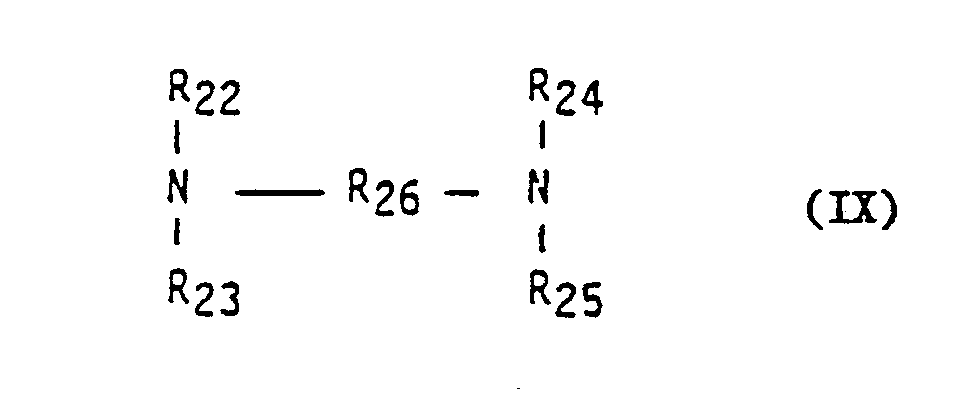
dans laquelle R₂₂, R₂₃ et R₂₅ sont chacun des groupes alkyle comportant 1 ou 2 atomes de carbone et R₂₆ est un groupe alkylène qui peut être substitué ou interrompu par des hétéroatomes ou par un bischlorométhyldiphényle.
dans laquelle R₂₂, R₂₃ et R₂₅ sont chacun des groupes alkyle comportant 1 ou 2 atomes de carbone et R₂₆ est un groupe alkylène qui peut être substitué ou interrompu par des hétéroatomes ou par un bischlorométhyldiphényle.
9. Procédé selon la revendication 1, dans lequel le composé qui provoque la séparation
permanente des franges d'interférence est un composé qui possède une masse moléculaire
supérieure à 200 et qui réagit avec la gélatine pour former des liaisons covalentes
avec cette dernière afin d'augmenter la masse moléculaire de la gélatine.
10. Procédé selon la revendication 9, dans lequel le composé qui réagit avec la gélatine
est un colorant réactif.
11. Procédé selon la revendication 10, dans lequel le colorant réactif comprend un groupe
chromophore et un groupe réactif dérivé d'un noyau monoazine, diazine, triazine, oxazine,
pyridine, pyrimidine, pyridazine, pyrazine et thiazine substitué ou d'un noyau de
ce type qui est condensé, ou choisi parmi les groupes acryloyle, mono-, di- ou trichloroacryloyle,
acryloyle protégé, vinylsulfone et vinylsulfone protégée.
12. Procédé selon la revendication 1, dans lequel le composé qui provoque la séparation
permanente des franges d'interférence est un polymère hydrosoluble qui comprend un
groupe amino tertiaire soit dans le motif récurrent, soit dans une chaîne latérale.
13. Procédé selon la revendication 12, dans lequel le polymère hydrosoluble est un polymère
formé par réaction de méthylènebisacrylamide ou d'un de ses dérivés substitués avec
un composé qui comprend deux groupes amino secondaires.
14. Procédé selon la revendication 12, dans lequel le polymère qui comprend un groupe
amino tertiaire dans une chaîne latérale est un polymère qui possède le motif récurrent
de formule générale :
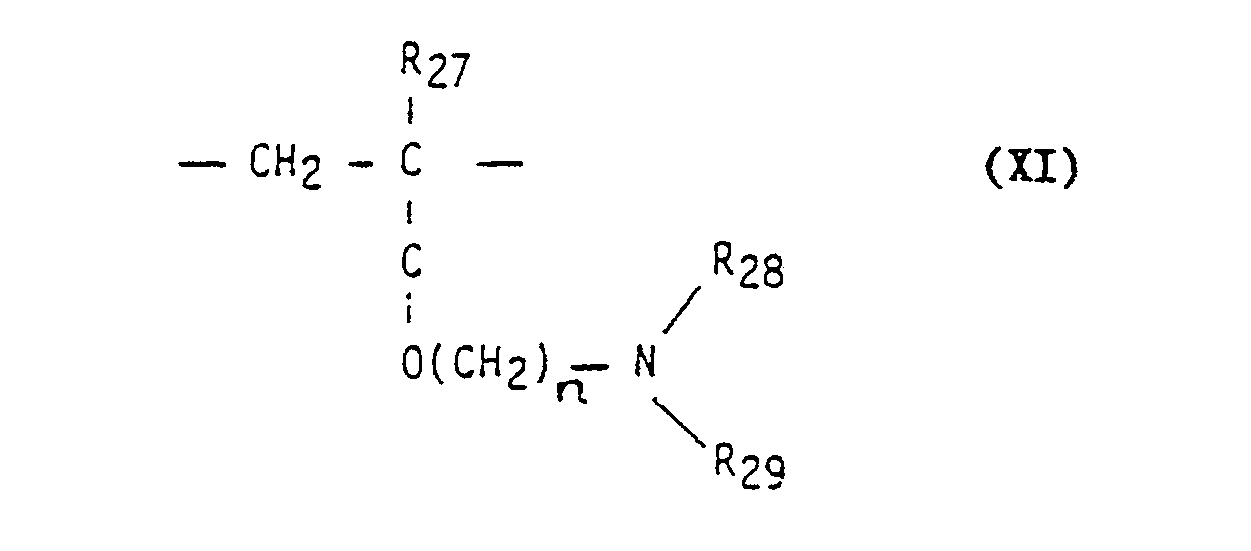
dans laquelle R₂₇ est un hydrogène ou un groupe méthyle, R₂₈ et R₂₉ sont chacun choisis parmi les groupes alkyle, arylalkyle ou aryle éventuellement substitués et n a une valeur de 2-4, ou R₂₈ et R₂₉ représentent les atomes nécessaires pour compléter un noyau hétérocyclique saturé.
dans laquelle R₂₇ est un hydrogène ou un groupe méthyle, R₂₈ et R₂₉ sont chacun choisis parmi les groupes alkyle, arylalkyle ou aryle éventuellement substitués et n a une valeur de 2-4, ou R₂₈ et R₂₉ représentent les atomes nécessaires pour compléter un noyau hétérocyclique saturé.
15. Procédé selon la revendication 14, dans lequel le polymère est un poly(méthacrylate
de diméthylaminoéthyle) ou un poly(méthacrylate de morpholinoéthyle).
16. Hologramme préparé par le procédé selon la revendication 1.
1. Verfahren zur Herstellung eines vielfarbigen Hologramms unter Verwendung von Gelatine
als Bindemittel, wobei das Hologramm in zum Substrat parallel gelegenen Schichten
Interferenzstreifen aufweist, deren Farben durch Reflektion im einfallenden natürlichen
Licht sichtbar sind, bei dem man das Material holographisch belichtet und dann zur
Herstellung eines darin befindlichen Hologramms verarbeitet, wobei das Verfahren dadurch
gekennzeichnet ist, daß man auf ausgewählte Flächen der die Interferenzstreifen enthaltenden
Gelatine eine Lösung einer Verbindung aufbringt, welche eine permanente Trennung der
Interferenzstreifen verursacht die dann eine bathochrome Verschiebung in der Wiedergabewellenlänge
erzeugen.
2. Verfahren nach Anspruch 1, worin es sich bei der die permanente Trennung der Interferenzstreifen
verursachenden Verbindung um eine Oniumverbindung handelt, die mindestens eine Alkylgruppe
mit 10 bis 18 Kohlenstoffatomen enthält, oder mindestens insgesamt 15 Kohlenstoffatome
in ihren Substituentengruppen aufweist oder bei der es sich um ein Polymer handelt
mit mindestens einer Oniumgruppe in ihrer Wiederholeinheit.
3. Verfahren nach Anspruch 1, worin es sich bei der Oniumverbindung um eine quaternäre
Ammoniumverbindung handelt.
4. Verfahren nach Anspruch 3, worin die quaternäre Ammoniumverbindung die allgemeine
Formel:
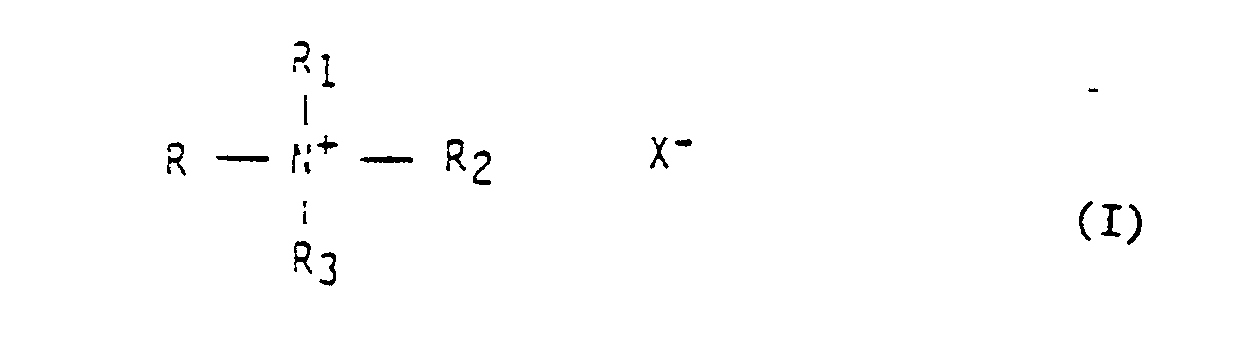
aufweist, worin R eine geradkettige Alkylgruppe mit 10 bis 18 Kohlenstoffatomen, R₁ und R₂ jeweils Alkylgruppen mit 1 oder 2 Kohlenstoffatomen und R₃ entweder eine Alkylgruppe mit 1 bis 2 Kohlenstoffatomen oder eine Aralkylgruppe oder eine Cycloalkylgruppe oder eine Gruppe der Formel
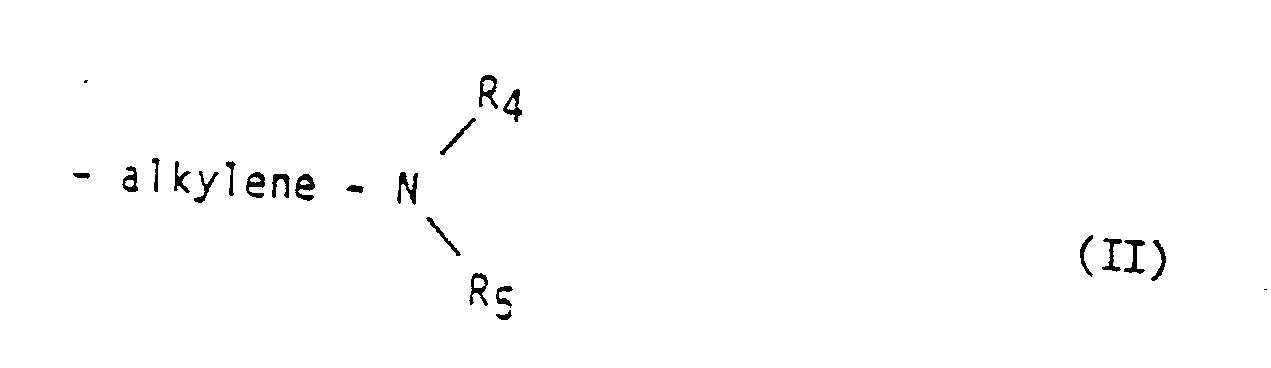
bedeuten, worin R₄ und R₅ jeweils Alkylgruppen mit 1 oder 2 Kohlenstoffatomen bedeuten, oder R₁, R₂ und R₃ die zur Vervollständigung eines heterozyklischen aromatischen Ringes notwendigen Atome darstellen und X ein Anion bedeutet.
aufweist, worin R eine geradkettige Alkylgruppe mit 10 bis 18 Kohlenstoffatomen, R₁ und R₂ jeweils Alkylgruppen mit 1 oder 2 Kohlenstoffatomen und R₃ entweder eine Alkylgruppe mit 1 bis 2 Kohlenstoffatomen oder eine Aralkylgruppe oder eine Cycloalkylgruppe oder eine Gruppe der Formel
bedeuten, worin R₄ und R₅ jeweils Alkylgruppen mit 1 oder 2 Kohlenstoffatomen bedeuten, oder R₁, R₂ und R₃ die zur Vervollständigung eines heterozyklischen aromatischen Ringes notwendigen Atome darstellen und X ein Anion bedeutet.
5. Verfahren nach Anspruch 3, worin die quaternäre Ammoniumverbindung die allgemeine
Formel:
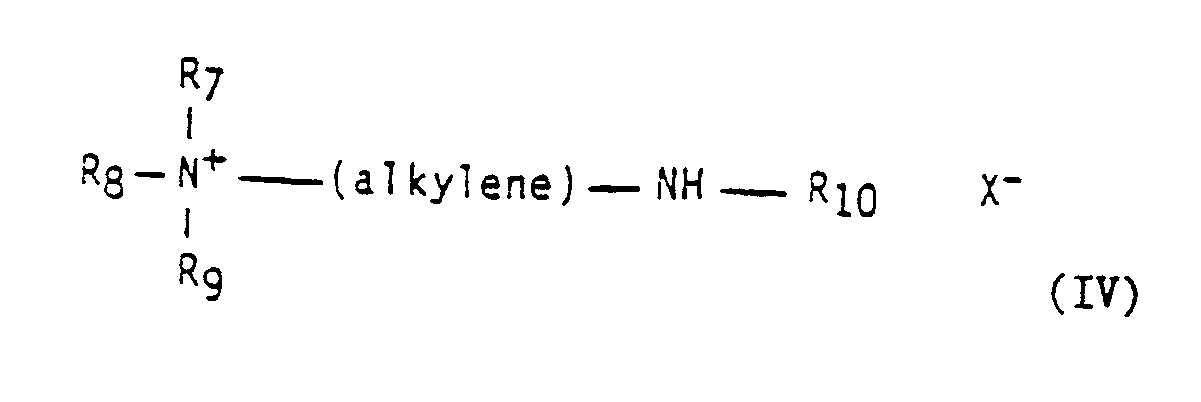
aufweist, worin R₇ und R₈ jeweils Alkylgruppen mit 1 oder 2 Kohlenstoffatomen, Rg eine gegebenenfalls substituierte Alkylgruppe, (Alkylen) einen gegebenenfalls substituierten oder durch Heteroatome unterbrochenen Alkylenrest, R₁₀ eine Gruppe mit einer Alkylgruppe von 10 bis 18 Kohlenstoffatomen und X ein Anion bedeuten.
aufweist, worin R₇ und R₈ jeweils Alkylgruppen mit 1 oder 2 Kohlenstoffatomen, Rg eine gegebenenfalls substituierte Alkylgruppe, (Alkylen) einen gegebenenfalls substituierten oder durch Heteroatome unterbrochenen Alkylenrest, R₁₀ eine Gruppe mit einer Alkylgruppe von 10 bis 18 Kohlenstoffatomen und X ein Anion bedeuten.
6. Verfahren nach Anspruch 3, worin die quaternäre Ammoniumverbindung die allgemeine
Formel
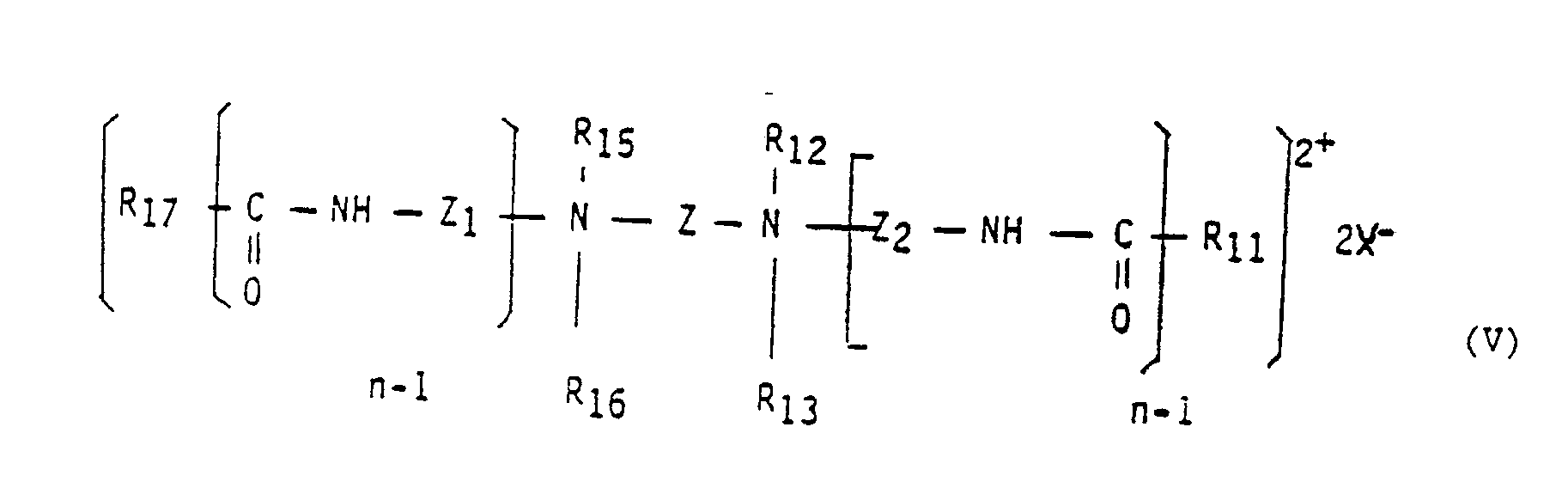
aufweist, worin R₁₇ und R₁₁ jeweils aliphatische Kohlenwasserstoffreste mit 12 bis 18 Kohlenstoffatomen, R₁₂, R₁₃, R₁₅ und R₁₆ gegebenenfalls substituierte Alkyl-, Cycloalkyl- oder Aralkylreste, Z eine gegebenenfalls substituierte alkylenbindende Gruppe, die Heteroatome enthalten kann, Z₁ und Z₂ Alkylenreste mit 2 oder 3 Kohlenstoffatomen, n eine ganze Zahl von höchstens 2 und X ein Anion bedeuten.
aufweist, worin R₁₇ und R₁₁ jeweils aliphatische Kohlenwasserstoffreste mit 12 bis 18 Kohlenstoffatomen, R₁₂, R₁₃, R₁₅ und R₁₆ gegebenenfalls substituierte Alkyl-, Cycloalkyl- oder Aralkylreste, Z eine gegebenenfalls substituierte alkylenbindende Gruppe, die Heteroatome enthalten kann, Z₁ und Z₂ Alkylenreste mit 2 oder 3 Kohlenstoffatomen, n eine ganze Zahl von höchstens 2 und X ein Anion bedeuten.
7. Verfahren nach Anspruch 6, worin in der dort genannten Formel der quaternären Ammoniumverbindung
R₁₇ und R₁₁ jeweils einen geradkettigen Alkylrest mit 12 bis 18 Kohlenstoffatomen,
Z einen Alkylenrest mit 2-4 Kohlenstoffatomen, der gegebenenfalls durch Hydroxylgruppen
substituiert ist, R₁₂, R₁₃, R₁₅ und R₁₆ jeweils Alkylgruppen mit einem oder zwei Kohlenstoffatomen
und X ein Halogenatom bedeuten.
8. Verfahren nach Anspruch 3, worin es sich bei der quaternären Ammoniumverbindung um
ein Polymer handelt, das durch Quaternisierung eines Diamins der Formel IX:
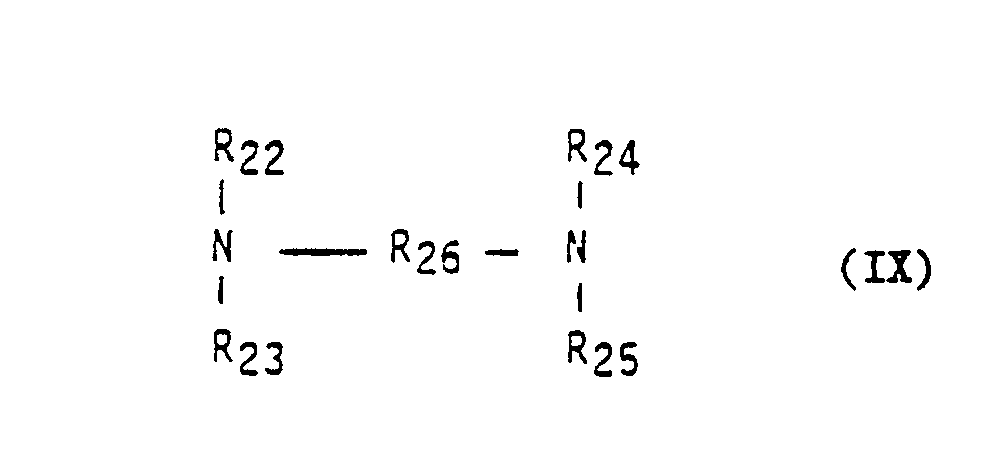
worin R₂₂, R₂₃ und R₂₅ jeweils Alkylgruppen mit 1 oder 2 Kohlenstoffatomen und R₂₆ eine gegebenenfalls substituierte oder durch Heteroatome oder Bischlormethyldiphenyl unterbrochene Alkylengruppe bedeuten, hergestellt wurde.
worin R₂₂, R₂₃ und R₂₅ jeweils Alkylgruppen mit 1 oder 2 Kohlenstoffatomen und R₂₆ eine gegebenenfalls substituierte oder durch Heteroatome oder Bischlormethyldiphenyl unterbrochene Alkylengruppe bedeuten, hergestellt wurde.
9. Verfahren nach Anspruch 1, worin die die permanente Trennung der Interferenzstreifen
verursachende Verbindung eine Verbindung ist, die ein Molekulargewicht von über 200
aufweist und mit der Gelatine unter Bildung kovalenter Bindungen damit und Erhöhung
des Molekulargewichts der Gelatine reagiert.
10. Verfahren nach Anspruch 9, worin es sich bei der mit Gelatine reaktiven Verbindung
um einen Reaktivfarbstoff handelt.
11. Verfahren nach Anspruch 10, worin der Reaktivfarbstoff eine Chromophorgruppe und eine
Reaktivgruppe enthält, die sich von einem substituiertes annelierten Monoazin-, Diazin-,
Triazin-, Oxazin-, Pyridin-, Pyrimidin-, Pyridazin-, Pyrazin- oder Thiazinring oder
einem derartigen Ring ableiten oder ausgewählt sind aus einer Acryloyl-, Mono-, Di-
oder Trichloracryloyl-, geschützten Acryloyl-, Vinylsulfon- und geschützten Vinylsulfongruppe.
12. Verfahren nach Anspruch 1, worin die die permanente Trennung der Interferenzstreifen
verursachende Verbindung ein wasserlösliches Polymer mit einer tertiären Aminogruppe
entweder in der Wiederholeinheit oder in einer Seitenkette ist.
13. Verfahren nach Anspruch 12, worin es sich bei dem wasserlöslichen Polymer um ein Polymer
handelt, das durch Reaktion von Methylenbisacrylamid oder einem substituierten Derivat
davon mit einer Verbindung mit zwei sekundären Aminogruppen gebildet wurde.
14. Verfahren nach Anspruch 12, worin es sich bei dem Polymer mit einer tertiären Aminogruppe
in einer Seitenkette um ein Polymer handelt, das eine Wiederholeinheit der allgemeinen
Formel:
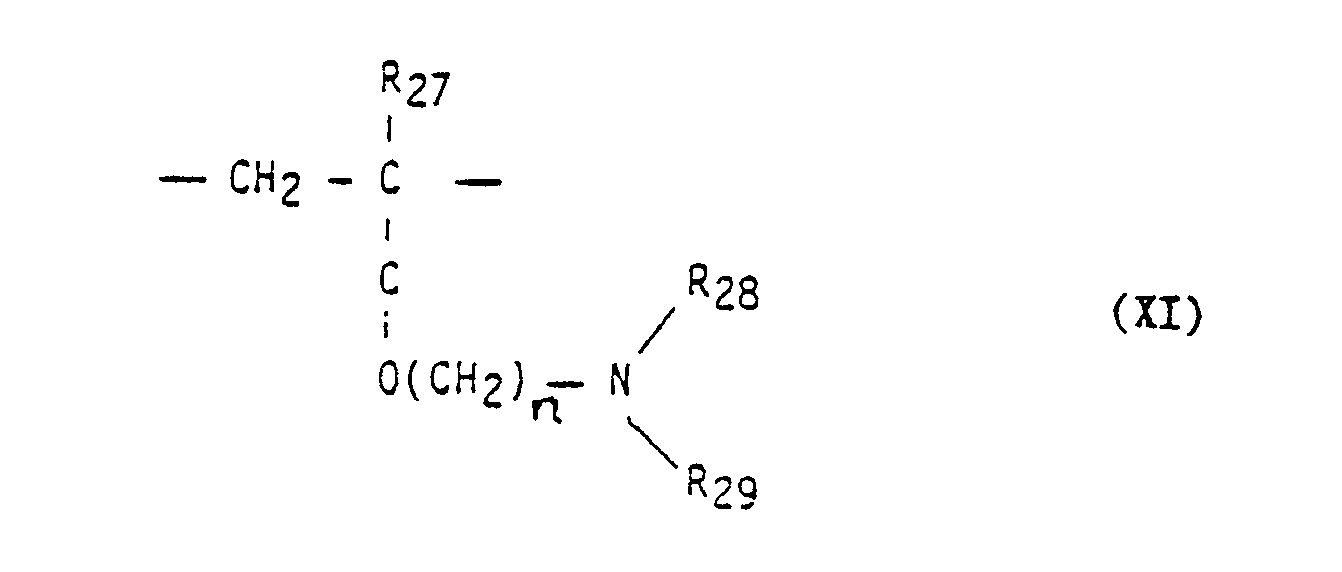
aufweist, worin R₂₇ Wasserstoff oder eine Methylgruppe bedeutet, R₂₈ und R₂₈ jeweils aus gegebenenfalls substituierten Alkyl, Aralkyl- oder Arylgruppen ausgewählt sind und n 2 - 4 bedeutet, oder R₂₈ und R₂₉ die zur Vervollständigung eines gesättigten heterocyclischen Rings notwendigen Atome darstellen.
aufweist, worin R₂₇ Wasserstoff oder eine Methylgruppe bedeutet, R₂₈ und R₂₈ jeweils aus gegebenenfalls substituierten Alkyl, Aralkyl- oder Arylgruppen ausgewählt sind und n 2 - 4 bedeutet, oder R₂₈ und R₂₉ die zur Vervollständigung eines gesättigten heterocyclischen Rings notwendigen Atome darstellen.
15. Verfahren nach Anspruch 14, worin es sich bei dem Polymer um Poly(dimethylaminoethylmethacrylat)
oder Poly(morpholinethylmethacrylat) handelt.
16. Gemäß dem Verfahren nach Anspruch 1 hergestelltes Hologramm.