|
(11) | EP 0 226 989 B1 |

| (12) | EUROPEAN PATENT SPECIFICATION |
|
|
| (54) |
Crystalline aluminophosphate composition Kristalline Aluminophosphatverbindung Composition d'aluminophosphate cristalline |
|
|
|||||||||||||||||||||||||||||||
| Note: Within nine months from the publication of the mention of the grant of the European patent, any person may give notice to the European Patent Office of opposition to the European patent granted. Notice of opposition shall be filed in a written reasoned statement. It shall not be deemed to have been filed until the opposition fee has been paid. (Art. 99(1) European Patent Convention). |
[0001] The present invention relates in general to crystalline aluminophosphate compositions, and more particularly to a novel crystalline aluminophosphate of the molecular sieve type, and to the methods for its preparation.
[0002] Microporous crystalline aluminophosphate compositions having open framework structures formed of A102 and P02 tetrahedral units joined by the sharing of the corner oxygen atoms and characterized by having pore openings of uniform dimensions have heretofore been disclosed in a number of publications, notably the specification of U.S.P.-4 310 440 issued July 7, 1980 to S.T. Wilson et al. The Wilson et al. aluminophosphates constitute a generic class of non-zeolite molecular sieve materials which are capable of undergoing complete and reversible dehydration while retaining the same essential framework topology in both the anhydrous and hydrated state. By the term "essential framework topology" or "essential framework structure" as used in the aforesaid patent, and also in the present specification and claims, is meant the spatial arrangement of the primary AI-O and P-O bond linkages. Other microporous aluminophosphates which undergo structure rearrangements, either reversibly or irreversibly, upon partial or complete dehydration are also known, for example the minerals variscite and metavariscite and certain of the synthetic metastable aluminophosphates reported by F.D Yvoire [Bull. Soc. Chim. France, 1762 (1961)]. Another class of synthetic crystalline compositions which contain framework tetrahedral metal oxides of manganese, magnesium, cobalt and/or zinc in addition the A102 and P02 tetrahedra are disclosed in US-A-4 567 029.
[0003] The present invention comprises a novel microporous crystalline aluminophosphate, denominated ALP04-39 and the methods for its preparations AIP04-39 has an essential framework structure whose chemical composition, expressed in terms of mole ratios of oxides, is:
and exhibits an X-ray powder diffraction pattern which contains at least the d-spacings set forth in Table I set forth hereinafter.
[0004] AIP04-39 can be prepared by hydrothermal crystallization from a reaction mixture containing in addition to water, a reactive source of aluminum and phosphorus and an organic templating agent which is preferably an alkyl amine, and most preferably di-n-propylamine.
[0005] The novel microporous aluminophosphate of the present invention can be produced by hydrothermal crystallization from a reaction mixture containing reactive sources of phosphorus and aluminum and an organic templating agent, preferably di-n-propylamine (Pr2NH). The preparative process typically comprises forming a reaction mixture which in terms of molar ratios of oxides is
and contains at least about 1.5 moles of di-n-propylamine per mole of A1203. The reaction mixture is placed in a reaction vessel inert toward the reaction mixture and heated at a temperature of at least about 100°C, preferably between 100°C and 300°C, until crystallized, usually a period of from 2 hours to 2 weeks. The solid crystalline reaction product is then recovered by any covenient method, such as filtration or centrifugation washed. with water and dried in air at a temperature between ambient and about 110°C. In a preferred crystallization method, the source of phosphorus is phosphoric acid, and the source of aluminum is a pseudo-boehmite hydrated aluminum oxide, the temperature is 150°C to 200°C the crystallization time is from 3 to 7 days, and the ratio of inorganic oxides in the reaction mixture is
[0006] The preferred templating agent is di-n-propylamine and is present in the reaction mixture in an amount of from about 1.5 to 2.0 moles per mole of alumina. Additionally present, because of the relatively high concentration of the basic amine, is from about 0.25 to 1.5, preferably 0.5 to 1.0, moles of an organic or mineral acid such as acetic acid or hydrochloric acid per mole of alumina. In general the stronger the acid, the lower will be its preferred concentration in the reaction mixture, within the aforesaid range. In the preferred crystallization procedure, acetic acid is present in an amount of about 1 mole per mole of alumina and di-n-propylamine is present in an amount of about 2.0 moles per mole of alumina.
[0007] It is to be noted that di-n-propylamine has heretofore been employed as the templating agent in the hydrothermal synthesis of another microporous crystalline aluminophosphate, namely AIP04-31. The synthesis of AIP04-31 is reported in U.S.P.-4 385 994 issued May 31, 1983. In that synthesis, however, the di-n-propylamine was present in relatively low concentrations in the reaction mixture, i. e. 1 mole per mole of alumina, and no acid was added to the reaction mixture. From the available data, it appears likely that ALP04-39 can suitably be synthesized using lesser amounts of di-n-propylamine templating agent, or even none at all, provided seed crystals of previously prepared AIP04-39 are also present in the reaction mixture to influence the course of the crystallization.
[0008] The template-containing as-synthesized form of AIP04-39 of the present invention has an essential framework structure whose chemical composition expressed in terms of mole ratios of oxides is:
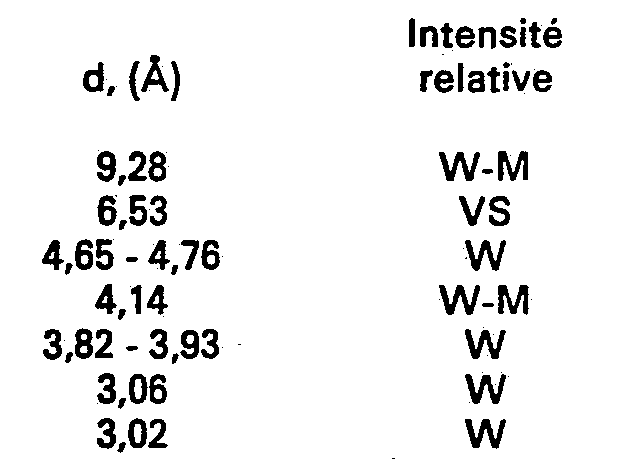
and has a characteristic X-ray powder diffraction pattern which contains at least the d-spacings set forth in Table I below:
[0009] All of the as-synthesized forms of AIP04-39 for which X-ray powder diffraction data have been obtained to date have patterns within the generalized pattern of TABLE 11 below:
[0010] When the as-synthesized AIP04-39 compositions are calcined, i. e., heated at a temperature sufficiently high, typically between about 300°C and about 700°C, or otherwise treated, such as by chemical oxidation, to remove essentially all of the organic templating agent present in the intracrystalline pore system, the composition has an X-ray powder diffraction pattern which contains at least the d-spacings set forth in Table A below:
[0011] The above X-ray patterns and all other X-ray patterns appearing hereinafter were obtained by use of either a standard X-ray powder diffraction technique or by use of computer based techniques using a Siemens D-500 X-ray powder diffractometer, available from Siemens corporation, cherry Hill, N.J. When the standard X-ray technique is employed radiation source is a high-intensity, copper target, X-ray tube operated at 50 Kv and 49 mA. The diffraction pattern from the copper K-alpha radiation and graphite monochromator were recorded by an X-ray spectrometer scintillation counter, pulse height analyzer and strip chart recorder.
[0012] Flat compressed powder samples are scanned at 2 degrees (2 theta) per minute, using a two second time constant. Interplanar spacings (d) in Angstrom units are obtained from the position of the diffraction peaks expressed as 2e (theta) as observed on the strip chart where theta is the Bragg angle. Intensities were determined from the heights of diffraction peaks after subtracting background, "lo" being the intensity of the strongest line or peak, and "I" being the intensity of each of the other peaks.
[0013] As will be understood by those skilled in the art the determination of the parameter 2 theta, irrespective of the technique employed, is subject to both human and mechanical error, which in combination, can impose an uncertainty of about 0.4° on each reported value of 2 theta. This uncertainty is of course, also manifested in the reported value of the d-spacings, which are calculated from the 2 theta values. This imprecision is general throughout the art and is not sufficient to preclude the differentiation of the present crystalline materials from the compositions of the prior art. In some of the X-ray patterns reported, the relative intensities of the d-spacings are indicated by the notations VS, S, M, and W which represent Very Strong, Strong, Medium and Weak respectively.
[0014] AIP04-39 exhibits surface characteristics which make it useful as a catalyst or catalyst support in various hydrocarbon conversion and oxidative combustion processes. AIP04-39 can be associated with catalytically active metals, e. g., by framework substitution, by impregnation, doping and the like, by methods traditionally used in the art for the fabrication of catalyst compositions. Further, AIP04-39 has a pore size of less than about 4.3 Angstroms which makes AIP04-39 suitable for use as a molecular sieve for the separation of molecular species.
[0015] The following examples are provided to illustrate the invention and are not to be construed as limiting thereof:
Example 1
[0016] AIP04-39 was prepared by combining 27.2 grams of a hydrated aluminum oxide, a pseudo-boehmite phase comprising 75.1 (wt.-%) weight percent A1203 and 24.9 (wt.-%) weight percent H20, with a solution of 46.2 grams of 85 wt.-% ortho-phosphoric acid (H3PO4) and 46.2 grams of H20. The resulting mixture was stirred until a homogeneous mixture was observed. This mixture was then mixed with 12.1 grams glacial acetic acid (CH3COOH) and the resulting mixture stirred until homogeneous. To the above mixture 40.5 grams di-n-propylamine (nPr2NH) was added and the resultant mixture was once again mixed until homogeneous. The composition of reaction mixture in molar oxide ratios was:
[0017] The reaction mixture was sealed in a stainless steel-pressure vessel lined with polytetrafluoroethylene and heated in an oven at 150°C at the autogenous pressure for 168 hours. The solid reaction product was recovered by centrifuging, washed with water and dried in air at ambient temperature.
[0018] A portion of the solid reaction product was analyzed and the following chemical analysis obtained:
[0020] The solid reaction product contained a small amount of impurity but the major phase had an X-ray powder diffraction pattern characterized by the following data:
Example 2
[0022] The solid reaction product was recovered by centrifuging, washed with water and dried in air at ambient temperature. The solid reaction product has an X-ray powder diffraction pattern characterized by the following data.
[0023] (b) A portion of the reaction product was calcined in air at about 600°C for 4.75 hours. The calcined product has an X-ray powder diffraction pattern as set forth in Table C below;
[0025] (c) Adsorption capacities for AIP04-39 [prepared in part (b), supra] were measured using a standard McBain-Bakr gravimetric adsorption apparatus. The following data were obtained on the calcined sample of part (b) activated at 350° C:
1. Microporous crystalline aluminophosphate having an essential framework structure
whose chemical composition expressed in terms of mole ratios of oxides is

and having a characteristic X-ray powder diffraction pattern containing at least the following d-spacings
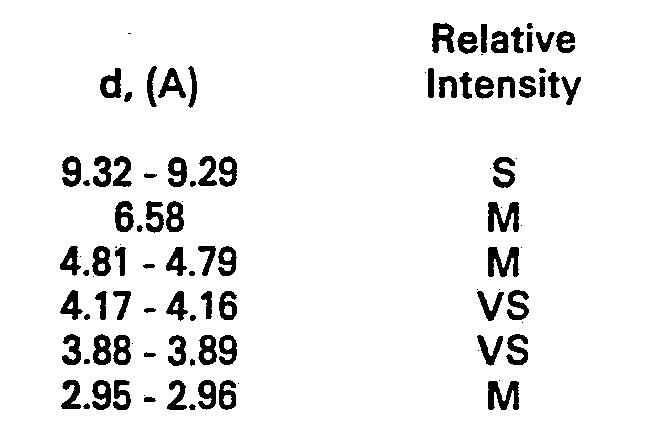
and having a characteristic X-ray powder diffraction pattern containing at least the following d-spacings
2. Microporous crystalline aluminophosphate which results from the calcination of
the composition of claim 1 at a temperature of at least 300° C.
3. Microporous crystalline aluminophosphate having an essential framework structure
whose chemical composition expressed in terms of mole ratios of oxides is
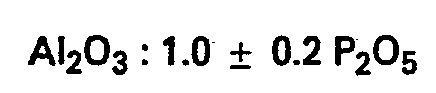
and having a characteristic X-ray powder diffraction pattern containing at least the following d-spacings
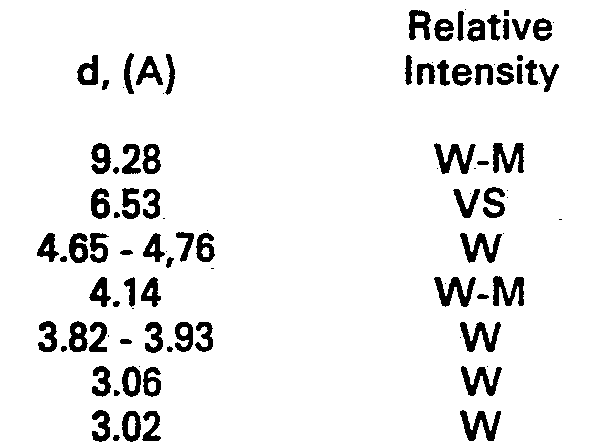
and having a characteristic X-ray powder diffraction pattern containing at least the following d-spacings
4. Process for preparing a microporous crystalline aluminophosphate of claim 1 which
comprises forming a reaction mixture having a composition expressed in terms of mole
ratios of oxides of

and containing from about 1.5 to about 2 moles of di-n-propylamine per mole of A1203 and from about 0.25 to 1.5 moles of an organic or mineral acid per mole of AI203, and heating the reaction mixture thus formed at a temperature of at least 100°C under autogenous pressure until crystals of said aluminophosphate are formed.
and containing from about 1.5 to about 2 moles of di-n-propylamine per mole of A1203 and from about 0.25 to 1.5 moles of an organic or mineral acid per mole of AI203, and heating the reaction mixture thus formed at a temperature of at least 100°C under autogenous pressure until crystals of said aluminophosphate are formed.
5. Process according to claim 4 wherein the acid present in the reaction mixture is
acetic acid and the di-n-propylamine is present in an amount of about 2 moles per
mole of A1203.
1. Mikroporöses kristallines Aluminophosphat mit einer grundlegenden Gerüststruktur,
deren chemische Zusammensetzung ausgedrückt zahlenmäßig in Molverhältnissen der Oxide
ist

und mit einem charakteristischen Röntgenpulverbeugungsmuster, das wenigstens die nachfolgenden d-Werte enthält:
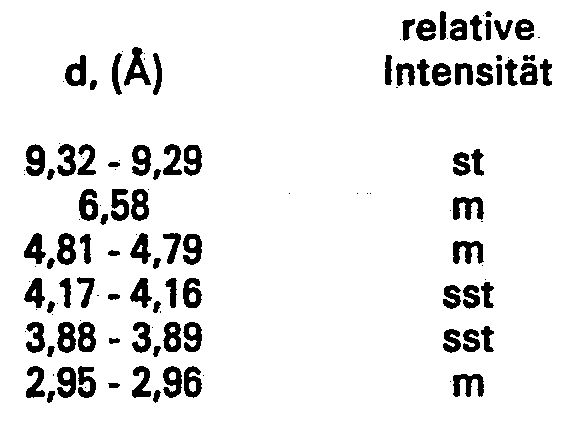
und mit einem charakteristischen Röntgenpulverbeugungsmuster, das wenigstens die nachfolgenden d-Werte enthält:
2. Mikroporöses kristallines Aluminophosphat erhältlich durch Calcinierung der Zusammensetzung
gemäß Anspruch 1 bei einer Temperatur von wenigstens 300° C.
3. Mikroporöses kristallines Aluminophosphat mit einer grundlegenden Gerüststruktur,
deren chemische Zusammensetzung ausgedrückt zahlenmäßig in Molverhältnissen der Oxide
ist
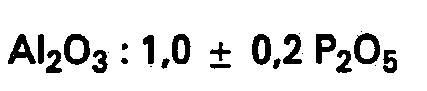
und mit einem charakteristischen Röntgenpuiverbeugungsmuster, das wenigstens die nachfolgenden d-Werte enthält:
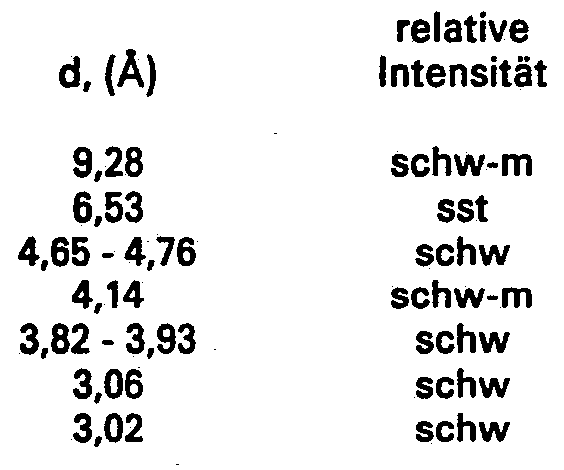
und mit einem charakteristischen Röntgenpuiverbeugungsmuster, das wenigstens die nachfolgenden d-Werte enthält:
4. Verfahren zur Herstellung eines mikroporösen kristallinen Aluminophosphats nach
Anspruch 1, umfassend das Bilden einer Reaktionsmischung mit einer Zusammensetzung,
die ausgedrückt zahlenmäßig in Molverhältnissen der Oxide ist

und das zwischen etwa 1,5 und etwa 2 Molen an Di-n-propylamin pro Mol Al2O3 und zwischen etwa 0,25 und 1,5 Molen einer organischen oder Mineralsäure pro Mol A1203 enthält, und das Erhitzen der so gebildeten Reaktionsmischung auf eine Temperatur von wenigstens 100°C unter autogenem Druck, bis sich Kristalle dieses Aluminophosphats bilden.
und das zwischen etwa 1,5 und etwa 2 Molen an Di-n-propylamin pro Mol Al2O3 und zwischen etwa 0,25 und 1,5 Molen einer organischen oder Mineralsäure pro Mol A1203 enthält, und das Erhitzen der so gebildeten Reaktionsmischung auf eine Temperatur von wenigstens 100°C unter autogenem Druck, bis sich Kristalle dieses Aluminophosphats bilden.
5. Verfahren nach Anspruch 4, bei dem die im Reaktionsgemisch anwesende Säure Essigsäure
ist und das Di-n-propylamin in einer Menge von etwa 2 Mol pro Mol AI203 vorhanden
ist.
1. Aluminophosphate cristallin microporeux, ayant une ossature structurale essentielle
dont la composition chimique, exprimée d'après les rapports molaires des oxydes, répond
à la formule
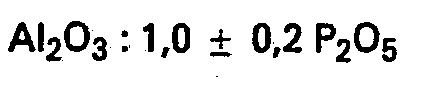
et ayant un diagramme caractéristique de diffraction des rayons X sur poudre contenant au moins les distances d suivantes:
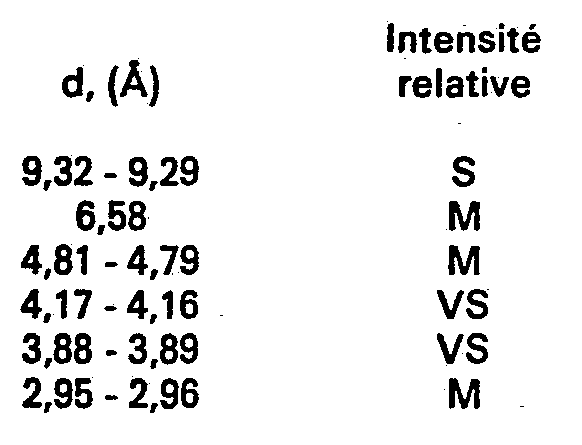
et ayant un diagramme caractéristique de diffraction des rayons X sur poudre contenant au moins les distances d suivantes:
2. Aluminophosphate cristallin microporeux, qui résulte de la calcination de la composition
suivant la revendication 1 à une température d'au moins 300°C.
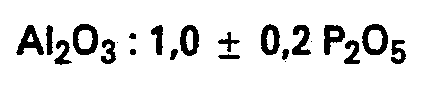
3. Aluminophosphate cristallin microporeux, ayant une ossature structurale essentielle
dont la composition chimique, exprimée d'après les rapports molaires des oxydes, répond
à la formule
et ayant un diagramme caractéristique de diffraction des rayons X sur poudre contenant au moins les distances d suivantes:
et ayant un diagramme caractéristique de diffraction des rayons X sur poudre contenant au moins les distances d suivantes:
4. Procédé de préparation d'un aluminophosphate cristallin microporeux suivant la
revendication 1, qui consiste à former un mélange réactionnel dont la composition,
exprimée d'après les rapports molaires des oxydes, répond à la formule:

et contenant environ 1,5 à environ 2 moles de di-n-propylamine par mole de A1203 et environ 0,25 à 1,5 mole d'un acide organique ou minéral par mole de AI203, et à chauffer le mélange réactionnel ainsi formé à une température d'au moins 100°C sous pression autogène jusqu'à ce que des cristaux dudit aluminophosphate soient formés.
et contenant environ 1,5 à environ 2 moles de di-n-propylamine par mole de A1203 et environ 0,25 à 1,5 mole d'un acide organique ou minéral par mole de AI203, et à chauffer le mélange réactionnel ainsi formé à une température d'au moins 100°C sous pression autogène jusqu'à ce que des cristaux dudit aluminophosphate soient formés.
5. Procédé suivant la revendication 4, dans lequel l'acide présent dans le mélange
réactionnel est l'acide acétique et la di-n-propylamine est présente en une quantité
d'environ 2 moles par mole de AI203.