|
(11) | EP 0 227 179 A1 |

| (12) | EUROPEAN PATENT APPLICATION |
|
|
|
|
|||||||||||||||||||||||||||
| (54) | Stainless steels stress corrosion inhibitors |
| (57) The invention relates to inhibitors of stress corrosion in stainless steels in the
presence of solutions containing Cl⁻ ions and possibly Cu⁺⁺ ions, said inhibitors
being selected from the class of quaternary ammonium alkyl or benzyl carbonates.
|
[0002] It is known that steels in general, and also stainless steels undergo stress corrosion, when they are in contact with some types of liquids or solutions.
[0003] It has been observed that the stress corrosion is particularly noxious in case of CU⁺⁺ and Cl⁻ ions containing solutions.
[0004] The possible solutions the art offers in the latter exposed case, which is the one we are mostly interested in, are either using stainless steels of Hastelloy type, with consequent increases in equipment cost, or reducing the contents of Cu⁺⁺ and Cl⁻ ions by means of a series of beds of anionic and cationic resins, with consequent increase in plant operations cost both as relates to the resins cost and consumption, and to the regeneration thereof.
[0005] It should be furthermore observed that the lower the concentration of Cu⁺⁺ and Cl⁻ ions, the more difficult their separation by means of resins, so that, already starting from values of Cu⁺⁺ and Cl⁻ ions concentrations of respectively 2 and 10 ppm, the cost for such a separation would result prohibitive. It has been surprisingly found that the stress corrosion in the presence of Cl⁻ ions, and possibly in the presence of Cu⁺⁺ ions too, can be eliminated by resorting to corrosion inhibitors dissolved in the aqueous and/or polar organic solution containing said ions in contact with the stainless steel, after reducing, if necessary, by known means, in particular by such means as above mentioned, the contents of Cu⁺⁺ and Cl⁻ ions to maximum values of respectively 2 ppm and 10 ppm, preferably of 1 and 5 ppm.
[0006] The corrosion inhibitors according to the invention are selected from the class of the quaternary ammonium alkyl or benzyl carbonates having general formula
wherein: R₁ is a linear or branched, saturated or unsaturated, possibly hydroxylated alkyl radical containing from 1 to 30 carbon atoms; R₂ and R₃ are alkylaryl radicals, in particular benzyl radicals, possibly bearing one or more substituents on their ring, or have, individually, the same meaning as of R₁; R₄ is an alkyl radical of from 1 to 4 carbon atoms, or is benzyl radical.
[0007] The carbonate used according to the invention is obtained by means of a dialkylcarbonate having the formula:
with respectively a tertiary or secondary amine having the formula:
wherein: R₁, R₂, R₃ and R₄ have the above said meaning, in the liquid phase, at temperatures of from about 100 to about 200°C, with an amount of carbonate equal to, or higher than the stoichiometric amount for the reaction with the amine, up to complete, or substantially complete conversion of the same amine.
[0008] The reaction between the dialkylcarbonate and the tertiary amine can be described as follows:
[0009] The reaction between the dialkylcarbonate and the secondary amine can be described as follows:
[0010] That is to say, the alcohol corresponding to radical R₄ in the carbonate, as well as carbon dioxide, is formed.
[0011] Examples of dialkylcarbonates useful as alkylating agents are dimethylcarbonate, methylethylcarbonate, methylpropylcarbonate, methylbutylcarbonate, methylbenzylcarbonate, diethylcarbonate and dibenzylcarbonate.
[0012] Examples of tertiary amines useful to the purposes of the present invention are N,N-dimethylbenzylamine, trimethylamine, triethylamine, tri-n-propylamine, tri-n-butylamine, dimethylcetylamine and dimethylstearylamine. Examples of secondary amines useful to the purposes of the present invention are: laurylmyristylamine, dipropylamine, benzylcetylamine, dimethylamine, diethylamine, di-n-butylamine and benzylmethylamine.
[0013] The molar ratio between carbonate and amine is equal to at least 1/1 in case of tertiary amines and to at least 2/1 in case of secondary amines. It is generally preferable to use an excess of carbonate relatively to the stoichiometric value, and, in practice, operating is possible with values of such a ratio of up to 10/1, with the values of from 3/1 to 5/1 being preferred. The possibly used carbonate excess remains unchanged, and can be recovered for a subsequent use.
[0014] The reaction is carried out at a temperature of from about 100 to about 200°C and preferably of from 130 to 160°C and under such a pressure as to keep the reaction mixture in the liquid phase, thus as a function of the nature of the amine, of the carbonate and of the possibly used solvent. In practice, said pressures can vary from the atmospheric pressure up to about 15 bars.
[0015] The reaction times depend on the nature of reactants used, besides on the other conditions under which the reaction is carried out. Generally, under the conditions as set forth, the reaction is complete, or nearly complete, within a time of from 1 to 30 hours.
[0016] Furthermore, the reaction can be carried out in the presence of an added, not reactive, and preferably polar solvent. Solvents suitable to the purpose are the alcoholic solvents (in particular, methanol and ethanol), hydrocarbon solvents and ethereal solvents.
[0017] In order to achieve a highest reaction rate, should it be regarded as useful, a substance may be used, which performs a catalytic action on the formation of quaternary ammonium carbonates, selected from such organic and inorganic iodides as methyl iodide, ethyl iodide and sodium and potassium iodides. The catalyst can be used in amounts of from 0.1 to 5 mol per each 100 mol of amine, and preferably of from 0.5 to 2 mol per 100 mol of amine.
[0018] At reaction end, the quaternary ammonium carbonate can be separated from the reaction mixture by a simple filtration, when said product separates in the solid form at temperatures lower than reaction temperatures.
[0019] As an alternative, the separation is carried out by evaporating off the unchanged dialkylcarbonate, the possibly used solvent, as well as the byproduct alcohol.
[0020] The separation can be also simply accomplished by pouring the reaction mass into water and separating the carbonate excess, insoluble in the aqueous ammonium hydroxide solution.
[0021] The inhibitor concentration in the aqueous and/or polar organic solution containing Cu⁺⁺ and Cl⁻ ions is comprised within the range of from 50 to 1000 ppm, preferably of from 100 to 600 ppm.
[0022] The corrosion inhibitors in accordance with the present invention allow, at concentrations as mentioned, austenitic, austeno-ferritic and superaustenitic stainless steels to be passivated, in a complete way, against the stress corrosion, when the concentrations of Cu⁺⁺ and Cl⁻ ions are not higher than respectively 2 and 20 ppm.
[0023] Should the values of concentrations of Cu⁺⁺ and Cl⁻ions be higher than the above limits, the inhibitors of the invention allow the stress corrosion to be reduced, but not to be completely eliminated.
[0024] The inhibitors of the invention can be used in aqueous solutions, or in polar organic solutions, or also in water-polar organic liquid solutions or dispersions, with the maximum limit of concentration of Cu⁺⁺ and Cl⁻ions being the only limitation.
[0025] Among the polar organic liquids, there should be mentioned the alcohols and, among these, in particular, methanol and ethanol; the ketones, and, among these latter, in particular, acetone; the esters.
[0026] We underline moreover that the activity of the inhibitors according to the invention is in no way influenced by the presence, in the aqueous and/or organic solution, of organic compounds therein dissolved or dispersed, such as, e.g., esters, aldehydes or still others.
[0027] Some examples are now supplied to the purpose of better explaining the invention, it being understood that the invention is not to be considered as being limited to them or by them.
Examples 1, 2, 3
[0028] All of the exemplified tests have been carried out in an AISI-316 autoclave internally protected by a teflon coating. As the specimen, a ring of AISI 304 L stainless steel of 10 mm in height and 20 mm in diameter has been used. The specimen has been kept stressed and heated at a temperature of 120°C, under a N₂ atmosphere, over a 7-days time.
[0029] The inhibitors used in the three examples have been, respectively, trimethyl-ethanol-ammonium methoxycarbonate (TMEA), trimethyl-cetyl-ammonium methoxycarbonate (TMCA), and trimethyl-stearyl-ammonium methoxycarbonate (TMSA), at the concentration of 200 ppm in the organic compound being in contact with the ring.
[0030] In the three examples, the contents of Cu⁺⁺ and Cl⁻was respectively of 1 and 5 ppm, 2 and 10 ppm, 4 and 20 ppm. The blank tests, carried out in the absence of the inhibitor, have caused the presence of cracks for each corrosive medium used in the tested specimens.
Examples 4 to 8
[0032] In these examples, the influence is evidenced of the concentration of Cl⁻ om the absence of Cu⁺⁺, by using, as the inhibitor, trimethyl-ethanol-ammonium methoxycarbonate (TMEA) at a concentration of 100 ppm.
1. Inhibitors of stress corrosion of stainless steels in contact with aqueous and/or
polar organic solutions, contalnlng Cl⁻ ions, and, possibly, also Cu⁺⁺ ions, characterized
in that they are selected from the class of quaternary ammonium alkylcarbonates or
benzylcarbonates.
2. Inhibitors according to claim 1, characterized in that the quaternary ammonium
alkyl- or benzylcarbonates have the general formula:
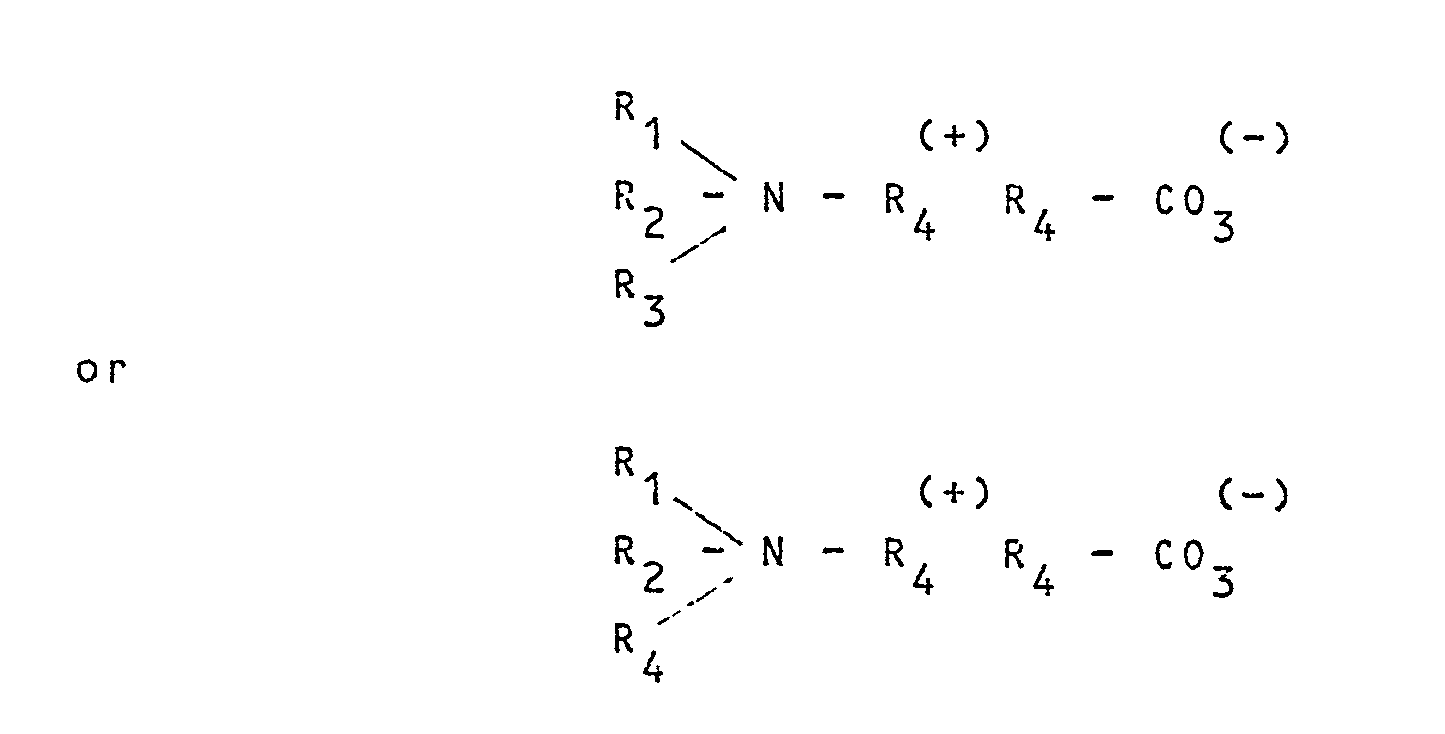
wherein: R₁ is a linear or branched, saturated or unsaturated alkyl radicaL containing from 1 to 30 carbon atoms; R₂ and R₃ are alkylaryl radicals, in particular benzyl radicals, possibly bearing one or more substitutents on their ring, or which have, individually, the same meaning as of R₁ R₄ being an alkyl radical of from 1 to 4 carbon atoms, or benzyl radical.
wherein: R₁ is a linear or branched, saturated or unsaturated alkyl radicaL containing from 1 to 30 carbon atoms; R₂ and R₃ are alkylaryl radicals, in particular benzyl radicals, possibly bearing one or more substitutents on their ring, or which have, individually, the same meaning as of R₁ R₄ being an alkyl radical of from 1 to 4 carbon atoms, or benzyl radical.
3. Inhibitors according to claim 1, characterized in that they are selected from trimethyl-ethanol-ammonium
methoxycarbonate, trimethyl-cetyl-ammonium methoxycarbonate and trimethyl-stearyl
methoxycarbonate.
4. Inhibitors according to the preceding claims, characterized in that their concentration
in the aqueous and/or polar organic solution is comprised within the range of from
50 ppm to 1000 ppm.
5. Inhibitors according to claim 4, wherein their concentration is comprised within
the range of from 100 to 600 ppm.