|
(11) | EP 0 230 779 B1 |

| (12) | EUROPEAN PATENT SPECIFICATION |
|
|
| (54) |
Alkylresorcinol phosphites Alkylresorcinolphosphite Phosphites d'alkyl résorcinols |
|
|
|||||||||||||||||||||||||||||||
| Note: Within nine months from the publication of the mention of the grant of the European patent, any person may give notice to the European Patent Office of opposition to the European patent granted. Notice of opposition shall be filed in a written reasoned statement. It shall not be deemed to have been filed until the opposition fee has been paid. (Art. 99(1) European Patent Convention). |
[0001] Alkylcatechol phosphites useful as antioxidants are disclosed in FR-A-1493181 and alkylquinol phosphites useful as antioxidants are disclosed in US-A-3635884.
[0002] The present invention provides novel alkylresorcinol phosphites useful as antioxidants for organic materials such as lubricants and greases.
[0003] According to one aspect of the invention there is provided a compound which can be represented by the formula :
wherein R is H or alkyl, and R' is alkyl, said alkyl having from 8 to 18 carbon atoms.
[0004] According to another aspect there is provided a mixture of two or more compounds each of which can be represented by the formula :
wherein R is H or alkyl, and R1 is alkyl, said alkyl having from 8 to 18 carbon atoms, at least 75 % of said alkyl groups in the mixture of two or more compounds being secondary alkyl groups.
[0005] It has now been discovered that certain novel long-chain alkylresorcinol phosphites are useful antioxidants, particularly in functional fluids such as lubricants and greases.
[0006] Preferably at least 90 % of the alkyl groups in the mixture of two or more compounds are secondary alkyl groups. The or each secondary alkyl group is preferably attached at its second carbon atom to the benzene ring and is preferably attached to the benzene ring at the 2, 4 or 6 position. These phosphites are liquids at room temperature and soluble and miscible with functional fluids such as lubricants and greases at room temperature. They can be compounded into organic functional fluid substrates such as alkylated naphthalenes in concentrations between about 0.05 wt.% and about 5.0 wt.% at low temperatures such as 25 °C. Moreover, the novel compounds do not separate from hot compounds on cooling. They also have very high thermal stability, high flash points and high fire points.
[0007] The mono and dialkylresorcinol intermediates can be prepared by the alkylation of resorcinol with alpha-olefins in the presence of a catalyst. The mole ratio of resorcinol to alpha olefin should be from about 0.7 to 1.3 or more, in the case of the monoalkylresorcinol, and from about 0.4 to about 0.5 in the case of the dialkylresorcinol. The reaction can be conducted at a temperature between about 125°C and about 250 °C, preferably under an inert gas such as nitrogen. Suitable catalysts include the activated clay aluminosilicates and high silical zeolites which are used in an amount from between 10 wt.% and about 100 wt.% based on the resorcinol.
[0008] The novel phosphites can be prepared by reacting about three moles of dialkyl or monoalkylresorcinol with about one mole of phosphorus trichloride preferably with a solvent such as aliphatic and aromatic hydrocarbons such as n-heptane and toluene or a chlorinated hydrocarbon solvent such as methylene chloride, and a catalyst. A catalyst is not required by is preferred. Catalytic amounts of between about 0.1 wt.% and about 5.0 wt.% are employed when the catalyst is utilized. Typical catalysts include triaryl phosphines, pyridine, alkylpyridines and quinolines. Reaction times for the preparation of the novel phosphites are between about 1 and about 12 hours at temperatures of between about 25 °C and about 200 °C.
[0009] Functional fluids that can be stabilized with the phosphite compounds of the invention include the mono and polyalkylated naphthalenes, methyl naphthalenes and dimethyl naphthalenes. Other functional fluids that can be stabilized are, for example, mineral oils, hydrogenated poly(alpha-olefins), and esters.
[0010] The following Examples will serve to illustrate the invention and preferred embodiments thereof, and in the Examples, as elsewhere in the specification and in the following claims, all parts and percentages are by weight unless otherwise specified.
Example I
(Preparation of mono-C,6-alkylresorcinol)
[0011] A reactor was charged with 440.0 g (4.0 m) resorcinol, 851.2 g (3.8 m) C16-alpha-olefin (Gulftene-16) and 220.0 g Filtrol 13-LM (acid clay) catalyst. The mixture, under a nitrogen blanket, was stirred and heated to 220 °C, and then held at 220 °C for 1 hr. It was then cooled and filtered. The filtrate (1,002.1 g, 77.6 wt.% of the organics charged) was stripped to 260 °C, 133 N/m2 (1 Torr). The residue, 671.1 g (52 wt.% yield on the organics charged ; 67 wt.% yield, corrected for mechanical losses), was an ambercoloured, viscous oil consisting of a C1s-alkylresorcinol with an average of 1.6 alkyl groups on the resorcinol ring as determined by IR/NMR analysis. The oil was free of alkene impurities. If desired, pure mono-C16-alkylresorcinol can be separated from this mixture by fractional distillation.
Example II
(Preparation of di-C16-alkylresorcinol)
[0012] A reactor was charged with 110.0 g (1.0 m) resorcinol, 493.0 g (2.2 m) of C16-alpha-olefin and 60.3 g Filtrol 13-LM catalyst. The mixture was blanketed with nitrogen, stirred and heated to 220 °C in 3 hrs., and then held at 220 °C for 1 hr. It was then cooled and filtered. The filtrate (548.0 g, 90.9 wt.% of the organics charged) was stripped to 260° (pot)/667 N/m2 (5 Torr) to give 507.0 g (84.1 wt.% yield, based on the organics charged ; 92.5 wt.% yield, corrected for mechanical losses) of residue. This residue was an ambercoloured, viscous oil consisting largely of di-C,6-alkylresorcinol (ave. 2.2 C16-alkyl groups on the resorcinol ring as determined by IR/NMR analysis), free of alkene impurities.
Example III
(Preparation of Tris-(3-hydroxy-di-decylphenyl) phosphite)
[0013] A reactor was charged-with 234.0 g (0.6 m) of di-(decyl) resorcinol (b.p. 221-240°C/133 N/m2 (1 Torr) ; ave. 2.2 Clo-alkyl groups on the resorcinol ring as determined by IR/NMR analysis), 200 ml. n-heptane and 2.3 g of triphenyl-phosphine as the catalyst. The mixture was heated to 40 °C and 27.5 g (0.2 m) phosphorus trichloride were added dropwise over a period of 15 minutes. Heavy evolution of hydrogen chloride began almost immediately. The mixture was then held, successively, for 0.5 hr. at 40-41 °C, 1 hr. at 70 °C, and 3 hrs. at 90 °C while sparging with a stream of dry nitrogen. At the end of this period, the evolution of HCI had ceased. The heptane was distilled off at atmospheric pressure and the product stripped to 200 °C (pot)/133 N/m2 (1 Torr) to give 242.7 g of a pale yellow residue as a viscous oil identified as tris-(3-hydroxy-di-decylphenyl) phosphite, analysis found : 2.6 %P ; calculated : 2.57 %P.
Example IV
(Preparation of Tris-(3-hydroxy-hexadecylphenyl) phosphite)
[0014] A glass reactor was charged with 481.4 g (1.2 m) of mono-C16-alkylresorcinol (crude product from Ex. I above) and 4.8 g triphenylphosphine as the catalyst. To the stirred mixture was added dropwise, at room temperature over a period of 12 minutes, 57.8 g (0.42 m) of phosphorus trichloride. The mixture was held for 1 hr. at 28 °C, 1 hr. at 40 °C, 1 hr. at 70 °C and 2 hrs. at 90 °C, with a nitrogen sparge at 90 °C. At the end of this period the hydrogen chloride evolution had almost ceased. The charge was now stripped to 265 °C (pot)/1 Torr to give 452.6 g (92 % yield) of the hydroxyaryl phosphite as an amber, viscous oil ; analysis found : 2.4 %P, calculated : 2.2 %P.
Examples V-VII
[0015] In accordance with the general procedure of the previous Examples, Tris-[3-dihydroxy-di(tetradecyl) phenyl] phosphite (Example V), tris-[3-hydroxy-di(hexadecyl) phenyl] phosphite (Example VI), and tris-[3-hydroxy-di(octadecyl) phenyl] phosphite (Example VII) were prepared.
[0016] The compounds of Examples III-VII had the alkyl predominantly attached to the 2,4 or 6 positions on the benzene ring and at least 90 % were secondary alkyl attached at the second carbon to the benzene ring.
[0017] The thermogravimetric analyses (TGA), flash points, and fire points of the new compounds are shown in Table I.
[0018] The phosphites made from the long-chain alkylresorcinols were effective oxidation inhibitors in a synthetic lubricant oil, as evidenced by much reduced sludge formation at 204 °C (400 °F). The relevant data are summarized in Table II.
a) The test oil was a di-C16-alkylnaphthalene ; 1 g. in a small cup was exposed in an air-draft oven at 204 °C (400 °F).
b) Hexane insolubles.
c) Tris-[3-hydroxy-di(decyl) phenyl] phosphite
d) Tris-[3-hydroxy-hexadecylphenyl] phosphite
e) Tris-[3-hydroxy-di(hexadecyl) phenyl] phosphite
f) Tris-[3-hydroxy-di(octadecyl) phenyl] phosphite
Claims for the following Contracting State(s) : BE, CH, DE, FR, GB, GR, IT, LI, LU,
NL, SE
1. A compound which can be represented by the following general formula I :
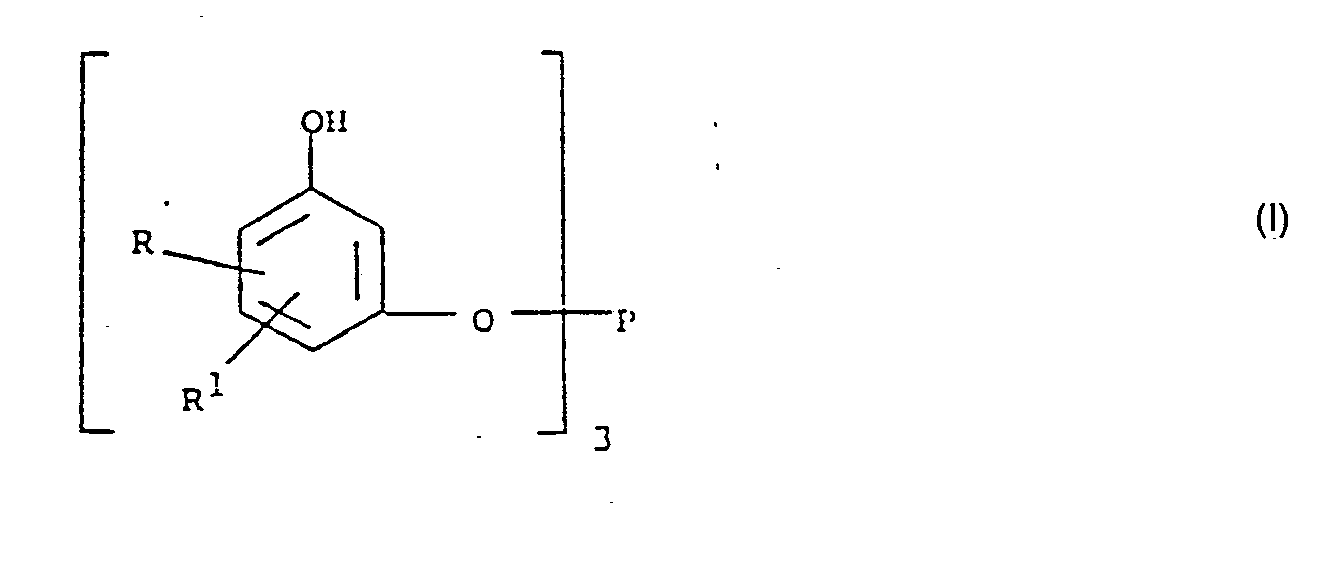
wherein R is H or alkyl, and R1 is alkyl, said?aling from 8 to 18 carbon atoms.
wherein R is H or alkyl, and R1 is alkyl, said?aling from 8 to 18 carbon atoms.
2. A compound as claimed in claim 1 wherein the or each of said alkyl is attached
at its second carbon atom to the benzene ring.
3. A compound as claimed in claim 1 or 2, wherein the or each of said alkyl groups
in a secondary alkyl group.
4. A compound as claimed in claim 1, 2 or 3, wherein the or each of said alkyl is
attached to the 2, 4 or 6 position on the benzene ring.
5. A compound as claimed in claim 1, 2, 3 or 4, wherein R is hydrogen and R1 is hexadecyl.
6. A compound as claimed in claim 1, 2, 3 or 4, wherein R and R1 are both decyl, tetradecyl, hexadecyl or octadecyl.
7. A mixture of two or more compounds each of which can be represented by the formula
:
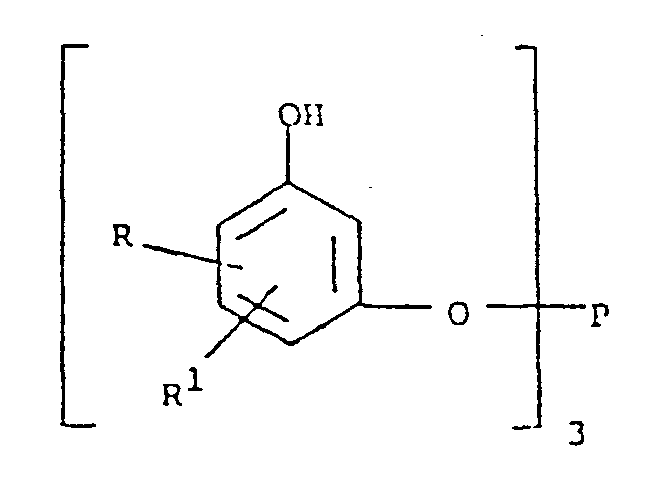
wherein R is H or alkyl, and R' is alkyl, said alkyl having from 8 to 18 carbon atoms, at least 75 % of said alkyl groups in the mixture of two or more compounds being secondary alkyl groups.
wherein R is H or alkyl, and R' is alkyl, said alkyl having from 8 to 18 carbon atoms, at least 75 % of said alkyl groups in the mixture of two or more compounds being secondary alkyl groups.
8. A mixture of compounds as claimed in claim 7, wherein at least 90 % of said alkyl
groups in the mixture of two or more compounds are secondary alkyl groups.
9. A method of preparing a compound of the formula
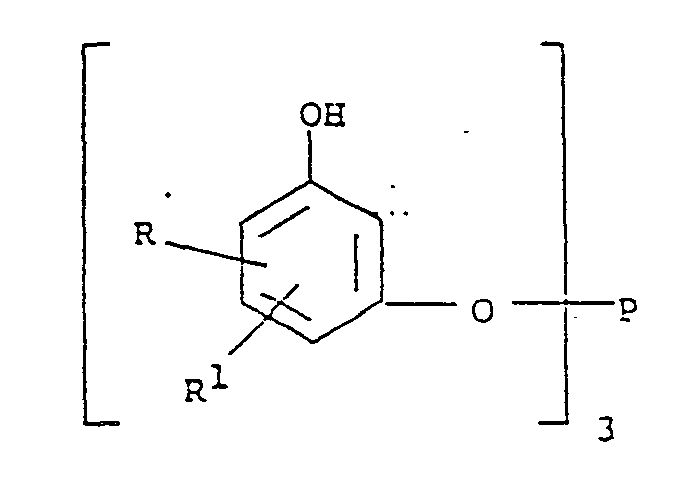
which comprises reacting a mono or dialkylresorcinol in which the alkyl groups have from 8 to 18 carbon atoms with phosphorus trichloride.
which comprises reacting a mono or dialkylresorcinol in which the alkyl groups have from 8 to 18 carbon atoms with phosphorus trichloride.
10. A composition comprising a functional fluid and a compound as claimed in any one
of claims 1 to 6 or of a mixture of compounds as claimed in either one or claims 7
and 8.
11. A composition as claimed in claim 10 wherein the functional fluid is a mono or
polyalkylated naphthalene.
Claims for the following Contracting State(s) : AT, ES
1. A method of preparing a compound of the following general formula I :
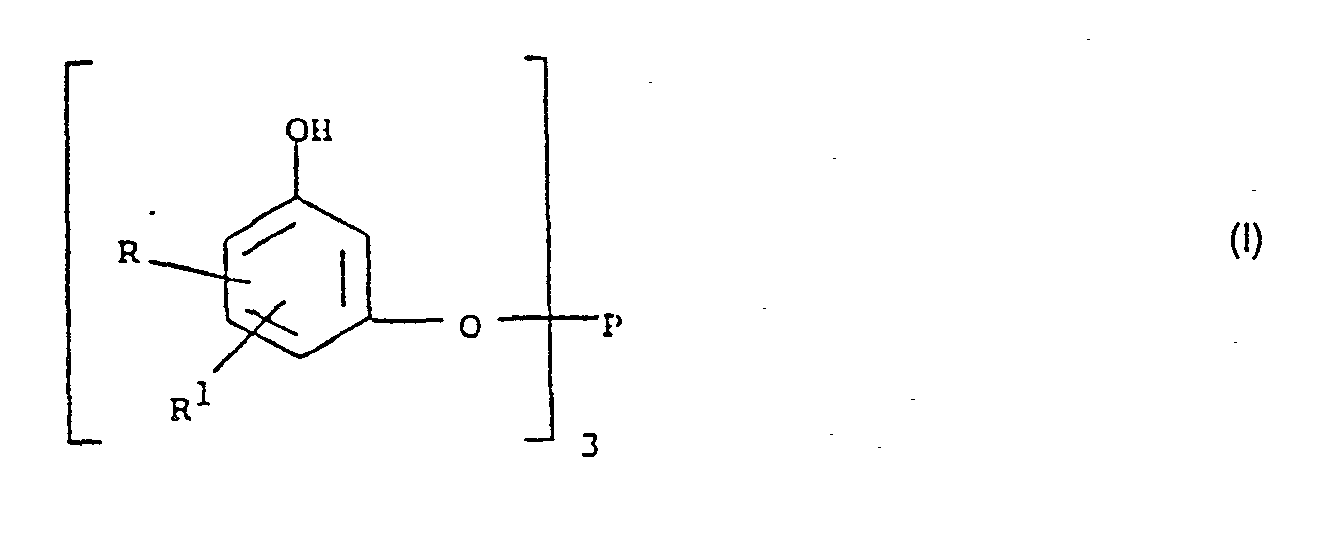
which comprises reacting a mono or dialkylresorcinol in which the alkyl groups have from 8 to 18 carbon atoms with phosphorus trichloride.
which comprises reacting a mono or dialkylresorcinol in which the alkyl groups have from 8 to 18 carbon atoms with phosphorus trichloride.
2. A method as claimed in claim 1 wherein the or each of said alkyl is attached at
its second carbon atom to the benzene ring.
3. A method as claimed in claim 1 or 2, wherein the or each of said alkyl groups is
a secondary alkyl group.
4. A method as claimed in claim ; 1, 2 or 3, wherein the or each of said alkyl is
attached to the 2, 4 or 6 position on the benzene ring.
5. A method as claimed in claim 1, 2, 3 or 4, wherein R is hydrogen and R' is hexadecyl.
6. A method as claimed in claim 1, 2, 3 or 4, wherein R and R' are both decyl tetradecyl,
hexadecyl or octadecyl.
7. A method of preparing a mixture of two or more compounds of formula I, each prepared
in accordance with the process claimed in Claim 1, characterized in that the mixture
is prepared by mixing together the two or more compounds in amounts such as to provide
a mixture in which at least 75 % of the alkyl groups are secondary alkyl groups.
8. A process according to Claim 7, wherein the two or more compounds of formula I
are mixed together in amounts such as to provide a mixture in which at least 90 %
of the alkyl groups in are secondary alkyl groups.
9. A process for preparing a composition which comprises combining a functional fluid
with a compound prepared by a process as claimed in any one of claims 1 to 6 or of
a mixture of compounds prepared by a process as claimed in either one of claims 7
and 8.
10. A process as claimed in claim 9 wherein the functional fluid is a mono or polyalkylated
naphthalene.
Patentansprüche für folgende(n) Vertragsstaat(en) : BE, CH, DE, FR, GR, GB, IT, LI,
LU, NL, SE
1. Eine Verbindung, die durch nachstehende, allgemeine Formel dargestellt werden kann
:
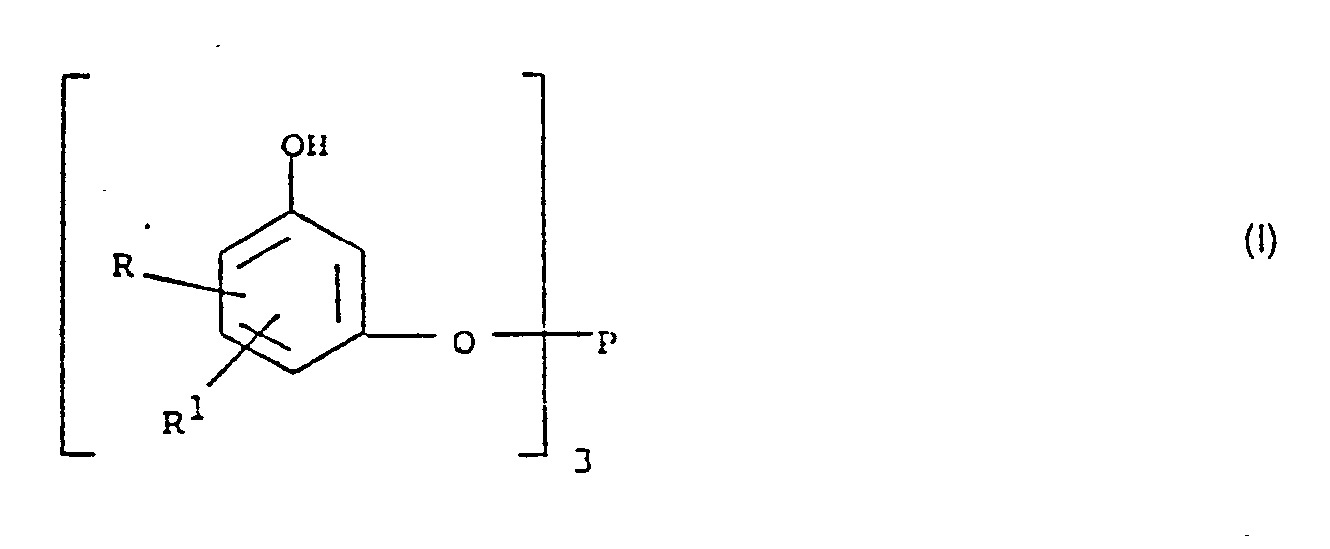
darin ist R ein H oder Alkyl und R1 ein Alkyl, und wobei besagtes Alkyl 8 bis 18 Kohlenstoffatome aufweist.
darin ist R ein H oder Alkyl und R1 ein Alkyl, und wobei besagtes Alkyl 8 bis 18 Kohlenstoffatome aufweist.
2. Verbindung nach Patentanspruch 1, dadurch gekennzeichnet, dass jedes der besagten
Alkyle mit seinem zweiten Kohlenstoffatom an den Benzolring gebunden ist.
3. Verbindung nach Patentanspruch 1 oder 2, dadurch gekennzeichnet, dass die oder
jede der besagten Alkylgruppen eine sekundäre Alkylgruppe ist.
4. Verbindung nach Patentanspruch 1, 2 oder 3, dadurch gekennzeichnet, dass das oder
jedes der besagten Alkyle an die Position 2, 4 oder 6 des Benzolringes gebunden ist.
5. Verbindung nach Patentanspruch 1, 2, 3 oder 4, dadurch gekennzeichnet, dass R ein
Wasserstoff und R1 ein Hexadezyl ist.
6. Verbindung nach Patentanspruch 1, 2, 3 oder 4, dadurch gekennzeichnet, dass R und
R1 sowohl ein Dezyl, Tetradezyl, Hexadezyl oder Oktadezyl sind.
7. Ein Gemisch von zwei oder mehr Verbindungen, deren jede durch die nachstehende
Formel dargestellt werden kann :
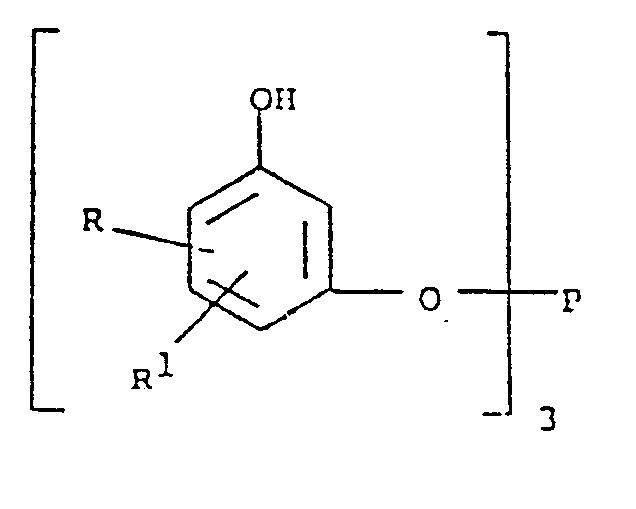
darin ist R ein H oder Alkyl und R1 ein Alkyl, und wobei besagtes Alkyl 8 bis 18 Kohlenstoffatome aufweist, und wobei mindestens 75 % der besagten Alkylgruppen im Gemisch der zwei oder mehr Verbindungen sekundäre Alkylgruppen sind.
darin ist R ein H oder Alkyl und R1 ein Alkyl, und wobei besagtes Alkyl 8 bis 18 Kohlenstoffatome aufweist, und wobei mindestens 75 % der besagten Alkylgruppen im Gemisch der zwei oder mehr Verbindungen sekundäre Alkylgruppen sind.
8. Ein Gemisch von Verbindungen gemäss Patentanspruch 7, dadurch gekennzeichnet, dass
mindestens 90 % der besagten Alkylgruppen im Gemisch der zwei oder mehr Verbindungen
sekundäre Alkylgruppen sind.
9. Verfahren zur Herstellung einer Verbindung mit der Formel
(Siehe Formel Seite 8f.)
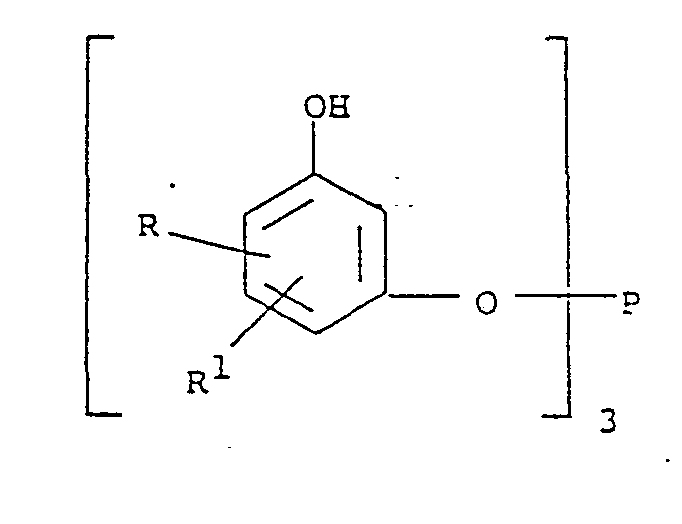
das besteht aus der Reaktion eines Mono- oder Dialkylresorzinols, in dem die Alkylgruppen 8 bis 18 Kohlenstoffatome mit Phosphortrichlorid enthalten.
(Siehe Formel Seite 8f.)
das besteht aus der Reaktion eines Mono- oder Dialkylresorzinols, in dem die Alkylgruppen 8 bis 18 Kohlenstoffatome mit Phosphortrichlorid enthalten.
10. Verbindung bestehend aus einem funktionellen Fluid und einer Verbindung nach einem
der Patentansprüche 1 bis 6 oder aus einem Gemisch von Verbindungen der Patentansprüche
7 und 8.
11. Verbindung nach Patentanspruch 10, worin das funktionelle Fluid ein mono- oder
polyalkyliertes Naphtalen ist.
Patentansprüche für folgende(n) Vertragsstaat(en) : AT, ES
1. Verfahren zur Herstellung einer Verbindung mit der Formel
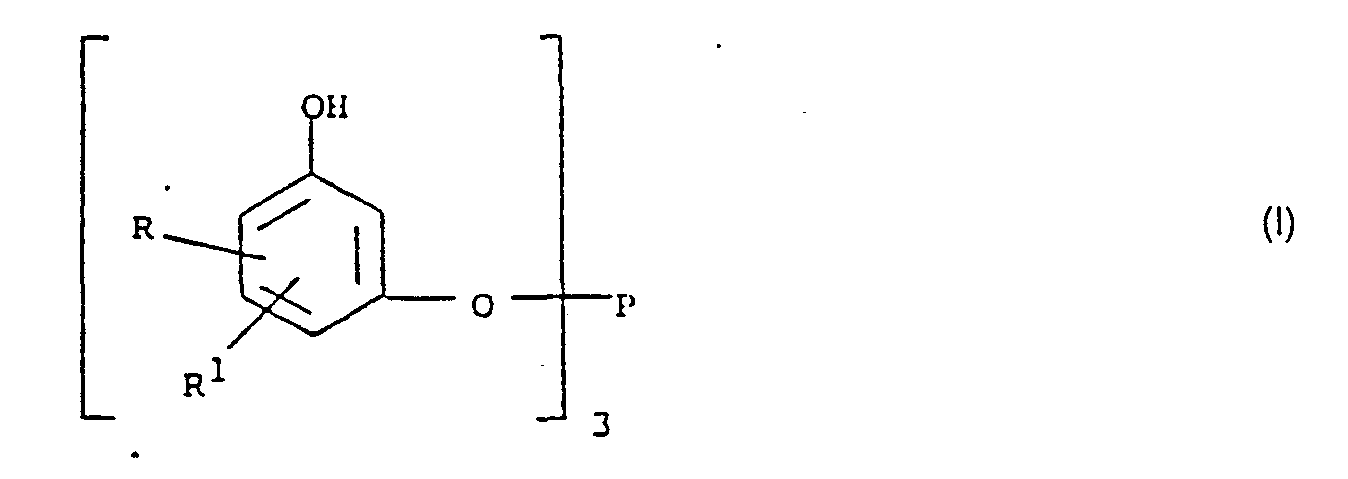
das besteht aus der Reaktion eines Mono- oder Dialkylresorzinols, in dem die Alkylgruppen 8 bis 18 Kohlenstoffatome mit Phosphortrichlorid enthalten.
das besteht aus der Reaktion eines Mono- oder Dialkylresorzinols, in dem die Alkylgruppen 8 bis 18 Kohlenstoffatome mit Phosphortrichlorid enthalten.
2. Verfahren nach Patentanspruch 1, dadurch gekennzeichnet, dass jedes besagte Alkyl
mit seinem zweiten Kohlenstoffatom an den Benzolring gebunden ist.
3. Verfahren nach Patentanspruch 1 oder 2, dadurch gekennzeichnet, dass die oder jede
der besagten Alkylgruppen eine sekundâre Alkylgruppe ist.
4. Verfahren nach Patentanspruch 1, 2 oder 3, dadurch gekennzeichnet, dass das oder
jedes der besagten Alkyle an die Position 2, 4 oder 6 des Benzolringes gebunden ist.
5. Verfahren nach Patentanspruch 1, 2, 3 oder 4, dadurch gekennzeichnet, dass R ein
Wasserstoff und R' ein Hexadezyl ist.
6. Verfahren nach Patentanspruch 1, 2, 3 oder 4, dadurch gekennzeichnet, dass R und
R1 sowohl ein Dezyl, Tetradezyl, Hexadezyl oder Oktadezyl sind.
7. Ein Verfahren zur Herstellung eines Gemisches von zwei oder mehr Verbindungen mit
der Formel l, deren jede gemâss dem Verfahren nach Patentanspruch 1 hergestellt wird,
dadurch gekennzeichnet, dass das Gemisch hergestellt wird durch Zusammenmischen der
zwei oder mehr Verbindungen in solchen Mengen, dass im resultierenden Gemisch mindestens
75 % der Alkylgruppen sekundâre Alkylgruppen sind.
8. Verfahren nach Patentanspruch 7, dadurch gekennzeichnet, dass zwei oder mehr Verbindungen
nach Formel in solchen Mengen zusammengemischt werden, dass im resultierenden Gemisch
mindestens 90 % der Alkylgruppen sekundâre Alkylgruppen sind.
9. Verfahren zur Herstellung eine Verbindung, dadurch gekennzeichnet, dass es kombiniert
ein funktionelles Fluid mit eines Verbindung, bestehend aus einer Verbindung nach
einem der Patentansprüche 1 bis 6 oder aus einem Gemisch von Verbindungen nach einem
der Patentansprüche 7 und 8.
10. Verbindung nach Patentanspruch 9, worin das funktionelle Fluid ein mono- oder
polyalkyliertes Naphtalen ist.
Revendications pour l'(les) Etat(s) contractant(s) suivant(s) : BE, CH, DE, FR, GB,
GR, IT, LI, LU, NL, SE
1. Composé qui peut être représenté par la formule générale l suivante :
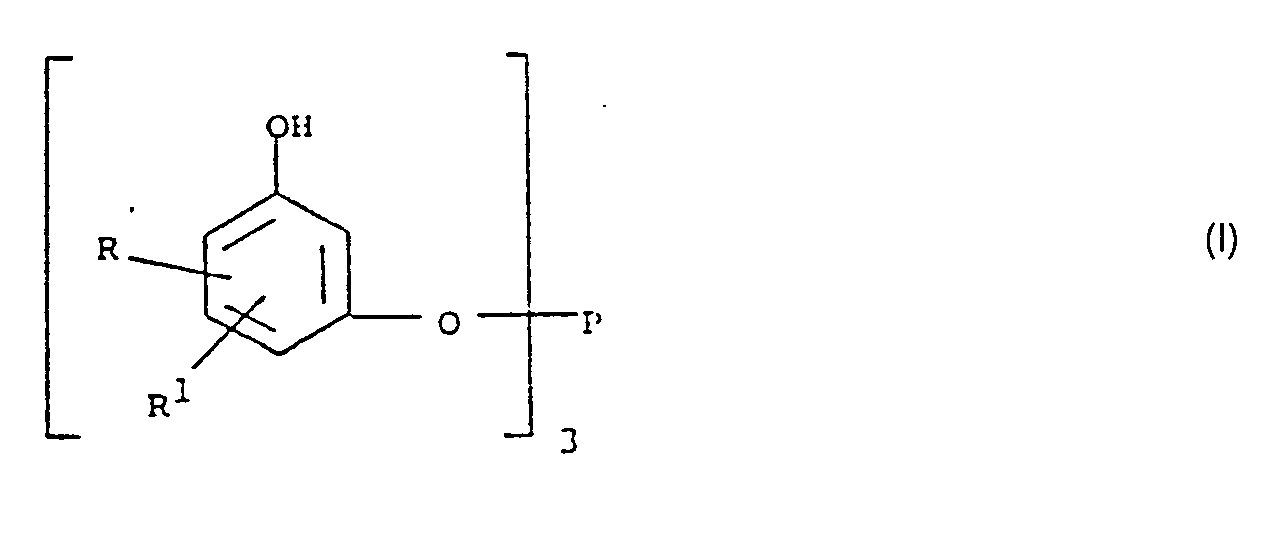
où R est un H ou un alkyle et R' est un alkyle, ledit alkyle ayant de 8 à 18 atomes de carbone.
où R est un H ou un alkyle et R' est un alkyle, ledit alkyle ayant de 8 à 18 atomes de carbone.
2. Composé selon la revendication 1, où le ou chacun desdits alkyles est attaché au
noyau benzénique par son second atome de carbone.
3. Composé selon la revendication 1 ou 2, où le ou chacun desdits groupes alkyle est
un groupe alkyle secondaire.
4. Composé selon la revendication 1, 2 ou 3, où le ou chacun desdits alkyles est attaché
au noyau benzénique en position 2, 4 ou 6.
5. Composé selon la revendication 1, 2, 3 ou 4, où R est un hydrogène et R1 est un hexadécyle.
6. Composé selon la revendication 1, 2, 3 ou 4, où R et R' sont tous deux des décyles,
des tétradécyles, des hexadécyles ou des octadécyles.
7. Mélange de deux composés ou davantage qui peuvent être chacun représentés par la
formule :
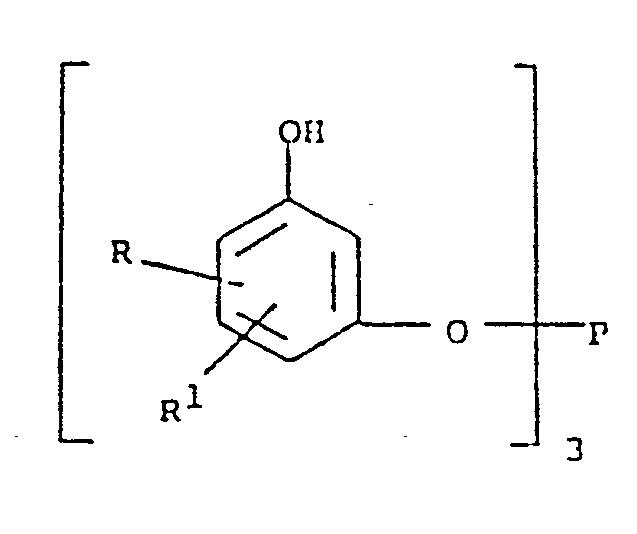
où R est un H ou un alkyle et R1 est un alkyle, ledit alkyle ayant de 8 à 18 atomes de carbone, au moins 75 % desdits groupes alkyle dans le mélange des deux composés ou davantage étant des groupes alkyle secondaire.
où R est un H ou un alkyle et R1 est un alkyle, ledit alkyle ayant de 8 à 18 atomes de carbone, au moins 75 % desdits groupes alkyle dans le mélange des deux composés ou davantage étant des groupes alkyle secondaire.
8. Mélange de composés selon la revendication 7, où au moins 90 % desdits groupes
alkyle dans le mélange des deux composés ou davantage sont des groupes alkyle secondaire.
9. Méthode de préparation d'un composé de la formule
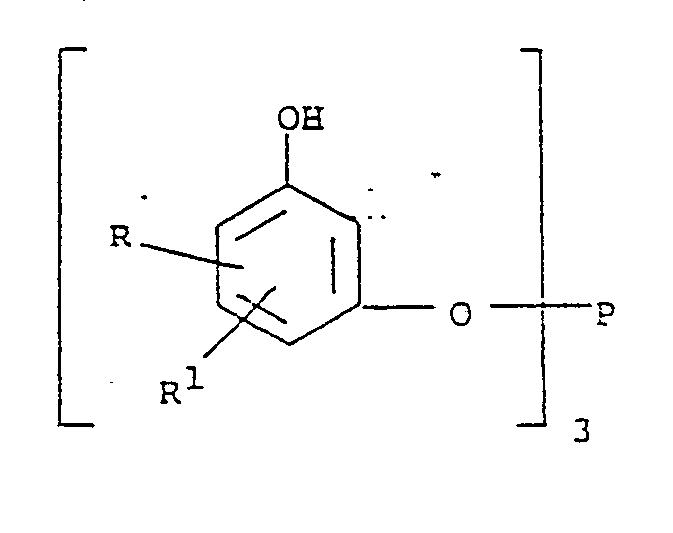
qui comprend de faire réagir un mono ou un dialkylrésorcinol dans lequel les groupes alkyle ont de 8 à 18 atomes de carbone avec du trichlorure de phosphore.
qui comprend de faire réagir un mono ou un dialkylrésorcinol dans lequel les groupes alkyle ont de 8 à 18 atomes de carbone avec du trichlorure de phosphore.
10. Composition comprenant un fluide fonctionnel et un composé selon l'une quelconque
des revendications de 1 à 6 ou un mélange des composés selon l'une ou l'autre des
revendications 7 et 8.
11. Composition selon la revendication 10, où le fluide fonctionnel est un naphtalène
mono ou polyalkylé.
Revendications pour l'(les) Etat(s) contractant(s) suivant(s) : AT, ES
1. Méthode de préparation d'un composé de la formule générale 1 suivante :
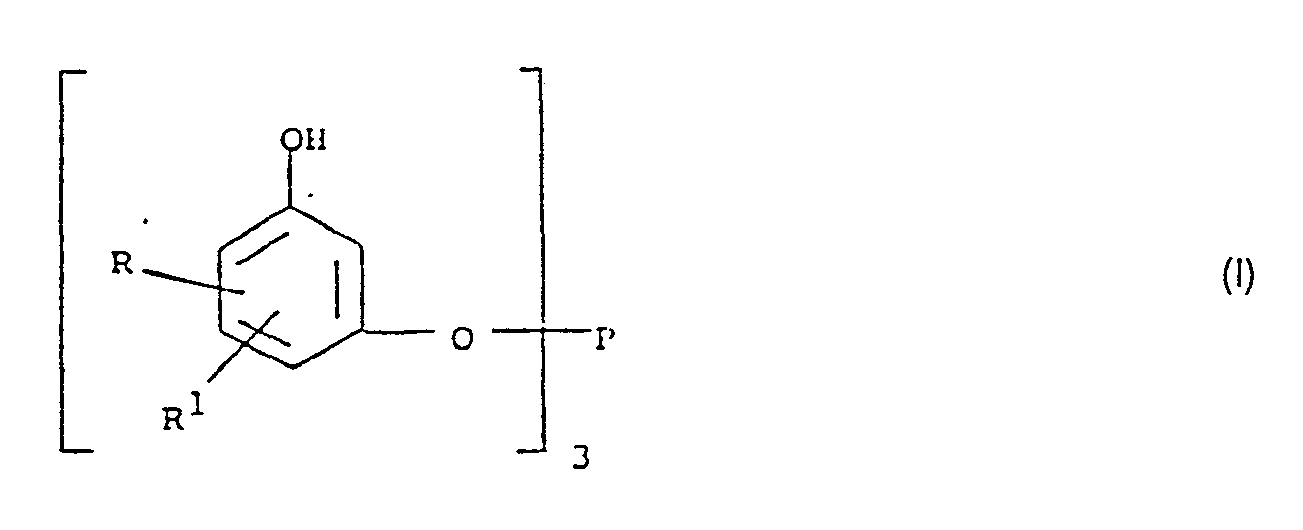
qui comprend de faire réagir un mono ou un dialkylrésorcinol dans lequel les groupes alkyle ont de 8 à 18 atomes de carbone avec du trichlorure de phosphore.
qui comprend de faire réagir un mono ou un dialkylrésorcinol dans lequel les groupes alkyle ont de 8 à 18 atomes de carbone avec du trichlorure de phosphore.
2. Méthode selon la revendication 1, où le ou chacun desdits alkyles est attaché au
noyau benzénique par son second atome de carbone.
3. Méthode selon la revendication 1 ou 2, où le ou chacun desdits groupes alkyle est
un groupe alkyle secondaire.
4. Méthode selon la revendication 1, 2 ou 3, où le ou chacun desdits alkyles est attaché
au noyau benzénique en position 2, 4 ou 6.
5. Méthode selon la revendication 1, 2,..3 ou 4, où R est un hydrogène et R1 est un hexadécyle.
6. Méthode selon la revendication 1, 2, 3 ou 4, où R et R1 sont tous deux des décyles, des tétradécyles, des hexadécyles ou des octadécyles.
7. Méthode de préparation d'un mélange de deux ou de plusieurs composés de formule
l, chacun préparé selon le procédé de la revendication 1, caractérisée en ce que le
mélange est préparé en mélangeant ensemble les deux composés ou davantage en des proportions
propres à fournir un mélange où au moins 75 % des groupes alkyle sont des groupes
alkyle secondaire.
8. Procédé selon la revendication 7, où deux composés de la formule ou davantage sont
mélangés ensemble en des proportions propres à fournir un mélange où au moins 90 %
des groupes alkyle sont des groupes alkyle secondaire.
9. Procédé de préparation d'une composition qui comprend de combiner un fluide fonctionnel
avec un composé préparé selon le procédé de l'une quelconque des revendications 1
à 6 ou un mélange de composés préparé selon l'une ou l'autre des revendications 7
et 8.
10. Procédé selon la revendication 9, où le fluide fonctionnel est un naphtalène mono
ou polyalkylé.