|
(11) | EP 0 232 618 A1 |

| (12) | EUROPEAN PATENT APPLICATION |
|
|
|
|
|||||||||||||||||||||||||||
| (54) | Biocide and method for protecting organic materials |
| (57) A biociode for of protecting organic materials from fungi and/or bacteria which comprises
a compound of the formula:
wherein M is hydrogen, phosphorus, an alkali metal or an alkaline earth metal and n is 1, 2 or 3. The biocide can be applied to or incorporated in the organic material as a solution or suspension. |
[0001] This invention relates to a biocide (i.e. a bacteriocide or fungicide) for preservative compositions useful in wood, paint, fuels, lubricants and other organic materials, and to a method of protecting organic materials from fungi and/or bacteria.
[0002] Many organic materials are subject to degradation due to fungal or bacterial attack. For example, wood is one of the best structural materials for the construction of buildings because of its strength, ease of processing, and relatively low cost, but wood has one serious drawback in that it is susceptible to discoloration and decay by wood-destroying fungi. While there are a number of materials that will control bacteria and fungi, many are highly toxic to man. It is an object of the present invention to provide compounds that are both effective biocides and also of low toxicity to man.
[0003] Accordingly, in a first aspect this invention there is provided a biocide comprising as its essential ingredient a compound of the formula:
wherein M is phosphorus or an alkali metal or alkaline earth metal and n is 1, 2 or 3.
[0004] In a second aspect of this invention, there is provided a biocidal composition characterised in that it comprises a compound of the formula:
wherein M is hydrogen, phosphorus, an alkali metal or an alkaline earth metal and n is 1, 2 or 3, contained in a preservative comprising from about 90% to about 99% by weight of a solvent for said compound.
[0005] In another aspect, the present invention provides a method of protecting organic materials from fungi and/or bacteria which method is characterised by the steps of applying to or incorporating in said organic material a minor but biocidally effective amount of a compound of the formula:
wherein M is hydrogen, phosphorus, an alkali metal or an alkaline earth metal and n is 1, 2 or 3.
[0006] In the biocide and method of the invention, the preferred alkali metals are sodium and potassium but lithium, rubidium and cesium may also be employed. Any of calcium, strontium and barium may be employed as alkaline earth metals. When M is phosphorus, n is 3; when M is hydrogen or an alkali metal, n is 1; and when M is an alkaline earth metal, n is 2.
[0007] 4,6-Di-t-butylresorcinol is a known compound, and the salts can be prepared by reaction of the appropriate metal oxide or hydroxide with the dibutylresorcinol in a suitable solvent (e.g. water, an alcohol or an alkoxyalkanol or a dihydric alcohol optionally in the presence of water) and used as thus prepared or stripped of solvent to make a dry salt which can be redispersed. Tris-(3-hydroxy-4,6-di-t-alkylphenyl) phosphite can also be made from 4,6-di-t-butylresorcinol and phosphorus trichloride in the presence of pyridine, alkylpyridines, quinolines or aryl phosphines as the catalyst and aliphatic or aromatic hydrocarbons or halogenated hydrocarbons as the solvent.
[0008] A biocidal composition comprising the biocide of the present invention can be prepared as a solution or emulsion by conventional means using water or organic solvents, or the neat materials can be used without solvents.
[0009] The quantity of biocide used will depend upon the specific application. Generally, however, they will be used in a preservative composition which will contain from about 0.01 to 100% by weight biocide; preferably from about 0.1 to about 5% by weight biocide is used. If a solvent is used it will generally comprise from about 90 to about 99% by weight of the total preservative composition. Typical solvents useful in the present invention include: water, aromatic solvents, such as xylene and toluene; alcohols, such as methanol, ethanol and hexanol; ketones such as acetone, cyclohexane and diisobutylketone; aliphatic hydrocarbons such as pentane, hexane and mineral spirits; and mixtures thereof.
[0010] If desired, the biocidal compositions of the invention may incorporate other preservatives. Typical examples of such other preservatives include pentachlorophenol, zinc naphthenate, copper naphthenate and the like.
[0011] The following Examples serve to illustrate the invention and preferred embodiments thereof, and in the Examples, as elsewhere in the specification and claims, all parts and percentages are by weight unless otherwise indicated.
Example 1
[0012] Ten small red pine wood samples (each 10 x 10 x 100mm) were soaked for 30 seconds in a 1.0% 4,6-di-t-butylresorcinol (DTBR)/methanol solution. After air drying, the samples were placed in a dish and inoculated with a spore suspension of the mold fungus Aspergillus niger. The fungus growth was then measured after 4, 8 and 16 days incubation at 90% relative humidity and 320C. Untreated control samples and pentachlorophenol-treated samples were included for comparison purposes. The results obtained are shown in the following Table 1.
[0013] LD50 > 2.00 g/kg - male rat skin penetration From the above results, it can be seen that DTBR is equal in fungicidal effectiveness to pentachlorophenol, a commercial preservative.
Example 2
[0014] In the following Table 2 the fungicidal activity against wood-destroying fungi was determined as described above in Example I, except that there were used birch wood samples were used which were soaked with (a) 1% solutions of DTBR or (b) tris-(3-hydroxy-4,6-di-t-butylphenyl) phosphite of the formula:
or (c) pentachlorophenol, or (d) a 1% solution of CCA-C(copper-chromium-arsenate) preservative in water. The wood samples were then placed in a dish and inoculated with mycellial suspensions of a mixture of fungi as listed in the footnote to Table II. The test specimens were then incubated for 10 days and 30 days at 90% relative humidity and 320C.
[0015] The results obtained show that DTBR and its derived phosphite are at least as effective as, and in some cases more effective than, known preservatives such as pentachlorophenol and CCA-C.
Example 3
[0016] 4,6-Di-t-butylresorcinol (DTBR) was evaluated as a wood preservative against a brown-rot decay fungus, as shown in Table 3, using a standard ASTM test D1413-76 soil block test.
TABLE 3
[0018] Toxic threshold values (pound of chemical per cubic foot of wood or pcf of the active ingredients) of pentachlorophenol and 4,6-di-t-butylresorcinol against the brown-rot decay fungus, Gloeophyllum trabeum.
Example 4
1. A biocide characterised in that it comprises as its essential ingredient a compound
of the formula:
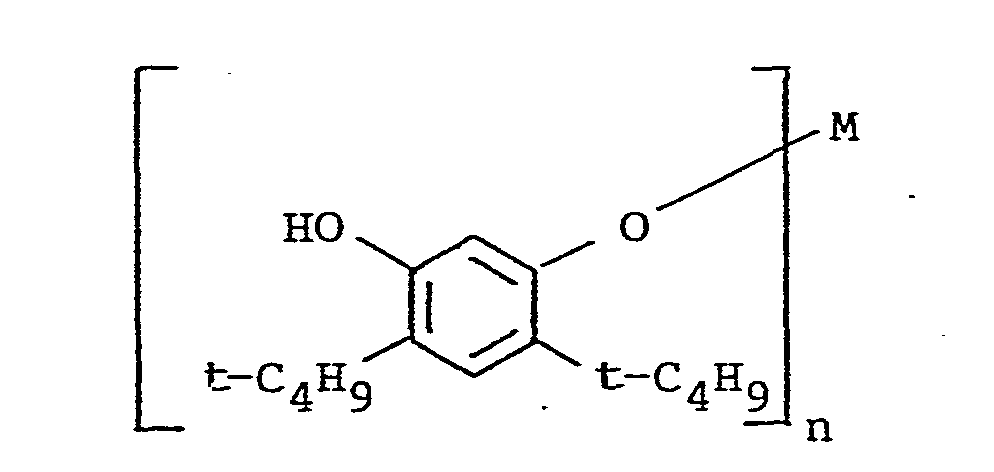
wherein M is phosphorus, an alkali metal or an alkaline earth metal and n is 1, 2 or 3.
wherein M is phosphorus, an alkali metal or an alkaline earth metal and n is 1, 2 or 3.
2. A biocide as claimed in claim 1, characterised in that said compound is 4,6-dit-butylresorcinol
or tris-(3-hydroxy-4,6-di-t-butylphenyl) phosphite.
3. A biocidal composition characterised in that it comprises a compound of the formula:
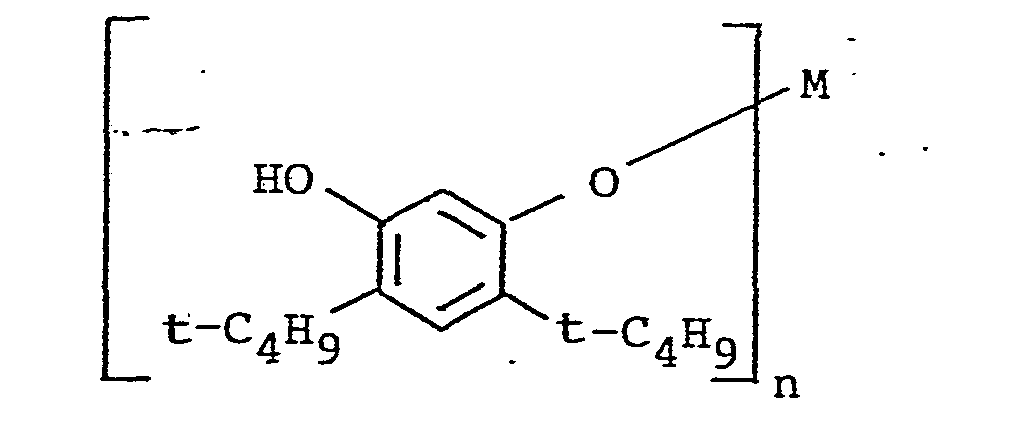
wherein M is hydrogen, phosphorus, an alkali metal or an alkaline earth metal and n is 1, 2 or 3, contained in a preservative comprising from about 90% to about 99% by weight of a solvent for said compound.
wherein M is hydrogen, phosphorus, an alkali metal or an alkaline earth metal and n is 1, 2 or 3, contained in a preservative comprising from about 90% to about 99% by weight of a solvent for said compound.
4. A biocidal composition characterised in that it comprises a biocide according to
claim 2 contained in a preservative comprising from about 90% to about 99% by weight
of a solvent for said biocide.
5. A method of protecting an organic material from fungi and/or bacteria which method
is characterised by the step of applying to or incorporating in said organic material
a minor but biocidally effective amount of a compound of the formula:
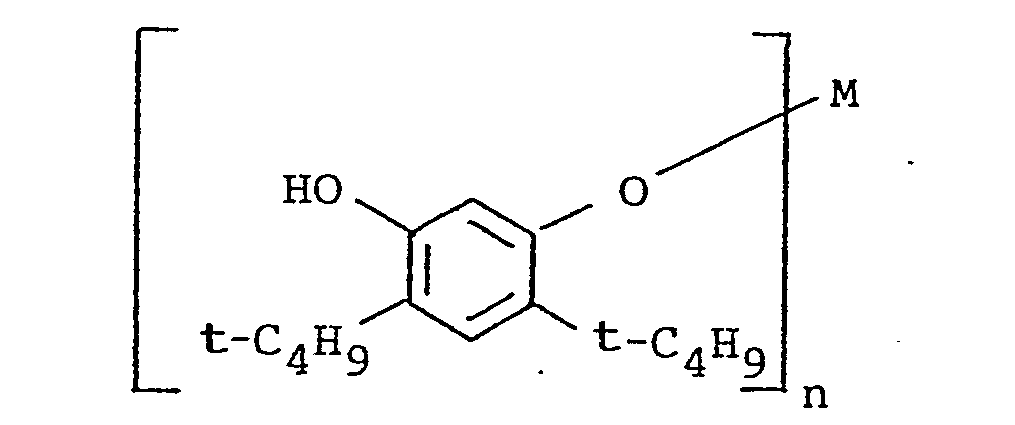
wherein M is hydrogen, phosphorus, an alkali metal or an alkaline earth metal and n is 1, 2 or 3.
wherein M is hydrogen, phosphorus, an alkali metal or an alkaline earth metal and n is 1, 2 or 3.
6. A method according to claim 5 characterised in that said compound is 4,6-di-t-butylresorcinol
or tris-(3-hydroxy-4,6-di-t-butylphenyl) phosphite.
7. A method according to claim 5 or 6, characterised in that said compound is contained
in a preservative comprising from about 90% to about 99% by weight of a solvent for
said compound.
8. A method according to claim 5, 6 or 7, characterised in that said organic material
is wood.
Claims for the following Contracting State(s) : AT, ES
1. A process for preparing a biocide comprising as its essential ingredient a compound
of the formula:
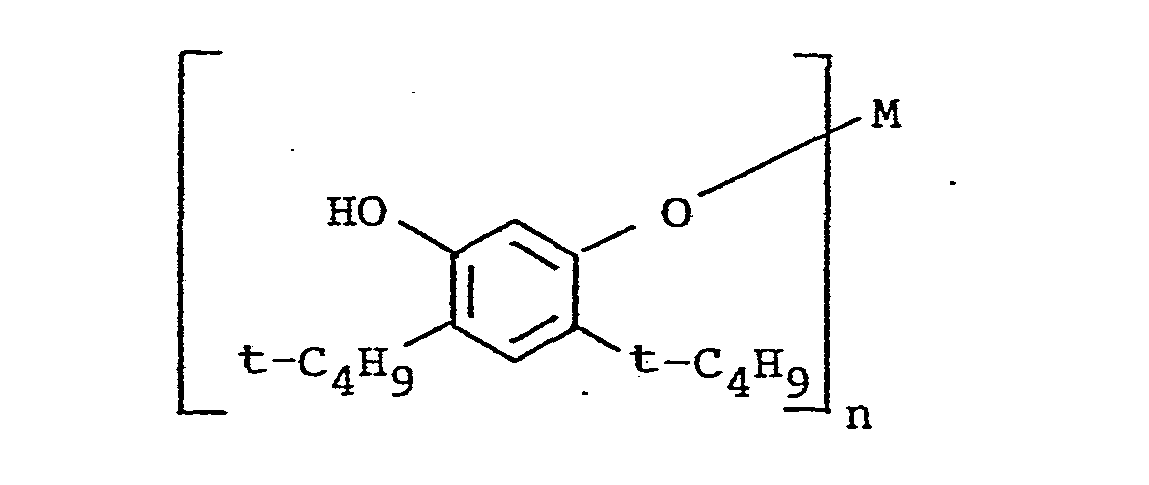
wherein M is phosphorus, an alkali metal or an alkaline earth metal and n is 1, 2 or 3, which process comprises, when M is an alkali metal or an alkaline earth metal, reacting 4,6-di-t-butylresorcinol with the appropriate metal oxide or hydroxide to yield the alkali metal or alkaline earth metal salt or, where M is phosphorus, reaching 4,6-di-t-butylresorcinol with phosphorus chloride.
wherein M is phosphorus, an alkali metal or an alkaline earth metal and n is 1, 2 or 3, which process comprises, when M is an alkali metal or an alkaline earth metal, reacting 4,6-di-t-butylresorcinol with the appropriate metal oxide or hydroxide to yield the alkali metal or alkaline earth metal salt or, where M is phosphorus, reaching 4,6-di-t-butylresorcinol with phosphorus chloride.
2. A process as claimed in claim 1, wherein the compound prepared has the name tris-(3-hydroxy-4,6-dit-butylphenyl) phosphite. _r
3. A process for preparing a biocidal composition which comprises combining a compound
of the formula:
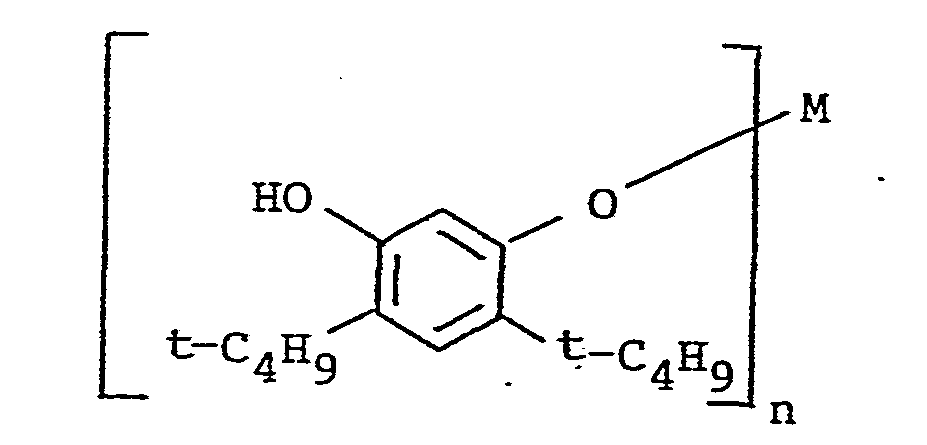
wherein M is hydrogen, phosphorus, an alkali metal or an alkaline earth metal and n is 1, 2 or 3 with a preservative comprising from about 90% to about 99% by weight of a solvent for said compound.
wherein M is hydrogen, phosphorus, an alkali metal or an alkaline earth metal and n is 1, 2 or 3 with a preservative comprising from about 90% to about 99% by weight of a solvent for said compound.
4. A process for preparing a biocidal composition which comprises combining a biocide
prepared by a process according to claim 2 with a preservative comprising from about
90% to about 99% by weight of a solvent for said biocide.
5. A method of protecting an organic material from fungi and/or bacteria which method
is characterised by the step of applying to or incorporating in said organic material
a minor but biocidally effective amount of a compound of the formula:
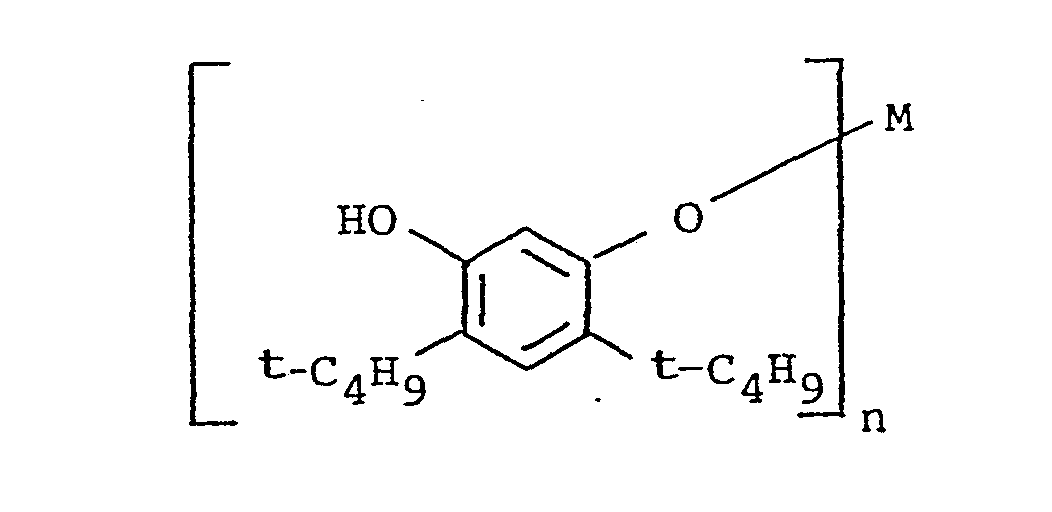
wherein M is hydrogen, phosphorus, an alkali metal or an alkaline earth metal and n is 1, 2 or 3.
wherein M is hydrogen, phosphorus, an alkali metal or an alkaline earth metal and n is 1, 2 or 3.
6. A method according to claim 5 characterised in that said compound is 4,6-di-t-butylresorcinol
or tris-(3-hydroxy-4,6-di-t-butylphenyl) phosphite.
7. A method according to claim 5 or 6, characterised in that said compound is contained
in a preservative comprising from about 90% to about 99% by weight of a solvent for
said compound.
8. A method according to claim 5, 6 or 7, characterised in that said organic material
is wood.