(57) A silver halide color photographic material having a halide emulsion layer on a support
is disclosed. One silver halide emulsion layer contains a yellow-dye forming coupler
of the general formula (I) shown below, one silver halide emulsion layer contains
a magenta-dye forming coupler of the general formula (II) shown below, and one silver
halide emulsion layer contains a cyan-dye forming coupler of the general formula (III)
shown below, and the silver halide color photographic material affords a magenta y
to cyan y ratio of 0.85-1.00, and a yellow γ to cyan y ratio of 0.83 - 1.00 when said
photographic material is subjected to monochromatic exposure to blue, green and red
light under the conditions specified below, then developed and processed under the
conditions specified below, and subsequently subjected to measurement of cyan γ, magenta
y and yellow γ values of the respective colors by the method specified below:

(where R, is an alkyl or aryl group; R2 is an aryl group; and Z, is a hydrogen atom or a group that can be eliminated upon
reaction with the oxidized product of a color developing agent)

(where Z signifies the group of non-metallic atoms that are necessary to form a nitrogen-containing
heterocyclic ring which may optionally have a substituent; X is a hydrogen atom or
a group that can be eliminated upon reaction with the oxidized product of a color
developing agent; and R is a hydrogen atom or a substituent);
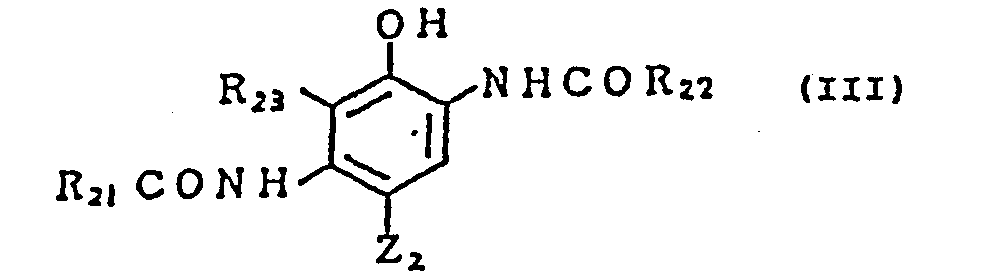
(where R21 is an alkyl or aryl group; R22 is an alkyl, cycloalkyl, aryl or heterocyclic group; R23 is a hydrogen atom, a halogen atom, an alkyl group or an alkoxy group, provided that
R23 may combine with R21 to form a ring; and Z2 is a hydrogen atom or a group that can be eliminated upon reaction with the oxidized
product of a color developing agent);
Conditions of monochromatic exposure
(1) exposure to red light light source : tungsten lamp exposure time : 0.5 seconds
filter : Kodak WRATTEN gelatin filter No. 29
(2) exposure to green light light source : tungsten lamp exposure time : 0.5 seconds
filter : Kodak WRANTTEN gelatin filter No. 61
(3) exposure to blue light light source : tungsten lamp exposure time : 0.5 seconds
filter : Kodak WRATTEN gelatin filter No. 478
provided that exposure through a neutral step tablet is performed in each of (1).
(2) and (3) in order to achieve variation in the amount of exposure;
Conditions of development and subsequent prccessing
(1) scheme (steps and the duration of their times)
(2) Composition of processing flulds (color developing solution)Method of y measurement
The reflection density of the image formed on a developed and subsequently processed
sample is measured with a densitometer that satisfies the geometric conditions for
reflection density measurement specified in JIS 7612 - 1982 and which has interference
filters that feature maximum transmission wavelengths of 644 nm, 546 nm and 436 nm
for the measurement of cyan, magenta and yellow reflection densities, respectively,
and each of which has a half-width of no greater than 18 nm; the γ value for each
color is calculated by the following formula:

where E1 and E2 represent the amounts of exposure that are necessary to provide reflection densities
of Dmin + 0.5 and Dmin + 1.8, respectively, Dmin signifying the reflection density
of unexposed areas.
Cyan y, magenta y and yellow γ are defined as follows:
cyan y: calculated from the reflection density measured with an interference filter
of 644 nm in the densitometer for a sample in which dominant color formation occurred
in a silver halide emulsion layer containing a cyan coupler of the general formula
(III);
magenta γ: calculated from the reflection density measured with an interference filter
of 546 nm in the densitometer for a sample in which dominant color formation occurred
in a silver halide emulsion layer containing a magenta coupler of the general formula
(II);
yellow γ: calculated from the reflection density measured with an interference filter
of 436 nm in the densitometer for a sample in which dominant color formation occurred
in a silver halide emulsion layer containing a yellow coupler of the general formula
(I).
|
|
