| (19) |
 |
|
(11) |
EP 0 234 763 B1 |
| (12) |
EUROPEAN PATENT SPECIFICATION |
| (45) |
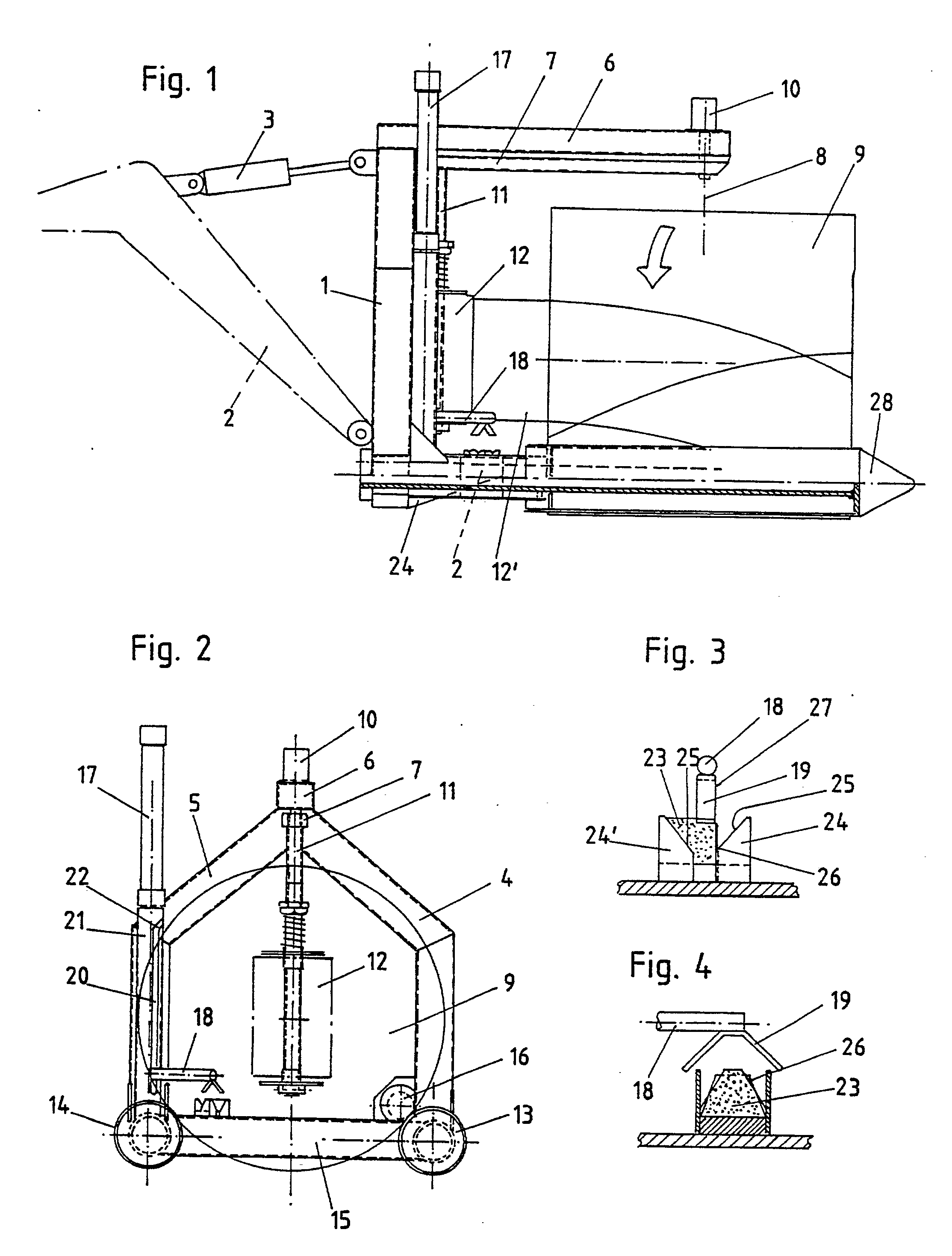
Mention of the grant of the patent: |
|
25.07.1990 Bulletin 1990/30 |
| (22) |
Date of filing: 02.02.1987 |
|
|
| (54) |
A device for wrapping cylindrical objects
Vorrichtung zum Einwickeln von zylindrischen Gegenständen
Dispositif pour emballer des articles cylindriques
|
| (84) |
Designated Contracting States: |
|
AT BE CH DE ES FR GB GR IT LI LU NL SE |
| (30) |
Priority: |
05.02.1986 NO 860404
07.04.1986 NO 861340
|
| (43) |
Date of publication of application: |
|
02.09.1987 Bulletin 1987/36 |
| (73) |
Proprietor: Oiestad, Jens |
|
4880 Rykene (NO) |
|
| (72) |
Inventor: |
|
- Oiestad, Jens
4880 Rykene (NO)
|
| (74) |
Representative: Spall, Christopher John et al |
|
BARKER, BRETTELL & DUNCAN
138 Hagley Road
Edgbaston
Birmingham B16 9PW
Edgbaston
Birmingham B16 9PW (GB) |
| (56) |
References cited: :
EP-A- 0 079 321
DE-A- 3 412 740
GB-A- 2 159 489
|
EP-A- 0 110 110
GB-A- 2 056 401
US-A- 4 161 253
|
|
| |
|
|
- BALE WRAPPER, WILDER ENGINEERING, folder distributed at Royal Smithfield Show, 1st-4th
December 1986, London, GB
|
|
| |
|
| Note: Within nine months from the publication of the mention of the grant of the European
patent, any person may give notice to the European Patent Office of opposition to
the European patent
granted. Notice of opposition shall be filed in a written reasoned statement. It shall
not be deemed to
have been filed until the opposition fee has been paid. (Art. 99(1) European Patent
Convention).
|
[0001] The present invention relates to a device for wrapping cylindrical objects, especially
bales of straw or hay fodder with stretchably self-adhesive film, generally known
as stretch film. Straw and hay fodder, is now increasingly baled into round bales,
i.e. large bales of compressed straw or hay in the shape of a circular cylinder. The
object of wrapping such bales, as far as hay is concerned, is to cause ensiling of
the hay. The hay is dried only to a degree at which it retains part of its moisture
before being compressed into a bale. The resulting silage retains most of its natural
consistency and nutritional value without the addition of any ensiling agent. In this
way the fodder is made more easily digestible for the animals. As regards straw, leaching
or gassing may be carried out in the bale itself, and it is possible to avoid the
bulky and expensive wrapping of the larger number of bales previously necessary for
such treatment.
[0002] Several devices for wrapping bales of straw feed according to the pre-characterising
portions of claims 1 and 8 are known, for example from European published patent application
No. 0 110 110. This wrapping device is mounted on a separate carriage that is towed
behind a baling machine. A disadvantage of this device, however, is that manual work
is needed to displace the bale from the baler to the device. The device per se is
expensive because it requires a separate carriage.
[0003] It is an object of the present invention to provide a device for wrapping such cylindrical
objects that is inexpensive to produce and requires a minimum of manual work in use.
[0004] According to one aspect the present invention consists in a device for wrapping cylindrical
objects, especially bales of straw or hay, comprising at least first and second rotatable
rollers spaced apart a distance less than the diameter of the object and, in use of
the device, being substantially horizontal and intended to support the object, at
least one of the rollers being rotationally driven to rotate the object about the
axis of its cylindrical shape, and carrier means for supporting a roll of stretchable
self-adhesive film with the axis of the roll in a plane which is generally at right
angles to the plane containing the axes of the first and second rollers (13, 14) and
for moving the roll orbitally around the object characterized in that the rollers
are arranged as prongs freely projecting from the face of a rigid frame which at the
lower portion of the opposite face of the frame, that is the side facing away from
the prongs, is provided with two attachment means at a mutual distance suitable for
connection with two lifting arms on the tractor, and further attachment means on the
upper portion of said opposite face of the frame and arranged between the two attachment
means and intended for connection with an adjustable tension stay on the tractor.
[0005] The supporting rollers, two for instance, are thus mounted on a vehicle in just the
same way as are the prongs of a fork-lift. Bales set down by a round baler orm conh
lifted in t.,rn a distance frnm the around by the prongs or rollers of the device.
By driven rotation of the rollers the bale is rotated about the central axis of the
cylinder of the bale which is parallel to the rollers. During rotation the plastic
film roll is moved around the rotating bale at the level of its centre. When the bale
has rotated 180
° the film roll has made five complete turns around the bale and the bale is then completely
wrapped with ample overlap between each layer. This wrapping may occur while the bale
is being driven to a place of storage.
[0006] According to a second aspect the present invention consists in a device for wrapping
cylindrical objects, especially bales of straw or hay, comprising at least first and
second rotatable rollers spaced apart a distance less than the diameter of the object
and, in use of the device, being substantially horizontal and intended to support
the object, at least one of the rollers being rotationally driven to rotate the object
about the axis of its cylindrical shape, and carrier means for supporting a roll of
stretchable self-adhesive film with the axis of the roll in a plane which is generally
at right angles to the plane containing the axes of the first and second rollers and
for moving the roll orbitally around the object characterized in that the device comprises
a collector movable, across that part of the path of the film which extends from the
roll to the object, into film-gripping engagement with a stop, and a knife adjacent
the stop with its cutting edge directed towards the film, the arrangement being such
that during its movement, which occurs at the end of a full wrapping cycle, the collector
gathers the film and urges the film against the stop and the knife, the film being
cut by the knife and the free end of film coming from the roll being gripped between
the collector and the stop, and that the collector is a fork-shaped member the movement
of which starts from a first position, in which the fork-shaped member and the stop
lie on opposite sides of the width of the film lying in the path, the arrangement
being such that during its movement the fork-shaped member engages an edge of the
film and moves in the direction across the width of the film while gathering the film.
[0007] Further features and details of both aspects of the invention will appear from the
subclaims and the following disclosure with reference to the drawings showing an embodiment
of the invention.
Figure 1 shows a wrapping device according to the invention in side elevation,
Figure 2 shows the device in front elevation,
Figure 3 shows a detail of a cutting member for wrapping film in side elevation,
Figure 4 shows the same detail in front elevation,
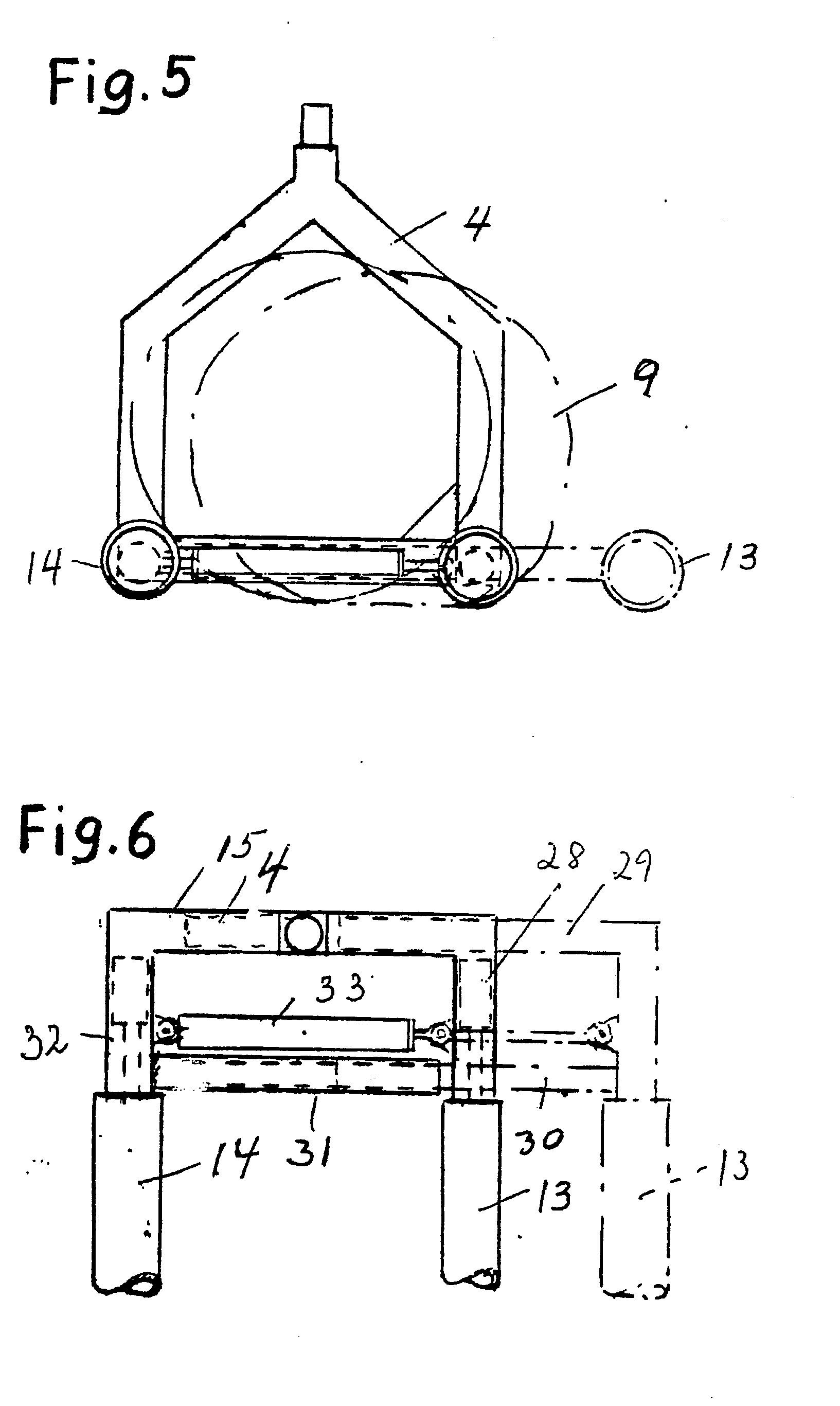
Figure 5 shows a modified embodiment in front elevation, and
Figure 6 shows the embodiment of Figure 5 in plan view.
[0008] The device illustrated in Figures 1 to 4 comprises a frame 1 which is arranged in
use to be vertical and hinged by its lower portion to lifting arms 2 that are standard
equipment of a tractor (not shown), or another agricultural vehicle. The frame may
alternatively be mounted for vertical movement on the mast of a fork lift truck. Arms
2 in the illustrated embodiment are the lifting arms of a front mounted loader, but
frame 1 can be secured in a similar manner to rear mounted lifting arms on a tractor
or the like. The upper portion of frame 1 is connected to the lifting arms 2 by means
of an adjustable top stay 3 preferably in the form of a hydraulic ram, as shown in
the drawing. The intended use of this ram will be disclosed below. The frame 3 comprises
side members 4 and 5 of which lower portions are parallel but upper, inclined portions
meet in a point, giving the frame a generally triangular shape. To this top point
a horizontally extending bar 6 is connected, and on the under side of bar 6 an arm
7 is rotatably mounted. The centre of rotation 8 of the arm 7 is placed above the
centre of a bale 9 of straw or hay to be wrapped. The arm 7 can be rotated by a hydraulic
motor 10. To the free outer end of the arm 7 a shaft 11 is secured so as to depend
perpendicularly. The shaft 11 carries a freely rotatable roll 12 of stretchable self-sealing
plastic film. Rollers 13 and 14 are mounted with their axes parallel at the lower
ends of frame portions 4 and 5 from which they extend outwards and, in use, are usually
horizontal. The rollers 13 and 14 form the lowermost members of the device as the
lower edge of a transverse bracing bar 15 is above the lower portions of the rollers
13,14. The rollers 13,14 can be rotated by a hydraulic motor 16, through transmission
means which may, for example, comprise direct gear drive for one roller 13 and belt
drive for the other roller 14. Obviously, it is also possible to arrange motor 16
to drive a belt driving both the rollers 13 and 14.
[0009] To the face of the frame 1 turned away from arms 2 a combined cutting and holding
device for film 12
' is secured. This device comprises a hydraulic cylinder 17 having a piston rod to
which is attached an arm 18 projecting from the rod at right angles. To the outward
end of the arm 18 is secured a V-shaped plate 19 having its opening facing downwards.
The arm 18 is guided by a slot 20 in a tube 21 extending coaxially with cylinder 17.
From its lower end the slot 20 extends axially upwards in the tube 21 and ends in
an inclined slot 22 at the upper end. The V-shaped plate 19 cooperates with a resilient
stop 23 attached to a bracket 24 which projects from the transverse brace 15. On two
opposing sides the stop 23 is confined by a pair of plates 24,24' each shaped into
an inclined edge 25 at its upper inward facing portions. Close to one side of the
stop 23 a knife 26 is provided. During the downward movement of the V-shaped plate
19 a vertical edge 27 of the plate 19 will pass along the inside of knife 26.
[0010] In Figures 5 and 6 a modified embodiment of the arrangement according to the invention
is shown. One supporting roller 13 is rotatably secured to a U-shaped holder 28 having
slidable legs. One leg 29 is slidable in the transverse brace 15 and leg 30 is slidable
in a square tube 31 secured to a holder 32 which is rigidly attached to frame 4 and
carries the other roller 14. A hydraulic cylinder 33 is secured by one end to holder
32. At the other end a piston rod of the hydraulic cylinder 33 is connected to act
on the U-shaped holder 28. As shown in Figures 5 and 6, the mutual distance between
rollers 13 and 14 is thus adjustable.
[0011] Both embodiments of the present invention operate as follows:
A bale 9 to be wrapped lies originally with its -curved surface resting on the ground
where it was left by a baler. The tractor or the like is driven in with the two rollers
13 and 14 placed so that a roller is inserted at each side of the bale. In order to
simplify the insertion each roller 13,14 is provided with a conical end cap 28. The
rollers 13,14 are rotated and the roll 12 of plastic film is moved around the bale
9 by the driven crank arm 7. During the first turn the end of plastic film 12' is
held between the V-shaped plate 19 and the resilient stop 23. When one turn of the
roll 12 has been completed the arm 18 with the V-shaped plate 19 is moved upwards
and will swing inwards away from the bale 9, owing to the inclined slot 22, so that
the V-shaped plate remains above and clear of the plastic film which extends between
the roll 12 and the circumference of the bale 9. The rotational speed of the rollers
is approximately the same as that of the arm 17 but as the bale is about five times
the diameter of the rollers 13 14, when the bale 9 has rotated about 180° the arm 17 has moved the roll 12 about five turns around the bale 9 and the bale
is then completely wrapped. The rotation of the rollers 13,14, and the rotation of
crank arm 7 is stopped. Film 12' now extends obliquely from the edge of bale 9 to
roll 12 with the lower edge of the film over the stop 23. Cylinder 17 is activated
and arm 18 is moved downwards. The V-shaped plate straddles the upper edge of film
12' and brings it along downwards. During this movement the film will be gathered
together by the V-shaped plate, acting as a collector, and is in this shape urged
towards stop 23. The arm 18 with V-shaped plate 19 is moved further downwards, so
that the V-shaped plate is urged down alongside the knife 26. Thus, the gathered film
is cut by the knife. The wrapped bale 9 is tipped off rollers 13,14. This is done
by extending cylinder 3 so that the rollers 13 and 14 are tilted forwards and the
bale 9 slides off the rollers. The end of the film from roll 12 is held by the V-shaped
plate 19 against the stop 23 until a new bale 9 is loaded and the roll 12 has moved
one full turn around this bale to have the film locked to the bale by one layer of
film. Then the arm 18 together with the plate 19 is moved upwards again.
[0012] The object of being able to adjust the mutual distance between rollers 13 and 14
in the embodiment of Figures 5 and 6 is that a bale 9 resting on the ground will get
flattened at the portion resting against the ground, as indicated in Figure 5. With
fixed position rollers 13 and 14, as shown in Figure 2, it will be difficult to get
in beneath the bale to lift it. When a bale rests on the ground and is to be lifted
from the ground to be treated with the device shown in Figures 5 and 6, the rollers
13 and 14 are moved apart, as shown by dot-and-dash-lines in Figures 5 and 6. The
rollers can then be introduced under a wider part of the bale and during the lifting
operation the rollers 13,14 may be moved closer to each other to the position shown
by full lines in Figures 5 and 6 to provide a more central support of the bale during
wrapping. When the completely wrapped bale is put down it is moved down towards the
ground and the rollers are moved apart so that the bale rests on the ground and the
device may be withdrawn.
1. A device for wrapping cylindrical objects, especially bales of straw or hay, comprising
at least first and second rotatable rollers (13, 14) spaced apart a distance less
than the diameter of the object (9) and, in use of the device, being substantially
horizontal and intended to support the object, at least one of the rollers (13, 14)
being rotationally driven to rotate the object about the axis of its cylindrical shape,
and carrier means (7, 10, 11) for supporting a roll (12) of stretchable self-adhesive
film with the axis of the roll in a plane which is generally at right angles to the
plane containing the axes of the first and second rollers (13, 14) and for moving
the roll (12) orbitally around the object, characterized in that the rollers are arranged
as prongs (13, 14) freely projecting from the face of a rigid frame (1) which at the
lower portion of the opposite face of the frame, that is the side facing away from
the prongs, is provided with two attachment means at a mutual distance suitable for
connection with two lifting arms on the tractor, and further attachment means on the
upper portion of said opposite face of the frame and arranged between the two attachment
means and intended for connection with an adjustable tension stay (3) on the tractor.
2. A device as defined in claim 1, characterized in that the frame has a generally
triangular shape with a point facing upwards in its mounted position and that an arm
(6) extends from the point parallel to the prongs (13, 14) and supports a driving
motor (10) for the crank arm (7) carrying the film roll (12).
3. A device as defined in claim 1 or claim 2, characterized in that the rotational
speed of the driven rollers (13, 14) for supporting the object (9) is so selected
in relation to the rotational speed of the crank mechanism (7, 10, 11) that in use
of the device the object is rotated 180° during each full wrapping cycle while the crank mechanism moves the film roll (12)
five times round the object (9), that is to say that the ratio between the rotational
speed of the object (9) and that of the crank mechanism carrying the film roll is
1:10.
4. A device as defined in any one of the preceding claims, characterized in that a
fork shaped member (19) is provided movable in the path of the film (12') with respect
to a resilient stop (23), that adjacent to the stop (23) a knife (26) is mounted with
its edge facing upwards and extending across the plane of the film path, which knife
(26) cuts the film gathered by the fork shaped member (19) and the stop when the fork
shaped member engages the stop.
5. A device as defined in any preceding claim, characterised in that the mutual distance
between the two driven supporting rollers (13, 14) is adjustable.
6. A device as defined in claim 5, characterized in that one of the rollers (13) is
secured to a U-shaped holder (28) the legs (29, 30) of which are provided slidingly
in guides (15, 31) attached to the rigid frame (4), and that means, (33) is provided
to move the U-shaped holder (28).
7. A device as defined in claim 5 or claim 6, characterized in that the rollers (13)
are relatively movable towards and away from each other in a straight line.
8. A device for wrapping cylindrical objects, especially bales of straw or hay, comprising
at least first and second rotatable rollers (13, 14) spaced apart a distance less
than the diameter of the object (9) and, in use of the device, being substantially
horizontal and intended to support the object, at least one of the rollers (13, 14)
being rotationally driven to rotate the object about the axis of its cylindrical shape,
and carrier means (7, 10, 11) for supporting a roll (12) of stretchable self-adhesive
film with the axis of the roll in a plane which is generally at right angles to the
plane containing the axes of the first and second rollers (13, 14) and for moving
the roll (12) orbitally around the object, characterized in that the device comprises
a collector (19) movable, across that part (12') of the path of the film which extends
from the roll (12) to the object (9), into film-gripping engagement with a stop (23),
and a knife (26) adjacent the stop with its cutting edge directed towards the film
(12'), the arrangement being such that during its movement, which occurs at the end
of a full wrapping cycle, the collector (19) gathers the film and urges the film against
the stop (23) and the knife (26), the film being cut by the knife (26) and the free
end of film (12') coming from the roll being gripped between the collector and the
stop, and that the collector (19) is a fork-shaped member the movement of which starts
from a first position, in which the fork-shaped member and the stop (23) lie on opposite
sides of the width of the film (12') lying in the path, the arrangement being such
that during its movement the fork-shaped member (19) engages an edge of the film (12')
and moves in the direction across the width of the film while gathering the film.
9. A device as defined in claim 8 wherein the stop (23) is a resilient stop.
1. Vorrichtung zum Einwickeln von zylindrischen Gegenständen, insbesondere Ballen
aus Stroh oder Heu, mit mindestens ersten und zweiten drehbaren Walzen (13, 14), die
mit einem Abstand voneinander beabstandet sind, der geringer als der Durchmesser des
Gegenstandes (9) ist, und die bei Gebrauch der Vorrichtung im wesentlichen horizontal
angeordnet sind und den Gegenstand stützen, wobei wenigstens eine der Walzen (13,
14) drehangetrieben ist, um den zylinderförmigen Gegenstand um seine Längsachse zu
drehen, und mit Führungseinrichtungen (7, 10, 11) zum Stützen einer Rolle (12) eines
dehnbaren, selbstklebenden Films, wobei die Achse der Rolle in einer Ebene liegt,
die senkrecht auf der durch die erste und zweite Walze (13, 14) aufgespannten Ebene
steht, und zum Bewegen der Rolle (12) auf einer Orbital-Bahn um den Gegenstand, dadurch
gekennzeichnet, daß sich die Walzen als Zinken (13, 14) frei von der einen Seite eines
starren Rahmens (1) weg erstrecken, welcher an seinem unteren Teil auf der anderen
Seite des Rahmens, d.h., auf der Seite, die von den Zinken weg weist, mit zwei Halteeinrichtungen,
die einen gegenseitigen Abstand voneinander aufweisen, der geeignet ist, diese mit
zwei Hublenkern eines Traktors zu verbinden, und weiteren Halteeinrichtungen im oberen
Teil dieser entgegengesetzten Seite des Rahmens versehen ist, die zwischen den beiden
anderen Halteeinrichtungen angeordnet sind und zum Verbinden mit einer einstellbaren
Zugstange (3) an dem Traktor vorgesehen sind.
2. Vorrichtung nach Anspruch 1, dadurch gekennzeichnet, daß der Rahmen eine im wesentlichen
dreieckige Form aufweist, wobei eine Ecke in seiner aufgerichteten Position nach oben
gerichtet ist, und daß sich ein Arm (6) von dieser Ecke parallel zu den Zinken (13,
14) erstreckt und einen Antriebsmotor (10) für den die Filmrolle (12) führenden Kurbelarm
(7) trägt.
3. Vorrichtung nach Anspruch 1 oder 2, dadurch gekennzeichnet, daß die Drehgeschwindigkeit
der angetriebenen, den Gegenstand (9) tragenden Walzen (13, 14) in Relation zu der
Drehgeschwindigkeit des Kurbeltriebs (7, 10, 11) so gewählt ist, daß bei der Benutzung
der Vorrichtung der Gegenstand während jedes vollen Einwickel-Arbeitsganges um 180° gedreht wird, während der Kurbeltrieb die Filmrolle (12) fünfmal um den Gegenstand
bewegt, d.h., daß das Verhältnis zwischen der Drehgeschwindigkeit des Gegenstandes
und derjenigen des die Filmrolle tragenden Kurbeltriebs 1:10 beträgt.
4. Vorrichtung nach einem der vorhergehenden Ansprüche, dadurch gekennzeichnet, daß
in dem Weg des Filmes (12') ein gabelförmiges Teil (19) in bezug zu einem elastischen
Anschlag (23) bewegbar angeordnet ist und daß benachbart zu dem Anschlag (23) ein
mit seiner Kante nach oben gerichtetes und sich über die Fläche des Weges des Films
erstreckendes Messer (26) festgelegt ist, das den durch das gabelförmige Teil (19)
und den Anschlag zusammengerafften Film schneidet, wenn das gabelförmige Teil den
Anschlag umgreift.
5. Vorrichtung nach einem der vorhergehenden Ansprüche, dadurch gekennzeichnet, daß
der gegenseitige Abstand zwischen den beiden angetriebenen Tragwalzen (13, 14) einstellbar
ist.
6. Vorrichtung nach Anspruch 5, dadurch gekennzeichnet, daß eine der Walzen (13) an
einem U-förmigen Halter (28) festgelegt ist, dessen Beine (29, 30) gleitbar in Führungen
(15, 31) angeordnet sind, die an dem starren Rahmen (4) angebracht sind, und daß Einrichtungen
(33) vorgesehen sind, um den U-förmigen Halter (28) zu bewegen.
7. Vorrichtung nach Anspruch 5 oder 6, dadurch gekennzeichnet, daß die Walzen (13)
auf einer geraden Linie aufeinander zu und voneinander weg bewegbar sind.
8. Vorrichtung zum Einwickeln von zylindrischen Gegenständen, insbesondere Ballen
aus Stroh oder Heu, mit mindestens ersten und zweiten drehbaren Walzen (13, 14), die
mit einem Abstand voneinander beabstandet sind, der geringer als der Durchmesser des
Gegenstandes (9) ist, und die bei Gebrauch der Vorrichtung im wesentlichen horizontal
angeordnet sind und den Gegenstand stützen, wobei wenigstens eine der Walzen (13,
14) drehangetrieben ist, um den Gegenstand um die Achse seiner zylindrischen Form
zu drehen, und mit Führungseinrichtungen (7, 10, 11) zum Stützen einer Rolle (12)
eines dehnbaren, selbstklebenden Films, wobei die Achse der Rolle in einer Ebene liegt,
die senkrecht auf der durch die erste und zweite Walzen (13, 14) aufgespannten Ebene
steht, und zum Bewegen der Rolle (12) auf einer Bahn um den Gegenstand, dadurch gekennzeichnet,
daß die Vorrichtung einen Sammler (19), der über den Teil des Weges des Films, der
sich von der Rolle (12) zu dem Gegenstand (9) erstreckt, in einen den Film erfassenden
Eingriff mit einem Anschlag (23) bewegbar ist, und ein dem Anschlag benachbartes Messer
(26) aufweist, dessen Schneidkante gegen den Film (12') gerichtet ist, wobei die Anordnung
so ausgebildet ist, daß der Sammler während seiner Bewegung, die am Ende eines vollen
Einwickelvorganges auftritt, den Film rafft und den Film gegen den Anschlag (23) und
das Messer (26) bewegt, der Film durch das Messer (26) geschnitten wird und das freie
Ende des von der Rolle kommenden Films (12') zwischen dem Sammler und dem Anschlag
gehalten wird, und daß der Sammler (19) ein gabelförmiges Teil ist, dessen Bewegung
in einer ersten Position beginnt, in der das gabelförmige Teil und der Anschlag auf
entgegengesetzten Seiten der Breite des im Weg liegenden Films (12') liegen, wobei
die Anordnung so ausgebildet ist, daß das gabelförmige Teil (19) während seiner Bewegung
eine Kante des Films (12') ergreift und sich in der Richtung der Breite des Films
bewegt und den Film rafft.
9. Vorrichtung nach Anspruch 8, dadurch gekennzeichnet, daß der Anschlag (23) ein
elastischer Anschlag ist.
1. Dispositif pour envelopper des objets cylindriques, en particulier des bottes de
paille ou de foin, comprenant au moins des premier et second rouleaux rotatifs (13,
14), qui sont séparés par une distance inférieure au diamètre de l'objet (9) et, lors
de l'utilisation du dispositif, sont sensiblement horizontaux et destinés à supporter
l'objet, au moins l'un des rouleaux (13, 14) étant entraîné en rotation de manière
à faire tourner l'objet autour de l'axe de sa configuration cylindrique, et des moyens
de support (7, 10, 11) destinés à supporter un rouleau (12) d'une pellicule auto-adhésive
étirable, dont l'axe est situé dans un plan qui est, d'une manière générale, perpendiculaire
au plan contenant les axes des premier et second rouleau (13, 14), et servant à déplacer
le rouleau (12) selon un mouvement orbital autour de l'objet, caractérisé en ce que
les rouleaux sont disposés sous la forme des dents (13, 14) d'une fourche, faisant
saillie librement à partir de la face d'un cadre rigide (1) qui comporte, au niveau
de la partie inférieure de sa face opposée, c'est-à-dire au niveau du côté tourné
à l'opposé des dents, deux moyens de fixation séparés par une distance convenant pour
le raccordement de deux bras de levage du tracteur, et d'autres moyens de fixation
situés sur la partie supérieure de la face opposée du cadre, disposés entre les deux
moyens de fixation et destinés à être raccordés à un dispositif de retenue (3) à tension
réglable, monté sur le tracteur
2. Dispositif selon la revendication 1, caractérisé en ce que le cadre possède une
forme générale triangulaire, dont un sommet est dirigé vers le haut, lorsque le cadre
est dans la position installée, et qu'un bras (6) s'étend à partir de ce sommet, parallèlement
aux dents (13, 14) et supporte un moteur (10) servant à entraîner le bras de manivelle
(7) portant le rouleau (12) de la pellicule.
3. Dispositif selon l'une des revendications 1 ou 2, caractérisé en ce que la vitesse
de rotation des rouleaux entraînés (13, 14) servant à supporter l'objet (9) est choisie
en rapport avec la vitesse de rotation du mécanisme à manivelle (7, 10, 11), de telle
sorte que, lors de l'utilisation du dispositif, l'objet est entraîné en rotation sur
180° pendant chaque cycle complet d'enveloppement, tandis que le mécanisme à manivelle
déplace le rouleau (12) de la pellicule cinq fois autour de l'objet (9), c'est-à-dire
que le rapport entre la vitesse de rotation et l'objet (9) et celui du mécanisme à
manivelle portant le rouleau de la péllicule est égal à 1:10.
4. Dispositif selon l'une quelconque des revendications précédentes, caractérisé en
ce qu'il est prévu un élément (19) en forme de fourche, déplaçable sur le trajet (12')
de la pellicule par rapport à une butée fixe (23), qu'au voisinage de la butée (23)
est installé un couteau (26), dont l'arête est tournée vers le haut et s'étend en
travers du plan du trajet de déplacement de la pellicule, ce couteau (26) coupant
la pellicule rassemblée par l'élément (19) en forme de fourche et la butée, lorsque
l'élément en forme de fourche vient en contact avec la butée.
5. Dispositif selon l'une quelconque des revendications précédente, caractérisé en
ce que la distance entre les deux rouleaux de support entraînés (13, 14) est réglable.
6. Dispositif selon la revendication 5, caractérisé en ce que l'un des rouleaux (13)
est fixé à un support en forme de U (28), dont les branches (29, 30) sont insérées,
de manière à pouvoir y glisser, dans des guides (15, 31) fixés au cadre rigide (4),
et qu'il est prévu des moyens (33) permettant de deplacer le support en forme de U
(28).
7. Dispositif selon la revendication 5 ou 6, caractérisé en ce que les rouleaux (13)
peuvent être rapprochés et écartés l'un de l'autre le long d'une ligne droite.
8. Dispositif pour envelopper des objets cylindriques, notamment des bottes de paille
ou de foin, comprenant au moins des premier et second rouleaux rotatifs (13, 14),
qui sont séparés par une distance inférieure au diamètre de l'objet (9) et, lors de
l'utilisation du dispositif, sont sensiblement horizontaux et destinés à supporter
l'objet, au moins l'un des rouleaux (13, 14) étant entraîné en rotation de manière
à faire tourner l'objet autour de l'axe de sa configuration cylindrique, et des moyens
de support (7, 10, 11) destinés à supporter un rouleau (12) d'une pellicule auto-adhésive
étirable, dont l'axe est perpendiculaire à un plan contenant l'axe principal de l'objet
(9), et servant à déplacer le rouleau (12) selon un mouvement orbital autour de l'objet,
ce rouleau recoupant le plan, caractérisé en ce que ce dis- . positif comporte un
collecteur (19) déplaçable en travers de la partie (12') du trajet de la pellicule,
qui s'étend entre le rouleau (12) et l'objet (9), de manière à venir en contact avec
une butée (23), tout en saisissant la pellicule, et un couteau (26), qui est situé
au voisinage de la butée et dont l'arête de coupe est tournée vers la pellicule (12'),
l'avencement étant tel que, pendant son déplacement, qui intervient à la fin d'un
cycle complet d'enroulement, le collecteur (19) collecte la pellicule et la repousse
contre la butée (23) et le couteau (26), la pellicule étant coupée par le couteau
(26) et l'extrémité libre de la pellicule (12'), qui s'étend à partir du rouleau,
étant saisie entre le collecteur et la butée, et que le collecteur (19) est un élément
en forme de fourche, dont le déplacement commence dans une première position, dans
laquelle l'élément en forme de fourche et la butée (23) sont situés sur des côtés
opposés de l'étendue en largeur de la pellicule (12') située dans le trajet, l'agencement
étant tel que, pendant son déplacement, l'élément en forme de fourche (19) vient en
contact avec un bord de la pellicule (12') et se déplace en travers de l'étendue en
largeur du film, tout en rassemblant ce dernier.
9. Dispositif selon la revendication 8, dans lequel la butée (23) est un butée élastique.