|
(11) | EP 0 235 450 A1 |

| (12) | EUROPEAN PATENT APPLICATION |
|
|
|
|
|||||||||||||||||||||||||||
| (54) | Phosphine compounds for complex catalysts for asymmetric syntheses |
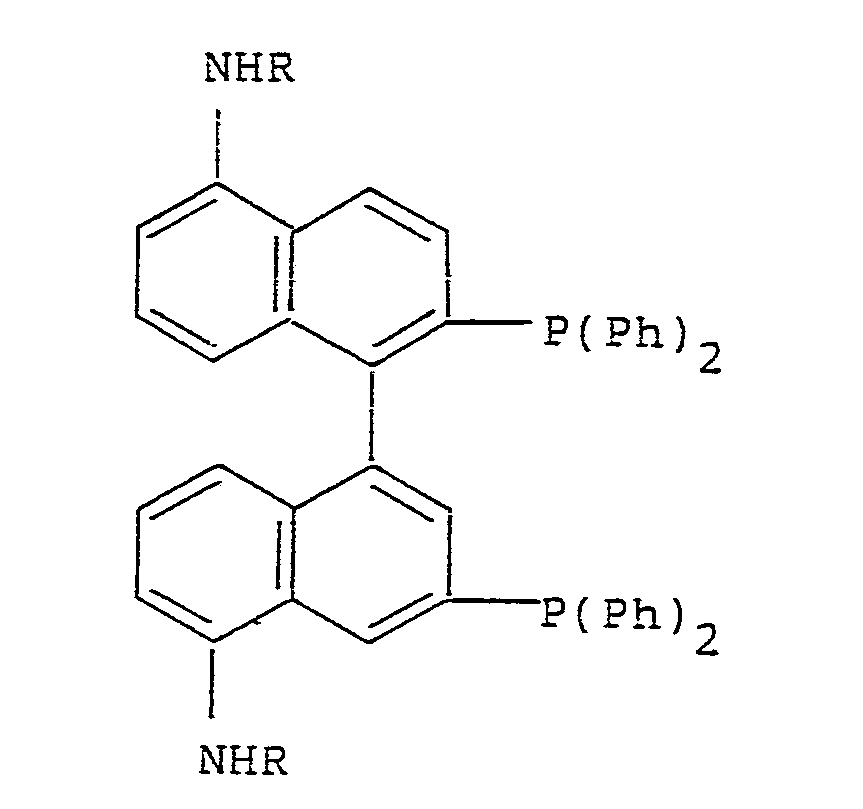
| (57) A phosphine compound is represented by formula:
wherein R represents a hydrogen atom or an acetyl group; and Ph represents a phenyl group. Synthesis is from BINAP dioxide by nitration at the 5,5 positions, conversion of the nitro groups to amino groups by reduction, e.g. with SnCl₂, reduction of the carbon with H Si Cl₃ and optional acetylation of the -NH₂ groups. The compound is reacted with a compound of rhodium, ruthenium or palladium [Rh(nobornadiene)₂] ClO₄, to form a metal complex. |
[0001] This invention relates to novel phosphine compounds forming a complex with a metallic element, e.g., rhodium, ruthenium or palladium, which is useful as a catalyst for asymmetric syntheses.
[0002] Many complexes in which a chiral tertiary phosphine is coordinated to a metallic element, e.g., rhodium, ruthenium or palladium exhibit excellent performances as catalysts for asymmetric syntheses. In an attempt to improve catalytic performances of these metal-phosphine complexes, a number of phosphine compounds having special structures have hitherto been prepared as disclosed e.g., in Nihon Kagakukai (ed.), Kagaku Sosetsu, Vol. 32, pp. 237-238, and "Yuki Kinzoku Sakutai no Kagaku" (1982), Synthesis (Reviews,) pp. 85-116 (1981).
[0003] 2,2′-Bis(diphenylphosphino)-1,1′-binaphthyl (hereinafter abbreviated as BINAP) disclosed in U.S. Patents 4,564,708 and 4,605,750, and Japanese Patent Application (OPI) No. 61937/80 (the term "OPI" as used herein means an unexamined published application ) is excellent as such a phosphine compound catalyst.
[0004] However, none of the conventionally proposed phosphine compounds was capable of providing catalysts which fully satisfy the requirements of selectivity, conversion and duration in asymmetric syntheses. There was therefore a demand for modified forms of BINAP to form catalysts for asymmetric syntheses which exhibit markedly improved catalytic performances.
[0005] In prior European Applications we have disclosed catalytic complexes of metals and substituted BINAP as follows:
EP 0156607 (and USP 4604474), p-tolyl substituted BINAP is complexed with Rh and ClO₄⁻ ion and used for isomerisation of N,N-diethylgeranylamine to citronellaldiethyleneamine.
EP 0170470, the -CH₃ (R) of the toluene groups may also be H or tert-butyl; the complex is with Rh and ClO₄⁻ or P F₆⁻ and it is used to isomerise alkylamines to optically active enamines or imines.
EP 0174057, the same complex but with Ru, Cl and optionally a tertiary amine is used for asymmetric hydrogenations or dehydrogenations.
[0006] We have now devised novel BINAP derivatives substituted not at the 3,3- position but at the 5,5- position of the naphthyl ring and we have found that metal complexes thereof have high conversions when used as catalysts for asymmetric isomerization, e.g. of diethylgeranylamine.
[0008] The present invention relates to novel phosphine compounds represented by the following formula:
wherein R represents a hydrogen atom or an acetyl group; and Ph represents a phenyl group.
[0009] These compounds are, specifically., 5,5′-diamino-2,2′-bis(diphenylphosphino)-1,1′-binaphthyl and 5,5′-diacetamido-2,2′-bis(diphenylphosphino)-1,1′-binaphthyl.
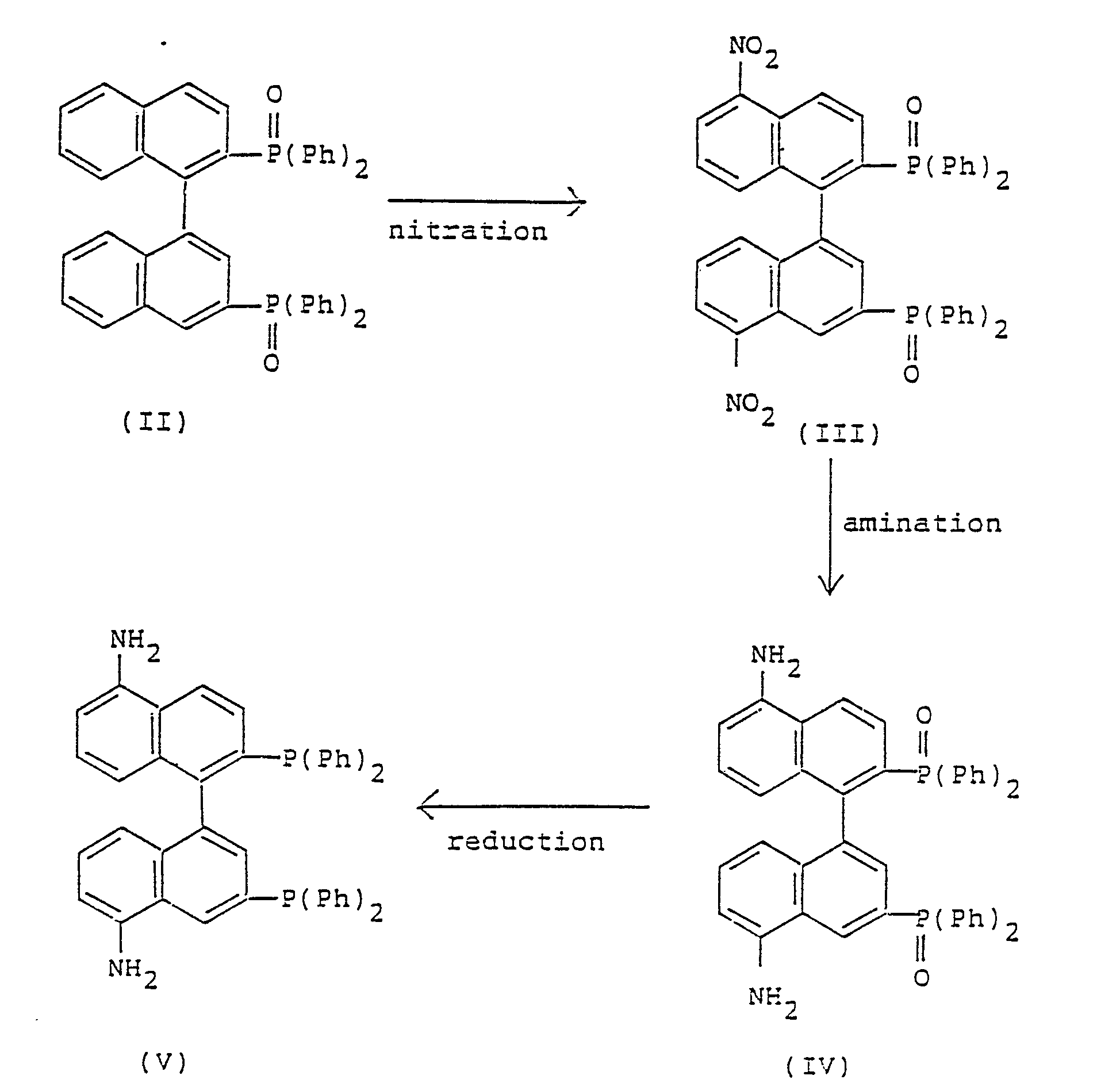
[0010] The phosphine compounds represented by formula (I) according to the present invention can be prepared from BINAP dioxide represented by formula (II) by the following reaction scheme:
[0011] The BINAP dioxide of formula (II) can be synthesized by the process according to U.S. Patent 4,564,708 (corresponding to Japanese Patent Application (OPI) No. 157094/84) which comprises reacting bromine and 1,1′-bis-2-naphthol using triphenyl phosphine as a reaction auxiliary, reacting the resulting 2,2′-dibromo-1,1′-binaphthyl with chlorodiphenyl phosphine in the presence of t-butyl lithium to form BINAP, and oxidizing BINAP with peracetic acid or hydrogen peroxide.
[0012] The BINAP dioxide (II) is reacted with an appropriate nitrating agent, such as a combination of nitric acid and acetic anhydride, to introduce a nitro group to the 5,5′-positions of the naphthyl ring thereof to give 5,5′-dinitro BINAP dioxide of formula (III). Nitration at the 5,5′-positions may be confirmed by X-ray analysis and two-dimensional NMR analysis. The nitro groups of the compound (III) are then converted to amino groups by reduction, such as acidic reduction using stannous chloride, to form 5,5′-diamino BINAP dioxide of formula (IV). The compound (IV) is reduced with trichlorosilane (HSiCl₃) in accordance with a known process (see Chem. Ber., Vol. 98, p. 171 (1965)) to thereby obtain the phosphine compound of formula (V) according to the present invention. The phosphine compound of formula (VI) according to the present invention can be obtained by acetylating the compound of formula (V) in a usual manner.
[0013] The phosphine compound according to the present invention is capable of forming a complex with a metallic element, e.g., rhodium, ruthenium, palladium, etc. For example, it easily reacts with a known rhodium compound, [Rh(nbd)₂]ClO₄ wherein nbd represents norbornadiene, to form a complex, [Rh(5,5′-amino or acetamido BINAP(nbd)]⁺ClO₄⁻.
[0014] These phosphine-metal complexes are usually employed as produced, or may be supported on a carrier, such as crosslinked polystyrene, etc.
[0015] This invention will now be illustrated in greater detail with reference to the following ex amples and comparative examples, wherein percentages are by weight unless otherwise indicated.
EXAMPLE 1
Synthesis of (+)-5,5′-Dinitro BINAP Dioxide
[0017] In 500 ml-volume flask was charged 180 ml of acetic anhydride, and 30 ml of 69% nitric acid was added dropwise thereto with stirring over a period of 1 hour while cooling with ice and sodium chloride. To the mixture was added dropwise 3 ml of 95% sulfuric acid. To the resulting system was further added 9.8 g (15 mM) of (+)-BINAP dioxide, followed by stirring at 0°C for 2 hours to complete the reaction. The reaction mixture was slowly poured into 800 ml of a 10% sodium hydroxide aqueous solution cooled in an ice-water bath, followed by allowing to stand for 1 hour in the ice-water bath. The thus formed precipitate was collected by filtration, dried at room temperature under reduced pressure for 3 hours, and dissolved in a mixture of 90 ml of tetrahydrofuran (THF) and 10 ml of water. The THF was removed from the solution by evaporating on a hot water bath at 60°C, and 40 ml of THF was then added thereto while stirring to yield 11.0 g (98.6%) of the titled com pount as yellow particulate crystals.
Melting Point: 340°C or more
Elementary Analysis:
Calcd. (%): C 70.96, H 4.03, N 3.76
Found (%): C 70.46, H 4.14, N 3.74
[0018] It was confirmed by X-ray and two-dimensional NMR analyses that the product had a nitro group at the 5- and 5′-positions of the naphthyl ring. The two-dimensional NMR chart of this compound as measured by means of AM250 (an NMR spectrometer manufactured by Bruker) is shown in Figure 1.
Synthesis of (+)-5,5′-Diamino DINAP Dioxide
[0019] A one liter-volume flask was charged with 2.21 g (3 mM) of (+)-5,5′-dinitro BINAP dioxide as prepared above and 75 ml of ethanol. To the mixture was added dropwise 192 ml of 12.1N hydrochloric acid over a period of 1 hour. A solution of 39.7 g (176 mM) of stannous chloride (SnCl₂.2H₂O) in 45 ml of ethanol was then added dropwise to the mixture, followed by refluxing for 15 hours to complete the reaction. The reaction mixture was concentrated until a hydrochloride was precipitated. After allowing the concentrate to stand at room temperature overnight, the hydrochloride was removed by filtration. The filtrate was dissolved in 200 ml of ethanol, and the solution was neutralized with 16 ml of a 10% sodium hydroxide aqueous solution, followed by concentration. The concentrate was extracted with 50 ml of methylene chloride, and the extract was concentrated to dryness. The resulting solid was dissolved in 20 ml of hot alcohol. After cooling, 20 ml of n-hexane was added thereto to give 1.75 g (85.3%) of the titled compound as brown quartz-like crystals.
Melting Point: 340°C or more
Elementary Analysis:
Calcd. (%): C 77.19, H 4.97, N 4.09
Found (%): C 77.28, H 5.02, N 3.83
Synthesis of (+)-5,5′-Diamino BINAP
[0020] In a 200 ml-volume flask was placed 75 ml of toluene, and 12 ml (0.12 M) of trichlorosilane and 23 ml (0.12 M) of tri-n-propylamine were added thereto under a nitrogen stream, followed by stirring for 10 minutes. To the mixture was added 4.2 g (6 mM) of the (+)-5,5′-diamino BINAP dioxide as above prepared, followed by refluxing for 5 hours. The reaction mixture was poured into 400 ml of a 10% sodium hydroxide aqueous solution cooled with ice-water, and the mixture was extracted with 300 ml of toluene. The extract was concentrated to dryness, and the solid was dissolved in 50 ml of hot toluene. Upon allowing the solution to stand at room temperature, 2.76 g (70.5%) of the titled compound was obtained as brown particulate crystals.
Melting Point: 340°C or more
Elementary Analysis:
Calcd. (%): C 80.98, H 5.21, N 4.29
Found (%): C 81.14, H 5.35, N 4.01
[0021] The infrared absorption spectrum (KBr) and NMR chart of this compound are shown in Figures 2 and 3, respectively.
EXAMPLE 2
Synthesis of (+)-5,5′-Diacetamido BINAP
[0022] A 50 ml-volume flask was charged with 1.3 g (2 mM) of the (+)-5,5′-diamino BINAP as obtained in Example 1, 12 ml of acetic anhydride, and 3 ml of tri-n-propylamine, and the mixture was refluxed for 1.5 hours under a nitrogen stream. The reaction mixture was poured into ice-water, and the thus formed crystals were collected by filtration. Recrystallization from hot methanol gave 1.12 g (76.0%) of the titled compound as yellow particulate crystals.
Melting Point: 176-178°C
Elementary Analysis:
Calcd. (%): C 78,26, H 5.16, N 3.80
Found (%): C 78.71, H 5.23, N 3.72
USE EXAMPLE 1
Preparation of [Rh((+)-5,5′-Diamino BINAP)(nbd)]⁺ClO₄⁻
[0023] One milliliter of a 0.02 mM/ml solution of [Rh(nbd)₂]ClO₄ in methylene chloride was charged in a 100 ml-volume pressure bottle whose atmosphere had been replaced with nitrogen. After removing the methylene chloride by distillation under reduced pressure, the residue was dried in a high vacuum system (1 mmHg) for 1 hour. Then, 14.3 mg (0.022 mM) of the (+)-5,5′-diamino BINAP as obtained in Example 1 and 20 ml of THF were added thereto, followed by stirring at room temperature for 1 hour to prepare 20 ml of a THF solution containing [Rh((+)-5,5′-diamino BINAP)(nbd)]⁺ClO₄⁻.
Asymmetric Isomerization Using [ Rh((+)-5,5′-Diamino BINAP)(nbd)]⁺ClO₄⁻
[0024] To 20 ml of the above-prepared THF solution of the Rh-phosphine complex was added 40 ml of diethyl geranylamine, and the mixture was heated to 100°C to effect an asymmetric isomerization reaction as shown by the following scheme. The enamine produced was analyzed with the passage of time by gas chromatography to determine conversions to enamine. The results obtained are shown in Table 1.
USE EXAMPLE 2
Preparation of [Rh((+)-5,5′-Diacetamide BINAP)(nbd)]⁺ClO₄⁻
[0025] A THF solution containing [Rh((+)-5,5′-diacetamido BINAP)(nbd)]⁺ClO₄⁻ was prepared in the same manner as described in Use Example 1 except for replacing the (+)-5,5′-diamino BINAP as used in Use Example 1 with 15.4 mg (0.022 mM) of the (+)-5,5′-diacetamido BINAP as obtained in Example 2.
Asymmetric Isomerization Using [Rh((+)-5,5′-Diacetamido BINAP)(nbd)]⁺ClO₄⁻
[0026] An asymmetric isomerization reaction was carried out in the same manner as in Use Example 1 except for replacing the THF solution of the Rh-phosphine complex as used in Use Example 1 with 20 ml of the THF solution containing [Rh((+)-5,5′-diacetamido BINAP)(nbd)]⁺ClO₄⁻ as above prepared. The conversions were determined with the passage of time in the same manner as in Use Example 1, and the results obtained are shown in Table 1.
COMPARATIVE USE EXAMPLE
[0027] [Rh((+)-BINAP)(nbd) ] ⁺ClO₄⁻ was prepared in the same manner as described in Use Example 1 except for using unsubstituted (+)-BINAP.
1. A phosphine compound represented by the formula:
wherein R represents a hydrogen atom or an acetyl group; and Ph represents a phenyl group.
wherein R represents a hydrogen atom or an acetyl group; and Ph represents a phenyl group.
2. A complex of a phosphine compound as claimed in Claim 1 with rhodium, ruthenium
or palladium.
3. A method of preparing a compound as claimed in Claim 1, wherein each R is hydrogen,
which comprises carrying out the reactions shown as follows:
4. A method of preparing a compound as claimed in Claim 1, wherein R is acetyl, which
comprises acetylation of the product (V) of the reaction shown in Claim 3.
5. A process of synthesis wherein a complex as claimed in Claim 2 is used as catalyst.
6. A process as claimed in Claim 5, wherein an optically active asymmetric compound
is synthesised.
7. A process as claimed in Claim 5 or 6, wherein an amine is isomerised to an enamine.