|
(11) | EP 0 236 095 B1 |

| (12) | EUROPEAN PATENT SPECIFICATION |
|
|
| (54) |
An electrolyte for an electrolytic capacitor Elektrolyt für elektrolytischen Kondensator Electrolyte pour condensateur électrolytique |
|
|
|||||||||||||||||||||||||||||||
| Note: Within nine months from the publication of the mention of the grant of the European patent, any person may give notice to the European Patent Office of opposition to the European patent granted. Notice of opposition shall be filed in a written reasoned statement. It shall not be deemed to have been filed until the opposition fee has been paid. (Art. 99(1) European Patent Convention). |
[0001] This invention relates to an electrolyte for an electrolytic capacitor containing an aprotic solvent and a fluorocomplex acid salt of an alkylene bisamine compound as solute.
[0002] Hitherto, organic acids or their salts and glycol series pastes have been principally used as electrolytes for electrolytic capacitors. The latest expansion of uses of electronic instruments requires an improvement in the reliability and performance of such capacitors entailing avoidance of the presence of water in the paste and as a result an electrolyte using an aprotic solvent in place of organic acids and their salts and glycol pastes has attracted interest.
[0003] The most important property that should be possessed by an aprotic solvent system electrolyte is high conductivity and in order to achieve this an organic carboxylic acid or a salt thereof which is highly soluble in the aprotic solvent and has a high degree of dissociation therein has been sought but so far unsuccessfully. In order to attain sufficiently high conductivity, a solvent which produces water by the reaction between an acid and an alcohol or glycol, or even water itself has been incorporated into the aprotic solvent, as disclosed in Japanese patent. publications No.55-3989, 57-56763, 58-32769 and U.S. patent No.4,117,531, but performance and reliability are still unsatisfactory.
[0004] After extensive researches and studies to obtain an electrolyte which is substantially a non-aqueous electrolyte and has a high conductivity with use of an aprotic solvent but without using any solvent which forms water by the reaction between an acid and an alcohol or glycol, it has been discovered that a fluorocomplex acid salt of an alkylene bisamine compound has a high solubility in aprotic solvents and provides a high conductivity.
[0005] An electrolyte for an electrolytic capacitor according to the invention comprises a solution of a fluorocomplex acid salt of an alkylene bisamine compound in an aprotic solvent.
[0006] The alkylene bisamine compounds according to the invention is preferably selected from the compounds having the general formula:
in which R¹ is straight or side chain alkylene group - CnH2n - in which n is an integer of 2 to 6; R² comprises from 1 to 3 hydrogen, lower alkyl groups or lower alkenyl groups and forms a primary, secondary or tertiary amine group, or a quaternary ammonium group together with the nitrogen atom N.
[0007] The alkylene group forming the alkylene bisamine compound may for example be an ethylene group, propylene group
trimethylene group, pentamethylene group, or hexamethylene group. The bisamine compound is formed by the bonding of the alkylene group R¹ with the amine groups, in which said amine groups are primary amine groups ( - NH₂ ), secondary amine groups ( - NHR ), tertiary amine groups ( - N(R)₂) or quaternary ammonium groups ( - N⁺(R)₃), in which R is a lower alkyl group or lower alkenyl group, and in the case of (R)₂ or (R)₃ the R groups are preferably the same from the point of view of industrial use and cost, but may be different from one another.
[0008] The alkylene bisamine compound preferably used in the invention may be selected from the following but is not limited thereto:
[0009] The fluorocomplex acid to be used in the invention may for example be tetrafluoroboric acid (HBF₄) or hexafluorophosphoric acid (HPF₆).
[0010] The aprotic solvent to be used in the invention may be selected from the following but is not limited thereto:
(1) Amides : N-methylformamide, N,N-dimethylformamide, N-ethylformamide, N,N-diethylformamide, N-methylacetoamide, N,N-dimethylacetoamide, N-ethylacetoamide, N,N-diethylacetoamide, hexamethylphosphorinamide
(2) Oxides : dimethyl sulfoxide
(3) Nitriles : acetonitrile
(4) Cyclic esters, cyclic amides : γ-butyrolactone, N-methyl-2-pyrrolidone, ethylene carbonate, propylene carbonate.
[0011] An electrolyte for an electrolytic capacitor according to the invention may conveniently be prepared by adding to an aqueous solution of the fluorocomplex acid salt at least one equivalent, and preferably two equivalents, of the alkylene bisamine compound with subsequent vacuum drying to obtain an anhydrous salt which as an approximately 10% by weight solution is then added to the aprotic solvent to prepare the resultant electrolyte.
[0012] The conductivity of examples of electrolytes according to the invention are shown as examples 1 to 13 in Table 1. In each case the electrolyte comprises a 10% (by weight) of the fluorocomplex acid salt.
1. An electrolyte for an electrolytic capacitor characterised in that it comprises
a solution of a fluorocomplex acid salt of an alkylene bisamine compound in an aprotic
solvent.
2. An electrolyte for electrolytic capacitors comprising an aprotic solvent and a
fluorocomplex acid salt of an alkylene bisamine compound of general formula:
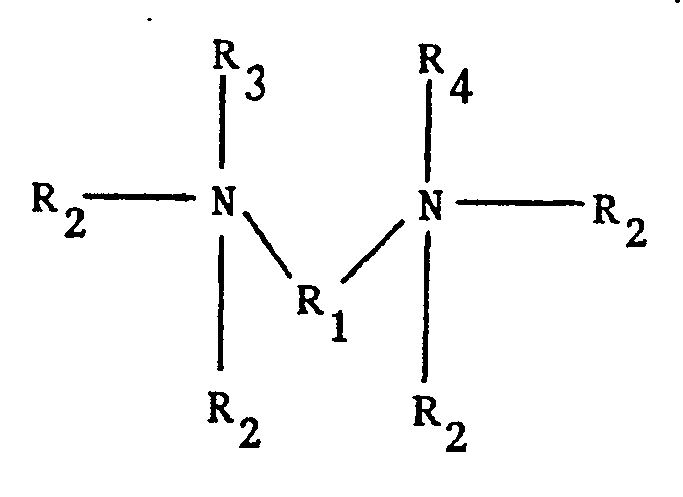
in which R₁ is a linear or branched alkylene group of the formula CnH2n in which n is an integer from 2 to 6, and each R₂ is independently selected from hydrogen, alkyl groups having 1 to 8 carbon atoms and alkenyl groups having 1 to 8 carbon atoms, R₃ and R₄ which may be the same or different, are absent or are hydrogen or are the same as R₂.
in which R₁ is a linear or branched alkylene group of the formula CnH2n in which n is an integer from 2 to 6, and each R₂ is independently selected from hydrogen, alkyl groups having 1 to 8 carbon atoms and alkenyl groups having 1 to 8 carbon atoms, R₃ and R₄ which may be the same or different, are absent or are hydrogen or are the same as R₂.
3. An electrolyte for an electrolytic capacitor according to claim 1 or 2, characterised
in that the aprotic solvent is:
N-methylformamide, N, N-dimethylformamide, N-ethylformamide, N, N-diethylformamide, N-methylacetamide, N, N-diemethylacetamide, N-ethylacetamide, N, N-diethylacetamide, γ-butyrolactone, N-methyl-2-pyrrolidone, ethylene carbonate, propylene carbonate, dimethyl sulfoxide, acetonitrile or a mixture of two or more thereof.
N-methylformamide, N, N-dimethylformamide, N-ethylformamide, N, N-diethylformamide, N-methylacetamide, N, N-diemethylacetamide, N-ethylacetamide, N, N-diethylacetamide, γ-butyrolactone, N-methyl-2-pyrrolidone, ethylene carbonate, propylene carbonate, dimethyl sulfoxide, acetonitrile or a mixture of two or more thereof.
4. An electrolyte for an electrolytic capacitor according to any preceding Claim characterised
in that the fluorocomplex acid is tetrafluoroboric acid or hexafluorophosphoric acid.
1. Elektrolyt für einen Elektrolytkondensator, dadurch gekennzeichnet, daß er die Lösung eines Fluorkomplexsäuresalzes einer Alkylenbisaminverbindung in
einem aprotischen Lösungsmittel darstellt.
2. Elektrolyt für Elektrolytkondensatoren, dadurch gekennzeichnet, daß er ein aprotisches Lösungsmittel und ein Fluorkomplexsäuresalz einer Alkylenbisaminverbindung
der allgemeinen Formel
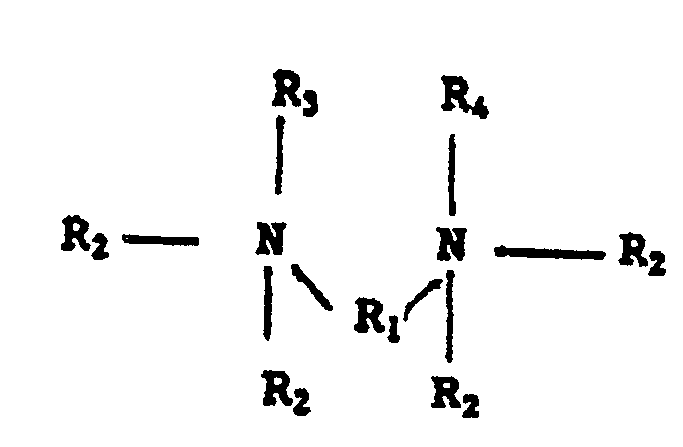
umfaßt, worin R₁ eine unverzweigte oder verzweigte Alkylengruppe der Formel CnHZn bedeutet, in der n für cinc ganze Zahl von 2 bis 6 steht, und RZ jeweils unabhängig voneinander ausgewählt ist unter Wasserstoff, C₁₋₈-Alkyl und C₁₋₈-Alkenyl und R₃ und R₄, welche dieselbe oder unterschiedliche Bedeutung haben, entweder fehlen oder Wasserstoff bedeuten oder dieselbe Bedeutung wie R₂ haben können.
umfaßt, worin R₁ eine unverzweigte oder verzweigte Alkylengruppe der Formel CnHZn bedeutet, in der n für cinc ganze Zahl von 2 bis 6 steht, und RZ jeweils unabhängig voneinander ausgewählt ist unter Wasserstoff, C₁₋₈-Alkyl und C₁₋₈-Alkenyl und R₃ und R₄, welche dieselbe oder unterschiedliche Bedeutung haben, entweder fehlen oder Wasserstoff bedeuten oder dieselbe Bedeutung wie R₂ haben können.
3. Elektrolyt für einen Elektrolytkondensator nach Anspruch 1 oder 2, dadurch gekennzeichnet, daß das aprotische Lösungsmittel folgende Verbindungen darstellt:
N-Methylformamid, N,N-Dimethylformamid, N-Ethylformamid, N,N-Diethylformamid, N-Methylacetamid, N,N-Dimethylacetamid, N-Ethylacetamid, N,N-Diethylacetamid, γ-Butyrolacton, N-Methyl-2-pyrrolidon, Ethylencarbonat, Propylencarbonat, Dimethylsulfoxid, Acetonitril oder ein Gemisch aus zwei oder mehreren dieser Verbindungen.
N-Methylformamid, N,N-Dimethylformamid, N-Ethylformamid, N,N-Diethylformamid, N-Methylacetamid, N,N-Dimethylacetamid, N-Ethylacetamid, N,N-Diethylacetamid, γ-Butyrolacton, N-Methyl-2-pyrrolidon, Ethylencarbonat, Propylencarbonat, Dimethylsulfoxid, Acetonitril oder ein Gemisch aus zwei oder mehreren dieser Verbindungen.
4. Elektrolyt für einen Elektrolytkondensator nach einem der vorangegangenen Ansprüche,
dadurch gekennzeichnet, daß die Fluorkomplexsäure Tetrafluorborsäure oder Hexafluorphosphorsäure ist.
1. Electrolyte pour condensateur électrolytique, caractérisé en ce qu'il comprend
une solution d'un sel d'acide fluorocomplexe d'un composé alkylènebisamine dans un
solvant aprotique.
2. Electrolyte pour condensateurs électrolytiques, comprenant un solvant aprotique
et un sel d'acide fluorocomplexe d'un composé alkylènebisamine de formule générale
:
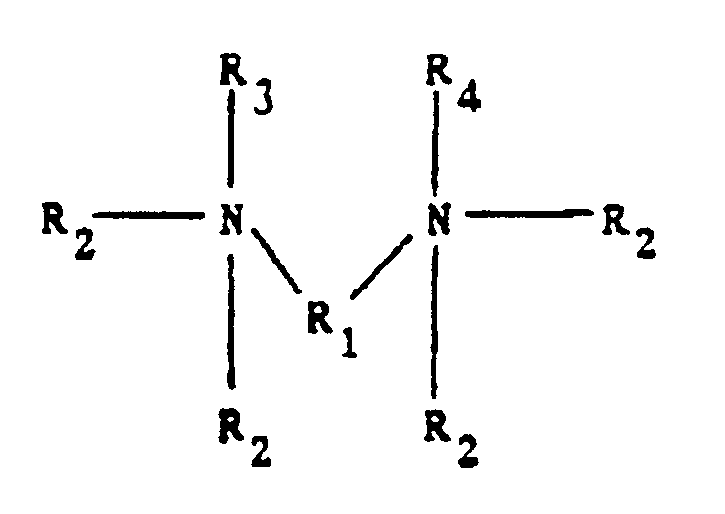
dans laquelle R₁ est un groupe alkylène linéaire ou ramifié de formule CnH₂n, dans laquelle n est un nombre entier de 2 à 6 et chaque R₂ est indépendamment choisi parmi un hydrogène, des groupes alkyle comportant 1 à 8 atomes de carbone et des groupes alcényle comportant 1 à 8 atomes de carbone, R₃ et R₄, qui peuvent être identiques ou différents, sont absents ou sont des atomes d'hydrogène, ou sont identiques à R₂.
dans laquelle R₁ est un groupe alkylène linéaire ou ramifié de formule CnH₂n, dans laquelle n est un nombre entier de 2 à 6 et chaque R₂ est indépendamment choisi parmi un hydrogène, des groupes alkyle comportant 1 à 8 atomes de carbone et des groupes alcényle comportant 1 à 8 atomes de carbone, R₃ et R₄, qui peuvent être identiques ou différents, sont absents ou sont des atomes d'hydrogène, ou sont identiques à R₂.
3. Electrolyte pour condensateur électrolytique selon la revendication 1 ou 2, caractérisé
en ce que le solvant aprotique est :
le N-méthylformamide, le N,N-diméthylformamide, le N-éthylformamide, le N,N-diéthylformamide, le N-méthylacétamide, le N,N-diméthylacétamide, le N-éthylacétamide, le N,N-diéthylacétamide, la γ-butyrolactone, la N-méthyl-2-pyrrolidone, le carbonate d'éthylène, le carbonate de propylène, le diméthylsulfoxyde, l'acétonitrile ou un mélange de deux ou plus d'entre eux.
le N-méthylformamide, le N,N-diméthylformamide, le N-éthylformamide, le N,N-diéthylformamide, le N-méthylacétamide, le N,N-diméthylacétamide, le N-éthylacétamide, le N,N-diéthylacétamide, la γ-butyrolactone, la N-méthyl-2-pyrrolidone, le carbonate d'éthylène, le carbonate de propylène, le diméthylsulfoxyde, l'acétonitrile ou un mélange de deux ou plus d'entre eux.
4. Electrolyte pour condensateur électrolytique selon l'une quelconque des revendications
précédentes, caractérisé en ce que l'acide fluorocomplexe est l'acide tétrafluoroborique
ou l'acide hexafluorophosphorique.