|
(11) | EP 0 236 103 B1 |

| (12) | EUROPEAN PATENT SPECIFICATION |
|
|
| (54) |
Preparation of aqeous solutions of copolymers of dicarboxylic acids having a low dicarboxylic acid monomer content Herstellung wässriger Lösungen von Copolymeren von Dicarbonsäuren mit niedrigem Gehalt an Dicarbonsäuremonomeren Préparation de solutions aqueuses de copolymères d'acides dicarboxyliques à faible teneur de monomères d'acide dicarboxylique |
|
|
|||||||||||||||||||||||||||||||
| Note: Within nine months from the publication of the mention of the grant of the European patent, any person may give notice to the European Patent Office of opposition to the European patent granted. Notice of opposition shall be filed in a written reasoned statement. It shall not be deemed to have been filed until the opposition fee has been paid. (Art. 99(1) European Patent Convention). |
[0001] The present invention relates to the production of aqueous solutions or dispersions of copolymers of aliphatic dicarboxylic acids, especially maleic acid, with α,β-ethylenically unsaturated monomers, especially those having carboxyl or sulfonic acid groups, such as (meth)acrylic acid or 2-acrylamido-2-methylepropane sulfonic acid (AMPS), respectively, which solutions or dispersions have a very low residual content of unpolymerized dicarboxylic acid monomer. Such copolymers are useful as antiscalants, dispersants, detergent additives, deflocculants and fluid retention aids for water-based drilling fluids used in oil drilling operations.
[0002] Copolymers of aliphatic monoethylenically unsaturated mono- and dicarboxylic acids are well known and have been used as incrustation inhibitors and deflocculants in aqueous systems, and as builders in detergent compositions. Such copolymers have been prepared by copolymerizing a monoethylenically unsaturated aliphatic dicarboxylic acid, such as maleic acid, with one or more monoethylenically unsaturated monocarboxylic acids, and/or monoethylenically unsaturated sulfonic acids. Examples of monocarboxylic acid monomers are acrylic and methacrylic acid.
[0003] Various processes for preparing such copolymers in an aqueous solvent system have been described in the literature. Thus, US-A-3,806,367 and 3,898,037 disclose, inter alia, the preparation of copolymers of the disodium salt of maleic acid and acrylamido-sulfonic acid compounds, especially monomeric 2-acrylamido-2-methylpropane sulfonic acid in an aqueous system in the presence of an organic chain transfer agent such as isopropanol. Although the amount of residual maleic acid monomer is not stated, it is believed that the degree of conversion of monomer to copolymer is on the order of 80 percent. In addition, the solids content of the resulting copolymer solution is on the order of 15 to 25 percent.
[0004] US-A-4,314,044 discloses preparation of low molecular weight water soluble copolymers of acrylic and methacrylic acid with monoethylenically unsaturated dicarboxylic acids such as itaconic, fumaric and maleic acids, in an aqueous solvent system containing an initiator and a metal salt in which the molar ratio of initiator to metal ion of the salt is from 10:1 to 150:1, and the initiator is present in an amount of from 0.5 weight percent to 35 weight percent based on the weight of monomers present. Depending upon the monomers used, the degree of monomer conversion varies from about 75 to about 95 percent. Thus, the copolymer solution contains substantial amounts of unreacted monomer. The problem of unreacted residual monomer would be even greater with copolymers of maleic acid, a less reactive monomer.
[0005] DE-A-31 38 574 discloses a process for the production of copolymers of monoethylenically unsaturated monocarboxylic acids with dicarboxylic acids in aqueous medium in the presence of a water soluble radical generating initiator, such as a peroxide, hydroperoxide or persulfate. In such process, to an aqueous solution of the partially neutralized salt of the dicarboxylic acid monomer there are added over a period of hours an aqueous solution of an α,β-ethylenically unsaturated monocarboxylic acid monomer and an initiator, while the temperature of the reaction medium is maintained at about 60°C to 150°C. During the polymerization 20% to 80% of the carboxyl groups of the monomers are neutralized. However, such process requires the use of large amounts of initiator and relatively high polymerization temperatures to obtain a copolymer solution containing a relatively low residual content of unpolymerized dicarboxylic acid monomer. The presence of dicarboxylic acid monomer in the aqueous polymer solution decreases the effectiveness of the copolymer in many uses, an example of which is as an encrustation inhibitor. In addition, the dicarboxylic acid monomer, e.g. maleic acid, physiologically is not a totally harmless substance.
[0006] In an effort to reduce the amount of residual unpolymerized dicarboxylic acid monomer it has been suggested to carry out the process of DE-A-31 47 489 in the presence of a water soluble radical generating initiator comprising a combination of hydrogen peroxide and a persulfate, the weight ratio of the former to the latter being from 3:1 to 1:3 - see EP-A-01 06 110. Although such combination of initiators significantly reduces the residual content of unpolymerized dicarboxylic acid, the use of such process makes it difficult to obtain relatively high molecular weight copolymers while at the same time maintaining a high degree of monomer conversion.
[0007] The present invention is dircted to an improvement in the above-type processes for the copolymerization of certain monoethylenically unsaturated dicarboxylic acids with α,β-ethylenically unsaturated monomers, especially those having a carboxyl or sulfonic acid group, whereby the residual content of the dicarboxylic acid in the aqueous solvent system used in the polymerization is significantly reduced so as not to exceed 0.5 percent, based on the total weight of dry copolymer. Stated differently, the present process typically makes possible the conversion of at least 99.5 percent of dicarboxylic acid monomer. Generally, the residual dicarboxylic acid monomer content is reduced to 0.3 percent or less. Such result is obtained by carrying out the polymerization in accordance with claim 1.
[0008] It was discovered that if the copolymerization of α,β-monoethylenically unsaturated aliphatic monomers, especially those containing a carboxyl or sulfonic acid group, with dicarboxylic acids is carried out in an aqueous solvent system at a given pH range and in the presence of a water-soluble radical-generating initiator and certain metal ions as defined in claim 1, the content of residual unreacted dicarboxylic acid in the resulting aqueous copolymer solution could be reduced to an extremely low level on the order of not more than 0.5 percent, by weight, based on the total weight of dry copolymer. Depending upon the exact polymerization conditions used according to the present invention, the dicarboxylic acid monomer content can be reduced to less than 0.1 percent. In addition, the novel process makes possible the control of the molecular weight and of the molar ratio of dicarboxylic acid monomer to α,β-ethylenically unsaturated monomer in the resulting copolymer, independently of residual unreacted dicarboxylic acid monomer.
[0009] The metal ions used in the process are selected from Zn⁺⁺, Co⁺⁺⁺, Co⁺⁺, Cu⁺⁺, Mo⁺⁺, Fe⁺⁺⁺, Fe⁺⁺, Cr⁺⁺, Ni⁺⁺, Ce⁺⁺⁺⁺ and Ce⁺⁺. Mixtures of such ions may also be used.
[0010] The concentration of metal ions in the aqueous solvent system should be an amount effective to reduce the residual content of unpolymerized dicarboxylic acid in the aqueous copolymer solution to a level which does not exceed 0.5 percent, by weight of total dry polymer produced in the polymerization process. The metal ion concentration may typically vary from 1 to 250 ppm, based on the total aqueous polymerization system, including monomers and initiator. By maintaining the molar ratio of metal ion to initiator in the range of from 1:300 to 1:4000 the residual dicarboxylic acid content is reduced to 0.5 percent or less. Preferably the metal ions are present at a concentration of from 1 to 5 ppm.
[0011] The metal ions may be added to the aqueous solvent system in the form of their salts and oxides which are soluble in aqueous solvent system. Suitable water-soluble salts include zinc nitrate, zinc sulfate, zinc chloride, cupric acetate, cupric chloride, molybdenous chloride, cobalt (II) acetate, cobalt (II) nitrate, cobalt (III) chloride, ferric chloride, ferric sulfate, ferrous sulfate, chromium (II) acetate, chromium (II) chloride, nickel (II) sulfate, cerium (IV) sulfate, and cerium (II) nitrate. Preferably, these salts are added to the aqueous solvent system in the form of an aqueous solution of the desired concentration.
[0012] The monoethylenically unsaturated aliphatic dicarboxylic acids used in the process of the invention contain from 4 to 6 carbon atoms, and examples are maleic acid, itaconic acid, mesaconic acid, fumaric acid, methylene malonic acid and citraconic acid. They are used in an at least partially neutralized form. For example as their monoalkali metal or monoammonium salts, eg a monoalkali metal maleate or monoammonium maleate. Depending upon the geometrical location of the carboxyl groups (cis position), they may be added to the aqueous solvent system in the form of their anhydrides, maleic anhydride being typical of such anhydrides. The dicarboxylic acid monomer comprises from 10 to 70 percent, preferably 25 to 55 percent, by weight of total monomers.
[0013] The α,β-ethylenically unsaturated monomers which are copolymerized with the dicarboxylic acid monomers according to the process of this invention are of three particular types, namely (a) monocarboxylic (eg aliphatic) acids having 3 to 10 carbon atoms and the alkali metal and ammonium salts of such acids; (b) organic sulfonic acid compounds and the alkali metal and ammonium salts thereof, and (c) vinyl monomers free from carboxyl and sulfonic acid groups, and mixtures of such (a), (b) and (c) monomers. The (a), (b) and (c) monomers comprise from 90 to 30 percent, preferably 45 to 75 percent, of said copolymers, based on the total weight of monomers. However, for solubility reasons, preferably the (c) monomers do not comprise more than 30 percent of the total monomers, the remainder of the monomers being either the dicarboxylic acid or a mixture of dicarboxylic acid and (a) and/or (b) type monomers in the above-stated proportions.
[0014] The (a) type monomers include acrylic and lower alkyl-substituted acrylic acid such as methacrylic acid (acrylic and methacrylic acid being referred to collectively herein as "(meth)acrylic acid"), vinyl acetic acid, and the like, and the alkali metal, e.g. sodium and potassium, and ammonium salts of such monocarboxylic acids.
[0015] The (b) type monomers include sulfonic acid monomers, such as vinylsulfonic acid, allylsulfonic acid, methallylsulfonic acid, styrene sulfonic acid, vinyltoluenesulfonic acid and the alkali metal and ammonium salts of such sulfonic acids, as well as sulfonic acid compounds of the formula
where R₁, R₂ and R₃ are each independently selected from hydrogen and lower alkyl, R₄ is lower alkylene or alkyl-substituted lower alkylene, and M is hydrogen, an alkali metal or ammonium ion. "Lower" preferably denotes 1 to 6, more preferably 1 to 4, carbon atoms.
[0016] The acrylamido alkyl sulfonic acid monomers of the above formula can be prepared by well-known processes which are described in US-A-3,506,707 and the patents referred to therein.
[0017] Although various derivatives which are included within the structural formula set forth above may be prepared, the monomer which has been found to be particularly suitable for use in the process of this invention is 2-acrylamido-2-methylpropane sulfonic acid, or a salt thereof, commonly referred to as "AMPS", having the formula
where M represents hydrogen, sodium, potassium or ammonium.
[0018] The third type of monomer copolymerizable with the dicarboxylic acid monomer, and with monomer types (a) and/or (b) if also present, are the vinyl monomers (c) which are free from carboxyl and sulfonic acid groups. Typical of such monomers are vinyl acetate, allyl alcohol, acrylamide, N,N'-dimethylacrylamide, N-methylolacrylamide, N,N'-methylenebisacrylamide, vinyl crotonate, ethylene glycol diacrylate, tripropylene glycol diacrylate, diallylphthalate, hydroxyethyl acrylate, hydroxyethyl methacrylate, hydroxypropyl acrylate, vinyl pyrrolidone and N-vinyl-N-methyl-acetamide. As noted previously, in order that the copolymers will have adequate water solubility, the sum of the type (c) monomers should not constitute more than 30 percent by weight of total monomers employed to form the copolymer.
[0019] The copolymerization reaction is carried out in the presence of a water-soluble, radical-generating initiator. Such polymerization initiators are well known and include peroxides such as hydrogen peroxide, hydroperoxides such as t-butylhydroperoxide, and persulfates such as sodium, potassium and ammonium persulfate. Water-soluble azo initiators, such as 2,2¹-azobis (2-amidinopropane) hydrochloride, can also be used. A particularly effective initiator is hydrogen peroxide.
[0020] The amount of initiator employed is usually from 0.5 to 10 percent, by weight of total monomers. A redox system can be used where lower polymerization temperatures are used. Using a redox system requires purging of the aqueous solution(s) of monomers with an inert gas, such as nitrogen. Suitable reducing agents are ascorbic acid and erythorbic acid.
[0021] According to a preferred embodiment of the invention an aqueous solution of the dicarboxylic acid monomer which is at least partially neutralized, eg in monoalkali metal or monoammonium salt form, is placed in a suitable reactor and one or more water soluble salts of the above-described metal ions, generally as aqueous solutions, are added thereto. Then aqueous solutions of one or more of the (a), (b) and (c) monomers are added to the reactor over a period of several hours, e.g. 3 to 10 hours and preferably 5 to 7 hours, while maintaining the pH of the system in the range of from 2 to 7. Addition of initiator may be made in similar fashion as a separate aqueous solution. During the polymerization reaction, the aqueous solvent system containing the monomers and initiator is maintained at a temperature of from 40° to 150°C, preferably 80° to 100°C, and at a pH of from 2 to 7, preferably pH 3 to 5. If the temperature of the reaction mixture exceeds the boiling point thereof, the reaction may be carried out under pressure.
[0022] An important factor in minimising residual unreacted dicarboxylic acid monomer is pH of the aqueous solvent system during the polymerization reaction. Where the molar ratio of dicarboxylic acid monomer to monocarboxylic and/or sulfonic acid monomers and/or monomer (c) is relatively low, e.g. 1:4 to 1:3, the degree of neutralization of the latter monomers is relatively low, calling for a pH of the polymerization system which is also relatively low, e.g. from 2 to 4. On the other hand, where such molar ratio is relatively high, e.g. 1:1.5 to 1:1, a pH which is also relatively high, e.g. from 4 to 6, is desirable. Generally speaking, it is preferred that the pH should increase proportionally (e.g. to within ± 1.5 pH units) with increases in the molar ratio of the dicarboxylic acid monomer to the total of the α,β-olefinically unsaturated monomers (a), (b) and/or (c) as represented by the percentage by weight of dicarboxylic acid monomer in the polymer. For example, a pH of at least 4 is appropriate where the dicarboxylic acid monomer content is more than 55 percent by weight, a pH of at least 3 is appropriate where that content is 40-55 per cent by weight, a pH of not more than 6 is appropriate where the content is 25-40 percent by weight and a pH of not more than 5 is appropriate where that content is less than 25 percent by weight. A pH in these specified ranges can be maintained by neutralizing or partially neutralizing the monocarboxylic or monosulfonic acid monomer solution which is added to the dicarboxylic acid monomer solution.
[0023] The process is carried out in the absence of organic chain-transfer agents, such as isopropanol, which result in high percentages of unreacted dicarboxylic acid monomer.
[0024] At the completion of the polymerization reaction, the free carboxylic groups on the copolymer can be neutralized by addition of a suitable base, such as sodium hydroxide.
[0025] The copolymers obtained according to the process of this invention have a weight average molecular weight of from 2,000 to 1,000,000. By having metal ions present at a concentration of 10 ppm or somewhat higher, lower molecular weight copolymers within the above-stated molecular weight range can be obtained.
[0026] The copolymer solutions produced according to this invention ordinarily will have a solids content on the order of 30 to 60 percent, by weight, and can be used directly in such applications as pigment and coal slurry dispersants, antiscalants, incrustation inhibitors, oil drilling mud thinners and fluid loss agents.
[0027] The following examples are presented to illustrate the preparation of copolymers according to process of this invention, and are presented by way of illustration and are not to be construed as limiting the scope of this invention which is defined in the appended claims. In the examples molecular weights were determined by gel permeation chromatography (GPC) using polyacrylic acid of known molecular weight as the standard for molecular weight calibration. Residual monomer in the aqueous solution system at the completion of the copolymerization was determined by high performance liquid chromatography (HPLC), and for each example the amount of residual unreacted dicarboxylic acid monomer is set forth in Table I, together with process conditions employed.
Example 1 (Comparative example)
[0028] To a 5-neck, 3000 ml round bottom flask equipped with a mechanical stirrer, reflux condenser, and graduated addition funnels for continuous addition of monomers and initiator were charged 264 g distilled water and 150 g (1.5 mols) maleic anhydride hydrolyzed to maleic acid after being dissolved with agitation. To the resulting maleic acid solution were added 125 g (1.56 mols) caustic soda (50%), and the resulting solution of monosodium maleate was heated to a temperature of 90 ± 4°C. Five grams of erythorbic acid in 30 g distilled water, 28 g. hydrogen peroxide (35% active) in 100 g distilled water, and a mixture of partially neutralized acrylic acid solution consisting of 350 g (4.81 mols) acrylic acid, 195 g (2.43 mols) caustic soda (50%) and 180 g distilled water were each added separately into the flask at a constant rate over a period of 6 hours while the polymerization temperature was held between 86° and 100°C. The reaction mixture was refluxed for an additional 2 hours and then cooled to room temperature. The resulting copolymer solution contained 46%, by weight, of solids. Further neutralization of the copolymer was carried out by adding 210 g caustic soda (50%) to bring the pH value of polymer solution to 7.
Example 2
[0029] The procedure of Example 1 was repeated except that 0.040 g of ferrous ammonium sulfate hexahydrate (5 ppm Fe⁺⁺ ion) was added to the aqueous solution of monosodium maleate prior to carrying out the polymerization reaction.
Example 3
[0030] To a 4-neck, 3000 ml round bottom flask equipped as in Example 1 were charged 294 g (3 mols) maleic anhydride and 425 g distilled water. Two hundred and forty grams (3 mols) of caustic soda (50%) were then used to partially neutralize the aqueous solution of maleic acid. Then 0.125 g of ferrous ammonium sulfate hexahydrate were added to the partially neutralized maleic acid solution and the reaction vessel was heated to 92° ± 6°C.
[0031] Forty-seven grams of hydrogen peroxide (35% active) in 90 g of distilled water, and a mixture of partially neutralized acrylic acid solution comprising 324 g (4.5 mols) acrylic acid, 180 g (2.25 mols) caustic soda (50%) and 200 g of distilled water were each added separately to the flask at a constant rate over a period of 8 hours while the polymerization temperature was held between 90° to 102°C. The reaction mixture was refluxed for an additional 2 hours and cooled to room temperature. Further neutralization was accomplished by adding 276 g of caustic soda (50%) to provide the copolymer solution with a pH of 7.3.
Example 4
[0032] To a 4-neck, 3000 ml round bottom flask equipped as in Example 1 were charged 250 g distilled water and 206 g (2.1 mols) maleic anhydride. One hundred and sixty-eight grams (2.1 mols) of caustic soda (50%) were used to partially neutralize the aqueous solution of maleic acid. Then 0.20 g of ferrous ammonium sulfate hexahydrate were added to the partially neutralized maleic acid solution and the reaction vessel was heated to 95° ± 3°C.
[0033] 40 g of hydrogen peroxide (35% active) in 138 g of distilled water and 967 g (2.1 mols) of an aqueous solution of the sodium salt of AMPS (50% active) were each added separately to the flask at a constant rate over a period of 8 hours while the polymerization temperature was held between 96° to 102°C. The reaction mixture was refluxed for an additional 2 hours and then cooled to room temperature. Further neutralization was done by adding 50 g of caustic soda (50%) to provide the copolymer solution with a pH of 7.
Example 5 (comparative)
Example 6
[0035] The procedure of Example 4 was repeated except 642 g (1.4 mols) of an aqueous solution of the sodium salt of AMPS (50% active) were mixed with 152 g (2.1 mols) of acrylic acid, 134 g (1.68 mols) of caustic soda (50%), and 135 g of distilled water. This monomer mixture of AMPS and acrylic acid was then added to the partially neutralized maleic acid solution in the same manner as described in Example 4.
Example 7
[0036] The procedure of Example 4 was repeated except 0.33 g of ferrous ammonium sulfate hexahydrate (40 ppm Fe⁺⁺ ion) and 1934 g (4.2 mols) of an aqueous solution of the sodium salt of AMPS (50% active) were used. Both ferrous ion and AMPS solutions were added to the partially neutralized maleic acid solution in the same manner as described in Example 4.
Examples 8 (Incrustation Inhibition)
[0037] The purpose of this example is to illustrate the anti-incrustation properties of detergent compositions containing copolymers produced by the process of the present invention. In each case the detergent composition used had the formulation given in Table II below; however, a different copolymer was used in each example and these are identified in Table III.
[0038] In the tests which provided the data presented in Table III, the detergent level was 0.15 percent, by weight, and five cycles were used. The water had a hardness of 110 ppm (CaCO₃), and the wash temperature was 50°C.
[0039] The detergent compositions of Table II were prepared by dry mixing all ingredients except the copolymers. The appropriate amount of copolymer and dry mixed powder were then dissolved in water at 10% total active detergent.
[0040] The procedure for the laundry cycle was as follows:
For each test, one 9" x 9" cotton percale sheeting swatch was placed in 500 ml wide-mouthed plastic bottle and 400 ml of the water at the appropriate temperature were added. 6 ml of 10% detergent solution (0.6 g active, 0.15%) was added, and the bottle was capped and rolled end to end at 45 rpm for 20 minutes. To rinse, wash water was drained from each bottle, except for 10% (40 ml) which remained in the bottles. 360 ml of water at ambient temperature were added and the bottle was capped and rolled 5 minutes more. The swatch was then wrung to 100% water pick-up and air dried.
[0041] After 5 cycles described as above, a portion of the swatch weighing 0.5 to 1 g was weighed to the nearest mg, placed in a beaker with 20 ml of 5% acetic acid, and held at 80-90°C for 1 hour. The acid solution was drained from the cotton swatch, and the swatch was washed with 5 ml of 1% acetic acid, adding the washings to the acid solution. The acid solution was neutralized with ammonia to pH 10 and titrated with 5 x 10⁻³ M EDTA, using either the calcium specific ion electrode or Eriochrome Black T as indicator. The end points from the two methods were the same.
1. A process for the manufacture of a water-soluble copolymer of a monoethylenically
unsaturated dicarboxylic acid having from 4 to 6 carbon atoms and an α,β-ethylenically
unsaturated monomer, said copolymer having a weight average molecular weight of from
2,000 to 1,000,000, in which process, based on the total weight of monomers, from
10 to 70 percent by weight of said dicarboxylic acid which is at least partially neutralized
is reacted with from 90 to 30 percent by weight of one or more α,β-ethylenically unsaturated
monomers selected from (a) monocarboxylic acids having from 3 to 10 carbon atoms and
the alkali metal and ammonium salts thereof, (b) organic sulphonic acid compounds
and the alkali metal and ammonium salts thereof, (c) vinyl monomers free from carboxyl
and sulfonic acid groups, and mixtures of said (a), (b) and (c) monomers, at a temperature
of from 40° to 150°C in an aqueous solution system substantially free from organic
chain-transfer agents, said dicarboxylic acid being first dissolved in said aqueous
solution system and being at least partially neutralized, and said α,β-ethylenically
unsaturated monomer or monomers and a water-soluble initiator being added to the resulting
aqueous solution system during a period of from 3 to 10 hours, the total amount of
monomers employed in said reaction comprising at least 30 percent, by weight, of said
aqueous solution system, characterised in that said polymerization reaction is carried
out in the presence of an amount, effective to reduce the residual content of unpolymerized
dicarboxylic acid in said aqueous solution system to a level which does not exceed
0.5 percent by weight based on total dry copolymer, of a metal ion selected from Zn⁺⁺,
Co⁺⁺⁺, Co⁺⁺, Cu⁺⁺, Mo⁺⁺, Fe⁺⁺⁺, Fe⁺⁺, Cr⁺⁺ Ni⁺⁺, Ce⁺⁺⁺⁺ and Ce⁺⁺ and mixtures thereof,
while maintaining the pH of said aqueous solution system at a pH of from 2 to 7, said
pH increasing proportionally with increases in the molar ratio of said dicarboxylic
acid monomer to the total of said (a), (b) and/or (c) monomers, and further characterised
in that the molar ratio of said metal ion to said water-soluble initiator is from
1:300 to 1:4000.
2. A process according to claim 1, in which said copolymer is obtained by reacting from
25 to 55 percent by weight of said dicarboxylic acid, which is at least partially
neutralized, with from 45 to 75 percent by weight of said α,β-ethylenically unsaturated
monomer(s) (a), (b) and/or (c).
3. A process according to claim 1 or 2, in which said α,β-ethylenically unsaturated monomer(s)
comprise a monomer selected from vinylsulfonic acid, allylsulfonic acid, methallylsulfonic
acid, styrenesulfonic acid, vinyltolenesulfonic acid, the alkali metal and ammonium
salts of such acids, and compounds of the formula
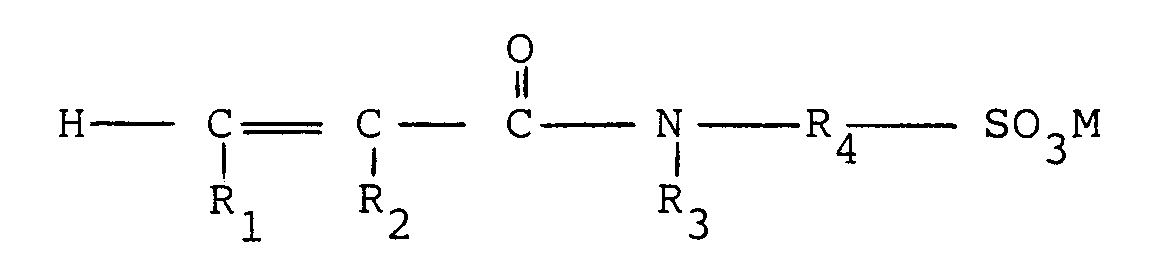
where R₁, R₂ and R₃ are independently hydrogen or C₁-C₆ alkyl, R₄ is C₁-C₆ alkylene or alkyl-substituted C₁-C₆ alkylene, and M is hydrogen, an alkali metal or ammonium ion.
where R₁, R₂ and R₃ are independently hydrogen or C₁-C₆ alkyl, R₄ is C₁-C₆ alkylene or alkyl-substituted C₁-C₆ alkylene, and M is hydrogen, an alkali metal or ammonium ion.
4. A process according to claim 1 or 2, in which said α,β-ethylenically unsaturated monomer(s)
comprise a monomer selected from vinyl acetate, allyl alcohol, acrylamide, N,N'-dimethylacrylamide,
N-methylolacrylamide, N,N'-methylenebisacrylamide, vinyl crotonate, ethylene glycol
diacrylate, tripropylene glycol diacrylate, diallylphthalate, hydroxyethyl acrylate,
hydroxyethyl methacrylate, hydroxypropyl acrylate, vinyl pyrrolidone and N-vinyl-N-methyl-acetamide.
5. A process according to any of claims 1 to 4, in which an aqueous solution of said
α,β-ethylenically unsaturated monomer or monomers (a), (b) and/or (c) is added to
said aqueous solution system.
6. A process according to any of claims 1 to 5, in which said water-soluble initiator
is selected from hydrogen peroxide, t-butylhydroperoxide, sodium, potassium and ammonium
persulfate, and 2,2¹-azobis-(2-amidinopropane) hydrochloride, and is present in an
amount of from 0.5 to 10 percent, by weight, based on the total weight of monomers
used in the process.
7. A process according to any of claims 1 to 5, in which said water-soluble initiator
comprises hydrogen peroxide.
8. A process according to any of claims 1 to 7, in which said dicarboxylic acid monomer
is maleic acid, a monoalkali metal maleate or a monoammonium maleate.
9. A process according to any of claims 1 to 8, in which from about 1 to about 250 ppm
of said metal ion is present in said aqueous solution system.
10. A process according to claim 9, in which from 1 to 5 ppm of said metal ion is present
in said aqueous solution system.
11. A process according to any of claims 1 to 10, in which the pH of said polymerization
system is maintained in the range of from 2 to 4 and the molar ratio of dicarboxylic
acid monomer to α,β-ethylenically unsaturated monomer(s) (a), (b) and/or (c) is from
1:4 to 1:3.
12. A process according to any of claims 1 to 10, in which the pH of said polymerization
system is maintained in the range of from 4 to 6 and the molar ratio of dicarboxylic
acid monomer to α,β-ethylenically unsaturated monomer(s) (a), (b) and/or (c) is from
1:1.5 to 1:1.
1. Procédé de fabrication d'un copolymère hydrosoluble d'un acide dicarboxylique à insaturation
monoéthylénique comportant de 4 à 6 atomes de carbone et d'un monomère à insaturation
α,β-éthylénique, ledit copolymère ayant une masse moléculaire moyenne en poids de
2 000 à 1 000 000, procédé dans lequel, par rapport au poids total des monomères,
on fait réagir de 10 à 70% en poids dudit acide dicarboxylique, au moins partiellement
neutralisé, avec de 90 à 30% en poids d'un ou plusieurs monomères à insaturation α,β-éthylénique
choisis parmi (a) les acides monocarboxyliques comportant de 3 à 10 atomes de carbone
et leurs sels de métal alcalin et d'ammonium, (b) les composés d'acides sulfoniques
organiques et leurs sels de métal alcalin et d'ammonium, (c) les monomères vinyliques
exempts de groupes carboxyle et acide sulfonique, et des mélanges de ces monomères
(a), (b) et (c), à une température de 40° à 150°C, dans un système en solution aqueuse
essentiellement exempt d'agents de transfert de chaîne organiques, ledit acide dicarboxylique
étant d'abord dissous dans ledit système en solution aqueuse et étant au moins partiellement
neutralisé, et ledit ou lesdits monomères à insaturation α,β-éthylénique et un initiateur
hydrosoluble étant ajoutés au système en solution aqueuse résultant durant une période
de 3 à 10 heures, la quantité totale de monomères employée dans ladite réaction constituant
au moins 30% en poids dudit système en solution aqueuse, caractérisé en ce que ladite
réaction de polymérisation est mise en oeuvre en présence d'une quantité, efficace
pour réduire la teneur résiduelle en acide dicarboxylique non polymérisé dans ledit
système en solution aqueuse jusqu'à une valeur ne dépassant pas 0,5% en poids, par
rapport au copolymère sec total, d'un ion métallique choisi parmi Zn⁺⁺, Co⁺⁺⁺, Co⁺⁺,
Cu⁺⁺, Mo⁺⁺, Fe⁺⁺⁺, Fe⁺⁺, Cr⁺⁺, Ni⁺⁺, Ce⁺⁺⁺⁺ et Ce⁺⁺ et leurs mélanges, tout en maintenant
le pH dudit système en solution aqueuse à une valeur de 2 à 7, ledit pH augmentant
proportionnellement à l'augmentation du rapport molaire dudit monomère acide dicarboxylique
au total desdits monomères (a), (b) et/ou (c), et caractérisé en outre en ce que le
rapport molaire dudit ion métallique audit initiateur hydrosoluble est de 1:300 à
1:4000.
2. Procédé selon la revendication 1, dans lequel ledit copolymère est obtenu par la réaction
de 25 à 55% en poids dudit acide dicarboxylique, au moins partiellement neutralisé,
avec de 45 à 75% en poids dudit ou desdits monomère(s) à insaturation α,β-éthylénique
(a), (b) et/ou (c).
3. Procédé selon la revendication 1 ou 2, dans lequel ledit ou lesdits monomère(s) à
insaturation α,β-éthylénique comprennent un monomère choisi parmi l'acide vinylsulfonique,
l'acide allylsulfonique, l'acide méthallylsulfonique, l'acide styrènesulfonique, l'acide
vinyltoluènesulfonique, les sels de métal alcalin et d'ammonium de ces acides, et
les composés de formule
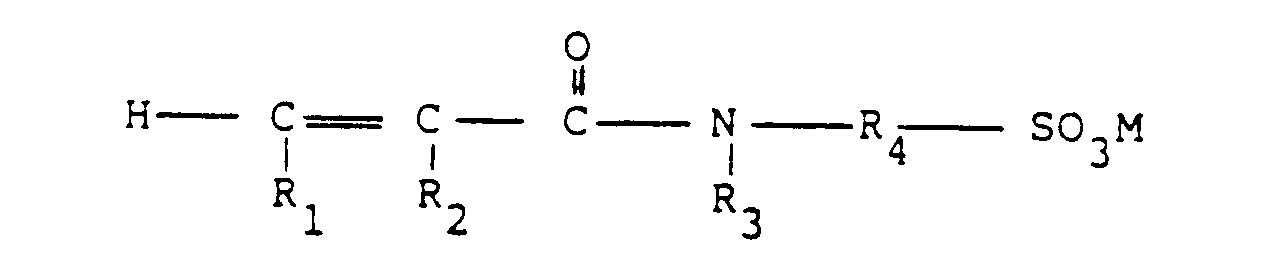
dans laquelle R₁, R₂ et R₃ sont, indépendamment, des atomes d'hydrogène ou des groupes alkyle en C₁-C₆, R₄ est un groupe alkylène en C₁-C₆ ou alkylène en C₁-C₆ alkyl-substitué, et M est un atome d'hydrogène, un métal alcalin ou un ion ammonium.
dans laquelle R₁, R₂ et R₃ sont, indépendamment, des atomes d'hydrogène ou des groupes alkyle en C₁-C₆, R₄ est un groupe alkylène en C₁-C₆ ou alkylène en C₁-C₆ alkyl-substitué, et M est un atome d'hydrogène, un métal alcalin ou un ion ammonium.
4. Procédé selon la revendication 1 ou 2, dans lequel ledit ou lesdits monomère(s) à
insaturation α,β-éthylénique comprennent un monomère choisi parmi l'acétate de vinyle,
l'alcool allylique, l'acrylamide, le N,N'-diméthylacrylamide, le N-méthylolacrylamide,
le N,N'-méthylènebisacrylamide, le crotonate de vinyle, le diacrylate d'ethylèneglycol,
le diacrylate de tripropylèneglycol, le phtalate de diallyle, l'acrylate d'hydroxyéthyle,
le méthacrylate d'hydroxyéthyle, l'acrylate d'hydroxypropyle, la vinylpyrrolidone
et le N-vinyl-N-méthylacétamide.
5. Procédé selon l'une quelconque des revendications 1 à 4, dans lequel on ajoute audit
système en solution aqueuse une solution aqueuse du monomère ou des monomères à insaturation
α,β-éthylénique (a), (b) et/ou (c).
6. Procédé selon l'une quelconque des revendications 1 à 5, dans lequel ledit initiateur
hydrosoluble est choisi parmi le peroxyde d'hydrogène, l'hydroperoxyde de t-butyle,
le persulfate de sodium, de potassium et d'ammonium, et le chlorhydrate de 2,2¹-azobis(2-amidinopropane),
et est présent en une quantité de 0,5 à 10%, en poids, par rapport au poids total
des monomères utilisés dans le procédé.
7. Procédé selon l'une quelconque des revendications 1 à 5, dans lequel ledit initiateur
hydrosoluble comprend du peroxyde d'hydrogène.
8. Procédé selon l'une quelconque des revendications 1 à 7, dans lequel ledit monomère
acide dicarboxylique est l'acide maléique, un maléate de mono(métal alcalin) ou un
maléate de monoammonium.
9. Procédé selon l'une quelconque des revendications 1 à 8, dans lequel d'environ 1 à
environ 250 ppm dudit ion métallique est présent dans ledit système en solution aqueuse.
10. Procédé selon la revendication 9, dans lequel de 1 à 5 ppm dudit ion métallique est
présent dans ledit système en solution aqueuse.
11. Procédé selon l'une quelconque des revendications 1 à 10, dans lequel le pH dudit
système de polymérisation est maintenu dans le domaine de 2 à 4 et le rapport molaire
du monomère acide dicarboxylique au(x) monomère(s) à insaturation α,β-éthylénique
(a), (b) et/ou (c) est de 1:4 à 1:3.
12. Procédé selon l'une quelconque des revendications 1 à 10, dans lequel le pH dudit
système de polymérisation est maintenu dans le domaine de 4 à 6 et le rapport molaire
du monomère acide dicarboxylique au(x) monomère(s) à insaturation α,β-éthylénique
(a), (b) et/ou (c) est de 1:1,5 à 1:1.
1. Verfahren zur Herstellung eines wasserlöslichen Copolymeren einer monoethylenisch
ungesättigten Dicarbonsäure mit 4 bis 6 Kohlenstoffatomen und eines α,β-ethylenisch
ungesättigten Monomeren, wobei jenes Copolymer ein gewichtsmittleres Molekülgewicht
von 2000 bis 1 000 000 aufweist und bei diesem Verfahren 10 bis 70 Gew.-% bezüglich
des Gesamtgewichts an Monomeren dieser, zumindest teilweise neutralisierten Dicarbonsäure
mit 90 bis 30 Gew.-% eines oder mehrerer α,β-ethylenisch ungesättigter Monomere, ausgewählt
aus (a) Monocarbonsäuren mit 3 bis 10 Kohlenstoffatomen sowie deren Alkali- und Ammoniumsalze,
(b) organischen Sulphonsäureverbindungen sowie deren Alkali- und Ammoniumsalze, (c)
carboxyl- und sulphonsäuregruppenfreie Vinylmonomeren sowie Mischungen aus jenen (a)-,
(b)- und (c)-Monomeren, bei einer Temperatur von 40 bis 150°C in einem wäßrigen, von
organischen Kettenübertragungsmitteln im wesentlichen freien Lösungssystem umgesetzt
wird, wobei jene Dicarbonsäure zuerst in jenem wäßrigen Lösungssystem gelöst und zumindest
teilweise neutralisiert wird, und jenes α,β-ethylenisch ungesättigte Monomere oder
Monomeren sowie ein wasserlöslicher Initiator dem entstehenden wäßrigen Lösungsystem
innerhalb von 3 bis 10 Stunden zugegeben werden, wobei die Gesamtmenge an in jener
Reaktion eingesetzten Monomeren mindestens 30 Gew.-% bezüglich jenes wäßrigen Lösungssystems
beträgt, dadurch gekennzeichnet, daß jene Polymerisationsreaktion in Gegenwart einer
zur Verringerung der Restmenge an unpolymerisierter Dicarbonsäure in jenem wäßrigen
Lösungssystem auf einen Wert, der 0,5 Gew.-% bezüglich des Gesamttrockencopolymeren
nicht überschreitet, wirksamen Menge eines Metallions, ausgewählt aus Zn⁺⁺, Co⁺⁺⁺,
Co⁺⁺, Cu⁺⁺, Mo⁺⁺, Fe⁺⁺⁺, Fe⁺⁺, Cr⁺⁺, Ni⁺⁺, Ce⁺⁺⁺⁺ und Ce⁺⁺ sowie deren Mischungen,
unter Aufrechterhaltung des pH-Wertes jenes wäßrigen Lösungssystems bei 2 bis 7 erfolgt,
wobei jener pH proportional zur Zunahme des Molverhältnisses jenes Dicarbonsäuremonomeren
zu der Gesamtmenge jener (a)- , (b)- und/oder (c)-Monomerer ansteigt, und weiterhin
dadurch gekennzeichnet, daß das Molverhältnis jenes Metallions zu jenem wasserlöslichen
Initiator 1:300 bis 1:4000 beträgt.
2. Verfahren nach Anspruch 1, wobei jenes Copolymere durch Reaktion von 25 bis 55 Gew.-%
jener mindestens teilweise neutralisierten Dicarbonsäure mit 45 bis 75 Gew.-% jenes
α,β-ethylenisch ungesättigten/r Monomeren/r (a), (b) und/oder (c) erhalten wird.
3. Verfahren nach Anspruch 1 oder 2, bei dem jene/s α,β-ethylenisch ungesättigten Monomeres/n
ein Monomer enthält/enthalten, ausgewählt aus Vinylsulphonsäure, Allylsulphonsäure,
Methallylsulphonsäure, Styrolsulphonsäure, Vinyltoluolsulphonsäure, den Alkali- und
Ammoniumsalzen solcher Säuren und Verbindungen der Formel
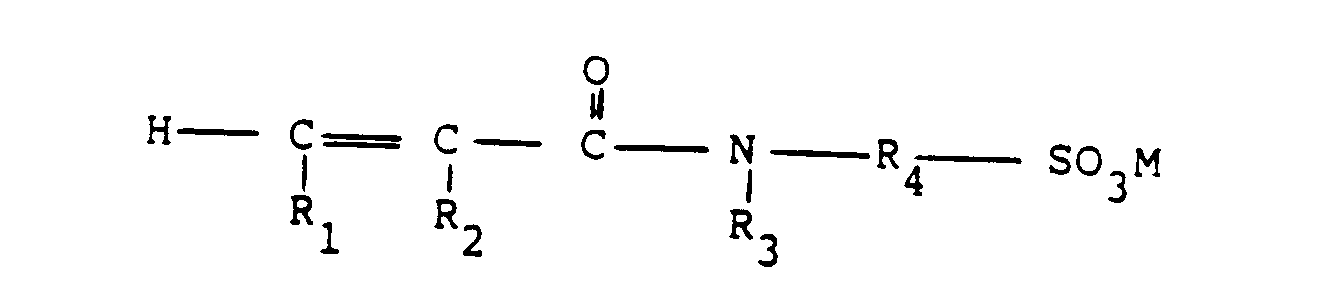
worin R₁, R₂ und R₃ unabhängig Wasserstoff oder C₁-C₆-Alkyl, R₄ C₁-C₆-Alkylen oder durch Alkyl substituiertes C₁-C₆-Alkylen und M Wasserstoff, ein Alkali- oder Ammoniumion bedeuten.
worin R₁, R₂ und R₃ unabhängig Wasserstoff oder C₁-C₆-Alkyl, R₄ C₁-C₆-Alkylen oder durch Alkyl substituiertes C₁-C₆-Alkylen und M Wasserstoff, ein Alkali- oder Ammoniumion bedeuten.
4. Verfahren nach Anspruch 1 oder 2, worin jene/s α,β-ethylenisch ungesättigte/n Monomeres/n
ein Monomer enthält/enthalten, ausgewählt aus Vinylacetat, Allylalkohol, Acrylamid,
N,N'-Dimethylacrylamid, N-Methylolacrylamid, N,N'-Methylenbisacrylamid, Vinylcrotonat,
Ethylenglycoldiacrylat, Tripropylenglycoldiacrylat, Diallylphthalat, Hydroxyethylacrylat,
Hydroxyethylmethacrylat, Hydroxypropylacrylat, Vinylpyrrolidon und N-Vinyl-N-methylacetamid.
5. Verfahren nach einem der Ansprüche 1 bis 4, worin eine wäßrige Lösung jenes/r α,β-ethylenisch
ungesättigten/r Monomeren/r (a), (b) und/oder (c) jenem wässrigen Lösungssystem zugegeben
wird.
6. Verfahren nach einem der Ansprüche 1 bis 5, worin jener wasserlösliche Initiator aus
Hydrogenperoxid, t-Butylhydroperoxid, Natrium-, Kalium- und Ammoniumpersulfat und
2,2'-Azobis-(2-amidinopropan)hydrochlorid ausgewählt und in einer Menge von 0,5 bis
10 Gew.-% bezüglich des Gesamtgewichts an in dem Verfahren eingesetzten Monomeren
vorhanden ist.
7. Verfahren nach einem der Ansprüche 1 bis 5, worin jener wasserlösliche Initiator aus
Hydrogenperoxid besteht.
8. Verfahren nach einem der Ansprüche 1 bis 7, worin es sich bei jenem Dicarbonsäuremonomeren
um Maleinsäure, ein Monoalkalimaleat oder ein Monoammoniummaleat handelt.
9. Verfahren nach einem der Ansprüche 1 bis 8, worin etwa 1 bis etwa 250 ppm jenes Metallions
in jenem wäßrigen Lösungssystem enthalten sind.
10. Verfahren nach Anspruch 9, worin 1 bis 5 ppm jenes Metallions in jenem wäßrigen Lösungssystem
enthalten sind.
11. Verfahren nach einem der Ansprüche 1 bis 10, worin der pH-Wert jenes Polymerisationssystems
im Bereich von 2 bis 4 aufrechterhalten wird und das Molverhältnis aus Dicarbonsäuremonomerem
zu α,β-ethylenisch ungesättigtem/n Monomerem/n (Monomerer) (a), (b) und/oder (c) 1:4
bis 1:3 beträgt.
12. Verfahren nach einem der Ansprüche 1 bis 10, worin der pH-Wert jenes Polymerisationssystems
im Bereich von 4 bis 6 aufrechterhalten wird und das Molverhältnis aus Dicarbonsäuremonomerem
zu α,β-ethylenisch ungesättigtem/n Monomerem/n (a), (b) und/oder (c) 1:1,5 bis 1:1
beträgt.