|
(11) | EP 0 237 279 B1 |

| (12) | EUROPEAN PATENT SPECIFICATION |
|
|
| (54) |
Process of preparing 1-methyl-3,5,7-triaza-1-azoniatricyclodecane halides Verfahren zur Herstellung von 1-Methyl-3,5,7-triaza-1-azoniatricyclodecan-Halogeniden Procédé pour la préparation d'halides de 1-méthyl-3,5,7-triaza-1-azoniatricyclodécane |
|
|
|||||||||||||||||||||||||||||||
| Note: Within nine months from the publication of the mention of the grant of the European patent, any person may give notice to the European Patent Office of opposition to the European patent granted. Notice of opposition shall be filed in a written reasoned statement. It shall not be deemed to have been filed until the opposition fee has been paid. (Art. 99(1) European Patent Convention). |
[0001] This invention relates to the preparation of organic compounds and more particularly to the preparation of quaternary ammonium salts of hexamethylenetetramine which are useful as microbicides.
[0002] These organic quaternary ammonium salts are more specifically designated as 1-methy)-3,5,7-triaza-1- azoniatricyclodecane fluoride, chloride, bromide and iodide which have the formula (I)
wherein X is fluoride, chloride, bromide, or iodide.
[0003] Friedrich et al. (Ber. 54B, 1531-42, 1921) have reported the preparation of such compounds, specifically 1-methyl-3,5,7-triaza-1-azoniatricyclodecane chloride, by refluxing a mixture of formaldehyde, ammonium hydroxide and ammonium chloride for 7 hours. As shown in Comparative Example 1, however, the reaction time for this reaction is unusually long and the yields of the desired product are disadvantageously low.
[0004] It would therefore be desirable to provide an improved process for the preparation of the quaternary ammonium compounds of formula (I) and especially an economical process for their preparation as aqueous solutions.
[0005] We have now found that the compounds of formula (I) may be prepared more efficiently by reacting an ammonium halide of formula NH4X (wherein X is as defined above) with methylamine, formaldehyde and ammonia in an aqueous medium at a temperature of from 40 to 70°C, each mole of ammonium halide being reacted with from 0.75 to 1.25 moles of methylamine, from 5.75 to 6.25 moles of formaldehyde and 1.75 or more moles of ammonia. Preferably, an aqueous reaction medium of the ammonium halide, methylamine and formaldehyde is first prepared, followed by addition of sufficient ammonia to bring the pH of the final reaction medium to from about 6 to 8.
[0006] The quaternary ammonium salts of formula (I) are thus prepared in accordance with the present invention by reacting an ammonium halide, preferably ammonium chloride, ammonium bromide or ammonium iodide, with methylamine, formaldehyde and ammonia in an aqueous system. All of these starting materials for the process of the present invention are readily available commercial products.
[0007] In the reaction of the present invention, each mole of ammonium halide is preferably reacted with 2 or more moles of ammonia. Most preferably, from 2 to 2.4 moles of ammonia per mole of ammonium halide are used in the reaction.
[0008] The process of the present invention is preferably conducted at a temperature in the range from about 45 to 50°C.
[0009] The process of the present invention is preferably conducted by forming an aqueous reaction medium by treating formaldehyde with a mixture of ammonium halide and methylamine while keeping the temperature around about 45°C.
[0010] Ammonia is then preferably added to the reaction medium, the temperature of which is preferably kept below 50°C. The amount of ammonia added is preferably 1.75, more preferably 2, or more moles per mole of ammonium halide to bring the pH of the final reaction medium, preferably an aqueous solution, within the range of from about 6 to 8.
[0011] The reaction is conducted for a time sufficient to generate the required yield of quaternary ammonium salt of formula (I). Preferably, the reaction is conducted for about 2 hours to 6 hours, more preferably for about 2 hours.
COMPARATIVE EXAMPLE 1
PreDaration of 1-methvl-3.5.7-triaza-1-azoniatricvclodecane chloride
[0013] A 250 ml, three-neck round-bottom flask equipped with a reflux condenser, a mechanical stirrer and a thermometer was charged with 22 g (0.410 moles) of ammonium chloride and 129 g (1.59 moles) of 37% aqueous formaldehyde. To the above well-agitated mixture were added 40 g (0.286 moles) of 25% aqueous ammonium hydroxide. After completing the addition of ammonium hydroxide, the solution was heated under reflux for 7 hours. The resulting water-clear solution was analyzed by HPLC. The solution contained 5.6% (24.7% yield) by weight of the 1-methy)-3,5,7-triaza-1-azoniatricyciodecanechloride.
EXAMPLE 2
PreDaration of 1-methyl-3.5.7-triaza-1-azoniatricyclodecane chloride
[0014] A 2.0 litre, three-neck flask equipped with a reflux condenser, a mechanical stirrer, a thermometer and a dropping funnel was charged with 67.0 g (1.25 moles) of ammonium chloride and 78.0 g (1.25 moles) of 50% aqueous methylamine. To the above well-agitated mixture were slowly added 608.0 g (7.5 moles) of 37% aqueous formaldehyde, while maintaining the temperature between 45° and 50°C. After completing this addition and while continuing vigorous agitation, 175.0 g (3 moles) of 29% aqueous ammonia were introduced at such a rate as to maintain the temperature between 45° and 50°C. Stirring was continued for an additional 2 hours while the temperature fell gradually to ambient. The resulting water-clear solution was analysed by HPLC. This solution contained 23% (89% yield) by weight of the 1-methyl-3,5,7-tria- za-1-azoniatricyclodecane chloride.
EXAMPLE 3
Preparation of 1-methyl-3.5.7-triaza-1-azoniatricyclodecane bromide
[0015] A 2.0 litre, three-neck flask equipped with a reflux condenser, a mechanical stirrer, a thermometer and a dropping funnel was charged with 98.0 g (1.25 moles) of ammonium bromide and 78.0 g (1.25 moles) of 50% aqueous methylamine. To the above well-agitated mixture were slowly added 608.0 g (7.5 moles) of 37% aqueous formaldehyde, while maintaining the temperature between 45° and 50°C. After completing the addition and while continuing vigorous agitation, 175.0 g (3 moles) of 29% aqueous ammonia were introduced at such a rate as to maintain the temperature between 45° and 50°C. Stirring was continued for an additional 2 hours while the temperature fell gradually to ambient. The resulting water-clear solution was analysed by HPLC. This solution contained 24.7% (83% yield) by weight of the 1-methyl-3,5,7-triaza-1-azoniatricyclodecane bromide.
EXAMPLE 4
Preparation of 1-methvl-3.5.7-triaza-1-azoniatricvclodecane iodide
[0016] A 250 ml, three-neck round-bottom flask equipped with a reflux condenser, a mechanical stirrer, a thermometer and a dropping funnel was charged with 36.3 g (0.250 moles) of ammonium iodide and 15.6 g (0.250 moles) of 50% aqueous methylamine. To the above well-agitated mixture were slowly added 121.6 g (1.5 moles) of 37% aqueous formaldehyde, while maintaining the temperature between 45° and 50°C. After completing the addition and while continuing vigorous agitation, 30.4 g (0.500 moles) of 29% aqueous ammonia were introduced at such a rate as to maintain the temperature between 45° and 50°C. Stirring was continued for an additional 2 hours while the temperature fell gradually to ambient. The resulting water-clear solution was analysed by HPLC. This solution contained 29.0% (86% yield) by weight of the 1-methyl-3,5,7-triaza-1 -azoniatricydodecane iodide.
1. A process for the preparation of a compound of the formula (I):
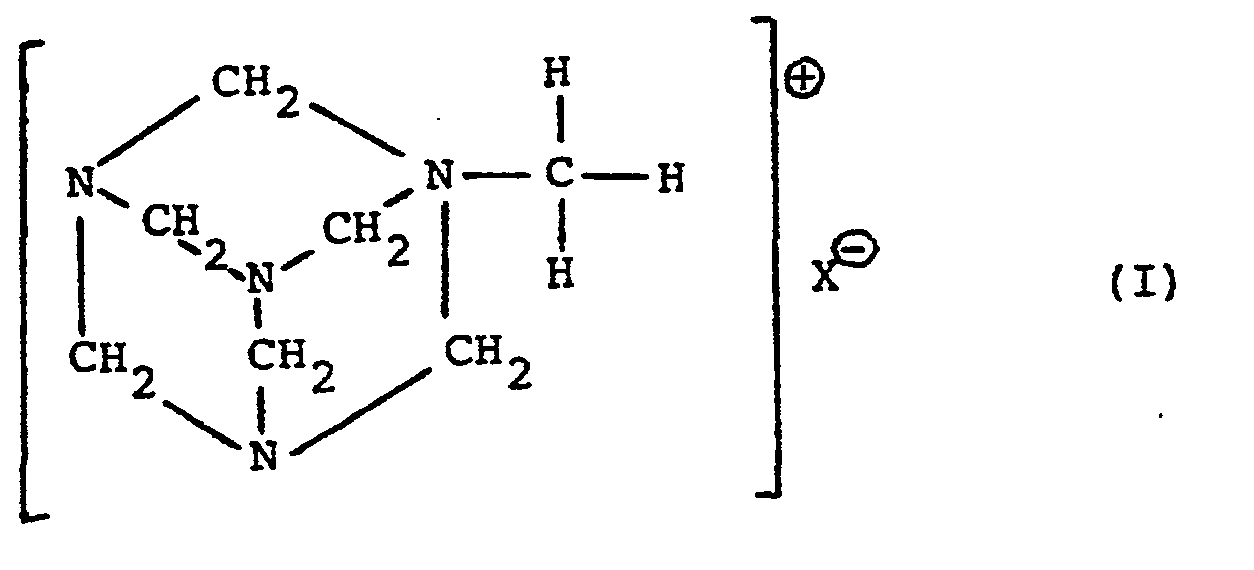
(wherein X is a fluoride, chloride, bromide or iodide anion) characterised in that an ammonium halide of formula NH4X (wherein X is as defined above) is reacted with methylamine, formaldehyde and ammonia in an aqueous medium at a temperature of from 40 to 70°C, each mole of ammonium halide being reacted with from 0.75 io 1.25 moles of methylamine, from 5.75 to 6.25 moles of formaldehyde and 1.75 or more moles of ammonia.
(wherein X is a fluoride, chloride, bromide or iodide anion) characterised in that an ammonium halide of formula NH4X (wherein X is as defined above) is reacted with methylamine, formaldehyde and ammonia in an aqueous medium at a temperature of from 40 to 70°C, each mole of ammonium halide being reacted with from 0.75 io 1.25 moles of methylamine, from 5.75 to 6.25 moles of formaldehyde and 1.75 or more moles of ammonia.
2. A process according to claim 1 wherein each mole of ammonium halide is reacted
with from 2 to 2.4 moles of ammonia.
3. A process according to any preceding claim wherein the temperature is maintained
at about 45-50°C.
4. A process according to any preceding claim wherein the reaction is conducted for
from about two to six hours.
5. A process claim 1 according to any preceding claim wherein an ammonium halide is
used in which X is chloride, bromide or iodide.
6. A process according to any preceding claim wherein the reaction is conducted by
forming an aqueous reaction medium of the ammonium halide, methylamine and formaldehyde,
followed by addition of ammonia to the said reaction medium in an amount sufficient
to adjust the pH of the reaction medium to from about 6 to 8.
7. A process according to claim 6 wherein the reaction medium is an aqueous solution.
1. Verfahren zur Herstellung einer Verbindung der Formel (I):
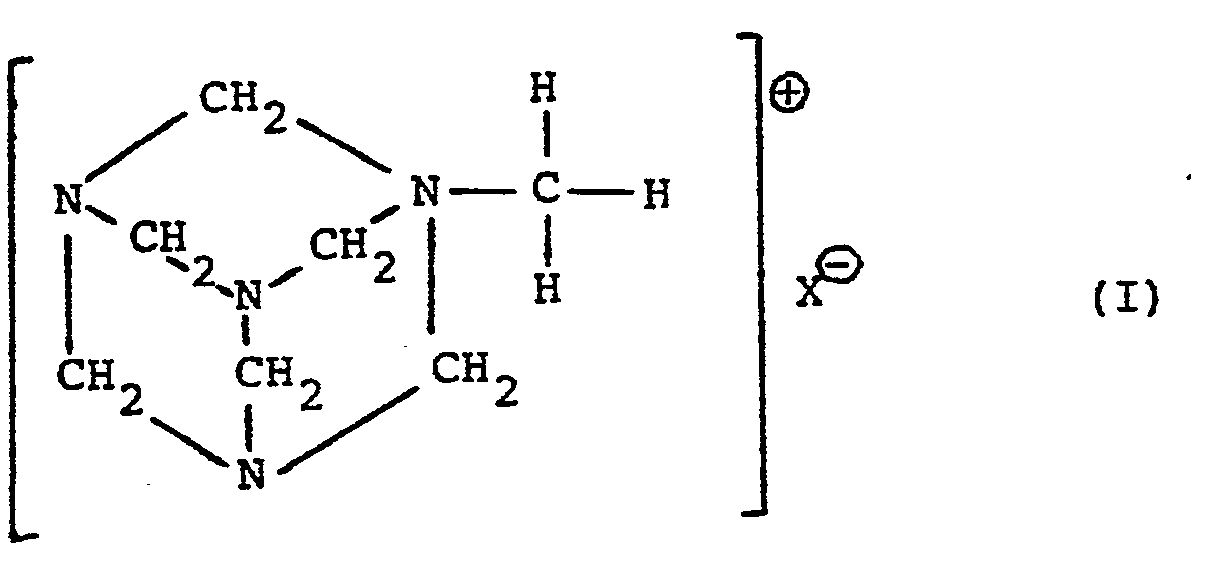
(worin X ein Fluorid-, Chlorid-, Bromid- oder Jodidanion ist), dadurch gekennzeichnet, daß ein Ammoniumhalogenid der Formel NH4X (worin X wie oben definiert ist) umgesetzt wird mit Methylamin, Formaldehyd und Ammoniak in einem wäßrigen Medium bei einer Temperatur von 40 bis 70°C, wobei jedes Mol Ammoniumhalogenid mit 0,75-1,25 Molen Methylamin, 5,75 bis 6,25 Molen Formaldehyd und 1,75 oder mehr Molen Ammoniak umgesetzt wird.
(worin X ein Fluorid-, Chlorid-, Bromid- oder Jodidanion ist), dadurch gekennzeichnet, daß ein Ammoniumhalogenid der Formel NH4X (worin X wie oben definiert ist) umgesetzt wird mit Methylamin, Formaldehyd und Ammoniak in einem wäßrigen Medium bei einer Temperatur von 40 bis 70°C, wobei jedes Mol Ammoniumhalogenid mit 0,75-1,25 Molen Methylamin, 5,75 bis 6,25 Molen Formaldehyd und 1,75 oder mehr Molen Ammoniak umgesetzt wird.
2. Verfahren nach Anspruch 1, wobei jedes Mol Ammoniumhalogenid mit 2 bis 2,4 Molen
Ammoniak umgesetzt wird.
3. Verfahren nach mindestens einem der vorangehenden Ansprüche, wobei die Temperatur
bei etwa 45-50°C gehalten wird.
4. Verfahren nach mindestens einem der vorangehenden Ansprüche, wobei die Umsetzung
etwa 2 bis 6 Stunden durchgeführt wird.
5. Verfahren nach mindestens einem der vorangehenden Ansprüche, wobei ein Ammoniumhalogenid
verwendet wird, worin X Chlorid, Bromid oder Jodid ist.
6. Verfahren nach mindestens einem der vorangehenden Ansprüche, wobei die Umsetzung
durchgeführt wird durch Bilden eines wäßrigen Reaktionsmediums aus dem Ammoniumhalogenid,
Methylamin und Formaldehyd, mit anschließender Zugabe von Ammoniak zu diesem Reaktionsmedium
in einer ausreichenden Menge, um den pH des Reaktionsmediums auf etwa 6 bis 8 einzustellen.
7. Verfahren nach Anspruch 6, wobei das Reaktionsmedium eine wäßrige Lösung ist.
1. Procédé pour la préparation d'un composé de la formule (I):
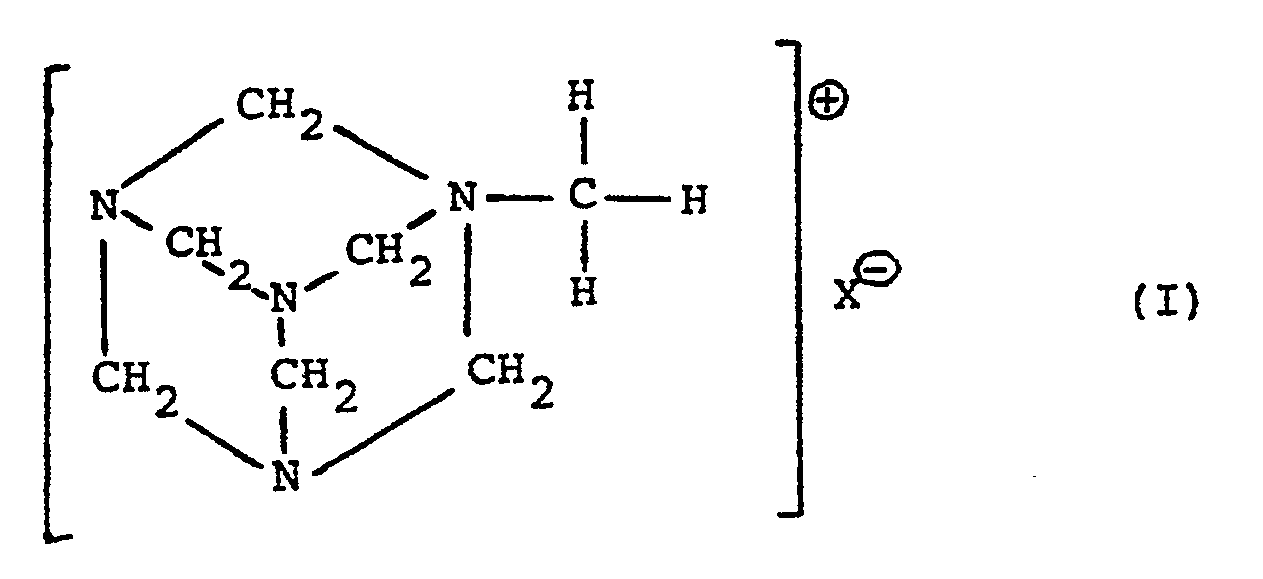
où X est un anion fluorure, chlorure, bromure ou iodure, caractérisé en ce que l'on fait réagir un halogénure d'ammonium de formule NH4X (où X est défini comme ci-dessus) avec la méthylamine, le formaldéhyde et l'ammoniac, dans un milieu aqueux à une température de 40 à 70°C, la réaction ayant lieu pour chaque mole d'halogénure d'ammonium avec de 0,75 à 1,25 mole de méthylamine, de 5,75 à 6,25 moles de formaldéhyde et 1,75 mole (ou plus) d'ammoniac.
où X est un anion fluorure, chlorure, bromure ou iodure, caractérisé en ce que l'on fait réagir un halogénure d'ammonium de formule NH4X (où X est défini comme ci-dessus) avec la méthylamine, le formaldéhyde et l'ammoniac, dans un milieu aqueux à une température de 40 à 70°C, la réaction ayant lieu pour chaque mole d'halogénure d'ammonium avec de 0,75 à 1,25 mole de méthylamine, de 5,75 à 6,25 moles de formaldéhyde et 1,75 mole (ou plus) d'ammoniac.
2. Procédé selon la revendication 1, caractérisé en ce que l'on fait réagir chaque
mole d'halogénure d'ammonium avec de 2 à 2,4 moles d'ammoniac.
3. Procédé selon l'une quelconque des revendications précédentes, caractérisé en ce
qu'on maintient la température à environ 45-50°C.
4. Procédé selon l'une quelconque des revendications précédentes, caractérisé en ce
qu'on poursuit la réaction pendant environ 2 à 6 heures.
5. Procédé défini par la revendication 1, selon une quelconque des revendications
précédentes, caractérisé en ce que l'on utilise un halogénure d'ammonium dans lequel
X est un anion chlorure, bromure ou ionure.
6. Procédé selon l'une quelconque des revendications précédentes, caractérisé en ce
que l'on mène la réaction en créant un milieu de réaction aqueux avec l'halogénure
d'ammonium, la méthylamine et le formaldéhyde, puis en ajoutant de l'ammoniac audit
milieu de réaction en une proportion suffisant à ajuster le pH du milieu de réaction
à une valeur d'environ 6 à 8.
7. Procédé selon la revendication 6, caractérisé en ce que le milieu de réaction est
une solution aqueuse.