|
(11) | EP 0 240 963 B1 |

| (12) | EUROPEAN PATENT SPECIFICATION |
|
|
| (54) |
Magnetic recording medium Magnetischer Aufzeichnungsträger Milieu d'enregistrement magnétique |
|
|
|||||||||||||||||||||||||||||||
| Note: Within nine months from the publication of the mention of the grant of the European patent, any person may give notice to the European Patent Office of opposition to the European patent granted. Notice of opposition shall be filed in a written reasoned statement. It shall not be deemed to have been filed until the opposition fee has been paid. (Art. 99(1) European Patent Convention). |
[0001] The present invention relates to a magnetic recording medium such as a magnetic tape, a magnetic disc and a magnetic card. More particularly, it relates to a magnetic recording medium comprising a lubricant layer on a surface of a magnetic layer.
[0002] A magnetic recording medium comprising a substrate and a magnetic layer which is formed on the substrate and consists of a thin film of a metal or a metal oxide with high coercive force has an extremely smooth surface and a large coefficient of friction, so that it is easily abrased or damaged when it is slid against a magnetic head and/or a guide during recording or reproducing. To prevent abrasion and damage of such magnetic layer, it has been proposed to coat the surface of the magnetic layer with a lubricating layer comprising higher fatty acids or their metal salts, and macromolecular compounds such as organic silicon compounds, whereby the coefficient of the surface of the magnetic layer is reduced so as to improve abrasion resistance, durability and running stability of the magnetic recording medium.
[0003] For a magnetic recording medium comprising a magnetic coating layer formed by applying a magnetic paint and drying it, improvement of abrasion resistance of the magnetic layer is increasingly required with the increase of surface smoothness of the magnetic layer which is desired for better electromagnetic conversion characteristics. To this end, it has been proposed to coat the surface of the magnetic layer with various lubricants to form a protective film with good lubrication, or to add the lubricant to the magnetic coating layer so as to exude it on the surface of the magnetic layer.
[0004] When the surfaces of the magnetic layer and of the magnetic head or the tape guide are extremely smooth, under a circumstance where the magnetic recording medium is slid on the magnetic head at a high speed, the lubricant cannot exert sufficient lubrication effect and viscosity resistance of the lubricant increases so that the running stability of the medium is deteriorated and, in turn, fluctuation of output is increased. Furthermore, the magnetic recording medium sticks to the tape guide and running of the medium is stopped.
[0005] GB-A-2 042 369 discloses lubricating coatings for magnetic recording media. In Example 1D and 1E a liquid lubricant and a solid lubricant is used in combination. After drying, the surface of the lubricant should be buffed with a dry, soft tissue to distribute the lubricant and remove any excess.
[0007] One object of the present invention is to provide a magnetic recording medium with improved abrasion resistance, durability and running stability. Another object of the present invention is to provide a magnetic recording medium having a magnetic layer on which a lubricating layer with a specific construction is formed.
[0008] These and other objects of the present invention are achieved by a magnetic recording medium comprising a substrate, a magnetic layer formed on at least one surface of the substrate and a lubricant layer comprising at least a liquid lubricant, selected from the group consisting of fluorine-containing liquid compounds of the formula:
or
Y-CF₂O-(CF₂CF₂O)m-(CF₂O)n-CF₂-X (II)
wherein the organic groups X and/or Y are the same or different having a terminal carbon-carbon double bond and are a (meth)acryloyloxy group of the formula:
wherein R₄ is a hydrogen atom or a methyl group, or an alkylene group having said (meth)acryloyloxy group, l is an integer of 10 to 100, m is an integer of 5 to 100 and n is an integer of 10 to 200 and a solid lubricant, selected from the group consisting of a higher fatty acid, a higher fatty acid ester and a fluorine-containing solid compound, which are not or hardly compatible with each other and coated on the surface of the magnetic layer, having a sea-island structure of at least one lubricant forming a continuous film on the surface of the magnetic layer and at least a second lubricant forming discontinuous portions in the continuous film.
[0009] Figure is a graph showing a relationship between the running speed of the magnetic tape and the coefficient of friction of the magnetic layer in Example 1 and Comparative Example 1.
[0010] When at least two specific lubricants which are not or hardly compatible with each other are coated on the surface of the magnetic layer, they are not mixed together and are separated from each other in microphase. Then, one lubricant having better affinity with the magnetic layer due to its properties and molecular structure than others forms a continuous film ("sea" portion) on the surface of the magnetic layer, and other lubricant(s) having less affinity with the surface of the magnetic layer forms discontinuous "islands" in the "sea" portion and thereby the sea-island structure of the lubricants is formed on the surface of the magnetic layer.
[0011] When the sea-island structure of the lubricants is destroyed by high speed sliding of the magnetic layer on the magnetic head or the guide, a new sea-island structure is successively formed by microphase separation of the lubricants. Therefore, the lubricant layer can keep stable performance, and viscosity resistance of the lubricants does not increase under high speed sliding conditions. In addition, since the lubricant layer with the sea-island structure has good durability or permanence, it has much better lubricating effect than the lubricant which forms the "sea" portion. By this effect together with the suppression of the viscosity resistance, the magnetic recording medium according to the present invention has better running stability and less fluctuation of output, and its sticking to the guide is prevented.
[0012] The combination of the lubricants is a combination of a liquid lubricant and a solid lubricant, in which the former forms the "sea" and the latter forms "islands".
[0013] The liquid lubricant is in a liquid state at room temperature. In view of good affinity with the surface of the magnetic layer and lubricating properties, supplementary liquid lubricants such as fluorine-containing compounds, organic silicone compounds and fatty acid esters are preferred.
[0014] The solid lubricant is in a solid or semisolid state at room temperature and incompatible with the liquid lubricant. In view of the lubricating effect, higher fatty acid, higher fatty acid esters and fluorine-containing compounds are used
[0015] The fluorine-containing liquid lubricants are compounds of the formula:
or
Y-CF₂O-(CF₂CF₂O)m-(CF₂O)n-CF₂-X (II)
wherein X and Y are the same or different and having for a terminal carbon-carbon double bond a (meth)acryloyloxy group of the formula:
wherein R₄ is a hydrogen atom or a methyl group, or an alkylene group having the group (i), l is an integer of 10 to 100, m is an integer of 5 to 100 and n is an integer of 10 to 200.
[0016] Other fluorine-containing liquid compounds may be used as supplementary liquid lubricants insofar as they have the same properties as the fluorine-containing compounds (I) and (II).
[0017] Examples of the organic silicone compound as supplementary liquid lubricant are polysiloxanes such as dimethylpolysiloxane and methylphenylpolysiloxane, and silicone compound having a hydrophilic group such as a hydroxyl group, a carboxyl group, a phosphoric acid group [-OP(=O)(OH)₂], a sulfonic acid group [-OS(=O)₂OH], an isocyanate group, salt forms of these groups, or an organic group containing one of these groups and their salt forms. Preferred examples of the salt are salts with alkali metals such as sodium and potassium, although salts with alkaline earth metals, iron, cobalt, nickel, chromium and the like may be used. Specific examples of the organic group containing one of the above groups and their salts are a group of the formula:
-(A)-M (ii)
or
wherein A is an alkylene group having not more than 40 carbon atoms, an alkyleneoxide group having 2 to 4 carbon atoms or a polyalkylene oxide having not more than 80 carbon atoms in total, and M is a hydroxyl group, a carboxylic group, a phosphoric acid group, a sulfonic acid group, an isocyanate group or their salts, or a group of the formula:
-O-(R₁O)q-H (iv)
or
wherein R₁ is an alkylene group having 1 to 4 carbon atoms, one of R₂ and R₃ is a hydrogen atom and the other is a methyl group or both are hydrogen atoms, q is an integer of 1 to 20, and n is an integer of 1 to 20.
[0018] Examples of the fatty acid esters as supplementary liquid lubricant are dioleyl maleate, trimethylolpropane tridecanolate, 2-ethylhexyl stearate and the like.
[0019] Examples of the higher fatty acid as the solid lubricant are fatty acids having at least 12 carbon atoms such as stearic acid. Examples of the ester of the higher fatty acid are a monoalkyl ester or cellosolve of a higher fatty acid having at least 16 carbon atoms, or a phosphate of a higher fatty alcohol having the same number of carbon atoms.
[0020] When two or more liquid lubricants or two or more solid lubricants are used, they may not or hardly be compatible with each other. Essential is that the liquid lubricant and the solid lubricants should not or hardly be compatible.
[0021] In the combination of the liquid lubricant and the solid lubricant, the former forming the "sea" portion is preferably used in an amount of 5 to 99.9 % by weight, particularly preferred 20 to 99.5 % by weight based on the total weight of the all lubricants, while the latter forming the "islands" in the "sea" is preferably used in an amount of 95 to 0.1 % by weight, particularly preferred 80 to 0.5 % by weight based on the total weight of the all lubricants.
[0022] The magnetic recording medium of the present invention may be either of one comprising a non-magnetic substrate and a magnetic layer made of a thin layer of ferromagnetic metal or alloy and one comprising a non-magnetic substrate and a magnetic layer made from a magnetic paint containing magnetic powder. The present invention is particularly useful for the former.
[0023] The ferromagnetic metal or metal oxide may be any of conventionally used ones and includes iron, cobalt, nickel, chromium and their alloys, and alloys of these metals with other metal element or non-metal element as well as their oxides.
[0024] The magnetic layer comprising the ferromagnetic metal or metal oxide is formed by a per se conventional method. For example, on a non-magnetic substrate such as a polyester film, a thin layer of the ferromagnetic metal or metal alloy is formed by vacuum deposition, ion plating, sputtering, plating and the like. The thickness of the ferromagnetic metal or metal oxide thin layer is from 0.005 to 0.5 µm.
[0025] The magnetic layer comprising the ferromagnetic metal or metal oxide may be provided with a coating film on its surface to protect its surface. The protective layer includes an oxide layer formed by oxidizing the surface of the magnetic layer, a layer consisting of a hard metal such as titanium and bismuth or their oxides, a thin layer of an organic or inorganic compound formed by vacuum deposition, sputtering or plasma polymerization. The protective layer may be a single layer or a laminated layer of these layers.
[0026] When the magnetic layer comprises the magnetic coating film, examples of the magnetic powder are metal oxide powder (e.g. γ-Fe₂O₃, Fe₃O₄, an intermediate oxide of these two iron oxides, Co-containing γ-Fe₂O₃, Co-containing Fe₃O₄, CrO₂ and barium, strontium or lead ferrite), and magnetic metal powder (e.g. iron, cobalt, nickel, their alloys, alloys of these metals with other metal or a small amount of non-metal element).
[0027] Specific examples of the binder resin are vinyl chloride-vinyl acetate copolymers, cellulose type resins, polyurethane, polyester resins, polyvinylbutyral, epoxy resins, polyols, and as a cross linking agent, a polyisocyanate compound.
[0028] The magnetic layer comprising the magnetic coating film can be formed by a per se conventional method. For example, a magnetic coating composition is prepared by mixing the magnetic powder, the binder and optionally at least one additive and coated on the non-magnetic substrate such as the polyester film followed by drying. The thickness of the magnetic coating film is preferably from 0.1 to 20 µm. As the optional additive, exemplified are abrasives, dispersion agents and antistatic agents.
[0029] Various methods can be employed to apply the lubricant mixture of the liquid lubricant and the solid lubricant which are not or hardly compatible with each other on the surface of the magnetic layer.
[0030] For example, when the liquid lubricant is the fluorine-containing compound (I) or (II) and solid lubricant is the fluorine-containing solid compound, they are dissolved in a fluorine-containing solvent (e.g. trichlorotrifluoroethane, tetrachlorodifluoroethane, etc.), ketone (e.g. methyl ethyl ketone, methyl isobutyl ketone, etc.) or ester (e.g. ethyl acetate, butyl acetate, etc.) or a mixture thereof. Then the solution containing the lubricants is coated or spray coated on the surface of the magnetic layer. Instead, the magnetic recording medium is dipped in the solution. Thereafter, the magnetic recording medium coated with the lubricant solution is dried to form the lubricant layer having the sea-island structure.
[0031] Alternatively, the lubricant mixture may be contained in or form a back coating on the back surface of the magnetic recording medium. Then, a plural magnetic mediums are piled up, or the magnetic tape is wound. Thereby, the magnetic layer is contacted with the back coating containing or comprising the lubricants so that the lubricants are transferred to the surface of the magnetic layer to form the lubricant layer having the sea-island structure.
[0032] When the magnetic recordimg medium is a magnetic disc and installed in a jacket, the lubricants can be contained in a liner which is made of non-woven fabric. Then, the lubricants are transferred from the jacket to the surface of the magnetic layer to form the lubricant layer with the sea-island structure.
[0033] The amount of the lubricants is usually from 0.5 to 200 mg/m². When the amount of the lubricant is too large, interlayer sticking may occur, this resulting in deterioration of running stability, or the surface condition may be worsen and in turn the electromagnetic conversion characteristics may be deteriorated.
[0034] For simply forming the lubricant layer having the sea-island structure according to the present invention when the magnetic layer is formed by the application of the magnetic paint followed by drying, the lubricants are added to the magnetic paint. When the lubricants are contained in the magnetic layer, they gradually exude onto the surface of the magnetic layer to form the lubricant layer having the sea-island structure. In this manner, the lubricants are added to the magnetic paint in a total amount of 0.2 to 20 % by weight per 100 parts by weight of the magnetic powder.
[0035] The sea-island structure of the lubricant layer is easily observed by a microscope and can be distinguished from a lubricant layer consisting of the lubricant which forms the sea portion.
[0036] In the above description, the liquid lubricant forms the "sea" portion and the solid lubricant forms the "islands". On the contrary, when the solid lubricant has better affinity with the surface of the magnetic layer than the liquid lubricant, the former forms the "sea" portion and the latter forms the "islands".
[0037] The present invention will be illustrated by following examples, in which "parts" are by weight unless otherwise indicated.
Example 1
[0038] On a non-magnetic substrate made of a polyester film of 12 µm in thickness, coated was a magnetic paint comprising iron powder (average major axis of 0.3 µm, average axis ratio of 10, a specific surface area (by nitrogen adsorption method) of 50 m²/g) (78 parts), carbon black (average particle size of 30 nm) (5 parts), nitrocellulose (Trade name H1/2 manufactured by Asahi Chemical) (10 parts), polyurethane elastomer (12 parts), methyl ethyl ketone (100 parts) and n-heptane (50 parts) and dried to form a magnetic layer of 4 µm.
[0039] Then, on the surface of the magnetic layer, a lubricant solution of the compound (II) wherein X and Y are -C(C=O)OCH₃, m is 60 and n is 120 (7 parts) as a liquid lubricant and myristic acid (7 parts) as a solid lubricant in trichlorotrifluoroethane (186 parts) was coated so that, after drying, non-volatile components remained in a total amount of 70 mg/m² followed by drying to form a lubricant layer. Then, the substrate film with the magnetic layer and the lubricant layer was cut to produce a magnetic tape having a width of 12.5 mm.
Comparative Example 1
[0040] In the same manner as in Example 1 but using, as a lubricant solution, a solution of liquid paraffin (14 parts) in methyl ethyl ketone (186 parts), a magnetic tape was produced.
[0041] The magnetic recording tapes produced in the Example and Comparative Example were examined for a coefficient of friction of the magnetic layer, durability and jitter as follows:
Coefficient of friction
[0042] Around a peripheral surface of a steel made cylindrical pin of 4 mm in diameter having surface roughness of 0.2S, a magnetic recording tape is wound at an angle of 150° with facing the magnetic layer surface with the cylinder surface. Then, one end of the tape is pulled at a rate of 1.4 cm/s with applying a load of 21 g to the other end of the tape. After the tape is pulled one hundred times, a coefficient of friction of the surface of the magnetic layer is measured.
Jitter
[0043] A magnetic recording tape is set in a standard video tape recorder and run at a running speed of 1.4 cm/s with applying tension of 6 g to record and reproduce color bar signals over a tape length of 5 m, during which a jitter value is recorded with a jitter meter.
Durability
[0044] A magnetic recording tape is reproduced at 25°C, 60 %RH with a head load of 5 g at a running speed of 0.048 m/s The number of runs after which output is decreased by 3 dB from the initial output is recorded.
1. A magnetic recording medium comprising a substrate, a magnetic layer formed on at
least one surface of the substrate and a lubricant layer comprising at least a liquid
lubricant, selected from the group consisting of fluorine-containing liquid compounds
of the formula:

or
Y-CF₂O-(CF₂CF₂O)m-(CF₂O)n-CF₂-X (II)
wherein the organic groups X and/or Y are the same or different having a terminal carbon-carbon double bond and are a (meth)acryloyloxy group of the formula:
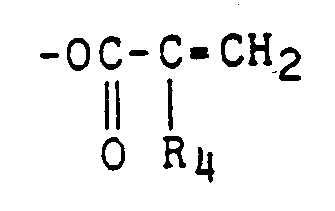
wherein R₄ is a hydrogen atom or a methyl group, or an alkylene group having said (meth)acryloyloxy group, l is an integer of 10 to 100, m is an integer of 5 to 100 and n is an integer of 10 to 200 and a solid lubricant, selected from the group consisting of a higher fatty acid, a higher fatty acid ester and a fluorine-containing solid compound, which are not or hardly compatible with each other and coated on the surface of the magnetic layer, having a sea-island structure of at least one lubricant forming a continuous film on the surface of the magnetic layer and at least a second lubricant forming discontinuous portions in the continuous film.
or
Y-CF₂O-(CF₂CF₂O)m-(CF₂O)n-CF₂-X (II)
wherein the organic groups X and/or Y are the same or different having a terminal carbon-carbon double bond and are a (meth)acryloyloxy group of the formula:
wherein R₄ is a hydrogen atom or a methyl group, or an alkylene group having said (meth)acryloyloxy group, l is an integer of 10 to 100, m is an integer of 5 to 100 and n is an integer of 10 to 200 and a solid lubricant, selected from the group consisting of a higher fatty acid, a higher fatty acid ester and a fluorine-containing solid compound, which are not or hardly compatible with each other and coated on the surface of the magnetic layer, having a sea-island structure of at least one lubricant forming a continuous film on the surface of the magnetic layer and at least a second lubricant forming discontinuous portions in the continuous film.
2. The magnetic recording medium further comprising as a liquid lubricant an organic
silicon compound or a fatty acid ester.
3. The magnetic recording medium according to claim 1, wherein the solid lubricant is
a fluorine-containing solid compound having an alkylene group, an alkyleneoxide group
or a polyalkyleneoxide group in the molecule.
4. The magnetic recording medium according to claim 1, wherein the lubricant layer comprises
5 to 99.9 % by weight of the liquid lubricant and 95 to 0.1 % by weight of the solid
lubricant.
1. Magnetisches Aufzeichnungsmedium, umfassend
ein Substrat, eine auf wenigstens einer Oberfläche des Substrats ausgebildete magnetische Schicht und eine Gleitmittel-Schicht, die Wenigstens
ein flüssiges Gleitmittel, das aus der aus fluorhaltigen flüssigen Verbindungen der Formel

oder
Y-CF₂O-(CF₂CF₂O)m-(CF₂O)n-CF₂-X (II)
bestehenden Gruppe ausgewählt ist, worin die organischen Gruppen X und/oder Y gleich oder verschieden sind, eine endständige Kohlenstoff-Kohlenstoff-Doppelbindung haben und eine (Meth)acryloyloxy-Gruppe der Formel
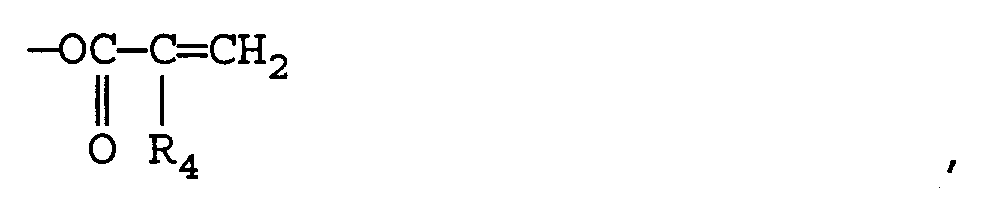
in der R₄ ein Wasserstoff-Atom oder eine Methyl-Gruppe ist, oder eine die genannte (Meth)acryloyloxy-Gruppe aufweisende Alkylen-Gruppe sind, ℓ eine ganze Zahl von 10 bis 100 ist, m eine ganze Zahl von 5 bis 100 ist und n eine ganze Zahl von 10 bis 200 ist,
und ein festes Gleitmittel, das aus der aus einer höheren Fettsäure, einem Ester einer höheren Fettsäure und einer fluorhaltigen festen Verbindung bestehenden Gruppe ausgewählt ist, umfaßt, die nicht oder kaum miteinander kompatibel sind und als Schicht auf die Oberfläche der magnetischen Schicht aufgetragen sind, mit einer Meer-Insel-Struktur aus wenigstens einem Gleitmittel, das einen geschlossenen Film auf der Oberfläche der magnetischen Schicht bildet, und wenigstens einem zweiten Gleitmittel, das diskontinuierliche Teilbereiche in dem kontinuierlichen Film bildet.
ein Substrat, eine auf wenigstens einer Oberfläche des Substrats ausgebildete magnetische Schicht und eine Gleitmittel-Schicht, die Wenigstens
ein flüssiges Gleitmittel, das aus der aus fluorhaltigen flüssigen Verbindungen der Formel
oder
Y-CF₂O-(CF₂CF₂O)m-(CF₂O)n-CF₂-X (II)
bestehenden Gruppe ausgewählt ist, worin die organischen Gruppen X und/oder Y gleich oder verschieden sind, eine endständige Kohlenstoff-Kohlenstoff-Doppelbindung haben und eine (Meth)acryloyloxy-Gruppe der Formel
in der R₄ ein Wasserstoff-Atom oder eine Methyl-Gruppe ist, oder eine die genannte (Meth)acryloyloxy-Gruppe aufweisende Alkylen-Gruppe sind, ℓ eine ganze Zahl von 10 bis 100 ist, m eine ganze Zahl von 5 bis 100 ist und n eine ganze Zahl von 10 bis 200 ist,
und ein festes Gleitmittel, das aus der aus einer höheren Fettsäure, einem Ester einer höheren Fettsäure und einer fluorhaltigen festen Verbindung bestehenden Gruppe ausgewählt ist, umfaßt, die nicht oder kaum miteinander kompatibel sind und als Schicht auf die Oberfläche der magnetischen Schicht aufgetragen sind, mit einer Meer-Insel-Struktur aus wenigstens einem Gleitmittel, das einen geschlossenen Film auf der Oberfläche der magnetischen Schicht bildet, und wenigstens einem zweiten Gleitmittel, das diskontinuierliche Teilbereiche in dem kontinuierlichen Film bildet.
2. Das magnetische Aufzeichnungsmedium, weiterhin umfassend, als flüssiges Gleitmittel,
eine organische Silicium-Verbindung oder einen Fettsäureester.
3. Das magnetische Aufzeichnungsmedium nach Anspruch 1, worin das feste Gleitmittel eine
fluorhaltige feste Verbindung mit einer Alkylen-Gruppe, einer Alkylenoxid-Gruppe oder
einer Polyalkylenoxid-Gruppe im Molekül ist.
4. Das magnetische Aufzeichnungsmedium nach Anspruch 1, worin die Gleitmittel-Schicht
5 bis 99,9 Gew.-% des flüssigen Gleitmittels und 95 bis 0,1 Gew.-% des festen Gleitmittels
umfaßt.
1. Milieu d'enregistrement magnétique comprenant un substrat, de couche magnétique formée
sur au moins une surface du substrat et une couche lubrifiante comprenant au moins
un lubrifiant liquide choisi parmi des composés liquides contenant du fluor, de formule
:
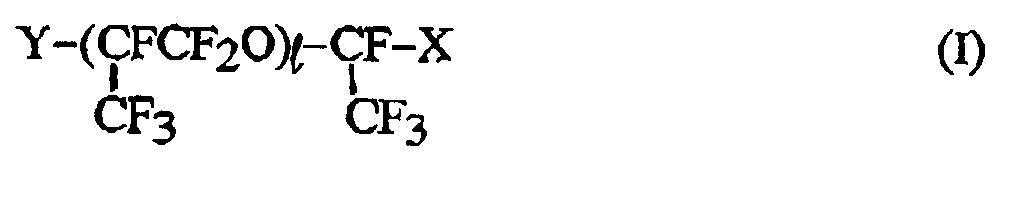
ou
Y-CF₂O-(CF₂CF₂O)m-(CF₂O)n-CF₂-X (II)
dans lesquelles les groupements organiques X et/ou Y sont des groupements identiques et différents comportant une double liaison carbone-carbone terminale et sont un groupement (meth)acryloyloxy de formule :
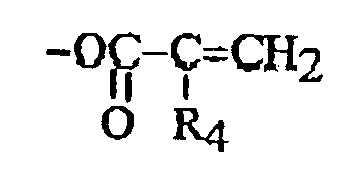
dans laquelle R₄ est un atome d'hydrogène ou un groupement méthyle, ou un groupement alkylène comportant un groupement (meth)acryloyloxy, ℓ est un nombre entier compris entre 10 et 100, m est un nombre entier compris entre 5 et 100 et n est un nombre entier compris entre 10 et 200 et un lubrifiant solide choisi dans le coupe constitué par un acide gras supérieur, un ester d'acide gras supérieur et un composé solide contenant du fluor, qui ne sont pas compatibles ou sont difficilement compatibles l'un avec l'autre et sont appliqués sur la surface de la couche magnétique, ayant une structure mer-île (ou structure "sea-island") constituée d'au moins un lubrifiant qui forme un film continu sur la surface de la couche magnétique et d'au moins un second lubrifiant qui forme des parties discontinues dans le film continu.
ou
Y-CF₂O-(CF₂CF₂O)m-(CF₂O)n-CF₂-X (II)
dans lesquelles les groupements organiques X et/ou Y sont des groupements identiques et différents comportant une double liaison carbone-carbone terminale et sont un groupement (meth)acryloyloxy de formule :
dans laquelle R₄ est un atome d'hydrogène ou un groupement méthyle, ou un groupement alkylène comportant un groupement (meth)acryloyloxy, ℓ est un nombre entier compris entre 10 et 100, m est un nombre entier compris entre 5 et 100 et n est un nombre entier compris entre 10 et 200 et un lubrifiant solide choisi dans le coupe constitué par un acide gras supérieur, un ester d'acide gras supérieur et un composé solide contenant du fluor, qui ne sont pas compatibles ou sont difficilement compatibles l'un avec l'autre et sont appliqués sur la surface de la couche magnétique, ayant une structure mer-île (ou structure "sea-island") constituée d'au moins un lubrifiant qui forme un film continu sur la surface de la couche magnétique et d'au moins un second lubrifiant qui forme des parties discontinues dans le film continu.
2. Milieu d'enregistrement magnétique comprenant de plus en tant que lubrifiant liquide
un composé organique du silicium ou un ester d'acide gras.
3. Milieu d'enregistrement magnétique selon la revendication 1, dans lequel le lubrifiant
solide est un composé solide contenant du fluor comportant un groupement alkylène,
un groupement oxyalkylène ou un groupement polyoxyalkylène dans sa molécule.
4. Milieu d'enregistrement magnétique selon la revendication 1, dans lequel la couche
lubrifiante comprend de 5 à 99,9 % en poids du lubrifiant liquide et de 95 à 0,1 %
en poids du lubrifiant solide.