| (19) |
 |
|
(11) |
EP 0 240 975 B1 |
| (12) |
EUROPEAN PATENT SPECIFICATION |
| (45) |
Mention of the grant of the patent: |
|
10.08.1994 Bulletin 1994/32 |
| (22) |
Date of filing: 06.04.1987 |
|
|
| (54) |
Human gamma interferon-specific receptor protein, antibody against said protein, methods
for obtaining said protein and said antibody and compositions containing said protein
and antibody
Menschliches gamma-interferon-spezifisches Rezeptorprotein, Antikörper gegen dieses
Protein, Verfahren zur Herstellung dieses Proteins und dieses Antikörpers und dieses
Protein und diesen Antikörper enthaltende Zusammensetzungen
Protéine réceptrice spécifique de l'interféron gamma humain, anticorps contre cette
protéine, méthodes pour obtenir cette protéine et cet anticorps et compositions contenant
cette protéine et cet anticorps
|
| (84) |
Designated Contracting States: |
|
BE CH DE ES FR GB GR IT LI NL SE |
| (30) |
Priority: |
08.04.1986 IL 78444
|
| (43) |
Date of publication of application: |
|
14.10.1987 Bulletin 1987/42 |
| (73) |
Proprietor: YEDA RESEARCH AND DEVELOPMENT COMPANY LIMITED |
|
Rehovot 76100 (IL) |
|
| (72) |
Inventors: |
|
- Novick, Daniela
Rehovot (IL)
- Orchansky, Patricia
Rehovot (IL)
- Fischer, Dina
Rehovot (IL)
- Rubinstein, Menachem
Givat Shmuel (IL)
|
| (74) |
Representative: Grünecker, Kinkeldey,
Stockmair & Schwanhäusser
Anwaltssozietät |
|
Maximilianstrasse 58
80538 München
80538 München (DE) |
| (56) |
References cited: :
|
| |
|
|
- PROC. NATL. ACAD. SCI. USA, vol. 81, August 1984, pages 5160-5164, Washington D.C.,
US; F.H. SARKAR et al.: "Receptors for human gamma interferon: binding and crosslinking
of 125I-labeled recombinant human gamma interferon to receptors on WISH cells"
- UCLA SYMP. MOLL. CELL. BIOL., NEW SERIES, vol. 50, 1986, pages 269-278, Alan R. Liss
Inc.; M. RUBINSTEIN et al.: "Multiple interferon-gamma receptors"
- THE JOURNAL OF BIOLOGICAL CHEMISTRY, vol. 260, no. 2, 25th January 1985, pages 1191-1195,
The Amrican Society of Biological Chemists, Inc., US; S.J. LITTMAN: "Binding of human
recombinant 125I-interferon gamma to receptors on human cells"
- THE JOURNAL OF IMMUNOLOGY, vol. 136, no. 1, 1st January 1986, pages 169-173, The American
Association of Immunologists, US; P. ORCHANSKY et al.: "The interferon-gamma receptor
in human monocytes is different from the one in nonhematopoietic cells"
- S. FERRONE et al.: "Handbook of monoclonal antibodies", 1985, chapter 8, Noyes Publictions,
Park Ridge, New York, US; M. SCHMITT et al.: "Monoclonal antibodies as tools to study
receptor-transducer-effector systems"
- CHEMICAL ABSTRACTS, vol. 107, no. 11, 14th September 1987, page 545, abstract no.
94974y, Columbus, Ohio, US; D. NOVICK: "Purification and characterization of the receptor
for human interferon-gamma", & BIOL. INTERFERON SYST., PROC. ISIR-TNO MEET. INTERFERON
SYST. 1986 (Pub. 1987), 121-8 (7th - 12th September 1986, Espoo, Finland)
|
|
| |
|
| Note: Within nine months from the publication of the mention of the grant of the European
patent, any person may give notice to the European Patent Office of opposition to
the European patent
granted. Notice of opposition shall be filed in a written reasoned statement. It shall
not be deemed to
have been filed until the opposition fee has been paid. (Art. 99(1) European Patent
Convention).
|
BACKGROUND OF THE INVENTION
[0001] The invention herein concerns antibodies directed against different receptors of
interferon gamma on human cells.Such antibodies can block the action of interferon
gamma on some cells and not on others, thus leading to selective action of interferon
gamma as a pharmaceutical agent or to prevention of the action of endogenous interferon
gamma on some cells and not on others.
[0002] Interferon gamma is a lymphokine produced by activated T-lymphocytes and exerting
many immunoregulatory activities. It is generally known as an immune stimulant because
of its ability to activate monocytes and macrophages towards cell killing in vitro
(Le et al., 1983, J.Immunol.
131,2821-2823).
[0003] In addition, interferon gamma is a direct inducer of class I and II major histocompatibility
complex (MHC) antigens in both immune and non-immune cells (Steeg et al., 1982 J.Exp.
Med.
156, 1780; Wallach et al., 1982 Nature
299, 833-836). So far, it is the only known direct inducer of class II MHC antigens and
it exerts its effect even at very low concentrations (1-10 pM).
[0004] Class II major histocompatibility antigens (HLA-DR in humans) play a major role in
the immune system. These transmembranal proteins are mainly expressed on monocytes,
macrophages, B lymphocytes, langerhans cells and thymus epithelial cells. They are
absent from most tissue specific cells and from resting T cells. The genes of these
proteins show extensive polymorphism which results in a large number of different
serotypes.
[0005] In general, T-lymphocytes respond to a given antigen only when it is presented on
the surface of an "antigen presenting cell" such as monocytes and in combination with
class II major histocompatibility antigens such as HLA-DR in humans and Ia in mice.
Once this occurs, an antigen specific clonal expansion of T helper cells will take
place.
[0006] These T cells will induce cytotoxic/suppressor T cells on one hand and will "help"
B cells to mature and become antibody producing plasma cells. Another important function
of HLA-DR is in the interaction of T cells with B cells which is essential for proliferation
and maturation of B cells. Further details on the role of HLA-DR are found in immunology
textbooks (e.g.
The Immune System by I.McConnel, A. Munro and M. Waldman, Blackwell Scientific Publications, 1981,
Oxford). Thus interferon gamma, plays a central role in the initiation of the immune
response by modulating the level of surface HLA-DR on antigen presenting cells and
it plays an important role in augmenting cellular cytotoxicity.
[0007] Additional studies have shown that the induction of HLA-DR by interferon gamma is
not limited to hematopoietic cells. In fact many types of cells including fibroblasts,
endothelial cells, keratinocytes, astrocytes and thyroid follicular cells will express
HLA-DR after exposure to low doses of interferon gamma
in vitro.
[0008] As to the role of HLA-DR in non-hematopoietic cells there is a debate among various
investigators. Thus, Mason and Barclay (Immunobiology
168, 167-171, 1984) pointed out that Ia positive cells (Ia is the mouse equivalent of
human HLA-DR) are also producing interleukin-1 and therefore can be suitable as antigen
presenting cells. They specifically referred to vascular endothelial cells (Hirshberg
et al., 1980, J. Exp. Med.
152, 2495), keratinocytes (Luger et al., 1982, J. Immunol.
128, 2147) and astrocytes (Fontana et al., 1982, J. Immunol.
129, 2143). In all of these cases, T cell proliferation which was taken as a measure
of immune stimulation was induced by these Ia positive, non-hematopoietic cells. More
recently, Bottazzo et al., (Lancet 1983,
II, 1115; Immunol. Today
5, 23, 1984) proposed that the expression of HLA-DR on thyroid follicular cells may
be involved in the initiation and maintenance of autoimmune diseases of the thyroid
gland. Later (Londei et al., Science
228, 85, 1985) they identified T-cell clones which originated from autoimmune thyroid
glands and recognized autologous HLA-DR positive thyroid cells. These authors suggested
that autoimmune thyrocytes "may act as antigen presenting cells that present their
own surface autoantigens". In another study, Fierz et al., (J. Immunol.
134, 3785-3793, 1985) demonstrated that interferon gamma treated astrocytes are Ia positive
and that such treatment augments up to four-fold the induction of T-cell proliferation
by contact with said astrocytes. These authors state that it is conceivable that "abnormal"
induction of Ia antigens on astrocytes by some stimulus is a basis for the development
of an autoimmune disease in the central nervous system. While the above studies were
performed
in vitro, a recent
in vivo study was performed by Groenewegen et al., (Nature
316, 361-363, 1985). Using cyclosporin A, a known inhibitor of interferon gamma production,
they have demonstrated that class II antigen expression by canine endothelial cells
was not constitutive but rather it was interferon gamma dependent. These authors also
suggested that class II MHC products (e.g., HLA-DR in humans and Ia in murine cells)
of non-hematopoietic cells are involved in immune responses.
[0009] The conclusion of the aforesaid studies was mainly circumstantial and based only
on cell to cell interaction and T-cell proliferation.
[0010] However, in none of the cases reported so far, direct cytotoxicity of T-cells against
HLA-DR bearing tissue cells or induction of specific autoantibodies was reported.
These thoughts were expressed recently by Mowat (Lancet, Aug. 3, 1985, p. 283) who
suggested that "enhanced expression of class II MHC antigens in autoimmune disease
merely reflects the involvement of effector T-lymphocytes in the tissue pathology"
and although he did not dismiss the role of HLA-DR in worsening autodestructive processes,
he suggests a careful experimental consideration.
[0011] Three unrelated lines of research indicate, in an indirect way, that in fact the
situation may even be opposite to what was so far expected, namely, it is possible
that interferon gamma actually inhibits immune response by inducing HLA-DR on non-hematopoietic
cells. Taramelli et al. (Int. J. Cancer
34, 797-806, 1984) studied the role of HLA-DR on metastatic human melanoma cells in
suppressing autologous lymphocyte mediated cytotoxicity and lymphocyte proliferation.
Human tumor cells can stimulate in 60-70% of the cases the proliferation of autologous
lymphocytes and their differentiation into tumor specific cytotoxic T-cells. This
is effected via production of IL-2. Taramelli et al., found that metastatic melanoma
cells (from lymph nodes) can inhibit the IL-2 dependent stimulation of autologous
lymphocytes. This inhibition was observed only with HLA-DR positive melanoma cells.
Moreover, on treatment of HLA-DR negative cells with interferon gamma they became
HLA-DR positive and acquired the suppressive activity. Thus, the induction of HLA-DR
on melanoma cells by interferon gamma was circumstantially linked to inhibition of
an autologous lymphocyte mediated cytotoxicity. If this phenomenon is not limited
to neoplastic cells but rather it occurs in all cells, then the appearance of HLA-DR
on tissue cells associated with an autoimmune disease maybe a part of the homeostatic
response which inhibits tissue damage by monocytes, killer cells and cytotoxic T-lymphocytes.
Indeed, recently it was reported by Biogen Inc., that cancer patients who suffered
from rheumatoid arthritis and were given interferon gamma as a potential antineoplastic
drug showed signs of improvement in their arthritis. In a preliminary study, 70% of
the patients experienced relief from their pain and swelling. These observations may
be related to an enhanced expression of HLA-DR on sinovial cells as was demonstrated
in vitro.
[0012] The best documented role of interferon gamma as a suppressor of cell mediated cytotoxicity
is in the field of natural killer (NK) activity. Several studies have demonstrated
that while interferon activates NK cells towards killing of target cells is also renders
these target cells more resistant to NK (Trincieri and Santoli, 1978 J. Exp. Med.
147, 1314; Hansson et al., 1980, J. Immunol.
125, 2225; Welsh 1981, Antiviral Res.,
1, 5; Wallach 1982, J. Interferon Res.
2, 329; Wallach 1983, Cellular Immunol.
75, 390). It appears therefore that interferon gamma may have opposing effects on different
cells. Monocytes and NK cells are activated by interferon gamma and became more efficient
in their function as cytotoxic cells, while various non-hematopoietic cells which
are potential targets for lysis may become NK resistant. Moreover, certain tumor cells
(metastatic melanoma, Taramelli et al., Int. J. Cancer
34, 797, 1984; murine leukemia, Ramila and Erb, Nature
304, 442, 1983; glyomas, Gately et al., Acta Neurochirurg.
64, 175, 1982; and lyposarcoma, Roth et al., J. Immunol.
130,303, 1983), have immunosuppressive activity which is possibly linked with the expression
of HLA-DR on their surface.
[0013] The presence of specific receptor molecules for interferon gamma on WISH cells was
previously shown by Sarkar and Gupta (Proc. Natl. Acad. Sci. USA
81, 5160-5164, 1984). Littman et al (J. Biol. Chem.
260, 1191-1195, 1985) succeeded in demonstrating the existence of interferon gamma receptors
on Daudi und HeLa cells.
SUMMARY OF THE INVENTION
[0014] The invention herein is directed to antibodies developed against the various forms
of the interferon gamma receptor which can block the binding of interferon gamma to
some cells and not to other cells in a selective manner. The invention is based on
the observation that human cells of different tissue bear different receptors for
interferon gamma. Since interferon gamma exerts opposite effects on various cells,
selective blockage of its receptors on e.g. immune cells can for instance reduce the
immunostimulatory effects of interferon gamma while maintaining its ability to interact
with non immune cells and render them resistant to the damage caused in autoimmune
diseases.
[0015] The invention further concerns methods for preparing the purified active form of
these receptors and the antibodies directed against them. The invention also concerns
pharmaceutical preparations containing the aforesaid antibodies for administration
as immuno-suppressants for various autoimmune diseases.
BRIEF DESCRIPTION OF THE DRAWINGS
[0016] Fig. 1: Binding and crosslinking of [¹²⁵I] -IFN-gamma to receptor on WISH cells and KG-1
cells and competition with unlabeled IFN-gamma . Lane 1: [¹²⁵I] -IFN-gamma crosslinked
with itself; lane 2: [¹²⁵I] -IFN-gamma crosslinked to WISH cells; lane 3: [¹²⁵I] -IFN-gamma
crosslinked to WISH cells in the presence of 100-fold excess unlabeled IFN-gamma;
lane 4: molecular weight markers (from top to bottom: myosin. 200,000; phosphorylase
B: 100,000 and 92,000; bovine serum albumin: 69,000; ovalbumin: 46,000); lane 5: [¹²⁵I]
-IFN-gamma crosslinked to KG-1 cells; lane 6: [¹²⁵I] -IFN-gamma crosslinked to KG-1
cells in the presence of 100-fold excess unlabeled IFN-gamma.
[0017] Fig. 2: Binding and crosslinking of [¹²⁵I] -IFN-gamma to receptors and competition with
unlabeled IFN-gamma. Lane 1: molecular weight markers: (from top to bottom: Myosin:
200,000; phosphorylase B: 100,000 and 92,000: bovine serum albumin: 69,000; ovalbumin:
46,000); lane 2: [¹²⁵I] -IFN-gamma crosslinked to WISH cells; lane 3: [¹²⁵I] -IFN-gamma
crosslinked to WISH cells in the presence of 100-fold excess unlabeled IFN-gamma.
lane 4: [¹²⁵I] -IFN-gamma crosslinked to normal peripheral blood monocytes; lane 5;
[¹²⁵I] -IFN-gamma crosslinked to normal peripheral blood monocytes in the presence
of 100-fold excess unlabeled IFN-gamma. lane 6: [¹²⁵I] -IFN-gamma crosslinked to normal
peripheral blood T-lymphocytes; lane 7: [¹²⁵I] -IFN-gamma crosslinked to normal peripheral
blood T-lymphocytes in the presence of 100-fold excess unlabeled IFN-gamma.
[0018] Fig. 3: Binding and crosslinking of [¹²⁵I] -IFN-gamma to receptors and competition with unlabeled
IFN-gamma. Lane 1 & 6: Molecular weight markers: (from top to bottom: Myosin: 200,000;
phosphorylase B: 92,000; bovine serum albumin: 69,000); lane 2: [¹²⁵I] -IFN-gamma
crosslinked to WISH cells; lane 3: [¹²⁵I]-IFN-gamma crosslinked to WISH cells in the
presence of 100-fold excess unlabeled-IFN-gamma; lane 4: [¹²⁵I] -IFN-gamma crosslinked
to H-229 cells; lane 5: [¹²⁵I]-IFN-gamma crosslinked to H-229 cells in the presence
of 100-fold excess unlabeled-IFN-gamma; lane 7: [¹²⁵I] -IFN-gamma crosslinked to MOLT-4
cells; lane 8: [¹²⁵I] -IFN-gamma crosslinked to MOLT-4 cells in the presence of 100-fold
excess unlabeled-IFN-gamma; lane 9: [¹²⁵I] -IFN-gamma crosslinked to DAUDI cells;
lane 10: [¹²⁵I] -IFN-gamma crosslinked to DAUDI cells in the presence of 100-fold
excess unlabeled-IFN-gamma.
[0019] Fig. 4: Elution profile of the IFN-gamma receptor from the affinity column. Each fraction
was tested for its ability to bind [¹²⁵I] -IFN-gamma (▲―▲) and for protein content
(●―●). L: Load; W: WASH; E: elution fractions. Protein was determined with fluorescamine.
[0020] Fig. 5: Binding of [¹²⁵I] -IFN-gamma to elution fraction No.6 (Fig.4). Protein (200 ng) was
incubated with increasing concentrations of[¹²⁵I] -IFN-gamma at 4°C (●―●) and at 37°C
(▲―▲). Free-radioactivity was separated from protein-bound radioactivity as described.
Inset: Scatchard plots of the binding data.
[0021] Fig. 6: Analysis by SDS-PAGE (7.5%) and autoradiography of immuno-precipitated cross-linked
complex of [¹²⁵I] -IFN-gamma and its receptor.
Lane a: Load fraction; lane b: Effluent; lanes c & d: wash fractions; lane e: molecular
weight marker from top to bottom; Myosin: 200,000;phosphorylase B: 92,000; bovine
serum albumin: 69,000; ovalbumin: 46,000); lanes f, g & h: Elution fractions; lane
i: elution fraction No.6 immunoprecipitated with control serum.
DESCRIPTION OF THE INVENTION
[0022] The receptors of interferon gamma on various human cells were identified by cross-linking
experiments with radiolabelled interferon gamma . Briefly pure interferon gamma was
labelled with [¹²⁵I] according to published procedures. The resulting preparation
exhibited intact biological activity. Such labelled interferon was allowed to react
with various human cells at 4°C and the resulting interferon-receptor complexes were
covalently cross-linked. The cross-linked complexes were then analyzed by polyacrylamide
gel electrophoresis (PAGE) in the presence of Na dodecyl sulfate (SDS) followed by
autoradiography. As shown in the examples, human cells of different tissue origin
exhibited interferon gamma receptors having different molecular weights, thus indicating
that they are structurally different.
[0023] The receptors from various cell lines were then purified by affinity chromatography
on an immobilized interferon gamma column without loss of their ability to bind interferon
gamma. These purified preparations were used for developing antibodies that block
selectively the binding of interferon gamma to some cells and not to other cells.
The invention is further illustrated by way of Examples.
Example 1. Crosslinking of [¹²⁵I] -IFN-gamma to its receptor in intact cells.
[0024] Cells (1-2X10⁸ cells, according to the cell type) were incubated with [¹²⁵I] -IFN-gamma
with or without excess unlabeled IFN-gamma for 1.5 hrs at 4°C in PBS containing Ca⁺⁺
and Mg⁺⁺. A non cleavable cross-linking reagent [dissuccinimidyl suberate (DSS)] was
added at a final concentration of 0.5-1 mM for 20 min at 4°C. The cells were then
washed and resuspended in 50 mM Tris-HCl,0.1M NaCl, pH 7.5 containing 1.5% Triton
X-100 for 1 h at 4°C with gentle stirring. The preparations were centrifuged at 27,000
xg for 20 min. The supernatants were immunoprecipitated with rabbit anti-IFN-gamma
serum (prepared by immunizing rabbits with homogenous IFN-gamma) diluted 1:50. After
2 hrs at room temperature a suspension of Protein-A Sepharose was added and left for
1 h at room temperature. The Sepharose beads were then washed, and bound material
was dissociated by the addition of SDS-PAGE sample buffer. Analysis of the samples
was done by SDS-PAGE (7.5%). Figure 1 shows the apparent M.Ws of the [¹²⁵I] -IFN-gamma
crosslinked to its receptor on WISH and KG-1 cells. For WISH cells (Fig. 1 lane 2)
a broad band of M.W. 105,000-130,000 was found. Assuming that the receptor binds one
molecule of IFN-gamma (25 kD), the calculated M.W. of the receptor must be 90,000
to 105,000.(KG-1 Myeloid cells (Fig. 1, lane 5) shows a sharp band of M.W. 165,000
giving a receptor of M.W. 140,000-150,000. An addition of a 100-fold excess of unlabeled
IFN-gamma prevented the formation of these cross-linked complexes (Fig. 1, lane 3,
WISH lane 6, KG-1) indicating the specificity in the binding. Bands with M.Ws lower
than 92,000 correspond to IFN-gamma cross-linked with itself as it is shown in Fig.
1, lane 1.
[0025] Figure 2 shows a similar pattern, [¹²⁵I] -IFN-gamma cross-linked to the receptor
in WISH cells appeared to have a M.W. of 105,000-130,000. When [¹²⁵I] -IFN-gamma was
cross-linked to the receptor in normal peripheral bloodmonocytes a band of M.W. 165,000
was obtained. This band was identical to the one that was seen in KG-1 cells (myeloidic
cell line). Normal peripheral blood T-lymphocytes did not show any detectable band
that can be related to an IFN-gamma receptor complex, while bands that appeared with
a M.W. lower than 92,000 correspond to IFN-gamma cross-linked with itself.
[0026] Figure 3 shows the same molecular weight for the receptor on WISH cells as previously
shown. Hela H-229 cells (fibroblastic cell line) shows a broad band of 105,000-130,000
for the complex. DAUDI cells (B-lymphoblastoid) shows also a broad band of 120,000-140,000.
MOLT-4 (T-cell line) did not show any detectable complex.
Example 2. Isolation of IFN-gamma receptors from human WISH cells
[0027] Human WISH cells were grown in minimal essential medium supplemented with 10% foetal
bovine serum and glutamine 2mM. Cells were washed with phosphate buffered saline (PBS).
1-10X10¹⁰ cells were solubilized in a solubilization buffer (final concentrations:
10mM Hepes, pH 7.4, 1-2% Triton X-100, 1 mM PMSF and 20 units/ml aprotinin). The suspension
was spun first at 10,000 xg for 15 min and then at 100,000 xg for 60 min. The supernatant
was applied to an immobilized IFN-gamma column (7 mg per 1 ml of Affigel-10). Loading
was at a flow rate of 0.2-0.5 ml/min.
[0028] The column was then washed with PBS (50 ml) and the bound material was eluted with
a solution of 50 mM Na₂CO₃ and 0.5M NaCl, pH 11. Fractions of 1 ml were collected
and to immediately neutralized with 3M acetic acid. Each fraction was tested for its
ability to bind [¹²⁵I] -IFN-gamma and for protein content. Figure 4 shows the elution
profile of the affinity column for WISH cells. Protein was determined with fluorescamine.
Based on specific activity a purification factor of at least 2600 was obtained in
one step.
Example 3. Isolation of IFN-gamma receptors from human (KG-1) cells
[0029] Human KG-1 cells were grown in minimal essential medium (alpha-modification) supplemented
with 10% foetal bovine serum and glutamine 2mM. Cells were washed with phosphate buffered
saline (PBS). 1-10X10¹⁰ cells were solubilized in a solubilization buffer (final concentrations:
10mM Hepes, pH 7.4, 1-2% Triton X-100, 1 mM PMSF and 20 units/ml aprotinin). The suspension
was spun first at 10,000 xg for 15 min and then at 100,000 xg for 60 min. The supernatant
was applied to an immobilized IFN-gamma column (7 mg per 1 ml of Affigel-10). Loading
was at a flow rate of 0.2-0.5 ml/min. The column was then washed with PBS (50 ml)
and the bound material was eluted with an appropriate buffer. Fractions of 1 ml were
collected and immediately neutralized. Each fraction was tested for its ability to
bind [¹²⁵I] -IFN-gamma and for protein content. Based on specific activity a purification
factor of at least 1500 was obtained in one step.
Example 4. Isolation of IFN-gamma receptors from human (Daudi) cells
[0030] Human Daudi cells were grown in RPMI-1640 medium supplemented with 10% foetal bovine
serum and glutamine 2mM. Cells were washed with phosphate buffered salim (PBS). 1-10X10¹⁰
cells were solubilized in a solubilization buffer (final concentrations: 10mM Hepes,
pH 7.4, 1-2% Triton X-100, 1 mM PMSF and 20 units/ml aprotinin). The suspension was
spun first at 10,000 xg for 15 min and then at 100,000 xg for 60 min. The supernatant
was applied to an immobilized IFN-gamma column (7 mg per 1 ml of Affigel-10). Loading
was at a flow rate of 0.2-0.5 ml/min. The column was then washed with PBS (50 ml)
and the bound material was eluted with an appropriate buffer. Fractions of 1 ml were
collected and to immediately neutralized. Each fraction was tested for its ability
to bind ¹²⁵I -IFN-gamma and for protein content. Protein was determined with fluorescamine.
Based on specific activity a purification factor of at least 1000 was obtained in
one step.
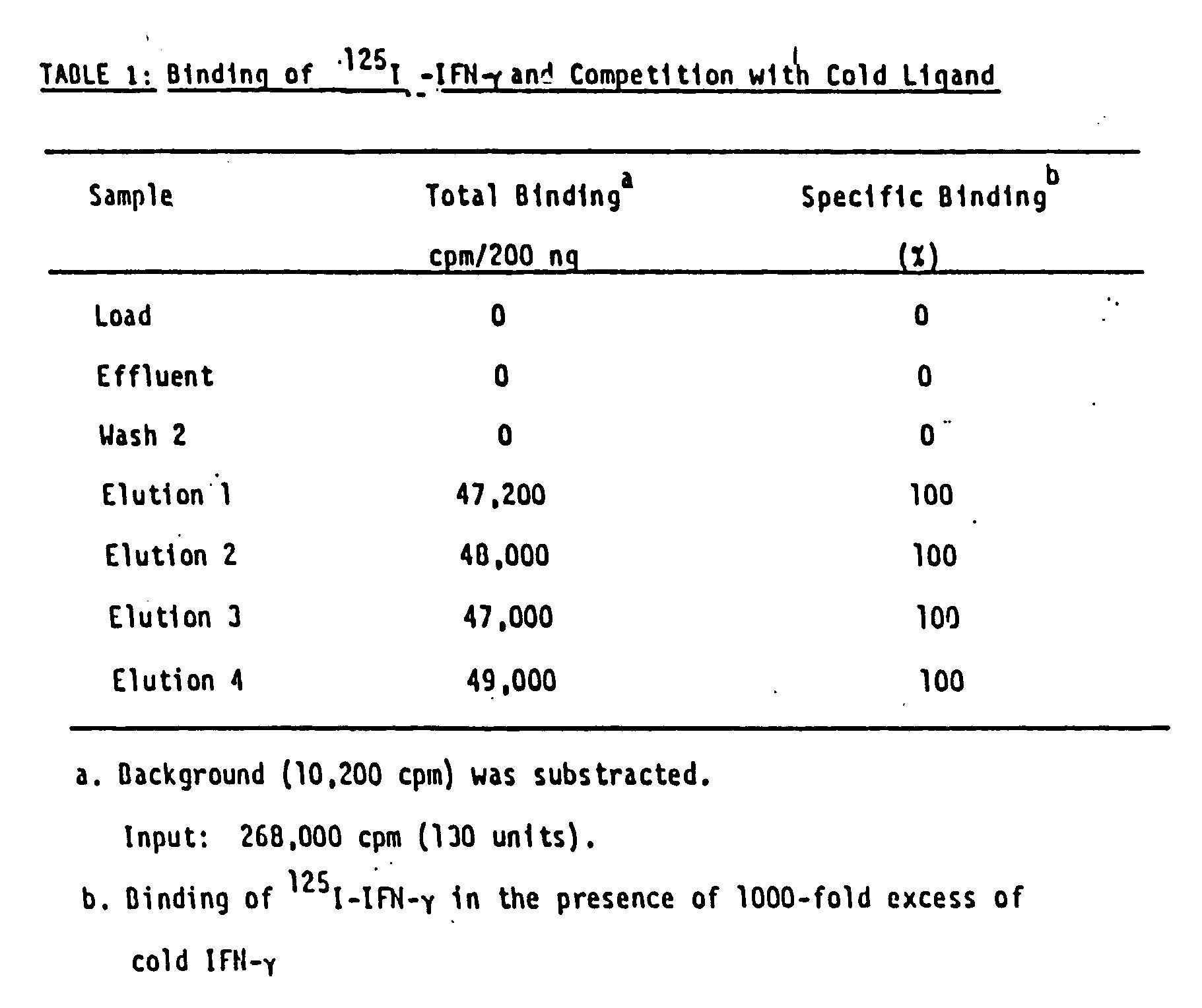
Example 5. Binding of [¹²⁵I] -IFN-gamma and competition with cold ligand.
[0031] Aliquots of various fractions from the affinity column of WISH cells containing 200
ng protein, mixed with [¹²⁵I] -IFN-gamma (130 units) either with or without unlabeled
IFN-gamma (130,000 units). After incubation at 4°C for 2 hr, gamma-globulin was added
as a carrier and the proteins were precipitated by polyethylene glycol (PEG) (8000
M.W.). The mixture was filtered on a millipore (HAWP, 0.45u) membrane and membrane
bound radioactivity determined. Background counts were determined in a similar reaction
mixture but in the absence of soluble receptor. Table 1 shows that the binding [¹²⁵I]
-IFN-gamma to the protein in the elution fractions was completely displaced by cold
ligands, indicating specificity in the binding. The background represented less than
20% of the total binding in the elution fraction and was subtracted from all readings.
Example 6. Saturation binding sites
[0032] Aliquots of elution fraction No. 6 (from example 2) containing 200 ng protein were
mixed with increasing concentrations of [¹²⁵I] -IFN-gamma (5-6000 units/ml). The protein
was precipitated and filtered, as explained previously.
[0033] Figure 5 shows that [¹²⁵I] -IFN-gamma binds to the receptor in a saturable manner
both at 4°C and at 37°C. Scatchard analysis of the saturation curves show linear plots
at both temperatures. The Kd at 4°C was found to be 4.8X10⁻¹⁰M and 2.95X10⁻¹⁰M at
37°C. These values are in the same order of magnitude as those reported for intact
cells.
Example 7. Analysis of the purified receptor from WISH cells by crosslinking and immunoprecipitation
[0034] Aliquots of various fractions of the affinity column of Example 2 were mixed with
[¹²⁵I] -IFN-gamma in a final volume of 60 ul. Di-N-hydroxysuccinimidyl suberate (DSS)
was added, and after incubation rabbit anti-IFN-gamma serum was added. The complex
was precipitated by Protein-A Sepharose. Analysis of the samples was done by SDS-PAGE
(7.5%), followed by autoradiography. Figure 6 shows a complex of M.W. 115,000 as well
as higher molecular weight bands obtained in the elution fractions. To further confirm
the specificity of the immunoprecipitation a competition with either IFN-gamma (0,
10 or 1000-fold molar excess) or IFN-alpha(1000-fold molar excess) was performed.
Specific inhibition of the immunoprecipitation was seen only by IFN-gamma (Fig. 6).
Example 8. Immunization of mice
[0035] The partially purified preparations of interferon gamma receptors from the various
cell lines were used as antigens to immunize female BALB/c mice. Mice were initially
injected subcutaneously with 5µg of a receptor preparation emulsified in complete
Freunds adjuvant. Thirty days later the mice were injected subcutaneously with 5µg
receptor preparations. Injections were repeated three more times at 1 week intervals.
The development of antibody level was followed by the ability of the mouse serum to
inhibit the antiviral activity of IFN-gamma in human WISH cells and by its ability
to inhibit the binding of[¹²⁵I]-interferon-gamma to KG-1 and to Daudi cells. In another
experiment mice were injected subcutaneously with minced polyacrylamide gel containing
the 95,000 band protein (2µg) emulsified in complete Freund's adjuvant. Thirty days
later the mice were injected subcutaneously with minced polyacrylamide gel containing
the 95,000 band protein (2µg). Infections were repeated three more times at 1 week
intervals and the development of antibody level was followed by the ability of the
mouse serum to inhibit the antiviral activity of IFN-gamma in human WISH cells.
Example 9. Pharmaceutical Compositions
[0036] The compounds of the present invention can be formulated according to known methods
to prepare pharmaceutically useful compositions, whereby either the purified receptor
or the antibody product hereof or the F(ab') fragment of the antibody or interferon
gamma are combined in a mixture with a pharmaceutically acceptable carrier vehicle.
Suitable vehicles and their formulation are described in Remington's
Pharmaceutical Sciences by E.W. Martin. Such compositions will contain an effective amount of active substance
hereof together with a suitable amount of vehicle in order to prepare pharmaceutically
acceptable compositions suitable for effective administration to the host.
Example 10. Parenteral Administration
[0037] The antibody or the purified receptor both or mixed with interferon gamma may be
parenterally administered to subjects requiring immunosuppressive or immunoregulatory
treatment. Dosage and dose rate may parallel that currently in use in clinical investigations
of other antibodies e.g. about 0.1-100mg or even significantly elevated for greater
effect.
[0038] As one example of an appropriate dosage form for essentially homogenous antibody
in parenteral from applicable herein, 6g of antibody may be dissolved in 250 ml serum
albumin (human)-USP, the solution passed through a bacteriological filter and the
filtered solution aseptically subdivided into 100 vials, each containing 60 mg pure
antibody suitable for parenteral administration. The vials are preferably lyophilized
and reconstituted with sterile water prior to use.
Claims for the following Contracting State(s): BE, CH, LI, DE, FR, GB, IT, NL, SE
1. A human interferon gamma specific receptor protein soluble in aqueous media and having
a purification factor of at least 1,000 based on specific activity.
2. The receptor protein of claim 1, which is a receptor protein of WISH, Hela and FS-11
cells having an approximate molecular weight of 90,000 to 105,000 dalton.
3. The receptor protein of claim 1, which is a receptor protein of monocytes and KG-1
cells having an approximate molecular weight of 140,000 dalton.
4. The receptor protein of claim 1, which is a receptor protein of Daudi lymphoblastoid
cells having an approximate molecular weight of 95,000 to 115,000 dalton.
5. An antibody against the protein of claim 1.
6. An antibody against the protein of claim 2.
7. An antibody against the protein of claim 3.
8. An antibody against the protein of claim 4.
9. A method of isolating a human interferon gamma receptor protein according to claim
1 which comprises solubilizing human cells bearing the receptors to obtain a suspension,
centrifuging the suspension to obtain a supernatant, applying the supernatant to an
immobilized interferon gamma column, and eluting the bound receptor protein by varying
pH conditions, in a state of enhanced purity.
10. The method of claim 9 in which the cells are WISH, Hela, or FS-11 cells.
11. The method of claim 9 in which the cells are monocytes or KG-1 cells.
12. The method of claim 9 in which the cells are Daudi lymphoblastoid cells.
13. A method of obtaining an antibody against a human interferon gamma receptor protein
which comprises immunizing an animal with the protein of claim 1.
14. A composition comprising interferon gamma and the antibody of claim 5.
15. The composition of claim 14 comprising antibodies against at least one of the human
interferon gamma receptors, but lacking an antibody against at least one other human
interferon gamma receptor.
16. The composition of claim 15, lacking an antibody against the receptor protein of claim
2.
17. The composition of claim 15, lacking an antibody against the receptor protein of claim
3.
18. The composition of claim 15, lacking an antibody against the receptor protein of claim
4.
19. A composition comprising antibodies against at least one of the human interferon gamma
receptors, but lacking an antibody against at least one other human interferon gamma
receptor.
20. Use of the composition of claim 19 for the preparation of a medicament for controlling
the effect of human interferon gamma.
21. The use of claim 20, wherein the receptors for interferon gamma on immune cells are
selectively blocked.
22. A composition comprising soluble receptor of claim 1 for controlling the therapeutical
effect of human interferon gamma.
23. A composition comprising soluble receptor of claim 2 for controlling the therapeutical
effect of human interferon gamma.
24. A composition comprising soluble receptor of claim 3 for controlling the therapeutical
effect of human interferon gamma.
25. A composition comprising soluble receptor of claim 4 for controlling the therapeutical
effect of human interferon gamma.
Claims for the following Contracting State(s): ES
1. A method for isolating a human interferon gamma specific receptor protein soluble
in aqueous media and having a purification factor of at least 1,000 based on specific
activity which comprises solubilizing human cells bearing the receptors to obtain
a suspension, centrifuging the suspension to obtain a supernatant, applying the supernatant
to an immobilized interferon gamma column, and eluting the bound receptor protein
by varying pH conditions, in a state of enhanced purity.
2. The method of claim 1 in which the cells are WISH, Hela or FS-11 cells.
3. The method of claim 1 in which the cells are monocytes or KG-1 cells.
4. The method of claim 1 in which the cells are Daudi lymphoblastoid cells.
5. The method of claim 2 in which the human interferon gamma specific receptor protein
has an approximate molecular weight of 90,000 to 105,000 daltons.
6. The method of claim 3 in which the human interferon gamma specific receptor protein
has an approximate molecular weight of 140,000 daltons.
7. The method of claim 4 in which the human interferon gamma specific receptor protein
has an approximate molecular weight of 95,000 to 115,000 daltons.
8. A method for obtaining an antibody against a human interferon gamma specific receptor
protein, the method comprising immunizing an animal with a human interferon gamma
specific receptor protein soluble in aqueous media and having a purification factor
of at least 1,000 based on specific activity.
9. The method of claim 8, wherein the protein is obtainable by a method of one of the
claims 1 to 7.
10. A method for preparing a composition comprising combining interferon gamma and the
antibody obtainable by the method according to claim 8.
11. The method of claim 10, wherein the antibodies used comprise antibodies against at
least one of the human interferon gamma receptors, but lack an antibody against at
least one other human interferon gamma receptor.
12. The method of claim 11, wherein an antibody against a receptor protein of WISH, Hela
or FS-11 cells having an approximate molecular weight of 90,000 to 105,000 dalton
is lacking.
13. The method of claim 11, wherein an antibody against a receptor protein of monocytes
or KG-1 cells having an approximate molecular weight of 140,000 dalton is lacking.
14. The method of claim 11, wherein an antibody against a receptor protein of Daudi lymphoblastoid
cells having an approximate molecular weight of 140,000 dalton is lacking.
15. A method for preparing a composition comprising combining soluble human interferon
gamma specific receptor proteins, which are obtainable by a method of claim 1 with
a pharmaceutically acceptable carrier vehicle.
16. Use of the composition of claim 10 for the preparation of a medicament for controlling
the effect of human interferon gamma.
17. The use of claim 16, wherein the receptors for interferon gamma on immune cells are
selectively blocked.
Claims for the following Contracting State(s): GR
1. A human interferon gamma specific receptor protein soluble in aqueous media and having
a purification factor of at least 1,000 based on specific activity.
2. The receptor protein of claim 1, which is a receptor protein of WISH, Hela and FS-11
cells having an approximate molecular weight of 90,000 to 105,000 dalton.
3. The receptor protein of claim 1, which is a receptor protein of monocytes and KG-1
cells having an approximate molecular weight of 140,000 dalton.
4. The receptor protein of claim 1, which is a receptor protein of Daudi lymphoblastoid
cells having an approximate molecular weight of 95,000 to 115,000 dalton.
5. An antibody against the protein of claim 1.
6. An antibody against the protein of claim 2.
7. An antibody against the protein of claim 3.
8. An antibody against the protein of claim 4.
9. A method of isolating a human interferon gamma receptor protein according to claim
1 which comprises solubilizing human cells bearing the receptors to obtain a suspension,
centrifuging the suspension to obtain a supernatant, applying the supernatant to an
immobilized interferon gamma column, and eluting the bound receptor protein by varying
pH conditions, in a state of enhanced purity.
10. The method of claim 9 in which the cells are WISH, Hela, or FS-11 cells.
11. The method of claim 9 in which the cells are monocytes or KG-1 cells.
12. The method of claim 9 in which the cells are Daudi lymphoblastoid cells.
13. A method of obtaining an antibody against a human interferon gamma receptor protein
which comprises immunizing an animal with the protein of claim 1.
14. A composition comprising interferon gamma and the antibody of claim 5.
15. The composition of claim 14 comprising antibodies against at least one of the human
interferon gamma receptors, but lacking an antibody against at least one other human
interferon gamma receptor.
16. The composition of claim 15, lacking an antibody against the receptor protein of claim
2.
17. The composition of claim 15, lacking an antibody against the receptor protein of claim
3.
18. The composition of claim 15, lacking an antibody against the receptor protein of claim
4.
19. A composition comprising antibodies against at least one of the human interferon gamma
receptors, but lacking an antibody against at least one other human interferon gamma
receptor.
20. Use of the composition of claim 19 for the preparation of a medicament for controlling
the effect of human interferon gamma.
21. The use of claim 20, wherein the receptors for interferon gamma on immune cells are
selectively blocked.
22. A method for preparing a composition comprising combining interferon gamma and the
antibody of claim 13.
23. The method of claim 22, wherein the antibodies used comprise antibodies against at
least one of the human interferon gamma receptors, but lack an antibody against at
least one other human interferon gamma receptor.
24. The method of claim 23, wherein an antibody against a receptor protein of WISH, Hela
or FS-11 cells having an approximate molecular weight of 90,000 to 105,000 dalton
is lacking.
25. The method of claim 23, wherein an antibody against a receptor protein of monocytes
or KG-1 cells having an approxiamte molecular weight of 140,000 dalton is lacking.
26. The method of claim 23, wherein an antibody against a receptor protein of Daudi lymphoblastoid
cells having an approximate molecular weight of 95,000 to 115,000 dalton is lacking.
27. A method for preparing a composition comprising combining antibodies against at least
one of the human interferon gamma receptors, while omitting an antibody against at
least one other human interferon gamma receptor.
28. A method for preparing a composition for controlling the therapeutical effect of human
interferon gamma by combining the soluble receptor protein according to claim 1 and
a pharmaceutical acceptable carrier vehicle.
29. A method for preparing a composition for controlling the therapeutical effect of human
interferon gamma by combining the soluble receptor protein according to claim 2 and
a pharmaceutical acceptable carrier vehicle.
30. A method for preparing a composition for controlling the therapeutical effect of human
interferon gamma by combining the soluble receptor protein according to claim 3 and
a pharmaceutical acceptable carrier vehicle.
31. A method for preparing a composition for controlling the therapeutical effect of human
interferon gamma by combining the soluble receptor protein according to claim 4 and
a pharmaceutical acceptable carrier vehicle.
Patentansprüche für folgende(n) Vertragsstaat(en): BE, CH, LI, DE, FR, GB, IT, NL,
SE
1. Humanes Interferon-gamma-spezifisches Rezeptorprotein, welches in wäßrigen Medien
löslich ist und einen auf spezifischer Aktivität basierenden Reinigungsfaktor von
mindestens 1.000 besitzt.
2. Rezeptorprotein nach Anspruch 1, welches ein Rezeptorprotein von WISH-, Hela- und
FS-11-Zellen mit einem ungefähren Molekulargewicht von 90.000 bis 105.000 Dalton ist.
3. Rezeptorprotein nach Anspruch 1, welches ein Rezeptorprotein von Monozyten und KG-1-Zellen
mit einem ungefähren Molekulargewicht von 140.000 Dalton ist.
4. Rezeptorprotein nach Anspruch 1, welches ein Rezeptorprotein von Daudi-Lymphoblastoid-Zellen
mit einem ungefähren Molekulargewicht von 95.000 bis 115.000 Dalton ist.
5. Antikörper gegen das Protein nach Anspruch 1.
6. Antikörper gegen das Protein nach Anspruch 2.
7. Antikörper gegen das Protein nach Anspruch 3.
8. Antikörper gegen das Protein nach Anspruch 4.
9. Verfahren zum Isolieren eines humanen Interferon-gamma-Rezeptorproteins nach Anspruch
1, welches das Solubilisieren humaner Zellen, welche die Rezeptoren tragen, zum Erhalten
einer Suspension umfaßt, das Zentrifugieren der Suspension, um einen Überstand zu
erhalten, das Auftragen des Überstands auf eine Säule mit immobilisiertem Interferon-gamma
und das Eluieren des gebundenen Rezeptorproteins in einen Zustand erhöhter Reinheit
durch Variieren der pH-Bedingungen.
10. Verfahren nach Anspruch 9, worin die Zellen WISH-, Hela- oder FS-11-Zellen sind.
11. Verfahren nach Anspruch 9, worin die Zellen Monozyten oder KG-1-Zellen sind.
12. Verfahren nach Anspruch 9, worin die Zellen Daudi-Lymphoblastoid-Zellen sind.
13. Verfahren zum Gewinnen eines Antikörpers gegen ein humanes Interferon-gamma-Rezeptorprotein,
welches das Immunisieren eines Tieres mit dem Protein nach Anspruch 1 umfaßt.
14. Zusammensetzung, umfassend Interferon-gamma und den Antikörper nach Anspruch 5.
15. Zusammensetzung nach Anspruch 14, umfassend Antikörper gegen mindestens einen humanen
Interferon-gamma-Rezeptor, jedoch ohne einen Antikörper gegen mindestens einen weiteren
humanen Interferon-gamma-Rezeptor.
16. Zusammensetzung nach Anspruch 15, ohne einen Antikörper gegen das Rezeptorprotein
nach Anspruch 2.
17. Zusammensetzung nach Anspruch 15, ohne einen Antikörper gegen das Rezeptorprotein
nach Anspruch 3.
18. Zusammensetzung nach Anspruch 15, ohne einen Antikörper gegen das Rezeptorprotein
nach Anspruch 4.
19. Zusammensetzung, umfassend Antikörper gegen mindestens einen humanen Interferon-gamma-Rezeptor,
jedoch ohne einen Antikörper gegen mindestens einen weiteren humanen Interferon-gamma-Rezeptor.
20. Verwendung der Zusammensetzung nach Anspruch 19 für die Herstellung eines Medikaments
zum Kontrollieren der Wirkung von humanem Interferon-gamma.
21. Verwendung nach Anspruch 20, worin die Rezeptoren für Interferon-gamma auf Immunzellen
selektiv blockiert werden.
22. Zusammensetzung, umfassend einen löslichen Rezeptor nach Anspruch 1 zum Kontrollieren
der therapeutischen Wirkung von humanem Interferon-gamma.
23. Zusammensetzung, umfassend einen löslichen Rezeptor nach Anspruch 2 zum Kontrollieren
der therapeutischen Wirkung von humanem Interferon-gamma.
24. Zusammensetzung, umfassend einen löslichen Rezeptor nach Anspruch 3 zum Kontrollieren
der therapeutischen Wirkung von humanem Interferon-gamma.
25. Zusammensetzung, umfassend einen löslichen Rezeptor nach Anspruch 4 zum Kontrollieren
der therapeutischen Wirkung von humanem Interferon-gamma.
Patentansprüche für folgende(n) Vertragsstaat(en): ES
1. Verfahren zum Isolieren eines humanen Interferon-gamma-spezifischen Rezeptorproteins,
welches in wäßrigen Medien löslich ist und einen auf spezifischer Aktivität basierenden
Reinigungsfaktor von mindestens 1.000 besitzt, welches das Solubilisieren humaner
Zellen, welche die Rezeptoren tragen, das Zentrifugieren der Suspension, um einen
Überstand zu erhalten, das Auftragen des Überstands auf eine Säule mit immobilisiertem
Interferon-gamma und das Eluieren des gebundenen Rezeptorproteins in einen Zustand
erhöhter Reinheit durch Variieren der pH-Bedingungen umfaßt.
2. Verfahren nach Anspruch 1, worin die Zellen WISH-, Hela- oder FS-11-Zellen sind.
3. Verfahren nach Anspruch 1, worin die Zellen Monozyten oder KG-1-Zellen sind.
4. Verfahren nach Anspruch 1, worin die Zellen Daudi-Lymphoblastoid-Zellen sind.
5. Verfahren nach Anspruch 2, worin das humane Interferon-gamma-spezifische Rezeptorprotein
ein ungefähres Molekulargewicht von 90.000 bis 105.000 Dalton besitzt.
6. Verfahren nach Anspruch 3, worin das humane Interferon-gamma-spezifische Rezeptorprotein
ein ungefähres Molekulargewicht von 140.000 Dalton besitzt.
7. Verfahren nach Anspruch 4, worin das humane Interferon-gamma-spezifische Rezeptorprotein
ein ungefähres Molekulargewicht von 95.000 bis 115.000 Dalton besitzt.
8. Verfahren zum Erhalten eines Antikörpers gegen ein humanes Interferon-gamma-spezifisches
Rezeptorprotein, wobei das Verfahren das Immunisieren eines Tieres mit einem humanen
Interferon-gamma-spezifischen Rezeptorprotein, welches in wäßrigen Medien löslich
ist und einen auf spezifischer Aktivität basierenden Reinigungsfaktor von mindestens
1.000 besitzt, umfaßt.
9. Verfahren nach Anspruch 8, worin das Protein durch ein Verfahren nach einem der Ansprüche
1 bis 7 erhältlich ist.
10. Verfahren zum Herstellen einer Zusammensetzung, umfassend das Kombinieren von Interferon-gamma
mit dem durch das Verfahren nach Anspruch 8 erhältlichen Antikörper.
11. Verfahren nach Anspruch 10, worin die verwendeten Antikörper Antikörper gegen mindestens
einen humanen Interferon-gamma-Rezeptor, jedoch nicht einen Antikörper gegen mindestens
einen weiteren humanen Interferon-gamma-Rezeptor umfassen.
12. Verfahren nach Anspruch 11, worin ein Antikörper gegen ein Rezeptorprotein von WISH-,
Hela- oder FS-11-Zellen mit einem ungefähren Molekulargewicht von 90.000 bis 105.000
Dalton fehlt.
13. Verfahren nach Anspruch 11, worin ein Antikörper gegen ein Rezeptorprotein von Monozyten
oder KG-1-Zellen mit einem ungefähren Molekulargewicht von 140.000 Dalton fehlt.
14. Verfahren nach Anspruch 11, worin ein Antikörper gegen ein Rezeptorprotein von Daudi-Lymphoblastoid-Zellen
mit einem ungefähren Molekulargewicht von 140.000 Dalton fehlt.
15. Verfahren zum Herstellen einer Zusammensetzung, umfassend das Kombinieren von löslichen
humanen Interferon-gamma-spezifischen Rezeptorproteinen, welche durch ein Verfahren
nach Anspruch 1 erhältlich sind, mit einem pharmazeutisch annehmbaren Trägervehikulum.
16. Verwendung der Zusammensetzung nach Anspruch 10 für die Herstellung eines Medikaments
zum Kontrollieren der Wirkung von humanem Interferon-gamma.
17. Verwendung nach Anspruch 16, worin die Rezeptoren für Interferon-gamma auf Immunzellen
selektiv blockiert werden.
Patentansprüche für folgende(n) Vertragsstaat(en): GR
1. Humanes Interferon-gamma-spezifisches Rezeptorprotein, welches in wäßrigen Medien
löslich ist und einen auf spezifischer Aktivität basierenden Reinigungsfaktor von
mindestens 1.000 besitzt.
2. Rezeptorprotein nach Anspruch 1, welches ein Rezeptorprotein von WISH-, Hela- und
FS-11-Zellen mit einem ungefähren Molekulargewicht von 90.000 bis 105.000 Dalton ist.
3. Rezeptorprotein nach Anspruch 1, welches ein Rezeptorprotein von Monozyten und KG-1-Zellen
mit einem ungefähren Molekulargewicht von 140.000 Dalton ist.
4. Rezeptorprotein nach Anspruch 1, welches ein Rezeptorprotein von Daudi-Lymphoblastoid-Zellen
mit einem ungefähren Molekulargewicht von 95.000 bis 115.000 Dalton ist.
5. Antikörper gegen das Protein nach Anspruch 1.
6. Antikörper gegen das Protein nach Anspruch 2.
7. Antikörper gegen das Protein nach Anspruch 3.
8. Antikörper gegen das Protein nach Anspruch 4.
9. Verfahren zum Isolieren eines humanen Interferon-gamma-Rezeptorproteins nach Anspruch
1, welches das Solubilisieren humaner Zellen, welche die Rezeptoren tragen, zum Erhalten
einer Suspension umfaßt, das Zentrifugieren der Suspension, um einen Überstand zu
erhalten, das Auftragen des Überstands auf eine Säule mit immobilisiertem Interferon-gamma
und das Eluieren des gebundenen Rezeptorproteins in einen Zustand erhöhter Reinheit
durch Variieren der pH-Bedingungen.
10. Verfahren nach Anspruch 9, worin die Zellen WISH-, Hela- oder FS-11-Zellen sind.
11. Verfahren nach Anspruch 9, worin die Zellen Monozyten oder KG-1-Zellen sind.
12. Verfahren nach Anspruch 9, worin die Zellen Daudi-Lymphoblastoid-Zellen sind.
13. Verfahren zum Gewinnen eines Antikörpers gegen ein humanes Interferon-gamma-Rezeptorprotein,
welches das Immunisieren eines Tieres mit dem Protein nach Anspruch 1 umfaßt.
14. Zusammensetzung, umfassend Interferon-gamma und den Antikörper nach Anspruch 5.
15. Zusammensetzung nach Anspruch 14, umfassend Antikörper gegen mindestens einen humanen
Interferon-gamma-Rezeptor, jedoch ohne einen Antikörper gegen mindestens einen weiteren
humanen Interferon-gamma-Rezeptor.
16. Zusammensetzung nach Anspruch 15, ohne einen Antikörper gegen das Rezeptorprotein
nach Anspruch 2.
17. Zusammensetzung nach Anspruch 15, ohne einen Antikörper gegen das Rezeptorprotein
nach Anspruch 3.
18. Zusammensetzung nach Anspruch 15, ohne einen Antikörper gegen das Rezeptorprotein
nach Anspruch 4.
19. Zusammensetzung, umfassend Antikörper gegen mindestens einen humanen Interferon-gamma-Rezeptor,
jedoch ohne einen Antikörper gegen mindestens einen weiteren humanen Interferon-gamma-Rezeptor.
20. Verwendung der Zusammensetzung nach Anspruch 19 für die Herstellung eines Medikaments
zum Kontrollieren der Wirkung von humanem Interferon-gamma.
21. Verwendung nach Anspruch 20, worin die Rezeptoren für Interferon-gamma auf Immunzellen
selektiv blockiert werden.
22. Verfahren zum Herstellen einer Zusammensetzung, umfassend das Kombinieren von Interferon-gamma
und des Antikörpers nach Anspruch 13.
23. Verfahren nach Anspruch 22, worin die verwendeten Antikörper Antikörper gegen mindestens
einen humanen Interferon-gamma-Rezeptor, jedoch nicht einen Antikörper gegen mindestens
einen weiteren humanen Interferon-gamma-Rezeptor umfassen.
24. Verfahren nach Anspruch 23, worin ein Antikörper gegen ein Rezeptorprotein von WISH-,
Hela- oder FS-11-Zellen mit einem ungefähren Molekulargewicht von 90.000 bis 105.000
Dalton fehlt.
25. Verfahren nach Anspruch 23, worin ein Antikörper gegen ein Rezeptorprotein von Monozyten
oder KG-1-Zellen mit einem ungefähren Molekulargewicht von 140.000 Dalton fehlt.
26. Verfahren nach Anspruch 23, worin ein Antikörper gegen ein Rezeptorprotein von Daudi-Lymphoblastoid-Zellen
mit einem ungefähren Molekulargewicht von 95.000 bis 115.000 Dalton fehlt.
27. Verfahren zum Herstellen einer Zusammensetzung, umfassend das Kombinieren von Antikörpern
gegen mindestens einen humanen Interferon-gamma-Rezeptor, wobei ein Antikörper gegen
mindestens einen weiteren humanen Interferon-gamma-Rezeptor weggelassen wird.
28. Verfahren zum Herstellen einer Zusammensetzung zum Kontrollieren der therapeutischen
Wirkung von humanem Interferon-gamma durch Kombinieren des löslichen Rezeptorproteins
nach Anspruch 1 mit einem pharmazeutisch annehmbaren Trägervehikulum.
29. Verfahren zum Herstellen einer Zusammensetzung zum Kontrollieren der therapeutischen
Wirkung von humanem Interferon-gamma durch Kombinieren des löslichen Rezeptorproteins
nach Anspruch 2 mit einem pharmazeutisch annehmbaren Trägervehikulum.
30. Verfahren zum Herstellen einer Zusammensetzung zum Kontrollieren der therapeutischen
Wirkung von humanem Interferon-gamma durch Kombinieren des löslichen Rezeptorproteins
nach Anspruch 3 mit einem pharmazeutisch annehmbaren Trägervehikulum.
31. Verfahren zum Herstellen einer Zusammensetzung zum Kontrollieren der therapeutischen
Wirkung von humanem Interferon-gamma durch Kombinieren des löslichen Rezeptorproteins
nach Anspruch 4 mit einem pharmazeutisch annehmbaren Trägervehikulum.
Revendications pour l'(les) Etat(s) contractant(s) suivant(s): BE, CH, LI, DE, FR,
GB, IT, NL, SE
1. Protéine réceptrice spécifique d'interféron gamma humain soluble dans un milieu aqueux
et ayant un facteur de purification d'au moins 1000 sur la base d'une activité spécifique.
2. Protéine réceptrice selon la revendication 1, qui est une protéine réceptrice de cellules
Wish, Hela et FS-11 ayant un poids moléculaire approximatif de 90 000 à 105 000 daltons.
3. Protéine réceptrice selon la revendication 1, qui est une protéine réceptrice de monocytes
et de cellules KG-1 ayant un poids moléculaire approximatif de 140 000 daltons.
4. Protéine réceptrice selon la revendication 1, qui est une protéine réceptrice de cellules
lymphoblastoïdes de DAUDI ayant un poids moléculaire approximatif de 95 000 à 115
000 daltons.
5. Anticorps dirigé contre la protéine de la revendication 1.
6. Anticorps dirigé contre la protéine de la revendication 2.
7. Anticorps dirigé contre la protéine de la revendication 3.
8. Anticorps dirigé contre la protéine de la revendication 4.
9. Méthode pour isoler une protéine réceptrice d'interféron gamma humain selon la revendication
1, comprenant les étapes suivantes : solubiliser des cellules humaines portant les
récepteurs pour obtenir une suspension, centrifuger la suspension pour obtenir un
supernageant, appliquer le supernageant sur une colonne d'interféron gamma immobilisé
et éluer la protéine réceptrice liée en faisant varier les conditions de pH, dans
un état de pureté augmenté.
10. Méthode selon la revendication 9, dans laquelle les cellules sont des cellules Wish,
Hela ou FS-11.
11. Méthode selon la revendication 9, dans laquelle les cellules sont des monocytes ou
des cellules KG-1.
12. Méthode selon la revendication 9, dans laquelle les cellules sont des cellules lymphoblastoïdes
de DAUDI.
13. Méthode pour obtenir un anticorps dirigé contre une protéine réceptrice d'interféron
gamma humain, qui consiste à immuniser un animal avec la protéine de la revendication
1.
14. Composition contenant l'interféron gamma et l'anticorps de la revendication 5.
15. Composition selon la revendication 14, comprenant des anticorps dirigés contre au
moins l'un des récepteurs d'interféron gamma humain, mais ne possédant pas un anticorps
dirigé contre au moins un autre récepteur d'interféron gamma humain.
16. Composition selon la revendication 15, ne contenant pas un anticorps dirigé contre
la protéine réceptrice de la revendication 2.
17. Composition selon la revendication 15, ne contenant pas un anticorps dirigé contre
la protéine réceptrice de la revendication 3.
18. Composition selon la revendication 15, ne contenant pas un anticorps dirigé contre
la protéine réceptrice de la revendication 4.
19. Composition contenant des anticorps dirigés contre au moins un des récepteurs d'interféron
gamma humain, mais ne contenant pas un anticorps dirigé contre au moins un autre récepteur
d'interféron gamma humain.
20. Utilisation de la composition de la revendication 19 pour la préparation d'un médicament
pour réguler l'effet de l'interféron gamma humain.
21. Utilisation selon la revendication 20, dans laquelle les récepteurs d'interféron gamma
sur des cellules immunes sont sélectivement bloqués.
22. Composition contenant un récepteur soluble selon la revendication 1 pour réguler l'effet
thérapeutique de l'interféron gamma humain.
23. Composition contenant un récepteur soluble selon la revendication 2 pour réguler l'effet
thérapeutique de l'interféron gamma humain.
24. Composition contenant un récepteur soluble selon la revendication 3 pour réguler l'effet
thérapeutique de l'interféron gamma humain.
25. Composition contenant un récepteur soluble selon la revendication 4 pour réguler l'effet
thérapeutique de l'interféron gamma humain.
Revendications pour l'(les) Etat(s) contractant(s) suivant(s): ES
1. Méthode pour isoler une protéine réceptrice spécifique de l'interféron gamma humain,
soluble dans un milieu aqueux et ayant un facteur de purification d'au moins 1000
sur la base d'une activité spécifique, qui comprend les étapes suivantes : solubiliser
des cellules humaines portant les récepteurs pour obtenir une suspension, centrifuger
la suspension pour obtenir un surnageant, appliquer le surnageant à une colonne d'interféron
gamma immobilisé et éluer la protéine réceptrice liée en faisant varier les conditions
de pH, dans un état de pureté augmenté.
2. Méthode selon la revendication 1, dans laquelle les cellules sont des cellules Wish,
Hela ou FS-11.
3. Méthode selon la revendication 1, dans laquelle les cellules sont des monocytes ou
des cellules KG-1.
4. Méthode selon la revendication 1, dans laquelle les cellules sont des cellules lymphoblastoïdes
de DAUDI.
5. Méthode selon la revendication 2, dans laquelle la protéine réceptrice spécifique
de l'interféron gamma humain a un poids moléculaire approximatif de 90 000 à 105 000
daltons.
6. Méthode selon la revendication 3, dans laquelle la protéine réceptrice spécifique
de l'interféron gamma humain a un poids moléculaire approximatif de 140 000 daltons.
7. Méthode selon la revendication 4, dans laquelle la protéine réceptrice spécifique
de l'interféron gamma humain a un poids moléculaire approximatif de 95 000 à 115 000
daltons.
8. Méthode pour obtenir un anticorps dirigé contre une protéine réceptrice spécifique
de l'interféron gamma humain, la méthode consistant à immuniser un animal avec une
protéine réceptrice spécifique de l'interféron gamma humain, soluble dans un milieu
aqueux et ayant un facteur de purification d'au moins 1000, sur la base d'une activité
spécifique.
9. Méthode selon la revendication 8, dans laquelle la protéine peut être obtenue par
une méthode selon l'une des revendications 1 à 7.
10. Méthode pour préparer une composition consistant à combiner l'interféron gamma et
l'anticorps pouvant être obtenu par la méthode selon la revendication 8.
11. Méthode selon la revendication 10, dans laquelle les anticorps utilisés comprennent
des anticorps dirigés contre au moins un des récepteurs d'interféron gamma humain,
mais ne contenant pas un anticorps dirigé contre au moins un autre récepteur d'interféron
gamma humain.
12. Méthode selon la revendication 11, dans laquelle un anticorps dirigé contre une protéine
réceptrice de cellules Wish, Hela ou FS-11 ayant un poids moléculaire approximatif
de 90 000 à 105 000 daltons, est absent.
13. Méthode selon la revendication 11, dans laquelle un anticorps dirigé contre une protéine
réceptrice de monocytes ou de cellules KG-1 ayant un poids moléculaire approximatif
de 140 000 daltons est absent.
14. Méthode selon la revendication 11, dans laquelle un anticorps dirigé contre une protéine
réceptrice de cellules lymphoblastoïdes de DAUDI et ayant un poids moléculaire approximatif
de 140 000 daltons est absent.
15. Méthode pour préparer une composition, consistant à combiner des protéines réceptrices
spécifiques d'interféron gamma humain solubles, pouvant être obtenues par une méthode
selon la revendication 1 avec un véhicule porteur pharmaceutiquement acceptable.
16. Utilisation de la composition selon la revendication 10 pour la préparation d'un médicament
pour réguler l'effet de l'interféron gamma humain.
17. Utilisation selon la revendication 16, dans laquelle les récepteurs pour un interféron
gamma sur des cellules immunes sont sélectivement bloqués.
Revendications pour l'(les) Etat(s) contractant(s) suivant(s): GR
1. Protéine réceptrice spécifique de l'interféron gamma humain, soluble dans un milieu
aqueux et ayant un facteur de purification d'au moins 1000, sur la base d'une activité
spécifique.
2. Protéine réceptrice selon la revendication 1, qui est une protéine réceptrice de cellules
Wish, Hela et FS-11 ayant un poids moléculaire approximatif de 90 000 à 105 000 daltons.
3. Protéine réceptrice selon la revendication 1, qui est une protéine réceptrice de monocytes
et de cellules KG-1 ayant un poids moléculaire approximatif de 140 000 daltons.
4. Protéine réceptrice selon la revendication 1, qui est une protéine réceptrice de cellules
lymphoblastoïdes de DAUDI ayant un poids moléculaire approximatif de 95 000 à 115
000 daltons.
5. Anticorps dirigé contre la protéine de la revendication 1.
6. Anticorps dirigé contre la protéine selon la revendication 2.
7. Anticorps dirigé contre la protéine de la revendication 3.
8. Anticorps dirigé contre la protéine de la revendication 4.
9. Méthode pour isoler une protéine réceptrice d'interféron gamma humain selon la revendication
1, qui comprend les étapes suivantes : solubiliser des cellules humaines portant les
récepteurs pour obtenir une suspension, centrifuger la suspension pour obtenir un
surnageant, appliquer le surnageant sur une colonne d'interféron gamma immobilisé,
et éluer la protéine réceptrice liée en faisant varier les conditions de pH, dans
un état de pureté augmenté.
10. Méthode selon la revendication 9, dans laquelle les cellules sont des cellules Wish,
Hela ou FS-11.
11. Méthode selon la revendication 9, dans laquelle les cellules sont des monocytes ou
des cellules KG-1.
12. Méthode selon la revendication 9, dans laquelle les cellules sont des cellules lymphoblastoïdes
de DAUDI.
13. Méthode pour obtenir un anticorps dirigé contre une protéine réceptrice d'interféron
gamma humain, qui consiste à immuniser un animal avec la protéine de la revendication
1.
14. Composition contenant un interféron gamma et l'anticorps selon la revendication 5.
15. Composition selon la revendication 14, comprenant des anticorps dirigés contre au
moins un des récepteurs d'interféron gamma humain, mais ne contenant pas un anticorps
dirigé contre au moins un autre récepteur d'interféron gamma humain.
16. Composition selon la revendication 15, ne contenant pas un anticorps dirigé contre
la protéine réceptrice de la revendication 2.
17. Composition selon la revendication 15, ne contenant pas un anticorps dirigé contre
la protéine réceptrice de la revendication 3.
18. Composition selon la revendication 15, ne contenant pas un anticorps dirigé contre
la protéine réceptrice de la revendication 4.
19. Composition contenant des anticorps dirigés contre au moins un des récepteurs d'interféron
gamma humain, mais ne contenant pas un anticorps dirigé contre au moins un autre récepteur
d'interféron gamma humain.
20. Utilisation de la composition de la revendication 19 pour la préparation d'un médicament
pour réguler l'effet de l'interféron gamma humain.
21. Utilisation selon la revendication 20, dans laquelle les récepteurs d'interféron gamma
sur des cellules humaines sont sélectivement bloqués.
22. Méthode pour préparer une composition consistant à combiner l'interféron gamma et
l'anticorps selon la revendication 13.
23. Méthode selon la revendication 22, dans laquelle les anticorps utilisés comprennent
des anticorps dirigés contre au moins un des récepteurs d'interféron gamma humain,
mais ne contenant pas un anticorps dirigé contre au moins un autre récepteur d'interféron
gamma humain.
24. Méthode selon la revendication 23, dans laquelle un anticorps dirigé contre une protéine
réceptrice de cellules Wish, Hela ou FS-11 et ayant un poids moléculaire approximatif
de 90 000 à 105 000 daltons est absent.
25. Méthode selon la revendication 23, dans laquelle un anticorps dirigé contre une protéine
réceptrice de monocytes ou de cellules KG-1 ayant un poids moléculaire approximatif
de 140 000 daltons est absent.
26. Méthode selon la revendication 23, dans laquelle un anticorps dirigé contre une protéine
réceptrice de cellules lymphoblastoïdes de DAUDI ayant un poids moléculaire approximatif
de 95 000 à 115 000 daltons est absent.
27. Méthode pour préparer une composition, consistant à combiner des anticorps dirigés
contre au moins un des récepteurs d'interféron gamma humain, tout en omettant un anticorps
dirigé contre au moins un autre récepteur d'interféron gamma humain.
28. Méthode pour préparer une composition pour réguler l'effet thérapeutique de l'interféron
gamma humain en combinant la protéine réceptrice soluble selon la revendication 1
et un véhicule porteur pharmaceutiquement acceptable.
29. Méthode pour préparer une composition pour réguler l'effet thérapeutique de l'interféron
gamma humain en combinant la protéine réceptrice soluble selon la revendication 2
et un véhicule porteur pharmaceutiquement acceptable.
30. Méthode pour préparer une composition pour réguler l'effet thérapeutique de l'interféron
gamma humain en combinant la protéine réceptrice soluble selon la revendication 3
et un véhicule porteur pharmaceutiquement acceptable.
31. Méthode pour préparer une composition pour réguler l'effet thérapeutique de l'interféron
gamma humain en combinant la protéine réceptrice soluble selon la revendication 4
et un véhicule porteur pharmaceutiquement acceptable.