|
(11) | EP 0 242 934 B1 |

| (12) | EUROPEAN PATENT SPECIFICATION |
|
|
| (54) |
Method of catalytically hydrolyzing alpha,beta-unsaturated carbonyl compounds Verfahren zur katalytischen Hydrolyse von alpha,beta-ungesättigten Carbonylverbindungen Procédé d'hydrolyse catalytique de composés carbonyles alpha,bêta-insaturés |
|
|
|||||||||||||||||||||||||||||||
| Note: Within nine months from the publication of the mention of the grant of the European patent, any person may give notice to the European Patent Office of opposition to the European patent granted. Notice of opposition shall be filed in a written reasoned statement. It shall not be deemed to have been filed until the opposition fee has been paid. (Art. 99(1) European Patent Convention). |
[0001] Hydrolytic cleavage of prenyl mesityl oxide (prenyl-methyl-pentenone) under alkaline conditions to yield a mixture of the ketones, methyl heptenone and acetone, is described in GB-A-1519093. DE-C-946443 describes hydrolytic cleavage under alkaline conditions of 1-cyclohexylidencyclohexanone-2, i.e. o-cyclohexylidenylcyclohexanone, to yield the ketone cyclohexanone.
[0002] In US-A-4617419, which was published after the earliest priority date claimed in the present application, there is described a process for preparing a mixture of benzaldehyde and acetaldehyde by contacting a base with natural cinnamaldehyde or a natural product rich in cinnamaldehyde, such as cassia oil. Example 2 of this specification teaches how 10 g of cassia oil is heated to reflux with 100 ml of 3% aqueous sodium carbonate. Cassia oil has varying degrees of acidity and base that is added at the outset of the reaction serves at least in part to neutralise the acidity. In a repeat of this Example the maximum pH recorded was 10.81.
[0003] The retroaldol reaction of cinnamaldehyde is well known. In this reaction, cinnamaldehyde is converted to benzaldehyde and acetaldehyde with various potential side reactions. Recently, for example, an investigation of the kinetics of the retroaldol reaction of cinnamaldehyde has been reported by J. Peter Guthrie, et al, Can. J. Chem., Vol. 62, pp 1441-1445 (1984). The conversion of the cinnamaldehyde to benzaldehyde has been long known and well studied. However, it has not been heretofore known to produce benzaldehyde from cinnamaldehyde in substantial yields, and favourable reaction conditions for production of such yields have not been reported. Similarly, citral has been hydrolyzed via the retroaldol reaction to produce 6-methyl-5-hepten-2-one and acetaldehyde. Again, however, product yield is low. Up to now, it has not been known how to obtain carbonyl-containing reaction products in substantial yields through the retroaldol hydrolysis of any of the alpha, beta-unsaturated aldehydes, of which cinnamaldehyde and citral are examples.
[0004] One preferred aspect of the invention is directed to a method of making benzaldehyde by conversion of cinnamaldehyde in the presence of water with surprisingly high yields heretofore unachieved. This aspect of the invention involves the dispersion of cinnamaldehyde in water and, in the presence of an effective catalytic amount of hydroxide ion, fractionally steam distilling benzaldehyde from the cinnamaldehyde. The reaction is conducted at a pH of the order of about 11 to about 13 and, unexpectedly, within this pH range it has been discovered that a substantial conversion of cinnamaldehyde to benzaldehyde can be achieved of the order of about 75% or more. It has also been found that the conversion may be achieved at such a high pH without adverse side reaction.
[0005] It has also been found that members of the class of compound known as alpha, beta-unsaturated aldehydes, of which cinnamaldehyde is an example, can be hydrolyzed via the retroaldol reaction to produce carbonyl-containing compounds in substantial yields.
[0006] In a preferred mode of conducting the method, the alpha, beta-unsaturated aldehyde is dispersed in water in the presence of shearing agitation. It will be understood that other water soluble or dispersible cosolvents such as alcohols, ethers or the like may be used in the aqueous reaction medium. An anionic surfactant such as sodium lauryl sulfate or a non-ionic surfactant such as polyethylene glycol having a molecular weight in the range of 400 to 600 may be used. Preferably, the hydroxide ion is furnished by means of sodium hydroxide which also achieves a pH in the range of about 11 to about 13. After the starting materials have been charged to the flask, reaction is initiated with the addition of heat. Once reaction has begun, separation of the products is achieved through the production of water-product azeotropes which are isolated by fractional distillation. It has been critically determined that the fractional distillation must be conducted at a pH within the range of about 11 to about 13, preferably about 12 to about 12.5. We have found that reactions conducted outside this pH range exhibit very poor conversion to desired product because side reactions, polymerization and other adverse reactions occur.
[0007] Reactions conducted within the pH range of about 11 to about 13, and especially between about 12 and about 12.5, produce significant yields of the order of 75% or greater and are substantially free of side reaction products. These results are considered to be unexpected, especially at the high pH levels of the reaction, where it may have been expected that side reactions would have significantly lessened or prevented the yield of the desired product.
[0008] The reaction products isolated by fractional distillation may be further purified by means of additional separation techniques. The separation technique employed may vary with the degree of purity sought. Pure alpha, beta-unsaturated aldehydes may be used as starting materials for the reaction. However, product yield percentage is not adversely affected when natural products containing the desired starting materials are used in the reaction. Thus, a natural product such as cassia oil containing substantial amounts of cinnamaldehyde may be used successfully in this invention. Similarly, lemon grass oil containing citral may be used successfully.
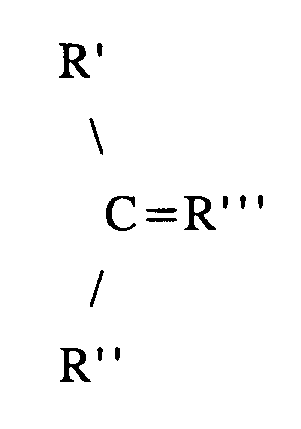
[0009] The method in its broader aspects is practiced by hydrolyzing after dispersing in water an alpha, beta-unsaturated aldehyde having the formula
to produce a carbonyl-containing compound and a by-product having the general formulae
and H₂R'''
The substituents R' and R'' are hydrogen, aliphatic or aromatic hydrocarbon groups or substituted derivatives thereof, and R''' is an aliphatic or aromatic aldehyde-containing group having the carbon to oxygen double bond of the aldehyde conjugated with the alpha, beta double bond between C and R''' of the alpha, beta-unsaturated carbonyl compound. The hydrolysis reaction proceeds under the action of heat and is catalyzed by hydroxide ion having a concentration level sufficient to maintain the solution pH between about 11 and about 13.
[0010] A large number of alpha, beta-unsaturated aldehydes may be hydrolyzed according to the teachings of this invention. The compounds in the following non-comprehensive list are included under the description of hydrolyzable alpha, beta-unsaturated carbonyl compounds: cinnamaldehyde to produce benzaldehyde and acetaldehyde; citral to produce 6-methyl-5-hepten-2-one and acetaldehyde; 2-dodecenal to produce decanal and acetaldehyde; 2-heptenal to produce pentanal and acetaldehyde; 2-hexenal to produce butanal and acetaldehyde; 5-methyl-2-phenyl-2-hexenal to produce phenyl acetaldehyde and 3-methylbutanal; and ortho-methoxy cinnamaldehyde to produce ortho-methoxy benzaldehyde and acetaldehyde.
Operating Examples
[0011] The following detailed operating examples illustrate the practice of the invention in its most preferred form, thereby enabling a person of ordinary skill in the art to practice the invention. The principles of this invention, its operating parameters and other obvious modifications thereof will be understood in view of the following detailed procedure.
Operating Example I
[0012] A solution was made up from 38.6 lbs. (17.51 kg) sodium hydroxide, 4 lbs. (1.81 kg) sodium lauryl sulfate and 10 litres antifoam agent in 760 gallons (2876.91 litres) of water. The solution was stirred until a homogeneous solution was obtained. Then, 1320 lbs. (598.74 kg) of cassia oil were placed in a 1150 gallon still. The oil contained approximately 72% by weight of cinnamaldehyhde. The still had a pot volume of about 1150 gallons (4353.2 litres) onto which was mounted a 4 foot (121.9 cm) fractionating column containing 1" x 1" (2.54 cm x 2.54 cm) ceramic tubes and a water-cooled condenser was thereafter connected in series for condensing the benzaldehyde-water azeotrope.
[0013] The above prepared sodium hydroxide solution was then added to the cassia oil and introduced into the pot of the still. The pot was equipped with a stirrer. Using pressurized steam and vigorous stirring, the pot was heated to reflux with a pot temperature of 105°C. Reflux was established with a column head temperature of about 99°C. Once reflux was established, it was continued for about 1 hour. During the course of the conversion of the cinnamaldehyde in the cassia oil to benzaldehyde, pH was monitored and was maintained at about 12 to about 12.5. In the event the pH fell below about 12, sodium hydroxide was added to bring the pH back up to the range of about 12-12.5. After refluxing for about 1 hour, take-off of the water-benzaldehyde azeotrope was initiated. The water-cooled condenser was operated at 100°F (37.8°C) thereby enabling the water-benzaldehyde azeotrope to be condensed and collected in a chilled receiver. The acetaldehyde by-product was principally vaporized at the temperature of the condenser and was taken off as vapor. The distillate consisted principally of benzaldehyde in an amount of about 75% or more with minor amounts of cinnamaldehyde, terpenes, orthomethoxybenzaldehyde and acetaldehyde. The crude benzaldehyde was thus collected in a chilled receiver and, in a continuous feed operation the condensed water was continuously fed back to the still to replace what had been taken off and the distillation of the azeotrope continued. The fractional steam distillation of the crude benzaldehyde continued until about 670 lbs. (303.91 kg) of crude benzaldehyde was obtained. The crude distillate containing benzaldehyde was then dried under vacuum and fractionally distilled under vacuum of about 29" (72 millibar) thereby providing a boiling point for the benzaldehyde at about 70°C in order to obtain a substantially pure benzaldehyde free from residual terpenes and other impurities.
Operating Example II
[0014] Approximately 500ml water, 5g (90% active) sodium hydroxide, and 88g terpeneless lemon grass oil containing approximately 95% citral were charged into a one-liter round bottom flask. The round bottom flask was equipped additionally with a trap having means of permitting removal of the lower density liquid while recirculating the higher density liquid, a fractionating column, and a means for stirring.
[0015] The stirred contents of the flask were heated to reflux by means of a heating mantle. The pH of the contents was set at 12 and maintained at that level during the remainder of the run by addition of sodium hydroxide when necessary. The contents were refluxed for one hour, after which time the steam distillate was slowly collected. The distillate take-off was regulated so that little or no citral distilled over. The distillation was continued until no additional oil was collected.
[0016] The oil phase distillate was separated from the steam condensate. The separated oil was then short-path vacuum distilled. The main cut yielded 72g of the citral hydrolysis product, 6-methyl-5-hepten-2-one. The other reaction product, acetaldehyde, was vented from the flask through the fractionating column during the reaction. The yield of 6-methyl-5-hepten-2-one was approximately 90% under the above conditions.
[0017] Thus, by means of practicing the preferred processes listed above, the objectives of this invention are achieved in that desirable products can be obtained in good yield from alpha, beta-unsaturated carbonyl compounds. Pure starting materials may be used, but good results are obtainable even from natural sources of the alpha, beta-unsaturated carbonyl compounds. It is critical to the teachings of this invention that reaction take place in an alkaline hydroxide environment wherein the pH is maintained within a window of about 11 to about 13. Unexpectedly, not only are products obtained in yields exceeding 70 to 75%, but the reaction proceeds with a low level of competitive side reactions, polymerization or other adverse reactions.
1. A method of producing a carbonyl-containing compound which comprises
hydrolyzing by dispersing in water an alpha, beta-unsaturated aldehyde of the formula
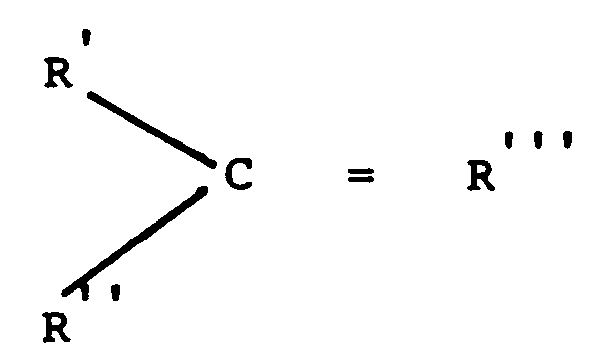
to produce a carbonyl-containing compound and by-product according to the following formulae
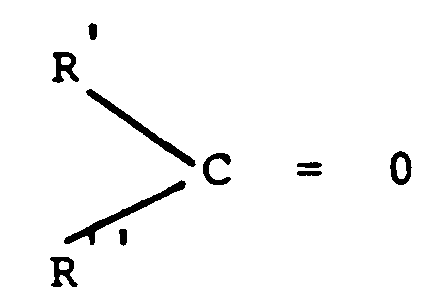
and H₂R'''
wherein R' and R'' are hydrogen, aliphatic or aromatic hydrocarbon groups or substituted derivatives thereof, and R''' is an aliphatic or aromatic aldehyde-containing group having the carbon to oxygen double bond of said aldehyde-group conjugated with the alpha, beta double bond between C and R''' of the above formula, and
conducting said hydrolysis of the alpha, beta-unsaturated carbonyl compound under the action of heat in the presence of a catalytic amount of hydroxide ion and at a pH of about 11 to about 13.
hydrolyzing by dispersing in water an alpha, beta-unsaturated aldehyde of the formula
to produce a carbonyl-containing compound and by-product according to the following formulae
and H₂R'''
wherein R' and R'' are hydrogen, aliphatic or aromatic hydrocarbon groups or substituted derivatives thereof, and R''' is an aliphatic or aromatic aldehyde-containing group having the carbon to oxygen double bond of said aldehyde-group conjugated with the alpha, beta double bond between C and R''' of the above formula, and
conducting said hydrolysis of the alpha, beta-unsaturated carbonyl compound under the action of heat in the presence of a catalytic amount of hydroxide ion and at a pH of about 11 to about 13.
2. The method of claim 1 which is conducted at a pH in the range of about 12 to about
12.5.
3. The method of claim 1 or 2 wherein the individual carbonyl-containing compounds obtained
from said hydrolysis reaction are fractionally distilled for separation in substantially
pure form.
4. The method of claim 1, 2 or 3 conducted in the presence of an anionic or non-ionic
surfactant.
5. The method of anyone of claims 1 to 4 conducted under shearing agitation to facilitate
the dispersion of the alpha, beta-unsaturated carbonyl compound in the water.
6. The method of anyone of claims 1 to 5 wherein said alpha, beta-unsaturated aldehyde
is citral and the carbonyl-containing compounds produced are 6-methyl-5-hepten-2-one
and acetaldehyde.
7. The method of anyone of claims 1 to 5 wherein said alpha, beta-unsaturated aldehyde
is cinnamaldehyde and the carbonyl-containing compounds produced are benzaldehyde
and acetaldehyde.
8. The method of claim 7 wherein cassia oil is employed as a natural source for the cinnamaldehyde
employed in the conversion.
9. A method of producing a carbonyl-containing compound which comprises
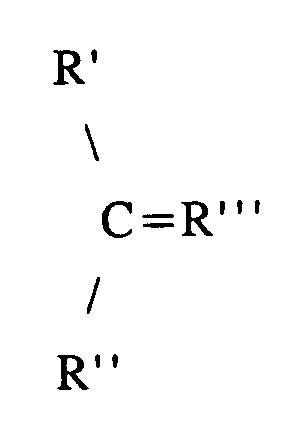
hydrolyzing by dispersing in water under shearing agitation in the presence of an anionic surfactant an alpha, beta-unsaturated aldehyde of the formula
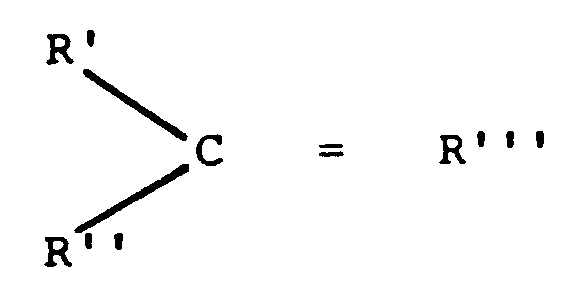
to produce a carbonyl-containing compound and by-product according to the following formulas
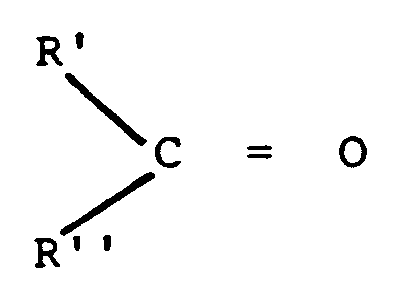
and H₂R'''
wherein R' and R'' are hydrogen, aliphatic or aromatic hydrocarbon groups or substituted derivatives thereof, and R''' is an aliphatic or aromatic aldehyde-containing group having the carbon to oxygen double bond of said aldehyde-group conjugated with the alpha, beta double bond between C and R''' of the above formula, and
conducting said hydrolysis of the alpha, beta-unsaturated aldehyde under the action of heat in the presence of a catalytic amount of hydroxide ion and at a pH of about 12 to about 12.5.
hydrolyzing by dispersing in water under shearing agitation in the presence of an anionic surfactant an alpha, beta-unsaturated aldehyde of the formula
to produce a carbonyl-containing compound and by-product according to the following formulas
and H₂R'''
wherein R' and R'' are hydrogen, aliphatic or aromatic hydrocarbon groups or substituted derivatives thereof, and R''' is an aliphatic or aromatic aldehyde-containing group having the carbon to oxygen double bond of said aldehyde-group conjugated with the alpha, beta double bond between C and R''' of the above formula, and
conducting said hydrolysis of the alpha, beta-unsaturated aldehyde under the action of heat in the presence of a catalytic amount of hydroxide ion and at a pH of about 12 to about 12.5.
1. Verfahren zur Herstellung von Carbonylverbindungen, umfassend die Hydrolyse von alpha,
beta-ungesättigten Aldehyden gemäß der allgemeinen Formel
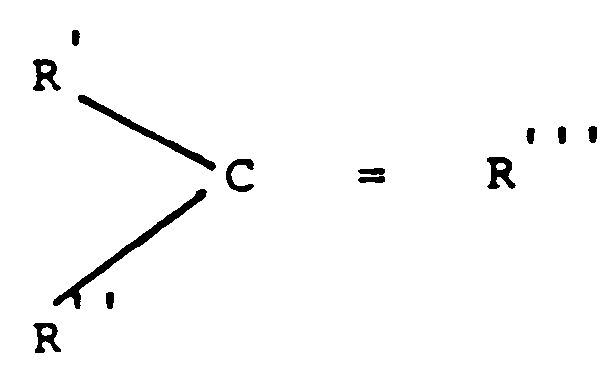
durch Dispergieren in Wasser zur Gewinnung einer Carbonylverbindung und Nebenprodukten gemäß den nachstehenden Formeln
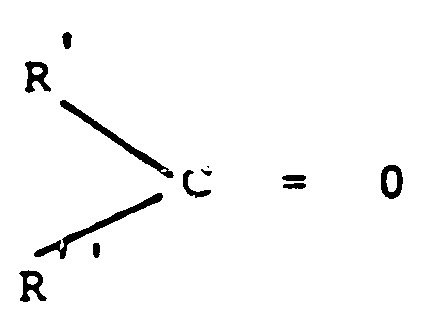
and H₂R'''
wobei R' und R'' Wasserstoff, aliphatische oder aromatische
Kohlenwasserstoffgruppen oder substituierte Derivate davon bedeuten und R''' eine einen aliphatischen oder aromatischen Aldehyd enthaltende Gruppe ist, die die Kohlenstoff-Sauerstoff-Doppelbindung der Aldehydgruppe konjugiert mit der alpha, beta-Doppelbindung zwischen C und R''' gemäß der obigen Formel aufweist,
und
Durchführung der Hydrolyse des alpha, beta-ungesättigten Aldehyds unter der Einwirkung von Wärme und in der Gegenwart einer katalytischen Menge eines Hydroxidions bei einem pH-Wert von etwa 11 bis etwa 13.
durch Dispergieren in Wasser zur Gewinnung einer Carbonylverbindung und Nebenprodukten gemäß den nachstehenden Formeln
and H₂R'''
wobei R' und R'' Wasserstoff, aliphatische oder aromatische
Kohlenwasserstoffgruppen oder substituierte Derivate davon bedeuten und R''' eine einen aliphatischen oder aromatischen Aldehyd enthaltende Gruppe ist, die die Kohlenstoff-Sauerstoff-Doppelbindung der Aldehydgruppe konjugiert mit der alpha, beta-Doppelbindung zwischen C und R''' gemäß der obigen Formel aufweist,
und
Durchführung der Hydrolyse des alpha, beta-ungesättigten Aldehyds unter der Einwirkung von Wärme und in der Gegenwart einer katalytischen Menge eines Hydroxidions bei einem pH-Wert von etwa 11 bis etwa 13.
2. Verfahren gemäß Anspruch 1,
dadurch gekennzeichnet
daß es bei einem pH-Wert im Bereich von etwa 12 bis etwa 12,5 durchgeführt wird.
dadurch gekennzeichnet
daß es bei einem pH-Wert im Bereich von etwa 12 bis etwa 12,5 durchgeführt wird.
3. Verfahren gemäß Anspruch 1 oder 2,
dadurch gekennzeichnet,
daß die bei der Hydrolysereaktion erhaltenen jeweiligen Carbonylverbindungen zur Gewinnung in im wesentlichen reiner Form fraktioniert destilliert werden.
dadurch gekennzeichnet,
daß die bei der Hydrolysereaktion erhaltenen jeweiligen Carbonylverbindungen zur Gewinnung in im wesentlichen reiner Form fraktioniert destilliert werden.
4. Verfahren gemäß Anspruch 1, 2 oder 3,
dadurch gekennzeichnet,
daß es in Gegenwart einer anionischen oder nichtionogenen oberflächenaktiven Substanz durchgeführt wird.
dadurch gekennzeichnet,
daß es in Gegenwart einer anionischen oder nichtionogenen oberflächenaktiven Substanz durchgeführt wird.
5. Verfahren gemäß einem jeden der Ansprüche 1 bis 4,
dadurch gekennzeichnet,
es zwecks Erleichterung der Dispersion der alpha, beta-ungessättigten Carbonylverbindung im Wasser unter Scherbewegung durchgeführt wird.
dadurch gekennzeichnet,
es zwecks Erleichterung der Dispersion der alpha, beta-ungessättigten Carbonylverbindung im Wasser unter Scherbewegung durchgeführt wird.
6. Verfahren gemäß einem jeden der Ansprüche 1 bis 5,
dadurch gekennzeichnet,
daß der eingesetzte alpha-, beta-ungesättigte Aldehyd Citral ist und die hergestellten Carbonylverbindungen 6-Methyl-5-hepten-2-on und Acetaldehyd sind.
dadurch gekennzeichnet,
daß der eingesetzte alpha-, beta-ungesättigte Aldehyd Citral ist und die hergestellten Carbonylverbindungen 6-Methyl-5-hepten-2-on und Acetaldehyd sind.
7. Verfahren gemäß einem jeden der Ansprüche 1 bis 5,
dadurch gekennzeichnet,
daß der eingesetzte alpha, beta-ungesättigte Aldehyd Zimtaldehyd ist und die hergestellten Carbonylverbindungen Benzaldehyd und Acetaldehyd sind.
dadurch gekennzeichnet,
daß der eingesetzte alpha, beta-ungesättigte Aldehyd Zimtaldehyd ist und die hergestellten Carbonylverbindungen Benzaldehyd und Acetaldehyd sind.
8. Verfahren gemäß Anspruch 7,
dadurch gekennzeichnet,
daß bei der Umsetzung Kassiaöl als natürliche Quelle für den Zimtaldehyd eingeetzt wird.
dadurch gekennzeichnet,
daß bei der Umsetzung Kassiaöl als natürliche Quelle für den Zimtaldehyd eingeetzt wird.
9. Verfahren zur Herstellung einer Carbonylverbindung, umfassend
die Hydrolyse von alpha, beta-ungesättigten Aldehyden gemäß der allgemeinen Formel
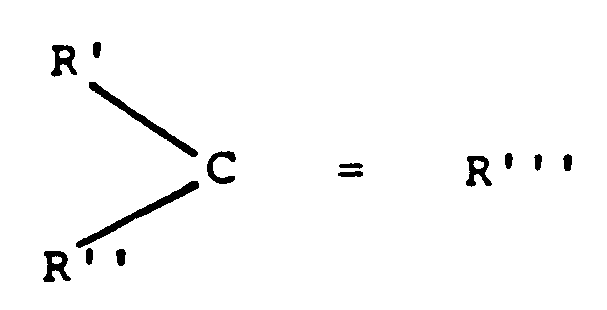
durch Dispergieren in Wasser unter Scherbewegung und in Gegenwart von einer anionischen oberflächenaktiven Substanz zur Gewinnung von Carbonylverbindungen und Nebenprodukten gemäß den nachstehenden Formeln
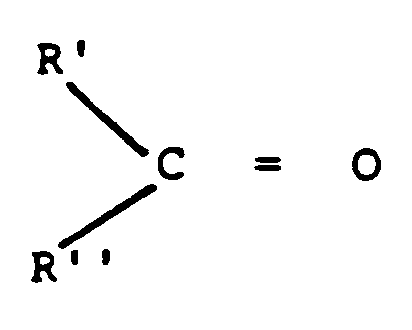
and H₂R'''
worin R' und R'' Wasserstoff, aliphatische oder aromatische
Kohlenwasserstoffgruppen oder substituierte Derivate davon bedeuten und R''' eine einen aliphatischen oder aromatischen Aldehyd enthaltende Gruppe ist, die die Kohlenstoff-Sauerstoff-Doppelbindung der Aldehydgruppe konjugiert mit der alpha, beta-Doppelbindung zwischen C und R''' gemäß der obigen Formel aufweist,
und
Durchführung der Hydrolyse des alpha, beta-ungesättigten Aldehyds unter der Einwirkung von Wärme und in Gegenwart einer katalytischen Menge von Hydroxidionen bei einem pH-Wert von etwa 12 bis etwa 12,5.
die Hydrolyse von alpha, beta-ungesättigten Aldehyden gemäß der allgemeinen Formel
durch Dispergieren in Wasser unter Scherbewegung und in Gegenwart von einer anionischen oberflächenaktiven Substanz zur Gewinnung von Carbonylverbindungen und Nebenprodukten gemäß den nachstehenden Formeln
and H₂R'''
worin R' und R'' Wasserstoff, aliphatische oder aromatische
Kohlenwasserstoffgruppen oder substituierte Derivate davon bedeuten und R''' eine einen aliphatischen oder aromatischen Aldehyd enthaltende Gruppe ist, die die Kohlenstoff-Sauerstoff-Doppelbindung der Aldehydgruppe konjugiert mit der alpha, beta-Doppelbindung zwischen C und R''' gemäß der obigen Formel aufweist,
und
Durchführung der Hydrolyse des alpha, beta-ungesättigten Aldehyds unter der Einwirkung von Wärme und in Gegenwart einer katalytischen Menge von Hydroxidionen bei einem pH-Wert von etwa 12 bis etwa 12,5.
1. Procédé pour la production d'un composé à fonctionnalité carbonyle, ledit procédé
comprenant :
l'hydrolyse par dispersion dans de l'eau d'un aldéhyde α,β-insaturé de formule :
pour produire un composé à fonctionnalité carbonyle et un produit secondaire selon les formules suivantes
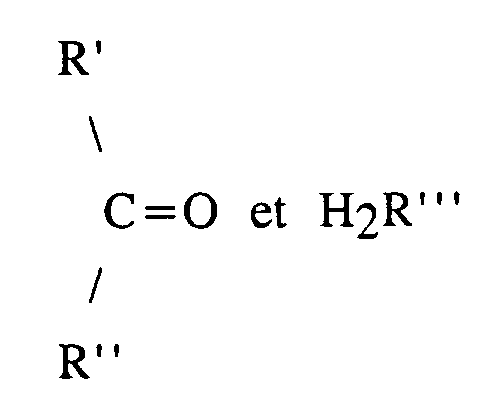
où R' et R'' sont des groupes H, hydrocarbonés aliphatiques ou aromatiques ou leurs dérivés substitués, et R''' est un groupe comportant une fonction aldéhyde aliphatique ou aromatique ayant la double liaison C=O de ladite fonction aldéhyde conjuguée avec la double liaison α,β située entre l'atome de carbone et le groupe R''', et
réalisation de ladite hydrolyse du composé carbonyle α,β-insaturé sous action de la chaleur en présence d'une quantité catalytique d'ion hydroxyde et à un pH d'environ 11 à environ 12.
l'hydrolyse par dispersion dans de l'eau d'un aldéhyde α,β-insaturé de formule :
pour produire un composé à fonctionnalité carbonyle et un produit secondaire selon les formules suivantes
où R' et R'' sont des groupes H, hydrocarbonés aliphatiques ou aromatiques ou leurs dérivés substitués, et R''' est un groupe comportant une fonction aldéhyde aliphatique ou aromatique ayant la double liaison C=O de ladite fonction aldéhyde conjuguée avec la double liaison α,β située entre l'atome de carbone et le groupe R''', et
réalisation de ladite hydrolyse du composé carbonyle α,β-insaturé sous action de la chaleur en présence d'une quantité catalytique d'ion hydroxyde et à un pH d'environ 11 à environ 12.
2. Procédé suivant la revendication 1, réalisé à un pH se situant dans l'intervalle d'environ
12 à environ 12,5.
3. Procédé suivant l'une quelconque des revendications 1 ou 2, dans lequel les composés
à fonctionnalité carbonyle qui sont obtenus individuellement selon ladite réaction
d'hydrolise sont soumis à une distillation fractionnée pour séparation sous une forme
essentiellement pure.
4. Procédé suivant l'une quelconque des revendications 1 à 3, réalisée en présence d'un
tensio-actif anionique ou non-ionique.
5. Procédé suivant l'une quelconque des revendications 1 à 4, réalisée sous forte agitation
(en anglais : "shearing agitation") pour faciliter la dispersion du composé carbonyle
α,β-insaturé dans l'eau.
6. Procédé suivant l'une quelconque des revendications 1 à 5, dans lequel ledit aldéhyde
α,β-insaturé est le citral et les composés à fonctionnalité carbonyle produits sont
les 6-méthyl-5-heptène-2-one et acétaldéhyde.
7. Procédé suivant l'une quelconque des revendications 1 à 5, dans lequel ledit aldéhyde
α,β-insaturé est le cinnamaldéhyde et les composés à fonctionnalité carbonyle produits
sont les benzaldéhyde et acétaldéhyde.
8. Procédé suivant la revendication 7, dans lequel l'essence de cassia est utilisée en
tant que source naturelle pour le cinnamaldéhyde utilisé dans la conversion.
9. Procédé pour la production d'un composé à fonctionnalité carbonyle, ledit procédé
comprenant :
l'hydrolyse par dispersion dans de l'eau, sous forte agitation en présence d'un tensio-actif anionique, d'un aldéhyde α,β-insaturé de formule :
pour produire un composé à fonctionnalité carbonyle et un produit secondaire selon les formules suivantes
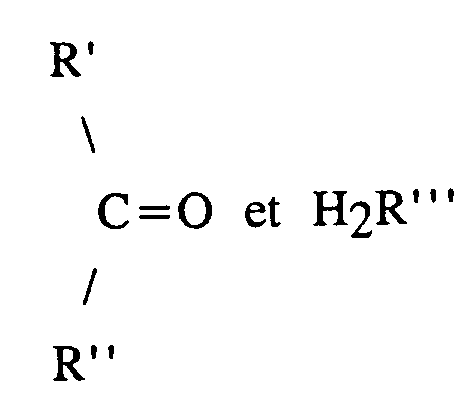
où R' et R'' sont des groupes H, hydrocarbonés aliphatiques ou aromatiques ou leurs dérivés substitués, et R''' est un groupe comportant une fonction aldéhyde aliphatique ou aromatique ayant la double liaison C=O de ladite fonction aldéhyde conjuguée avec la double liaison α,β située entre l'atome de carbone et le groupe R''', et
réalisation de ladite hydrolyse du composé carbonyle α,β-insaturé sous action de la chaleur en présence d'une quantité catalytique d'ion hydroxyde et à un pH d'environ 12 à environ 12,5.
l'hydrolyse par dispersion dans de l'eau, sous forte agitation en présence d'un tensio-actif anionique, d'un aldéhyde α,β-insaturé de formule :
pour produire un composé à fonctionnalité carbonyle et un produit secondaire selon les formules suivantes
où R' et R'' sont des groupes H, hydrocarbonés aliphatiques ou aromatiques ou leurs dérivés substitués, et R''' est un groupe comportant une fonction aldéhyde aliphatique ou aromatique ayant la double liaison C=O de ladite fonction aldéhyde conjuguée avec la double liaison α,β située entre l'atome de carbone et le groupe R''', et
réalisation de ladite hydrolyse du composé carbonyle α,β-insaturé sous action de la chaleur en présence d'une quantité catalytique d'ion hydroxyde et à un pH d'environ 12 à environ 12,5.