|
(11) | EP 0 243 713 B1 |

| (12) | EUROPEAN PATENT SPECIFICATION |
|
|
| (54) |
Bactericidal composition and use thereof Bakterizide Zusammensetzung Composition bactéricide |
|
|
|||||||||||||||||||||||||||||||
| Note: Within nine months from the publication of the mention of the grant of the European patent, any person may give notice to the European Patent Office of opposition to the European patent granted. Notice of opposition shall be filed in a written reasoned statement. It shall not be deemed to have been filed until the opposition fee has been paid. (Art. 99(1) European Patent Convention). |
[0001] This invention relates to a bactericidal composition. More particularly, it relates to a bactericidal composition which exhibits a high bactericidal effect even in the presence of organic materials such as feces in a cattle stall.
[0002] It has been videly known that didecyldimethylammonium chloride exhibits higher bactericidal effects on various bacteria including pathogenic ones than other bactericidal compounds such as alkylbenzyl- dimethylammonium chloride.
[0003] However, didecyldimethylammonium chloride has the disadvantage that its bactericidal effect is significantly lowered because of a large amount of feces adhering thereto when used in stalls of cattle, for example, cows or horses, or poultry.
[0004] Under these circumstances, we have tried to solve the above problem and to enhance the bactericidal effect of didecyldimethylammonium chloride in the presence of organic materials originating from feces. As a result, we have found that the didecyldimentylammonium chloride can exhibit an excellent bactericidal effect even in the presence of organic materials when used together with a particular compound, thus completing the present invention.
[0005] The invention provides a bactericidal composition which comprises didecyldimethylammonium chloride and an alkylene oxide adduct of a polyhydric alcohol, said alcohol being selected from pentaerythritol, trimethylolpropan, di-trimethylolpropane, polymethylolnonane, neopentylglycol, di-pentaerythritol, glycerine and polyglycerine. It is preferred that the adduct has the mole number of the added alkylene oxide in the range between 4 and 200, more preferably 4 and 100, per one mole of the polyhydric alcohol.
[0006] The adduct includes an embodiment having the formula (I):
in which R is an alkylene having 2 to 4 carbon atoms, a, b, c and d each are zero or an integer of 1 to 50 and the total number of a, b, c and d ranges from 4 to 200.
[0007] The alkylene oxide adduct preferably contains 20 to 100 mole percent of ethylene oxide based on the total alkylene oxide.
[0008] The adduct for use in the invention obtained by the addition reaction between a polyhydric alcohol being trivalent or more and an alkylene oxide in the presence of an acid catalyst or an alkali catalyst. The alkylene oxide preferably includes ethylene oxide, propylene oxide, butylene oxide and a mixture thereof. The addition reaction may be conducted so as to obtain a block adduct.
[0009] It is preferable that a weight ratio of the didecyldimethylammonium chloride to said adduct ranges from 1/0.1 to 1/10, more preferably from 1/0.2 to 1/7.
[0010] The bactericidal composition of the present invention may be prepared in the form of an aqueous solution of 2 to 50% by weight in concentration and diluted prior to use to give a concentration of 100 to 1000 ppm, although it may vary depending on the subject.
[0011] In the embodiment of the present invention, various surfactants or other additives may be added to the diluted composition of the present invention to thereby improve the physical properties thereof, for example, to lower the surface tension, to impart the wet maleability or to control foaming. Examples of these additives are nonionic surfactants such as polyoxyethylene (POE) (9) nonylphenyl ether and POE (12) octylphenyl ether; and anionic surfactants such as sodium POE (5) octylphenyl ether sulfate and magnesium POE (6) dodecylphenyl ether sulfate.
[0012] The bactericidal composition of the invention provides an excellent bactericidal effect even in the presence of organic materials such as feces. This effect is synergistic due to the two components.
[0015] Escherichia coli, which had been previously cultured in a slant medium, was suspended in didecyldimethylammonium chloride diluted to the concentrations as shown in Table 1 for 1, 2.5 and 5 minutes. Then the cells were collected, transplanted to an agar medium and allowed to stand therein for 24 hours, followed by observation of the growth condition thereof.
[0016] The abovementioned procedure was followed except that 1 % by weight of fowl droppings were added to each didecyldimethylammonium chloride solution.
[0017] The growth of the E. coli was evaluated according to the following criterion:
-: no colony is formed,
±: 1 to 5 colonies are formed,
+: 6 to 10 colonies are formed, and
+ +: 11 or more colonies are formed.
[0019] These results suggest that the bactericidal effect of didecyldimethylammonium chloride is lowered under practical conditions, i.e., in the presence of fowl droppings.
Example 1
[0020] The compositions listed in Table 2 were each prepared, using didecyldimethylammonium chloride, an an alkylene oxide adduct of a polyhydric alcohol and water. The alkylene oxide adduct was an adduct of 8 moles of ethylene oxide to pentaerythritol, called POE(8)pentaerythritol, or an adduct of 8 moles of ethylene oxide and 20 moles of propylene oxide to pentaerythritol, called POE(8)POP(20)pentaerythritol. These compositions were examined about the effect against the growth of E. coli in the same way as shown in Comparative Example 1. Results are shown in Table 3.
Comparative Example 2
[0021] The procedure of Example 1 was followed except that the preparations were formulated, as shown below, by using POE(8) lauryl ether and POE(7) nonylphenylether for the adduct.
Example 2
[0023] The preparations 9 to 13 were each formulated by using 10 wt.% of didecyldimethylammonium chloride, 50 wt.% of an alkylene oxide adduct listed below and 40 wt.% of water and examined about the effect against the growth E. coli in the same way as shown in Comparative Example 1. Results are shown in Table 5.
preparation 9 POE(10) trimethylolpropane
10 POE(15) ditrimethylolpropane
11 POE(8)POP(6)glycerine
12 POE(12)dipentaerythritol
13 POE(12)diglycerine
Claims for the following Contracting State(s) : DE, FR, GB, IT, NL, SE
1. A composition which comprises didecyldimethylammonium chloride and an alkylene
oxide adduct of a polyhydric alcohol, said alkohol being selected from pentaerythritol,
trimethylolpropane, di-trimethylolpropane, polymethylolnonane, neopentylglycol, di-pentaerythritol,
glycerine and polyglycerine.
2. A composition as claimed in claim 1, in which said adduct has the mole number of
the added alkylene oxide in the range between 4 and 200 per one mole of the polyhydric
alcohol.
3. A composition as claimed in claim 1,
in which said adduct has the formula (I):
in which R is an alkylene having 2 to 4 carbon atoms, a, b, c and d each are zero or an integer of 1 to 50 and the total number of a, b, c and d ranges from 4 to 200.
4. A composition as claimed in claim 1,
in which a weight ratio of said didecyldimethylammonium chloride to the alkylene oxide adduct ranges from 1/0.1 to 1/10.
in which a weight ratio of said didecyldimethylammonium chloride to the alkylene oxide adduct ranges from 1/0.1 to 1/10.
5. A composition as claimed in claim 1, in which the adduct contains 20 to 100 mole
percent of ethylene oxide based on the total alkylene oxide.
6. A composition as claimed in claim 1,
which further comprises a surfactant.
which further comprises a surfactant.
7. An aqueous solution which comprises 2 to 50 percent by weight of said composition
as defined in claim 1 or 6 and the balance of water.
8. Use of the composition of any of claims 1 to 7 as a bactericide.
Claims for the following Contracting State(s) : ES
1. Process for preparing a compositon which comprises mixing didecyldimethylammonium
chloride and an alkylene oxide adduct of a polyhydric alcohol, said polyhydric alcohol
being selected from pentaerythritol, trimethylolpropane, di-trimethylolpropane, polymethylolnonane,
neopentylglycol, di-pentaerythritol, glycerine and polyglycerine.
2. Process for preparing a composition as claimed in claim 1, in which said adduct
has the mole number of the added alkylene oxide in the range between 4 and 200 per
one mole of the polyhydric alcohol.
3. Process for preparing a composition as claimed in claim 1, in which said adduct
has the formula (I):
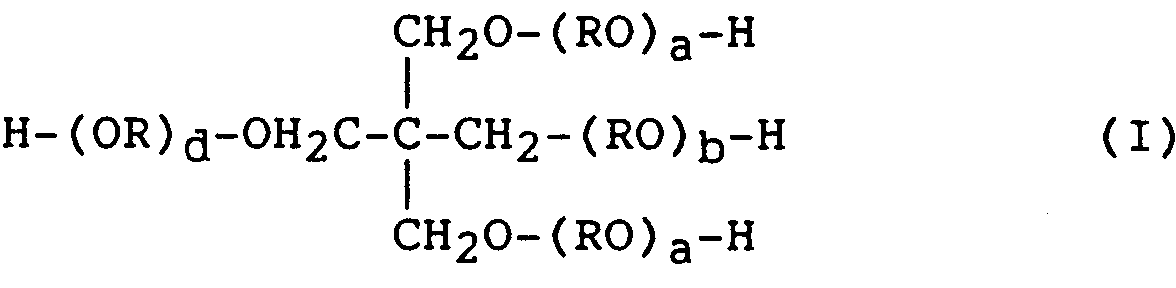
in which R is an alkylene having 2 to 4 carbon atoms, a, b, c and d each are zero or an integer of 1 to 50 and the total number of a, b, c and d ranges from 4 to 200.
in which R is an alkylene having 2 to 4 carbon atoms, a, b, c and d each are zero or an integer of 1 to 50 and the total number of a, b, c and d ranges from 4 to 200.
4. Process for preparing a composition as claimed in claim 1, in which the amounts
of didecyldimethyalammonium chloride and alkylene oxide are chosen such that the weight
ratio of said didecyldimehtylammonium chloride to the alkylene oxide adduct ranges
from 1/0.1 to 1/10.
5. Process for preparing a composition as claimed in claim 1, in which the adduct
contains 20 to 100 mole percent of ethylene oxide based on the total alkylene oxide.
6. Process for preparing a composition as claimed in claim 1,
in which a surfactant is also added.
in which a surfactant is also added.
7. Process for preparing an aqueous solution which comprises mitxing the composition
prepared in claim 1 or 6 with water in quantities such that the final solution comprises
2 to 50 percent by weight of said composition prepared in claim 1 or 6 and the balance
of water.
8. Use of the composition of any of claims 1 to 7 as a bactericide.
Revendications pour l'(les) Etat(s) contractant(s) suivant(s) : suivants : DE, FR,
GB, IT, NL, SE
1. Composition qui comprend du chlorure de didécyldiméthylammonium et un produit d'addition
d'oxyde d'alkylène sur un polyalcool, ledit alcool étant choisi parmi le pentaérythritol,
le triméthylolpropane, le di-triméthylolpropane, un polyméthylolnonane, le néopentylglycol,
le dipentaérythritol, le glycérol et un polyglycérol.
2. Composition selon la revendication 1, dans laquelle le nombre de moles de l'oxyde
d'alkylène ajouté dudit produit d'addition est compris dans l'intervalle de 4 à 200
par mole du polyalcool.
3. Composition selon la revendication 1, dans laquelle ledit produit d'addition répond
à la formule (1) :
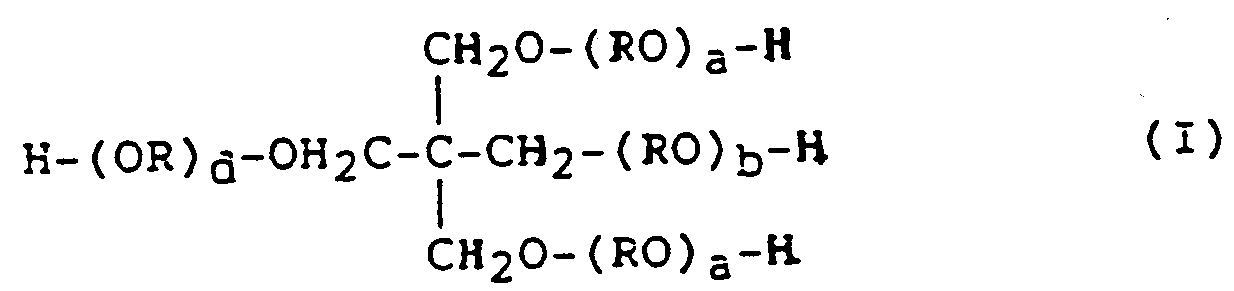
dans laquelle R est un groupe alkylène ayant 2 à 4 atomes de carbone, a, b, c et d sont chacun égaux à zéro ou à un nombre entier de 1 à 50, et la somme de a, b, c et d s'inscrit entre 4 et 200.
dans laquelle R est un groupe alkylène ayant 2 à 4 atomes de carbone, a, b, c et d sont chacun égaux à zéro ou à un nombre entier de 1 à 50, et la somme de a, b, c et d s'inscrit entre 4 et 200.
4. Composition selon la revendication 1, dans laquelle le rapport en poids dudit chlorure
de didécyldiméthylammonium au produit d'addition d'oxyde d'alkylène se situe entre
1/0,1 et 1/10.
5. Composition selon la revendication 1, dans laquelle le produit d'addition contient
20 à 100 moles pour cent d'oxyde d'éthylène par rapport à l'oxyde d'alkylène total.
6. Composition selon la revendication 1, qui comprend de plus un agent tensio-actif.
7. Solution aqueuse qui comprend 2 à 50 pour cent en poids de ladite composition telle
que définie dans la revendication 1 ou 6, et le reste d'eau.
8. Utilisation de la composition de l'une quelconque des revendications 1 à 7 comme
bactéricide.
Revendications pour l'(les) Etat(s) contractant(s) suivant(s) : suivant : ES
1. Procédé pour préparer une composition, qui consiste à mélanger du chlorure de didécyldiméthylammonium
et un produit d'addition d'oxyde d'alkylène sur un polyalcool, ledit polyalcool étant
choisi parmi le pentaérythritol, le triméthylolpropane, le di-triméthylolpropane,
un polyméthylolnonane, le néopentylglycol, le dipentaérythritol, le glycérol et un
polyglycérol.
2. Procédé pour préparer une composition selon la revendication 1, dans lequel le
nombre de moles de l'oxyde d'alkylène ajouté du produit d'addition est compris dans
l'intervalle de 4 à 200 par mole du polyalcool.
3. Procédé pour préparer une composition selon la revendication 1, dans lequel ledit
produit d'addition répond à la formule (1) :
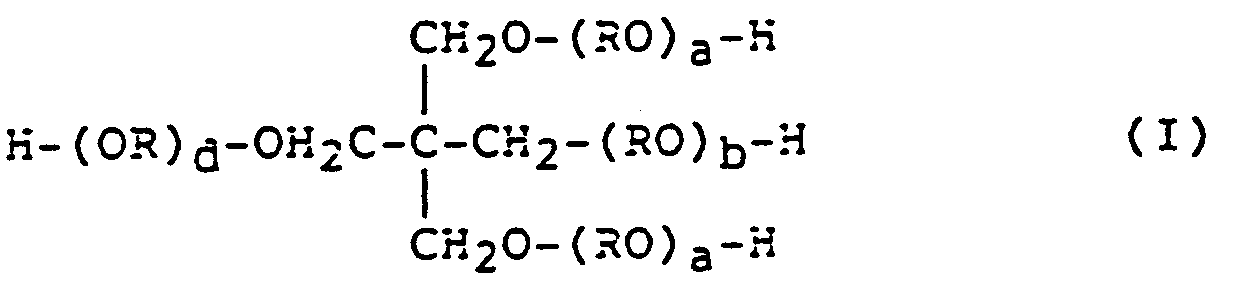
dans laquelle R est un groupe alkylène ayant 2 à 4 atomes de carbone, a, b, c et d sont chacun égaux à zéro ou à un nombre entier de 1 à 50, et la somme de a, b, c et d s'inscrit entre 4 et 200.
dans laquelle R est un groupe alkylène ayant 2 à 4 atomes de carbone, a, b, c et d sont chacun égaux à zéro ou à un nombre entier de 1 à 50, et la somme de a, b, c et d s'inscrit entre 4 et 200.
4. Procédé pour préparer une composition selon la revendication 1, dans lequel les
quantités de chlorure de didécyldiméthylammonium et d'oxyde d'alkylène sont choisies
de telle manière que le rapport en poids dudit chlorure de didécyldiméthylammonium
au produit d'addition d'oxyde d'alkylène se situe entre 1/0,1 et 1/10.
5. Procédé pour préparer une composition selon la revendication 1, dans lequel le
produit d'addition contient 20 à 100 moles pour cent d'oxyde d'éthylène par rapport
à l'oxyde d'alkylène total.
6. Procédé pour préparer une composition selon la revendication 1, dans lequel on
ajoute également un agent tensio-actif.
7. Procédé pour préparer une solution aqueuse, qui consiste à mélanger la composition
préparée selon la revendication 1 ou 6 avec de l'eau en des quantités telles que la
solution finale comprenne 2 à 50 pour cent en poids de ladite composition préparée
selon la revendication 1 ou 6, et le reste d'eau.
8. Utilisation de la composition de l'une quelconque des revendications 1 à 7 comme
bactéricide.
Patentansprüche für folgende(n) Vertragsstaat(en) : DE, FR, GB, IT, NL, SE
1. Zusammensetzung, umfassend Didecyldimethylammoniumchlorid und ein Alkylenoxid-Addukt
eines mehrwertigen Alkohols, wobei der Alkohol ausgewählt ist aus Pentaerythrit, Trimethylolpropan,
Di-trimethylolpropan, Polymethylolnonan, Neopentylglykol, Di-pentaerythrit, Glyzerin
und Polyglyzerin.
2. Zusammensetzung gemäss Anspruch 1, in welcher das Addukt die Molzahl des zugegebenen
Alkylenoxids im Bereich von 4 bis 200 pro 1 Mol des mehrwertigen Alkohols hat.
3. Zusammensetzung gemäss Anspruch 1, in welcher das Addukt die Formel (I) hat
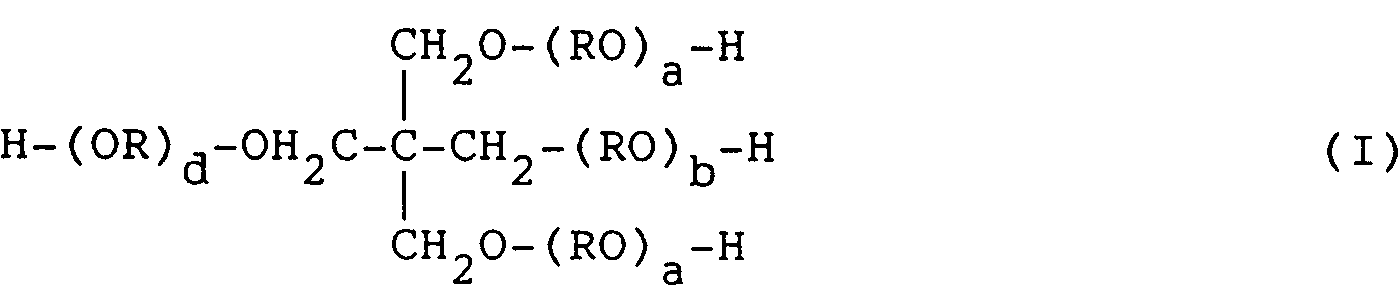
in welcher R ein Alkylen mit 2 bis 4 Kohlenstoffatomen, a, b, c und d jeweils 0 oder eine ganze Zahl von 1 bis 50 und die Gesamtzahl von a, b, c und d im Bereich von 4 bis 200 ist.
in welcher R ein Alkylen mit 2 bis 4 Kohlenstoffatomen, a, b, c und d jeweils 0 oder eine ganze Zahl von 1 bis 50 und die Gesamtzahl von a, b, c und d im Bereich von 4 bis 200 ist.
4. Zusammensetzung gemäss Anspruch 1, in welcher das Gewichtsverhältnis des
Didecyldimethylammoniumchlorids zu dem Alkylenoxid-Addukt im Bereich von 1:0,1 bis 1:10 ist.
Didecyldimethylammoniumchlorids zu dem Alkylenoxid-Addukt im Bereich von 1:0,1 bis 1:10 ist.
5. Zusammensetzung gemäss Anspruch 1, in welcher das Addukt 20 bis 100 Mol.% Ethylenoxid,
bezogen auf das gesamte Alkylenoxid, enthält.
6. Zusammensetzung gemäss Anspruch 1, welche weiterhin ein oberflächenaktives Mittel
umfasst.
7. Wässrige Lösung, die 2 bis 50 Gew.% der Zusammensetzung wie in Ansprüchen 1 oder
6 angegeben und als Rest Wasser umfasst.
8. Verwendung der Zusammensetzung gemäss einem der Ansprüche 1 bis 7 als Bakterizid.
Patentansprüche für folgende(n) Vertragsstaat(en) : ES
1. Verfahren zur Herstellung einer Zusammensetzung, umfassend das Vermischen von Didecyldimethylammoniumchlorid
und einem Alkylenoxid-Addukt eines mehrwertigen Alkohols, wobei der mehrwertige Alkohol
ausgewählt ist aus Pentaerythrit, Trimethylolpropan, Di-trimethylolpropan, Polymethylolnonan,
Neopentylglykol, Di-pentaerythrit, Glyzerin und Polyglyzerin.
2. Verfahren zur Herstellung einer Zusammensetzung gemäss Anspruch 1, in welcher das
Addukt die Anzahl des zugegebenen Alkylenoxids im Bereich von 4 bis 200 pro 1 Mol
des mehrwertigen Alkohols hat.
3. Verfahren zur Herstellung einer Zusammensetzung gemäss Anspruch 1, in welcher das
Addukt die Formel (I) hat

in welcher R ein Alkylen mit 2 bis 4 Kohlenstoffatomen, a, b, c und d jeweils 0 oder eine ganze Zahl von 1 bis 50 und die Gesamtzahl von a, b, c und d im Bereich von 4 bis 200 ist.
in welcher R ein Alkylen mit 2 bis 4 Kohlenstoffatomen, a, b, c und d jeweils 0 oder eine ganze Zahl von 1 bis 50 und die Gesamtzahl von a, b, c und d im Bereich von 4 bis 200 ist.
4. Verfahren zur Herstellung einer Zusammensetzung gemäss Anspruch 1, bei welchem
die Mengen an Didecyldimethylammoniumchlorid und Alkylenoxid so ausgewählt werden,
dass das Gewichtsverhältnis des Didecyldimethylammoniumchlorids zu dem Alkylenoxid-Addukt
im Bereich von 1:0,1 bis 1:10 liegt.
5. Verfahren zur Herstellung einer Zusammensetzung gemäss Anspruch 1, in welcher das
Addukt 20 bis 100 Mol.% Ethylenoxid, bezogen auf das gesamte Alkylenoxid, enthält.
6. Verfahren zur Herstellung einer Zusammensetzung gemäss Anspruch 1, bei dem ausserdem
ein oberflächenaktives Mittel zugegeben wird.
7. Verfahren zur Herstellung einer wässrigen Lösung, umfassend das Vermischen der
Zusammensetzung, hergestellt gemäss Anspruch 1 oder 6, mit Wasser, in solchen Mengen,
dass die Endlösung 2 bis 50 Gew.% der Zusammensetzung, hergestellt gemäss Ansprüchen
1 oder 6, und als Rest Wasser enthält.
8. Verwendung der Zusammensetzung gemäss einem der Ansprüche 1 bis 7 als Bakterizid.