|
(11) | EP 0 244 939 B1 |

| (12) | EUROPEAN PATENT SPECIFICATION |
|
|
| (54) |
Halogen-containing pyridine compound and liquid crystal composition Halogen enthaltende Pyridinverbindung und flüssigkristalline Zusammensetzung Composé de pyridine contenant d'halogène et composition cristalline liquide |
|
|
|||||||||||||||||||||||||||||||
|
||||||||||||||||||||||||||||||||
| Note: Within nine months from the publication of the mention of the grant of the European patent, any person may give notice to the European Patent Office of opposition to the European patent granted. Notice of opposition shall be filed in a written reasoned statement. It shall not be deemed to have been filed until the opposition fee has been paid. (Art. 99(1) European Patent Convention). |
BACKGROUND OF THE INVENTION
1. Field of the Invention
[0001] This invention relates to a novel compound and a chiral smectic C (SC*) liquid crystal composition containing the above-mentioned compound and useful for liquid crystal display elements.
2. Description of the Related Art
[0002] At present, as to liquid crystal display elements, TN (Twisted Nematic) type display mode has been most broadly employed, but as far as the response speed is concerned, such TN type display elements are inferior to emissive type display elements (such as those of electroluminescence, plasma display, etc.). Although various improvements in this respect have been attempted, it appears that possibility of the improvement to a large extent has not been left behind so much. Thus, various liquid crystal display devices based on a different principle from that of TN type display elements have been attempted. As one of such devices, there is a display mode utilizing a ferroelectric liquid crystal (N.A. Clark et al: Applied Phys. lett., 36, 899 (1980)). This mode utilizes the chiral smectic C phase (hereinafter abbreviated to SC* phase) or the chiral smectic H phase (hereinafter abbreviated to SH* phase) of the ferroelectric liquid crystal, and those having these phases in the vicinity of room temperature are preferred.
[0003] These chiral smectic liquid crystal materials may be obtained by blending a plurality of single compounds each exhibiting a chiral smectic phase by itself, but it is known that the materials may be also obtained by adding an optically active liquid crystal compound, preferably a chiral smectic liquid crystal compound to an achiral smectic liquid crystal (exhibiting smectic C phase (SC phase), smectic H phase (SH phase), etc.).
[0004] Various kinds of compounds exhibiting SC phase have been known, but as to whether or not chiral smectic liquid crystal materials obtained by adding an optically active liquid crystal to the above-mentioned known compounds exhibit superior performances in liquid crystal display utilizing ferroelectricity, no ultimate evaluation thereof has been yet obtained. This is due to the fact that liquid crystal display utilizing ferroelectricity has not yet been technically completed. Thus it is necessary in the present situation to test various novel SC materials.
SUMMARY OF THE INVENTION
[0005] The main object of the present invention is to provide a novel liquid crystal compound exhibiting SC phase and suitable to the above-mentioned use application.
[0006] The present invention resides in a halogen-containing pyridine compound, 2-(m-halogen-p-alkylphenol)-5-alkylpyridine, expressed by the formula:
wherein X represents F or Cℓ and R₁ and R₂ each represents an alkyl group of 1 to 18 carbon atoms, and a chiral smectic liquid crystal composition comprising at least one member of said liquid crystal compound and at least one member of optically actice liquid crystal compounds.
[0007] The invention also provides chiral smectic C (SC*) liquid crystal compositions comprising at least one compound of formula (I) together with at least one optically active compound. The invention further provides a light-switching element utilizing ferroelectricity and comprising a composition as defined above.
[0008] The present applicants have previously filed a U.S. application entitled "Halogen-containing heterocyclic compound", filed on January 14, 1987 (US-A-4 765 924). This application is directed to a compound expressed by the formula
wherein R₁ and R₂ each represents a C₂-C₁₈ alkyl group; X represents _N= or _CH=; Y represents F or Cℓ; n represents 0 or an integer of 1 to 10; and the symbol * represents an asymmetric carbon atom.
[0009] The case where X represents _CH= in the above formula corresponds to the case where R₂ of the present invention is changed to an optically active group. Thus, the compounds of the prior invention naturally exhibit SC* phase, whereas the compound of the present invention exhibit no SC* phase. Further, in the compounds of the present invention, those exhibiting SC phase have a tendency that their upper limit temperatures are higher than those of SC* phase of the corresponding optically active substances.
DETAILED DESCRIPTION OF PREFERRED EMBODIMENTS
[0011] 2-(m-fluoro-p-ethoxyphenyl)-5-ethylpyridine, 2-(m-fluoro-p-butoxyphenyl)-5-ethylpyridine, 2-(m-fluoro-p-hexyloxyphenyl)-ethylpyridine, 2-(m-fluoro-p-octyloxyphenyl)-ethylpyridine, 2-(m-fluoro-p-octadecyloxyphenyl)-5-ethylpyridine, 2-(m-fluoro-p-methoxyphenyl)-5-propylpyridine, 2-(m-fluoro-p-butoxyphenyl)-5-propylpyridine, 2-(m-fluoro-p-nonyloxyphenyl)-5-propylpyridine, 2-(m-fluoro-p-dodecyloxyphenyl)-5-propylpyridine, 2-(m-fluoro-p-pentoxyphenyl)-5-butylpyridine, 2-(m-fluoro-p-octyloxyphenyl)-5-butylpyridine, 2-(m-chloro-p-decyloxyphenyl)-5-butylpyridine, 2-(m-fluoro-p-ethoxyphenyl)-5-pentylpyridine, 2-(m-chloro-p-pentyloxyphenyl)-5-pentylpyridine, 2-(m-fluoro-p-octyloxyphenyl)-5-pentylpyridine, 2-(m-chloro-p-nonyloxyphenyl)-5-pentylpyridine, 2-(m-fluoro-p-dodecyloxyphenyl)-5-pentylpyridine, 2-(m-fluoro-p-methoxyphenyl)-5-hexylpyridine, 2-(m-chloro-p-ethoxyphenyl)-5-hexylpyridine, 2-(m-fluoro-p-propoxyphenyl)-5-hexylpyridine, 2-(m-chloro-p-butoxyphenyl)-hexylpyridine, 2-(m-fluoro-p-heptyloxyphenyl)-5-hexylpyridine, 2-(m-chloro-p-octyloxyphenyl)-5-hexylpyridine, 2-(m-fluoro-p-decyloxyphenyl)-5-hexylpyridine, 2-(m-fluoro-p-tetradecyloxyphenyl)-5-hexylpyridine, 2-(m-chloro-p-propoxyphenyl)-2-heptylpyridine, 2-(m-fluoro-p-pentoxyphenyl)-5-heptylpyridine, 2-(m-fluoro-p-hexyloxyphenyl)-5-heptylpyridine, 2-(m-chloro-p-heptyloxyphenyl)-5-heptylpyridine, 2-(m-fluoro-p-octyloxyphenyl)-5-heptylpyridine, 2-(m-fluoro-p-nonyloxyphenyl)-5-heptylpyridine, 2-(m-fluoro-p-decyloxyphenyl)-5-heptylpyridine, 2-(m-fluoro-p-dodecyloxyphenyl)-5-heptylpyridine, 2-(m-fluoro-p-tetradecyloxyphenyl)-5-heptylpyridine, 2-(m-chloro-p-decyloxyphenyl)-5-heptylpyridine, 2-(m-fluoro-p-methoxyphenyl)-octylpyridine, 2-(m-fluoro-p-propoxyphenyl)-5-octylpyridine, 2-(m-fluoro-p-butoxyphenyl)-5-octylpyridine, 2-(m-chloro-p-heptyloxyphenyl)-5-octylpyridine, 2-(m-fluoro-p-octyloxyphenyl)-5-octylpyridine, 2-(m-fluoro-p-nonyloxyphenyl)-5-octylpyridine, 2-(m-fluoro-p-decyloxyphenyl)-5-octylpyridine, 2-(m-fluoro-p-undecyloxyphenyl)-5-octylpyridine, 2-(m-fluoro-p-tetradecyloxyphenyl)-5-octylpyridine, 2-(m-fluoro-p-octadecyloxyphenyl)-5-octylpyridine, 2-(m-chloro-p-methoxyphenyl)-5-nonylpyridine, 2-(m-fluoro-p-propoxyphenyl)-5-nonylpyridine, 2-(m-chloro-p-butoxyphenyl)-5-nonylpyridine, 2-(m-fluoro-p-hexyloxyphenyl)-5-nonylpyridine, 2-(m-chloro-p-hexyloxyphenyl)-5-nonylpyridine, 2-(m-fluoro-p-heptyloxyphenyl)-5-nonylpyridine, 2-(m-fluoro-p-decyloxyphenyl)-5-nonylpyridine, 2-(m-fluoro-p-dodecyloxyphenyl)-5-nonylpyridine, 2-(m-chloro-p-tridecyloxyphenyl)-5-nonylpyridine, 2-(m-fluoro-p-hexadecyloxyphenyl)-5-nonylpyridine, 2-(m-fluoro-p-methoxyphenyl)-5-decylpyridine, 2-(m-fluoro-p-butoxyphenyl)-5-decylpyridine, 2-(m-fluoro-p-pentoxyphenyl)-decylpyridine, 2-(m-chloro-p-pentoxyphenyl)-5-decylpyridine, 2-(m-fluoro-p-heptyloxyphenyl)-2-decylpyridine, 2-(m-fluoro-p-nonyloxyphenyl)-5-decylpyridine, 2-(m-fluoro-p-dodecyloxyphenyl)dodecylpyridine, 2-(m-fluoro-p-ethoxyphenyl)-dodecylpyridine, 2-(m-fluoro-p-propoxyphenyl)dodecylpyridine, 2-(m-fluoro-p-butoxyphenyl)dodecylpyridine, 2-(m-fluoro-p-pentoxyphenyl)dodecylpyridine, 2-(m-chloro-p-hexyloxyphenyl)-5-dodecylpyridine, 2-(m-fluoro-p-heptyloxyphenyl)-dodecylpyridine, 2-(m-fluoro-p-decyloxyphenyl)-5-dodecylpyridine, 2-(m-fluoro-p-ethoxyphenyl)-5-tetradecylpyridine, 2-(m-fluoro-p-butoxyphenyl)-5-tetradecylpyridine.
[0013] A greater part of the compounds of the formula (I) are liquid crystal substances solely exhibiting smectic C phase (SC phase), and by blending thereto other optically active compounds, preferably optically active liquid crystal compounds, more preferably chiral smectic C liquid crystal compounds, it is possible to obtain liquid crystal materials exhibiting chiral smectic C phase (SC* phase) within a broad temperature range. As to the compounds of the formula (I), although those which by themselves exhibit SC phase are preferred, even those which are not observed to solely exhibit SC phase may be also used. Preferable compounds among those of the formula (I) are those wherein the total of the carbon numbers, of R₁ and R₂ is in the range of 4 to 24. Further, more preferable compounds of the formula (I) are those of R₁ of 6 to 12 carbon atoms, R₂ of 4-12 carbon atoms and X = F. Since these compounds exhibit SC phase within a broad temperature range including temperatures in the vicinity of room temperature, as illustrated in Table 1, they are very suitable substances for constituting ferroelectric liquid crystal compositions.
[0014] Further, the liquid crystal compounds of the formula (I) have superior compatibility with other optically active compounds, particularly chiral smectic liquid crystal compounds having SC* phase and SH* phase, compounds exhibiting cholesteric phase, etc.; hence when the compounds of the formula (I) are blended with the latter compounds, they exhibit a superior effect of broadening the temperature range of SC* phase exhibited by chiral smectic liquid crystal compositions, particularly the low temperature range thereof.
[0015] A specific feature of the compound of the present invention consists in that the halogen atom is laterally present as a substituent in the aspect of chemical structure. At present it is difficult to anticipate in what manner the change in the phase transition points appears in a specified liquid crystal compound when the hydrogen atom of a non-substitute (hydrogen compound) is replaced by a halogen atom (or another substituent). It may be generally said that the upper limit temperature in a liquid crystalline state (clearing point) will lower, but its extent cannot be presumed so that there is no method other than that of preparing a specified substance and actually observing its temperature. This applies also to even a relatively simple case as in nematic state, and it applies much more to the smectic state aimed in the present invention., where the phase transition points of various smectic modification are present. In the compound of the present invention, it has been found that this lateral substituent halogen atom affords an extremely preferred effect.
[0016] The effect of introducing such a halogen atom will be concretely described by way of the following example:
Substituent (A):
Phase transition points:
Halogen substituent (B):
Phase transition points:
[0022] As apparent from the above comparison, the effect of the halogen introduction in the formula (I) of the present invention consists in that appearance of other undesirable smectic phases at lower temperatures than that of SC phase is greatly inhibited. Namely, in the case of compound (A), SF and SG phases appear below SC phase, whereas in the case of compound (B), such phases are not observed at all. Further, as optically active compounds to be blended with the compounds of the present invention, those exhibiting chiral smectic C phase are preferred, but even in the case of compounds exhibiting no chiral smectic C phase, a liquid crystal composition exhibiting chiral smectic C phase may often be obtained by blending such compounds with those of the present invention.
[0023] Next, preparation of the compounds of the present invention will be described. The compounds of the formula (I) may be prepared through the following passageways:
Example 1
[0025] Preparation of 2-(m-fluoro-p-hexyloxyphenyl)-5-heptyl-pyridine (a compound of the formula (I) wherein R₁ = C₇H₁₅, X = F and R₂ = C₆H₁₃; sample No. 5)
[0026] (i) To sodium methoxide (37.2 g, 0.688 mol) and toluene (2.1 ℓ) agitated at room temperature were dropwise added a solution of m-fluoro-p-methoxyacetophenone (150.1 g, 0.625 mol) as a known substance, ethyl formate (46.3 g, 0.625 mol) and toluene (700 mℓ), followed by keeping the mixture with stirring at room temperature for 8 hours, then adding water (500 mℓ), transferring the mixture into a separating funnel (this being a solution of a compound of the formula (IV) wherein X = F). To this aqueous solution were added a solution of conc. sulfuric acid (25 mℓ) and and water (500 mℓ), followed by dissolving the deposited crystals in fresh toluene, drying this toluene solution of a compound of the formula (V) wherein X = F with calcium chloride, further dropwise and slowly adding thionyl chloride (150 mℓ) under cooling, keeping reflux on heating for one hour, thereafter distilling off the solvent and excess thionyl chloride under reduced pressure and recrystallizing the residue from heptane to obtain m-fluoro-p-methoxyphenyl β-chlorovinyl ketone (a compound of the formula (VI) wherein X = F) (83 g).
[0027] (ii) N-nonenylpiperidine (a compound of the formula, (VII) wherein R₁ = C₇H₁₅; b.p. 103°C/3.5 mmHg) (39 g, 0.176 mol) and triethylamine (17.8 g, 0.176 mol) were dissolved in ethyl ether (160 mℓ) with stirring, followed by dropwise adding to the resulting solution, a solution of m-fluoro-p-methoxypehnyl β-chlorovinyl ketone (VI) (35 g, 0.176 mol) obtained above, dissolved in ethyl ether (400 mℓ), while the temperature of the system was kept at 35°C or lower, agitating the mixture at room temperature for 8 hours, adding water (100 mℓ) and toluene (100 mℓ), transferring the mixture into a separating funnel, twice washing the resulting organic layer with water, distilling off the solvent from the organic layer under reduced pressure, slowly adding perchloric acid (70%) (80 mℓ) to the residue (a compound of the formula (VIII) wherein R₂ = C₇H₁₅ and X = F) adding water (80 mℓ), refluxing the mixture on heating for 10 minutes, cooling, washing the resulting crystals with ethyl ether and drying them to obtain 2-(m-fluoro-p-methoxyphenyl)-5-heptylpyrilium perchlorate (a compound of the formula (IX) wherein R₁ = C₇H₁₅ and X = F) (23 g). N-nonenylpiperidine as the raw material was prepared from n-nonylaldehyde and piperidine according to Mannich et al's method (Chem. Ber., 69, 2106 (1936)).
[0028] (iii) 2-(m-Fluoro-p-methoxyphenyl)-5-heptylpyrilium perchlorate (123.0 g, 0.057 mol), ammonium acetate (44.1 g, 0.570 mol) and acetic acid (500 mℓ) were heated under reflux with stirring for 4 hours, followed by pouring the reaction fluid in water, dissolving the resulting crystals in toluene, transferring the solution into a separating funnel, three times washing it with water, distilling off the solvent under reduced pressure and recrystallizing the residue to obtain 2-(m-fluoro-p-methoxyphenyl)-5-heptylpyridine (a compound of the formula (X) wherein R₁ = C₇H₁₅, R₂ = CH₃ and X = F) (13 g) having a m.p. of 49.1.
[0029] (iv) 2-(m-Fluoro-p-methoxyphenyl)-5-heptylpyridine (X) (13 g, 0.043 mol) obtained at the step (III) hydrobromic acid (47%) (50 mℓ) and acetic acid (140 mℓ) were heated under reflux for 30 hours, followed by cooling the reaction fluid, pouring it in water, filtering off the resulting crystals, dissolving the crystals in 2N-NaOH aqueous solution (about 100 mℓ), further adding acetic acid (30 mℓ) to obtain an acidic solution filtering off deposited crystals and recrystallizing them from ethyl alcohol to obtain 2-(m-fluoro-p-hydroxyphenyl)-5-heptylpyridine (a compound of the formula (XI) wherein X = f and R₁ = C₇H₁₅) (7.2 g) having a m.p. of 83.7-86.1°C.
[0030] In addition, compounds of the formula (XI) wherein X = F and R = C₆H₁₃, X = F and C₈H₁₇, and X = F and C₁₀H₂₁ had melting points of 100.7-103.0°C, 73.5-74.6°C and 46.8-48.3°C, respectively. (v) 2-(m-Fluoro-p-hydroxyphenyl)-5-heptylpyridine (2 g, 0.007 mol), ethanol (20 mℓ), potassium hydroxide (0.48 g, 0.008 mol) and n-hexylbromide (1.4 g, 0.008 mol) were heated under reflux with stirring for 4 hours, followed by cooling the resulting reaction fluid, adding water and toluene, transferring the mixture into a separating funnel, washing the resulting organic layer with 2N-NaOH aqueous solution, then washing it with water, distilling off the solvent under reduced pressure, recrystallizing the residue from ethanol, filtering off it in a refrigerator and drying it to obtain the aimed final product 2-(m-fluoro-p-hexyloxyphenyl)-5-heptylpyridine (1.7 g).
[0031] This product had a C-SC point of 25.0°C, a SC-SA point of 40.6°C and a SA-I point of 50.5°C. Further its elementary analysis values accorded well with its calculated values as follows:
[0032] Example 1 was repeated except that 2-(m-fluoro-p-methoxyphenyl)-5-heptylpyrilium perchlorate at the step (iii) was replaced by other 2-(m-fluoro-p-methoxyphenyl)-5-alkylpyrilium perchlorates and hexylbromide at the step (v) was replaced by various alkylbromides, to obtain any of other compounds of the formula (I).
Example 2 (Composition example 1)
[0033] Eight kinds of compounds of the present invention (sample Nos. 2, 3, 5, 7, 10, 13, 18 and 19) were blended together each in equal weights to prepare a liquid crystal composition A, which had a m.p. of _19°C, exhibited SC phase at temperatures higher than the above one, formed SA phase at 38°C and formed an isotropic liquid at 51°C.
[0034] To 60 parts by weight of this liquid crystal composition A were added the following two kinds of chiral smectic liquid crystal compounds C and D each in 20 parts by weight and they were blended to prepare a chiral smectic liquid crystal composition B.
(Compound C from EP-A-0 233 706)
(Compound D from EP-A-0 197 677)
[0035] The SC* phase of the thus obtained chiral smectic liquid crystal composition B had an upper limit temperature of 37°C and no crystallization was observed down to _70°C and also no smectic phase other than SC* phase appeared. Further, its spontaneous polarization value was 8 nC/cm² at 25°C and the tilt angle was 17°.
[0036] In addition, the mixture of the compound C and the compound D each in equal weights had the following phase transition points:
[0037] The above chiral smectic liquid crystal composition B was filled in a cell of 2 µm thick provided with transparent electrodes each having PVA (polyvinyl alcohol) as an aligning agent applied thereonto and subjected to pararell aligning treatment by rubbing the surface, and when the resulting liquid crystal element was provided between two sheets of crossed polarizers, followed by impressing an electric field, change in the intensity of transmitted light was observed by impressing 15 V. Response time was sought from the change in the intensity of transmitted light at that time to give about 150 µ sec at 25°C.
[0038] As described above, it is seen that by blending the pyridine compound expressed by the formula (I) of the present invention with an optically active liquid crystal compound, a ferroelectric chiral smectic C liquid crystal composition having a broad temperature range of SC* phase and a superior response rate is obtained.
Example 3 (Composition example 2)
[0039] The same liquid crystal component as used in Example 2 was used except that only its blending proportions were varied as follows to prepare a chiral smectic liquid crystal composition:
[0040] With this liquid crystal composition, the temperature change of its texture was observed under a polarizing microscope so that it was found that the composition formed a ferroelectric chiral smectic C liquid crystal in the range of 11° to 61°C; its spontaneous polarization value was 60 nC/cm² at 25°C and its tilt angle was 26°. Further, when this liquid crystal composition was filled in a cell of 2 µm thick same as in Example 2, and the resulting liquid crystal element was provided between two sheets of crossed polarizers and when an electric field was impressed, change in the intensity of transmitted light was observed by impressing 15 V. Response time was sought from the change in the intensity of transmitted light at that time to give about 15 µ sec at 25°C. In addition, a mixture of only compound C and compound D (1: 3) had the following phase transition points:
1. Halogen-containing pyridine compounds of the formula
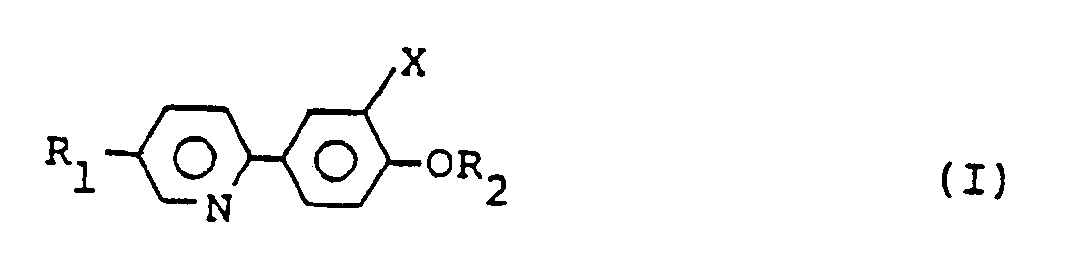
wherein X represents F or Cℓ and R₁ and R₂ each represent a C₁-C₁₈ alkyl group.
wherein X represents F or Cℓ and R₁ and R₂ each represent a C₁-C₁₈ alkyl group.
2. Compounds according to claim 1 wherein R₁ and R₂ together contain a total of 4
to 24 carbon atoms.
3. Compounds according to claim 1 or claim 2 wherein R₁ is a C₆-C₁₂ alkyl group and
R₂ is a C₄-C₁₂ alkyl group.
4. Compounds according to any one of the preceding claims in which X represents F.
5. A chiral smectic C (SC*) liquid crystal composition comprising at least one compound
as claimed in any one of the preceding claims together with at least one optically
active compound.
6. A chiral smectic C liquid crystal composition according to claim 5 wherein the
optically active compound is a chiral smectic liquid crystal compound.
7. A light switching element utilizing ferroelectricity, and comprising a chiral smectic
C liquid crystal composition as claimed in claim 5 or claim 6.
1. Halogenhaltige Pyridinverbindungen der Formel
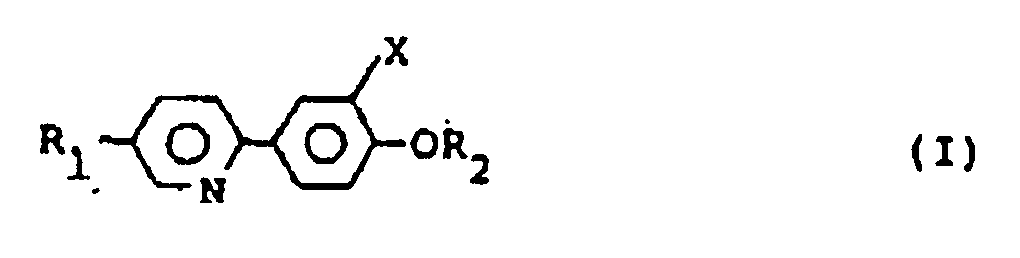
worin X die Bedeutung F oder Cℓ besitzt und R₁ und R₂ jeweils eine C₁-C₁₈-Alkylgruppe bedeuten.
worin X die Bedeutung F oder Cℓ besitzt und R₁ und R₂ jeweils eine C₁-C₁₈-Alkylgruppe bedeuten.
2. Verbindungen nach Anspruch 1, worin R₁ und R₂ zusammen Insgesamt 4 bis 24 Kohlenstoffatome
enthalten.
3. Verbindungen nach Anspruch 1 oder 2, worin R₁ eine C₆-C₁₂-Alkylgruppe und R₂ eine
C₄-C₁₂-Alkylgruppe ist.
4. Verbindungen nach einem der vorhergehenden Ansprüche, worin X die Bedeutung F besitzt.
5. Eine chirale smektische C (SC*)-Phase aufweisende Flüssigkristallzusammensetzung,
umfassend mindestens eine Verbindung gemäß einem der vorhergehenden Ansprüche zusammen
mit mindestens einer optisch aktiven Verbindung.
6. Eine chirale smektische C-Phase aufweisende Flüssigkristallzusammensetzung nach
Anspruch 5, worin die optisch aktive Verbindung eine chirale smektische Flüssigkristallverbindugg
ist.
7. Ferroelektrizität anwendendes Lichtschaltelement, umfassend eine Flüssigkristallzusammensetzung
mit chiraler smektischer C-Phase gemäß Anspruch 5 oder 6.
1. Composés de pyridine contenant un halogène de formule:
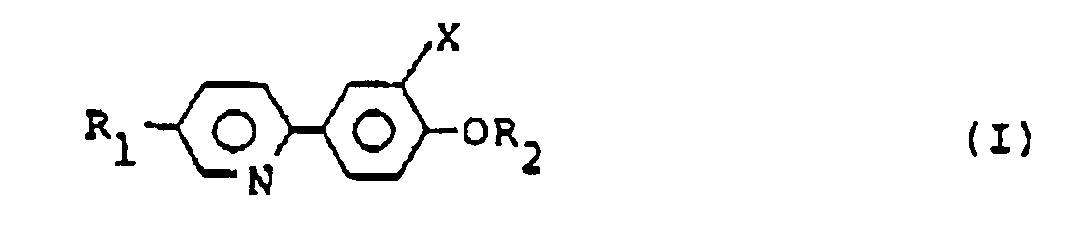
dans laquelle X représente F ou Cl et R₁ et R₂ représentent chacun un groupement alkyle en C₁-C₁₈.
dans laquelle X représente F ou Cl et R₁ et R₂ représentent chacun un groupement alkyle en C₁-C₁₈.
2. Composés suivant la revendication 1 dans laquelle R₁ et R₂ comprennent ensemble
un total de 4 à 24 atomes de carbone.
3. Composés suivant la revendication 1 ou la revendication 2 dans laquelle R₁ est
un groupement alkyle en C₆-C₁₂ et R₂ est un groupement alkyle en C₄-C₁₂.
4. Composés suivant l'une quelconque des revendications précédentes dans laquelle
X représente F.
5. Une composition de cristal liquide en phase smectique C présentant un pouvoir rotatoire
(SC*) comprenant au moins un composé tel que revendiqué dans l'une quelconque des
revendications précédentes avec au moins un composé optiquement actif.
6. Une composition de cristal liquide en phase smectique C présentant un pouvoir rotatoire
suivant la revendication 5 dans laquelle le composé optiquement actif est un composé
de cristal liquide en phase smectique présentant un pouvoir rotatoire.
7. Un élément de commutation de lumière utilisant la ferro-électricité et comprenant
une composition de cristal liquide en phase smectique C présentant un pouvoir rotatoire
tel que revendiqué dans la revendication 5 ou la revendication 6.