|
(11) | EP 0 245 524 B1 |

| (12) | EUROPEAN PATENT SPECIFICATION |
|
|
| (54) |
VITAMIN D 3 DERIVATIVE VITAMIN D3-ABKÖMMLING DERIVE DE LA VITAMINE D 3 |
|
|
|||||||||||||||||||||||||||||||
|
||||||||||||||||||||||||||||||||
| Note: Within nine months from the publication of the mention of the grant of the European patent, any person may give notice to the European Patent Office of opposition to the European patent granted. Notice of opposition shall be filed in a written reasoned statement. It shall not be deemed to have been filed until the opposition fee has been paid. (Art. 99(1) European Patent Convention). |
[0001] This invention relates to a novel vitamin D₃ derivate, and more specifically, to 1α,25-dihydroxy-24a,24a-difluoro-24-homovitamin D₃ (1α,25-dihydroxy-24a,24a-difluoro-24-homocholecalciferol) and a process for its production.
[0002] Active-form vitamins D are drugs useful for preventing and improving bone symptoms in renal failure, reduced function of the parathyroid gland and osteoporosis. Furthermore, the activities of vitamin D homologs as an anticancer agent or a cancer eliminating agent have recently attracted attention. Much research has therefore been undertaken on their synthesis. For example, JP-A-56/500296 and JP-A-58/52268 describe derivatives to 1α,25-dihydroxyvitamin D₃ having two or one fluorine atom(s) on the 24-carbon atom, while Journal of Medical Chemistry, 1977,20, No. 1, pages 5 to 11 describes side chain analogues of 25-hydroxyvitamin D including the 9-carbon side chain analogue.
[0003] The vitamin D derivatives proposed heretofore, however, have not proved to be entirely satisfactory in regard to efficacy and toxicity, and it has been desired to develop vitamin D derivatives having higher pharmacological efficacy and lower toxicity.
[0004] Physiological functions well known as the mechanism of calcium metabolizing action of vitamin D include (1) absorption of calcium in the small intestines, (2) dissolution of calcium and inorganic phosphorus from bones, and (3) deposition of calcium on bones. When vitamin D is considered from the viewpoint of a therapeutic agent for diseases induced by bone calcium disorders such as osteoporosis and rachitis, the greatest problem is a side-effect such as calcification of tissues other than bones owing to a rise in blood calcium level.
[0005] Accordingly, an ideal vitamin D derivative would be one which has a weak action of dissolving calcium and inorganic phosphorus from the bones as compared with its action of absorbing calcium from the small intestines, or inhibits such dissolving action, and has a strong action of depositing calcium on the bones.
[0006] In spite of the recent research and development of many vitamin D derivatives, an ideal vitamin D derivative has not yet been developed. This means that in drug design, it is very difficult to separate the action of absorbing calcium from the small intestines, the action of dissolving calcium and inorganic phosphorus from bones and the action of depositing calcium on bones.
[0007] It has been made clear that many vitamin D derivatives so far synthesized all show actions of dissolving calcium from the bones, and these actions are stronger as the action of absorbing calcium from the small intestines is stronger. See, for example, Tateo Suda, Eiji Ozawa, and Eimei Takahashi: "Science of Bones" pages 176-177 (1985), Ishiyaku Shuppan, Tokyo; Raisz, L. G., Trummel, C. L., Holick, M. F. and DeLuca, H. F.: Science, 175, 768 (1972); C. Kaneko, S. Yamada, A. Sugimoto, T. Suda, M. Suzuki, C. Kakuta and S. Sasaki; Steroids, 23, 75 (1974); M. F. Holick, M. Garakedian, H. F. DeLuca: Science, 176, 1146 (1972); and N. Ikegawa, Biochemistry, 55, 1297 (1983).
[0008] The present inventor has conducted extensive work in search of a very ideal vitamin D derivative which has strong vitamin D activity and inhibits dissolution of calcium from bones. Unexpectedly, the inventor has found that by introducing fluorine atoms into the carbon skeleton at the 24a-positions of 24-homovitamin D₃, a vitamin D homolog can be obtained which in spite of having strong vitamin D activity, shows an action of inhibiting dissolution of calcium from bones and has low toxicity. This discovery has led to the accomplishment of the present invention.
DISCLOSURE OF THE INVENTION
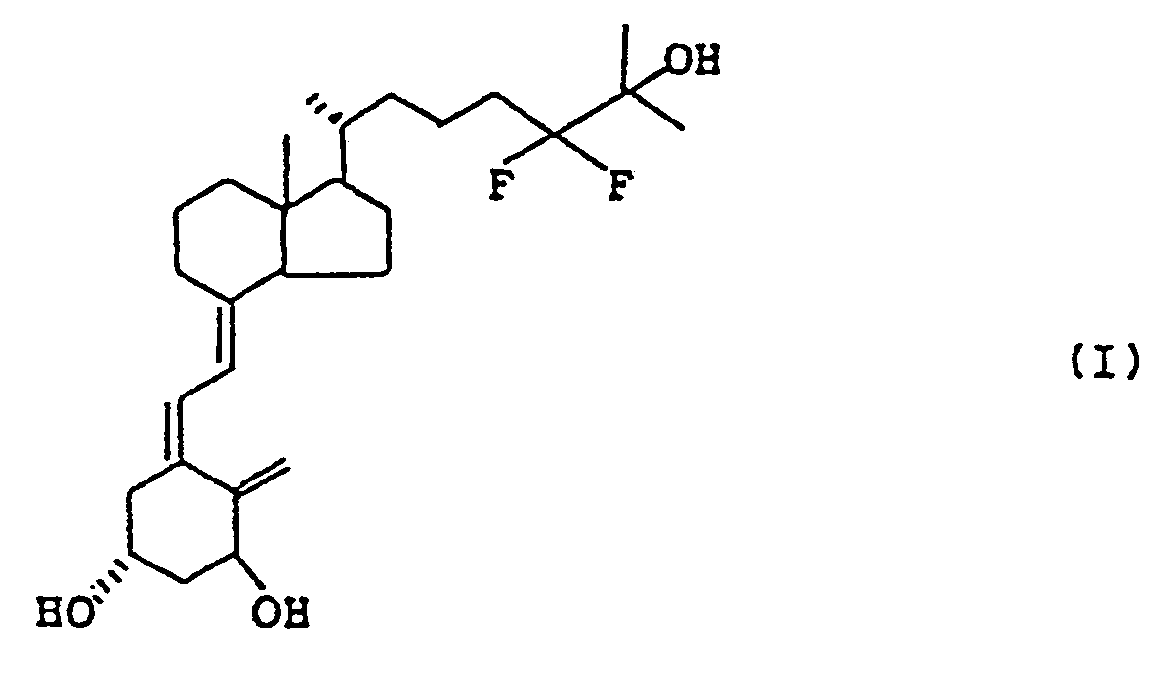
[0009] According to this invention, 24a,24a-difluoro-1α,25-dihydroxy-24-homovitamin D₃ represented by the following formula
is provided as a novel compound.
[0010] According to this invention, the compound of formula (I) can be produced by the route shown by the following reaction scheme. In the following scheme, Ac represents an acyl group such as acetyl, and R represents a lower alkyl group such as methyl.
[0011] First, 1α,3β-diacetoxychol-5-en-24-ol represented by formula (1) is oxidized by the method of Swern et al. [J. Org. Chem., vol. 43, p. 2480 (1975)] to form the corresponding 24-aldehyde represented by formula (2). It is then treated with an anion prepared from a phosphonoacetate derivative represented by the following formula
wherein R represents a lower alkyl group such as methyl, and THP represents a tetrahydropyranyl group,
and n-butyllithium, to form an enol ether. Treatment of the enol ether with an acid to remove the tetrahydropyranyl group gives a carboxylate of formula (3). Preparation of the anion can be effected, for example, by reacting n-butyllithium with a nearly equimolar amount of the phosphonoacetate derivative of formula (7) in a suitable inert solvent (such as tetrahydrofuran), preferably in an inert gaseous atmosphere, and optionally in the presence of an organic base such as diisopropylamine. The reaction temperature used at this time is generally as low as about -80°C to about -70°C. The anion so prepared can be immediately reacted with the 24-aldehyde of formula (2) at room temperature without isolation. This reaction gives the corresponding enol ether. By subsequently treating the enol ether with an acid such as p-toluenesulfonic acid in a solvent, the tetrahydropyranyl group can be removed. As a result, the carboxylate represented by formula (3) can be obtained.
[0012] The carboxylate of formula (3) so obtained is then reacted with diethylaminosulfur trifluoride at low temperatures in a solvent such as dichloromethane in an inert gaseous atmosphere. This gives a 24a,24a-difluoro ester represented by formula (4). This ester can be converted to a 25-alcohol compound represented by formula (5) by subjecting it to a Grignard reaction known per se using, for example, methylmagnesium bromide.
[0013] A double bond is introduced between the carbons at the 7- and 8-positions of the 25-alcohol compound, and the acyl groups at the 1α- and 3β-positions are removed, by, for example, hydrolysis to give a 1α,3β,25-trihydroxy-5,7-diene compound represented by formula (6). Introduction of the double bond can be carried out, for example, by brominating the carbon atom at the allylic position (7-position) with an equimolar or a slightly excessive molar amount of N-bromosuccinimide under heat, and then debrominating it using, for example, a tetra-n-butyl ammonium halide. Hydrolysis of the acyl groups may be carried out, for example by using an alcoholic solution of potassium hydroxide or sodium hydroxide.
[0014] Irradiation of ultraviolet light on the resulting compound of formula (6) gives the desired compound of formula (I). Ultraviolet irradiation on the compound of formula (6) can be carried out by dissolving the compound of formula (6) in a suitable solvent, for example, a hydrocarbon solvent such as hexane, octane or benzene, an ether solvent such as diethyl ether or tetrahydrofuran, an alcohol such as methanol or ethanol, preferably a lower alkanol, or a mixture thereof, preferably a low-boiling solvent, and exposing the resulting solution to ultraviolet irradiation. The effective wavelength of the ultraviolet light to be irradiated is in the range of 200 to 360 mn. Light beams from any light sources can be used if they include ultraviolet light having a wavelength in the above-specifed range. Suitable irradiating light sources include, for example, a medium-pressure mercury lamp, a low-pressure mercury lamp, a high-pressure mercury lamp, and laser. As required, unwanted light beams may be cut off by using a filter.
[0015] The ultraviolet irradiation time varies depending upon the intensity of the light-source lamp or the scale of the reaction, but can generally be selected from the range of several tens of seconds to several hours.
[0016] The irradiation is carried out at a temperature in the range of usually about -20°C to about 120°C, preferably about -10°C to about 30°C, preferably in an inert gaseous atmosphere.
[0017] After the irradiation, the solution is heated in an inert gaseous atmosphere at a temperature between nearly room temperature to the refluxing temperature of the solvent, preferably at the refluxing temperature, for 1 to 2 hours to give the compound of formula (I).
[0018] The product may be isolated from the reaction mixture and purified by methods known per se, such as chromatography, extraction or recrystallization.
[0019] The 1α,25-dihydroxy-24a,24a-difluoro-24-homovitamin D₃ provided by the present invention has very high vitamin D₃ activity and an excellent action of enhancing calcium absorption and retention in vivo with reduced toxicity. Hence, the compound of formula (I) provided by this invention is useful as a drug for preventing and treating various diseases induced by abnormality and disorder of calcium balance and/or calcium absorption, soch as calcium pathobolism and osteoporosis.
[0020] The following tests in vitro and in vivo demonstrate the excellent pharmacological activity of the compound of this invention.
TEST EXAMPLE 1
Test on receptor binding ability (in vitro):
Method
[0021] 1,25-Dihydroxyvitamin D₃ receptor (Yamasa) prepared from the intestines of chicken embryo was suspended in TED buffer (10 mM Tris-HCl, 0.5 mM EDTA, 1 mM dithiothreitol; 10 mM Na₂MoO₄, pH 7.4), and the resulting suspension is used as a receptor solution (protein about 0.5 mg/ml).
[0022] To the receptor solution was added 3 mocroliters or 10 microliters of an assay compound disolved in 50% ethanol so an to provide a concentration of 10⁻⁹-10⁻⁵ M. Then, 1α,25-dihydroxyvitamin D₃ (about 0.4 mM) was added. The mixture was incubated at 0°C for 3 hours.
[0023] The free assay compound and the assay compound bound to the receptor were separated by the charcoal method. The specific binding amount is obtained by subtracting the non-specific binding amount obtained in the presence of 10 µM of 1α,25-dihydroxyvitamin D₃ from the total binding amount obtained by the above reaction.
Results
[0025] As shown in Table 1, the receptor binding ability of compound of this invention to 1,25-dihydroxyvitamin D₃ is recognized and its IC5O value is 5.0 × 10⁻⁸ M.
[0026] Since the IC5O value of 1,25-dihydroxyvitamin D₃ used as a control is 6.8 × 10⁻⁸, the receptor binding ability of the compound of this invention is considered to be 1.36 times as strong as that of 1,25-dibydroxyvitamin D₃.
TEST EXAMPLE 2
[0027] The strong vitamin D receptor binding ability of the compound of this invention is considered to have basically to do with its possession of strong vitamin D activity. To confirm it in an in vivo (animal) test, however, its action of increasing the blood calcium level in vitamin D-deficient rats was examined.
Method
[0028] Wistar rats (male, three weeks old) purchased from Japan Charles River Co. were fed 3 to 4 weeks with a vitamin D-deficient diet containing calcium (0.02%) and phosphorus (0.99%) to prepare vitamin D-deficient rats. The compound of this invention or 1,25-dihydroxy-26,27-dimethylvitamin D₃ was orally administered to these animals once a day over 3 days. On the fourth days, blood was drawn from the animals, and calcium in the serum was measured by atomic absorptiometry.
[0029] As soon as the administration began, the feed was changed to one which was vitamin D-deficient but contained calcium in a normal amount (0.56%).
Results
[0031] As shown in Table 2, the compound of this invention shows an action of increasing the calcium level in the serum in animals being vitamin D-deficient but having normal calcium level. On the other hand, the 1,25-dihydroxy-26,27-dimethylvitamin D₃ as a control has a stronger action of increasing calcium level in the serum than 1α-hydroxyvitamin D₃ or 1,25-dihydroxyvitamin D₃ as shown in Japanese Laid-Open Patent Publication No. 44860/1986.
[0032] Accordingly, the activity of the compound of this invention to increase the calcium level in the serum is considered to be stronger than that of 1,25-dihydroxyvitamin D₃. Thus, the effect of the in vitro test shown in Test Example 1 was also substantiated by the animal experiment.
TEST EXAMPLE 3
[0034] Vitamin D has both an action of calcium deposition on bones and an action of liberating calcium from the bones, and promotes bone formation when the balance between these actions is shifted toward the former. Accordingly, a vitamin D derivative which inhibits dissolution of calcium from bones can be expected to have a very strong bone-forming action. In the present test, calcium in the feed was limited to a low level, and under conditions in which no calcium absorption from the intestinal tract occurred, the activity to increase the calcium level in the serum was examined. This activity is considered to reflect calcium dissolution from the bones.
Method
[0035] The following test was conducted in accordance with the method of C. Kaneko et al. [C. Kaneko, S. Yamada, A. Sugimoto, M. Katuta, and S. Sasaki: Steroids, 23, 75 (1974)].
[0036] Three week old Wistar rats (male) were purchased from Japan Charles River Co., and were fed for 19 days with a feed being deficient in vitamin D and containing low calcium (0.02%) to prepare vitamin D-deficient hypocalcemia rats. An ethanol solution of an assay compound was intravenously administered once to the rats. On the next day, blood was drawn from the animals, and the calcium level in the serum was measured by atomic absorptiometry (using a double beam atomic absorption photometer made by Shimazu Seisakusho; Model AA-650).
Results
[0038] For use as a medicament for the prevention and/or treatment of diseases such as calcium pathobolism and osteoporosis, the compound of this invention may be administered to mammals in a dose of about 25 to about 400 ng/day, preferably about 50 to about 200 ng/day. This dose range, however, is a provisional criterion, and the compound may be administered in doses outside this range in accordance wit a physician′s judgement depending upon the condition, sex, age and weight, for example, of a patient. The administration may be effected orally or parenterally through various routes (e.g., subcutaneous, intramuscular, intravenous, intraperitoneal, and intrarectal).
[0039] The compound of this invention may be formulated into a dosage form according to the route of administration. For example, for oral administration, it can be formulated into tablets, capsules, granules, powders, syrups, elixirs, etc. For parenteral administration, it can be formulated into injectable preparations, drops, suppostories, etc. A pharmaceutical composition in such dosage forms may be prepared by mixing an effective amount of the compound of this invention with a pharmaceutically acceptable carrier or diluent (adjuvant) and formulating the mixture into the desired dosage form in a usual manner.
[0040] Illustrative of the adjuvant which may be incorporated in solid preparations such as tablets, capsules, granules and powders are binders such as corn starch or gelatin; excipients such as dicalcium phosphate; disintegrants such as potato starch and alginic acid; lubricants such as magnesium stearate; sweetening such as sucrose; and flavors such as peppermint. Various other materials may be present as coatings or in order to otherwise modify the physical form of the dosage unit. For example, tablets may be coated with shellac, sugar, or both. The syrups or elixirs may contain the active compound, sucrose as a sweetening agent, methyl and propyl parabens as preservatives, a dye, and a flavor such as an orange flavor. Sterile compositions for injection can be formulated according to the conventional practice of pharmaceutical preparation by dissolving or suspending a fluorinated compound in a vehicle such as water for injection, a natural vegetable oil such as sesame oil, or a synthetic fatty acid vehicle such as ethyl oleate. Buffers, antiseptics and antioxidants may also be incorporated.
EXAMPLE
(a) Synthesis of 1α,3β-diacetoxychol-5-en-24-al (2)
[0042] Dimethyl sulfoxide (0.27 ml; 3.81 mmol) was added at -78°C in an argon atmosphere to 5 ml of a dichloromethane solution of 0.17 ml (1.95 mmol) of oxalyl chloride, and the mixture was stirred for 10 minutes under the same conditions. To the resulting solution was added 3 ml of a dichloromethane solution of 432 mg (0.94 mmol) of 1α,3β-diacetoxychol-5-en-24-ol (1), and the mixture was further stirred for 15 minutes. Triethylamine (1.05 ml; 7.55 mmol) was added to the reaction mixture, and the mixture was stirred for 5 minutes. The temperature of the reaction mixture was returned to ambient temperature. It was treated in a customary manner (extracted with ether). The crude product was purified by silica gel column chromatography [30 g; eluted with hexane/ethyl acetate (5: 1)] to give 382 mg of the captioned aldehyde (2).
[0043] ¹H=NMR δ(ppm):
0.65 (3H, s), 1.04 (3H, s), 1.94 (3H, s),
1.97 (3H, s), 4.82 (1H, m), 4.98 (1H, m),
5.41 (1H, m), 9.58 (1H, t, J=1, 6Hz)
(b) Synthesis of methyl 1α,3β-diacetoxy-24a-oxo-24-homochol-5-ene-25-carboxylate (3)
[0044] In an argon atmosphere, 1.2 ml (2.04 mmol) of an n-butyllithium solution was added at -78°C to 3 ml of a tetrahydrofuran (to be referred to as THF) solution of 0.3 ml (2.14 mmol) of diisopropylamine, and the mixture was stirred for 30 minutes. To the mixture was added 5 ml of a THF solution of 576 mg (2.04 mmol) of phosphonoacetate (7) (R=CH₃), and the mixture was stirred at -78°C for 30 minutes. Then, 6 ml of a THF solution of 750 mg (1.64 mmol) of 1α,3β-diacetoxychol-5-en-24-al (2) obtained in (a) above was added, and the mixture was stirred at room temperature for 4 hours. The crude enol ether obtained by a conventional treatment (extraction with ether) was dissolved in a mixed solvent of 8 ml of THF and 5 ml of methanol, and 20 mg of p-toluenesulfonic acid was added. The mixture was stirred at room temperature for 40 minutes and then treated in a customary manner (extracted with ether). The resulting crude product was purified by silica gel column chromatography [22 g; eluted with hexane/ethyl acetate (5: 1)] to give 510 mg of the captioned α-keto ester (3).
[0045] ¹H=NMR δ(ppm):
0.65 (3H, s), 1.04 (3H, s), 1.94 (3H, s),
1.97 (3H, s), 2.74 (2H, t, J=6, 6Hz),
3.79 (3H, s), 4.85 (1H, m), 5.41 (1H, m).
[0046] EI-MS (30eV) m/z:
410 (M⁺, 48.4%), 395 (6.5), 151 (3.6),
308 (4.2), 291 (7.3), 253 (3.9), 211 (6.5),
157 (8.4), 135 (15.8), 118 (base peak).
(c) Synthesis of methyl 1α,3β-diacetoxy-24a,24a-difluoro-24-homochol-5-ene-25-carboxylate (4)
[0047] Diethylaminosulfur trifluoride (0.6 ml; 4.93 mmol) was added at 0°C in an argon atmosphere to 15 ml of a dichloromethane solution of 530 mg (1.00 mmol) of the methyl 1α,3β-diacetoxy-24a-oxo-24-homochol-5-ene-25-carboxylate (3), and the mixture was stirred at room temperature for 16 hours. The reaction mixture was treated in a customary manner (extracted with ethyl acetate). The resulting crude product was purified by silica gel column chromatography [38 g; eluted with hexane/ethyl acetate] to give 180 mg of the captioned difluoro ester (4).
[0048] ¹H=NMR δ(ppm):
0.65 (3H, s), 1.05 (3H, s), 1.96 (3H, s),
1.98 (3H, s), 3.79 (3H, s), 4.85 (1H, m),
4.98 (1H, m), 5.44 (1H, m).
[0049] EI-MS (30eV) m/z:
432 (M⁺, 62.0%), 417 (11.2), 373 (1.2),
313 (13.1), 253 (4.0), 211 (8.1), 135
(20.8), 135 (15.8), 118 (base peak).
(d) Synthesis of 1α,3β-diacetoxy-24a,24a-difluoro-24-homochlolest-5-en-25-ol (5)
[0050] A mixture of 72 mg (0.13 mmol) of the methyl 1α,3β-diacetoxy-24a,24a-difluoro-24-homochol-5-ene-25-carboxylate (4), 1.3 ml of a 1 mole THF solution of methylmagnesium bromide, and 2.5 ml of THF was stirred at room temperature for 80 minutes in an argon atmosphere. The reaction mixture was treated in a customary manner (extracted with ethyl acetate). The residue was dissolved in 1 ml of pyridine, and 1 ml of acetic anhydride was added. The mixture was stirred at room temperature for 16 hours, and treated in a customary manner (extracted with ethyl acetate). The crude product was purified by silica gel column chromatography (14 g; eluted with hexane/ethyl acetate) to give 43 mg of the captioned alcohol (5).
[0051] ¹H=NMR δ(ppm):
0.65 (3H, s), 1.05 (3H, s), 1.30 (6H, s),
1.97 (3H, s), 1.99 (3H, s), 4.91 (1H, m),
5.08 (1H, m), 5.46 (1H, m).
[0052] EI-MS (30eV) m/z:
432 (M⁺, 52.0%), 417 (10.8), 374 (4,3),
313 (13.3), 253 (5.4), 211 (7.8), 135
(22.3), 118 (base peak), 59 (4.9).
(e) Synthesis of 1α,3β,25-trihydroxy-24a,24a-difluoro-24-homocholesta-5,7-diene (6)
[0053] A mixture of 16 mg (0.03 mmol) of 1α,3β-diacetoxy-24a,24a-difluoro-24-homocholest-5-ene-25-ol (5) and 7.2 mg (0.04 mmol) of N-bromosuccinimide was heated under reflux in 4 ml of carbon tetrachloride for 20 minutes in an argon atmosphere. The reaction mixture was cooled to 0°C, and the precipitate formed was separated by filtration, and the solvent in the filtrate was distilled off. The resulting residue was dissolved in 4 ml of THF, and a catalytic amount of tetra-n-butyl ammonium bromide was added. While the light was shut off in an argon atmosphere, the mixture was stirred for 50 minutes. Then, 0.1 ml (0.1 mmol) of a 1 mole THF solution of tetra-n-butylammonium fluoride was added. Under the same conditions, the mixture was stirred for 30 minutes. The reaction mixture was treated in a customary manner (extracted with ethyl acetate). The crude product was dissolved in 2 ml of THF, and 1 ml of a 5% methanol solution of potassium hydroxide was added. The mixture was stirred at room temperature in an argon atomosphere for 14 hours while shutting off the light. The reaction mixture was reacted in a customary manner (extracted with ethyl acetate). The resulting crude product was purified by preparative thinlayer chromatography (developing solvent: benzene/ethyl acetate = 1: 1, developed four times) to give 3.1 mg of the captioned 5,7-diene (6).
(f) Synthesis of 1α,25-dihydroxy-24a,24a-difluoro-24-homovitamin D₃ (I)
[0055] 3,1 mg of 1α,3β,25-trihydroxy-24a,24a-difluoro-24-homocholesta-5,7-diene (6) was dissolved in a mixed solvent of 90 ml of benzene and 40 ml of ethyl acetate. The solution was exposed to ultraviolet irradiation by using a high-pressure mercury lamp (Hanovia, 200W) at 0°C for 3 minutes in an atmosphere of argon. Subsequently, the reaction mixture was heated under reflux for 1 hour in an atmosphere of argon. The solvent was evaporated under reduced pressure. The resulting crude product was purified by preparative thin-layer silica gel column chromatography (developing solvent: benzene/ethyl acetate = 1: 1, developed three times) to give 421 µg of the captioned vitamin D₃ derivative (I).
[0058] EI-MS (70eV) m/z:
466 (M⁺, 15.1%), 448 (76.6), 430 (79.6),
415 (14.9), 407 (5.7), 287 (7.0), 269
(12.8), 251 (31.5), 236 (16.6), 152 (27.2),
141 (43.0), 135 (73.4), 116 (15.7), 59
(95.5), 43 (base peak), 41 (54.2).
INDUSTRIAL UTILIZABILITY
1. 1α,25-Dihydroxy-24a,24a-difluoro-24-homovitamin D represented by the following
formula:

2. A process for producing 1α,25-dihydroxy-24a,24a-difluoro-24-homovitamin D₃ set
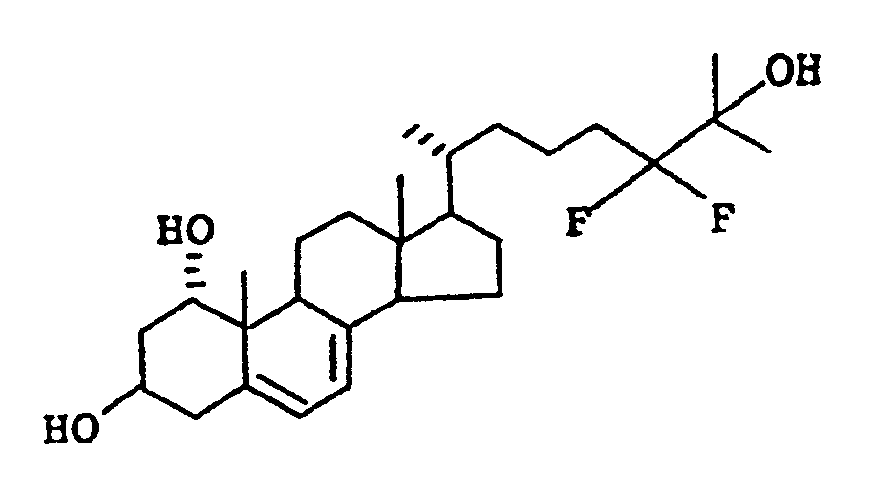
forth in claim 1, which comprises exposing 1α,3β,25-trihydroxy-24a,24a-difluoro-24-homocholesta-5,7-diene
represented by the following formula
to ultraviolet irradiation.
to ultraviolet irradiation.
1. 1α,25-Dihydroxy-24a,24a-difluor-24-homovitamin-D₃, angegeben durch die folgende
Formel

2. Verfahren zur Herstellung von 1α,25-Dihydroxy-24a,24a-difluor-24-homovitamin-D₃
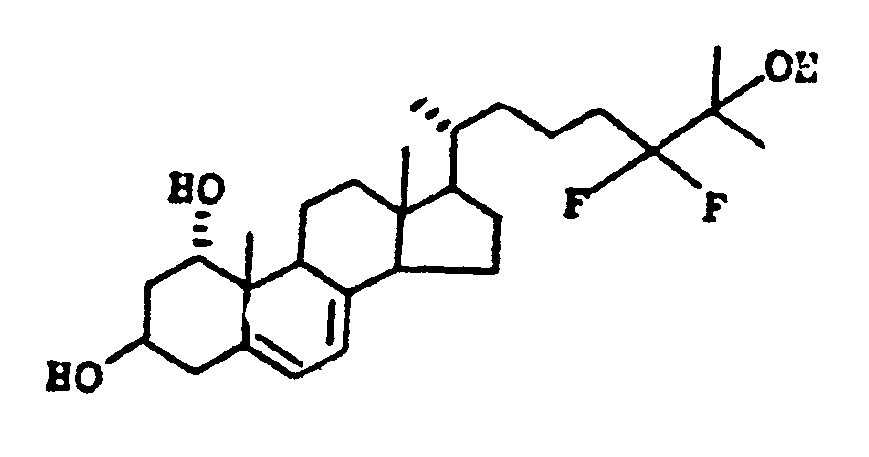
nach Anspruch 1, bei dem man 1α,3β,25-Trihydroxy-24a,24a-difluor-24-homocholesta-5,7-dien
der folgenden Formel
der ultravioletten Strahlung aussetzt.
der ultravioletten Strahlung aussetzt.
1. 1α,25-Dihydroxy-24a,24a-difluoro-24-homovitamine D₃ représentée par la formule
suivante:
2. Procédé pour produire la 1α,25-dihydroxy-24a,24a-difluoro-24-homovitamine D₃ indiquée
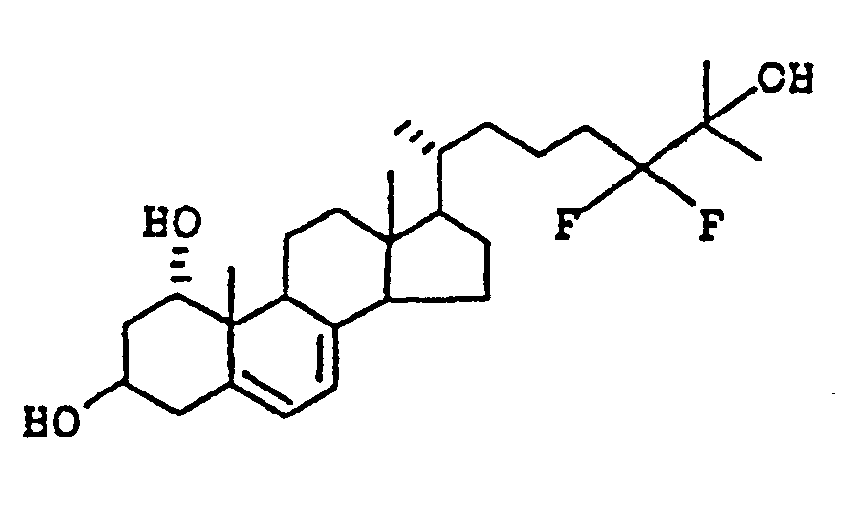
dans la revendication 1, lequel comprend l'exposition du 1α,3β,25-trihydroxy-24a,24a-difluoro-24-homocholesta-5,7-diène
représenté par la formule suivante:
à une irradiation par un rayonnement ultraviolet.
à une irradiation par un rayonnement ultraviolet.