|
(11) | EP 0 245 836 B1 |

| (12) | EUROPEAN PATENT SPECIFICATION |
|
|
| (54) |
Thermosensitive recording sheet Wärmeempfindliches Aufzeichnungsblatt Feuille thermosensible pour l'enregistrement |
|
|
|||||||||||||||||||||||||||||||
|
||||||||||||||||||||||||||||||||
| Note: Within nine months from the publication of the mention of the grant of the European patent, any person may give notice to the European Patent Office of opposition to the European patent granted. Notice of opposition shall be filed in a written reasoned statement. It shall not be deemed to have been filed until the opposition fee has been paid. (Art. 99(1) European Patent Convention). |
[0001] This invention relates to a thermosensitive recording sheet, and more specifically, to a thermosensitive recording sheet having a coated film containing a color-forming lactone compound, an acidic substance and a specific aliphatic carboxylic acid ester as a sensitizer.
[0002] Thermosensitive recording sheets are designed to display images such as characters and geometric figures by thermal energy, and have recently found applications in various printer recorders, facsimiles, POS labels and automatic ticket examination. There are various methods of thermosensitive recording. From the viewpoint of the clearness, resolution and color of images, the most prevalent method is to use a color-forming lactone compound such as Crystal Violet Lactone which is a dye precursor and an acidic substance capable of causing the lactone compound to form a color. In this method, a phenolic compound such as bisphenol A which is solid at room temperature but upon heating, is melted and acts as an acid component has previously been used as the acidic substance. Thermosensitive recording sheets used in this case are required to have a high degree of whiteness and excellent stability in the colored portion and the non-colored portion. Usually, to obtain a brilliant color, the sheets must be maintained at a temperature of about 140 to 150oC for a period of time above a certain limit. Hence, various approaches have been made in order to obtain brilliant colors more rapidly and more easily. For example, there are a method in which stearamide is added as a sensitizer (Japanese Laid-Open Patent Publication No. 139740/1979), and a method in which benzyl p-hydroxybenzoate is used as the acidic substance (Japanese Laid-Open Patent Publication No. 74762/1979). The methods described in these patent documents are still not entirely satisfactory although they can increase color forming sensitivity. There is also a method in which an aryl ester derivative of an aliphatic mono- or di-basic acid having a melting point of 40 to 150oC is added as the sensitizer (Japanese Laid-Open Patent Publication No. 71191/1983). The method described in this patent document can fully increase color forming sensitivity, but is not satisfactory with regard to the stability of the colored portion and the non-colored portion.
[0003] DE-A-3,601,645, published on 07.08.86, describes a thermosensitive recording sheet having a coated film containing a color-forming lactone compound, an acidic substance and a sensitizer.
[0004] Extensive investigations of the present inventors undertaken with the foregoing background have now led to the discovery that the use of a specific aliphatic carboxylic acid ester as a sensitizer can give a thermosensitive recording sheet having a much higher effect of increasing color forming sensitivity than in the case of using conventional sensitizers, and has excellent stability in the colored portion and the non-colored portion.
[0005] According to this invention, there is provided a thermosensitive recording sheet having a coated film containing a color-forming lactone compound, an acidic substance and a sensitizer, said sensitizer being at least one aliphatic carboxylic acid ester represented by the formula
wherein R¹ and R² are identical or different and each represents an alkyl group having 1 to 20 carbon atoms, a cycloalkyl group, an aryl group, a group of the formula -CnH2n-Ar in which n is an integer of 1 to 8 and Ar is an aryl group, or a group of the formula -CnH2n-CO-Ar in which n and Ar are as defined; R³ represents a group of the formula -CnH2n- in which n is as defined; R⁴ and R⁵ are identical or different and each represents an alkyl group having 1 to 20 carbon atoms, a cycloalkyl group, a group of the formula -CnH2n-Ar in which n and Ar are as defined, or a group of the formula -CnH2n-CO-Ar in which n and Ar are as defined; and R⁶ represents an alkyl group having 2 to 6 carbon atoms and substituted by a halogen atom selected from clorine, bromine and iodine atoms; with the proviso that the alkyl group having 1 to 20 carbon atoms for R¹, R², R⁴ and R⁵ may be substituted by a halogen atom, and the cycloalkyl group, the aryl group and Ar in -CnH2n-Ar and -CnH2n-CO-Ar may be substituted by an alkyl, cycloalkyl, aryl, aralkyl, phenacyl, alkyloxy, aryloxy, aralkyloxy, arylcarbonyl, arylsulfonyl, nitro or ammoniumsulfonic acid group or a halogen atom.
[0006] A preferred group of aliphatic carboxylic acid esters among the above compounds have a melting point of 60 to 150oC and are represented by the following general formula
R²-COOR¹⁰ (III')
wherein R⁷ represents a cycloalkyl group, an aryl group, a group of the formula -CnH2n-Ar in which n is an integer of 1 to 8 and Ar is an aryl group; R³ represents a group of the formula -CnH2n- in which n is as defined; R⁸ represents a cycloalkyl group, a group of the formula -CnH2n-Ar in which n and Ar are as defined, or a group of the formula -CnH2n-CO-Ar in which n and Ar are as defined; R⁹ represents an alkyl group having 2 to 6 carbon atoms and substituted by a chlorine or bromine atom; and R¹⁰ represents an aryl group; with the proviso that the cycloalkyl group, the aryl group, and Ar in -CnH2n-Ar and -CnH2n-CO-Ar may be substituted by an alkyl, cycloalkyl, aryl, aralkyl, phenacyl, alkyloxy, aryloxy, aralkyloxy, arylcarbonyl, arylsulfonyl, nitro or ammonium-sulfonic acid group, or a halogen atom.
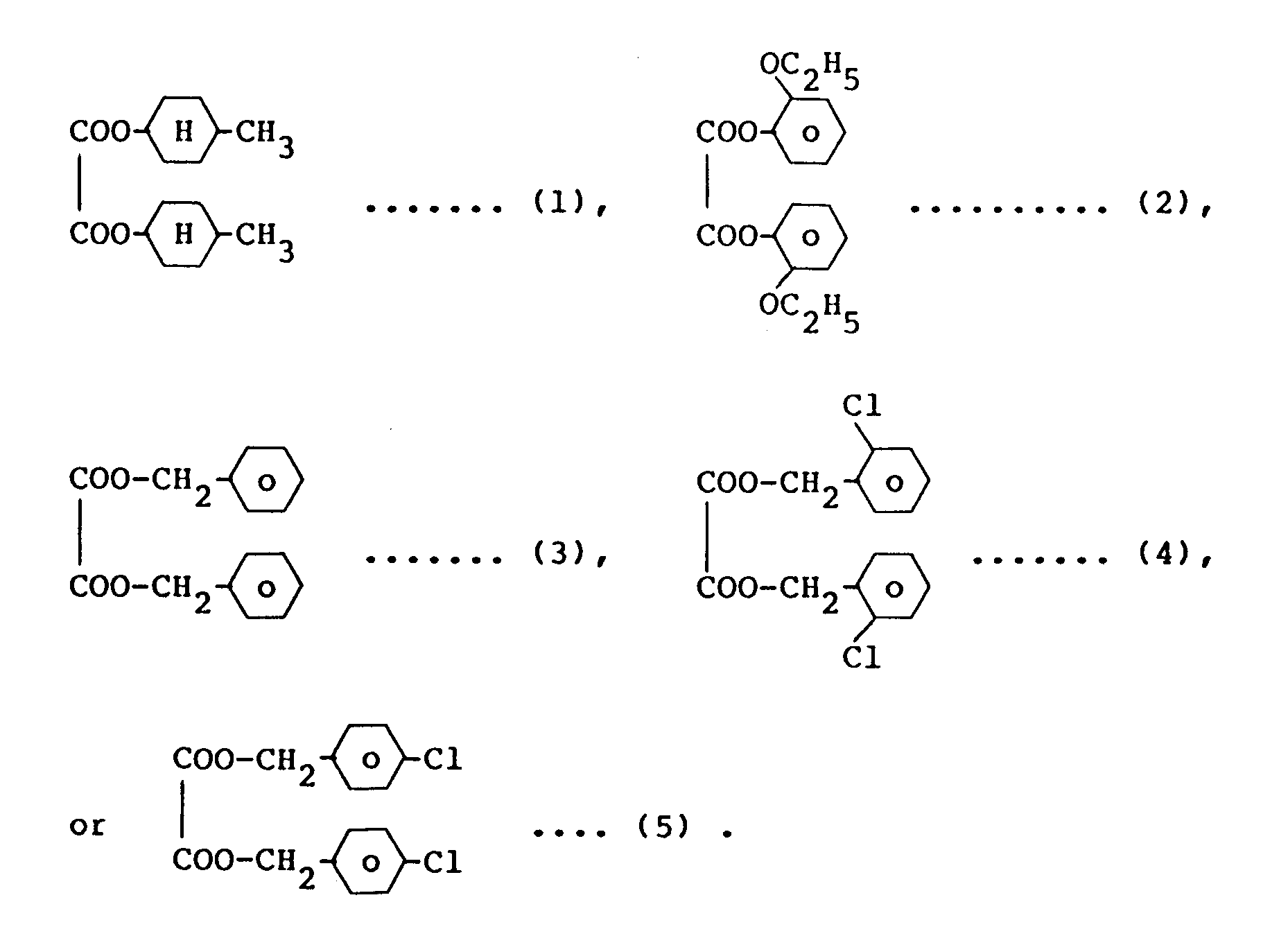
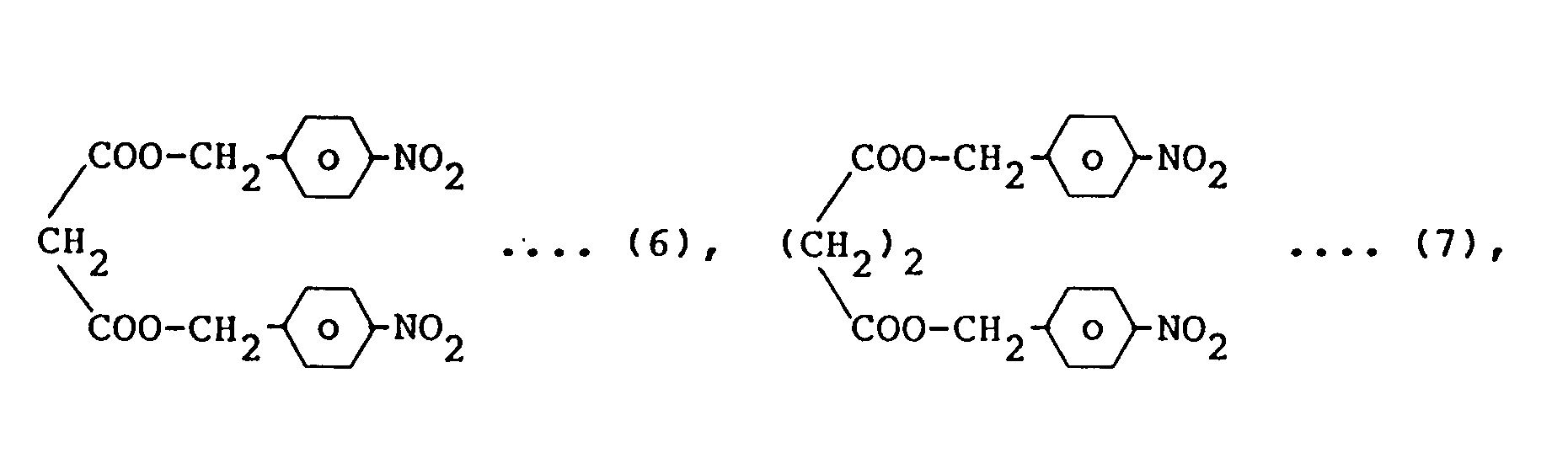
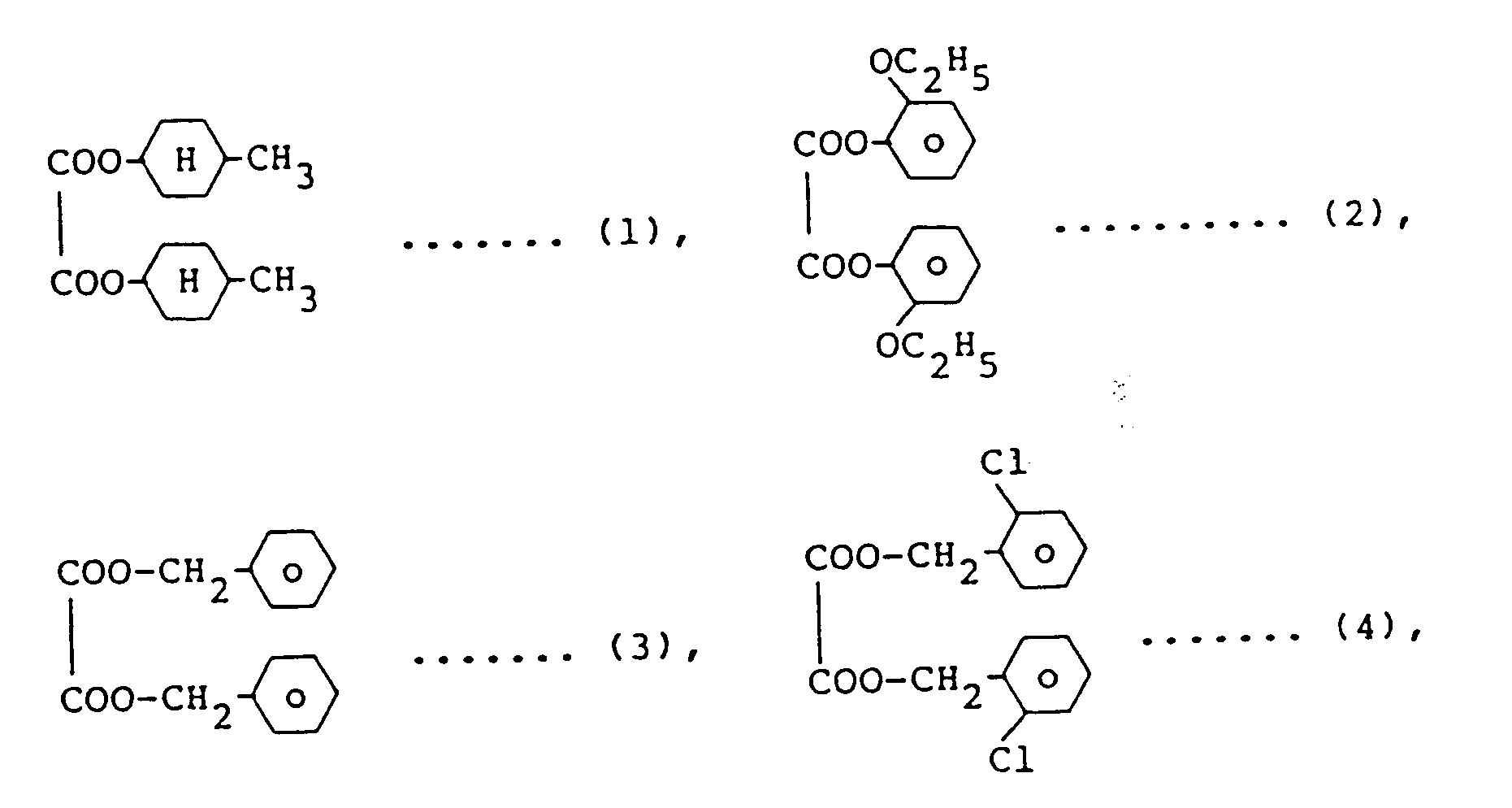
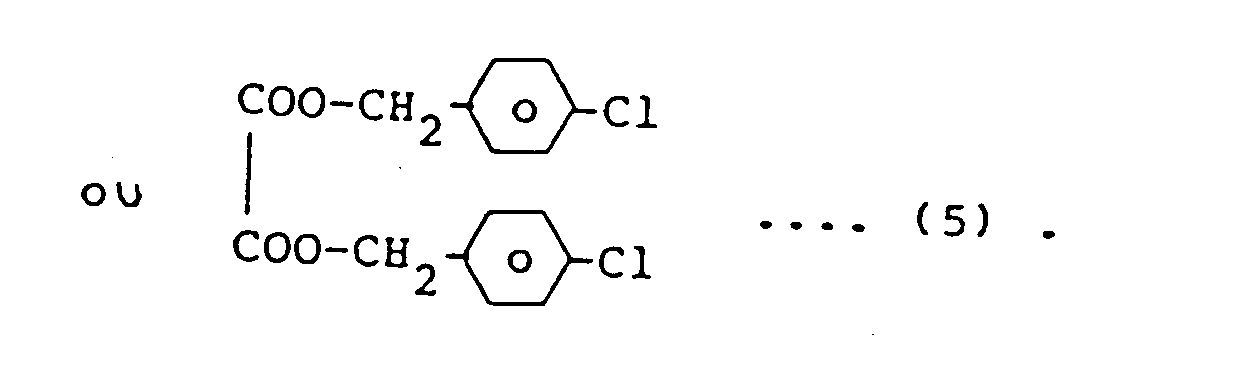
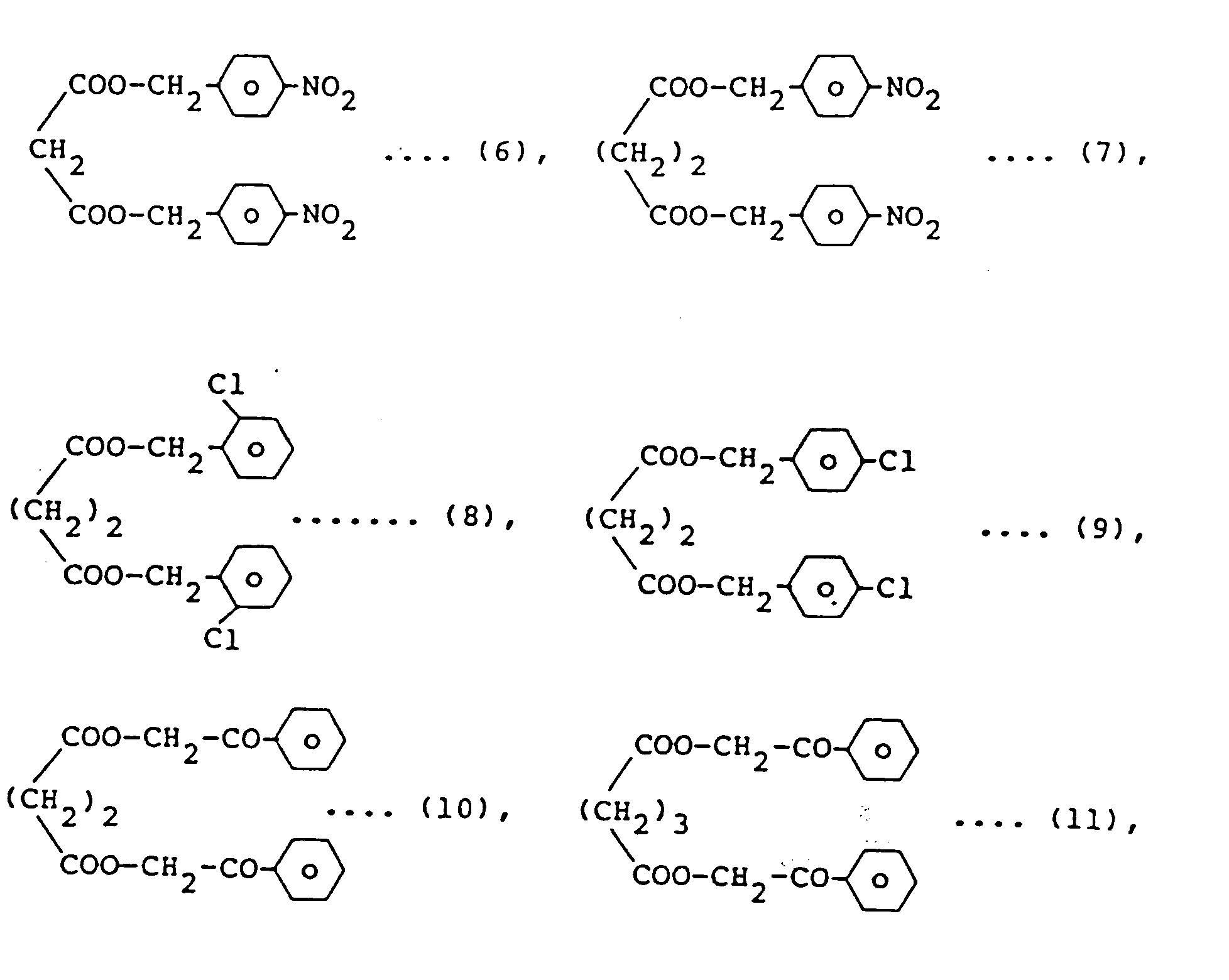
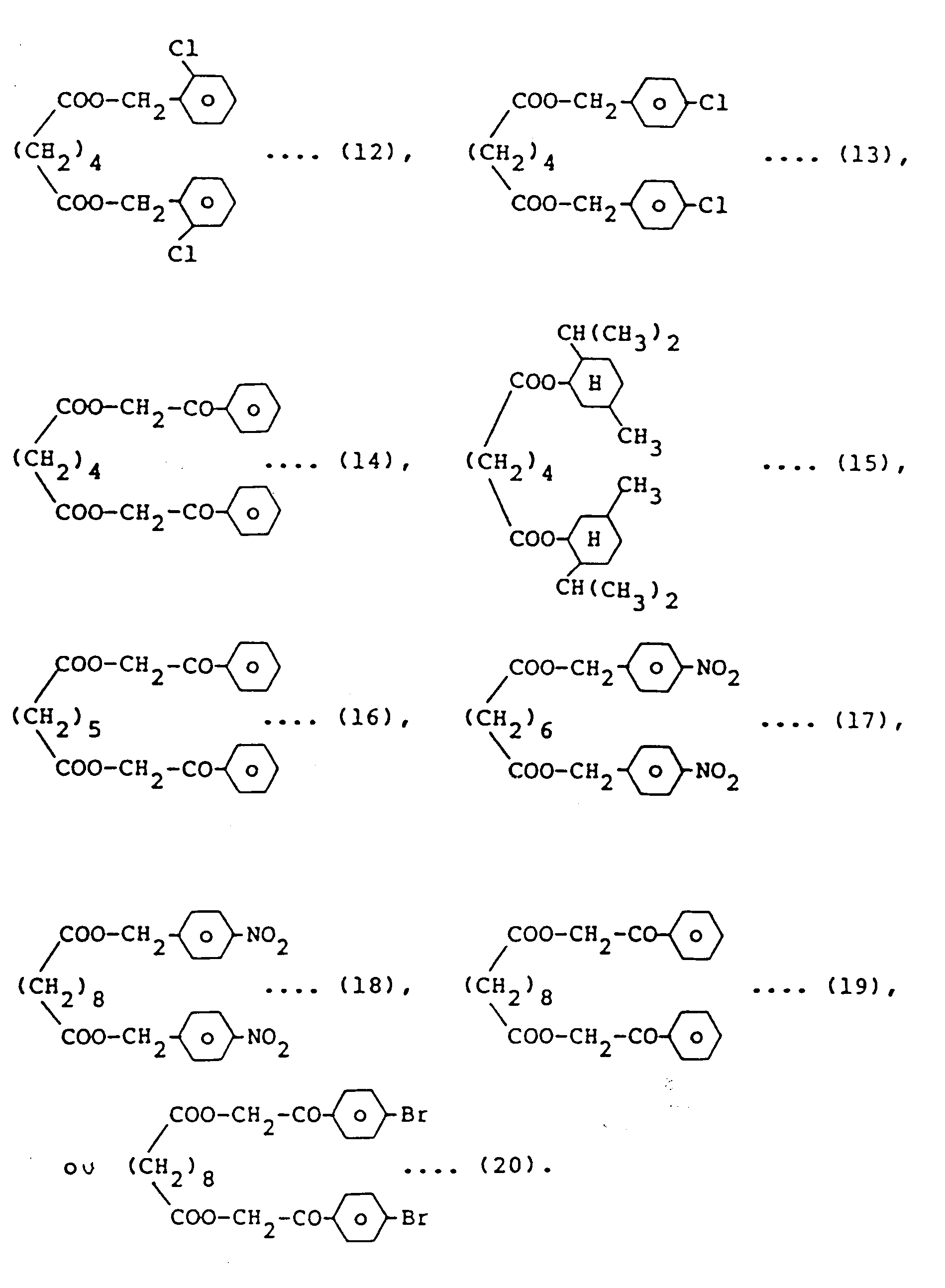
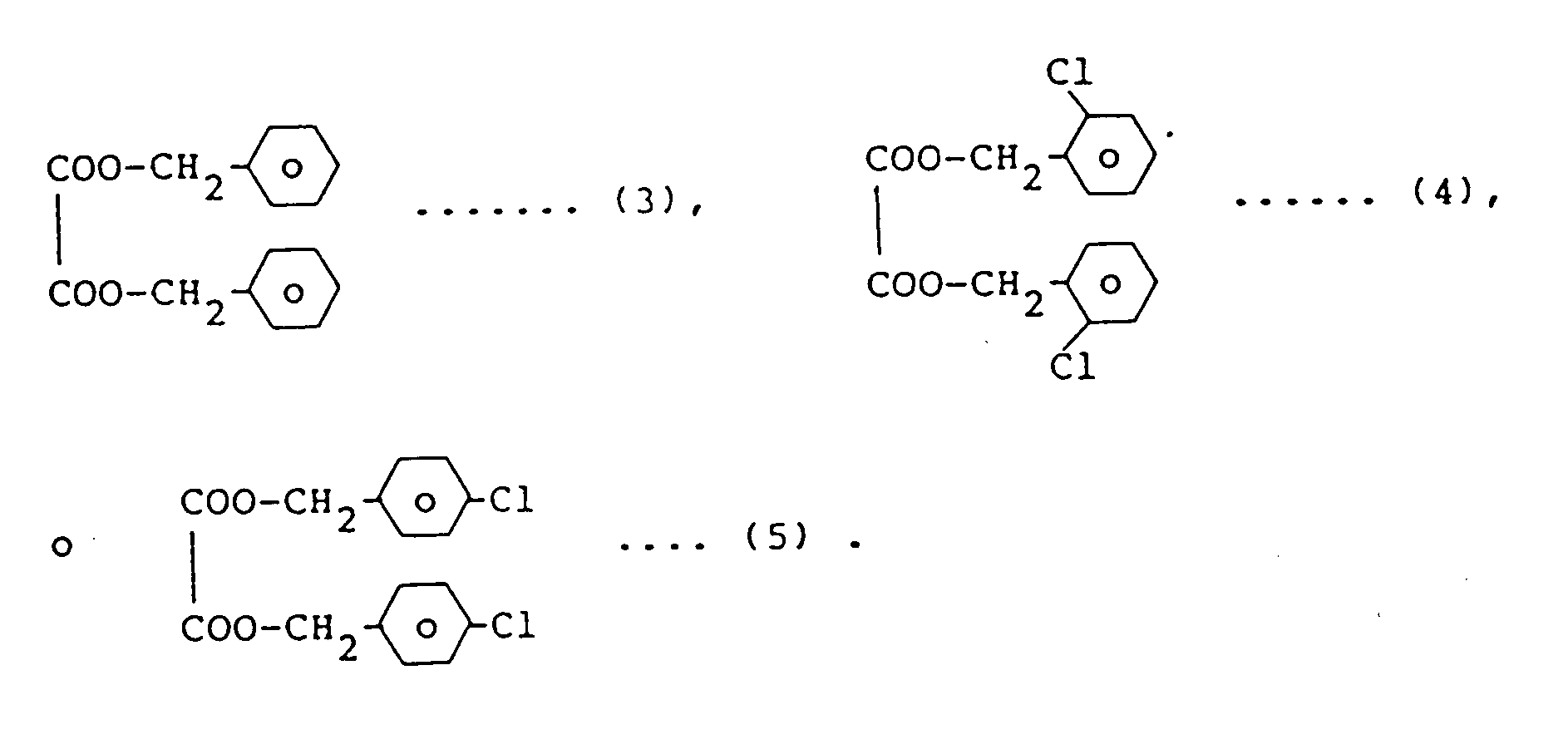
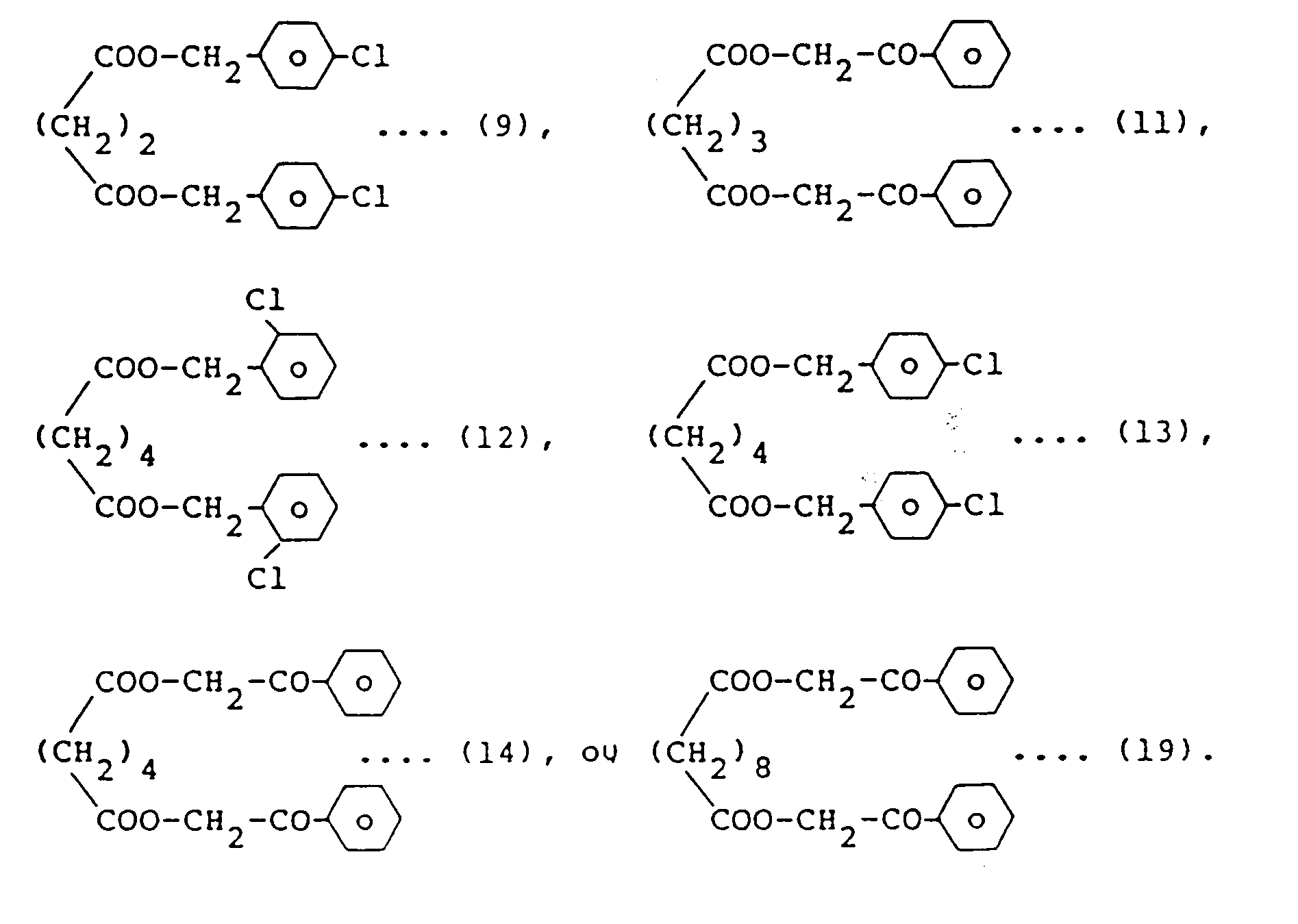
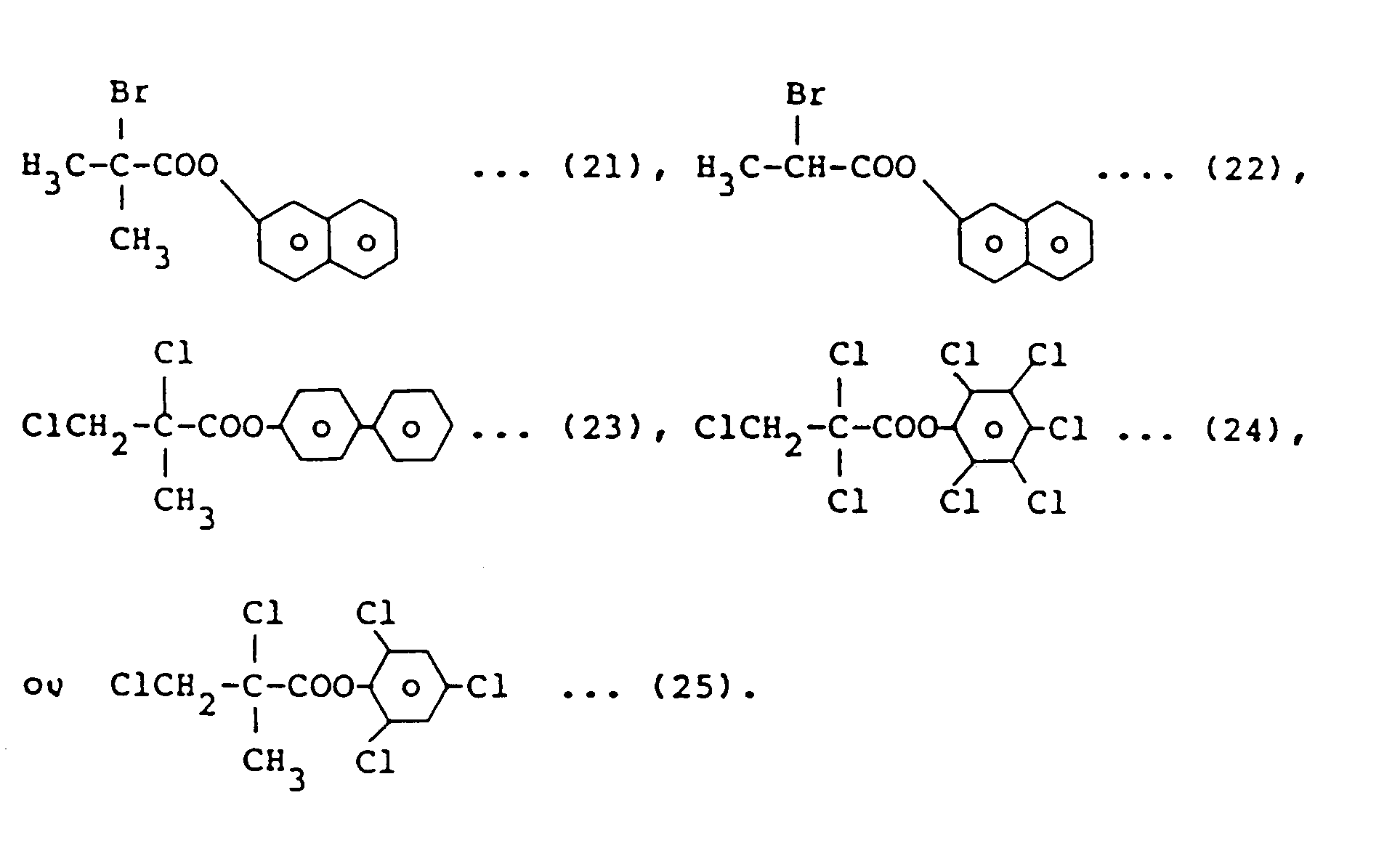
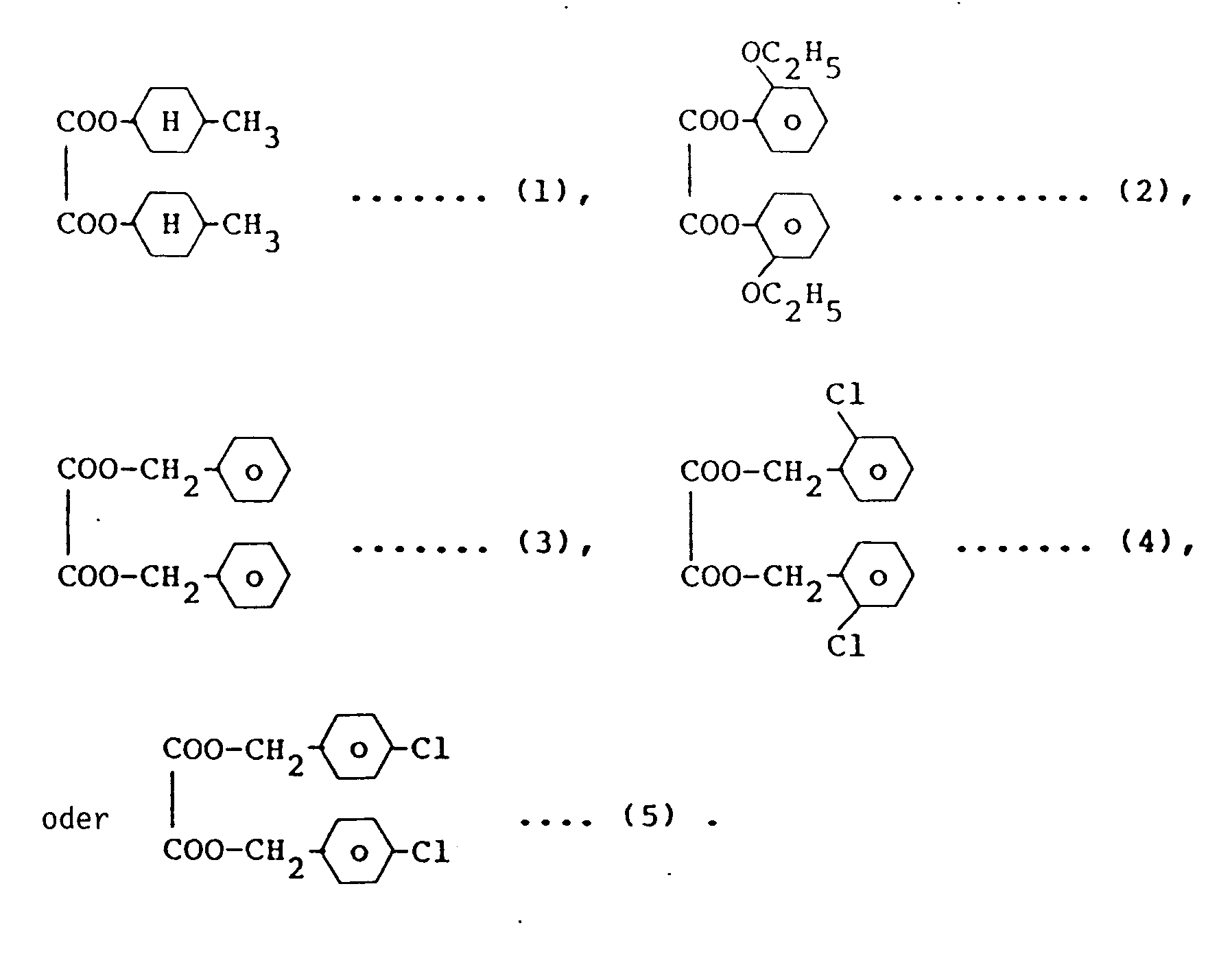
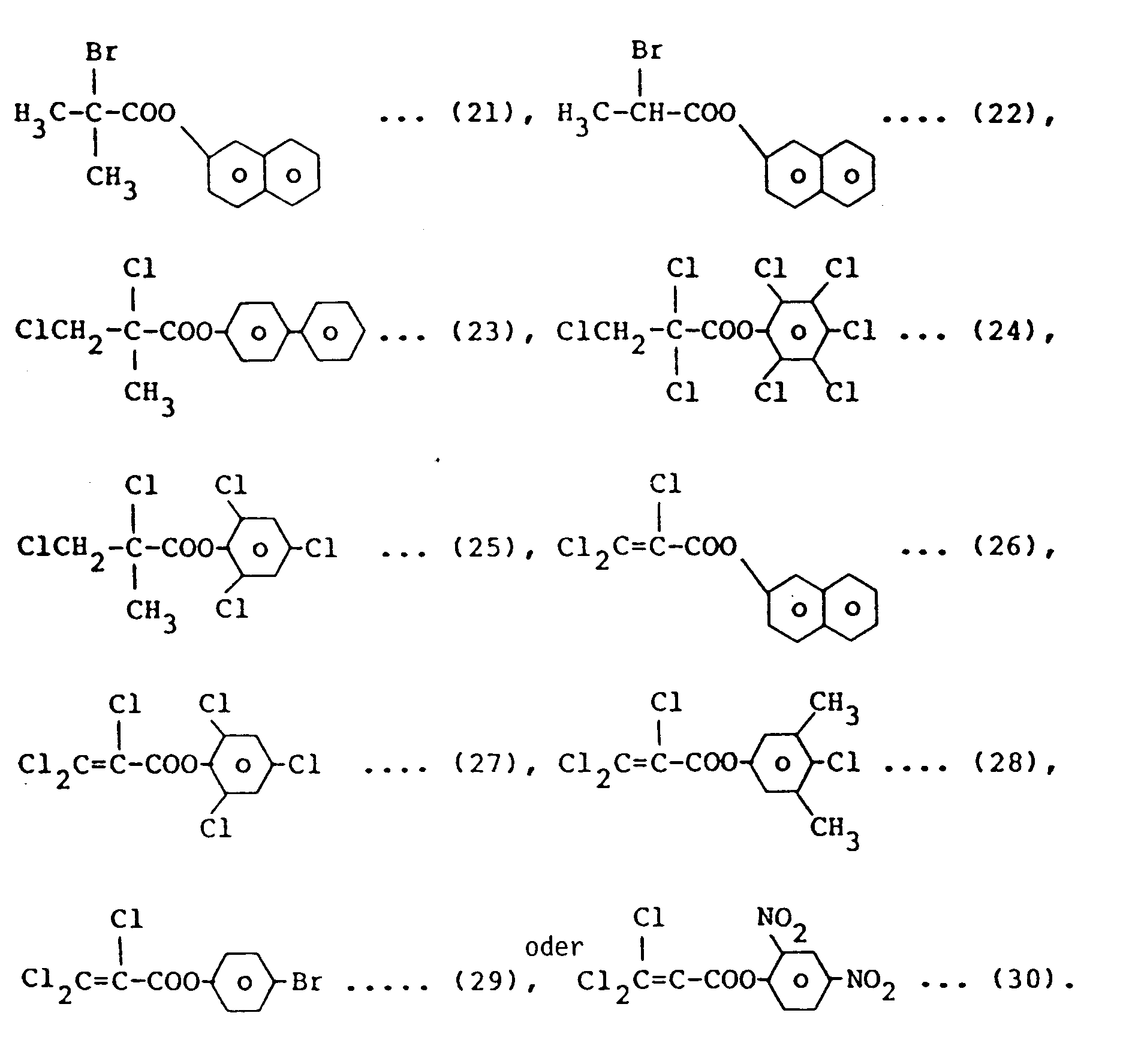
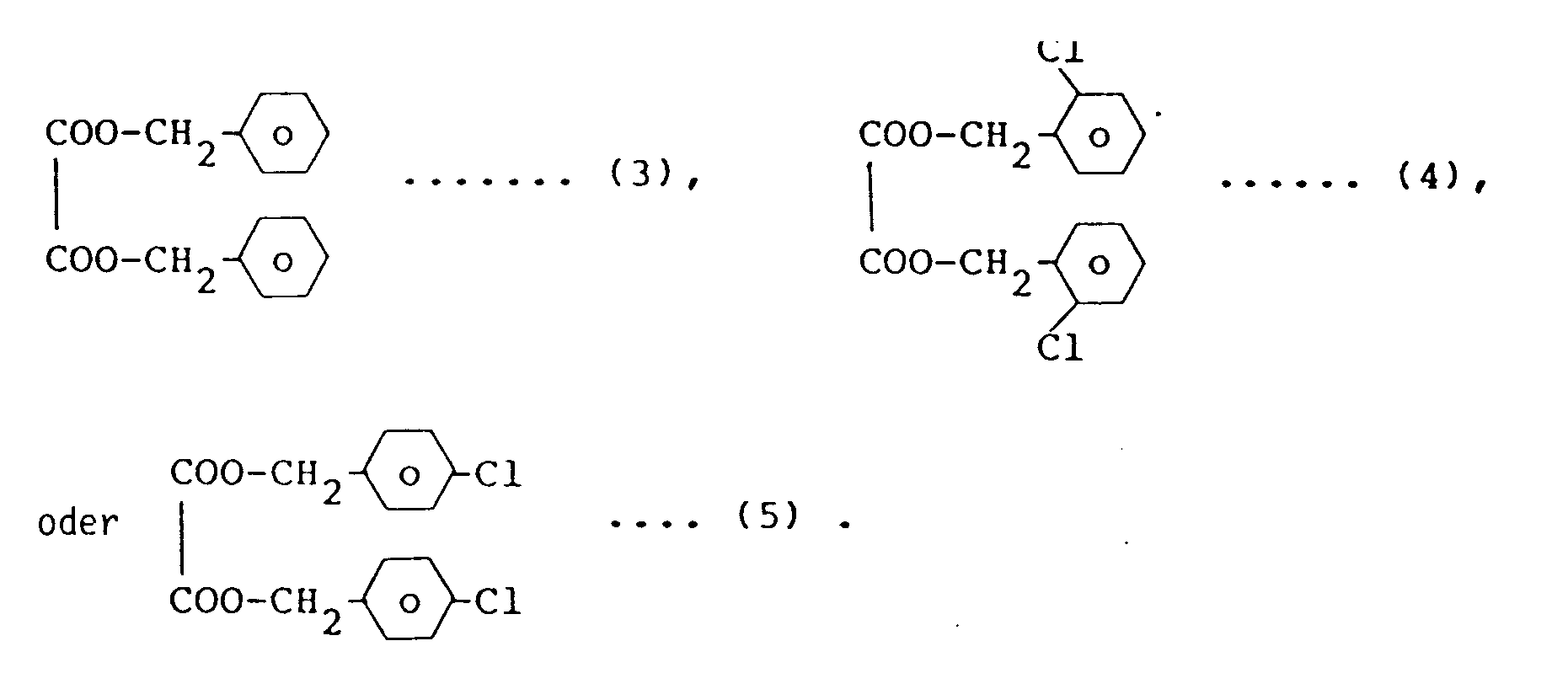
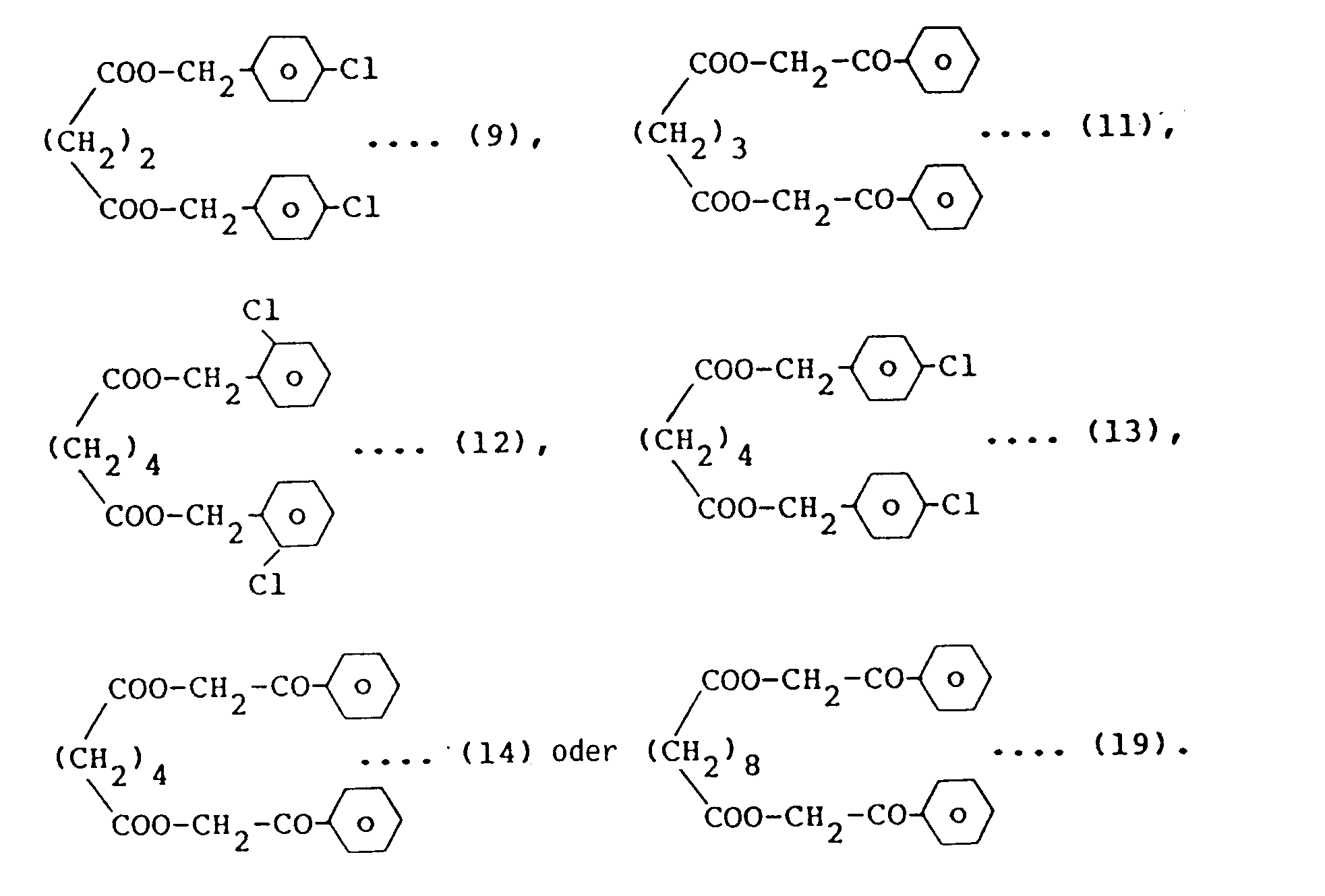
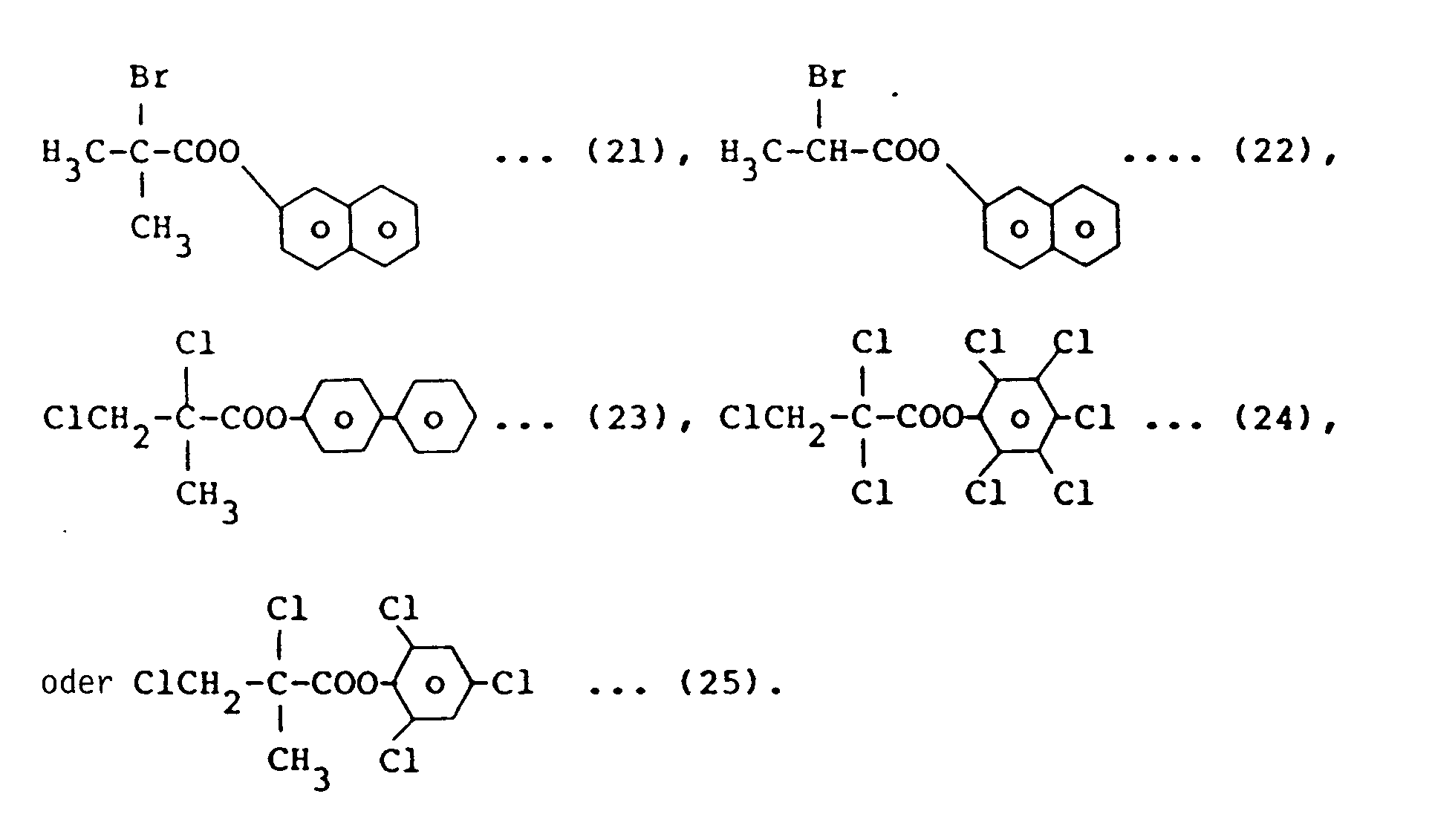
[0007] Specific examples include aliphatic carboxylic acid esters of the following structural formulae (1) to (30). Of these, the aliphatic carboxylic acid esters of structural formulae (3) to (5), (9), (11) to (14), (19) and (21) to (25) are preferred.
[0008] Examples of the color-forming lactone compound used in this invention include fluoranphthalides such as 3,3-bis(p-dimethylaminophenyl)phthalide, 3,3-bis(p-dimethylaminophenyl)-6-dimethylaminophthalide (also known as Crystal Violet Lactone; CVL for short), 3,3-bis(p-dimethylaminophenyl)-6-aminophthalide, 3,3-bis(p-dimethylaminophenyl)-6-nitrophthalide, 3,3-bis(p-dimethylaminophenyl)phthalide, 3,3-bis-3-dimethylamino-7-methylfluoran, 3-diethylamino-7-chlorofluoran, 3-diethylamino-6-chloro-7-methylfluoran, 3-diethylamino-7-anilinofluoran, 3-diethylamino-6-methyl-7-anilinofluoran, 3-piperidino-6-methyl-7-anilinofluoran, 3-(N-ethyl-p-toluidino)-7-(N-methylanilino)fluoran, 3-(N-ethyl-p-tolidino)-6-methyl-7-anilinofluoran, 3-N-ethyl-N-isoamylamino-6-methyl-7-anilinofluoran, 3-N-methyl-N-cyclohexylamino-6-methyl-7-anilinofluoran and 3-N,N-diethylamino-7-o-chloroanilinofluoran; lactams such as Rhodamin B lactam; and spiropyrans such as 3-methylspirodinaphtopyran, 3-ethylspirodinaphthopyran and 3-benzylspironaphthopyran. These compounds should be colorless or pale-colored and react with acidic substances to form colors.
[0009] The acidic substance used in this invention may be any acidic substrance which is solid at room temperature and when heated to about 60 to 180oC, is melted and opens the lactone ring of the color-forming lactone compound. It functions well in the presence of sensitizers. Examples of the acidic substance include 4-phenylphenol, 4-hydroxyacetophenone, 2,2'-dihydroxydiphenyl, 2,2'-methylenebis(4-chlorophenol), 2,2'-methylene-bis(4-methyl-6-t-butylphenol), 4,4'-isopropylidenediphenol (also known as bisphenol A), 4,4'-isopropylidenebis(2-chlorophenol), 4,4'-isopropylidenebis(2-methylphenol), 4,4'-ethylenebis(2-methylphenol), 4,4'-thiobis(6-t-butyl-3-methylphenol), 1,1-bis(4-hydroxyphenyl)-cyclohexane, 2,2'-bis(4-hydroxyphenyl)-n-heptane, 4,4'-cyclohexylidene-bis(2-isopropylphenol), 4,4'-sulfonyldiphenol, salicylanilide, novolak-type phenolic resin and benzyl p-hydroxybenzoate.
[0010] The acidic substance is used in an amount of usually 10 to 1,000 parts by weight (all parts hereinafter are by weight), preferably 100 to 500 parts, per 100 parts of the color-forming lactone compound.
[0011] The sensitizer is used in an amount of usually 1 to 1,000 parts, preferably 30 to 100 parts, per 100 parts of the acidic substance.
[0012] The color forming lactone compound, the acidic substance and the sensitizer are used in the form of fine particles, preferably fine particles having a particle diameters of less than several microns.
[0013] Various known methods can be used to produce the thermosensitive recording sheet. Usually, there may be used (1) a method which comprises preparing a coating dispersion of the color forming lactone compound, the acidic substance and the sensitizer in water, and coating the coating dispersion on a sheet substrate, and (2) a method which comprises dispersing the color-forming lactone compound and the acidic substance separately in water, including the sensitizer into at least one of the aqueous coating dispersions, and coating the coating dispersions in superimposed relation on a sheet substrate. An aqueous binder should be added to the coating dispersions. Examples of the binder are polyvinyl alcohol, methyl cellulose, hydroxyethyl cellulose, carboxymethyl cellulose, starches, and styrene/maleic acid copolymer. Besides, ultraviolet absorbers (for example, benzophenone compounds and triazole compounds) fillers such as calcium carbonate, lubricants such as polyethylene wax and paraffin wax, agents for imparting water resistance, and other various chemicals may be added to the coating dispersions in order to improve their performance. Various dispersing agents for dispersing the various chemicals in the above coating dispersions may also be added.
[0014] The coating dispersion is coated on a sheet substrate so that its dry weight becomes generally 2 to 12 g per m² of the sheet substrate, and then dried at room temperature to about 50oC to give the thermosensitive recording sheet of the invention.
[0015] Paper is generally used as the sheet substrate, but plastic sheets and nonwoven sheets may also be used.
[0016] The thermosensitive recording sheet of this invention has very high color forming sensitivity and its colored and non-colored portions have excellent stability.
[0017] The following Examples, Comparative Examples and Test Example illustrate the present invention more specifically. It should be understood that the invention is not limited at all by these examples. All parts and percentages in these examples are by weight.
EXAMPLE 1
[0018]
| Dispersion A (containing a dye) | |
| 3-(N-ethyl-p-toluidino)-6-methyl-7-anilinofluoran | 1.0 part |
| Aliphatic carboxylic acid ester of formula (1) | 2.0 parts |
| 10% Aqueous solution of polyvinyl alcohol | 3.0 parts |
| Water | 5.0 parts |
| Total | 11.0 parts |
| Dispersion B (containing an acidic substance) | |
| bisphenol A | 3.0 parts |
| Calcium carbonate | 3.0 parts |
| Zinc stearate | 0.5 part |
| 10% Aqueous solution of polyvinyl alcohol | 7.0 parts |
| Water | 10.0 parts |
| Total | 23.5 parts |
[0019] Dispersions A and B were separately prepared by mixing the indicated ingredients and pulverizing and dispersing them by a paint conditioner. Then, 11.0 parts of dispersion A and 23.5 parts of dispersion B were mixed to form a thermosensitive coating dispersion. It was coated on high-quality paper at a rate of 64.5 g/m² so that its amount upon drying became 8 g/m², and then dried to obtain a thermosensitive recording sheet in accordance with this invention.
[0020] This sheet had excellent color forming sensitivity and excellent stability at the colored and non-colored portions.
EXAMPLES 2-30
[0021] Thermosensitive recording sheets in accordance with this invention were prepared in the same way as in Example 1 except that the aliphatic carboxylic acid esters of formulae (2) to (30) were used instead of the aliphatic carboxylic acid ester of formula (1).
[0022] These sheets had excellent color-forming sensitivity and excellent stability at the colored and non-colored portions.
EXAMPLE 31
[0023] A thermosensitive recording sheet in accordance with this invention was prepared in the same way as in Example 3 except that the amount of the aliphatic carboxylic acid ester of formula (3) added was changed to 1.0 part and the amount of dispersion A was changed to 10 parts.
[0024] The sheet had excellent color forming sensitivity and excellent stability at the colored and non-colored portions.
EXAMPLE 32
[0025] A thermosensitive recording sheet in accordance with this invention was prepared in the same way as in Example 3 except that the amount of the aliphatic carboxylic acid ester of formula (3) added was changed to 4.0 parts and the amount of dispersion A was changed to 13 parts.
[0026] The sheet had excellent color forming sensitivity and excellent stability at the colored and non-colored portions.
COMPARATIVE EXAMPLE 1
[0027] A thermosensitive recording sheet for comparison was prepared in the same way as in Example 1 except that the aliphatic carboxylic acid ester of formula (1) was not added, and the amount of dispersion A used was changed to 9.0 parts.
COMPARATIVE EXAMPLE 2
[0029] A thermosensitive recording sheet for comparison was pepared in the same way as in Example 1 except that stearamide was used instead of the aliphatic carboxylic acid ester of formula (1).
[0030] The sheet had inferior color-forming sensitivity and stability at the colored and non-colored portions.
COMPARATIVE EXAMPLE 3
[0031] A thermosensitive recording sheet for comparison was prepared except that the addition of the aliphatic carboxylic acid ester of formula (1) was omitted, the amount of dispersion A was changed to 9 parts, and benzyl p-hydroxybenzoate was used instead of bisphenol A.
[0032] The sheet had inferior color-forming sensitivity and inferior stability at the colored portion.
COMPARATIVE EXAMPLE 4
[0033] A thermosensitive recording sheet for comparison was prepared in the same way as in Example 1 except that bis(p-benzylphenyl) malonate was used instead of the aliphatic carboxylic acid ester of formula (1).
COMPARATIVE EXAMPLE 5
[0035] A thermosensitive recording sheet for comparison was prepared in the same way as in Example 1 except that di-m-tolyl adipate was used instead of the aliphatic carboxylic acid ester of formula (1).
COMPARATIVE EXAMPLE 6
[0037] A thermosensitive recording sheet for comparison was prepared in the same way as in Example 1 except that diphenyl sebacate was used instead of the aliphatic carboxylic acid ester of formula (1).
TEST EXAMPLE
[0039] The thermosensitive recording sheets obtained in Examples 1 to 32 and Comparative Example 1 to 6 were tested for dynamic image density, and the stability of the colored and non-colored portions by methods described below. The results are shown in Tables 1 and 2.
Measurement of the dynamic image density
[0040] An image was printed on the thermosensitive recording sheet by means of a thermal head printing device (Model MSI, made by Matsushita Electronic Components Co., Ltd.) with a pulse width of 0.5 millisecond, and the density of the image was measured by a Macbeth densitometer (RD-918, made by Macbeth Co., U. S. A.).
Evaluation (A) of the stability of the colored and non-colored portions
[0041] The sheet was pressed against a hot plate at 140oC under a pressure of 2.0 kg/cm² for 1 second. The colored portion and the remaining non-colored portion were left to stand at 40oC and 90% RH for 24 hours. The degree of whitening or background fog of the colored and non-colored portions was visually observed and evaluated on the following scale.
1) Scale of evaluation of the colored portion
- ⓞ :
- No whitening
- ○ :
- Hardly any whitening
- △ :
- Whitening occurred
- X :
- Marked whitening
2) Scale of evaluation of the non-colored portion
- ⓞ :
- No background fog
- ○ :
- Hardly any background fog
- △ :
- Background fog occurred
- X :
- Marked background fog
Evaluation (B) of the stability of the colored and non-colored portions
1. A thermosensitive recording sheet having a coated film containing a color-forming
lactone compound, an acidic substance and a sensitizer, said sensitizer being at least
one aliphatic carboxylic acid ester represented by the formula

wherein R¹ and R² are identical or different and each represents an alkyl group having 1 to 20 carbon atoms, a cycloalkyl group, an aryl group, a group of the formula -CnH2n-Ar in which n is an integer of 1 to 8 and Ar is an aryl group, or a group of the formula -CnH2n-CO-Ar in which n and Ar are as defined; R³ represents a group of the formula -CnH2n- in which n is as defined; R⁴ and R⁵ are identical or different and each represents an alkyl group having 1 to 20 carbon atoms, a cycloalkyl group, a group of the formula -CnH2n-Ar in which n and Ar are as defined, or a group of the formula -CnH2n-CO-Ar in which n and Ar are as defined; and R⁶ represents an alkyl group having 2 to 6 carbon atoms and substituted by a halogen atom selected from chlorine, bromine and iodine atoms; with the proviso that the alkyl group having 1 to 20 carbon atoms for R¹, R², R⁴ and R⁵ may be substituted by a halogen atom, and the cycloalkyl group, the aryl group and Ar in -CnH2n-Ar and -CnH2n-CO-Ar may be substituted by an alkyl, cycloalkyl, aryl, aralkyl, phenacyl, alkyloxy, aryloxy, aralkyloxy, arylcarbonyl, arylsulfonyl, nitro or ammoniumsulfonic acid group or a halogen atom.
wherein R¹ and R² are identical or different and each represents an alkyl group having 1 to 20 carbon atoms, a cycloalkyl group, an aryl group, a group of the formula -CnH2n-Ar in which n is an integer of 1 to 8 and Ar is an aryl group, or a group of the formula -CnH2n-CO-Ar in which n and Ar are as defined; R³ represents a group of the formula -CnH2n- in which n is as defined; R⁴ and R⁵ are identical or different and each represents an alkyl group having 1 to 20 carbon atoms, a cycloalkyl group, a group of the formula -CnH2n-Ar in which n and Ar are as defined, or a group of the formula -CnH2n-CO-Ar in which n and Ar are as defined; and R⁶ represents an alkyl group having 2 to 6 carbon atoms and substituted by a halogen atom selected from chlorine, bromine and iodine atoms; with the proviso that the alkyl group having 1 to 20 carbon atoms for R¹, R², R⁴ and R⁵ may be substituted by a halogen atom, and the cycloalkyl group, the aryl group and Ar in -CnH2n-Ar and -CnH2n-CO-Ar may be substituted by an alkyl, cycloalkyl, aryl, aralkyl, phenacyl, alkyloxy, aryloxy, aralkyloxy, arylcarbonyl, arylsulfonyl, nitro or ammoniumsulfonic acid group or a halogen atom.
2. The thermosensitive recording sheet of claim 1 wherein the sensitizer is at least
one oxalic ester having a melting point of 60 to 150oC and represented by the general formula (I')
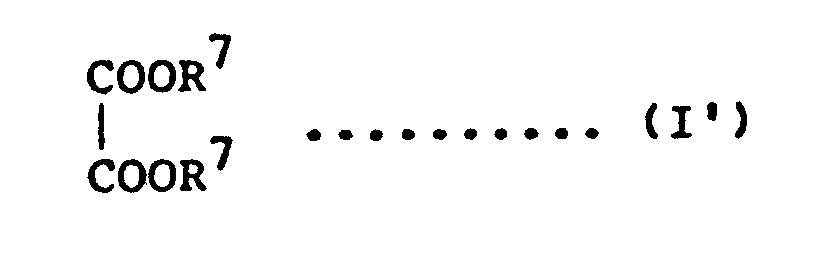
wherein R⁷ represents a cycloalkyl group, an aryl group, a group of the formula -CnH2n-Ar in which n is an integer of 1 to 8 and Ar is an aryl group, with the proviso that the cycloalkyl group, the aryl group, and Ar in -CnH2n-Ar may be substituted by an alkyl, cycloalkyl, aryl, aralkyl, phenacyl, alkyloxy, aryloxy, aralkyloxy, arylcarbonyl, arylsulfonyl, nitro or ammonium sulfonic acid group, or a halogen atom.
wherein R⁷ represents a cycloalkyl group, an aryl group, a group of the formula -CnH2n-Ar in which n is an integer of 1 to 8 and Ar is an aryl group, with the proviso that the cycloalkyl group, the aryl group, and Ar in -CnH2n-Ar may be substituted by an alkyl, cycloalkyl, aryl, aralkyl, phenacyl, alkyloxy, aryloxy, aralkyloxy, arylcarbonyl, arylsulfonyl, nitro or ammonium sulfonic acid group, or a halogen atom.
3. The thermosentive recording sheet of claim 1 wherein the sensitizer is at least one
dibasic acid ester having a melting point of 60 to 150oC and represented by the following general formula (II')
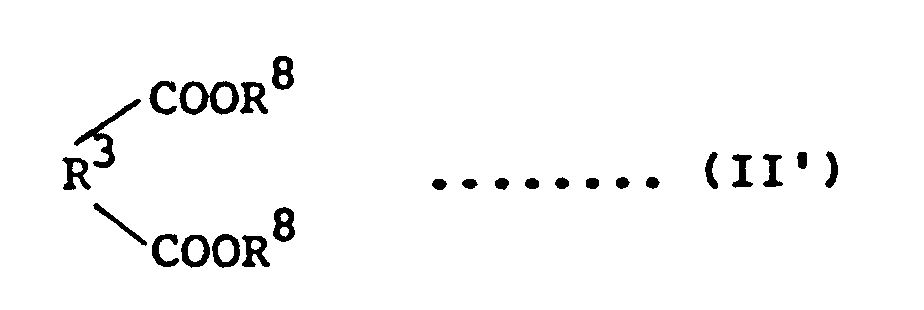
wherein R³ represents a group of the formula -CnH2n-in which n is an integer of 1 to 8; R⁸ represents a cycloalkyl group, a group of the formula -CnH2n-Ar in which n is as defined and AR is an aryl group, or a group of the formula -CnH2n-CO-Ar in which n and Ar are as defined; with the proviso that the cycloalkyl group, and Ar in -CnH2n-Ar and -CnH2n-CO-Ar may be substituted by an alkyl, cycloalkyl, aryl, aralkyl, phenacyl, alkyloxy, aryloxy, aralkyloxy, arylcarbonyl, arylsulfonyl, nitro or ammonium sulfonic acid group, or a halogen atom.
wherein R³ represents a group of the formula -CnH2n-in which n is an integer of 1 to 8; R⁸ represents a cycloalkyl group, a group of the formula -CnH2n-Ar in which n is as defined and AR is an aryl group, or a group of the formula -CnH2n-CO-Ar in which n and Ar are as defined; with the proviso that the cycloalkyl group, and Ar in -CnH2n-Ar and -CnH2n-CO-Ar may be substituted by an alkyl, cycloalkyl, aryl, aralkyl, phenacyl, alkyloxy, aryloxy, aralkyloxy, arylcarbonyl, arylsulfonyl, nitro or ammonium sulfonic acid group, or a halogen atom.
4. The thermosensitive recording sheet of claim 1 whrein the sensitizer is at least one
aliphatic monocarboxylic acid ester having a melting point of 60 to 150oC and represented by the general formula (III')
R⁹-COOR¹⁰ (III')
wherein R⁹ represents an alkyl group having 2 to 6 carbon atoms and substituted by a chlorine or bromine atom; R¹⁰ represents an aryl group which may be substituted by an alkyl, cycloalkyl, aryl, aralkyl, phenacyl, alkyloxy, aryloxy, aralkyloxy, arylcarbonyl, arylsulfonyl, nitro or ammonium sulfonic acid group, or a halogen atom.
R⁹-COOR¹⁰ (III')
wherein R⁹ represents an alkyl group having 2 to 6 carbon atoms and substituted by a chlorine or bromine atom; R¹⁰ represents an aryl group which may be substituted by an alkyl, cycloalkyl, aryl, aralkyl, phenacyl, alkyloxy, aryloxy, aralkyloxy, arylcarbonyl, arylsulfonyl, nitro or ammonium sulfonic acid group, or a halogen atom.
5. The thermosensitive recording sheet of claim 1 wherein the sensitizer is at least
one oxalic ester represented by the structural formula
6. The thermosensitive recording sheet of claim 1 wherein the sensitizer is at least
one dibasic acid ester represented by the formula
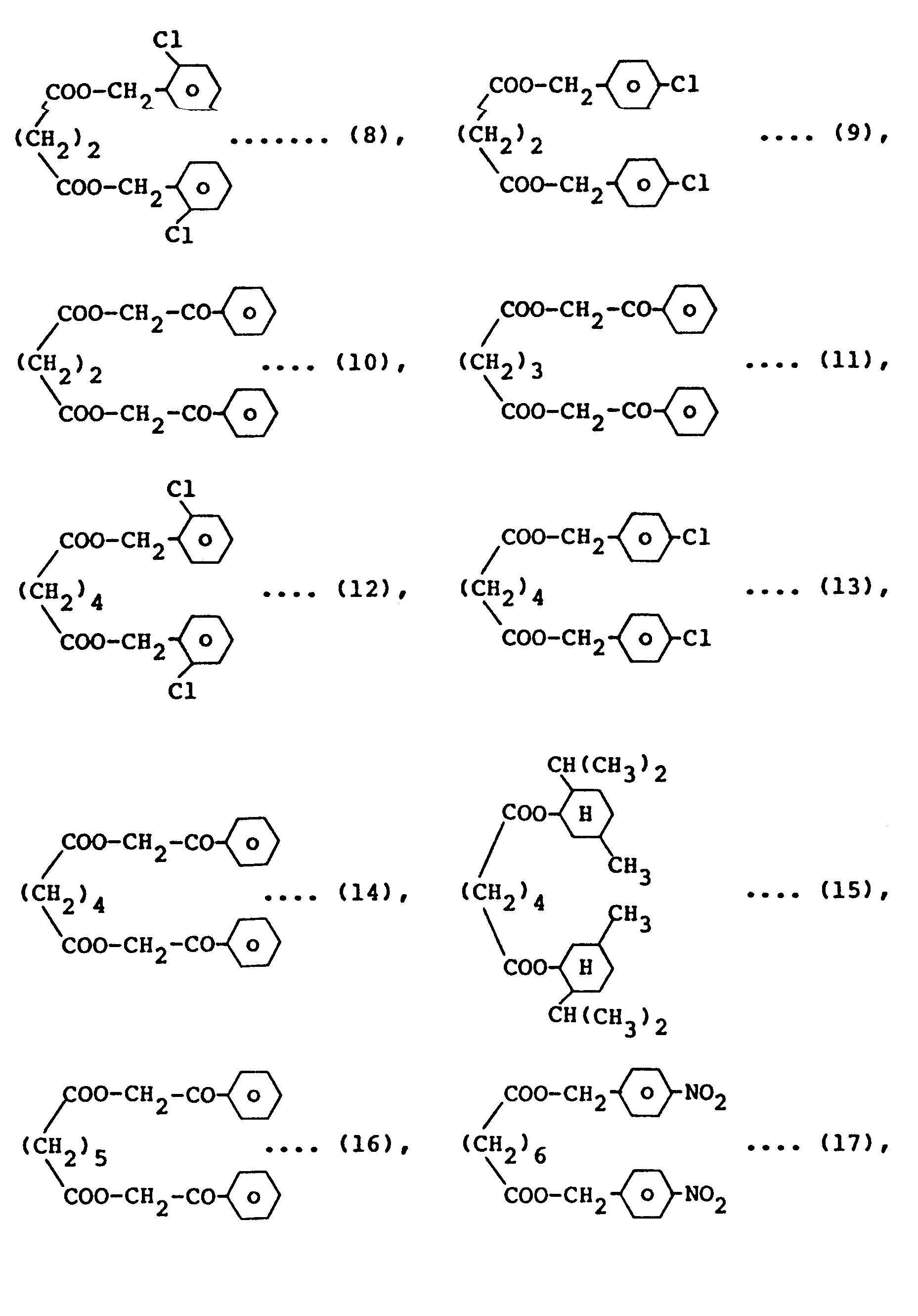
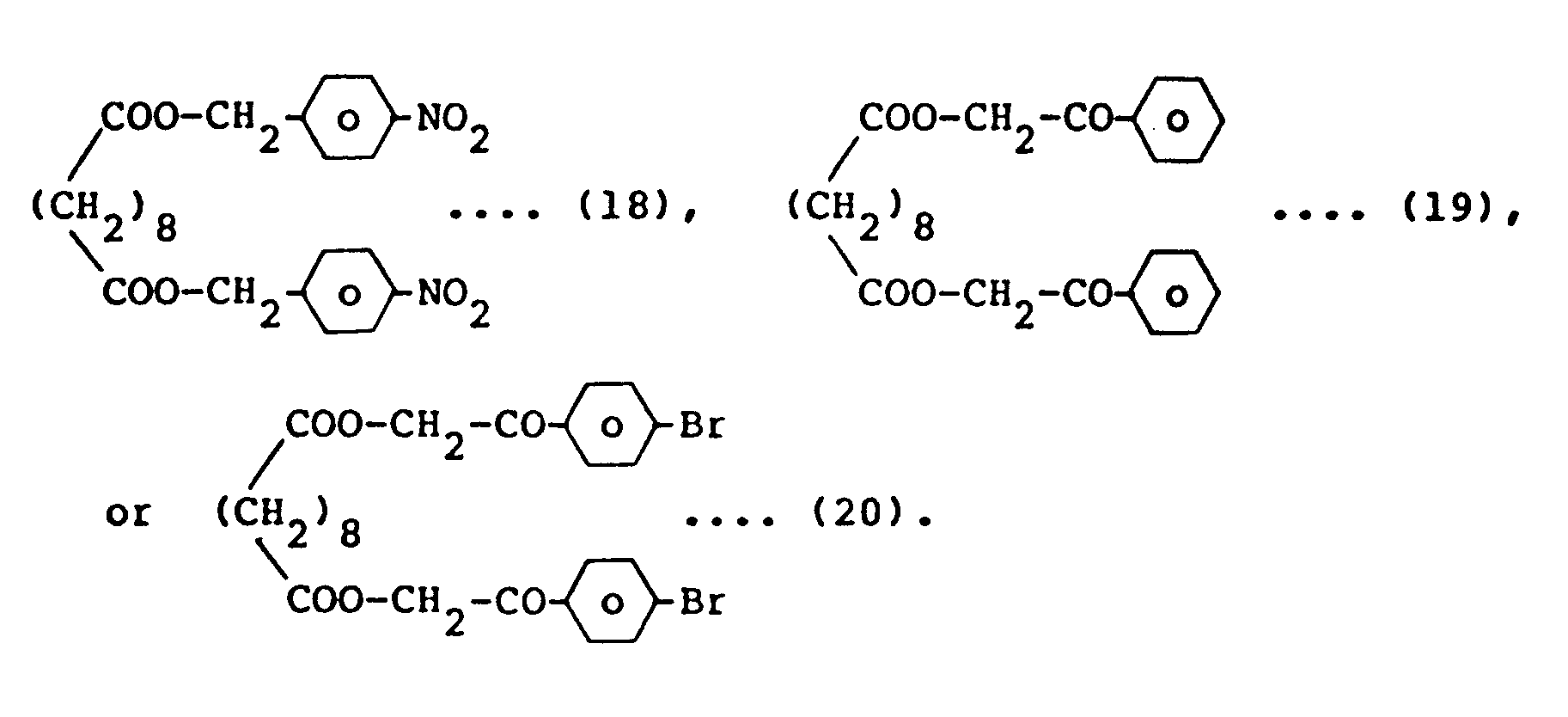
7. The thermosensitive recording sheet of claim 1 wherein the sensitizer is at least
one aliphatic monocarboxylic acid ester represented by the structural formula
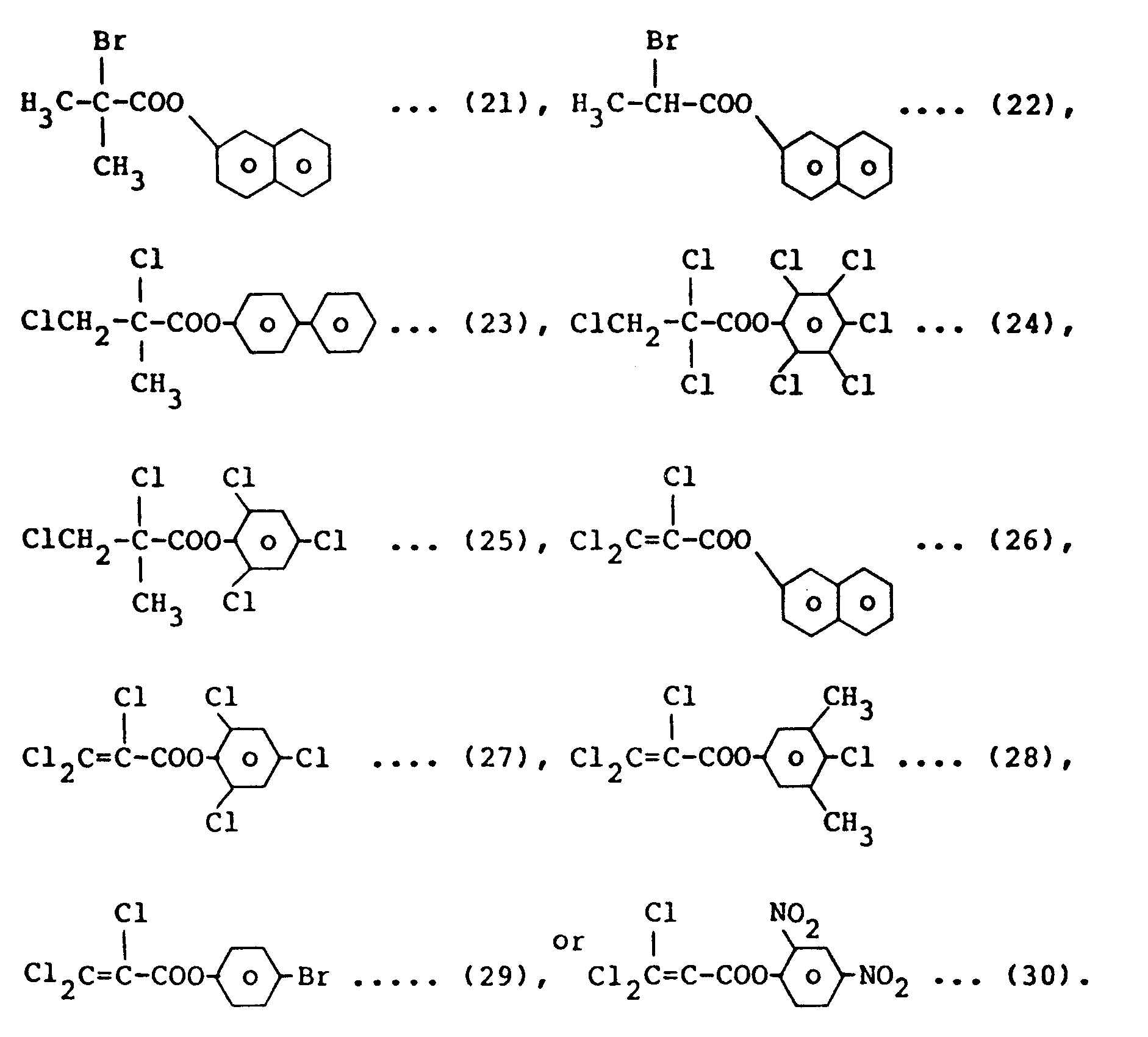
8. The thermosensitive recording sheet of claim 1 wherein the sensitizer is at least
one oxalic ester represented by the structural formula
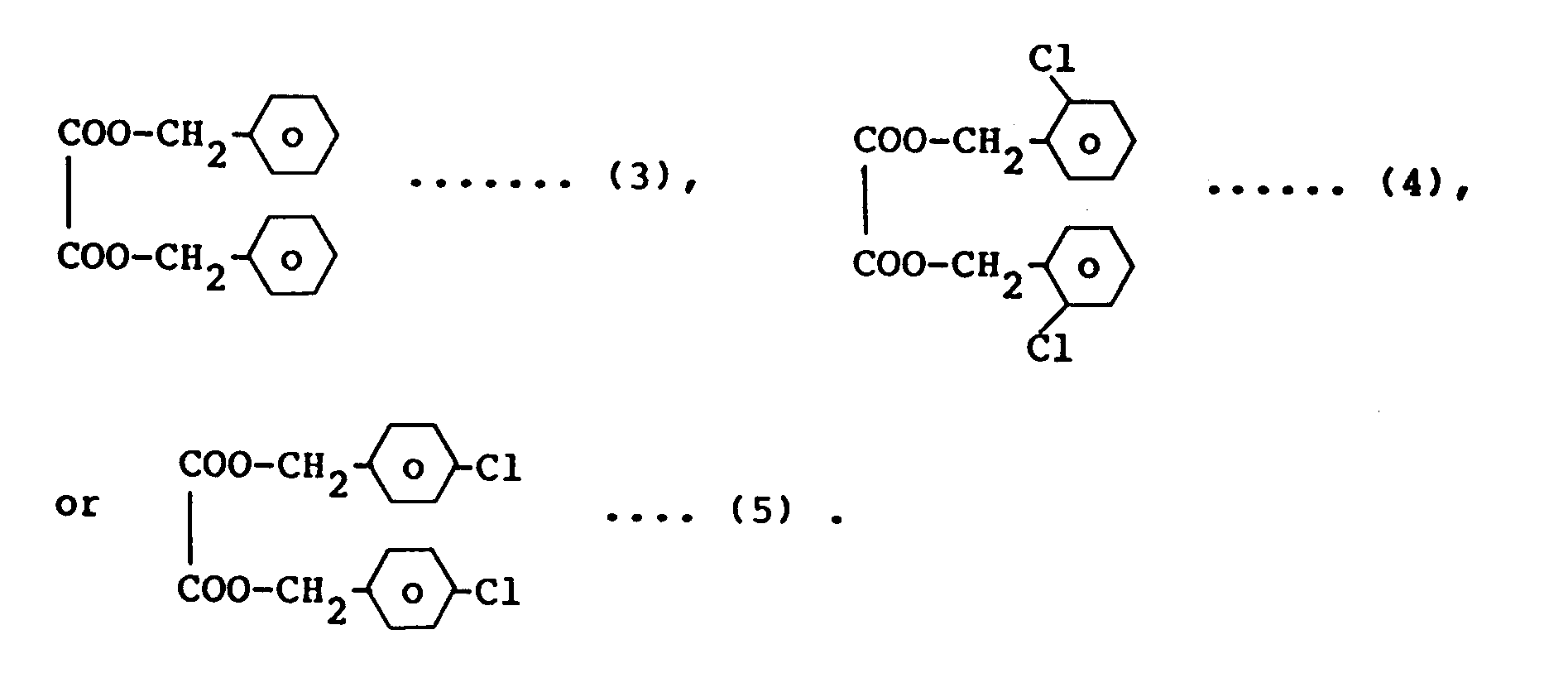
9. The thermosensitive recording sheet of claim 1 wherein the sensitizer is at least
one dibasic acid ester represented by the structural formula
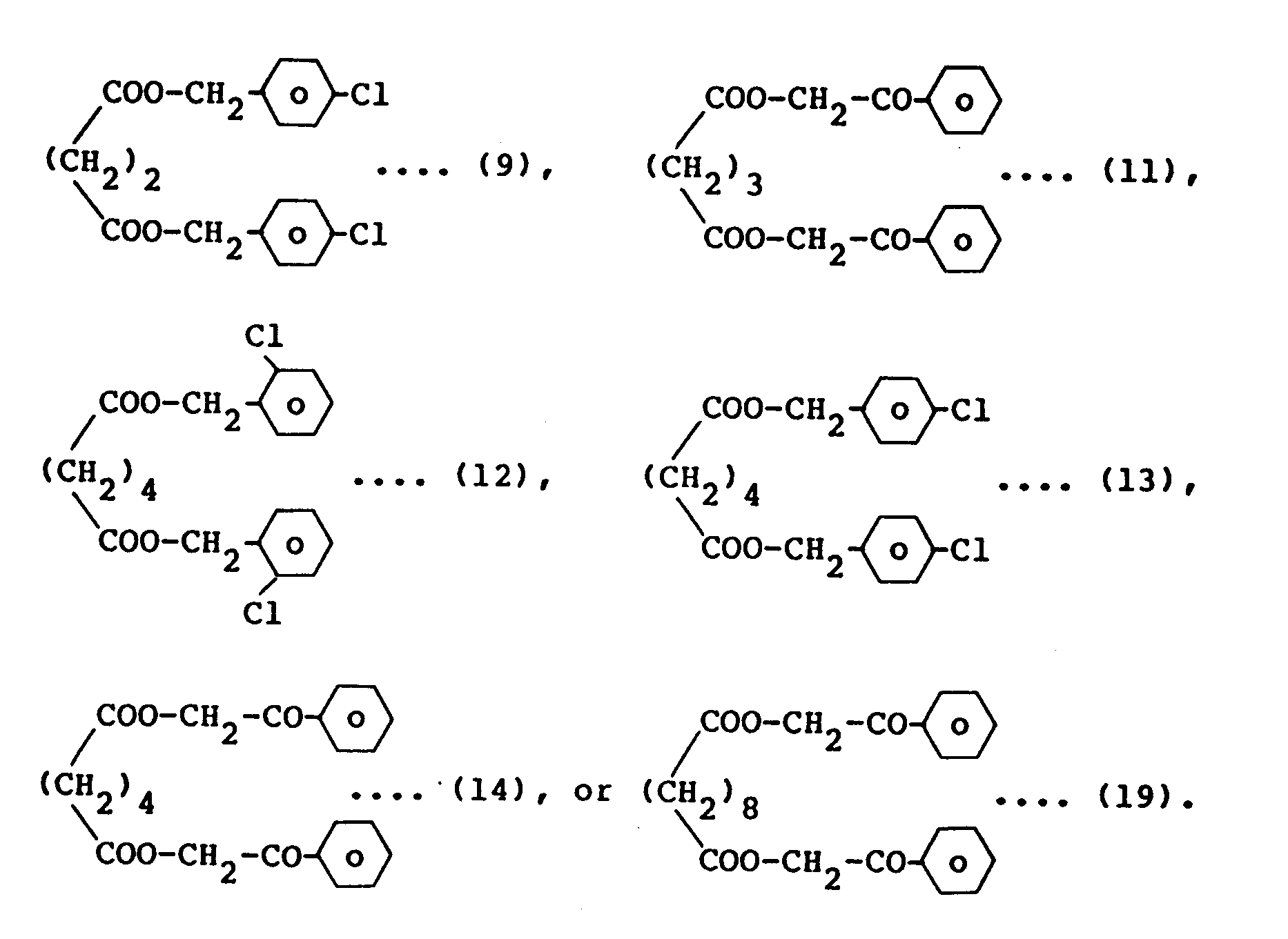
10. The thermosensitive recording sheet of claim 1 wherein the sensitizer is at least
one aliphatic monocarboxylic acid ester represented by the structural formula
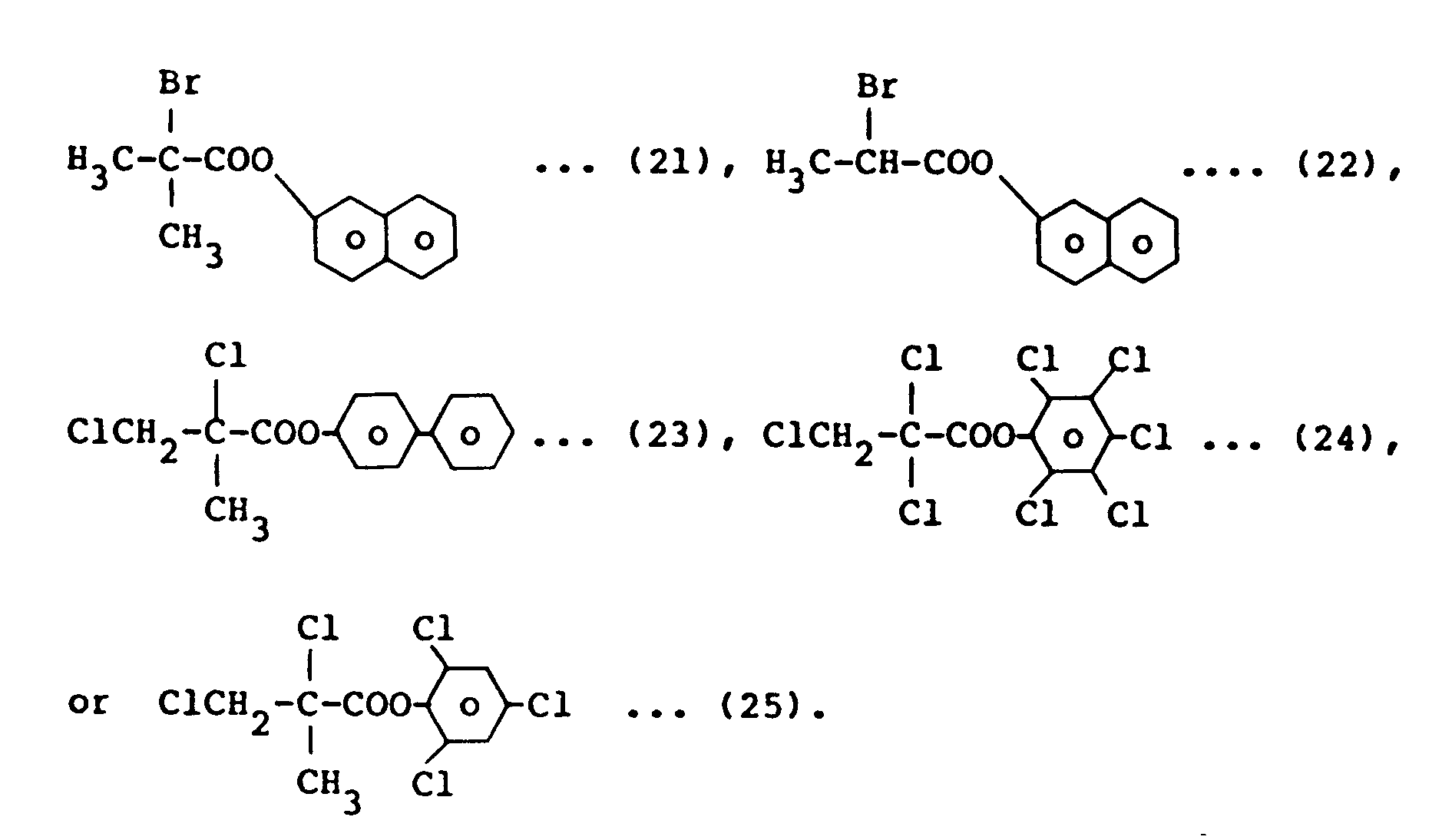
11. The thermosensitive recording sheet of claim 1 wherein the amount of the acidic substance
in the coated film is 100 to 500 parts by weight per 100 parts by weight of the color-forming
lactone compound.
12. The thermosensitive recording sheet of claims 1 to 11 wherein the amount of the sensitizer
in the coated film is 1 to 1,000 parts by weight per 100 parts by weight of the acidic
substance.
13. The thermosensitive recording sheet of claim 12 wherein the amount of the sensitizer
in the coated film is 30 to 100 parts by weight per 100 parts by weight of the acidic
substance.
1. Feuille thermosensible pour enregistrement, comportant un film revêtu contenant une
lactone formatrice de couleur , une substance acide et un sensibilisateur, ledit sensibilisateur
étant formé d'au moins un ester d'ester d'acide carboxylique aliphatique représenté
par la formule

[ où R¹ et R² sont identiques ou différents, et représentent chacun un groupe alkyle ayant 1 à 20 atomes de carbone, un groupe cycloakyle, un groupe aryle, un groupe de formule -CnH2n-CO-Ar, dans laquelle n est un nombre entier valant 1 à 8, et Ar représente un groupe aryle, ou un groupe de formule -CnH2n- Co-Ar(dans laquelle n et Ar sont tels que définis ci-dessus); R³ représente un groupe de formule - CnH2n- dans laquelle n est tel que défini ci-dessus ; R⁴ et R⁵ sont identiques ou différents et ils représentent chacun un groupe alkyle ayant 1 à 20 atomes de carbone, un groupe cycloalkyle, un groupe de formule -Cn-H2n-Ar dans lequel n et Ar sont tels que définis ci-dessus, ou un groupe de formule -CnH2n-CO-Ar dans laquelle n et Ar sont tels que définis ci-dessus, et R⁶ représente un groupe alkyle ayant 2 à 6 atomes de carbone et qui porte comme substituant un atome d'halogène choisi parmi des atomes de chlore, de brome et d'iode; à la condition que le groupe alkyle ayant 1 à 20 atomes de carbone et qui peut être représenté par R¹, R², R³, et R⁴ , puisse être substitué par un atome d'halogène, et que le cycloalkyle, le groupe aryle, et Ar dans -CnH2n-Ar et -CnH2n-CO-Ar puissent être substitués par un groupe alkyle, cycloalkyle, aryle, aralkyle, phénacyle, alkyloxy, aryloxy, aralkyloxy, arylcarbonyle, arylsulfonyle, nitro ou un groupe acide ammonium-sulfonique ou sulfate d'ammonium ou un atome d'halogène.
[ où R¹ et R² sont identiques ou différents, et représentent chacun un groupe alkyle ayant 1 à 20 atomes de carbone, un groupe cycloakyle, un groupe aryle, un groupe de formule -CnH2n-CO-Ar, dans laquelle n est un nombre entier valant 1 à 8, et Ar représente un groupe aryle, ou un groupe de formule -CnH2n- Co-Ar(dans laquelle n et Ar sont tels que définis ci-dessus); R³ représente un groupe de formule - CnH2n- dans laquelle n est tel que défini ci-dessus ; R⁴ et R⁵ sont identiques ou différents et ils représentent chacun un groupe alkyle ayant 1 à 20 atomes de carbone, un groupe cycloalkyle, un groupe de formule -Cn-H2n-Ar dans lequel n et Ar sont tels que définis ci-dessus, ou un groupe de formule -CnH2n-CO-Ar dans laquelle n et Ar sont tels que définis ci-dessus, et R⁶ représente un groupe alkyle ayant 2 à 6 atomes de carbone et qui porte comme substituant un atome d'halogène choisi parmi des atomes de chlore, de brome et d'iode; à la condition que le groupe alkyle ayant 1 à 20 atomes de carbone et qui peut être représenté par R¹, R², R³, et R⁴ , puisse être substitué par un atome d'halogène, et que le cycloalkyle, le groupe aryle, et Ar dans -CnH2n-Ar et -CnH2n-CO-Ar puissent être substitués par un groupe alkyle, cycloalkyle, aryle, aralkyle, phénacyle, alkyloxy, aryloxy, aralkyloxy, arylcarbonyle, arylsulfonyle, nitro ou un groupe acide ammonium-sulfonique ou sulfate d'ammonium ou un atome d'halogène.
2. Feuille thermosensible pour enregistrement selon la revendication 1, dans laquelle
le sensibilisateur est constitué par au moins un ester oxalique ayant un point de
fusion de 60 à 150°C et qui est représenté par la formule générale (I'):
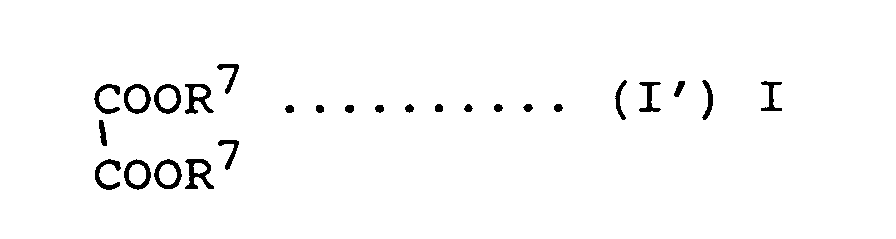
dans laquelle R⁷ représente un groupe cycloalkyle, un groupe aryle, un groupe de formule -CnH2n-Ar (dans laquelle n est un nombre entier valant 1 à 8 et Ar représente un groupe aryle) à la condition que le groupe cycloalkyle, le groupe aryle, et Ar présent dans -CnH₂-Ar puissent porter comme substituant un groupe alkyle, cycloalkyle, aryle, aralkyle, phénacyle, alkyloxy, aryloxy, aralkyloxy, arylcarbonyle, arylsulfonyle, nitro ou acide ammonium sulfonique (ou sulfonate d'ammonium), ou un atome d'halogène.
dans laquelle R⁷ représente un groupe cycloalkyle, un groupe aryle, un groupe de formule -CnH2n-Ar (dans laquelle n est un nombre entier valant 1 à 8 et Ar représente un groupe aryle) à la condition que le groupe cycloalkyle, le groupe aryle, et Ar présent dans -CnH₂-Ar puissent porter comme substituant un groupe alkyle, cycloalkyle, aryle, aralkyle, phénacyle, alkyloxy, aryloxy, aralkyloxy, arylcarbonyle, arylsulfonyle, nitro ou acide ammonium sulfonique (ou sulfonate d'ammonium), ou un atome d'halogène.
3. Feuille thermosensible d'enregistrement selon la revendication 1, dans laquelle le
sensibilisateur est constitué par au moins un ester d'un diacide ayant un point de
fusion de 60 à 150°C et qui est représenté par la formule générale (II') :
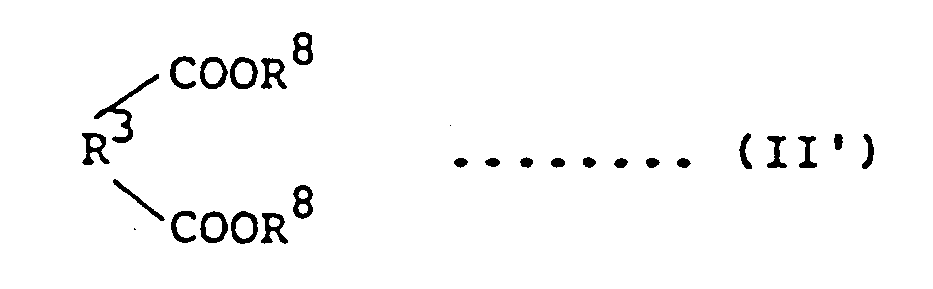
dans laquelle R³ représente un groupe de formule -CnH2n- (dans laquelle n est un nombre entier valant 1 à 8); R⁸ représente un groupe cycloalkyle, un groupe de formule - CnH2n-Ar (dans laquelle n est tel que défini ci-dessus et Ar représente un groupe aryle) , ou un groupe de formule - CnH2n-CO-Ar, dans laquelle n et Ar sont tels que définis ci-dessus, à la condition que le groupe cycloalkyle et Ar dans -CnH2n-Ar et -CnH2n-CO-Ar puissent porter comme substituants un groupe alkyle, cycloalkyle, aryle, aralkyle, phénacyle, alkyloxy, aryloxy, aralkyloxy, arylcarbonyle, arylsulfonyle, nitro ou acide ammonium-sulfonique (sulfonate d'ammonium), ou un atome d'halogène.
dans laquelle R³ représente un groupe de formule -CnH2n- (dans laquelle n est un nombre entier valant 1 à 8); R⁸ représente un groupe cycloalkyle, un groupe de formule - CnH2n-Ar (dans laquelle n est tel que défini ci-dessus et Ar représente un groupe aryle) , ou un groupe de formule - CnH2n-CO-Ar, dans laquelle n et Ar sont tels que définis ci-dessus, à la condition que le groupe cycloalkyle et Ar dans -CnH2n-Ar et -CnH2n-CO-Ar puissent porter comme substituants un groupe alkyle, cycloalkyle, aryle, aralkyle, phénacyle, alkyloxy, aryloxy, aralkyloxy, arylcarbonyle, arylsulfonyle, nitro ou acide ammonium-sulfonique (sulfonate d'ammonium), ou un atome d'halogène.
4. Feuille thermosensible d'enregistrement selon la revendication 1, dans laquelle le
sensibilisateur est constitué par au moins un ester d'acide monocarboxylique aliphatique
ayant un point de fusion de 60 à 150°C et qui est représenté par la formule -III')
R⁹ - COOR¹⁰ (III')
dans laquelle R⁹ représente un groupe alkyle ayant 2 à 6 atomes de carbone, et qui porte comme substituant un atome de chlore ou de brome, R¹⁰ représente un groupe aryle qui peut porter comme substituant un groupe alkyle, cycloalkyle, aryle, aralkyle, phénacyle, alkyloxy, aryloxy, aralkyloxy, arylcarbonyle, aralkylsulfonyle , nitro ou acide ammonium-sulfonique (sulfonate d'ammonium), ou un atome d'halogène.
R⁹ - COOR¹⁰ (III')
dans laquelle R⁹ représente un groupe alkyle ayant 2 à 6 atomes de carbone, et qui porte comme substituant un atome de chlore ou de brome, R¹⁰ représente un groupe aryle qui peut porter comme substituant un groupe alkyle, cycloalkyle, aryle, aralkyle, phénacyle, alkyloxy, aryloxy, aralkyloxy, arylcarbonyle, aralkylsulfonyle , nitro ou acide ammonium-sulfonique (sulfonate d'ammonium), ou un atome d'halogène.
5. Feuille thermosensible pour enregistrement selon la revendication 1, dans laquelle
le sensibilisateur est constitué par au moins un ester oxalique représenté par les
formules de structure
6. Feuille thermosensible pour enregistrement selon la revendication 1, dans laquelle
le sensibilisateur est constitué par au moins un ester de diacide représenté par la
formule
7. Feuille thermosensible pour enregistrement selon la revendication 1, dans laquelle
le sensibilisateur est constitué par au moins un ester d'un acide monocarboxylique
aliphatique représenté par la formule de structure :
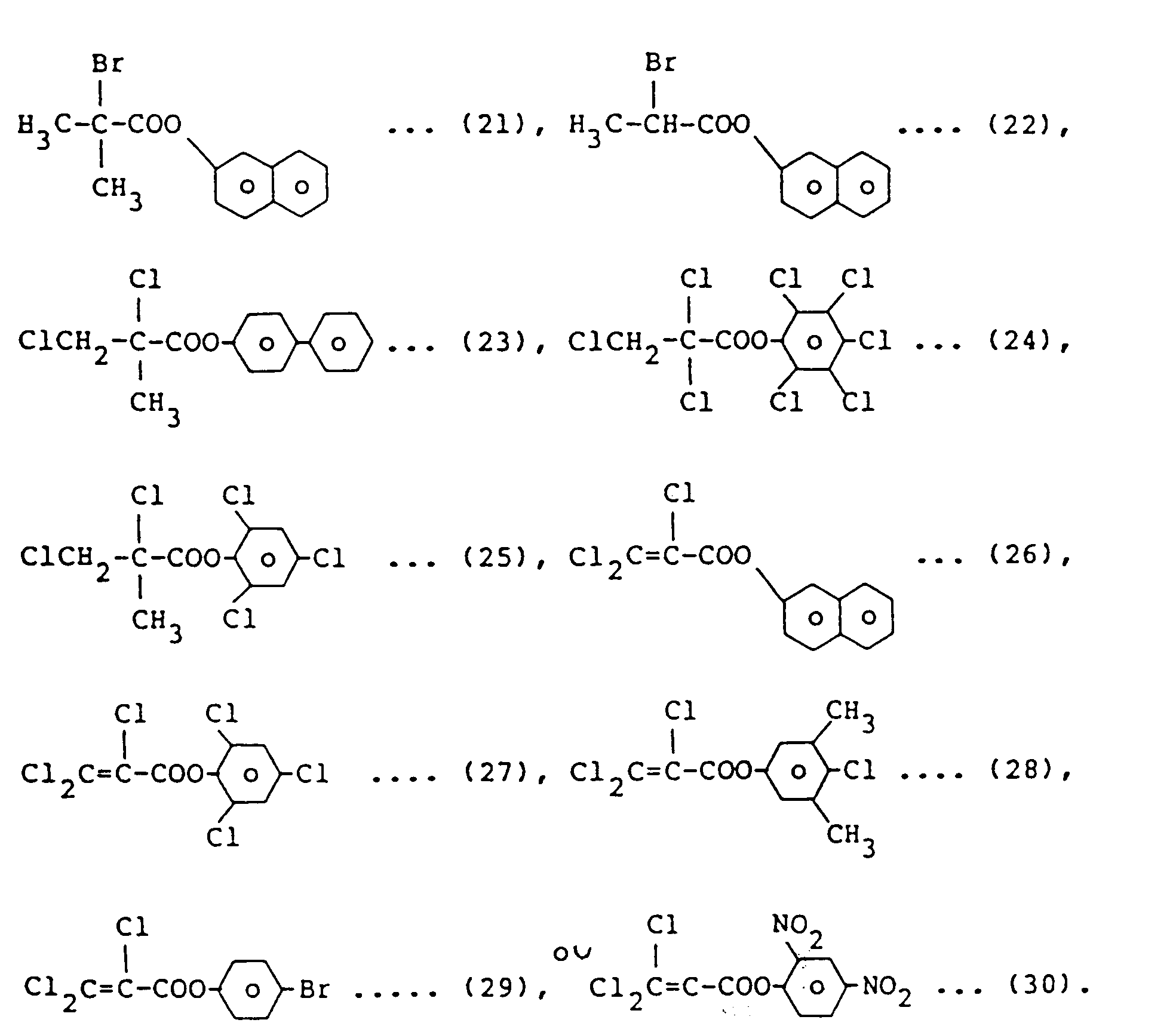
8. Feuille thermosensible pour enregistrement selon la revendication 1, dans laquelle
le sensibilisateur est constitué par au moins un ester oxalique représenté par la
formule de structure :
9. Feuille thermosensible pour enregistrement selon la revendication 1, dans laquelle
le sensibilisateur est constitué par au moins un ester de diacide représenté par la
formule de structure :
10. Feuille thermosensible pour enregistrement selon la revendication 1, dans laquelle
le sensibilisateur est constitué par au moins un ester d'acide monocarboxylique aliphatique
représenté par la formule de structure :
11. Feuille thermosensible pour enregistrement selon la revendication 1, dans laquelle
la quantité de substance acide dans le film revêtu est de 100 à 500 parties en poids,
pour 100 parties en poids de la lactone formatrice de couleur .
12. Feuille thermosensible pour enregistrement selon les revendications 1 à 11, dans laquelle
la quantité du sensibilisateur dans le film revêtu est de 1 à 1000 parties en poids
pour 100 parties en poids de la substance acide.
13. Feuille thermosensible pour enregistrement selon la revendication 12, dans laquelle
la quantité du sensibilisateur dans le film revêtu est de 30 à 100 parties en poids
pour 100 parties en poids de la substance acide.
1. Wärmeempfindliches Aufzeichnungsblatt, dadurch gekennzeichnet, daß es einen Überzugssfilm aufweist, der eine farbbildende Lactonverbindung, eine
azide Substanz und einen Sensibilisator enthält, wobei der genannte Sensibilisator
aus zumindest einem aliphatischen Carbonsäureester besteht, der durch die Formel:
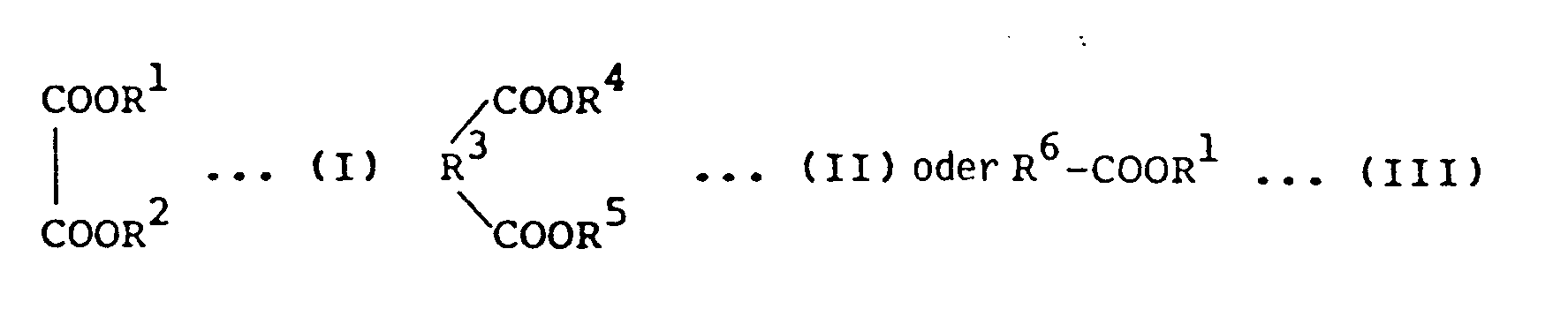
dargestellt wird, in denen R¹ und R² identisch oder verschieden sind und jeweils eine Alkylgruppe mit 1 bis 20 Kohlenstoffatomen, eine Cycloalkylgruppe, eine Arylgruppe, eine Gruppe der Formel -CnH2n-Ar, in der n eine ganze Zahl von 1 bis 8 und Ar eine Arylgruppe ist, oder eine Gruppe der Formel -CnH2n-Co-Ar, in der n und Ar genauso definiert sind, darstellen; R³ für eine Gruppe der Formel -CnH2n-, in der n die definitionsgemäße Bedeutung hat, steht; R⁴ und R⁵ identisch oder verschieden sind und jeweils eine Alkylgruppe mit 1 bis 20 Kohlenstoffatomen, eine Cycloalkylgruppe, eine Gruppe der Formel -CnH2n-Ar, in der n und Ar die definitionsgemäße Bedeutung haben, oder eine Gruppe der Formel -CnH2n-CO-Ar, in der n und Ar die definitionsgemäße Bedeutung haben, darstellen; und R⁶ für eine durch ein Halogenatom, ausgewählt aus der Gruppe Chlor, Brom und Iod, substituierte Alkylgruppe mit 2 bis 6 Kohlenstoffatomen steht; mit der Maßgabe, daß die Alkylgruppe mit 1 bis 20 Kohlenstoffatomen für R¹, R², R⁴ und R⁵ durch ein Halogenatom substituiert sein kann, und daß die cycloalkylgruppe, die Arylgruppe und Ar in -CnH2n-Ar und -CnH2n-CO-Ar durch eine Alkyl-, Cycloalkyl-, Aryl-, Aralkyl-, Phenacyl-, Alkyloxy-, Aryloxy-, Aralkyloxy-, Arylcarbonyl-, Arylsulfonyl-, Nitro- oder Ammoniumsulfonsäuregruppe oder ein Halogenatom substituiert sein können.
dargestellt wird, in denen R¹ und R² identisch oder verschieden sind und jeweils eine Alkylgruppe mit 1 bis 20 Kohlenstoffatomen, eine Cycloalkylgruppe, eine Arylgruppe, eine Gruppe der Formel -CnH2n-Ar, in der n eine ganze Zahl von 1 bis 8 und Ar eine Arylgruppe ist, oder eine Gruppe der Formel -CnH2n-Co-Ar, in der n und Ar genauso definiert sind, darstellen; R³ für eine Gruppe der Formel -CnH2n-, in der n die definitionsgemäße Bedeutung hat, steht; R⁴ und R⁵ identisch oder verschieden sind und jeweils eine Alkylgruppe mit 1 bis 20 Kohlenstoffatomen, eine Cycloalkylgruppe, eine Gruppe der Formel -CnH2n-Ar, in der n und Ar die definitionsgemäße Bedeutung haben, oder eine Gruppe der Formel -CnH2n-CO-Ar, in der n und Ar die definitionsgemäße Bedeutung haben, darstellen; und R⁶ für eine durch ein Halogenatom, ausgewählt aus der Gruppe Chlor, Brom und Iod, substituierte Alkylgruppe mit 2 bis 6 Kohlenstoffatomen steht; mit der Maßgabe, daß die Alkylgruppe mit 1 bis 20 Kohlenstoffatomen für R¹, R², R⁴ und R⁵ durch ein Halogenatom substituiert sein kann, und daß die cycloalkylgruppe, die Arylgruppe und Ar in -CnH2n-Ar und -CnH2n-CO-Ar durch eine Alkyl-, Cycloalkyl-, Aryl-, Aralkyl-, Phenacyl-, Alkyloxy-, Aryloxy-, Aralkyloxy-, Arylcarbonyl-, Arylsulfonyl-, Nitro- oder Ammoniumsulfonsäuregruppe oder ein Halogenatom substituiert sein können.
2. Wärmeempfindliches Aufzeichnungsblatt nach Anspruch 1, dadurch gekennzeichnet, daß der Sensibilisator zumindest ein Ester der Oxalsäure mit einem Schmelzpunkt von
60 bis 150°C ist und durch die allgemeine Formel (I') dargestellt wird:
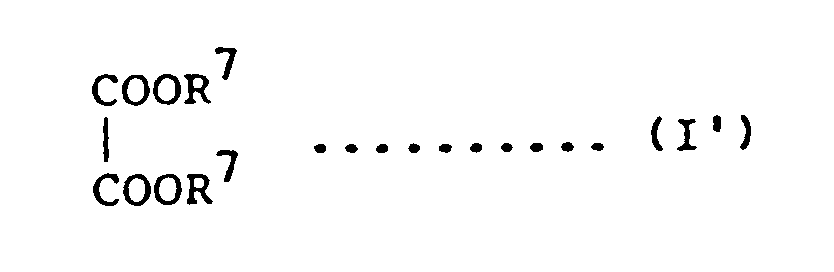
worin R⁷ für eine Cycloalkylgruppe, eine Arylgruppe, eine Gruppe der Formel -CnH2n-Ar, in der n eine ganze Zahl von 1 bis 8 und Ar eine Arylgruppe ist, steht, mit der Maßgabe, daß die Cycloalkylgruppe, die Arylgruppe und Ar in -CnH2n-Ar durch eine Alkyl-, Cycloalkyl-, Aryl-, Aralkyl-, Phenacyl-, Alkyloxy-, Aryloxy-, Aralkyloxy-, Arylcarbonyl-, Arylsulfonyl-, Nitro- oder Ammoniumsulfonsäuregruppe oder ein Halogenatom substituiert sein können.
worin R⁷ für eine Cycloalkylgruppe, eine Arylgruppe, eine Gruppe der Formel -CnH2n-Ar, in der n eine ganze Zahl von 1 bis 8 und Ar eine Arylgruppe ist, steht, mit der Maßgabe, daß die Cycloalkylgruppe, die Arylgruppe und Ar in -CnH2n-Ar durch eine Alkyl-, Cycloalkyl-, Aryl-, Aralkyl-, Phenacyl-, Alkyloxy-, Aryloxy-, Aralkyloxy-, Arylcarbonyl-, Arylsulfonyl-, Nitro- oder Ammoniumsulfonsäuregruppe oder ein Halogenatom substituiert sein können.
3. Wärmeempfindliches Aufzeichnungsblatt nach Anspruch 1, dadurch gekennzeichnet, daß der Sensibilisator zumindest ein Ester einer zweibasischen Säure mit einem Schmelzpunkt
von 60 bis 150°C ist und durch die folgende allgemeine Formel (II') dargestellt wird:
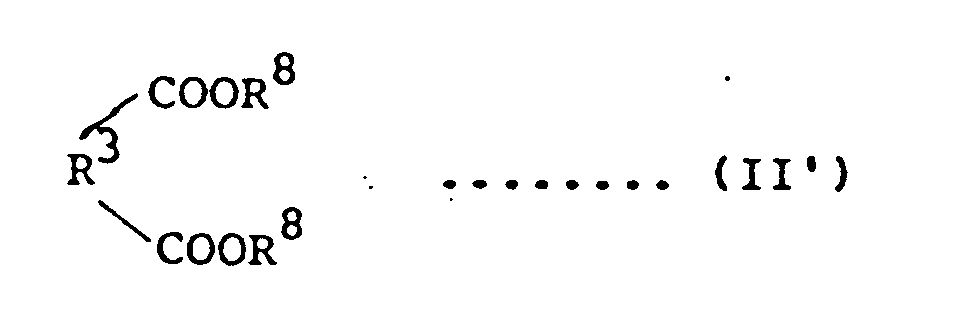
worin R³ für eine Gruppe der Formel -CnH2n- steht, in der n eine ganze Zahl von 1 bis 8 ist; R⁸ eine Cycloalkylgruppe, eine Gruppe der Formel -CnH2n-Ar, in der n die definitionsgemäße Bedeutung hat und Ar eine Arylgruppe ist, oder eine Gruppe der Formel -CnH2n-CO-Ar, in der n und Ar die definitionsgemäße Bedeutung haben, darstellt; mit der Maßgabe, daß die Cycloalkylgruppe und Ar in -CnH2n-Ar und -CnH2n-CO-Ar durch eine Alkyl-, Cycloalkyl-, Aryl-, Aralkyl-, Phenacyl-, Alkyloxy-, Aryloxy-, Aralkyloxy-, Arylcarbonyl-, Arylsulfonyl-, Nitro- oder Ammoniumsulfonsäuregruppe oder ein Halogenatom substituiert sein können.
worin R³ für eine Gruppe der Formel -CnH2n- steht, in der n eine ganze Zahl von 1 bis 8 ist; R⁸ eine Cycloalkylgruppe, eine Gruppe der Formel -CnH2n-Ar, in der n die definitionsgemäße Bedeutung hat und Ar eine Arylgruppe ist, oder eine Gruppe der Formel -CnH2n-CO-Ar, in der n und Ar die definitionsgemäße Bedeutung haben, darstellt; mit der Maßgabe, daß die Cycloalkylgruppe und Ar in -CnH2n-Ar und -CnH2n-CO-Ar durch eine Alkyl-, Cycloalkyl-, Aryl-, Aralkyl-, Phenacyl-, Alkyloxy-, Aryloxy-, Aralkyloxy-, Arylcarbonyl-, Arylsulfonyl-, Nitro- oder Ammoniumsulfonsäuregruppe oder ein Halogenatom substituiert sein können.
4. Wärmeempfindliches Aufzeichnungsblatt nach Anspruch 1, dadurch gekennzeichnet, daß der Sensibilisator zumindest ein aliphatischer Monocarbonsäureester mit einem
Schmelzpunkt von 60 bis 150°C ist und durch die allgemeine Formel (III') dargestellt
wird:
R⁹-COOR¹⁰ (III')
,
worin R⁹ für eine durch Chlor oder Brom substituierte Alkylgruppe mit 2 bis 6 Kohlenstoffatomen steht; R¹⁰ eine Arylgruppe, die durch eine Alkyl-, Cycloalkyl-, Aryl-, Aralkyl-, Phenacyl-, Alkyloxy-, Aryloxy-, Aralkyloxy-, Arylcarbonyl-, Arylsulfonyl-, Nitro- oder Ammoniumsulfonsäuregruppe oder ein Halogenatom substituiert sein kann, darstellt.
R⁹-COOR¹⁰ (III')
,
worin R⁹ für eine durch Chlor oder Brom substituierte Alkylgruppe mit 2 bis 6 Kohlenstoffatomen steht; R¹⁰ eine Arylgruppe, die durch eine Alkyl-, Cycloalkyl-, Aryl-, Aralkyl-, Phenacyl-, Alkyloxy-, Aryloxy-, Aralkyloxy-, Arylcarbonyl-, Arylsulfonyl-, Nitro- oder Ammoniumsulfonsäuregruppe oder ein Halogenatom substituiert sein kann, darstellt.
5. Wärmeempfindliches Aufzeichnungsblatt nach Anspruch 1, dadurch gekennzeichnet, daß der Sensibilisator zumindest ein durch die folgenden Strukturformeln dargestellter
Oxalsäureester ist:
6. Wärmeempfindliches Aufzeichnungsblatt nach Anspruch 1, dadurch gekennzeichnet, daß der Sensibilisator zumindest ein durch folgende Formeln dargestellter Ester einer
zweibasischen Säure ist:
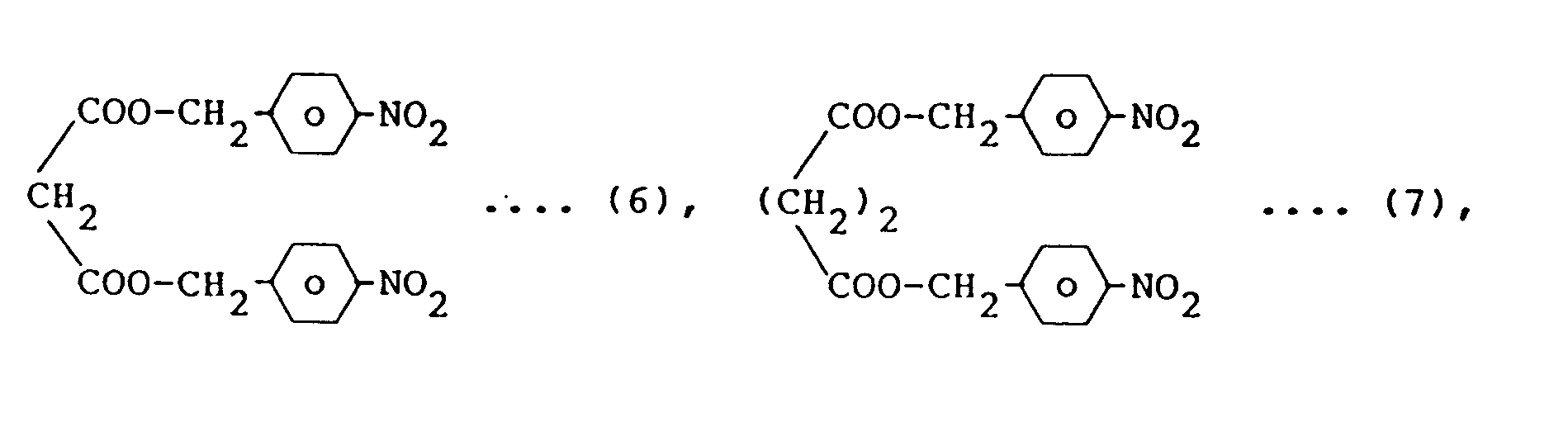
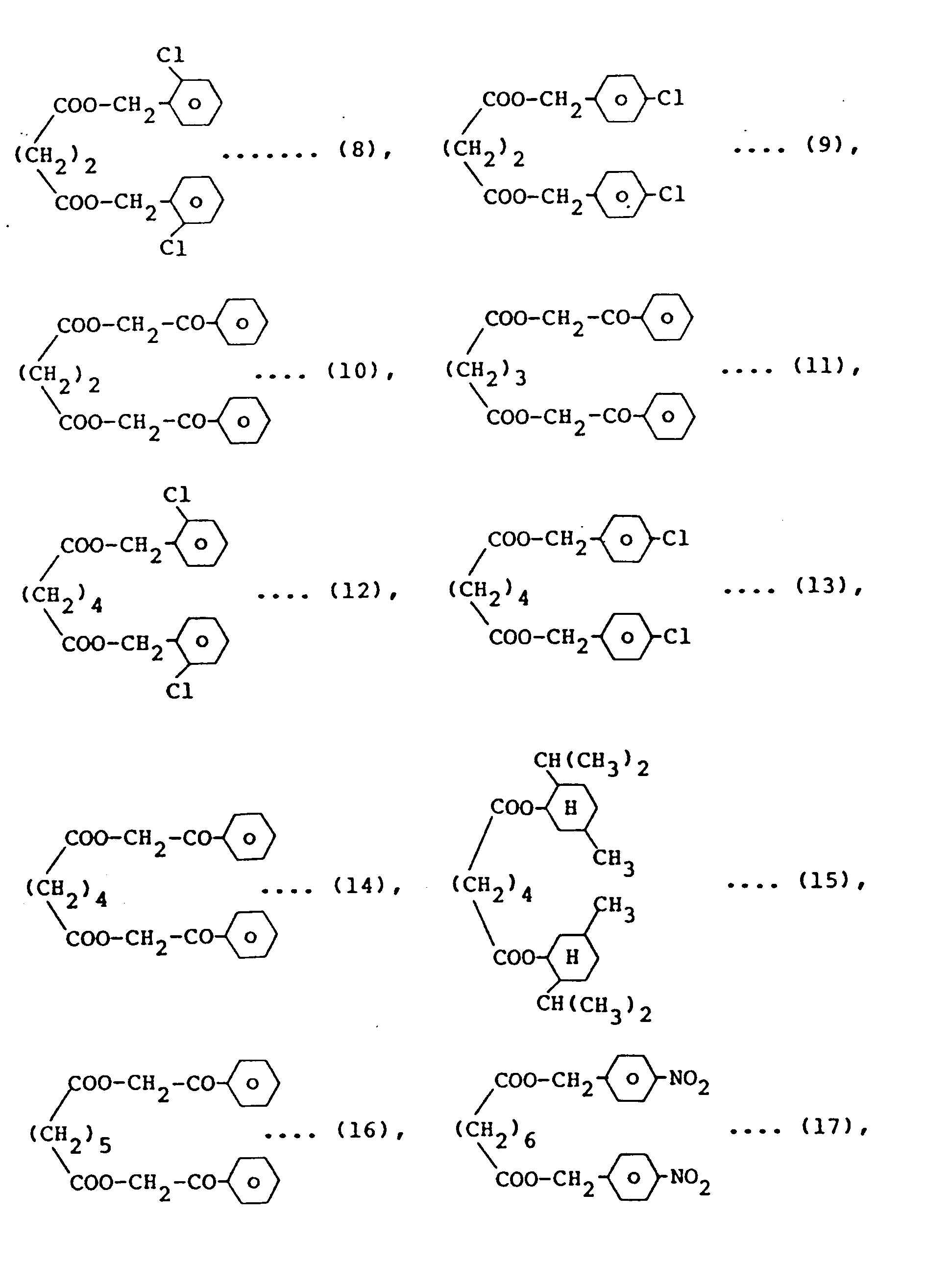
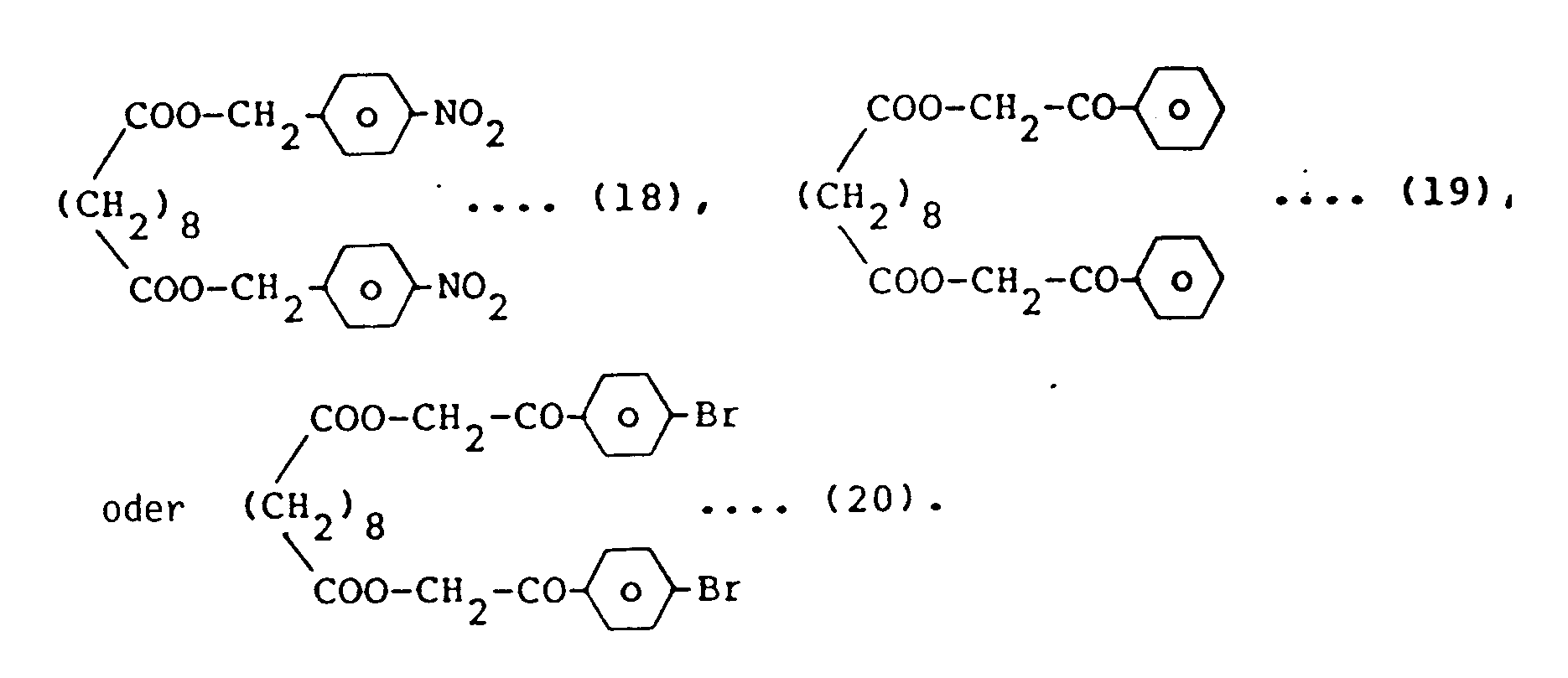
7. Wärmeempfindliches Aufzeichnungsblatt nach Anspruch 1, dadurch gekennzeichnet, daß der Sensibilisator zumindest ein durch die folgenden Strukturformeln dargestellter
aliphatischer Monocarbonsäureester ist:
8. Wärmeempfindliches Aufzeichnungsblatt nach Anspruch 1, dadurch gekennzeichnet, daß der Sensibilisator zumindest ein durch folgende Strukturformeln dargestellter
Oxalsäureester ist:
9. Wärmeempfindliches Aufzeichnungsblatt nach Anspruch 1, dadurch gekennzeichnet, daß der Sensibilisator zumindest ein durch folgende Strukturformeln dargestellter
Ester einer zweibasischen Säure ist:
10. Wärmeempfindliches Aufzeichnungsblatt nach Anspruch 1, dadurch gekennzeichnet, daß der Sensibilisator zumindest ein durch folgende Strukturformeln dargestellter
aliphatischer Monocarbonsäureester ist:
11. Wärmeempfindliches Aufzeichnungsblatt nach Anspruch 1, dadurch gekennzeichnet, daß die Menge an azider Substanz in dem Überzugsfilm 100 bis 500 Gew.-Teile pro 100
Gew.-Teile der farbbildenden Lactonverbindung beträgt.
12. Wärmeempfindliches Aufzeichnungsblatt nach Anspruch 1 bis 11, dadurch gekennzeichnet, daß die Menge des Sensibilisators in dem Überzugsfilm 1 bis 1000 Gew.-Teile pro 100
Gew.-Teile azider Substanz beträgt.
13. Wärmeempfindliches Aufzeichnungsblatt nach Anspruch 12, dadurch gekennzeichnet, daß die Menge an Sensiblisator in dem Überzugsfilm 30 bis 100 Gew.-Teile pro 100
Gew.-Teile azider Substanz beträgt.