|
(11) | EP 0 246 669 B1 |

| (12) | EUROPEAN PATENT SPECIFICATION |
|
|
| (54) |
Halopyridones Halopyridone Halopyridones |
|
|
|||||||||||||||||||||||||||||||||||
| Note: Within nine months from the publication of the mention of the grant of the European patent, any person may give notice to the European Patent Office of opposition to the European patent granted. Notice of opposition shall be filed in a written reasoned statement. It shall not be deemed to have been filed until the opposition fee has been paid. (Art. 99(1) European Patent Convention). |
[0002] An object of the present invention is to provide 3- or 4-halo-5-methyl-2-pyridones for use as intermediates in an efficient and reliable synthesis of 2-halo-5-methylpyridines. These 2-halo-5-methylpyridines may then be converted to 2-halo-5-trichloromethylpyridines by chlorinating under ultraviolet light irradiation as described in US Patent 4,152,328. The 2-halo-5-trichloromethylpyridines are important starting materials for 4-(5-halomethyl-2-pyridyloxy)phenoxy compounds such as fluazifop-butyl which are effective grass herbicides.
[0003] According to the present invention there is provided a 3- or 4-halo-2-pyridone compound of the following formula (XIII):
wherein X4 is halogen.
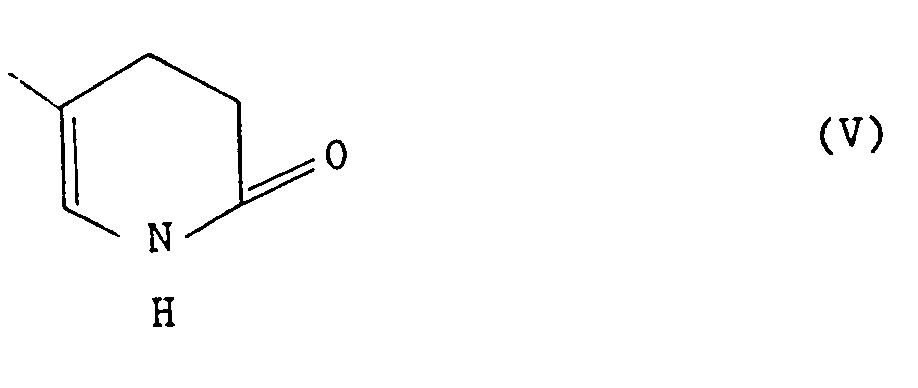
[0005] Compounds of formula (XIII) are prepared by reacting a dihydropyridone of formula (V)
with a halogenating agent such as N-chloro-or N-bromo-succinimide or 1,3-dichloro- or 1,3-dibromo-5,5-dimethyl-hydantoin which adds halogen at an allylic position or the position alpha to the carbonyl, i.e., the 3-or 4-halo-2-pyridone to yield the compound of formula (XIII). Compounds of formula (V) are prepared according to the following two-step process.
[0006] In the first step a) of the process propionaldehyde of the following formula (II) is reacted in a Michael type addition with an acrylic compound of the following formula (III):
wherein Y is a moiety of the formula -COOR, -CONH2 or -CN and R is an organic moiety, to produce a pentanoic aldehyde of the following formula (IV):
R, in particular, may be a substituted or unsubstituted alkyl or aryl group although a wide range of moieties may be used since the -OR function is removed in the following step. Thus, R may be any grouping which is stable to the Michael addition conditions used and which is removable as the -OR moiety upon nucleophilic attach by a nitrogen on the -COOR group. Particular examples of R are alkyl of about 1 to 6 carbons, e.g. methyl or ethyl, aryl of about 6 to 10 carbons or arylalkyl of about 1 to 8 carbons in the alkyl portion and about 6 to 10 carbons in the aryl portion, which aryl or aryl portion may be substituted by groups such as lower alkyl or halogen. The Michael addition may be conducted as known in the art such as at a temperature of about 0°C to 100°C, neat or in the presence of an inert solvent and optionally in the presence of a reaction catalyst such as strong base. The compound of formula (IV) may be recovered by extraction, chromatography or distillation.
[0007] Preferably, the first step of the process is conducted in three stages by the use of protection and deprotection reactions which serve to activate the propionaldehyde for the Michael addition, to minimise side reactions and to avoid the use of strong reagents and catalysts. The three stages of the first step involve i) reacting propionaldehye with a secondary amine of the formula HNR1R2, wherein R1 and R2 are independently organic moieties which may be attached to each other to form a ring, to form, directly or through an intermediate aminal the enamine of the following formula (VII):
In particular, values of R1 and R2 include individual substituted and unsubstituted alkyl of about 1 to 6 carbons such as ethyl and butyl and, when R1 and R2 are connected, substituted and unsubstituted heterocyclic rings such as 5- or 6-membered heterocyclic rings, e.g. to define the secondary amines pyrrolidine, piperidine and morpholine. The first stage i) may be conducted at about -10°C to 35°C preferably in the presence of an alkali or alkaline earth metal carbonate, sulfate, halide or oxide, e.g. calcium sulfate, magnesium sulfate, calcium chloride, sodium sulfate, magnesium oxide, potassium carbonate, calcium oxide or even molecular sieves, as disclosed by D. Roelofsen et al. in Recueil, Vol. 91, pages 605-610 (1972), with at least two moles of HNRlR2 per mole of propionaldehyde. The secondary amine is used in excess in view of the intermediate formation of an aminal of the formula CH3CH2CH-(NR1R2)2 which is then heated to form the enamine of formula (VII) and distil off the excess HNRlR2 which is released with formation of the double bond. Thus the aminal may be heated to about 75°C to 100°C at a vacuum of about 40 to 100 mm of Hg. According to this aspect of the present invention, the enamine of formula (VII) and the secondary amine HNRlR2 are conformed from the aminal and preferably, the HNRlR2 will be separated from the enamine at this point by fractional distillation. If the secondary amine has a boiling point close to the enamine, e.g. if the secondary amine is morpholine, the distillation should be monitored to avoid codistillation of the two products and/or an incomplete reaction of the aminal. If the aminal is obtained in whole or in part at this point, such may be taken on to the cyclobutane of formula (VIII) as described below. This monitoring can be carried out by gas liquid chromatography and % nitrogen by elenental analysis. Disclosures of such enamine formations include C. Mannich and H. Davidsen in Ber., vol. 69, pages 2106-2112 (1936); G. Optiz et al. in Ann., Vol. 623, pages 112-117 (1959); P. deBenneville et al in J. American Chemical Society, Vol. 72, pages 3073-3075 (1950); R. Dulou et al. in Bull. Chem. Soc. France, pages 967-971 (1960); G. Kalaus in Ber., Vol. 114, pages 1476-1483 (1981); and U.S. Patent 3,074,940 to E. Benzing.
[0008] In the second stage ii) the enamine of formula (VII) is reacted with the acrylic compound of formula (III) to yield the compound of the following formula (VIII):
wherein Y, R1 and R2 are as defined above for formulae (III) and (VII). The compound of formula (VIII) may exist to a limited extent in the form of the open chain enamine of the structure (R1R2N)HC=CHCH3(CH2)2Y. The synthesis of cyclobutanes of the formula (VIII) type is described in detail by I. Fleming et al, in the Journals of the Chemical Society, pages 2165-2174 (1964) and in U.S. Patents 3,051,622; 3,133,924; 3,369,024; 3,481,936; and 3,481,939. The reaction may be carried out neat or in the presence of a nitrile, ether, ester, halogenated alkane or ketone solvent, e.g., acetonitrile, although a neat reaction is preferred in view of simplicity. The reaction may be carried out at room temperature up to the boiling point of the acrylic compound of formula (III), e.g., up to about 170°C, with the higher temperatures of this range being advantageously used to complete the reaction. The enamine of formula (VII) may be cooled to about -5 to 20°C with dropwise addition of the acrylic compound of formula (III) followed by warming to the range of room temperature to about the boiling point of the acrylic compound.
[0009] The third stage iii) process is the hydrolysis of the compound of formula (VIII) to the aldehyde of formula (IV) with recovery of one mole of the secondary amine HNR1R2. The reaction may be conducted in an aqueous acidic medium such as in the presence of an aqueous organic or mineral acid, such as acetic, sulfuric, hydrochloric, phosphoric or toluene sulfonic acids, optionally with a solvent such as those listed for the second stage ii) of the first step, at a temperature of about 25 ° C to 105°C at a pH of about 1.5 to 4.5. The solvent for this reaction may advantageously be that used in stage ii) whereby the product of stage ii) need not be purified but rather may be simply carried forward in its crude state with solvent. However, a solvent other than the aqueous acidic reaction medium need not be present. The aldehyde of formula (IV) may be recovered by extraction of the aqueous acid solution containing HNRlR2 with a neutral organic solvent such as ethyl acetate or methylene chloride. Alternatively, the third stage hydrolysis iii) may be conducted under basic conditions and in the event of saponification of the ester, the acid is formed, i.e., the compound of formula (IV) wherein Y is -COOR and R is hydrogen, and such may be cyclized to the dihydropyridone of formula (V) as explained below. A disclosure of reactions leading to (IV) wherein Y is -COOCH3 was made by W. Pirkle et al. in the Journal of Organic Chemistry, Vol. 40, pages 1617-1620 (1975) with similar reactions being described by G. Stork in the Journal of the American Chemical Society, Vol. 85, pages 207-221 (1963). The reaction of acrylonitrile i.e., compound (III) where Y=CN, with the pyrrolidine enamine of n-heptaldehyde is described by Ross C. Terrell, Ph.D. Thesis Columbia University (1955) as yielding a-cyanoethyl-n-heptaldehyde and compound (IV) where Y=CN may be produced in a similar manner.
[0010] In the second step b) of the process of the invention when Y=COOR, the aldehyde of formula (IV) is reacted with an amine or ammonium salt to form the dihydropyridone of formula (V). The cyclization in step b) may be carried out with a nitrogen source such as amine or ammonium salt, with specific examples being ammonium carbamate, ammonium carbonate, ammonium hydroxide, ammonia, ammonium bicarbonate, ammonium acetate or ammonium orthophosphate. In general, an ammonium salt of a weak acid such as phosphoric, carbonic or acetic acid is preferred. The reaction may be carried out neat or in a solvent, e.g., a high boiling solvent, for one or both reactants such as a carboxylic acid, e.g., acetic acid, an alkanol which use is less preferred, e.g., ethanol, an aromatic hydrocarbon compound, e.g., benzene or toluene, a halogenated aromatic hydrocarbon, e.g., a mono-, di-or tri-chlorobenzene, or a ketone, e.g., methyl ethyl ketone, methyl isobutyl ketone and disobutyl ketone. The temperature of the cyclization reaction will vary depending on the particular nitrogen source used and the solvent but is, in general, from about room temperature up to the boiling point of any solvent or reactant utilised, e.g., from about 25°C to 150°C.
[0011] In the second step b) of the process of the invention when Y = CONH2 the aldehyde of Formula (IV) is thermally cyclized at a temperature of about 100 to 200 °C neat or in a high boiling solvent such as aromatic hydrocarbon compound, e.g., benzene, xylene or acrylamide, or a halogenated aromatic hydrocarbon, e.g., a mono-, di-or tri-chlorobenzene and the pyridone of formula (V) may be recovered by standard techniques such as distillation or extraction.
[0012] In the second step b) when Y=CN, the aldehyde (IV) is converted to the pyridone (V) by acid catalysis, e.g., with hydrogen halide such as HCI, sulfuric acid, phosphoric acid or a sulfonic acid at a temperature of room temperature to about 100°C neat or in a solvent such as a halogenated hydrocarbon. Such reaction conditions are described by N.P. Susherina et al. in Chemical Abstracts, Vol., 55 7410e, by A.I. Meyers in J. Organic Chemistry, Vol. 29, pages 1435-1438 (1964) and in German Offenlegundschrift 2,245,097 (March 21, 1974).
The cyclization step b) may be conducted in two stages by iv) dimerizing the aldehyde of formula (IV) where Y = COOR by reaction with excess ammonia or other nitrogen source to yield the pyridone adduct of the following formula (X):
followed by v) pyrolyzing the compound of formula (X) with loss of NH3 at a temperature of about 200 °C to 300 ° C to yield the dihydro-pyridine of the formula (V).
Claims for the following Contracting State(s) : BE, CH, DE, FR, GB, IT, LI, NL, SE
1. A 3- or 4-halo-2-pyridone compound of the following formula (XIII):
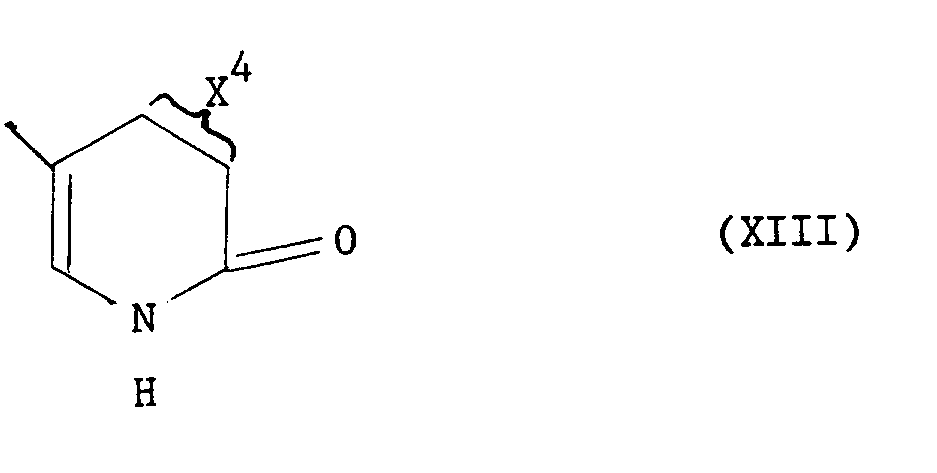
wherein X4 is halogen.
wherein X4 is halogen.
2. The pyridone compound of claim 1, wherein X4 is bromine or chlorine.
3. A process for the preparation of the compound of claim 1 or 2 which comprises reacting
a dihydropyridone of formula (V):
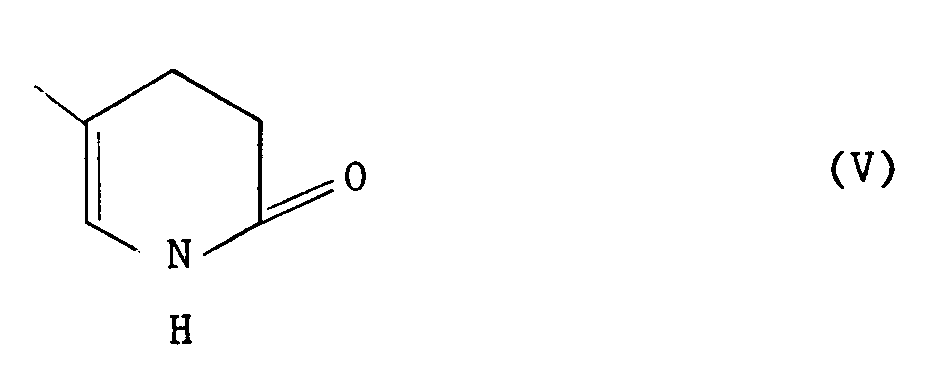
with a halogenating agent.
with a halogenating agent.
Claims for the following Contracting State(s) : AT
1. A process for the preparation of a 3- or 4-halo-2-pyridone compound of the following
formula (XIII):
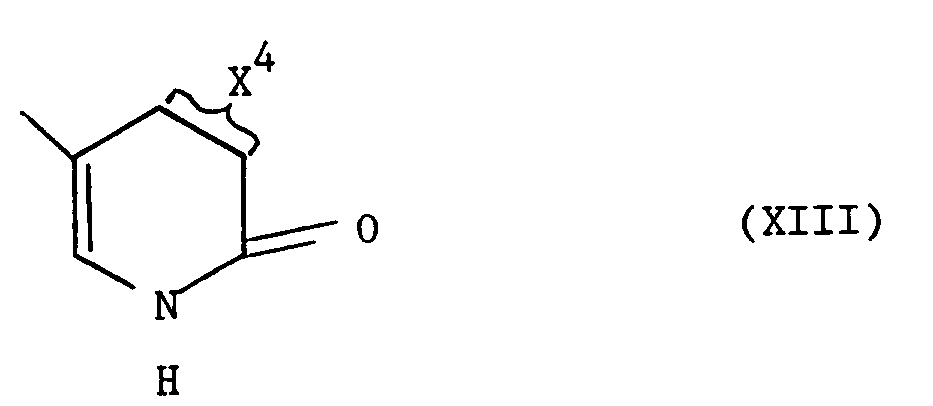
wherein X4 is halogen which comprises reacting a dihydropyridone of formula (V):
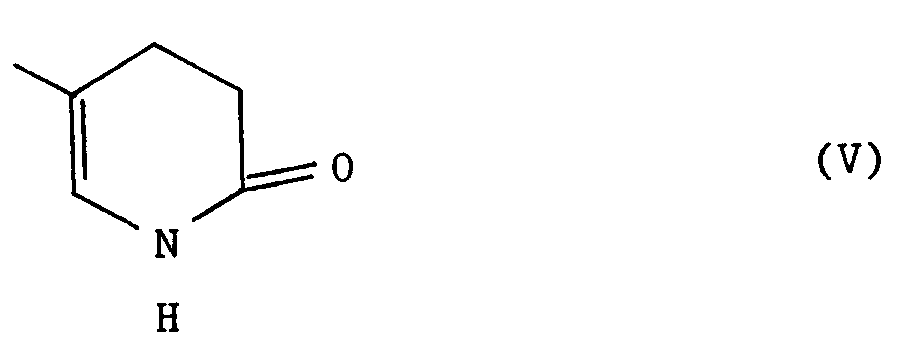
with a halogenating agent.
wherein X4 is halogen which comprises reacting a dihydropyridone of formula (V):
with a halogenating agent.
2. A process according to claim 1 wherein X4 is bromine or chlorine.
Patentansprüche für folgende(n) Vertragsstaat(en) : BE, CH, DE, FR, GB, IT, LI, NL,
SE
1. 3- oder 4-Halogeno-2-pyridon-Verbindungen der Formel (XIII),
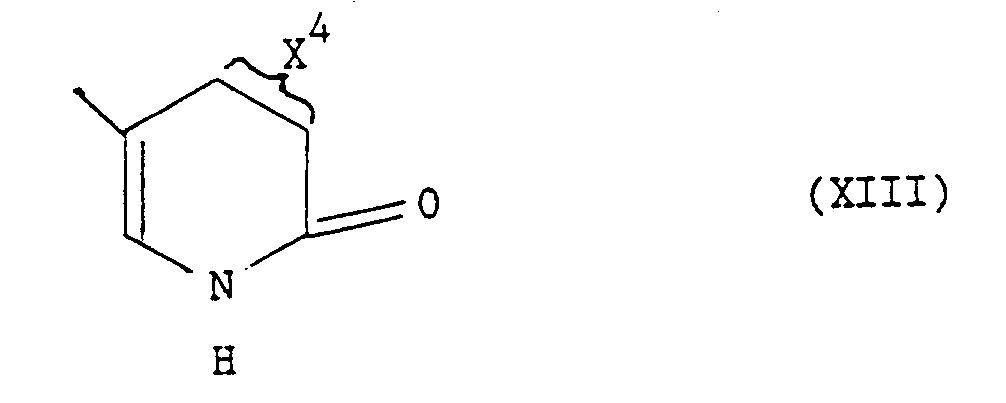
worin X4 für Halogen steht.
worin X4 für Halogen steht.
2. Pyridonverbindungen nach Anspruch 1, worin X4 für Brom oder Chlor steht.
3. Verfahren zur Herstellung der Verbindungen von Anspruch 1 oder 2, bei welchem ein
Dihydropyridon der Formel (V)
mit einem Halogenierungsmittel umgesetzt wird.
Patentansprüche für folgende(n) Vertragsstaat(en) : AT
1. Verfahren zur Herstellung von 3- oder 4-Halogeno-2-pyridon-Verbindungen der Formel
(XIII),
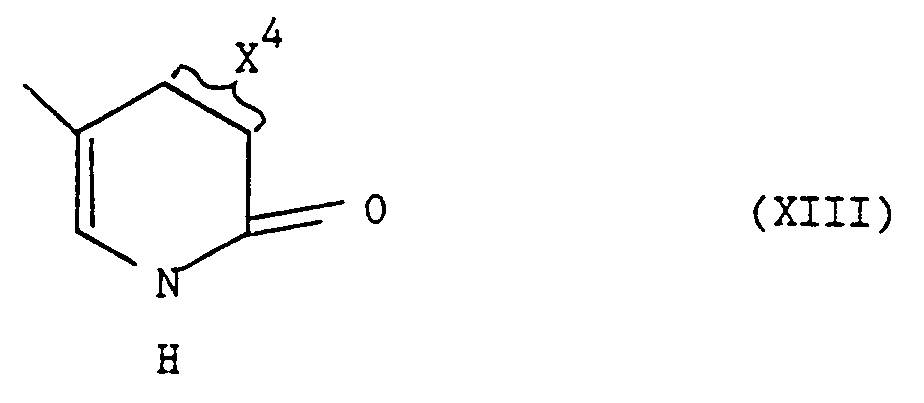
worin X4 für Halogen steht, bei welchem ein Dihydropyridon der Formel (V)
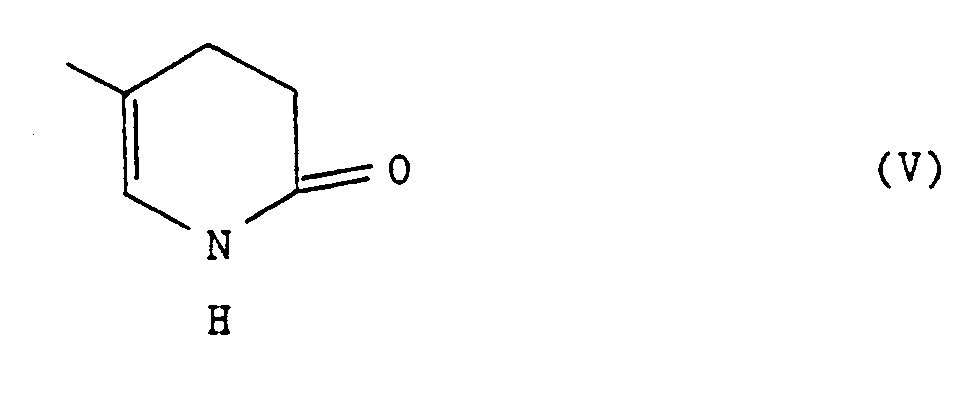
mit einem Halogenierungsmittel umgesetzt wird.
worin X4 für Halogen steht, bei welchem ein Dihydropyridon der Formel (V)
mit einem Halogenierungsmittel umgesetzt wird.
2. Verfahren nach Anspruch 1, bei welchem X4 für Brom oder Chlor steht.
Revendications pour l'(les) Etat(s) contractant(s) suivant(s) : BE, CH, DE, FR, GB,
IT, LI, NL, SE
1. 3-halogéno- ou 4-halogéno-2-pyridone de formule (XIII) suivante :
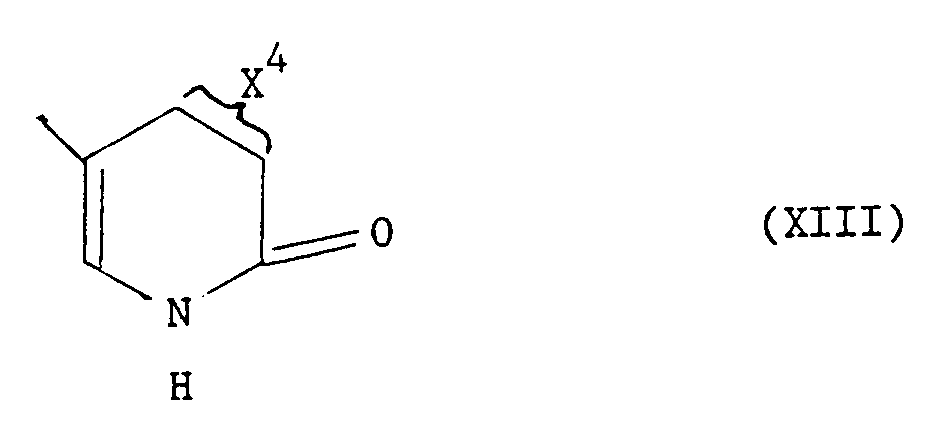
dans laquelle X4 est un halogène.
dans laquelle X4 est un halogène.
2. Composé de pyridone suivant la revendication 1, dans lequel X4 est le brome ou le chlore.
3. Procédé de production du composé suivant la revendication 1 ou 2, qui comprend
la réaction d'une dihydropyridone de formule (V) :
avec un agent d'halogénation.
avec un agent d'halogénation.
Revendications pour l'(les) Etat(s) contractant(s) suivant(s) : AT
1. Procédé de production d'une 3- ou 4-halogéno-2-pyridone de formule (XIII) suivante
:
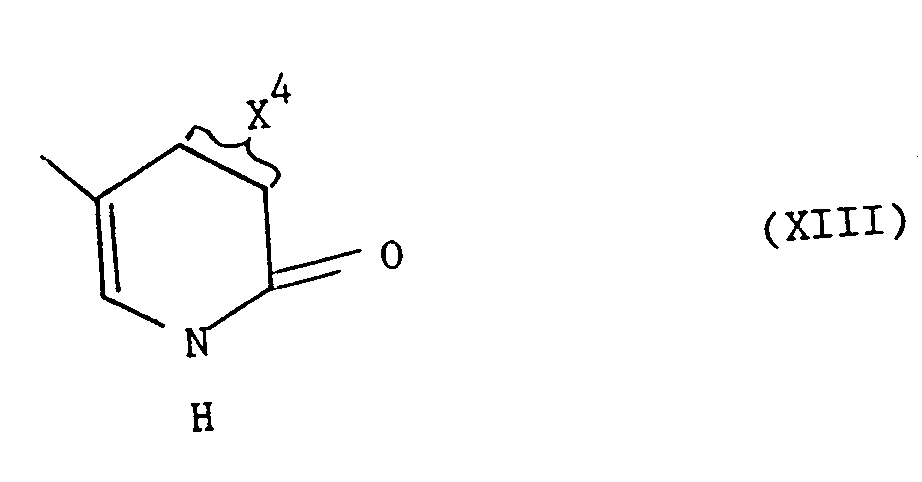
dans laquelle X4 est un halogène, qui comprend la réaction d'une dihydropyridone de formule (V) :
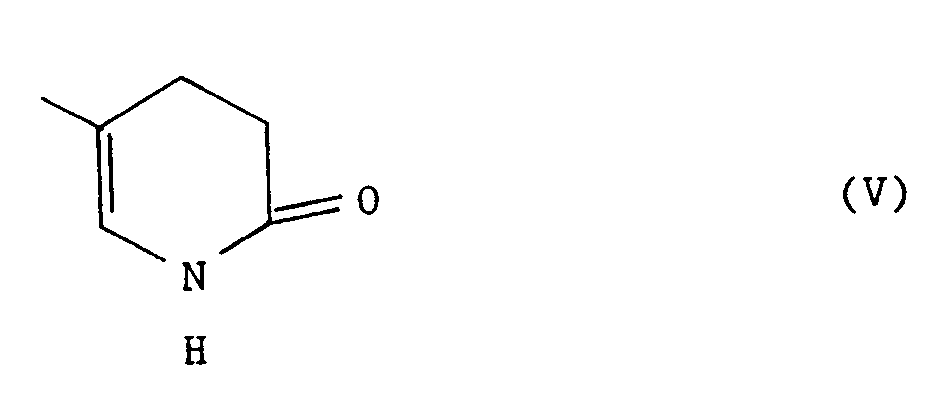
avec un agent d'halogénation.
dans laquelle X4 est un halogène, qui comprend la réaction d'une dihydropyridone de formule (V) :
avec un agent d'halogénation.
2. Procédé suivant la revendication 1, dans lequel X4 est le brome ou le chlore.