| (19) |
 |
|
(11) |
EP 0 247 050 B1 |
| (12) |
EUROPEAN PATENT SPECIFICATION |
| (45) |
Mention of the grant of the patent: |
|
21.03.1990 Bulletin 1990/12 |
| (22) |
Date of filing: 03.03.1986 |
|
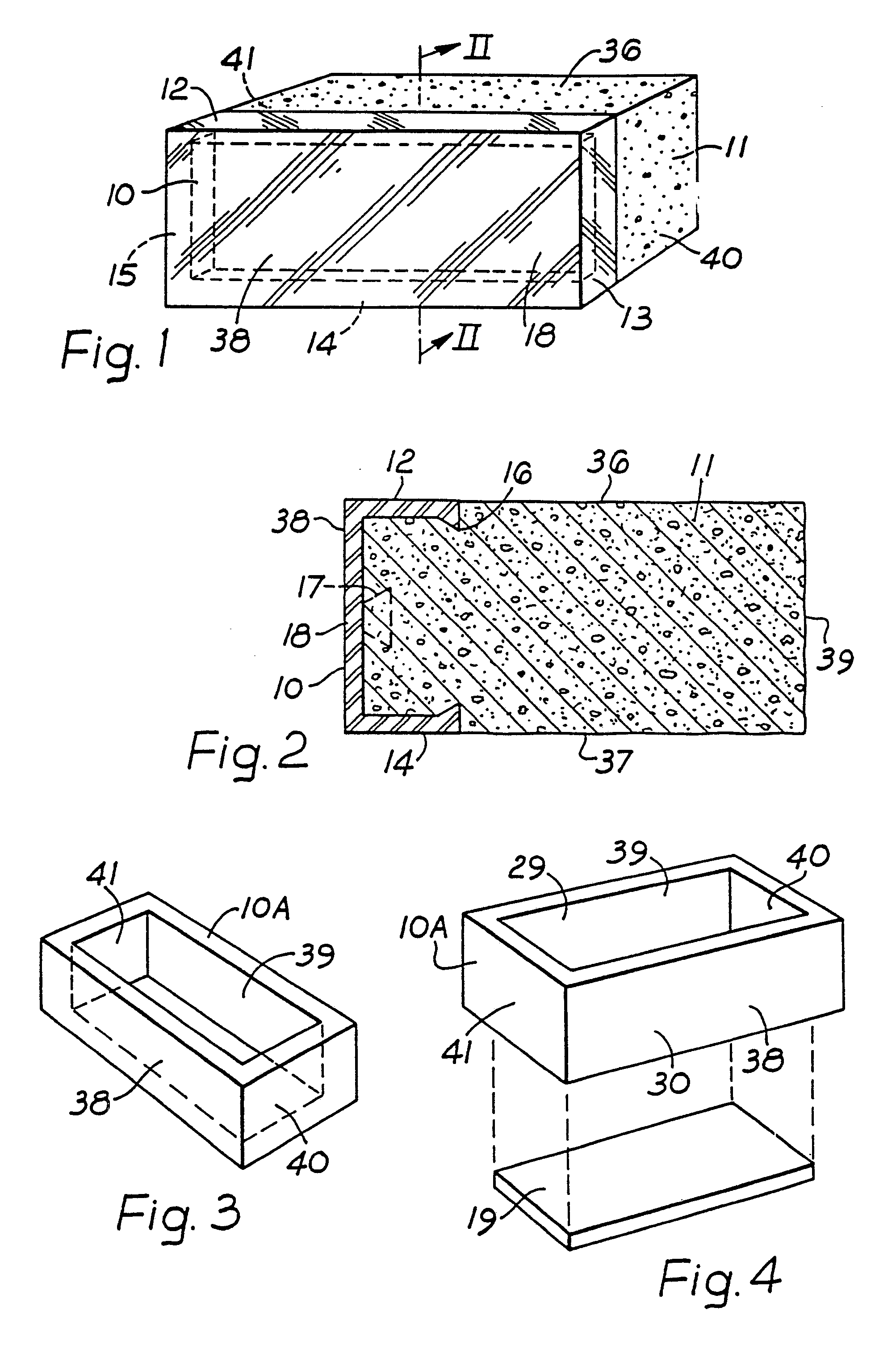
| (51) |
International Patent Classification (IPC)5: E04C 1/40 |
| (86) |
International application number: |
|
PCT/GB8600/113 |
| (87) |
International publication number: |
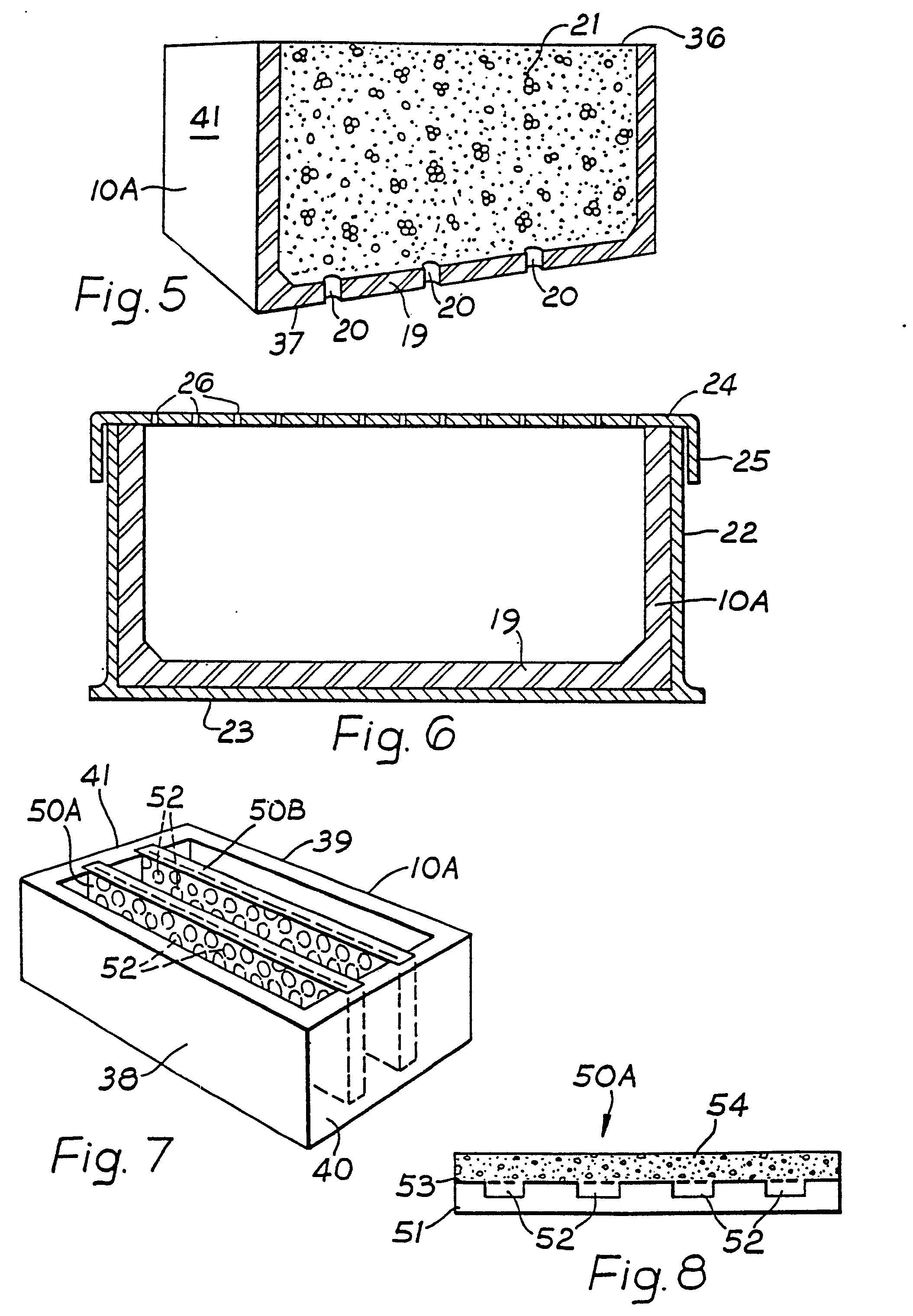
|
WO 8605/226 (12.09.1986 Gazette 1986/20) |
|
| (54) |
COMPOSITE BUILDING UNIT
KOMPOSITBAUEINHEIT
ELEMENT COMPOSITE DE CONSTRUCTION
|
| (84) |
Designated Contracting States: |
|
AT BE CH DE FR GB IT LI LU NL SE |
| (30) |
Priority: |
04.03.1985 GB 8505432
|
| (43) |
Date of publication of application: |
|
02.12.1987 Bulletin 1987/49 |
| (73) |
Proprietor: LEEKAM, Charles, Oliver |
|
Hampstead, London NW3 (GB) |
|
| (72) |
Inventor: |
|
- LEEKAM, Charles, Oliver
Hampstead, London NW3 (GB)
|
| (74) |
Representative: Dearing-Lambert, Peter Richard |
|
DEARING LAMBERT & CO.
P.O. Box 8
109 High Street
Ibstock
Leicestershire LE6 1LJ
Ibstock
Leicestershire LE6 1LJ (GB) |
| (56) |
References cited: :
BE-A- 532 740
FR-A- 535 948
FR-A- 1 524 275
|
CH-A- 496 529
FR-A- 776 695
US-A- 3 905 170
|
|
| |
|
|
|
|
| |
|
| Note: Within nine months from the publication of the mention of the grant of the European
patent, any person may give notice to the European Patent Office of opposition to
the European patent
granted. Notice of opposition shall be filed in a written reasoned statement. It shall
not be deemed to
have been filed until the opposition fee has been paid. (Art. 99(1) European Patent
Convention).
|
[0001] This invention relates to a polyhedral, composite building unit comprising an integrally
formed first component of ceramic or vitreous material or natural or synthetic stone
at least one face of which will be exposed on one side of a wall in which the unit
is incorporated, in use, and a second component comprising cementitious material,
cemented to the first component and having better therms lly insulative properties
than the first component.
[0002] Architects and builders are nowadays confronted with increasing problems. Their customers
are on the one hand conservative in their taste, having a preference for walls made
from traditional materials such as brick or stone but on the other hand overridingly
cost conscious. Additionally, different countries apply progressively more stringent
building regulations both to ensure safety and, with an increasing awareness of the
need for energy conservation especially in the colder climates of the more industrially
advanced countries, the inhibition of heat transmittance across external walls of
a building primarily to avoid heat loss from building interiors.
[0003] A common way to achieve heat insulation is cavity wall construction. In the case
of an external wall of porous material, such as relatively low- grade, common brick
the cavity serves the additional and more important purpose of preventing water ingress.
When the external brick wall becomes saturated the cavity acts as a vapour barrier.
Thus to a certain extent measures which are adopted to increase heat insulation after
a building has been constructed, such as filling the cavity with a settable, heat
insulating foam, can be counter-productive. These measures have in any event come
into disrepute. Poisonous or noxious emission into the building interior can occur
when certain foams are used.
[0004] On occasions the interior surface of an external wall must have a 'fair facing',
i. e. must be more aesthetically acceptable than, e. g. exposed brieze block or concrete.
A cavity wall consisting of two leaves or skins of brick without plaster or other
lining would present a fair-faced interior. A brick interior is often specified by
the client, but the standard 105 mm brick used to build two walls with a 50 mm cavity
or spacing would not comply with e. g. British building regulations, which require
a heat transmittance value across the wall (hereinafter referred to as the "µ value')
of less than 0.6 w/m
2 deg. C. This value could be achieved by additional measures, such as building with
one of the walls a heat insulating or reflective layer adjacent one of the inwardly
presented faces of the two brick walls, but any such measures wou'd be highly labour
intensive and therefore prohibitively expensive. The after- native of providing either
or both of the outwardly presented faces of the two brick walls with a suitable layer
would also be expensive and, more to the point, would destroy the intended aesthetic
effect.
[0005] The internal leaf or skin of a cavity wall is more commonly provided by building
it not out of brick but by laying brieze blocks or blocks of thermally insulating
concrete. These are cheap to produce and blocks of substantial thickness can be used
because the material is relatively light in weight. The required J1 value is easily
achieved, but such inner walls certainly are not aesthetically acceptable, so that
subsequent rendering or plastering or some other form of lining is in almost all cases
essential. Alternatively a cavity wall which will have the required J1 value may be
constructed with an inner leaf or skin consisting of a timber frame supporting a thermal
insulation material, say 100 mm thick. This however will require a finish or lining
of plasterboard.
[0006] To achieve the required µ value it is not essential to provide a cavity at all. A
single-leaf wall constructed from 150 mm blocks of thermally insulating concrete lined
internally e. g. with vermiculite plaster or a dry lining could comply with building
regulations but it is rarely used in the construction of habitable dwellings in cool
climates. It would require a weather- and waterproof external render. The application
of such a render would involve high labour costs and the finished building, having
an unfamiliar appearance, would not on the whole be acceptable to conservative customers
and planning authorities.
[0007] It will be seen, therefore, that when the customer specifies a brick interior additional
measures have to be adopted to comply with building regulations. Either an insulating
layer e. g. of fibrous material must be built up in the cavity adjacent the inner
brick leaf or skin or the thickness of the inner brick leaf or skin must be "artificially"
increased, e. g. by building a layer of 50 mm brick bats adjacent the inner brick
skin (leaving, of course, a cavity of about 50 mm between the brick bat wall and the
outer brick skin). Both of these measures are highly labour intensive and moreover
the latter, at least, requires brick laying skills of a high order, leading to greatly
increased costs.
[0008] It is known that, as opposed to the "fixed" nature of brick clay, stone, glass or
other °fair facing
* materials, cementitious materials can be given a wide range of desired characteristics
simply by altering the mixture or providing suitable inclusions. A hollow, load-bearing
concrete structure can be filled with a (weaker) concrete mixture with better heat
insulating characteristics, as exemplified in British Patent Specifications Nos. 1
252 562 and 1 525 238 which also suggest that cavities may be left open (in the latter
event resembling so-called "air bricks', which are bricks formed with through-openings
to provide ventilation when included with solid bricks in a wall).
[0009] French Patent Specification No. 1 524 275 states that it is known to produce cement
blocks pre-faced with stone, using the stone slabs as a slip base for casting the
cement blocks. This Patent Specification proposes the improvement of utilising special
metal ties to reinforce the connection between the concrete blocks and facing slabs
of stone. Individual stone slabs to face individual faces of the block have recesses
formed in them to accept opposite ends of a metal tie which extends outwardly from
the rear of the slab. When concrete is poured into a mould lined with the slabs, their
ties projecting into interior of the mould, the ties become embedded in the concrete.
In this way a concrete block is provided which 'gives an outward appearance of dressed
ashlar" since it is "clad on all visible faces with thin stone slabs." How stone slabs
can be connected to sides of the concrete block at right- angles to one another is
not explained, but in any event there is no suggestion that such slabs are mutually
connected and clearly they would not form an integral external structure.
[0010] U.S Patent Specification No. 3 905 170 discloses light-weight composite slabs with
tongue-and-grooved edges for the prefabrication of buildings, an improvement upon
heavier concrete slabs. These cementitious slabs may be lined on external surfaces
with brick veneer plates to imitate a brick wall, but no method of bonding the plates
to the cementitious base is disclosed other than by cementitious bonding as in the
case of tiles applied to a plaster wall.
[0011] Belgian Patent Specification No. 532 740 discloses the manufacture of a "monolithic
block". A thermally insulative core is moulded between harder and less porous outer
layers, which may fully surround the core. Optionally ceramic facings may be attached
to the outer layers, but again no special means is described for so doing.
[0012] None of the foregoing prior art proposals is concerned with the provision of a composite
unit which can be used as a substitute for a brick in conventional brick-laying techniques.
Each is concerned either with the provision of a block or, in the case of the U.S.
Specification, with the provision of a prefabricated wall unit of much greater area
than the cross-sectional area of a brick. The difference between a block (e. g. of
sintered material or concrete) and a brick (e. g of fired clay, natural or synthetic
stone or glass) is well recognised in the art - see for example the 1972 Edition of
Alan Everett's "Mitchells Building Construction" at pages 114 and 130. Moreover, in
none of the prior art above discussed is any means suggested whereby a "fair facing"
material can be attached to a thermally insulative body other than simply by cementing.
[0013] The invention as claimed is designed to overcome the problems of previous proposals.
Firstly an integral unit is provided having the shape and dimensions of a standard
brick and adapted for use in conventional brick-laying techniques. This avoids the
resistance of the consumer to the adoption of wholly new building techniques and permits
the provision of a traditional-looking brick- laid wall without, however, the problems
inherent in the latter as above discussed. Secondly, the fair-facing and the thermally
insulative components of the unit of the invention are mechanically coupled, so that
reliance is not placed wholly on a cementitious bond between flat surfaces, but at
the same time metal ties or other extraneous devices are dispensed with. Preferred
embodiments of the invention will now be described by way of example with reference
to the accompanying diagrammatic drawings, in which:
Figure 1 is an isometric view of a composite building unit in accordance with the
invention,
Figure 2 is a cross-sectional elevation taken on the line II - II of Figure 1,
Figure 3 is an isometric view of the enclosure component (only) of an alternative
unit in accordance with the invention,
Figure 4 illustrates an optional additional step in the construction of the enclosure
component of Figure 3,
Figure 5 is a sectional elevation of a completed unit having the enclosure component
of Figure 4,
Figure 6 is a sectional elevation showing the component of Figure 4 positioned in
a mould,
Figure 7 diagrammatically illustrates the use of thermal barriers in an enclosure
component similar to that of Figure 3, and
Figure 8 is a sectional elevation, on a larger scale, of one of the thermal barriers
of Figure 7.
[0014] As shown in Figures 1 and 2 a composite unit is provided which has the overall shape
and dimensions of a conventional house brick and which may be used in the same way
in the construction of a wall, i. e. it may be laid with other, similar units, with
or without the interposition of mortar, according to established brick-laying techniques.
[0015] Unlike a conventional house brick, however, the unit does not consist entirely of
clay. Similarly, unlike a conventional concrete block it does not consist entirely
of concrete. By contrast it is made up of two components: (a) a box-like enclosure
the base 18 of which constitutes one of the longer sides 38 of the unit and (b) a
body 11 of cementitious material contained by and hydraulically and mechanically bonded
to the enclosures 10.
[0016] The principal purpose of the enclosure 10 is to give to the unit, when included in
a wall, the appearance of a traditional building material and for this reason it is
prefabricated from a ceramic material, such as fired clay, from a vitreous material,
such as glass, or from natural or synthetic stone. The box-like shape can be achieved
by building the enclosure 10 from separate pieces e. g. of stone or fired clay or
by moulding wet clay, heat softened glass or a synthetic stone mixture to the shape
illustrated prior to firing, hardening or setting.
[0017] However it is prefabricated the enclosure 10 preferably has inwardly directed lips
or flanges 16 at the free end edges of its four "walls" such as 12 and 14. For additional
anchorage to the cementitious body 11 additional flanges, ribs or protrusions such
as indicated in phantom lines at 17 in Figure 2 may be formed or provided on inner
surfaces of the enclosure component 10.
[0018] After its prefabrication the component 10 is placed in a mould (not shown in Figures
1 and 2) the internal shape of which is the intended external shape of the finished
unit. A cementitious mixture together with a measured quantity of water is introduced
into the mould so as to form the body 11, which will be hydraulically and mechanically
bonded (cemented) to the internal surfaces of the enclosure 10, providing an integral
unit 10, 11 at least one face 18 of which is of a 'fair facing" material.
[0019] To provide the unit thus formed with better heat insulating characteristics than
a unitary body of the same material as the enclosure component 10 the cementitious
mixture of the body 11 has suitable inclusions such as expanded polystyrene granules,
expanded clay, fibreglass, exfoliated vermiculite and/or expanded perlite. Known technology
for the production of aerated concrete may be exploited to ensure that, in addition
to strength-imparting aggregates, the cementitious material contains air- or gas-filled
voids to provide improved thermal insulation. For example 0.2 % by weight of aluminium
powder may be included in the mixture. This will react with alkaline substances in
the mixture to produce hydrogen bubbles before the mixture hardens.
[0020] Thus a unit is provided with has load-bearing top 36 and bottom 37 surfaces, "facer"
sides 38 and 39 and 'header' ends 40 and 41. By suitably filling the mould with the
cementitious material the external surfaces of the "sides" of the 'box' 10 are flush
with the exposed surfaces of the body 11 to give a regular, rectangular contour.
[0021] It will be apparent that alternative units may be constructed for use as 'headers'
in which the box-like enclosure 10 contains not one side but one end, such as 40 or
41, of the body 11. The brick layer ensures that in the construction of a wall all
the units are positioned with the fair facing' side or end, such as 18, presented
outwardly in the same direction.
[0022] An alternative unit constructed using an enclosure 10 A such as illustrated in Figures
3 - 7 does not require the brick-layer to exercise any thought as to which way round
to place the unit, and the unit can equally be used either as a "facer" or as a 'header'.
Figure 3 illustrates an annular enclosure 10 A made by moulding or e. g. by bending
a strip of wet clay about three transverse lines and then joining the ends. Optionally,
and as illustrated in Figures 4, 5 and 6 the enclosure component 10A is given a base
19 of the same material. If made of clay the constructed component 10 A may be fired
in a kiln before being filled with a cementitious core 21 as shown in Figure 5. This
Figure also shows that weep-holes 20 may be provided in the base 19 for the escape
of surplus moisture from the cementitious core 21.
[0023] The choice of materials for the enclosure 10 A, with or without a base 19, and for
the cementitious core 21, is as indicated in connection with the embodiment of Figures
1 and 2. Preferably, and as shown in Figure 6, the prefabricated and hardened enclosure
component 10 A is placed in a cast-iron mould 23 before the introduction of the cementitious
mixture. In the case of clay for the component 10 A it may be fired while in the mould
23, the mould being covered by a removable lid 24 having perforations 26. The mould
23 may serve the secondary purpose of supporting the component 10 A while a cementitious
core 21 is formed therein. This will be particularly advantageous if, for example,
polystyrene granules or other thermal insulation inclusions are introduced under pressure
into the cementitious mixture before it has hardened and before it bonded to the enclosure
10 A or if it is desired to impart vibration to the unit during the introduction of
the cementitious mixture, e. g. to impart improved load-bearing properties to the
core 21.
[0024] Although in Figure 5 the core 21 is shown as a homogeneous body it may alternatively
be constructed from mutually bonded, adjacent layers all of cementitious material
but differing in their load-bearing and thermal insulation characteristics. Thus certain
layers may provide the unit with the requisite load-bearing strength, being of a dense,
high-aggregate mixture while one or more other layers may be reticulated or consist
of a high proportion of air- or gas-filled voids.
[0025] Where layers provided for their thermal insulation characteristics span the length
of the core 21 between the end walls 40 and 41 of the unit, or alternatively the width
of the core 21 between the sidewalls 38 and 39 of the unit, it is desirable that they
should be generally parallel to the side, or to the ends, of the unit, i. e. that
any thermally insulating layer should be perpendicular to the direction in which the
unit will face outward of a wall, in use.
[0026] Individual layers may be prefabricated separately, e. g. by moulding, before introduction
into the enclosure 10 A or aftematively the interior of the enclosure 10 A may be
sub-divided by removable partition means (not shown) and the cementitious mixtures
introduced on opposite sides of the partitions. The removable partition means may
be physically removable before the wetted cementitious mixtures have hardened, allowing
them to bond together, or degradable or porous membrane partition means may be used
which, while serving to separate the dry mixtures when introduced so as generally
to preserve the shape of the layers, will not prevent the wetted mixtures from bonding
together.
[0027] Figures 7 and 8 illustrate a further modification of the unit in accordance with
the invention in which prefabricated thermal barrier elements 50 A and 50 B are positioned
in the enclosure 10 A, and their end edges fixed to the end walls 40 and 41 of the
enclosure 10 A, before cementitious material is introduced on opposite sides of each
barrier element 50 A and 50 B. As shown in Figure 8 each barrier element such as 50
A may itself be of cementitious material. A base member 51 is made, for example by
moulding, from an aerated cementitious mixture so as to have recesses 52 distributed
throughout one face. Subsequently a membrane 53 is laid over this face and covered
by another cementitious layer 54 so as to form a barrier element 50 A a high proportion
of the interior of which is made up of voids because the membrane 52 has prevented
the added layer 54 filling the recesses 52.
[0028] Subsequent to prefabricating the enclosure 10 A and the barrier elements 50 A and
50 B, e. g. in separate moulds, the barrier elements 50 A and 50 B are inserted into
the enclosure component 10 A so that their opposite edges bond to the end walls 40
and 41. Of course if both components 10 A and 50 A or 50 B are dry at this stage it
may be necessary to use additional cement. Subsequent to the positioning of the barrier
elements 50 A and 50 B in the enclosure 10 A cementitious material is introduced on
opposite sides of each barrier element 50 A and 50 B, as in the previous examples,
to bond both to the barrier elements and to the interior surfaces of the enclosure
10 A.
[0029] In a mass production process the two barrier elements 50 A and 50 B would differ
in the disposition along their lengths and/or breadths of the voids 52 therein so
that, in a direction perpendicular to the sides 38 and 39 of the unit, no two voids
of the respective barrier elements 50 A and 50 B would be in alignment.
[0030] Both the enclosure 10 A and the barrier elements 50 A and 50 B may be made of glass,
e. g. by moulding, in which case the barrier elements 50 A and 50 B may be inserted
in the enclosure 10 A while the glass is still hot so that the end edges of the barriers
will fuse to the enclosure. After allowing the assembly to cool it is filled with
a cementitous mixture, and in this case the mixture(s) may include suitable colourant(s).
[0031] Although primarily intended as a substitute for a standard brick and as such of similar
overall shape and dimensions larger units (e. g. 150 mm x 215 mm) may be provided
for particular purposes, for example to build an external wall with a ceramic facing
in a building of timberframe con. struction. In this case additional insulation between
the studwork may be dispensed with if the units of the invention are given adequate
thermal insulation properties.
1. A polyhedral, composite building unit comprising an integrally formed first component
(10, 10 A) of ceramic or vitreous material or natural or synthetic stone at least
one face (18, 38, 39, 40, 41) of which will be exposed on one side of a wall in which
the unit is incorporated, in use, and a second component (11, 21) comprising cementitious
material, cemented to the first component (10, 10 A) and having better thermally insulative
properties than the first component (10, 10 A) characterised in that at a position
remote from said at least one face (18, 38) the first component (10, 10A) has a cavity
which is filled by at least part of the second component (11, 21) and the unit has
the shape and dimensions of a standard brick whereby a wall comprising units of the
invention may be constructed using conventional bricklaying techniques.
2. A composite building unit as claimed in claim 1, characterised in that said first
component (10, 10 A) is prefabricated to define an enclosure which surrounds and contains
at least part of the cementitious component (11, 21)
3. A composite building unit as claimed in claim 2, characterised in that said cementitious
component (21) is wholly contained within said first component (10 A), the latter
comprising four walls and a base (19).
4. A composite building unit as claimed in any one of claims 1 - 3, characterized
in that the first component (10) is prefabricated so that said cavity therein has
integral inward projections (16, 17) to make a mechanical connection to the cementitious
component (11, 21). \
5. A composite building unit as claimed in any one of the preceding claims, wherein
there is included in the second component (11, 21) a plurality of thermal barrier
layers (50 A, 50 B) in mutually spaced relation, all generally parallel with said
at least one face (38) of the first component (10 A), the thermal barrier layers (50
A, 50 B) comprising discrete, air- or gas-filled voids (52) distributed throughout
their respective lengths and breadths, characterised in that the voids (52) of one
barrier (50 A, 50 B) are not aligned in a direction perpendicular to said face (38)
with the voids (52) of an adjacent barrier (50 A, 50 B).
6. A composite building unit as claimed in claim 5, characterised in that the or each
said thermal barrier layer is a prefabricated unit (50 A, 50 B) comprising a base
(51) formed in one face thereof with a plurality of recesses (52) and a covering element
(54) extending over said one face of the base (51) without filling the recesses (52)
but serving to seal the same.
7. A composite building unit as claimed in claim 6, characterised in that the base
(51) is moulded from aerated cementitious material and the covering element (54) is
of cementitious material.
8. A composite building unit as claimed in claim 7, character/sed In that a degradable
membrane (53) is interposed between the base (51) and the covering element (54) to
prevent the material of the latter filling the recesses (52) of the base (51) before
the cementitious material has hardened.
9. A method of manufacturing the composite building unit claimed in any one of the
preceding claims, characterised In that the method comprises prefabricating a first
component (10, 10 A) of ceramic or vitreous material or natural or synthetic stone
to have at least one external face (18, 38, 39, 40, 41) which will be exposed, in
use, on one side of a wall in which the unit is included and a cavity at a position
remote from said face (18, 38, 39, 40, 41), placing the first component (10, 10 A)
in a mould (23) having an internal shape corresponding to the intended external shape
of the unit and introducing into the mould (23) a thermally-insulative cementitious
mixture at least part of which, before hardening, will be received into the cavity
and which will bond mechanically and hydraulically to the material of the first component
(10, 10 A) to form a thermally insulative second component (11, 21).
10. A method as claimed in claim 9, characterised In that the first component (10,
10 A) is prefabricated so that its cavity has inward projections (16, 17) which will
mechanically lock the components (10, 10 A, 11, 21) together when the cementitious
material hardens.
11. A method as claimed in claim 9 or claim 10, wherein an annular enclosure (10 A)
constituting said first component is placed in the mould (23) around the walls of
the latter so that the cementitious mixture, when introduced, forms a core (21) surrounded
by the enclosure (10 A) characterised bythe further step of separately fabricating
one or more thermal barriers (50 A, 50 B), inserting the or each thermal barrier (50
A, 50 B) into the enclosure (10 A) within the mould (23) so that the or each thermal
barrier (50 A, 50 B) spans the space between two opposed side- or end-walls of the
enclosure (10 A) in spaced relation to the other two opposed end- or side-walls of
the enclosure (10 A) and subsequently introducing the cementitious mixture into the
enclosure (10 A) on opposite sides of the or each thermal barrier (50 A, 50 B).
12. A method as claimed in claim 11, characterised in that the or each thermal barrier
(50 A, 50 B) is prefabricated by moulding a base (51) to have recesses (52) in one
face thereof and covering said one face with a cover element (54) to seal but not
fill the recesses (52).
13. A method as claimed in claim claim 11 or claim 12, character/sed in that both
the enclosure (10 A) and the or each thermal barrier (50 A, 50 B) are of a vitreous
material such as glass and in that the or each thermal barrier (50 A, 50 B) is inserted
in the enclosure (10 A) after the latter has been positioned in the mould (23) but
while both the enclosure (10 A) and the or each thermal barrier (50 A, 50 B) are in
a heat softened condition such that opposite ends of the or each thermal barrier (50A,
50 B) fuse to opposite sides or ends of the enclosure (10 A), and In that the assembly
of the enclosure (10 A) and thermal barrier or barriers (50 A, 50 B) are allowed to
cool before the introduction of the cementitious mixture.
14. A method as claimed in any one of claims 9 - 12, characterised In that the first
component (10 A) is prefabricated from fired clay before introduction of the cementitious
material.
15. A method as claimed in claim 14 as appendant to claim 12, characterised in that
the base (51) and the cover element (54) of the or each thermal barrier (50 A, 50
B) are prefabricated from cementitious material and the or each thermal barrier (50
A, 50 B) is cemented into position within the enclosure (10 A) before the introduction
of said cementitious mixture on opposite sides of the or each thermal barrier (50
A, 50 B).
1. Un élément polyèdre composé de construction comprenant un premier composant intégralement
formé (10, 10 A) de matériau céramique ou vitreux ou en pierre naturelle ou synthétique
avec au moins une face (18, 38, 39, 40, 41) duquel sera exposée sur un côté d'un mur
dans lequel l'élément sera incorporé, utilisé, et un second élément (11, 21) comprenant
un matériau cimenté, cimenté au premier composant (10, 10 A) et ayant des propriétés
thermiquement meilleures que le premier composant (10, 10 A), caractérisé par le fait
que dans une position eloignée dudit élément au moins une face (18, 38) le premier
composant (10, 10 A) a une cavité replie par au moins une partie du deuxième composant
(11, 21) et l'élément a la forme et les dimensions d'une brique standard, voulant
dire qu'un mur comprenant des éléments de l'invention peut être construit en utilisant
des techniques convention- elles de briquetage.
2. Un élément composé de construction selon la caractéristique 1, caractérisé par
le fait que ledit premier composant (10, 10 A) est prefabriqué pour definir une enceinte
qui entoure au moins une partie à être cimenté.
3. Un élément composé de construction selon la caractéristique 2, caractérisé par
le fait que ledit composant à être cimenté (21) est entièrement contenu dans ledit
premier composant (10 A), ce dernier comprenant quatre murs et une base (19).
4. Un élément composé de construction selon toute caractéristique 1 à 3, caractérisé
par le fait que le premier composant (10) est préfabriqué de telle façon que ladite
cavité dedans a des projections intégrales vers l'intérieur (16, 17) pour établir
une connexion mécanique avec le composant à être cimenté (11, 21 ).
5. Un élément composé de construction selon toute caractéristique précédante, dans
laquelle est inclus dans le second composant (11, 21) une pluralité de couches de
barrières thermiques (50 A, 50 B) en relation mutuellement espacée, toutes généralement
parallèlles avec ledit élément au moins une face (38) du premier composant (10 A),
les couches de barrières thermiques (50 A, 50 B) comprenant des vides discrets remplis
d'air ou de gaz (52) distribués dans toutes leurs longueurs et largeurs respectives,
carac- terisé par le fait que les vides (52) d'une barrière (50 A, 50 B) ne sont pas
alignés dans une direction perpendiculaire à ladite face (38) avec les vides (52)
d'une barrière adjacente (50 A, 50 B).
6. Un élément de construction composé selon la caractéristique 5, caractérisé par
le fait que la ou chaque couche de barrière thermique est un élément préfabriqué (50
A, 50 B) comprenant une base (51) formée dans une face de ladite base avec une pluralité
d'enfoncements (52) et un élément couvrant (54) s'étendant par-dessus le dit élément
une face de la base (51) sans remplir les enfoncements (52) mais servant à rendre
étanche ces mêmes enfoncements.
7. Un élément de construction composé selon la caractéristique 6, caractérisé par
le fait que la base (51 ) est moulée à partir de matériau aéré pouvant être cimenté
et l'élément recouvrant (54) est en matériau pouvant être cimenté.
8. Un élément de construction composé selon la caractéristique 7, caractérisé par
le fait qu'une membrane dégradable (53) est interposée entre la base (51) et l'élément
couvrant (54) pour em- pécher le matériau de ce dernier de remplir les enfoncements
(52) de la base (51) avant que la matériau cimentable ne se soit solidifié.
9. Une méthode de fabrication de l'élément de construction composé selon toute caractéristique
précédente, caractérisé par le fait que la méthode comprend la préfabrication d'un
premier composant (10, 10 A) de matériau céramique ou viteux ou en pierre naturelle
ou synthétique pour avoir au moins une face externe (18, 38, 39, 40, 41) qui sera
exposée, à l'utilisation, sur un côté d'un mur dans lequel l'élément est inclu eu
une cavité à un endroit éloigné de ladite face (18, 38, 39, 40, 41), placant le premier
composant (10, 10 A) dans un moule (23) ayant une forme interne correspondant à la
forme externe voulue de l'élément et introduisant dans le moule (23) un mélange à
cimenter thermiquement isolant dont au moins une partie, avant de se durcir, sera
recue dans la cavité et qui adhérera mécaniquement et hydrauliquement au matériau
du premier composant (10, 10 A) pour former un deuxième composant thermiquement isolant
(11, 21).
10. Une méthode selon la caractéristique 9, caractérisée par le fait que le premier
composant (10, 10 A) est préfabriqué de telle façon que sa cavité a des projections
vers l'intérieur (16, 17) qui emboiteront mécaniquement les composants (10, 10 A,
11, 21) ensemble quand le matériau cimentable durcit.
11. Une méthode selon la caractéristique 9 ou 10, dans laquelle une enceinte (10 A)
constituant le dit premier élément est placée dans le moule (23) autour des murs de
ce dernier de telle façon que le mélange cimentable, une fois introduit, forme un
noyau (21) entouré de l'enceinte (10 A) caractérisée par la mesure supplémentaire
de fabriquer séparatement une ou plus barrière thermique (50, 50 A), insérant la ou
chaque barrière thermique (50, 50 A) dans l'enceinte (10 A) à l'intérieur du moule
(23) de telle façon que la ou chaque barrière thermique (50, 50 A) recouvre l'éspace
entre des parois opposées latérales ou d'extrémité de l'enceinte (10 A) en relation
d'és- pace aux deux autres parois opposées finales ou latérales de l'enceinte (10
A) et en conséquence introduisant le mélange cimentable dans l'enceinte (10 A) aux
côtés opposées de la ou chaque barrière thermique (50 A, 50 B).
12. Une méthode selon la caractéristique 11, caractérisée par le fait que la ou chaque
barrière thermique (50 A, 50 B) est préfabriquée en moulant une base (51) pour avoir
des renfoncements (52) dans une face de celle-ci et couvrant ladite face d'un élément
de couverture (54) pour sceller les renfoncements (52) mais non les remplir.
13. Une méthode selon la caractéristique 11 ou 12, caractérisée par le fait que l'enceinte
(10 A) et la barrière ou chaque barrière thermique (50 A, 50 B) sont toutes les deux
en matériau vitreux tel que du verre et dans le fait que la barrière ou chaque barrière
thermique (50 A, 50 B) est insérée dans l'enceinte (10 A) après que cette dernière
ait été positionnée dans le moule (23), mais l'enceinte (10 A) et la barrière ou chaque
barrière thermique (50 A, 50 B) étant toutes les deux dans un état amolli par la chaleur
de telle façon que les extrémités opposées de la barrière ou chaque barrière thermique
(50 A, 50 B) se fusionnent aux côtés opposés ou aux extremités de l'enceinte (10 A),
et dans le fait que l'assemblage de l'enceinte (10 A) et la ou les barrières thermiques
(50 A, 50 B) soient laissées à refroidir avant d'introduire le mélange cimentable.
14. Une méthode selon les caractéristiques 9 à 12, caractérisée par Io fait que le
premier composant (10 A) est préfabriqué à partir d'argile cuite avant l'introduction
du matériau cimentable.
15. Une méthode selon la caractéristique 14, en annexe à la caractéristique 12, caractérisée
par le fait que la base (51) et l'élément de couverture (54) de la ou chaque barrière
thermique (50 A, 50 B) est préfabriqué à partir de matériau cimentable et par le fait
que la ou chaque barrière thermique (50 A, 50 B) est cimentée en position à l'intérieur
de l'enceinte (10 A) avant l'introduction dudit mélange cimentable sur les côtés opposés
de la ou chaque barrière thermique (50 A, 50 B).
1. Eine polyedrische Komposit-Baueinheit umfassend eine einstückig geformte erste
Komponente (10, 10 A) aus keramischem oder glasartigem Material oder aus natürlichem
oder synthetischem Stein, von der wenigstens eine Fläche (18, 38, 39, 40, 41) auf
einer Seite einer Wand, in die die Einheit bei Gebrauch eingebaut ist, freiliegt,
und eine zweite Komponente (11, 21) aus einem zementartigen Material, die an die erste
Komponente (10, 10 A) zementiert ist und bessere Wärmeisolierungseigenschaften aufweist
als die erste Komponente (10, 10 A), dadurch gekennzeichnet, daß die erste Komponente
(10, 10 A) an einer Stelle, die von der genannten wenigstens einen Fläche (18, 38)
entfernt ist, einen Hohlraum aufweist, der von wenigstens einem Teil der zweiten Komponente
(11, 21) gefüllt wird, und die Einheit die Form und die Größe eines standardmäßigen
Ziegelsteins aufweist, so daß eine Wand, die erfindungsgemäße Einheiten aufweist,
mit Hilfe von konventionellen Mauertechniken gebaut werden kann.
2. Komposit-Baueinheit nach Anspruch 1, dadurch gekennzeichnet, daß die erste Komponente
(10, 10 A) vorgefertigt ist und ein Gehäuse bildet, das wenigstens einen Teil der
zementartigen Komponente (11, 21) umgibt und beinhaltet.
3. Komposit-Baueinheit nach Anspruch 2, dadurch gekennzeichnet, daß die genannte zementartige
Komponente (21) vollständig in der genannten ersten Komponente (10 A) enthalten ist,
wobei die letztere aus vier Wänden und einem Boden (19) besteht.
4. Komposit-Baueinheit nach einem der Ansprüche 1 bis 3, dadurch gekennzeichnet, daß
die erste Komponente (10) so vorgefertigt ist, daß der genannte Hohlraum darin integrale,
nach innen gerichtete Vorsprünge (16, 17) aufweist, mit dem Ziel, eine mechanische
Verbindung mit der zementartigen Komponente (11, 21) zu bilden.
5. Komposit-Baueinheit nach einem der vorhergehenden Ansprüche, wobei die zweite Komponente
(11, 21) in Abständen voneinander mehrere thermische Sperrschichten (50 A, 50 B) beinhaltet,
die alle im allgemeinen parallel zu der genannten wenigstens einen Fläche (38) der
ersten Komponente (10 A) angeordnet sind, wobei die thermischen Sperrschichten (50
A, 50 B) diskrete luft- oder gasgefülfte Hohlräume (52) aufweisen, die über ihre jeweilige
Länge und Breite verteilt sind, dadurch gekennzeichnet, daß die Hohlräume (52) einer
Sperrschicht (50 A, 50 B) nicht in einer Richtung aus gerichtet sind, die perpendikular
zu der genannten Fläche (38) mit den Hohlräumen (52) einer benachbarten Sperrschicht
(50 A, 50 B) liegt.
6. Komposit-Baueinheit nach Anspruch 5, dadurch gekennzeichnet, daß die oder jede
der genannten thermischen Sperrschichten eine vorgefertigte Einheit (50 A, 50 B) mit
einer Basis (51) ist, bei der eine Fläche mit mehreren Ausnehmungen (52) und einem
Abdeckelement (54) ausgebildet ist, das sich über die genannte eine Fläche der Basis
(51) erstreckt, ohne die Ausnehmungen (52) auszufüllen, das jedoch dazu dient, diese
abzudichten.
7. Komposit-Baueinheit nach Anspruch 6, dadurch gekennzeichnet, daß die Basis (51)
aus porösem zementartigem Material geformt ist und daß das Abdeckelement (54) aus
zementartigem Material besteht.
8. Komposit-Baueinheit nach Anspruch 7, dadurch gekennzeichnet, daß zwischen der Basis
(51) und dem Abdeckelement (54) eine abbaufähige Membran (53) vorgesehen ist, um zu
verhindern, daß das Material des Abdeckelementes (54) die Ausnehmungen (52) der Basis
(51) füllt, bevor das zementartige Material ausgehärtet ist.
9. Verfahren zur Herstellung der Komposit-Baueinheit nach einem der vorhergehenden
Ansprüche, dadurch gekennzeichnet, daß das Verfahren die folgenden Schritte beinhaltet:
Vorfertigen einer ersten Komponente (10, 10 A) aus keramischem oder glasartigem Material
oder aus natürlichem oder künstlichem Stein auf eine solche Weise, daß sie wenigstens
eine Außenfläche (18, 38, 39, 40, 41) aufweist, die bei Gebrauch auf einer Seite einer
Wand freiliegt, in die die Einheit eingebaut ist, und einen Hohlraum an einer Stelle
aufweist, die von der genannten Fläche (18, 38, 39, 40, 41) entfernt ist; Einsetzen
der ersten Komponente (10, 10 A) in eine Form (23), die innen so ausgebildet ist,
daß sie mit der vorgesehenen Außenform der Einheit übereinstimmt; und Eingeben einer
wärmeisolierenden zementartigen Mischung in die Form (23), wobei wenigstens ein Teil
der Mischung vor dem Aushärten von dem Hohlraum aufgenommen wird und wobei die Mischung
mechanisch und hydraulisch mit dem Material der ersten Komponente (10, 10 A) abbindet,
um eine wärmeisolierende zweite Komponente (11, 21) zu bilden.
10. Verfahren nach Anspruch 9, dadurch gekennzeichnet, daß die erste Komponente (10,
10 A) so vorgefertigt wird, daß ihr Hohlraum nach innen gerichtete Vorsprünge (16,
17) aufweist, die die Komponenten (10, 10A, 11, 21) mechanisch miteinander verbindet,
wenn das zementartige Material aushärtet.
11. Verfahren nach Anspruch 9 oder Anspruch 10, wobei ein ringförmiges Gehäuse (10
A), das die erste Komponente darstellt, in die Form (23) um die Wände derselben herum
so eingesetzt wird, daß die zementartige Mischung nach dem Eingeben einen Kern (21)
bildet, der von dem Gehäuse (10 A) umgeben wird, dadurch gekennzeichnet, daß in einem
zusätzlichen Schritt eine oder mehrere thermische Sperrschichten (50 A, 50 B) separat
gefertigt werden, die oder jede thermische Sperrschicht (50 A, 50 B) in das Gehäuse
(10 A) in der Form (23) eingesetzt wird, so daß die oder jede thermische Sperrschicht
(50 A, 50 B) den Raum zwischen den beiden gegenüberliegenden Seiten- oder Endwänden
des Gehäuses (10 A) in einem Abstand von den beiden anderen gegenüber liegenden End-
oder Seitenwänden des Gehäuses (10 A) überbrückt, und danach die zementartige Mischung
in das Gehäuse (10 A) auf gegenüberliegenden Seiten der oder jeder thermischen Sperrschicht
(50 A, 50 B) eingegeben wird.
12. Verfahren nach Anspruch 11, dadurch gekennzeichnet, daß die oder jede thermische
Sperrschicht (50 A, 50 B) vorgefertigt wird, indem eine Basis (51) geformt wird, die
in einer ihrer Flächen Ausnehmungen (52) aufweist, wobei die genannte eine Fläche
mit einem Abdeckelement (54) abgedeckt wird, mit dem Ziel, die Ausnehmungen (52) abzudichten,
aber nicht zu füllen.
13. Verfahren nach Anspruch 11 oder Anspruch 12, dadurch gekennzeichnet, daß sowohl
das Gehäuse (10 A) als auch die oder jede thermische Sperrschicht (50 A, 50 B) aus
einem glasartigen Material wie z. B. Glas besteht, und dadurch, daß die oder jede
thermische Sperrschicht (50 A, 50 B) in das Gehäuse (10 A) eingesetzt wird, nachdem
das Gehäuse in der Form (23) positioniert wurde, jedoch während sich sowohl das Gehäuse
(10 A) als auch die oder jede thermische Sperrschicht (50 A, 50 B) in einem durch
Hitze erweichten Zustand befinden, so daß gegenüberliegende Enden der oder jeder thermischen
Sperrschicht (50 A, 50 B) mit den gegen- übediegenden Seiten oder Enden des Gehäuses
(10 A) verschmelzen, und dadurch, daß die Baugruppe bestehend aus dem Gehäuse (10
A) und der thermischen Sperrschicht oder den thermischen Sperrschichten (50 A, 50
B) abkühlen können, bevor die zementartige Mischung eingegeben wird.
11. Verfahren nach einem der Ansprüche 9 bis 12, dadurch gekennzeichnet, daß die erste
Komponente (10 A) aus feuerfestem Ton vorgefertigt wird, bevor das zementartige Material
eingegeben wird.
15. Verfahren nach Anspruch 14 in Abhängigkeit von Anspruch 12, dadurch gekennzeichnet,
daß die Basis (51) und das Abdeckelement (54) der oder jeder thermischen Sperrschicht
(50 A, 50 B) aus zementartigem Material vorgefertigt sind, und dadurch, daß die oder
jede thermische Sperrschicht (50 A, 50 B) innerhalb des Gehäuses (10 A) einzementiert
wird, bevor die genannte zementartige Mischung auf entgegengesetzten Seiten der oder
jeder thermischen Sperrschicht (50 A, 50 B) eingegeben wird.