|
(11) | EP 0 248 876 B1 |

| (12) | EUROPEAN PATENT SPECIFICATION |
|
|
| (54) |
PROCESS FOR THE PREPARATION OF 1-METHYLAMINO-QUINOLINE-CARBOXYLIC ACID DERIVATIVES HERSTELLUNGSVERFAHREN FÜR 1-METHYLAMINOCHINOLIN-CARBONSÄUREN-ZWISCHENVERBINDUNGEN PROCEDE POUR LA PREPARATION DE DERIVES DE L'ACIDE 1-METHYLAMINO-QUINOLEINE-CARBOXYLIQUE |
|
|
|||||||||||||||||||||||||||||||
|
||||||||||||||||||||||||||||||||
| Note: Within nine months from the publication of the mention of the grant of the European patent, any person may give notice to the European Patent Office of opposition to the European patent granted. Notice of opposition shall be filed in a written reasoned statement. It shall not be deemed to have been filed until the opposition fee has been paid. (Art. 99(1) European Patent Convention). |
[0001] This invention relates to a new process for the preparation of 7-substituted-6-fluoro-1-methylamino--4-oxo-1,4-dihydro-quinoline-3-carboxylic acid derivatives and pharmaceutically acceptable salts thereof.
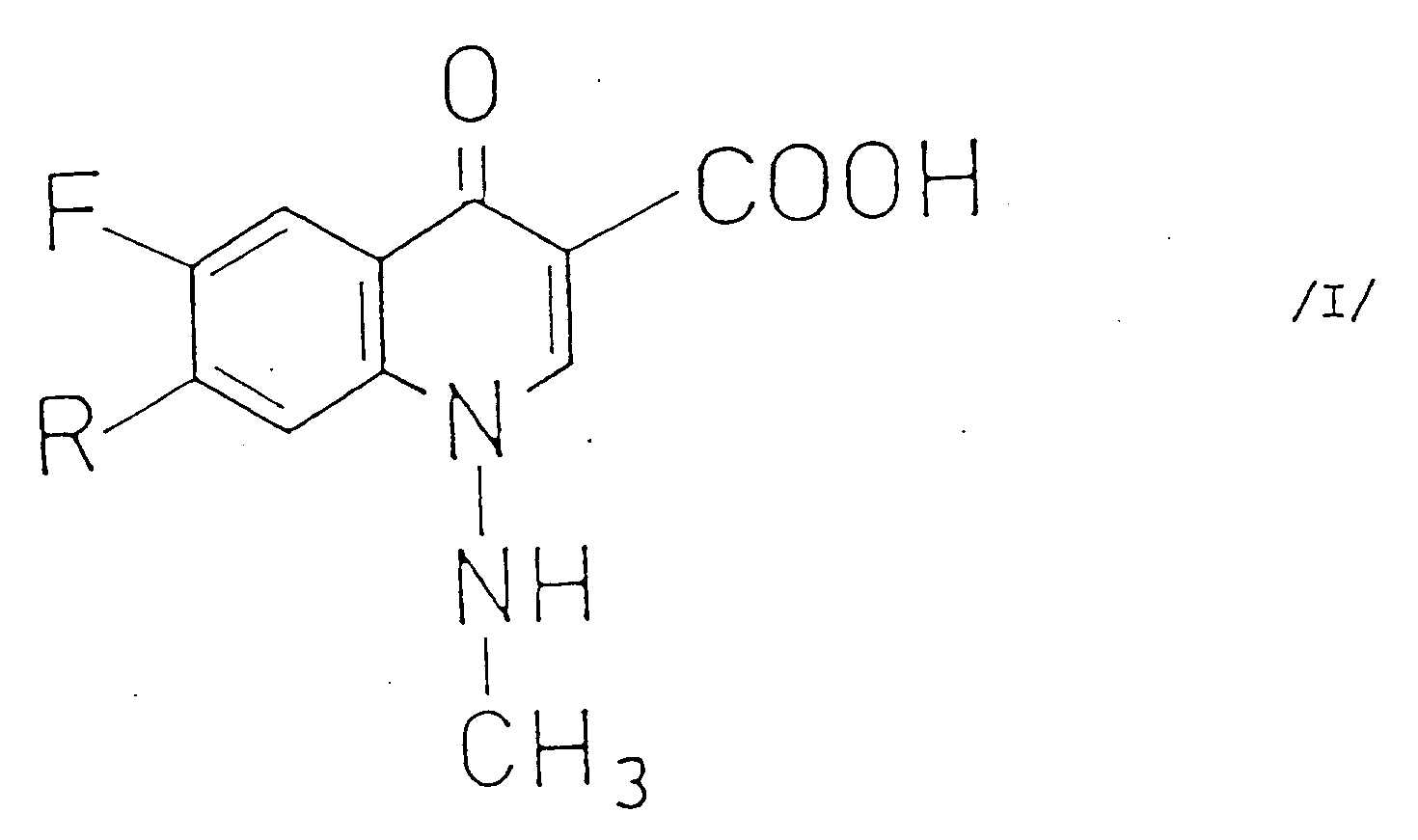
[0002] It is known that 6-fluoro-1-methylamino-4-oxo--1,4-dihydro-quinoline-3-carboxylic acid derivatives of the general Formula I
(wherein R stands for piperazinyl or 4-methyl-piperazinyl) exhibit outstanding antibacterial effect (Journal of Medicinal Chemistry 1984, 27, 1103; Antimicrobal Agents and Chemotherapy 1984, 25, 377; 1984, 26, 104; 275; 421; 781; 933; 1985, 27, 4 and 499; European Journal of Clinical Microbiology 1984, 3, 344; Clin. Therapy 1984, 7, 73).
[0003] The said compounds can be prepared by reacting 6-fluoro-7-chloro-1-methylamino-4-oxo-1,4-dihydro--quinoline-3-carboxylic acid with a cyclic amine in pyridine or methoxyethanol, at the boiling point, under a protecting nitrogen atmosphere for 15-22 hours (European patent specification No. 90, 424; Japanese patent specification No. 84 01,468; Journal of Medicinal Chemistry 25, 377 /1984/). JP-A-59-122 470 and JP-A-60-78986 disclose the production of quinoline-3-carboxylic acids via their boron and borate derivatives, respectively.
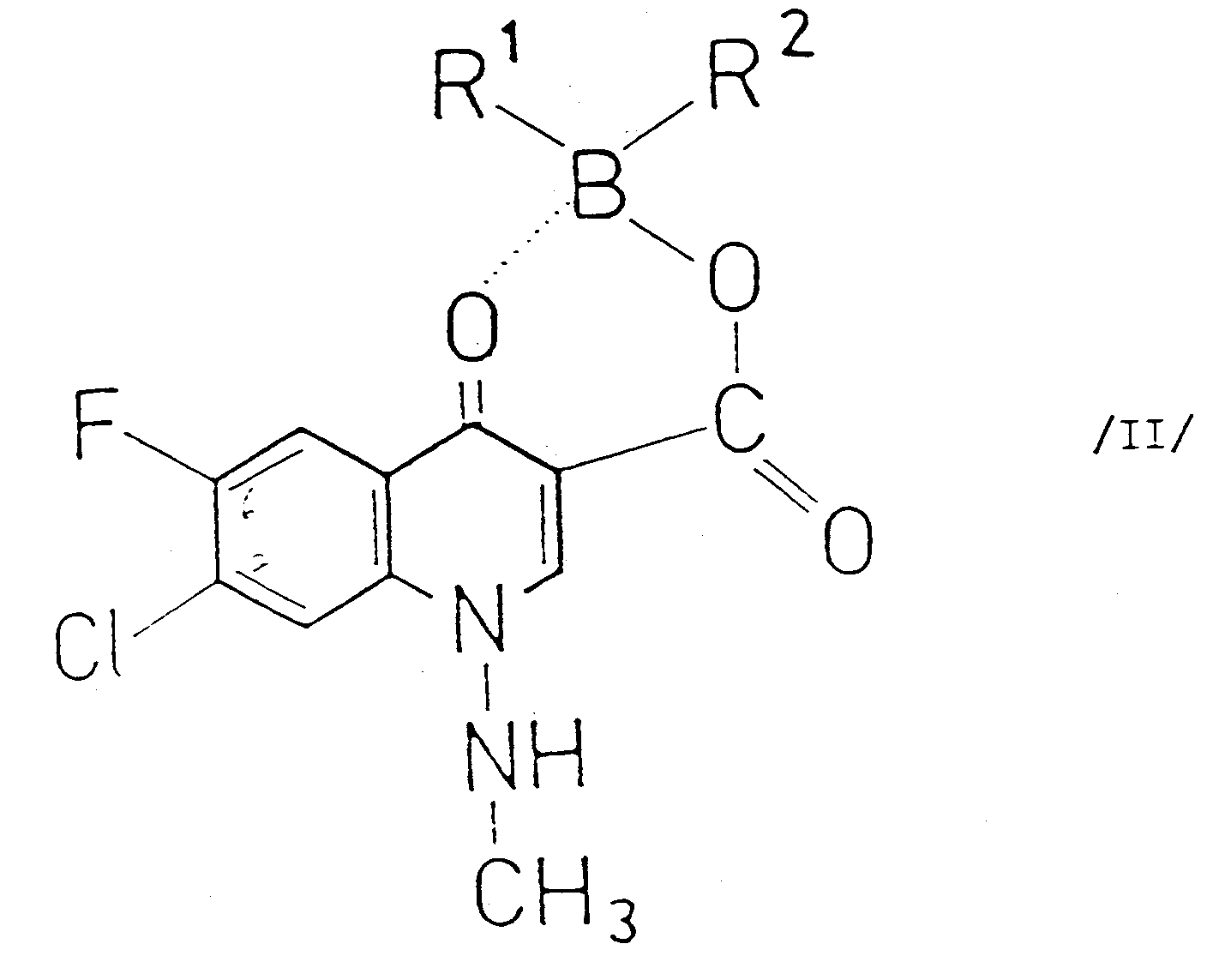
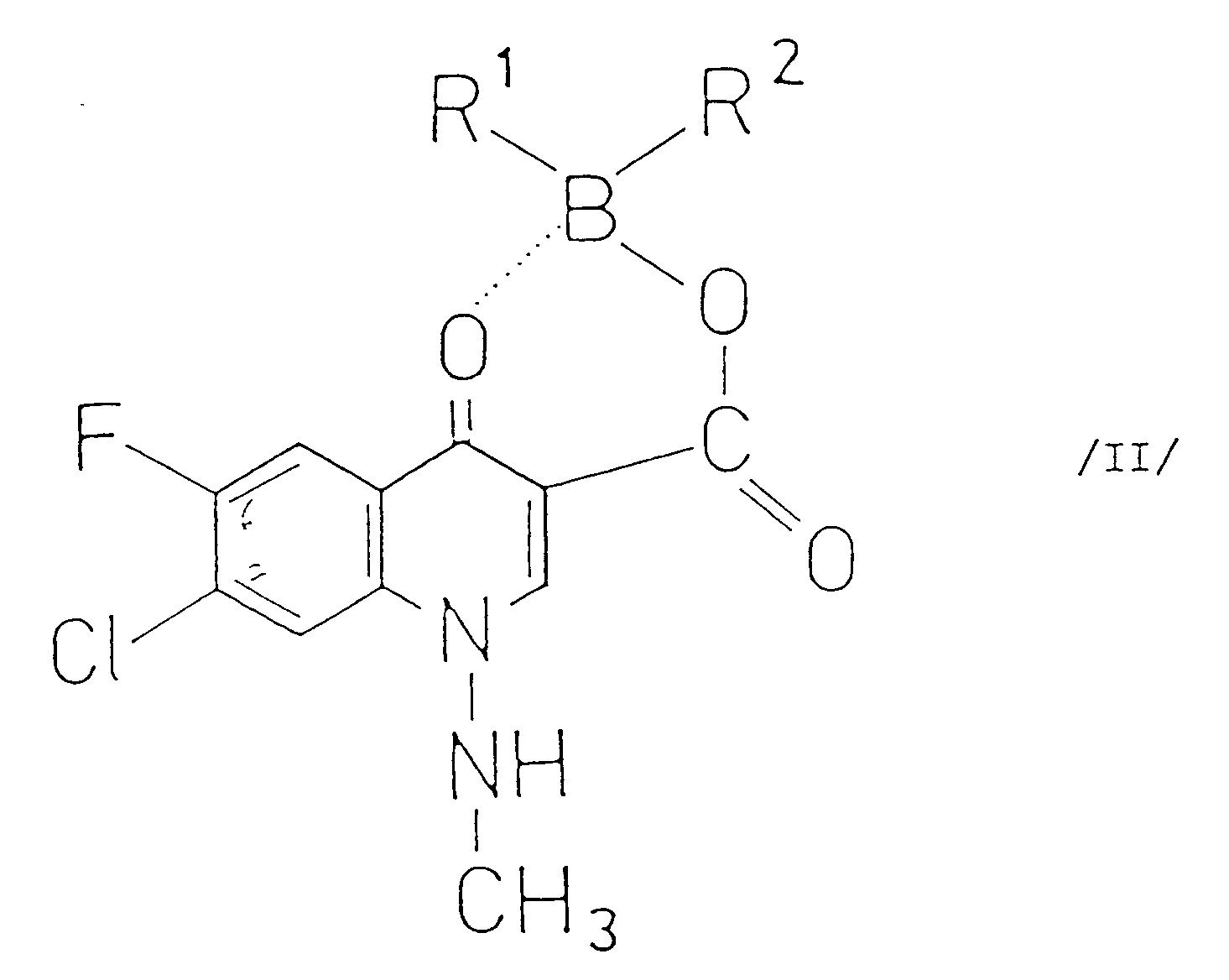
[0004] According to the present invention there is provided a process for the preparation of compounds of the general Formula I and pharmaceutically acceptable salts thereof (wherein R stands for piperazinyl or 4-methyl-piperazinyl) which comprises reacting a compound of the general Formula II
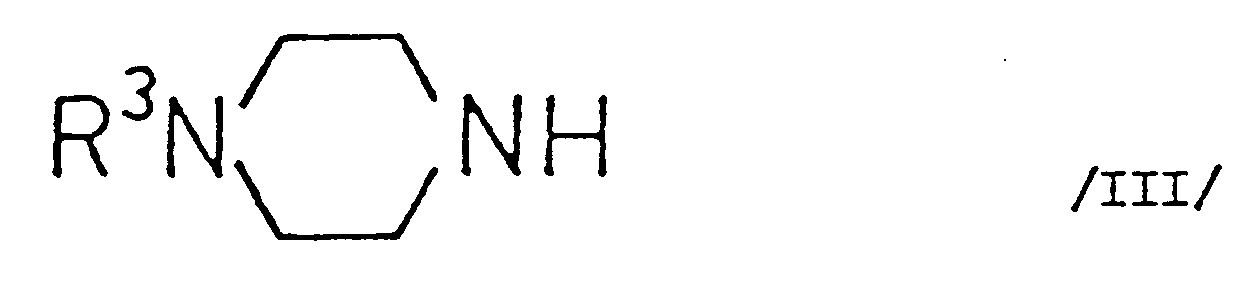
(wherein R¹ and R² stand for an aliphatic acyloxy group comprising 2-6 carbon atoms and optionally substituted by halogen; or an aromatic acyloxy group comprising 7-11 carbon atoms) with a piperazine of the general Formula III
(wherein R³ represents hydrogen or methyl) or a salt thereof, hydrolysing the compound of the general Formula IV
thus obtained (wherein R, R¹ and R² are as stated above) without or after isolation and if desired converting the compound of the general Formula I thus obtained into a salt thereof or setting free the same from its salt.
[0005] The process of the present invention enables the preparation of the compounds of the general Formula I in a simple manner, with very high yields and in a short reaction time.
[0006] According to a preferred form of realization of the process of the present invention the borate derivatives of the general Formula IV are converted into the desired quinoline-3-carboxylic acids of the general Formula I without isolation.
[0008] The reaction of the borate derivative of the general Formula II and the cyclic amine of the general Formula III may be carried out optionally in the presence of an inert organic solvent and an acid binding agent.
[0009] As inert organic solvent e.g. an acid amide (e.g. dimethyl formamide, dimethyl acetamide), a ketone (e.g. acetone, methyl ethyl ketone), an ether (e.g. dioxane, tetrahydrofuran, diethyl ether), an ester (e.g. ethyl acetate, methyl acetate, ethyl propionate), a sulfoxide (e.g. dimethyl sulfoxide), an alcohol (e.g. methanol, ethanol, 1-decanol, butanol, etc.) may be used.
[0010] As acid binding agent e.g. organic or inorganic bases can be used. From the group of organic bases preferably trialkyl amines ( e.g. triethyl amine, tributyl amine), cyclic amines (e.g. pyridine, 1,5-diazabicyclo/5.4.0/-undec-5-ene, 1,5-diazabicyclo/4.3.0/non-5-ene, 1,4-diazabicyclo/2.2.2/octane) may be mentioned, while as inorganic base e.g. hydroxides or carbonates of alkali or alkaline earth metals may be applied. Thus it is preferred to use potassium carbonate, potassium hydrogen carbonate, sodium hydroxide, calcium hydroxide or an excess of the amine of the general Formula III as acid binding agent.
[0011] The reaction of the borone derivative of the general Formula II and the amine of the general Formula III may be carried out at a temperature of 0-200 °C during 0.5-10 hours, depending on the solvent used. The reaction time depends on the reaction temperature too. If the reaction temperature is raised, the reaction time can be shortened. The above reaction conditions are but preferable intervals, while other reaction conditions can be applied as well.
[0012] The borate of the general Formula IV thus obtained is subjected to acidic or basic hydrolysis - after or without isolation - to yield the desired quinoline-3--carboxylic acid derivative of the general Formula I. The reaction product of the general Formula IV may be isolated e.g. by cooling the reaction mixture and separating the precipitated product e.g. by filtration or centrifuging.
[0013] Alkaline hydrolysis can preferably be carried out with the aid of a hydroxide or carbonate of an alkali metal or an alkaline earth metal hydroxide, preferably in the form of an aqueous solution. One may particularly preferably proceed by hydrolysing the compound of the general Formula IV by means of heating with an aqueous solution of sodium hydroxide, potassium hydroxide, sodium carbonate, potassium hydrogen carbonate, potassium carbonate or calcium hydroxide. Hydrolysis may also be accomplished with the aid of an organic base (e.g. triethyl amine).
[0014] Acidic hydrolysis may preferably be carried out by using an aqueous mineral acid solution. One may particularly advantageously proceed by heating with an aqueous hydrochloric acid, hydrogen bromide, sulfuric acid or phosphoric acid solution. Hydrolysis may also be accomplished with the aid of an organic acid (e.g. acetic acid, propionic acid, etc.).
[0015] The hydrolysis of the compounds of the general Formula IV may also be carried out in the presence of a water-miscible organic solvent. For this purpose e.g. alcohols (e.g. methanol, ethanol), ketones (e.g. acetone), ethers (e.g. dioxane), acid amides (e.g. formamide, dimethyl formamide), sulfoxides (e.g. dimethyl sulfoxide) and pyridine may be used.
[0016] The quinoline-3-carboxylic acid derivatives of the general Formula I thus obtained may be isolated e.g. by adjusting the pH value to a suitable value and separating the precipitated crystals e.g. by centrifuging, filtration, or by liophylisation of the aqueous solution.
[0017] The quinoline-3-carboxylic acids of the general Formula I can be converted into the pharmaceutically acceptable salts thereof. One may preferably form acid addition salts, e.g. salts formed with hydrogen halides, sulfonic acids, sulfuric acid or organic acids. Thus e.g. the chlorides, bromides, 4-methyl-phenyl-sulfonates, methanesulfonates, maleates, fumarates, benzonates, etc. can be formed. The compounds of the general Formula I form salts with alkali or alkaline earth metals or other metal ions too; thus e.g. the sodium, potassium, magnesium, silver, copper salts, etc. can be prepared.
[0018] The hydrates (e.g. hemihydrates, trihydrates) of the compounds of the general Formula I or pharmaceutically acceptable acid addition salts thereof may also prepared, if desired, by methods known per se.
[0019] The starting materials of the general Formula II can be prepared e.g. by reacting 6-fluoro-7-chlorol-1--methylamino-4-oxo-1,4-dihydro-quinoline-3-carboxylic acid (European patent specification No. 90,424) with various borone derivatives, e.g. with a borone derivative of the general Formula V
(wherein R¹, R² are as stated above and R⁴ has the same meaning as R¹ or R²) in an aqueous or organic medium.
Example 1
[0021] 0.797 g. of [6-fluoro-7-chlorol-1,4-dihydro--1-(methyl-amino)-4-oxo-3-quinoline-carboxylate-O³,O⁴]-bis(acetate-O)-boron and 0.6 g. of 1-methyl-piperazine are reacted in the presence of 5 ml. of dimethylsulfoxide at 110 °C for 2 hours. Then an aqueous solution of 6 % by W/V sodium hydroxide (5.1 ml.) is added and stirred for another 1 hour at 110 °C. The mixture is then cooled to 40 °C and the pH value is adjusted to 6.5 with 96 % by W/V acetic acid. The mixture is then cooled to room temperature whereupon crystals are precipitated. The mixture is allowed to stand in a refrigerator overnight, then diluted with 15 ml. of water and the precipitated crystals are filtered, and washed with water and cold methanol. 0.56 g. (84 %) of 6-fluoro-1,4-dihydro-1-(methylamino)-7-(4-methyl-piperazino)-4-oxo-3-quinoline-carboxylic acid is obtained. Decomposition after recrystallization from dimethylformamide at 293 °C.
| Analysis for the formula C₁₆H₁₉FN₄O₃ | |||
| calculated: | C = 57.48 % | H = 5.73 % | N = 16.76 % |
| found: | C = 58.0 % | H = 5.9 % | N = 16.9 % |
Preparation of the starting material
[0022] 0.568 g. of boric acid and 3.28 g. of acetic acid anhydride are reacted in the presence of 1 mg. of zinc chloride while the temperature of the reaction mixture raises to 46 °C. The white suspension is slowly heated to 100 °C and 2.0 g. of ethyl [7-chloro-6-fluoro-1,4-dihydro-1-(formylmethyl-amino)-4-oxo-3-quinoline-carboxylate] are added which had been previously dissolved in 10 ml. of 96 % by W/V acetic acid. The reaction mixture is further heated for 2 hours at 110 °C. The solution is cooled to room temperature and diluted with 40 ml of cold water. The precipitated crystals are filtered, washed with water and cold abs. ethanol, dried. 1.75 g. off-white, crystalline [6-fluoro--7-chloro-1,4-dihydro-1-(methyl-amino)-4-oxo-3-quinoline- carboxylate-O³,O⁴]-bis(acetate-O)-boron are obtained. Decomposition: 272 °C.
[0023] Upon standing further 0.45 g. product crystallizes from the mother liquor.
| Analysis for the formula C₁₅H₁₃BClFN₂O₇ | |||
| calculated: | C = 45.55 % | H = 3.31 % | N = 3.54 % |
| found: | C = 45.2 % | H = 3.2 % | N = 3.6 %. |
Example 2
[0024] 0.797 g. of [6-fluoro-7-chloro-1,4-dihydro-1-(methylamino)-4-oxo-3-quinolinecarboxylate-O³,O⁴]-bis(acetate-O)-boron and 0.52 g. of piperazine are reacted in the presence of 5 ml. of dimethylsulfoxide at 110 °C for 2 hours. An aqueous solution of 6 % by W/V sodium hydroxide (5 ml.) is then added to the reaction mixture which is then mildly boiled for 1 hour. The first crystals precipitate after 10 minutes. The reaction mixture is cooled to 40 °C and the pH is adjusted to 6.5 by adding 96 % by W/V acetic acid whereafter the suspension is diluted. The precipitated crystals are filtered and washed with water and abs. ethanol Yellowish-beige 6-fluoro-1,4-dihydrol-1-(methylamino)-7-piperazino-4-oxo-3-quinoline-carboxylic acid (0.42 g. 65 %) is obtained.
| Analysis for the formula: C₁₅H₁₇FN₄O₃ | |||
| calculated: | C = 56.24 % | H = 5.35 % | N = 17.49 % |
| found: | C = 55.9 % | H = 5.5 % | N = 17.8 %. |
[0025] A mixture of 1 g of 6-fluoro-1-methylamino-7-piperazino-4-oxo-1,4-dihydro-quinoline-3-carboxylic acid and 1.5 ml of water is treated with 0.6 g of p-toluene-sulfonic acid and the mixture is poured into 10 ml of methyl ethyl ketone. The reaction mixture is allowed to crystallize in a refrigerator overnight. Next morning the precipitated crystals are filtered and washed with methyl ethyl ketone. Thus 1.3 of the p-toluene-sulfonate salt of 6-fluoro-1-methylamino-7-piperazine-4-oxo-1,4--dihydro-quinoline-3-carboxylic acid are obtained, yield: 84.5 %.
| Analysis for the Formula C₁₅H₁₇FN₄O₃ . C₇H₈O₃S | |||
| calculated | C = 53.65 %, | H = 5.11 %, | N = 11.37 % |
| found | C = 53.89 %, | H = 4.96 %, | N = 11.25 % |
Example 3
[0026] 0.426 g. [6-fluoro-7-chloro-1,4-dihydro-1-(methylamino)-4-oxo-3-quinoline-carboxylate-O³,O⁴]-bis(propanoate-O)-boron and 0.3 g. of 1-methyl-piperazine are reacted in the presence of 2.5 ml. of dimethylsulfoxide for 2 hours at 110 °C. Then an aqueous solution of 6 % by W/V of sodium hydroxide (2.5 ml.) is added and the mixture is further heated for 1 hour at the above temperature. The reaction mixture is then cooled to 40 °C and the pH is adjusted to 6.5 by adding 96 % by W/V acetic acid. Crystals immediately precipitate. The reaction mixture is allowed to stand overnight in the refrigerator and the precipitated crystals are filtered, washed with some water and methanol. Thus 0.22 g. (66 %) of 6-fluoro-1,4-dihydro-1-(methylamino)-7-(4-methyl-piperazine)-4-oxo-3-quinoline-carboxylic acid is obtained, decomposing at 294 °C after recrystallization from dimethylformamide. No depression of the melting point is observed when admixing the product at any ratio with the product of the previous Example.
Preparation of the starting material:
[0028] A mixture of 1.42 g of boric acid and 10.7 g of propionic anhydride is stirred at 100 °C for 15 minutes whereupon the reaction mixture is heated to boiling point. After 30 minutes the temperature of the reaction mixture is lowered to 110 °C and 4.2 g of 6-fluoro-7-chloro-1-methylamino-4-oxo-1,4-dihydro-quinoline-3-carboxylic acid are added. After some minutes the precipitation of crystals begins. The reaction mixture is stirred at 110 °C for 2 hours, cooled to 10 °C, whereupon 20 ml of water and 20 ml of ethanol are added to the crystalline suspension. The reaction mixture is allowed to crystallize in a refrigerator overnight. The precipitated crystals are filtered, washed with water and dried. Thus 6.12 g of (6-fluoro-7-chloro-1-methylamino-4-oxo-1,4-dihydro-quinoline-3-carboxylicacid-borone-dipropionyloxy)-anhydride are obtained. Yield: 93.5 %, mp.: 215 °C (decomposition).
| Analysis for the formula C₁₇H₁₇BFClN₂O₇ | |||
| calculated: | C = 47.86 %, | H = 4.01 %, | N = 6.56 %, |
| found: | C = 48.07 %, | H = 3.87 %, | N = 6.48 %. |
1. Process for the preparation of compounds of the general Formula I
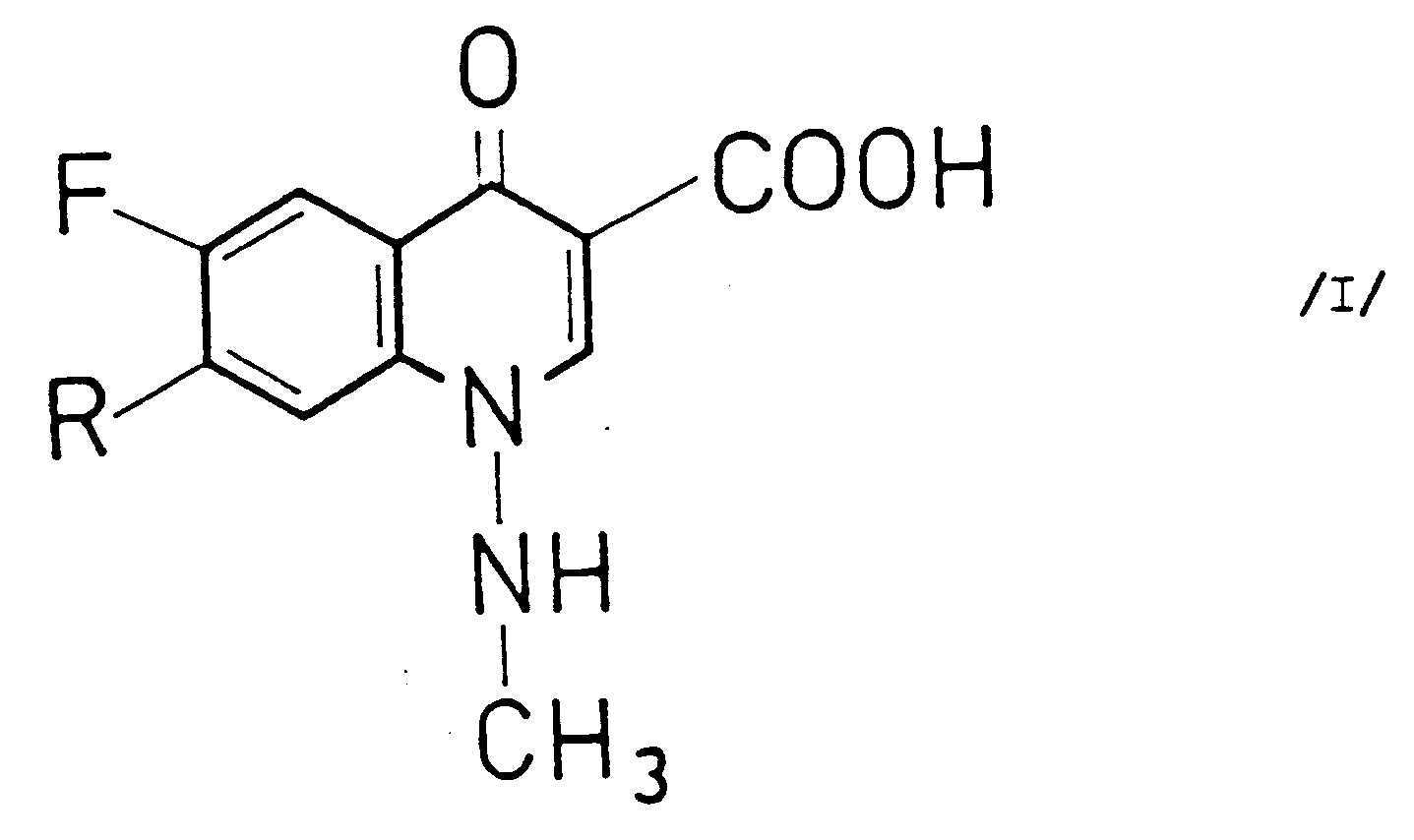
and pharmaceutically acceptable salts thereof (wherein R stands for piperazinyl or 4-methyl-piperazinyl) which comprises reacting a compound of the general Formula II
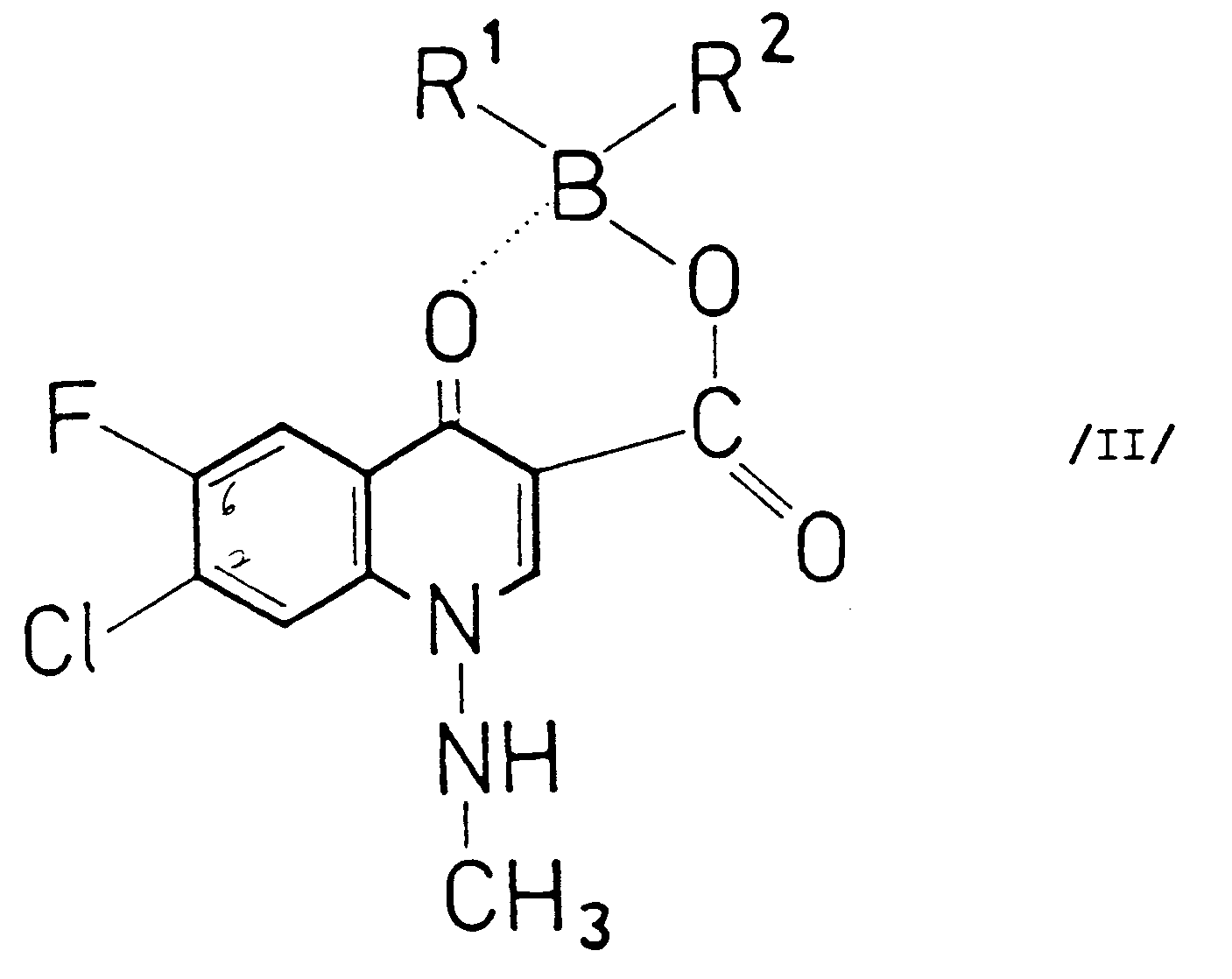
(wherein R¹ and R² stand for an aliphatic acyloxy group comprising 2-6 carbon atoms and optionally substituted by halogen; or an aromatic acyloxy group comprising 7-11 carbon atoms) with a piperazine of the general Formula III

(wherein R³ represents hydrogen or methyl) or a salt thereof, hydrolysing the compound of the general Formula IV
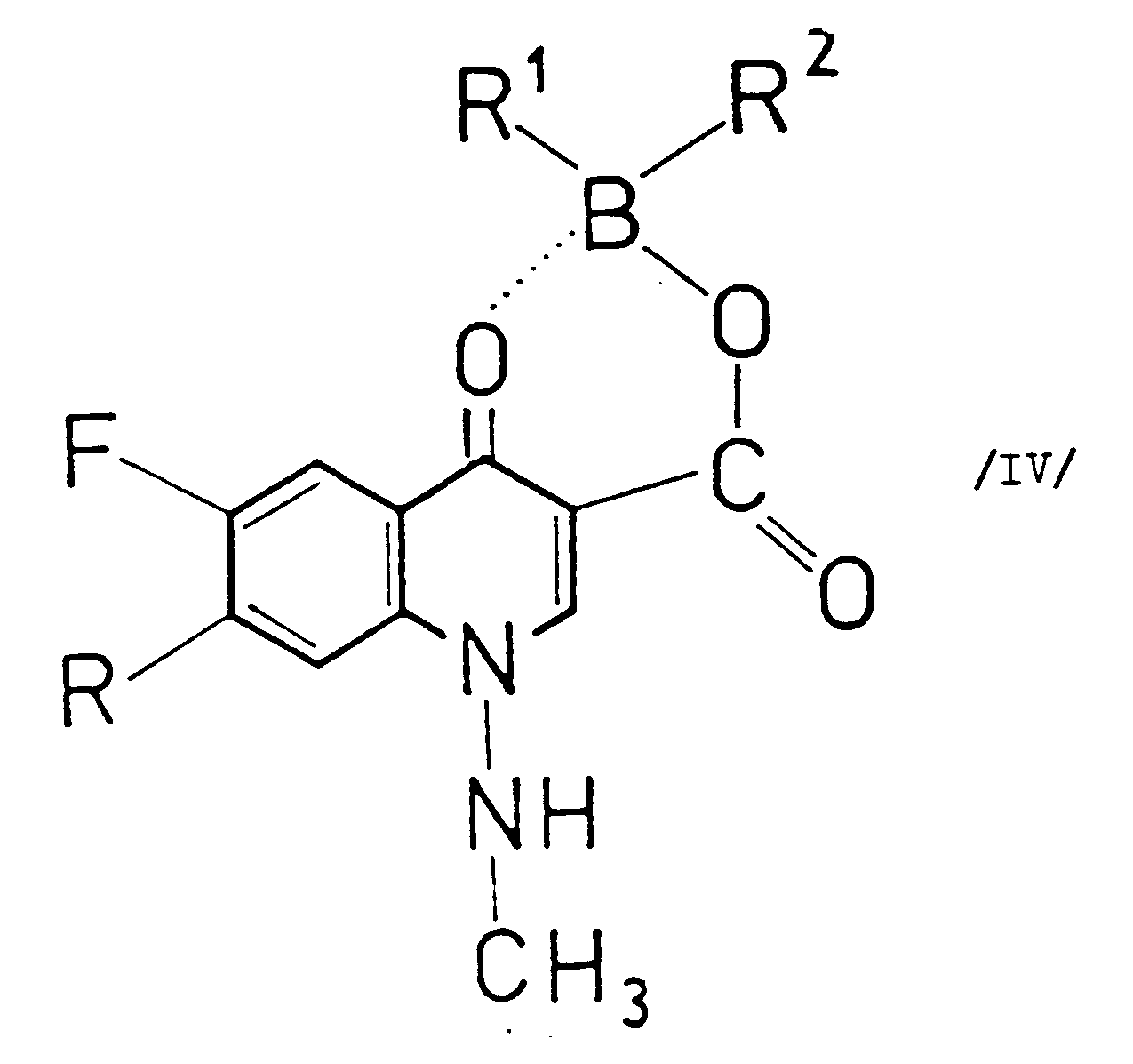
thus obtained (wherein R, R¹ and R² are as stated above) without or after isolation and if desired converting the compound of the general Formula I thus obtained into a salt thereof or setting free the same from its salt.
and pharmaceutically acceptable salts thereof (wherein R stands for piperazinyl or 4-methyl-piperazinyl) which comprises reacting a compound of the general Formula II
(wherein R¹ and R² stand for an aliphatic acyloxy group comprising 2-6 carbon atoms and optionally substituted by halogen; or an aromatic acyloxy group comprising 7-11 carbon atoms) with a piperazine of the general Formula III
(wherein R³ represents hydrogen or methyl) or a salt thereof, hydrolysing the compound of the general Formula IV
thus obtained (wherein R, R¹ and R² are as stated above) without or after isolation and if desired converting the compound of the general Formula I thus obtained into a salt thereof or setting free the same from its salt.
2. Process according to Claim 1 which comprises carrying out the reaction of the compounds
of the general Formula II and III (wherein R¹, R² and R³ are as stated in Claim 1)
in the presence of an organic solvent,
3. Process according to Claim 2 which comprises using an acid amide, sulfoxide, ketone,
alcohol, ether or ester as organic solvent.
4. Process according to Claim 3 which comprises using dimethyl sulfoxide as organic solvent.
5. Process according to Claim 1 which comprises reacting the compounds of the general
Formulae II and III in the presence of an acid binding agent.
6. Process according to Claim 5 which comprises using an amine or an excess of the compound
of the general Formula III as acid binding agent.
7. Process according to Claim 1 which comprises carrying out hydrolysis in acidic medium.
8. Process according to Claim 7 which comprises using an organic or inorganic acid.
9. Process according to Claim 8 which comprises using hydrochloric acid, sulfuric acid
or acetic acid.
10. Process according to Claim 1 which comprises carrying out hydrolysis in alkaline medium.
11. Process according to Claim 10 which comprises using an alkali metal hydroxide, alkaline
earth metal hydroxide or an organic base.
12. Process according to Claim 11 which comprises using an aqueous solution of triethyl
amine.
13. Compounds of the general Formula IV wherein R stands for piperazinyl or 4-methyl-piperazinyl
and R¹ and R² represent an aliphatic acyloxy group comprising 2-6 carbon astoms and
optionally substituted by halogen; or an aromatic acyloxy group comprising 7-11 carbon
atoms.
1. Verfahren zur Herstellung von Verbindungen der allgemeinen Formel I
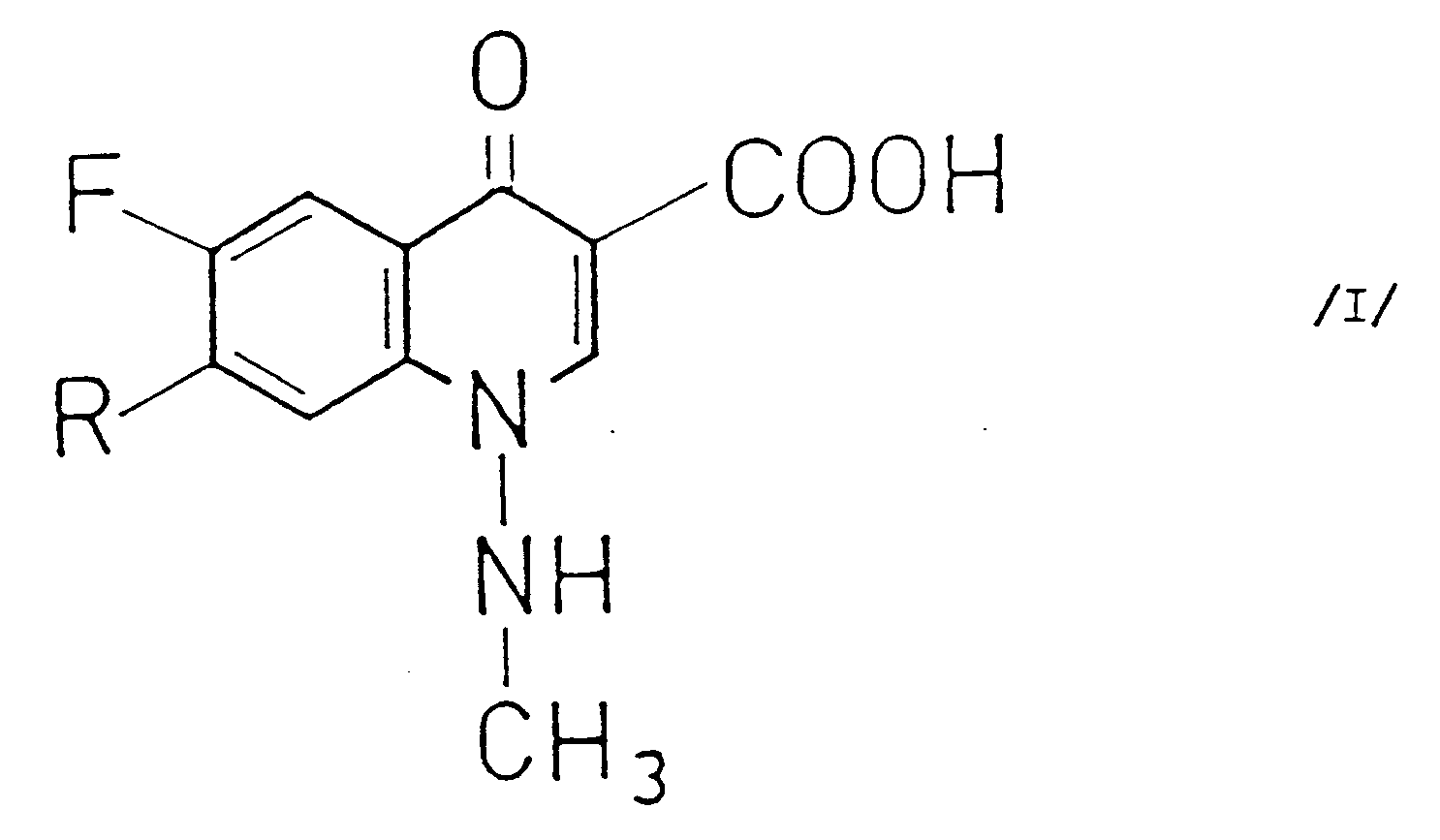
und pharmazeutisch akzeptabler Salze davon (worin R für Piperazinyl oder 4-Methyl-piperazinyl steht), welches die Umsetzung einer Verbindung der allgemeinen Formel II
(worin R¹ und R² für eine aliphatische Acyloxygruppe mit 2-6 Kohlenstoffatomen, gegebenenfalls substituiert durch Halogen; oder eine aromatische Acyloxygruppe mit 7-11 Kohlenstoffatomen steht) mit einem Piperazin der allgemeinen Formel III
(worin R³ Wasserstoff oder Methyl darstellt) oder einem Salz davon, die Hydrolyse der so erhaltenen Verbindung der allgemeinen Formel IV

(worin R, R¹ und R² die obige Bedeutung haben) ohne oder nach der Isolierung und gewünschtenfalls die Überführung der so erhaltenen Verbindung der allgemeinen Formel I in ein Salz derselben oder die Freisetzung derselben aus ihrem Salz umfaßt.
und pharmazeutisch akzeptabler Salze davon (worin R für Piperazinyl oder 4-Methyl-piperazinyl steht), welches die Umsetzung einer Verbindung der allgemeinen Formel II
(worin R¹ und R² für eine aliphatische Acyloxygruppe mit 2-6 Kohlenstoffatomen, gegebenenfalls substituiert durch Halogen; oder eine aromatische Acyloxygruppe mit 7-11 Kohlenstoffatomen steht) mit einem Piperazin der allgemeinen Formel III
(worin R³ Wasserstoff oder Methyl darstellt) oder einem Salz davon, die Hydrolyse der so erhaltenen Verbindung der allgemeinen Formel IV
(worin R, R¹ und R² die obige Bedeutung haben) ohne oder nach der Isolierung und gewünschtenfalls die Überführung der so erhaltenen Verbindung der allgemeinen Formel I in ein Salz derselben oder die Freisetzung derselben aus ihrem Salz umfaßt.
2. Verfahren nach Anspruch 1, welches die Durchführung der Umsetzung der Verbindungen
der allgemeinen Formeln II und III (worin R¹, R² und R³ wie in Anspruch 1 angegeben
sind) in Anwesenheit eines organischen Lösungsmittels umfaßt.
3. Verfahren nach Anspruch 2, welches die Verwendung eines Säureamids, Sulfoxids, Ketons,
Alkohols, Ethers oder Esters als organisches Lösungsmittel umfaßt.
4. Verfahren nach Anspruch 3, welches die Verwendung von Dimethylsulfoxid als organisches
Lösungsmittel umfaßt.
5. Verfahren nach Anspruch 1, welches die Umsetzung der Verbindungen der allgemeinen
Formeln II und III in Anwesenheit eines Säurebindungsmittels umfaßt.
6. Verfahren nach Anspruch 5, welches die Verwendung eines Amins oder eines Überschusses
der Verbindung der allgemeinen Formel III als Säurebindungsmittel umfaßt.
7. Verfahren nach Anspruch 1, welches die Durchführung der Hydrolyse in einem sauren
Medium umfaßt.
8. Verfahren nach Anspruch 7, welches die Verwendung einer organischen oder anorganischen
Säure umfaßt.
9. Verfahren nach Anspruch 8, welches die Verwendung von Salzsäure, Schwefelsäure oder
Essigsäure umfaßt.
10. Verfahren nach Anspruch 1, welches die Durchführung der Hydrolyse in einem alkalischen
Medium umfaßt.
11. Verfahren nach Anspruch 10, welches die Verwendung eines Alkalimetallhydroxids, Erdalkalimetallhydroxids
oder einer organischen Base umfaßt.
12. Verfahren nach Anspruch 11, welches die Verwendung einer wässerigen Triethylaminlösung
umfaßt.
13. Verbindungen der allgemeinen Formel IV, worin R für Piperazinyl oder 4-Methyl-piperazinyl
steht und R¹ und R² eine aliphatische Acyloxygruppe mit 2-6 Kohlenstoffatomen, gegebenenfalls
substituiert durch Halogen; oder eine aromatische Acyloxygruppe mit 7-11 Kohlenstoffatomen
darstellt.
1. Procédé de préparation de composés de formule générale I
et de ses sels pharmaceutiquement acceptables (formule dans laquelle R désigne un groupe pipérazinyle ou 4-méthylpipérazinyle), qui comprend la réaction d'un compose de formule générale II
(dans laquelle R¹ et R² désignent des groupes acyloxy aliphatiques comprenant 2-6 atomes de carbone et éventuellement substitués par un atome d'halogène; ou des groupes acyloxy aromatiques comprenant 7-11 atomes de carbone) avec une pipérazine de formule générale III

(dans laquelle R³ représente un atome d'hydrogène ou un groupe méthyle) ou un de ses sels, l'hydrolyse du composé de formule générale IV
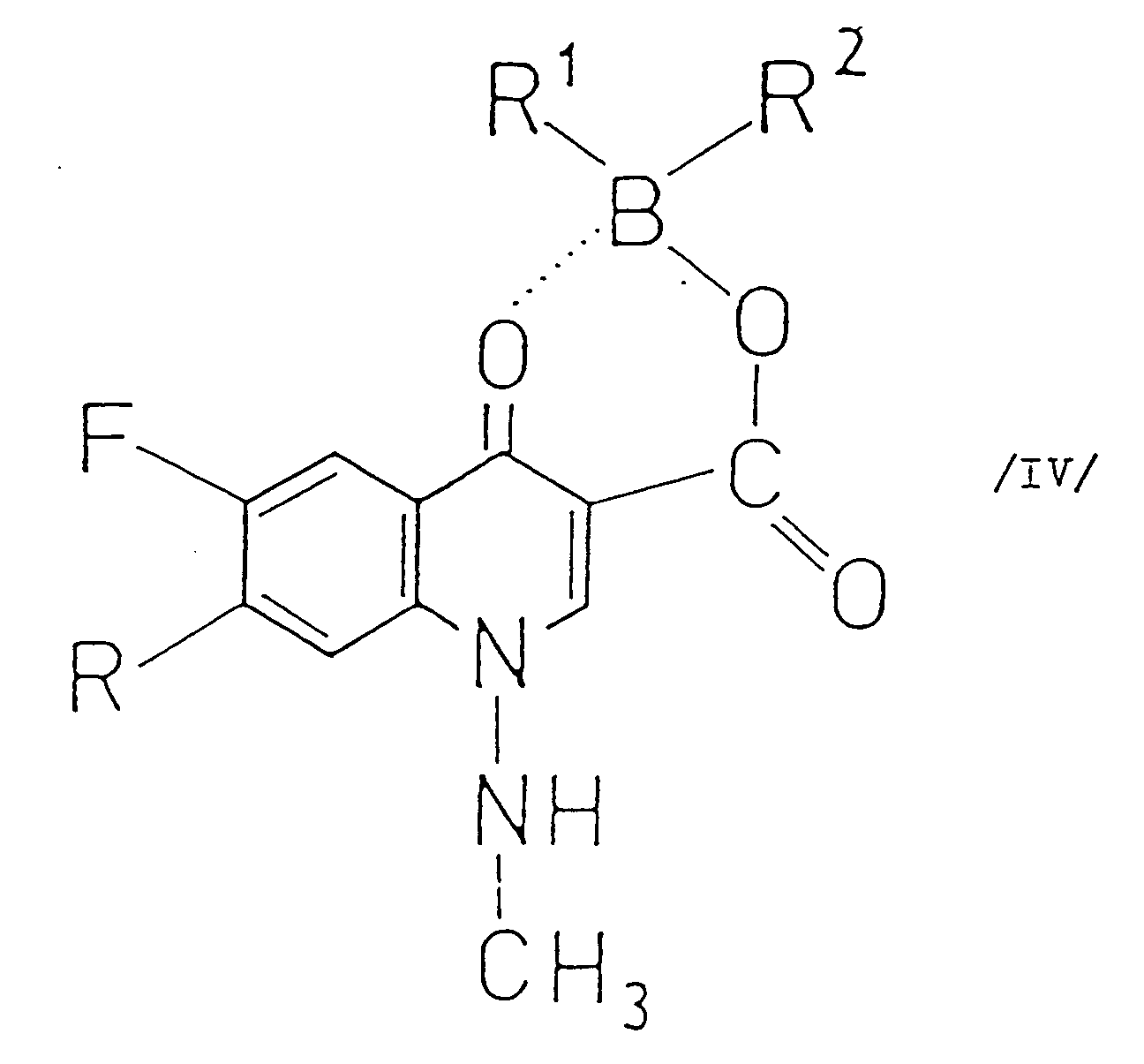
ainsi obtenu (formule dans laquelle R, R¹ et R² sont tels que définis ci-dessus) sans ou après l'isolement et, le cas échéant, la conversion du composé de formule générale I ainsi obtenu en un de ses sels, ou la libération de ce composé à partir de son sel.
et de ses sels pharmaceutiquement acceptables (formule dans laquelle R désigne un groupe pipérazinyle ou 4-méthylpipérazinyle), qui comprend la réaction d'un compose de formule générale II
(dans laquelle R¹ et R² désignent des groupes acyloxy aliphatiques comprenant 2-6 atomes de carbone et éventuellement substitués par un atome d'halogène; ou des groupes acyloxy aromatiques comprenant 7-11 atomes de carbone) avec une pipérazine de formule générale III
(dans laquelle R³ représente un atome d'hydrogène ou un groupe méthyle) ou un de ses sels, l'hydrolyse du composé de formule générale IV
ainsi obtenu (formule dans laquelle R, R¹ et R² sont tels que définis ci-dessus) sans ou après l'isolement et, le cas échéant, la conversion du composé de formule générale I ainsi obtenu en un de ses sels, ou la libération de ce composé à partir de son sel.
2. Procédé selon la revendication 1, qui comprend la mise en oeuvre de la réaction des
composés de formule générale II et III (dans lesquelles R¹, R² et R³ sont tels que
définis dans la revendication 1), en présence d'un solvant organique.
3. Procédé selon la revendication 2, qui comprend l'utilisation d'un amide d'acide, d'un
sulfoxyde, d'une cétone, d'un alcool, d'un éther ou d'un ester comme solvant organique.
4. Procédé selon la revendication 3, qui comprend l'utilisation de diméthylsulfoxyde
comme solvant organique.
5. Procédé selon la revendication 1, qui comprend la réaction des composés de formules
générales II et III en présence d'un agent liant acide.
6. Procédé selon la revendication 5, qui comprend l'utilisation d'une amine ou d'un excès
du composé de formule générale III comme agent liant acide.
7. Procédé selon la revendication 1, qui comprend la mise en oeuvre de l'hydrolyse dans
un milieu acide.
8. Procédé selon la revendication 7, qui comprend l'utilisation d'un acide organique
ou minéral.
9. Procédé selon la revendication 8, qui comprend l'utilisation d'acide chlorhydrique,
d'acide sulfurique ou d'acide acétique.
10. Procédé selon la revendication 1, qui comprend la mise en oeuvre de l'hydrolyse dans
un milieu alcalin.
11. Procédé selon la revendication 10, qui comprend l'utilisation d'un hydroxyde de métal
alcalin, d'un hydroxyde de métal alcalino-terreux ou d'une base organique.
12. Procédé selon la revendication 11, qui comprend l'utilisation d'une solution aqueuse
de triéthylamine.
13. Composés de formule générale IV, dans laquelle R désigne un groupe pipérazinyle ou
4-méthylpipérazinyle et R¹ et R² représentent des groupes acyloxy aliphatiques comprenant
2-6 atomes de carbone et éventuellement substitués par un atome d'halogène; ou des
groupes acyloxy aromatiques comprenant 7-11 atomes de carbone.