|
(11) | EP 0 249 039 B1 |

| (12) | EUROPEAN PATENT SPECIFICATION |
|
|
| (54) |
Process for granulating azobisamidine salt Verfahren zur Körnung von Azobisamidinsalzen Procédé de granulation de sels d'azobisamidine |
|
|
|||||||||||||||||||||||||||||||
|
||||||||||||||||||||||||||||||||
| Note: Within nine months from the publication of the mention of the grant of the European patent, any person may give notice to the European Patent Office of opposition to the European patent granted. Notice of opposition shall be filed in a written reasoned statement. It shall not be deemed to have been filed until the opposition fee has been paid. (Art. 99(1) European Patent Convention). |
[0001] This invention relates to a process for granulating an azobisamidine salt useful as a polymerization initiator in aqueous solution polymerization and emulsion polymerization.
[0002] Azobisamidine salts as exemplified typically by 2,2'-azobisisobutylamidine hydrochloride or acetate, and by 2,2'-azobis(N,N'-dimethyleneisobutylamidine) hydrochloride or acetate, have good solubility in water as can be estimated from their structures, and thus are useful as a polymerization initiator in aqueous solution polymerization or emulsion polymerization. That is, when they are used in the form of an acidic aqueous solution, they act as highly active water-soluble polymerization initiators. Further, when they are used as a polymerization initiator for emulsion polymerization, there is yielded a polymer having positively charged terminals. The azobisamidine salts can be used variously, for example, for the polymerization of water-soluble monomers such as acrylamide, allylamine, and vinylpyrrolidone; for the production of cationic polymers; for the polymerization of fluorine resins; for various emulsion polymerizations; and for photopolymerization.
The azobisamidine salts are usually in the form of a fine powder that irritates the skin, so that they are unfavorable for handling from the viewpoint of health.
Azobisamidine salts are highly active when in aqueous solution and are easily decomposed as mentioned above. It is also well known that when they are allowed to stand with water, they deteriorate in quality with the lapse of time. Therefore, use of water for the granulation of azobisamidine salts was not thought of, although the granulation of azobisamidine salts has long been desired. Further, since there has been found no suitable binder for the granulation, azobisamidine salts have previously only been used in the form of fine powders.
SUMMARY OF THE INVENTION
[0003] It is an object of the present invention to provide a process for producing granular azobisamidine salts and the invention extends to the thus produced granulated azobisamidine salts.
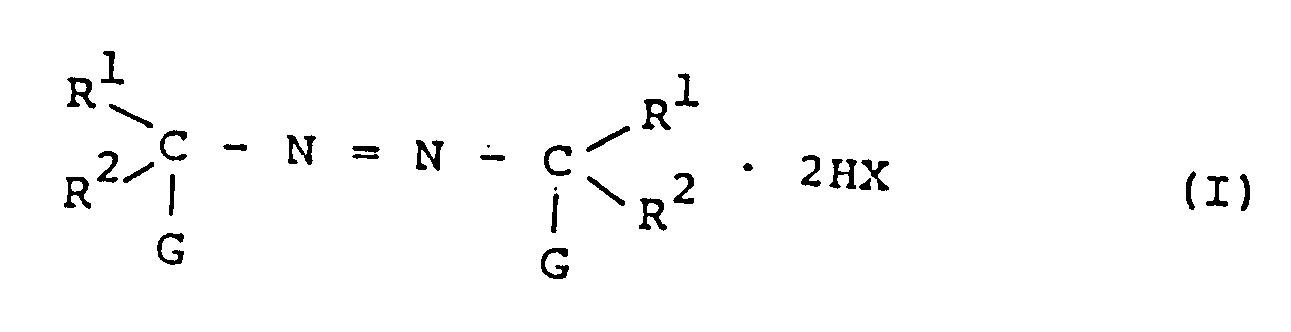
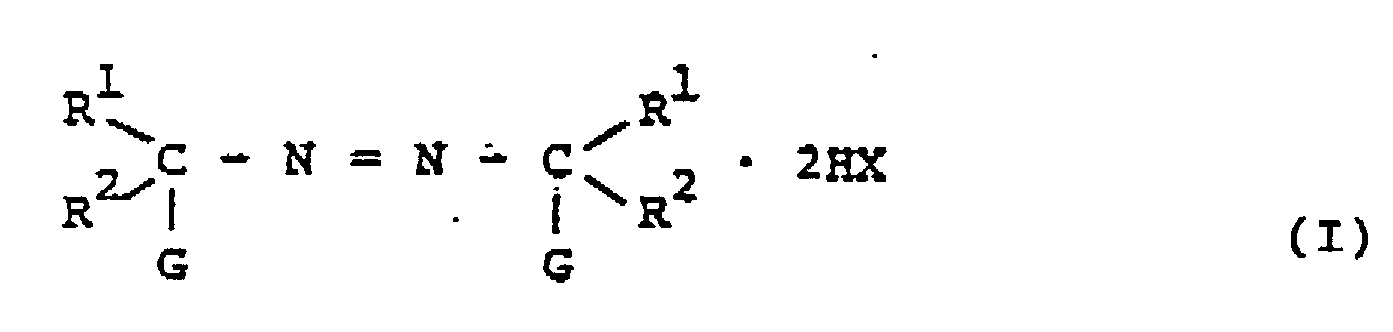
[0004] The present invention provides a process for producing granules of an azobisamidine salt of the formula:
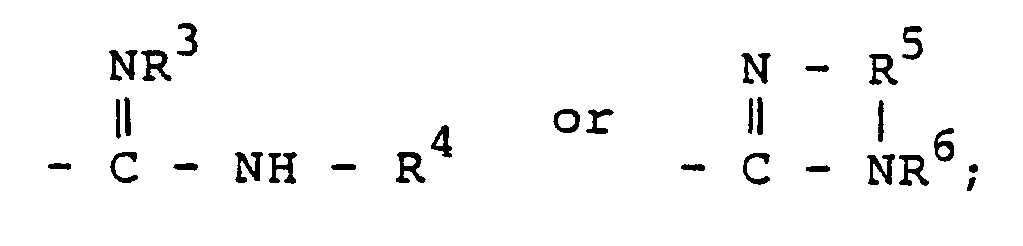
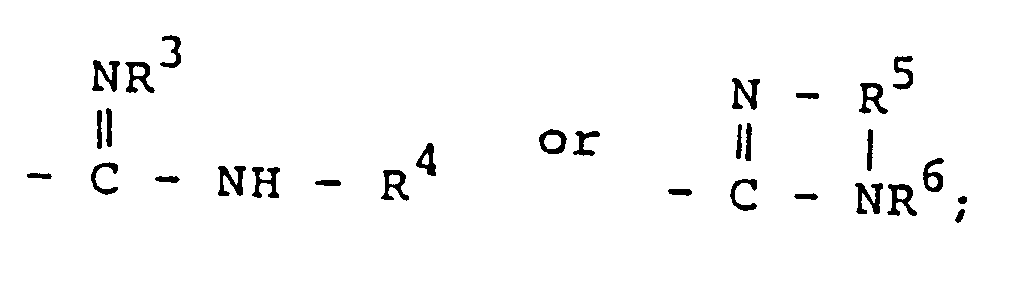
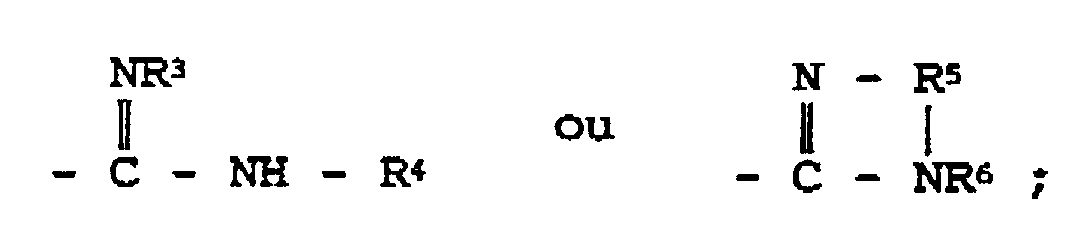
wherein R¹ and R² are independently an alkyl group or a cycloalkyl group, and may form an aliphatic ring by combining R¹ and R²; G is a guanyl group of the formula:
R³ and R⁴ are independently hydrogen, an alkyl group, a substituted alkyl group, a cycloalkyl group, an allyl group, a phenyl group or a substituted phenyl group; R⁵ is a lower alkylene group which may have one or more substituents; and R⁶ is hydrogen or a hydroxyalkyl group; and X is Cl, Br or a group of the formula: CH₃COO- which comprises granulating a powder of azobisamidine salt of said formula (I) using as a binder from 5% to 22% by weight of water based on the dry weight of said powder of formula (I), said water optionally being mixed with a water soluble organic solvent.
[0005] This invention also provides granules of the azobisamidine salt of the formula (I) thus produced having a particle size of about 300 µm or more in a content of 90% by weight or more usable as a water-soluble polymerization initiator or for other purposes.
DESCRIPTION OF THE PREFERRED EMBODIMENTS
[0006] According to the present invention, granules of azobisamidine salts can be produced by using a specified amount of water as a binder without a deterioration in the quality of the azobisamidine salts with the lapse of time.
[0007] The azobisamidine salts used in the present invention are represented by the formula:
In the formula (I), R¹ and R² are independently an alkyl group such as a methyl group, an ethyl group, a propyl group, a butyl group, an amyl group, and a hexyl group; or a cycloalkyl group such as a cyclopropyl group, a cycloheptyl group and a cyclohexyl group. R¹ and R² may form an aliphatic ring such as cyclohexane, cycloheptane, or cyclooctane, by combining R¹ and R².
[0008] G in the formula (I) is a guanyl group of the formula:
wherein R³ and R⁴ are independently hydrogen, a straight-or branched-chain alkyl group such as a methyl group, an ethyl group, a propyl group, a butyl group, a pentyl group, a hexyl group, an octyl group, a nonyl group, or a decyl group; a substituted alkyl group such as a hydroxymethyl group, a hydroxyethyl group, a hydroxypropyl group, a chloroethyl group, a bromoethyl group, a chloropropyl group, a bromopropyl group, a benzyl group, or a phenetyl group; a cycloalkyl group such as a cyclopropyl group, a cycloheptyl group, or a cyclohexyl group; an allyl group, a phenyl group, or a substituted phenyl group such as a tolyl group, an ethylphenyl group, a methoxyphenyl group, an ethoxyphenyl group, a hydroxyphenyl group, a nitrophenyl group, an aminophenyl group, an acetylphenyl group, or an acetylaminophenyl group; R⁵ is a lower alkylene group such as -CH₂CH₂-, or -CH₂-CH₂-CH₂-; or a substituted lower alkylene group wherein one or more hydrogen atoms in the lower alkylene group is substituted with one or more lower alkyl groups such as a methyl group, an ethyl group, a propyl group, a butyl group, etc., or a hydroxyl group; and R⁶ is hydrogen, or a hydroxyalkyl group such as a hydroxymethyl group, a hydroxyethyl group, a hydroxypropyl group, etc.
[0010] The present invention is characterized by using a specified amount of water as a binder for granulation. The use of water as a binder is very important but this does not imply the exclusion of an other auxilliary solvent. For example, methanol, ethanol, isopropanol, or a like alcohol is well miscible with water and can easily be removed by vaporization. Such an auxiliary solvent can be used together with water so long as it does not damage the effect of water as a binder. In other words, such an auxiliary solvent can be used together with water in this invention.
[0011] Examples of the auxiliary solvent are water-soluble organic solvents, for example lower alcohols such as methanol, ethanol, or isopropanol; ketones such as acetone, or methyl ethyl ketone; dioxane, dimethylformamide, dimethylsulfoxide, or acetonitrile.
[0012] The above-mentioned water-soluble organic solvents can function as a binder only when used together with water and do not show the function of a binder when used as they are like other water-insoluble organic solvents such as aromatic hydrocarbons, halogenated hydrocarbons, ethers, etc.
[0013] The amount of water used as a binder changes depending on the dryness of an azobisamidine salt to be granulated, the kind of granulators used, and granulating conditions or methods, In the case of using a well dried azobisamidine salt it is preferable to use 10 ∿ 22%, more preferably 12 ∿ 20%, by weight of water based on the weight the azobisamidine salt. In the case of using non-dried azobisamidine salt (usually 5 to 15% by weight of methanol which was used for washing is retained), it is preferable to use 5 ∿ 18%, more preferably 6 ∿ 15%, by weight of water based on the weight of the azobisamidine salt (on dry basis).
[0014] When a mixture of water and a water-soluble organic solvent is used, it is preferable to use up to 1.5 parts by weight, more preferably 0.5 to 1.3 parts by weight of the water-soluble organic solvent per part by weight of water. In this case, it is preferable to use the mixture of water and the water-soluble organic solvent so as to make the amount of water 5 to 18% by weight, more preferably 6 to 15% by weight, based on the weight of azobisamidine salt (dry basis).
[0015] According to the present invention, the azobisamidine salts which are highly active and easily decomposed in an aqueous solution can be granulated remarkably stably by using a specified amount of water as a binder without deterioration in the quality. This is a very unexpected thing.
[0016] The granulation of the azobisamidine salt of the formula (I) can be carried out by a conventional method such as an extrusion granulation method, a rolling granulation method, or a spray granulation method, The granulation temperature is not limited and granulation takes place usually at room temperature.
[0017] The granulation method is explained in detail by reference to an extrusion granulation method as one example by using 2,2'-azobisisobutylamidine hydrochloride powder (V-50, a trade name, mfd. by Wako Pure Chemical Industries, Ltd.). First, a suitable amount of water is added to a V-50 powder and kneading is carried out to regulate the bonding force of the powder. After compressing for the purpose of minimizing vacant spaces, the compressed powder is extruded from a die having a form for forming granules. As the granulator, there can be used a granulator, or a pelleter. When a screw type pelleter is used, a suitable amount of water , preferably an amount of 10 to 20% by weight, is added to the V-50 powder, followed by mixing, kneading and granulating to give cylindrical granules. The quality of the V-50 granules is the same as that of the powder and the strength of granules and the stability of granules with the lapse of time are sufficient.
[0018] Further, according to the process of the present invention, there can easily be obtained granules of the azobisamidine salt of the formula (I) having a particle size of 300 µm or more in a content of 90% by weight or more with high strength.
[0019] The present invention is explained in detail by way of the following Examples, in which all percents are by weight unless otherwise specified.
Example 1
[0020] To 1.0 kg of V-50 powder (dried material), about 13.3% of water based on the weight of the V-50 powder was added and kneaded, followed by granulation by using an EXD-60 type pelleter (mfd. by Fuji Paudal Co., Ltd.). After drying, there were obtained granules having a particle size of 300 µm or more in a content of 90% or more.
[0021] No significant difference was noticed between the quality of the powder before granulation and that of the granules obtained. When the granules were subjected to a vibration test, no destruction of the granules was noticed. The vibration test was carried out as follows. In a test tube vibrator (mfd. by Nippon Koden Kenkyusho K.K.), the V-50 granules were placed at a height of 75 mm and subjected to vibration of 120 reciprocations/min and amplitude of vibration of 7 cm for 30 minutes. Further, when the V-50 granules were packed in bags and carried by a truck for a distance of 1000 km or more (the transportation test), almost no destruction of the granules was noticed. In addition, there was noticed no change in properties when the granules were stored at room temperature for 4 months or more.
Example 2
[0022] The process of Example 1 was repeated except for using about 18.4% of water. The resulting granules had the same properties as those obtained in Example 1.
[0023] The V-50 granules obtained in Example 2 had the following particle size distribution:
| Mesh | % |
| 7 - 32 (500 - 2830 µm) | 93.3 |
| 32 - 42 (350 - 500 µm) | 3.1 |
| 42 - 80 (177 - 350 µm) | 2.8 |
| 80 or more (< 177 µm) | 0.8 |
Example 3
[0024] The process of Example 1 was repeated except for using 3 kg of non-dried V-50 (weight loss by drying was 10.1% almost all due to methanol) in place of 1.0 kg of V-50 powder. The resulting granules had the same properties as those obtained in Example 1.
[0025] The V-50 granules obtained in Example 3 had the following particle size distribution:
| Mesh | % |
| 8 - 32 (500 - 2380 µm) | 94.6 |
| 32 - 48 (297 - 500 µm) | 3.4 |
| 48 - 80 (177 - 297 µm) | 1.2 |
| 80 or more (< 177 µm) | 0.8 |
Example 4
[0026] The process of Example 1 was repeated except for using 4 kg of non-dried V-50 (weight loss by drying was 8.7% almost all due to methanol) in place of 1.0 kg V-50 powder, and using about 7% of water in place of about 13.3% of water. The resulting granules had the same properties as those obtained in Example 1.
[0027] The V-50 granules obtained in Example 4 had the following particle size distribution:
| Mesh | % |
| 8 - 32(500-2380 µm) | 93.5 |
| 32 - 48(297 - 500 µm) | 4.1 |
| 48 - 80(177 - 297 µm) | 1.5 |
| 80 or more (< 177 µm) | 0.9 |
Example 5
[0028] The process of Example 1 was repeated except for using about 8% of water and about 10% of methanol in place of about 13.3% of water. The resulting granules had the same properties as those obtained in Example 1.
[0029] The V-50 granules obtained in Example 5 had the following particle size distribution:
| Mesh | % |
| 8 - 32 (500-2380 µm) | 93.0 |
| 32 - 48(297 - 500 µm) | 3.5 |
| 48 - 80(177 - 297 µm) | 2.3 |
| 80 or more (< 177 µm) | 1.2 |
Example 6
[0030] The process of Example 1 was repeated except for using 4 kg of non-dried V-50 (weight loss by drying was 6.7% almost all due to methanol) in place of 1.0 kg of V-50 powder, and about 9% of water and about 5% of methanol in place of about 13.3% of water. The resulting granules had the same properties as those obtained in Example 1.
Example 7
[0032] The process of Example 1 was repeated except for using 4 kg of non-dried V-50 (weight loss by drying was 6.7% almost all due to methanol) in place of 1.0 kg of V-50 powder, and about 14% of water in place of about 13.3% of water. The resulting granules had the same properties as those obtained in Example 1.
Example 8
[0034] The process of Example 5 was repeated except for using about 9% of water and about 10% of acetonitrile in place of about 8% of water and about 10% of methanol. The resulting granules had the same properties as those obtained in Example 5.
[0035] The same result was obtained when ethanol, isopropanol, dioxane, or dimethylformamide was used in place of acetonitrile.
Example 9
[0036] The process of Example 1 was repeated except for using a powder of 2,2'-azobis(N,N'-dimethyleneisobutylamidine) hydrochloride (VA-044, a trade name, mfd. by Wako Pure Chemical Industries, Ltd.) in place of the V-50 powder. The resulting granules had the same properties as those obtained in Example 1.
[0037] The VA-044 granules obtained in Example 9 had the following particle size distribution:
| Mesh | % |
| 8 - 32(500 - 2380 µm) | 93.9 |
| 32 - 48(297 - 500 µm) | 3.5 |
| 48 - 80(177 - 297 µm) | 1.8 |
| 80 or more(< 177 µm) | 0.8 |
[0038] According to the Present invention, the azobisamidine salts which hitherto have been used in powder form and are effective as water-soluble radical polymerization initiators can be granulated, and hence the workability in the practical use or handling of the azobisamidine salts can be improved due to better fluidity than when in fine powder state and the problem of dusting can be solved. Thus, the expansion of the utility of the azobisamidine salts can be expected.
1. A process for producing granules of an azobisamidine salt of the formula:

wherein R¹ and R² are independently an alkyl group or a cycloalkyl group, and may form an aliphatic ring by combining R¹ and R²; G is a guanyl group of the formula:
R³ and R⁴ are independently hydrogen, an alkyl group, a substituted alykl group, a cycloalkyl group, an allyl group, a phenyl group or a substituted phenyl group; R⁵ is a lower alkylene group which may have one or more substituents; R⁶ is hydrogen or a hydroxyalkyl group; and X is Cl, Br or a group of the formula: CH₃COO-, which comprises granulating a powder of azobisamidine salt of said formula (I) using as a binder from 5% to 22% by weight of water based on the dry weight of said powder of formula (I) said water optionally being mixed with a water soluble organic solvent.
wherein R¹ and R² are independently an alkyl group or a cycloalkyl group, and may form an aliphatic ring by combining R¹ and R²; G is a guanyl group of the formula:
R³ and R⁴ are independently hydrogen, an alkyl group, a substituted alykl group, a cycloalkyl group, an allyl group, a phenyl group or a substituted phenyl group; R⁵ is a lower alkylene group which may have one or more substituents; R⁶ is hydrogen or a hydroxyalkyl group; and X is Cl, Br or a group of the formula: CH₃COO-, which comprises granulating a powder of azobisamidine salt of said formula (I) using as a binder from 5% to 22% by weight of water based on the dry weight of said powder of formula (I) said water optionally being mixed with a water soluble organic solvent.
2. A process according to Claim 1, wherein said water is used in an amount of 10 to 22%
by weight based on the dry weight of said powder of formula (I).
3. A process according to Claim 1, wherein a mixture of water and a water-soluble organic
solvent is used so as to make the amount of water 5 to 18% by weight based on the
dry weight of said azobisamidine salt.
4. A process according to Claim 3, wherein the water-soluble organic solvent is used
in an amount of up to 1.5 parts by weight per part by weight of water.
5. A process according to Claim 4, wherein the water-soluble organic solvent is methanol.
6. Granules of azobisamidine salt of the formula (I) obtainable by the process of any
preceding claim.
7. Use of the granules of Claim 6 as a water-soluble polymerization initiator.
1. Verfahren zum Erzeugen von Granulatkörnern eines Azobisamidinsalzes der Formel
in der R¹ und R² unabhängig voneinander eine Alkylgruppe oder eine Cycloalkylgruppe sind und durch Vereinigung von R¹ und R² einen aliphatischen Ring bilden können; G eine Guanylqruppe der Formel
ist, R³ und R⁴ unabhängig voneinander Wasserstoff, eine Alkylgruppe, eine substituierte Alkylgruppe, eine Cycloalkylgruppe, eine Allylqruppe, eine Phenylgruppe oder eine substituierte Phenylgruppe sind; R⁵ eine niedere Alkylengruppe ist, die einen oder mehr Substituenten haben kann; R⁶ Wasserstoff oder eine Hydroxyalkylgruppe ist und X Cl, Br oder eine Gruppe der Formel CH₃COO- ist, in dem ein Pulver aus dem Azobisamidinsalz der Formel (I) granuliert und dabei als Bindemittel Wasser in einer auf das Gewicht des Pulvers der Formel (I) bezogenen Menge von 5 bis 22 Gew.-% gegebenenfalls im Gemisch mit einem wasserlöslichen organischen Lösungsmittel verwendet wird.
in der R¹ und R² unabhängig voneinander eine Alkylgruppe oder eine Cycloalkylgruppe sind und durch Vereinigung von R¹ und R² einen aliphatischen Ring bilden können; G eine Guanylqruppe der Formel
ist, R³ und R⁴ unabhängig voneinander Wasserstoff, eine Alkylgruppe, eine substituierte Alkylgruppe, eine Cycloalkylgruppe, eine Allylqruppe, eine Phenylgruppe oder eine substituierte Phenylgruppe sind; R⁵ eine niedere Alkylengruppe ist, die einen oder mehr Substituenten haben kann; R⁶ Wasserstoff oder eine Hydroxyalkylgruppe ist und X Cl, Br oder eine Gruppe der Formel CH₃COO- ist, in dem ein Pulver aus dem Azobisamidinsalz der Formel (I) granuliert und dabei als Bindemittel Wasser in einer auf das Gewicht des Pulvers der Formel (I) bezogenen Menge von 5 bis 22 Gew.-% gegebenenfalls im Gemisch mit einem wasserlöslichen organischen Lösungsmittel verwendet wird.
2. Verfahren nach Anspruch 1, in dem das Wasser in einer auf das Trockengewicht des Pulvers
der Formel (I) bezogenen Menge von 10 bis 22 Gew.-% verwendet wird.
3. Verfahren nach Anspruch 1, in dem ein solches Gemisch von Wasser und einem wasserlöslichen
organischen Lösungsmittel verwendet wird, daß die auf das Trockengewicht des Azobisamidinsalzes
bezogene Wassermenge 5 bis 18 Gew.-% beträgt.
4. Verfahren nach Anspruch 3, in dem das wasserlösliche organische Lösungsmittel in einer
Menge von bis zu 1,5 Gewichtsteilen pro Gewichtsteil Wasser verwendet wird.
5. Verfahren nach Anspruch 4, in dem das wasserlösliche organische Lösungsmittel Methanol
ist.
6. Granulatkörner aus dem Azobisamidinsalz der Formel (I), die nach dem Verfahren nach
einem der vorhergehenden Ansprüche erhältlich sind.
7. Verwendung der Granulatkörner nach Anspruch 6 als wasserlöslicher Polymerisationsinitiator.
1. Procédé de fabrication de granules d' un sel d'azobisamidine de formule :
où R¹ et R² sont indépendamment un groupe alkyle ou un groupe cycloalkyle, et peuvent former un cycle aliphatique en combinant R¹ et R² ; G est un groupe guanyle de formule :
R³ et R⁴ sont indépendamment de l'hydrogène, un groupe alkyle, un groupe alkyle substitué, un groupe cycloalkyle, un groupe allyle, un groupe phényle ou un groupe phényle substitué ; R⁵ est un groupe alkylène inférieur pouvant avoir un ou plusieurs substituant(s) ; R⁶ est de l'hydrogène ou un groupe hydroxyalkyle ; et X est Cl, Br ou un groupe de formule : CH₃COO-, qui comprend la granulation d'une poudre de sel d'azobisamidine de ladite formule (I) en utilisant comme liant de 5% à 22% en poids d'eau sur la base du poids sec de ladite poudre de formule (I), ladite eau étant éventuellement mélangée avec un solvant organique soluble dans l'eau.
où R¹ et R² sont indépendamment un groupe alkyle ou un groupe cycloalkyle, et peuvent former un cycle aliphatique en combinant R¹ et R² ; G est un groupe guanyle de formule :
R³ et R⁴ sont indépendamment de l'hydrogène, un groupe alkyle, un groupe alkyle substitué, un groupe cycloalkyle, un groupe allyle, un groupe phényle ou un groupe phényle substitué ; R⁵ est un groupe alkylène inférieur pouvant avoir un ou plusieurs substituant(s) ; R⁶ est de l'hydrogène ou un groupe hydroxyalkyle ; et X est Cl, Br ou un groupe de formule : CH₃COO-, qui comprend la granulation d'une poudre de sel d'azobisamidine de ladite formule (I) en utilisant comme liant de 5% à 22% en poids d'eau sur la base du poids sec de ladite poudre de formule (I), ladite eau étant éventuellement mélangée avec un solvant organique soluble dans l'eau.
2. Procédé selon la revendication 1, dans lequel ladite eau est utilisée en une quantité
de 10 à 22 % en poids sur la base du poids sec de ladite poudre de formule (I).
3. Procédé selon la revendication 1, dans lequel on utilise un mélange d'eau et d'un
solvant organique soluble dans l'eau afin d'obtenir une quantité d'eau de 5 à 18 %
en poids, sur la base du poids sec dudit sel d'azobisamidine.
4. Procédé selon la revendication 3, dans lequel on utilise le solvant organique soluble
dans l'eau en une quantité pouvant aller jusqu'à 1,5 parties en poids par partie en
poids d'eau.
5. Procédé selon la revendication 4, dans lequel le solvant organique soluble dans l'eau
est le méthanol.
6. Granules de sel d'azobisamidine de formule (I) obtenues par le procédé de l'une quelconque
des revendications précédentes.
7. Utilisation des granules de la revendication 6 comme initiateur de polymérisation
soluble dans l'eau.