|
(11) | EP 0 249 610 B1 |

| (12) | EUROPEAN PATENT SPECIFICATION |
|
|
| (54) |
SYNTHESIS OF OPTICALLY ACTIVE ARYLOXYPROPANOLAMINES AND ARYLETHANOLAMINES HERSTELLUNG OPTISCH AKTIVER ARYLOXYPROPANOLAMINE UND ARYLAETHANOLAMINE SYNTHESE D'ARYLOXYPROPANOLAMINES ET ARYLETHANOLAMINES OPTIQUEMENT ACTIVES |
|
|
|||||||||||||||||||||||||||||||
| Note: Within nine months from the publication of the mention of the grant of the European patent, any person may give notice to the European Patent Office of opposition to the European patent granted. Notice of opposition shall be filed in a written reasoned statement. It shall not be deemed to have been filed until the opposition fee has been paid. (Art. 99(1) European Patent Convention). |
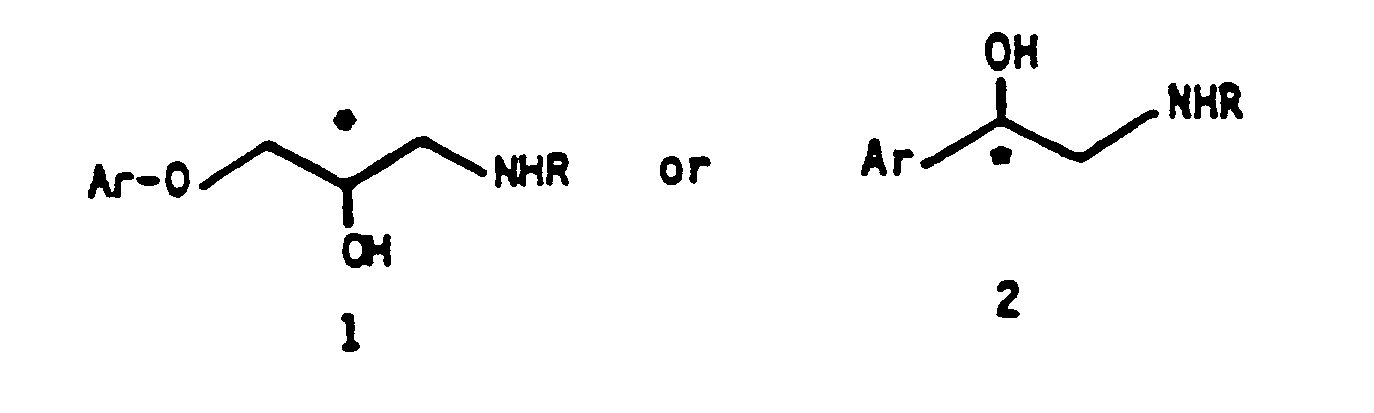
[0001] Aryloxypropanolamines (1) and arylethanolamines (2) are widely used therapeutic agents, particularly those compounds possessing potent beta-adrenergic receptor blocking activity. Use beta-adrenergic blocking agents are widely used for a number of cardiovascular therapeutic indications, such as hypertension, angina pectoris, cardiac arrhythmias, myocardial infarction and more recently in the treatment of glaucoma. In addition, certain aryloxypropanolamines possess potent beta-adrenergic stimulating properties and such compounds are used as cardiac stimulants.
[0002] Among beta-blocker oxypropanolamines, the R isomers are less active or essentially devoid of beta-blocking activity as compared to their counterpart S isomers. Similarly, the R-isomer beta-agonists are are potent agents than their S-isomer counterparts
Conventional methods for preparing such compounds utilize HBr/AcOH treatment of the diol 4 to provide the bromoacetoxy 5. Subsequently, the bromoacetoxy 5 is transformed into an epoxide which is then treated with the corresponding amine to provide the desired beta-blocker in separate stages. Such a procedure is described by S. Iriuchijima and N. Kojima, Agric. Biol. Chem. 46 (5), 1153 (1982). The diol 4 may be prepared by hydrolysis of the ketal 3, or, as described by Iriuchijima and Kojima, by reaction of 1,2-diacetoxy-3-chloropropane with a phenol. In such conventional methods, to prepare the optically active aryloxypropanolamines, four steps are required, starting from the ketal 3 or 1,2-diacetoxy-3-chloropropane. An efficient and an economical process for prepare the separate isomers is therefore highly desirable.
US-A-4 202 978 discloses a process wherein a ketal is hydrolysed to the corresponding diol which is reacted with a trialkylorthoacetate to give a cyclic orthoacetate which is converted to a 1-aralkyl-3-halo-propylacetate.
SUMMARY OF THE INVENTION
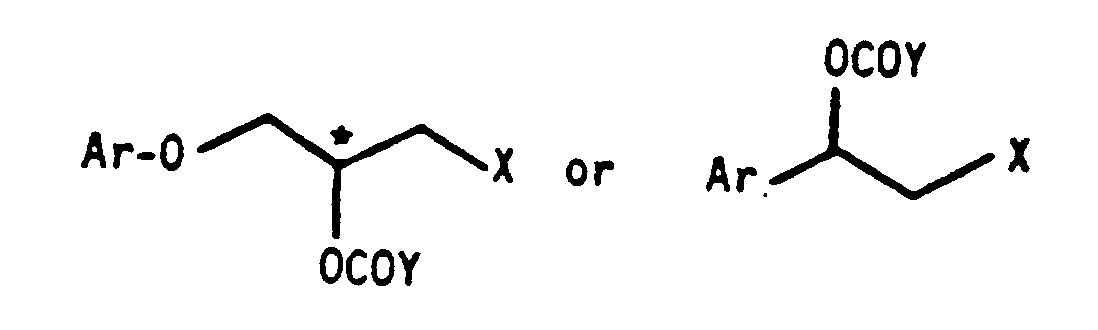
[0003] In accordance with the present invention, there is provided a method of preparing a compound of the formula
wherein Ar is aryl, substituted aryl, heteroaryl, or aralkyl, X is chloro, bromo or iodo and Y is hydrogen, loweralkyl or cycloloweralkyl, which method comprises: reacting a selected racemic or chiral dioxolane of the formula
wherein Ar is defined as above and R₁ and R₂ are each independently hydrogen loweralkyl, cycloloweralkyl, or R₁ and R₂ together with the carbon atom form a 3 to 6 member cycloalkyl group or aryl group, with an acid of formula HX, wherein X is defined as above, in solution in a organic acid of the formula Y-COOH wherein Y is defined as above.
[0004] A racemic or chiral (i.e. optically active) aryloxypropanolamine (1) or arylethanolamine (2) may be prepared by reacting the compound prepared by the method specified in the preceding paragraph with an amine or by reacting the compound with a base to prepare an epoxide and reacting the epoxide with an amine.
In Formula (1) and (2) R is alkyl, aryl, aralkyl or WB wherein W is a straight or branched chain alkylene of from 1 to about 6 carbon atoms and wherein B is -NR₂COR₃, -NR₂CONR₃R₄, -NR₂SO₂R₃, -NR₂SO₂NR₃R₄, or -NR₂COOR₅, where R₂, R₃, R₄, and R₅ may be the same or different and may be hydrogen, all preferably of from 1 to 10 carbons, more preferably from 1 to 6 carbon atoms, alkoxyalkyl, wherein the all groups may be the same or different and preferably contain from 1 to 10 carbon atoms, more preferably from 1 to 6 carbon atoms, alkoxyaryl, wherein the all groups contain from 1 to about 6 atoms, cycloalkyl, preferably of from 3 to 8 carbon atoms, alkenyl, preferably of from 3 to 10 carbon atoms, alkynyl, preferably of from 3 to 10 carbon atoms, aryl, which may be selected from substituted and unsubstituted monocyclic and polycyclic aromatic and heterocyclic ring systems of from 6 to about 10 carbon atoms such as phenyl, thienyl, imidazole and oxazole, indole, heteroaryl, or aralkyl, except that R₃ and R₄ may together with N form a 5-to 7-membered heterocyclic group.
[0005] A specific embodiment of the invention involves the utilization of an HBr/acetic acid (AcOH) mixture to directly convert the ketal (3) to the bromoacetozy (5) without going through the intermediate diol (4). The bromoacetoxy (5) is then allowed to react with a selected amine in an alcoholic medium to provide the desired aryloxypropanolamine. An alternative procedure for the latter reaction is to convert the bromacetoxy (5) to an epoxide followed by amination. The method offers the convenience of fewer reaction steps. More generally, a mixture of a strong acid, HX, where X is chloro, bormo or iodo, in an amount of from 0.1 to 50% in an organic acid, Y-COOH where Y is hydrogen, loweralkyl or cycloalkyl, is used to convert the ketal (3).
DETAILED DESCRIPTION OF THE INVENTION
[0006] As used herein, the term "aryl" may represent a phenyl or naphthyl group which may be unsubstituted or substituted with alkyl of from 1 to about 6 carbon atoms, alkenyl of from 2 to about 6 carbon atoms, alkynyl of from 2 to about 10 carbon atoms, alkoxy wherein the alkyl group contains from 1 to about 6 carbon atoms, halo, acetamido, amino, amido, nitro, alkylamino of from 1 to about 6 carbon atoms, hydroxy, hydroxyalkyl of from 1 to about 6 carbon atoms, cyano or arylalkoxy wherein the alkyl group contains from 1 to about 6 carbon atoms and the aryl group is substituted or unsubstituted phenyl.
[0007] The term "heteroaryl" as used herein may represent pyridine, pyrazine, pyrrole, pyrazole, piperazine, thiophene, benzothiophene, furan, benzofuran, imidazole, oxazole, indole, carbazole, thiazole, thiadiazole, benzothiadiazole, triazole, tetrazole, azepine, 1, 2-diazepine, or 1,4-thiazepine. Preferably, the heteroaryl is selected from the group consisting of pyridine, pyrazine, thiophene, benzothiophene, benzofuran, indole, carbazole, thiadiazole or benzothiadiazole, with the most preferred being pyrazine, indole, 1,2,5-thiadiazole, or benzofuran.
[0008] The term "heterocyclic" as used herein may represent pyrrolidine, piperidine, morpholine, or thiomorpholine.
[0009] In the term "aralkyl" as used herein, the alkyl group may contain from about 1 to about 6 carbon atoms and the aryl group may represent substituted or unsubstituted monocyclic or polycyclic aromatic or heterocyclic ring systems of from 5 to 10 carbon atoms, such as benzyl, phenethyl, 3,4-dimethoxyphenethyl and 1,1-dimethyl-2-(3-indolyl)-ethyl Aromatic (Ar) substituents may include lower alkyl of from 1 to 10 carbons atoms, alkenyl of from 2 to 10 carbon atoms, alkynyl of from 2 to 10 carbon atoms, alkoxy wherein the alkyl group contains from 1 to 10 carbon atoms, halo, acetamido, amino, nitro, alkylamino of from 1 to 10 carbon atoms, hydroxy, hydroxyalkyl of from 1 to 10 carbon atoms, cyano, arylalkoxy wherein the alkyl group contains from 1 to 6 carbon atoms and the aryl group represents substituted or unsubstituted phenyl and groups of the formula
wherein R₃ is lower alkyl, aryl or aralkyl and A is a direct bond, alkylene of from 1 to 10 carbon atoms or alkenylene of from 2 to 10 carbon atoms.
[0010] The term "cycloalkyl" as used herein refers to cyclic saturated aliphatic radicals, which may contain 3 to 6 carbon atoms in the ring, such as cyclopropyl, cyclobutyl, cyclopentyl or cyclohexyl.
[0011] R₃ and R₄ may together with N form a 5- to 7-membered heterocyclic group such as pyrrolidine, piperidine, piperazine morpholine, or thiomorpholine.
[0013] The following reaction schemes incorporate the method of the present invention.
Referring to the scheme, the (R)-(-) or S-(+)-2,2-dimethyl-4-aryloxymethyl-1,3-dioxolane (3) can be made by known methods. For example, the S-enantiomer can be prepared readily by reacting an appropriate phenoxide with S-(+)-2,2-dimethyl-4-(hydroxymethyl)-1,3- dioxolane methanesulfonate or p-toluene-sulfonate.
[0014] The aryloxypropanolamine (1) can be made by reacting the above dioxolane (or ketal) with HBr/Acetic acid, followed by amination with a selected amine.
[0015] If desired, the bromoacetoxy 5 is allowed to react with a suitable base to give the epoxide 6, which is then reacted with a selected amine to prepare the desired aryloxypropanolamine.
[0016] A suitable base for reaction with the bromoacetoxy is a metal alkoxide, metal hydroxide, metal hydride, metal carbonate or metal bicarbonate wherein the metal is sodium, potassium or calcium, or an ammonium hydroxide or a suitable organic base. Preferred organic bases are pyridine, dimethylaminopyridine, dimethylanlline, quinoline, 1,8-Diazabicyclo[5.4.0]undec-7-ene (DBU), 1,5-Diazabicyclo[4,3.0]non-5-ene (DBN) or tertiary alkylamines. Preferred bases are sodium or potassium methoxide, ethoxide or t-butoxide or a tertiary alkyl amine.
[0017] The arylethanolamines can be prepared as follows. The aryl ketal of 1,2-ethanediol can be converted to the corresponding bromoacetate by reacting it with HBr/AcOH. The resulting bromohydrin then can be cyclized to an epoxide by treating it with one equivalent of sodium methoxide. The arylethanolamine can be obtained by treating the epoxide with one equivalent of amine.
[0018] The following beta-adrenergic blocking agents, beta-agonists and partial agonists are representative of the compounds that can be made using the described process:
In order to illustrate the manner in which the above compounds may be made, reference is made to the following examples, which, however, are not meant to limit or restrict the scope of The invention in any respect.
EXAMPLE 1
Preparation of (R)-(-)-2-(1-Naphthyloxy-3-bromo)propyl acetate
[0019]
A mixture of (R)-(-)-2,2-dimethyl-4-napthyloxymethyl-1,3-dioxolane (100 g. 0.38 m), 30% HBr/AcOH (150 g) and AcOH (200 g) was allowed to stand at room temperature for 2 hours. Cyclohexane (1 L) was then added. The resulting mixture was stirred and cooled in an ice bath. The K₂CO₃ (300 g) was added portionwise. After the addition was completed, stirring was continued for 30 minutes. Ice water was then added slowly. The aqueous layer was discarded and The organic layer was further washed with a saturated solution of NaHCO₃. The extract was dried over MgSO₄ and evaporated to an oil (120 g, 96%). This was used in the next step without any further purification.
EXAMPLE 2
Preparation of (S)-(-)-propranolol - Method A
[0020]
A solution of (R)-(-)-2-(1-napthyloxy-3-bromo)propyl acetate (20 g, 6.2 mM) and ispropylamine (5 g) in methanol (50 mL) was refluxed for 1 hour and evaporated to dryness. The residue was taken up with water, basified with K₂CO₃ and extracted twice with ether. The organic layers were combined, washed with water, dried over MgSO₄, filtered and acidified with hydrogen chloride. The solid precipitate was filtered and recrystallized from ethanol to afford 14.6 g (79.6%) of white crystal ins product, m.p. 197-200° C, α
= -26.1 (c 1, EtOH).
EXAMPLE 3
Preparation of (S)(+)glycidyl napththyl ether
[0021]
To a solution of (R)-(-)-2-(1-napthyloxy-3-bromo)propyl acetate (120 g, 0.37 m) in methanol (50 mL) was added a solution of 25% MeONa in methanol (96 g). Sodium bromide was separated instantaneously. After stirring for 30 minutes, cyclohexane (1 L) was added to the mixture which was washed twice with water. The organic layer was dried over MgSO₄ and evaporated to an oil (70 g, 95%). The crude material was distilled under reduced pressure to yield 62 g (85%) of pure product, bp 130-135° C (0.1-0.2 mmHg), [α]
+27.1 (c 1.1, EtOH). NMR and IR were consistent with the assigned structure.
EXAMPLE 4
Preparation of (S)-(-)-propranolol - Method B
[0022]
A solution of (S)-(+)-glycidyl naphthyl ether (20 g, 0.1 m) and isopropylamine (10 g, 0.17 m) in methanol (100 mL) was refluxed for 1 hour and evaporated to dryness. The residue was taken up with ether (200 mL), washed with water and dried over MgSO₄. After filtering, the filtrate was acididified with gaseous HCl. The crude solid was recrystallized from ethanol to afford 24 g (81%) of pure I-propranolol, mp 198-200° C, [α]
-26.8 (c 1, EtOH). NMR and IR were consistent with the assigned structure.
1. A method of preparing a compound of the formula
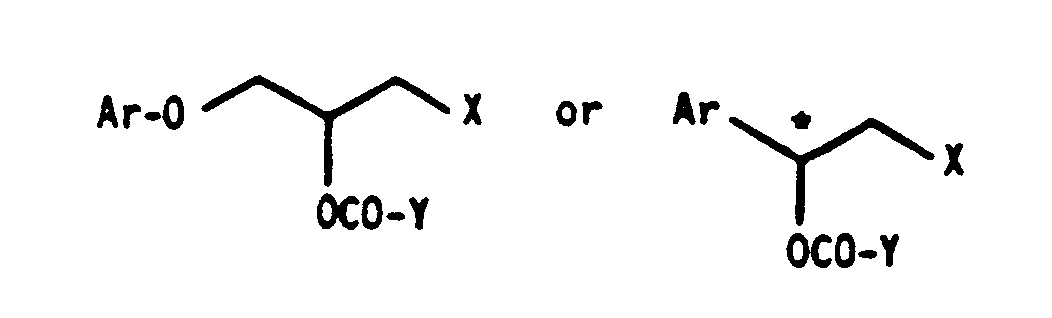
wherein Ar is aryl, substituted aryl, heteroaryl, or aralkyl, X is chloro, bromo or iodo and Y is hydrogen, loweralkyl or cycloloweralkyl, which method comprises: reacting a selected racemic or chiral dioxolane of the formula
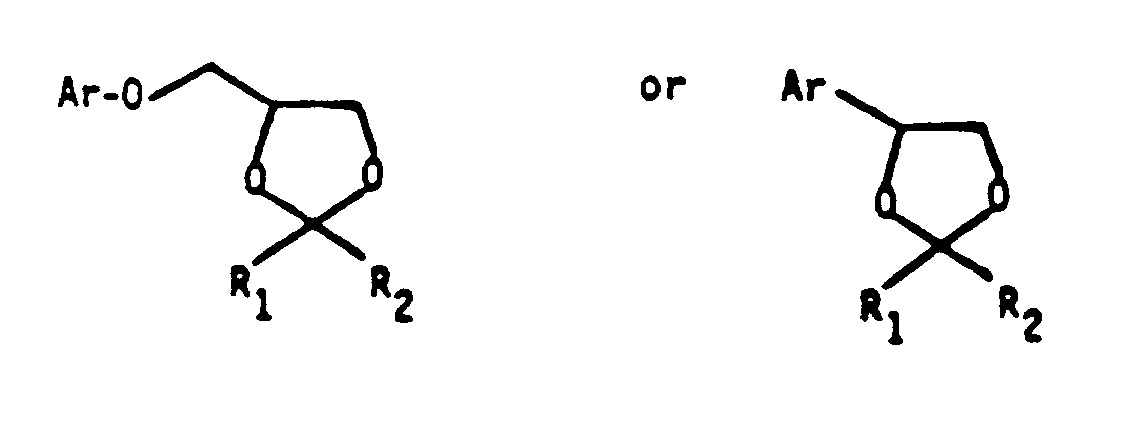
wherein Ar is defined as above and R₁ and R₂ are each independently hydrogen, loweralkyl, cycloloweralkyl, or R₁ and R₂ together with the carbon atom form a 3 to 6 member cycloalkyl group or aryl group, with an acid of formula HX, wherein X is defined as above, in solution in an organic acid of the formula Y-COOH wherein Y is defined as above.
wherein Ar is aryl, substituted aryl, heteroaryl, or aralkyl, X is chloro, bromo or iodo and Y is hydrogen, loweralkyl or cycloloweralkyl, which method comprises: reacting a selected racemic or chiral dioxolane of the formula
wherein Ar is defined as above and R₁ and R₂ are each independently hydrogen, loweralkyl, cycloloweralkyl, or R₁ and R₂ together with the carbon atom form a 3 to 6 member cycloalkyl group or aryl group, with an acid of formula HX, wherein X is defined as above, in solution in an organic acid of the formula Y-COOH wherein Y is defined as above.
2. The method of Claim 1 wherein the solution of acid of the formula HX in the organic
acid of the formula Y-COOH comprises from 0.1 to 50% acid.
3. The method of Claim 1 or 2 wherein HX is HBr and the organic acid is acetic acid.
4. The method of Claim 3 wherein the HBr is present in the acetic acid in an amount of
from 0.1 to 50% of the solution.
5. A method of preparing a racemic or chiral aryloxypropanolamine (1) or chiral arylethanolamine
(2) of the formula
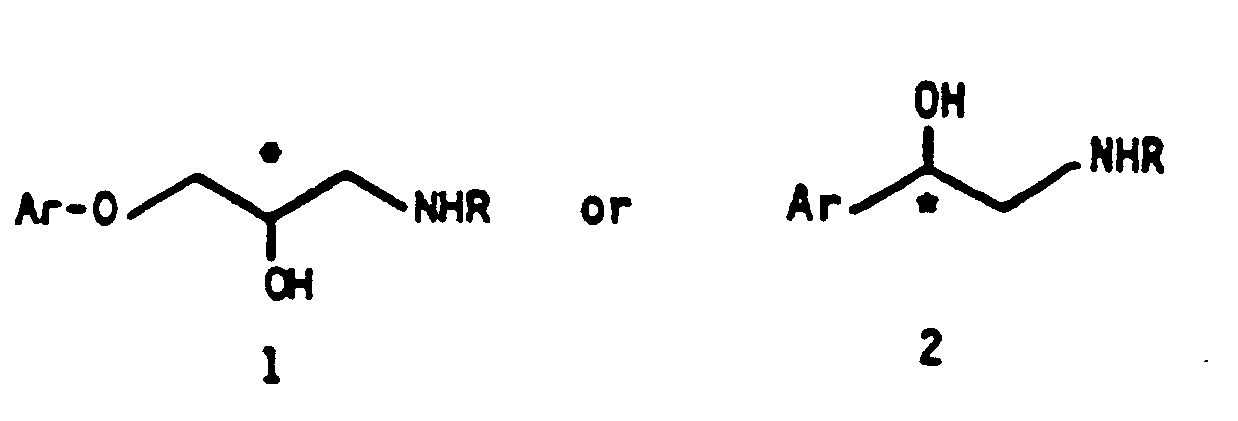
wherein Ar is as defined in claim 1 and R is alkyl, aryl, aralkyl, or WB wherein W is a straight or branched chain alkylene of from 1 to 6 carbon atoms and wherein B is -NR₂COR₃, -NR₂CONR₃R₄, -NR₂SO₂R₃, -NR₂SO₂NR₃R₄, or NR₂COOR₅, where R₂, R₃, R₄, and R₅ may be the same or different and may be hydrogen, alkyl, alkoxyalkyl, alkoxyaryl, cycloalkyl, alkenyl, alkynyl, aryl, heteroaryl, or aralkyl, except that R₃ and R₅ are not hydrogen when B is -NR₂SO₂R₃ or -NR₂COOR₅, or R₃ and R₄ may together with N fom a 5- to 7-membered heterocyclic group, which method comprises: carrying out a method according to any of claims 1 to 4 to prepare a recemic or chiral compound of the formula
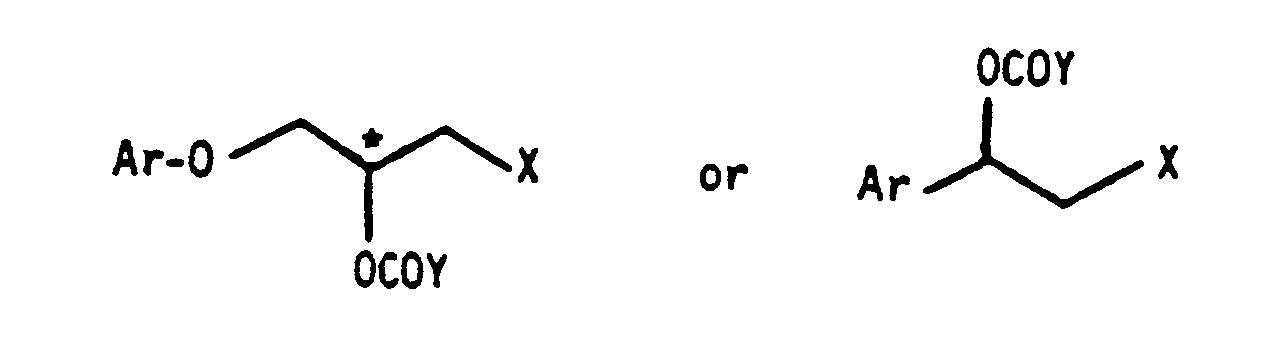
wherein X and Y are as defined in claim 1, and reacting said compound with amine to prepare the aryloxypropanolamine or arylethanolamine.
wherein Ar is as defined in claim 1 and R is alkyl, aryl, aralkyl, or WB wherein W is a straight or branched chain alkylene of from 1 to 6 carbon atoms and wherein B is -NR₂COR₃, -NR₂CONR₃R₄, -NR₂SO₂R₃, -NR₂SO₂NR₃R₄, or NR₂COOR₅, where R₂, R₃, R₄, and R₅ may be the same or different and may be hydrogen, alkyl, alkoxyalkyl, alkoxyaryl, cycloalkyl, alkenyl, alkynyl, aryl, heteroaryl, or aralkyl, except that R₃ and R₅ are not hydrogen when B is -NR₂SO₂R₃ or -NR₂COOR₅, or R₃ and R₄ may together with N fom a 5- to 7-membered heterocyclic group, which method comprises: carrying out a method according to any of claims 1 to 4 to prepare a recemic or chiral compound of the formula
wherein X and Y are as defined in claim 1, and reacting said compound with amine to prepare the aryloxypropanolamine or arylethanolamine.
6. A method of preparing a racemic or chiral aryloxypropanolamine (1) or chiral arylethanolamine
(2) of the formula
wherein Ar is as defined in claim 1 and R is alkyl, aryl, aralkyl, or WB wherein W is a straight or branched chain alkylene of from 1 to 6 carbon atoms and wherein B is -NR₂COR₃, -NR₂CONR₃R₄, -NR₂SO₂R₃, -NR₂SO₂NR₃R₄, or -NR₂COOR₅, where R₂, R₃, R₄, and R₅ and be the same or different and may be hydrogen, alkyl, alkoxyalkyl, alkoxyaryl, cycloakyl, alkenyl, alkynyl, aryl, heteroaryl, or aralkyl, except that R₃ and R₄ are not hydrogen when B is -NR₂SO₂R₃ or -NR₂COOR₅, or R₃ and R₄ nay together with N form a 5- to 7-membered heterocyclic group, which method comprises: carrying out a method according to any of claims 1 to 4 to prepare a racemic or chiral compound of the formula
wherein X and Y are as defined in claim 1, reacting said compound with a base to prepare an epoxide, and reacting said epoxide with amine to prepare the aryloxypropanolamine or arylethanolamine.
wherein Ar is as defined in claim 1 and R is alkyl, aryl, aralkyl, or WB wherein W is a straight or branched chain alkylene of from 1 to 6 carbon atoms and wherein B is -NR₂COR₃, -NR₂CONR₃R₄, -NR₂SO₂R₃, -NR₂SO₂NR₃R₄, or -NR₂COOR₅, where R₂, R₃, R₄, and R₅ and be the same or different and may be hydrogen, alkyl, alkoxyalkyl, alkoxyaryl, cycloakyl, alkenyl, alkynyl, aryl, heteroaryl, or aralkyl, except that R₃ and R₄ are not hydrogen when B is -NR₂SO₂R₃ or -NR₂COOR₅, or R₃ and R₄ nay together with N form a 5- to 7-membered heterocyclic group, which method comprises: carrying out a method according to any of claims 1 to 4 to prepare a racemic or chiral compound of the formula
wherein X and Y are as defined in claim 1, reacting said compound with a base to prepare an epoxide, and reacting said epoxide with amine to prepare the aryloxypropanolamine or arylethanolamine.
1. Verfahren zur Herstellung einer Verbindung der Formel
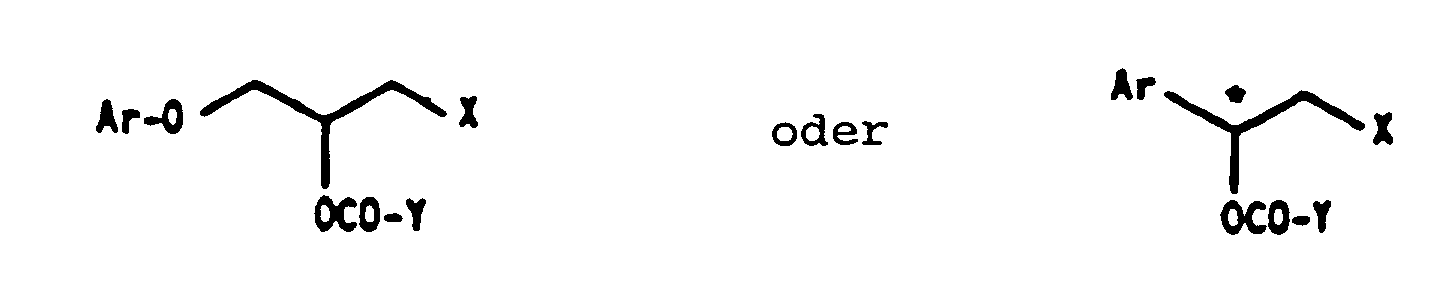
worin Ar Aryl, substituiertes Aryl, Heteroaryl oder Aralkyl ist, X Chlor, Brom oder Iod ist, und Y Wasserstoff, Niederalkyl oder Cyclo-Niederalkyl ist, umfassend die Umsetzung eines ausgewählten racemischen oder chiralen Dioxolans der Formel
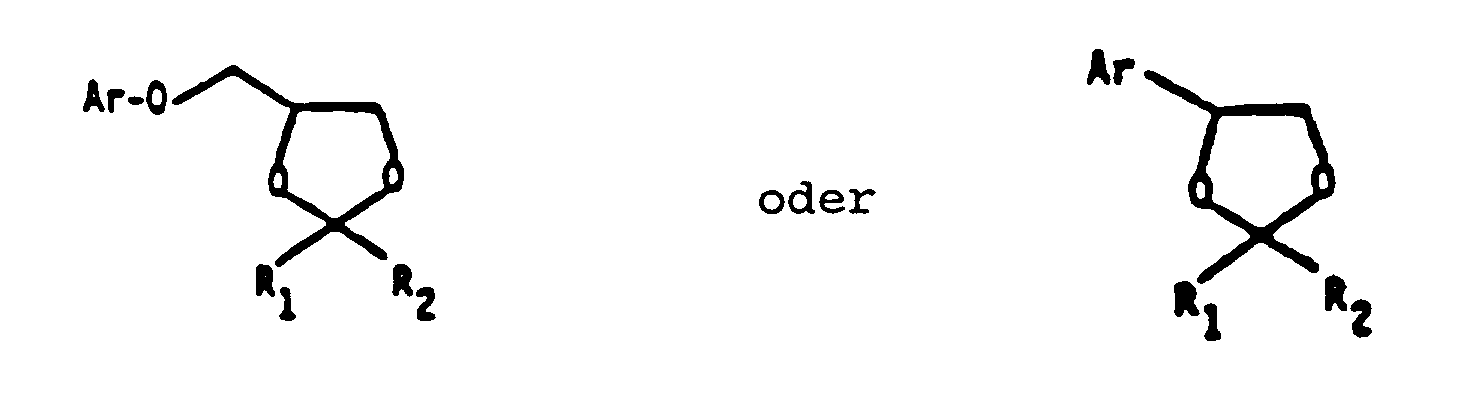
worin Ar wie oben definiert ist, und R₁ und R₂ jeweils unabhängig Wasserstoff, Niederalkyl oder Cyclo-Niederalkyl sind, oder R₁ und R₂ zusammen mit dem Kohlenstoff-Atom eine 3- bis 6gliedrige Cycloalkyl-Gruppe oder Aryl-Gruppe bilden, mit einer Säure der Formel HX, worin X wie vorstehend definiert ist, in Lösung in einer organischen Säure der Formel Y-COOH, worin Y wie vorstehend definiert ist.
worin Ar Aryl, substituiertes Aryl, Heteroaryl oder Aralkyl ist, X Chlor, Brom oder Iod ist, und Y Wasserstoff, Niederalkyl oder Cyclo-Niederalkyl ist, umfassend die Umsetzung eines ausgewählten racemischen oder chiralen Dioxolans der Formel
worin Ar wie oben definiert ist, und R₁ und R₂ jeweils unabhängig Wasserstoff, Niederalkyl oder Cyclo-Niederalkyl sind, oder R₁ und R₂ zusammen mit dem Kohlenstoff-Atom eine 3- bis 6gliedrige Cycloalkyl-Gruppe oder Aryl-Gruppe bilden, mit einer Säure der Formel HX, worin X wie vorstehend definiert ist, in Lösung in einer organischen Säure der Formel Y-COOH, worin Y wie vorstehend definiert ist.
2. Verfahren nach Anspruch 1, wobei die Lösung der Säure der Formel HX in Lösung in der
organischen Säure der Formel Y-COOH 0,1 bis 50% Säure umfaßt.
3. Verfahren nach Anspruch 1 oder 2, wobei HX HBr ist und die organische Säure Essigsäure
ist.
4. Verfahren nach Anspruch 3, wobei HBr in der Essigsäure in einer Menge von 0,1 bis
50% der Lösung vorhanden ist.
5. Verfahren zur Herstellung eines racemischen oder chiralen Aryloxypropanolamins (1)
oder eines chiralen Arylethanolamins (2) der Formel
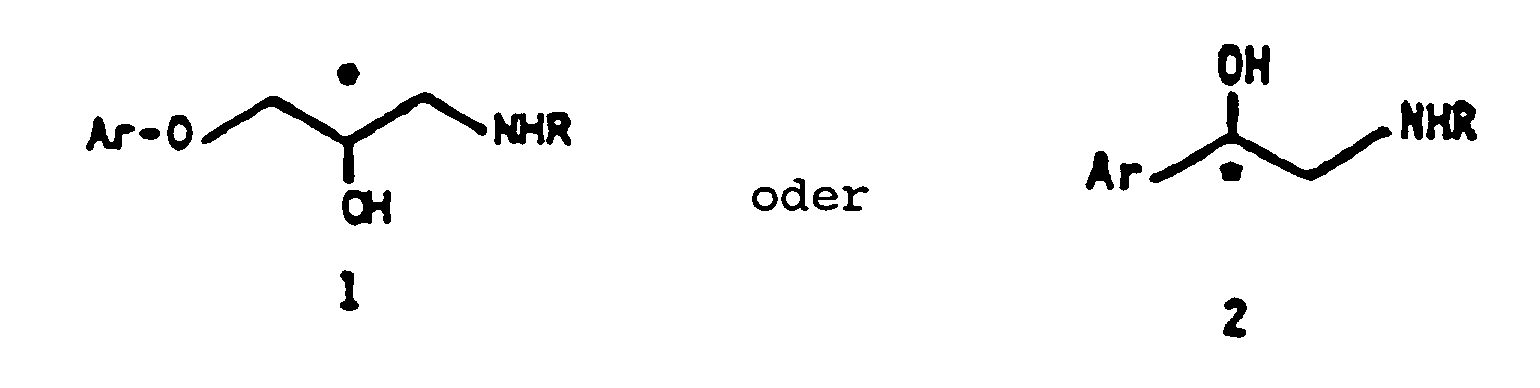
worin Ar wie in Anspruch 1 definiert ist, und R Alkyl, Aryl, Aralkyl oder WB ist, worin W ein lineares oder verzweigtkettiges Alkylen mit 1 bis 6 Kohlenstoff-Atomen ist und worin B -NR₂COR₃, -NR₂CONR₃R₄, -NR₂SO₂R₃, -NR₂SO₂NR₃R₄ oder -NR₂COOR₅ ist, worin R₂, R₃, R₄ und R₅ gleich oder verschieden sein können und Wasserstoff, Alkyl, Alkoxyalkyl, Alkoxyaryl, Cycloalkyl, Alkenyl, Alkinyl, Aryl, Heteroaryl oder Aralkyl sind, außer daß R₃ und R₅ nicht Wasserstoff sind, wenn B -NR₂SO₂R₃ oder -NR₂COOR₅ ist, oder R₃ und R₄ zusammen mit N eine 5- bis 7gliedrige heterocyclische Gruppe bilden können, umfassend die Durchführung eines Verfahrens nach irgendeinem der Ansprüche 1 bis 4, um eine racemische oder chirale Verbindung der Formel
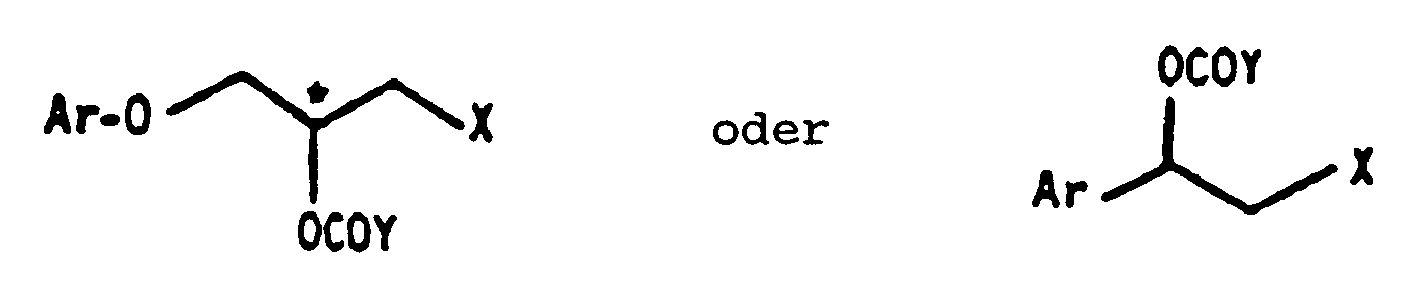
herzustellen, worin X und Y wie in Anspruch 1 definiert sind, und die Umsetzung der Verbindung mit einem Amin, um das Aryloxypropanolamin oder Arylethanolamin herzustellen.
worin Ar wie in Anspruch 1 definiert ist, und R Alkyl, Aryl, Aralkyl oder WB ist, worin W ein lineares oder verzweigtkettiges Alkylen mit 1 bis 6 Kohlenstoff-Atomen ist und worin B -NR₂COR₃, -NR₂CONR₃R₄, -NR₂SO₂R₃, -NR₂SO₂NR₃R₄ oder -NR₂COOR₅ ist, worin R₂, R₃, R₄ und R₅ gleich oder verschieden sein können und Wasserstoff, Alkyl, Alkoxyalkyl, Alkoxyaryl, Cycloalkyl, Alkenyl, Alkinyl, Aryl, Heteroaryl oder Aralkyl sind, außer daß R₃ und R₅ nicht Wasserstoff sind, wenn B -NR₂SO₂R₃ oder -NR₂COOR₅ ist, oder R₃ und R₄ zusammen mit N eine 5- bis 7gliedrige heterocyclische Gruppe bilden können, umfassend die Durchführung eines Verfahrens nach irgendeinem der Ansprüche 1 bis 4, um eine racemische oder chirale Verbindung der Formel
herzustellen, worin X und Y wie in Anspruch 1 definiert sind, und die Umsetzung der Verbindung mit einem Amin, um das Aryloxypropanolamin oder Arylethanolamin herzustellen.
6. Verfahren zur Herstellung eines racemischen oder chiralen Aryloxypropanolamins (1)
oder eines chiralen Arylethanolamins (2) der Formel
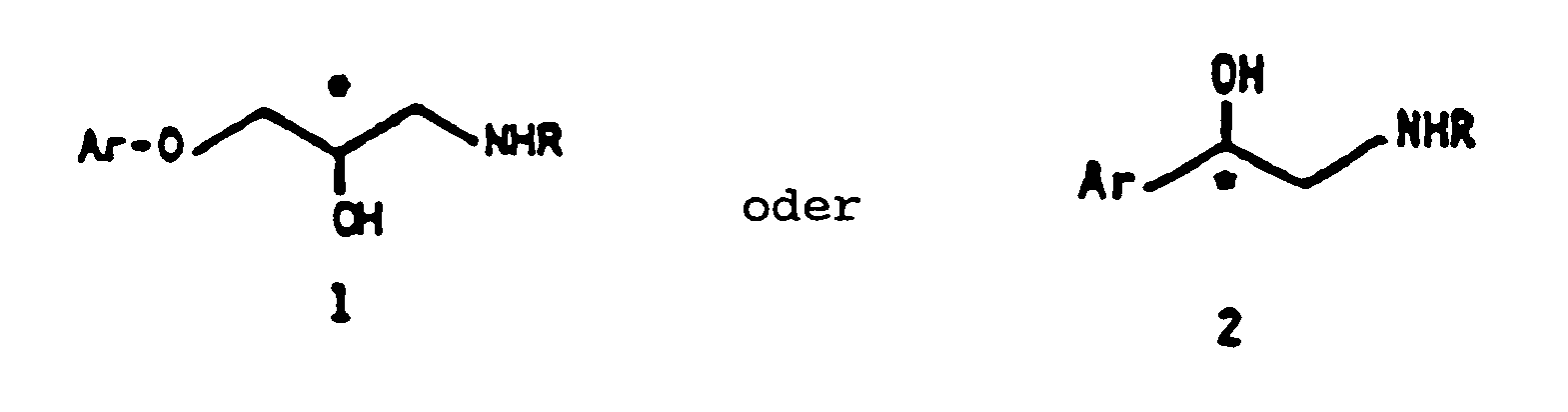
worin Ar wie in Anspruch 1 definiert ist, und R Alkyl, Aryl, Aralkyl oder WB ist, worin W ein lineares oder verzweigtkettiges Alkylen mit 1 bis 6 Kohlenstoff-Atomen ist und worin B -NR₂COR₃, -NR₂CONR₃R₄, -NR₂SO₂R₃, -NR₂SO₂NR₃R₄ oder -NR₂COOR₅ ist, worin R₂, R₃, R₄ und R₅ gleich oder verschieden sein können und Wasserstoff, Alkyl, Alkoxyalkyl, Alkoxyaryl, Cycloalkyl, Alkenyl, Alkinyl, Aryl, Heteroaryl oder Aralkyl sind, außer daß R₃ und R₄ nicht Wasserstoff sind, wenn B -NR₂SO₂R₃ oder -NR₂COOR₅ ist, oder R₃ und R₄ zusammen mit N eine 5- bis 7gliedrige heterocyclische Gruppe bilden können, umfassend die Durchführung eines Verfahrens nach irgendeinem der Ansprüche 1 bis 4, um eine racemische oder chirale Verbindung der Formel

herzustellen, worin X und Y wie in Anspruch 1 definiert sind, Umsetzung der Verbindung mit einer Base, um ein Epoxid herzustellen, und Umsetzung des Epoxids mit einem Amin, um das Aryloxypropanolamin oder Arylethanolamin herzustellen.
worin Ar wie in Anspruch 1 definiert ist, und R Alkyl, Aryl, Aralkyl oder WB ist, worin W ein lineares oder verzweigtkettiges Alkylen mit 1 bis 6 Kohlenstoff-Atomen ist und worin B -NR₂COR₃, -NR₂CONR₃R₄, -NR₂SO₂R₃, -NR₂SO₂NR₃R₄ oder -NR₂COOR₅ ist, worin R₂, R₃, R₄ und R₅ gleich oder verschieden sein können und Wasserstoff, Alkyl, Alkoxyalkyl, Alkoxyaryl, Cycloalkyl, Alkenyl, Alkinyl, Aryl, Heteroaryl oder Aralkyl sind, außer daß R₃ und R₄ nicht Wasserstoff sind, wenn B -NR₂SO₂R₃ oder -NR₂COOR₅ ist, oder R₃ und R₄ zusammen mit N eine 5- bis 7gliedrige heterocyclische Gruppe bilden können, umfassend die Durchführung eines Verfahrens nach irgendeinem der Ansprüche 1 bis 4, um eine racemische oder chirale Verbindung der Formel
herzustellen, worin X und Y wie in Anspruch 1 definiert sind, Umsetzung der Verbindung mit einer Base, um ein Epoxid herzustellen, und Umsetzung des Epoxids mit einem Amin, um das Aryloxypropanolamin oder Arylethanolamin herzustellen.
1. Un procédé de préparation d'un composé de la formule
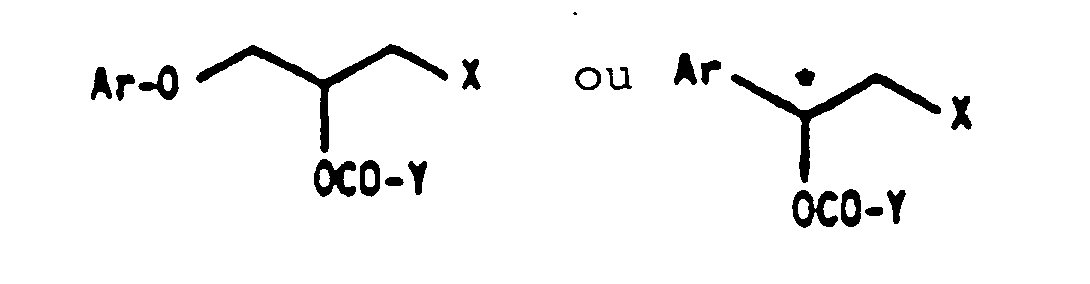
dans laquelle Ar est un groupe aryle, aryle substitué, hétéroaryle, ou aralkyle, X est un atome de chlore, brome ou iode et Y est de l'hydrogène, un groupe alkyle inférieur ou cyclo(alkyle inférieur), ce procédé consistant à : faire réagir un dioxolane racémique ou chiral choisi de la formule
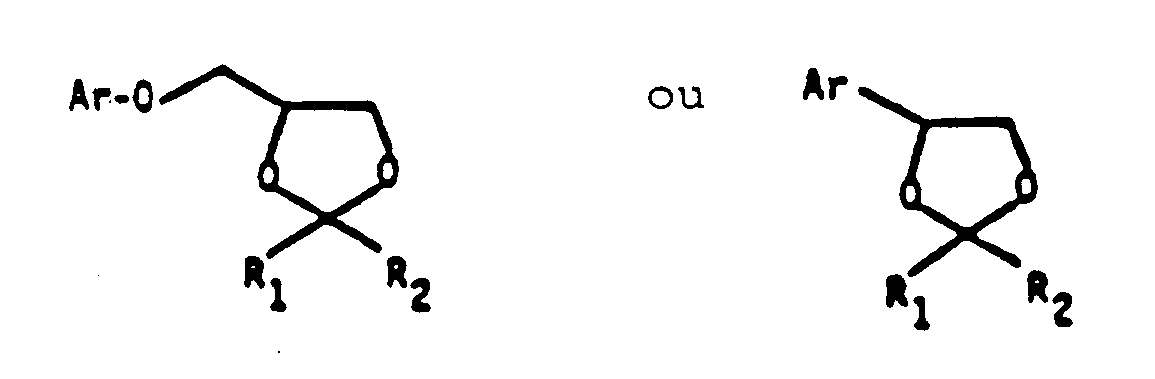
dans laquelle Ar est tel que défini ci-dessus et R₁ et R₂ sont chacun indépendemment de l'hydrogène, un groupe alkyle inférieur, cyclo (alkyle inférieur), ou R₁ et R₂ ensemble avec l'atome de carbone forment un groupe aryle ou un groupe cycloalkyle comportant de 3 à 6 chaînons, avec un acide de formule HX, dans laquelle X est tel que défini ci-dessus, en solution dans un acide organique de la formule Y-COOH dans laquelle Y est tel que défini ci-dessus.
dans laquelle Ar est un groupe aryle, aryle substitué, hétéroaryle, ou aralkyle, X est un atome de chlore, brome ou iode et Y est de l'hydrogène, un groupe alkyle inférieur ou cyclo(alkyle inférieur), ce procédé consistant à : faire réagir un dioxolane racémique ou chiral choisi de la formule
dans laquelle Ar est tel que défini ci-dessus et R₁ et R₂ sont chacun indépendemment de l'hydrogène, un groupe alkyle inférieur, cyclo (alkyle inférieur), ou R₁ et R₂ ensemble avec l'atome de carbone forment un groupe aryle ou un groupe cycloalkyle comportant de 3 à 6 chaînons, avec un acide de formule HX, dans laquelle X est tel que défini ci-dessus, en solution dans un acide organique de la formule Y-COOH dans laquelle Y est tel que défini ci-dessus.
2. Le procédé de la revendication 1 dans lequel la solution d'acide de la formule HX
dans l'acide organique de la formule Y-COOH comprend de 0,1 à 50 % d'acide.
3. Le procédé de la revendication 1 ou 2 dans lequel HX est HBr et l'acide organique
est de l'acide acétique.
4. Le procédé de la revendication 3 dans lequel le HBr est présent dans l'acide acétique
dans une quantité allant de 0,1 à 50 % de la solution.
5. Un procédé de préparation d'une aryloxypropanolamine (1) racémique ou chirale ou d'une
aryléthanolamine (2) chirale de la formule
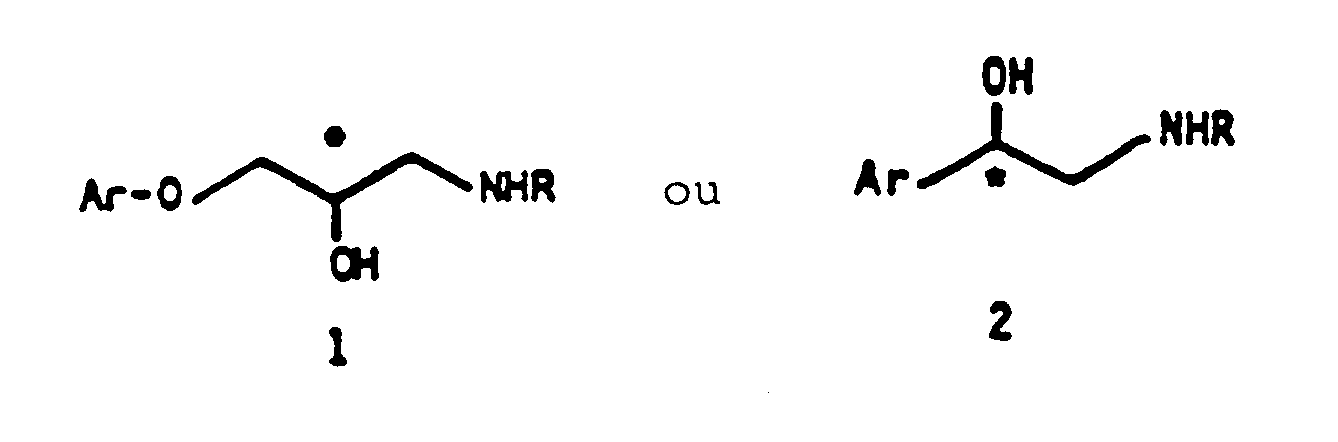
dans laquelle Ar est tel que défini dans la revendication 1 et R est un groupe alkyle, aryle, aralkyle, ou WB dans lequel W est un groupe alkylène à chaîne linéaire ou ramifiée de 1 à 6 atomes de carbone et dans lequel B est - NR₂COR₃, -NR₂CONR₃R₄, -NR₂SO₂R₃, -NR₂SO₂NR₃R₄, ou NR₂COOR₅, où R₂, R₃, R₄ et R₅ peuvent être identiques ou différents et peuvent être de l'hydrogène, un groupe alkyle, alcoxyalkyle, alcoxyaryle, cycloalkyle, alcényle, alcynyle, aryle, hétéroaryle, ou aralkyle, si ce n'est que R₃ et R₅ ne sont pas de l'hydrogène lorsque B est -NR₂SO₂R₃ ou - NR₂COOR₅, ou R₃ et R₄ peuvent ensemble avec N former un groupe hétérocyclique comportant de 5 à 7 chaînons, ce procédé consistant à : mettre en oeuvre un procédé selon l'une quelconque des revendications 1 à 4 pour préparer un composé racémique ou chiral de la formule
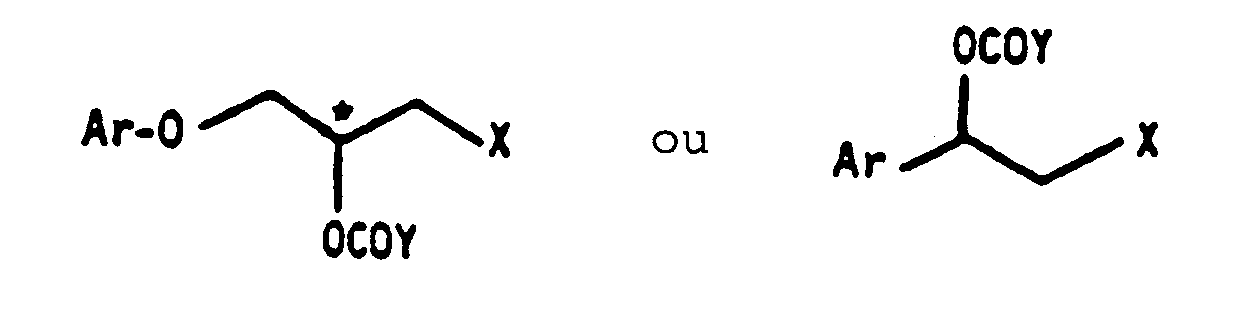
dans laquelle X et Y sont tels que définis dans la revendication 1, et faire réagir ledit composé avec une amine pour préparer l'aryloxypropanolamine ou l'aryléthanolamine.
dans laquelle Ar est tel que défini dans la revendication 1 et R est un groupe alkyle, aryle, aralkyle, ou WB dans lequel W est un groupe alkylène à chaîne linéaire ou ramifiée de 1 à 6 atomes de carbone et dans lequel B est - NR₂COR₃, -NR₂CONR₃R₄, -NR₂SO₂R₃, -NR₂SO₂NR₃R₄, ou NR₂COOR₅, où R₂, R₃, R₄ et R₅ peuvent être identiques ou différents et peuvent être de l'hydrogène, un groupe alkyle, alcoxyalkyle, alcoxyaryle, cycloalkyle, alcényle, alcynyle, aryle, hétéroaryle, ou aralkyle, si ce n'est que R₃ et R₅ ne sont pas de l'hydrogène lorsque B est -NR₂SO₂R₃ ou - NR₂COOR₅, ou R₃ et R₄ peuvent ensemble avec N former un groupe hétérocyclique comportant de 5 à 7 chaînons, ce procédé consistant à : mettre en oeuvre un procédé selon l'une quelconque des revendications 1 à 4 pour préparer un composé racémique ou chiral de la formule
dans laquelle X et Y sont tels que définis dans la revendication 1, et faire réagir ledit composé avec une amine pour préparer l'aryloxypropanolamine ou l'aryléthanolamine.
6. Un procédé de préparation d'une aryloxypropanolamine racémique ou chirale (1) ou d'une
aryléthanolamine chirale (2) de la formule
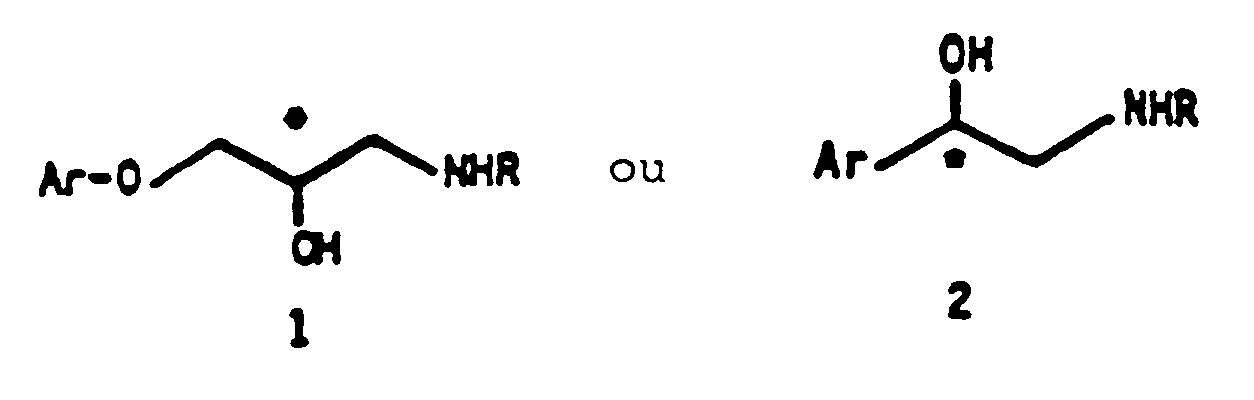
dans laquelle Ar est tel que défini dans la revendication 1 et R est un groupe alkyle, aryle, aralkyle, ou WB dans lequel W est un groupe alkylène à chaîne linéaire ou ramifiée de 1 à 6 atomes de carbone et dans lequel B est - NR₂COR₃, -NR₂CONR₃R₄, - -NR₂SO₂R₃, -NR₂SO₂NR₃R₄, ou -NR₂COOR₅, où R₂, R₃, R₄ et R₅ peuvent être identiques ou différents et peuvent être de l'hydrogène, un groupe alkyle, alcoxyalkyle, alcoxyaryle, cycloalkyle, alcényle, alcynyle, aryle, hétéroaryle, ou aralkyle, si ce n'est que R₃ et R₄ ne sont pas de l'hydrogène lorsque B est -NR₂SO₂R₃ ou - NR₂COOR₅, ou R₃ et R₄ peuvent ensemble avec N former un groupe hétérocyclique comportant de 5 à 7 chaînons, ce procédé consistant à : mettre en oeuvre un procédé selon l'une quelconque des revendications 1 à 4 pour préparer un composé racémique ou chiral de la formule
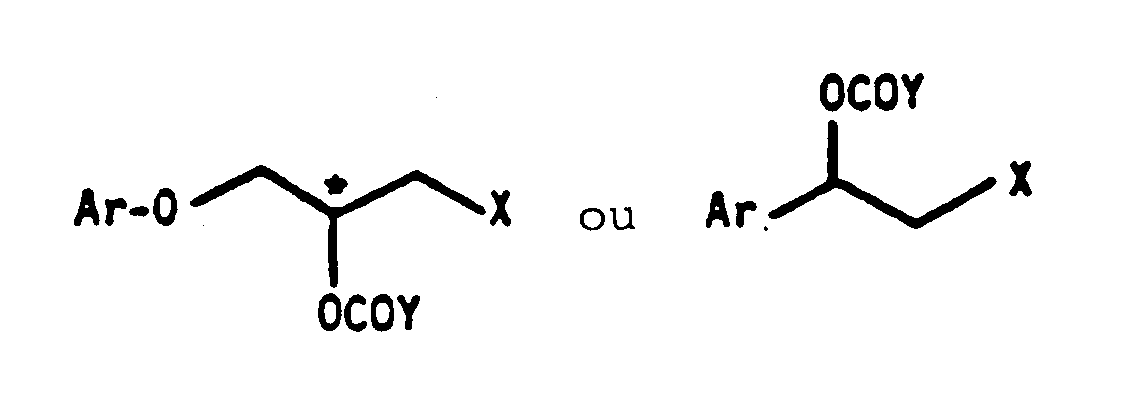
dans laquelle X et Y sont tels que définis dans la revendication 1, faire réagir ledit composé avec une base pour préparer un époxyde, et faire réagir ledit époxyde avec l'amine afin de préparer l'aryloxypropanolamine ou l'aryléthanolamine.
dans laquelle Ar est tel que défini dans la revendication 1 et R est un groupe alkyle, aryle, aralkyle, ou WB dans lequel W est un groupe alkylène à chaîne linéaire ou ramifiée de 1 à 6 atomes de carbone et dans lequel B est - NR₂COR₃, -NR₂CONR₃R₄, - -NR₂SO₂R₃, -NR₂SO₂NR₃R₄, ou -NR₂COOR₅, où R₂, R₃, R₄ et R₅ peuvent être identiques ou différents et peuvent être de l'hydrogène, un groupe alkyle, alcoxyalkyle, alcoxyaryle, cycloalkyle, alcényle, alcynyle, aryle, hétéroaryle, ou aralkyle, si ce n'est que R₃ et R₄ ne sont pas de l'hydrogène lorsque B est -NR₂SO₂R₃ ou - NR₂COOR₅, ou R₃ et R₄ peuvent ensemble avec N former un groupe hétérocyclique comportant de 5 à 7 chaînons, ce procédé consistant à : mettre en oeuvre un procédé selon l'une quelconque des revendications 1 à 4 pour préparer un composé racémique ou chiral de la formule
dans laquelle X et Y sont tels que définis dans la revendication 1, faire réagir ledit composé avec une base pour préparer un époxyde, et faire réagir ledit époxyde avec l'amine afin de préparer l'aryloxypropanolamine ou l'aryléthanolamine.