| (19) |
 |
|
(11) |
EP 0 249 833 B1 |
| (12) |
EUROPEAN PATENT SPECIFICATION |
| (45) |
Mention of the grant of the patent: |
|
24.10.1990 Bulletin 1990/43 |
| (22) |
Date of filing: 05.06.1987 |
|
|
| (54) |
An engine retarding system and method of a gas compression release type
Motorbremsvorrichtung und Verfahren zum Motorbremsen durch Entspannung der Kompression
Dispositif et méthode de freinage d'un moteur du type à relâchement de la compression
|
| (84) |
Designated Contracting States: |
|
AT BE CH DE FR GB IT LI LU NL SE |
| (30) |
Priority: |
10.06.1986 US 872494
|
| (43) |
Date of publication of application: |
|
23.12.1987 Bulletin 1987/52 |
| (73) |
Proprietor: THE JACOBS MANUFACTURING COMPANY |
|
Bloomfield
Connecticut 06002 (US) |
|
| (72) |
Inventors: |
|
- Meistrick,Zdenek Sidonius
Bloomfield
Connecticut 06002 (US)
- Quenneville, Raymond Noel
Suffield
Connecticut 06078 (US)
|
| (74) |
Representative: KOHLER SCHMID + PARTNER |
|
Patentanwälte
Ruppmannstrasse 27
70565 Stuttgart
70565 Stuttgart (DE) |
| (56) |
References cited: :
DE-A- 2 423 643
US-A- 3 405 699
US-A- 4 485 780
|
DE-A- 2 805 040
US-A- 4 398 510
|
|
| |
|
|
|
|
| |
|
| Note: Within nine months from the publication of the mention of the grant of the European
patent, any person may give notice to the European Patent Office of opposition to
the European patent
granted. Notice of opposition shall be filed in a written reasoned statement. It shall
not be deemed to
have been filed until the opposition fee has been paid. (Art. 99(1) European Patent
Convention).
|
BACKGROUND OF THE INVENTION
1. Field of the Invention
[0001] The present invention relates to an engine retarding system and method of a gas compression
release type. More particularly, the invention relates to a system and method for
modifying the motion of the exhaust valve so as to open the valve more rapidly and
at a predetermined time. The invention is particularly adapted for use in engines
where the retarder is driven from an exhaust or intake cam.
2. The Prior Art
[0002] Engine retarders of the compression release type are well known in the art. In general,
such retarders are designed temporarily to convert an internal combustion engine into
an air compressor so as to develop a retarding horsepower which may be a substantial
portion of the operating horsepower normally developed by the engine in its powering
mode.
[0003] The basic design of the compression release engine retarder is disclosed in the Cummins
U.S. Patent 3,220,392. That design employs an hydraulic system wherein the motion
of a master piston actuated by an intake, exhaust or injector pushrod or rocker arm
controls the motion of a slave piston which, in turn opens the exhaust valve near
its top dead center position whereby the work done during the compression stroke of
the engine piston is not recovered during the expansion or power stroke but, instead,
is dissipated through the engine exhaust and cooling systems.
[0004] With compression ignition engines having a fuel injector driven from a third cam
on the engine camshaft, it has been found to be desirable to derive the motion for
the compression release retarder from the fuel injector pushtube for the cylinder
experiencing the compression release event. The fuel injector pushtube is a desirable
source of motion both because it peaks very shortly after the top dead center (TDC)
position of the piston following the compression stroke and also because the effective
stroke of the injector pushtube is completed in a relatively short period, e.g., 25-30
crankangle degrees. Further development of the injector-driven compression release
retarder has disclosed the desirability of advancing the timing of the compression
release event and this has been accomplished by a timing advance mechanism as disclosed
in Custer U.S. Patent 4,398,510. The Custer mechanism automatically decreases the
clearance or "lash" in the valve train mechanism so that the motion of the injector
pushtube-driven master piston is delivered to the exhaust valve sooner. As the "lash"
approaches zero, the motion of the exhaust valve approaches the motion defined by
the injector cam. Although the total exhaust valve travel can be increased or decreased
by varying the ratio of the diameter of the master and slave pistons (i.e., the "hydraulic
ratio"), the elapsed time during which motion occurs is determined by the motion of
the master piston which, in turn, is defined by the shape of the fuel injector cam.
[0005] Many compression ignition engines employ fuel injection systems which are not driven
from the engine camshaft and most spark ignition engines having fuel injection systems
do not use an engine camshaft driven fuel injection system. Such engines, commonly
known as two-cam engines to distinguish them from the three-cam engines referred to
above utilize a remote intake or exhaust valve pushtube or cam to operate the compression
release retarder. The valve motions produced by the intake and exhaust valve cams
are similar to each other but significantly different from the motion produced by
the injector cam. Typically, exhaust and intake valves require more than 90 crankangle
degrees to move from the closed to the fully open position. Additionally, the exhaust
cam generates a motion that begins too early, reaches its peak too late and provides
a total travel which is too great for optimum retarding performance. Partial compensation
for these disadvantages can be effected by increasing the slave piston lash and increasing
the hydraulic ratio of the master and slave pistons. Also, as disclosed in Price et
al U.S. Patent 4 485 780, the rate at which the exhaust valve is opened may be increased
and the time of opening correspondingly decreased by employing a second master piston
driven by an appropriate intake pushtube. Although the time of opening using the invention
of the Price et al Patent 4 485 780 may be reduced from about 90 to about 50 crankangle
degrees, the time is still above that available with an injector cam-driven retarder.
As a result, and prior to the present invention, substantially less retarding horsepower
can be developed from an exhaust cam-driven retarder when both are optimized for the
same engine.
[0006] U.S. Patent 4 592 319 discloses a process for compression release retarding of an
engine having intake and exhaust valves, and intake and exhaust pushtubes means for
each cylinder thereof, an hydraulic slave piston and slave cylinder associated with
each exhaust valve, an hydraulic master piston and master cylinder associated with
one of said intake and exhaust pushtube means, by providing a compression release
retarding system including a plenum interconnected with the slave cylinders and the
master cylinder, a trigger valve interconnected between said plenum and said master
cylinder associated with said one pushtube means through a free piston biased to move
outwardly with respect to said plenum by the pressure in said plenum. This patent
describes a two-cycle retarder which produces one compression release event and one
bleeder event during each engine cycle or two compression release events per cycle.
[0007] U.S. Patent 4 592 319 also discloses an apparatus for the compression release retarding
of a multicylinder four cycle internal combustion engine, in which, for controlling
the timing and rate of opening exhaust valve means to maximize the retarding horse
power during a braking operational mode of the compression release retarding system,
the system comprises plenum means including drive cylinder means and a free piston
means and being connected with the slave piston means, which is in fluid communication
with the master cylinder means in which the master piston means is displaceable by
one pushtube means, trigger valve means operatively connected to the slave piston
means, said trigger valve means having an open and a closed position, and trigger
valve opening means.
[0008] The problem of the present invention is to improve the performance of a compression
release retarder driven from any of the fuel injector, exhaust or intake cams.
[0009] Generally, we solve the noted problem by controlling the timing and the rate of opening
of the exhaust valve to maximize the retarding horsepower. Because with the inventive
system and according to claim 1, the rate at which the exhaust valve is opened is
independent of the shape of the injector, exhaust or intake cam, the cam can be designed
to best serve its primary function.
[0010] More specifically and in accordance with the invention we provide a process for compression
release retarding of an engine, comprising the steps of hydraulically connecting the
plenum with the slave cylinders and the master cylinder so that the plenum is filled
with hydraulic fluid, rapidly increasing the pressure of the hydraulic fluid in said
plenum so as to absorb energy therein by driving the master piston by one of the pushtube
means to bias the free piston in an inward direction with respect to said plenum,
releasing said energy absorbed in said plenum from said plenum at a predetermined
point in the travel of said master piston at a rapid rate by opening the trigger valve
which is a trigger check valve interposed between said plenum and the hydraulic slave
piston by the movement of said master piston, and applying said absorbed energy to
the slave piston through the motion of said free piston outwardly with respect to
said plenum and biased by the pressure in said plenum when the internal combustion
engine piston is approaching its top dead center position during a compression stroke
of the engine.
[0011] We also provide an engine retarding system according to claim 3.
[0012] The trigger check valve means may be set to open at any desired point with respect
to the top dead center position of the engine piston so as to deliver rapidly a predetermined
volume of high pressure oil to the slave piston means, thus opening the exhaust valve
means rapidly at a predetermined time. The hydraulic fluid supply automatically admits
fresh oil as makeup for leakage and automatically limits the maximum pressure in the
plenum to that pressure required to perform the compression release function. While
the invention is particularly adapted for use in two-cam engines where the master
pistons are driven from the exhaust and intake cams, it may also be applied to a three-cam
engine where the master pistons can be driven from any of the injector, exhaust or
intake cams. Accordingly, while the invention is particularly directed to the exhaust
(or intake) cam-driven retarder, it may also be applied to an injector cam-driven
retarder.
Description of the Drawinas
[0013] Additional advantages of the novel combination according to the present invention
will become apparent from the following description of the invention and the accompanying
drawings in which:
Fig. 1 is a schematic diagram of a prior art compression release engine retarder of
a type which may be modified to incorporate the principles and mechanisms of the present
invention.
Fig. 1A is a fragmentary schematic diagram showing an alternative electrical circuit
for the apparatus as shown in Fig. 1.
Fig. 2A is a diagram showing the typical motion of an exhaust valve during the retarding
mode of operation in a retarder driven by an injector cam.
Fig. 2B is a diagram showing the typical motion of an exhaust valve during the retarding
mode of operation in a retarder driven by a remote exhaust or intake cam.
Fig. 3 is a diagram showing the motion of certain master pistons, the exhaust valve
and the pressures at certain points in the mechanism of the present invention as a
function of the crankangle for a complete engine cycle.
Fig. 4 is a schematic diagram of a compression release engine retarder in accordance
with the present invention with the control switch in the "OFF" position.
Fig. 5 is a schematic diagram of a compression release engine retarder in accordance
with the present invention with the control switch in the "ON" position.
Fig. 6 is a schematic diagram of a compression release engine retarder in accordance
with the present invention showing the conditions prevailing during the upward travel
of the intake master piston (about 460 crankangle degrees).
Fig. 7 is a schematic diagram of a compression release engine retarder in accordance
with the present invention showing the conditions prevailing during the upward travel
of the exhaust master piston (about 680 crankangle degrees).
Fig. 8 is a schematic diagram of a compression release engine retarder in accordance
with the present invention showing the conditions prevailing during the initial part
of the compression release event (about 14 crankangle degrees).
Fig. 9 is a schematic diagram of a compression release engine retarder in accordance
with the present invention showing the conditions prevailing at the end of the retarding
cycle (about 140 crankangle degrees).
Fig. 10 is a frag mentary diagram of a modified form of an engine retarder in accordance
with the present invention incorporating a modified trigger check valve and a modified
control check valve.
Fig. 11 A is a cross-sectional view of the modified trigger check valve shown in Fig.
10 in its unactuated position.
Fig. 11 B is a cross-sectional view of the trigger check valve of Fig. 11 A in its
actuated position.
Fig. 12 is a cross-sectional view showing, in more detail, the modified control check
valve indicated in Fig. 10.
Detailed Description of the Invention
[0014] In order that the present invention may clearly be distinguished from the now well-known
compression release engine retarder, reference will first be made to Fig. 1 which
illustrates schematically a typical compression release engine retarder driven from
the injector pushtube for the same cylinder or from the exhaust pushtube for another
cylinder. The retarder housing 10 is attached to the engine head 12 and carries the
mechanism required to perform the retarding function. Typically, for exhaust cam driven
retarders, one housing 10 will contain the mechanism for three cylinders of a six-cylinder
engine and a second housing 10 will be used for the remaining three cylinders. Passageway
14 communicates between a two-position three-way solenoid valve 16 and the low pressure
engine lubricating oil system (not shown). Drain passageway 18 communicates between
the solenoid valve 16 and the engine sump (not shown) while passageway 20 communicates
with control valve chamber 22. In the energized or "on" position of the solenoid valve
16, low pressure oil flows through passageways 14 and 20 and into the control valve
chamber 22. In the deenergized or "off" position of the solenoid 16, passageways 18
and 20 are in communication so as to permit drainage of oil back to the engine sump
(not shown). A two-position control valve 24 is mounted for reciprocatory motion in
the control valve chamber 22 and biased toward the bottom of the chamber 22 by a compression
spring 26. The control valve 24 contains an axial passageway 28 which intersects a
diametral passageway 30. A circumferential groove 32 communicates with the diametral
passageway 30. A ball check valve 34 is biased against a seat 36 formed in the axial
passageway 28 by a compression spring 38. When the solenoid valve 16 is energized,
low pressure oil lifts the control valve 24 against the bias of spring 26 and then
passes the ball check valve 34. A passageway 40 communicates between the control valve
chamber 22 and a slave cylinder 42 located in the housing 10, while a second passageway
44 communicates between the slave cylinder 42 and a master cylinder 46, also located
in the housing 10.
[0015] A slave piston 48 is mounted for reciprocatory motion within the slave cylinder 42.
The slave piston 48 is biased by a compression spring 50 toward an adjusting screw
52 threaded into the housing 10. The adjusting screw 52 is locked in its adjusted
position by a lock nut 54. The lower end of the compression spring 50 seats on a retainer
plate 56 which is located in the slave cylinder 42 by a snap ring 58.
[0016] A master piston 60 is mounted for reciprocatory motion in the master cylinder 46
and is lightly biased in an upwardly direction (as shown in Fig. 1) by a leaf spring
62. The master piston 60 is located so as to register with the adjusting screw mechanism
64 of rocker arm 66. The rocker arm 66 is actuated by a pushtube 68. If the retarder
is driven from the fuel injector cam, rocker arm 66 will be the fuel injector rocker
arm and the pushtube 68 will be the fuel injector pushtube for the cylinder associated
with slave piston 48. However, if the retarder is driven, for example, from an exhaust
valve cam, then the rocker arm 66 and pushtube 68 will be the exhaust valve rocker
arm and pushtube for a cylinder other than the one with which the slave piston 48
is associated.
[0017] The lower end of the slave piston 48 is adapted to contact an exhaust valve crosshead
70. The crosshead 70 is mounted for reciprocatory motion on a pin 72 affixed to the
engine head 12 and is adapted to contact the stems 74 of the dual exhaust valves 76
which are biased toward the closed position by valve springs 78. The line 71 indicates
the rest position of the crosshead 70 when the exhaust valves 76 are closed. During
the powering mode of engine operation, the exhaust valves 76 are opened by the actuation
of the exhaust valve rocker arm 80 which drives the crosshead 70 downwardly (as viewed
in Fig. 1) against the exhaust valve stems 74.
[0018] The electrical control circuit for the retarder comprises a conduit 82 which runs
from the coil of the solenoid valve 16 to a three-position switch 84. Thereafter the
circuit includes, in series, a fuel pump switch 86, a clutch switch 88, a manual or
dash switch 90, a fuse 92, the vehicle battery 94 and a ground 96. Preferably, the
switches 86, 88 and 90 are protected by a diode 98 which is grounded. It is convenient
to use one solenoid valve 16 to actuate control valves 24 associated with one retarder
housing. Thus the switch 84 enables the operator to retard two, four or six cylinders
of a six-cylinder engine in case of a three housing unit as contemplated by Fig. 1
or three or six cylinders of a six cylinder engine in case of a two housing unit as
contemplated by Fig. 1 A. As shown in Fig. 1 A, no separate manual switch 90 is required
since the third position of the three position switch 84 functions as a manual "OFF"
switch. The fuel pump switch 86 and the clutch switch 88 are automatic switches which
ensure that the fuel supply is interrupted during retarding and that the retarder
is turned off whenever the clutch is disengaged. The dash switch 90 enables the operator
to deactivate the system.
[0019] In operation, energizing of the solenoid 16 permits the flow of low pressure oil
through the passageways 14 and 20 into the control valve chamber 22 and thence through
passageways 40 and 44 into the slave cylinder 42 and master cylinder 46. Reverse flow
of oil from the passageway 40 is prevented by the ball check valve 34 located in the
control valve 24. Once the mechanism is filled with oil, upward motion (as viewed
in Fig. 1) of the master piston 60 as a result of the motion of the pushtube 68 will
result in a corresponding downward motion (as viewed in Fig. 1) of the slave piston
48. This, in turn, causes the exhaust valves 76 to open.
[0020] Referring to Fig. 2A which relates to a retarder mechanism driven from the fuel injector
cam, it will be noted that the significant motion of the fuel injector pushtube for
Cylinder No. 1 begins at about 30
° BT-DC as the piston in Cylinder No. 1 is completing its compression stroke. Since
a lash of about 0.018" is normally provided in the valve train mechanism (by means
of the adjusting screw 52) the initial motion of the slave piston 48, shown by curve
100, will take up the lash so that the exhaust valve begins to open at about 25
° BTDC and reaches its maximum opening just after TDC. Thus, the work done in compressing
air during the compression stroke is not recovered during the ensuing expansion stroke.
It may be observed that both the timing of the travel and the extent of the travel
of the slave piston 48 are such that a relatively large retarding horsepower can be
developed by using an injector cam-driven mechanism.
[0021] Fig. 2B shows a typical exhaust valve motion produced during engine retarding when
the motion is derived from a remote exhaust pushtube and exhaust cam. It will be noted
that the slave piston travel curve 102, begins sooner, ends later, travels farther
and its rate of rise is lower than when the motion is derived from the injector cam,
all of which are disadvantageous for purposes of driving the retarder. Also, when
utilizing a remote exhaust cam, the exhaust valve travel must be limited to avoid
interference between the exhaust valve and the engine piston at TDC. This may be accomplished
by in creasing the valve train lash from the usual value of about 0.018" to, for example,
0.070", as shown in Fig. 2B. An advantage of increasing the valve train lash is that
the exhaust valve begins to open at a later time, e.g., about 55
° BTDC, and thus the cylinder pressure can build to a higher level before the compression
release event occurs. However, even when the exhaust cam operation is optimized it
produces significantly less retarding horsepower than an injector cam-driven retarder.
The ideal condition would be, of course, to let the cylinder pressure build to its
maximum and then to open the exhaust valve instantaneously. Applicants provide a mechanism
which approaches this ideal.
[0022] Reference is now made to Fig. 3 which illustrates, graphically, the result of applicants'
method and apparatus. In Fig. 3 the ordinate is pressure or motion plotted against
the crankangle position, as abscissa, where TDC I represents the top dead center position
of the piston in Cylinder No. 1 following the compression stroke and TDC 11 represents
the top dead center position of the piston in Cylinder No. 1 following the exhaust
stroke. Curve 104 represents the motion of the master piston driven by the intake
pushtube for Cylinder No. 1; curve 105 represents the motion of the intake pushtube
for Cylinder No. 1; curve 106 represents the motion of the exhaust pushtube for Cylinder
No. 1; and curve 108 represents the motion of the exhaust pushtube for Cylinder No.
2. Curve 110 shows the variation in the pressure above the master piston driven by
the intake pushtube for Cylinder No. 1; curve 112 shows the variation in the pressure
above the master piston driven by the exhaust pushtube for Cylinder No. 2; curve 114
shows the variation in the cylinder pressure in Cylinder No. 1; and curve 116 shows
the variation in the plenum pressure. Curve 118 shows the motion of the exhaust valve
during engine retarding for Cylinder No. 1 resulting from the mechanism of the present
invention while curve 120 shows the motion of the exhaust valve during engine retarding
for Cylinder No. 1 without the mechanism of the present invention.
[0023] Reference is now made to Figs. 4-9 which show mechanism in accordance with the present
invention in conjunction with the exhaust cam-driven retarder shown in Figs. 1 and
2B. Components which are common to all Figures carry the same designation. Fig. 4
illustrates the condition of the mechanism when the compression retarding system has
been shut off, e.g., the dash switch 90 (Fig. 1) or the three-position switch 84 (Fig.
1A) is in the "OFF" or open position. The mechanisms shown in Figs. 4-9 are related
to the exhaust valve for Cylinder No. 1. It will be understood that a similar mechanism
is provided for each cylinder of the engine. For a six cylinder engine having the
normal firing order 1-5-3-6-2-4 the relationship between the cylinders may be shown
in Table I below:
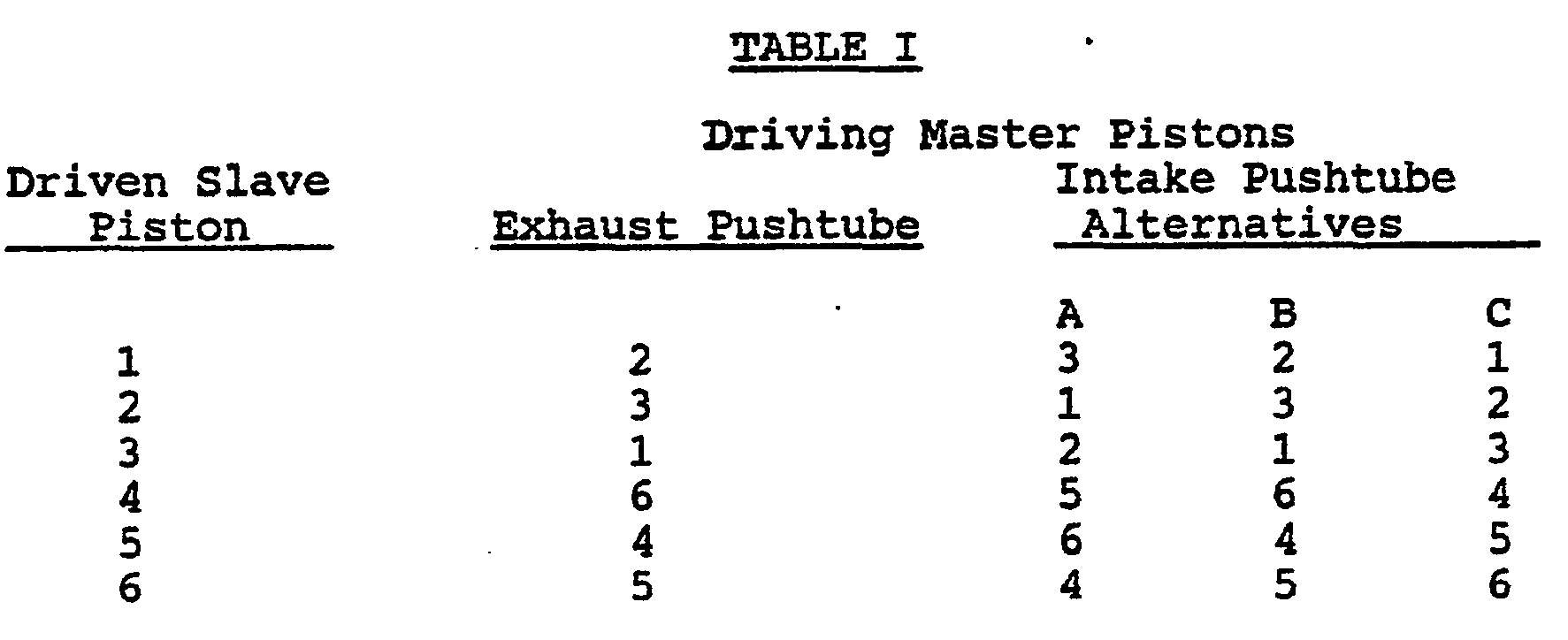
[0024] As the intake master pistons are used to pump up the pressure in the plenum, any
of the three alternatives shown in Table I may be employed based on preference and
ease of manufacture without significantly affecting the performance. For simplicity
of description, Alternative C will be referred to hereafter. The exhaust pushtube
122 for Cylinder No. 2 drives the exhaust rocker arm 124 for Cylinder No. 2 and, through
the adjusting screw mechanism 126, the master piston 128 which reciprocates in the
master cylinder 130 formed in the retarder housing 10. The master piston 128 is biased
upwardly (as viewed in Figs. 4-9) by a light leaf spring 129. Similarly, the intake
pushtube 132 for Cylinder No. 1 drives the intake pushtube 132 for Cylinder No. 1
drives the intake rocker arm 134 for Cylinder No. 1 and, through the adjusting screw
mechanism 136, the master piston 138 which reciprocates in the master cylinder 140
also formed in the retarder housing 10. The master piston 138 is biased in an upwardly
direction (as viewed in Figs. 4-9) by a light leaf spring 139.
[0025] A plenum chamber 142 is formed in the retarder housing 10. The plenum chamber 142
may have any desired shape provided that its volume is large enough to absorb, temporarily,
at a reasonable pressure, energy delivered from the full travel of the intake master
piston and a partial travel of the exhaust master piston sufficient to open the exhaust
valve against the cylinder pressure within two engine cycles. The plenum size is determined
by the bulk modulus of the working fluid, in this case, engine lubricating oil. For
an engine having a displacement of about 2.35 liters per cylinder, applicants have
found that a plenum volume of about 10 cubic inches is sufficient to service three
cylinders. Thus, a standard six cylinder engine may conveniently be provided with
two retarder housings 10, each housing having a 10 cubic inch plenum 142.
[0026] For each engine cylinder it services, the plenum 142 is provided with a driving cylinder
144 within which a free piston 146 may reciprocate against the bias of a compression
spring 148. The cylinder 144 communicates with the plenum 142 through passageway 150.
A passageway 152 communicates between the driving cylinder 144 and a trigger check
valve 154 which controls flow through passageway 156 which, in turn, connects with
passageway 44. Passageway 156 is aligned with, but is isolated from, the master cylinder
130. A pin 158 passing through a lap fit seal in the housing 10 contacts the end of
master piston 128 and passes axially through the passageway156. Pin 158 is of sufficient
length to displace the trigger check valve ball 160 against the bias of the spring
162 and the pressure in the passageway 152 when the master piston 128 approaches the
upper limit of its travel within the master cylinder 130. A bypass 164 communicates
between the master cylinder 130 and passageway 152.
[0027] A passageway 166 communicates between the master cylinder 140 and a control check
valve chamber 168 which, in turn, communicates with the bypass 164 through passageway
170. Control check valve cylinder 172 communicates with passageway 170 through passageway
174. Control check valve piston 176 reciprocates within the control check valve cylinder
172 and is biased toward the upward (as viewed in Figs. 4-9) or open position by a
compression spring 178. The control check valve cylinder 172 is vented through duct
180. Control check valve 182 is located in the control check valve chamber 168 and
connected to the control check valve piston 176 by a rod 184 passing through a lap
fit seal in the housing 10.
[0028] Slave cylinder 42 communicates with the plenum 142 through. a check valve 186 and
a passageway 188. Check valve 186 permits flow only from the slave cylinder 42 toward
the plenum 142.
[0029] It will be understood that mechanisms like those shown connected to passageways 188
and 152 for Cylinder No. 1 are connected to passageways 188' and 152' for Cylinder
No. 2 and to passageways 188" and 152" for Cylinder No. 3. A duplicate system services
Cylinders 4, 5 and 6.
[0030] The operation of the system will now be explained by a sequential reference to Figs.
4 through 9. As noted, Fig. 4 represents the "Off position in which the solenoid valve
16 is closed and the oil in the system (other than the plenum) is vented to the engine
sump. Thus, no oil pressure exists beyond the solenoid valve 16; the control valve
24 is in the "down" (as viewed in Fig. 4) or closed position; trigger check valve
154 is held open by pin 158; control check valve 182 is open because the control check
valve piston 176 is in its upward position (as seen in Fig. 4), the slave piston 48
rests against the stop 52 and the master pistons 128 and 138 are biased away from
the adjusting screw mechanism 126 and 136. It will be appreciated that the retarding
mechanism is out of contact with the operating parts of the engine so that the engine,
in its operating mode, is entirely unaffected by the retarder mechanism.
[0031] Fig. 5 shows the condition of the mechanism when the retarder is turned to the "on"
position. In this mode, the solenoid valve 16 opens and low pressure oil flows from
passageway 14 into passageway 20 and then into the control valve chamber 22 thereby
raising the control valve 24 so that the circumferential groove 32 registers with
passageway 40. Oil then flows past the ball check valve 34, through passageways 40
and 44 into the slave cylinder 42 and through a check valve 186 and passageway 188
into the plenum 142. Also, oil flows through passageways 44 and 156, past the trigger
check valve ball 160 and into the master cylinders 130 and 140 by way of bypass 164
and by way of passageway 170, check valve chamber 168 and passageway 166, causing
the master pistons 128 and 138 to extend downwardly (as viewed in Fig. 5) to contact
the adjusting screw mechanisms 126 and 136. It will be understood that when the low
pressure oil initially fills the system, the pressure is insufficient to cause any
motion of the slave piston 48 or the driving piston 146.
[0032] Reference will now be made to Fig. 6 which shows the conditions occurring at the
peak of the upward motion of the intake pushtube 132 for Cylinder No. 1 (about 400
°; see Fig. 3). As the intake pushtube 132 moves upwardly (as viewed in Fig. 6) the
master piston 138 is driven into the master cylinder 140 and oil is forced through
passageway 166, past control check valve 182 and into the control check valve chamber
168. The control check valve 182 remains in the open position (as viewed in Fig. 5)
until the pressure of the control check valve chamber 168 reaches about 1,000 psi.
At this point, the control check valve 182 closes (as viewed in Fig. 6) and functions
as a check valve. The pressure of the oil in the bypass 164 and the trigger check
valve 154 assures that the trigger check valve ball 160 is seated and that the oil
passes through passageway 152 and into the driving cylinder 144 so as to move the
free piston 146 against the bias of spring 148 thereby rapidly increasing the pressure
of the oil in the plenum 142.
[0033] Reference is now made to Fig. 7 which shows the events which occur at about 680
° crankangle position during a portion of the upward movement (as viewed in Fig. 7)
of exhaust pushtube 122 for Cylinder No. 2. As the exhaust pushtube 122 is driven
upwardly, it, in turn, drives the master piston 128 upwardly (as viewed in Fig. 7)
and forces oil from the master cylinder 130 into the bypass 164, the passageway 152,
the trigger check valve 154 and the driving cylinder 144. The resulting upward movement
(as viewed in Fig. 7) of the free piston 146 causes the pressure to rise further in
the plenum 142.
[0034] At a predetermined point in the travel of master piston 128, the pin 158 contacts
the trigger check valve ball 160 and forces it away from its seat. This event may
occur, for example, at about 695
° crankangle position. When the trigger check valve ball 160 is unseated, a volume
of high pressure oil will be delivered rapidly through passageways 156, 44 (and also
through passageway 40) to the slave cylinder 42 (see Fig. 8). If the amount of energy
is sufficiently high to drive the slave piston 48 downwardly (as viewed in Fig. 8),
the exhaust valve crosshead 70 will be actuated so as to open the exhaust valves near
TDC I and thereby produce a compression release event. If, on the other hand, the
retarder has just been turned on and the pressure in the plenum chamber 142 is relatively
low, the oil delivered to the slave cylinder 42 from the driving cylinder 144 through
passageway 152, on unseating the trigger check valve ball 160, will pass through check
valve 186 and passageway 188 and be delivered to the plenum chamber 142. The oil so
delivered, together with any leakage, will be replaced through the control valve 24
beginning during return motion of the exhaust pushtube 122 for Cylinder No. 2 and
the corresponding downward motion of master piston 128 and ending shortly before 360
° crankangle position when intake pushtube 132 for Cylinder No. 1 is again actuated.
This latter condition is illustrated in Fig. 9 which shows the slave piston 42 in
its rest position against the stop 52, trigger check valve ball 160 seated, and master
pistons 128 and 138 in their lowermost or extended positions.
[0035] It will be noted in Figs. 7 and 8 that the control check valve 182 remains closed
and the master piston 138 remains in the upward position even though the pushtube
132 has retracted. The areas of control check valve 182 and piston 176 are coordinated
with the spring rate of compression spring 178 so that whenever the pressure in passageways
170 and 174 rises above about 1,000 psi the control check valve 182 will close and
will remain closed so as to function as a check valve until the pressure drops below
about 400 psi. This design limits the oil introduced into the system to the amount
required to attain a pressure sufficient to drive the slave piston 48 downwardly and
therby open the exhaust valve, plus leakage. Oil which may leak past the slave piston
48 or the master pistons 128 and 138 is returned to the engine sump along with the
oil used to lubricate the rocker arm assembly. Oil which may leak past the piston
176 and rod 184 is vented to the rocker arm region through vent duct 180. Oil released
from the system over the control valve 24 when the system is turned off returns to
the sump through duct means (not shown).
[0037] Also, the pressure drop during a compression release event depends on the volume
of the plenum. A large plenum will require a number of engine cycles in order to attain
its operating pressure level, but will maintain a more nearly constant pressure level
during operation. As noted above, applicants have found a 10 cubic inch plenum adequate
to service three cylinders of a 12 to 14 liter six cylinder engine. In this arrangement,
operating plenum pressure can be attained within two engine cycles. It will be understood
that applicants have utilized the compliance of the oil contained in the system, and,
particularly in the plenum, to absorb and release the energy delivered by the master
pistons.
[0038] Referring to Fig. 3, the compression release exhaust valve opening (curve 118) is
triggered just before TDC I by the unseating of the trigger check valve ball 160 and
is evidenced by a drop in plenum pressure (curve 116) or pressure above the exhaust
master piston 128 (curve 112). Since the motion of the master piston 128 is precisely
determined by the exhaust cam for Cylinder No. 2, the timing of the opening of the
trigger check valve 154 is determined by the length of the pin 158. Thus, the timing
of the compression release event is fully controllable by the designer. Moreover,
the rate at which the exhaust valve opens depends on the amount of energy delivered
from the driving cylinder 144 to the slave piston 48 and is independent of the shape
of the injector, exhaust or intake cam which may thus be designed to best accommodate
its primary function. However, because the exhaust valve may now be opened very rapidly
and at any desired time, the retarding horsepower can be maximized for a given set
of engine conditions.
[0039] Tests on a six cylinder 14 liter engine equipped with a conventional exhaust cam-driven
retarder produced 275 horsepower at an engine speed of 2100 RPM. When this retarder
was modified to test the concepts of the present invention, the retarding horsepower
was increased by over 100 horsepower at the same engine speed.
[0040] Reference is now made to Fig. 10 which illustrates, in schematic form, a modification
of the trigger and control check valve mechanisms. To the extent that the parts in
Fig. 10 are also shown in Figs. 4-9, the same designators will be used and the earlier
description will not be repeated Modified parts will be designated by a subscript
(a).
[0041] The trigger check valve mechanism comprises a cavity 190 formed in the housing and
communicating at one end with the master cylinder 130 and at the other end with passageway
152. The master cylinder 130 is formed with an annular cavity 192 which communicates
with passageway 44 and permits a flow past the master piston 128 when that piston
is in its uppermost position, as viewed in Fig. 10. A tubular valve element 194 having
a rim 196 at its open end and a hole 198 at the opposite end is biased toward the
bottom of the cavity 190 by a compression spring 200. The compression spring 200 is
positioned between the top of the cavity 190 and the rim 196 of the tubular valve
element 194. A piston 202 is adjustably mounted on one end of a connecting rod 204
for reciprocating movement within the tubular valve element 194. The opposite end
of the connecting rod 204 is fixed to the master piston 128. It will be appreciated
that the piston 202 and tubular valve element 194 function as a valve which opens
whenever the master piston 128 moves far enough in an upward direction so that the
piston 202 raises the tubular valve element 194 off its seat against the bias of compression
spring 200 and the pressure within the cavity 190. Until the tubular valve element
194 is lifted from its seat, motion of the master piston 128 and piston 202 pump hydraulic
fluid from the cavity 190 through passageway 152 and into driving cylinder 144a.
[0042] A firing cylinder 206 is formed within the plenum 142a coaxially with the driving
cylinder 144a. The firing cylinder 206 is vented through passageway 208. A firing
piston 210 is mounted for reciprocatory motion in the firing cylinder 206 and is spaced
from the free piston 146 by a drive pin 212 which passes through a lap fit seal in
the wall of the plenum 142a.
[0043] A check valve chamber 214 is formed in the housing 10 and communicates with passageway
152 through passageway 216 and with the intake master cylinder 140 through passageway
218. Check valve 220 is biased toward a seat formed in the check valve chamber 214
mounted on a guide pin 226 which passes through a lap fit seal in the housing 10.
One end of the guide pin 226 extends into passageway 228 which communicates with the
plenum 142a. It will be noted that the pressure in the plenum 142a is applied to each
side of the check valve 220, but the pressure is applied to different areas. As will
be apparent, the pressure exerted through passageway 216 is applied to the underlying
area of the check valve 220 while the pressure exerted through passageway 228 is applied
to the much smaller upper area of the guide pin 226, as viewed in Fig. 10. -It will
also be observed that when the free piston 146 is seated against the end of the driving
cylinder 144a communicating with passageway 152, the pressure in passageways 152 and
216 may be substantially less than the pressure in the plenum 142a.
[0044] The operation of the mechanism shown in Fig. 10 is substantially like that of the
mechanism shown in Figs. 4-9. When the retarder is in the "OFF" position, the check
valve 220 will be held open so long as the pressure in the plenum 142a exceeds the
pressure in passageway 152. Additionally, since the control valve 24 is in the "down"
position (as shown in Fig. 9) the pressure in passageways 40, 44, 152 and 216 will
be released and the master piston 128 will return to its uppermost position thereby
holding tubular valve element 194 in the open position.
[0045] When the retarder is turned on by energizing the solenoid valve 16, hydraulic fluid
will be pumped at low pressure through passageways 40 and 44 and into master cylinder
130, cavity 190, passageways 152 and 216, check valve chamber 214, passageway 218
and master cylinder 140. When master cylinder 130 is filled, the tubular valve element
194 will seat.
[0046] At about 360 crankangle degrees, the intake valve pushtube for Cylinder No. 1 begins
to drive master piston 138 upwardly (as shown in Fig. 10) so as to apply pressure
to passageways 216 and 152, cavity 190 and free piston 146. When the pressure due
to the motion of master piston 138 exceeds the pressure in the plenum 142a, the free
piston 146 will be displaced upwardly. When master piston 138 stops its upward movement
at about 450
°, the check valve 220 will remain closed, thereby maintaining the pressure in cavity
190.
[0047] At about 630 crankangle degrees, the exhaust pushtube for Cylinder No. 2 begins to
drive master piston 128 upwards (as shown in Fig. 10) thereby further pressurizing
the cavity 190 and driving free piston 146 further in an upward direction. It will
be understood that upward motion of the free piston 146 results in an increase in
the pressure within the plenum 142a.
[0048] At a predetermined point, which may be, for example, about 695 crankangle degrees,
piston 202 driven by the master piston 128 lifts the tubular valve element from its
seat thereby permitting the pressure energy stored in the plenum 142a and the high
pressure fluid under the free piston 146 to be delivered rapidly through passageway
44 to the slave cylinder 42. If the fluid pressure is high enough to overcome the
engine cylinder pressure and the bias of the valve springs 74, the slave piston 48
will drive the crosshead 70 downwardly against the valve stems 74 so as to open the
exhaust valves 76. If the fluid pressure is insufficient to open the engine exhaust
valve, the hydraulic fluid will be pumped through check valve 186 into the plenum
142a. It will be appreciated that a small addition of hydraulic fluid to the plenum
142a will result in a substantial pressure rise in the plenum 142a during the ensuing
cycle.
[0049] Consideration of the mechanism shown in Fig. 10 will reveal that although the lifting
of the tubular valve element 194 signals the beginning of the valve opening event,
the rate at which the slave piston moves downwardly is controlled by the rate at which
the free piston 146 moves downwardly. The rate of motion of free piston 146 is proportional
to the net downward force acting upon the piston 146. Since the fluid pressure on
each side of the free piston 146 and the areas against which it acts are substantially
equal, the net force available to drive the free piston 146 downwardly is substantially
equal to the spring rate of compression spring 148. Although it is desirable to maximize
the rate of spring 148, there are physical constraints in the apparatus which limit
the spring rates which may be employed. In order to increase the net downward force
available to accelerate the free piston 146, applicants provide firing piston 210
and drive pin 212. It will be seen that the additional force acting downwardly on
the free piston 146 is proportional to the difference between the cross-sectional
areas of the firing piston 210 and the drive pin 212.
[0050] Figs. 11 A and 11B show additional details of the construction of the trigger check
valve shown schematically in Fig. 10; Fig. IIA shows the mechanism at the beginning
of the stroke of the master piston 128 while Fig. 11 B shows the mechanism at the
end of the stroke of the master piston 128. Connecting rod 204 may be affixed to the
master piston 128 by a pin 230 and is provided with a shoulder 232 adjacent the upper
end of the master piston 128. The upper end of the connecting rod 204 is threaded
to receive the adjustable piston 202. The piston 202 is locked into its adjusted position
on the connecting rod 204 by a set screw 234. The piston 202 reciprocates within a
tubular valve element 194 which is biased in a downwardly direction (as shown in Figs.
11A and 11 B) by a compression spring 200 mounted between the rim 196 of the tubular
valve element 194 and a cap 236 which is threaded into the cavity 190. A valve seat
238 is also threaded into the cavity 190 adjacent to an enlarged portion 192 of the
master cylinder 130. Passageway 44 communicates with the enlarged portion of the master
cylinder 130 while passageway 152 communicates with the cavity 190 in the region between
the bottom of the cap 236 and the top of the valve seat 238.
[0051] It will be seen that compression spring 200 normally biases the tubular valve element
194 against the valve seat 238 so that piston 202 can pump hydraulic fluid through
the hole 198, the cavity 190 and passageway 152. When the piston 202 lifts the tubular
element 194 away from the valve seat 238, which occurs when the piston engages shoulder
198a on the tubular valve element 194, reverse flow of hydraulic fluid from passageway
152 through cavity 190 to passageway 44 occurs. Timing of the opening of the tubular
valve element 194 may be controlled by adjusting the piston 202 relative to the connecting
rod 204.
[0052] Fig. 12 shows in more detail, the preferred check valve shown schematically in Fig.
10 which is associated with the intake master piston 138.
[0053] Passageway 228 which leads to the plenum 142a contains an enlarged threaded bore
240 which communicates with passageway 218, master cylinder 140 and master piston
138. A further enlarged threaded bore 242 communicates axially with bore 240 and radially
with passageway 216 which, through passageway 152 (Fig. 10), communicates with the
driving cylinder 144a and the trigger check valve. A bushing 244 having an axial bore
246 is threaded into the bore 240. A lapped fit is provided between the guide pin
226 and the bore 246. A valve seat 248 having an axial bore 250 is threaded into the
bore 240. Preferably, a collar 252 is formed on the guide pin 226 to limit its axial
travel in a direction toward the plenum 142a. A valve retaining cap 254 having an
axial blind bore 246 and an axial boss 258 is threaded into the further enlarged bore
242. A relief passage 260 communicates between the bottom of the blind bore 246 and
an inner surface of the valve retaining cap 254.
[0054] A check valve 262 having a support pin 264 is mounted for reciprocating movement
in the bore 246 of the retaining cap 254. A light compression spring 266 biases the
valve 262 toward the valve seat 248 while plenum pressure in passageway 228 urges
the guide pin 226 in a direction to move the check valve 262 away from the valve seat
248. Upward motion of the intake master piston 138 also tends to move the check valve
262 away from the valve seat 248.
[0055] Whenever the intake master piston 138 is driven upwardly (as shown in Fig. 12) and
the pressure delivered by the master piston exceeds the plenum pressure, hydraulic
fluid passes through the bore 250 of valve seat 248, displaces the check valve 262
and flows through passageway 216 towards the driving cylinder 144a (Fig. 10). Under
these circumstances, check valve 262 functions as an ordinary check valve.
[0056] As master piston 138 attains its full stroke and begins its return stroke, the pressure
in bore 250 and passageway 218 drops and the check valve 262 is held against its seat
248 against the bias of the plenum pressure acting on the end of guide pin 226. It
will be noted that the area of the check valve 262 upon which the pressure from the
driving cylinder 144a acts is larger than the cross-sectional area of the guide pin
226 which is exposed to the plenum pressure. Thus, the force tending to close the
check valve 262 will be larger than the force from the guide pin 226 tending to open
the check valve. If, for example, the ratio of the cross-sectional areas of the check
valve 262 and guide pin 226 is 7 and the plenum pressure is 3,500 psi, the check valve
262 will open whenever the pressure in passageway 216 and bore 242 falls below 500
psi. For this calculation, the force due to compression spring 266 has been neglected
since it is relatively small. It will be understood that when the check valve 262
is opened, hydraulic fluid may flow back into master cylinder 140 to prepare it for
the next cycle of operation.
[0057] While the description has proceeded to the present principally with respect to the
improvement of an exhaust pushtube-actuated retarder, it will be appreciated that
the principles herein outlined are equally applicable to an injector pushtube-actuated
retarder. However, when applied to an injector pushtube- driven retarder the improvement
in performance will be less dramatic because the characteristics of the injector cam
are more favorable for retarding purposes than those of the exhaust cam.
[0058] In U.S. Patents 4,572,114 and 4,592,319, retarding processes and apparatus are disclosed
for producing two compression release events per cylinder per engine cycle, i.e.,
one compression release event per cylinder per crankshaft revolution. The invention
disclosed herein may also be used in conjunction with the inventions, disclosed in
the above-cited patent and patent application. Considering a six cylinder engine having
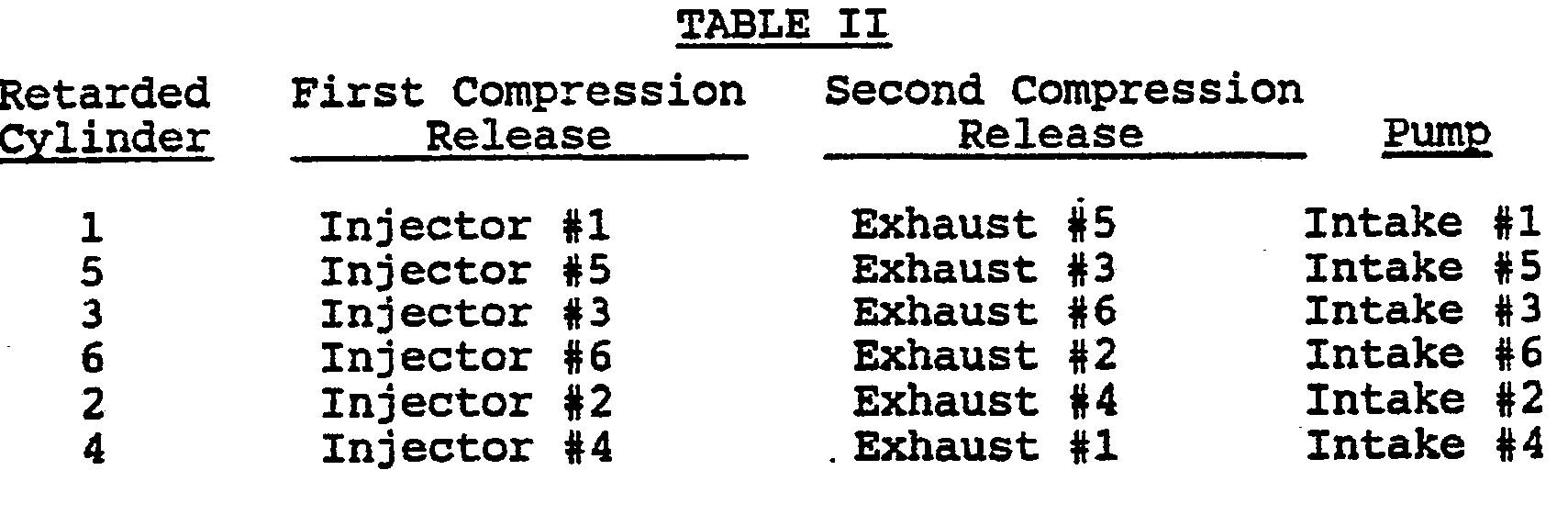
the usual firing order 1-5-3-6-2-4, a retarding system providing two compression release
events per engine cycle may be arranged as set forth in Table II below:
[0059] For engines having no fuel injector cam or pushtube an arrangement as set forth below
in Tables III or IV is feasible:
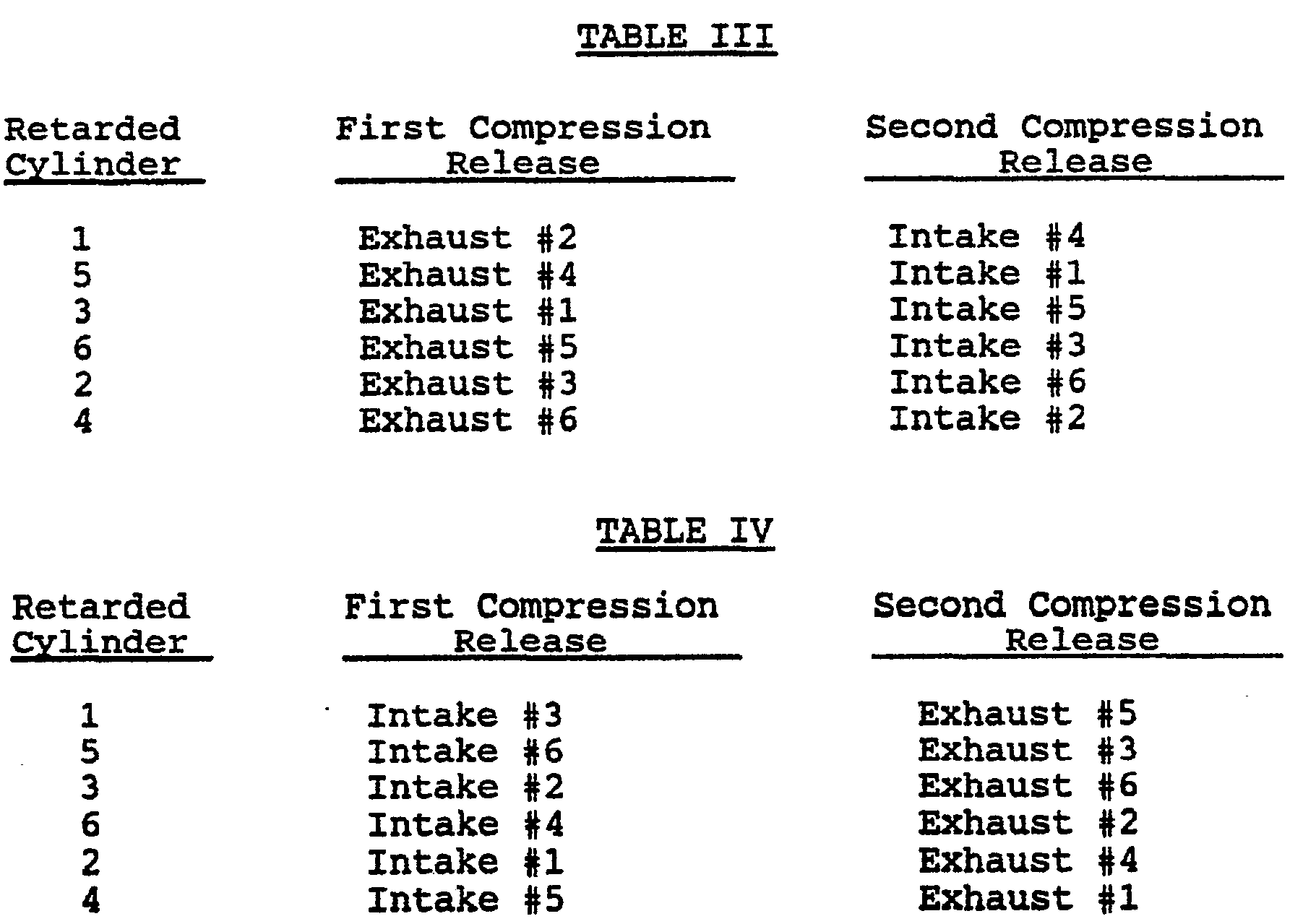
[0060] It will be noted that in Tables III and IV no master cylinder and piston is provided
to perform the pumping function of master cylinder 140 and master piston 138 in Figs.
4-9. In order to meet the pumping requirements of the master cylinders and pistons
associated with the exhaust and/or intake pushtubes may be increased in diameter.
This, of course, will cause an increase in the pushtube loading and care must be taken
not to exceed the design load limits for these components.
[0061] For purpose of clarity and simplicity, the above description has been based on a
six cylinder engine having a firing order 1-5-3-6-21.. Other firing orders may be
encountered as well as engines having differing numbers of cylinders. The present
invention may be applied to such engines by identifying a pushtube or rocker arm the
motion of which occurs during the compression stroke of the cylinder to be retarded;
identifying a second pushtube or rocker arm the motion of which occurs during the
exhaust stroke of the cylinder to be retarded (if two compression release events per
engine cycle are desired); and/or identifying a third pushtube or rocker arm the motion
of which can be utilized to provide pumping (if a separate pumping action is desired).
Properly sized master pistons may then be provided for each of the identified pushtubes
and the system interconnected as shown, for example, in Figs. 4-9.
1. A process for compression release retarding of an engine having a hydraulic fluid
supply, intake and exhaust valves, and intake and exhaust pushtube means and, for
each cylinder thereof, an hydraulic slave piston and slave cylinder supplied with
hydraulic fluid and associated with each exhaust valve, an hydraulic master piston
and master cylinder associated with one of said intake and exhaust pushtube means,
comprising the steps of providing a compression release retarding system including
a plenum interconnected with the slave cylinders and the master cylinder, a trigger
valve interconnected between said plenum and said master cylinder associated with
said one pushtube means through a free piston biased to move outwardly with respect
to said plenum by the pressure in said plenum, characterized by, for at least one
cylinder of the internal combustion engine, hydraulically connecting said plenum (142,
142a) with the slave cylinders (42) and the master cylinder (130) so that the plenum
is filled with hydraulic fluid, rapidly increasing the pressure of the hydraulic fluid
in said plenum so as to absorb energy therein by driving said master piston (128)
by said one pushtube means (122 or 132) to bias said free piston (146) in an inward
direction with respect to said plenum, releasing said energy absorbed in said plenum
from said plenum at a predetermined point in the travel of said master piston (128)
at a rapid rate by opening said trigger valve which is a trigger check valve (154)
interposed between said plenum (142, 142a) and said hydraulic slave piston (48) by
the movement of said master piston, and applying said absorbed energy to said slave
piston (48) through the motion of said free piston (146) outwardly with respect to
said plenum and biased by the pressure in said plenum when the internal combustion
engine piston is approaching its top dead center position during a compression stroke
of the engine.
2. The process of claim 1, characterized in that, for the engine which also has a
fuel injector and fuel injector pushtube means, said hydraulic master piston and cylinder
is associated with one of said fuel injector pushtube means, said exhaust and said
intake valve pushtube means, and wherein the pressure is increased in said plenum
so as to absorb energy therein by driving said master piston by one of said fuel injector
pushtube means, said intake pushtube means or said exhaust pushtube means.
3. An engine retarding system of a gas compression release type for carrying out the
process of claim 1, for an internal combustion engine having a hydraulic fluid supply,
intake valve means, exhaust valve means, pushtube means (122, 132) associated with
each of said intake valve means and exhaust valve means, one of said pushtube means
acting on master piston means (128) displaceable in master cylinder means (130), and
hydraulically actuated slave piston means (48) supplied with hydraulic fluid from
said supply and operatively associated with said exhaust valve means to open said
exhaust valve means, on supply of pressurized hydraulic fluid to said slave piston
means, for a compression release event, said system, for controlling the timing and
rate of opening of said exhaust valve means to maximize the retarding horsepower during
a braking operational mode of the system, comprising plenum means including drive
cylinder means (144) and a free piston means (146) and being connected with said slave
piston means (48) which is in fluid communication with said master cylinder means
(130) in which said master piston means (128) is displaceable by said one pushtube
means, and first valve means comprising trigger valve means operatively connected
to said slave piston means (48), said trigger valve means having an open and a closed
position, and trigger valve opening means (158 or 202), characterized in that said
system further comprises passage means (188, 150, 152, 164) for hydraulically connecting
said plenum means with the slave cylinder means and the master piston means so that
the plenum means is filled with the hydraulic fluid, said master piston means (128),
when displaced in a pressure increasing direction in said master cylinder means, being
effective via said drive cylinder means (144) to increase the pressure of the hydraulic
fluid in said plenum means (142) on initiating said braking operation mode, said drive
cylinder means (144) being in hydraulic fluid communication with said slave piston
means (48), said trigger valve means being trigger check valve means (154) operatively
connected to said plenum means (142, 142a) to permit a pulse of high pressure hydraulic
fluid to be directed to said slave piston means from said plenum means for opening
said exhaust valve means at a predetermined rate for a compression release event,
said trigger valve opening means (158 or 202) being connected to the master piston
means (128) for moving said trigger check valve means to its open position at a predetermined
time for triggering said pulse of high pressure hydraulic fluid from said drive cylinder
means (144) to said slave piston means (48), second check valve means (186) connected
to said slave piston means (48) to supply hydraulic fluid uni-directionally from said
slave piston means (48) to said plenum means (142 or 142a), said passage means including
a bypass passage (164 or 228) bypassing said trigger check valve means between said
plenum means (142 or 142a) and said master cylinder means (130), said increased pressure
hydraulic fluid in said plenum means, attributable to said master piston means (128),
passing through said bypass passage when said trigger check valve means is in its
closed position, wherein said trigger check valve means is aligned with said master
piston means (128) and said drive cylinder means (144) communicates with said plenum
means and includes said free piston means (146) having first and second ends mounted
for reciprocatory motion in said drive cylinder means, and spring means (148) biasing
said free piston means (146) outwardly from said plenum means, said free piston means
(146) communicating on said first end with said plenum means (142, 142a), said master
cylinder (130) being aligned with said one of the pushtube means and communicating
with said second end of said free piston means (146), said trigger check valve means
(154) operating in its closed position between said slave piston means (48) and said
second end of said free piston means (146) to permit flow of hydraulic fluid from
said slave piston means (48) toward said free piston means (146).
4. The system of claim 3, characterized in that, for the engine which also has fuel
injector means and a pushtube means associated with said fuel injector means, one
of the pushtube means of said intake valve means, exhaust valve means and fuel injector
means acts on the master piston means.
5. The system of claim 3, characterized by said one pushtube means being associated
with said exhaust valve means.
6. The system of claim 3, characterized by said one pushtube means being associated
with said intake valve means.
7. The system of claim 3 or 4, characterized by additional master piston means (138)
displaceable in a respective additional master cylinder means (140), another one of
said pushtube means acting on said additional master piston means, and third check
valve means comprising a control check valve means (182 or 220) operatively connected
between said additional master cylinder means and said plenum means (142 or 142a)
and being in the path of hydraulic fluid therefrom and having an open position for
hydraulic fluid pressure up to a predetermined value and a closed checking position
for hydraulic fluid pressures above said predetermined value.
8. The system of claim 7, characterized by said control check valve means (182 or
220) communicating between said second end of said free piston means and said additional
master cylinder means.
9. The system of claim 8, characterized in that said control check valve means (182)
comprises a control check valve cylinder (172) communicating with said master cylinder
means (130), a control check valve piston (176) mounted for reciprocatory motion in
said control check valve cylinder (172), a control check valve (182) affixed to said
control check valve piston (176) and adapted to move between a first open position
and a second closed checking position, biasing means (178) located in said control
check valve cylinder (172) adapted to bias said control check valve piston (176) and
said control check valve (182) toward the open position.
10. The retarding system of claim 9, characterized in that said biasing means (178)
maintains said control check valve (182) in said first open position until a first
predetermined pressure is attained at said second end of the free piston means (146)
and thereafter maintains said control check valve (182) in said second closed checking
position until the pressure at said second end of said free piston means drops below
a second predetermined pressure which is less than said first predetermined pressure.
11. The system of claim 8, characterized in that said control check valve means comprises
a control check valve (220) adapted to move between a first open position and a second
checking position, said control check valve being biased toward said second checking
position by the pressure communicated from said second end of said free piston means
(146), said control check valve (220) being biased toward said first open position
by the pressure from said plenum means (142a).
12. The system of claim 11, characterized in that the pressure communicated from said
second end of said free piston means (146) acts upon a larger area of said control
check valve (220) than the area of said control check valve acted upon by the pressure
communicated by said plenum means (142a) whereby said control check valve (220) is
maintained in said first open position until a first predetermined pressure is attained
at said second end of said free piston means, and thereafter said control check valve
means is maintained in said second checking position until the pressure at said second
end of said free piston means drops below a second predetermined pressure which is
less than said first predetermined pressure.
13. The system of claim 12, characterized in that the pressure communicated from said
plenum means (142a) to said control check valve (220) is communicated by an axially
movable pin member (226) exposed on a first end to the pressure existing in said plenum
means (142a) and on a second end to said control check valve (220).
14. The system of any of the preceding claims, characterized in that said trigger
check valve means (154) comprises a valve chamber (190), a tubular valve element (194)
having a seat at a first end and a discharge hole (198) at a second end, spring means
(220) biasing said tubular valve element (194) towards a seated position in said valve
chamber (190), said tubular valve element (194) having formed therein a cylindrical
bore, piston means (202) mounted for reciprocatory motion within said cylindrical
bore, and connecting rod means (204) affixed at a first end to said piston means (202)
and at a second end to said first master piston means (128).
15. The system of claim 14, characterized by said piston means (202) of said trigger
check valve means being adjustably affixed on said first end of said connecting rod
means (204).
16. The system of any of the preceding claims, characterized by firing cylinder means
(206) formed within said plenum means (142a), said firing cylinder means (206) communicating
at a first end with said plenum means (142a) and vented at its second end, a firing
piston (210) mounted for reciprocatory motion in said firing cylinder means (206)
and drive pin means (212) positioned between said firing piston means (206) and said
free piston means (146) whereby the pressure in said plenum means (142a) acting on
said firing piston (210) biases said free piston means (146) outwardly from said plenum
means.
17. The system of claim 3, 4 or 7, characterized in that said trigger check valve
means comprises a body (10) having a cavity (190) formed therein and inlet and outlet
ports, said body having a valve seat (238) formed in the cavity portion thereof, a
tubular valve element (194) having a valve seat engaging surface formed on a first
end thereof, a cylindrical bore formed in said tubular valve element and a shoulder
(198a) formed on a second end thereof, spring means (200) adapted to bias said tubular
valve element (194) against said valve seat, a piston (202) mounted for reciprocating
movement within said cylindrical bore and a connecting rod (204) affixed to said piston,
said piston (202) being adapted to lift the tubular valve element from said valve
seat when said piston engages said shoulder (198a) on the tubular valve element.
18. The system of claim 17, characterized in that said piston (202) is adjustably
affixed to said connecting rod (204).
19. The system of claim 7, characterized in that said control check valve means comprises
a body (10) having first (228, 240, 242), second (140, 218) and third (216) bores
formed therein, said second (140) and third (216) bores communicating with said first
bore (228, 240, 242), a bushing (244) seated in said first bore, said bushing (244)
having a fourth bore (246) formed therethrough, a cylindrical guide pin (226) lap
fitted for axial movement of said fourth bore (246), a valve seat (248) seated in
said first bore and having a fifth bore (250) formed therethrough, said fifth bore
(250) having a larger diameter than the diameter of said cylindrical guide pin (226),
said second bore (140, 218) communicating with said first bore in a region of said
first bore between said bushing (244) and said valve seat (248), a master piston (138)
mounted for reciprocatory motion within said second bore (140, 218), a valve retaining
cap (254) seated in said first bore, said third bore (216) communicating with said
first bore in a region of said first bore between said valve seat and said valve retaining
cap, a valve element (262) mounted for axial movement with respect to said valve retaining
cap (254), said valve element having a cross-sectional area larger than the cross-sectional
area of said cylindrical guide pin (226), and spring means (266) mounted on said valve
retaining cap and adapted to bias said valve element (262) toward said valve seat.
20. The system of claim 19, characterized in that the valve element includes an axial
pin member (264) and said valve retaining cap includes a sixth axial bore (256) adapted
to slidingly receive said axial pin member of said valve element.
21. The system of claim 19, characterized in that said valve (262) element is integral
with said cylindrical guide pin (226).
22. The system of claim 19, characterized in that said cylindrical guide pin (226)
has formed, in its central region, an enlarged collar (252) whereby axial movement
into said first bore is limited.
1. Verfahren zur Kompressionsfreigabeverzögerung eines Motors, der aufweist eine Hydraulikfluid-Versorgung,
Einlaß- und Auslaßventile und Einlaß- und Auslaßstößel und für jeden Zylinder einen
hydraulischen Hilfskolben und Hilfszylinder, der mit Hydraulikfluid versorgt wird
und zu jedem Auslaßventil gehört, einen hydraulischen Hauptkolben und einen Hauptzylinder,
der zu einem von den Einlaß- oder Auslaßstößeln gehört, mit folgenden Schritten: Vorsehen
eines Kompressionsfreigabe-Verzögerungssystems einschließlich einer mit den Hilfszylindern
und dem Hauptzylinder verbundenen Kammer, einem Triggerventil, das die Kammer und
den dem einen Stößel zugehörigen Hauptzylinder über einen freien Kolben verbindet,
der so vorgespannt ist, daß er bezüglich der Kammer durch den Druck in der Kammer
nach außen bewegt wird, dadurch gekennzeichnet, daß für zumindest einen Zylinder des
Innenbrennkraftmotors eine hydraulische Verbindung der Kammer (142, 142a) mit dem
Hilfszylinder (42) und dem Hauptzylinder (130) vorgesehen ist, so daß die Kammer mit
Hydraulikfluid gefüllt wird, der Druck des Hydraulikfluids in der Kammer schnell erhöht
wird, so daß darin Energie absorbiert wird, indem der Hauptkolben (128) durch den
einen Stößel (122 oder 132) zum Vorspannen des freien Kolbens (146) bezüglich der
Kammer einwärtsgerichtet angetrieben wird, die in der Kammer absorbierte Energie von
der Kammer an einem vorgegebenen Punkt des Wegs des Hauptkolbens (128) mit hoher Geschwindigkeit
durch Öffnen des Triggerventils mittels der Bewegung des Hauptkolbens, das ein zwischen
die Kammer (142, 142a) und den hydraulischen Hilfskolben (48) eingeschaltetes Trigger-Rückschlagventil
(154) ist, und daß die absorbierte Energie dem Hilfskolben (48) durch die Bewegung
des freien Kolbens (146) bezüglich der Kammer nach außen hin und vorgespannt durch
den Druck in der Kammer zugeführt wird, wenn der Kolben des Innenbrennkraftmotors
während eines Kompressionshubs des Motors sich seinem oberen Totpunkt nähert.
2. Verfahren nach Anspruch 1, dadurch gekennzeichnet, daß für den Motor, der auch
einen Kraftstoffinjektor und Kraftstoffinjektorstößel hat, der hydraulische Hauptkolben
und Hauptzylinder entweder zum Stößel des Kraftstoffinjektors, zum Stößel des Auslaßventils
oder zum Stößel des Einlaßventils gehört, und daß der Druck in der Kammer, um darin
Energie zu absorbieren, erhöht wird, indem der Hauptkolben durch den Injektorstößel,
den Einlaßstößel oder den Auslaßstößel angetrieben wird.
3. Motorverzögerungssystem vom Gaskompressionsfreigabetyp zur Ausführung des Verfahrens
nach Anspruch 1 für einen Innenbrennkraftmotor, der eine hydraulische Fluidversorgung,
Einlaßventilglieder, Auslaßventilglieder, Stößelglieder (122, 132) zugehörig zu jeweils
den Einlaßventilgliedern und den Auslaßventilgliedern, wobei eines der Stößelglieder
auf eine Hauptkolbeneinrichtung (123) einwirkt, die in einer Hauptzylindereinrichtung
(130) bewegbar ist, und eine hydraulische betätigte Hilfskolbeneinrichtung (48) hat,
die von der Fluidversorgung mit Hydraulikfluid versorgt wird und die operativ den
Auslaßventilgliedern zugeordnet ist, um diese auf die Zufuhr von unter Druck stehendem
Hydraulikfluid zur Hilfskolbeneinrichtung für ein Kompressionsfreigabe-Ereignis zu
öffnen, wobei das System zur Steuerung der Öffnungszeit und Öffnungsgeschwindigkeit
der Auslaßventilglieder um die Verzögerungsleistung während einer Bremsbetriebsart
des Systems zu maximieren aufweist: eine Kammereinrichtung (142), die Antriebszylindermittel
(144) und eine Freikolbeneinrichtung (146) enthält und die mit der Hilfskolbeneinrichtung
(48) verbunden ist, welche in Fluidverbindung mit der Hauptzylindereinrichtung (130)
steht, in die die Hauptkolbeneinrichtung (128) durch eines der Stößelglieder bewegbar
ist, und erste Ventilglieder, die eine Triggerventileinrichtung, die operativ mit
der Hilfskolbeneinrichtung (48) verbunden ist, und eine offene und geschlossene Stellung
hat und Triggerventilöffnungsmittel (158 oder 202) aufweist, dadurch gekennzeichnet,
daß das System weiterhin aufweist: Durchlaßkanäle (188, 150, 152, 164), die die Kammereinrichtung
mit der Hilfszylindereinrichtung und der Hauptkolbeneinrichtung verbinden, so daß
die Kammereinrichtung mit dem Hydraulikfluid gefüllt wird, wobei die Hautpkolbeneinrichtung
(128), wenn sie in einer druckerhöhenden Richtung in der Hauptzylindereinrichtung
versetzt wird, über die Antriebszylindermittel (144) zur Erhöhung des Drucks des Hydraulikfluids
in der Kammereinrichtung (142) auf die Initiierung der Bremsbetriebsart hin einwirkt,
die Antriebszylindermittel (144) in Hydraulikfluidverbindung mit der Hilfskolbeneinrichtung
(48) steht, die Triggerventileinrichtung ein Trigger-Rückschlagventil (154) ist, das
operativ mit der Kammereinrichtung (142, 142a) verbunden ist, um einem Hochdruckimpuls
des Hydraulikfluids zu ermöglichen, das dieser von der Kammereinrichtung zum Öffnen
der Auslaßventilmittel mit einer vorgegebenen Geschwindigkeit für ein Kompressionsfreigabe-Ereignis
der Hilfskolbeneinrichtung zugeführt wird, die Triggerventilöffnungsmittel (128) zur
Bewegung des Auslöse-Rückschlagventils in seine Offenstellung zu einem vorgegebenen
Zeitpunkt zum Auslösen des Hochdruck-Hydraulikfluidimpulses von den Antriebszylindermitteln
(144) zur Hilfskolbeneinrichtung (48) mit der Hauptkolbeneinrichtung (128) verbunden
sind, zweite Rückschlagventilglieder (186), die mit der Hilfskolbeneinrichtung (48)
verbunden sind, um-Hydraulikfluid in einer Richtung von der Hilfskolbeneinrichtung
(48) der Kammereinrichtung (142 oder 142a) zuzuführen, wobei die Durchlaßkanäle einen
Bypaß-Durchlaß (164 oder 228) haben, der das Trigger-Rückschlagventil zwischen der
Kammereinrichtung (142 oder 142a) und der Hauptzylindereinrichtung (130) umgeht, wobei
in der Kammereinrichtung befindliches Hydraulikfluid erhöhten Drucks, welcher der
Hauptkolbeneinrichtung (128) zuzuschreiben ist, durch den Bypaß-Durchlaß geht, wenn
das Trigger-Rückschlagventil in seiner geschlossenen Stellung ist, wobei das Trigger-Rückschlagventil
mit der Hauptkolbeneinrichtung (128) fluchtet und die Antriebszylindermittel (144)
mit der Kammereinrichtung kommunizieren und die Freikolbeneinrichtung (146) enthalten,
die ein erstes und zweites Ende haben, die zu einer hin- und hergehenden Bewegung
in den Antriebszylindermitteln befestigt sind, und Federmittel (148), die die Freikolbeneinrichtung
(146) bezüglich der Kammer nach außen vorspannen, die Freikolbeneinrichtung (146)
mit dem ersten Ende der Kammereinrichtung (142, 142a) in Verbindung steht, der Hauptzylinder
(130) mit einem der Stößel fluchtet und mit dem zweiten Ende der Freikolbeneinrichtung
(146) in Verbindung steht, das Trigger-Rückschlagventil (154) in seiner geschlossenen
Stellung zwischen der Hilfskolbeneinrichtung (48) und dem zweiten Ende der Freikolbeneinrichtung
(146) betrieben wird, um Hydraulikfluid von der Hilfskolbeneinrichtung (48) zur Freikolbeneinrichtung
(146) fließen zu lassen.
4. System nach Anspruch 3, dadurch gekennzeichnet, daß bei einem Motor, der auch eine
Kraftstoffinjektoreinrichtung und dazugehörige Stößelglieder hat, entweder die Stößelglieder
des Einlaßventils, die des Auslaßventils oder der Kraftstoffinjektoreinrichtung auf
die Hauptkolbeneinrichtung einwirken.
5. System nach Anspruch 3, dadurch gekennzeichnet, daß die genannten Stößelglieder
die der Auslaßventile sind.
6. System nach Anspruch 3, dadurch gekennzeichnet, daß die genannten Stößelglieder
die der Einlaßventile sind.
7. System nach Anspruch 3 oder 4, gekennzeichnet durch eine zusätzliche Hauptkolbeneinrichtung
(138), die in einem zugehörigen zusätzlichen Hauptzylinder (140) bewegbar ist, wobei
ein anderes Stö- ßelglied auf den zusätzlichen Hauptkolben einwirkt, und eine dritte
Rückschlagventileinrichtung, die operativ zwischen den zusätzlichen Hauptzylinder
und die Kammereinrichtung (142 oder 142a) eingeschaltete Steuer-Rückschlagventilmittel
(182 oder 220) aufweist, die in dem davon kommenden Weg des Hydraulikfluids liegen
und die eine offene Stellung für einen Hydraulikfluiddruck bis zu einem vorgegebenen
Wert und eine geschlossene Rückschlagstellung für Hydraulikfluiddruck oberhalb des
vorgegebenen Wertes haben.
8. System nach Anspruch 7, dadurch gekennzeichnet, daß die Steuer-Rückschlagventilmittel
(182 oder 220) das zweite Ende der Freikolbeneinrichtung mit dem zusätzlichen Hauptzylinder
verbinden.
9. System nach Anspruch 8, dadurch gekennzeichnet, daß die Steuer-Rückschlagventilmittel
(182) einen mit der Hauptzylindereinrichtung (130) in Verbindung stehenden Steuer-Rückschlagventilzylinder
(172), einen Steuer-Rückschlagventilkolben (176), der für hin- und hergehende Bewegung
in dem Steuer-Rückschlagventilzylinder (172) montiert ist, ein Steuer-Rückschlagventil
(182), das an dem Steuer-Rückschlagventilkolben (176) befestigt und so eingerichtet
ist, daß es sich zwischen einer ersten offenen Stellung und einer zweiten geschlossenen
Rückschlagstellung bewegt, und Vorspannungsmittel (178) aufweisen, die in dem Steuer-Rückschlagventilzylinder
(172) liegen und so eingerichtet sind, daß sie den Steuer-Rückschlagventilkolben (176)
und das Steuer-Rückschlagventil (182) in Richtung der Offenstellung vorspannen.
10. Verzögerungssystem nach Anspruch 9, dadurch gekennzeichnet, daß die Vorspannungsglieder
(178) das Steuer-Rückschlagventil (182) in der ersten offenen Stellung halten, bis
ein erster vorgegebener Druck an dem zweiten Ende der Freikolbeneinrichtung (146)
erreicht ist und danach das Steuer-Rückschlagventil (182) in der zweiten geschlossenen
Rückschlagstellung halten, bis der Druck am zweiten Ende der Freikolbeneinrichtung
unter einen vorgegebenen zweiten Druckwert abfällt, der geringer ist als der erste
vorgegebene Druck.
11. System nach Anspruch 8, dadurch gekennzeichnet, daß die Steuer-Rückschlagventilmittel
ein Steuer-Rückschlagventil (220) aufweisen, das zur Bewegung zwischen einer ersten
oberen und einer zweiten Rückschlagstellung eingerichtet ist und das in Richtung seiner
zweiten Rückschlagstellung durch den vom zweiten Ende der Freikolbeneinrichtung (146)
zugeführten Druck vorgespannt und das in Richtung seiner ersten offenen Stellung durch
den Druck von der Kammereinrichtung (142a) vorgespannt wird.
12. System nach Anspruch 11, dadurch gekennzeichnet, daß der von dem zweiten Ende
der Freikolbeneinrichtung (146) zugeführte Druck auf eine Fläche des Steuer-Rückschlagventils
(220) einwirkt, die größer ist als die Fläche des Steuer-Rückschlagventils, auf die
der von der Kammereinrichtung (142a) zugeführte Druck einwirkt, wodurch das Steuer-Rückschlagventil
(220) in seiner ersten offenen Position bleibt, bis ein erster vorgegebener Druck
an dem zweiten Ende der Freikolbeneinrichtung erreicht wird, und danach das Steuer-Rückschlagventil
in seiner zweiten Rückschlagstellung bleibt, bis der Druck am zweiten Ende der Freikolbeneinrichtung
unterhalb einen zweiten vorgegebenen Druckwert fällt, der kleiner ist als der erste
vorgegebene Druckwert.
13. System nach Anspruch 12, dadurch gekennzeichnet, daß der von der Kammereinrichtung
(142a) dem Steuer-Rückschlagventil (220) zugeführte Druck durch ein axialbewegliches
Stiftglied zugeführt wird, das an einem ersten Ende dem in der Kammereinrichtung (142a)
vorhandenen Druck und an einem zweiten Ende dem Steuer-Rückschlagventil (220) ausgesetzt
ist.
14. System nach einem der vorangehenden Ansprüche, dadurch gekennzeichnet, daß die
Trigger-Rückschlagventileinrichtung (154) eine Ventilkammer (190), ein röhrenförmiges
Ventilglied (194), das einen Sitz an einem ersten Ende und ein Entladungsbohrung (198)
an einem zweiten Ende hat, und Federmittel (220) aufweisen, die das röhrenförmige
Ventilglied (194) in Richtung einer Position im Sitz in der Ventilkammer (190)- vorspannen,
wobei das röhrenförmige Ventilglied (194) eine darin ausgebildete zylindrische Bohrung,
einen Kolben (202), der für eine Hin- und Herbewegung innerhalb der zylindrischen
Bohrung angebracht ist, und eine Verbindungsstange (204) hat, die mit einem ersten
Ende an dem Kolben (202) und mit einem zweiten Ende an der ersten Hauptkolbeneinrichtung
(128) befestigt ist.
15. System nach Anspruch 14, dadurch gekennzeichnet, daß der Kolben (202) der Trigger-Rückschlagventileinrichtung
einstellbar an dem ersten Ende der Verbindungsstange (204) befestigt ist.
16. System nach einem der vorangehenden Ansprüche, gekennzeichnet durch: Schlagzylindermittel
(206), die innerhalb der Kammereinrichtung (142a) ausgebildet sind und an einem ersten
Ende mit der Kammereinrichtung (142a) in Verbindung stehen und an ihrem zweiten Ende
entlüftet sind, einen Schlagkolben (210), der für eine hin- und hergehende Bewegung
in den Schlagzylindermitteln (206) montiert ist und Antriebsstiftmittel (212), deren
Lage zwischen dem Schlagkolben (210) und der Freikolbeneinrichtung (146) ist, wodurch
der Druck in der Kammereinrichtung (142a), der auf den Schlagkolben (210) einwirkt,
die Freikolbeneinrichtung (146) von der Kammereinrichtung weg vorspannt.
17. System nach einem der Ansprüche 3, 4 oder 7, dadurch gekennzeichnet, daß das Trigger-Rückschlagventil
einen Körper (10), der einen darin ausgebildeten Hohlraum (190) und Einlaß- und Auslaßöffnungen
hat, wobei der Körper einen in dem Hohlraumbereich ausgebildeten Ventilsitz (238)
hat, ein röhrenförmiges Ventilelement (194), das eine am Ventilsitz eingreifende Oberfläche,
die an seinem ersten Ende ausgebildet ist, eine zylindrische Bohrung und eine am zweiten
Ende ausgebildete Schulter (198a) hat, ein Federglied (200), das zur Vorspannung des
röhrenförmigen Ventilelementes (194) gegen den Ventilsitz eingerichtet ist, einen
Kolben (202), der für Hin- und Herbewegung innerhalb der zylindrischen Bohrung montiert
ist und eine Verbindungsstange (204), die am Kolben befestigt ist, aufweist, wobei
der Kolben (202) so eingerichtet ist, daß er das röhrenförmige Ventilelement aus dem
Ventilsitz hebt, wenn der Kolben an der Schulter (198a) an dem röhrenförmigen Ventilelement
angreift.
18. System nach Anspruch 17, dadurch gekennzeichnet, daß der Kolben (202) einstellbar
an der Verbindungsstange (204) befestigt ist.
19. System nach Anspruch 7, dadurch gekennzeichnet, daß die Steuer-Rückschlagventilmittel
aufweisen: einen Körper (10) mit einer ersten (228, 240, 242), zweiten (140, 218)
und dritten darin ausgebildeten Bohrung (216), wobei die zweite (140) und dritte Bohrung
(216) mit der ersten Bohrung (228, 240, 242) in Verbindung stehen, eine in der ersten
Bohrung gelegene Hülse (244), die eine durch sie gehende vierte Bohrung (246) hat,
einen eine Schleifpassung aufweisenden zylindrischen Führungsstift (226) für eine
axiale Bewegung der vierten Bohrung (246), einen in der ersten Bohrung sitzenden Ventilsitz
(248), der eine fünfte durch ihn ausgebildete Bohrung (250) hat, die einen größeren
Durchmesser als der zylindrische Führungsstift (226) hat, wobei die zweite Bohrung
(140, 218) mit der ersten Bohrung in einem Bereich der ersten Bohrung zwischen der
Hülse (244) und dem Ventilsitz (248) in Verbindung steht, einen für eine Hin- und
Herbewegung innerhalb der zweiten Bohrung (140, 218) montierten Hauptkolben (138),
eine in der ersten Bohrung sitzende Ventilrückhaltekappe (254), wobei die dritte Bohrung
(216) mit der ersten Bohrung in einem Bereich der ersten Bohrung zwischen dem Ventilsitz
und der Ventilrückhaltekappe in Verbindung steht, ein Ventilglied (262), das für eine
axiale Bewegung bezüglich der Ventilrückhaltekappe (254) montiert ist und dessen Querschnittsfläche
größer als die Querschnittsfläche des zylindrischen Führungsstifts (226) ist, und
ein Federglied (266) aufweist, das an der Ventilrückhaltekappe montiert ist und zur
Vorspannung des Ventilglieds (262) in Richtung auf den Ventilsitz eingerichtet ist.
20. System nach Anspruch 19, dadurch gekennzeichnet, daß das Ventilglied ein axiales
Stiftglied (264) und die Ventilrückhaltekappe eine sechste axiale Bohrung (256) aufweist,
die für gleitende Aufnahme des axialen Stiftglieds des Ventilglieds eingerichtet ist.
21. System nach Anspruch 19, dadurch gekennzeichnet, daß das Ventilglied mit dem zylindrischen
Führungsstift (226) einstückig ist.
22. System nach Anspruch 19, dadurch gekennzeichnet, daß der zylindrische Führungsstift
(226) in seinem mittleren Bereich einen vergrößerten Kragen (252) trägt, wodurch die
axiale Bewegung in der ersten Bohrung begrenzt ist.
1. Processus de freinage, par relâchement de la compression, d'un moteur comportant
une alimentation de fluide hydraulique, des soupapes d'admission et d'échappement,
des moyens de tubes de poussoir d'admission et d'échappement pour chaque cylindre
du moteur, un piston hydraulique esclave et un cylindre hydraulique esclave alimenté
par le fluide hydraulique et associé à chaque soupape d'échappement, un maître piston
hydraulique et un maître cylindre hydraulique associés à l'un des moyens de tubes
de poussoir d'admission et d'échappement, ce processus comprenant les différentes
étapes consistant à utiliser un système de freinage à relâchement de compression comprenant
une chambre de pression montée entre les cylindres esclaves et le maître cylindre,
une soupape de déclenchement montée entre la chambre de pression et le maître cylindre
associé à l'un des moyens de tubes de poussoir par l'intermédiaire d'un piston libre
poussé de manière à se déplacer vers l'extérieur par rapport à la chambre de pression,
sous l'action de la pression régnant dans cette chambre, processus caractérisé en
ce qu'il consiste, pour l'un au moins des cylindres du moteur à combustion interne,
à relier hydrauliquement la chambre de pression (142, 142a) aux cylindres esclaves
(42) et au maître cylindre (130) de façon que la chambre de pression soit remplie
de fluide hydraulique, à augmenter rapidement la pression du fluide hydraulique dans
la chambre de pression de manière à absorber l'énergie contenue dans celle-ci en commandant
le maître piston (128) par l'un des moyens de tubes de poussoir (122 ou 132) pour
pousser le piston libre (146) dans une direction dirigée vers l'intérieur par rapport
à la chambre de pression, à relâcher à un rythme rapide, de la chambre de pression,
l'énergie absorbée dans celle-ci, en un point prédéterminé de la course du maître
piston (128), en ouvrant la soupape de déclenchement consistant en un clapet de retenue
de déclenchement (154) interposé entre la chambre de pression (142, 142a) et le piston
hydraulique esclave (48) grâce au mouvement du maître piston, et à appliquer cette
énergie absorbée au piston esclave (48) par l'intermédiaire du mouvement du piston
libre (146) se déplacant vers l'extérieur par rapport à la chambre de pression et
se trouvant poussé par la pression régnant dans cette chambre de pression lorsque
le piston du moteur à combustion interne s'approche de sa position de point mort haut
pendant une course de compression du moteur.
2. Processus selon la revendication 1, caractérisé en ce que, pour le moteur qui comporte
également un injecteur de carburant et des moyens de tube de poussoir d'injecteur
de carburant, le maître piston hydraulique et le maître cylindre hydraulique sont
associés à l'un des moyens de tube de poussoir d'injecteur de carburant et des moyens
de tubes de poussoir de soupapes d'échappement et d'admission, et en ce qu'on augmente
la pression dans la chambre de pression de manière à absorber l'énergie contenue dans
celle-ci, en commandant le maître piston par l'un au moins des moyens de tube de poussoir
d'injecteur de carburant, de tube de poussoir d'admission ou de tube de poussoir d'échappement.
3. Dispositif de freinage d'un moteur du type à relâchement de la compression des
gaz, permettant de mettre en oeuvre le processus selon la revendication, pour un moteur
à combustion interne comportant une alimentation de fluide hydraulique, des moyens
de soupape d'admission, des moyens de soupape d'échappement, des moyens de tubes de
poussoir (122, 132) associés à chacun des moyens de soupape d'admission et des moyens
de soupape d'échappement, l'un de ces moyens de tubes de poussoir agissant sur des
moyens de maître piston (128) pouvant se déplacer dans des moyens de maître cylindre
(130), et des moyens de pistons esclaves actionnés hydrauliquement (48) alimentés
en fluide hydraulique par l'alimentation et associés en fonctionnement aux moyens
de soupape d'échappement pour ouvrir ces moyens de soupape d'échappement lorsqu'on
envoie du fluide hydraulique sous pression aux moyens de pistons esclaves pour produire
un événement de relâchement de compression, ce dispositif, pour commander le réglage
en temps et le taux d'ouverture des moyens de soupape d'échappement de manière à optimiser
la puissance de freinage pendant un mode de fonctionnement en freinage du dispositif,
comprenant des moyens de chambre de pression comprenant des moyens de cylindre d'entraînement
(144) et des moyens de piston libre (146) et se trouvant reliés aux moyens de pistons
esclaves (48) en communication de fluide avec les moyens de maître cylindre (130)
dans lesquels les moyens de maître piston (128) peuvent se déplacer sous l'action
de l'un des moyens de tubes de poussoir, et des premiers moyens de soupape comprenant
des moyens de soupape de déclenchement reliés en fonctionnement aux moyens de pistons
esclaves (48), ces moyens de soupape de déclenchement présentant une position ouverte
et une position fermée, et des moyens d'ouverture de soupape de déclenchement (158
ou 202), dispositif caractérisé en ce qu'il comprend en outre des moyens de passage
(188, 150, 152, 164) pour relier hydrauliquement les moyens de chambre de pression
aux moyens de cylindres esclaves et aux moyens de maître piston de façon que les moyens
de chambre de pression soient remplis de fluide hydraulique, les moyens de maître
piston (128), lorsqu'ils sont déplacés dans une direction d'augmentation de la pression
dans les moyens de maître cylindre, fonctionnant par l'intermédiaire des moyens de
cylindre d'entraînement (144) pour augmenter la pression du fluide hydraulique dans
les moyens de chambre de pression (142) au démarrage du mode de fonctionnement en
freinage, les moyens de cylindre d'entraînement (144) étant en communication de fluide
avec les moyens de pistons esclaves (48), les moyens de soupape de déclenchement étant
constitués par des moyens de clapet de retenu de déclenchement (154) reliés en fonctionnement
aux moyens de chambre de pression (142, 142a) pour pouvoir diriger une impulsion de
fluide hydraulique haute pression vers les moyens de pistons esclaves à partir des
moyens de chambre de pression de manière à ouvrir les moyens de soupape d'échappement
à un taux prédéterminé pour produire un événement de relâchement de compression, les
moyens d'ouverture de soupape de déclenchement (158 ou 202) étant reliés aux moyens
de maître piston (128) pour déplacer les moyens de clapet de retenue de déclenchement
vers leur position ouverte à un instant prédéterminé, de manière à déclencher l'impulsion
de fluide hydraulique haute pression des moyens de cylindre d'entraînement (144) vers
les moyens de pistons esclaves (48), des seconds moyens de clapet de retenue (186)
reliés aux moyens de pistons esclaves (48) pour fournir du fluide hydraulique dans
un seul sens depuis les moyens de pistons esclaves (48) vers les moyens de chambre
de pression(142 ou 142a), les moyens de passage comprenant un passage de dérivation
(164 ou 228) contournant les moyens de clapet de retenue de déclenchement entre les
moyens de chambre de pression (142 ou 142a) et les moyens de maître cylindre (130),
le fluide hydraulique de la chambre de pression, dont la pression a été augmentée
par les moyens de maître piston (128), passant par le passage de dérivation lorsque
les moyens de clapet de retenue de déclenchement sont en position de fermeture, de
sorte que les moyens de clapet de retenue de déclenchement sont alignés avec les moyens
de maître piston (128) et que les moyens de cylindre d'entraînement (144) communiquent
avec les moyens de chambre de pression et comprennent les moyens de piston libre (146)
dont les première et seconde extrémité sont montées pour effectuer un mouvement de
va-et-vient dans les moyens de cylindre d'entraînementet des moyens de ressort (148)
poussant les moyens de piston libre (146) vers l'extérieur de la chambre de pression,
ces moyens de piston libre (146) communiquant par leur première extrémité avec les
moyens de chambre de pression (142, 142a), le maître cylindre (130) étant aligné avec
l'un des moyens de tube de poussoir et communiquant avec la seconde extrémité des
moyens de piston libre (146), les moyens de clapet de retenue de déclenchement (154)
fonctionnant, dans leur position de fermeture, entre les moyens de pistons esclaves
(48) et la seconde extrémité des moyens de piston libre (146) pour permettre le passage
d'un débit de fluide hydraulique des moyens de pistons esclaves (48) vers les moyens
de piston libre (146).
4. Dispositif selon la revendication 3, caractérisé en ce que pour le moteur qui comporte
également des moyens d'injecteur de carburant et des moyens de tube de poussoir associés
aux moyens d'injecteur de carburant, l'un des moyens de tube de poussoir, des moyens
de soupape d'admission, des moyens de soupape d'échappement et des moyens d'injecteur
de carburant, agit sur les moyens de maître piston.
5. Dispositif selon la revendication 3, caractérisé en ce que l'un des moyens de tube
de poussoir est associé aux moyens de soupape d'échappement.
6. Dispositif selon la revendication 3, caractérisé en ce que l'un des moyens de tube
de poussoir est associé aux moyens de soupape d'admission.
7. Dispositif selon l'une quelconque des revendications 3 et 4, caractérisé en ce
qu'il comprend des moyens de maître piston supplémentaire (138) pouvant se déplacer
dans des moyens de maître cylindre supplémentaire correspondant (140), un autre des
moyens de tube de poussoir agissant sur ces moyens de maître piston supplémentaire,
et des troisièmes moyens de clapet de retenue comprenant des moyens de clapet de retenue
de commande (182 ou 220) montés en fonctionnement entre les moyens de maître cylindre
supplémentaire et les moyens de chambre de pression (142 ou 142a) et se trouvant dans
le chemin de passage du fluide hydraulique sortant de cette chambre, ces moyens présentant
une position ouverte pour laisser la pression de fluide hydraulique monter jusqu'à
une valeur prédéterminée, et une position de fermeture de blocage pour les pressions
de fluide hydraulique supérieures à cette valeur prédéterminée.
8. Dispositif selon la revendication 7, caractérisé en ce que les moyens de clapet
de retenue de commande (182 ou 220) assurent la communication entre la seconde extrémité
des moyens de piston libre et les moyens de maître cylindre supplémentaire.
9. Dispositif selon la revendication 8, caractérisé en ce que les moyens de clapet
de retenue de commande (182) comprennent un cylindre de clapet de retenue de commande
(172) communiquant avec les moyens de maître cylindre (130), un piston de clapet de
retenue de commande (176) monté pour effectuer un mouvement de va-et-vient dans le
cylindre de clapet de retenue de commande (172), un clapet de retenue de commande
(182) fixé au piston de clapet de retenue de commande (176) et conçu pour se déplacer
entre une première position ouverte et une seconde position de fermeture de blocage,
des moyens de poussée (178) placés dans le cylindre de clapet de retenue de commande
(172) et destinés à pousser le piston de clapet de retenue de commande (176) et le
clapet de retenue de commande (182) vers la position ouverte.
10. Dispositif de freinage selon la revendication 9, caractérisé en ce que les moyens
de poussée (178) maintiennent le clapet de retenue de commande (182) dans la première
position ouverte jusqu'à ce qu'une première pression prédéterminée soit atteinte à
la seconde extrémité des moyens de piston libre (146), et maintiennent ensuite le
clapet de retenue de commande (182) dans la seconde position de fermeture de blocage
jusqu'à ce que la pression à la seconde extrémité des moyens de piston libre chute
au-dessous d'une seconde pression prédéterminée inférieure à la première pression
prédéterminée.
11. Dispositif selon la revendication 8, caractérisé en ce que les moyens de clapet
de retenue de commande comprennent un clapet de retenue de commande (220) conçu pour
se déplacer entre une première position ouverte et une seconde position de fermeture
de blocage, le clapet de retenue de commande étant poussé vers la seconde position
de blocage par la pression transmise par la seconde extrémité des moyens de piston
libre (146), et le clapet de retenue de commande (220) étant poussé vers la première
position ouverte par la pression provenant des moyens de chambre de pression (142a).
12. Dispositif selon la revendication 11, caractérisé en ce que la pression transmise
par la seconde extrémité des moyens de piston libre (146) agit sur une surface du
clapet de retenue de commande (220) plus grande que la surface de ce clapet de retenue
de commande sur laquelle agit la pression transmise par les moyens de chambre de pression
(142a), de sorte que le clapet de retenue de commande (220) est maintenu dans la première
position ouverte jusqu'à ce qu'une première pression prédéterminée soit atteinte à
la seconde extrémité des moyens de piston libre et qu'ensuite les moyens de clapet
de retenue de commande sont maintenus dans la seconde position de blocage jusqu'à
ce que la pression à la seconde extrémité des moyens de piston libre chute au-dessous
d'une seconde pression prédéterminée inférieure à la première pression prédéterminée.
13. Dispositif selon la revendication 12, caractérisé en ce que la pression transmise
par les moyens de chambre de pression (142a) au clapet de retenue de commande (220),
est transmise par un élément de tige pouvant se déplacer axialement (226) exposé,
par une première extrémité, à la pression régnant dans les moyens de chambre de pression
(142a) et, par la seconde extrémité, au clapet de retenue de commande (220).
14. Dispositif selon l'une quelconque des revendications précédentes, caractérisé
en ce que les moyens de clapet de retenue de déclenchement (154) comprennent une chambre
de soupape (190), un élément de soupape tubulaire (194) muni d'un siège à une première
extrémité et d'un trou de décharge (198) à la seconde extrémité, des moyens de ressort
(220) poussant l'élément de soupape tubulaire (194) vers une position d'appui dans
la chambre de soupape (190), l'élément de soupape tubulaire (194) étant percé d'un
alésage cylindrique, des moyens de piston (202) montés pour effectuer un mouvement
de va-et-vient à l'intérieur de l'alésage cylindrique, et des moyens de tige de liaison
(204) fixés, par une première extrémité, aux moyens de piston (202) et par la seconde
extrémité aux premiers moyens de maître piston (128).
15. Dispositif selon la revendication 14, caractérisé en ce que les moyens de piston
(202) des moyens de clapet de retenue de déclanchement sont fixés de manière réglable
sur la première extrémité des moyens de tige de liaison (204).
16. Dispositif selon l'une quelconque des revendications précédentes, caractérisé
en ce qu'il comprend des moyens de cylindre d'allumage (206) formés à l'intérieur
des moyens de chambre de pression (142a), ces moyens de cylindre d'allumage (206)
communiquant, par une première extrémité, avec les moyens de chambre de pression (142a)
et se trouvant déchargés à l'extérieur par la seconde extrémité, un piston d'allumage
(210) monté pour effectuer un mouvement de va-et-vient dans les moyens de cylindre
d'allumage (206), et des moyens de tige d'entraînement (212) placés entre les moyens
de piston d'allumage (206) et les moyens de piston libre (146), de façon que la pression
des moyens de chambre de pression (142a) agissant sur le piston d'allumage (210),
pousse les moyens de piston libre (146) vers l'extérieur des moyens de chambre de
pression.
17. Dispositif selon l'une quelconque des revendications 3, 4 et 7, caractérisé en
ce que les moyens de clapet de retenue de déclenchement comprennent un corps (10)
comportant une cavité (190) formée dans ce corps, et des orifices d'entrée et de sortie,
ce corps comportant un siège de soupape (238) formé dans sa partie de cavité, un élément
de soupape tubulaire (194) muni d'une surface d'engagement de siège de soupape formée
sur une première extrémité de celui-ci, un alésage cylindrique formé dans l'élément
de soupape tubulaire et un épaulement (198a) formé sur une seconde extrémité de celui-ci,
des moyens de ressort (200) destinés à pousser l'élément de soupape tubulaire (194)
contre le siège de soupape, un piston (202) monté pour effectuer un mouvement de va-et-vient
à l'intérieur de l'alésage cylindrique, et une tige de liaison (204) fixée à ce piston,
le piston (202) étant destiné à soulever l'élément de soupape tubulaire du siège de
soupape lorsque ce piston s'engage contre l'épaulement (198a) de l'élément de soupape
tubulaire.
18. Dispositif selon la revendication 17, caractérisé en ce que le piston (202) est
fixé de manière réglable à la tige de liaison (204).
19. Dispositif selon la revendication 7, caractérisé en ce que le dispositif de clapet
de retenue de commande comprend un corps (10) comportant un premier alésage (228,
240, 242), un second alésage (140, 218) et une troisième alésage (216) formés dans
celui-ci, les second (140) et troisième (216) alésages communiquant avec le premier
alésage (228, 240, 242), un manchon (244) logé dans le premier alésage, ce manchon
(244) étant percé d'un quatrième alésage (246), une tige de guidage cylindrique (226)
emboîtée en recouvrement pour permettre le mouvement axial du quatrième alésage (246),
un siège de soupape (248) logé dans le premier alésage et comportant un cinquième
alésage (250) percé dans celui-ci, ce cinquième alésage (250) présentant un diamètre
plus grand que le diamètre de la tige de guidage cylindrique (226), le second alésage
(140, 218) communiquant avec le premier alésage dans la zone du premier alésage comprise
entre le manchon (244) et le siège de soupape (248), un maître piston (138) monté
pour effectuer un mouvement de va-et-vient à l'intérieur du second alésage (140, 218),
un bouchon de retenue de soupape (254) logé dans le premier alésage, le troisième
alésage (216) communiquant avec le premier alésage dans la zone de ce premier alésage
comprise entre le siège de soupape et le bouchon de retenue de soupape, un élément
de soupape (262) monté pour effectuer un mouvement axial par rapport au bouchon de
retenue de soupape (254), l'élément de soupape présentant une surface de section transversale
plus grande que la surface de section transversale de la tige de guidage cylindrique
(226), et des moyens de ressort (266) montés sur le bouchon de retenue de soupape
et destinés à pousser l'élément de soupape (262) vers le siège de soupape.
20. Dispositif selon la revendication 19, caractérisé en ce que l'élément de soupape
comprend un élément de tige axiale (264), et en ce que le bouchon de retenue de soupape
comprend un sixième alésage axial (256) destiné à recevoir en glissement l'élément
de tige axiale de l'élément de soupape.
21. Dispositif selon la revendication 19, caractérisé en ce que l'élément de soupape
(262) est réalisé d'une seule pièce avec la tige de guidage cylindrique (226).
22. Dispositif selon la revendication 19, caractérisé en ce que la tige de guidage
cylindrique (226) comporte un collier agrandi (252) formé dans sa zone centrale, ce
qui permet ainsi de limiter son mouvement axial dans le premier alésage.