|
(11) | EP 0 252 240 B1 |

| (12) | EUROPEAN PATENT SPECIFICATION |
|
|
| (54) |
A process for forming thermoplastic foam Verfahren zur Herstellung eines thermoplastischen Schaumes Procédé pour préparer une mousse thermoplastique |
|
|
|||||||||||||||||||||||||||||||
| Note: Within nine months from the publication of the mention of the grant of the European patent, any person may give notice to the European Patent Office of opposition to the European patent granted. Notice of opposition shall be filed in a written reasoned statement. It shall not be deemed to have been filed until the opposition fee has been paid. (Art. 99(1) European Patent Convention). |
[0001] Foamable molding compositions containing chemical blowing agents are known, U.S. Patent 3,888,801 discloses the chemical blowing agents which are suitable in the context of the present invention. Resins which are suitable in the present invention are also disclosed in that patent.
[0002] Polycarbonate compositions having an improved level of impact strength comprising an aromatic polycarbonate, glass fibers and a polyanhydride have been disclosed in U.S. Patent 4,420,584, U.S. Patent 4,207,402 discloses foamable compositions comprising certain addition polymers in combination with an interpolymer of an alkyl aromatic monomer and maleic anhydride and a particular foamable agent. The advantages said to be associated with the invention relates to the attainments of short molding cycles.
[0003] An earlier European Patent Application No. 86,111,850.3, filed August 27, 1986, and published under number EP-A-214552 after the priority date of the present European Patent Application, was directed to foamable thermoplastic molding compositions exhibiting an improved impact resistance. In accordance with that invention there was provided a composition comprising a thermoplastic resin, a nucleating agent, a chemical blowing agent and an anhydride. In practicing the earlier invention, there were fed to the molding machine a mixture of (a) resinous pellets containing an anhydride and (b) a chemical blowing agent concentrate which comprised up to about 10% by weight of a chemical blowing agent (CBA) the balance being substantially the same resin as that used in (a). The present invention is an improvement to the process and entails including the anhydride in the concentrate (b) and not in (a). The improved process produces better molding and affords better process flexibility.
[0004] The polymeric resin component of the composition of the invention is a thermoplastic resin which is both suitable for foaming, i.e. foamable, and is sensitive to the foaming agent's decomposition products which contain primary amines, for instance, an amino urazole. Sensitivity in the present context is considered to be a tendency towards structural degradation, expressed for instance, as a reduction in molecular weight resulting upon exposing the resin to the decomposition products at the molding temperature of the resin. Among the sensitive resins mentioned may be made of polycarbonates, polyalkylene terephthalates, aromatic polyesters and aromatic polyester-carbonates. The preferred resins are polycarbonates and polyalkylene terephthalates.
[0005] Thus subject of instant invention is the process of producing a foamed article of a thermoplastic resin using a chemical blowing agent of which decomposition products contain a primary amine and which process includes the use of a chemical blowing agent concentrate the improvement comprising incorporating in said concentrate at least one anhydride in an amount sufficient to promote the impact strength of said foamed article, said resin being characterised in that it is sensitive to said decomposition product wherein sensitivity is considered to be a tendency towards structural degradation expressed as a reduction in molecular weight resulting upon exposing the resins to the decomposition products at the molding temperature of the resin, and wherein the anhydride is a compound containing at least one cyclic anhydride. Said anhydride is preferably a polymeric compound.
[0006] In the present context, polycarbonate resins preferably have a molecular weight (weight average) of 10,000 to 200,000, more preferably 20,000 to 80,000, which may alternatively be characterized as having a melt flow rate per ASTM D-1238 at 300°C, of 1 to 24 gm/10 minutes, preferably 2-6 gm/10 minutes. Polycarbonates which are suitable for the preparation of the preferred composition of the invention are known in the art and in the market.
[0007] Dihydroxy compounds suitable for the preparation of the polycarbonates of the invention are for example hydroquinone, resorcinol, bis-(hydroxyphenyl)-alkanes, bis-(hydroxyphenyl)-cycloalkanes, bis-(hydroxyphenyl)-ethers, bis-(hydroxyphenyl)-ketones, bis-(hydroxyphenyl)-ethers, bis-(hydroxyphenyl)-ketones, bis-(hydroxyphenyl)-sulfoxides, bis-(hydroxyphenyl)-sulfide, bis-(hydroxyphenyl)-sulfones and a,a-bis-(hydroxyphenyl)-diisopropylbenzenes. These and further suitable aromatic dihydroxy compounds are described, for example, in U.S. Patent 3,028,365 and in the monograph, H. Schnell, Chemistry and Physics of Polycarbonates, Interscience Publishers, New York, 1964. Further examples of suitable bisphenols are 2,2-bis-(hydroxyphenyl)-propane (bisphenol A), 2,2-bis-(4-hydroxyphenyl)-2-methylbutane, 1,1-bis-(4-hydroxyphenyl)-cyclohexane, a,a-bis-(4-hydroxyphenyl)-p-diisopropylbenzene, 2,2-bis-(3-chloro-4-hydroxyphenyl)-propane, hydroxybenzophenone and 4,4'-sulfonyl diphenyl.
[0009] The polycarbonates of the invention may entail in their structure, units derived from one or more of the suitable dihydroxy compounds.
[0010] The preparation of polycarbonate resins may be carried out in accordance with any of the processes known in the art, for example, by the interfacial polycondensation process, polycondensation in a homogeneous phase or by transesterification.
[0011] In the preparation of the polycarbonate resins of the invention, monofunctional reactants such as monophenols may be used in order to limit their respective molecular weights. Also branching agents may be employed. Branching may be obtained by the incorporation of small amounts, preferably of between 0.05 and 2.0 mol % (relative to diphenols employed), of trifunctional or more than trifunctional compounds, especially compounds having three or more aromatic hydroxyl groups. Polycarbonates of this type are also known in the art (see for example DE-PS 1,570,533 and DE-PS 2,500,092).
[0012] Some examples of compounds with three or more than three aromatic hydroxyl groups which can be used are phloroglucinol, 4,6-dimethyl-2,4,6-tri-(4-hydroxyphenyl)-heptane, 1,1,1-tri-(4-hydroxyphenyl)-ethane, tri-(4-hydroxyphenyl)-phenyl methane, 2,2-bis[4,4-bis-(4-hydroxyphenyl)-cyclohexyl]-propane, 2,4- bis-(4-hydroxyphenyl)-isopropyl)-phenol, 2-(4-hydroxyphenyl)-2-(2,4-dihydroxyphenyl)-propane, hexa-(4-(4-hydroxyphenylisopropyl)-phenyl)-orthoterephthalic acid ester, tetra-(4-hydroxyphenyl)-methane, tetra-(4-hydroxyphenylisopropyl)-phenoxy)-methane and 1,4-bis(4',4"-dihydroxytriphenyl)-methyl-benzene. Some of the other trifunctional compounds are 2,4-dihydroxy-benzoic acid, trimesic acid, cyanuric acid and 3,3-bis-(4-hydroxyphenyl)-2-oxo-2,3-dihydroindole.
[0013] The polyalkylene terephthalate resins which are suitable in the present context are known. The preferred species, polyethylene terephthalate (PET) and polybutylene terephthalate (PBT) are available in commerce. Processes for their preparation are known and have been described in, among others, US. Patents 2,465,319 and 3,047,539.
[0014] Aromatic polyesters and polyester-carbonates are known in the art (see for example DE-OS 3,346,946 (Le A 22 776), U.S. Patent 4,252,939 and the article "Synthesis of Poly(ester Carbonate) Copolymers", D. C. Prevorsek et al, Journal of Polymer Science: Polymer Chemistry Edition, Vol.18, 75-90 (1980)). The relative solution viscosity (vrel) of the aromatic polyesters and polyester carbonates, suitable in the present context generally lies in the range of from 1.15 to 1.40, preferably from 1.20 to 1.35 (measured in solutions of 0.5 g of polycarbonate in 100 ml CH2CI2 solution of 25°C).
[0015] The blowing agent in the present context is characterized in that among its thermal decomposition products there exists a primary amine, preferably an amino urazole. Among the suitable agents; there are hydrazodicarboxylates which are noted for the great volume of gas evolution attendant upon their thermal decomposition. These hydrazodicarboxylates conform to
where R and R, independently denote a member selected from the group consisting of primary, secondary and tertiary straight-chain or branched-chain C1―C8 alkyl, C5―C8 cycloalkyl, C6―C10 aryl, C7―C10 aralkyl and C7―C10 alkaryl radicals. Preferred species have at least one of R and R, selected from the group consisting of isopropyl, secondary butyl and tertiary butyl and the other of R and R, is a C,-C4 alkyl. Most preferred species are those wherein both R and R, are selected from the group consisting of isopropyl, secondary butyl and tertiary butyl. The foaming agent most suitable is diisopropylhydrazodicarboxylate:
U.S. Patent 3,888,801, contains further information respecting the hydrazodicarboxylates of the invention. The most suitable foaming agent may be prepared in accordance with the technique disclosed in U.S. Patent 3,888,801. This agent is characterized in that its melting temperature is 105-107°C and its decomposition temperature is 271-310°C. Upon its decomposition, it generates an amount of 4-amino-urazole corresponding to 15% of its original weight.
[0016] The anhydride of the invnetion is a compound containing at least one cyclic anhydride. Preferably the anhydride is a polymeric compound containing at least one cyclic anhydride, preferably maleic acid anhydride, in its repeating unit; most preferably the anhydride is a copolymer of maleic acid anhydride and at least one olefin. Examples of suitable olefins are styrene, vinyl ether and methyl vinyl ether. Among the suitable are anhydrides which are represented by the structural formula:
wherein R is H or a a substituted or an unsubstituted radical selected from the group consisting of C6―C12 phenyl, C1―C12 alkoxy and C1―C28 alkyl radicals. In general, the carbon atoms of R may not be greater in number than 28, R' and R" independently are hydrogen or a halogen atom or a C1-C3 alkyl radical, n is an integer of from 1 to 200, and m is an integer of from 1 to 5. In one preferred embodiment, n is about 145 and m is 1. The preparation of a suitable anhydride, namely a copolymer of maleic anhydride and an a-olefin is described in U.S. Patent 3,586,659. Examples of olefin compounds suitable for forming the anhydride of the composition include: ethylene; 1-propane; 1-decene; 1-butene; 1-undecene; 1-isobutylene; 1-hexene; 1- dodecene; 1-pentene; 1-tridecene; 1-heptene; 1-octene; 1-tetradecene; 1-octadecene; 1-nonadecene; styrene; 1-nonene and mixtures thereof.
[0017] The copolymerization procedure may involve contacting the olefinic compound with the maleic anhydride in a suitable solvent in the presence of a catalyst. The molar ratio of the mono-a-olefin to maleic anhydride is desirably between 1:1 and 8:1.
[0018] Additionally, the concentrate of the invention may contain an amount of a nucleating agent sufficient to bring about a uniform size distribution of the cells. Preferably, the amount of the nucleating agent is 0.05 to 5% by weight relative to the weight of the composition. The nucleating agents for structural foams are well known in the art and among them, mention may be made of glass fibers and milled glass.
[0019] In the practice of the invention, the chemical blowing agent concentrate (CBA) consists essentially of a resinous material which is the same as or is compatible with the resin to be molded, a chemical blowing agent and an anhydride. Typically, the chemical blowing agent concentrate of the invention comprises at least 50% resin, the balance being of the chemical blowing agent and the anhydride. In a preferred embodiment the amount of the resin in the chemical blowing agent concentrate is 50 to 95% and the relative amounts of chemical blowing agents and anhydride may vary but preferably are ranged from 1:4 to 8:1. In the practice of the invention, the chemical blowing agent concentrates are added to the resin to be foamed in an amount calculated to bring about a predetermined, desired amount of foaming. Typically the amount of CBA ranges from 0.5 to 5%, preferably 1 to 4% by weight relative to the weight of the resin.
[0020] In the following examples all parts and percentages are by weight unless otherwise specified.
Experimental
[0021] Moldings in accordance with the practice of the invention were prepared and their properties determined. The table below summarizes the properties of several moldings. The chemical blowing agent concentrate contained 10% by weight of the chemical agent conforming to formula (I) above. The anhydride was a mixture, as indicated, of a styrene/maleic anhydride copolymer containing approximately 12% of anhydride (anhydride A) and a 1:1 copolymer of ethylene/maleic anhydride (anhydride B). The ratio between the components of the anhydride mixture is indicated in the table. The amount of the anhydride present in the concentrate is the sum total of the indicated percentages. The polycarbonate resin of the concentrate used in the course of these experiments is a homopolymer based on bisphenol A. The composition also contained about 5% by weight of glass fibers and a flame retardant package, the glass serving as a nucleating agent and the flame retardant having no criticality in the present context. The processing of the concentrate and the molding was in accordance with the invention in that the concentrate contained the chemical blowing agent and the anhydride. The processing parameters were conventional.
[0022] The table below is summary of the result of testing an additional series of molded compositions, 6―10 which contained 2.5% of the chemical blowing agent concentrate.
The main advantage offered by the present invention is seen in that the compound of the anhydride with the chemical blowing agent results in that it is subjected to a less severe heat history and is therefore more color stable. Importantly, in the prior art process the anhydride is incorporated in the base resin and the impact strength advantages are substantially lost with increasing the amount of the blowing agent concentrate. In the process in accordance with the invention, an increased amount of blowing agent concentrate (from 2.5% to 5%) does not greatly effect the impact strength of the resulting foamed structure. Further, the inclusion of the anhydride in the chemical blowing agent concentrates, enables better control of the final properties of the molding.
Example 2
[0023] A series of chemical blowing concentrates containing the chemical blowing agent of formula (I), a polycarbonate resin and of a variety of anhydrides have been prepared using a 3.81 cm (1)") extruder following conventional pelletizing techniques. The results showed that the concentrate preferably contains at least 3 equivalents of anhydride per 1 equivalent of amino-urazole. At levels higher than 8 equivalents of anhydride, the impact resistance of moldings containing 3% concentrate drops off.
[0024] The compositions of the invention may contain further additives which are known in the art for their efficacy in the context of foamable molding compositions. These include various reinforcing agents, fillers, pigments and dyes, plasticizers, UV and hydrolysis stabilizers, flame retardants, drip suppressants and mold release agents. The mixing of the components may be carried out in a known manner utilizing known equipment. Preferably, mixing may be carried out in an extruder.
1. In the process of producing a foamed article of a thermoplastic resin using a chemical
blowing agent of which decomposition products contain a primary amine and which process
includes the use of a chemical blowing agent concentrate the improvement comprising
incorporating in said concentrate at least one anhydride in an amount sufficient to
promote the impact strength of said foamed article, said resin being characterized
in that it is sensitive to said decomposition product, wherein sensitivity is considered
to be a tendency towards structural degradation expressed as a reduction in molecular
weight resulting upon exposing the resins to the decomposition products at the molding
temperature of the resin, and wherein the anhydride is a compound containing at least
one cyclic anhydride.
2. The improvement of Claim 1 wherein the said anhydride is a polymeric compound.
3. The improvement of Claim 1 wherein the amount by weight of said chemical blowing
agent relates to the amount by weight of said anhydride in the range of 1:4 to 8:1.
4. The improvement of Claim 1 wherein about 50 to 95% of said concentrate consists
of said thermoplastic resin.
5. The improvement of Claim 1 wherein said thermoplastic resin is selected from the
group consisting of polycarbonate, polyalkylane terephthalate, aromatic polyester,
and aromatic polyester-carbonate.
6. The improvement of Claim 1 wherein said chemical blowing agent concentrate is used
in an amount of 0.5 to 5%, relative to the weight of the resin.
7. The improvement of Claim 2 wherein said polymeric compound contains maleic acid
anhydride in its repeating unit.
8. The improvement of Claim 7 wherein said anhydride conforms to
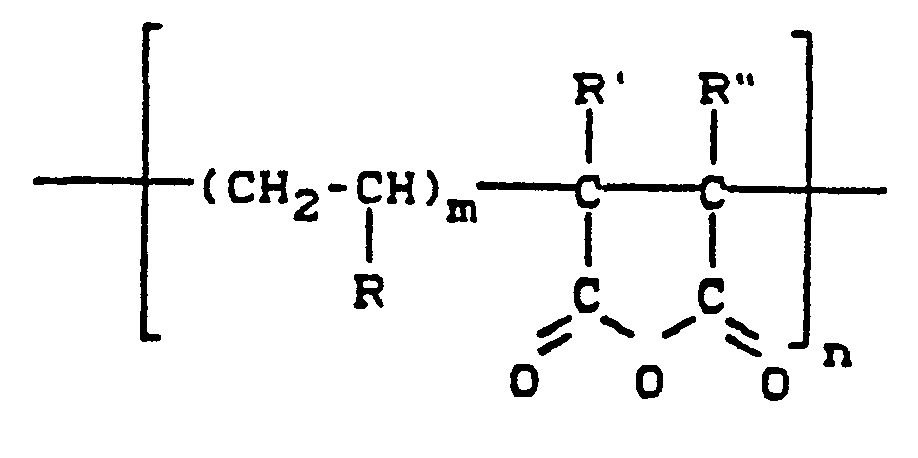
wherein R is H or a substituted or an unsubstituted radical selected from the group consisting of C6―C12 phenyl, C1―C12 alkoxy and C,-C28 alkyl radicals, n is an integer of from 1 to 200, m is an integer of from 1 to 5 and R' and R" independently are hydrogen or a halogen atom or a C1―C3 alkyl radical.
wherein R is H or a substituted or an unsubstituted radical selected from the group consisting of C6―C12 phenyl, C1―C12 alkoxy and C,-C28 alkyl radicals, n is an integer of from 1 to 200, m is an integer of from 1 to 5 and R' and R" independently are hydrogen or a halogen atom or a C1―C3 alkyl radical.
9. The improvement of Claim 1 wherein said blowing agent conforms to
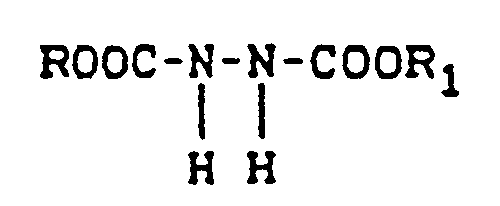
wherein R and R, independently denote a member selected from the group consisting of primary, secondary and tertiary straight-chain or branched-chain C1―C8 alkyl, C5―C8 cycloalkyl, C6―C10 aryl, C7―C10 aralkyl, and C7―C10 alkaryl radicals.
wherein R and R, independently denote a member selected from the group consisting of primary, secondary and tertiary straight-chain or branched-chain C1―C8 alkyl, C5―C8 cycloalkyl, C6―C10 aryl, C7―C10 aralkyl, and C7―C10 alkaryl radicals.
10. The improvement of Claim 9 wherein at least 1 of Rand R, is selected from the
group consisting of isopropyl, secondary butyl and tertiary butyl radicals and the
other of R and R1 is Cl-C4 alkyl.
1. In einem Verfahren zu Herstellung eines geschäumten Gegenstandes aus einem thermoplastischen
Harz unter Verwendung eines chemischen Treibmittels, dessen Zersetzungsprodukte ein
primäres Amin enthalten, wobei das Verfahren die Verwendung eines Konzentrats eines
chemischen Treibmittels einschließt, die Verbesserung, die das Einarbeiten wenigstens
eines Anhydrids in einer Menge, die ausreicht, um die Schlagzähigkeit des geschäumten
Gegenstandes zu fördern, in das Konzentrat umfaßt, wobei das Harz dadurch gekennzeichnet
ist, daß es gegen das genannte Zersetzungsprodukt empfindlich ist, wobei als Empfindlichkeit
die Neigung zu einem Strukturabbau angesehen wird, die als Erniedrigung des Molekulargewichtes
ausgedrückt wird, die sich beim Einwirkenlassen der Zersetzungsprodukte auf die Harze
bei der Formungstemperatur der Harze ergibt, und worin das Anhydrid eine wenigstens
ein cyclisches Anhydrid enthaltende Verbindung ist.
2. Verbesserung nach Anspruch 1, worin das Anhydrid eine polymere Verbindung ist.
3. Verbesserung nach Anspruch 1, worin das Verhältnis der Gewichts-Menge des chemischen
Treibmittels zu der Gewichts-Menge des Anhydrids im Bereich von 1:4 bis 8:1 liegt.
4. Verbesserung nach Anspruch 1, worin etwa 50 bis 95% des Konzentrats aus dem thermoplastischen
Harz bestehen.
5. Verbesserung nach Anspruch 1, worin das thermoplastische Harz aus der aus Polycarbonat,
Polyalkylenterephthalat, aromatischen Polyester und aromatischem Polyestercarbonat
bestehenden Gruppe ausgewählt ist.
6. Verbesserung nach Anspruch 1, worin das chemische Treibmittel-Konzentrat in einer
Menge von 0,5 bis 5 Gew.-%, bezogen auf das Gewicht des Harzes, verwendet wird.
7. Verbesserung nach Anspruch 2, worin die polymere Verbindung Maleinsäureanhydrid
in ihrer Repetiereinheit enthält.
8. Verbesserung nach Anspruch 7, worin das Anhydrid der Formel
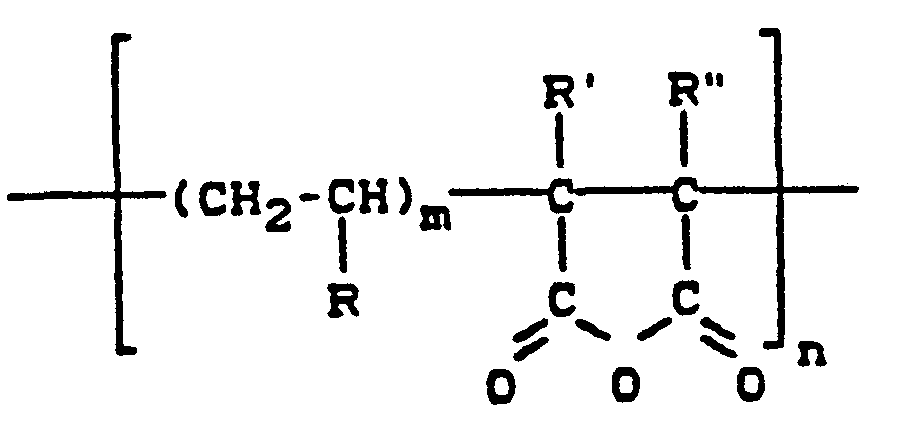
entspricht, in der
entspricht, in der
R H oder ein substituierter oder unsubstituierter Rest ist, der aus der aus C6―C12-Phenyl-, C2―C12-Alkoxy- und C,-C28-Alkyl-Resten bestehenden Gruppe ausgewählt ist,
n ein ganze Zahl von 1 bis 200 ist,
m ein ganze Zahl von 1 bis 5 ist, und
R' und R" unabhängig Wasserstoff oder ein Halogen-Atom oder ein C,-C3-Alkyl-Rest sind.
9. Verbesserung nach Anspruch 1, worin das Treibmittel der Formel
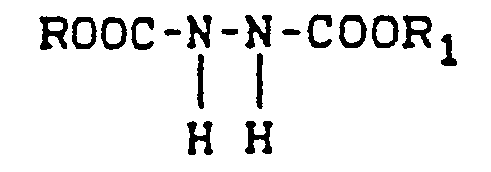
entspricht, in der
entspricht, in der
R und R1 unabhängig ein Glied aus der aus primärem, sekundärem und tertiärem geradkettigen oder kettenverzweigten C1―C8-Alkyl, C5―C8-Cycloalkyl-, C6―C10-Aryl-, C7―C10-Aralkyl- und C7―C10-Alkaryl-Resten bestehenden Gruppe bezeichnen.
10. Verbesserung nach Anspruch 9, worin wenigstens einer der Reste R und R1 aus der aus einem Isopropyl-Rest, einem sekundären Butyl-Rest und einem tertiären
Butyl-Rest bestehenden Gruppe ausgewählt ist und der andere der Reste und R1 C1―C4-Alkyl ist.
1. Procédé perfectionné de production d'un article en résine thermoplastique rendu
cellulaire, utilisant un agent chimique porogène dont les produits de décomposition
contiennent une amine primaire, et impliquant l'utilisation d'un concentré d'agent
chimique porogène, le perfectionnement consistant à incorporer dans ledit concentré
au moins un anhydride en une quantité suffisante pour améliorer la résistance au choc
dudit article rendu cellulaire, ladite résine étant caractérisée en ce qu'elle est
sensible audit produit de décomposition, la sensibilité étant considérée comme étant
une tendance à la dégradation structurale exprimée par une réduction de poids moléculaire
se manifestant après exposition des résines aux produits de décomposition à la température
de moulage de la résine, l'anhydride étant un composé contenant au moins un anhydride
cyclique.
2. Perfectionnement suivant la revendication 1, dans lequel ledit anhydride est un
composé polymérique.
3. Perfectionnement suivant la revendication 1, dans lequel le rapport de la quantité
en poids d'agent chimique porogène à la quantité en poids d'anhydride se situe dans
la plage de 1:4 à 8:1.
4. Perfectionnement suivant la revendication 1, dans lequel environ 50 à 95% dudit
concentré sont constitués de ladite résine thermoplastique.
5. Perfectionnement suivant la revendication 1, dans lequel la résine thermoplastique
est choisie dans le groupe comprenant un polycarbonate, un polyalkylène-téréphtalate,
un polyester aromatique et un polyester-carbonate aromatique.
6. Perfectionnement suivant la revendication 1, dans lequel le concentré d'agent chimique
porogène est utilisé en une quantité de 0,5 à 5% par rapport au poids de résine.
7. Perfectionnement suivant la revendication 2, dans lequel le composé polymérique
contient de l'anhydride d'acide maléique dans son motif récurrent.
8. Perfectionnement suivant la revendication 7, dans lequel ledit anhydride répond
à la formule
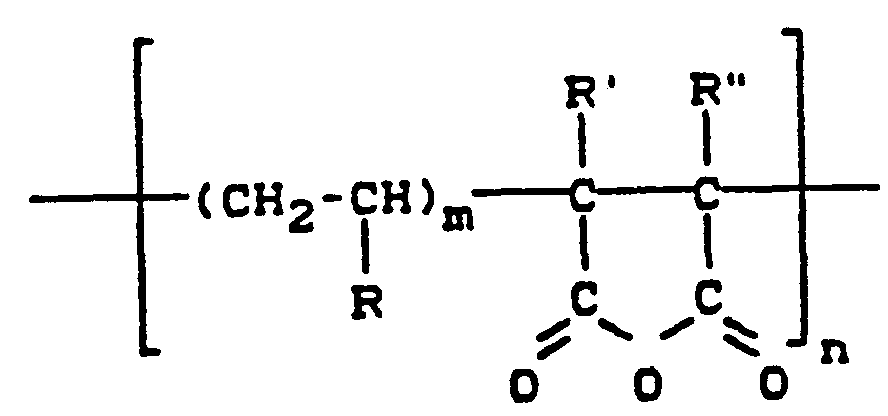
dans laquelle R représente H ou un radical substitué ou non substitué choisi dans le groupe des radicaux phényle en C6 à C,2, alkoxy en Ci à C12, alkyle en Ci à C28, n est un nombre entier de 1 à 200, m est un nombre entier de 1 à 5 et R' et R" représentent, indépendamment l'un de l'autre, l'hydrogène ou un atome d'halogène ou un radical alkyle en C, à C3.
dans laquelle R représente H ou un radical substitué ou non substitué choisi dans le groupe des radicaux phényle en C6 à C,2, alkoxy en Ci à C12, alkyle en Ci à C28, n est un nombre entier de 1 à 200, m est un nombre entier de 1 à 5 et R' et R" représentent, indépendamment l'un de l'autre, l'hydrogène ou un atome d'halogène ou un radical alkyle en C, à C3.
9. Perfectionnement suivant la revendication 1, dans lequel l'agent porogène répond
à la formule
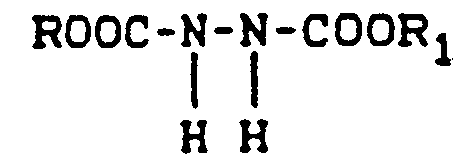
dans laquelle R et R1 désignent, indépendamment, un représentant du groupe comprenant des radicaux alkyle primaires, secondaires et tertiares à chaîne droite ou ramifiée en C, à C8, cycloalkyle en C5 à C8, aryle en C6 à C10, aralkyle en C7 à C10 et alkaryle en C7 à C10.
dans laquelle R et R1 désignent, indépendamment, un représentant du groupe comprenant des radicaux alkyle primaires, secondaires et tertiares à chaîne droite ou ramifiée en C, à C8, cycloalkyle en C5 à C8, aryle en C6 à C10, aralkyle en C7 à C10 et alkaryle en C7 à C10.
10. Perfectionnement suivant la revendication 9, dans lequel au moins l'un de R et
R1 est choisi dans le groupe comprenant des radicaux isopropyle, butyle secondaire et
tertio-butyle et l'autre est un groupe alkyle en C1 à C4.